
All Topics  
Cybele

 
Cybele

   Email Print
   Bookmark   Link


Cybele


Cybele (Phrygian
Phrygian language

The Phrygian language was the Indo-European language of the Phrygians, a people from Thrace who later migrated to Asia Minor.Inscriptions...
: Matar Kubileya/Kubeleya "Kubeleyan Mother", perhaps "Mountain Mother"; Kubele, ??ß?ß? Kubebe, ??ße??? Kubelis), was the Phrygia
Phrygia

In antiquity, Phrygia was a kingdom in the west central part of Anatolia, in what is now modern-day Turkey. The Phrygians initially lived in the Southern Balkans; according to Herodotus, under the name of Bryges, changing it to Phruges after their final migration to Anatolia, via the Hellespont....
n deification of the Earth Mother. As with Greek Gaia
Gaia (mythology)

Gaia Gaia is a Greek primordial gods and chthonic deity in the Ancient Greek Pantheon and considered a Mother Goddess or Great Goddess....
 (the "Earth"), or her Minoan
Minoan civilization

The Minoan civilization was a Bronze Age civilization which arose on the island of Crete. The Minoan culture flourished from approximately 27th century BC to 1450 BC; afterwards, Mycenaean Greece culture became dominant at Minoan sites in Crete....
 equivalent Rhea
Rhea (mythology)

This page is about the Greek mythological figure. For the bird, see Rhea .Rhea was the Titan daughter of Ouranos , the sky, and Gaia , the earth, in Classical Greece mythology....
, Cybele embodies the fertile Earth, a goddess of caverns and mountain
Mountain

A mountain is a landform that stretches above the surrounding land in a limited area usually in the form of a peak. A mountain is generally steeper than a hill....
s, wall
Wall

A wall is a usually solid structure that defines and sometimes protects an area. Most commonly, a wall delineates a building and supports its superstructure, separates space in buildings into Room s, or protects or delineates a space in the open air....
s and fortresses, nature, wild animals (especially lion
Lion

The lion is a member of the family Felidae and one of four big cats in the genus Panthera. With exceptionally large males exceeding 250 kg in weight, it is the second-largest living cat after the tiger....
s and bee
Bee

Bees are flying insects closely related to wasps and ants. Bees are a monophyly lineage within the superfamily Apoidea, presently classified by the unranked taxon name Anthophila....
s). Phrygian Cybele is often identified with the Hittite-Hurrian goddess Hebat
Hebat

Hebat also transcribed a Kheba or Khepat, was the mother goddess of the Hurrians, known as "the mother of all living". She was the consort of Teshub and the mother of Sarruma....
, though this latter deity might have been the origin of only Anatolian
Kubaba.


Discussion
Ask a question about 'Cybele'
Start a new discussion about 'Cybele'
Answer questions from other users
Full Discussion Forum


Recent Posts


Encyclopedia


Cybele (Phrygian
Phrygian language

The Phrygian language was the Indo-European language of the Phrygians, a people from Thrace who later migrated to Asia Minor.Inscriptions...
:
Matar Kubileya/Kubeleya "Kubeleyan Mother", perhaps "Mountain Mother"; Kubele, ??ß?ß? Kubebe, ??ße??? Kubelis), was the Phrygia
Phrygia

In antiquity, Phrygia was a kingdom in the west central part of Anatolia, in what is now modern-day Turkey. The Phrygians initially lived in the Southern Balkans; according to Herodotus, under the name of Bryges, changing it to Phruges after their final migration to Anatolia, via the Hellespont....
n deification of the Earth Mother. As with Greek Gaia
Gaia (mythology)

Gaia Gaia is a Greek primordial gods and chthonic deity in the Ancient Greek Pantheon and considered a Mother Goddess or Great Goddess....
 (the "Earth"), or her Minoan
Minoan civilization

The Minoan civilization was a Bronze Age civilization which arose on the island of Crete. The Minoan culture flourished from approximately 27th century BC to 1450 BC; afterwards, Mycenaean Greece culture became dominant at Minoan sites in Crete....
 equivalent Rhea
Rhea (mythology)

This page is about the Greek mythological figure. For the bird, see Rhea .Rhea was the Titan daughter of Ouranos , the sky, and Gaia , the earth, in Classical Greece mythology....
, Cybele embodies the fertile Earth, a goddess of caverns and mountain
Mountain

A mountain is a landform that stretches above the surrounding land in a limited area usually in the form of a peak. A mountain is generally steeper than a hill....
s, wall
Wall

A wall is a usually solid structure that defines and sometimes protects an area. Most commonly, a wall delineates a building and supports its superstructure, separates space in buildings into Room s, or protects or delineates a space in the open air....
s and fortresses, nature, wild animals (especially lion
Lion

The lion is a member of the family Felidae and one of four big cats in the genus Panthera. With exceptionally large males exceeding 250 kg in weight, it is the second-largest living cat after the tiger....
s and bee
Bee

Bees are flying insects closely related to wasps and ants. Bees are a monophyly lineage within the superfamily Apoidea, presently classified by the unranked taxon name Anthophila....
s). Phrygian Cybele is often identified with the Hittite-Hurrian goddess Hebat
Hebat

Hebat also transcribed a Kheba or Khepat, was the mother goddess of the Hurrians, known as "the mother of all living". She was the consort of Teshub and the mother of Sarruma....
, though this latter deity might have been the origin of only Anatolian
Kubaba. The Greeks frequently conflated the two names, the Anatolian
Anatolian languages

The Anatolian languages are a group of extinct Indo-European languages languages, which were spoken in Asia Minor, the best attested of them being the Hittite language....
 "Kubaba" and the Phrygian "Kybele", to refer to the Phrygian deity.

The goddess was known among the Greeks as Meter or Meter oreie/a ("Mountain-Mother"), or, with a particular Anatolian sacred mountain in mind, Idaea
Idaea

Idaea can mean:* Idaea , a genus of geometer moths, including Idaea aversata, Idaea biselata and Idaea seriata.* In Greek mythology, Idaea was a nymph, wife of Scamander and mother of King Teucer....
, inasmuch as she was supposed to have been born on Mount Ida
Mount Ida

In Greek mythology, two sacred mountains are called Mount Ida, the "Mountain of the Goddess": Mount Ida, Crete, and Mount Ida, Turkey, known as Mount Ida, Turkey in Classical times....
 in Anatolia
Anatolia

Anatolia or Asia Minor is a region of Western Asia, comprising most of the modern Republic of Turkey. It is a geographic region bounded by the Black Sea to the north, the Caucasus to the northeast, the Aegean Sea to the west, the Mediterranean Sea to the south, and the Iranian plateau to the east and southeast....
, or equally Dindymene or Sipylene, with her sacred mountains Mount Dindymon
Dindymon

In Greek mythology, Dindymon was a mountain in eastern Phrygia, later part of Galatia, that was later called Agdistis, sacred to the "mountain mother", Cybele, whom the Hellenes knew as Rhea....
 (in Mysia
Mysia

Mysia was a region in the northwest of ancient Asia Minor or Anatolia . It was located on the south coast of the Sea of Marmara. It was bounded by Bithynia on the east, Phrygia on the southeast, Lydia on the south, Aeolis on the southwest, Troad on the west and by the Propontis on the north....
 and variously located) or Mount Sipylus in mind. In Roman mythology
Roman mythology

Roman mythology, or more appropriately, Latin mythology, refers to the mythology beliefs of the Italic people inhabiting the region of Latium and its main city, Rome....
, her equivalent was Magna Mater or "Great Mother".

Her Ancient Greek
Ancient greek language

#REDIRECT Ancient Greek...
 title,
Potnia Theron
Potnia Theron

Potnia Theron is an ancient title of the Minoan civilization Goddess, an aspect of her power that was assumed by Artemis among others in the Twelve Olympians that was later introduced in mainland Greece....
, also associated with the Minoan Great Mother
Great Mother

The Great Mother refers to the concept of the mother goddess, including:*Great Mother, anglicization of Latin Magna Mater, Roman title of the goddess Cybele...
, alludes to her Neolithic
Neolithic

The Neolithic period was a period in the development of human technology, beginning about 9500 Before the Christian Era in the Middle East that is traditionally considered the last part of the Stone Age....
 roots as the "Mistress of the Animals". She becomes a life-death-rebirth deity
Life-death-rebirth deity

The category life-death-rebirth deity also known as a "dying-and-rising" or "Resurrection" deity is a convenient means of classifying the many divinities in world mythology or religion who are born, suffer death, an eclipse, or other death-like experience, pass a phase in the underworld among the dead, and are subsequently reborn, in either a...
 in connection with her resurrection
Resurrection

Miraculous resurrection of one sort or another has been a recurrent theme or central doctrine of Judaism, Christianity, and Islam, and other Abrahamic religions....
 of her son and consort, Attis
Attis

Attis was Cybele's lover, eunuch attendant, and driver of her lion-driven chariot. He was driven mad by her and Castration himself.Attis was originally a local semi-deity of Phrygia, associated with the great Phrygian trading city of Pessinos, which lay under the lee of Mount Agdistis....
. She is associated with her lion throne
Throne

A throne is the official chair or seat upon which a monarch is seated on state or ceremonial occasions. "Throne" in an abstract sense can also refer to the monarchy or the Crown itself, an instance of metonymy, and is also used in many terms such as "power behind the throne"....
 and her chariot
Chariot

The chariot is the earliest and simplest type of carriage, used in both peace and war as the chief vehicle of many ancient peoples. Chariots were built in Mesopotamia by the Mesopotamians as early as 3000 BC and in China during the 2nd millennium BC....
 drawn by lions.

Walter Burkert
Walter Burkert

Walter Burkert , a scholar of Greek mythology and Cult , is an emeritus professor of classics at the University of Zurich, Switzerland, and also has taught in the United Kingdom and the United States....
, who treats Cybele among "foreign gods" in
Greek Religion, notes that "The cult of the Great Mother, Meter, presents a complex picture insofar as indigenous, Minoan-Mycenean tradition is here intertwined with a cult taken over directly from the Phrygian kingdom of Asia Minor" The inscription matar occurs frequently in her Phrygian sites (Burkert). Kubileya is usually read as a Phrygian adjective "of the mountain
Mountain

A mountain is a landform that stretches above the surrounding land in a limited area usually in the form of a peak. A mountain is generally steeper than a hill....
", so that the inscription may be read Mother of the Mountain, and this is supported by Classical sources (Roller 1999, pp. 67–68). Another theory is that her name can be traced to the Luwian
Kubaba
Kubaba

Kubaba is the only queen on the Sumerian king list. She was monarch in the 3rd Dynasty of Kish , reigned in the "Early Dynastic III" period of History of Sumer and is listed to have reigned for 100 years....
, the deified queen of the Third Dynasty of Kish
Kish (Sumer)

Kish is modern Tell al-Uhaymir, Babil Governorate, Iraq), and was an ancient city of Sumer. Kish is located some 12 km east of Babylon, and 80 km south of Baghdad....
 worshiped at Carchemish
Carchemish

Carchemish was an important ancient city of the Mitanni and Hittites empires, now on the frontier between Turkey and Syria. It was the location of an Battle of Carchemish between the Babylonians and Egyptians, mentioned in the Bible....
 and Hellenized
Hellenization

Hellenization is a term used to describe the spread of Greek culture. It is mainly used to describe the spread of Hellenistic civilization during the Hellenistic period following the campaigns of Alexander the Great of Macedon....
 to
Kybebe (Munn 2004, Motz 1997, pp. 105-106). With or without the etymological connection, Kubaba and Matar certainly merged in at least some aspects, as the genital mutilation later connected with Cybele's cult is associated with Kybebe in earlier texts, but in general she seems to have been more a collection of similar tutelary goddesses associated with specific Anatolian mountains or other localities, and called simply "mother" (Motz). Later, Cybele's most ecstatic followers were males who ritually castrated
Castration

Castration is any action, surgery, chemical castration, or otherwise, by which a male loses the functions of the testicles. In common usage the term is usually applied to males, although as a medical term it is applied to both males and females....
 themselves, after which they were given women's clothing and assumed "female" identities, who were referred to by one third-century commentator, Callimachus
Callimachus

Callimachus was a native of the Greek colony of Cyrene, Libya, Libya. He was a noted poet, critic and scholar of the Library of Alexandria and enjoyed the patronage of ancient Egyptian Greeks Pharaohs Ptolemy II Philadelphus and Ptolemy III Euergetes....
, in the feminine as
Gallai, but to whom other contemporary commentators in ancient Greece and Rome referred to as Gallos or Galli
Galli

Galli was the Roman name for castration followers of the Phrygian goddess Cybele, which were regarded as a third gender by contemporary Roman scholars, comparable to transgendered people in the modern world....
.

There is no mention of these followers in Classical references although they related that her priestesses led the people in orgiastic ceremonies with wild music, drumming, dancing, and drinking. She was associated with the mystery religion concerning her son, Attis
Attis

Attis was Cybele's lover, eunuch attendant, and driver of her lion-driven chariot. He was driven mad by her and Castration himself.Attis was originally a local semi-deity of Phrygia, associated with the great Phrygian trading city of Pessinos, which lay under the lee of Mount Agdistis....
, who was castrated, died of his wounds, and resurrected by his mother. The dactyls
Dactyl (mythology)

In Greek mythology, the Dactyls were the archaic race of small phallus male beings associated with the Mother Goddess, whether as Cybele or Rhea ....
 were part of her retinue.

Other followers of Cybele, the Phrygian
kurbantes or Corybantes, expressed her ecstatic and orgiastic cult in music, especially drumming, clashing of shield
Shield

A shield is a protective device, meant to intercept attacks. The term often refers to a device that is held in the hand, as opposed to armour or a bullet proof vest....
s and spear
Spear

A spear is a pole weapon consisting of a shaft, usually of wood, with a sharpened head. The head may be simply the sharpened end of the shaft itself, as is the case with bamboo spears, or it may be of another material fastened to the shaft, such as obsidian, iron or bronze....
s, dancing, singing, and shouting—all at night.

Cult history

Her cult moved from Phrygia to Greece
Greece

Greece , officially the Hellenic Republic , is a country in southeastern Europe, situated on the southern end of the Balkans. It has borders with Albania, Bulgaria and the former Yugoslav Republic of Macedonia to the north, and Turkey to the east....
 from the 6th to the 4th century BCE. In 203 BCE, Rome adopted her cult as well.

Anatolia and Greece

Greek mythographers recalled that Broteas
Broteas

In Greek mythology, Broteas was the ugly son of Tantalus, whose other offspring were Niobe and Pelops. He carved the most ancient image of the Great Mother of the Gods , an image that in Pausanias ' day was still held sacred by the Magnesia ad Sipylum....
, the son of Tantalus
Tantalus

In Greek mythology Tantalus was a son of Zeus and the nymph Plouto. Thus he was a king in the primordial world, the father of a son Broteas whose very name signifies "mortals" ....
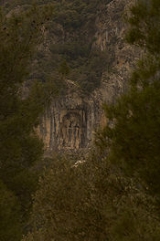
, was the first to carve the Great Mother's image
Petroglyph

Petroglyphs are s created by removing part of a Rock surface by incising, pecking, carving, and abrading. Outside North America, scholars often use terms such as "carving", "engraving", or other descriptions of the technique to refer to such images....
 into a rock-face. At the time of Pausanias
Pausanias (geographer)

Pausanias was a Roman Greece traveller and geographer of the 2nd century AD, who lived in the times of Hadrian, Antoninus Pius and Marcus Aurelius....
 (2nd century CE), a sculpture carved into the rock-face of a spur of Spil Mount was still held sacred by the Magnesians
Magnesia ad Sipylum

Magnesia ad Sipylum was a city of Lydia, situated about 65 km northeast of Smyrna on the river Hermus at the foot of Spil Mount. Nowadays this is the location of Manisa in Turkey....
.

At Pessinos in Phrygia, an archaic image of Cybele had been venerated as well as the cult of Agdistis
Agdistis

Agdistis was a deity of Greek mythology, Roman mythology and Anatolian mythology, possessing both male and female genitalia, con?nected with the Phrygian worship of Attis and Cybele....
, in 203 BCE its aniconic cult object was removed to Rome.

Her cult had already been adopted in 5th century BCE Greece, where she is often referred to euphemistically as
Meter Theon Idaia ("Mother of the Gods, from Mount Ida") rather than by name. Mentions of Cybele's worship are found in Pindar
Pindar

Pindar , was an Ancient Greek Lyric poetry poet.Of the canonical nine lyric poets of ancient Greece, Pindar is the one whose work is by far the best preserved, and critics in antiquity tended to regard him as the greatest....
 and Euripides
Euripides

Euripides was the last of the three great tragedy of classical Athens . Ancient scholars thought that Euripides had written ninety-five plays, although four of those were probably written by Critias....
, among other locations. Classical Greek writers, however, either did not know of or did not mention the castrated galli
Galli

Galli was the Roman name for castration followers of the Phrygian goddess Cybele, which were regarded as a third gender by contemporary Roman scholars, comparable to transgendered people in the modern world....
, although they did mention the castration of Attis
Attis

Attis was Cybele's lover, eunuch attendant, and driver of her lion-driven chariot. He was driven mad by her and Castration himself.Attis was originally a local semi-deity of Phrygia, associated with the great Phrygian trading city of Pessinos, which lay under the lee of Mount Agdistis....
.

Cybele's cult in Greece was closely associated with, and apparently resembled, the later cult of Dionysus
Dionysus

In classical mythology, Dionysus or Dionysos , is the God of wine, the inspirer of ritual madness and ecstasy, and a major figure of Greek mythology, and one of the twelve Olympians, among whom Greek mythology treated Dionysus as a late arrival....
, whom Cybele is said to have initiated and cured of Hera
Hera

In the Twelve Olympians of classical Greek Mythology, Hera or Here was the wife and older sister of Zeus. Her chief function was as goddess of women and marriage....
's madness. They also identified Cybele with the Mother of the Gods Rhea
Rhea (mythology)

This page is about the Greek mythological figure. For the bird, see Rhea .Rhea was the Titan daughter of Ouranos , the sky, and Gaia , the earth, in Classical Greece mythology....
.

Anatolian Cybele
Various aspects of Cybele's Anatolian attributes probably predate the Bronze Age in origin.

A figurine found at Çatalhöyük
Çatalhöyük

?atalh?y?k was a very large Neolithic and Chalcolithic settlement in southern Anatolia, c 7500-5700 BCE. It is the largest and best preserved Neolithic site found to date....
, (Archaeological Museum, Ankara), dating about 6000 BCE
6th millennium BC

During the 6th millennium BC, agriculture spreads from the Balkans to Italy and Eastern Europe and from Mesopotamia to Egypt. World population is essentially stable at ca....
, depicts a corpulent and fertile Mother Goddess
Mother goddess

A mother goddess is a term used to refer to any goddess associated with motherhood, fertility, creation or the bountiful embodiment of the Earth....
 in the process of giving birth while seated on her throne, which has two hand rests in the form of lion's heads. No direct connection with the later
matar goddesses is documented, but the similarity to some of the later iconography
Iconography

Iconography is the branch of art history which studies the identification, description, and the interpretation of the content of images. The word iconography literally means "image writing", and comes from the Ancient Greek e???? and ??afe?? ....
 is striking.

By the 2nd millennium BCE the Kubaba
Kubaba

Kubaba is the only queen on the Sumerian king list. She was monarch in the 3rd Dynasty of Kish , reigned in the "Early Dynastic III" period of History of Sumer and is listed to have reigned for 100 years....
 of Bronze Age Carchemish was known to the Hittites and Hurrians: "[O]n the basis of inscriptional and iconographical
Iconography

Iconography is the branch of art history which studies the identification, description, and the interpretation of the content of images. The word iconography literally means "image writing", and comes from the Ancient Greek e???? and ??afe?? ....
 evidence it is possible to trace the diffusion of her cult in the early Iron Age; the cult reached the Phrygians in inner Anatolia
Anatolia

Anatolia or Asia Minor is a region of Western Asia, comprising most of the modern Republic of Turkey. It is a geographic region bounded by the Black Sea to the north, the Caucasus to the northeast, the Aegean Sea to the west, the Mediterranean Sea to the south, and the Iranian plateau to the east and southeast....
, where it took on special significance" (Burkert, III.3.4, p. 177). If the theory on the Luwian origin of Cybele's name is correct, Kubaba must have merged with the various
matar goddesses well before time the Phrygian matar kubileya inscription was made around the first half of the 6th century BCE (Vassileva 2001).

In Phrygia
Phrygia

In antiquity, Phrygia was a kingdom in the west central part of Anatolia, in what is now modern-day Turkey. The Phrygians initially lived in the Southern Balkans; according to Herodotus, under the name of Bryges, changing it to Phruges after their final migration to Anatolia, via the Hellespont....
 Rhea-Cybele was venerated as Agdistis
Agdistis

Agdistis was a deity of Greek mythology, Roman mythology and Anatolian mythology, possessing both male and female genitalia, con?nected with the Phrygian worship of Attis and Cybele....
, with a temple at the great trading city Pessinos, mentioned by the geographer Strabo
Strabo

Strabo was a Ancient Greeks history, geography and philosophy....
. It was at Pessinos that her lover Attis
Attis

Attis was Cybele's lover, eunuch attendant, and driver of her lion-driven chariot. He was driven mad by her and Castration himself.Attis was originally a local semi-deity of Phrygia, associated with the great Phrygian trading city of Pessinos, which lay under the lee of Mount Agdistis....
 (son of Nana
Nana (mythology)

According to Greek mythology, Nana was a nymph of Sakarya River, a river located in present-day Turkey.She became pregnant when an almond from an almond tree fell on her lap....
) was about to wed the daughter of the king, when Agdistis-Cybele appeared in her awesome glory, and he castrated himself.

In Archaic Phrygian images of Cybele of the sixth century, already betraying the influence of Greek style (Burkert), her typical representation is in the figuration of a building’s façade, standing in the doorway. The façade itself can be related to the rock-cut monuments of the highlands of Phrygia. She is wearing a belted long dress, a
polos (high cylindrical hat), and a veil covering the whole body. In Phrygia, her usual attributes are the bird
Bird

Birds are wing, Bipedalismal, endothermic , vertebrate animals that lay egg . There are around 10,000 living species, making them the most numerous tetrapod vertebrates....
 of prey and a small vase
Vase

The vase is an open container, often used to hold cut flowers. It can be made from a number of materials including ceramics and glass art. The vase is often decorated and thus used to extend the beauty of its contents....
. Sometimes lions are related to her in an aggressive, but tamed, manner. Often the lions are shown drawing her chariot
Chariot

The chariot is the earliest and simplest type of carriage, used in both peace and war as the chief vehicle of many ancient peoples. Chariots were built in Mesopotamia by the Mesopotamians as early as 3000 BC and in China during the 2nd millennium BC....
, which may be related as the sun traversing the sky daily.

Later, under Hellenic influence along the coastal lands of Asia Minor, the sculptor Agoracritos, a pupil of Pheidias, produced a version of Cybele that became the standard one. It showed her still seated on a throne but now more decorous and matronly, her hand resting on the neck of a perfectly still lion and the other hand holding the circular frame drum
Frame drum

A frame drum is a drum that has a drumhead diameter greater than its depth. Usually the single drumhead is made of rawhide or man-made materials....
, similar to a tambourine
Tambourine

The tambourine or Marine is a musical instrument of the Percussion instrument family consisting of a frame, often of wood or plastic, with pairs of small metal jingles, called "zils"....
, (
tymbalon or tympanon), which evokes the full moon
Moon

The Moon is Earth's only natural satellite and the List of natural satellites by diameter satellite in the Solar System. The average centre-to-centre distance from the Earth to the Moon is km, about thirty times the diameter of the Earth....
 in its shape and is covered with the hide of the sacred lunar bull
Bull (mythology)

Appearances of the Bull in mythology and worship are widespread in the ancient world. It is the subject of various cultural and Religion incarnations, as well as modern mentions in new age cultures....
.
Cybele and Attis
The goddess appears alone, 8th
8th century BC

The 8th century BC started the first day of 800 BC and ended the last day of 701 BC....
6th
6th century BC

The 6th century BC started the first day of 600 BC and ended the last day of 501 BC.In India, Panini, sometime during this century, composed a grammar for sanskrit, which is the oldest extant grammar of any language....
 centuries BCE. Later she is joined by her son and consort Attis
Attis

Attis was Cybele's lover, eunuch attendant, and driver of her lion-driven chariot. He was driven mad by her and Castration himself.Attis was originally a local semi-deity of Phrygia, associated with the great Phrygian trading city of Pessinos, which lay under the lee of Mount Agdistis....
, who incurred her jealousy. He, in an ecstasy, castrated himself, and subsequently died. Grieving, Cybele resurrected
Resurrection

Miraculous resurrection of one sort or another has been a recurrent theme or central doctrine of Judaism, Christianity, and Islam, and other Abrahamic religions....
 him. This tale is told by Catullus in
carmen 63. The evergreen pine
Pine

Pines are Pinophyta trees in the genus Pinus, in the family Pinaceae. They make up the monotypic subfamily Pinoideae. There are about 115 species of pine, although different authorities accept between 105 and 125 species....
 and ivy
Ivy

Hedera is a genus of 15 species of climbing or ground-creeping evergreen woody plants in the family Araliaceae, native to the Macaronesia, western, central and southern Europe, northwestern Africa and across central-southern Asia east to Japan....
 were sacred to Attis.

Some ecstatic followers of Cybele, known in Rome as galli
Galli

Galli was the Roman name for castration followers of the Phrygian goddess Cybele, which were regarded as a third gender by contemporary Roman scholars, comparable to transgendered people in the modern world....
, willingly castrated themselves in imitation of Attis
Attis

Attis was Cybele's lover, eunuch attendant, and driver of her lion-driven chariot. He was driven mad by her and Castration himself.Attis was originally a local semi-deity of Phrygia, associated with the great Phrygian trading city of Pessinos, which lay under the lee of Mount Agdistis....
. For Roman devotees of Cybele Mater Magna who were not prepared to go so far, the testicles of a bull
Bull

A bull is an adult male of various large mammal species including elk, moose, bovinae , elephants, whales, pinniped, and sea lions.Things...
, one of the Great Mother's sacred animals, were an acceptable substitute, as many inscriptions show. An inscription of 160 CE records that a certain Carpus had transported a bull's testes from Rome to Cybele's shrine at Lyon, France.

Aegean Cybele
The worship of Cybele spread from inland areas of Anatolia and Syria to the Aegean coast, to Crete and other Aegean islands, and to mainland Greece. She was particularly welcomed at Athens
Athens

Athens , the Capital and largest city of Greece, dominates the Attica periphery; as one of the List of cities by time of continuous habitation, its recorded history spans around 3,400 years....
. The geographer Strabo (book x, 3:18) made some useful observations:
"Just as in all other respects the Athenians continue to be hospitable to things foreign, so also in their worship of the gods; for they welcomed so many of the foreign rites ... the Phrygian [rites of Rhea-Cybele are mentioned] by Demosthenes
Demosthenes

Demosthenes was a prominent Greeks statesman and orator of History of Athens. His oratorys constitute a significant expression of contemporary Athenian intellectual prowess and provide an insight into the politics and culture of ancient Greece during the 4th century BC....
, when he casts the reproach upon Aeskhines' mother and Aeskhines himself, that he was with her when she conducted initiations, that he joined her in leading the Dionysiac march, and that many a time he cried out evoe saboe, and hyes attes, attes hyes; for these words are in the ritual of Sabazios
Sabazios

Sabazios is the nomadic horseman and sky father god of the Phrygians and Thracians. In Indo-European languages, such as Phrygian language, the '-zios' element in his name derives from dyeus, the common precursor of 'deus' and Zeus....
 and the Mother [Rhea]."
In Ancient Egypt
Ancient Egypt

Ancient Egypt was an Ancient history civilization in eastern North Africa, concentrated along the lower reaches of the Nile in what is now the modern nation of Egypt....
 at Alexandria
Alexandria

Alexandria , with a population of 4.1 million, is the second-largest city in Egypt, and is the country's largest seaport, serving about 80% of Egypt's imports and exports....
, Cybele was worshiped by the Greek population as "The Mother of the Gods, the Savior who Hears our Prayers" and as
"The Mother of the Gods, the Accessible One". Ephesus
Ephesus

Ephesus was an ancient Greek city on the west coast of Anatolia, in the region known as Ionia during the period known as Classical Greece. It was one of the twelve cities of the Ionian League....
, one of the major trading centers of the area, was devoted to Cybele as early the 10th century BCE, and the city's ecstatic celebration, the Ephesia, honored her.

The goddess was not welcome among the Scythians north of Thrace. From Herodotus
Herodotus

Herodotus of Halicarnassus was a Greeks historian who lived in the 5th century BC and is regarded as the "Father of History" in Western culture....
 (4.76-7) we learn that the Scythian Anacharsis
Anacharsis

Anacharsis was a Scythian philosopher who travelled from his homeland on the northern shores of the Black Sea to Athens in the early 6th century BCE and made a great impression as a forthright, outspoken "barbarian," apparently a forerunner of the Cynics, though none of his works have survived....
 (6th century BCE), after traveling among the Greeks and acquiring vast knowledge, was put to death by his fellow Scythians for attempting to introduce the foreign cult of Magna Mater.

Atalanta
Atalanta

Atalanta is a character from ancient Greek mythology.After being told by an oracle she would be ruined if she were to marry, Atalanta set up a contest to win her hand in marriage....
 and Hippomenes
Hippomenes

In Greek mythology, Hippomenes , also known as Melanion, was the husband of Atalanta....
 were turned into lions by Cybele or Zeus
Zeus

Zeus in Greek mythology is the king of the gods, the ruler of Mount Olympus and the god of the sky father and List of thunder gods. His symbols are the thunderbolt, eagle, bull , and oak....
 as punishment for having sex in one of her or his temples because the Greeks believed that lions could not mate with other lions. Another account says that Aphrodite
Aphrodite

Aphrodite is the classical Greek mythology goddess of love, sex, and beauty. According to Greek oral poet Hesiod, she was born when Uranus was castrated by his son Cronus....
 turned them into lions for forgetting to do her tribute. As lions they then drew Cybele's chariot, which sometimes numbered to seven.

Roman Cybele

According to Livy in 210 BCE, an archaic version of Cybele, from Pessinos in Phrygia, as mentioned above, that
embodied the Great Mother was ceremoniously and reverently moved to Rome, marking the official beginning of her cult there. Rome was embroiled in the Second Punic War
Second Punic War

The Second Punic War lasted from 218 BC to 201 BC and involved combatants in the western and eastern Mediterranean. It was the second of three major wars between Carthage and the Roman Republic....
 at the time (218 to 201 BCE). An inspection had been made of the Sibylline Books
Sibylline Books

The Sibylline Books or Libri Sibyllini were a collection of oracle utterances, set out in Ancient Greece hexameters, purchased from a sibyl by the last king of Ancient Rome, Tarquinius Superbus, and consulted at momentous crises through the history of the Roman Republic and the Roman Empire....
 and some oracular verses had been discovered that announced that if a foreign foe should carry war into Italy, that foe could be driven out and conquered if the Mater Magna were brought from Pessinos to Rome. The Romans also consulted the Greek oracle at Delphi
Pythia

The Pythia was the priestess presiding over the Oracle of Apollo at Delphi, located on the slopes of Mount Parnassus. The Pythia was widely credited with giving prophecy inspired by Apollo, giving her a prominence unusual for a woman in male-dominated ancient Greece....
, which also recommended bringing the Magna Mater "from her sanctuary in Asia Minor to Rome." Publius Cornelius Scipio Nasica
Publius Cornelius Scipio Nasica

Publius Cornelius Scipio Nasica was a consul of ancient Rome in 191 BC. He was a son of Gnaeus Cornelius Scipio Calvus. Sometimes referred to as Scipio Nasica the First to distinguish him from his Publius Cornelius Scipio Nasica Corculum and Publius Cornelius Scipio Nasica Serapio, he was a cousin of Scipio Africanus....
 was ordered to go to the port of Ostia, accompanied by all the matrons, to meet the goddess. He was to receive her image as she left the vessel, and when brought to land he was to place her in the hands of the matrons who were to bear her to her destination, the Temple of Victory on the Palatine Hill
Palatine Hill

The Palatine Hill is the centermost of the Seven Hills of Rome and is one of the most ancient parts of the city. It stands 40 metres above the Roman Forum, looking down upon it on one side, and upon the Circus Maximus on the other....
. The day on which this event took place, 12 April, was observed afterwards as a festival, the Megalesian.

Plutarch relates that in 103 BCE, Battakes, a high priest of Cybele, journeyed to Rome to announce a prediction of Gaius Marius
Gaius Marius

Gaius Marius was a Roman Republic general and politician elected consul an unprecedented seven times during his career. He was also noted for his dramatic Marian Reforms of Roman legion, authorizing recruitment of landless citizens and reorganizing the structure of the legions into separate Cohort ....
's victory over the Cimbri and Teutoni. A. Pompeius, plebeian tribune, together with a band of ruffians, chased Battakes off of the Rostra
Rostra

In ancient Rome, the Rostra was a platform from which Roman Magistrates, politicians, advocates and other orators spoke to the assembled people of Rome and conducted criminal trials....
. Pompeius supposedly died of a fever a few days later.

Under the emperor Augustus, Cybele enjoyed great prominence thanks to her inclusion in Augustan ideology. Augustus restored Cybele's temple, which was located next to his own palace on the Palatine Hill
Palatine Hill

The Palatine Hill is the centermost of the Seven Hills of Rome and is one of the most ancient parts of the city. It stands 40 metres above the Roman Forum, looking down upon it on one side, and upon the Circus Maximus on the other....
. On the cuirass of the Prima Porta
Prima Porta

Prima Porta is a suburb of Rome located 12 kilometres north of its center along the Via Flaminia and just a kilometre outside of the Grande Raccordo Anulare highway....
 of Augustus, the tympanon of Cybele lies at the feet of the goddess Tellus
Tellus

Tellus is a Latin word meaning "earth" and may refer to:* An alternative name for Terra , the Roman Earth Mother goddess* Tellus , a citizen of ancient Athens who was thought to be the happiest of men...
. Livia
Livia

Livia Drusilla, after 14 AD called Julia Augusta was the wife of Augustus and one of the most powerful women in the Roman Empire, being Augustus' faithful advisor....
, the wife of Augustus, ordered cameo-cutters to portray Cybele with her likeness. The Malibu statue of Cybele bears the visage of Livia.. The cult seems to have been fully accepted under Claudius
Claudius

Tiberius Claudius Caesar Augustus Germanicus or Claudius I was the fourth Roman Emperor, a member of the Julio-Claudian dynasty, ruling from January 24, AD 41 to his death in AD 54....
 as the festival of Magna Mater and Attis are included within the stes religious calendar. At the same time the chief priest of the cult (the
archigallus) was permitted to be a Roman citizen, so long as he was not a eunuch
Eunuch

A eunuch is a castrated man, in particular one castrated early enough to have major hormonal consequences; the term usually refers to those castrated in order to perform a specific social function, as was common in many societies of the past....
. Under the Roman Empire the most important festival of Cybele was the
Hilaria
Hilaria

For the saint of this name, see Saints Chrysanthus and Daria.In Ancient Roman religious tradition, the hilaria were festivals celebrated on the vernal equinox to honor Cybele....
, taking place between March 15 and March 28. It symbolicaly commemorated the death of Attis
Attis

Attis was Cybele's lover, eunuch attendant, and driver of her lion-driven chariot. He was driven mad by her and Castration himself.Attis was originally a local semi-deity of Phrygia, associated with the great Phrygian trading city of Pessinos, which lay under the lee of Mount Agdistis....
 and his resurrection by Cybele
Cybele

Cybele , was the Phrygian deification of the Earth Mother. As with Greek Gaia , or her Minoan civilization equivalent Rhea , Cybele embodies the fertile Earth, a goddess of caverns and mountains, walls and fortresses, nature, wild animals ....
, involving days of mourning followed by rejoicing. Celebrations also took place on 4 April with the
Megalensia festival, the anniversary of the arrival of the goddess (i.e the Black Stone) in Rome. On the 10th April, the anniversary of the consecration of her temple on the Palatine, a procession of her image was carried to the Circus Maximus
Circus Maximus

The Circus Maximus is an ancient hippodrome and mass entertainment venue located in Rome. Situated in the valley between the Aventine Hill and Palatine Hill hills, it was the first and largest circus in ancient Rome....
 where races were held. These two dates seem to be incorporated within the same festival, though the evidence for what took place in between is lacking.

The most famous rite of Magna Mater introduced by the Romans was the
taurobolium
Taurobolium

In the Roman empire of the second to fourth centuries, 'taurobolium' referred to practices involving the animal sacrifice of a Bull , which after mid-second century became connected with the worship of the Great Mother of the Gods; though not previously limited to her Cult , after 159 CE all private taurobolia inscriptions mention Ma...
, the initiation ceremony in which a candidate took their place in a pit beneath a wooden floor. A bull was sacrificed on the wooden floor so that the blood would run through gaps in the slats and drench the initiate in a symbolic shower of blood. This act was thought to cleanse an initiate of sin as well as signify a 'rebirth' and re-energisation. A cheaper version, known as a criobolium, involved the sacrifice of a ram. The first recorded taurobolium
Taurobolium

In the Roman empire of the second to fourth centuries, 'taurobolium' referred to practices involving the animal sacrifice of a Bull , which after mid-second century became connected with the worship of the Great Mother of the Gods; though not previously limited to her Cult , after 159 CE all private taurobolia inscriptions mention Ma...
took place at Puteoli in AD 134 in honour of Venus
Venus

Venus is the second-closest planet to the Sun, orbiting it every 224.7 Earth days. The planet is named after Venus , the Roman mythology goddess of love....
 Caelestia.

In Roman mythology
Roman mythology

Roman mythology, or more appropriately, Latin mythology, refers to the mythology beliefs of the Italic people inhabiting the region of Latium and its main city, Rome....
, Cybele was given the name Magna Mater deorum Idaea ("great Idaean
Mount Ida

In Greek mythology, two sacred mountains are called Mount Ida, the "Mountain of the Goddess": Mount Ida, Crete, and Mount Ida, Turkey, known as Mount Ida, Turkey in Classical times....
 mother of the gods"), in recognition of her Phrygia
Phrygia

In antiquity, Phrygia was a kingdom in the west central part of Anatolia, in what is now modern-day Turkey. The Phrygians initially lived in the Southern Balkans; according to Herodotus, under the name of Bryges, changing it to Phruges after their final migration to Anatolia, via the Hellespont....
n origins (although this title was given to Rhea
Rhea (mythology)

This page is about the Greek mythological figure. For the bird, see Rhea .Rhea was the Titan daughter of Ouranos , the sky, and Gaia , the earth, in Classical Greece mythology....
 also).

Roman devotion to Cybele ran deeply. Not coincidentally, when a Christian basilica was built over the site of a temple to Cybele to occupy the site, the sanctuary was rededicated to the Mother of God, as the Basilica di Santa Maria Maggiore
Basilica di Santa Maria Maggiore

The Basilica of Saint Mary Major , is an Ancient Rome Roman Catholic Church basilica of Rome. It is one of the Basilica#The major basilicas or Basilica#Papal and patriarchal basilicas in Rome, which, together with Basilica di San Lorenzo fuori le Mura, were formerly referred to as the five "patriarchal basilicas" of Rome, associated with the...
. However, later, Roman citizens were forbidden to become priests of Cybele, who were eunuchs like those of their Asiatic Goddess.

The worship of Cybele was exported to the empire, even as far away as Mauretania
Mauretania

In Antiquity, Mauretania was originally an independent Berber people monarchy on the Mediterranean coast of north Africa , corresponding to western Algeria, northern Morocco and Spain Plazas de soberan?a....
, where, just outside Setif
Sétif

S?tif is a town in northeastern Algeria. It is the Capital of S?tif Province and it has a population of 239,195 inhabitants as of the 1998 census....
, the ceremonial "tree-bearers" and the faithful (
religiosi) restored the temple of Cybele and Attis after a disastrous fire in 288 CE. Lavish new fittings paid for by the private group included the silver statue of Cybele and the chariot that carried her in procession received a new canopy with tassels in the form of fir
Fir

Firs are a genus of between 45-55 species of evergreen Pinophyta in the family Pinaceae. All are trees, reaching heights of 10-80 m tall and trunk diameters of 0.5-4 m when mature....
 cones. (Robin Lane Fox,
Pagans and Christians, p 581.) The popularity of the Cybele cult in the city of Rome and throughout the empire is thought to have inspired the author of Book of Revelation
Book of Revelation

The Book of Revelation, also called Revelation to John, Apocalypse of John , and Revelation of Jesus Christ is the last Biblical canon of the New Testament in the Christian Bible....
 to allude to her in his portrayal of
the mother of harlots who rides the Beast. Cybele drew ire from Christians throughout the Empire; famously, St. Theodore of Amasea
Theodore of Amasea

Saint Theodore of Amasea is one of the Greek military saints of the 4th century, the earlier patron saint of Venice, now outshone there by Saint Mark, but still represented atop one of the two Byzantine columns standing in the Piazzetta of the Piazza San Marco, treading upon the sacred crocodile of Egypt....
 is said to have spent the time granted to him to recant his beliefs, burning a temple of Cybele instead.

Today, a modern monumental statue of Cybele can be found in one of the principal traffic circles of Madrid
Madrid

Madrid is the Capital and largest city of Spain. It is the Largest cities of the European Union by population within city limits in the European Union after Greater London and Berlin, and its Madrid metropolitan area is the Largest urban areas of the European Union in the European Union after Paris aire urbaine, Greater London Urban Area, a...
, the Plaza de Cibeles
Plaza de Cibeles

The Plaza de Cibeles is an attractive square featuring a famous sculpture with fountains that have been adopted as a symbol for the city of Madrid....
 (
illustration, lower right).
Cibeles Con Palacio De Linares Closeup
In Roman poetry
In Rome, her Phrygian origins were recalled by Catullus
Catullus

Gaius Valerius Catullus was a Roman poet of the 1st century BC. His work remains widely studied, and continues to influence poetry and other forms of art....
, whose famous poem ( number 63 ) on the theme of Attis includes a vivid description of Cybele's worship:
"Together come and follow to the Phrygian home of Cybele, to the Phrygian forests of the goddess, where the clash of cymbal
Cymbal

Cymbals are a modern percussion instrument. Cymbals consist of thin, normally round plates of various cymbal alloys; see cymbal making for a discussion of their manufacture....
s ring, where tambourine
Tambourine

The tambourine or Marine is a musical instrument of the Percussion instrument family consisting of a frame, often of wood or plastic, with pairs of small metal jingles, called "zils"....
s resound, where the Phrygian flute
Flute

The flute is a musical instrument of the woodwind family. Unlike other woodwind instruments, a flute is a reedless wind instrument that produces its sound from the flow of air against an edge....
-player blows deeply on his curved reed, where ivy-crowned maenad
Maenad

In Greek mythology, Maenads were the female followers of Dionysus, the most significant members of the Thiasus, the retinue of Dionysus. Their name literally translates as "raving ones"....
s toss their heads wildly."

In the second book of his
De rerum natura, Lucretius
Lucretius

Titus Lucretius Carus was a Roman Republic poet and philosopher. His only known work is the epic philosophical poem on Epicureanism De rerum natura, translated into English as On the Nature of Things....
 appropriately uses the image of Cybele, the Great Mother, as a metaphor for the Earth. His description of the followers of the goddess is thought to be based on autopsy of the celebration of her cult in Rome.

Cybele in the Aeneid
In his Aeneid
Aeneid

The Aeneid is a Latin Epic poetry written by Virgil in the late 1st century BC that tells the legendary story of Aeneas, a Troy who traveled to Italy, where he became the ancestor of the Rome....
, which was written in the first century BCE (between 29 and 19 BCE), Virgil
Virgil

Publius Vergilius Maro was a classical Roman poet, best known for three major works?the Bucolics , the Georgics and the Aeneid?although several Appendix Vergiliana are also attributed to him....
 called her
Berecyntian Cybele, alluding to her place of origin. He described her as the mother of the gods.

In his late version of the legendary story, the Trojans
Troy

Troy is a legendary city and center of the Trojan War, as described in the Epic Cycle, and especially in the Iliad, one of the two epic poems attributed to Homer....
 are in Italy
Italy

Italy , officially the Italian Republic , is a country located on the Italian Peninsula in Southern Europe and on the two largest islands in the Mediterranean Sea, Sicily and Sardinia....
 and have kept themselves safe in a walled city, following Aeneas
Aeneas

This article is about the Roman hero. For other uses, see Aeneas .In Greco-Roman mythology, Aeneas was a Troy hero, the son of prince Anchises and the goddess Venus_....
's orders. The leader of the Rutuli
Rutuli

The Rutuli or Rutulians were members of a legendary Ancient Italic peoples tribe. Thought to have been descended from the Umbri and the Pelasgians, the Rutuli were located in territory whose capital was the ancient town of Ardea_%28RM%29, located about 20 miles southeast of Rome....
, Turnus
Turnus

In Virgil's Aeneid, Turnus was the King of the Rutuli, and the chief antagonist of the hero Aeneas. Prior to Aeneas' arrival in Italy, Turnus was the primary potential suitor of Lavinia, daughter of Latinus, King of the Latin people....
, then ordered his men to burn the ships of the Trojans. At this point in the new legend, there is a flashback
Flashback

In history, film, television and other media, a flashback is an interjected scene that takes the narrative back in time from the current point the Plot has reached....
 to Mount Olympus
Mount Olympus

Mount Olympus is the highest mountain in Greece at 2,919 metres high . Since its base is located at sea level, it is one of the highest mountains in Europe in terms of topographic prominence, the relative altitude from base to top....
 years before the Trojan War
Trojan War

In Greek mythology, the Trojan War was waged against the city of Troy by the Achaeans after Paris of Troy stole Helen from her husband Menelaus, the king of Sparta....
: After Cybele had given her sacred tree
TREE

TREE was a Boston hardcore punk band formed in the summer of 1990. They were active in the Boston music scene until disbanding in 2002....
s to the Trojans so that they could build their ships, she went to Zeus and begged him to make the ships indestructible. Zeus granted her request by saying that when the ships had finally fulfilled their purpose (bringing Aeneas
Aeneas

This article is about the Roman hero. For other uses, see Aeneas .In Greco-Roman mythology, Aeneas was a Troy hero, the son of prince Anchises and the goddess Venus_....
 and his army to Italy) they would be turned into sea nymph
Nymph

In Greek mythology, a nymph is any member of a large class of mythological entities in human form. They were typically associated with a particular location or landform....
s rather than be destroyed; so, as Turnus approached with fire, the ships came to life, dove beneath the sea, and emerged as nymphs.

Of course, Cybele was a powerful goddess who had existed long before the "birth" of Zeus, and she would have been worshipped in that area from antiquity, so this new legend may contain elements of much older myths that have been lost — such as the trees that turned into sea nymphs.

Further reading


External links