

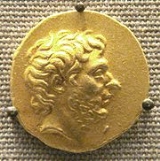
Titus Quinctius Flamininus

Encyclopedia
Roman Republic
The Roman Republic was the period of the ancient Roman civilization where the government operated as a republic. It began with the overthrow of the Roman monarchy, traditionally dated around 508 BC, and its replacement by a government headed by two consuls, elected annually by the citizens and...
politician and general instrumental in the Roman conquest of Greece
Greece
Greece , officially the Hellenic Republic , and historically Hellas or the Republic of Greece in English, is a country in southeastern Europe....
.
Member of the gens
Gens
In ancient Rome, a gens , plural gentes, referred to a family, consisting of all those individuals who shared the same nomen and claimed descent from a common ancestor. A branch of a gens was called a stirps . The gens was an important social structure at Rome and throughout Italy during the...
Quinctia
Quinctius
The gens Quinctia, sometimes written Quintia, was a patrician family at Rome. Throughout the history of the Republic, its members often held the highest offices of the state, and it produced some men of importance even during the imperial period...
, and brother to Lucius Quinctius Flamininus
Lucius Quinctius Flamininus
Lucius Quinctius Flamininus, the brother of Titus Quinctius Flamininus, was a Roman Consul in 192 BC. In 184 BC he was deposed from the Senate by the Censor, Cato the Elder, for his bad conduct in his consulship. Flamininus' removal from the Senate was a part of a bigger struggle between the...
, he served as a military tribune
Tribune
Tribune was a title shared by elected officials in the Roman Republic. Tribunes had the power to convene the Plebeian Council and to act as its president, which also gave them the right to propose legislation before it. They were sacrosanct, in the sense that any assault on their person was...
in the Second Punic war
Second Punic War
The Second Punic War, also referred to as The Hannibalic War and The War Against Hannibal, lasted from 218 to 201 BC and involved combatants in the western and eastern Mediterranean. This was the second major war between Carthage and the Roman Republic, with the participation of the Berbers on...
and in 205 BC he was appointed propraetor
Praetor
Praetor was a title granted by the government of Ancient Rome to men acting in one of two official capacities: the commander of an army, usually in the field, or the named commander before mustering the army; and an elected magistratus assigned varied duties...
in Tarentum
Taranto
Taranto is a coastal city in Apulia, Southern Italy. It is the capital of the Province of Taranto and is an important commercial port as well as the main Italian naval base....
. He was a curule aedile
Aedile
Aedile was an office of the Roman Republic. Based in Rome, the aediles were responsible for maintenance of public buildings and regulation of public festivals. They also had powers to enforce public order. There were two pairs of aediles. Two aediles were from the ranks of plebeians and the other...
in Rome
Rome
Rome is the capital of Italy and the country's largest and most populated city and comune, with over 2.7 million residents in . The city is located in the central-western portion of the Italian Peninsula, on the Tiber River within the Lazio region of Italy.Rome's history spans two and a half...
in 203 BC and a quaestor
Quaestor
A Quaestor was a type of public official in the "Cursus honorum" system who supervised financial affairs. In the Roman Republic a quaestor was an elected official whereas, with the autocratic government of the Roman Empire, quaestors were simply appointed....
in 199 BC. He became consul
Consul
Consul was the highest elected office of the Roman Republic and an appointive office under the Empire. The title was also used in other city states and also revived in modern states, notably in the First French Republic...
in 198 BC, despite being only about thirty years old, younger than the constitutional age required to serve in that position. As Livy records, two tribunes, Marcus Fulvius and Manius Curius publicly opposed his candidacy for consulship, as he was just a quaestor, but the Senate overrode the opposition and he was elected along with Sextus Aelius Paulus.
After his election to the consulship he was chosen to replace Publius Sulpicius Galba
Publius Sulpicius Galba Maximus
Publius Sulpicius Galba Maximus was a consul of Rome in 211 BC, when he defended the city against the surprise attack by Hannibal.He was proconsul in Greece from 210 to 206, continuing the First Macedonian War against Philip V of Macedon...
who was consul with Gaius Aurelius in 200 BC, according to Livy, as general during the Second Macedonian War
Second Macedonian War
The Second Macedonian War was fought between Macedon, led by Philip V of Macedon, and Rome, allied with Pergamon and Rhodes. The result was the defeat of Philip who was forced to abandon all his possessions in Greece...
. He chased Philip V of Macedon
Philip V of Macedon
Philip V was King of Macedon from 221 BC to 179 BC. Philip's reign was principally marked by an unsuccessful struggle with the emerging power of Rome. Philip was attractive and charismatic as a young man...
out of most of Greece
Greece
Greece , officially the Hellenic Republic , and historically Hellas or the Republic of Greece in English, is a country in southeastern Europe....
, except for a few fortresses, defeating him at the Battle of the Aous
Battle of the Aous
The Battle of the Aous was fought in 198 BC between the Roman Republic and The Ancient Kingdom of Macedonia, at or near modern Tepelenë in Albania. The Roman forces were led by Titus Quinctius Flamininus and the Macedonian ones were led by Philip V....
, but as his term as consul was coming to an end he attempted to establish a peace with the Macedonian king. During the negotiations, Flamininus was made proconsul
Proconsul
A proconsul was a governor of a province in the Roman Republic appointed for one year by the senate. In modern usage, the title has been used for a person from one country ruling another country or bluntly interfering in another country's internal affairs.-Ancient Rome:In the Roman Republic, a...
, giving him the authority to continue the war rather than finishing the negotiations. In 197 BC he defeated Philip at the Battle of Cynoscephalae
Battle of Cynoscephalae
The Battle of Cynoscephalae was an encounter battle fought in Thessaly in 197 BC between the Roman army, led by Titus Quinctius Flamininus, and the Antigonid dynasty of Macedon, led by Philip V.- Prelude :...
in Thessaly
Thessaly
Thessaly is a traditional geographical region and an administrative region of Greece, comprising most of the ancient region of the same name. Before the Greek Dark Ages, Thessaly was known as Aeolia, and appears thus in Homer's Odyssey....
, the Roman legions
Roman legion
A Roman legion normally indicates the basic ancient Roman army unit recruited specifically from Roman citizens. The organization of legions varied greatly over time but they were typically composed of perhaps 5,000 soldiers, divided into maniples and later into "cohorts"...
making the Macedonian phalanx
Macedonian phalanx
The Macedonian phalanx is an infantry formation developed by Philip II and used by his son Alexander the Great to conquer the Persian Empire and other armies...
obsolete in the process. Philip was forced to surrender, give up all the Greek cities he had conquered, and pay Rome 1,000 talent
Talent (weight)
The "talent" was one of several ancient units of mass, as well as corresponding units of value equivalent to these masses of a precious metal. It was approximately the mass of water required to fill an amphora. A Greek, or Attic talent, was , a Roman talent was , an Egyptian talent was , and a...
s, but his kingdom was left intact to serve as a buffer state between Greece
Greece
Greece , officially the Hellenic Republic , and historically Hellas or the Republic of Greece in English, is a country in southeastern Europe....
and Illyria
Illyria
In classical antiquity, Illyria was a region in the western part of the Balkan Peninsula inhabited by the Illyrians....
. This displeased the Achaean League
Achaean League
The Achaean League was a Hellenistic era confederation of Greek city states on the northern and central Peloponnese, which existed between 280 BC and 146 BC...
, Rome's allies in Greece, who wanted Macedon to be dismantled completely.
In 198 BC he occupied Anticyra
Anticyra
Anticyra, or Antikyra the ancient name of a city in Phokis, Greece.-Name and Mycenaean past:Mod. name Antikyra; until the early 20th century it was called "Aspra Spitia", a name given after 1960 to a wholly new adjacent settlement, 3 km to the East; in Phocis, on the bay of Anticyra, in the...
in Phokis and made it his naval yard and his main provisioning port. During the period from 197 to 194 BC, from his seat in Elateia, Flamininus directed the political affairs of the Greek states. In 196 BC Flamininus appeared at the Isthmian Games
Isthmian Games
The Isthmian Games or Isthmia were one of the Panhellenic Games of Ancient Greece, and were named after the isthmus of Corinth, where they were held...
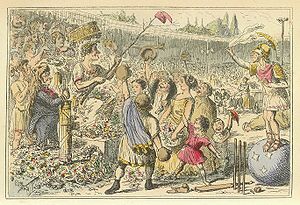
in Corinth and proclaimed the freedom of the Greek states. He was fluent in Greek
Greek language
Greek is an independent branch of the Indo-European family of languages. Native to the southern Balkans, it has the longest documented history of any Indo-European language, spanning 34 centuries of written records. Its writing system has been the Greek alphabet for the majority of its history;...
and was a great admirer of Greek culture, and the Greeks hailed him as their liberator; they minted coins with his portrait, and in some cities he was deified. According to Livy
Livy
Titus Livius — known as Livy in English — was a Roman historian who wrote a monumental history of Rome and the Roman people. Ab Urbe Condita Libri, "Chapters from the Foundation of the City," covering the period from the earliest legends of Rome well before the traditional foundation in 753 BC...
, this was the act of an unselfish Hellenophile, although it seems more likely that Flamininus understood freedom as liberty for the aristocracy of Greece, who would then become clients of Rome, as opposed to being subjected to Macedonian hegemony. With his Greek allies, Flamininus plundered Sparta
Sparta
Sparta or Lacedaemon, was a prominent city-state in ancient Greece, situated on the banks of the River Eurotas in Laconia, in south-eastern Peloponnese. It emerged as a political entity around the 10th century BC, when the invading Dorians subjugated the local, non-Dorian population. From c...
, before returning to Rome in triumph along with thousands of freed slaves, 1200 of which were freed from Achaea
Achaea
Achaea is one of the regional units of Greece. It is part of the region of West Greece. It is situated in the northwestern part of the Peloponnese peninsula. The capital is Patras. The population exceeds 300,000 since 2001.-Geography:...
, who had been taken captive and sold in Greece during the Second Punic War
Second Punic War
The Second Punic War, also referred to as The Hannibalic War and The War Against Hannibal, lasted from 218 to 201 BC and involved combatants in the western and eastern Mediterranean. This was the second major war between Carthage and the Roman Republic, with the participation of the Berbers on...
.
Meanwhile, Eumenes II
Eumenes II
Eumenes II of Pergamon was king of Pergamon and a member of the Attalid dynasty. The son of king Attalus I and queen Apollonis, he followed in his father's footsteps and collaborated with the Romans to oppose first Macedonian, then Seleucid expansion towards the Aegean, leading to the defeat of...
of Pergamum appealed to Rome for help against the Seleucid king Antiochus III. Flamininus was sent to negotiate with him in 192 BC, and warned him not to interfere with the Greek states. Antiochus did not believe Flamininus had the authority to speak for the Greeks, and promised to leave Greece alone only if the Romans did the same. These negotiations came to nothing and Rome was soon at war with Antiochus. Flamininus was present at the Battle of Thermopylae
Battle of Thermopylae (191 BC)
The Battle of Thermopylae was fought in 191 BC between a Roman army led by consul Manius Acilius Glabrio and a Seleucid force led by King Antiochus III the Great. The Romans were victorious, and as a result, Antiochus was forced to flee Greece. It was described by Appian and by Livy at...
in 191 BC, in which Antiochus was defeated.
In 189 BC he was elected censor along with Marcus Claudius Marcellus
Marcus Claudius Marcellus (consul 196 BC)
Marcus Claudius Marcellus was a consul and a censor in of the Roman Republic. He was the son of the famous general Marcus Claudius Marcellus , and possibly father of the three-time consul Marcus Claudius Marcellus .Marcellus first appears in Livy's history when his father, then curule aedile,...
, defeating among others Cato the Elder
Cato the Elder
Marcus Porcius Cato was a Roman statesman, commonly referred to as Censorius , Sapiens , Priscus , or Major, Cato the Elder, or Cato the Censor, to distinguish him from his great-grandson, Cato the Younger.He came of an ancient Plebeian family who all were noted for some...
.
In 183 BC he was sent to negotiate with Prusias I
Prusias I of Bithynia
Prusias I Cholus was a king of Bithynia...
of Bithynia
Bithynia
Bithynia was an ancient region, kingdom and Roman province in the northwest of Asia Minor, adjoining the Propontis, the Thracian Bosporus and the Euxine .-Description:...
in an attempt to capture Hannibal, who had been exiled there from Carthage
Carthage
Carthage , implying it was a 'new Tyre') is a major urban centre that has existed for nearly 3,000 years on the Gulf of Tunis, developing from a Phoenician colony of the 1st millennium BC...
, but Hannibal committed suicide to avoid being taken prisoner. Although nothing is known of him after this, Flamininus seems to have died around 174.
External links
- Plutarch's parallel lives - Flamininus - Loeb edn. at Bill Thayer's website (accessed 13 July 2009)
- Livy's History of Rome