

List of Roman Emperors

Encyclopedia
Roman Empire
The Roman Empire was the post-Republican period of the ancient Roman civilization, characterised by an autocratic form of government and large territorial holdings in Europe and around the Mediterranean....
. The Roman Empire developed from the Roman Republic
Roman Republic
The Roman Republic was the period of the ancient Roman civilization where the government operated as a republic. It began with the overthrow of the Roman monarchy, traditionally dated around 508 BC, and its replacement by a government headed by two consuls, elected annually by the citizens and...
after its ascent to the dominant power in Europe, and is characterised by the concentration of power in one individual, rather than the "Senate and People of Rome". However, Augustus, universally accepted to have been the first emperor, was careful to maintain the facade of republican rule, and took no specific title to mark his rule (which began in 27 BC). Instead, he simply concentrated the pre-existing powers of Roman magistrates upon his own person, taking the existing honorific of 'Princeps Senatus
Princeps senatus
The princeps senatus was the first member by precedence of the Roman Senate. Although officially out of the cursus honorum and owning no imperium, this office brought enormous prestige to the senator holding it.-Overview:...
' (the first man of the senate). This style of government, which lasted for nearly 300 years, is thus called the 'Principate
Principate
The Principate is the first period of the Roman Empire, extending from the beginning of the reign of Caesar Augustus to the Crisis of the Third Century, after which it was replaced with the Dominate. The Principate is characterized by a concerted effort on the part of the Emperors to preserve the...
'. The modern word 'emperor' derives from the title 'Imperator
Imperator
The Latin word Imperator was originally a title roughly equivalent to commander under the Roman Republic. Later it became a part of the titulature of the Roman Emperors as part of their cognomen. The English word emperor derives from imperator via Old French Empreur...
', which was granted by an army to a successful general; as such, during the initial phase of the Roman Empire, it still had to be earned by the 'Princeps'. The term 'emperor', though modern, is used when describing rulers of the Roman Empire, since (a) it emphasises the strong links between the ruler and the army (on whose support the ruler's power depended), and (b) does not discriminate between the style of rule in different phases of the Empire.
In the late 3rd century AD, after the Crisis of the Third Century
Crisis of the Third Century
The Crisis of the Third Century was a period in which the Roman Empire nearly collapsed under the combined pressures of invasion, civil war, plague, and economic depression...
, Diocletian
Diocletian
Diocletian |latinized]] upon his accession to Diocletian . c. 22 December 244 – 3 December 311), was a Roman Emperor from 284 to 305....
formalised and embellished the recent manner of imperial rule, establishing the so-called 'Dominate
Dominate
The Dominate was the "despotic" latter phase of government in the ancient Roman Empire from the conclusion of the Third Century Crisis of 235–284 until the formal date of the collapse of the Western Empire in AD 476. It followed the period known as the Principate...
' period of the Roman Empire. This was characterised by the explicit investment of authority in the person of the Emperor, and the use of the style 'Dominus Noster' ('Our Lord'). From Diocletian onwards, there were often multiple simultaneous emperors, dividing the rule of the vast territories between them. After 395 AD, and the death of Theodosius I
Theodosius I
Theodosius I , also known as Theodosius the Great, was Roman Emperor from 379 to 395. Theodosius was the last emperor to rule over both the eastern and the western halves of the Roman Empire. During his reign, the Goths secured control of Illyricum after the Gothic War, establishing their homeland...
, the Empire became more firmly split into Western
Western Roman Empire
The Western Roman Empire was the western half of the Roman Empire after its division by Diocletian in 285; the other half of the Roman Empire was the Eastern Roman Empire, commonly referred to today as the Byzantine Empire....
and Eastern halves They were not legally separate however, and the Emperor of the more stable Eastern Empire often imposed his authority over the Western half. The Western Empire was heavily troubled after 395 AD, and collapsed completely after 455 AD, the last Western Emperor abdicating in 476 AD; after which the Eastern Empire maintained claim to the territories in the west. The Eastern Empire would continue until 1453, and the capture of Constantinople
Constantinople
Constantinople was the capital of the Roman, Eastern Roman, Byzantine, Latin, and Ottoman Empires. Throughout most of the Middle Ages, Constantinople was Europe's largest and wealthiest city.-Names:...
by the Ottoman Turks
Ottoman Turks
The Ottoman Turks were the Turkish-speaking population of the Ottoman Empire who formed the base of the state's military and ruling classes. Reliable information about the early history of Ottoman Turks is scarce, but they take their Turkish name, Osmanlı , from the house of Osman I The Ottoman...
. The Eastern Emperors, generally known in modern times as the Byzantine Emperors, continued an unbroken succession of Roman Emperors. The listing of the early Byzantine Emperors in this article ends in the 6th century with Justin II
Justin II
Justin II was Byzantine Emperor from 565 to 578. He was the husband of Sophia, nephew of Justinian I and the late Empress Theodora, and was therefore a member of the Justinian Dynasty. His reign is marked by war with Persia and the loss of the greater part of Italy...
, last of the Justinian dynasty
Justinian Dynasty
The Justinian Dynasty is a family who ruled over the Byzantine Empire from 518 to 602. It originated with Justin I and ended with Maurice. Patriarch Germanus I of Constantinople , whose father was named Justinian, might have been a descendant of the dynasty...
.
- For further Eastern/Byzantine Emperors, see: List of Byzantine Emperors.
The emperors listed in this article are those generally agreed to have been 'legitimate' emperors
(e.g. not usurpers, etc.). However, since the emperorship was rather vaguely defined legally, which persons were 'legitimate' is not easy to define; many of the 'legitimate' emperors accessed to the position by usurpation, and many 'illegitimate' claimants had a legitimate claim to the position. The following criteria can be used to derive the list:
- Any individual who undisputedly ruled the whole Empire, at some point, must, in point of fact, be a 'legitimate emperor'(1).
- Any individual who was nominated as heir or co-emperor by a legitimate emperor (1), and who succeeded to rule in his own right, is a legitimate emperor (2).
- Where there were multiple claimants, and none were legitimate heirs; the claimant accepted by the Roman SenateRoman SenateThe Senate of the Roman Republic was a political institution in the ancient Roman Republic, however, it was not an elected body, but one whose members were appointed by the consuls, and later by the censors. After a magistrate served his term in office, it usually was followed with automatic...
as emperor is the legitimate emperor (3), at least during the PrincipatePrincipateThe Principate is the first period of the Roman Empire, extending from the beginning of the reign of Caesar Augustus to the Crisis of the Third Century, after which it was replaced with the Dominate. The Principate is characterized by a concerted effort on the part of the Emperors to preserve the...
.
So for instance, Aurelian
Aurelian
Aurelian , was Roman Emperor from 270 to 275. During his reign, he defeated the Alamanni after a devastating war. He also defeated the Goths, Vandals, Juthungi, Sarmatians, and Carpi. Aurelian restored the Empire's eastern provinces after his conquest of the Palmyrene Empire in 273. The following...
, though acceding to the throne by usurpation, was the sole and undisputed monarch between 274–275 AD, and thus was a legitimate emperor. Gallienus, though not in control of the whole Empire, and plagued by other claimants, was the legitimate heir of (the legitimate emperor) Valerian
Valerian (emperor)
Valerian , also known as Valerian the Elder, was Roman Emperor from 253 to 260. He was taken captive by Persian king Shapur I after the Battle of Edessa, becoming the only Roman Emperor who was captured as a prisoner of war, resulting in wide-ranging instability across the Empire.-Origins and rise...
. Claudius Gothicus, though acceding illegally, and not in control of the whole Empire, was the only claimant accepted by the Senate, and thus, for his reign, was the legitimate emperor. Equally, during the Year of the Four Emperors
Year of the Four Emperors
The Year of the Four Emperors was a year in the history of the Roman Empire, AD 69, in which four emperors ruled in a remarkable succession. These four emperors were Galba, Otho, Vitellius, and Vespasian....
, all claimants, though not undisputed, were at some point accepted by the Senate and are thus included; conversely, during the Year of the Five Emperors
Year of the Five Emperors
The Year of the Five Emperors refers to the year 193 AD, in which there were five claimants for the title of Roman Emperor. The five were Pertinax, Didius Julianus, Pescennius Niger, Clodius Albinus and Septimius Severus....
neither Pescennius Niger
Pescennius Niger
Pescennius Niger was a Roman usurper from 193 to 194 during the Year of the Five Emperors. He claimed the imperial throne in response to the murder of Pertinax and the elevation of Didius Julianus, but was defeated by a rival claimant, Septimius Severus and killed while attempting to flee from...
nor Clodius Albinus
Clodius Albinus
Clodius Albinus was a Roman usurper proclaimed emperor by the legions in Britain and Hispania upon the murder of Pertinax in 193.-Life:...
were accepted by the Senate, and are thus not included. There are a few examples where individuals were made co-emperor, but never wielded power in their own right (typically the child of an emperor); these are legitimate, but are listed together with the 'senior' emperor.
The above formula holds until 395, when the Western and Eastern halves of the Empire split. After that, it continues to hold, with the caveat that a legitimate emperor had undisputed control over one half of the Empire. Towards the end of the Western Empire (after 455), the emperor ceased to be a relevant figure and there was sometimes actually no claimant. For the sake of historical completeness, all Western Emperors after that point are included, even though Romulus Augustus
Romulus Augustus
Romulus Augustus , was the last Western Roman Emperor, reigning from 31 October 475 until 4 September 476...
, traditionally the "last Roman Emperor" was technically a usurper.
Julio-Claudian dynasty
| Portrait | Name | Born | Reigned | Succession | Died |
|---|---|---|---|---|---|
|
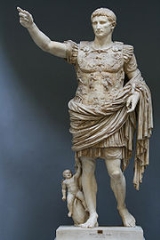
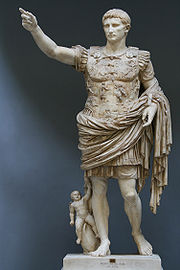
Augustus Augustus Augustus ;23 September 63 BC – 19 August AD 14) is considered the first emperor of the Roman Empire, which he ruled alone from 27 BC until his death in 14 AD.The dates of his rule are contemporary dates; Augustus lived under two calendars, the Roman Republican until 45 BC, and the Julian... GAIVS IVLIVS CAESAR AVGVSTVS |
September 23 63 BC 63 BC Year 63 BC was a year of the pre-Julian Roman calendar. At the time it was known as the Year of the Consulship of Cicero and Hibrida... , Rome Rome Rome is the capital of Italy and the country's largest and most populated city and comune, with over 2.7 million residents in . The city is located in the central-western portion of the Italian Peninsula, on the Tiber River within the Lazio region of Italy.Rome's history spans two and a half... , Italia Italia (Roman province) Italia was the name of the Italian peninsula of the Roman Empire.-Under the Republic and Augustan organization:During the Republic and the first centuries of the empire, Italia was not a province, but rather the territory of the city of Rome, thus having a special status: for example, military... |
January 16 27 BC 27 BC Year 27 BC was either a common year starting on Sunday, Monday or Tuesday or a leap year starting on Monday of the Julian calendar and a common year starting on Sunday of the Proleptic Julian calendar... – August 19, 14 AD |
Became de facto emperor as a result of the 'first settlement' between himself and the Roman Senate Roman Senate The Senate of the Roman Republic was a political institution in the ancient Roman Republic, however, it was not an elected body, but one whose members were appointed by the consuls, and later by the censors. After a magistrate served his term in office, it usually was followed with automatic... . |
August 19, 14 AD Natural causes. |
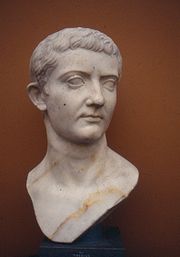 |
Tiberius Tiberius Tiberius , was Roman Emperor from 14 AD to 37 AD. Tiberius was by birth a Claudian, son of Tiberius Claudius Nero and Livia Drusilla. His mother divorced Nero and married Augustus in 39 BC, making him a step-son of Octavian... TIBERIVS IVLIVS CAESAR AVGVSTVS |
November 16 42 BC 42 BC Year 42 BC was either a common year starting on Monday, Tuesday or Wednesday or a leap year starting on Tuesday of the Julian calendar and a common year starting on Tuesday of the Proleptic Julian calendar... , Rome Rome Rome is the capital of Italy and the country's largest and most populated city and comune, with over 2.7 million residents in . The city is located in the central-western portion of the Italian Peninsula, on the Tiber River within the Lazio region of Italy.Rome's history spans two and a half... |
September 18, 14 AD – March 16, 37 AD | Son of Augustus Augustus Augustus ;23 September 63 BC – 19 August AD 14) is considered the first emperor of the Roman Empire, which he ruled alone from 27 BC until his death in 14 AD.The dates of his rule are contemporary dates; Augustus lived under two calendars, the Roman Republican until 45 BC, and the Julian... 's wife Livia Livia Livia Drusilla, , after her formal adoption into the Julian family in AD 14 also known as Julia Augusta, was a Roman empress as the third wife of the Emperor Augustus and his adviser... by a previous marriage; adopted son of Augustus Augustus Augustus ;23 September 63 BC – 19 August AD 14) is considered the first emperor of the Roman Empire, which he ruled alone from 27 BC until his death in 14 AD.The dates of his rule are contemporary dates; Augustus lived under two calendars, the Roman Republican until 45 BC, and the Julian... . |
March 16, 37 AD Probably old age, possibly assassinated |
 |
Caligula Caligula Caligula , also known as Gaius, was Roman Emperor from 37 AD to 41 AD. Caligula was a member of the house of rulers conventionally known as the Julio-Claudian dynasty. Caligula's father Germanicus, the nephew and adopted son of Emperor Tiberius, was a very successful general and one of Rome's most... GAIVS IVLIVS CAESAR AVGVSTVS GERMANICVS |
August 31, 12 AD, Antium Anzio Anzio is a city and comune on the coast of the Lazio region of Italy, about south of Rome.Well known for its seaside harbour setting, it is a fishing port and a departure point for ferries and hydroplanes to the Pontine Islands of Ponza, Palmarola and Ventotene... , Italia Italia (Roman province) Italia was the name of the Italian peninsula of the Roman Empire.-Under the Republic and Augustan organization:During the Republic and the first centuries of the empire, Italia was not a province, but rather the territory of the city of Rome, thus having a special status: for example, military... |
March 18, 37 AD – January 24, 41 AD | Tiberius Tiberius Tiberius , was Roman Emperor from 14 AD to 37 AD. Tiberius was by birth a Claudian, son of Tiberius Claudius Nero and Livia Drusilla. His mother divorced Nero and married Augustus in 39 BC, making him a step-son of Octavian... 's great-nephew and adopted grandson; great-grandson of Augustus Augustus Augustus ;23 September 63 BC – 19 August AD 14) is considered the first emperor of the Roman Empire, which he ruled alone from 27 BC until his death in 14 AD.The dates of his rule are contemporary dates; Augustus lived under two calendars, the Roman Republican until 45 BC, and the Julian... . |
January 24, 41 AD Assassinated in a conspiracy involving senators and Praetorian Guard Praetorian Guard The Praetorian Guard was a force of bodyguards used by Roman Emperors. The title was already used during the Roman Republic for the guards of Roman generals, at least since the rise to prominence of the Scipio family around 275 BC... s. |
| Claudius Claudius Claudius , was Roman Emperor from 41 to 54. A member of the Julio-Claudian dynasty, he was the son of Drusus and Antonia Minor. He was born at Lugdunum in Gaul and was the first Roman Emperor to be born outside Italy... TIBERIVS CLAVDIVS CAESAR AVGVSTVS GERMANICVS |
August 1, 10 BC, Lugdunum Lugdunum Colonia Copia Claudia Augusta Lugdunum was an important Roman city in Gaul. The city was founded in 43 BC by Lucius Munatius Plancus. It served as the capital of the Roman province Gallia Lugdunensis. To 300 years after its foundation Lugdunum was the most important city to the west part of Roman... , Gallia Lugdunensis Gallia Lugdunensis Gallia Lugdunensis was a province of the Roman Empire in what is now the modern country of France, part of the Celtic territory of Gaul. It is named after its capital Lugdunum , possibly Roman Europe's major city west of Italy, and a major imperial mint... |
January 25/26, 41 AD – October 13, 54 AD | Nephew of Tiberius Tiberius Tiberius , was Roman Emperor from 14 AD to 37 AD. Tiberius was by birth a Claudian, son of Tiberius Claudius Nero and Livia Drusilla. His mother divorced Nero and married Augustus in 39 BC, making him a step-son of Octavian... , brother of Germanicus Germanicus Germanicus Julius Caesar , commonly known as Germanicus, was a member of the Julio-Claudian dynasty and a prominent general of the early Roman Empire. He was born in Rome, Italia, and was named either Nero Claudius Drusus after his father or Tiberius Claudius Nero after his uncle... and uncle of Caligula Caligula Caligula , also known as Gaius, was Roman Emperor from 37 AD to 41 AD. Caligula was a member of the house of rulers conventionally known as the Julio-Claudian dynasty. Caligula's father Germanicus, the nephew and adopted son of Emperor Tiberius, was a very successful general and one of Rome's most... ; proclaimed emperor by the Praetorian Guard Praetorian Guard The Praetorian Guard was a force of bodyguards used by Roman Emperors. The title was already used during the Roman Republic for the guards of Roman generals, at least since the rise to prominence of the Scipio family around 275 BC... . |
October 13, 54 AD Probably poisoned by his wife Agrippina the Younger Agrippina the Younger Julia Agrippina, most commonly referred to as Agrippina Minor or Agrippina the Younger, and after 50 known as Julia Augusta Agrippina was a Roman Empress and one of the more prominent women in the Julio-Claudian dynasty... , in favour of her son Nero Nero Nero , was Roman Emperor from 54 to 68, and the last in the Julio-Claudian dynasty. Nero was adopted by his great-uncle Claudius to become his heir and successor, and succeeded to the throne in 54 following Claudius' death.... . |
|
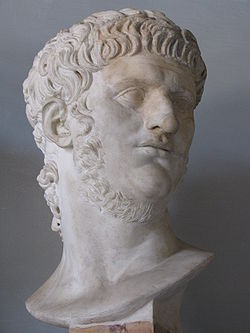 |
Nero Nero Nero , was Roman Emperor from 54 to 68, and the last in the Julio-Claudian dynasty. Nero was adopted by his great-uncle Claudius to become his heir and successor, and succeeded to the throne in 54 following Claudius' death.... NERO CLAVDIVS CAESAR AVGVSTVS GERMANICVS |
December 15, 37 AD, Antium Anzio Anzio is a city and comune on the coast of the Lazio region of Italy, about south of Rome.Well known for its seaside harbour setting, it is a fishing port and a departure point for ferries and hydroplanes to the Pontine Islands of Ponza, Palmarola and Ventotene... , Italia Italia (Roman province) Italia was the name of the Italian peninsula of the Roman Empire.-Under the Republic and Augustan organization:During the Republic and the first centuries of the empire, Italia was not a province, but rather the territory of the city of Rome, thus having a special status: for example, military... |
October 13, 54 AD – June 11, 68 AD | Grandson of Germanicus Germanicus Germanicus Julius Caesar , commonly known as Germanicus, was a member of the Julio-Claudian dynasty and a prominent general of the early Roman Empire. He was born in Rome, Italia, and was named either Nero Claudius Drusus after his father or Tiberius Claudius Nero after his uncle... , nephew, step- and adopted son of Claudius Claudius Claudius , was Roman Emperor from 41 to 54. A member of the Julio-Claudian dynasty, he was the son of Drusus and Antonia Minor. He was born at Lugdunum in Gaul and was the first Roman Emperor to be born outside Italy... ; great-great-grandson of Augustus Augustus Augustus ;23 September 63 BC – 19 August AD 14) is considered the first emperor of the Roman Empire, which he ruled alone from 27 BC until his death in 14 AD.The dates of his rule are contemporary dates; Augustus lived under two calendars, the Roman Republican until 45 BC, and the Julian... . |
June 11, 68 AD Committed suicide after being declared a public enemy by the Senate. |
Year of the Four Emperors and Flavian Dynasty
| Portrait | Name | Born | Reigned | Succession | Died |
|---|---|---|---|---|---|
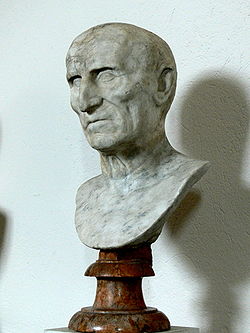 |
Galba Galba Galba , was Roman Emperor for seven months from 68 to 69. Galba was the governor of Hispania Tarraconensis, and made a bid for the throne during the rebellion of Julius Vindex... SERVIVS SVLPICIVS GALBA CAESAR AVGVSTVS |
December 24 3 BC 3 BC Year 3 BC was a common year starting on Wednesday or Thursday of the Julian calendar and a common year starting on Tuesday of the Proleptic Julian calendar... , Near Terracina Terracina Terracina is a town and comune of the province of Latina - , Italy, 76 km SE of Rome by rail .-Ancient times:... , Italia Italia (Roman province) Italia was the name of the Italian peninsula of the Roman Empire.-Under the Republic and Augustan organization:During the Republic and the first centuries of the empire, Italia was not a province, but rather the territory of the city of Rome, thus having a special status: for example, military... |
June 8, 68 AD – January 15, 69 AD | Seized power after Nero Nero Nero , was Roman Emperor from 54 to 68, and the last in the Julio-Claudian dynasty. Nero was adopted by his great-uncle Claudius to become his heir and successor, and succeeded to the throne in 54 following Claudius' death.... 's suicide, with support of the Spanish legions |
January 15, 69 AD Murdered by Praetorian Guard Praetorian Guard The Praetorian Guard was a force of bodyguards used by Roman Emperors. The title was already used during the Roman Republic for the guards of Roman generals, at least since the rise to prominence of the Scipio family around 275 BC... in coup led by Otho Otho Otho , was Roman Emperor for three months, from 15 January to 16 April 69. He was the second emperor of the Year of the four emperors.- Birth and lineage :... . |
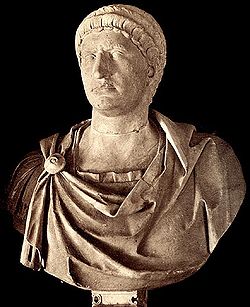 |
Otho Otho Otho , was Roman Emperor for three months, from 15 January to 16 April 69. He was the second emperor of the Year of the four emperors.- Birth and lineage :... MARCVS SALVIVS OTHO CAESAR AVGVSTVS |
April 25, 32 AD, Ferentinum, Etruria Etruria Etruria—usually referred to in Greek and Latin source texts as Tyrrhenia—was a region of Central Italy, an area that covered part of what now are Tuscany, Latium, Emilia-Romagna, and Umbria. A particularly noteworthy work dealing with Etruscan locations is D. H... , Italia Italia (Roman province) Italia was the name of the Italian peninsula of the Roman Empire.-Under the Republic and Augustan organization:During the Republic and the first centuries of the empire, Italia was not a province, but rather the territory of the city of Rome, thus having a special status: for example, military... |
January 15, 69 AD – April 16, 69 AD | Appointed by Praetorian Guard Praetorian Guard The Praetorian Guard was a force of bodyguards used by Roman Emperors. The title was already used during the Roman Republic for the guards of Roman generals, at least since the rise to prominence of the Scipio family around 275 BC... |
April 16, 69 AD Committed suicide after losing Battle of Bedriacum Battle of Bedriacum The Battle of Bedriacum refers to two battles fought during the Year of the Four Emperors near the village of Bedriacum , about from the town of Cremona in northern Italy... to Vitellius Vitellius Vitellius , was Roman Emperor for eight months, from 16 April to 22 December 69. Vitellius was acclaimed Emperor following the quick succession of the previous emperors Galba and Otho, in a year of civil war known as the Year of the Four Emperors... |
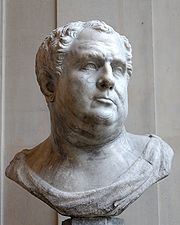 |
Vitellius Vitellius Vitellius , was Roman Emperor for eight months, from 16 April to 22 December 69. Vitellius was acclaimed Emperor following the quick succession of the previous emperors Galba and Otho, in a year of civil war known as the Year of the Four Emperors... AVLVS VITELLIVS CAESAR AVGVSTVS GERMANICVS |
September 24, 15 AD, Rome Rome Rome is the capital of Italy and the country's largest and most populated city and comune, with over 2.7 million residents in . The city is located in the central-western portion of the Italian Peninsula, on the Tiber River within the Lazio region of Italy.Rome's history spans two and a half... |
April 17, 69 AD – December 20, 69 AD | Seized power with support of German Legions (in opposition to Galba Galba Galba , was Roman Emperor for seven months from 68 to 69. Galba was the governor of Hispania Tarraconensis, and made a bid for the throne during the rebellion of Julius Vindex... /Otho Otho Otho , was Roman Emperor for three months, from 15 January to 16 April 69. He was the second emperor of the Year of the four emperors.- Birth and lineage :... ) |
December 20, 69 AD Murdered by Vespasian Vespasian Vespasian , was Roman Emperor from 69 AD to 79 AD. Vespasian was the founder of the Flavian dynasty, which ruled the Empire for a quarter century. Vespasian was descended from a family of equestrians, who rose into the senatorial rank under the Emperors of the Julio-Claudian dynasty... 's troops |
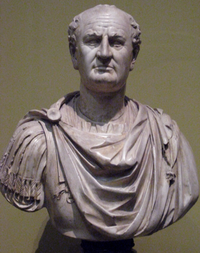 |
Vespasian Vespasian Vespasian , was Roman Emperor from 69 AD to 79 AD. Vespasian was the founder of the Flavian dynasty, which ruled the Empire for a quarter century. Vespasian was descended from a family of equestrians, who rose into the senatorial rank under the Emperors of the Julio-Claudian dynasty... TITVS FLAVIVS CAESAR VESPASIANVS AVGVSTVS |
November 17, 9 AD, Falacrine Falacrina Falacrine was a village of Ancient Rome that was the birthplace of the emperor Vespasian .-Location:The location of Falacrine has been the subject of debate. The village is described as lying just beyond Reate , in the Sabine hill country northeast of Rome... , Italia Italia (Roman province) Italia was the name of the Italian peninsula of the Roman Empire.-Under the Republic and Augustan organization:During the Republic and the first centuries of the empire, Italia was not a province, but rather the territory of the city of Rome, thus having a special status: for example, military... |
July 1, 69 AD – June 24, 79 AD | Seized power with the support of the eastern Legions (in opposition to Vitellius Vitellius Vitellius , was Roman Emperor for eight months, from 16 April to 22 December 69. Vitellius was acclaimed Emperor following the quick succession of the previous emperors Galba and Otho, in a year of civil war known as the Year of the Four Emperors... ) |
June 24, 79 AD Natural causes |
| Titus Titus Titus , was Roman Emperor from 79 to 81. A member of the Flavian dynasty, Titus succeeded his father Vespasian upon his death, thus becoming the first Roman Emperor to come to the throne after his own father.... TITVS FLAVIVS CAESAR VESPASIANVS AVGVSTVS |
December 30, 39 AD, Rome Rome Rome is the capital of Italy and the country's largest and most populated city and comune, with over 2.7 million residents in . The city is located in the central-western portion of the Italian Peninsula, on the Tiber River within the Lazio region of Italy.Rome's history spans two and a half... |
June 24, 79 AD – September 13, 81 AD | Son of Vespasian Vespasian Vespasian , was Roman Emperor from 69 AD to 79 AD. Vespasian was the founder of the Flavian dynasty, which ruled the Empire for a quarter century. Vespasian was descended from a family of equestrians, who rose into the senatorial rank under the Emperors of the Julio-Claudian dynasty... |
September 13, 81 AD Natural causes (Plague) |
|
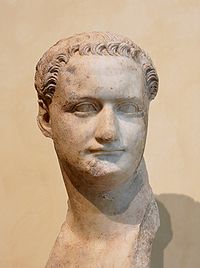 |
Domitian Domitian Domitian was Roman Emperor from 81 to 96. Domitian was the third and last emperor of the Flavian dynasty.Domitian's youth and early career were largely spent in the shadow of his brother Titus, who gained military renown during the First Jewish-Roman War... TITVS FLAVIVS CAESAR DOMITIANVS AVGVSTVS |
October 24, 51 AD, Rome Rome Rome is the capital of Italy and the country's largest and most populated city and comune, with over 2.7 million residents in . The city is located in the central-western portion of the Italian Peninsula, on the Tiber River within the Lazio region of Italy.Rome's history spans two and a half... |
September 14, 81 AD – September 18, 96 AD | Son of Vespasian Vespasian Vespasian , was Roman Emperor from 69 AD to 79 AD. Vespasian was the founder of the Flavian dynasty, which ruled the Empire for a quarter century. Vespasian was descended from a family of equestrians, who rose into the senatorial rank under the Emperors of the Julio-Claudian dynasty... |
September 18, 96 AD Assassinated by court officials |
Nervan-Antonian dynasty
| Portrait | Name | Born | Reigned | Succession | Died |
|---|---|---|---|---|---|
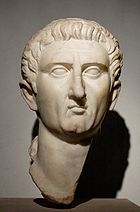 |
Nerva Nerva Nerva , was Roman Emperor from 96 to 98. Nerva became Emperor at the age of sixty-five, after a lifetime of imperial service under Nero and the rulers of the Flavian dynasty. Under Nero, he was a member of the imperial entourage and played a vital part in exposing the Pisonian conspiracy of 65... MARCVS COCCEIVS NERVA CAESAR AVGVSTVS, |
November 8, 30 AD, Narni Narni Narni is an ancient hilltown and comune of Umbria, in central Italy, with 20,100 inhabitants, according to the 2003 census. At an altitude of 240 m , it overhangs a narrow gorge of the Nera River in the province of Terni. It is very close to the Geographic center of Italy... , Italia Italia (Roman province) Italia was the name of the Italian peninsula of the Roman Empire.-Under the Republic and Augustan organization:During the Republic and the first centuries of the empire, Italia was not a province, but rather the territory of the city of Rome, thus having a special status: for example, military... |
September 18, 96 AD – January 27, 98 AD | Appointed by the Senate Roman Senate The Senate of the Roman Republic was a political institution in the ancient Roman Republic, however, it was not an elected body, but one whose members were appointed by the consuls, and later by the censors. After a magistrate served his term in office, it usually was followed with automatic... |
January 27, 98 AD Natural causes |
 |
Trajan Trajan Trajan , was Roman Emperor from 98 to 117 AD. Born into a non-patrician family in the province of Hispania Baetica, in Spain Trajan rose to prominence during the reign of emperor Domitian. Serving as a legatus legionis in Hispania Tarraconensis, in Spain, in 89 Trajan supported the emperor against... CAESAR MARCVS VLPIVS NERVA TRAIANVS AVGVSTVS |
September 18, 53 AD, Italica Italica The city of Italica was founded in 206 BC by the Roman general Publius Cornelius Scipio Africanus in order to settle Roman soldiers wounded in the Battle of Ilipa, where the Carthaginian army was defeated during the Second Punic War... , Hispania Baetica Hispania Baetica Hispania Baetica was one of three Imperial Roman provinces in Hispania, . Hispania Baetica was bordered to the west by Lusitania, and to the northeast by Hispania Tarraconensis. Baetica was part of Al-Andalus under the Moors in the 8th century and approximately corresponds to modern Andalucia... |
January 28, 98 AD – August 7, 117 AD | Adopted son and heir of Nerva Nerva Nerva , was Roman Emperor from 96 to 98. Nerva became Emperor at the age of sixty-five, after a lifetime of imperial service under Nero and the rulers of the Flavian dynasty. Under Nero, he was a member of the imperial entourage and played a vital part in exposing the Pisonian conspiracy of 65... |
August 7, 117 AD Natural causes |
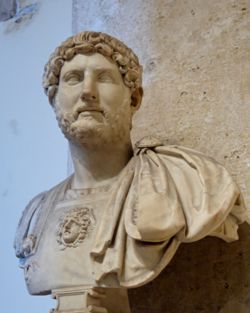 |
Hadrian Hadrian Hadrian , was Roman Emperor from 117 to 138. He is best known for building Hadrian's Wall, which marked the northern limit of Roman Britain. In Rome, he re-built the Pantheon and constructed the Temple of Venus and Roma. In addition to being emperor, Hadrian was a humanist and was philhellene in... CAESAR PVBLIVS AELIVS TRAIANVS HADRIANVS AVGVSTVS |
January 24, 76 AD, Italica Italica The city of Italica was founded in 206 BC by the Roman general Publius Cornelius Scipio Africanus in order to settle Roman soldiers wounded in the Battle of Ilipa, where the Carthaginian army was defeated during the Second Punic War... , Hispania Baetica Hispania Baetica Hispania Baetica was one of three Imperial Roman provinces in Hispania, . Hispania Baetica was bordered to the west by Lusitania, and to the northeast by Hispania Tarraconensis. Baetica was part of Al-Andalus under the Moors in the 8th century and approximately corresponds to modern Andalucia... (or Rome Rome Rome is the capital of Italy and the country's largest and most populated city and comune, with over 2.7 million residents in . The city is located in the central-western portion of the Italian Peninsula, on the Tiber River within the Lazio region of Italy.Rome's history spans two and a half... ) |
August 11, 117 AD – July 10, 138 AD | Adopted son and heir of Trajan Trajan Trajan , was Roman Emperor from 98 to 117 AD. Born into a non-patrician family in the province of Hispania Baetica, in Spain Trajan rose to prominence during the reign of emperor Domitian. Serving as a legatus legionis in Hispania Tarraconensis, in Spain, in 89 Trajan supported the emperor against... |
July 10, 138 AD Natural causes |
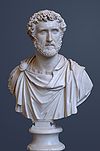 |
Antoninus Pius Antoninus Pius Antoninus Pius , also known as Antoninus, was Roman Emperor from 138 to 161. He was a member of the Nerva-Antonine dynasty and the Aurelii. He did not possess the sobriquet "Pius" until after his accession to the throne... CAESAR TITVS AELIVS HADRIANVS ANTONINVS AVGVSTVS PIVS |
September 19, 86 AD, Near Lanuvium Lanuvium Lanuvium is an ancient city of Latium , some 32 km southeast of Rome, a little southwest of the Via Appia.... , Italia Italia (Roman province) Italia was the name of the Italian peninsula of the Roman Empire.-Under the Republic and Augustan organization:During the Republic and the first centuries of the empire, Italia was not a province, but rather the territory of the city of Rome, thus having a special status: for example, military... |
July 10, 138 AD – March 7, 161 AD | Adopted son and heir of Hadrian Hadrian Hadrian , was Roman Emperor from 117 to 138. He is best known for building Hadrian's Wall, which marked the northern limit of Roman Britain. In Rome, he re-built the Pantheon and constructed the Temple of Venus and Roma. In addition to being emperor, Hadrian was a humanist and was philhellene in... |
March 7, 161 AD Natural causes |
 |
Lucius Verus Lucius Verus Lucius Verus , was Roman co-emperor with Marcus Aurelius, from 161 until his death.-Early life and career:Lucius Verus was the first born son to Avidia Plautia and Lucius Aelius Verus Caesar, the first adopted son and heir of Roman Emperor Hadrian . He was born and raised in Rome... CAESAR LVCIVS AVRELIVS VERVS AVGVSTVS |
December 15, 130 AD, Rome Rome Rome is the capital of Italy and the country's largest and most populated city and comune, with over 2.7 million residents in . The city is located in the central-western portion of the Italian Peninsula, on the Tiber River within the Lazio region of Italy.Rome's history spans two and a half... |
March 7, 161 AD – ? March 169 AD | Adopted son and heir of Antoninus Pius Antoninus Pius Antoninus Pius , also known as Antoninus, was Roman Emperor from 138 to 161. He was a member of the Nerva-Antonine dynasty and the Aurelii. He did not possess the sobriquet "Pius" until after his accession to the throne... ; Co-emperor with Marcus Aurelius until death |
March 169 AD Natural causes (Plague) |
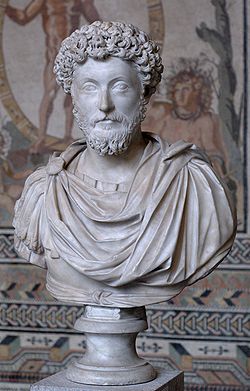 |
Marcus Aurelius CAESAR MARCVS AVRELIVS ANTONINVS AVGVSTVS |
April 26, 121 AD, Rome Rome Rome is the capital of Italy and the country's largest and most populated city and comune, with over 2.7 million residents in . The city is located in the central-western portion of the Italian Peninsula, on the Tiber River within the Lazio region of Italy.Rome's history spans two and a half... |
March 7, 161 AD – March 17, 180 AD | Adopted son and heir of Antoninus Pius Antoninus Pius Antoninus Pius , also known as Antoninus, was Roman Emperor from 138 to 161. He was a member of the Nerva-Antonine dynasty and the Aurelii. He did not possess the sobriquet "Pius" until after his accession to the throne... ; Co-emperor with Lucius Verus Lucius Verus Lucius Verus , was Roman co-emperor with Marcus Aurelius, from 161 until his death.-Early life and career:Lucius Verus was the first born son to Avidia Plautia and Lucius Aelius Verus Caesar, the first adopted son and heir of Roman Emperor Hadrian . He was born and raised in Rome... until 169 AD |
March 17, 180 AD Natural causes |
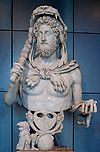 |
Commodus Commodus Commodus , was Roman Emperor from 180 to 192. He also ruled as co-emperor with his father Marcus Aurelius from 177 until his father's death in 180. His name changed throughout his reign; see changes of name for earlier and later forms. His accession as emperor was the first time a son had succeeded... CAESAR MARCVS AVRELIVS COMMODVS ANTONINVS AVGVSTVS |
August 31, 161 AD, Lanuvium Lanuvium Lanuvium is an ancient city of Latium , some 32 km southeast of Rome, a little southwest of the Via Appia.... , Italia Italia (Roman province) Italia was the name of the Italian peninsula of the Roman Empire.-Under the Republic and Augustan organization:During the Republic and the first centuries of the empire, Italia was not a province, but rather the territory of the city of Rome, thus having a special status: for example, military... |
177 AD – December 31, 192 AD | Natural son of Marcus Aurelius; joint emperor from 177 AD | December 31, 192 AD Assassinated in palace, strangled to death |
Year of the Five Emperors & Severan dynasty
| Portrait | Name | Born | Reigned | Succession | Died |
|---|---|---|---|---|---|
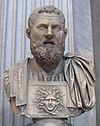 |
Pertinax Pertinax Pertinax , was Roman Emperor for three months in 193. He is known as the first emperor of the tumultuous Year of the Five Emperors. A high ranking military and Senatorial figure, he tried to restore discipline in the Praetorian Guards, whereupon they rebelled and killed him... CAESAR PVBLIVS HELVIVS PERTINAX AVGVSTVS |
August 1, 126 AD, Alba, Italia Italia (Roman province) Italia was the name of the Italian peninsula of the Roman Empire.-Under the Republic and Augustan organization:During the Republic and the first centuries of the empire, Italia was not a province, but rather the territory of the city of Rome, thus having a special status: for example, military... |
January 1, 193 AD – March 28, 193 AD | Proclaimed emperor by Praetorian Guard Praetorian Guard The Praetorian Guard was a force of bodyguards used by Roman Emperors. The title was already used during the Roman Republic for the guards of Roman generals, at least since the rise to prominence of the Scipio family around 275 BC... |
March 28, 193 AD Murdered by Praetorian Guard Praetorian Guard The Praetorian Guard was a force of bodyguards used by Roman Emperors. The title was already used during the Roman Republic for the guards of Roman generals, at least since the rise to prominence of the Scipio family around 275 BC... |
| Didius Julianus Didius Julianus Didius Julianus , was Roman Emperor for three months during the year 193. He ascended the throne after buying it from the Praetorian Guard, who had assassinated his predecessor Pertinax. This led to the Roman Civil War of 193–197... CAESAR MARCVS DIDIVS SEVERVS IVLIANVS AVGVSTVS |
133 or 137 AD, Milan Milan Milan is the second-largest city in Italy and the capital city of the region of Lombardy and of the province of Milan. The city proper has a population of about 1.3 million, while its urban area, roughly coinciding with its administrative province and the bordering Province of Monza and Brianza ,... , Italia Italia (Roman province) Italia was the name of the Italian peninsula of the Roman Empire.-Under the Republic and Augustan organization:During the Republic and the first centuries of the empire, Italia was not a province, but rather the territory of the city of Rome, thus having a special status: for example, military... |
March 28, 193 AD – June 1, 193 AD | Won auction held by the Praetorian Guard Praetorian Guard The Praetorian Guard was a force of bodyguards used by Roman Emperors. The title was already used during the Roman Republic for the guards of Roman generals, at least since the rise to prominence of the Scipio family around 275 BC... for the position of emperor |
June 1, 193 AD Executed on orders of the Senate Roman Senate The Senate of the Roman Republic was a political institution in the ancient Roman Republic, however, it was not an elected body, but one whose members were appointed by the consuls, and later by the censors. After a magistrate served his term in office, it usually was followed with automatic... |
|
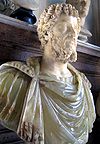 |
Septimius Severus Septimius Severus Septimius Severus , also known as Severus, was Roman Emperor from 193 to 211. Severus was born in Leptis Magna in the province of Africa. As a young man he advanced through the customary succession of offices under the reigns of Marcus Aurelius and Commodus. Severus seized power after the death of... CAESAR LVCIVS SEPTIMIVS SEVERVS PERTINAX AVGVSTVS |
April 11, 145 AD, Leptis Magna Leptis Magna Leptis Magna also known as Lectis Magna , also called Lpqy, Neapolis, Lebida or Lebda to modern-day residents of Libya, was a prominent city of the Roman Empire. Its ruins are located in Khoms, Libya, east of Tripoli, on the coast where the Wadi Lebda meets the sea... , Africa Africa Province The Roman province of Africa was established after the Romans defeated Carthage in the Third Punic War. It roughly comprised the territory of present-day northern Tunisia, and the small Mediterranean coast of modern-day western Libya along the Syrtis Minor... |
April 9, 193 AD – February 4, 211 AD | Seized power with support of Pannonia Pannonia Pannonia was an ancient province of the Roman Empire bounded north and east by the Danube, coterminous westward with Noricum and upper Italy, and southward with Dalmatia and upper Moesia.... n legionsa |
February 4, 211 AD Natural causes |
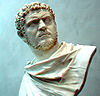 |
Caracalla Caracalla Caracalla , was Roman emperor from 198 to 217. The eldest son of Septimius Severus, he ruled jointly with his younger brother Geta until he murdered the latter in 211... CAESAR MARCVS AVRELIVS SEVERVS ANTONINVS PIVS AVGVSTVS |
April 4, 188 AD, Lugdunum Lugdunum Colonia Copia Claudia Augusta Lugdunum was an important Roman city in Gaul. The city was founded in 43 BC by Lucius Munatius Plancus. It served as the capital of the Roman province Gallia Lugdunensis. To 300 years after its foundation Lugdunum was the most important city to the west part of Roman... , Gallia Lugdunensis Gallia Lugdunensis Gallia Lugdunensis was a province of the Roman Empire in what is now the modern country of France, part of the Celtic territory of Gaul. It is named after its capital Lugdunum , possibly Roman Europe's major city west of Italy, and a major imperial mint... |
198 AD – April 8, 217 AD | Son of Septimius Severus Septimius Severus Septimius Severus , also known as Severus, was Roman Emperor from 193 to 211. Severus was born in Leptis Magna in the province of Africa. As a young man he advanced through the customary succession of offices under the reigns of Marcus Aurelius and Commodus. Severus seized power after the death of... ; co-emperor with Severus from 198 AD; with Severus and Geta Publius Septimius Geta Geta , was a Roman Emperor co-ruling with his father Septimius Severus and his older brother Caracalla from 209 to his death.-Early life:Geta was the younger son of Septimius Severus by his second wife Julia Domna... from 209 AD until February 211 AD; co-emperor with Geta until December 211 AD |
April 8, 217 AD Murdered by a soldier as part of a conspiracy involving Macrinus Macrinus Macrinus , was Roman Emperor from 217 to 218. Macrinus was of "Moorish" descent and the first emperor to become so without membership in the senatorial class.-Background and career:... |
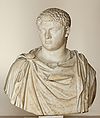 |
Geta Publius Septimius Geta Geta , was a Roman Emperor co-ruling with his father Septimius Severus and his older brother Caracalla from 209 to his death.-Early life:Geta was the younger son of Septimius Severus by his second wife Julia Domna... CAESAR PVBLIVS SEPTIMIVS GETA AVGVSTUS |
March 7, 189 AD, Rome Rome Rome is the capital of Italy and the country's largest and most populated city and comune, with over 2.7 million residents in . The city is located in the central-western portion of the Italian Peninsula, on the Tiber River within the Lazio region of Italy.Rome's history spans two and a half... |
209 AD – December 26, 211 AD | Son of Septimius Severus Septimius Severus Septimius Severus , also known as Severus, was Roman Emperor from 193 to 211. Severus was born in Leptis Magna in the province of Africa. As a young man he advanced through the customary succession of offices under the reigns of Marcus Aurelius and Commodus. Severus seized power after the death of... ; co-emperor with Severus and Caracalla Caracalla Caracalla , was Roman emperor from 198 to 217. The eldest son of Septimius Severus, he ruled jointly with his younger brother Geta until he murdered the latter in 211... from 209 AD until February 211 AD; co-emperor with Caracalla until December 211 AD |
December 26, 211 AD Murdered on the orders of Caracalla Caracalla Caracalla , was Roman emperor from 198 to 217. The eldest son of Septimius Severus, he ruled jointly with his younger brother Geta until he murdered the latter in 211... |
 |
Macrinus Macrinus Macrinus , was Roman Emperor from 217 to 218. Macrinus was of "Moorish" descent and the first emperor to become so without membership in the senatorial class.-Background and career:... MARCVS OPELLIVS SEVERVS MACRINVS AVGVSTVS PIVS FELIX with Diadumenian Diadumenian Diadumenian , was the son of the Roman Emperor Macrinus, and served his father briefly as Caesar and as Augustus . Diadumenian was born on the 14th of September 208 or, according to Historia Augusta, on the 19th of September because he shared the same birthday with the Emperor Antoninus Pius... MARCVS OPELLIVS ANTONINVS DIADUMENIANVS |
c. 165 AD, Iol Caesarea, Mauretania Mauretania Mauretania is a part of the historical Ancient Libyan land in North Africa. It corresponds to present day Morocco and a part of western Algeria... |
April 11, 217 AD – June 8, 218 AD | Praetorian Prefect Praetorian prefect Praetorian prefect was the title of a high office in the Roman Empire. Originating as the commander of the Praetorian Guard, the office gradually acquired extensive legal and administrative functions, with its holders becoming the Emperor's chief aides... to Caracalla Caracalla Caracalla , was Roman emperor from 198 to 217. The eldest son of Septimius Severus, he ruled jointly with his younger brother Geta until he murdered the latter in 211... , probably conspired to have Caracalla murdered and proclaimed himself emperor after Caracalla's death; appointed his son Diadumenian Diadumenian Diadumenian , was the son of the Roman Emperor Macrinus, and served his father briefly as Caesar and as Augustus . Diadumenian was born on the 14th of September 208 or, according to Historia Augusta, on the 19th of September because he shared the same birthday with the Emperor Antoninus Pius... junior emperor in May 217 |
June 8, 218 AD Both executed in favour of Elagabalus Elagabalus Elagabalus , also known as Heliogabalus, was Roman Emperor from 218 to 222. A member of the Severan Dynasty, he was Syrian on his mother's side, the son of Julia Soaemias and Sextus Varius Marcellus. Early in his youth he served as a priest of the god El-Gabal at his hometown, Emesa... |
_-_musei_capitolini_-_foto_giovanni_dallorto_-_15-08-2000_.jpg) |
Elagabalus Elagabalus Elagabalus , also known as Heliogabalus, was Roman Emperor from 218 to 222. A member of the Severan Dynasty, he was Syrian on his mother's side, the son of Julia Soaemias and Sextus Varius Marcellus. Early in his youth he served as a priest of the god El-Gabal at his hometown, Emesa... MARCVS AVRELIVS ANTONINVS AVGVSTVS |
c. 203 AD, Emesa, Syria Syria (Roman province) Syria was a Roman province, annexed in 64 BC by Pompey, as a consequence of his military presence after pursuing victory in the Third Mithridatic War. It remained under Roman, and subsequently Byzantine, rule for seven centuries, until 637 when it fell to the Islamic conquests.- Principate :The... |
June 8, 218 AD – March 11, 222 AD | Grandson of Septimius Severus Septimius Severus Septimius Severus , also known as Severus, was Roman Emperor from 193 to 211. Severus was born in Leptis Magna in the province of Africa. As a young man he advanced through the customary succession of offices under the reigns of Marcus Aurelius and Commodus. Severus seized power after the death of... 's sister-in-law, alleged illegitimate son of Caracalla Caracalla Caracalla , was Roman emperor from 198 to 217. The eldest son of Septimius Severus, he ruled jointly with his younger brother Geta until he murdered the latter in 211... ; proclaimed emperor by Syrian legions |
March 11, 222 AD Murdered by Praetorian Guard Praetorian Guard The Praetorian Guard was a force of bodyguards used by Roman Emperors. The title was already used during the Roman Republic for the guards of Roman generals, at least since the rise to prominence of the Scipio family around 275 BC... |
 |
Severus Alexander CAESAR MARCVS AVRELIVS SEVERVS ALEXANDER AVGVSTVS |
October 1, 208 AD, Arca Caesarea Arqa Arqa is a village near Miniara in Akkar District of the North Governorate in Lebanon, 22 km northeast of Tripoli, near the coast... , Iudaea Iudaea Province Judaea or Iudaea are terms used by historians to refer to the Roman province that extended over parts of the former regions of the Hasmonean and Herodian kingdoms of Israel... |
March 13, 222 AD – March 18, 235 AD | Grandson of Septimius Severus Septimius Severus Septimius Severus , also known as Severus, was Roman Emperor from 193 to 211. Severus was born in Leptis Magna in the province of Africa. As a young man he advanced through the customary succession of offices under the reigns of Marcus Aurelius and Commodus. Severus seized power after the death of... 's sister-in-law, cousin and adoptive heir of Elagabalus Elagabalus Elagabalus , also known as Heliogabalus, was Roman Emperor from 218 to 222. A member of the Severan Dynasty, he was Syrian on his mother's side, the son of Julia Soaemias and Sextus Varius Marcellus. Early in his youth he served as a priest of the god El-Gabal at his hometown, Emesa... |
March 18, 235 AD Murdered by the army |
| Notes | aThe other claimants for the throne in the Year of the Five Emperors Year of the Five Emperors The Year of the Five Emperors refers to the year 193 AD, in which there were five claimants for the title of Roman Emperor. The five were Pertinax, Didius Julianus, Pescennius Niger, Clodius Albinus and Septimius Severus.... were Pescennius Niger Pescennius Niger Pescennius Niger was a Roman usurper from 193 to 194 during the Year of the Five Emperors. He claimed the imperial throne in response to the murder of Pertinax and the elevation of Didius Julianus, but was defeated by a rival claimant, Septimius Severus and killed while attempting to flee from... and Clodius Albinus Clodius Albinus Clodius Albinus was a Roman usurper proclaimed emperor by the legions in Britain and Hispania upon the murder of Pertinax in 193.-Life:... , supported by the Syrian and British legions respectively. Although not completely defeated until 197 AD, they were not formally accepted by the senate and were therefore not technically reigning emperors. |
||||
Emperors during the Crisis of the Third Century
| Portrait | Name | Born | Reigned | Succession | Died |
|---|---|---|---|---|---|
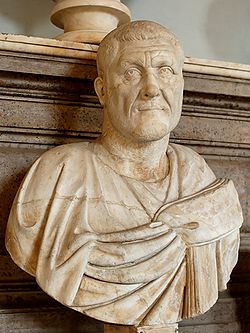 |
Maximinus I CAESAR GAIVS JVLIVS VERVS MAXIMINVS AVGVSTVS |
c.173 AD, Thrace Thrace Thrace is a historical and geographic area in southeast Europe. As a geographical concept, Thrace designates a region bounded by the Balkan Mountains on the north, Rhodope Mountains and the Aegean Sea on the south, and by the Black Sea and the Sea of Marmara on the east... or Moesia Moesia Moesia was an ancient region and later Roman province situated in the Balkans, along the south bank of the Danube River. It included territories of modern-day Southern Serbia , Northern Republic of Macedonia, Northern Bulgaria, Romanian Dobrudja, Southern Moldova, and Budjak .-History:In ancient... |
March 20, 235 AD – April 238 AD | Proclaimed emperor by German legions after the murder of Severus Alexander | April 238 AD Assassinated by Praetorian Guard Praetorian Guard The Praetorian Guard was a force of bodyguards used by Roman Emperors. The title was already used during the Roman Republic for the guards of Roman generals, at least since the rise to prominence of the Scipio family around 275 BC... |
 |
Gordian I Gordian I Gordian I , was Roman Emperor for one month with his son Gordian II in 238, the Year of the Six Emperors. Caught up in a rebellion against the Emperor Maximinus Thrax, he was defeated by forces loyal to Maximinus before committing suicide.-Early life:... CAESAR MARCVS ANTONIVS GORDIANVS SEMPRONIANVS AFRICANVS AVGVSTVS |
c. 159 AD, Phrygia Phrygia In antiquity, Phrygia was a kingdom in the west central part of Anatolia, in what is now modern-day Turkey. The Phrygians initially lived in the southern Balkans; according to Herodotus, under the name of Bryges , changing it to Phruges after their final migration to Anatolia, via the... ? |
March 22, 238 AD – April 12, 238 AD | Proclaimed emperor, whilst Pro-consul in Africa, during a revolt against Maximinus. Ruled jointly with his son Gordian II Gordian II Gordian II , was Roman Emperor for one month with his father Gordian I in 238, the Year of the Six Emperors. Seeking to overthrow the Emperor Maximinus Thrax, he died in battle outside of Carthage.-Early career:... , and in opposition to Maximinus. Technically a usurper, but retrospectively legitimised by the accession of Gordian III Gordian III Gordian III , was Roman Emperor from 238 to 244. Gordian was the son of Antonia Gordiana and an unnamed Roman Senator who died before 238. Antonia Gordiana was the daughter of Emperor Gordian I and younger sister of Emperor Gordian II. Very little is known on his early life before his acclamation... |
April 238 AD Committed suicide upon hearing of the death of Gordian II Gordian II Gordian II , was Roman Emperor for one month with his father Gordian I in 238, the Year of the Six Emperors. Seeking to overthrow the Emperor Maximinus Thrax, he died in battle outside of Carthage.-Early career:... . |
 |
Gordian II Gordian II Gordian II , was Roman Emperor for one month with his father Gordian I in 238, the Year of the Six Emperors. Seeking to overthrow the Emperor Maximinus Thrax, he died in battle outside of Carthage.-Early career:... CAESAR MARCVS ANTONIVS GORDIANVS SEMPRONIANVS ROMANVS AFRICANVS AVGVSTVS |
c. 192 AD, ? | March 22, 238 AD – April 12, 238 AD | Proclaimed emperor, alongside father Gordian I Gordian I Gordian I , was Roman Emperor for one month with his son Gordian II in 238, the Year of the Six Emperors. Caught up in a rebellion against the Emperor Maximinus Thrax, he was defeated by forces loyal to Maximinus before committing suicide.-Early life:... , in opposition to Maximinus by act of the Senate. |
April 238 AD Killed during the Battle of Carthage Battle of Carthage (238) The Battle of Carthage was fought in 238 between a Roman army loyal to Emperor Maximinus Thrax and the forces of Emperors Gordian I and Gordian II.... , fighting a pro-Maximinus army |
 |
Pupienus Pupienus Pupienus , also known as Pupienus Maximus, was Roman Emperor with Balbinus for three months in 238, the Year of the Six Emperors. The sources for this period are scant, and thus knowledge of the emperor is limited... CAESAR MARCVS CLODIVS PVPIENVS MAXIMVS AVGVSTVS |
c. 178 AD, ? | April 22, 238 AD – July 29, 238 AD | Proclaimed joint emperor with Balbinus Balbinus Balbinus , was Roman Emperor with Pupienus for three months in 238, the Year of the Six Emperors.- Origins and career :Not much is known about Balbinus before his elevation to emperor. It has been conjectured that he descended from Publius Coelius Balbinus Vibullius Pius, the consul ordinarius of... by the Senate Roman Senate The Senate of the Roman Republic was a political institution in the ancient Roman Republic, however, it was not an elected body, but one whose members were appointed by the consuls, and later by the censors. After a magistrate served his term in office, it usually was followed with automatic... in opposition to Maximinus; later co-emperor with Balbinus. |
July 29, 238 AD Assassinated by the Praetorian Guard Praetorian Guard The Praetorian Guard was a force of bodyguards used by Roman Emperors. The title was already used during the Roman Republic for the guards of Roman generals, at least since the rise to prominence of the Scipio family around 275 BC... |
| Balbinus Balbinus Balbinus , was Roman Emperor with Pupienus for three months in 238, the Year of the Six Emperors.- Origins and career :Not much is known about Balbinus before his elevation to emperor. It has been conjectured that he descended from Publius Coelius Balbinus Vibullius Pius, the consul ordinarius of... CAESAR DECIMVS CAELIVS CALVINVS BALBINVS PIVS AVGVSTVS |
? | April 22, 238 AD – July 29, 238 AD | Proclaimed joint emperor with Pupienus Pupienus Pupienus , also known as Pupienus Maximus, was Roman Emperor with Balbinus for three months in 238, the Year of the Six Emperors. The sources for this period are scant, and thus knowledge of the emperor is limited... by the Senate Roman Senate The Senate of the Roman Republic was a political institution in the ancient Roman Republic, however, it was not an elected body, but one whose members were appointed by the consuls, and later by the censors. After a magistrate served his term in office, it usually was followed with automatic... after death of Gordian I Gordian I Gordian I , was Roman Emperor for one month with his son Gordian II in 238, the Year of the Six Emperors. Caught up in a rebellion against the Emperor Maximinus Thrax, he was defeated by forces loyal to Maximinus before committing suicide.-Early life:... & II Gordian II Gordian II , was Roman Emperor for one month with his father Gordian I in 238, the Year of the Six Emperors. Seeking to overthrow the Emperor Maximinus Thrax, he died in battle outside of Carthage.-Early career:... , in opposition to Maximinus; later co-emperor with Pupienus and Gordian III Gordian III Gordian III , was Roman Emperor from 238 to 244. Gordian was the son of Antonia Gordiana and an unnamed Roman Senator who died before 238. Antonia Gordiana was the daughter of Emperor Gordian I and younger sister of Emperor Gordian II. Very little is known on his early life before his acclamation... |
July 29, 238 AD Assassinated by Praetorian Guard Praetorian Guard The Praetorian Guard was a force of bodyguards used by Roman Emperors. The title was already used during the Roman Republic for the guards of Roman generals, at least since the rise to prominence of the Scipio family around 275 BC... |
|
 |
Gordian III Gordian III Gordian III , was Roman Emperor from 238 to 244. Gordian was the son of Antonia Gordiana and an unnamed Roman Senator who died before 238. Antonia Gordiana was the daughter of Emperor Gordian I and younger sister of Emperor Gordian II. Very little is known on his early life before his acclamation... CAESAR MARCVS ANTONIVS GORDIANVS AVGVSTVS |
January 20, 225 AD, Rome Rome Rome is the capital of Italy and the country's largest and most populated city and comune, with over 2.7 million residents in . The city is located in the central-western portion of the Italian Peninsula, on the Tiber River within the Lazio region of Italy.Rome's history spans two and a half... |
April 22, 238 AD – February 11, 244 AD | Proclaimed emperor by supporters of Gordian I Gordian I Gordian I , was Roman Emperor for one month with his son Gordian II in 238, the Year of the Six Emperors. Caught up in a rebellion against the Emperor Maximinus Thrax, he was defeated by forces loyal to Maximinus before committing suicide.-Early life:... & II Gordian II Gordian II , was Roman Emperor for one month with his father Gordian I in 238, the Year of the Six Emperors. Seeking to overthrow the Emperor Maximinus Thrax, he died in battle outside of Carthage.-Early career:... , then by the Senate Roman Senate The Senate of the Roman Republic was a political institution in the ancient Roman Republic, however, it was not an elected body, but one whose members were appointed by the consuls, and later by the censors. After a magistrate served his term in office, it usually was followed with automatic... ; joint emperor with Pupienus Pupienus Pupienus , also known as Pupienus Maximus, was Roman Emperor with Balbinus for three months in 238, the Year of the Six Emperors. The sources for this period are scant, and thus knowledge of the emperor is limited... and Balbinus Balbinus Balbinus , was Roman Emperor with Pupienus for three months in 238, the Year of the Six Emperors.- Origins and career :Not much is known about Balbinus before his elevation to emperor. It has been conjectured that he descended from Publius Coelius Balbinus Vibullius Pius, the consul ordinarius of... until July 238 AD. |
February 11, 244 AD Unknown; possibly murdered on orders of Philip I Philip the Arab Philip the Arab , also known as Philip or Philippus Arabs, was Roman Emperor from 244 to 249. He came from Syria, and rose to become a major figure in the Roman Empire. He achieved power after the death of Gordian III, quickly negotiating peace with the Sassanid Empire... |
 |
Philip I Philip the Arab Philip the Arab , also known as Philip or Philippus Arabs, was Roman Emperor from 244 to 249. He came from Syria, and rose to become a major figure in the Roman Empire. He achieved power after the death of Gordian III, quickly negotiating peace with the Sassanid Empire... CAESAR MARCVS IVLIVS PHILLIPVS AVGVSTVS with Philip II Philippus II Marcus Julius Philippus Severus, also known as Philippus II, Philip II and Philip the Younger was the son and heir of the Roman Emperor Philip the Arab by his wife Roman Empress Marcia Otacilia Severa... |
c. 204 AD, Shahba Shahba Shahba , known in Late Antiquity as Philippopolis, is a city located 87 km south of Damascus in the Jabal el Druze in As-Suwayda Governorate of Syria, but formerly in the Roman province of Arabia Petraea.-Roman history:... , Syria Syria (Roman province) Syria was a Roman province, annexed in 64 BC by Pompey, as a consequence of his military presence after pursuing victory in the Third Mithridatic War. It remained under Roman, and subsequently Byzantine, rule for seven centuries, until 637 when it fell to the Islamic conquests.- Principate :The... |
February 244 AD – September/October 249 AD | Praetorian Prefect Praetorian prefect Praetorian prefect was the title of a high office in the Roman Empire. Originating as the commander of the Praetorian Guard, the office gradually acquired extensive legal and administrative functions, with its holders becoming the Emperor's chief aides... to Gordian III Gordian III Gordian III , was Roman Emperor from 238 to 244. Gordian was the son of Antonia Gordiana and an unnamed Roman Senator who died before 238. Antonia Gordiana was the daughter of Emperor Gordian I and younger sister of Emperor Gordian II. Very little is known on his early life before his acclamation... , took power after his death; made his son Philip II Philippus II Marcus Julius Philippus Severus, also known as Philippus II, Philip II and Philip the Younger was the son and heir of the Roman Emperor Philip the Arab by his wife Roman Empress Marcia Otacilia Severa... co-emperor in summer 247 AD |
September/October 249 AD Killed in battle against Trajan Decius, near Verona Verona Verona ; German Bern, Dietrichsbern or Welschbern) is a city in the Veneto, northern Italy, with approx. 265,000 inhabitants and one of the seven chef-lieus of the region. It is the second largest city municipality in the region and the third of North-Eastern Italy. The metropolitan area of Verona... |
.jpg) |
Trajan Decius CAESAR GAIVS MESSIVS QVINTVS TRAIANVS DECIVS AVGVSTVS with Herennius Etruscus Herennius Etruscus Herennius Etruscus , was Roman emperor in 251, in a joint rule with his father Decius. Emperor Hostilian was his younger brother.Herennius was born in near Sirmium in Pannonia , during one of his father's military postings. His mother was Herennia Cupressenia Etruscilla, a Roman lady of an... |
c. 201 AD, Budalia, Lower Pannonia Lower Pannonia The Lower Pannonia or Pannonia Inferior was an ancient Roman province. It was formed in the year 103 AD. The Lower Pannonia included parts of present-day Hungary, Serbia, Croatia, and Bosnia and Herzegovina.-Cities:... |
September/ October 249 AD – June 251 AD | Governor under Philip I Philip I Philip I may refer to:* Philip I of Macedon * Philip I Philadelphus * Philip the Arab , Roman Emperor* Philip I of France * Philip I... ; proclaimed emperor by Danubian legions and defeated Philip in battle; made his son Herennius Etruscus Herennius Etruscus Herennius Etruscus , was Roman emperor in 251, in a joint rule with his father Decius. Emperor Hostilian was his younger brother.Herennius was born in near Sirmium in Pannonia , during one of his father's military postings. His mother was Herennia Cupressenia Etruscilla, a Roman lady of an... co-emperor in early 251 AD |
June 251 AD Both killed in the Battle of Abrittus Battle of Abrittus The Battle of Abritus, also known as the Battle of Forum Terebronii, occurred in the Roman province of Moesia Inferior probably in July, 251, between the Roman Empire and a federation of Scythian tribesmen under the Goth king Cniva. The Romans were soundly defeated, and Roman emperors Decius and... fighting against the Goths Goths The Goths were an East Germanic tribe of Scandinavian origin whose two branches, the Visigoths and the Ostrogoths, played an important role in the fall of the Roman Empire and the emergence of Medieval Europe.... |
 |
Hostilian Hostilian Hostilian was Roman emperor in 251. Hostilian was born in Sirmium in Illyricum sometime after 230, as the son of the future emperor Decius by his wife Herennia Cupressenia Etruscilla... CAESAR CAIVS VALENS HOSTILIANVS MESSIVS QVINTVS AVGVSTVS |
Rome | June 251 AD – late 251 AD | Son of Trajan Decius, accepted as heir by the Senate Roman Senate The Senate of the Roman Republic was a political institution in the ancient Roman Republic, however, it was not an elected body, but one whose members were appointed by the consuls, and later by the censors. After a magistrate served his term in office, it usually was followed with automatic... |
September/October 251 AD Natural causes (Plague) |
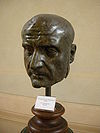 |
Trebonianus Gallus Trebonianus Gallus Trebonianus Gallus , also known as Gallus, was Roman Emperor from 251 to 253, in a joint rule with his son Volusianus.-Early life:Gallus was born in Italy, in a family with respected ancestry of Etruscan senatorial background. He had two children in his marriage with Afinia Gemina Baebiana: Gaius... CAESAR GAIVS VIBIVS TREBONIANVS GALLVS AVGVSTVS with Volusianus Volusianus Volusianus , also known as Volusian, was a Roman Emperor from 251 to 253.He was son to Gaius Vibius Trebonianus Gallus by his wife Afinia Gemina Baebiana. He is known to have had a sister, Vibia Galla.... |
206 AD, Italia Italia (Roman province) Italia was the name of the Italian peninsula of the Roman Empire.-Under the Republic and Augustan organization:During the Republic and the first centuries of the empire, Italia was not a province, but rather the territory of the city of Rome, thus having a special status: for example, military... |
June 251 AD – August 253 AD | Governor of Moesia Superior, proclaimed emperor by Danubian legions after Trajan Decius's death (and in opposition to Hostilian Hostilian Hostilian was Roman emperor in 251. Hostilian was born in Sirmium in Illyricum sometime after 230, as the son of the future emperor Decius by his wife Herennia Cupressenia Etruscilla... ); made his son Volusianus Volusianus Volusianus , also known as Volusian, was a Roman Emperor from 251 to 253.He was son to Gaius Vibius Trebonianus Gallus by his wife Afinia Gemina Baebiana. He is known to have had a sister, Vibia Galla.... co-emperor in late 251 AD. |
August 253 AD Assassinated by their own troops, in favour of Aemilian |
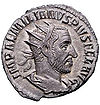 |
Aemilian CAESAR MARCVS AEMILIVS AEMILIANVS AVGVSTVS |
c. 207 AD Africa Africa Province The Roman province of Africa was established after the Romans defeated Carthage in the Third Punic War. It roughly comprised the territory of present-day northern Tunisia, and the small Mediterranean coast of modern-day western Libya along the Syrtis Minor... |
August 253 AD – October 253 AD | Governor of Moesia Superior, proclaimed emperor by Danubian legions after defeating the Goths Goths The Goths were an East Germanic tribe of Scandinavian origin whose two branches, the Visigoths and the Ostrogoths, played an important role in the fall of the Roman Empire and the emergence of Medieval Europe.... ; accepted as emperor after death of Gallus Trebonianus Gallus Trebonianus Gallus , also known as Gallus, was Roman Emperor from 251 to 253, in a joint rule with his son Volusianus.-Early life:Gallus was born in Italy, in a family with respected ancestry of Etruscan senatorial background. He had two children in his marriage with Afinia Gemina Baebiana: Gaius... |
September/October 253 AD Assassinated by his own troops, in favour of Valerian |
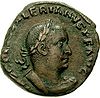 |
Valerian CAESAR PVBLIVS LICINIVS VALERIANVSAVGVSTVS |
c. 195 AD | October 253 AD – 260 AD | Governor of Noricum Noricum Noricum, in ancient geography, was a Celtic kingdom stretching over the area of today's Austria and a part of Slovenia. It became a province of the Roman Empire... and Raetia Raetia Raetia was a province of the Roman Empire, named after the Rhaetian people. It was bounded on the west by the country of the Helvetii, on the east by Noricum, on the north by Vindelicia, on the west by Cisalpine Gaul and on south by Venetia et Histria... , proclaimed emperor by Rhine legions after death of Gallus Trebonianus Gallus Trebonianus Gallus , also known as Gallus, was Roman Emperor from 251 to 253, in a joint rule with his son Volusianus.-Early life:Gallus was born in Italy, in a family with respected ancestry of Etruscan senatorial background. He had two children in his marriage with Afinia Gemina Baebiana: Gaius... ; accepted as emperor after death of Aemilian |
After 260 AD Captured in Battle of Edessa Battle of Edessa The Battle of Edessa took place between the armies of the Roman Empire under the command of Emperor Valerian and Sassanid forces under Shahanshah Shapur I in 259... against Persians Sassanid Empire The Sassanid Empire , known to its inhabitants as Ērānshahr and Ērān in Middle Persian and resulting in the New Persian terms Iranshahr and Iran , was the last pre-Islamic Persian Empire, ruled by the Sasanian Dynasty from 224 to 651... , died in captivity |
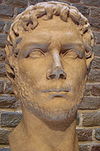 |
Gallienus Gallienus Gallienus was Roman Emperor with his father Valerian from 253 to 260, and alone from 260 to 268. He took control of the Empire at a time when it was undergoing great crisis... CAESAR PVBLIVS LICINIVS EGNATIVS GALLIENVS AVGVSTVS with Saloninus Saloninus Publius Licinius Cornelius Saloninus Valerianus was Roman Emperor in 259 or 260.-Early life:Saloninus was born around the year 242. His father was the later emperor Gallienus, his mother Cornelia Salonina, a Greek from Bithynia... |
218 AD | October 253 AD – September 268 AD | Son of Valerian, made co-emperor in 253 AD; his son Saloninus Saloninus Publius Licinius Cornelius Saloninus Valerianus was Roman Emperor in 259 or 260.-Early life:Saloninus was born around the year 242. His father was the later emperor Gallienus, his mother Cornelia Salonina, a Greek from Bithynia... is very briefly co-emperor in c. July before assassination by Postumus Postumus Marcus Cassianius Latinius Postumus was a Roman emperor of Batavian origin. He usurped power from Gallienus in 260 and formed the so-called Gallic Empire... . |
September 268 AD Murdered at Aquileia Aquileia Aquileia is an ancient Roman city in what is now Italy, at the head of the Adriatic at the edge of the lagoons, about 10 km from the sea, on the river Natiso , the course of which has changed somewhat since Roman times... by his own commanders. |
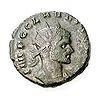 |
Claudius Gothicus CAESAR MARCVS AVRELIVS CLAVDIVS AVGVSTVS |
May 10, 213 AD/214 AD, Sirmium Sirmium Sirmium was a city in ancient Roman Pannonia. Firstly mentioned in the 4th century BC and originally inhabited by the Illyrians and Celts, it was conquered by the Romans in the 1st century BC and subsequently became the capital of the Roman province of Lower Pannonia. In 294 AD, Sirmium was... |
September 268 AD – January 270 AD | Victorious general at Battle of Naissus Battle of Naissus The Battle of Naissus was the defeat of a Gothic coalition by the Roman Empire under Emperor Gallienus near Naissus... , seized power after Gallienus Gallienus Gallienus was Roman Emperor with his father Valerian from 253 to 260, and alone from 260 to 268. He took control of the Empire at a time when it was undergoing great crisis... 's death |
January 270 AD Natural causes (Plague) |
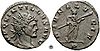 |
Quintillus Quintillus Quintillus , commonly known as Quintillus, was Roman Emperor for less than a year in 270.-Early Life and Election as Emperor:Quintillus was born at Sirmium in Illyricum. Originally coming from a low born family, Quintillus came to prominence with the accession of his brother Claudius II Gothicus to... CAESAR MARCVS AVRELIVS CLAVDIVS QVINTILLVS AVGVSTVS |
?, Sirmium Sirmium Sirmium was a city in ancient Roman Pannonia. Firstly mentioned in the 4th century BC and originally inhabited by the Illyrians and Celts, it was conquered by the Romans in the 1st century BC and subsequently became the capital of the Roman province of Lower Pannonia. In 294 AD, Sirmium was... |
January 270 AD – 270 AD | Brother of Claudius Gothicus, seized power after his death | 270 AD Unclear; possibly suicide or murder |
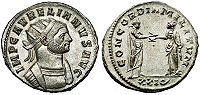 |
Aurelian Aurelian Aurelian , was Roman Emperor from 270 to 275. During his reign, he defeated the Alamanni after a devastating war. He also defeated the Goths, Vandals, Juthungi, Sarmatians, and Carpi. Aurelian restored the Empire's eastern provinces after his conquest of the Palmyrene Empire in 273. The following... CAESAR LVCIVS DOMITIVS AVRELIANVS AVGVSTVS |
September 9, 214 AD/215 AD, Sirmium Sirmium Sirmium was a city in ancient Roman Pannonia. Firstly mentioned in the 4th century BC and originally inhabited by the Illyrians and Celts, it was conquered by the Romans in the 1st century BC and subsequently became the capital of the Roman province of Lower Pannonia. In 294 AD, Sirmium was... |
September(?) 270 AD – September 275 AD | Proclaimed emperor by Danubian legions after Claudius II Claudius II Claudius II , commonly known as Claudius Gothicus, was Roman Emperor from 268 to 270. During his reign he fought successfully against the Alamanni and scored a crushing victory against the Goths at the Battle of Naissus. He died after succumbing to a smallpox plague that ravaged the provinces of... 's death, in opposition to Quintillus Quintillus Quintillus , commonly known as Quintillus, was Roman Emperor for less than a year in 270.-Early Life and Election as Emperor:Quintillus was born at Sirmium in Illyricum. Originally coming from a low born family, Quintillus came to prominence with the accession of his brother Claudius II Gothicus to... |
September 275 AD Assassinated by Praetorian Guard Praetorian Guard The Praetorian Guard was a force of bodyguards used by Roman Emperors. The title was already used during the Roman Republic for the guards of Roman generals, at least since the rise to prominence of the Scipio family around 275 BC... |
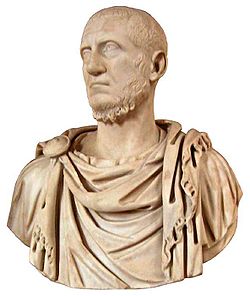 |
Tacitus Marcus Claudius Tacitus Tacitus , was Roman Emperor from 275 to 276. During his short reign he campaigned against the Goths and the Heruli, for which he received the title Gothicus Maximus.-Biography:Tacitus was born in Interamna , in Italia... CAESAR MARCVS CLAVDIVS TACITVS AVGVSTVS |
c. 200, Interamna Terni Terni is a city in southern Umbria, central Italy, capital of the province of Terni, located in the plain of the Nera river. It is 104 km N of Rome, 36 km NW of Rieti, and 29 km S of Spoleto.-History:... |
September 25, 275 AD – June 276 AD | Elected by the Senate Roman Senate The Senate of the Roman Republic was a political institution in the ancient Roman Republic, however, it was not an elected body, but one whose members were appointed by the consuls, and later by the censors. After a magistrate served his term in office, it usually was followed with automatic... to replace Aurelian Aurelian Aurelian , was Roman Emperor from 270 to 275. During his reign, he defeated the Alamanni after a devastating war. He also defeated the Goths, Vandals, Juthungi, Sarmatians, and Carpi. Aurelian restored the Empire's eastern provinces after his conquest of the Palmyrene Empire in 273. The following... , after a short interregnum Interregnum An interregnum is a period of discontinuity or "gap" in a government, organization, or social order... |
June 276 AD Natural causes (possibly assassinated) |
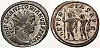 |
Florian Florianus -Biography: Florian was reportedly a maternal half-brother to the Emperor Marcus Claudius Tacitus. Appointed Praetorian Prefect in Tacitus's army in his campaign against the Goths, according to the available sources, he was chosen by the army in the West to succeed Tacitus in 276, without the... CAESAR MARCVS ANNIVS FLORIANVS AVGVSTVS |
? | June 276 AD – September? 276 AD | Brother of Tacitus Tacitus Publius Cornelius Tacitus was a senator and a historian of the Roman Empire. The surviving portions of his two major works—the Annals and the Histories—examine the reigns of the Roman Emperors Tiberius, Claudius, Nero and those who reigned in the Year of the Four Emperors... , elected by the army in the west to replace him |
September? 276 AD Assassinated by his own troops, in favour of Probus |
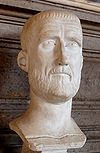 |
Probus CAESAR MARCVS AVRELIVS PROBVS AVGVSTVS |
232 AD, Sirmium Sirmium Sirmium was a city in ancient Roman Pannonia. Firstly mentioned in the 4th century BC and originally inhabited by the Illyrians and Celts, it was conquered by the Romans in the 1st century BC and subsequently became the capital of the Roman province of Lower Pannonia. In 294 AD, Sirmium was... |
September? 276 AD – September/ October 282 AD | Governor of the eastern provinces, proclaimed emperor by Danubian legions in opposition to Florian Florian Florian may refer to:*Florian , including a list of people with the given name or surname of Florian* Marcus Annius Florianus, Roman emperor for a few months before his death in 276 AD* Saint Florian, patron saint of Poland, died around 304 AD... |
September/ October 282 AD Assassinated by his own troops, in favour of Carus Carus Carus , was Roman Emperor from 282 to 283. During his short reign, Carus fought the Germanic tribes and Sarmatians along the Danube frontier with success. During his campaign against the Sassanid Empire he sacked their capital Ctesiphon, but died shortly thereafter... |
| Carus Carus Carus , was Roman Emperor from 282 to 283. During his short reign, Carus fought the Germanic tribes and Sarmatians along the Danube frontier with success. During his campaign against the Sassanid Empire he sacked their capital Ctesiphon, but died shortly thereafter... CAESAR MARCVS AVRELIVS CARVS AVGVSTVS |
c. 230 AD, Narbo | September/ October 282 AD – late July/ early August 283 AD | Praetorian Prefect Praetorian prefect Praetorian prefect was the title of a high office in the Roman Empire. Originating as the commander of the Praetorian Guard, the office gradually acquired extensive legal and administrative functions, with its holders becoming the Emperor's chief aides... to Probus; seized power either before or after Probus was murdered |
Late July/early August 283 AD Natural causes? (Possibly killed by lightning) |
|
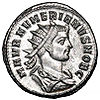 |
Numerian Numerian Numerian , was a Roman Emperor from 282 to 284 with his older brother Carinus. They were sons of Carus, a general raised to the office of praetorian prefect under Emperor Probus in 282.-Reign:... CAESAR MARCVS AVRELIVS NVMERIVS NVMERIANVS AVGVSTVS |
? | Late July/early August 283 AD – 284 AD? | Son of Carus Carus Carus , was Roman Emperor from 282 to 283. During his short reign, Carus fought the Germanic tribes and Sarmatians along the Danube frontier with success. During his campaign against the Sassanid Empire he sacked their capital Ctesiphon, but died shortly thereafter... , succeeded him jointly with his brother Carinus Carinus Carinus , was Roman Emperor 282 to 285. The elder son of emperor Carus, he was appointed Caesar and co-emperor of the western portion of the empire upon his father's accession... |
284 AD Unclear; possibly assassinated |
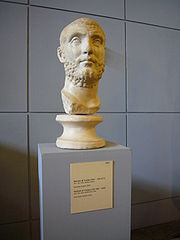 |
Carinus Carinus Carinus , was Roman Emperor 282 to 285. The elder son of emperor Carus, he was appointed Caesar and co-emperor of the western portion of the empire upon his father's accession... CAESAR MARCVS AVRELIVS CARINVS AVGVSTVS |
? | Late July/early August 283 AD – 285 AD | Son of Carus Carus Carus , was Roman Emperor from 282 to 283. During his short reign, Carus fought the Germanic tribes and Sarmatians along the Danube frontier with success. During his campaign against the Sassanid Empire he sacked their capital Ctesiphon, but died shortly thereafter... , succeeded him jointly with his brother Numerian Numerian Numerian , was a Roman Emperor from 282 to 284 with his older brother Carinus. They were sons of Carus, a general raised to the office of praetorian prefect under Emperor Probus in 282.-Reign:... |
285 AD Died in battle against Diocletian Diocletian Diocletian |latinized]] upon his accession to Diocletian . c. 22 December 244 – 3 December 311), was a Roman Emperor from 284 to 305.... ? |
Tetrarchy and Constantinian dynasty
| Portrait | Name | Born | Reigned | Succession | Died |
|---|---|---|---|---|---|
| Diocletian Diocletian Diocletian |latinized]] upon his accession to Diocletian . c. 22 December 244 – 3 December 311), was a Roman Emperor from 284 to 305.... CAESAR GAIVS AVRELIVS VALERIVS DIOCLETIANVS AVGVSTVS |
c. December 22, 244 AD, Salona Salona Salona was an ancient Illyrian Delmati city in the first millennium BC. The Greeks had set up an emporion there. After the conquest by the Romans, Salona became the capital of the Roman province of Dalmatia... |
November 20, 284 AD – May 1, 305 AD | Proclaimed emperor by army after death of Numerian Numerian Numerian , was a Roman Emperor from 282 to 284 with his older brother Carinus. They were sons of Carus, a general raised to the office of praetorian prefect under Emperor Probus in 282.-Reign:... , and in opposition to Carinus Carinus Carinus , was Roman Emperor 282 to 285. The elder son of emperor Carus, he was appointed Caesar and co-emperor of the western portion of the empire upon his father's accession... ; adopted Maximian Maximian Maximian was Roman Emperor from 286 to 305. He was Caesar from 285 to 286, then Augustus from 286 to 305. He shared the latter title with his co-emperor and superior, Diocletian, whose political brain complemented Maximian's military brawn. Maximian established his residence at Trier but spent... as senior co-emperor in 286 AD |
3 December 311 AD Abdicated; died of natural causes in Aspalatos Split (city) Split is a Mediterranean city on the eastern shores of the Adriatic Sea, centered around the ancient Roman Palace of the Emperor Diocletian and its wide port bay. With a population of 178,192 citizens, and a metropolitan area numbering up to 467,899, Split is by far the largest Dalmatian city and... |
|
| Maximian Maximian Maximian was Roman Emperor from 286 to 305. He was Caesar from 285 to 286, then Augustus from 286 to 305. He shared the latter title with his co-emperor and superior, Diocletian, whose political brain complemented Maximian's military brawn. Maximian established his residence at Trier but spent... CAESAR GAIVS AVRELIVS VALERIVS MAXIMIANVS AVGVSTVS |
c. 250 AD, near Sirmium Sirmium Sirmium was a city in ancient Roman Pannonia. Firstly mentioned in the 4th century BC and originally inhabited by the Illyrians and Celts, it was conquered by the Romans in the 1st century BC and subsequently became the capital of the Roman province of Lower Pannonia. In 294 AD, Sirmium was... , Pannonia Pannonia Pannonia was an ancient province of the Roman Empire bounded north and east by the Danube, coterminous westward with Noricum and upper Italy, and southward with Dalmatia and upper Moesia.... |
April 1, 286 AD – May 1, 305 AD | Adopted as senior co-emperor ('Augustus') in the west by Diocletian Diocletian Diocletian |latinized]] upon his accession to Diocletian . c. 22 December 244 – 3 December 311), was a Roman Emperor from 284 to 305.... in 286 AD |
310 AD Abdicated with Diocletian Diocletian Diocletian |latinized]] upon his accession to Diocletian . c. 22 December 244 – 3 December 311), was a Roman Emperor from 284 to 305.... ; twice tried to regain throne with, and then from Maxentius Maxentius Maxentius was a Roman Emperor from 306 to 312. He was the son of former Emperor Maximian, and the son-in-law of Emperor Galerius.-Birth and early life:Maxentius' exact date of birth is unknown; it was probably around 278... ; captured by Constantine I Constantine I Constantine the Great , also known as Constantine I or Saint Constantine, was Roman Emperor from 306 to 337. Well known for being the first Roman emperor to convert to Christianity, Constantine and co-Emperor Licinius issued the Edict of Milan in 313, which proclaimed religious tolerance of all... and committed suicide at his behest |
|
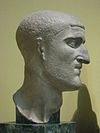 |
Constantius I Chlorus CAESAR GAIVS FLAVIVS VALERIVS CONSTANTIVS AVGVSTVS |
March 31 c. 250 AD, Dardania, Moesia Moesia Moesia was an ancient region and later Roman province situated in the Balkans, along the south bank of the Danube River. It included territories of modern-day Southern Serbia , Northern Republic of Macedonia, Northern Bulgaria, Romanian Dobrudja, Southern Moldova, and Budjak .-History:In ancient... |
May 1, 305 AD – July 25, 306 AD | Adopted as junior co-emperor ('Caesar') and heir by Maximian Maximian Maximian was Roman Emperor from 286 to 305. He was Caesar from 285 to 286, then Augustus from 286 to 305. He shared the latter title with his co-emperor and superior, Diocletian, whose political brain complemented Maximian's military brawn. Maximian established his residence at Trier but spent... in 293 AD |
306 AD Natural causes |
 |
Galerius Galerius Galerius , was Roman Emperor from 305 to 311. During his reign he campaigned, aided by Diocletian, against the Sassanid Empire, sacking their capital Ctesiphon in 299. He also campaigned across the Danube against the Carpi, defeating them in 297 and 300... CAESAR GALERIVS VALERIVS MAXIMIANVS AVGVSTVS |
c. 260 AD, Felix Romuliana Gamzigrad Gamzigrad is an archaeological site, spa resort and UNESCO World Heritage Site of Serbia, located south of the Danube river, near the city of Zaječar. It is the location of the ancient Roman complex of palaces and temples Felix Romuliana, built by Emperor Galerius... , Moesia Superior |
May 1, 305 AD – May 311 AD | Adopted as junior co-emperor ('Caesar') and heir by Diocletian Diocletian Diocletian |latinized]] upon his accession to Diocletian . c. 22 December 244 – 3 December 311), was a Roman Emperor from 284 to 305.... in 293 AD |
311 AD Natural causes |
 |
Severus II FLAVIVS VALERIVS SEVERVS AVGVSTVS |
? | Summer 306 AD – March/ April 307 AD | Adopted as junior co-emperor ('Caesar') and heir by Constantius I Chlorus in 305 AD; succeeded as Augustus in 306; opposed by Maxentius Maxentius Maxentius was a Roman Emperor from 306 to 312. He was the son of former Emperor Maximian, and the son-in-law of Emperor Galerius.-Birth and early life:Maxentius' exact date of birth is unknown; it was probably around 278... and Constantine I Constantine I Constantine the Great , also known as Constantine I or Saint Constantine, was Roman Emperor from 306 to 337. Well known for being the first Roman emperor to convert to Christianity, Constantine and co-Emperor Licinius issued the Edict of Milan in 313, which proclaimed religious tolerance of all... |
September 16, 307 AD Captured by Maxentius Maxentius Maxentius was a Roman Emperor from 306 to 312. He was the son of former Emperor Maximian, and the son-in-law of Emperor Galerius.-Birth and early life:Maxentius' exact date of birth is unknown; it was probably around 278... and forced to commit suicide (or murdered) |
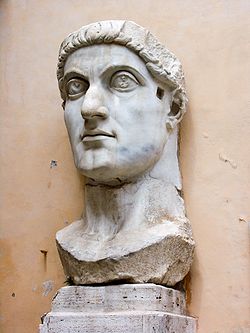 |
Constantine I Constantine I Constantine the Great , also known as Constantine I or Saint Constantine, was Roman Emperor from 306 to 337. Well known for being the first Roman emperor to convert to Christianity, Constantine and co-Emperor Licinius issued the Edict of Milan in 313, which proclaimed religious tolerance of all... CAESAR FLAVIVS CONSTANTINVS VALERIVS AVGVSTVS |
February 27 c. 272 AD, Naissus, Moesia Superior | 25 July 306 AD – May 22, 337 AD | Son of Constantius I Chlorus, proclaimed emperor by his father's troops; accepted as Caesar (west) by Galerius in 306 AD; promoted to Augustus (west) in 307 AD by Maximian after death of Severus II Flavius Valerius Severus Severus , sometimes known as Severus II, was a Western Roman Emperor from 306 to 307.- Officer in the Roman army :Severus was of humble birth, born in the Illyrian provinces around the middle of the third century AD... ; refused relegation to Caesar in 309 AD |
May 22, 337 AD Natural causes |
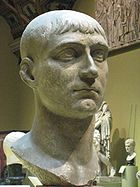 |
Maxentius Maxentius Maxentius was a Roman Emperor from 306 to 312. He was the son of former Emperor Maximian, and the son-in-law of Emperor Galerius.-Birth and early life:Maxentius' exact date of birth is unknown; it was probably around 278... MARCVS AVRELIVS VALERIVS MAXENTIVS AVGVSTVS |
c. 278 AD, ? | 28 October 306 AD – October 28, 312 AD | Son of Maximian Maximian Maximian was Roman Emperor from 286 to 305. He was Caesar from 285 to 286, then Augustus from 286 to 305. He shared the latter title with his co-emperor and superior, Diocletian, whose political brain complemented Maximian's military brawn. Maximian established his residence at Trier but spent... , seized power in 306 after death of Constantius I Chlorus, in opposition to Severus Flavius Valerius Severus Severus , sometimes known as Severus II, was a Western Roman Emperor from 306 to 307.- Officer in the Roman army :Severus was of humble birth, born in the Illyrian provinces around the middle of the third century AD... and Constantine I Constantine I Constantine the Great , also known as Constantine I or Saint Constantine, was Roman Emperor from 306 to 337. Well known for being the first Roman emperor to convert to Christianity, Constantine and co-Emperor Licinius issued the Edict of Milan in 313, which proclaimed religious tolerance of all... ; made Caesar (west) by Maximian in 307 AD after the death of Severus |
October 28, 312 AD Died at the Battle of the Milvian Bridge, against Constantine I Constantine I Constantine the Great , also known as Constantine I or Saint Constantine, was Roman Emperor from 306 to 337. Well known for being the first Roman emperor to convert to Christianity, Constantine and co-Emperor Licinius issued the Edict of Milan in 313, which proclaimed religious tolerance of all... |
 |
Maximinus II CAESAR GALERIVS VALERIVS MAXIMINVS AVGVSTVS |
November 20 c. 270 AD, Dacia Aureliana Dacia Aureliana Dacia Aureliana was a province of the Roman Empire found by Emperor Aurelian, after his retreat from Dacia Traiana in 271. Between 271/275 and 285, it occupied most of what is today Bulgaria. Its capital was in Serdica... |
May 1, 311 AD – July/August 313 AD | Nephew of Galerius, adopted as Caesar and his heir in 305 AD; succeeded as Augustus (shared with Licinius I) in 311 AD | July/August 313 AD Defeated in civil war against Licinius I; probably committed suicide thereafter |
| Licinius I CAESAR GAIVS VALERIVS LICINIVS AVGVSTVS with Valerius Valens Valerius Valens Aurelius Valerius Valens was Roman Emperor from late 316 to March 1, 317. Valens had previously been dux limitis in Dacia, but this is all we know of him.... Martinian Sextus Martinianus Sextus Marcius Martinianus was Roman Emperor from July to September 18, 324. He had been appointed co-emperor by Licinius.-Elevation:... |
c. 250 AD, Felix Romuliana, Moesia Superior | November 11, 308 AD – September 18, 324 AD | Appointed Augustus in the west by Galerius Galerius Galerius , was Roman Emperor from 305 to 311. During his reign he campaigned, aided by Diocletian, against the Sassanid Empire, sacking their capital Ctesiphon in 299. He also campaigned across the Danube against the Carpi, defeating them in 297 and 300... in 308 AD, in opposition to Maxentius Maxentius Maxentius was a Roman Emperor from 306 to 312. He was the son of former Emperor Maximian, and the son-in-law of Emperor Galerius.-Birth and early life:Maxentius' exact date of birth is unknown; it was probably around 278... ; became Augustus in the east in 311 AD after the death of Galerius (shared with Maximinus II); defeated Maximinus in civil war to become sole eastern Augustus in 313 AD; appointed Valerius Valens Valerius Valens Aurelius Valerius Valens was Roman Emperor from late 316 to March 1, 317. Valens had previously been dux limitis in Dacia, but this is all we know of him.... in 317 AD, and Martinian Sextus Martinianus Sextus Marcius Martinianus was Roman Emperor from July to September 18, 324. He had been appointed co-emperor by Licinius.-Elevation:... in 324 AD as western Augustus, in opposition to Constantine, both being executed within weeks. |
325 AD Defeated in civil war against Constantine I Constantine I Constantine the Great , also known as Constantine I or Saint Constantine, was Roman Emperor from 306 to 337. Well known for being the first Roman emperor to convert to Christianity, Constantine and co-Emperor Licinius issued the Edict of Milan in 313, which proclaimed religious tolerance of all... in 324 AD and captured; executed on the orders of Constantine the next year |
|
| Constantine II Constantine II (emperor) Constantine II , was Roman Emperor from 337 to 340. Co-emperor alongside his brothers, his short reign saw the beginnings of conflict emerge between the sons of Constantine the Great, and his attempt to exert his perceived rights of primogeniture ended up causing his death in a failed invasion of... CAESAR FLAVIVS CLAVDIVS CONSTANTINVS AVGVSTVS |
316 AD, Arles Arles Arles is a city and commune in the south of France, in the Bouches-du-Rhône department, of which it is a subprefecture, in the former province of Provence.... |
May 22, 337 AD – 340 AD | Son of Constantine I Constantine I Constantine the Great , also known as Constantine I or Saint Constantine, was Roman Emperor from 306 to 337. Well known for being the first Roman emperor to convert to Christianity, Constantine and co-Emperor Licinius issued the Edict of Milan in 313, which proclaimed religious tolerance of all... ; appointed Caesar in 317 AD, succeeded as joint Augustus with his brothers Constantius II Constantius II Constantius II , was Roman Emperor from 337 to 361. The second son of Constantine I and Fausta, he ascended to the throne with his brothers Constantine II and Constans upon their father's death.... and Constans I |
340 AD Died in battle against Constans I |
|
.jpg) |
Constantius II Constantius II Constantius II , was Roman Emperor from 337 to 361. The second son of Constantine I and Fausta, he ascended to the throne with his brothers Constantine II and Constans upon their father's death.... CAESAR FLAVIVS IVLIVS CONSTANTIVS AVGVSTVS |
August 7, 317 AD, Sirmium Sirmium Sirmium was a city in ancient Roman Pannonia. Firstly mentioned in the 4th century BC and originally inhabited by the Illyrians and Celts, it was conquered by the Romans in the 1st century BC and subsequently became the capital of the Roman province of Lower Pannonia. In 294 AD, Sirmium was... , Pannonia Pannonia Pannonia was an ancient province of the Roman Empire bounded north and east by the Danube, coterminous westward with Noricum and upper Italy, and southward with Dalmatia and upper Moesia.... |
May 22, 337 AD – November 3, 361 AD | Son of Constantine I Constantine I Constantine the Great , also known as Constantine I or Saint Constantine, was Roman Emperor from 306 to 337. Well known for being the first Roman emperor to convert to Christianity, Constantine and co-Emperor Licinius issued the Edict of Milan in 313, which proclaimed religious tolerance of all... ; succeeded as joint Augustus with his brothers Constantine II Constantine II (emperor) Constantine II , was Roman Emperor from 337 to 340. Co-emperor alongside his brothers, his short reign saw the beginnings of conflict emerge between the sons of Constantine the Great, and his attempt to exert his perceived rights of primogeniture ended up causing his death in a failed invasion of... and Constans I; sole emperor from 350 AD |
361 AD Natural causes |
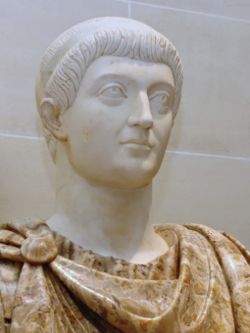 |
Constans I CAESAR FLAVIVS IVLIVS CONSTANS AVGVSTVS |
320 AD, ? | May 22, 337 AD – 350 AD | Son of Constantine I Constantine I Constantine the Great , also known as Constantine I or Saint Constantine, was Roman Emperor from 306 to 337. Well known for being the first Roman emperor to convert to Christianity, Constantine and co-Emperor Licinius issued the Edict of Milan in 313, which proclaimed religious tolerance of all... ; succeeded as joint Augustus with his brothers Constantine II Constantine II (emperor) Constantine II , was Roman Emperor from 337 to 340. Co-emperor alongside his brothers, his short reign saw the beginnings of conflict emerge between the sons of Constantine the Great, and his attempt to exert his perceived rights of primogeniture ended up causing his death in a failed invasion of... and Constantius II Constantius II Constantius II , was Roman Emperor from 337 to 361. The second son of Constantine I and Fausta, he ascended to the throne with his brothers Constantine II and Constans upon their father's death.... |
350 AD Assassinated on the orders of the usurper Magnentius Magnentius Flavius Magnus Magnentius was a usurper of the Roman Empire .-Early life and career:... |
 |
Vetranio Vetranio Vetranio , born in the province of Moesia in a part of the region located in modern Serbia, is sometimes but incorrectly referred to as Vetriano. He was an experienced soldier and officer when he was asked by Constantina, the sister of Roman Emperor Constantius II, to proclaim himself Caesar... |
?, Moesia Moesia Moesia was an ancient region and later Roman province situated in the Balkans, along the south bank of the Danube River. It included territories of modern-day Southern Serbia , Northern Republic of Macedonia, Northern Bulgaria, Romanian Dobrudja, Southern Moldova, and Budjak .-History:In ancient... |
March 1 – December 25, 350 AD | General of Constans I, proclaimed Caesar against Magnentius Magnentius Flavius Magnus Magnentius was a usurper of the Roman Empire .-Early life and career:... and temporarily accepted as Augustus of the west by Constantius II Constantius II Constantius II , was Roman Emperor from 337 to 361. The second son of Constantine I and Fausta, he ascended to the throne with his brothers Constantine II and Constans upon their father's death.... . |
c. 356 As a private citizen, after abdication. |
-cng.jpg) |
Julian II Julian the Apostate Julian "the Apostate" , commonly known as Julian, or also Julian the Philosopher, was Roman Emperor from 361 to 363 and a noted philosopher and Greek writer.... CAESAR FLAVIVS CLAVDIVS IVLIANVS AVGVSTVS |
331 AD/332 AD, Constantinople Constantinople Constantinople was the capital of the Roman, Eastern Roman, Byzantine, Latin, and Ottoman Empires. Throughout most of the Middle Ages, Constantinople was Europe's largest and wealthiest city.-Names:... , Thracia Thracia Thracia is a Web-Based computer game created and developed by an exclusively Romanian team, part of Infotrend Consulting, and launched in 2009. At the time, it was the first endeavor of its kind. All browser games were text based, made up mostly of static content... |
February 360 AD – June 26, 363 AD | Cousin of Constantius II Constantius II Constantius II , was Roman Emperor from 337 to 361. The second son of Constantine I and Fausta, he ascended to the throne with his brothers Constantine II and Constans upon their father's death.... ; made Caesar of the west in 355 AD; proclaimed Augustus by his troops in 360; sole emperor after the death of Constantius |
June 26, 363 AD Mortally wounded in battle |
 |
Jovian CAESAR FLAVIVS IOVIANVS AVGVSTVS |
331 AD, Singidunum Singidunum Singidunum is the name for the ancient city in Serbia which became Belgrade, the capital of Serbia. It was recorded that a Celtic tribe Scordisci settled the area in the 3rd century BC following the Gallic invasion of the Balkans. The Roman Empire conquered the area in 75 BC and later garrisoned... , Moesia Moesia Moesia was an ancient region and later Roman province situated in the Balkans, along the south bank of the Danube River. It included territories of modern-day Southern Serbia , Northern Republic of Macedonia, Northern Bulgaria, Romanian Dobrudja, Southern Moldova, and Budjak .-History:In ancient... |
June 26, 363 AD – February 17, 364 AD | General of Julian's army; proclaimed emperor by the troops on Julian's death | February 17, 364 AD Natural causes (suffocated on fumes) |
Valentinian dynasty
| Portrait | Name | Born | Reigned | Succession | Died |
|---|---|---|---|---|---|
| Valentinian I Valentinian I Valentinian I , also known as Valentinian the Great, was Roman emperor from 364 to 375. Upon becoming emperor he made his brother Valens his co-emperor, giving him rule of the eastern provinces while Valentinian retained the west.... FLAVIVS VALENTINIANVS AVGVSTVS |
321 AD, Cibalae, Pannonia Pannonia Pannonia was an ancient province of the Roman Empire bounded north and east by the Danube, coterminous westward with Noricum and upper Italy, and southward with Dalmatia and upper Moesia.... |
February 26, 364 AD – November 17, 375 AD | Elected to replace Jovian by the army | November 17, 375 AD Natural causes |
|
 |
Valens Valens Valens was the Eastern Roman Emperor from 364 to 378. He was given the eastern half of the empire by his brother Valentinian I after the latter's accession to the throne... FLAVIVS IVLIVS VALENS AVGVSTVS |
328 AD, Cibalae, Pannonia Pannonia Pannonia was an ancient province of the Roman Empire bounded north and east by the Danube, coterminous westward with Noricum and upper Italy, and southward with Dalmatia and upper Moesia.... |
March 28, 364 AD – August 9, 378 AD | Brother of Valentinian I Valentinian I Valentinian I , also known as Valentinian the Great, was Roman emperor from 364 to 375. Upon becoming emperor he made his brother Valens his co-emperor, giving him rule of the eastern provinces while Valentinian retained the west.... , appointed co-augustus (for the east) by him |
August 9, 378 AD Killed in Battle of Adrianople Battle of Adrianople The Battle of Adrianople , sometimes known as the Battle of Hadrianopolis, was fought between a Roman army led by the Roman Emperor Valens and Gothic rebels led by Fritigern... against the Goths Goths The Goths were an East Germanic tribe of Scandinavian origin whose two branches, the Visigoths and the Ostrogoths, played an important role in the fall of the Roman Empire and the emergence of Medieval Europe.... |
| Gratian Gratian Gratian was Roman Emperor from 375 to 383.The eldest son of Valentinian I, during his youth Gratian accompanied his father on several campaigns along the Rhine and Danube frontiers. Upon the death of Valentinian in 375, Gratian's brother Valentinian II was declared emperor by his father's soldiers... FLAVIVS GRATIANVS AVGVSTVS |
April 18/May 23, 359 AD, Sirmium Sirmium Sirmium was a city in ancient Roman Pannonia. Firstly mentioned in the 4th century BC and originally inhabited by the Illyrians and Celts, it was conquered by the Romans in the 1st century BC and subsequently became the capital of the Roman province of Lower Pannonia. In 294 AD, Sirmium was... , Pannonia Pannonia Pannonia was an ancient province of the Roman Empire bounded north and east by the Danube, coterminous westward with Noricum and upper Italy, and southward with Dalmatia and upper Moesia.... |
August 4, 367 AD – August 25, 383 AD | Son of Valentinian I Valentinian I Valentinian I , also known as Valentinian the Great, was Roman emperor from 364 to 375. Upon becoming emperor he made his brother Valens his co-emperor, giving him rule of the eastern provinces while Valentinian retained the west.... , appointed 'junior' Augustus by him in 367, became 'senior' augustus (for the west) after Valentinian's death. |
August 25, 383 AD Murdered by rebellious army faction |
|
 |
Valentinian II Valentinian II Flavius Valentinianus , commonly known as Valentinian II, was Roman Emperor from 375 to 392.-Early Life and Accession :... FLAVIVS VALENTINIANVS INVICTVS AVGVSTVS |
371 AD, Milan Milan Milan is the second-largest city in Italy and the capital city of the region of Lombardy and of the province of Milan. The city proper has a population of about 1.3 million, while its urban area, roughly coinciding with its administrative province and the bordering Province of Monza and Brianza ,... , Italia Italia (Roman province) Italia was the name of the Italian peninsula of the Roman Empire.-Under the Republic and Augustan organization:During the Republic and the first centuries of the empire, Italia was not a province, but rather the territory of the city of Rome, thus having a special status: for example, military... |
November 17, 375 AD – May 15, 392 AD | Son of Valentinian I Valentinian I Valentinian I , also known as Valentinian the Great, was Roman emperor from 364 to 375. Upon becoming emperor he made his brother Valens his co-emperor, giving him rule of the eastern provinces while Valentinian retained the west.... , proclaimed emperor by Pannonian army after Valentinian's death; accepted as co-Augustus for the west by Gratian Gratian Gratian was Roman Emperor from 375 to 383.The eldest son of Valentinian I, during his youth Gratian accompanied his father on several campaigns along the Rhine and Danube frontiers. Upon the death of Valentinian in 375, Gratian's brother Valentinian II was declared emperor by his father's soldiers... |
May 15, 392 AD Unclear; possibly murdered or committed suicide |
Theodosian dynasty
| Portrait | Name | Born | Reigned | Succession | Died |
|---|---|---|---|---|---|
| Theodosius I Theodosius I Theodosius I , also known as Theodosius the Great, was Roman Emperor from 379 to 395. Theodosius was the last emperor to rule over both the eastern and the western halves of the Roman Empire. During his reign, the Goths secured control of Illyricum after the Gothic War, establishing their homeland... FLAVIVS THEODOSIVS AVGVSTVS |
January 11, 347 AD, Cauca Coca, Segovia Coca is a municipality in the province of Segovia, central Spain, part of the autonomous community of Castile-Leon. It is located 50 kilometres northwest of the provincial capital city of Segovia, and 60 kilometres from Valladolid. Coca is known for its 15th Century Mudéjar castle... , Hispania Hispania Another theory holds that the name derives from Ezpanna, the Basque word for "border" or "edge", thus meaning the farthest area or place. Isidore of Sevilla considered Hispania derived from Hispalis.... |
January 1, 379 AD – January 17, 395 AD | Appointed as Augustus for the east by Gratian Gratian Gratian was Roman Emperor from 375 to 383.The eldest son of Valentinian I, during his youth Gratian accompanied his father on several campaigns along the Rhine and Danube frontiers. Upon the death of Valentinian in 375, Gratian's brother Valentinian II was declared emperor by his father's soldiers... after the death of Valens Valens Valens was the Eastern Roman Emperor from 364 to 378. He was given the eastern half of the empire by his brother Valentinian I after the latter's accession to the throne... ; became sole 'senior' Augustus after death of Valentinian II Valentinian II Flavius Valentinianus , commonly known as Valentinian II, was Roman Emperor from 375 to 392.-Early Life and Accession :... |
January 17, 395 AD Natural causes |
|
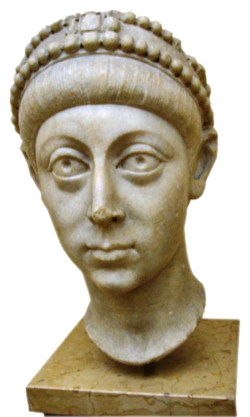 |
Arcadius Arcadius Arcadius was the Byzantine Emperor from 395 to his death. He was the eldest son of Theodosius I and his first wife Aelia Flaccilla, and brother of the Western Emperor Honorius... FLAVIVS ARCADIVS AVGVSTVS EAST |
c. 377 AD, Hispania Hispania Another theory holds that the name derives from Ezpanna, the Basque word for "border" or "edge", thus meaning the farthest area or place. Isidore of Sevilla considered Hispania derived from Hispalis.... |
January 383 AD – May 1, 408 AD | Son of Theodosius I Theodosius I Theodosius I , also known as Theodosius the Great, was Roman Emperor from 379 to 395. Theodosius was the last emperor to rule over both the eastern and the western halves of the Roman Empire. During his reign, the Goths secured control of Illyricum after the Gothic War, establishing their homeland... ; appointed as 'junior' Augustus for the east by Theodosius in 383 (after the death of Gratian Gratian Gratian was Roman Emperor from 375 to 383.The eldest son of Valentinian I, during his youth Gratian accompanied his father on several campaigns along the Rhine and Danube frontiers. Upon the death of Valentinian in 375, Gratian's brother Valentinian II was declared emperor by his father's soldiers... ); became 'senior' Augustus for the east after his father's death |
May 1, 408 AD Natural causes |
 |
Honorius Honorius (emperor) Honorius , was Western Roman Emperor from 395 to 423. He was the younger son of emperor Theodosius I and his first wife Aelia Flaccilla, and brother of the eastern emperor Arcadius.... FLAVIVS HONORIVS AVGVSTVS WEST |
September 9, 384 AD, ? | January 23, 393 AD – August 15, 423 AD | Son of Theodosius I Theodosius I Theodosius I , also known as Theodosius the Great, was Roman Emperor from 379 to 395. Theodosius was the last emperor to rule over both the eastern and the western halves of the Roman Empire. During his reign, the Goths secured control of Illyricum after the Gothic War, establishing their homeland... ; appointed as 'junior' Augustus for the west by Theodosius in 393 (after the death of Valentinian II Valentinian II Flavius Valentinianus , commonly known as Valentinian II, was Roman Emperor from 375 to 392.-Early Life and Accession :... ); became 'senior' Augustus for the west after his father's death |
August 15, 423 AD Natural causes |
| Theodosius II Theodosius II Theodosius II , commonly surnamed Theodosius the Younger, or Theodosius the Calligrapher, was Byzantine Emperor from 408 to 450. He is mostly known for promulgating the Theodosian law code, and for the construction of the Theodosian Walls of Constantinople... FLAVIVS THEODOSIVS AVGVSTVS EAST |
April 10, 401 AD, Constantinople Constantinople Constantinople was the capital of the Roman, Eastern Roman, Byzantine, Latin, and Ottoman Empires. Throughout most of the Middle Ages, Constantinople was Europe's largest and wealthiest city.-Names:... ? |
May 1, 408 AD – July 28, 450 AD | Son of Arcadius Arcadius Arcadius was the Byzantine Emperor from 395 to his death. He was the eldest son of Theodosius I and his first wife Aelia Flaccilla, and brother of the Western Emperor Honorius... , succeeded to the throne after his father's death |
July 28, 450 AD Natural causes |
|
 |
Constantius III Constantius III Flavius Constantius , commonly known as Constantius III, was Western Roman Emperor for seven months in 421. A prominent general and politician, he was the power behind the throne for much of the 410s, and in 421 briefly became co-emperor of the Western Empire with Honorius.- Early life and rise to... FLAVIVS CONSTANTIVS AVGVSTVS WEST |
?, Naissus, Moesia Superior | February 8, 421 AD – September 2, 421 AD | Married to Theodosius I Theodosius I Theodosius I , also known as Theodosius the Great, was Roman Emperor from 379 to 395. Theodosius was the last emperor to rule over both the eastern and the western halves of the Roman Empire. During his reign, the Goths secured control of Illyricum after the Gothic War, establishing their homeland... 's daughter Galla Placidia Galla Placidia Aelia Galla Placidia , daughter of the Roman Emperor Theodosius I, was the Regent for Emperor Valentinian III from 423 until his majority in 437, and a major force in Roman politics for most of her life... , elevated to co-Augustus for the west by Honorius Honorius (emperor) Honorius , was Western Roman Emperor from 395 to 423. He was the younger son of emperor Theodosius I and his first wife Aelia Flaccilla, and brother of the eastern emperor Arcadius.... |
September 2, 421 AD Natural causes |
 |
Joannes Joannes Ioannes, known in English as Joannes, was a Roman usurper against Valentinian III.On the death of the Emperor Honorius , Theodosius II, the remaining ruler of the House of Theodosius hesitated in announcing his uncle's death... WEST |
? | August 27, 423 AD – May 425 AD | A senior civil servant under Honorius Honorius (emperor) Honorius , was Western Roman Emperor from 395 to 423. He was the younger son of emperor Theodosius I and his first wife Aelia Flaccilla, and brother of the eastern emperor Arcadius.... , proclaimed emperor by Castinus Castinus Flavius Castinus held the position of patricius in the court of Roman Emperor Honorius at the time of the Emperor's death, and most likely for some time before. He also served as consul for the year 424.- Career :... ; initially undisputed |
June or July 425 AD Defeated in battle by Theodosius II Theodosius II Theodosius II , commonly surnamed Theodosius the Younger, or Theodosius the Calligrapher, was Byzantine Emperor from 408 to 450. He is mostly known for promulgating the Theodosian law code, and for the construction of the Theodosian Walls of Constantinople... and Valentinian III Valentinian III -Family:Valentinian was born in the western capital of Ravenna, the only son of Galla Placidia and Flavius Constantius. The former was the younger half-sister of the western emperor Honorius, and the latter was at the time Patrician and the power behind the throne.... , captured and executed |
 |
Valentinian III Valentinian III -Family:Valentinian was born in the western capital of Ravenna, the only son of Galla Placidia and Flavius Constantius. The former was the younger half-sister of the western emperor Honorius, and the latter was at the time Patrician and the power behind the throne.... FLAVIVS PLACIDIVS VALENTINIANVS AVGVSTVS WEST |
July 2, 419 AD, Ravenna Ravenna Ravenna is the capital city of the Province of Ravenna in the Emilia-Romagna region of Italy and the second largest comune in Italy by land area, although, at , it is little more than half the size of the largest comune, Rome... , Italia Italia (Roman province) Italia was the name of the Italian peninsula of the Roman Empire.-Under the Republic and Augustan organization:During the Republic and the first centuries of the empire, Italia was not a province, but rather the territory of the city of Rome, thus having a special status: for example, military... |
October 23, 424 AD – March 16, 455 AD | Son of Constantius III Constantius III Flavius Constantius , commonly known as Constantius III, was Western Roman Emperor for seven months in 421. A prominent general and politician, he was the power behind the throne for much of the 410s, and in 421 briefly became co-emperor of the Western Empire with Honorius.- Early life and rise to... , appointed Caesar for the west by Theodosius II Theodosius II Theodosius II , commonly surnamed Theodosius the Younger, or Theodosius the Calligrapher, was Byzantine Emperor from 408 to 450. He is mostly known for promulgating the Theodosian law code, and for the construction of the Theodosian Walls of Constantinople... after the death of Honorius Honorius (emperor) Honorius , was Western Roman Emperor from 395 to 423. He was the younger son of emperor Theodosius I and his first wife Aelia Flaccilla, and brother of the eastern emperor Arcadius.... , in opposition to the Johannes Johannes Johannes is the Latin form of the personal name that usually appears as "John" in English language contexts. It is a variant of the Greek name Ιωάννης , itself derived from the Hebrew name Yehochanan meaning "Yahweh is gracious". The name became popular in Northern Europe, especially in Germany... ; became Augustus for the west after the defeat of Johannes |
March 16, 455 AD Assassinated, possibly at the behest of Petronius Maximus Petronius Maximus Flavius Petronius Maximus was Western Roman Emperor for two and a half months in 455. A wealthy senator and a prominent aristocrat, he was instrumental in the murders of the Western Roman magister militum, Flavius Aëtius, and the Western Roman Emperor Valentinian III... |
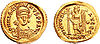 |
Marcian Marcian Marcian was Byzantine Emperor from 450 to 457. Marcian's rule marked a recovery of the Eastern Empire, which the Emperor protected from external menaces and reformed economically and financially... FLAVIVS MARCIANIVS AVGVSTVS EAST |
396, Thrace Thrace Thrace is a historical and geographic area in southeast Europe. As a geographical concept, Thrace designates a region bounded by the Balkan Mountains on the north, Rhodope Mountains and the Aegean Sea on the south, and by the Black Sea and the Sea of Marmara on the east... or Illyria Illyria In classical antiquity, Illyria was a region in the western part of the Balkan Peninsula inhabited by the Illyrians.... |
Summer 450 AD – January 457 AD | Nominated as successor (and husband) by Pulcheria Pulcheria Aelia Pulcheria was the daughter of Eastern Roman Emperor Arcadius and Empress Aelia Eudoxia. She was the second child born to Arcadius and Eudoxia. Her oldest sister was Flaccilla born in 397, but is assumed she had died young. Her younger siblings were Theodosius II, the future emperor and... , sister of Theodosius II Theodosius II Theodosius II , commonly surnamed Theodosius the Younger, or Theodosius the Calligrapher, was Byzantine Emperor from 408 to 450. He is mostly known for promulgating the Theodosian law code, and for the construction of the Theodosian Walls of Constantinople... |
January 457 AD Natural causes |
The last emperors of the Western Empire
| Portrait | Name | Born | Reigned | Succession | Died |
|---|---|---|---|---|---|
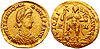 |
Petronius Maximus Petronius Maximus Flavius Petronius Maximus was Western Roman Emperor for two and a half months in 455. A wealthy senator and a prominent aristocrat, he was instrumental in the murders of the Western Roman magister militum, Flavius Aëtius, and the Western Roman Emperor Valentinian III... FLAVIVS ANICIVS PETRONIVS MAXIMVS AVGVSTVS |
c. 396 AD, ? | March 17, 455 AD – May 31, 455 AD | Proclaimed himself emperor with the support of the army, after the death of Valentinian III Valentinian III -Family:Valentinian was born in the western capital of Ravenna, the only son of Galla Placidia and Flavius Constantius. The former was the younger half-sister of the western emperor Honorius, and the latter was at the time Patrician and the power behind the throne.... |
May 31, 455 AD Murdered, probably stoned to death by the Roman mob |
 |
Avitus Avitus Eparchius Avitus was Western Roman Emperor from July 8 or July 9, 455 to October 17, 456. A Gallic-Roman aristocrat, he was a senator and a high-ranking officer both in the civil and military administration, as well as Bishop of Piacenza.A representative of the Gallic-Roman aristocracy, he... EPARCHIVS AVITVS AVGVSTVS |
c. 385 AD, ? | July 9, 455 AD – October 17, 456 AD | Magister militum Magister militum Magister militum was a top-level military command used in the later Roman Empire, dating from the reign of Constantine. Used alone, the term referred to the senior military officer of the Empire... under Petronius Maximus Petronius Maximus Flavius Petronius Maximus was Western Roman Emperor for two and a half months in 455. A wealthy senator and a prominent aristocrat, he was instrumental in the murders of the Western Roman magister militum, Flavius Aëtius, and the Western Roman Emperor Valentinian III... , proclaimed emperor by the Visigoth Visigoth The Visigoths were one of two main branches of the Goths, the Ostrogoths being the other. These tribes were among the Germans who spread through the late Roman Empire during the Migration Period... king Theoderic II after Petronius's death |
after 17 October 456 AD Deposed by his Magister militum, Ricimer Ricimer Flavius Ricimer was a Germanic general who achieved effective control of the remaining parts of the Western Roman Empire, during the middle of the 5th century... ; became bishop of Placentia Piacenza Piacenza is a city and comune in the Emilia-Romagna region of northern Italy. It is the capital of the province of Piacenza... ; murdered at some point afterwards |
| Majorian Majorian Majorian , was the Western Roman Emperor from 457 to 461.A prominent general of the Late Roman army, Majorian deposed Emperor Avitus in 457 and succeeded him. Majorian was one of the last emperors to make a concerted effort to restore the Western Roman Empire... IVLIVS VALERIVS MAIORIANVS AVGVSTVS |
November 420 AD, ? | April 457 AD – August 2, 461 AD | Appointed emperor by Ricimer Ricimer Flavius Ricimer was a Germanic general who achieved effective control of the remaining parts of the Western Roman Empire, during the middle of the 5th century... |
August 7, 461 AD Deposed by his troops (probably at the behest of Ricimer Ricimer Flavius Ricimer was a Germanic general who achieved effective control of the remaining parts of the Western Roman Empire, during the middle of the 5th century... ); died shortly afterwards in unclear circumstances |
|
| Libius Severus Libius Severus Flavius Libius Severus Serpentius was Western Roman Emperor from November 19, 461 to his death.A Roman senator from Lucania Severus was one of the last Western Emperors, emptied of any effective power , and unable to solve the many problems affecting the Empire; the sources... LIBIVS SEVERVS AVGVSTVS |
?, Lucania Lucania Lucania was an ancient district of southern Italy, extending from the Tyrrhenian Sea to the Gulf of Taranto. To the north it adjoined Campania, Samnium and Apulia, and to the south it was separated by a narrow isthmus from the district of Bruttium... , Italia Italia (Roman province) Italia was the name of the Italian peninsula of the Roman Empire.-Under the Republic and Augustan organization:During the Republic and the first centuries of the empire, Italia was not a province, but rather the territory of the city of Rome, thus having a special status: for example, military... |
November 461 AD – August 465 AD | Appointed emperor by Ricimer Ricimer Flavius Ricimer was a Germanic general who achieved effective control of the remaining parts of the Western Roman Empire, during the middle of the 5th century... |
August 465 AD Probably assassinated by Ricimer |
|
| Anthemius Anthemius Procopius Anthemius was Western Roman Emperor from 467 to 472. Perhaps the last capable Western Roman Emperor, Anthemius attempted to solve the two primary military challenges facing the remains of the Western Roman Empire: the resurgent Visigoths, under Euric, whose domain straddled the Pyrenees;... PROCOPIVS ANTHEMIVS AVGVSTVS |
c. 420 AD | April 12, 467 AD – July 11, 472 AD | Appointed emperor by Ricimer Ricimer Flavius Ricimer was a Germanic general who achieved effective control of the remaining parts of the Western Roman Empire, during the middle of the 5th century... , with the backing of the eastern emperor Leo I |
July 11, 472 AD Executed by Ricimer |
|
| Olybrius Olybrius Anicius Olybrius was Western Roman Emperor from April or May 472 to his death. He was in reality a puppet ruler, put on the throne by the Roman general of Germanic descent Ricimer, and was mainly interested in religion, while the actual power was held by Ricimer and his nephew Gundobad.-Family and... FLAVIVS ANICIVS OLYBRIVS AVGVSTVS |
c. 420 AD | July 11, 472 AD – November 2, 472 AD | Son-in-law of Valentinian III Valentinian III -Family:Valentinian was born in the western capital of Ravenna, the only son of Galla Placidia and Flavius Constantius. The former was the younger half-sister of the western emperor Honorius, and the latter was at the time Patrician and the power behind the throne.... ; appointed emperor by Ricimer Ricimer Flavius Ricimer was a Germanic general who achieved effective control of the remaining parts of the Western Roman Empire, during the middle of the 5th century... |
November 2, 472 AD Natural causes |
|
| Glycerius Glycerius Glycerius was a Western Roman Emperor from 473 to 474. Elevated by his Magister militum, Gundobad, Glycerius’ elevation was rejected by the court at Constantinople, and he was ousted by Julius Nepos. He later served as the bishop of Salona in the early Catholic Church.-Rise to power:Sources on... |
? | March 473 AD – June 474 AD | Appointed emperor by Gundobad Gundobad Gundobad was King of the Burgundians , succeeding his father Gundioc of Burgundy. Previous to this, he had been a Patrician of the Western Roman Empire in 472–473, succeeding his uncle Ricimer.- Early life :... (Ricimer Ricimer Flavius Ricimer was a Germanic general who achieved effective control of the remaining parts of the Western Roman Empire, during the middle of the 5th century... 's successor) |
after 480 AD Deposed by Julius Nepos Julius Nepos Julius Nepos was Western Roman Emperor de facto from 474 to 475 and de jure until 480. Some historians consider him to be the last Western Roman Emperor, while others consider the western line to have ended with Romulus Augustulus in 476... , became Bishop of Salona Salona Salona was an ancient Illyrian Delmati city in the first millennium BC. The Greeks had set up an emporion there. After the conquest by the Romans, Salona became the capital of the Roman province of Dalmatia... , time and manner of death unknown |
|
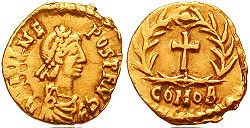 |
Julius Nepos Julius Nepos Julius Nepos was Western Roman Emperor de facto from 474 to 475 and de jure until 480. Some historians consider him to be the last Western Roman Emperor, while others consider the western line to have ended with Romulus Augustulus in 476... |
c. 430 AD, ? | June 474 AD – August 28, 475 AD (in Italy); – Spring 480 AD (in Gaul and Dalmatia) | Nephew-in-law of the eastern emperor Leo I, appointed emperor in opposition to Glycerius Glycerius Glycerius was a Western Roman Emperor from 473 to 474. Elevated by his Magister militum, Gundobad, Glycerius’ elevation was rejected by the court at Constantinople, and he was ousted by Julius Nepos. He later served as the bishop of Salona in the early Catholic Church.-Rise to power:Sources on... |
480 AD Deposed in Italy by Flavius Orestes Flavius Orestes Orestes was a Roman general and politician of Germanic ancestry, who was briefly in control of the Western Roman Empire in 475–6.-Early life:... , ruled in exile until assassination in 480 |
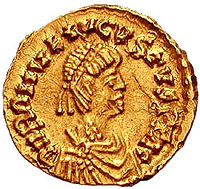 |
Romulus Augustus Romulus Augustus Romulus Augustus , was the last Western Roman Emperor, reigning from 31 October 475 until 4 September 476... |
? | October 31, 475 AD – September 4, 476 AD (in Italy) | Appointed by his father, Flavius Orestes Flavius Orestes Orestes was a Roman general and politician of Germanic ancestry, who was briefly in control of the Western Roman Empire in 475–6.-Early life:... |
after 480 AD Deposed by Odoacer Odoacer Flavius Odoacer , also known as Flavius Odovacer, was the first King of Italy. His reign is commonly seen as marking the end of the Western Roman Empire. Though the real power in Italy was in his hands, he represented himself as the client of Julius Nepos and, after Nepos' death in 480, of the... , who then ruled in the name of Julius Nepos Julius Nepos Julius Nepos was Western Roman Emperor de facto from 474 to 475 and de jure until 480. Some historians consider him to be the last Western Roman Emperor, while others consider the western line to have ended with Romulus Augustulus in 476... until the latter's death, which formally ended the western empire; most likely lived out his life on a private villa in obscurity |
Leonid Dynasty
| Portrait | Name | Born | Reigned | Succession | Died |
|---|---|---|---|---|---|
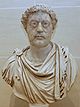 |
Leo I FLAVIVS VALERIVS LEO AVGVSTVS |
401 AD, ? | February 7, 457 AD – January 18, 474 AD | Proclaimed emperor by the Magister militum Magister militum Magister militum was a top-level military command used in the later Roman Empire, dating from the reign of Constantine. Used alone, the term referred to the senior military officer of the Empire... Aspar Aspar Flavius Ardabur Aspar was an Alan patrician and magister militum of the Eastern Roman Empire. Aspar's family exerted a great influence on the Eastern Roman Emperors for half a century, from the 420s to his death in 471, over Theodosius II, Marcian and Leo I, who, in the end, had him killed.Alans... after Marcian's death |
January 18, 474 AD Natural causes |
-coin.jpg) |
Leo II Leo II (emperor) Leo II was Byzantine Emperor for less than a year in 474. He was the son of Zeno and Ariadne, and maternal grandson of Leo I and Verina. As Leo's closest male relative, he was named successor upon his grandfather's death. After taking his father as colleague, he died of an unknown disease about 10... FLAVIVS LEO IVNIOR AVGVSTVS |
467 AD, Constantinople Constantinople Constantinople was the capital of the Roman, Eastern Roman, Byzantine, Latin, and Ottoman Empires. Throughout most of the Middle Ages, Constantinople was Europe's largest and wealthiest city.-Names:... ? |
January 18, 474 AD – November 17, 474 AD | Grandson of Leo I by his daughter Ariadne (empress) Ariadne (empress) Aelia Ariadne was the Empress consort of Zeno and Anastasius I of the Byzantine Empire.-Family:Ariadne was a daughter of Leo I and Verina. Her mother was a sister of Basiliscus.... |
November 17, 474 AD Unclear, possibly assassinated |
 |
Zeno Zeno (emperor) Zeno , originally named Tarasis, was Byzantine Emperor from 474 to 475 and again from 476 to 491. Domestic revolts and religious dissension plagued his reign, which nevertheless succeeded to some extent in foreign issues... FLAVIVS ZENO PERPETVVS AVGVSTVS |
425 AD, Isauria Isauria Isauria , in ancient geography, is a rugged isolated district in the interior of South Asia Minor, of very different extent at different periods, but generally covering what is now the district of Bozkır and its surroundings in the Konya province of Turkey, or the core of the Taurus Mountains. In... |
February 9, 474 AD – January 9, 475 AD & August 476 AD – April 9, 491 AD |
Father of Leo II Leo II (emperor) Leo II was Byzantine Emperor for less than a year in 474. He was the son of Zeno and Ariadne, and maternal grandson of Leo I and Verina. As Leo's closest male relative, he was named successor upon his grandfather's death. After taking his father as colleague, he died of an unknown disease about 10... |
April 9, 491 AD Natural causes |
 |
Basiliscus Basiliscus Basiliscus was Eastern Roman Emperor from 475 to 476. A member of the House of Leo, he came to power when Emperor Zeno had been forced out of Constantinople by a revolt.... FLAVIVS BASILISCVS AVGVSTVS |
? | January 9, 475 AD – August 476 AD | Brother-in-law of Leo I, seized power during a plot against Zeno Zeno (emperor) Zeno , originally named Tarasis, was Byzantine Emperor from 474 to 475 and again from 476 to 491. Domestic revolts and religious dissension plagued his reign, which nevertheless succeeded to some extent in foreign issues... by Verina Verina Aelia Verina was the Empress consort of Leo I of the Byzantine Empire. She was a sister of Basiliscus. Her daughter Ariadne was Empress consort of first Zeno and then Anastasius I. Verina was the maternal grandmother of Leo II.-Family:... (Leo I's widow and Basiliscus's sister) |
August 476 AD Defeated, captured and executed by Zeno Zeno (emperor) Zeno , originally named Tarasis, was Byzantine Emperor from 474 to 475 and again from 476 to 491. Domestic revolts and religious dissension plagued his reign, which nevertheless succeeded to some extent in foreign issues... |
 |
Anastasius I Anastasius I (emperor) Anastasius I was Byzantine Emperor from 491 to 518. During his reign the Roman eastern frontier underwent extensive re-fortification, including the construction of Dara, a stronghold intended to counter the Persian fortress of Nisibis.... FLAVIVS ANASTASIVS AVGVSTVS |
c. 430 AD, Dyrrachium | April 9, 491 AD – July 9, 518 AD | Selected by Ariadne Ariadne Ariadne , in Greek mythology, was the daughter of King Minos of Crete, and his queen Pasiphaë, daughter of Helios, the Sun-titan. She aided Theseus in overcoming the Minotaur and was the bride of the god Dionysus.-Minos and Theseus:... as successor to Zeno (as both emperor and husband) |
July 9, 518 Natural causes |
Justinian Dynasty
| Portrait | Name | Born | Reigned | Succession | Died |
|---|---|---|---|---|---|
 |
Justin I Justin I Justin I was Byzantine Emperor from 518 to 527. He rose through the ranks of the army and ultimately became its Emperor, in spite of the fact he was illiterate and almost 70 years old at the time of accession... FLAVIVS IVSTINVS AVGVSTVS |
c. 450 AD, Naissus | July 9, 518 AD – August 1, 527 AD | Commander of the palace guard under Anastasius I) Anastasius I (emperor) Anastasius I was Byzantine Emperor from 491 to 518. During his reign the Roman eastern frontier underwent extensive re-fortification, including the construction of Dara, a stronghold intended to counter the Persian fortress of Nisibis.... ; elected as emperor with support of army |
August 1, 527 AD Natural causes |
 |
Justinian I Justinian I Justinian I ; , ; 483– 13 or 14 November 565), commonly known as Justinian the Great, was Byzantine Emperor from 527 to 565. During his reign, Justinian sought to revive the Empire's greatness and reconquer the lost western half of the classical Roman Empire.One of the most important figures of... FLAVIVS PETRVS SABBATIVS IVSTINIANVS AVGVSTVS |
c. 482 AD, Tauresium Tauresium Tauresium or known as Gradište is an archaeological site in Macedonia, located approximately 20 km south-east of the capital Skopje. Tauresium is the birthplace of Byzantine Emperor Justinian I and King Theodahad of the Ostrogoths .- Name :The ancient town of Tauresium is located on the... , Dardani Dardani Dardania was the region of the Dardani .Located at the Thraco-Illyrian contact zone, their identification as either an Illyrian or Thracian tribe is uncertain. Their territory itself was not considered part of Illyria by Strabo. The term used for their territory was , while for other tribes had... a |
August 1, 527 AD – 13/14 November 565 AD | Nephew and nominated heir of Justin I Justin I Justin I was Byzantine Emperor from 518 to 527. He rose through the ranks of the army and ultimately became its Emperor, in spite of the fact he was illiterate and almost 70 years old at the time of accession... |
13/14 November 565 AD Natural causes |
 |
Justin II Justin II Justin II was Byzantine Emperor from 565 to 578. He was the husband of Sophia, nephew of Justinian I and the late Empress Theodora, and was therefore a member of the Justinian Dynasty. His reign is marked by war with Persia and the loss of the greater part of Italy... FLAVIVS IVSTINIVS IVNIOR AVGVSTVS |
c. 520 AD, ? | 13/14 November 565 AD – 578 AD | Nephew of Justinian I Justinian I Justinian I ; , ; 483– 13 or 14 November 565), commonly known as Justinian the Great, was Byzantine Emperor from 527 to 565. During his reign, Justinian sought to revive the Empire's greatness and reconquer the lost western half of the classical Roman Empire.One of the most important figures of... |
578 AD Became insane; Tiberius II Constantine Tiberius II Constantine Tiberius II Constantine was Byzantine Emperor from 574 to 582.During his reign, Tiberius II Constantine gave away 7,200 pounds of gold each year for four years.... ruled as regent from December 574 and became emperor on Justin's death in 578 |
- Continue to List of Byzantine Emperors
See also
- List of Roman dictators (501 – 44 BC)
- List of Roman usurpers
- Roman Emperors family treeRoman Emperors family treeThis is a family tree of the Roman Emperors, showing only the relationships between the emperors.- 27BC-AD192 :The emperors from Augustus to Commodus can be organised into one large family tree with one non-related emperor...