
See Also

Aphrodite

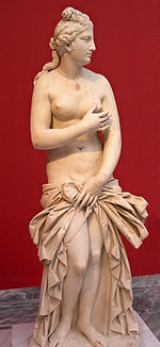
Aphrodite is the Greek Greek mythology

Greek mythology consists in part of a large collection of narratives that explain the origins of the wo... 

 goddess Goddess

A goddess is a female [i] deity [i], in contrast with a male [i] deity known as a "god [i]". ... 

 of love Love

Love is a profound feeling [i] of tender affection [i] for or intense attraction [i] ... 

 and beauty Beauty

Beauty is a value [i] associated with an innate [i] and emotional [i] perception [i] of life [i]' ... 

 and sexuality. Her Roman Roman Empire

The Roman Empire was a phase of the ancient Roman [i] civilization characterized by an autocratic [i] ... 

 equivalent is the goddess Venus Venus

Venus is the second-closest planet [i] to the Sun [i], orbiting it every 224.7 Earth days. ... 

.

Discussions

  Discussion Features

   Ask a question about 'Aphrodite'

   Start a new discussion about 'Aphrodite'

   Answer questions about 'Aphrodite'

   'Aphrodite' discussion forum


Encyclopedia


Aphrodite is the Greek Greek mythology

Greek mythology consists in part of a large collection of narratives that explain the origins of the wo... 

 goddess Goddess

A goddess is a female [i] deity [i], in contrast with a male [i] deity known as a "god [i]". ... 

 of love Love

Love is a profound feeling [i] of tender affection [i] for or intense attraction [i] ... 

 and beauty Beauty

Beauty is a value [i] associated with an innate [i] and emotional [i] perception [i] of life [i]' ... 

 and sexuality. Her Roman Roman Empire

The Roman Empire was a phase of the ancient Roman [i] civilization characterized by an autocratic [i] ... 

 equivalent is the goddess Venus Venus

Venus is the second-closest planet [i] to the Sun [i], orbiting it every 224.7 Earth days. ... 

.

Origins


Her Roman analogue is Venus Venus

Venus is the second-closest planet [i] to the Sun [i], orbiting it every 224.7 Earth days. ... 

. Her Mesopotamia Mesopotamia

Mesopotamia refers to the region [i] now occupied by modern Iraq [i], eastern Syria [i], and southeaster ... 

n counterpart was Ishtar Ishtar

Ishtar is the Assyria [i]n counterpart to the Sumerian [i] Inanna [i] and to the ... 

. Her Egyptian counterpart is Hathor Hathor

In Egyptian mythology [i], Hathor was originally a personification of the Milky Way [i], which was seen ... 

, and her Syro-Palestinian counterpart was `Ashtart Astarte

Astarte is the name of a major goddess [i] as known from Northwestern Semitic [i] regi... 

 ; her Etruscan Etruscan mythology

The Etruscan [i]s were a people of unknown origin living in Northern Italy [i], who were ... 

 equivalent was Turan. She has parallels to Indo-European dawn Dawn

Dawn or civil dawn is the time at which the sun [i] is 6 degree [i]s below the horizon [i] ... 

 goddesses such as Ushas Ushas

Ushas, Sanskrit [i] for "dawn [i]", is a Vedic deity [i]. ... 

 or Aurora.

The name the name is connected by popular etymology with ?f??? "foam", interpreting it as "risen from the foam". It has reflexes in Messapic and Etruscan , which were probably loaned from Greek. Attempts to derive the name from Semitic Aštoret, via undocumented Hittite transmission, remain doubtful. A suggestion by Hammarström, rejected by Hjalmar Frisk, connects the name with p??ta???, a loan into Greek from a cognate of Etruscan pruni, "lord" or similar.

Worship

The epithet Aphrodite Acidalia was occasionally added to her name, after the spring she used to bathe in, located in Boeotia Boeotia

Boeotia or Beotia
... 

 . She was also called Kypris or Cytherea after her alleged birth-places in Cyprus Cyprus

Cyprus , officially the Republic of Cyprus , is a Eurasia [i]n island nation [i] in the eastern pa ... 

 and Cythera Kythira

Kythira, also known as Cerigo is an island [i] of Greece [i], historically part of the Ionian Islands [i] ... 

, respectively. The island of Cythera was a center of her cult. She was associated with Hesperia and frequently accompanied by the Oreads, nymph Nymph

In Greek mythology [i], a nymph is any member of a large class of female nature entities, either bound t ... 

s of the mountains.

Aphrodite had a festival of her own, the Aphrodisiac , which was celebrated all over Greece but particularly in Athens Athens

Athens is the capital [i] and the largest city of Greece [i]. ... 

 and Corinth Corinth

Corinth, or Korinth is a Greek [i] city-state [i], on the Isthmus of Corinth [i], the narr ... 

. In Corinth, intercourse with her priestesses was considered a method of worshipping Aphrodite.

Aphrodite was associated with, and often depicted with dolphin Dolphin

Dolphins are highly intelligent aquatic mammal [i]s closely related to whale [i]s and porpoise [i]s. ... 

s, dove Dove

The pigeons and doves are some 300 species [i] of near passerine [i] bird [i]s in the order Columbiformes [i] ... 

s, swan Swan

Swans are large water bird [i]s of the family [i] Anatidae [i], which also includes geese [i] ... 

s, pomegranate Pomegranate

The Pomegranate is a fruit [i]-bearing deciduous [i] shrub [i] or small tree [i] growing to 5–8&n... 

s, apples Apple

The apple is a tree [i] and its pomaceous [i] fruit [i], of the species Malus domestica in the ... 

, myrtle Myrtle

The Myrtle is a genus of one or two species of flowering plant [i]s in the family Myrtaceae [i], native ... 

, rose Rose

A rose is a flowering shrub [i] of the genus [i] Rosa, and the flower [i] of this shrub. ... 

 and lime trees.

Venus was often referred to with epithet Venus Erycina Venus (mythology)

Venus was a major Roman [i] goddess [i] principally associated with love [i] and beauty [i] ... 

  after Mount Eryx, Sicily Sicily

Sicily is an autonomous region [i] of Italy [i] and the larges ... 

, one of the centers of her cult.

Birth


"Foam-arisen" Aphrodite was born of the sea foam near Paphos Paphos

Paphos, and New Paphos[2006]] [i] the second Commonwealth Tenpin Bowling Championships [i] were held in Paph ... 

, Cyprus after Cronus Cronus

Cronus , also called Cronos or Kronos, was the leader and the youngest of the first generati... 

 cut off Uranus' Uranus

Uranus is the seventh planet [i] from the Sun [i]. ... 

 genitals and threw them into the sea spreading his god-like genes. Hesiod's Theogony described that the genitals "were carried over the sea a long time, and white foam arose from the immortal flesh; with it a girl grew" to become Aphrodite. Thus Aphrodite is of an older generation than Zeus Zeus

In Greek mythology [i], Zeus is the highest ranking god [i] among the Olympian gods [i] ... 

. Iliad Iliad

The Iliad is, together with the Odyssey [i], one of two ancient Greek [i] epic [i]... 

expresses another version of her origin, by which she was considered a daughter of Dione, who was the original oracular goddess at Dodona Dodona

At Dodona in Epirus [i], northwestern Greece [i], was a prehistoric oracle [i] devoted to the Greek god [i] ... 

. In Homer, Aphrodite, venturing into battle to protect her son, Aeneas Aeneas

Aeneas was a Trojan [i] hero, the son of prince Anchises [i] and the goddess Aphrodite [i] . ... 

, is wounded by Diomedes Diomedes

Diomds is a hero [i] in Greek mythology [i], mostly known for his participation in the Trojan War [i]. ... 

 and returns to her mother, to sink down at her knee and be comforted. "Dione" seems to be an equivalent of Rhea, the Earth Mother, whom Homer has relocated to Olympus, and refers back to a hypothesized original Proto-Indo-European Proto-Indo-Europeans

The Proto-Indo-Europeans are the hypothetical speakers of the reconstructed Proto-Indo-European language [i] ... 

 pantheon, with the chief male god represented by the sky and thunder, and the chief female god represented as the earth or fertile soil. Aphrodite herself was sometimes referred to as "Dione". Once the worship of Zeus had usurped the oak-grove oracle at Dodona, some poets made him out to be the father of Aphrodite.

Aphrodite's chief center of worship remained at Paphos, on the south-western coast of Cyprus, where the goddess of desire had long been worshipped as Ishtar Ishtar

Ishtar is the Assyria [i]n counterpart to the Sumerian [i] Inanna [i] and to the ... 

 and Ashtaroth Astarte

Astarte is the name of a major goddess [i] as known from Northwestern Semitic [i] regi... 

. It is said that she first tentatively came ashore at Cytherea, a stopping place for trade and culture between Crete Crete

Crete is the largest of the Greek [i] islands and the fifth largest in the Mediterranean Sea [i] ... 

 and the Peloponesus Peloponnese

The Peloponnese or Peloponnesus is a large peninsula [i] in southern Greece [i], forming the part ... 

. Thus perhaps we have hints of the track of Aphrodite's original cult from the Levant Levant

Levant or in Arabic [i] ?????, Ash-Sham is an imprecise geographical term [i] ... 

 to mainland Greece Greece

Greece
Greece lies at the juncture of Europe [i], Asia [i], and Africa [i]. ... 

.

In Plato Plato

Plato , whose real name is believed to have been Aristocles, was an immensely influential ancient... 

's Symposium Symposium

Symposium originally referred to a drinking party but has since come to refer to any academic conference [i] ... 

the speech of Pausanias distinguishes two manifestations of Aphrodite, represented by the two stories: Aphrodite Ourania , and Aphrodite Pandemos . These two manifestations represented her role in homosexuality and heterosexuality, respectively.

Alternatively, Aphrodite was a daughter of Thalassa  and Zeus Zeus

In Greek mythology [i], Zeus is the highest ranking god [i] among the Olympian gods [i] ... 

.

Adulthood

Aphrodite, in many of the myths involving her, is characterized as vain, ill-tempered and easily offended. Though she is one of the few gods of the Greek Pantheon to be actually married, she is frequently unfaithful to her husband. Hephaestus Hephaestus

[i] whose approximate Roman equivalent is [[Vulcan |Vulcan]... 

, of course, is one of the most even-tempered of the Hellenic deities; Aphrodite seems to prefer Ares Ares

[i] and son of [[Zeus]... 

, the volatile god of war. In Homer Homer

Homer was a legendary early Greek [i] poet [i] and rhapsode [i] traditionally credited ... 

's Iliad Iliad

The Iliad is, together with the Odyssey [i], one of two ancient Greek [i] epic [i]... 

 she surges into battle to save her son, but abandons him when she herself is hurt . And she is the original cause of the Trojan War Trojan War

The Trojan War was a war waged, according to legend, against the city of Troy [i] in Asia Minor [i] , by ... 

 itself: not only did she start the whole affair by offering Helen Helen

Helen , often known as Helen of Troy, was reputed to be the most beautiful mortal woman in Greek mythology [i] ... 

 of Troy Troy

Troy is a legendary city and center of the Trojan War [i], as described in the Trojan War cycle [i], es... 

 to Paris Paris

native_name = Ville de Paris
|common_name = Paris
... 

, but the abduction was accomplished when Paris, seeing Helen for the first time, was inflamed with desire to have her—which is Aphrodite's realm. Her domain may involve love, but it does not involve romance; rather, it tends more towards lust, the human irrational longing.

Marriage with Hephaestus

Due to her immense beauty, Zeus was frightened that she would be the cause of violence between the other gods. He married her off to Hephaestus Hephaestus

[i] whose approximate Roman equivalent is [[Vulcan |Vulcan]... 

, the dour, humorless god of smithing. There is another version of this story. Because Hera, his mother, threw him off Olympus, he got his revenge by trapping her in a magic throne, then demanding Aphrodite's hand in return for Hera's release. Hephaestus was overjoyed at being married to the goddess of beauty and forged her beautiful jewelry, including the cestus, a girdle Girdle

The word girdle originally meant a belt.
... 

 that made her even more irresistible to men. Her unhappiness with her marriage caused Aphrodite to seek out companionship from others, most frequently Ares Ares

[i] and son of [[Zeus]... 

, but also Adonis Adonis

Adonis, an annual vegetation [i] life-death-rebirth deity [i], imported from Lebanese [i] into Greek mythology [i] ... 

, Anchises and more. Hephaestus once cleverly caught Ares and Aphrodite in bed with finely wrought chains, and brought all the other Olympian gods together to mock the pair Hephaestus would not free them until Poseidon Poseidon

In Greek mythology [i], Poseidon was the god of the sea [i], as well as horse [i]s and, as "Earth-Shake ... 

 promised Hephaestus that Ares would pay reparations, but both escaped as soon as the chains were lifted and their promise was not kept.

Aphrodite and Psyche

Aphrodite was jealous of the beauty of a mortal woman named Psyche. She asked Eros to use his golden arrows to cause Psyche to fall in love with the ugliest man on earth. Eros agreed but then fell in love with Psyche on his own, or by accidentally pricking himself with a golden arrow. Meanwhile, Psyche's parents were anxious that their daughter remained unmarried. They consulted an oracle who told them she was destined for no mortal lover, but a monster who lived on top of a particular mountain. Psyche was resigned to her fate and climbed to the top of the mountain. There, Zephyrus Anemoi

In Greek mythology [i], the Anemoi were wind gods who were each ascribed a cardinal direction [i], from ... 

, the west wind, gently floated her downwards. She entered a cave on the appointed mountain, surprised to find it full of jewellery and finery. Eros visited her every night in the cave and they made love; he demanded only that she never light any lamps because he did not want her to know who he was . Her two sisters, jealous of Psyche, convinced her to do so one night and she lit a lamp, recognizing him instantly. A drop of hot lamp oil fell on Eros' chest and he awoke, then fled.

When Psyche told her two jealous elder sisters what had happened; they rejoiced secretly and each separately walked to the top of the mountain and did as Psyche described her entry to the cave, hoping Eros would pick them instead. Zephyrus did not pick them and they fell to their deaths at the base of the mountain.

Psyche searched for her lover across much of Greece, finally stumbling into a temple to Demeter Demeter

Dmtr is the Greek [i] goddess [i] of agriculture [i], the pure nourisher of youth and ... 

, where the floor was covered with piles of mixed grains. She started sorting the grains into organized piles and, when she finished, Demeter spoke to her, telling her that the best way to find Eros was to find his mother, Aphrodite, and earn her blessing. Psyche found a temple to Aphrodite and entered it. Aphrodite assigned her a similar task to Demeter's temple, but gave her an impossible deadline to finish it by. Eros intervened, for he still loved her, and caused some ants to organize the grains for her. Aphrodite was outraged at her success and told her to go to a field where golden sheep grazed and get some golden wool. Psyche went to the field and saw the sheep but was stopped by a river-god, whose river she had to cross to enter the field. He told her the sheep were mean and vicious and would kill her, but if she waited until noontime, the sheep would go the shade on the other side of the field and sleep; she could pick the wool that stuck to the branches and bark of the trees. Psyche did so and Aphrodite was even more outraged at her survival and success. Finally, Aphrodite claimed that the stress of caring for her son, depressed and ill as a result of Psyche's unfaithfulness, had caused her to lose some of her beauty. Psyche was to go to Hades Hades

Hades refers to both the ancient Greek Underworld [i] and the God of the Dead. ... 

 and ask Persephone Persephone

In Greek mythology [i], Persephone was the queen of the Underworld [i], the Kore' ... 

, the queen of the underworld, for a bit of her beauty in a black box that Aphrodite gave to Psyche. Psyche walked to a tower, deciding that the quickest way to the underworld would be to die. A voice stopped her at the last moment and told her a route that would allow her to enter and return still living, as well as telling her how to pass Cerberus Cerberus

In Greek mythology [i], Cerberus or Kerberos , was the hound [i] of Hades [i]—a monstrous three-headed [i]... 

, Charon and the other dangers of the route. She pacified Cerberus, the three-headed dog, with a sweet honey-cake and paid Charon an obolus Obolus

The obolus is a Greek [i] silver coin [i] worth a sixth of a drachma [i]. ... 

 to take her into Hades. On the way there, she saw hands reaching out of the water. A voice told her to toss a honey cake to them. Once there, Persephone said she would be glad to do Aphrodite a favor. She once more paid Charon, threw the cake out to the hands, and gave one to Cerberus.

Psyche left the underworld and decided to open the box and take a little bit of the beauty for herself, thinking that if she did so Eros would surely love her. Inside was a " sleep" which overtook her. Eros, who had forgiven her, flew to her body and wiped the sleep from her eyes, then begged Zeus and Aphrodite for their consent to his wedding of Psyche. They agreed and Zeus made her immortal. Aphrodite danced at the wedding of Eros and Psyche and their subsequent child was named Pleasure, or Volupta.

Adonis

Aphrodite was Adonis Adonis

Adonis, an annual vegetation [i] life-death-rebirth deity [i], imported from Lebanese [i] into Greek mythology [i] ... 

' lover and had a part in his birth. She urged Myrrha or Smyrna to commit incest Incest

Incest is sexual activity [i] between close family [i] members.
... 

 with her father, Theias, the King of Assyria Assyria

Assyria in earliest historical times referred to a region on the Upper Tigris [i] river, named for its o ... 

. Another version says Myrrha's father was Cinyras of Cyprus Cyprus

Cyprus , officially the Republic of Cyprus , is a Eurasia [i]n island nation [i] in the eastern pa ... 

. Myrrha's nurse helped with the scheme. When Theias discovered this, he flew into a rage, chasing his daughter with a knife. The gods turned her into a myrrh Myrrh

Myrrh is a red-brown resin [i]ous material, the dried sap [i] of the tree Commiphora myrrha [i], nat ... 

 tree and Adonis eventually sprang from this tree. Alternatively, Aphrodite turned her into a tree and Adonis was born when Theias shot the tree with an arrow or when a boar used its tusks to tear the tree's bark off.

Once Adonis was born, Aphrodite took him under her wing, seducing him with the help of Helene, her friend, and was entranced by his unearthly beauty. She gave him to Persephone Persephone

In Greek mythology [i], Persephone was the queen of the Underworld [i], the Kore' ... 

 to watch over, but Persephone was also amazed at his beauty and refused to give him back. The argument between the two goddesses was settled either by Zeus Zeus

In Greek mythology [i], Zeus is the highest ranking god [i] among the Olympian gods [i] ... 

 or Calliope Calliope

In Greek mythology [i], Calliope was the muse [i] of epic poetry, daughter of Zeus [i] and Mnemosyne [i] ... 

, with Adonis spending four months with Aphrodite, four months with Persephone and four months of the years on his own.

Adonis was eventually killed by a jealous Ares Ares

[i] and son of [[Zeus]... 

. Aphrodite was warned of this jealousy and was told that Adonis would be killed by a boar that Ares transformed into. She tried to persuade Adonis to stay with her at all times, but his love of hunting was his downfall. While Adonis was hunting, Ares found him and gored him to death. Aphrodite arrived just in time to hear his last breath.
It is also said that Aphrodite bore a daughter to Adonis, Beroe.

The Judgment of Paris Judgement of Paris

For the famous wine-tasting event known as "The Judgment of Paris", see Paris Wine Tasting of 1976 [i]
... 


The gods and goddesses as well as various mortals were invited to the marriage of Peleus Peleus

In Greek mythology [i], Peles was the son of Endeis [i] and Aeacus [i], King of Aegina [i], and father ... 

 and Thetis Thetis

In Greek mythology [i], silver-footed Thetis is a sea nymph [i], one of the fifty Nereid [i]s, daughters ... 

 . Only the goddess Eris  was not invited, but she arrived with a golden apple Apple

The apple is a tree [i] and its pomaceous [i] fruit [i], of the species Malus domestica in the ... 

 inscribed with the words "to the fairest," which she threw among the goddesses. Aphrodite, Hera, and Athena Athena

In Greek mythology [i], Athena was the goddess of wisdom [i], weaving [i], crafts [i], and war [i]. ... 

 all claimed to be the fairest, and rightful owners of the apple. The goddesses chose to put the matter before Paris Paris

native_name = Ville de Paris
|common_name = Paris
... 

, a shepherd known for his solving matters, who later turned out to be a prince of Troy Troy

Troy is a legendary city and center of the Trojan War [i], as described in the Trojan War cycle [i], es... 

. Hera tried to bribe Paris with the Asia Minor Anatolia

Anatolia is a region of Southwest Asia [i] which corresponds today to the Asiatic portion of Turkey [i] ... 

, while Athena offered glory and fame in battle, but Aphrodite whispered to Paris that if he were to choose her as the fairest he would have the most beautiful mortal woman as a wife, and he accordingly chose her. This woman was Helen Helen

Helen , often known as Helen of Troy, was reputed to be the most beautiful mortal woman in Greek mythology [i] ... 

. The other goddesses were enraged by this and through Helen's abduction by Paris they stirred up the Trojan War Trojan War

The Trojan War was a war waged, according to legend, against the city of Troy [i] in Asia Minor [i] , by ... 

. This abduction led to the Trojan war because Helen had already been married to a Greek. In this way, the Greeks found out that Paris had taken Helen to far away Troy and so they sieged Troy for an almost endless ten years which led up to Homer's book, The Iliad.

Pygmalion and Galatea

Pygmalion was a sculptor who had never found a woman worthy of his love. Aphrodite took pity on him and decided to show him the wonders of love. One day, Pygmalion was inspired by a dream of Aphrodite to make a woman out of ivory Ivory

Ivory is a hard, white, opaque substance that is the bulk of the teeth [i] and tusk [i]s of animals such ... 

 resembling her image, and he called her Galatea. He fell in love with the statue and decided he could not live without her. He prayed to Aphrodite, who carried out the final phase of her plan and brought the exquisite sculpture to life. Pygmalion loved Galatea and they were soon married.

Another version of this myth tells that the women of the village in which Pygmalion lived grew angry that he had not married. They all asked Aphrodite to force him to marry. Aphrodite accepted and went that very night to Pygmalion, and asked him to pick a woman to marry. She told him that if he did not pick one, she would do so for him. Not wanting to be married, he begged her for more time, asking that he be allowed to make a sculpture of Aphrodite before he had to choose his bride. Flattered, she accepted.

Pygmalion spent a lot of time making small clay sculptures of the Goddess, claiming it was needed so he could pick the right pose. As he started making the actual sculpture he was shocked to discover he actually wanted to finish, even though he knew he would have to marry someone when he finished. The reason he wanted to finish it was that he had fallen in love with the sculpture. The more he worked on it, the more it changed, until it no longer resembled Aphrodite at all.

At the very moment Pygmalion stepped away from the finished sculpture Aphrodite appeared and told him to choose his bride. Pygmalion chose the statue. Aphrodite told him that could not be, and asked him again to pick a bride. Pygmalion put his arms around the statue, and asked Aphrodite to turn him into a statue so he could be with her. Aphrodite took pity on him and brought the statue to life instead.

Other Stories

In one version of the story of Hippolytus, Aphrodite was the catalyst for his death. He scorned the worship of Aphrodite for Artemis Artemis

Artemis , in Greek mythology [i] was daughter of Zeus [i] and of Leto [i] and the twin sister of Apollo [i]... 

 and, in revenge, Aphrodite caused his step-mother, Phaedra, to fall in love with him, knowing Hippolytus would reject her. In the most popular version of the story, the play "Hippolytus" by Euripides Euripides

Euripides was the last of the three great tragedians [i] of classical Athens [i] .
... 

, Phaedra seeks revenge against Hippolytus by killing herself and, in her suicide note Suicide note

A suicide note is a message left by someone who later attempts or commits suicide [i]. ... 

, telling Theseus Theseus

Theseus was a legend [i]ary king of Athens [i], son of Aethra [i], and fathered by Aegeus [i] ... 

, her husband and Hippolytus' father, that Hippolytus had raped her. Hippolytus was oath-bound not to mention Phaedra's love for him and nobly refused to defend himself despite the consequences. Theseus Theseus

Theseus was a legend [i]ary king of Athens [i], son of Aethra [i], and fathered by Aegeus [i] ... 

 then cursed his son, a curse that Poseidon Poseidon

In Greek mythology [i], Poseidon was the god of the sea [i], as well as horse [i]s and, as "Earth-Shake ... 

 was bound to fulfil and so Hipploytus was laid low by a bull from the sea that caused his chariot-team to panic and wreck his vehicle. This is, intersestingly enough not quite how Aphrodite envisaged his death in the play, as in the prologue she says she expects Hippolytus to submit to lust with Phaedra and for Theseus to catch the pair in the act. Hippolytus forgives his father before he dies and Artemis Artemis

Artemis , in Greek mythology [i] was daughter of Zeus [i] and of Leto [i] and the twin sister of Apollo [i]... 

 reveals the truth to Theseus before vowing to kill one Aphrodite loves- Adonis Adonis

Adonis, an annual vegetation [i] life-death-rebirth deity [i], imported from Lebanese [i] into Greek mythology [i] ... 

 in revenge.

Glaucus of Corinth angered Aphrodite and she made her horses angry during the funeral games of King Pelias Pelias

King Pelias was the father of Acastus [i], Pisidice [i], Alcestis [i] in Greek mythology [i]. ... 

. They tore him apart. His ghost supposedly frightened horses during the Isthmian Games.

Aphrodite was often accompanied by the Charites Charites

In Greek mythology [i], a Charis is one of several Charites, goddesses of charm, beauty, nature, h ... 

.

Aphrodite was one of the gods to be mocked by Momus, which resulted in his expulsion from Olympus.

In book III of Homer Homer

Homer was a legendary early Greek [i] poet [i] and rhapsode [i] traditionally credited ... 

's Iliad Iliad

The Iliad is, together with the Odyssey [i], one of two ancient Greek [i] epic [i]... 

, Aphrodite saves Paris Paris

native_name = Ville de Paris
|common_name = Paris
... 

 when he is about to be killed by Menelaos.

Aphrodite was very protective of her son, Aeneas Aeneas

Aeneas was a Trojan [i] hero, the son of prince Anchises [i] and the goddess Aphrodite [i] . ... 

, who fought in the Trojan War Trojan War

The Trojan War was a war waged, according to legend, against the city of Troy [i] in Asia Minor [i] , by ... 

. Diomedes Diomedes

Diomds is a hero [i] in Greek mythology [i], mostly known for his participation in the Trojan War [i]. ... 

 almost killed Aeneas in battle but Aphrodite saved him. Diomedes wounded Aphrodite and she dropped her son, fleeing to Mt. Olympus Mount Olympus

Mount Olympus is the highest mountain in Greece, at 2,919 meter [i]s high and one of the highest, in ... 

. Aeneas was then enveloped in a cloud by Apollo Apollo

In Greek [i] and Roman mythology [i], Apollo , the ideal of the kouros [i], was the ... 

, who took him to Pergamos, a sacred spot in Troy Troy

Troy is a legendary city and center of the Trojan War [i], as described in the Trojan War cycle [i], es... 

. Artemis Artemis

Artemis , in Greek mythology [i] was daughter of Zeus [i] and of Leto [i] and the twin sister of Apollo [i]... 

 healed Aeneas there.

She turned Abas to stone for his pride.

She turned Anaxarete to stone for reacting so dispassionately to Iphis' pleas to love him, even after his suicide.

Aphrodite helps Hippomenes Hippomenes

In Greek mythology [i], Hippomenes, also known as Melanion, was the husband of Atalanta [i].
... 

 to win a footrace against Atalanta Atalanta

Atalanta is a character from ancient Greek mythology [i]. ... 

 to win Atalanta's hand in marriage, giving him three golden apples to distract her with. However, when the couple fails to thank Aphrodite, she has them turned into lions.

Consorts and children

  • Deities
    • Ares Ares

      [i] and son of [[Zeus]... 

      • Anteros
      • Eros
      • Harmonia
      • Himeros
      • Deimos
      • Phobos
    • Dionysus Dionysus

      Dionysus and Dionysos or Dionysius , the Thracian [i] god of wine [i], represents not only t... 

      • Charites Charites

        In Greek mythology [i], a Charis is one of several Charites, goddesses of charm, beauty, nature, h ... 

        • Aglaea
        • Euphrosyne
        • Thalia Thalia

          In Greek mythology [i], Thalia or Thaleia was the muse [i] of comedy [i] and pastoral poetry [i].... 

      • Hymenaios
      • Priapus Priapus

        In Greek [i] mythology, Priapus was a minor rustic fertility god of purely phallic chara ... 

    • Hephaestus Hephaestus

      [i] whose approximate Roman equivalent is [[Vulcan |Vulcan]... 

    • Hermes Hermes

      Hermes , in Greek mythology [i], is the Olympian god [i] of boundaries and of the trave... 

      • Eros
      • Eunomia Horae

        In Greek mythology [i], the Horae were three goddess [i]es controlling orderly life.... 

      • Hermaphroditus Hermaphroditus

        In Greek mythology [i], Hermaphroditus or Hermaphroditos was the child of Aphrodite [i] and Hermes [i] ... 

      • Peitho
      • Priapus Priapus

        In Greek [i] mythology, Priapus was a minor rustic fertility god of purely phallic chara ... 

      • Rhodos
      • Tyche Tyche

        In Greek mythology [i], Tyche was the presiding tutelary [i] deity that governed the fortune and prospe ... 

  • Mortals
    • Adonis Adonis

      Adonis, an annual vegetation [i] life-death-rebirth deity [i], imported from Lebanese [i] into Greek mythology [i] ... 

    • Anchises
      • Aeneas Aeneas

        Aeneas was a Trojan [i] hero, the son of prince Anchises [i] and the goddess Aphrodite [i] . ... 

    • Butes
      • Eryx
    • Dinlas

Surnames and titles

  • Acidalia
  • Anadyomene, the emerging as in Aphrodite Anadyomene, a painting by Apelles Apelles

    Apelles was a renowned painter [i] of ancient Greece [i]. ... 

  • Cytherea
  • Despina
  • Kypris
  • Hetaira
  • Porne, the prostitute
  • Kalligloutos
  • Kallipygos, she of the beautiful buttocks
  • Morpho, the shapely, she of the various shapes
  • Ambologera, she who postpones old age
  • Aphrodite en koipos
  • Genetyllis
  • Epitragidia
  • Melaina, the black
  • Melainis, the black one
  • Skotia, the dark
  • Anosia, the unholy
  • Androphonos, killer of men
  • Tymborychos, the gravedigger
  • Epitymbidia, she upon the graves
  • Basilis, queen
  • Persephaessa

In popular culture

  • Aphrodite is well-known in popular culture due to several works of art such as the Venus de Milo Venus de Milo

    The "Aphrodite of Milos" otherwise known as the Venus de Milo is an ancient Greek [i] sta ... 

    and Botticelli Sandro Botticelli

    Alessandro di Mariano Filipepi, better known as Sandro Botticelli was an Italian [i] painter [i] ... 

    's The Birth of Venus.
  • In film, she has been portrayed by actresses such as Vanna White Vanna White

    Vanna White is an American [i] television [i] personality, best known as the hostess and p... 

     and Ursula Andress Ursula Andress

    Ursula Andress is a Swiss [i] actress [i] who was a major sex symbol [i] of the 1960s. ... 

    .
  • In the and television series, Aphrodite was played by Alexandra Tydings Alexandra Tydings

    Alexandra Tydings Luzzatto is an American [i] actress, best known for her role as Aphrodit ... 

    , who gained a cult following due to her portrayal of Aphrodite as a ditzy valley girl Valley girl

    In the United States [i], Valley girl, or "Val", is a term coined for boys and girls in the 1970s [i] ... 

     who dressed in pink negligee.

See also

  • Venus Venus

    Venus is the second-closest planet [i] to the Sun [i], orbiting it every 224.7 Earth days. ... 

  • Aphrodite of Knidos Aphrodite of Knidos

    The Aphrodite of Knidos [i] was one of the most famous works of the Attic [i] sculptor [i]... 

  • Venus de Milo Venus de Milo

    The "Aphrodite of Milos" otherwise known as the Venus de Milo is an ancient Greek [i] sta ... 


References

  • C. Kerényi . The Gods of the Greeks.

External links

  • information from classical literature, Greek and Roman art
  • summary of Aphrodite in myth