

Sibylline Books

Encyclopedia
The Sibylline Books or Libri Sibyllini were a collection of oracular
utterances, set out in Greek
hexameter
s, purchased from a sibyl
by the last king of Rome
, Tarquinius Superbus, and consulted at momentous crises through the history of the Republic
and the Empire
. Only fragments have survived, the rest being lost or deliberately destroyed
.
The Sibylline Books should not be confused with the so-called Sibylline Oracles
, twelve books of prophesies thought to be of Judaeo-Christian origin.
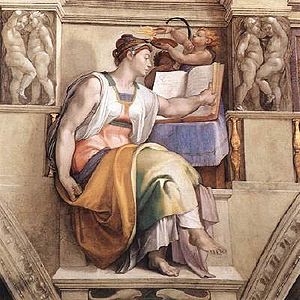 According to the Roman tradition, the oldest collection of Sibylline books appears to have been made about the time of Solon
and Cyrus
at Gergis on Mount Ida
in the Troad; it was attributed to the Hellespontine Sibyl
and was preserved in the temple of Apollo at Gergis. From Gergis the collection passed to Erythrae
, where it became famous as the oracles of the Erythraean Sibyl
. It would appear to have been this very collection that found its way to Cumae
(see the Cumaean Sibyl
) and from Cumae to Rome.
The story of the acquisition of the Sibylline Books by Tarquinius is one of the famous mythic elements of Roman history. The Cumaean Sibyl
offered to Tarquinius nine books of these prophecies; and as the king declined to purchase them, owing to the exorbitant price she demanded, she burned three and offered the remaining six to Tarquinius at the same stiff price, which he again refused, whereupon she burned three more and repeated her offer. Tarquinius then relented and purchased the last three at the full original price and had them preserved in a vault beneath the Capitoline temple of Jupiter. The story is alluded to in Varro
's lost books quoted in Lactantius
Institutiones Divinae (I: 6) and by Origen
.
The Roman Senate
kept tight control over the Sibylline Books; Sibylline Books were entrusted to the care of two patricians; after 367 BC ten custodians were appointed, five patricians and five plebeians, who were called the decemviri sacris faciundis; subsequently (probably in the time of Sulla
) their number was increased to fifteen, the quindecimviri sacris faciundis. They were usually ex-consuls or ex-praetors. They held office for life, and were exempt from all other public duties. They had the responsibility of keeping the books in safety and secrecy. These officials, at the command of the Senate, consulted the Sibylline Books in order to discover not exact predictions of definite future events in the form of prophecy
but the religious observances necessary to avert extraordinary calamities and to expiate ominous prodigies (comets and earthquakes, showers of stones, plague, and the like). It was only the rites of expiation prescribed by the Sibylline Books, according to the interpretation of the oracle that were communicated to the public, and not the oracles themselves, which left ample opportunity for abuses.
In particular, the keepers of the Sibylline Books had the superintendence of the worship of Apollo
, of the "Great Mother" Cybele
or Magna Mater, and of Ceres, which had been introduced upon recommendations as interpreted from the Sibylline Books. The Sibylline Books motivated the construction of eight temples in ancient Rome, aside from those cults that have been interpreted as mediated by the Sibylline Books simply by the Greek nature of the deity. Thus, one important effect of the Sibylline Books was their influence on applying Greek cult practice and Greek conceptions of deities to indigenous Roman religion, which was already indirectly influenced through Etruscan
religion. As the Sibylline Books had been collected in Anatolia
, in the neighborhood of Troy
, they recognized the gods and goddesses and the rites observed there and helped introduce them into Roman state worship, a syncretic
amalgamation of national deities with the corresponding deities of Greece, and a general modification of the Roman religion.
Since they were written in hexameter verse and in Greek, the college of curators was always assisted by two Greek interpreters. The books were kept in the Temple of Jupiter on the Capitol
, and, when the temple burned in 83 BC, they were lost. The Roman Senate sent envoys in 76 BC to replace them with a collection of similar oracular sayings, in particular collected from Ilium
, Erythrae, Samos
, Sicily, and Africa. This new Sibylline collection was deposited in the restored temple, together with similar sayings of native origin, e.g. those of the Sibyl at Tibur (the 'Tiburtine Sibyl
') of the brothers Marcius, and others. The priests then sorted them, retaining only those that appeared true to them (Tacitus, Annales, VI, 12). From the Capitol, they were transferred by Augustus as pontifex maximus in 12 BC, to the temple of Apollo Patrous on the Palatine, after they had been examined and copied; there they remained until about AD 405. According to the poet Rutilius Claudius Namatianus
, the general Flavius Stilicho (died AD 408) burned them, as they were used to attack his government.
Some genuine Sibylline verses are preserved in the Book of Marvels or Memorabilia of Phlegon of Tralles
(2nd century AD). These represent an oracle, or a combination of two oracles, of seventy hexameters in all. They report the birth of an androgyne
, and prescribe a long list of rituals and offerings to the gods.
(late 1st century) as well as by numerous Christian writers of the second century, including Athenagoras of Athens
who, in a letter addressed to Marcus Aurelius in ca. AD 176, quoted verbatim a section of the extant Oracles, in the midst of a lengthy series of other classical and pagan references such as Homer
and Hesiod
, stating several times that all these works should already be familiar to the Roman Emperor. Copies of the actual Sibylline Books (as reconstituted in 76 BC) were still in the Roman Temple at this time. The Oracles are nevertheless thought by modern scholars to be anonymous compilations that assumed their final form in the fifth century, after the Sibylline Books perished. They are a miscellaneous collection of Jewish and Christian portents of future disasters, that may illustrate the confusions about sibyls that were accumulating among Christians of Late Antiquity
.
Oracle
In Classical Antiquity, an oracle was a person or agency considered to be a source of wise counsel or prophetic predictions or precognition of the future, inspired by the gods. As such it is a form of divination....
utterances, set out in Greek
Ancient Greece
Ancient Greece is a civilization belonging to a period of Greek history that lasted from the Archaic period of the 8th to 6th centuries BC to the end of antiquity. Immediately following this period was the beginning of the Early Middle Ages and the Byzantine era. Included in Ancient Greece is the...
hexameter
Hexameter
Hexameter is a metrical line of verse consisting of six feet. It was the standard epic metre in classical Greek and Latin literature, such as in the Iliad and Aeneid. Its use in other genres of composition include Horace's satires, and Ovid's Metamorphoses. According to Greek mythology, hexameter...
s, purchased from a sibyl
Sibyl
The word Sibyl comes from the Greek word σίβυλλα sibylla, meaning prophetess. The earliest oracular seeresses known as the sibyls of antiquity, "who admittedly are known only through legend" prophesied at certain holy sites, under the divine influence of a deity, originally— at Delphi and...
by the last king of Rome
Ancient Rome
Ancient Rome was a thriving civilization that grew on the Italian Peninsula as early as the 8th century BC. Located along the Mediterranean Sea and centered on the city of Rome, it expanded to one of the largest empires in the ancient world....
, Tarquinius Superbus, and consulted at momentous crises through the history of the Republic
Roman Republic
The Roman Republic was the period of the ancient Roman civilization where the government operated as a republic. It began with the overthrow of the Roman monarchy, traditionally dated around 508 BC, and its replacement by a government headed by two consuls, elected annually by the citizens and...
and the Empire
Roman Empire
The Roman Empire was the post-Republican period of the ancient Roman civilization, characterised by an autocratic form of government and large territorial holdings in Europe and around the Mediterranean....
. Only fragments have survived, the rest being lost or deliberately destroyed
Book burning
Book burning, biblioclasm or libricide is the practice of destroying, often ceremoniously, books or other written material and media. In modern times, other forms of media, such as phonograph records, video tapes, and CDs have also been ceremoniously burned, torched, or shredded...
.
The Sibylline Books should not be confused with the so-called Sibylline Oracles
Sibylline oracles
The Sibylline Oracles are a collection of oracular utterances written in Greek hexameters ascribed to the Sibyls, prophetesses who uttered divine revelations in a frenzied state. Fourteen books and eight fragments of Sibylline Oracles survive...
, twelve books of prophesies thought to be of Judaeo-Christian origin.
History
Solon
Solon was an Athenian statesman, lawmaker, and poet. He is remembered particularly for his efforts to legislate against political, economic and moral decline in archaic Athens...
and Cyrus
Cyrus the Great
Cyrus II of Persia , commonly known as Cyrus the Great, also known as Cyrus the Elder, was the founder of the Achaemenid Empire. Under his rule, the empire embraced all the previous civilized states of the ancient Near East, expanded vastly and eventually conquered most of Southwest Asia and much...
at Gergis on Mount Ida
Mount Ida
In Greek mythology, two sacred mountains are called Mount Ida, the "Mountain of the Goddess": Mount Ida in Crete; and Mount Ida in the ancient Troad region of western Anatolia which was also known as the Phrygian Ida in classical antiquity and is the mountain that is mentioned in the Iliad of...
in the Troad; it was attributed to the Hellespontine Sibyl
Hellespontine Sibyl
thumb|right|Montfoort's rendering of the Hellespontine SibylThe Hellespontine Sibyl was the priestess presiding over the Apollonian oracle at Dardania. The Sibyl is sometimes referred to as the Trojan Sibyl. The word Sibyl comes from the ancient Latin word sibylla, meaning prophetess or oracle...
and was preserved in the temple of Apollo at Gergis. From Gergis the collection passed to Erythrae
Erythrae
Erythrae or Erythrai later Litri, was one of the twelve Ionian cities of Asia Minor, situated 22 km north-east of the port of Cyssus , on a small peninsula stretching into the Bay of Erythrae, at an equal distance from the mountains Mimas and Corycus, and directly opposite the island of Chios...
, where it became famous as the oracles of the Erythraean Sibyl
Erythraean Sibyl
The Erythraean Sibyl was the prophetess of classical antiquity presiding over the Apollonian oracle at Erythrae, a town in Ionia opposite Chios, which was built by Neleus, the son of Codrus....
. It would appear to have been this very collection that found its way to Cumae
Cumae
Cumae is an ancient Greek settlement lying to the northwest of Naples in the Italian region of Campania. Cumae was the first Greek colony on the mainland of Italy , and the seat of the Cumaean Sibyl...
(see the Cumaean Sibyl
Cumaean Sibyl
The ageless Cumaean Sibyl was the priestess presiding over the Apollonian oracle at Cumae, a Greek colony located near Naples, Italy.The word sibyl comes from the ancient Greek word sibylla, meaning prophetess. There were many Sibyls in different locations throughout the ancient world...
) and from Cumae to Rome.
The story of the acquisition of the Sibylline Books by Tarquinius is one of the famous mythic elements of Roman history. The Cumaean Sibyl
Cumaean Sibyl
The ageless Cumaean Sibyl was the priestess presiding over the Apollonian oracle at Cumae, a Greek colony located near Naples, Italy.The word sibyl comes from the ancient Greek word sibylla, meaning prophetess. There were many Sibyls in different locations throughout the ancient world...
offered to Tarquinius nine books of these prophecies; and as the king declined to purchase them, owing to the exorbitant price she demanded, she burned three and offered the remaining six to Tarquinius at the same stiff price, which he again refused, whereupon she burned three more and repeated her offer. Tarquinius then relented and purchased the last three at the full original price and had them preserved in a vault beneath the Capitoline temple of Jupiter. The story is alluded to in Varro
Marcus Terentius Varro
Marcus Terentius Varro was an ancient Roman scholar and writer. He is sometimes called Varro Reatinus to distinguish him from his younger contemporary Varro Atacinus.-Biography:...
's lost books quoted in Lactantius
Lactantius
Lucius Caecilius Firmianus Lactantius was an early Christian author who became an advisor to the first Christian Roman emperor, Constantine I, guiding his religious policy as it developed, and tutor to his son.-Biography:...
Institutiones Divinae (I: 6) and by Origen
Origen
Origen , or Origen Adamantius, 184/5–253/4, was an early Christian Alexandrian scholar and theologian, and one of the most distinguished writers of the early Church. As early as the fourth century, his orthodoxy was suspect, in part because he believed in the pre-existence of souls...
.
The Roman Senate
Roman Senate
The Senate of the Roman Republic was a political institution in the ancient Roman Republic, however, it was not an elected body, but one whose members were appointed by the consuls, and later by the censors. After a magistrate served his term in office, it usually was followed with automatic...
kept tight control over the Sibylline Books; Sibylline Books were entrusted to the care of two patricians; after 367 BC ten custodians were appointed, five patricians and five plebeians, who were called the decemviri sacris faciundis; subsequently (probably in the time of Sulla
Lucius Cornelius Sulla
Lucius Cornelius Sulla Felix , known commonly as Sulla, was a Roman general and statesman. He had the rare distinction of holding the office of consul twice, as well as that of dictator...
) their number was increased to fifteen, the quindecimviri sacris faciundis. They were usually ex-consuls or ex-praetors. They held office for life, and were exempt from all other public duties. They had the responsibility of keeping the books in safety and secrecy. These officials, at the command of the Senate, consulted the Sibylline Books in order to discover not exact predictions of definite future events in the form of prophecy
Prophecy
Prophecy is a process in which one or more messages that have been communicated to a prophet are then communicated to others. Such messages typically involve divine inspiration, interpretation, or revelation of conditioned events to come as well as testimonies or repeated revelations that the...
but the religious observances necessary to avert extraordinary calamities and to expiate ominous prodigies (comets and earthquakes, showers of stones, plague, and the like). It was only the rites of expiation prescribed by the Sibylline Books, according to the interpretation of the oracle that were communicated to the public, and not the oracles themselves, which left ample opportunity for abuses.
In particular, the keepers of the Sibylline Books had the superintendence of the worship of Apollo
Apollo
Apollo is one of the most important and complex of the Olympian deities in Greek and Roman mythology...
, of the "Great Mother" Cybele
Cybele
Cybele , was a Phrygian form of the Earth Mother or Great Mother. As with Greek Gaia , her Minoan equivalent Rhea and some aspects of Demeter, Cybele embodies the fertile Earth...
or Magna Mater, and of Ceres, which had been introduced upon recommendations as interpreted from the Sibylline Books. The Sibylline Books motivated the construction of eight temples in ancient Rome, aside from those cults that have been interpreted as mediated by the Sibylline Books simply by the Greek nature of the deity. Thus, one important effect of the Sibylline Books was their influence on applying Greek cult practice and Greek conceptions of deities to indigenous Roman religion, which was already indirectly influenced through Etruscan
Etruscan mythology
The Etruscans were a diachronically continuous population, with a distinct language and culture during the period of earliest European writing, in the Mediterranean Iron Age in the second half of the first millennium BC...
religion. As the Sibylline Books had been collected in Anatolia
Anatolia
Anatolia is a geographic and historical term denoting the westernmost protrusion of Asia, comprising the majority of the Republic of Turkey...
, in the neighborhood of Troy
Troy
Troy was a city, both factual and legendary, located in northwest Anatolia in what is now Turkey, southeast of the Dardanelles and beside Mount Ida...
, they recognized the gods and goddesses and the rites observed there and helped introduce them into Roman state worship, a syncretic
Syncretism
Syncretism is the combining of different beliefs, often while melding practices of various schools of thought. The term means "combining", but see below for the origin of the word...
amalgamation of national deities with the corresponding deities of Greece, and a general modification of the Roman religion.
Since they were written in hexameter verse and in Greek, the college of curators was always assisted by two Greek interpreters. The books were kept in the Temple of Jupiter on the Capitol
Capitoline Hill
The Capitoline Hill , between the Forum and the Campus Martius, is one of the seven hills of Rome. It was the citadel of the earliest Romans. By the 16th century, Capitolinus had become Capitolino in Italian, with the alternative Campidoglio stemming from Capitolium. The English word capitol...
, and, when the temple burned in 83 BC, they were lost. The Roman Senate sent envoys in 76 BC to replace them with a collection of similar oracular sayings, in particular collected from Ilium
Troy
Troy was a city, both factual and legendary, located in northwest Anatolia in what is now Turkey, southeast of the Dardanelles and beside Mount Ida...
, Erythrae, Samos
Samos Island
Samos is a Greek island in the eastern Aegean Sea, south of Chios, north of Patmos and the Dodecanese, and off the coast of Asia Minor, from which it is separated by the -wide Mycale Strait. It is also a separate regional unit of the North Aegean region, and the only municipality of the regional...
, Sicily, and Africa. This new Sibylline collection was deposited in the restored temple, together with similar sayings of native origin, e.g. those of the Sibyl at Tibur (the 'Tiburtine Sibyl
Tiburtine Sibyl
The Tiburtine Sibyl was a Roman sibyl, whose seat was the ancient Etruscan town of Tibur .The mythic meeting of Cæsar Augustus with the Sibyl, of whom he inquired whether he should be worshiped as a god, was a favored motif of Christian artists. Whether the sibyl in question was the Etruscan Sibyl...
') of the brothers Marcius, and others. The priests then sorted them, retaining only those that appeared true to them (Tacitus, Annales, VI, 12). From the Capitol, they were transferred by Augustus as pontifex maximus in 12 BC, to the temple of Apollo Patrous on the Palatine, after they had been examined and copied; there they remained until about AD 405. According to the poet Rutilius Claudius Namatianus
Rutilius Claudius Namatianus
Rutilius Claudius Namatianus was a Roman Imperial poet, notable as the author of a Latin poem, De Reditu Suo, in elegiac metre, describing a coastal voyage from Rome to Gaul in 416...
, the general Flavius Stilicho (died AD 408) burned them, as they were used to attack his government.
Some genuine Sibylline verses are preserved in the Book of Marvels or Memorabilia of Phlegon of Tralles
Phlegon of Tralles
Phlegon of Tralles was a Greek writer and freedman of the emperor Hadrian, who lived in the 2nd century AD.His chief work was the Olympiads, an historical compendium in sixteen books, from the 1st down to the 229th Olympiad , of which several chapters are preserved in Eusebius' Chronicle, Photius...
(2nd century AD). These represent an oracle, or a combination of two oracles, of seventy hexameters in all. They report the birth of an androgyne
Androgyny
Androgyny is a term derived from the Greek words ανήρ, stem ανδρ- and γυνή , referring to the combination of masculine and feminine characteristics...
, and prescribe a long list of rituals and offerings to the gods.
Relationship with the "Sibylline Oracles"
The Sibylline Oracles were quoted by the Roman-Jewish historian JosephusJosephus
Titus Flavius Josephus , also called Joseph ben Matityahu , was a 1st-century Romano-Jewish historian and hagiographer of priestly and royal ancestry who recorded Jewish history, with special emphasis on the 1st century AD and the First Jewish–Roman War, which resulted in the Destruction of...
(late 1st century) as well as by numerous Christian writers of the second century, including Athenagoras of Athens
Athenagoras of Athens
Athenagoras was a Father of the Church, a Proto-orthodox Christian apologist who lived during the second half of the 2nd century of whom little is known for certain, besides that he was Athenian , a philosopher, and a convert to Christianity. In his writings he styles himself as "Athenagoras, the...
who, in a letter addressed to Marcus Aurelius in ca. AD 176, quoted verbatim a section of the extant Oracles, in the midst of a lengthy series of other classical and pagan references such as Homer
Homer
In the Western classical tradition Homer , is the author of the Iliad and the Odyssey, and is revered as the greatest ancient Greek epic poet. These epics lie at the beginning of the Western canon of literature, and have had an enormous influence on the history of literature.When he lived is...
and Hesiod
Hesiod
Hesiod was a Greek oral poet generally thought by scholars to have been active between 750 and 650 BC, around the same time as Homer. His is the first European poetry in which the poet regards himself as a topic, an individual with a distinctive role to play. Ancient authors credited him and...
, stating several times that all these works should already be familiar to the Roman Emperor. Copies of the actual Sibylline Books (as reconstituted in 76 BC) were still in the Roman Temple at this time. The Oracles are nevertheless thought by modern scholars to be anonymous compilations that assumed their final form in the fifth century, after the Sibylline Books perished. They are a miscellaneous collection of Jewish and Christian portents of future disasters, that may illustrate the confusions about sibyls that were accumulating among Christians of Late Antiquity
Late Antiquity
Late Antiquity is a periodization used by historians to describe the time of transition from Classical Antiquity to the Middle Ages, in both mainland Europe and the Mediterranean world. Precise boundaries for the period are a matter of debate, but noted historian of the period Peter Brown proposed...
.
Consultations of the Books cited in history
An incomplete list of consultations of the Sibylline Books recorded by historians:- 399 BC: The books were consulted following a pestilence, resulting in the institution of the lectisterniumLectisterniumIn ancient Roman religion, the lectisternium was a propitiatory ceremony, consisting of a meal offered to gods and goddesses. The word derives from lectum sternere, "to spread a couch." The deities were represented by their busts or statues, or by portable figures of wood, with heads of bronze,...
ceremony. (LivyLivyTitus Livius — known as Livy in English — was a Roman historian who wrote a monumental history of Rome and the Roman people. Ab Urbe Condita Libri, "Chapters from the Foundation of the City," covering the period from the earliest legends of Rome well before the traditional foundation in 753 BC...
5,13) - 348 BC: A plague strikes Rome after a brief skirmish with the Gauls and Greeks. Another lectisternium is ordered. (Livy 7,27)
- 345 BC: The books were consulted when a "shower of stones rained down and darkness filled the sky during daylight". Publius Valerius Publicola was appointed dictator to arrange a public holiday for religious observances. (Livy 7, 28)
- 295 BC: They were consulted again following a pestilence, and reports that large numbers of Appius ClaudiusAppius ClaudiusThere were a number of Romans named Appius Claudius:* Appius Claudius Sabinus Inregillensis, consul in 495 BC* Appius Claudius Crassus, a decemvir in 451 BC* Appius Claudius Caecus , censor in 312 BC...
' army had been struck by lightning. A Temple was built to Venus near the Circus Maximus. (Livy 10,31) - 293 BC: After yet another plague, the books were consulted, with the prescription being 'that Aesculapius must be brought to Rome from EpidaurusEpidaurusEpidaurus was a small city in ancient Greece, at the Saronic Gulf. Two modern towns bear the name Epidavros : Palaia Epidavros and Nea Epidavros. Since 2010 they belong to the new municipality of Epidavros, part of the peripheral unit of Argolis...
'; however, the Senate, being preoccupied with the Samnite warsSamnite WarsThe First, Second, and Third Samnite Wars, between the early Roman Republic and the tribes of Samnium, extended over half a century, involving almost all the states of Italy, and ended in Roman domination of the Samnites...
, took no steps beyond performing one day of public prayers to Aesculapius. (Livy 10,47) - 240/238 BC: The Ludi FloralesReligious festivalA religious festival is a time of special importance marked by adherents to that religion. Religious festivals are commonly celebrated on recurring cycles in a calendar year or lunar calendar...
, or "Flower Games", were instituted after consulting the books. - 216 BC: When Hannibal annihilated the Roman Legions at CannaeBattle of CannaeThe Battle of Cannae was a major battle of the Second Punic War, which took place on August 2, 216 BC near the town of Cannae in Apulia in southeast Italy. The army of Carthage under Hannibal decisively defeated a numerically superior army of the Roman Republic under command of the consuls Lucius...
, the books were consulted, and on their recommendation, two Gauls and two Greeks were buried alive in the city's marketplace. - 204 BC: During the Second Punic WarSecond Punic WarThe Second Punic War, also referred to as The Hannibalic War and The War Against Hannibal, lasted from 218 to 201 BC and involved combatants in the western and eastern Mediterranean. This was the second major war between Carthage and the Roman Republic, with the participation of the Berbers on...
, upon interpreting the oracles in the Sibylline Books, Scipio AfricanusScipio AfricanusPublius Cornelius Scipio Africanus , also known as Scipio Africanus and Scipio the Elder, was a general in the Second Punic War and statesman of the Roman Republic...
brought an image of CybeleCybeleCybele , was a Phrygian form of the Earth Mother or Great Mother. As with Greek Gaia , her Minoan equivalent Rhea and some aspects of Demeter, Cybele embodies the fertile Earth...
from Pessinos and established her cult in Rome. - 63 BC: Believing in a prediction of the books that 'three Cornelii' would dominate Rome, Publius Cornelius Lentulus Sura took part in the conspiracy of CatilineCatilineLucius Sergius Catilina , known in English as Catiline, was a Roman politician of the 1st century BC who is best known for the Catiline conspiracy, an attempt to overthrow the Roman Republic, and in particular the power of the aristocratic Senate.-Family background:Catiline was born in 108 BC to...
(Plutarch, Life of Cicero, XVII) - ca. 55 BC: As Romans deliberated sending a force to restore Ptolemy XII to the throne of Egypt, lightning struck the statue of JupiterJupiter (mythology)In ancient Roman religion and myth, Jupiter or Jove is the king of the gods, and the god of the sky and thunder. He is the equivalent of Zeus in the Greek pantheon....
on the Alban MountAlban HillsThe Alban Hills are the site of a quiescent volcanic complex in Italy, located southeast of Rome and about north of Anzio.The dominant peak is Monte Cavo. There are two small calderas which contain lakes, Lago Albano and Lake Nemi...
; the oracles were consulted and one found to read "If the King of Egypt comes to you asking for assistance, refuse him not your friendship, yet do not grant him any army, or else you will have toil and danger". This considerably delayed Ptolemy's return. (Dio CassiusDio CassiusLucius Cassius Dio Cocceianus , known in English as Cassius Dio, Dio Cassius, or Dio was a Roman consul and a noted historian writing in Greek...
History of Rome 39:15) - 44 BC: According to SuetoniusSuetoniusGaius Suetonius Tranquillus, commonly known as Suetonius , was a Roman historian belonging to the equestrian order in the early Imperial era....
, a sibylline prediction that only a king could triumph over ParthiaParthiaParthia is a region of north-eastern Iran, best known for having been the political and cultural base of the Arsacid dynasty, rulers of the Parthian Empire....
fueled rumors that CaesarJulius CaesarGaius Julius Caesar was a Roman general and statesman and a distinguished writer of Latin prose. He played a critical role in the gradual transformation of the Roman Republic into the Roman Empire....
, leader of the then-republic, was aspiring to kingship. (Caesar, 79) - 15 AD: When the Tiber river flooded the lower parts of Rome, one of the priests suggested consulting the books, but Emperor TiberiusTiberiusTiberius , was Roman Emperor from 14 AD to 37 AD. Tiberius was by birth a Claudian, son of Tiberius Claudius Nero and Livia Drusilla. His mother divorced Nero and married Augustus in 39 BC, making him a step-son of Octavian...
refused, preferring to keep the divine things secret. (Tacitus, Annales I, 76) - 271: The books were consulted following the Roman defeat at PlacentiaBattle of PlacentiaThe Battle of Placentia was fought in January 271 between a Roman army led by Emperor Aurelian and the Alamanni , near modern Piacenza....
by the AlamanniAlamanniThe Alamanni, Allemanni, or Alemanni were originally an alliance of Germanic tribes located around the upper Rhine river . One of the earliest references to them is the cognomen Alamannicus assumed by Roman Emperor Caracalla, who ruled the Roman Empire from 211 to 217 and claimed thereby to be...
. - 312: MaxentiusMaxentiusMaxentius was a Roman Emperor from 306 to 312. He was the son of former Emperor Maximian, and the son-in-law of Emperor Galerius.-Birth and early life:Maxentius' exact date of birth is unknown; it was probably around 278...
consulted the Sibylline Books in preparation for combat with Constantine, who had recently switched his allegiance from ApolloApolloApollo is one of the most important and complex of the Olympian deities in Greek and Roman mythology...
to ChristJesusJesus of Nazareth , commonly referred to as Jesus Christ or simply as Jesus or Christ, is the central figure of Christianity...
. - 363: Julian the ApostateJulian the ApostateJulian "the Apostate" , commonly known as Julian, or also Julian the Philosopher, was Roman Emperor from 361 to 363 and a noted philosopher and Greek writer....
consulted the books in preparation for marching against the Sassanids. The response mailed from Rome "manifestly supported crossing the border this year." (Ammianus MarcellinusAmmianus MarcellinusAmmianus Marcellinus was a fourth-century Roman historian. He wrote the penultimate major historical account surviving from Antiquity...
, History of Rome, XXIII 1, 7) - 405: StilichoStilichoFlavius Stilicho was a high-ranking general , Patrician and Consul of the Western Roman Empire, notably of Vandal birth. Despised by the Roman population for his Germanic ancestry and Arian beliefs, Stilicho was in 408 executed along with his wife and son...
ordered the destruction of the Sibylline Books, possibly because Sibylline prophecies were being used to attack his government in the face of the attack of Alaric IAlaric IAlaric I was the King of the Visigoths from 395–410. Alaric is most famous for his sack of Rome in 410, which marked a decisive event in the decline of the Roman Empire....
.