


Melqart

Encyclopedia
Melqart, properly Phoenician Milk-Qart "King of the City", less accurately Melkart, Melkarth or Melgart , Akkadian
Milqartu, was tutelary god of the Phoenicia
n city of Tyre as Eshmun
protected Sidon
. Melqart was often titled Ba‘l
Ṣūr "Lord of Tyre", the ancestral king of the royal line. In Greek
, by interpretatio graeca
he was identified with Heracles
and referred to as the Tyrian Herakles
.
Melqart was venerated in Phoenicia
n and Punic cultures from Syria
to Spain
. The first occurrence of the name is in a ninth-century BCE stela inscription found in 1939 north of Aleppo
in northern Syria, the "Ben-Hadad" inscription, erected by the son of the king of Arma, "for his lord Melqart, which he vowed to him and he heard his voice".
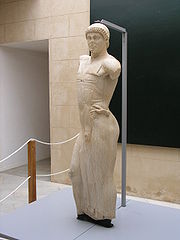 Melqart is likely to have been the particular Ba‘al found in the Tanach, whose worship was prominently introduced into Israel
by King Ahab
and largely eradicated by King Jehu
. In 1 Kings 18.27 it is possible there is a mocking reference to legendary Heraclean journeys made by the god and to the annual egersis ("awakening") of the god:
The Hellenistic novelist Heliodorus of Emesa
in his Aethiopica refers to the dancing of Tyrian sailors in honor of the Tyrian Heracles, "Now they leap spiritedly into the air, now they bend their knees to the ground and revolve on them like persons possessed".
The historian Herodotus
recorded (2.44):
Josephus
records (Antiquities 8.5.3), following Menander
the historian, concerning King Hiram I
of Tyre (c. 965–935 BCE):
The Macedon
ian month of Peritius corresponds to our February, indicating this annual awakening was in no way a solstitial celebration. It would have coincided with the normal ending of the winter rains. The annual observation of the revival of Melqart's "awakening" may identify Melqart as a life-death-rebirth deity
.
The Roman Emperor Septimius Severus
was a native of Lepcis Magna in North Africa, an originally Phoenician city where worship of Melqart was widespread. He is known to have constructed in Rome a temple dedicated to "Liber
and Hercules", and it is assumed that the Emperor, seeking to honour the god of his native city, identified Melqart with the Roman god Liber.
, the temple to Melqart is as early as the earliest vestiges of Phoenician occupation. (The Greeks followed a parallel practice in respect to Heracles.) Carthage
even sent a yearly tribute of 10% of the public treasury to the god in Tyre up until the Hellenistic period
.
In Tyre, the high priest of Melqart ranked second only to the king. Many names in Carthage reflected this importance of Melqart, for example, the names Hamilcar
and Bomilcar
; but Ba‘l "Lord" as a name-element in Carthaginian names such as Hasdrubal
and Hannibal almost certainly does not refer to Melqart but either to Ba`al Hammon, chief god of Carthage, a god identified by Greeks with Cronus
and by Romans with Saturn
, or is simply used as a title.
Melqart protected the Punic areas of Sicily
such as Ras Melqart 'Cape of Melqart', where his head, indistinguishable from a Heracles, appears on locally-minted coins of the fourth century BCE.
The Cippi of Melqart
, found on Malta
and dedicated to the god as an ex voto offering, provided the key to understanding the Phoenician language, as the inscriptions on the cippi were written in both Phoenician and Greek
.
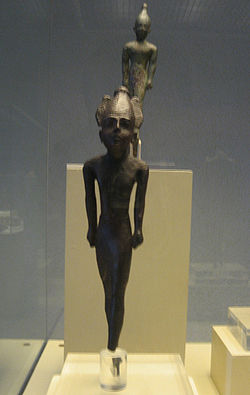 Temples to Melqart are found at least three Phoenician/Punic sites in Spain: Cádiz, Ibiza in the Balearic Islands
and Cartagena. Near Gades/Gádeira (modern Cádiz
) was the westernmost temple of Tyrian Heracles, near the eastern shore of the island (Strabo
3.5.2–3). Strabo notes (3.5.5–6) that the two bronze pillars within the temple, each 8 cubits high, were widely proclaimed to be the true Pillars of Heracles by many who had visited the place and had sacrificed to Heracles there. Strabo believes the account to be fraudulent, in part noting that the inscriptions on those pillars mentioned nothing about Heracles, speaking only of the expenses occurred by the Phoenicians in their making.
Another temple to Melqart was at Ebyssus (Ibiza
), in one of four Phoenician sites on the island's south coast. In 2004 a highway crew in the Avinguda Espanya, (one of the main routes into Ibiza), uncovered a further Punic temple in the excavated roadbed. Texts found mention Melqart among other Punic gods Eshmun, Astarte and Baʻl.
Another Iberian temple to Melqart has been identified at Carthago Nova (Cartagena
). The Tyrian god's protection extended to the sacred promontory (Cape Saint Vincent) of the Iberian peninsula, the westernmost point of the known world, ground so sacred it was forbidden even to spend the night.
records the legend that just before setting off on his march to Italy
he made a pilgrimage to Gades
, the most ancient seat of Phoenician worship in the west. Hannibal strengthened himself spiritually by prayer and sacrifice at the Altar of Melqart. He returned to New Carthage with his mind focused on the god and on the eve of departure to Italy he saw a strange vision which he believed was sent by Melqart.
A youth of divine beauty appeared to Hannibal in the night. The youth told Hannibal he had been sent by supreme deity, Melqart, to guide the son of Hamilcar
to Italy. “Follow me,” said the ghostly visitor, “and see that that thou look not behind thee.” Hannibal followed the instructions of the visitor. His curiosity, however, overcame him, and as he turned his head, Hannibal saw a serpent crashing through forest and thicket causing destruction everywhere. It moved as a black tempest with claps of thunder and flashes of lightning gathered behind the serpent. When Hannibal asked the meaning of the vision Melqart replied, “What thou beholdest is the desolation of Italy. Follow thy star and inquire no farther into the dark counsels of heaven.”
son of Ino
found in Greek mythology was in origin a reflection of Melqart. Though no classical source explicitly connects the two, Ino is the daughter of Cadmus
of Tyre. Lewis Farnell thought not, referring in 1916 to "the accidental resemblance in sound of Melikertes and Melqart, seeing that Melqart, the bearded god, had no affinity in form or myth with the child- or boy-deity, and was moreover always identified with Herakles: nor do we know anything about Melqart that would explain the figure of Ino that is aboriginally inseparable from Melikertes."
Athenaeus
(392d) summarizes a story by Eudoxus of Cnidus
(c. 355 BCE
) telling how Heracles the son of Zeus
by Asteria
(= ‘Ashtart ?) was killed by Typhon
in Libya
. Heracles' companion Iolaus
brought a quail to the dead god (presumably a roasted quail) and its delicious scent roused Heracles back to life. This purports to explain why the Phoenicians sacrifice quails to Heracles. It seems that Melqart had a companion similar to the Hellenic Iolaus, who was himself a native of the Tyrian colony of Thebes. Sanchuniathon
also makes Melqart under the name Malcarthos or Melcathros the son of Hadad
who is normally identified with Zeus.
The Pseudo-Clementine Recognitions
(10.24) speaks of the tombs of various gods including "that of Heracles at Tyre, where he was burnt with fire." The Hellenic Heracles also died on a pyre, but the event was located on Mount Oeta in Trachis. A similar tradition is recorded by Dio Chrysostom
(Or. 33.47) who mentions the beautiful pyre which the Tarsians used to build for their Heracles, referring here to the Cilicia
n god Sandan.
To be sure, in Nonnus' Dionysiaca (40.366–580) the Tyrian Heracles is very much a sun god. However there is a tendency in the later Hellenistic and Roman periods for almost all gods to develop solar attributes and for almost all eastern gods to be identified with the sun. Nonnus gives the title Astrochiton 'Starclad' to Tyrian Heracles and has his Dionysus
recite a hymn to this Heracles, saluting him as: the son of Time, he who causes the threefold image of the Moon, the all-shining Eye of the heavens. Rain is ascribed to the shaking from his head of the waters of the his bath in the eastern Ocean
. His sun disk is praised as the cause of growth in plants. Then, in a climactic burst of syncretism, Dionysus identifies the Tyrian Heracles with Belus on the Euphrates
, Ammon
in Libya, Apis
by the Nile
, Arabian Cronus, Assyria
n Zeus, Serapis
, Zeus of Egypt
, Cronus
, Phaethon, Mithras, Delphi
c Apollo
, Gamos 'Marriage', and Paeon 'Healer'.
The Tyrian Heracles answers by appearing to Dionysus. There is red light in the fiery eyes of this shining god who clothed in a robe embroidered like the sky (presumably with various constellations). He has yellow, sparkling cheeks and a starry beard. The god reveals how he taught the primeval, earthborn inhabitants of Phoenicia how to build the first boat and instructed them to sail out to a pair of floating, rocky islands. On one of the islands there grew an olive tree with a serpent at its foot, an eagle at its summit, and which glowed in the middle with fire that burned but did not consume. Following the god's instructions, these primeval humans sacrificed the eagle to Poseidon, Zeus, and the other gods. Thereupon the islands rooted themselves to the bottom of the sea. On these islands the city of Tyre was founded.
Gregory Nazianzen (Oratio 4.108) and Cassiodorus
(Variae 1.2) relate how Tyrian Heracles and the nymph Tyrus were walking along the beach when Heracles' dog, who was accompanying them, devoured a murex snail and gained a beautiful purple color around its mouth. Tyrus told Heracles she would never accept him as her lover until he gave her a robe of that same colour. So Heracles gathered many murex shells, extracted the dye from them, and dyed the first garment of the colour later called Tyrian purple. The murex shell appears on the very earliest Tyrian coins and then reappears again on coins in Imperial Roman times.
in Archaeology and the Religion of Israel (Baltimore, 1953; pp. 81, 196) suggested Melqart was a god of the underworld partly because a god Malku who may be Melqart is sometimes equated with the Mesopotamian god Nergal
, a god of the underworld, whose name also means 'King of the City'. Others take this to be coincidental, since what we know about Melqart from other sources does not suggest an underworld god and it is more natural to understand the city to be Tyre. It has been suggested that Melqart began as a sea god who was later given solar attributes or alternatively that he began as a solar god who later received the attributes of a sea god. In fact little is known of his cult.
Akkadian language
Akkadian is an extinct Semitic language that was spoken in ancient Mesopotamia. The earliest attested Semitic language, it used the cuneiform writing system derived ultimately from ancient Sumerian, an unrelated language isolate...
Milqartu, was tutelary god of the Phoenicia
Phoenicia
Phoenicia , was an ancient civilization in Canaan which covered most of the western, coastal part of the Fertile Crescent. Several major Phoenician cities were built on the coastline of the Mediterranean. It was an enterprising maritime trading culture that spread across the Mediterranean from 1550...
n city of Tyre as Eshmun
Eshmun
Eshmun was a Phoenician god of healing and the tutelary god of Sidon.This god was known at least from the Iron Age period at Sidon and was worshipped also in Tyre, Beirut, Cyprus, Sardinia, and in Carthage where the site of Eshmun's temple is now occupied by the chapel of Saint Louis.According to...
protected Sidon
Sidon
Sidon or Saïda is the third-largest city in Lebanon. It is located in the South Governorate of Lebanon, on the Mediterranean coast, about 40 km north of Tyre and 40 km south of the capital Beirut. In Genesis, Sidon is the son of Canaan the grandson of Noah...
. Melqart was often titled Ba‘l
Baal
Baʿal is a Northwest Semitic title and honorific meaning "master" or "lord" that is used for various gods who were patrons of cities in the Levant and Asia Minor, cognate to Akkadian Bēlu...
Ṣūr "Lord of Tyre", the ancestral king of the royal line. In Greek
Greek language
Greek is an independent branch of the Indo-European family of languages. Native to the southern Balkans, it has the longest documented history of any Indo-European language, spanning 34 centuries of written records. Its writing system has been the Greek alphabet for the majority of its history;...
, by interpretatio graeca
Interpretatio graeca
Interpretatio graeca is a Latin term for the common tendency of ancient Greek writers to equate foreign divinities to members of their own pantheon. Herodotus, for example, refers to the ancient Egyptian gods Amon, Osiris and Ptah as "Zeus", "Dionysus" and "Hephaestus", respectively.-Roman...
he was identified with Heracles
Heracles
Heracles ,born Alcaeus or Alcides , was a divine hero in Greek mythology, the son of Zeus and Alcmene, foster son of Amphitryon and great-grandson of Perseus...
and referred to as the Tyrian Herakles
Hercules
Hercules is the Roman name for Greek demigod Heracles, son of Zeus , and the mortal Alcmene...
.
Melqart was venerated in Phoenicia
Phoenicia
Phoenicia , was an ancient civilization in Canaan which covered most of the western, coastal part of the Fertile Crescent. Several major Phoenician cities were built on the coastline of the Mediterranean. It was an enterprising maritime trading culture that spread across the Mediterranean from 1550...
n and Punic cultures from Syria
Syria
Syria , officially the Syrian Arab Republic , is a country in Western Asia, bordering Lebanon and the Mediterranean Sea to the West, Turkey to the north, Iraq to the east, Jordan to the south, and Israel to the southwest....
to Spain
Spain
Spain , officially the Kingdom of Spain languages]] under the European Charter for Regional or Minority Languages. In each of these, Spain's official name is as follows:;;;;;;), is a country and member state of the European Union located in southwestern Europe on the Iberian Peninsula...
. The first occurrence of the name is in a ninth-century BCE stela inscription found in 1939 north of Aleppo
Aleppo
Aleppo is the largest city in Syria and the capital of Aleppo Governorate, the most populous Syrian governorate. With an official population of 2,301,570 , expanding to over 2.5 million in the metropolitan area, it is also one of the largest cities in the Levant...
in northern Syria, the "Ben-Hadad" inscription, erected by the son of the king of Arma, "for his lord Melqart, which he vowed to him and he heard his voice".
Cult: literary testimony
Israel
The State of Israel is a parliamentary republic located in the Middle East, along the eastern shore of the Mediterranean Sea...
by King Ahab
Ahab
Ahab or Ach'av or Achab in Douay-Rheims was king of Israel and the son and successor of Omri according to the Hebrew Bible. His wife was Jezebel....
and largely eradicated by King Jehu
Jehu
Jehu was a king of Israel. He was the son of Jehoshaphat, and grandson of Nimshi.William F. Albright has dated his reign to 842-815 BC, while E. R. Thiele offers the dates 841-814 BC...
. In 1 Kings 18.27 it is possible there is a mocking reference to legendary Heraclean journeys made by the god and to the annual egersis ("awakening") of the god:
And it came to pass at noon that Elijah mocked them and said, "Cry out loud: for he is a god; either he is lost in thought, or he has wandered away, or he is on a journey, or perhaps he is sleeping and must be awakened."
The Hellenistic novelist Heliodorus of Emesa
Heliodorus of Emesa
Heliodorus of Emesa, from Emesa, Syria, was a Greek writer generally dated to the third century AD who is known for the ancient Greek novel or romance called the Aethiopica or sometimes "Theagenes and Chariclea"....
in his Aethiopica refers to the dancing of Tyrian sailors in honor of the Tyrian Heracles, "Now they leap spiritedly into the air, now they bend their knees to the ground and revolve on them like persons possessed".
The historian Herodotus
Herodotus
Herodotus was an ancient Greek historian who was born in Halicarnassus, Caria and lived in the 5th century BC . He has been called the "Father of History", and was the first historian known to collect his materials systematically, test their accuracy to a certain extent and arrange them in a...
recorded (2.44):
In the wish to get the best information that I could on these matters, I made a voyage to Tyre in Phoenicia, hearing there was a temple of Heracles at that place, very highly venerated. I visited the temple, and found it richly adorned with a number of offerings, among which were two pillars, one of pure gold, the other of smaragdos, shining with great brilliancy at night. In a conversation which I held with the priests, I inquired how long their temple had been built, and found by their answer that they, too, differed from the Hellenes. They said that the temple was built at the same time that the city was founded, and that the foundation of the city took place 2,300 years ago. In Tyre I remarked another temple where the same god was worshipped as the Thasian Heracles. So I went on to ThasosThasosThasos or Thassos is a Greek island in the northern Aegean Sea, close to the coast of Thrace and the plain of the river Nestos but geographically part of Macedonia. It is the northernmost Greek island, and 12th largest by area...
, where I found a temple of Heracles which had been built by the Phoenicians who colonised that island when they sailed in search of EuropaEuropa (mythology)In Greek mythology Europa was a Phoenician woman of high lineage, from whom the name of the continent Europe has ultimately been taken. The name Europa occurs in Hesiod's long list of daughters of primordial Oceanus and Tethys...
. Even this was five generations earlier than the time when Heracles, son of AmphitryonAmphitryonAmphitryon , in Greek mythology, was a son of Alcaeus, king of Tiryns in Argolis.Amphitryon was a Theban general, who was originally from Tiryns in the eastern part of the Peloponnese. He was friends with Panopeus....
, was born in Hellas. These researches show plainly that there is an ancient god Heracles; and my own opinion is that those Hellenes act most wisely who build and maintain two temples of Heracles, in the one of which the Heracles worshipped is known by the name of OlympianTwelve OlympiansThe Twelve Olympians, also known as the Dodekatheon , in Greek mythology, were the principal deities of the Greek pantheon, residing atop Mount Olympus. Zeus, Hera, Poseidon, Demeter, Hestia, and Hades were siblings. Ares, Hermes, Hephaestus, Athena, Apollo, and Artemis were children of Zeus...
, and has sacrifice offered to him as an immortal, while in the other the honours paid are such as are due to a hero.
Josephus
Josephus
Titus Flavius Josephus , also called Joseph ben Matityahu , was a 1st-century Romano-Jewish historian and hagiographer of priestly and royal ancestry who recorded Jewish history, with special emphasis on the 1st century AD and the First Jewish–Roman War, which resulted in the Destruction of...
records (Antiquities 8.5.3), following Menander
Menander
Menander , Greek dramatist, the best-known representative of Athenian New Comedy, was the son of well-to-do parents; his father Diopeithes is identified by some with the Athenian general and governor of the Thracian Chersonese known from the speech of Demosthenes De Chersoneso...
the historian, concerning King Hiram I
Hiram I
Hiram I , according to the Hebrew Bible, was the Phoenician king of Tyre. He reigned from 980 to 947 BC, succeeding his father, Abibaal. Hiram was succeeded as king of Tyre by his son Baal-Eser I...
of Tyre (c. 965–935 BCE):
He also went and cut down materials of timber out of the mountain called LebanonMount LebanonMount Lebanon , as a geographic designation, is a Lebanese mountain range, averaging above 2,200 meters in height and receiving a substantial amount of precipitation, including snow, which averages around four meters deep. It extends across the whole country along about , parallel to the...
, for the roof of temples; and when he had pulled down the ancient temples, he both built the temple of Heracles and that of `Ashtart; and he was the first to celebrate the awakening (egersis) of Heracles in the month Peritius.
The Macedon
Macedon
Macedonia or Macedon was an ancient kingdom, centered in the northeastern part of the Greek peninsula, bordered by Epirus to the west, Paeonia to the north, the region of Thrace to the east and Thessaly to the south....
ian month of Peritius corresponds to our February, indicating this annual awakening was in no way a solstitial celebration. It would have coincided with the normal ending of the winter rains. The annual observation of the revival of Melqart's "awakening" may identify Melqart as a life-death-rebirth deity
Life-death-rebirth deity
A dying god, also known as a dying-and-rising or resurrection deity, is a god who dies and is resurrected or reborn, in either a literal or symbolic sense. Male examples include the ancient Near Eastern and Greek deities Baal, Melqart, Adonis, Eshmun, Attis Tammuz, Asclepius, Orpheus, as well as...
.
The Roman Emperor Septimius Severus
Septimius Severus
Septimius Severus , also known as Severus, was Roman Emperor from 193 to 211. Severus was born in Leptis Magna in the province of Africa. As a young man he advanced through the customary succession of offices under the reigns of Marcus Aurelius and Commodus. Severus seized power after the death of...
was a native of Lepcis Magna in North Africa, an originally Phoenician city where worship of Melqart was widespread. He is known to have constructed in Rome a temple dedicated to "Liber
Liber
In ancient Roman religion and mythology, Liber , also known as Liber Pater was a god of viticulture and wine, fertility and freedom. He was a patron deity of Rome's plebeians and was part of their Aventine Triad. His festival of Liberalia became associated with free speech and the rights...
and Hercules", and it is assumed that the Emperor, seeking to honour the god of his native city, identified Melqart with the Roman god Liber.
Archaeological evidence
Archaeological evidence for Melqart's cult is found earliest in Tyre and seems to have spread westward with the Phoenician colonies established by Tyre as well as eventually overshadowing the worship of Eshmun in Sidon. The name of Melqart was invoked in oaths sanctioning contracts, according to Dr. Aubet, thus it was customary to build a temple to Melqart, as protector of Tyrian traders, in each new Phoenician colony: at CádizCádiz
Cadiz is a city and port in southwestern Spain. It is the capital of the homonymous province, one of eight which make up the autonomous community of Andalusia....
, the temple to Melqart is as early as the earliest vestiges of Phoenician occupation. (The Greeks followed a parallel practice in respect to Heracles.) Carthage
Carthage
Carthage , implying it was a 'new Tyre') is a major urban centre that has existed for nearly 3,000 years on the Gulf of Tunis, developing from a Phoenician colony of the 1st millennium BC...
even sent a yearly tribute of 10% of the public treasury to the god in Tyre up until the Hellenistic period
Hellenistic civilization
Hellenistic civilization represents the zenith of Greek influence in the ancient world from 323 BCE to about 146 BCE...
.
In Tyre, the high priest of Melqart ranked second only to the king. Many names in Carthage reflected this importance of Melqart, for example, the names Hamilcar
Hamilcar
Hamilcar was a common name in the Punic culture. There are several different transcriptions into Greek and Roman scripts. The ruling families of ancient Carthage often named their members with the traditional name Hamilcar...
and Bomilcar
Bomilcar
Bomilcar may refer to:* Bomilcar , Carthaginian commander in the war against Agathocles* Bomilcar , Carthaginian suffete and commander in the Second Punic War, father of Hanno...
; but Ba‘l "Lord" as a name-element in Carthaginian names such as Hasdrubal
Hasdrubal
Hasdrubal was the name of several Carthaginian generals of the First and Second Punic Wars...
and Hannibal almost certainly does not refer to Melqart but either to Ba`al Hammon, chief god of Carthage, a god identified by Greeks with Cronus
Cronus
In Greek mythology, Cronus or Kronos was the leader and the youngest of the first generation of Titans, divine descendants of Gaia, the earth, and Uranus, the sky...
and by Romans with Saturn
Saturn (mythology)
In ancient Roman religion and myth, Saturn was a major god presiding over agriculture and the harvest time. His reign was depicted as a Golden Age of abundance and peace by many Roman authors. In medieval times he was known as the Roman god of agriculture, justice and strength. He held a sickle in...
, or is simply used as a title.
Melqart protected the Punic areas of Sicily
Sicily
Sicily is a region of Italy, and is the largest island in the Mediterranean Sea. Along with the surrounding minor islands, it constitutes an autonomous region of Italy, the Regione Autonoma Siciliana Sicily has a rich and unique culture, especially with regard to the arts, music, literature,...
such as Ras Melqart 'Cape of Melqart', where his head, indistinguishable from a Heracles, appears on locally-minted coins of the fourth century BCE.
The Cippi of Melqart
Cippi of Melqart
The Cippi of Melqart is the collective name for two white marble cippi that were unearthed at Tas-Silġ, Marsaxlokk, Malta by the Knights Hospitaller in the late 17th century...
, found on Malta
Malta
Malta , officially known as the Republic of Malta , is a Southern European country consisting of an archipelago situated in the centre of the Mediterranean, south of Sicily, east of Tunisia and north of Libya, with Gibraltar to the west and Alexandria to the east.Malta covers just over in...
and dedicated to the god as an ex voto offering, provided the key to understanding the Phoenician language, as the inscriptions on the cippi were written in both Phoenician and Greek
Greek language
Greek is an independent branch of the Indo-European family of languages. Native to the southern Balkans, it has the longest documented history of any Indo-European language, spanning 34 centuries of written records. Its writing system has been the Greek alphabet for the majority of its history;...
.
Temple sites
Balearic Islands
The Balearic Islands are an archipelago of Spain in the western Mediterranean Sea, near the eastern coast of the Iberian Peninsula.The four largest islands are: Majorca, Minorca, Ibiza and Formentera. The archipelago forms an autonomous community and a province of Spain with Palma as the capital...
and Cartagena. Near Gades/Gádeira (modern Cádiz
Cádiz
Cadiz is a city and port in southwestern Spain. It is the capital of the homonymous province, one of eight which make up the autonomous community of Andalusia....
) was the westernmost temple of Tyrian Heracles, near the eastern shore of the island (Strabo
Strabo
Strabo, also written Strabon was a Greek historian, geographer and philosopher.-Life:Strabo was born to an affluent family from Amaseia in Pontus , a city which he said was situated the approximate equivalent of 75 km from the Black Sea...
3.5.2–3). Strabo notes (3.5.5–6) that the two bronze pillars within the temple, each 8 cubits high, were widely proclaimed to be the true Pillars of Heracles by many who had visited the place and had sacrificed to Heracles there. Strabo believes the account to be fraudulent, in part noting that the inscriptions on those pillars mentioned nothing about Heracles, speaking only of the expenses occurred by the Phoenicians in their making.
Another temple to Melqart was at Ebyssus (Ibiza
Ibiza
Ibiza or Eivissa is a Spanish island in the Mediterranean Sea 79 km off the coast of the city of Valencia in Spain. It is the third largest of the Balearic Islands, an autonomous community of Spain. With Formentera, it is one of the two Pine Islands or Pityuses. Its largest cities are Ibiza...
), in one of four Phoenician sites on the island's south coast. In 2004 a highway crew in the Avinguda Espanya, (one of the main routes into Ibiza), uncovered a further Punic temple in the excavated roadbed. Texts found mention Melqart among other Punic gods Eshmun, Astarte and Baʻl.
Another Iberian temple to Melqart has been identified at Carthago Nova (Cartagena
Cartagena, Spain
Cartagena is a Spanish city and a major naval station located in the Region of Murcia, by the Mediterranean coast, south-eastern Spain. As of January 2011, it has a population of 218,210 inhabitants being the Region’s second largest municipality and the country’s 6th non-Province capital...
). The Tyrian god's protection extended to the sacred promontory (Cape Saint Vincent) of the Iberian peninsula, the westernmost point of the known world, ground so sacred it was forbidden even to spend the night.
Hannibal and Melqart
Hannibal was a faithful worshiper of Melqart: the Roman historian LivyLivy
Titus Livius — known as Livy in English — was a Roman historian who wrote a monumental history of Rome and the Roman people. Ab Urbe Condita Libri, "Chapters from the Foundation of the City," covering the period from the earliest legends of Rome well before the traditional foundation in 753 BC...
records the legend that just before setting off on his march to Italy
Italy
Italy , officially the Italian Republic languages]] under the European Charter for Regional or Minority Languages. In each of these, Italy's official name is as follows:;;;;;;;;), is a unitary parliamentary republic in South-Central Europe. To the north it borders France, Switzerland, Austria and...
he made a pilgrimage to Gades
Cádiz
Cadiz is a city and port in southwestern Spain. It is the capital of the homonymous province, one of eight which make up the autonomous community of Andalusia....
, the most ancient seat of Phoenician worship in the west. Hannibal strengthened himself spiritually by prayer and sacrifice at the Altar of Melqart. He returned to New Carthage with his mind focused on the god and on the eve of departure to Italy he saw a strange vision which he believed was sent by Melqart.
A youth of divine beauty appeared to Hannibal in the night. The youth told Hannibal he had been sent by supreme deity, Melqart, to guide the son of Hamilcar
Hamilcar Barca
Hamilcar Barca or Barcas was a Carthaginian general and statesman, leader of the Barcid family, and father of Hannibal, Hasdrubal and Mago. He was also father-in-law to Hasdrubal the Fair....
to Italy. “Follow me,” said the ghostly visitor, “and see that that thou look not behind thee.” Hannibal followed the instructions of the visitor. His curiosity, however, overcame him, and as he turned his head, Hannibal saw a serpent crashing through forest and thicket causing destruction everywhere. It moved as a black tempest with claps of thunder and flashes of lightning gathered behind the serpent. When Hannibal asked the meaning of the vision Melqart replied, “What thou beholdest is the desolation of Italy. Follow thy star and inquire no farther into the dark counsels of heaven.”
Mythology: Greek
It was suggested by some writers that the Phoenician MelicertesMelicertes
In Greek mythology, Melicertes is the son of the Boeotian prince Athamas and Ino, daughter of Cadmus....
son of Ino
Ino (Greek mythology)
In Greek mythology Ino was a mortal queen of Thebes, who after her death and transfiguration was worshiped as a goddess under her epithet Leucothea, the "white goddess." Alcman called her "Queen of the Sea" , which, if not hyperbole, would make her a doublet of Amphitrite.In her mortal self, Ino,...
found in Greek mythology was in origin a reflection of Melqart. Though no classical source explicitly connects the two, Ino is the daughter of Cadmus
Cadmus
Cadmus or Kadmos , in Greek mythology was a Phoenician prince, the son of king Agenor and queen Telephassa of Tyre and the brother of Phoenix, Cilix and Europa. He was originally sent by his royal parents to seek out and escort his sister Europa back to Tyre after she was abducted from the shores...
of Tyre. Lewis Farnell thought not, referring in 1916 to "the accidental resemblance in sound of Melikertes and Melqart, seeing that Melqart, the bearded god, had no affinity in form or myth with the child- or boy-deity, and was moreover always identified with Herakles: nor do we know anything about Melqart that would explain the figure of Ino that is aboriginally inseparable from Melikertes."
Athenaeus
Athenaeus
Athenaeus , of Naucratis in Egypt, Greek rhetorician and grammarian, flourished about the end of the 2nd and beginning of the 3rd century AD...
(392d) summarizes a story by Eudoxus of Cnidus
Eudoxus of Cnidus
Eudoxus of Cnidus was a Greek astronomer, mathematician, scholar and student of Plato. Since all his own works are lost, our knowledge of him is obtained from secondary sources, such as Aratus's poem on astronomy...
(c. 355 BCE
355 BC
Year 355 BC was a year of the pre-Julian Roman calendar. At the time, it was known as the Year of the Consulship of Peticus and Poplicola...
) telling how Heracles the son of Zeus
Zeus
In the ancient Greek religion, Zeus was the "Father of Gods and men" who ruled the Olympians of Mount Olympus as a father ruled the family. He was the god of sky and thunder in Greek mythology. His Roman counterpart is Jupiter and his Etruscan counterpart is Tinia.Zeus was the child of Cronus...
by Asteria
Asteria
In Greek mythology, Asteria was a name attributed to the following eight individuals:-Daughter of Coeus:Asteria was the daughter of the Titans Coeus and Phoebe and sister of Leto...
(= ‘Ashtart ?) was killed by Typhon
Typhon
Typhon , also Typhoeus , Typhaon or Typhos was the last son of Gaia, fathered by Tartarus, and the most deadly monster of Greek mythology. He was known as the "Father of all monsters"; his wife Echidna was likewise the "Mother of All Monsters."Typhon was described in pseudo-Apollodorus,...
in Libya
Ancient Libya
The Latin name Libya referred to the region west of the Nile Valley, generally corresponding to modern Northwest Africa. Climate changes affected the locations of the settlements....
. Heracles' companion Iolaus
Iolaus
In Greek mythology, Iolaus was a Theban divine hero, son of Iphicles, Heracles's brother, and Automedusa.He was famed for being Heracles's nephew and for helping with some of his Labors, and also for being one of the Argonauts...
brought a quail to the dead god (presumably a roasted quail) and its delicious scent roused Heracles back to life. This purports to explain why the Phoenicians sacrifice quails to Heracles. It seems that Melqart had a companion similar to the Hellenic Iolaus, who was himself a native of the Tyrian colony of Thebes. Sanchuniathon
Sanchuniathon
Sanchuniathon is the purported Phoenician author of three lost works originally in the Phoenician language, surviving only in partial paraphrase and summary of a Greek translation by Philo of Byblos, according to the Christian bishop Eusebius of Caesarea...
also makes Melqart under the name Malcarthos or Melcathros the son of Hadad
Hadad
Haddad was a northwest Semitic storm and rain god, cognate in name and origin with the Akkadian god Adad. Hadad was often called simply Ba‘al , but this title was also used for other gods. The bull was the symbolic animal of Hadad. He appeared as a bearded deity, often shown as holding a club and...
who is normally identified with Zeus.
The Pseudo-Clementine Recognitions
Clementine literature
Clementine literature is the name given to the religious romance which purports to contain a record made by one Clement of discourses...
(10.24) speaks of the tombs of various gods including "that of Heracles at Tyre, where he was burnt with fire." The Hellenic Heracles also died on a pyre, but the event was located on Mount Oeta in Trachis. A similar tradition is recorded by Dio Chrysostom
Dio Chrysostom
Dio Chrysostom , Dion of Prusa or Dio Cocceianus was a Greek orator, writer, philosopher and historian of the Roman Empire in the 1st century. Eighty of his Discourses are extant, as well as a few Letters and a funny mock essay In Praise of Hair, as well as a few other fragments...
(Or. 33.47) who mentions the beautiful pyre which the Tarsians used to build for their Heracles, referring here to the Cilicia
Cilicia
In antiquity, Cilicia was the south coastal region of Asia Minor, south of the central Anatolian plateau. It existed as a political entity from Hittite times into the Byzantine empire...
n god Sandan.
To be sure, in Nonnus' Dionysiaca (40.366–580) the Tyrian Heracles is very much a sun god. However there is a tendency in the later Hellenistic and Roman periods for almost all gods to develop solar attributes and for almost all eastern gods to be identified with the sun. Nonnus gives the title Astrochiton 'Starclad' to Tyrian Heracles and has his Dionysus
Dionysus
Dionysus was the god of the grape harvest, winemaking and wine, of ritual madness and ecstasy in Greek mythology. His name in Linear B tablets shows he was worshipped from c. 1500—1100 BC by Mycenean Greeks: other traces of Dionysian-type cult have been found in ancient Minoan Crete...
recite a hymn to this Heracles, saluting him as: the son of Time, he who causes the threefold image of the Moon, the all-shining Eye of the heavens. Rain is ascribed to the shaking from his head of the waters of the his bath in the eastern Ocean
Oceanus
Oceanus ; , Ōkeanós) was a pseudo-geographical feature in classical antiquity, believed by the ancient Greeks and Romans to be the world-ocean, an enormous river encircling the world....
. His sun disk is praised as the cause of growth in plants. Then, in a climactic burst of syncretism, Dionysus identifies the Tyrian Heracles with Belus on the Euphrates
Belus (Babylonian)
Belus or Belos in classical Greek or classical Latin texts in a Babylonian context refers to the Babylonian god Bel Marduk. Though often identified with Greek Zeus and Latin Jupiter as Zeus Belos or Jupiter Belus, in other cases Belus is euhemerized as an ancient king who founded Babylon and...
, Ammon
Ammon
Ammon , also referred to as the Ammonites and children of Ammon, was an ancient nation located east of the Jordan River, Gilead, and the Dead Sea, in present-day Jordan. The chief city of the country was Rabbah or Rabbath Ammon, site of the modern city of Amman, Jordan's capital...
in Libya, Apis
Apis (Egyptian mythology)
In Egyptian mythology, Apis or Hapis , was a bull-deity worshipped in the Memphis region.According to Manetho, his worship was instituted by Kaiechos of the Second Dynasty. Hape is named on very early monuments, but little is known of the divine animal before the New Kingdom...
by the Nile
Nile
The Nile is a major north-flowing river in North Africa, generally regarded as the longest river in the world. It is long. It runs through the ten countries of Sudan, South Sudan, Burundi, Rwanda, Democratic Republic of the Congo, Tanzania, Kenya, Ethiopia, Uganda and Egypt.The Nile has two major...
, Arabian Cronus, Assyria
Assyria
Assyria was a Semitic Akkadian kingdom, extant as a nation state from the mid–23rd century BC to 608 BC centred on the Upper Tigris river, in northern Mesopotamia , that came to rule regional empires a number of times through history. It was named for its original capital, the ancient city of Assur...
n Zeus, Serapis
Serapis
Serapis or Sarapis is a Graeco-Egyptian name of God. Serapis was devised during the 3rd century BC on the orders of Ptolemy I of Egypt as a means to unify the Greeks and Egyptians in his realm. The god was depicted as Greek in appearance, but with Egyptian trappings, and combined iconography...
, Zeus of Egypt
Egypt
Egypt , officially the Arab Republic of Egypt, Arabic: , is a country mainly in North Africa, with the Sinai Peninsula forming a land bridge in Southwest Asia. Egypt is thus a transcontinental country, and a major power in Africa, the Mediterranean Basin, the Middle East and the Muslim world...
, Cronus
Cronus
In Greek mythology, Cronus or Kronos was the leader and the youngest of the first generation of Titans, divine descendants of Gaia, the earth, and Uranus, the sky...
, Phaethon, Mithras, Delphi
Delphi
Delphi is both an archaeological site and a modern town in Greece on the south-western spur of Mount Parnassus in the valley of Phocis.In Greek mythology, Delphi was the site of the Delphic oracle, the most important oracle in the classical Greek world, and a major site for the worship of the god...
c Apollo
Apollo
Apollo is one of the most important and complex of the Olympian deities in Greek and Roman mythology...
, Gamos 'Marriage', and Paeon 'Healer'.
The Tyrian Heracles answers by appearing to Dionysus. There is red light in the fiery eyes of this shining god who clothed in a robe embroidered like the sky (presumably with various constellations). He has yellow, sparkling cheeks and a starry beard. The god reveals how he taught the primeval, earthborn inhabitants of Phoenicia how to build the first boat and instructed them to sail out to a pair of floating, rocky islands. On one of the islands there grew an olive tree with a serpent at its foot, an eagle at its summit, and which glowed in the middle with fire that burned but did not consume. Following the god's instructions, these primeval humans sacrificed the eagle to Poseidon, Zeus, and the other gods. Thereupon the islands rooted themselves to the bottom of the sea. On these islands the city of Tyre was founded.
Gregory Nazianzen (Oratio 4.108) and Cassiodorus
Cassiodorus
Flavius Magnus Aurelius Cassiodorus Senator , commonly known as Cassiodorus, was a Roman statesman and writer, serving in the administration of Theodoric the Great, king of the Ostrogoths. Senator was part of his surname, not his rank.- Life :Cassiodorus was born at Scylletium, near Catanzaro in...
(Variae 1.2) relate how Tyrian Heracles and the nymph Tyrus were walking along the beach when Heracles' dog, who was accompanying them, devoured a murex snail and gained a beautiful purple color around its mouth. Tyrus told Heracles she would never accept him as her lover until he gave her a robe of that same colour. So Heracles gathered many murex shells, extracted the dye from them, and dyed the first garment of the colour later called Tyrian purple. The murex shell appears on the very earliest Tyrian coins and then reappears again on coins in Imperial Roman times.
Attempts at a synthesis
Because of the scanty evidence scholars vary widely on what kind of a god Melqart was. William F. AlbrightWilliam F. Albright
William Foxwell Albright was an American archaeologist, biblical scholar, philologist and expert on ceramics. From the early twentieth century until his death, he was the dean of biblical archaeologists and the universally acknowledged founder of the Biblical archaeology movement...
in Archaeology and the Religion of Israel (Baltimore, 1953; pp. 81, 196) suggested Melqart was a god of the underworld partly because a god Malku who may be Melqart is sometimes equated with the Mesopotamian god Nergal
Nergal
The name Nergal, Nirgal, or Nirgali refers to a deity in Babylon with the main seat of his cult at Cuthah represented by the mound of Tell-Ibrahim. Nergal is mentioned in the Hebrew bible as the deity of the city of Cuth : "And the men of Babylon made Succoth-benoth, and the men of Cuth made Nergal"...
, a god of the underworld, whose name also means 'King of the City'. Others take this to be coincidental, since what we know about Melqart from other sources does not suggest an underworld god and it is more natural to understand the city to be Tyre. It has been suggested that Melqart began as a sea god who was later given solar attributes or alternatively that he began as a solar god who later received the attributes of a sea god. In fact little is known of his cult.
See also
- For information on the title Ba‘al which was applied to many gods who would not normally be identified with Melqart see Ba‘alBaalBaʿal is a Northwest Semitic title and honorific meaning "master" or "lord" that is used for various gods who were patrons of cities in the Levant and Asia Minor, cognate to Akkadian Bēlu...
. - For views about whether and how Melqart connects with biblical references to Moloch, see MolochMolochMoloch — also rendered as Molech, Molekh, Molok, Molek, Molock, or Moloc — is the name of an ancient Semitic god...
. - Sancti Petri
External links
- Temple of Melqart
- Melqart stele
- Roger Wright, review of María Eugenia Aubet, The Phoenicians and the West: Politics, Colonies and Trade, 2nd ed., 2001: a circumstantial review that gives a good sketch of Aubet's book, in which Melqart figures strongly; Aubet concentrates on Tyre and its colonies and ends, ca 550 BCE, with the rise of Carthage.
- L'iconographie de Melqart (article in PDF eng.)