
All Topics  
Eleusinian Mysteries

 
Eleusinian Mysteries

   Email Print
   Bookmark   Link


Eleusinian Mysteries


The Eleusinian Mysteries were initiation ceremonies held every year for the cult
Cult (religious practice)

In traditional usage, the cult of a religion, quite apart from its sacred writings , its theology or mythologys, or the personal faith of its believers, is the totality of external religious practice and observance, the neglect of which is the definition of impiety....
 of Demeter
Demeter

File:Demeter in horse chariot w daughter kore 83d40m wikiC Tempio Y di Selinunte sec VIa.JPGDemeter , in Greek mythology, is the Goddess of cereal and fertility, the pure....
 and Persephone
Persephone

In Greek mythology, Persephone was the embodiment of the Earth's fertility at the same time that she was the Queen of the Greek Underworld, the kore , and the parthenogenesis daughter of Demeter and, in later Classical myths, a daughter of Demeter and Zeus....
 based at Eleusis in ancient Greece
Ancient Greece

The term Ancient Greece refers to the period of History of Greece lasting from the Greek Dark Ages ca. 1100 BC and the Dorian invasion, to 146 BC and the Roman Republic conquest of Greece after the Battle of Corinth ....
. Of all the mysteries celebrated in ancient times, these were held to be the ones of greatest importance. These myths and mysteries, begun in the Mycenean period
Mycenaean Greece

Mycenaean Greece is a cultural period of ancient Greece taking its name from the archaeological site of Mycenae in northeastern Argolis, in the Peloponnese of southern Greece....
 (c. 1600 BC) and lasting two thousand years, were a major festival during the Hellenic era, later spreading to Rome
Ancient Rome

Ancient Rome was a civilization that grew out of a small agricultural community founded on the Italian Peninsula as early as the 10th century BC....
. The name of the town, Eleusís, is a variant of the noun ??e?s??, éleusis, arrival.

The rites, ceremonies, and beliefs were kept secret, as initiation was believed to unite the worshipper with the gods and included promises of divine power and rewards in the afterlife
Afterlife

The afterlife is the concept of a continued existence for the soul, spirit or mind of a being after biological death. The major views on the afterlife derive from religion, esotericism and metaphysics....
.


Discussion
Ask a question about 'Eleusinian Mysteries'
Start a new discussion about 'Eleusinian Mysteries'
Answer questions from other users
Full Discussion Forum


Encyclopedia


The Eleusinian Mysteries were initiation ceremonies held every year for the cult
Cult (religious practice)

In traditional usage, the cult of a religion, quite apart from its sacred writings , its theology or mythologys, or the personal faith of its believers, is the totality of external religious practice and observance, the neglect of which is the definition of impiety....
 of Demeter
Demeter

File:Demeter in horse chariot w daughter kore 83d40m wikiC Tempio Y di Selinunte sec VIa.JPGDemeter , in Greek mythology, is the Goddess of cereal and fertility, the pure....
 and Persephone
Persephone

In Greek mythology, Persephone was the embodiment of the Earth's fertility at the same time that she was the Queen of the Greek Underworld, the kore , and the parthenogenesis daughter of Demeter and, in later Classical myths, a daughter of Demeter and Zeus....
 based at Eleusis in ancient Greece
Ancient Greece

The term Ancient Greece refers to the period of History of Greece lasting from the Greek Dark Ages ca. 1100 BC and the Dorian invasion, to 146 BC and the Roman Republic conquest of Greece after the Battle of Corinth ....
. Of all the mysteries celebrated in ancient times, these were held to be the ones of greatest importance. These myths and mysteries, begun in the Mycenean period
Mycenaean Greece

Mycenaean Greece is a cultural period of ancient Greece taking its name from the archaeological site of Mycenae in northeastern Argolis, in the Peloponnese of southern Greece....
 (c. 1600 BC) and lasting two thousand years, were a major festival during the Hellenic era, later spreading to Rome
Ancient Rome

Ancient Rome was a civilization that grew out of a small agricultural community founded on the Italian Peninsula as early as the 10th century BC....
. The name of the town, Eleusís, is a variant of the noun ??e?s??, éleusis, arrival.

The rites, ceremonies, and beliefs were kept secret, as initiation was believed to unite the worshipper with the gods and included promises of divine power and rewards in the afterlife
Afterlife

The afterlife is the concept of a continued existence for the soul, spirit or mind of a being after biological death. The major views on the afterlife derive from religion, esotericism and metaphysics....
. There are many paintings and pieces of pottery that depict various aspects of the Mysteries. Since the Mysteries involved visions and conjuring of an afterlife, some scholars believe that the power and longevity of the Eleusinian Mysteries came from psychedelic agents.

Mythology of Demeter and Persephone

The Mysteries seem to be related to a myth concerning Demeter, the goddess of agriculture and fertility as recounted in one of the Homeric Hymns
Homeric Hymns

The thirty-three anonymous Homeric Hymns celebrating individual gods are a collection of ancient Greek language hymns, "Homeric" in the sense that they employ the same epic meter? dactylic hexameter? as the Iliad and Odyssey, use many similar formulas and are couched in the same dialect....
 (c. 650 B.C.). According to the hymn, Demeter's daughter Persephone (also referred to as Kore, "girl") was gathering flowers with friends, when she was seized by her uncle, Hades
Hades

Hades refers both to the ancient Greek underworld, the abode of Hades, and to the god of the underworld. Hades in Homer referred just to the god; the genitive case , Haidou, was an elision to denote locality: "[the house/dominion] of Hades"....
, the god of death and the underworld, with the consent of her father Zeus. He took her to his underworld kingdom. Distraught, Demeter searched high and low for her daughter. Because of her distress, and in an effort to coerce Zeus to allow the return of her daughter, she caused a terrible drought
Drought

A drought is an extended period of months or years when a region notes a deficiency in its water supply. Generally, this occurs when a region receives consistently below average precipitation ....
 in which the people suffered and starved. This would have deprived the gods of sacrifice and worship. As a result, Zeus relented and allowed Persephone to return to her mother.

According to the myth, during her search, Demeter traveled long distances and had many minor adventures along the way. In one instance, she teaches the secrets of agriculture
Agriculture

Agriculture refers to the production of food and goods through farming and forestry. Agriculture was the key development that led to the rise of civilization, with the animal husbandry of domestication animals and plants creating food surpluses that enabled the development of more Population density and Social stratification societies....
 to Triptolemus
Triptolemus

Triptolemus , in Greek mythology always connected with Demeter of the Eleusinian Mysteries, might be accounted the son of King Celeus of Eleusis in Attica, Greece, or, according to the Pseudo-Apollodorus , the son of Gaia and Okeanos?another way of saying he was "primordial man"....
. Finally, by consulting Zeus
Zeus

Zeus in Greek mythology is the king of the gods, the ruler of Mount Olympus and the god of the sky father and List of thunder gods. His symbols are the thunderbolt, eagle, bull , and oak....
, Demeter reunites with her daughter and the earth returns to its former verdure and prosperity: the first spring. (For more information on this story, see Demeter
Demeter

File:Demeter in horse chariot w daughter kore 83d40m wikiC Tempio Y di Selinunte sec VIa.JPGDemeter , in Greek mythology, is the Goddess of cereal and fertility, the pure....
.) Before allowing Persephone to return to her mother, Hades offered her a great feast as she was hungry and Persephone ate six seeds of a pomegranate
Pomegranate

The pomegranate is a fruit-bearing deciduous shrub or small tree growing to between five and eight metres tall. The pomegranate is native to the region from Iran to the Himalayas in northern India and has been cultivated and naturalized over the whole Mediterranean Basin region and the Caucasus since ancient times....
. As a result, Persephone could not avoid returning to the underworld for part of the year. According to the prevailing version of the myth, Persephone had to remain with Hades for six months (one month per seed) while staying above ground with her mother for a similar period. This left a large period of time when Demeter was unhappy due to Persephone's absence therefore she did not cultivate the Earth and it withered. When Persephone returned to the surface, Demeter became joyful and cared for the Earth again. However, six months of winter was unlikely and it is easier to believe that Persephone stayed with Hades for four months and Demeter eight months. The end result was eight months of growth and abundance to be followed by four months of no productivity. These periods correspond well with the Mediterranean climate of Ancient Greece. The four months during which Persephone is with Hades correspond to the dry Greek summer, a period during which plants are threatened with drought. After the first rains in the fall, when the seeds are planted, Persephone returns from the Underworld and the cycle of growth begins anew.

The Eleusinian Mysteries probably included a celebration of Persephone's return, for it was also the return of plants and of life to the earth. Persephone had gone into the underworld
Underworld

In the study of mythology and religion, the underworld is a generic term approximately equivalent to the lay term afterlife, referring to any place to which newly the dead souls go....
 (underground, like seeds in the winter), then returned to the land of the living: her rebirth is symbolic of the rebirth of all plant life during Spring and, by extension, all life on earth.

The Mysteries

The Eleusinian Mysteries are believed to have begun about 1600 BC, during the Mycenean Age
Mycenae

Mycenae , is an archaeology in Greece, located about 90 km south-west of Athens, in the north-eastern Peloponnese. Argos is 6 km to the south; Corinth, 48 km to the north....
. One line of thought by modern scholars has been that these Mysteries were intended "to elevate man above the human sphere into the divine and to assure his redemption by making him a god and so conferring immortality upon him."

The lesser mysteries were probably held every year; the greater mysteries only every five years. This cycle continued for about two millennia. In the Homeric Hymn
Homeric Hymns

The thirty-three anonymous Homeric Hymns celebrating individual gods are a collection of ancient Greek language hymns, "Homeric" in the sense that they employ the same epic meter? dactylic hexameter? as the Iliad and Odyssey, use many similar formulas and are couched in the same dialect....
 to Demeter, King Celeus
Celeus

Celeus was the king of Eleusis in Greek mythology. While Demeter was searching for her daughter, having taken the form of an old woman called Doso, she received a hospitable welcome from Celeus, the king of Eleusis in Attica, Greece....
 is said to have been one of the first people to learn the secret rites and mysteries of her cult. He was also one of her original priests, along with Diocles
Diocles (mythology)

In Greek mythology, Diocles, or D?okl?s, was one of the first priests of Demeter and one of the first to learn the secrets of the Eleusinian Mysteries....
, Eumolpos, Polyxeinus and Triptolemus
Triptolemus

Triptolemus , in Greek mythology always connected with Demeter of the Eleusinian Mysteries, might be accounted the son of King Celeus of Eleusis in Attica, Greece, or, according to the Pseudo-Apollodorus , the son of Gaia and Okeanos?another way of saying he was "primordial man"....
, Celeus' son, who had supposedly learned agriculture from Demeter.

Under Pisistratus
Peisistratos (Athens)

Peisistratus was a tyrant of Athens from 546 to 527/8 BCE. His legacy lies primarily in his institution of the Panathenaic Festival and the consequent first attempt at producing a definitive version for Homeric epics....
 of Athens, the Eleusinian Mysteries became pan-Hellenic and pilgrims flocked from Greece and beyond to participate. Around 300 BC, the state took over control of the Mysteries; they were specifically controlled by two families, the Eumolpidae
Eumolpidae

The Eumolpidae were one of the sacred Eleusis families of priests that ran the Eleusinian Mysteries during the Hellenistic Greece. They popularized the cult and allowed many more to be initiated into the great secrets of Demeter and Persephone....
 and the Kerykes
Kerykes

The Kerykes were one of the sacred Eleusis families of priests that ran the Eleusinian Mysteries during the Hellenic civilization. They popularized the cult and allowed many more to be initiated into the great secrets of Demeter and Persephone....
. This led to a vast increase in the number of initiates. The only requirements for membership were a lack of "blood guilt", meaning having never committed murder, and not being a "barbarian" (unable to speak Greek). Men, women and even slaves were allowed initiation.

Participants

There were four categories of people who participated in the Eleusinian Mysteries:
  1. Priest
    Priest

    A priest or priestess is a person having the authority or power to administer religious rites; in particular, rites of sacrifice to, and propitiation of, a deity or deities....
    s, priestesses and hierophant
    Hierophant

    The role of the hierophant in religion is to bring the congregants into the presence of that which is deemed holy. The word comes from Ancient Greece, where it was constructed from the combination of ta hiera, "the holy," and phainein, "to show." In Attica it was the title of the chief priest at the Eleusinian Mysteries....
    s.
  2. Initiates, undergoing the ceremony for the first time.
  3. Others who had already participated at least once. They were eligible for the fourth category.
  4. Those who had attained epopteia, who had learned the secrets of the greatest mysteries of Demeter.


Secrets

The outline below is only a capsule summary; much of the concrete information about the Eleusinian Mysteries was never written down. For example, only initiates knew what the kiste, a sacred chest, and the kalathos, a lidded basket, contained. The contents, like so much about the Mysteries, are unknown. However, one researcher writes that this Cista ("kiste") contained a golden mystical serpent, egg, a phallus and possibly also seeds sacred to Demeter.

The Church Father Hippolytus, writing in the early third century, discloses that "the Athenians, while initiating people into the Eleusinian rites, likewise display to those who are being admitted to the highest grade at these mysteries, the mighty, and marvellous, and most perfect secret suitable for one initiated into the highest mystic truths: an ear of corn in silence reaped."

Greater and Lesser Mysteries

There were two Eleusinian Mysteries, the Greater and the Lesser. According to Thomas Taylor, "the dramatic shows of the Lesser Mysteries occultly signified the miseries of the soul while in subjection to the body, so those of the Greater obscurely intimated, by mystic and splendid visions, the felicity of the soul both here and hereafter, when purified from the defilements of a material nature and constantly elevated to the realities of intellectual [spiritual] vision." And that according to Plato, "the ultimate design of the Mysteries … was to lead us back to the principles from which we descended, … a perfect enjoyment of intellectual [spiritual] good."

The Lesser Mysteries were held in Anthesterion (March) but the exact time was not always fixed and changed occasionally, unlike the Greater Mysteries. The priests purified the candidates for initiation (myesis). They first sacrificed a pig to Demeter then purified themselves.

The Greater Mysteries took place in Boedromion (the first month of the Attic calendar
Attic calendar

The Attic calendar is the calendar that was in use in ancient Attica, the ancestral territory of the ancient Athens polis. This article focuses on the 5th century BC and 4th century BC, the classical period that produced some of the most significant works of ancient Greek literature....
, falling in late Summer) and lasted ten days.

Greater Mysteries

The first act (14th Boedromion) of the Greater Mysteries was the bringing of the sacred objects from Eleusis to the Eleusinion
Eleusinion

An Athens, Greece temple to Demeter, the Eleusinion was the place where all sacred objects associated with the Eleusinian Mysteries were kept between ceremonies....
, a temple at the base of the Acropolis.

On 15th Boedromion, called Agyrmos (the gathering), the hierophants (priests or "those who show the sacred ones") declared prorrhesis
Prorrhesis

A part of the Eleusinian Mysteries, prorrhesis was the official announcement of the start of the rites. This announcement occurred on the 15th day of Boedromion , and was given by the hierophantes ....
, the start of the rites, and carried out the "Hither the victims" sacrifice (hiereía deúro). The "Seawards initiates" (halade mystai) began in Athens on 16th Boedromion with the celebrants washing themselves in the sea at Phaleron.

On 17th Boedromion, the participants began the Epidauria, a festival for Asklepios named after his main sanctuary at Epidauros. This "festival within a festival" celebrated the hero's arrival at Athens with his daughter Hygieia
Hygieia

In Greek mythology, Hygieia or Hygeia was a daughter of Asclepius. She was the goddess of health, cleanliness and sanitation and afterwards, the moon....
, and consisted of a procession leading to the Eleusinion, during which the mystai apparently stayed at home, a great sacrifice, and an all-night feast (pannykhís).

The procession to Eleusis began at Kerameikos (the Athenian cemetery) on the 19th Boedromion from where the people walked to Eleusis, along what was called the "Sacred Way" (?e?? ?d??, Hierá Hodós), swinging branches called bacchoi. At a certain spot along the way, they shouted obscenities in commemoration of Iambe
Iambe

In Greek mythology, Iambe was a goddess of verse, especially scurrilous, ribald humour. She was a daughter of Echo and Pan .It is believed that she made Demeter smile or laugh when Demeter was mourning the loss of her daughter, Persephone....
 (or Baubo
Baubo

Baubo is an old woman in Greek mythology who jested with Demeter when she was mourning the loss of her daughter Persephone.In his Greek Myths, Robert Graves writes that Demeter was the guest of King Celeus in Eleusis....
), an old woman who, by cracking dirty jokes, had made Demeter smile as she mourned the loss of her daughter. The procession also shouted "Íakch', O Íakche!" referring to Iacchus
Iacchus

In Greek mythology, Iacchus is an epithet of Dionysus, particularly associated with the Eleusinian Mysteries, where he was considered to be the son of Zeus and Demeter....
, possibly an epithet for Dionysus
Dionysus

In classical mythology, Dionysus or Dionysos , is the God of wine, the inspirer of ritual madness and ecstasy, and a major figure of Greek mythology, and one of the twelve Olympians, among whom Greek mythology treated Dionysus as a late arrival....
, or a separate deity, son of Persephone or Demeter.

Upon reaching Eleusis, there was a day of fasting in commemoration of Demeter's fasting while searching for Persephone. The fast was broken while drinking a special drink of barley and pennyroyal
Pennyroyal

The herb Pennyroyal , is a member of the mentha genus; an essential oil extracted from it is used in aromatherapy. Crushed Pennyroyal leaves and foliage exhibit a very strong spearmint fragrance....
, called kykeon
Kykeon

Kykeon was an Ancient Greek drink made mainly of water, barley and herbs. It was used at the climax of the Eleusinian Mysteries to break a sacred Fasting, but it was also a favourite drink of Greek peasants....
. Then on 20th and 21st Boedromion, the initiates entered a great hall called Telesterion
Telesterion

A great hall in Eleusis, Telesterion was one of the primary centers of the Eleusinian Mysteries. At some point in the 5th century BC, Iktinos, the great architect of the Parthenon, built the Telesterion big enough to hold thousands of people....
; in the center stood the Anaktoron ("palace"), which only the hierophantes could enter, where sacred objects were stored. Here, in the Telesterion, the initiates were shown the sacred relics of Demeter. This was the most secretive part of the Mysteries and those who had been initiated were forbidden ever to speak of the events that took place in the Telesterion. The penalty was death. Athenagoras of Athens
Athenagoras of Athens

Athenagoras was a Christian apologist who lived during the second half of the 2nd century of whom little is known for certain, besides that he was Athens , a philosopher, and a convert to Christianity....
 claims that it was for this crime (among others) that Diagoras
Diagoras

Diagoras may refer to:*Diagoras of Melos Atheist philosopher and poet *Diagoras of Rhodes boxer, olympionike *Diagoras a Greek physician quoted in Natural History ...
 had received the death penalty. The ban on divulging the core ritual of the Mysteries was thus absolute, which is probably why we know almost nothing about what transpired there.

As to the climax of the Mysteries, there are two modern theories. Some hold that the priests were the ones to reveal the visions of the holy night, consisting of a fire that represented the possibility of life after death, and various sacred objects. Others hold this explanation to be insufficient to account for the power and longevity of the Mysteries, and that the experiences must have been internal and mediated by a powerful psychoactive ingredient contained in the kykeon drink. (See "entheogenic theories
Eleusinian Mysteries

The Eleusinian Mysteries were initiation ceremony held every year for the Cult of Demeter and Persephone based at Eleusis in ancient Greece. Of all the mysteries celebrated in ancient times, these were held to be the ones of greatest importance....
" below.)

Following this section of the Mysteries was the Pannychis, an all-night feast accompanied by dancing and merriment. The dances took place in the Rharian Field
Rharian Field

The Rharian Field was located in Eleusis in ancient Greece and was supposedly where the first plot of cereal was grown after Demeter taught humanity agriculture. It was associated with the Eleusinian Mysteries....
, rumored to be the first spot where grain grew. A bull sacrifice also took place late that night or early the next morning. That day (22nd Boedromion), the initiates honored the dead by pouring libation
Libation

A libation is a ritual pouring of a drink as an offering to a deity. It was common in the religions of Ancient history, including Judaism:Isaiah uses libation as a metaphor when describing the end of the Suffering Servant figure who: "poured out his life unto death"....
s from special vessels.

On 23rd Boedromion, the Mysteries ended and everyone returned home.

End of the Eleusinian Mysteries

In 170 AD, the Temple of Demeter was sacked by the Sarmatians
Sarmatians

The Sarmatians, Sarmat? or Sauromat? were a people of Ancient Iranian peoples origin. Mentioned by Classics authors, they migrated from Central Asia to the Ural Mountains around fifth century B.C....
 but was rebuilt by Marcus Aurelius
Marcus Aurelius

Marcus Aurelius Antoninus Augustus was Roman Emperor from 161 to his death in 180. He was the last of the "Five Good Emperors", and is also considered one of the most important stoicism philosophy....
. Aurelius was then allowed to become the only lay-person to ever enter the anaktoron. As Christianity gained in popularity in the 4th and 5th centuries, Eleusis' prestige began to fade. Julian
Julian the Apostate

Flavius Claudius Julianus, known also as Julian or Julian the Apostate , was Roman Emperor of the Constantinian dynasty. He was the last non-Christian Roman Emperor, and expended much energy during his reign attempting to supplant the growing power of Christianity within the empire with officially revived Religion in ancient Rom...
 was the last emperor to be initiated into the Eleusinian Mysteries.

The Roman
Roman Empire

The Roman Empire was the Roman Republic phase of the Ancient Rome, characterised by an autocracy form of government and large territorial holdings in Europe and around the Mediterranean....
 emperor Theodosius I
Theodosius I

Flavius Theodosius , also called Theodosius I and Theodosius the Great , was Roman Emperor from 379 to 395. Reuniting the eastern and western portions of the empire, Theodosius was the last emperor of both the Eastern Roman Empire and Western Roman Empire....
 closed the sanctuaries by decree in 392 AD. The last remnants of the Mysteries were wiped out in 396 AD, when Alaric
Alaric I

Alaric I , was likely born about 370 on an Peuce Island at the mouth of the Danube. He was king of the Visigoths from 395–410 and the first Germanic peoples leader to take the city of Rome....
, King of the Goths
Goths

The Goths were East Germanic tribes who, in the 3rd and 4th centuries, invasion the Roman Empire and later adopted Arian Christianity. In the 5th and 6th centuries, divided as the Visigoths and the Ostrogoths, they established powerful successor-states of the Roman Empire in the Iberian peninsula and Italy....
, invaded accompanied by Christians "in their dark garments", bringing Arian
Arianism

Arianism is the theological teaching of Arius , a Christian priest, who was first ruled a heresy at the First Council of Nicea, later exonerated and then pronounced a heretic again after his death....
 Christianity and desecrating the old sacred sites. The closing of the Eleusinian Mysteries in the 4th century is reported by Eunapios, a historian and biographer of the Greek philosophers. Eunapios had been initiated by the last legitimate Hierophant
Hierophant

The role of the hierophant in religion is to bring the congregants into the presence of that which is deemed holy. The word comes from Ancient Greece, where it was constructed from the combination of ta hiera, "the holy," and phainein, "to show." In Attica it was the title of the chief priest at the Eleusinian Mysteries....
, who had been commissioned by the emperor Julian
Julian the Apostate

Flavius Claudius Julianus, known also as Julian or Julian the Apostate , was Roman Emperor of the Constantinian dynasty. He was the last non-Christian Roman Emperor, and expended much energy during his reign attempting to supplant the growing power of Christianity within the empire with officially revived Religion in ancient Rom...
 to restore the Mysteries, which had by then fallen into decay. According to Eunapios, the very last Hierophant was a usurper, "the man from Thespiae
Thespiae

Thespiae was an ancient Greece polis in Boeotia. It stood on level ground commanded by the low range of hills which runs eastward from the foot of Mount Helicon to Thebes, Greece....
 who held the rank of Father in the mysteries of Mithras."

The Mysteries in art

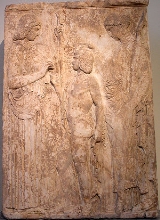
There are many paintings and pieces of pottery that depict various aspects of the Mysteries. The Eleusinian Relief, from late 5th century BC, displayed in the National Archaeological Museum of Athens
National Archaeological Museum of Athens

The National Archaeological Museum of Athens in Athens houses some of the most important artifacts from a variety of archaeological locations around Greece from prehistory to late antiquity....
 is a representative example. Triptolemus is depicted receiving seeds from Demeter and teaching mankind how to work the fields to grow crops, with Persephone holding her hand over his head to protect him. Vases and other works of relief sculpture, from the 4th
4th century BC

The 4th century BC started the first day of 400 BC and ended the last day of 301 BC. It is considered part of the Classical antiquity era, epoch, or historical period....
, 5th
5th century BC

The 5th century BC started the first day of 500 BC and ended the last day of 401 BC....
 and 6th centuries BC, depict Triptolemus holding an ear of corn, sitting on a winged throne or chariot, surrounded by Persephone and Demeter with pine torches. The monumental Protoattic amphora from the middle of the 7th century BC, with the depiction of Medusa's beheading by Perseus
Perseus

Perseus , the legendary founder of Mycenae and of the Mycenae there, was the first of the mythic heroes of Greek mythology whose exploits in defeating various archaic monsters provided the founding myths in the cult of the Twelve Olympians....
 and the blinding of Polyphemos by Odysseus
Odysseus

Odysseus or Ulysses , in Greek mythology , was a legendary Greeks king of Ithaca and the hero of Homer's Epic poetry, the Odyssey. Odysseus also plays a key role in Homer's Iliad and other works in the Epic Cycle....
 and his companions on its neck, is kept in the Archeological Museum of Eleusis which is located inside the archaeological site of Eleusis.

The Ninnion Tablet
Ninnion Tablet

The Ninnion Tablet, dated to approximately 370 BC, is a red clay tablet depicting the ancient Greece Eleusinian Mysteries . It was rediscovered in Eleusis, Attica in 1895, and is kept in the National Archaeological Museum of Athens....
, found in the same museum, depicts Demeter, followed by Persephone and Iacchus, and then the procession of initiates. Then, Demeter is sitting on the kiste inside the Telesterion, with Persephone holding a torch and introducing the initiates. The initiates each hold a bacchoi. The second row of initiates were led by Iakchos, a priest who held torches for the ceremonies. He is standing near the omphalos
Omphalos

An omphalos is an ancient religious stone Artifact , or baetylus. In Greek language, the word omphalos means "navel" . According to the ancient Greeks, Zeus sent out two eagles to fly across the world to meet at its center, the "navel" of the world....
 while an unknown female (probably a priestess of Demeter) sat nearby on the kiste, holding a scepter and a vessel filled with kykeon. Pannychis is also represented.

In Shakespeare's The Tempest
The Tempest

The Tempest is a play by William Shakespeare, probably written in 1610?11, although some researchers have argued for an earlier dating. Its protagonist is the banished sorcerer Prospero, rightful Duke of Milan, who uses his magical powers to punish and forgive his enemies when he raises a tempest that drives them ashore....
, the masque
Masque

The masque was a form of festive Noble court entertainment which flourished in sixteenth and early seventeenth century Europe, though it was developed earlier in Italy, in forms including the intermedio....
 that Prospero conjures to celebrate the troth-pledging of Miranda and Ferdinand echoes the Eleusinian Mysteries, although it uses the Roman names for the deities involved - Ceres, Iris, Dis and others - instead of the Greek. It is interesting that a play which is so steeped in esoteric imagery from alchemy
Alchemy

Alchemy , a part of the Occult Tradition, is both a philosophy and a practice with an aim of achieving ultimate wisdom as well as immortality, involving the improvement of the alchemist as well as the making of several substances described as possessing unusual properties....
 and hermeticism
Hermeticism

Hermeticism is a set of philosophy and Religion beliefs based primarily upon the Hellenistic Egyptian Pseudepigrapha attributed to Hermes Trismegistus who is the representation of the congruence of the Egyptian god Thoth and the Greek Hermes....
 should draw on the Mysteries for its central masque sequence.

Entheogenic theories

Some scholars believe that the power of the Eleusinian Mysteries came from the kykeon
Kykeon

Kykeon was an Ancient Greek drink made mainly of water, barley and herbs. It was used at the climax of the Eleusinian Mysteries to break a sacred Fasting, but it was also a favourite drink of Greek peasants....
's functioning as a psychedelic
Psychedelic

The word 'psychedelic' is an English term coined from the Greek language words for "soul," ???? , and "manifest," d???? . A psychedelic experience is characterized by the perception of aspects of one's mind previously unknown, or by the creative exuberance of the mind liberated from its ostensibly ordinary fetters....
 agent. Barley may be parasitized by the fungus
Fungus

A fungus is a Eukaryote organism that is a member of the Kingdom Fungi . The fungi are a monophyletic group, also called the Eumycota , that is phylogeny distinct from the morphologically similar slime molds and water molds ....
 ergot
Ergot

Ergot refers to a group of fungus of the genus Claviceps . The most prominent member of this group is Claviceps purpurea. This fungus grows on rye and related plants, and can cause ergotism in humans and other mammals consuming seeds contaminated with the fruiting structure of this fungus, called an ergot sclerotium....
, which contains the psychoactive alkaloids lysergic acid amide (LSA)
Ergine

LSA, also known as d-lysergic acid amide, d-lysergamide, ergine, and LA-111, is an alkaloid of the ergoline family that occurs in various species of vines of the Convolvulaceae and some species of fungi....
, a precursor to LSD
LSD

Lysergic acid diethylamide, LSD, LSD-25, or acid, is a semisynthetic psychedelic drug of the ergoline family. Its unusual psychological effects, which include visuals of colored patterns behind the eyes in the mind, a sense of time distorting, and crawling geometric patterns, have made it one of the most widely known psyched...
 and ergonovine
Ergonovine

Ergonovine, also known as ergometrine or d-lysergic acid beta-propanolamide, is an ergoline Derivative , and one of the primary ergot and morning glory alkaloids ....
. It is possible that a psychoactive potion was created using known methods of the day. The initiates, sensitized by their fast and prepared by preceding ceremonies, may have been propelled by the effects of a powerful psychoactive potion into revelatory mind states with profound spiritual and intellectual ramifications.

While modern scholars have presented evidence supporting their view that a potion
Potion

A potion is a consumable medicine or poison, usually possessing Magic properties.In mythology, a potion is a concoction used to heal, bewitch or poison people, made by a Magician , magic or witch....
 was drunk as part of the ceremony, the exact composition of that agent remains controversial. Modern preparations of kykeon using ergot-parasitized barley have yielded inconclusive results, although Alexander Shulgin
Alexander Shulgin

Alexander "Sasha" Shulgin is a Russian-American pharmacologist, chemist and psychoactive drug developer.Shulgin is credited with the popularization of Methylenedioxymethamphetamine in the late 1970s and early 1980s, especially for psychopharmacology use and the treatment of depression and post-traumatic stress disorder....
 and Ann Shulgin
Ann Shulgin

Ann Shulgin is an author and the wife of famous chemist Alexander Shulgin.She has worked as a lay therapist with psychedelic psychotherapy substances such as MDMA and 2C-B in therapeutic settings while these drugs were still legal....
 describe both ergonovine
Ergonovine

Ergonovine, also known as ergometrine or d-lysergic acid beta-propanolamide, is an ergoline Derivative , and one of the primary ergot and morning glory alkaloids ....
 and LSA
Ergine

LSA, also known as d-lysergic acid amide, d-lysergamide, ergine, and LA-111, is an alkaloid of the ergoline family that occurs in various species of vines of the Convolvulaceae and some species of fungi....
 to be known to produce LSD-like effects. Terence McKenna
Terence McKenna

Terence Kemp McKenna was a writer, philosopher, psychonaut and ethnobotanist. He was noted for his knowledge of the use of psychedelic, plant-based entheogens, and subjects ranging from shamanism, the theoretical origins of human consciousness, and his often criticized but unique concept of novelty theory....
 argued that the mysteries were focused around a variety of Psilocybe
Psilocybe

Psilocybe is a genus of small mushrooms growing worldwide. This genus is best known for its species with Psychedelic drug properties, widely known as "psychedelic mushroom", though the majority of species do not contain hallucinogenic compounds....
 mushrooms, and various other entheogen
Entheogen

An entheogen , in the strictest sense, is a psychoactive substance used in a religion or shamanism context. Historically, entheogens are derived primarily from plant sources and have been used in a variety of traditional religious contexts....
ic plants, such as Amanita muscaria
Amanita muscaria

Amanita muscaria, commonly known as the fly agaric or fly Amanita, is a poisonous and psychoactive basidiomycete fungus, one of many in the genus Amanita....
 mushrooms, have also been suggested but at present no consensus has been reached. The size of the event may rule out Amanita
Amanita

The genus Amanita contains about 600 species of agarics including some of the most toxic known mushrooms found worldwide. This genus is responsible for approximately 95% of the fatalities resulting from mushroom poisoning, with the death cap accounting for about 50% on its own....
 or Psilocybe mushrooms as active ingredient, since it is unlikely that there would have been enough wild mushrooms for all participants. However a recent hypothesis suggests that Psilocybe cultivation technology was not unknown in ancient Egypt, from which it could easily have spread to Greece.

Another theory is that the kykeon was an Ayahuasca
Ayahuasca

Ayahuasca is any of various psychoactive infusions or decoctions prepared from the Banisteriopsis caapi vine, usually mixed with the leaves of the Psychotria bush....
 analog involving Syrian Rue (Peganum harmala), a shrub
Shrub

A shrub or bush is a horticulture rather than strictly Botany category of woody plant, distinguished from a tree by its multiple stems and lower height, usually less than 5-6 m tall....
 which grows throughout the Mediterranean and also functions as a monoamine oxidase inhibitor
Monoamine oxidase inhibitor

Monoamine oxidase inhibitors are a class of powerful Antidepressants prescribed for the treatment of clinical depression. They are particularly effective in treating atypical depression, and have also shown efficacy in smoking cessation....
. The most likely candidate for the DMT
Dimethyltryptamine

Dimethyltryptamine , also known as N,N-dimethyltryptamine, is a naturally-occurring tryptamine and potent psychedelic drug, found not only in many plants, but also in trace amounts in the human body where its natural function is undetermined....
 containing plant, of which there are many in nature, would be a species of Acacia
Acacia

Acacia is a genus of shrubs and trees belonging to the subfamily Mimosoideae of the family Fabaceae, first described in Africa by the Sweden botanist Carolus Linnaeus in 1773....
. Other scholars however, noting the lack of any solid evidence and stressing the collective rather than individual character of initiation into the Mysteries, regard entheogenic theories with pointed skepticism.

See also

  • Dionysian Mysteries
    Dionysian Mysteries

    The Dionysian Mysteries probably began as an ancient initiation society, or family of similar societies, centred on a primeval nature god , apparently associated with horned animals, serpents and solitary predators , later known to the Greeks in the eclectic figure of Dionysus....
  • Flower Sermon
    Flower Sermon

    Within Zen, and thus from an Emic and etic perspective, the origins of Zen Buddhism are ascribed to what is rendered in English as the "Flower Sermon": in which Sakyamuni Buddha Dharma transmission direct praj?a to the disciple Mahakasyapa....
  • Orphic Mysteries
    Orphism (religion)

    Orphism is the name given to a set of religious beliefs and practices in the ancient Greek and Thracian world, associated with literature ascribed to the mythical poet Orpheus, who descended into Hades and returned....
  • Cabeiri
    Cabeiri

    In Greek mythology, the Cabeiri, were a group of enigmatic chthonic deities. They were worshiped in a mystery cult closely associated with that of Hephaestus, centered in the north Aegean islands of Lemnos and possibly Samothrace ?at the Samothrace temple complex? and at Thebes, Greece....


Sources

  • Apollodorus. , Sir James George Frazer (translator). Two volumes. Loeb Classical Library
    Loeb Classical Library

    The Loeb Classical Library is a series of books, today published by the Harvard University Press, which presents important works of ancient Greek Literature and Latin Literature in a way designed to make the text accessible to the broadest possible audience, by presenting the original Greek or Latin text on each left-hand leaf, and a fairly...
    . Cambridge MA: Harvard University Press and London: William Heinemann Ltd. 1921. Vol. 1: ISBN 0674991354. Vol. 2: ISBN 0674991362.
  • Boardman, Griffin, and Murray. The Oxford History of the Classical World (Oxford University Press 1986). ISBN 978-0198721123.
  • Burkert, Walter
    Walter Burkert

    Walter Burkert , a scholar of Greek mythology and Cult , is an emeritus professor of classics at the University of Zurich, Switzerland, and also has taught in the United Kingdom and the United States....
    , Ancient Mystery Cults, Harvard University Press, 1987.
  • Cicero. Laws II, xiv, 36.
  • Clinton, Kevin. "The Epidauria and the Arrival of Asclepius in Athens" in Ancient Greek Cult Practice from the Epigraphical Evidence. edited by R. Hägg, Stockholm, 1994. ISBN 9179160298.
  • Goblet d’Alviella, Eugène, comte
    Eugene Goblet d'Alviella

    Eug?ne F?licien Albert, Count Goblet d'Alviella was a lawyer, liberal senator of Belgium and a Professor of the history of religions and rector of the Universite Libre de Bruxelles ....
    , The mysteries of Eleusis : the secret rites and rituals of the classical Greek mystery tradition, 1903.
  • Greene, William C. "The Return of Persephone" in Classical Philology. University of Chicago Press 1946. pp. 105-106.
  • Kerényi, Karl
    Karl Kerényi

    One of the founders of modern studies in Greek mythology, K?roly Ker?nyi was born in Temesv?r, Hungary , and then lived in Hungary....
    . Eleusis: Archetypal Image of Mother and Daughter, Princeton University Press, 1991. ISBN 0-691-01915-0.
  • Metzner, Ralph. "The Reunification of the Sacred and the natural", Eleusis Volume VIII, pp. 3-13 (1997).
  • McKenna, Terence
    Terence McKenna

    Terence Kemp McKenna was a writer, philosopher, psychonaut and ethnobotanist. He was noted for his knowledge of the use of psychedelic, plant-based entheogens, and subjects ranging from shamanism, the theoretical origins of human consciousness, and his often criticized but unique concept of novelty theory....
    . Food of the Gods: Search for the Original Tree of Knowledge. Bantam, January 1993. ISBN 0553371304.
  • Moore, Clifford H. Religious Thought of the Greeks. (1916). Kessinger Publishing April, 2003. ISBN 0766151301.
  • Mylonas, George Emmanuel. Eleusis and the Eleusinian Mysteries. Princeton University Press 1961.
  • Nilsson, Martin P.
    Martin P. Nilsson

    Martin P[ersson] Nilsson was a Swedish philologist, a mythographer who specialised in Greek mythology and a History of religion. In his prolific studies he combined the literary evidence with the archaeological evidence, linking historic and prehistoric evidence for the evolution of the Greek mythological cycles....
    . 1940.
  • Rassias, Vlasis. Demolish Them. (in Greek) Athens, 2000. (2nd edition) ISBN 960-7748-20-4.
  • Riu, Xavier. Dionysism and Comedy, (1999), Rowman & Littlefield Publishers, Inc.; Reprint edition (March 2002). ISBN 0847694429. Cf. p. 107 for a discussion of Dionysus and his role in the Eleusinian Mysteries.
  • Rohde, Erwin
    Erwin Rohde

    Erwin Rohde was one of the great Germany classical scholars of the 19th and early 20th centuries.Rohde was born in Hamburg and was the son of a doctor....
    . Psyche: The Cult of Souls and the Belief in Immortality among the Greeks. trans. from the 8th edn. by W. B. Hillis, Routledge & Kegan Paul, 1925; reprinted by Routledge, 2000. cf. Chapter 6, "The Eleusinian Mysteries".
  • Shulgin, Alexander
    Alexander Shulgin

    Alexander "Sasha" Shulgin is a Russian-American pharmacologist, chemist and psychoactive drug developer.Shulgin is credited with the popularization of Methylenedioxymethamphetamine in the late 1970s and early 1980s, especially for psychopharmacology use and the treatment of depression and post-traumatic stress disorder....
    , Ann Shulgin
    Ann Shulgin

    Ann Shulgin is an author and the wife of famous chemist Alexander Shulgin.She has worked as a lay therapist with psychedelic psychotherapy substances such as MDMA and 2C-B in therapeutic settings while these drugs were still legal....
    . TiHKAL. Transform Press, 1997.
  • Smith, William, A New Classical Dictionary of Greek and Roman Biography, Mythology and Geography Vol. II. Kessinger Publishing, LLC 2006. ISBN 1428645616.
  • Smith, William. A Dictionary of Greek and Roman Antiquities. London, 1875.
  • Thomas Taylor, Eleusinian and Bacchic Mysteries. Lighting Source Publishers, 1997. ISBN 1564599760.
  • Tripolitis, Antonia. Religions of the Hellenistic-Roman Age. Wm. B. Eerdmans Publishing Company, November 2001. ISBN 080284913X.
  • Vaughn, Steck. Demeter and Persephone. Steck Vaughn Publishing, June 1994. ISBN 978-0811433624.
  • Wasson, R,, Ruck, C.
    Carl A. P. Ruck

    Carl A. P. Ruck , is a professor in the Classical Studies department at Boston University. He received his B.A. at Yale University, his M.A. at the University of Michigan, and a Ph.D....
    , Hofmann, A.
    Albert Hofmann

    Albert Hofmann was a Switzerland scientist best known for having been the first to Chemical synthesis, ingestion and learn of the psychedelic effects of lysergic acid diethylamide ....
    , The Road to Eleusis: Unveiling the Secret of the Mysteries. Harcourt, Brace, Jovanovich, 1978. ISBN 0-15-177872-8.
  • Willoughby, Harold R. , Ch. 2 of , 2003, Kessinger Publishing, ISBN 0766180832. Broad excerpts can be browsed online.


External links

  • of the Mysteries.
  • , Edward A. Beach.
  • , Thomas R. Martin, from An Overview of Classical Greek History from Homer to Alexander.
  • about the Mysteries at Eleusis, Cornell University Library.
  • R. Gordon Wasson, Albert Hofmann, Carl A. P. Ruck