


Colonies in antiquity

Encyclopedia
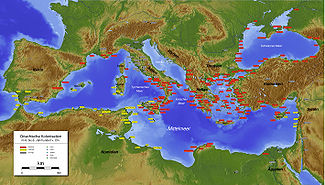
City-state
A city-state is an independent or autonomous entity whose territory consists of a city which is not administered as a part of another local government.-Historical city-states:...
s founded from a mother-city
City
A city is a relatively large and permanent settlement. Although there is no agreement on how a city is distinguished from a town within general English language meanings, many cities have a particular administrative, legal, or historical status based on local law.For example, in the U.S...
—its "metropolis"—, not from a territory-at-large. Bonds between a colony
Colony
In politics and history, a colony is a territory under the immediate political control of a state. For colonies in antiquity, city-states would often found their own colonies. Some colonies were historically countries, while others were territories without definite statehood from their inception....
and its metropolis remained often close, and took specific forms. However, unlike in the period of European colonialism during the Renaissance
Renaissance
The Renaissance was a cultural movement that spanned roughly the 14th to the 17th century, beginning in Italy in the Late Middle Ages and later spreading to the rest of Europe. The term is also used more loosely to refer to the historical era, but since the changes of the Renaissance were not...
and the modern era, ancient colonies were usually sovereign and self-governing from their inception.
Egyptian colony
An EgyptianAncient Egypt
Ancient Egypt was an ancient civilization of Northeastern Africa, concentrated along the lower reaches of the Nile River in what is now the modern country of Egypt. Egyptian civilization coalesced around 3150 BC with the political unification of Upper and Lower Egypt under the first pharaoh...
colony that was stationed in southern Canaan
Canaan
Canaan is a historical region roughly corresponding to modern-day Israel, Palestine, Lebanon, and the western parts of Jordan...
dates to slightly before the First Dynasty
First dynasty of Egypt
The first dynasty of Ancient Egypt is often combined with the Dynasty II under the group title, Early Dynastic Period of Egypt...
. Narmer
Narmer
Narmer was an ancient Egyptian pharaoh of the Early Dynastic Period . He is thought to be the successor to the Protodynastic pharaohs Scorpion and/or Ka, and he is considered by some to be the unifier of Egypt and founder of the First Dynasty, and therefore the first pharaoh of unified Egypt.The...
had Egyptian
Ancient Egypt
Ancient Egypt was an ancient civilization of Northeastern Africa, concentrated along the lower reaches of the Nile River in what is now the modern country of Egypt. Egyptian civilization coalesced around 3150 BC with the political unification of Upper and Lower Egypt under the first pharaoh...
pottery produced in Canaan
Canaan
Canaan is a historical region roughly corresponding to modern-day Israel, Palestine, Lebanon, and the western parts of Jordan...
and exported back to Egypt
Ancient Egypt
Ancient Egypt was an ancient civilization of Northeastern Africa, concentrated along the lower reaches of the Nile River in what is now the modern country of Egypt. Egyptian civilization coalesced around 3150 BC with the political unification of Upper and Lower Egypt under the first pharaoh...
, from regions such as Arad
Tel Arad
Tel Arad or 'old' Arad is located west of the Dead Sea, about 10 km west of modern Arad in an area surrounded by mountain ridges which is known as the Arad Plain. The site is divided into a lower city and an upper hill which holds the only ever discovered 'House of Yahweh' in the land of...
, En Besor, Rafiah
Rafah
Rafah , also known as Rafiah, is a Palestinian city in the southern Gaza Strip. Located south of Gaza, Rafah's population of 71,003 is overwhelmingly made up of Palestinian refugees. Rafah camp and Tall as-Sultan form separate localities. Rafah is the district capital of the Rafah Governorate...
, and Tel ʿErani. Shipbuilding
Shipbuilding
Shipbuilding is the construction of ships and floating vessels. It normally takes place in a specialized facility known as a shipyard. Shipbuilders, also called shipwrights, follow a specialized occupation that traces its roots to before recorded history.Shipbuilding and ship repairs, both...
was known to the Ancient Egypt
Ancient Egypt
Ancient Egypt was an ancient civilization of Northeastern Africa, concentrated along the lower reaches of the Nile River in what is now the modern country of Egypt. Egyptian civilization coalesced around 3150 BC with the political unification of Upper and Lower Egypt under the first pharaoh...
ians as early as 3000 BC, and perhaps earlier. The Archaeological Institute of America
Archaeological Institute of America
The Archaeological Institute of America is a North American nonprofit organization devoted to the promotion of public interest in archaeology, and the preservation of archaeological sites. It has offices on the campus of Boston University and in New York City.The institute was founded in 1879,...
reports that the earliest dated ship—75 feet long, dating to 3000 BC – may have possibly belonged to Pharaoh Aha
Hor-Aha
Hor-Aha is considered the second pharaoh of the first dynasty of ancient Egypt in current Egyptology. He lived around the thirty-first century BC.- Name :...
.
Phoenician colonies
The PhoeniciaPhoenicia
Phoenicia , was an ancient civilization in Canaan which covered most of the western, coastal part of the Fertile Crescent. Several major Phoenician cities were built on the coastline of the Mediterranean. It was an enterprising maritime trading culture that spread across the Mediterranean from 1550...
ns were the major trading
Trade
Trade is the transfer of ownership of goods and services from one person or entity to another. Trade is sometimes loosely called commerce or financial transaction or barter. A network that allows trade is called a market. The original form of trade was barter, the direct exchange of goods and...
power
Power in international relations
Power in international relations is defined in several different ways. Political scientists, historians, and practitioners of international relations have used the following concepts of political power:...
in the Mediterranean
Mediterranean Sea
The Mediterranean Sea is a sea connected to the Atlantic Ocean surrounded by the Mediterranean region and almost completely enclosed by land: on the north by Anatolia and Europe, on the south by North Africa, and on the east by the Levant...
in the early part of the first millennium BC
1st millennium BC
The 1st millennium BC encompasses the Iron Age and sees the rise of many successive empires, and spanned from 1000 BC to 1 BC.The Neo-Assyrian Empire, followed by the Achaemenids. In Greece, Classical Antiquity begins with the colonization of Magna Graecia and peaks with the rise of Hellenism. The...
. They had trading contacts in Egypt
Egypt
Egypt , officially the Arab Republic of Egypt, Arabic: , is a country mainly in North Africa, with the Sinai Peninsula forming a land bridge in Southwest Asia. Egypt is thus a transcontinental country, and a major power in Africa, the Mediterranean Basin, the Middle East and the Muslim world...
and Greece
Greece
Greece , officially the Hellenic Republic , and historically Hellas or the Republic of Greece in English, is a country in southeastern Europe....
, and established colonies as far west as modern Spain
Spain
Spain , officially the Kingdom of Spain languages]] under the European Charter for Regional or Minority Languages. In each of these, Spain's official name is as follows:;;;;;;), is a country and member state of the European Union located in southwestern Europe on the Iberian Peninsula...
, at Gadir (modern Cádiz
Cádiz
Cadiz is a city and port in southwestern Spain. It is the capital of the homonymous province, one of eight which make up the autonomous community of Andalusia....
). From Gadir they controlled access to the Atlantic Ocean
Atlantic Ocean
The Atlantic Ocean is the second-largest of the world's oceanic divisions. With a total area of about , it covers approximately 20% of the Earth's surface and about 26% of its water surface area...
and the trade route
Trade route
A trade route is a logistical network identified as a series of pathways and stoppages used for the commercial transport of cargo. Allowing goods to reach distant markets, a single trade route contains long distance arteries which may further be connected to several smaller networks of commercial...
s to Britain
Great Britain
Great Britain or Britain is an island situated to the northwest of Continental Europe. It is the ninth largest island in the world, and the largest European island, as well as the largest of the British Isles...
. The most famous and successful of Phoenician colonies was Kart-Hadasht (Qart-ḥadašt, literally "New Town"), a colony founded from Tyre. It would eventually be known as Carthage
Carthage
Carthage , implying it was a 'new Tyre') is a major urban centre that has existed for nearly 3,000 years on the Gulf of Tunis, developing from a Phoenician colony of the 1st millennium BC...
.
Greek colonies
See also :Category:Greek colonization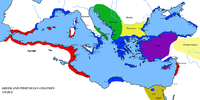
Ancient Greece
Ancient Greece is a civilization belonging to a period of Greek history that lasted from the Archaic period of the 8th to 6th centuries BC to the end of antiquity. Immediately following this period was the beginning of the Early Middle Ages and the Byzantine era. Included in Ancient Greece is the...
, colonies were sometimes founded by vanquished people, who left their homes to escape subjection at the hand of a foreign enemy; sometimes as a sequel to civil disorder
Civil disorder
Civil disorder, also known as civil unrest or civil strife, is a broad term that is typically used by law enforcement to describe one or more forms of disturbance caused by a group of people. Civil disturbance is typically a symptom of, and a form of protest against, major socio-political problems;...
s, when the losers in internecine battles left to form a new city elsewhere; sometimes to get rid of surplus population, and thereby to avoid internal convulsions. But in most cases the motivation was to establish and facilitate relations of trade with foreign countries and further the wealth of the mother-city (in Greek
Greek language
Greek is an independent branch of the Indo-European family of languages. Native to the southern Balkans, it has the longest documented history of any Indo-European language, spanning 34 centuries of written records. Its writing system has been the Greek alphabet for the majority of its history;...
, metropolis
Metropolis
A metropolis is a very large city or urban area which is a significant economic, political and cultural center for a country or region, and an important hub for regional or international connections and communications...
). Colonies were established in Ionia and Thrace
Thrace
Thrace is a historical and geographic area in southeast Europe. As a geographical concept, Thrace designates a region bounded by the Balkan Mountains on the north, Rhodope Mountains and the Aegean Sea on the south, and by the Black Sea and the Sea of Marmara on the east...
as early as the 8th century BC.
More than thirty Greek city-states had multiple colonies around the Mediterranean
Mediterranean Sea
The Mediterranean Sea is a sea connected to the Atlantic Ocean surrounded by the Mediterranean region and almost completely enclosed by land: on the north by Anatolia and Europe, on the south by North Africa, and on the east by the Levant...
world, with the most active being Miletus
Miletus
Miletus was an ancient Greek city on the western coast of Anatolia , near the mouth of the Maeander River in ancient Caria...
, with ninety colonies stretching throughout the Mediterranean Sea
Mediterranean Sea
The Mediterranean Sea is a sea connected to the Atlantic Ocean surrounded by the Mediterranean region and almost completely enclosed by land: on the north by Anatolia and Europe, on the south by North Africa, and on the east by the Levant...
, from the shores of the Black Sea
Black Sea
The Black Sea is bounded by Europe, Anatolia and the Caucasus and is ultimately connected to the Atlantic Ocean via the Mediterranean and the Aegean seas and various straits. The Bosphorus strait connects it to the Sea of Marmara, and the strait of the Dardanelles connects that sea to the Aegean...
and Anatolia
Anatolia
Anatolia is a geographic and historical term denoting the westernmost protrusion of Asia, comprising the majority of the Republic of Turkey...
(modern Turkey) in the east, to the southern coast of the Iberian Peninsula
Iberian Peninsula
The Iberian Peninsula , sometimes called Iberia, is located in the extreme southwest of Europe and includes the modern-day sovereign states of Spain, Portugal and Andorra, as well as the British Overseas Territory of Gibraltar...
in the west, as well as several colonies on the northern coast of Africa
Africa
Africa is the world's second largest and second most populous continent, after Asia. At about 30.2 million km² including adjacent islands, it covers 6% of the Earth's total surface area and 20.4% of the total land area...
with the overall sum being 1500 from the late ninth, up to the 5th century BC.
There were two similar types of colonies, ἀποικία - apoikia (pl.: ἀποικίαι, apoikiai) and ἐμπορία - emporia (pl.: ἐμπορίαι, emporiai). The first type of colonies were city-states on their own; the second were Greek trading-colonies.
The Greek city-states began establishing colonies around 800 BC, at first at Al Mina
Al Mina
Al-Mina is the modern name given by Leonard Woolley to an ancient trading post on the Mediterranean coast of northern Syria, in the estuary of the Orontes, near present-day Samandag in Turkey's province of Hatay....
on the coast
Coast
A coastline or seashore is the area where land meets the sea or ocean. A precise line that can be called a coastline cannot be determined due to the dynamic nature of tides. The term "coastal zone" can be used instead, which is a spatial zone where interaction of the sea and land processes occurs...
of Syria
Syria
Syria , officially the Syrian Arab Republic , is a country in Western Asia, bordering Lebanon and the Mediterranean Sea to the West, Turkey to the north, Iraq to the east, Jordan to the south, and Israel to the southwest....
and the Greek emporium Pithekoussai at Ischia
Ischia
Ischia is a volcanic island in the Tyrrhenian Sea. It lies at the northern end of the Gulf of Naples, about 30 km from the city of Naples. It is the largest of the Phlegrean Islands. Roughly trapezoidal in shape, it measures around 10 km east to west and 7 km north to south and has...
in the Bay of Naples
Gulf of Naples
The Gulf of Naples is a c. 15 km wide gulf located in the south western coast of Italy, . It opens to the west into the Mediterranean Sea. It is bordered on the north by the cities of Naples and Pozzuoli, on the east by Mount Vesuvius, and on the south by the Sorrentine Peninsula and the main...
, both established about 800 BC by Euboeans.
Two flushes of new colonists set out from Greece at the transition between the "Dark Ages
Greek Dark Ages
The Greek Dark Age or Ages also known as Geometric or Homeric Age are terms which have regularly been used to refer to the period of Greek history from the presumed Dorian invasion and end of the Mycenaean Palatial civilization around 1200 BC, to the first signs of the Greek city-states in the 9th...
" and the start of the Archaic Period, one in the early 8th century BC and a second burst of the colonizing spirit in the 6th century. Population growth and cramped spaces at home seem an insufficient explanation, while the economical and political dynamics produced by the competitive spirit between the frequently kingless, newly introduced concept of the Greek city-states, striving to expand their sphere of economical influence better fits as their true incentive. Through this Greek expansion the use of coins flourished throughout the Mediterranean Basin
Mediterranean Basin
In biogeography, the Mediterranean Basin refers to the lands around the Mediterranean Sea that have a Mediterranean climate, with mild, rainy winters and hot, dry summers, which supports characteristic Mediterranean forests, woodlands, and scrub vegetation...
.
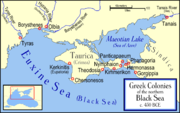
Cyme (Aeolis)
Cyme was an Aeol city in Aeolis close to the kingdom of Lydia. The Aeolians regarded Cyme as the largest and most important of their twelve cities, which were located on the coastline of Asia Minor...
, Rhegium
Reggio Calabria
Reggio di Calabria , commonly known as Reggio Calabria or Reggio, is the biggest city and the most populated comune of Calabria, southern Italy, and is the capital of the Province of Reggio Calabria and seat of the Council of Calabrian government.Reggio is located on the "toe" of the Italian...
(Rhegion) by Chalcis
Chalcis
Chalcis or Chalkida , the chief town of the island of Euboea in Greece, is situated on the strait of the Evripos at its narrowest point. The name is preserved from antiquity and is derived from the Greek χαλκός , though there is no trace of any mines in the area...
and Zankle (c. 8th century), Syracuse by Corinth
Corinth
Corinth is a city and former municipality in Corinthia, Peloponnese, Greece. Since the 2011 local government reform it is part of the municipality Corinth, of which it is the seat and a municipal unit...
/Tenea
Tenea
Tenea is an ancient city and a former municipality in Corinthia, Peloponnese, Greece. Since the 2011 local government reform it is part of the municipality Corinth, of which it is a municipal unit. The seat of the municipality was in Chiliomodi. Ancient Tenea was established approximately 15...
(c. 734 BC
730s BC
-Events and trends:* 739 BC—Hiram II becomes king of Tyre.* 738 BC—King Tiglath-Pileser III of Assyria invades Israel, forcing it to pay tribute.* 738 BC—The Biskupin settlement northeast of Poznan is built....
), Naxos
Naxos (Sicily)
Naxos or Naxus , was an ancient city of Sicily, on the east coast of the island between Catana and Messana...
by Chalkis (c. 734 BC), Massalia
Marseille
Marseille , known in antiquity as Massalia , is the second largest city in France, after Paris, with a population of 852,395 within its administrative limits on a land area of . The urban area of Marseille extends beyond the city limits with a population of over 1,420,000 on an area of...
(what millennia later became Marseille
Marseille
Marseille , known in antiquity as Massalia , is the second largest city in France, after Paris, with a population of 852,395 within its administrative limits on a land area of . The urban area of Marseille extends beyond the city limits with a population of over 1,420,000 on an area of...
, France
France
The French Republic , The French Republic , The French Republic , (commonly known as France , is a unitary semi-presidential republic in Western Europe with several overseas territories and islands located on other continents and in the Indian, Pacific, and Atlantic oceans. Metropolitan France...
) by Phokaia
Phocaea
Phocaea, or Phokaia, was an ancient Ionian Greek city on the western coast of Anatolia. Greek colonists from Phocaea founded the colony of Massalia in 600 BC, Emporion in 575 BC and Elea in 540 BC.-Geography:Phocaea was the northernmost...
(c. 598 BC
590s BC
-Events and trends:* 599 BC—Vardhamana Mahavira, last Tirthankara of Jainism, is born.* 598 BC—Jehoiachin succeeds Jehoiakim as King of Judah.* March 16, 597 BC—Babylonians capture Jerusalem following a siege, replace Jehoiachin with Zedekiah as king....
), Agathe
Agde
Agde is a commune in the Hérault department in southern France. It is the Mediterranean port of the Canal du Midi.-Location:Agde is located on the river Hérault, 4 km from the Mediterranean Sea, and 750 km from Paris...
by Phokaia (shortly after Massalia), Elea (Velia) by Phokaia
Phocaea
Phocaea, or Phokaia, was an ancient Ionian Greek city on the western coast of Anatolia. Greek colonists from Phocaea founded the colony of Massalia in 600 BC, Emporion in 575 BC and Elea in 540 BC.-Geography:Phocaea was the northernmost...
and Massalia (c. 540 BC
540s BC
-Events and trends:* 546 BC—Croesus, Lydian king, is defeated by Cyrus of Persia near the River Halys.* 546 BC—Cyrus of Persia completes his conquest of Lydia, and makes Pasargadae his capital....
), Emporion
Empúries
Empúries , formerly known by its Spanish name Ampurias , was a town on the Mediterranean coast of the Catalan comarca of Alt Empordà in Catalonia, Spain. It was founded in 575 BC by Greek colonists from Phocaea with the name of Ἐμπόριον...
(nowadays Spain
Spain
Spain , officially the Kingdom of Spain languages]] under the European Charter for Regional or Minority Languages. In each of these, Spain's official name is as follows:;;;;;;), is a country and member state of the European Union located in southwestern Europe on the Iberian Peninsula...
) by Phokaia/Massalia (early 6th century), Antipolis
Antipolis
Antipolis, Greek for 'city opposite' , is the name or part of the name of:*modern Antibes*Sophia-AntipolisIt is also the name of a tanker ship....
(nowadays France) by Achaea, Alalia
Aléria
Aléria is a commune in the Haute-Corse department of France on the island of Corsica...
(Corsica) by Phokaia/Massalia (c. 545 BC) and Cyrene
Cyrene, Libya
Cyrene was an ancient Greek colony and then a Roman city in present-day Shahhat, Libya, the oldest and most important of the five Greek cities in the region. It gave eastern Libya the classical name Cyrenaica that it has retained to modern times.Cyrene lies in a lush valley in the Jebel Akhdar...
(North Africa
North Africa
North Africa or Northern Africa is the northernmost region of the African continent, linked by the Sahara to Sub-Saharan Africa. Geopolitically, the United Nations definition of Northern Africa includes eight countries or territories; Algeria, Egypt, Libya, Morocco, South Sudan, Sudan, Tunisia, and...
) by Thera
Santorini
Santorini , officially Thira , is an island located in the southern Aegean Sea, about southeast from Greece's mainland. It is the largest island of a small, circular archipelago which bears the same name and is the remnant of a volcanic caldera...
(762/61 and 632/31 BCE).
Several formulae were generally adhered to on the solemn and sacred occasions when a new colony set forth. If a Greek city was sending out a colony, an oracle
Oracle
In Classical Antiquity, an oracle was a person or agency considered to be a source of wise counsel or prophetic predictions or precognition of the future, inspired by the gods. As such it is a form of divination....
, especially one such as the Oracle of Delphi
Delphi
Delphi is both an archaeological site and a modern town in Greece on the south-western spur of Mount Parnassus in the valley of Phocis.In Greek mythology, Delphi was the site of the Delphic oracle, the most important oracle in the classical Greek world, and a major site for the worship of the god...
, was almost invariably consulted beforehand. Sometimes certain classes of citizens were called upon to take part in the enterprises; sometimes one son was chosen by lot from every house where there were several sons; and strangers expressing a desire to join were admitted. A person of distinction was selected to guide the emigrants and make the necessary arrangements. It was usual to honor these founders of colonies, after their death, as heroes. Some of the sacred fire was taken from the public hearth in the Prytaneum
Prytaneis
The Prytaneis were the executives of the boule of ancient Athens. The term is probably of pre-Greek origin ....
, from which the fire on the public hearth of the new city was kindled. And, just as each individual had his private shrines, so the new community maintained the worship of its chief domestic deities, the colony sending embassies and votive gifts to the mother-city's principal festivals for centuries afterwards.
The relation between colony and mother-city, known literally as the metropolis
Metropolis
A metropolis is a very large city or urban area which is a significant economic, political and cultural center for a country or region, and an important hub for regional or international connections and communications...
, was viewed as one of mutual affection. Any differences that arose were made up, if possible, by peaceful means, war being deemed excusable only in cases of extreme necessity. The charter of foundation contained general provisions for the arrangement of the affairs of the colony, and also some special enactments. The constitution of the mother-city was usually adopted by the colony, but the new city remained politically independent. If the colony sent out a fresh colony on its own account, the mother-city was generally consulted, or was at least requested to furnish a leader. Frequently the colonies declaring their commitment to the various metropolitic alliances formed in the Greek mainland and for religious reasons would pay tribute in religious centres, like Delphi, Olympia
Olympia, Greece
Olympia , a sanctuary of ancient Greece in Elis, is known for having been the site of the Olympic Games in classical times, comparable in importance to the Pythian Games held in Delphi. Both games were held every Olympiad , the Olympic Games dating back possibly further than 776 BC...
or Delos
Delos
The island of Delos , isolated in the centre of the roughly circular ring of islands called the Cyclades, near Mykonos, is one of the most important mythological, historical and archaeological sites in Greece...
. It is worth noting that the Peloponnesian War
Peloponnesian War
The Peloponnesian War, 431 to 404 BC, was an ancient Greek war fought by Athens and its empire against the Peloponnesian League led by Sparta. Historians have traditionally divided the war into three phases...
was in part a result of a dispute between Corinth
Corinth
Corinth is a city and former municipality in Corinthia, Peloponnese, Greece. Since the 2011 local government reform it is part of the municipality Corinth, of which it is the seat and a municipal unit...
and her colony of Corcyra
Corfu
Corfu is a Greek island in the Ionian Sea. It is the second largest of the Ionian Islands, and, including its small satellite islands, forms the edge of the northwestern frontier of Greece. The island is part of the Corfu regional unit, and is administered as a single municipality. The...
(Corfu). The cleruchs
Cleruchy
A cleruchy in Hellenic Greece, was a specialized type of colony established by Athens. The term comes from the Greek word , klērouchos, literally "lot-holder"....
, known in Greek as klêrouchoi, formed a special class of Greek colonists, being assigned individual plots of land in the place to which they had been assigned. The trade factories set up in foreign countries, such as Egypt
Ancient Egypt
Ancient Egypt was an ancient civilization of Northeastern Africa, concentrated along the lower reaches of the Nile River in what is now the modern country of Egypt. Egyptian civilization coalesced around 3150 BC with the political unification of Upper and Lower Egypt under the first pharaoh...
, were somewhat different from the ordinary colonies, the members retaining the right of domicile in their own fatherland and confining themselves to their own quarter in the foreign city.
Roman colonies
It was an old custom in ancient ItalyHistory of Italy during Roman times
This is an overview of the history of Italy during Roman times.According to legend, Rome was founded in 753 BC by Romulus and Remus, and was then governed by seven Kings of Rome...
to send out colonies for the purpose of securing new conquests. The Romans
Roman Republic
The Roman Republic was the period of the ancient Roman civilization where the government operated as a republic. It began with the overthrow of the Roman monarchy, traditionally dated around 508 BC, and its replacement by a government headed by two consuls, elected annually by the citizens and...
, having no standing army
Standing army
A standing army is a professional permanent army. It is composed of full-time career soldiers and is not disbanded during times of peace. It differs from army reserves, who are activated only during wars or natural disasters...
, used to plant bodies of their own citizens in conquered towns as a kind of garrison. These bodies would consist partly of Roman citizens
Roman citizenship
Citizenship in ancient Rome was a privileged political and legal status afforded to certain free-born individuals with respect to laws, property, and governance....
, usually to the number of three hundred; partly of members of the Latin League
Latin league
The Latin League was a confederation of about 30 villages and tribes in the region of Latium near ancient Rome, organized for mutual defense...
, in larger numbers. The third part of the conquered territory was handed over to the settlers. The coloniae civium Romanorum (colonies of Roman citizens) were specially intended to secure the two seacoasts of Italy, and were hence called coloniae maritimae. The coloniae Latinae, of which there was a far greater number, served the same purpose for the mainland.
The duty of leading the colonists and founding the settlement was entrusted to a commission usually consisting of three members. These men continued to stand in the relation of patrons (patroni)
Patronage in ancient Rome
Patronage was the distinctive relationship in ancient Roman society between the patronus and his client . The relationship was hierarchical, but obligations were mutual. The patronus was the protector, sponsor, and benefactor of the client...
to the colony after its foundation. The colonists entered the conquered city in military array, preceded by banners, and the foundation was celebrated with special solemnities. The coloniae were free from taxes, and had their own constitution
Roman Constitution
The Roman Constitution was an uncodified set of guidelines and principles passed down mainly through precedent. The Roman constitution was not formal or even official, largely unwritten and constantly evolving. Concepts that originated in the Roman constitution live on in constitutions to this day...
, a copy of the Roman, electing from their own body their Senate
Roman Senate
The Senate of the Roman Republic was a political institution in the ancient Roman Republic, however, it was not an elected body, but one whose members were appointed by the consuls, and later by the censors. After a magistrate served his term in office, it usually was followed with automatic...
and other officers of State. To this constitution the original inhabitants had to submit. The coloniae civium Romanorum retained Roman citizenship
Roman citizenship
Citizenship in ancient Rome was a privileged political and legal status afforded to certain free-born individuals with respect to laws, property, and governance....
, and were free from military service, their position as outposts being regarded as an equivalent. The members of the coloniae Latinae served among the socii, the allies, and possessed the so-called ius Latinum
Latin Right
Latin Rights was a civic status given by the Romans, intermediate between full Roman citizenship and non-citizen status , and extended originally to the people of Latium . The most important Latin Rights were commercium, connubium, and ius migrationis...
or Latinitas. This secured to them the right of acquiring property, the concept of commercium, and the right of settlement in Rome, and under certain conditions the power of becoming Roman citizens; though in course of time these rights underwent many limitations.
From the time of the Gracchi
Gracchi
The Gracchi brothers, Tiberius and Gaius, were Roman Plebian nobiles who both served as tribunes in 2nd century BC. They attempted to pass land reform legislation that would redistribute the major patrician landholdings among the plebeians. For this legislation and their membership in the...
the colonies lost their military character. Colonization came to be regarded as a means of providing for the poorest class of the Roman populace. After the time of Sulla
Lucius Cornelius Sulla
Lucius Cornelius Sulla Felix , known commonly as Sulla, was a Roman general and statesman. He had the rare distinction of holding the office of consul twice, as well as that of dictator...
it was adopted as a way of granting land to veteran soldiers. The right of founding colonies was taken away from the people by Julius Caesar
Julius Caesar
Gaius Julius Caesar was a Roman general and statesman and a distinguished writer of Latin prose. He played a critical role in the gradual transformation of the Roman Republic into the Roman Empire....
, and passed into the hands of the Roman emperors
Roman Emperor
The Roman emperor was the ruler of the Roman State during the imperial period . The Romans had no single term for the office although at any given time, a given title was associated with the emperor...
, who used it mainly in the provinces
Roman province
In Ancient Rome, a province was the basic, and, until the Tetrarchy , largest territorial and administrative unit of the empire's territorial possessions outside of Italy...
for the exclusive purpose of establishing military settlements, partly with the old idea of securing conquered territory. It was only in exceptional cases that the provincial colonies enjoyed the immunity from taxation which was granted to those in Italy.
Most of this text is taken from Harry Thurston Peck
Harry Thurston Peck
Harry Thurston Peck was an American classical scholar, author, editor, and critic.-Biography:Peck was born in Stamford, Conn. He was educated in private schools and at Columbia College, graduating in 1881, where his literary gifts attracted wide attention...
's Harpers Dictionary of Classical Antiquities
Harpers Dictionary of Classical Antiquities
Harpers Dictionary of Classical Literature and Antiquities is an English-language encyclopedia on subjects of classical antiquity. It was edited by Harry Thurston Peck and published 1898 by Harper & Brothers in New York...
(1898) and needs to be rewritten and expanded.
See also
- Classical demographyClassical demographyClassical demography refers to the study of human demography in the Classical period. It often focuses on the absolute number of people who were alive in civilizations around the Mediterranean Sea between the Bronze Age and the Fall of the Roman Empire, but in recent decades historians have been...
- Colonia (Roman)Colonia (Roman)A Roman colonia was originally a Roman outpost established in conquered territory to secure it. Eventually, however, the term came to denote the highest status of Roman city.-History:...
- Magna GraeciaMagna GraeciaMagna Græcia is the name of the coastal areas of Southern Italy on the Tarentine Gulf that were extensively colonized by Greek settlers; particularly the Achaean colonies of Tarentum, Crotone, and Sybaris, but also, more loosely, the cities of Cumae and Neapolis to the north...
- List of ancient Thracian cities
- List of Illyrian cities
External links
- Map of Greek Colonies 9th-6th Centuries BC
- The Roman Law Library by Professor Yves Lassard and Alexandr Koptev
- Donald Kagan, Introduction to Ancient Greek History. 6. The Greek "Renaissance" - Colonization and Tyranny (Open Yale CoursesOpen Yale CoursesOpen Yale Courses is a project of Yale University to share full video and course materials from its undergraduate courses.Open Yale Courses provides free access to a selection of introductory courses....
)