

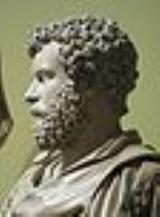
Clodius Albinus

Encyclopedia
- For others with this cognomenCognomenThe cognomen nōmen "name") was the third name of a citizen of Ancient Rome, under Roman naming conventions. The cognomen started as a nickname, but lost that purpose when it became hereditary. Hereditary cognomina were used to augment the second name in order to identify a particular branch within...
, see Albinus (cognomen)Albinus (cognomen)Albus or Albinus is a Latin surname, or cognomen, best known as the name of the main branch of the patrician gens Postumia. Albus, Albinus, the original form of the name, means "foreign", "someone of ofther jurisdiction" unlike, Album, Albus, which means "white"...
.
Clodius Albinus was a Roman usurper
Roman usurper
Usurpers are individuals or groups of individuals who obtain and maintain the power or rights of another by force and without legal authority. Usurpation was endemic during roman imperial era, especially from the crisis of the third century onwards, when political instability became the rule.The...
proclaimed emperor
Roman Emperor
The Roman emperor was the ruler of the Roman State during the imperial period . The Romans had no single term for the office although at any given time, a given title was associated with the emperor...
by the legions in Britain
Roman Britain
Roman Britain was the part of the island of Great Britain controlled by the Roman Empire from AD 43 until ca. AD 410.The Romans referred to the imperial province as Britannia, which eventually comprised all of the island of Great Britain south of the fluid frontier with Caledonia...
and Hispania
Hispania
Another theory holds that the name derives from Ezpanna, the Basque word for "border" or "edge", thus meaning the farthest area or place. Isidore of Sevilla considered Hispania derived from Hispalis....
(the Iberian Peninsula
Iberian Peninsula
The Iberian Peninsula , sometimes called Iberia, is located in the extreme southwest of Europe and includes the modern-day sovereign states of Spain, Portugal and Andorra, as well as the British Overseas Territory of Gibraltar...
, comprising modern Spain
Spain
Spain , officially the Kingdom of Spain languages]] under the European Charter for Regional or Minority Languages. In each of these, Spain's official name is as follows:;;;;;;), is a country and member state of the European Union located in southwestern Europe on the Iberian Peninsula...
and Portugal
Portugal
Portugal , officially the Portuguese Republic is a country situated in southwestern Europe on the Iberian Peninsula. Portugal is the westernmost country of Europe, and is bordered by the Atlantic Ocean to the West and South and by Spain to the North and East. The Atlantic archipelagos of the...
) upon the murder of Pertinax
Pertinax
Pertinax , was Roman Emperor for three months in 193. He is known as the first emperor of the tumultuous Year of the Five Emperors. A high ranking military and Senatorial figure, he tried to restore discipline in the Praetorian Guards, whereupon they rebelled and killed him...
in 193.
Life
Albinus was born into an aristocratic family at HadrumetumHadrumetum
Hadrumetum was a Phoenician colony that pre-dated Carthage and stood on the site of modern-day Sousse, Tunisia.-Ancient history:...
in Africa
Africa Province
The Roman province of Africa was established after the Romans defeated Carthage in the Third Punic War. It roughly comprised the territory of present-day northern Tunisia, and the small Mediterranean coast of modern-day western Libya along the Syrtis Minor...
. According to his father, he received the name of Albinus because of the extraordinary whiteness of his body. Showing great disposition for a military life, he entered the army at an early age and served with great distinction, especially during the rebellion of Avidius Cassius
Avidius Cassius
Gaius Avidius Cassius was a Roman general and usurper who briefly ruled Egypt and Syria in 175.-Origins:He was the son of Gaius Avidius Heliodorus, a noted orator who was Prefect of Egypt from 137 to 142 under Hadrian, and wife Junia Cassia Alexandra...
against the Emperor Marcus Aurelius in 175. His merits were acknowledged by the Emperor in two letters in which he calls Albinus an African, who resembled his countrymen but little, and who was praiseworthy for his military experience and the gravity of his character. The Emperor likewise declared that without Albinus the legions (in Bithynia
Bithynia
Bithynia was an ancient region, kingdom and Roman province in the northwest of Asia Minor, adjoining the Propontis, the Thracian Bosporus and the Euxine .-Description:...
) would have gone over to Avidius Cassius
Avidius Cassius
Gaius Avidius Cassius was a Roman general and usurper who briefly ruled Egypt and Syria in 175.-Origins:He was the son of Gaius Avidius Heliodorus, a noted orator who was Prefect of Egypt from 137 to 142 under Hadrian, and wife Junia Cassia Alexandra...
, and that he intended to have him chosen consul
Roman consul
A consul served in the highest elected political office of the Roman Republic.Each year, two consuls were elected together, to serve for a one-year term. Each consul was given veto power over his colleague and the officials would alternate each month...
.
The Emperor Commodus
Commodus
Commodus , was Roman Emperor from 180 to 192. He also ruled as co-emperor with his father Marcus Aurelius from 177 until his father's death in 180. His name changed throughout his reign; see changes of name for earlier and later forms. His accession as emperor was the first time a son had succeeded...
gave Albinus a command in Gallia Belgica
Gallia Belgica
Gallia Belgica was a Roman province located in what is now the southern part of the Netherlands, Belgium, Luxembourg, northeastern France, and western Germany. The indigenous population of Gallia Belgica, the Belgae, consisted of a mixture of Celtic and Germanic tribes...
and afterwards in Britain
Roman Britain
Roman Britain was the part of the island of Great Britain controlled by the Roman Empire from AD 43 until ca. AD 410.The Romans referred to the imperial province as Britannia, which eventually comprised all of the island of Great Britain south of the fluid frontier with Caledonia...
. A false rumor having been spread that Commodus had died, Albinus denounced the man before his soldiers in Britain, calling Commodus a tyrant, and maintaining that it would be useful to the Roman Empire
Roman Empire
The Roman Empire was the post-Republican period of the ancient Roman civilization, characterised by an autocratic form of government and large territorial holdings in Europe and around the Mediterranean....
to restore to the senate
Roman Senate
The Senate of the Roman Republic was a political institution in the ancient Roman Republic, however, it was not an elected body, but one whose members were appointed by the consuls, and later by the censors. After a magistrate served his term in office, it usually was followed with automatic...
its ancient dignity and power. The Senate was very pleased with these sentiments, but not so the Emperor, who sent Junius Severus to relieve Albinus of his command. At this time Albinus must have been a very distinguished man, which we may conclude from the fact that some time before Commodus had offered him the title of Caesar, which he declined. Notwithstanding the appointment of Junius Severus as his successor, Albinus kept his command until after the murders of Commodus and his successor Pertinax
Pertinax
Pertinax , was Roman Emperor for three months in 193. He is known as the first emperor of the tumultuous Year of the Five Emperors. A high ranking military and Senatorial figure, he tried to restore discipline in the Praetorian Guards, whereupon they rebelled and killed him...
in 193.
After Pertinax was assassinated
Assassination
To carry out an assassination is "to murder by a sudden and/or secret attack, often for political reasons." Alternatively, assassination may be defined as "the act of deliberately killing someone, especially a public figure, usually for hire or for political reasons."An assassination may be...
, the praetorian prefect
Praetorian Guard
The Praetorian Guard was a force of bodyguards used by Roman Emperors. The title was already used during the Roman Republic for the guards of Roman generals, at least since the rise to prominence of the Scipio family around 275 BC...
Aemilius Laetus
Quintus Aemilius Laetus
Quintus Aemilius Laetus was a prefect of the Roman imperial bodyguard, known as the Praetorian Guard, from 191 until his death in 193. He acceded to this position upon the deaths of his predecessors Regillus and Julius Julianus, by appointment of emperor Commodus...
and his men, who had arranged the murder, "sold" the imperial throne to wealthy senator Didius Julianus
Didius Julianus
Didius Julianus , was Roman Emperor for three months during the year 193. He ascended the throne after buying it from the Praetorian Guard, who had assassinated his predecessor Pertinax. This led to the Roman Civil War of 193–197...
, effectively crowning him emperor, but a string of mutinies from the troops in the provinces meant the next Emperor was far from decided. Immediately afterwards, Pescennius Niger
Pescennius Niger
Pescennius Niger was a Roman usurper from 193 to 194 during the Year of the Five Emperors. He claimed the imperial throne in response to the murder of Pertinax and the elevation of Didius Julianus, but was defeated by a rival claimant, Septimius Severus and killed while attempting to flee from...
was proclaimed Emperor by the legions in Syria
Syria (Roman province)
Syria was a Roman province, annexed in 64 BC by Pompey, as a consequence of his military presence after pursuing victory in the Third Mithridatic War. It remained under Roman, and subsequently Byzantine, rule for seven centuries, until 637 when it fell to the Islamic conquests.- Principate :The...
; Septimius Severus
Septimius Severus
Septimius Severus , also known as Severus, was Roman Emperor from 193 to 211. Severus was born in Leptis Magna in the province of Africa. As a young man he advanced through the customary succession of offices under the reigns of Marcus Aurelius and Commodus. Severus seized power after the death of...
by the troops in Illyricum
Illyricum (Roman province)
The Roman province of Illyricum or Illyris Romana or Illyris Barbara or Illyria Barbara replaced most of the region of Illyria. It stretched from the Drilon river in modern north Albania to Istria in the west and to the Sava river in the north. Salona functioned as its capital...
and Pannonia
Pannonia
Pannonia was an ancient province of the Roman Empire bounded north and east by the Danube, coterminous westward with Noricum and upper Italy, and southward with Dalmatia and upper Moesia....
; and Albinus by the armies in Britain and Gaul.
In the civil war that followed, Albinus was initially allied with Septimius Severus, who had captured Rome
Rome
Rome is the capital of Italy and the country's largest and most populated city and comune, with over 2.7 million residents in . The city is located in the central-western portion of the Italian Peninsula, on the Tiber River within the Lazio region of Italy.Rome's history spans two and a half...
, took his own name Septimius and accepted the title of Caesar
Caesar (title)
Caesar is a title of imperial character. It derives from the cognomen of Julius Caesar, the Roman dictator...
from him; the two shared a consulship
Roman consul
A consul served in the highest elected political office of the Roman Republic.Each year, two consuls were elected together, to serve for a one-year term. Each consul was given veto power over his colleague and the officials would alternate each month...
in 194. Albinus remained effective ruler of much of the western part of the Empire with support from three British legions and one Spanish. When Didius Julianus
Didius Julianus
Didius Julianus , was Roman Emperor for three months during the year 193. He ascended the throne after buying it from the Praetorian Guard, who had assassinated his predecessor Pertinax. This led to the Roman Civil War of 193–197...
was put to death by order of the Senate, who dreaded the power of Septimius Severus, the latter turned his arms against Pescennius Niger. After the defeat and death of Niger in 194, and the complete discomfiture of his adherents, especially after the fall of Byzantium
Byzantium
Byzantium was an ancient Greek city, founded by Greek colonists from Megara in 667 BC and named after their king Byzas . The name Byzantium is a Latinization of the original name Byzantion...
in 196, Severus resolved to make himself the absolute master of the Roman Empire. Albinus seeing the danger of his position, prepared for resistance. He narrowly escaped being assassinated by a messenger of Severus, after which he put himself at the head of his army, which is said to have consisted of 150,000 men.
Albinus declares himself emperor
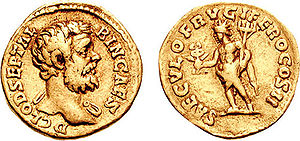
Gaul
Gaul was a region of Western Europe during the Iron Age and Roman era, encompassing present day France, Luxembourg and Belgium, most of Switzerland, the western part of Northern Italy, as well as the parts of the Netherlands and Germany on the left bank of the Rhine. The Gauls were the speakers of...
, bringing a large part of the British garrison with him. He defeated Severus' legate, Virius Lupus
Virius Lupus
Virius Lupus was a Roman soldier and politician of the late second and early 3rd century.His parents were Lucius Virius, born c. 140, and wife Antonia, also born c. 140 and daughter of Marcus Antonius Zeno. His paternal grandparents were Quintus Virius, born c. 110, and wife Larcia, born c...
, and was able to lay claim to the military resources of Gaul. And although he made Lugdunum
Lugdunum
Colonia Copia Claudia Augusta Lugdunum was an important Roman city in Gaul. The city was founded in 43 BC by Lucius Munatius Plancus. It served as the capital of the Roman province Gallia Lugdunensis. To 300 years after its foundation Lugdunum was the most important city to the west part of Roman...
the headquarters of his forces, he was unable to win the allegiance of the Rhine legions.
On February 19, 197, Albinus met Severus' army at the Battle of Lugdunum
Battle of Lugdunum
The Battle of Lugdunum, also called the Battle of Lyon, was fought on 19 February 197 at Lugdunum , between the armies of the Roman Emperor Septimius Severus and of the Roman usurper Clodius Albinus...
. After a hard-fought battle, with 150,000 troops on either side recorded by Dio Cassius
Dio Cassius
Lucius Cassius Dio Cocceianus , known in English as Cassius Dio, Dio Cassius, or Dio was a Roman consul and a noted historian writing in Greek...
, Albinus was defeated and killed himself, or was captured and executed on the orders of Severus. Severus had his naked body laid out on the ground before him, so that he could ride his horse over it, in a final act of humiliation. If Albinus' wife and sons were initially pardoned by Severus, he appeared to almost immediately afterwards change his mind again. For as the dead Albinus was beheaded, so were they. Albinus' headless body was thrown into the Rhine, together with the corpses of his murdered family. His body was ill treated by Severus, who sent his head to Rome as a warning to his supporters. With it he sent an insolent letter, in which he mocked the senate for their loyalty to Albinus. The town of Lugdunum
Lugdunum
Colonia Copia Claudia Augusta Lugdunum was an important Roman city in Gaul. The city was founded in 43 BC by Lucius Munatius Plancus. It served as the capital of the Roman province Gallia Lugdunensis. To 300 years after its foundation Lugdunum was the most important city to the west part of Roman...
was plundered and destroyed, and the adherents of Albinus were cruelly persecuted by Severus.
Albinus was a man of great bodily beauty and strength; he was an experienced general; a skillful gladiator; a severe, and often cruel commander; and he has been called the Catiline
Catiline
Lucius Sergius Catilina , known in English as Catiline, was a Roman politician of the 1st century BC who is best known for the Catiline conspiracy, an attempt to overthrow the Roman Republic, and in particular the power of the aristocratic Senate.-Family background:Catiline was born in 108 BC to...
of his time. He had one son, or perhaps two, who were executed with their mother, by order of Severus. It is said that he wrote a treatise on agriculture, and a collection of stories, called Milesian.