
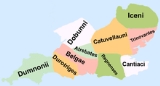
The
Iceni or
Eceni were a
BritishThe Britons were the Celtic people culturally dominating Great Britain from the Iron Age through the Early Middle Ages. They spoke the Insular Celtic language known as British or Brythonic...
tribeA tribe, viewed historically or developmentally, consists of a social group existing before the development of, or outside of, states.Many anthropologists use the term tribal society to refer to societies organized largely on the basis of kinship, especially corporate descent groups .Some theorists...
who inhabited an area of
East AngliaEast Anglia is a traditional name for a region of eastern England, named after an ancient Anglo-Saxon kingdom, the Kingdom of the East Angles. The Angles took their name from their homeland Angeln, in northern Germany. East Anglia initially consisted of Norfolk and Suffolk, but upon the marriage of...
corresponding roughly to the modern-day county of
NorfolkNorfolk is a low-lying county in the East of England. It has borders with Lincolnshire to the west, Cambridgeshire to the west and southwest and Suffolk to the south. Its northern and eastern boundaries are the North Sea coast and to the north-west the county is bordered by The Wash. The county...
between the 1st century BC and the 1st century AD. They were bordered by the Corieltauvi to the west, and the
CatuvellauniThe Catuvellauni were a tribe or state of south-eastern Britain before the Roman conquest.The fortunes of the Catuvellauni and their kings before the conquest can be traced through numismatic evidence and scattered references in classical histories. They are mentioned by Dio Cassius, who implies...
and
TrinovantesThe Trinovantes or Trinobantes were one of the tribes of pre-Roman Britain. Their territory was on the north side of the Thames estuary in current Essex and Suffolk, and included lands now located in Greater London. They were bordered to the north by the Iceni, and to the west by the Catuvellauni...
to the south.
The
CenimagniThe Cenimagni was a Celtic tribe, probably living somewhere in Southern England in the 1st century BC. They are known only from the writings of Julius Caesar...
, who surrendered to
Julius CaesarGaius Julius Caesar was a Roman general and statesman and a distinguished writer of Latin prose. He played a critical role in the gradual transformation of the Roman Republic into the Roman Empire....
during his
second expedition to BritainIn his Gallic Wars, Julius Caesar invaded Britain twice, in 55 and 54 BC. The first invasion, made late in summer, was either intended as a full invasion or a reconnaissance-in-force expedition...
in 54 BC, may have been a branch of the Iceni or it could be a corruption of
Iceni Magni meaning "Great Iceni".
Archaeology
ArchaeologicalArchaeology, or archeology , is the study of human society, primarily through the recovery and analysis of the material culture and environmental data that they have left behind, which includes artifacts, architecture, biofacts and cultural landscapes...
evidence of the Iceni includes
torcA torc, also spelled torq or torque, is a large, usually rigid, neck ring typically made from strands of metal twisted together. The great majority are open-ended at the front, although many seem designed for near-permanent wear and would have been difficult to remove. Smaller torcs worn around...
s — heavy rings of
goldGold is a chemical element with the symbol Au and an atomic number of 79. Gold is a dense, soft, shiny, malleable and ductile metal. Pure gold has a bright yellow color and luster traditionally considered attractive, which it maintains without oxidizing in air or water. Chemically, gold is a...
,
silverSilver is a metallic chemical element with the chemical symbol Ag and atomic number 47. A soft, white, lustrous transition metal, it has the highest electrical conductivity of any element and the highest thermal conductivity of any metal...
or
electrumElectrum is a naturally occurring alloy of gold and silver, with trace amounts of copper and other metals. It has also been produced artificially. The ancient Greeks called it 'gold' or 'white gold', as opposed to 'refined gold'. Its color ranges from pale to bright yellow, depending on the...
worn around the
neckThe neck is the part of the body, on many terrestrial or secondarily aquatic vertebrates, that distinguishes the head from the torso or trunk. The adjective signifying "of the neck" is cervical .-Boner anatomy: The cervical spine:The cervical portion of the human spine comprises seven boney...
and
shoulderThe human shoulder is made up of three bones: the clavicle , the scapula , and the humerus as well as associated muscles, ligaments and tendons. The articulations between the bones of the shoulder make up the shoulder joints. The major joint of the shoulder is the glenohumeral joint, which...
s.
The Iceni began producing coins
circa 10 BC. Their coins were a distinctive adaptation of the Gallo-Belgic "face/horse" design, and in some early issues, most numerous near
NorwichNorwich is a city in England. It is the regional administrative centre and county town of Norfolk. During the 11th century, Norwich was the largest city in England after London, and one of the most important places in the kingdom...
, the horse was replaced with a
boarWild boar, also wild pig, is a species of the pig genus Sus, part of the biological family Suidae. The species includes many subspecies. It is the wild ancestor of the domestic pig, an animal with which it freely hybridises...
. Some coins are inscribed ECENI, making them the only coin-producing group to use their tribal name on coins. The earliest personal name to appear on coins is
AntediosAntedios was an ancient king of the Iceni, a Brythonic Tribe who inhabited the present day county of Norfolk in Britain from approximately the 1st Century BCE until the 1st century CE....
(ca. 10 BC), and other abbreviated names like AESU and SAEMU follow.
Sir Thomas Browne, the first English archaeological writer, said of the Roman occupation,
BoudicaBoudica , also known as Boadicea and known in Welsh as "Buddug" was queen of the British Iceni tribe who led an uprising against the occupying forces of the Roman Empire....
and Iceni coins:

That Britain was notably populous is undeniable, from that expression of CaesarGaius Julius Caesar was a Roman general and statesman and a distinguished writer of Latin prose. He played a critical role in the gradual transformation of the Roman Republic into the Roman Empire....
. That the Romans themselves were early in no small Numbers, Seventy Thousand with their associates slain by BouadiceaBoudica , also known as Boadicea and known in Welsh as "Buddug" was queen of the British Iceni tribe who led an uprising against the occupying forces of the Roman Empire....
, affords a sure account... And no small number of silver pieces near NorwichNorwich is a city in England. It is the regional administrative centre and county town of Norfolk. During the 11th century, Norwich was the largest city in England after London, and one of the most important places in the kingdom...
; with a rude head upon the obverse, an ill-formed horse on the reverse, with the Inscriptions Ic. Duro.T. whether implying Iceni, DurotrigesThe Durotriges were one of the Celtic tribes living in Britain prior to the Roman invasion. The tribe lived in modern Dorset, south Wiltshire and south Somerset...
, Tascia, or Trinobantes, we leave to higher conjecture. The British Coyns afford conjecture of early habitation in these parts, though the city of Norwich arose from the ruins of VentaVenta Icenorum, probably meaning "Market Town of the Iceni", located at modern-day Caistor St Edmund in the English county of Norfolk, was the civitas or capital of the Iceni tribe, who inhabited the flatlands and marshes of that county and earned immortality for their revolt against Roman rule...
, and though perhaps not without some habitation before, was enlarged, built, and nominated by the SaxonsThe Saxons were a confederation of Germanic tribes originating on the North German plain. The Saxons earliest known area of settlement is Northern Albingia, an area approximately that of modern Holstein...
.
The
Icknield WayThe Icknield Way is an ancient trackway in southern England. It follows the chalk escarpment that includes the Berkshire Downs and Chiltern Hills.-Background:...
, an ancient trackway linking East Anglia to the
ChilternsThe Chiltern Hills form a chalk escarpment in South East England. They are known locally as "the Chilterns". A large portion of the hills was designated officially as an Area of Outstanding Natural Beauty in 1965.-Location:...
, may be named after the Iceni.
The Roman invasion
While the meaning of the name
Iceni is unknown, it is tempting to see it as derived from a Proto-Celtic
adjectiveIn grammar, an adjective is a 'describing' word; the main syntactic role of which is to qualify a noun or noun phrase, giving more information about the object signified....
cognateIn linguistics, cognates are words that have a common etymological origin. This learned term derives from the Latin cognatus . Cognates within the same language are called doublets. Strictly speaking, loanwords from another language are usually not meant by the term, e.g...
with Latin
picea ‘pine tree,’ the Italic tribal name
Piceni, English
picenePicene is a hydrocarbon found in the pitchy residue obtained in the distillation of peat tar and of petroleum. This is distilled to dryness and the distillate repeatedly recrystallized from cymene. It may be synthetically prepared by the action of anhydrous aluminium chloride on a mixture of...
, and with the English hydronym
ItchenThe River Itchen is a river in Hampshire, England. It flows from mid-Hampshire to join with Southampton Water below the Itchen Bridge in the city of Southampton. The river has a total length of , and is noted as one of England's - if not one of the World's - premier chalk streams for fly fishing,...
. Icenian coins dating from the 1st century AD use the spelling
ECEN http://www.predecimal.com/p1celtic.htm, which probably suggests a different
etymologyEtymology is the study of the history of words, their origins, and how their form and meaning have changed over time.For languages with a long written history, etymologists make use of texts in these languages and texts about the languages to gather knowledge about how words were used during...
.
TacitusPublius Cornelius Tacitus was a senator and a historian of the Roman Empire. The surviving portions of his two major works—the Annals and the Histories—examine the reigns of the Roman Emperors Tiberius, Claudius, Nero and those who reigned in the Year of the Four Emperors...
records that the Iceni were not conquered in the
Claudian invasionThe Roman conquest of Britain was a gradual process, beginning effectively in AD 43 under Emperor Claudius, whose general Aulus Plautius served as first governor of Britannia. Great Britain had already frequently been the target of invasions, planned and actual, by forces of the Roman Republic and...
of AD 43, but had come to a voluntary alliance with the Romans. However, they rose against them in 47 after the governor,
Publius Ostorius ScapulaPublius Ostorius Scapula was a Roman statesman and general who governed Britain from 47 until his death, and was responsible for the defeat and capture of Caratacus.-Career:...
, threatened to disarm them. The Iceni were defeated by Ostorius in a fierce battle at a fortified place, but were allowed to retain their independence. The site of the battle may have been
Stonea CampStonea Camp is an Iron Age hill fort located near March in the Cambridgeshire Fens. Situated on a gravel bank just above sea-level, it is the lowest hill fort in Britain. Around 500 BC, when fortification is thought to have begun at this site, this "hill" would have provided a significant area of...
in
CambridgeshireCambridgeshire is a county in England, bordering Lincolnshire to the north, Norfolk to the northeast, Suffolk to the east, Essex and Hertfordshire to the south, and Bedfordshire and Northamptonshire to the west...
.
A second and more serious uprising took place in AD 61.
PrasutagusPrasutagus was king of a British Celtic tribe called the Iceni, who inhabited roughly what is now Norfolk, in the 1st century AD. He is best known as the husband of Boudica....
, the wealthy, pro-Roman Icenian king, had died. It was common practice for a
Roman client kingThe Roman client kingdoms in Britain were native tribes who chose to align themselves with the Roman Empire because they saw it as the best option for self-preservation or for protection from other hostile tribes...
to leave his kingdom to Rome on his death, but Prasutagus had attempted to preserve his line by bequeathing his kingdom jointly to the Emperor and his own daughters. The Romans ignored this, and the
procuratorA procurator was the title of various officials of the Roman Empire, posts mostly filled by equites . A procurator Augusti was the governor of the smaller imperial provinces...
Catus DecianusCatus Decianus was the procurator of Roman Britain in AD 60 or 61. Tacitus blames his "rapacity" in part for provoking the rebellion of Boudica. Cassius Dio says he confiscated sums of money which had been given by the emperor Claudius to leading Britons, declaring them to be loans to be repaid...
seized his entire estate. Prasutagus's widow,
BoudicaBoudica , also known as Boadicea and known in Welsh as "Buddug" was queen of the British Iceni tribe who led an uprising against the occupying forces of the Roman Empire....
, was flogged, and her daughters were raped. At the same time, Roman financiers called in their loans. While the governor,
Gaius Suetonius PaulinusGaius Suetonius Paulinus, also spelled Paullinus, was a Roman general best known as the commander who defeated the rebellion of Boudica.-Career:...
, was campaigning in
WalesWales is a country that is part of the United Kingdom and the island of Great Britain, bordered by England to its east and the Atlantic Ocean and Irish Sea to its west. It has a population of three million, and a total area of 20,779 km²...
, Boudica led the Iceni and the neighbouring
TrinovantesThe Trinovantes or Trinobantes were one of the tribes of pre-Roman Britain. Their territory was on the north side of the Thames estuary in current Essex and Suffolk, and included lands now located in Greater London. They were bordered to the north by the Iceni, and to the west by the Catuvellauni...
in a large-scale revolt, destroying and looting
CamulodunumCamulodunum is the Roman name for the ancient settlement which is today's Colchester, a town in Essex, England. Camulodunum is claimed to be the oldest town in Britain as recorded by the Romans, existing as a Celtic settlement before the Roman conquest, when it became the first Roman town, and...
(
ColchesterColchester is an historic town and the largest settlement within the borough of Colchester in Essex, England.At the time of the census in 2001, it had a population of 104,390. However, the population is rapidly increasing, and has been named as one of Britain's fastest growing towns. As the...
),
LondiniumThe city of London was established by the Romans around AD 43. It served as a major imperial commercial centre until its abandonment during the 5th century.-Origins and language:...
(
LondonLondon is the capital city of :England and the :United Kingdom, the largest metropolitan area in the United Kingdom, and the largest urban zone in the European Union by most measures. Located on the River Thames, London has been a major settlement for two millennia, its history going back to its...
) and
VerulamiumVerulamium was an ancient town in Roman Britain. It was sited in the southwest of the modern city of St Albans in Hertfordshire, Great Britain. A large portion of the Roman city remains unexcavated, being now park and agricultural land, though much has been built upon...
(
St AlbansSt Albans is a city in southern Hertfordshire, England, around north of central London, which forms the main urban area of the City and District of St Albans. It is a historic market town, and is now a sought-after dormitory town within the London commuter belt...
) before finally being defeated by Suetonius Paulinus and his legions. Although the Britons outnumbered the Romans greatly, they lacked the superior discipline and tactics that won the Romans a decisive victory. The battle took place at an unknown location, probably in the
West MidlandsThe West Midlands is an official region of England, covering the western half of the area traditionally known as the Midlands. It contains the second most populous British city, Birmingham, and the larger West Midlands conurbation, which includes the city of Wolverhampton and large towns of Dudley,...
somewhere along
Watling StreetWatling Street is the name given to an ancient trackway in England and Wales that was first used by the Britons mainly between the modern cities of Canterbury and St Albans. The Romans later paved the route, part of which is identified on the Antonine Itinerary as Iter III: "Item a Londinio ad...
. Today, a large statue of Boudica wielding a sword and charging upon a
chariotThe chariot is a type of horse carriage used in both peace and war as the chief vehicle of many ancient peoples. Ox carts, proto-chariots, were built by the Proto-Indo-Europeans and also built in Mesopotamia as early as 3000 BC. The original horse chariot was a fast, light, open, two wheeled...
can be seen in
LondonLondon is the capital city of :England and the :United Kingdom, the largest metropolitan area in the United Kingdom, and the largest urban zone in the European Union by most measures. Located on the River Thames, London has been a major settlement for two millennia, its history going back to its...
on the north bank of the Thames by
Westminster BridgeWestminster Bridge is a road and foot traffic bridge over the River Thames between Westminster on the north side and Lambeth on the south side, in London, England....
.
The Iceni are recorded as a
civitasIn the history of Rome, the Latin term civitas , according to Cicero in the time of the late Roman Republic, was the social body of the cives, or citizens, united by law . It is the law that binds them together, giving them responsibilities on the one hand and rights of citizenship on the other...
of Roman Britain in
PtolemyClaudius Ptolemy , was a Roman citizen of Egypt who wrote in Greek. He was a mathematician, astronomer, geographer, astrologer, and poet of a single epigram in the Greek Anthology. He lived in Egypt under Roman rule, and is believed to have been born in the town of Ptolemais Hermiou in the...
's
GeographiaThe Geography is Ptolemy's main work besides the Almagest...
, which names
Venta IcenorumVenta Icenorum, probably meaning "Market Town of the Iceni", located at modern-day Caistor St Edmund in the English county of Norfolk, was the civitas or capital of the Iceni tribe, who inhabited the flatlands and marshes of that county and earned immortality for their revolt against Roman rule...
as a town of theirs. Venta, which is also mentioned in the
RavennaRavenna is the capital city of the Province of Ravenna in the Emilia-Romagna region of Italy and the second largest comune in Italy by land area, although, at , it is little more than half the size of the largest comune, Rome...
Cosmography, and the
Antonine ItineraryThe Antonine Itinerary is a register of the stations and distances along the various roads of the Roman empire, containing directions how to get from one Roman settlement to another...
, was a settlement near the village of
Caistor St. EdmundCaistor St Edmund is a village on the River Tas, near Norwich, Norfolk, England. It covers an area of and had a population of 270 in 116 households at the 2001 census....
, some five miles south of present-day
NorwichNorwich is a city in England. It is the regional administrative centre and county town of Norfolk. During the 11th century, Norwich was the largest city in England after London, and one of the most important places in the kingdom...
, and a mile or two from the
Bronze AgeThe Bronze Age is a period characterized by the use of copper and its alloy bronze as the chief hard materials in the manufacture of some implements and weapons. Chronologically, it stands between the Stone Age and Iron Age...
HengeThere are three related types of Neolithic earthwork which are all sometimes loosely called henges. The essential characteristic of all three types is that they feature a ring bank and ditch but with the ditch inside the bank rather than outside...
at
ArminghallArminghall is a small village in the English county of Norfolk, around three miles southeast of Norwich in the parish of Bixley. Most of the houses in the village are located close to the church, which lies just west of the B1332 road from Norwich to Poringland. Syfer Technology, an electronic...
.
After the Romans left Britain, it is possible that some of the Iceni migrated west away from the
AnglesThe Angles is a modern English term for a Germanic people who took their name from the ancestral cultural region of Angeln, a district located in Schleswig-Holstein, Germany...
into the inhospitable marshlands around
The WashThe Wash is the square-mouthed bay and estuary on the northwest margin of East Anglia on the east coast of England, where Norfolk meets Lincolnshire. It is among the largest estuaries in the United Kingdom...
known as the Fens. The possibility of this occurrence is supported by the
Life of Saint GuthlacSaint Guthlac of Crowland was a Christian saint from Lincolnshire in England. He is particularly venerated in the Fens of eastern England.-Life:...
- a biography written about the
East AngliaEast Anglia is a traditional name for a region of eastern England, named after an ancient Anglo-Saxon kingdom, the Kingdom of the East Angles. The Angles took their name from their homeland Angeln, in northern Germany. East Anglia initially consisted of Norfolk and Suffolk, but upon the marriage of...
n religious
hermitA hermit is a person who lives, to some degree, in seclusion from society.In Christianity, the term was originally applied to a Christian who lives the eremitic life out of a religious conviction, namely the Desert Theology of the Old Testament .In the...
who lived in the Fens during the early 8th century - it is stated that Saint Guthlac was attacked by people he believed were Britons living in the Fens at that time, 200 years after the establishment of Anglo-Saxon kingdoms, although Bertram Colgrave in the introduction to
The Life of Saint Guthlac states that is very unlikely due to the lack of evidence for British survival in the region and the fact that British placenames in the area are "very few".
External links