

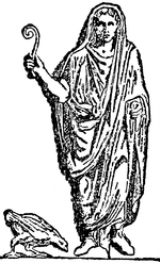
Augur

Encyclopedia
Ancient Rome
Ancient Rome was a thriving civilization that grew on the Italian Peninsula as early as the 8th century BC. Located along the Mediterranean Sea and centered on the city of Rome, it expanded to one of the largest empires in the ancient world....
and Etruria. His main role was to interpret the will of the gods by studying the flight of bird
Bird
Birds are feathered, winged, bipedal, endothermic , egg-laying, vertebrate animals. Around 10,000 living species and 188 families makes them the most speciose class of tetrapod vertebrates. They inhabit ecosystems across the globe, from the Arctic to the Antarctic. Extant birds range in size from...
s: whether they are flying in groups/alone, what noises they make as they fly, direction of flight and what kind of birds they are. This was known as "taking the auspice
Auspice
An auspice is literally "one who looks at birds", a diviner who reads omens from the observed flight of birds...
s." The ceremony and function of the augur was central to any major undertaking in Roman society—public or private—including matters of war, commerce, and religion
Religion in ancient Rome
Religion in ancient Rome encompassed the religious beliefs and cult practices regarded by the Romans as indigenous and central to their identity as a people, as well as the various and many cults imported from other peoples brought under Roman rule. Romans thus offered cult to innumerable deities...
.
The Roman historian Livy
Livy
Titus Livius — known as Livy in English — was a Roman historian who wrote a monumental history of Rome and the Roman people. Ab Urbe Condita Libri, "Chapters from the Foundation of the City," covering the period from the earliest legends of Rome well before the traditional foundation in 753 BC...
stresses the importance of the augurs: "Who does not know that this city was founded only after taking the auspices, that everything in war and in peace, at home and abroad, was done only after taking the auspices?"
Etymology and derivatives
The derivation of the word augur is uncertain; ancient authors believed that it contained the words avi and gero—LatinLatin
Latin is an Italic language originally spoken in Latium and Ancient Rome. It, along with most European languages, is a descendant of the ancient Proto-Indo-European language. Although it is considered a dead language, a number of scholars and members of the Christian clergy speak it fluently, and...
for "directing the birds"—but historical-linguistic evidence points instead to the root aug-, "to increase, to prosper."
The story is illustrative of the role of the augur: he does not predict what course of action should be taken, but through his augury he finds signs on whether or not a course already decided upon meets with divine sanction and should proceed.
Public role
Roman augurs were part of a collegiumCollegium (ancient Rome)
In Ancient Rome, a collegium was any association with a legal personality. Such associations had various functions.-Functioning:...
of priests who shared the duties and responsibilities of the position. At the foundation of the Republic
Roman Republic
The Roman Republic was the period of the ancient Roman civilization where the government operated as a republic. It began with the overthrow of the Roman monarchy, traditionally dated around 508 BC, and its replacement by a government headed by two consuls, elected annually by the citizens and...
in 510 BC, the patricians held sole claim to this office; by 300 BC
300 BC
Year 300 BC was a year of the pre-Julian Roman calendar. At the time it was known as the Year of the Consulship of Corvus and Pansa...
, the office was open to plebeian occupation as well. Senior members of the collegium put forth nominations for any vacancies, and members voted on whom to co-opt
Co-option
A co-opting or less frequently co-optation most commonly refers to action performed in a number of fields whereby an opponent is nullified or neutralized by absorption but there are other distinct senses as well....
.
In the Regal period tradition holds that there were three augurs at a time; by the time of Sulla, they had reached fifteen in number.
Augury sought the divine will regarding any proposed course of action which might affect Rome's pax, fortuna and salus (peace, good fortune and wellbeing).
Political, military and civil actions were sanctioned by augury, historically performed by priests of the college of augurs and by haruspices on behalf of senior magistrates. The presiding magistrate at an augural rite thus held the “right of augury” (ius augurii). Magistracies (which included senior military and civil ranks) were therefore religious offices in their own right, and magistrates were directly responsible for the pax, fortuna and salus of Rome and everything that was Roman.
The effectiveness of augury could only be judged retrospectively; the divinely ordained condition of peace (pax deorum) was an outcome of successful augury. Those whose actions had led to divine wrath (ira deorum) could not have possessed a true right of augury (ius augurum). Of all the protagonists in the Civil War, only Octavian could have possessed it, because he alone had restored the pax deorum to the Roman people. Lucan, writing during the Principate, described the recent Civil War as "unnatural" - a mirror to supernatural disturbances in the greater cosmos. His imagery is apt to the traditional principles of augury and its broader interpretation by Stoic apologists of the Imperial cult. In the Stoic cosmology, pax deorum is the expression of natural order in human affairs.
According to Cicero, the auctoritas of ius augurum included the right to adjourn and overturn the process of law: consular election could be - and was - rendered invalid by inaugural error. For Cicero, this made the augur the most powerful authority in the Republic. Cicero himself was co-opted into the college only late in his career.
In the later Republic, augury came under the supervision of the college of pontifices, a priestly-magistral office whose powers were increasingly woven into the cursus honorum
Cursus honorum
The cursus honorum was the sequential order of public offices held by aspiring politicians in both the Roman Republic and the early Empire. It was designed for men of senatorial rank. The cursus honorum comprised a mixture of military and political administration posts. Each office had a minimum...
. The office of pontifex maximus
Pontifex Maximus
The Pontifex Maximus was the high priest of the College of Pontiffs in ancient Rome. This was the most important position in the ancient Roman religion, open only to patricians until 254 BC, when a plebeian first occupied this post...
eventually became a de facto consular prerogative. When his colleague Lepidus
Marcus Aemilius Lepidus (triumvir)
Marcus Aemilius Lepidus , was a Roman patrician who rose to become a member of the Second Triumvirate and Pontifex Maximus. His father, Marcus Aemilius Lepidus, had been involved in a rebellion against the Roman Republic.Lepidus was among Julius Caesar's greatest supporters...
died, Augustus assumed his office as pontifex maximus, took priestly control over the State oracles (including the Sibylline books
Sibylline Books
The Sibylline Books or Libri Sibyllini were a collection of oracular utterances, set out in Greek hexameters, purchased from a sibyl by the last king of Rome, Tarquinius Superbus, and consulted at momentous crises through the history of the Republic and the Empire...
), and used his powers as censor to suppress the circulation of "unapproved" oracles.
Augurs, auguria and auspices
In ancient Rome the auguria were considered to be in equilibrium with the sacraSacra
Sacra may refer to :* Bibliotheca Sacra, the theological journal published by Dallas Theological Seminary* Harmonia Sacra, a Mennonite shape note hymn and tune book* Isola Sacra, an island in the Lazio region of Italy south of Rome...
("sacred things" or "rites") and were not the only way by which the gods made their will known.
The augures publici (public augurs) concerned themselves only with matters related to the state.
According to Varro they used to distinguish five kinds of territory: ager Romanus, ager Gabinus, ager peregrinus, ager hosticus, ager incertus: these distinctions clearly point to the times of the prehistory of Latium and testify the archaic quality of the art of augury.
The jus augurale (augural law) was rigorously secret, therefore very little about the technical aspects of ceremonies and rituals has been recorded. We have only the names of some auguria (augural rites): e.g. the augurium salutis which took place once a year before the magistrates and the people, in which the gods were asked whether it was auspicious to ask to for the welfare of the Romans, the augurium canarium and the vernisera auguria. The first one required the sacrifice of red dogs and took place before wheat grains were shelled but not before they had formed. Of the second we know only the name that implies a ritual related to the harvest.
Augurium and auspicium are terms used indifferently by the ancient. Modern scholars have debated the issue at length but have failed to find a distinctive definition that may hold for all the known cases. By such considerations Dumezil thinks that the two terms refer in fact to two aspects of the same religious act:
auspicium would design the technical process of the operation, i.e. aves spicere, looking at the birds. His result would be the augurium, i.e. the determination , acknowledgement of the presence of the *auges, the favour of the god(s), the intention and the final result of the whole operation. In Varro's words "Agere augurium, aves specit", "to conduct the augurium, he observed the birds".
Since auguria publica and inauguations of magistrates are strictly connected to political life this brought about the deterioration and abuses that condemned augury to progressive and inarrestable debasement, stripping it of all religious value.
The role of the augur was that of consulting and interpreting the will of gods about some course of action such as accession of kings to the throne, of magistrates and major sacerdotes to their functions (inauguration
Inauguration
An inauguration is a formal ceremony to mark the beginning of a leader's term of office. An example is the ceremony in which the President of the United States officially takes the oath of office....
) and all public enterprises.
The prototype of the ritual of inauguration of people is described in Livy's relation of the inauguration of king Numa Pompilius
Numa Pompilius
Numa Pompilius was the legendary second king of Rome, succeeding Romulus. What tales are descended to us about him come from Valerius Antias, an author from the early part of the 1st century BC known through limited mentions of later authors , Dionysius of Halicarnassus circa 60BC-...
. The augur asks Jupiter (signa
Signa
Signa is a comune in the Province of Florence in the Italian region Tuscany, located about 12 km west of Florence. As of 31 December 2004, it had a population of 16,809 and an area of 18.8 km²....
belong to Jupiter): "Si fas est... send me a certain signum", the augur listed the auspicia he wanted to see coming. When they appeared Numa was declared king.
Technically the sky was divided into four sections or regions: dextera, sinistra, antica and postica (right, left, anterior and posterior).
Before taking the auspicia impetrativa ("requested" or "sought" auspices; see below) the templum, or sacred space within which the operation would take place had to be established and delimited (it should be square and have only one entrance) and purified (effari, liberare).
The auspicia were divided into two categories: requested by man (impetrativa) and offered spontaneously by the gods (oblativa).
During a ceremony the enunciation of the requested auspicia was technically called legum dictio.
Magistrates endowed by the law with the right of spectio (observation of auspices) would establish the requested the auspicium.
To the augur was reserved the nuntiatio i.e. announcing the appearance of auspicia oblativa that would require the interruption of the operation.
The science of interpretation of signs was vast and complex.
Only some species of birds (aves augurales) could yield valid signs whose meaning would vary according to the species. Among them were ravens, woodpeckers, owls, oxifragae, eagles.
Signs from birds were divided into alites, from the flight, and oscines, from the voice.
The alites included region of the sky, height and type of flight, behaviour of the bird and place where it would rest.
The oscines included the pitch and direction of the sound.
Since the observation was complex conflict among signs was not uncommon.
A hierarchy among signs was devised: e.g. a sign from the eagle would prevail on that from the woodpecker and the oxifraga (parra).
Observation conditions were rigorous and required absolute silence for validity of the operation.
Both impetrativa and oblativa auspices could be divided into five classes:
ex caelo (thunder,lightning), ex avibus, ex tripudiis (attitude to food and feeding manner of the sacred chickens), ex quadrupedibus (dog, horse, wolf, fox), ex diris (ominous events).
During the last centuries of the republic the auspices ex caelo and ex tripudiis supplanted other types, as they could be easily used in a fraudulent way, i.e. bent to suit the desire of the asking person. It sufficed to say that the augur or magistrate had heard a clap of thunder to suspend the convocation of the comitia.
Cicero condemned the fraudulent use and denounced the decline in the level of knowledge of the doctrine by the augurs of his time.
In fact the abuse developed from the protective tricks devised to avoid being paralysed by negative signs. For an instance see the conversation between king Numa and Jupiter in Ovid, Fasti III, 339-344.
Against the negative auspicia oblativa the admitted procedures included:
1. actively avoiding to see them.
2. repudiare refuse them through an interpretative sleight of hands.
3. non observare by assuming one had not paid attention to them.
4. naming something that in fact had not appeared.
5. choosing the time of the observation (tempestas) at one's will.
6. making a distinction between observation and formulation (renunciatiatio).
7. resorting to acknowledging the presence of mistakes (vitia).
8. repeating the whole procedure.
Attus Navius
Contrary to other divinatory practices present in Rome (e.g. haruspicinaHaruspex
In Roman and Etruscan religious practice, a haruspex was a man trained to practice a form of divination called haruspicy, hepatoscopy or hepatomancy. Haruspicy is the inspection of the entrails of sacrificed animals, especially the livers of sacrificed sheep and poultry...
, consultation of the libri Sibyllini) augury appears to be autochthonous and originally Latin or Italic. The art has its roots in the prehistory of the Italic people and is attested in the Iguvine Tables
Iguvine Tables
The Iguvine Tablets are a series of seven bronze tablets discovered at Iguvium , Italy, in the year 1444. They are also known as Eugubian tablets...
(avif aseria) and among other Latin tribes. The very story or legend of the foundation of Rome is based on augury, i.e. the ascertaining of the will of gods through observation of the sky and of birds. Romulus and Remus indeed acted as augurs and Romulus was considered a great augur throughout the course of his life.
The character that best represented and portrayed the art however was Attus Navius. His story is related by Cicero.
He was born into a very poor family. One day he lost one of his pigs. He then promised the gods that if he found it, he would offer them the biggest grapes growing in his vineyard. After recovering his pig he stood right at the middle of his grape yard facing South. He divided the sky into four sections and observed birds: when they appeared he walked in that direction and found an extraordinary large grape that he offered to the gods.
His story was immediately famous and he became the augur of the king (see above the episode with king Tarquinius narrated by Livy). Henceforth he was considered the patron of the augurs.
See also
- AuspexAuspex (disambiguation)Auspex is a defunct computer company of the United States.Auspex is a French metal band.Auspex may also refer to:* Auspice, a diviner who reads omens from the flight of birds....
- De DivinationeDe DivinationeCicero's De Divinatione is a philosophical treatise in two books written in 44 BC. It takes the form of a dialogue whose interlocutors are Cicero and his brother Quintus....
- HaruspexHaruspexIn Roman and Etruscan religious practice, a haruspex was a man trained to practice a form of divination called haruspicy, hepatoscopy or hepatomancy. Haruspicy is the inspection of the entrails of sacrificed animals, especially the livers of sacrificed sheep and poultry...
- OmenOmenAn omen is a phenomenon that is believed to foretell the future, often signifying the advent of change...
- OrnithomancyOrnithomancyOrnithomancy is an Ancient Greek practice of reading omens from the actions of birds, equivalent to the Augury employed by the ancient Romans. Although it was mainly the flights and songs of birds that were studied, any action could have been interpreted to either foretell the future or relate a...
Sources
- Beard, Mary, John North, Simon Price, Religions of Rome: A History (Cambridge University Press, 1998)
- Hornblower, Simon and Anthony Spawforth, The Oxford Classical Dictionary (Third Edition) (Oxford: OUP, 1996), s.v. augures