
All Topics  
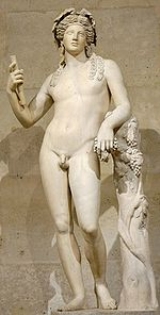
Dionysus

 
Dionysus

   Email Print
   Bookmark   Link


Dionysus


In classical mythology
Classical mythology

The terms "classical mythology" and "Greco-Roman mythology" usually refer to the mythology, and the associated polytheism rituals and practices, of Classical Antiquity....
, Dionysus or Dionysos (Greek
Ancient Greek

Ancient Greek is the historical stage in the development of the Greek language spanning across the Archaic Greece , Classical Greece , and Hellenistic civilization periods of ancient Greece and the classical antiquity....
 ?????s?? or ?????s??; ), is the god
God (male deity)

God, as a male deity, contrasts with female deities, or "goddesses". While the term 'goddess' specifically refers to a female deity, words like 'gods' and 'deities' can be applied to all gods collectively, regardless of gender....
 of wine
Wine

Wine is an alcoholic beverage often made of fermentation grape juice. The natural chemical balance of grapes is such that they can ferment without the addition of sugars, acids, enzymes or other nutrients....
, the inspirer of ritual madness and ecstasy
Ecstasy

Ecstasy may refer to:* Ecstasy , a trance or trance-like state in which an individual transcends normal consciousness* Religious ecstasy, a state of consciousness characterized by expanded spiritual awareness, visions or absolute euphoria...
, and a major figure of Greek mythology
Greek mythology

Greek mythology is the body of myths and legends belonging to the Ancient Greece concerning their List of Greek mythological figures#Immortals and Greek hero cult, Cosmology#Metaphysical cosmology, and the origins and significance of their own cult and ritual practices....
, and one of the twelve Olympians, among whom Greek mythology
Greek mythology

Greek mythology is the body of myths and legends belonging to the Ancient Greece concerning their List of Greek mythological figures#Immortals and Greek hero cult, Cosmology#Metaphysical cosmology, and the origins and significance of their own cult and ritual practices....
 treated Dionysus as a late arrival. The geographical origins of his cult were unknown to the classical Greeks, but almost all myths depicted him as having "foreign" origins: typical of the god of the epiphany, "the god that comes".

He was also known as Bacchus and the frenzy he induces, bakkheia.


Discussion
Ask a question about 'Dionysus'
Start a new discussion about 'Dionysus'
Answer questions from other users
Full Discussion Forum


Recent Posts


Encyclopedia


In classical mythology
Classical mythology

The terms "classical mythology" and "Greco-Roman mythology" usually refer to the mythology, and the associated polytheism rituals and practices, of Classical Antiquity....
, Dionysus or Dionysos (Greek
Ancient Greek

Ancient Greek is the historical stage in the development of the Greek language spanning across the Archaic Greece , Classical Greece , and Hellenistic civilization periods of ancient Greece and the classical antiquity....
 ?????s?? or ?????s??; ), is the god
God (male deity)

God, as a male deity, contrasts with female deities, or "goddesses". While the term 'goddess' specifically refers to a female deity, words like 'gods' and 'deities' can be applied to all gods collectively, regardless of gender....
 of wine
Wine

Wine is an alcoholic beverage often made of fermentation grape juice. The natural chemical balance of grapes is such that they can ferment without the addition of sugars, acids, enzymes or other nutrients....
, the inspirer of ritual madness and ecstasy
Ecstasy

Ecstasy may refer to:* Ecstasy , a trance or trance-like state in which an individual transcends normal consciousness* Religious ecstasy, a state of consciousness characterized by expanded spiritual awareness, visions or absolute euphoria...
, and a major figure of Greek mythology
Greek mythology

Greek mythology is the body of myths and legends belonging to the Ancient Greece concerning their List of Greek mythological figures#Immortals and Greek hero cult, Cosmology#Metaphysical cosmology, and the origins and significance of their own cult and ritual practices....
, and one of the twelve Olympians, among whom Greek mythology
Greek mythology

Greek mythology is the body of myths and legends belonging to the Ancient Greece concerning their List of Greek mythological figures#Immortals and Greek hero cult, Cosmology#Metaphysical cosmology, and the origins and significance of their own cult and ritual practices....
 treated Dionysus as a late arrival. The geographical origins of his cult were unknown to the classical Greeks, but almost all myths depicted him as having "foreign" origins: typical of the god of the epiphany, "the god that comes".

He was also known as Bacchus and the frenzy he induces, bakkheia. He is the patron deity of agriculture
Agriculture

Agriculture refers to the production of food and goods through farming and forestry. Agriculture was the key development that led to the rise of civilization, with the animal husbandry of domestication animals and plants creating food surpluses that enabled the development of more Population density and Social stratification societies....
 and the theatre
Theatre

Theatre is the branch of the performing arts defined by Bernard Beckerman as what "occurs when one or more actor, isolated in time and/or Theater , present themselves to Audience." By this broad definition, theatre has existed since the dawn of man, as a result of human tendency for story telling....
. He was also known as the Liberator (Eleutherios
Eleutherios

Eleutherios is an epithet of:*Dionysus*Eros ...
), freeing one from one's normal self, by madness, ecstasy, or wine. The divine mission of Dionysus was to mingle the music of the aulos
Aulos

An aulos or tibia was an ancient Greece musical instrument. Different kinds of instruments bore the name, including a single pipe without a reed called the monaulos , and a single pipe held horizontally, as the modern flute, called the plagiaulos , but the most common variety must have been a reed instrument....
 and to bring an end to care and worry. Scholars have discussed Dionysus' relationship to the "cult of the souls" and his ability to preside over communication between the living and the dead.

In Greek mythology, Dionysus is made to be a son of Zeus
Zeus

Zeus in Greek mythology is the king of the gods, the ruler of Mount Olympus and the god of the sky father and List of thunder gods. His symbols are the thunderbolt, eagle, bull , and oak....
 and Semele
Semele

File:Gustave Moreau 004.jpgIn Greek mythology, Semele, daughter of Cadmus and Harmonia , was the mortal mother of Dionysus by Zeus in one of his many origin myths....
; other versions of the myth contend that he is a son of Zeus and Persephone
Persephone

In Greek mythology, Persephone was the embodiment of the Earth's fertility at the same time that she was the Queen of the Greek Underworld, the kore , and the parthenogenesis daughter of Demeter and, in later Classical myths, a daughter of Demeter and Zeus....
. He is described as being womanly or "man-womanish".

The name Dionysos is of uncertain significance; its -nysos element may well be non-Greek in origin, but its dio- element has been associated since antiquity with Zeus (genitive Dios). Nysa
Nysa (mythology)

In Greek mythology, the mountainous district of Nysa, variously associated with Ethiopia, Libya, Tribalia, or Arabia by Greece Mythography, was the traditional place where the rain nymphs, the Hyades , raised the infant God Dionysus, the "Zeus of Nysa"....
, for Greek writers, is either the nymph
Nymph

In Greek mythology, a nymph is any member of a large class of mythological entities in human form. They were typically associated with a particular location or landform....
 who nursed him, or the mountain where he was attended by several nymphs (the Nysiads
Nysiads

The Nysiads or Nysiades were the nymphs who cared for and taught the infant Dionysus. They included Kallichore and Calyce .In some later tellings of Dionysus's infancy, the Nyiades are confused with the Hyades or the term Nysiades is used as a collective term for the Pleiades and the Hyades as Dionysus's tutors....
), who fed him and made him immortal as directed by Hermes
Hermes

Hermes is the messenger of the gods in Greek mythology. An Twelve Olympians, he is also the patron of boundaries and of the travelers who cross them, of shepherds and cowherds, of thieves and road travelers, of orators and wit, of literature and poets, of athletics, of weights and measures, of invention, of general commerce, and of the cunni...
.

The retinue
Retinue

A retinue is a body of persons "retained" in the service of a nobility or royal family personage, a suite of "retainers."...
 of Dionysus was called the Thiasus
Thiasus

In Greek mythology, the Thiasus , was the ecstatic retinue of Dionysus, often pictured as inebriated revelers. Many of the myths of Dionysus are connected with his arrival; the grandest such vision was his "Roman triumph return from India, represented in many Roman bas-reliefs and sarcophagus panels and celebrated in Nonnus' Dionysiaca....
 and comprised chiefly Maenads.

Worship


Dionysus is a god of mystery religious rites
Mystery religion

Mystery Religions, Sacred Mysteries or simply Mysteries, were "religious Cult of the Graeco-Roman world, full admission to which was restricted to those who had gone through certain secret initiation rites."...
, such as those practiced in honor of Demeter
Demeter

File:Demeter in horse chariot w daughter kore 83d40m wikiC Tempio Y di Selinunte sec VIa.JPGDemeter , in Greek mythology, is the Goddess of cereal and fertility, the pure....
 and Persephone
Persephone

In Greek mythology, Persephone was the embodiment of the Earth's fertility at the same time that she was the Queen of the Greek Underworld, the kore , and the parthenogenesis daughter of Demeter and, in later Classical myths, a daughter of Demeter and Zeus....
 at Eleusis
Eleusinian Mysteries

The Eleusinian Mysteries were initiation ceremony held every year for the Cult of Demeter and Persephone based at Eleusis in ancient Greece. Of all the mysteries celebrated in ancient times, these were held to be the ones of greatest importance....
 near Athens
Athens

Athens , the Capital and largest city of Greece, dominates the Attica periphery; as one of the List of cities by time of continuous habitation, its recorded history spans around 3,400 years....
. In the Thracian
Thrace

Thrace is a historical and geographic area in southeast Europe. Today the name Thrace designates a region spread over southern Bulgaria , northeastern Greece , and European Turkey ....
 mysteries, he wears the "bassaris" or fox
Fox

A fox is an animal belonging to any one of about 27 species of small to medium-sized Canidae, characterized by possessing a long, narrow snout, and a bushy tail, or brush....
-skin, symbolizing new life. His own rites the Dionysian Mysteries
Dionysian Mysteries

The Dionysian Mysteries probably began as an ancient initiation society, or family of similar societies, centred on a primeval nature god , apparently associated with horned animals, serpents and solitary predators , later known to the Greeks in the eclectic figure of Dionysus....
 were the most secretive of all (See also Maenads). Many scholars believe that Dionysus is a syncretism
Syncretism

Syncretism consists of the attempt to reconcile disparate or contrary beliefs, often while melding practices of various schools of thought. The term may refer to attempts to merge and analogy several originally discrete traditions, especially in the theology and mythology of religion, and thus assert an underlying unity allowing for an inclu...
 of a local Greek nature deity and a more powerful god from Thrace
Thrace

Thrace is a historical and geographic area in southeast Europe. Today the name Thrace designates a region spread over southern Bulgaria , northeastern Greece , and European Turkey ....
 or Phrygia
Phrygia

In antiquity, Phrygia was a kingdom in the west central part of Anatolia, in what is now modern-day Turkey. The Phrygians initially lived in the Southern Balkans; according to Herodotus, under the name of Bryges, changing it to Phruges after their final migration to Anatolia, via the Hellespont....
 such as Sabazios
Sabazios

Sabazios is the nomadic horseman and sky father god of the Phrygians and Thracians. In Indo-European languages, such as Phrygian language, the '-zios' element in his name derives from dyeus, the common precursor of 'deus' and Zeus....
.

Though the name of Dionysus appears, surprisingly, in two tablets at Mycenaean Pylos
Pylos

This article is about the Greek geographical feature and town. For the mythological figure see Pylus . For board game see Pylos .Pylos, or P?los , is a large bay and a town on the west coast of the Peloponnese, in the district of Messenia in southern Greece....
 at the moment of its ruin, and one at Khania (where he is worshipped alongside Zeus), Herodotus
Herodotus

Herodotus of Halicarnassus was a Greeks historian who lived in the 5th century BC and is regarded as the "Father of History" in Western culture....
, like all classical Greeks and many subsequent scholars until recently, was convinced that the worship of Dionysus arrived later among the Greeks than the Olympian pantheon. He remarks:

Many Greeks were sure that the cult of Dionysus arrived in Greece from Anatolia
Anatolia

Anatolia or Asia Minor is a region of Western Asia, comprising most of the modern Republic of Turkey. It is a geographic region bounded by the Black Sea to the north, the Caucasus to the northeast, the Aegean Sea to the west, the Mediterranean Sea to the south, and the Iranian plateau to the east and southeast....
, but Greek concepts of where Nysa was, whether set in Anatolia, or in Libya
Libya

Libya , officially the Great Socialist People's Libyan Arab Jamahiriya , is a country located in North Africa. Bordering the Mediterranean Sea to the north, Libya lies between Egypt to the east, Sudan to the southeast, Chad and Niger to the south, and Algeria and Tunisia to the west....
 ('away in the west beside a great ocean'), Ethiopia (Herodotus), or Arabia (Diodorus Siculus), are variable enough to suggest that a magical distant land was intended, perhaps named 'Nysa' to explain the god's unreadable name, as the 'god of Nysa.' Apollodorus
Apollodorus

Apollodorus of Athens son of Asclepiades, was a Greeks scholar and grammarian. He was a pupil of Diogenes of Babylon, Panaetius, and the grammarian Aristarchus of Samothrace....
 seems to be following Pherecydes, who relates how the infant Dionysus, god of the grapevine, was nursed by the rain-nymphs, the Hyades
Hyades (mythology)

In Greek mythology, the Hyades , are a sisterhood of nymphs that bring rain. They do not appear in Roman mythology, where Pluvius is an epithet of Jupiter , as "he who sends rain"....
 at Nysa. The Anatolian Hittites
Hittites

The Hittites were an ancient Anatolian people who spoke a Hittite language of the Anatolian languages of the Indo-European languages family, and established a kingdom centered at Hattusa in north-central Anatolia ca....
' name for themselves in their own language ("Nesili") was "Nesi," however. The Hittites' influence on early Greek culture is often unappreciated.

The above contradictions suggest to some that we are dealing not with the historical memory of a cult that is foreign, but with a god in whom foreignness is inherent. And indeed, Dionysus's name, as mentioned above, is found on Mycenean
Mycenaean language

Mycenaean is the most ancient attested form of the Greek language, spoken on the Greek mainland and on Crete in the Mycenaean period, before the Dorian invasion....
 Linear B
Linear B

Linear B is a script that was used for writing Mycenaean language, an early form of Greek language. It predated the Greek alphabet by several centuries and seems to have died out with the fall of Mycenaean Greece civilization....
 tablets as "DI-WO-NU-SO-JO", and Karl Kerenyi
Karl Kerényi

One of the founders of modern studies in Greek mythology, K?roly Ker?nyi was born in Temesv?r, Hungary , and then lived in Hungary....
 traces him to Minoan Crete, where his Minoan name is unknown but his characteristic presence is recognizable. Clearly, Dionysus had been with the Greeks and their predecessors a long time, and yet always retained the feel of something alien.

The bull
Bull (mythology)

Appearances of the Bull in mythology and worship are widespread in the ancient world. It is the subject of various cultural and Religion incarnations, as well as modern mentions in new age cultures....
, the serpent
Serpent (symbolism)

Serpent is a word of Latin origin that is commonly used in a specifically mythology or religion context, signifying a snake that is to be regarded not as a mundane natural phenomenon nor as an object of scientific zoology, but as the bearer of some symbolic value....
, the ivy
Ivy

Hedera is a genus of 15 species of climbing or ground-creeping evergreen woody plants in the family Araliaceae, native to the Macaronesia, western, central and southern Europe, northwestern Africa and across central-southern Asia east to Japan....
 and the wine are the signs of the characteristic Dionysian atmosphere, and Dionysus is strongly associated with satyr
Satyr

In Greek mythology, satyrs are a troop of male companions of Pan and Dionysus ? "satyresses" were a late invention of poets ? that roamed the woods and mountains....
s, centaur
Centaur

In Greek mythology, the centaurs are a race of creatures composed of part human and part horse. In early Attica Pottery of ancient Greece, they are depicted with the torso of a human joined at the waist to the horse's withers, where the horse's neck would be....
s, and sileni
Sileni

Sileni may refer to:* Lunacy , the original foreign title for Jan ?vankmajer's film Lunacy* Ipotane, Ipotanes who were followers of Dionysus in Greek mythology...
. He is often shown riding a leopard
Leopard

The leopard is a member of the Felidae biological family and the smallest of the four "Panthera" in the genus Panthera; the other three are the tiger, lion and jaguar....
, wearing a leopard skin, or in a chariot drawn by panthers
Panther (legendary creature)

A Panther is a creature out of ancient myth that resembles a big cat with a multicoloured hide.Under medieval belief after feasting the panther will sleep in a cave for a total of three days....
, and may also be recognized by the thyrsus
Thyrsus

In Greek mythology, a thyrsus was a staff of ferula covered with ivy vines and leaves, sometimes wound with taeniae and always topped with a pine conifer cone....
 he carries. Besides the grapevine
Grapevine

The term Grapevine may refer to:* Grapevine Talk, a online software product used for collaboration and voice communications with groups of people...
 and its wild barren alter-ego, the toxic ivy plant, both sacred to him, the fig
FIG

FIG may refer to:* F?d?ration Internationale de Gymnastique* International Federation of Surveyors...
 was also his symbol. The pinecone that tipped his thyrsus linked him to Cybele
Cybele

Cybele , was the Phrygian deification of the Earth Mother. As with Greek Gaia , or her Minoan civilization equivalent Rhea , Cybele embodies the fertile Earth, a goddess of caverns and mountains, walls and fortresses, nature, wild animals ....
, and the pomegranate
Pomegranate

The pomegranate is a fruit-bearing deciduous shrub or small tree growing to between five and eight metres tall. The pomegranate is native to the region from Iran to the Himalayas in northern India and has been cultivated and naturalized over the whole Mediterranean Basin region and the Caucasus since ancient times....
 linked him to Demeter
Demeter

File:Demeter in horse chariot w daughter kore 83d40m wikiC Tempio Y di Selinunte sec VIa.JPGDemeter , in Greek mythology, is the Goddess of cereal and fertility, the pure....
. The Dionysia
Dionysia

The Dionysia was a large religious festival in ancient Athens in honor of the god Dionysus, the central event of which was the performance of tragedy and, since 487 BC, Greek comedy....
 and Lenaia
Lenaia

The Lenaia was an annual festival with a dramatic competition but one of the lesser festivals of Athens and Ionia in ancient Greece. The Lenaia took place in the month of Gamelion, roughly corresponding to January....
 festivals in Athens
Athens

Athens , the Capital and largest city of Greece, dominates the Attica periphery; as one of the List of cities by time of continuous habitation, its recorded history spans around 3,400 years....
 were dedicated to Dionysus. Initiates worshipped him in the Dionysian Mysteries
Dionysian Mysteries

The Dionysian Mysteries probably began as an ancient initiation society, or family of similar societies, centred on a primeval nature god , apparently associated with horned animals, serpents and solitary predators , later known to the Greeks in the eclectic figure of Dionysus....
, which were comparable to and linked with the Orphic Mysteries, and may have influenced Gnosticism
Gnosticism

Gnosticism refers to diverse, syncretistic religious movements in antiquity consisting of various belief systems generally united in the teaching that humans are divine souls trapped in a Nature created by an imperfect god, the demiurge; this being is frequently identified with the Abrahamic God, and is contrasted with a superior entity, ref...
. Orpheus was said to have invented the Mysteries of Dionysus.

Bacchanalia


Bacchusbycaravaggio
Introduced into Rome
Rome

Rome is the capital city of Italy and Lazio, and is Italy's largest and most populous city, with 2,724,347 residents in an urban area of some ....
 (c. 200 BC) from the Greek culture of southern Italy
Magna Graecia

Magna Graecia is the name of the area in Southern Italy and Sicily that was Colonies in antiquity#Greek colonies by Greek settlers in the eighth century BC, who brought with them the lasting imprint of their Hellenic civilization....
 or by way of Greek-influenced Etruria
Etruria

Etruria — usually referred to in Greek language and Latin language source texts as Tyrrhenia — was a region of Central Italy, an area that covered part of what now are Tuscany, Latium, Emilia-Romagna and Umbria....
, the bacchanalia were held in secret and attended by women only, in the grove of Simila, near the Aventine Hill
Aventine Hill

The Aventine Hill is one of the Seven hills of Rome on which ancient Rome was built. It belongs to Ripa , the twelfth rione, or ward, of Rome....
, on March 16 and 17. Subsequently, admission to the rites were extended to men and celebrations took place five times a month. The notoriety of these festivals, where many kinds of crimes and political conspiracies were supposed to be planned, led in 186 BC to a decree of the Senate
Roman Senate

The Senate of the Roman Republic was a political institution in the ancient Roman Republic. According to the Greek historian Polybius, our principal source on the Constitution of the Roman Republic, the Roman Senate was the predominant branch of government....
 — the so-called Senatus consultum de Bacchanalibus, inscribed on a bronze tablet discovered in Calabria
Calabria

Calabria , is a Regions of Italy in Southern Italy Italy, south of Naples, located at the "toe" of the Italian peninsula. It is bounded to the north by the region of Basilicata, to the south-west by the region of Sicily, to the west by the Tyrrhenian Sea, and to the east by the Ionian Sea....
 (1640), now at Vienna
Vienna

Vienna is the Capital of Republic of Austria and also one of the nine states of Austria. Vienna is Austria's primary city, with a population of about 1.7 million...
 — by which the Bacchanalia were prohibited throughout all Italy except in certain special cases which must be approved specifically by the Senate. In spite of the severe punishment inflicted on those found in violation of this decree, the Bacchanalia were not stamped out, at any rate in the south of Italy, for a very long time.

Dionysus is equated with both Bacchus and Liber
Liber

In Roman mythology, Liber was originally associated with husbandry and crops, but then was assimilated with Dionysos. He is the consort of Ceres and the father of the goddess Libera ....
 (also Liber Pater). Liber ("the free one") was a god of fertility, wine, and growth, married to Libera
Libera (mythology)

In Roman mythology, Libera is a goddess of fertility and the Earth. She is the daughter of Liber and Ceres . Libera is associated with Persephone of Greek mythology....
. His festival was the Liberalia, celebrated on March 17, but in some myths the festival was also held on March 5.

Appellations


Dionysus Qingdao Beer
Dionysus sometimes has the epithet
Epithet

An epithet is a descriptive word or phrase accompanying or occurring in place of the name of a person or thing, which has become a fixed formula....
 Acratophorus, by which he was designated as the giver of unmixed wine, and worshipped at Phigaleia in Arcadia
Arcadia

Arcadia, Arkad?a , or Arcady is a region of Greece in the Peloponnesus. It takes its name from the mythological character Arcas....
. In Sicyon
Sicyon

Sikyon was an ancient Greece city situated in the northern Peloponnesus between Corinth, Greece and Achaea. The king-list given by Pausanias comprises twenty-four kings, beginning with the autochthonous Aegialeus; the penultimate king of the list, Agamemnon, compels the submission of Sicyon to Mycenae; after him comes the Dorian usurper Pha...
 he was worshiped by the name Acroreites. As Bacchus, he carried the Latin epithet Adoneus, "Ruler". Aegobolus, "goat killer", was the name under which he was worshiped at Potniae in Boeotia
Boeotia

Boeotia, Beotia, or B?otia , formerly Cadmeis, was a region of ancient Greece, north of the eastern part of the Gulf of Corinth. It was bounded on the south by Megaris and the Kithairon mountain range that forms a natural barrier with Attica, on the north by Opuntian Locris and the Euripus Strait at the Gulf of Euboea, and on the...
. As Aesymnetes
Dionysus Aesymnetes

Aesymnetes was an epithet of the Greek mythology Dionysus, which signifies the "Lord", or "Ruler", and under which he was worshipped at Aro? in Achaea....
 ("ruler" or "lord") he was worshipped at Aroë and Patrae
Patras

Patras is Greece's third largest urban centre and the capital of the prefecture of Achaea, located in northern Peloponnese, 215 kilometers west of Athens....
 in Achaea
Achaea

Achaea is an ancient province and a present prefectures of Greece of Greece, on the northern coast of the Peloponnese, stretching from the mountain ranges of Erymanthus and Cyllene on the south to a narrow strip of fertile land on the north, bordering the Gulf of Corinth, into which the mountain Panachaicus projects....
. Another epithet was Bromios, "the thunderer" or "he of the loud shout". As Dendrites, "he of the trees", he is a powerful fertility god. Dithyrambos is sometimes used to refer to him or to solemn songs sung to him at festivals; the name refers to his premature birth. Eleutherios ("the liberator") was an epithet for both Dionysus and Eros. Other forms of the god as that of fertility include the epithet in Samos
Samos Island

Samos is a Greece island in the North Aegean sea, south of Chios, north of Patmos and the Dodecanese, and off the Ionian coast of Turkey....
 and Lesbos Enorches
Enorches

In Greek mythology, Enorches was a son of Thyestes by his sister Daeta. He was born out of an egg and built a temple to Dionysus, who was hence called Dionysus Enorches, though Enorches may also describe the god as the dancer....
 ("with balls" or perhaps "in the testicles" in reference to Zeus' sewing the babe Dionysus into his thigh, i.e., his testicles). Evius is an epithet of his used prominently in Euripides
Euripides

Euripides was the last of the three great tragedy of classical Athens . Ancient scholars thought that Euripides had written ninety-five plays, although four of those were probably written by Critias....
' play, The Bacchae
The Bacchae

The Bacchae is an Classical Greece tragedy by the Classical Athens playwright Euripides. It premiered posthumously at the Theatre of Dionysus in 405 BCE as part of a tetralogy that also included Iphigeneia at Aulis, and which Euripides' son or nephew probably directed....
. Iacchus
Iacchus

In Greek mythology, Iacchus is an epithet of Dionysus, particularly associated with the Eleusinian Mysteries, where he was considered to be the son of Zeus and Demeter....
, possibly an epithet of Dionysus, is associated with the Eleusinian Mysteries
Eleusinian Mysteries

The Eleusinian Mysteries were initiation ceremony held every year for the Cult of Demeter and Persephone based at Eleusis in ancient Greece. Of all the mysteries celebrated in ancient times, these were held to be the ones of greatest importance....
; in Eleusis, he is known as a son of Zeus
Zeus

Zeus in Greek mythology is the king of the gods, the ruler of Mount Olympus and the god of the sky father and List of thunder gods. His symbols are the thunderbolt, eagle, bull , and oak....
 and Demeter
Demeter

File:Demeter in horse chariot w daughter kore 83d40m wikiC Tempio Y di Selinunte sec VIa.JPGDemeter , in Greek mythology, is the Goddess of cereal and fertility, the pure....
. The name "Iacchus" may come from the ?a???? (Iakchos), a hymn sung in honor of Dionysus. With the epithet Liknites ("he of the winnowing fan") he is a fertility god connected with the mystery religion
Mystery religion

Mystery Religions, Sacred Mysteries or simply Mysteries, were "religious Cult of the Graeco-Roman world, full admission to which was restricted to those who had gone through certain secret initiation rites."...
s. A winnowing fan was similar to a shovel
Shovel

A shovel is a tool for lifting and moving loose material such as coal, gravel, snow, soil, or sand and is an extremely common tool which is used extensively in agriculture, construction and gardening....
 and was used to separate the chaff from the grain. In addition, Dionysus is known as Lyaeus ("he who unties") as a god of relaxation and freedom from worry, and as Oeneus he is the god of the wine press
Wine press

A wine press is a device used to extract juice from crushed grapes during wine making. There are a number of different styles of presses that are used by wine makers but their overall functionality is the same....
.

In the Greek pantheon
Pantheon (gods)

A pantheon is a set of all the gods of a particular polytheistic religion or mythology.Max Weber's 1922 opus, Economy and Society discusses the link between a pantheon of gods and the development of monotheism....
, Dionysus (along with Zeus
Zeus

Zeus in Greek mythology is the king of the gods, the ruler of Mount Olympus and the god of the sky father and List of thunder gods. His symbols are the thunderbolt, eagle, bull , and oak....
) absorbs the role of Sabazios
Sabazios

Sabazios is the nomadic horseman and sky father god of the Phrygians and Thracians. In Indo-European languages, such as Phrygian language, the '-zios' element in his name derives from dyeus, the common precursor of 'deus' and Zeus....
, a Thracian/Phrygia
Phrygia

In antiquity, Phrygia was a kingdom in the west central part of Anatolia, in what is now modern-day Turkey. The Phrygians initially lived in the Southern Balkans; according to Herodotus, under the name of Bryges, changing it to Phruges after their final migration to Anatolia, via the Hellespont....
n deity. In the Roman pantheon
Roman mythology

Roman mythology, or more appropriately, Latin mythology, refers to the mythology beliefs of the Italic people inhabiting the region of Latium and its main city, Rome....
, Sabazius became an alternate name for Bacchus.

Mythology


Birth

Dionysus had a strange birth that evokes the difficulty in fitting him into the Olympian pantheon. His mother was a mortal woman. Semele
Semele

File:Gustave Moreau 004.jpgIn Greek mythology, Semele, daughter of Cadmus and Harmonia , was the mortal mother of Dionysus by Zeus in one of his many origin myths....
, the daughter of king Cadmus
Cadmus

Cadmus or Kadmos , in Greek mythology mythology, was a Phoenician prince, the son of Agenor and the brother of Phoenix , Cilix and Europa ....
 of Thebes
Thebes

Thebes may refer to one of the following places:* Thebes, Egypt – Thebes of the Hundred Gates; one-time capital of the New Kingdom of Egypt...
, and his father Zeus
Zeus

Zeus in Greek mythology is the king of the gods, the ruler of Mount Olympus and the god of the sky father and List of thunder gods. His symbols are the thunderbolt, eagle, bull , and oak....
, the king of the gods. Zeus' wife, Hera
Hera

In the Twelve Olympians of classical Greek Mythology, Hera or Here was the wife and older sister of Zeus. Her chief function was as goddess of women and marriage....
, a jealous and prudish goddess, discovered the affair while Semele was pregnant. Appearing as an old crone
Crone

A crone is a disagreeable old woman, or alternately the third of three aspects of the Triple Goddess popularized by Robert Graves and subsequently in some forms of neopaganism, particularly Wicca....
 (in other stories a nurse), Hera befriended Semele, who confided in her that Zeus was the actual father of the baby in her womb. Hera pretended not to believe her, and planted seeds of doubt in Semele's mind. Curious, Semele demanded of Zeus that he reveal himself in all his glory as proof of his godhood. Though Zeus begged her not to ask this, she persisted and he agreed. Therefore he came to her wreathed in bolts of lightning; mortals, however, could not look upon an undisguised god without dying, and she perished in the ensuing blaze. Zeus rescued the foetal Dionysus by sewing him into his thigh. A few months later, Dionysus was born on Mount Pramnos in the island of Ikaria, where Zeus went to release the now-fully-grown baby from his thigh. In this version, Dionysus is borne by two "mothers" (Semele and Zeus) before his birth, hence the epithet dimetor (of two mothers) associated with his being "twice-born".

In the Cretan version of the same story, which Diodorus Siculus
Diodorus Siculus

Diodorus Siculus , was a Roman Greece historian who flourished in the 1st century BC. According to Diodorus' own work, he was born at Agira in Sicily ....
 follows, Dionysus was the son of Zeus and Persephone
Persephone

In Greek mythology, Persephone was the embodiment of the Earth's fertility at the same time that she was the Queen of the Greek Underworld, the kore , and the parthenogenesis daughter of Demeter and, in later Classical myths, a daughter of Demeter and Zeus....
, the queen of the Greek underworld
Greek underworld

The Greek underworld is a general term used to describe the various realms of Greek mythology which were believed to lie beneath the earth or beyond the horizon....
. Diodorus' sources equivocally identified the mother as Demeter. A jealous Hera again attempted to kill the child, this time by sending Titans
Titan (mythology)

In Greek mythology, the Titans ; were a race of powerful deities that ruled during the legendary golden age. Their role as Elder Gods was overthrown by a race of younger gods, the Twelve Olympians, effected a mythological paradigm shift that the Greeks borrowed from the Ancient Near East....
 to rip Dionysus to pieces after luring the baby with toys. Zeus drove the Titans away with his thunderbolts, but only after the Titans ate everything but the heart, which was saved, variously, by Athena
Athena

In Greek mythology, Athena is the shrewd companion of Hero and the goddess of Hero endeavour. She is the virgin patron of Athens, which built the Parthenon to worship her....
, Rhea
Rhea (mythology)

This page is about the Greek mythological figure. For the bird, see Rhea .Rhea was the Titan daughter of Ouranos , the sky, and Gaia , the earth, in Classical Greece mythology....
, or Demeter
Demeter

File:Demeter in horse chariot w daughter kore 83d40m wikiC Tempio Y di Selinunte sec VIa.JPGDemeter , in Greek mythology, is the Goddess of cereal and fertility, the pure....
. Zeus used the heart to recreate him in the womb of Semele, hence he was again "the twice-born". Other versions claim that Zeus gave Semele the heart to eat to impregnate her.

The rebirth in both versions of the story is the primary reason why Dionysus was worshipped in mystery religion
Mystery religion

Mystery Religions, Sacred Mysteries or simply Mysteries, were "religious Cult of the Graeco-Roman world, full admission to which was restricted to those who had gone through certain secret initiation rites."...
s, as his death and rebirth were events of mystical reverence. This narrative was apparently used in several Greek and Roman cults, and variants of it are found in Callimachus
Callimachus

Callimachus was a native of the Greek colony of Cyrene, Libya, Libya. He was a noted poet, critic and scholar of the Library of Alexandria and enjoyed the patronage of ancient Egyptian Greeks Pharaohs Ptolemy II Philadelphus and Ptolemy III Euergetes....
 and Nonnus
Nonnus

Nonnus , was a Greek language epic poet. He was a native of Panopolis in the Egyptian Thebaid, and probably lived at the end of the 4th or early 5th century....
, who refer to this Dionysus with the title Zagreus
Zagreus

In Greek mythology, Zagreus was identified with the god Dionysus and was worshipped by followers of Orphism who believed him to be an ancient god of the Minoans....
, and also in several fragmentary poems attributed to Orpheus
Orpheus

Orpheus was a legendary figure, probably from Thracian origin, venerated by the Greeks and Thracians of the Classical age as a chief among poets and musicians, and the perfector of the lyre invented by Hermes....
.

Early life

The legend goes that Zeus gave the infant Dionysus into the charge of Hermes
Hermes

Hermes is the messenger of the gods in Greek mythology. An Twelve Olympians, he is also the patron of boundaries and of the travelers who cross them, of shepherds and cowherds, of thieves and road travelers, of orators and wit, of literature and poets, of athletics, of weights and measures, of invention, of general commerce, and of the cunni...
. One version of the story is that Hermes took the boy to King Athamas
Athamas

The king of Orchomenus in Greek mythology, Athamas , was married first to the goddess Nephele with whom he had the twins Phrixus and Helle . He later divorced Nephele and married Ino , daughter of Cadmus....
 and his wife Ino
Ino (Greek mythology)

In Greek mythology Ino was a mortal queen of Thebes , the second wife of Athamas, the mother of Learches and Melicertes, daughter of Cadmus and Harmonia and stepmother of Phrixus and Helle ....
, Dionysus' aunt. Hermes bade the couple raise the boy as a girl, to hide him from Hera's wrath. Another version is that Dionysus was taken to the rain-nymph
Nymph

In Greek mythology, a nymph is any member of a large class of mythological entities in human form. They were typically associated with a particular location or landform....
s of Nysa
Nysa (mythology)

In Greek mythology, the mountainous district of Nysa, variously associated with Ethiopia, Libya, Tribalia, or Arabia by Greece Mythography, was the traditional place where the rain nymphs, the Hyades , raised the infant God Dionysus, the "Zeus of Nysa"....
, who nourished his infancy and childhood, and for their care Zeus rewarded them by placing them as the Hyades
Hyades (mythology)

In Greek mythology, the Hyades , are a sisterhood of nymphs that bring rain. They do not appear in Roman mythology, where Pluvius is an epithet of Jupiter , as "he who sends rain"....
 among the stars (see Hyades star cluster
Hyades (star cluster)

The Hyades is the nearest open cluster to the Solar System and one of the best-studied of all star clusters. At a distance of 151 light years, it consists of a roughly spherical group of 300 to 400 stars that share the same age, place of origin, chemical content, and motion through space....
). Other versions have Zeus giving him to Rhea, or to Persephone to raise in the Underworld, away from Hera. Alternatively, he was raised by Maro
Maro

Maro may refer to:*A Tahitian men's loin-cloth, now more commonly referred to as a pareo or pareu. *Maro , in Greek mythology he raised Dionysus as an infant....
.

When Dionysus grew up he discovered the culture of the vine and the mode of extracting its precious juice; but Hera struck him with madness, and drove him forth a wanderer through various parts of the earth. In Phrygia
Phrygia

In antiquity, Phrygia was a kingdom in the west central part of Anatolia, in what is now modern-day Turkey. The Phrygians initially lived in the Southern Balkans; according to Herodotus, under the name of Bryges, changing it to Phruges after their final migration to Anatolia, via the Hellespont....
 the goddess Cybele
Cybele

Cybele , was the Phrygian deification of the Earth Mother. As with Greek Gaia , or her Minoan civilization equivalent Rhea , Cybele embodies the fertile Earth, a goddess of caverns and mountains, walls and fortresses, nature, wild animals ....
, better known to the Greeks as Rhea, cured him and taught him her religious rites, and he set out on a progress through Asia teaching the people the cultivation of the vine. The most famous part of his wanderings is his expedition to India
India

India, officially the Republic of India , is a country in South Asia. It is the List of countries and outlying territories by total area country by geographical area, the List of countries by population country, and the most populous liberal democracy in the world....
, which is said to have lasted several years. Returning in triumph he undertook to introduce his worship into Greece, but was opposed by some princes who dreaded its introduction on account of the disorders and madness it brought with it. (See Pentheus
Pentheus

In Greek mythology, Pentheus was a king of Thebes, Greece, son of the strongest of the Spartes, Echion, and of Agave , daughter of Cadmus, the founder of Thebes, and the goddess Harmonia....
 or Lycurgus
Lycurgus

Lycurgus or Lykurgus may refer to:* People:** Lycurgus of Sparta , ruler** Lycurgus of Athens , activist & government administrator...
.)

As a young man, Dionysus was exceptionally attractive. Once, while disguised as a mortal sitting beside the seashore, a few sailors spotted him, believing he was a prince. They attempted to kidnap him and sail him far away to sell for ransom or into slavery. They tried to bind him with ropes, but no type of rope could hold him. Dionysus turned into a fierce lion and unleashed a bear onboard, killing those he came into contact with. Those who jumped off the ship were mercifully turned into dolphins. The only survivor was the helmsman, Acoetes
Acoetes

Acoetes was the name of two men in Greek mythology and Roman mythology. The first Acoetes is known for helping the god Dionysus. Another, lesser-known Acoetes was father to Laocoon, who warned about the Trojan Horse....
, who recognized the god and tried to stop his sailors from the start. In a similar story, Dionysus desired to sail from Icaria
Icaria

Icaria, also spelled Ikaria , locally Nikaria or Nicaria , ancient name: Doliche , is a Greece island 10 nautical miles southwest of Samos Island....
 to Naxos
Naxos (island)

Naxos is a Greece island, the largest island in the Cyclades island group in the Aegean Sea. It was the centre of archaic Cycladic culture.The island comprises the two municipalities of Naxos and Drymalia....
. He then hired a Tyrrhenian
Tyrrhenians

The Tyrrhenians or Tyrsenians is an exonym used by Ancient Greece authors to refer to a pre-Greek....
 pirate ship. But when the god was on board, they sailed not to Naxos but to Asia, intending to sell him as a slave. So Dionysus turned the mast and oars into snakes, and filled the vessel with ivy and the sound of flutes so that the sailors went mad and, leaping into the sea, were turned into dolphins.

Other stories


Midas
Once, Dionysus found his old school master and foster father, Silenus, missing. The old man had been drinking, and had wandered away drunk, and was found by some peasants, who carried him to their king, Midas
Midas

In Greek mythology, Midas or King Midas is popularly remembered for his ability to turn everything he touched into gold: the Midas touch....
 (alternatively, he passed out in Midas' rose garden). Midas recognized him, and treated him hospitably, entertaining him for ten days and nights with politeness, while Silenus entertained Midas and his friends with stories and songs. On the eleventh day, he brought Silenus back to Dionysus. Dionysus offered Midas his choice of whatever reward he wanted. Midas asked that whatever he might touch should be changed into gold. Dionysus consented, though was sorry that he had not made a better choice. Midas rejoiced in his new power, which he hastened to put to the test. He touched and turned to gold an oak twig and a stone. Overjoyed, as soon as he got home, he ordered the servants to set a feast on the table. Then he found that his bread, meat, daughter and wine turned to gold.

Upset, Midas strove to divest himself of his power (the Midas Touch); he hated the gift he had coveted. He prayed to Dionysus, begging to be delivered from starvation. Dionysus heard and consented; he told Midas to wash in the river Pactolus
Pactolus

Pactolus is a river near the Aegean coast of Turkey. The river rises from Tmolus, flows through the ruins of the ancient city of Sardis, and empties into the Gediz River, the ancient Hermus....
. He did so, and when he touched the waters the power passed into them, and the river sands changed into gold. This was an etiological myth that explained why the sands of the Pactolus were rich in gold.
Pentheus
Euripides
Euripides

Euripides was the last of the three great tragedy of classical Athens . Ancient scholars thought that Euripides had written ninety-five plays, although four of those were probably written by Critias....
 wrote a tale concerning the destructive nature of Dionysus in The Bacchae
The Bacchae

The Bacchae is an Classical Greece tragedy by the Classical Athens playwright Euripides. It premiered posthumously at the Theatre of Dionysus in 405 BCE as part of a tetralogy that also included Iphigeneia at Aulis, and which Euripides' son or nephew probably directed....
. Since Euripides wrote this play while in the court of King Archelaus
Archelaus I of Macedon

Archelaus I was king of Macedon from 413 to 399 BC, following the death of Perdiccas II of Macedon. The son of Perdiccas by a slave woman, Archelaus obtained the throne by murdering his uncle, his cousin, and his half-brother, the legitimate heir, but proved a capable and beneficent ruler, known for the sweeping changes he made in state adm...
 of Macedon
Macedon

Macedon or Macedonia was the name of a monarchy centred in the northernmost part of ancient Greece. The homeland of the ancient Macedonians, it was bordered by the kingdom of Epirus to the west and the region of Thrace to the east....
, some scholars believe that the cult of Dionysus was malicious in Macedon but benign in Athens
Athens

Athens , the Capital and largest city of Greece, dominates the Attica periphery; as one of the List of cities by time of continuous habitation, its recorded history spans around 3,400 years....
.

In the play, Dionysus returns to his birthplace, Thebes, which is ruled by his cousin Pentheus
Pentheus

In Greek mythology, Pentheus was a king of Thebes, Greece, son of the strongest of the Spartes, Echion, and of Agave , daughter of Cadmus, the founder of Thebes, and the goddess Harmonia....
. Dionysus wants to exact revenge on Pentheus and the women of Thebes (his aunts Agave
Agave (mythology)

In Greek mythology, Agave was the daughter of Cadmus, the king and founder of the city of Thebes, Greece, and of the goddess Harmonia . Her sisters were Autono?, Ino and Semele....
, Ino and Autonoe
Autonoe

In Greek mythology, Autono? was a daughter of Cadmus, founder of Thebes, Greece, and the goddess Harmonia . She was the wife of Aristaeus and mother of Actaeon and possibly Macris....
 and his cousin Pentheus) for not believing his mother Semele's claims of being impregnated by Zeus, and for denying Dionysus's divinity (and therefore not worshiping him).

Dionysus slowly drives Pentheus mad, lures him to the woods of Mount Cithaeron, and then convinces him to spy/peek on the Maenads (female worshipers of Dionysus, who often experienced divine ecstasy). The Maenads are in an insane frenzy when Pentheus sees them (earlier in the play they had ripped apart a herd of cattle), and they catch him but mistake him for a wild animal. Pentheus is torn to shreds, and his mother (Agave, one of the Maenads), not recognizing her own son because of her madness, brutally tears his head off as he begs for his life.

Because of their acts the women are banished from Thebes (the ancient Greeks did not have an equivalent of the "innocent by reason of insanity" plea), and thus Dionysus has his revenge.

Hestia
When Hestia, goddess of the hearth and home decided to leave the Council of Twelve and tend to the fireplace of all family houses. Zeus chose Dionysus to take her place on Olympus as the immortal god of wine, revelry, and parties.

Lycurgus
When King Lycurgus
Lycurgus

Lycurgus or Lykurgus may refer to:* People:** Lycurgus of Sparta , ruler** Lycurgus of Athens , activist & government administrator...
 of Thrace
Thrace

Thrace is a historical and geographic area in southeast Europe. Today the name Thrace designates a region spread over southern Bulgaria , northeastern Greece , and European Turkey ....
 heard that Dionysus was in his kingdom, he imprisoned all the followers of Dionysus; the god fled, taking refuge with Thetis
Thetis

Silver-footed Thetis , disposer or "placer" , is encountered in Greek mythology mostly as a sea nymph, one of the fifty Nereids, daughters of the ancient one of the seas with shape-shifting abilities who survives in the historical vestiges of most later Greek myths as Proteus ....
, and sent a drought which stirred the people into revolt. Dionysus then made King Lycurgus insane, having him slice his own son into pieces with an axe, thinking he was a patch of ivy, a plant holy to Dionysus. An oracle
Oracle

An oracle is a person or agency considered to be a source of wise counsel or prophecy opinion; an infallible authority, usually Spirituality in nature....
 then claimed that the land would stay dry and barren as long as Lycurgus was alive, so his people had him drawn and quartered; with Lycurgus dead, Dionysus lifted the curse.

Prosymnus

A better-known story is that of his descent to Hades to rescue his mother Semele, whom he placed among the stars. He made the descent from a reputedly bottomless pool on the coast of the Argolid near the prehistoric site of Lerna
Lerna

In classical Greece, Lerna was a region of springs and a former lake near the east coast of the Peloponnesus, south of Argos. Its site near the village Myloi, Argolis at the Argolic Gulf is most famous as the lair of the Lernaean Hydra, the chthonic many-headed water snake, a creature of great antiquity when Heracles killed it, as Heracles#Se...
. He was guided by Prosymnus
Prosymnus

Prosymnus , in Greek mythology, was a shepherd living near the reputedly bottomless Alcyonian Lake, hazardous to swimmers, which lay in the Argolid, on the coast of the Gulf of Argos, near the prehistoric site of Lerna....
 or Polymnus, who requested, as his reward, to be Dionysus' lover. Prosymnus died before Dionysus could honor his pledge, so in order to satisfy Prosymnus' shade, the Dionysus fashioned a phallus
Phallus

Phallus can refer to a penis, or to an object shaped like a penis. The word comes from Vulgar Latin "phallus", from Ancient Greek "fa????" phallos, penis....
 from an olive branch and sat on it at Prosymnus' tomb. This story is told in full only in Christian sources whose aim was to discredit pagan mythology. It appears to have served as an explanation of the secret objects that were revealed in the Dionysian Mysteries
Dionysian Mysteries

The Dionysian Mysteries probably began as an ancient initiation society, or family of similar societies, centred on a primeval nature god , apparently associated with horned animals, serpents and solitary predators , later known to the Greeks in the eclectic figure of Dionysus....
.

Ampelos
A pederastic
Pederasty in ancient Greece

Greek pederasty, as idealised by the Ancient Greece from Archaic period in Greece onward, was a relationship and bond between an adolescent boy and an adult man outside of his immediate family....
 myth of the god involves his eromenos
Eromenos

In the Pederasty in ancient Greece of Athens, the eromenos was an adolescence boy who was in a love relationship with an adult man, known as the erastes ....
, Ampelos
Ampelos

Ampelos is the Ancient Greek for "vine".In an etiology told by Nonnus, the vine is personified as a beautiful satyr youth, who was close to Dionysus....
, a beautiful satyr
Satyr

In Greek mythology, satyrs are a troop of male companions of Pan and Dionysus ? "satyresses" were a late invention of poets ? that roamed the woods and mountains....
 youth whom he loved dearly. According to Nonnus
Nonnus

Nonnus , was a Greek language epic poet. He was a native of Panopolis in the Egyptian Thebaid, and probably lived at the end of the 4th or early 5th century....
, Ampelos was killed close by the river Pactolus
Pactolus

Pactolus is a river near the Aegean coast of Turkey. The river rises from Tmolus, flows through the ruins of the ancient city of Sardis, and empties into the Gediz River, the ancient Hermus....
, riding a bull maddened by the sting of Ate
Ate

At?, a Greek word for "ruin, folly, delusion", is the action performed by the hero, usually because of his or her hubris that leads to his or her death or downfall....
's gadfly, as foreseen by his lover. The Fates
Moirae

The Moirae or Moerae , in Greek mythology, were the white-robed personifications of destiny . The Greek word moira literally means a part or portion, and by extension one's portion in life or destiny....
 granted Ampelos a second life as a vine, from which Dionysus squeezed the first wine.

Secondary myths
Titian Bacchus and Ariadne
When Hephaestus
Hephaestus

Hephaestus was a Greek god whose Roman equivalent was Vulcan . He was the god of technology, blacksmiths, craftsmen, artisans, sculpture, metals, metallurgy, Fire and volcanoes....
 bound Hera
Hera

In the Twelve Olympians of classical Greek Mythology, Hera or Here was the wife and older sister of Zeus. Her chief function was as goddess of women and marriage....
 to a magical chair, Dionysus got him drunk and brought him back to Olympus after he passed out.

A third descent by Dionysus to Hades is invented by Aristophanes
Aristophanes

Aristophanes , son of Philippus, of the deme Cydathenaus, was a prolific and much acclaimed comedy playwright of ancient Athens. Eleven of his forty plays have come down to us virtually complete....
 in his comedy The Frogs
The Frogs

Frogs is a Greek comedy written by the Ancient Greek playwright Aristophanes. It was performed at the Lenaia, one of the Festivals of Dionysus, in 405 BC, and received first place....
. Dionysus, as patron of the Athenian dramatic festival, the Dionysia, wants to bring back to life one of the great tragedians. After a competition Aeschylus
Aeschylus

Aeschylus was an Ancient Greece playwright. He is often recognized as the father or the founder of tragedy, and is the earliest of the three Greek tragedy whose Play survive extant, the others being Sophocles and Euripides....
 is chosen in preference to Euripides
Euripides

Euripides was the last of the three great tragedy of classical Athens . Ancient scholars thought that Euripides had written ninety-five plays, although four of those were probably written by Critias....
.

When Theseus
Theseus

For other uses, see Theseus Theseus was a legendary king of Athens, son of Aethra , and fathered by Aegeus and Poseidon, with whom Aethra lay in one night....
 abandoned Ariadne
Ariadne

Ariadne, in Greek mythology , was daughter of Monarch Minos of Crete and his queen, Pasipha?, daughter of Helios, the Sun-titan. She aided Theseus in overcoming the Minotaur and later became the bride of the god Dionysus....
 sleeping on Naxos, Dionysus found and married her. She bore him a son named Oenopion, but he committed suicide or was killed by Perseus
Perseus

Perseus , the legendary founder of Mycenae and of the Mycenae there, was the first of the mythic heroes of Greek mythology whose exploits in defeating various archaic monsters provided the founding myths in the cult of the Twelve Olympians....
. In some variants, he had her crown put into the heavens as the constellation Corona; in others, he descended into Hades
Hades

Hades refers both to the ancient Greek underworld, the abode of Hades, and to the god of the underworld. Hades in Homer referred just to the god; the genitive case , Haidou, was an elision to denote locality: "[the house/dominion] of Hades"....
 to restore her to the gods on Olympus.

Callirhoe
Callirhoe

Callirrhoe may refer to* Callirrhoe , a daughter of Oceanus and mother of Echidna in Greek mythology, one of the Oceanids* Callirrhoe , a moon of Jupiter...
 was a Calydon
Calydon

Calydon was an ancient Greece city in Aetolia, situated on the west bank of the river Evenus. According to Greek mythology, the city took its name from its founder Calydon, son of Aetolus, son of Endymion....
ian woman who scorned a priest of Dionysus who threatened to inflict all the women of Calydon with insanity (see Maenad
Maenad

In Greek mythology, Maenads were the female followers of Dionysus, the most significant members of the Thiasus, the retinue of Dionysus. Their name literally translates as "raving ones"....
). The priest was ordered to sacrifice Callirhoe but he killed himself instead. Callirhoe threw herself into a well which was later named after her.

Acis
ACIS

The 3D ACIS Modeler is a 3D modelling kernel owned by Spatial Corp . ACIS is used by many software developers industries such as computer-aided design, , Computer-aided manufacturing , Computer-aided engineering , Architecture, engineering and construction , Coordinate-measuring machine , 3D animation, and shipbuilding....
, a Sicilian
Sicily

Sicily is an Autonomous regions with special statute of Italy. Of all the regions of Italy, Sicily covers the largest land area at 25,708 km? and currently has just over five million inhabitants....
 youth, was sometimes said to be Bacchus' son.

Consorts/Children


In art

Classical

Michelangelo Bacchus
Dionysos Sardanapalus
Naturally, the god appeared on many krater
Krater

A krater was a vase used to mix wine and water. At a Greek symposium, kraters were placed in the center of the room. They were quite large, so they were not easily portable when filled....
s and other wine vessels from classical Greece
Ancient Greece

The term Ancient Greece refers to the period of History of Greece lasting from the Greek Dark Ages ca. 1100 BC and the Dorian invasion, to 146 BC and the Roman Republic conquest of Greece after the Battle of Corinth ....
. His iconography became more complex in the Hellenistic period, between severe archaising or Neo Attic types such as the Dionysus Sardanapalus and types showing him as an indolent and androgynous young man and often shown nude (see the Dionysus and Eros, Naples Archeological Museum
Naples National Archaeological Museum

The Naples National Archaeological Museum is located in Naples, Italy, at the northwest corner of the original Greek wall of the city of Neapolis....
).

E. Kessler has theorized that a mosaic appearing on the triclinium floor of the House of Aion in Nea Paphpos, Cyprus
Cyprus

Cyprus , officially the Republic of Cyprus , is an island country situated in the eastern Mediterranean Sea, east of Greece, west of Lebanon, Syria, and Israel, south of Turkey and north of Egypt....
 details a monotheistic worship of Dionysus. In the mosaic, other gods appear but may only be lesser representations of the centrally-imposed Dionysus.

Post-classical


Parallels with Christianity

Martin Hengel
Martin Hengel

Martin Hengel is a German scholar of religion, focusing on the "Second-Temple Period" or "Hellenistic Period" of early Judaism, which encompasses 200 BCE to 200 CE....
 argued Dionysian religion and Christianity to be significantly parallel, stating that "Dionysus had been at home in Palestine for a long time", and Judaism was influenced by Dionysian traditions.

The modern scholar Barry Powell
Barry B. Powell

Barry B. Powell is the Halls-Bascom Professor of Classics Emeritus at the University of Wisconsin-Madison, author of the widely used textbook Classical Myth and many other books....
 thinks that Christian notions of eating and drinking the "flesh" and "blood" of Jesus
Jesus

Jesus of Nazareth , also known as Jesus Christ, is the central figure of Christianity and is revered by most Christian churches as the Son of God and the Incarnation ....
 were influenced by the cult of Dionysus. In another parallel Powell adduces, Dionysus was distinct among Greek gods as a deity commonly felt within individual followers. Another example of possible influence on Christianity, Dionysus' followers, as well as another god, Pan, are said to have had the most influence on the noncanonical depiction of Satan
Satan

Satan is a term that originates from the Abrahamic religions, being traditionally applied to an angel in Judeo-Christian belief, and to a Genie in Islamic belief....
 as animal
Animal

Animals are a major group of multicellular, eukaryotic organisms of the Kingdom Animalia or Metazoa. Their body plan eventually becomes fixed as they develop, although some undergo a process of metamorphosis later on in their life....
-like and horn
Horn (anatomy)

A horn is a pointed projection of the skin on the head of various mammals, consisting of a covering of horn surrounding a core of living bone....
ed.

Wine was important to Dionysus, imagined as its creator; the creation of wine from water figures also in Jesus's Marriage at Cana
Marriage at Cana

The Marriage at Cana or Wedding at Cana is an event reported by the Gospel of John but not by any of the Synoptic Gospels. John 2:1-11 reports that Jesus was attending a wedding in Cana with his disciple ....
. In the 19th century, Bultmann and others compared both themes and concluded that the Dionysian theophany was transferred to Jesus. At Elis
Elis

Elis, or Eleia is an ancient district, that corresponds with the modern Elis Prefecture. It is in southern Greece on the Peloponnesos peninsula, bounded on the north by Achaea, east by Arcadia, south by Messenia, and west by the Ionian Sea....
 during the Thyeia, the festival of Dionysus, three pots would be placed by priests in a sealed room and the following day be found to miraculously be filled with wine. At Andros
Andros

Andros, or Andro , an island of the Greece archipelago, the most northerly of the Cyclades, approximately 10 km south east of Euboea, and about north of Tinos....
 and Teos
Teos

Teos or Teo was a maritime city of Ionia, on a peninsula between Chytrium and Myonnesus, colonized by Orchomenus Minyans, Ionians, and Boeotians....
 water flowing from the spring in the temple of Dionysus changed to wine on his feast days, January 5 and 6; the Marriage at Cana is placed on 6 January in the Christian calendar. Heinz Noetzel's Christus und Dionysos disagrees, arguing Dionysus never actually did turn water into wine. Martin Hengel replied that opposing traditions would be anachronistic, and that since all Palestinians were familiar with the transformation of water to wine as a miracle, it was expected from the Messiah to perform it.

Peter Wick argues that the use of wine symbolism in the Gospel of John
Gospel of John

The Gospel of John is the fourth gospel in the Biblical canon of the New Testament, traditionally ascribed to John the Evangelist. Like the three synoptic gospels, it contains an account of some of the actions and sayings of Jesus of Nazareth, but differs from them in ethos and theological emphases....
, including the story of the Marriage at Cana
Marriage at Cana

The Marriage at Cana or Wedding at Cana is an event reported by the Gospel of John but not by any of the Synoptic Gospels. John 2:1-11 reports that Jesus was attending a wedding in Cana with his disciple ....
 at which Jesus turns water into wine, is intended to show Jesus as superior to Dionysus.

Dionysos At Corfu Museum

Modern views


Dionysus has remained an inspiration to artists, philosophers and writers into the modern era. In this 1872 book The Birth of Tragedy
The Birth of Tragedy

The Birth of Tragedy from the Spirit of Music is a 19th-century work of dramatic theory by the German philosopher Friedrich Nietzsche. It was reissued in 1886 as The Birth of Tragedy, Or: Hellenism and Pessimism ....
, the German philosopher Friedrich Nietzsche
Friedrich Nietzsche

Friedrich Wilhelm Nietzsche was a 19th century philosophy Germans philosophy and classical philology. He wrote critical texts on religion, morality, contemporary culture, philosophy, and science, using a distinctive German language style and displaying a fondness for metaphor and aphorism....
 contrasted Dionysus with the god Apollo
Apollonian and Dionysian

The Apollonian and Dionysian is a philosophical and literary concept, or dichotomy, based on certain features of ancient Greek mythology. Several Western culture philosophical and literary figures have invoked this dichotomy in critical and creative works, including Plutarch, Carl Jung, Friedrich Nietzsche, Robert A....
 as a symbol of the fundamental, unrestrained aesthetic principle of force, music, and intoxication versus the principle of sight, form, and beauty represented by the latter. Nietzsche continued to contemplate the character of Dionysus, which he revisited in the final pages of his 1886 work Beyond Good and Evil
Beyond Good and Evil

Beyond Good and Evil , subtitled "Prelude to a Philosophy of the Future" , is a book by the German philosopher Friedrich Nietzsche, first published in 1886....
. This reconceived Nietzschean
Nietzschean

The Nietzscheans are a species of genetic engineering humans in the television series Andromeda who quite Religion follow the works of Friedrich Nietzsche, Social Darwinism and Richard Dawkins genetics competitiveness....
 Dionysus was invoked as an embodyment of the central will to power
Will to Power

The will to power is a prominent concept in the philosophy of Friedrich Nietzsche. The term may also refer to:*The Will to Power , a posthumous publication of Nietzsche's notebooks...
 concept in Nietzsche's later works The Twilight of the Idols, The Antichrist
The Antichrist (book)

The Anti-Christ is a book by the philosopher Friedrich Nietzsche, originally published in 1895. Although it was written in 1888, its controversial content made Franz Overbeck and Heinrich K?selitz delay its publication, along with Ecce Homo ....
 and Ecce Homo
Ecce Homo

File:Titian - Christ Shown to the People .jpg.Ecce Homo are the Latin words used by Pontius Pilate in the Vulgate translation of the , when he presented a scourged Jesus Christ, bound and crown of thorns, to a hostile crowd shortly before his Crucifixion of Jesus....
.

The Russian
Russians

The Russian people are an East Slavs ethnic group, primarily living in Russia and neighboring countries.The English language term Russians is used to refer to the citizens of Russia, regardless of their ethnicity ; in Russian language, the demonym Russian is translated as Rossiyanin ....
 poet
Poet

A poet is a person who writes poetry....
 and philosopher Vyacheslav Ivanov
Vyacheslav Ivanovich Ivanov

Vyacheslav Ivanovich Ivanov was a Russian poet and playwright associated with the movement of Russian Symbolism. He was also a philosopher, translator, and literary critic....
 elaborated the theory of Dionysianism, which traces the roots of literary art in general and the art of tragedy in particular to ancient Dionysian mysteries. His views were expressed in the treatises The Hellenic Religion of the Suffering God (1904), and Dionysus and Early Dionysianism (1921).

Inspired by James Frazer
James Frazer

Sir James George Frazer , was a Scotland social anthropologist influential in the early stages of the modern studies of mythology and comparative religion....
, some have labeled Dionysus a life-death-rebirth deity
Life-death-rebirth deity

The category life-death-rebirth deity also known as a "dying-and-rising" or "Resurrection" deity is a convenient means of classifying the many divinities in world mythology or religion who are born, suffer death, an eclipse, or other death-like experience, pass a phase in the underworld among the dead, and are subsequently reborn, in either a...
. The mythographer Karl Kerenyi
Karl Kerényi

One of the founders of modern studies in Greek mythology, K?roly Ker?nyi was born in Temesv?r, Hungary , and then lived in Hungary....
 devoted much energy to Dionysus over his long career; he summed up his thoughts in Dionysos: Archetypal Image of Indestructible Life (Bollingen, Princeton) 1976.

Dionysus is the main character of Aristophanes' play The Frogs
The Frogs

Frogs is a Greek comedy written by the Ancient Greek playwright Aristophanes. It was performed at the Lenaia, one of the Festivals of Dionysus, in 405 BC, and received first place....
, later updated to a modern version by Burt Shevelove (libretto) and Stephen Sondheim
Stephen Sondheim

Stephen Joshua Sondheim is an American composer and lyricist for theatre and film, winner of an Academy Award, multiple Tony Awards and the Special Tony Award for Lifetime Achievement in the Theatre, multiple Grammy Awards, and a Pulitzer Prize....
 (music and lyrics) ("The time is the present. The place is ancient Greece. ... "). In the play, Dionysus and his slave Xanthius venture to Hades to bring a famed writer back from the dead, with the hopes that the writer's presence in the world will fix all nature of earthly problems. In Aristophanes' play, Euripides
Euripides

Euripides was the last of the three great tragedy of classical Athens . Ancient scholars thought that Euripides had written ninety-five plays, although four of those were probably written by Critias....
 competes against Aeschylus to be recovered from the underworld; In Sondheim and Shevelove's, George Bernard Shaw
George Bernard Shaw

George Bernard Shaw, was an Irish people playwright.Although Shaw's first profitable writing was music and literary criticism, his talent was for drama, and he wrote more than 60 plays....
 faces William Shakespeare
William Shakespeare

William Shakespeare was an English people poet and playwright, widely regarded as the greatest writer in the English language and the world's preeminent dramatist....
.

The Romanised equivalent of Dionysus was referenced in the 1852
1852 in literature

The year 1852 in literature involved some significant new books....
 plantation literature
Anti-Tom literature

Anti-Tom literature refers to the 19th century pro-slavery novels and other literary works written in response to Harriet Beecher Stowe's Uncle Tom's Cabin....
 novel Aunt Phillis's Cabin
Aunt Phillis's Cabin

Aunt Phillis's Cabin: or, Southern Life As It Is by Mary Henderson Eastman is an 1852 in literature Anti-Tom literature novel, and is perhaps the most read Anti-Tom literature novel in American literature....
, which featured a character named Uncle Bacchus, who was so-named due to his excessive alcoholism
Alcoholism

Alcoholism is a term with multiple and sometimes conflicting definitions to describe the detrimental effects of alcohol intake.In common and historic usage, alcoholism refers to any condition that results in the continued consumption of alcoholic beverages despite health problems and negative social consequences....
.

Both Eddie Campbell
Eddie Campbell

Eddie Campbell is a Scotland comics artist and cartoonist who now lives in Australia. Probably best known as the illustrator and publisher of From Hell , Campbell is also the creator of the semi-autobiographical Alec stories, and Bacchus , a wry adventure series about the few Greek gods who have survived to the present day....
 and Grant Morrison
Grant Morrison

Grant Morrison is a Scotland comic book writer and artist. He is best-known for his nonlinear narratives and counterculture leanings....
 have utilised the character. Morrison claims that the myth of Dionysus provides the inspiration for his violent and explicit graphic novel Kill Your Boyfriend
Kill Your Boyfriend

Kill Your Boyfriend is the title of a comic book One-shot written by Grant Morrison and drawn by Philip Bond and D'Israeli for DC Comics Vertigo imprint in June 1995 in comics....
, whilst Campbell used the character in his Deadface
Bacchus (comics)

Bacchus is a comics character created by Eddie Campbell and based upon the Roman god of wine and revelry, known to the Greeks as Dionysus....
 series to explore both the conventions of super-hero comic books and artistic endeavour.

Walt Disney
Walt Disney

Walter Elias Disney was a multiple Academy Award-winning American film producer, film director, screenwriter, voice actor, animator, entrepreneur and philanthropist....
 has depicted the character on a number of occasions. The first such portrayal of Dionysus, as the Roman Bacchus, was in the "Pastoral
Pastoral

Pastoral, as an adjective, refers to the lifestyle of shepherds and pastoralists, moving livestock around larger areas of land according to seasons and availability of water and food....
" segment of Walt Disney's 3rd classic Fantasia
Fantasia (film)

Fantasia is a 1940 in film List of animated feature-length films produced by Walt Disney, and is the third film in the List of Disney theatrical animated features#official canon....
. In keeping with the more fun-loving Roman god, he is portrayed as an overweight, happily drunk man wearing a tunic
Tunic

A tunic is any of several types of clothing for the body, with or without sleeves, and of various lengths reaching from the shoulders to somewhere between the hips and the ankles....
 and cloak, grape leaves
Grape leaves

File:Grapevineleaf2500ppx.jpgVitis Leaf are used in the cuisines of a number of cultures, including Greek cuisine, Turkish cuisine, Arab cuisine, and Romanian cuisine....
 on his head, carrying a goblet of wine, and riding a drunken donkey named Jacchus ("jackass
Jackass

A 'jackass' is a male donkey.'Jackass' may also refer to:In 'entertainment':* Jackass * ...
"). He is friends with the fauns and centaurs, and is shown celebrating a harvest festival. Other portrayals have appeared in both the Disney movie
Hercules (1997 film)

Hercules is a United States animated feature film, produced by Walt Disney Feature Animation and released on June 27, 1997 by Walt Disney Pictures....
 and spin-off TV series
Hercules: The Animated Series

Hercules is an animated television series based on the Hercules and the Greek mythology Heracles. The series follows teenage Hercules training as a hero as well as trying to adjust to life....
 of Hercules. He was depicted as an overweight drunkard as opposed to his youthful descriptions in myths. He has bright pink skin and rosy red cheeks hinting at his drunkenness. He always carries either a bottle or glass of wine in his hand, and like in the myths, wears a wreath of grape leaves upon his head. He is known by his Roman name in the series 'Bacchus', and in one episode headlines his own festival known as the 'Bacchanal'.

In music Dionysius (together with Demeter
Demeter

File:Demeter in horse chariot w daughter kore 83d40m wikiC Tempio Y di Selinunte sec VIa.JPGDemeter , in Greek mythology, is the Goddess of cereal and fertility, the pure....
) was used as an archetype for the character Tori by contemporary artist Tori Amos
Tori Amos

Tori Amos is a pianist and singer-songwriter of dual United Kingdom and United States citizenship. She is married to England sound engineer Mark Hawley, with whom she has one child, Natashya "Tash" L?rien Hawley, born on September 5, 2000....
 in her 2007 album American Doll Posse
American Doll Posse

American Doll Posse is the ninth studio album by singer-songwriter Tori Amos. The album, like her previous three, is a concept album, with the 23-track American Doll Posse entailing five female personae Amos developed based on Greek mythology....
, and the Canadian rock band Rush
Rush (band)

Rush is a Canadian Rock music band originally formed in August 1968, in the Willowdale, Toronto neighbourhood of Toronto, Ontario, currently composed of bass guitar, keyboard instrument, and singer Geddy Lee; electric guitar Alex Lifeson; and drum kit and lyricist Neil Peart....
 refer to a confrontation and hatred between Dionysus and Apollo
Apollo

In Greek mythology and Roman mythology, Apollo , is one of the most important and many-sided of the Twelve Olympians. The ideal of the kouros , Apollo has been variously recognized as a god of light and the sun; truth and prophecy; archery; medicine and healing; music, poetry, and the arts; and more....
 in the Cygnus X-1 duology. In literature, Dionysius has proven equally inspiring. Rick Riordan
Rick Riordan

Rick Riordan author from Texas of the Percy Jackson and the Olympians series. He also wrote the Tres Navarre mystery series for adults and helped to edit Demigods and Monsters, a collection of essays on the topic of his Percy Jackson series....
's series of books Percy Jackson & The Olympians presents Dionysus as an uncaring, childish and spoilt god who as a punishment has to work in Camp Half-Blood. In Fred Saberhagen
Fred Saberhagen

Fred Thomas Saberhagen was a Chicago-born American science fiction and fantasy fiction author most famous for his Berserker series of science fiction stories....
's 2001 novel, God of the Golden Fleece, a young man in a post-apocalyptic world picks up an ancient piece of technology shaped in the likeness of the Dionysus. Here, Dionysus is depicted as a relatively weak god, albeit a subversive one whose powers are able to undermine the authority of tyrants. A version of Bacchus also appears in C.S. Lewis' Prince Caspian
Prince Caspian

Prince Caspian: The Return to Narnia is a novel for children by C. S. Lewis, written in late 1949 and first published in 1951 in literature....
, part of the Chronicles of Narnia. Lewis depicts him as dangerous-looking, androgynous young boy who helps Aslan awaken the spirits of the Narnian trees and rivers. He does not appear in the 2008 film version.

Names originating in Dionysus

  • Denise (also spelled Denice, Daniesa, Denese, and Denisse)
  • Dennis, Denis or Denys (including the derivative surnames Denison and Dennison), Denny
  • Denis, Dionis, Dionisie (Romanian
    Romanian language

    Romanian or Daco-Romanian ; self-designation: limba rom?na, ) is a Romance languages spoken by around 24 to 28 million people, primarily in Romania and Moldova....
    )
  • Dénes (Hungarian
    Hungarian language

    Hungarian is a Uralic languages unrelated to most other languages in Europe. It is mainly spoken in Hungary and by the Hungarian minorities in the seven neighbouring countries....
    )
  • Dionisio/Dyonisio (Filipino
    Filipino language

    The Filipino language is the national language and an official language of the Philippines as designated in the 1987 Philippine Constitution. It is an Austronesian language that is the de facto standard language of Tagalog language....
    ), Dionigi (Italian
    Italian language

    Italian is a Romance languages spoken by about 63 million people as a first language, primarily in Italy. In Switzerland, Italian is one of four Linguistic geography of Switzerlands....
    )
  • ?????s???, ?????s?? (Dionysios, Dionysis; Modern Greek
    Greek language

    Greek is an Indo-European languages native to the southern Balkan peninsula, the language of the Greek people. It forms an independent branch within Indo-European....
    )
  • Deniska (diminutive of Russian Denis, itself a derivative of the Greek)


Bibliography

  • Livy
    Livy

    Titus Livius , known as Livy in English language, was a Ancient Rome historian who wrote a monumental history of Rome, Ab Urbe Condita, from its founding through the reign of Augustus in Livy's own time....
    , :13, Description of banned Bacchanalia in Rome and Italy
  • Detienne, Marcel
    Marcel Detienne

    Marcel Detienne is a Belgium history and specialist in the study of ancient Greece. Currently he is the Basil Lanneau Gildersleeve Professor of Classics at The Johns Hopkins University....
    , Arthur Goldhammer (translator), Dionysos at Large, Harvard University Press, 1989. ISBN 0674207734. (Originally in French as Dionysos ŕ ciel ouvert, 1986)
  • Seaford, Richard. Dionysos (Gods and Heroes of the Ancient World). Oxford: Routledge, 2006 (hardcover, ISBN 0-415-32487-4; paperback, ISBN 0-415-32488-2).
  • Taylor-Perry, Rosemarie The God Who Comes: Dionysian Mysteries Revisited. New York: Algora Press, 2003 (hardcover, ISBN 0-87586-214-4; paperback, ISBN 0-87586-213-6).


External links

  • myths from original sources, cult,
classical art
  • (A huge list of links.)