

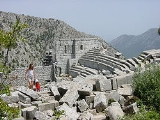
Pisidia

Encyclopedia
Pisidia was a region of ancient Asia Minor
located north of Lycia
, and bordering Caria
, Lydia
, Phrygia
and Pamphylia
. It corresponds roughly to the modern-day province of Antalya
in Turkey
. Among Pisidia's settlements were Termessus, Selge, Cremna, Sagalassos
, Etenna, Antiochia
, Neapolis
, Tyriacum, Laodiceia Katakekaumene
and Philomelium
.
on the map, the warm climate of the south cannot pass the height of the Taurus Mountains
. Owing to the climate, there is no timberland but crop plants grow in areas provided with water from the mountains, whose annual average rainfall is c. 1000 mm on the peaks and 500 mm on the slopes. This water feeds the plateau. The Pisidian cities, mostly founded on the slopes, benefited from this fertility. The irrigated soil of the land is very suitable for growing fruit and for husbandry.
age, with some settlements known from historical times ranging in age from the eighth to third millennium BC. The ancestors of the classical Pisidians were likely present in the region before the 14th century BC, when Hittite
records refer to a mountain site of Salawassa, identified with the later site of Sagalassos. At that time, Pisidia appears to have been part of the region the Hittites called Arzawa
. The Pisidian language is poorly known, but is assumed to be a member of the Anatolian
branch of Indo-European languages
.
Herodotus
mentioned the Pisidic people in the text which they were called "Lakuna" but this was one of the names given to Pisidic tribes, which occupied a little mountainous region north to the Antalya Bay. Pisidians are known to be among the nations which helped the Persians in their war against Greece. http://indoeuro.bizland.com/tree/anat/pisidic.html
There can be little doubt that the Pisidians and Pamphylians were the same people, but the distinction between the two seems to have been established at an early period. Herodotus
, who does not mention the Pisidians, enumerates the Pamphylians among the nations of Asia Minor, while Ephorus
mentions them both, correctly including the one among the nations on the interior, the other among those of the coast. Pamphylia early received colonies from Greece
and other lands, and from this cause, combined with the greater fertility of their territory, became more civilized than its neighbor in the interior. Pisidia remained a wild, mountainous region, and one of the most difficult for outside powers to rule.
As far back as the Hittite period, Pisidia was host to independent communities not under the Hittite yoke. Known for its warlike factions, it remained largely independent of the Lydians
, and even the Persians, who conquered Anatolia
in the 6th century BC, and divided the area into satrapies
for greater control, were unable to cope with constant uprisings and turmoil.
defied him. After Alexander died, the region became part of territories of Antigonus Monophthalmus, and possibly Lysimachus of Thrace, after which Seleucus I Nicator
, founder of the Seleucid Dynasty of Syria
, took control of Pisidia. Under the Selucids Greek colonies were founded at strategically important places and the local people Hellenised
. Even so, the Hellenistic kings were never in complete control, in part because Anatolia
was contested between the Selucids, the Attalids of Pergamon
, and the Galatia
ns, invading Celts from Europe
. The cities in Pisidia were among the last in western Anatolia to fully adopt Greek culture and to coin their own money.
Pisidia officially passed from the Selucids to the Attalids as a result of the Treaty of Apamea
, forced on Antiochos III of Syria by the Romans
in 188 BC. After Attalos III, the last king of Pergamon, bequeathed his kingdom to Rome in 133 BC as the province of Asia, Pisidia was given to the Kingdom of Cappadocia
, which proved unable to govern it. The Pisidians cast their lot with pirate-dominated Cilicia
and Pamphylia until Roman rule was restored in 102 BC.
In 39 BC Marcus Antonius
entrusted Pisidia to the Galatian client king Amyntas
and charged him with putting down the bandit Homonadesians of the Taurus Mountains, who threatened the roads connecting Pisidia to Pamphylia. After Amyntas was killed in the struggle 25 BC, Rome made Pisidia part of the new province of Galatia. The Homonadesians were finally wiped out in 3 BC.
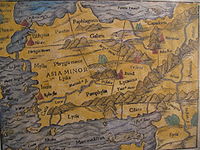 During the Roman period Pisidia was colonized the area with veterans of its legions
to maintain control. For the colonists, who came from poorer parts of Italy
, agriculture must have been the area’s main attraction. Under Augustus
, eight colonies were established in Pisidia, and Antioch and Sagalassos became the most important urban centers. The province was gradually Latinised. Latin remained the formal language of the area until the end of the 3rd century.
Pisidia was important in the early spread of Christianity
. St. Paul
visited Antioch
on each of his missionary journeys, helping to make it a center of the new faith in Anatolia. After the Emperor Constantine's legalization of Christianity in 311 it played an important role as a metropolitan city. Afterwards it became the capital city of the Christian Pisidian Province, founded in the 4th century; Parlais
became its titular see
. Most Pisidian cities were heavily fortified at that time due to civil wars and foreign invasions.
The area was devastated by earthquake
in 518, a plague around 541-543, and another earthquake and Arab raids in the middle of the 7th century. After the Muslim
conquest of Syria
disrupted trade routes, the area declined in importance. In the 8th century the raids increased. In the 11th century the Seljuk Turks captured the area and founded the Seljuk Sultanate
in Central Anatolia. Pisidia constantly changed hands between the Eastern Roman Empire and the Turks until 1176, when the Great Sultan Kılıçarslan
defeated Manuel Commenos in the Myriokephalon (thousand heads), which ended Roman rule and cemented Turkish rule of the area.
Asia Minor
Asia Minor is a geographical location at the westernmost protrusion of Asia, also called Anatolia, and corresponds to the western two thirds of the Asian part of Turkey...
located north of Lycia
Lycia
Lycia Lycian: Trm̃mis; ) was a region in Anatolia in what are now the provinces of Antalya and Muğla on the southern coast of Turkey. It was a federation of ancient cities in the region and later a province of the Roman Empire...
, and bordering Caria
Caria
Caria was a region of western Anatolia extending along the coast from mid-Ionia south to Lycia and east to Phrygia. The Ionian and Dorian Greeks colonized the west of it and joined the Carian population in forming Greek-dominated states there...
, Lydia
Lydia
Lydia was an Iron Age kingdom of western Asia Minor located generally east of ancient Ionia in the modern Turkish provinces of Manisa and inland İzmir. Its population spoke an Anatolian language known as Lydian....
, Phrygia
Phrygia
In antiquity, Phrygia was a kingdom in the west central part of Anatolia, in what is now modern-day Turkey. The Phrygians initially lived in the southern Balkans; according to Herodotus, under the name of Bryges , changing it to Phruges after their final migration to Anatolia, via the...
and Pamphylia
Pamphylia
In ancient geography, Pamphylia was the region in the south of Asia Minor, between Lycia and Cilicia, extending from the Mediterranean to Mount Taurus . It was bounded on the north by Pisidia and was therefore a country of small extent, having a coast-line of only about 75 miles with a breadth of...
. It corresponds roughly to the modern-day province of Antalya
Antalya
Antalya is a city on the Mediterranean coast of southwestern Turkey. With a population 1,001,318 as of 2010. It is the eighth most populous city in Turkey and country's biggest international sea resort.- History :...
in Turkey
Turkey
Turkey , known officially as the Republic of Turkey , is a Eurasian country located in Western Asia and in East Thrace in Southeastern Europe...
. Among Pisidia's settlements were Termessus, Selge, Cremna, Sagalassos
Sagalassos
Sagalassos is an archaeological site in southwestern Turkey, about 100 km north of Antalya , and 30 km from Burdur and Isparta...
, Etenna, Antiochia
Antioch, Pisidia
Antioch in Pisidia – alternatively Antiochia in Pisidia or Pisidian Antioch and in Roman Empire, Latin: Antiochia Caesareia or Antiochia Caesaria – is a city in the Turkish Lakes Region, which is at the crossroads of the Mediterranean, Aegean and Central Anatolian regions, and formerly...
, Neapolis
Neapolis, Pisidia
Neapolis is an ancient town in Pisidia, a few miles south of Antioch. Pliny mentions it as a town of the Roman province of Galatia, which embraced a portion of Pisidia. Franz identifies its site with Tutinek, where some ancient remains still exist.-References:*Smith, William ; Dictionary of Greek...
, Tyriacum, Laodiceia Katakekaumene
Laodicea Combusta
Laodicea or Laodicea Combusta – ), also transliterated as Laodiceia or Laodikeia; also Laodikeia Katakekaumenê and Λαοδίκεια Κεκαυμένη; later Claudiolaodicea – was a Hellenistic city in central Anatolia, in the region of Pisidia; its site is currently occupied by Ladik, Konya Province,...
and Philomelium
Aksehir
Akşehir is a town and district of Konya Province in the Central Anatolia region of Turkey. According to 2000 census, population of the district is 114,918 of which 63,000 live in the town of Akşehir...
.
Geography
Although close to Mediterranean SeaMediterranean Sea
The Mediterranean Sea is a sea connected to the Atlantic Ocean surrounded by the Mediterranean region and almost completely enclosed by land: on the north by Anatolia and Europe, on the south by North Africa, and on the east by the Levant...
on the map, the warm climate of the south cannot pass the height of the Taurus Mountains
Taurus Mountains
Taurus Mountains are a mountain complex in southern Turkey, dividing the Mediterranean coastal region of southern Turkey from the central Anatolian Plateau. The system extends along a curve from Lake Eğirdir in the west to the upper reaches of the Euphrates and Tigris rivers in the east...
. Owing to the climate, there is no timberland but crop plants grow in areas provided with water from the mountains, whose annual average rainfall is c. 1000 mm on the peaks and 500 mm on the slopes. This water feeds the plateau. The Pisidian cities, mostly founded on the slopes, benefited from this fertility. The irrigated soil of the land is very suitable for growing fruit and for husbandry.
Early history
The area of Pisidia has been inhabited since the PaleolithicPaleolithic
The Paleolithic Age, Era or Period, is a prehistoric period of human history distinguished by the development of the most primitive stone tools discovered , and covers roughly 99% of human technological prehistory...
age, with some settlements known from historical times ranging in age from the eighth to third millennium BC. The ancestors of the classical Pisidians were likely present in the region before the 14th century BC, when Hittite
Hittites
The Hittites were a Bronze Age people of Anatolia.They established a kingdom centered at Hattusa in north-central Anatolia c. the 18th century BC. The Hittite empire reached its height c...
records refer to a mountain site of Salawassa, identified with the later site of Sagalassos. At that time, Pisidia appears to have been part of the region the Hittites called Arzawa
Arzawa
Arzawa in the second half of the second millennium BC was the name of a region and a political entity in Western Anatolia, the core area of which was centered on the Hermos and Maeander river valleys, corresponding with the Late Bronze Age kingdoms of the...
. The Pisidian language is poorly known, but is assumed to be a member of the Anatolian
Anatolian languages
The Anatolian languages comprise a group of extinct Indo-European languages that were spoken in Asia Minor, the best attested of them being the Hittite language.-Origins:...
branch of Indo-European languages
Indo-European languages
The Indo-European languages are a family of several hundred related languages and dialects, including most major current languages of Europe, the Iranian plateau, and South Asia and also historically predominant in Anatolia...
.
Herodotus
Herodotus
Herodotus was an ancient Greek historian who was born in Halicarnassus, Caria and lived in the 5th century BC . He has been called the "Father of History", and was the first historian known to collect his materials systematically, test their accuracy to a certain extent and arrange them in a...
mentioned the Pisidic people in the text which they were called "Lakuna" but this was one of the names given to Pisidic tribes, which occupied a little mountainous region north to the Antalya Bay. Pisidians are known to be among the nations which helped the Persians in their war against Greece. http://indoeuro.bizland.com/tree/anat/pisidic.html
There can be little doubt that the Pisidians and Pamphylians were the same people, but the distinction between the two seems to have been established at an early period. Herodotus
Herodotus
Herodotus was an ancient Greek historian who was born in Halicarnassus, Caria and lived in the 5th century BC . He has been called the "Father of History", and was the first historian known to collect his materials systematically, test their accuracy to a certain extent and arrange them in a...
, who does not mention the Pisidians, enumerates the Pamphylians among the nations of Asia Minor, while Ephorus
Ephorus
Ephorus or Ephoros , of Cyme in Aeolia, in Asia Minor, was an ancient Greek historian. Information on his biography is limited; he was the father of Demophilus, who followed in his footsteps as a historian, and to Plutarch's claim that Ephorus declined Alexander the Great's offer to join him on his...
mentions them both, correctly including the one among the nations on the interior, the other among those of the coast. Pamphylia early received colonies from Greece
Greece
Greece , officially the Hellenic Republic , and historically Hellas or the Republic of Greece in English, is a country in southeastern Europe....
and other lands, and from this cause, combined with the greater fertility of their territory, became more civilized than its neighbor in the interior. Pisidia remained a wild, mountainous region, and one of the most difficult for outside powers to rule.
As far back as the Hittite period, Pisidia was host to independent communities not under the Hittite yoke. Known for its warlike factions, it remained largely independent of the Lydians
Lydians
The Lydians were the inhabitants of Lydia, a region in western Anatolia, who spoke the distinctive Lydian language, an Indo-European language of the Anatolian group....
, and even the Persians, who conquered Anatolia
Anatolia
Anatolia is a geographic and historical term denoting the westernmost protrusion of Asia, comprising the majority of the Republic of Turkey...
in the 6th century BC, and divided the area into satrapies
Satrap
Satrap was the name given to the governors of the provinces of the ancient Median and Achaemenid Empires and in several of their successors, such as the Sassanid Empire and the Hellenistic empires....
for greater control, were unable to cope with constant uprisings and turmoil.
Hellenistic period
Alexander the Great had somewhat better fortune, conquering Sagalassos on his way to Persia, though the city of TermessosTermessos
Termessos or Thermessos was a Pisidian city built at an altitude of more than 1000 meters at the south-west side of the mountain Solymos in the Taurus Mountains . It lies 30 kilometres to the north-west of Antalya...
defied him. After Alexander died, the region became part of territories of Antigonus Monophthalmus, and possibly Lysimachus of Thrace, after which Seleucus I Nicator
Seleucus I Nicator
Seleucus I was a Macedonian officer of Alexander the Great and one of the Diadochi. In the Wars of the Diadochi that took place after Alexander's death, Seleucus established the Seleucid dynasty and the Seleucid Empire...
, founder of the Seleucid Dynasty of Syria
Syria
Syria , officially the Syrian Arab Republic , is a country in Western Asia, bordering Lebanon and the Mediterranean Sea to the West, Turkey to the north, Iraq to the east, Jordan to the south, and Israel to the southwest....
, took control of Pisidia. Under the Selucids Greek colonies were founded at strategically important places and the local people Hellenised
Hellenization
Hellenization is a term used to describe the spread of ancient Greek culture, and, to a lesser extent, language. It is mainly used to describe the spread of Hellenistic civilization during the Hellenistic period following the campaigns of Alexander the Great of Macedon...
. Even so, the Hellenistic kings were never in complete control, in part because Anatolia
Anatolia
Anatolia is a geographic and historical term denoting the westernmost protrusion of Asia, comprising the majority of the Republic of Turkey...
was contested between the Selucids, the Attalids of Pergamon
Pergamon
Pergamon , or Pergamum, was an ancient Greek city in modern-day Turkey, in Mysia, today located from the Aegean Sea on a promontory on the north side of the river Caicus , that became the capital of the Kingdom of Pergamon during the Hellenistic period, under the Attalid dynasty, 281–133 BC...
, and the Galatia
Galatia
Ancient Galatia was an area in the highlands of central Anatolia in modern Turkey. Galatia was named for the immigrant Gauls from Thrace , who settled here and became its ruling caste in the 3rd century BC, following the Gallic invasion of the Balkans in 279 BC. It has been called the "Gallia" of...
ns, invading Celts from Europe
Europe
Europe is, by convention, one of the world's seven continents. Comprising the westernmost peninsula of Eurasia, Europe is generally 'divided' from Asia to its east by the watershed divides of the Ural and Caucasus Mountains, the Ural River, the Caspian and Black Seas, and the waterways connecting...
. The cities in Pisidia were among the last in western Anatolia to fully adopt Greek culture and to coin their own money.
Pisidia officially passed from the Selucids to the Attalids as a result of the Treaty of Apamea
Treaty of Apamea
The Treaty of Apamea of 188 BC, was peace treaty between the Roman Republic and Antiochus III , ruler of the Seleucid Empire. It took place after the Romans' victories in the battle of Thermopylae , in the Battle of Magnesia , and after Roman and Rhodian naval victories over the Seleucid navy.In...
, forced on Antiochos III of Syria by the Romans
Ancient Rome
Ancient Rome was a thriving civilization that grew on the Italian Peninsula as early as the 8th century BC. Located along the Mediterranean Sea and centered on the city of Rome, it expanded to one of the largest empires in the ancient world....
in 188 BC. After Attalos III, the last king of Pergamon, bequeathed his kingdom to Rome in 133 BC as the province of Asia, Pisidia was given to the Kingdom of Cappadocia
Cappadocia
Cappadocia is a historical region in Central Anatolia, largely in Nevşehir Province.In the time of Herodotus, the Cappadocians were reported as occupying the whole region from Mount Taurus to the vicinity of the Euxine...
, which proved unable to govern it. The Pisidians cast their lot with pirate-dominated Cilicia
Cilicia
In antiquity, Cilicia was the south coastal region of Asia Minor, south of the central Anatolian plateau. It existed as a political entity from Hittite times into the Byzantine empire...
and Pamphylia until Roman rule was restored in 102 BC.
In 39 BC Marcus Antonius
Mark Antony
Marcus Antonius , known in English as Mark Antony, was a Roman politician and general. As a military commander and administrator, he was an important supporter and loyal friend of his mother's cousin Julius Caesar...
entrusted Pisidia to the Galatian client king Amyntas
Amyntas
-External links:*...
and charged him with putting down the bandit Homonadesians of the Taurus Mountains, who threatened the roads connecting Pisidia to Pamphylia. After Amyntas was killed in the struggle 25 BC, Rome made Pisidia part of the new province of Galatia. The Homonadesians were finally wiped out in 3 BC.
Roman and Byzantine period
Roman legion
A Roman legion normally indicates the basic ancient Roman army unit recruited specifically from Roman citizens. The organization of legions varied greatly over time but they were typically composed of perhaps 5,000 soldiers, divided into maniples and later into "cohorts"...
to maintain control. For the colonists, who came from poorer parts of Italy
Italy
Italy , officially the Italian Republic languages]] under the European Charter for Regional or Minority Languages. In each of these, Italy's official name is as follows:;;;;;;;;), is a unitary parliamentary republic in South-Central Europe. To the north it borders France, Switzerland, Austria and...
, agriculture must have been the area’s main attraction. Under Augustus
Augustus
Augustus ;23 September 63 BC – 19 August AD 14) is considered the first emperor of the Roman Empire, which he ruled alone from 27 BC until his death in 14 AD.The dates of his rule are contemporary dates; Augustus lived under two calendars, the Roman Republican until 45 BC, and the Julian...
, eight colonies were established in Pisidia, and Antioch and Sagalassos became the most important urban centers. The province was gradually Latinised. Latin remained the formal language of the area until the end of the 3rd century.
Pisidia was important in the early spread of Christianity
Christianity
Christianity is a monotheistic religion based on the life and teachings of Jesus as presented in canonical gospels and other New Testament writings...
. St. Paul
Paul of Tarsus
Paul the Apostle , also known as Saul of Tarsus, is described in the Christian New Testament as one of the most influential early Christian missionaries, with the writings ascribed to him by the church forming a considerable portion of the New Testament...
visited Antioch
Antioch, Pisidia
Antioch in Pisidia – alternatively Antiochia in Pisidia or Pisidian Antioch and in Roman Empire, Latin: Antiochia Caesareia or Antiochia Caesaria – is a city in the Turkish Lakes Region, which is at the crossroads of the Mediterranean, Aegean and Central Anatolian regions, and formerly...
on each of his missionary journeys, helping to make it a center of the new faith in Anatolia. After the Emperor Constantine's legalization of Christianity in 311 it played an important role as a metropolitan city. Afterwards it became the capital city of the Christian Pisidian Province, founded in the 4th century; Parlais
Parlais
-History:As a Roman colony it was called Julia Augusta Parlais, and money was coined under this title. Ptolemy calls it Paralais and places it in Lycaonia . Kiepert identified it with Barla, in the Ottoman vilayet of Koniah, but W. M...
became its titular see
Titular see
A titular see in various churches is an episcopal see of a former diocese that no longer functions, sometimes called a "dead diocese". The ordinary or hierarch of such a see may be styled a "titular bishop", "titular metropolitan", or "titular archbishop"....
. Most Pisidian cities were heavily fortified at that time due to civil wars and foreign invasions.
The area was devastated by earthquake
Earthquake
An earthquake is the result of a sudden release of energy in the Earth's crust that creates seismic waves. The seismicity, seismism or seismic activity of an area refers to the frequency, type and size of earthquakes experienced over a period of time...
in 518, a plague around 541-543, and another earthquake and Arab raids in the middle of the 7th century. After the Muslim
Muslim
A Muslim, also spelled Moslem, is an adherent of Islam, a monotheistic, Abrahamic religion based on the Quran, which Muslims consider the verbatim word of God as revealed to prophet Muhammad. "Muslim" is the Arabic term for "submitter" .Muslims believe that God is one and incomparable...
conquest of Syria
Syria
Syria , officially the Syrian Arab Republic , is a country in Western Asia, bordering Lebanon and the Mediterranean Sea to the West, Turkey to the north, Iraq to the east, Jordan to the south, and Israel to the southwest....
disrupted trade routes, the area declined in importance. In the 8th century the raids increased. In the 11th century the Seljuk Turks captured the area and founded the Seljuk Sultanate
Sultanate of Rûm
The Sultanate of Rum , also known as the Anatolian Seljuk State , was a Turkic state centered in in Anatolia, with capitals first at İznik and then at Konya. Since the court of the sultanate was highly mobile, cities like Kayseri and Sivas also functioned at times as capitals...
in Central Anatolia. Pisidia constantly changed hands between the Eastern Roman Empire and the Turks until 1176, when the Great Sultan Kılıçarslan
Kilij Arslan II
Kilij Arslan II was a Seljuk Sultan of Rûm from 1156 until his death in 1192.As Arnold of Lübeck reports in his Chronica Slavorum, he was present at the meeting of Henry the Lion with Kilij-Arslan during the former's pilgrimage to Jerusalem in 1172...
defeated Manuel Commenos in the Myriokephalon (thousand heads), which ended Roman rule and cemented Turkish rule of the area.
External links
- Termessos on the Web, comprehensive guide to the striking Pisidian city
- Sagalassos on the Web, comprehensive guide to the striking Pisidian city
- Termessos Guide and Photo Album
- Sagalassos Guide and Photo Album
- Ancient Sagalassos: Pride of Pisidia
- Beyaz Arif Akbas: "Sagalassos: City of Fairies", Adrianapolis, Yalnizgoz Yay. 2010, ISBN 978-1-4536-1300-9. http://en.calameo.com/read/0002983841c7acaa28dc8