

Smyrna

Encyclopedia
Smyrna was an ancient city located at a central and strategic point on the Aegean
coast of Anatolia
. Thanks to its advantageous port conditions, its ease of defence and its good inland connections, Smyrna rose to prominence. The ancient city is located at two sites within modern İzmir
, Turkey. The first site, probably founded indigenously, rose to prominence during the Archaic Period
as one of the principal ancient Greek settlements in western Anatolia. The second, whose foundation is associated with Alexander the Great, reached metropolitan proportions during the period of the Roman Empire
. Most of the present-day remains date from the Roman era, the majority from after a 2nd century AD earthquake.
In practical terms, a distinction is often made between Old Smyrna, the initial settlement founded around the 11th century BC, first as an Aeolian
settlement, and later taken over and developed during the Archaic Period by the Ionians
, and Smyrna proper, the new city moved into from the older one as of the 4th century BC and whose foundation was inspired, and perhaps also initiated, by Alexander the Great. Old Smyrna was located on a small peninsula connected to the mainland by a narrow isthmus at the northeastern corner of the inner Gulf of İzmir
, at the edge of a fertile plain and at the foot of Mount Yamanlar which had seen the earlier Anatolian settlement commanding the gulf. New Smyrna developed simultaneously on the slopes of the Mount Pagos (Kadifekale
today) and alongside the coastal strait immediately below where a small bay existed until the 18th century. The core of the late Hellenistic and early Roman
Smyrna forms today the large area of İzmir Agora Open Air Museum at this site. Research is being pursued at the sites of both the old and the new cities in a continuous manner and in a regionalized structure, since 1997 for Old Smyrna and since 2002 for the Classical Period city, in collaboration between İzmir Archaeology Museum and the Metropolitan Municipality of İzmir.
There are several explanations brought forth as regards its name. One of these involve a Greek myth derived from an eponym
ous Amazon
named "Σμύρνα" (Smyrna), which was also the name of a quarter
of Ephesus
, and can also be recognized under the form Myrina
, a city of Aeolis
. In inscriptions and coins it is often written "Ζμύρνα" (Zmurna), "Ζμυρναῖος" (Zmurnaios), "of Smyrna". Smyrna is also an ancient Greek
word for myrrh
.
suggests. It could have been a city of the autochthonous Leleges
before the Greek colonists started to settle along the coast of Asia Minor
as of the beginning of the first millennium BC. Throughout antiquity Smyrna was a leading city-state of Ionia
, with influence over the Aegean shores and islands. Smyrna was also among the cities that claimed Homer
as a resident.
The early Aeolian
Greek settlers of Lesbos
and Cyme
, expanding eastwards, occupied the valley of Smyrna. It was one of the confederacy of Aeolian city-states, marking the Aeolian frontier with the Ionian colonies.
Strangers or refugees from the Ionian city of Colophon settled in the city and finally (traditionally in 688 BC) by an uprising Smyrna passed into their hands and became the thirteenth of the Ionian city-state
s. Revised mythologies made it a colony of Ephesus. In 688 BC, the Ionian boxer Onomastus of Smyrna won the prize at Olympia, but the coup was probably then a recent event. The Colophonian conquest is mentioned by Mimnermus (before 600 BC), who counts himself equally of Colophon and of Smyrna. The Aeolic form of the name was retained even in the Attic dialect
, and the epithet
"Aeolian Smyrna" remained current long after the conquest.
Smyrna's position at the mouth of the small river Hermus
at the head of a deep arm of the sea (Smyrnaeus Sinus) that reached far inland and admitted Greek trading ships into the heart of Lydia
, placed it on an essential trade route between Anatolia and the Aegean and raised Smyrna during the 7th century BC to power and splendor. One of the great trade routes which cross Anatolia descends the Hermus valley past Sardis
, and then, diverging from the valley, passes south of Mount Sipylus
and crosses a low pass into the little valley where Smyrna lies between the mountains and the sea. Miletus
and later Ephesus were situated at the sea end of the other great trade route across Anatolia and competed for a time successfully with Smyrna; but after both cities' harbors silted up, Smyrna remained without a rival.
The Meles River
, which flowed by Smyrna, is famous in literature and was worshiped in the valley. A common and consistent tradition connects Homer
with the valley of Smyrna and the banks of the Meles; his figure was one of the stock types on coins of Smyrna, one class of which numismatists call "Homerian"; the epithet Melesigenes was applied to him; the cave where he was wont to compose his poems was shown near the source of the river; his temple, the Homereum, stood on its banks. The steady equable flow of the Meles, alike in summer and winter, and its short course, beginning and ending near the city, are celebrated by Aristides
and Himerius. The description applies admirably to the stream which rises from abundant springs east of the city and flows into the southeast extremity of the gulf.
The archaic city ("Old Smyrna") contained a temple of Athena
from the 7th century BC.
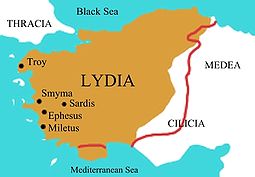 When the Mermnad kings raised the Lydian power and aggressiveness, Smyrna was one of the first points of attack. Gyges
(ca. 687—652 BC) was, however, defeated on the banks of the Hermus, the situation of the battlefield showing that the power of Smyrna extended far to the east. A strong fortress was built probably by the Smyrnaean Ionians to command the valley of Nymphi, the ruins
of which are still imposing, on a hill in the pass between Smyrna and Nymphi. According to Theognis
(c. 500 BC), it was pride that destroyed Smyrna. Mimnermus
laments the degeneracy of the citizens of his day, who could no longer stem the Lydian advance. Finally, Alyattes II
(609—560 BC) conquered the city and sacked it, and though Smyrna did not cease to exist, the Greek life and political unity were destroyed, and the polis
was reorganized on the village system. Smyrna is mentioned in a fragment of Pindar and in an inscription of 388 BC, but its greatness was past.
, actually carried out under Antigonus (316—301 BC) and Lysimachus (301 BC—281 BC), who enlarged and fortified the city. The ruined acropolis of the ancient city, the "crown of Smyrna", had been on a steep peak about 1250 feet high, which overhangs the northeast extremity of the gulf. Modern İzmir was constructed atop the later Hellenistic city, partly on the slopes of a rounded hill the Greeks called Pagos near the southeast end of the gulf, and partly on the low ground between the hill and the sea. The beauty of the Hellenistic city, clustering on the low ground and rising tier over tier on the hillside, was frequently praised by the ancients and is celebrated on its coins.
Smyrna is shut in on the west by a hill now called Deirmen Tepe, with the ruins of a temple on the summit. The walls of Lysimachus crossed the summit of this hill, and the acropolis occupied the top of Pagus. Between the two the road from Ephesus entered the city by the Ephesian gate, near which was a gymnasium. Closer to the acropolis the outline of the stadium is still visible, and the theatre was situated on the north slopes of Pagus. Smyrna possessed two harbours. The outer harbour was simply the open roadstead of the gulf, and the inner was a small basin with a narrow entrance partially filled up by Tamerlane in 1402 AD.
The streets were broad, well paved and laid out at right angles; many were named after temples: the main street, called the Golden, ran across the city from west to east, beginning probably from the temple of Zeus Akraios on the west slope of Pagus, and running round the lower slopes of Pagus (like a necklace on the statue, to use the favorite terms of Aristides the orator) towards Tepecik outside the city on the east, where probably stood the temple of Cybele
, worshipped under the name of Meter Sipylene, the patroness of the city. (name deriving from the nearby Mount Sipylus, which bounds the valley of the city's backlands). The plain towards the sea was too low to be properly drained, and hence in rainy weather the streets of the lower town were deep with mud and water.
At the end of the Hellenistic period, in 197 BC, the city suddenly cut its ties with King Eumenes of Pergamum and instead appealed to Rome for help. Because Rome and Smyrna had had no ties until then, Smyrna created a cult of Rome to establish a bond, and the cult eventually became widespread through the whole Roman Empire. As of 195 BC, the city of Rome started to be deified, in the cult to the goddess Roma
. In this sense, the Smyrneans can be considered as the creators of the goddess Roma.
In 133 BC, when the last Attalid king Eumenes III died without an heir, his will conferred his entire kingdom, including Smyrna, to the Romans. They organized it into the Roman province of Asia, making Pergamum the capital. Smyrna, however, as a major seaport, became a leading city in the newly constituted province.
A Christian church existed here from a very early time, probably originating in the considerable Jewish colony. It was one of the seven churches
addressed in the Book of Revelation
. Saint Ignatius of Antioch
visited Smyrna and later wrote letters to its bishop, Polycarp
. A mob of Jews and pagans abetted the martyrdom of Polycarp in AD 153. Saint Irenaeus
, who heard Polycarp as a boy, was probably a native of Smyrna. Another famous resident of the same period was Aelius Aristides
.
Polycrates reports a succession of bishops including Polycarp of Smryna, as well as others in nearby cities such as Melito of Sardis. Related to that time the German historian W. Bauer wrote:
In the late 2nd century, Irenaeus
also noted:
Tertullian
wrote c. 208 AD.
Hence, apparently the church in Smyrna was one of only two that Tertullian felt could have had some type of apostolic succession. During the mid-3rd century, however, changes occurred in Asia Minor, and most there became affiliated with the Greco-Roman churches.
When Constantinople
became the seat of government, the trade between Anatolia and the West diminished in importance, and Smyrna declined. The Seljuk commander Tzachas seized Smyrna in 1084 and used it as a base for naval raids, but the city was recovered by the generals of Alexios I Komnenos
. The city was several times ravaged by the Turks
, and had become quite ruinous when the emperor John Ducas Vatatzes about 1222 rebuilt it.
 Ibn Batuta found it still in great part a ruin when the homonymous chieftain of the Beylik
of Aydın had conquered it about 1330 and made his son Umur governor. It became the port of the emirate. Soon afterwards the Knights of Saint John established themselves in the town but failed to conquer the citadel. In 1402, Tamerlane
stormed the town and massacred almost all the inhabitants. The Mongol conquest was only temporary, but Smyrna was recovered by the Turks under the Aydın dynasty after which it became Ottoman
, when the Ottomans took over the lands of Aydın.
Greek influence was so strong in the area that the Turks called it "Smyrna of the infidels" (Gavur İzmir). While Turkish sources track the emergence of the term to the 14th century when two separate parts of the city were controlled by two different powers, the upper İzmir being Muslim and the lower part of the city Christian.
The Ottomans continued to control the area, with the exception of the 1919–1922 period, when the city was assigned to Greece by the Treaty of Sèvres
.
During the late 19th and early 20th century, the city was an important financial and cultural center of the Greek world. Out of the 391 factories 322 belonged to local Greeks, while 3 out of the 9 banks were backed by Greek capital. Education was also dominated by the local Greek communities with 67 male and 4 female schools in total. The most important Greek educational institution of the region was the Evangelical School
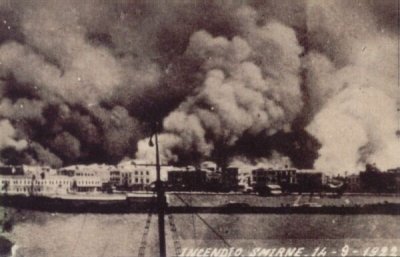
that operated from 1733 to 1922. The Great Fire of Smyrna
destroyed much of the city just after the conflict.
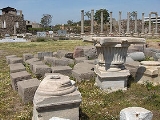
of Smyrna constitute today the space of İzmir Agora Museum in İzmir's Namazgah quarter, although its area is commonly referred to as "Agora" by the city's inhabitants.
Situated on the northern slopes of the Pagos hills, it was the commercial, judicial and political nucleus of the ancient city, its center for artistic activities and for teaching.
İzmir Agora Open Air Museum consists of five parts, including the agora area, the base of the northern basilica
gate, the stoa and the ancient shopping centre.
The agora of Smyrna was built during the Hellenistic era. After a destructive earthquake in 178 AD, Smyrna was rebuilt in the Roman period (2nd century AD) under the emperor Marcus Aurelius, according to an urban plan drawn by Hippodamos. The bust of the emperor's wife Faustina
on the second arch of the western stoa confirms this fact.
It was constructed on a sloping terrain in three floors, close to the city center. The terrain is 165 m wide and 200 m long. It is bordered on all sides by portico
s. Because a Byzantine
and later an Ottoman
cemetery were located over the ruins of the agora, it was preserved from modern constructions. This agora is now the largest and the best preserved among Ionian
agoras. The agora is now surrounded by modern buildings that still cover its eastern and southern parts.
The agora was used until the Byzantine period.
On entering the courtyard, to the left is the western stoa
, in the back the basilica
and on the right side the Ottoman cemetery. The courtyard was surrounded by porticoes on three sides. The basilica and the western portico were built over an infrastructure of basements with round arches to protect them against future earthquakes. The eastern end and the southern porticoes consisted of a two-floor compounded structure. Beneath the basilica was a covered market place. The design of the basement has a strong resemblance with the crypto-porticus constructions of the western provinces.
The monumental entrance at the eastern side was one of the most magnificent and arched structures of the Hellenistic era.
A two-storied stoa, 17.5 m wide, was constructed at the eastern and western side of the agora. Each stoa was divided in three galleries by two rows of columns. Each stoa had an upper story. The stoas were protected from sun and rain by a roof. These impressive structures measured 75 m by 18 m. The southern part of the western stoa has many water channels and large water reservoirs, pointing to the presence of water in the agora.
, the director of İzmir and Ephesus museums. They uncovered a three-floor, rectangular compound with stairs in the front, built on columns and arches around a large courtyard in the middle of the building.
New excavations in the agora began in 1996 and are being continued regularly since 2002 under the sponsorship of the Metropolitan Municipality of İzmir. A primary school that was adjacent to agora and that fell victim to a fire in 1980 not having been reconstructed, its space could be incorporated into the historical site. This meant that not only could the area of agora be increased to 16,590 square metres but also new digs could be launched in a previously unexplored zone. The archaeologists and the local authorities, means permitting, are also keenly eyeing a neighbouring multi-storey car park, which is known to cover an important part of the ancient settlement. During the present renovations the old restorations in concrete are gradually being replaced by marble.
The most important result of the new studies has been the discovery of the agora's northern gate. It has been concluded that embossed figures of the goddess Hestia
found in these digs were a continuation of the Zeus
altar
uncovered during the first digs. Statues of the gods Hermes
, Dionysos, Eros and Heracles
have also been found, as well as many statues, heads, embossments, figurines and monuments of people and animals, made of marble, stone, bone, glass, metal and terracotta. Inscriptions found here list the people who provided aid to Smyrna after the earthquake of 178 AD.
; Smyrna, Tennessee
; Smyrna, Delaware
and New Smyrna Beach, Florida
.
Aegean Sea
The Aegean Sea[p] is an elongated embayment of the Mediterranean Sea located between the southern Balkan and Anatolian peninsulas, i.e., between the mainlands of Greece and Turkey. In the north, it is connected to the Marmara Sea and Black Sea by the Dardanelles and Bosporus...
coast of Anatolia
Anatolia
Anatolia is a geographic and historical term denoting the westernmost protrusion of Asia, comprising the majority of the Republic of Turkey...
. Thanks to its advantageous port conditions, its ease of defence and its good inland connections, Smyrna rose to prominence. The ancient city is located at two sites within modern İzmir
Izmir
Izmir is a large metropolis in the western extremity of Anatolia. The metropolitan area in the entire Izmir Province had a population of 3.35 million as of 2010, making the city third most populous in Turkey...
, Turkey. The first site, probably founded indigenously, rose to prominence during the Archaic Period
Archaic period in Greece
The Archaic period in Greece was a period of ancient Greek history that followed the Greek Dark Ages. This period saw the rise of the polis and the founding of colonies, as well as the first inklings of classical philosophy, theatre in the form of tragedies performed during Dionysia, and written...
as one of the principal ancient Greek settlements in western Anatolia. The second, whose foundation is associated with Alexander the Great, reached metropolitan proportions during the period of the Roman Empire
Roman Empire
The Roman Empire was the post-Republican period of the ancient Roman civilization, characterised by an autocratic form of government and large territorial holdings in Europe and around the Mediterranean....
. Most of the present-day remains date from the Roman era, the majority from after a 2nd century AD earthquake.
In practical terms, a distinction is often made between Old Smyrna, the initial settlement founded around the 11th century BC, first as an Aeolian
Aeolians
The Aeolians were one of the four major ancient Greek tribes comprising Ancient Greeks. Their name derives from Aeolus, the mythical ancestor of the Aeolic branch and son of Hellen, the mythical patriarch of the Greek nation...
settlement, and later taken over and developed during the Archaic Period by the Ionians
Ionians
The Ionians were one of the four major tribes into which the Classical Greeks considered the population of Hellenes to have been divided...
, and Smyrna proper, the new city moved into from the older one as of the 4th century BC and whose foundation was inspired, and perhaps also initiated, by Alexander the Great. Old Smyrna was located on a small peninsula connected to the mainland by a narrow isthmus at the northeastern corner of the inner Gulf of İzmir
Gulf of Izmir
The Gulf of İzmir , formerly known as the Gulf of Smyrna, is a gulf on the Aegean Sea, with its inlet between the peninsula of Karaburun and the mainland area of Foça...
, at the edge of a fertile plain and at the foot of Mount Yamanlar which had seen the earlier Anatolian settlement commanding the gulf. New Smyrna developed simultaneously on the slopes of the Mount Pagos (Kadifekale
Kadifekale
Kadifekale is the name of the hill located within the urban zone of İzmir, Turkey, as well as being the name of the ancient castle on top of the same hill....
today) and alongside the coastal strait immediately below where a small bay existed until the 18th century. The core of the late Hellenistic and early Roman
Roman Empire
The Roman Empire was the post-Republican period of the ancient Roman civilization, characterised by an autocratic form of government and large territorial holdings in Europe and around the Mediterranean....
Smyrna forms today the large area of İzmir Agora Open Air Museum at this site. Research is being pursued at the sites of both the old and the new cities in a continuous manner and in a regionalized structure, since 1997 for Old Smyrna and since 2002 for the Classical Period city, in collaboration between İzmir Archaeology Museum and the Metropolitan Municipality of İzmir.
Etymology
For full explanations on etymology of the city's name, see İzmirIzmir
Izmir is a large metropolis in the western extremity of Anatolia. The metropolitan area in the entire Izmir Province had a population of 3.35 million as of 2010, making the city third most populous in Turkey...
There are several explanations brought forth as regards its name. One of these involve a Greek myth derived from an eponym
Eponym
An eponym is the name of a person or thing, whether real or fictitious, after which a particular place, tribe, era, discovery, or other item is named or thought to be named...
ous Amazon
Amazons
The Amazons are a nation of all-female warriors in Greek mythology and Classical antiquity. Herodotus placed them in a region bordering Scythia in Sarmatia...
named "Σμύρνα" (Smyrna), which was also the name of a quarter
Quarter (country subdivision)
A quarter is a section of an urban settlement.Its borders can be administratively chosen , and it may have its own administrative structure...
of Ephesus
Ephesus
Ephesus was an ancient Greek city, and later a major Roman city, on the west coast of Asia Minor, near present-day Selçuk, Izmir Province, Turkey. It was one of the twelve cities of the Ionian League during the Classical Greek era...
, and can also be recognized under the form Myrina
Myrina (Mysia)
Myrina , was one of the Aeolian cities on the western coast of Mysia, about 40 stadia to the southwest of Gryneion. Its site is believed to be occupied by the modern Sandarlik at the mouth of the Koca Çay....
, a city of Aeolis
Aeolis
Aeolis or Aeolia was an area that comprised the west and northwestern region of Asia Minor, mostly along the coast, and also several offshore islands , where the Aeolian Greek city-states were located...
. In inscriptions and coins it is often written "Ζμύρνα" (Zmurna), "Ζμυρναῖος" (Zmurnaios), "of Smyrna". Smyrna is also an ancient Greek
Ancient Greek
Ancient Greek is the stage of the Greek language in the periods spanning the times c. 9th–6th centuries BC, , c. 5th–4th centuries BC , and the c. 3rd century BC – 6th century AD of ancient Greece and the ancient world; being predated in the 2nd millennium BC by Mycenaean Greek...
word for myrrh
Myrrh
Myrrh is the aromatic oleoresin of a number of small, thorny tree species of the genus Commiphora, which grow in dry, stony soil. An oleoresin is a natural blend of an essential oil and a resin. Myrrh resin is a natural gum....
.
Third millennium to 687 BC
The region was settled at least as of the beginning of the third millennium BC, or perhaps earlier, as the recent finds in Yeşilova HöyükYesilova Höyük
Yeşilova Höyük is a höyük in Bornova, Turkey, and is the first known settlement in prehistory in the area of İzmir. It was occupied continuously from roughly 6500 to 4000 BCE, and was covered with silt afterwards....
suggests. It could have been a city of the autochthonous Leleges
Leleges
The Leleges were one of the aboriginal peoples of southwest Anatolia , who were already there when the Indo-European Hellenes emerged. The distinction between the Leleges and the Carians is unclear. According to Homer the Leleges were a distinct Anatolian tribe Homer...
before the Greek colonists started to settle along the coast of Asia Minor
Asia Minor
Asia Minor is a geographical location at the westernmost protrusion of Asia, also called Anatolia, and corresponds to the western two thirds of the Asian part of Turkey...
as of the beginning of the first millennium BC. Throughout antiquity Smyrna was a leading city-state of Ionia
Ionia
Ionia is an ancient region of central coastal Anatolia in present-day Turkey, the region nearest İzmir, which was historically Smyrna. It consisted of the northernmost territories of the Ionian League of Greek settlements...
, with influence over the Aegean shores and islands. Smyrna was also among the cities that claimed Homer
Homer
In the Western classical tradition Homer , is the author of the Iliad and the Odyssey, and is revered as the greatest ancient Greek epic poet. These epics lie at the beginning of the Western canon of literature, and have had an enormous influence on the history of literature.When he lived is...
as a resident.
The early Aeolian
Aeolians
The Aeolians were one of the four major ancient Greek tribes comprising Ancient Greeks. Their name derives from Aeolus, the mythical ancestor of the Aeolic branch and son of Hellen, the mythical patriarch of the Greek nation...
Greek settlers of Lesbos
Lesbos Island
Lesbos is a Greek island located in the northeastern Aegean Sea. It has an area of with 320 kilometres of coastline, making it the third largest Greek island. It is separated from Turkey by the narrow Mytilini Strait....
and Cyme
Cyme (Aeolis)
Cyme was an Aeol city in Aeolis close to the kingdom of Lydia. The Aeolians regarded Cyme as the largest and most important of their twelve cities, which were located on the coastline of Asia Minor...
, expanding eastwards, occupied the valley of Smyrna. It was one of the confederacy of Aeolian city-states, marking the Aeolian frontier with the Ionian colonies.
Strangers or refugees from the Ionian city of Colophon settled in the city and finally (traditionally in 688 BC) by an uprising Smyrna passed into their hands and became the thirteenth of the Ionian city-state
City-state
A city-state is an independent or autonomous entity whose territory consists of a city which is not administered as a part of another local government.-Historical city-states:...
s. Revised mythologies made it a colony of Ephesus. In 688 BC, the Ionian boxer Onomastus of Smyrna won the prize at Olympia, but the coup was probably then a recent event. The Colophonian conquest is mentioned by Mimnermus (before 600 BC), who counts himself equally of Colophon and of Smyrna. The Aeolic form of the name was retained even in the Attic dialect
Attic Greek
Attic Greek is the prestige dialect of Ancient Greek that was spoken in Attica, which includes Athens. Of the ancient dialects, it is the most similar to later Greek, and is the standard form of the language studied in courses of "Ancient Greek". It is sometimes included in Ionic.- Origin and range...
, and the epithet
Epithet
An epithet or byname is a descriptive term accompanying or occurring in place of a name and having entered common usage. It has various shades of meaning when applied to seemingly real or fictitious people, divinities, objects, and binomial nomenclature. It is also a descriptive title...
"Aeolian Smyrna" remained current long after the conquest.
Smyrna's position at the mouth of the small river Hermus
Hermus
In Greek mythology, Hermus is a name attributed to multiple characters.-River god:Hermus is the god of the river Hermus located in the Aegean region of Lydia . Like most of the river-gods, he is the son of Oceanus and Tethys...
at the head of a deep arm of the sea (Smyrnaeus Sinus) that reached far inland and admitted Greek trading ships into the heart of Lydia
Lydia
Lydia was an Iron Age kingdom of western Asia Minor located generally east of ancient Ionia in the modern Turkish provinces of Manisa and inland İzmir. Its population spoke an Anatolian language known as Lydian....
, placed it on an essential trade route between Anatolia and the Aegean and raised Smyrna during the 7th century BC to power and splendor. One of the great trade routes which cross Anatolia descends the Hermus valley past Sardis
Sardis
Sardis or Sardes was an ancient city at the location of modern Sart in Turkey's Manisa Province...
, and then, diverging from the valley, passes south of Mount Sipylus
Mount Sipylus
Mount Spil , the ancient Mount Sipylus , is a mountain rich in legends and history in Manisa Province, Turkey, in what used to be the heartland of the Lydians and what is now Turkey's Aegean Region....
and crosses a low pass into the little valley where Smyrna lies between the mountains and the sea. Miletus
Miletus
Miletus was an ancient Greek city on the western coast of Anatolia , near the mouth of the Maeander River in ancient Caria...
and later Ephesus were situated at the sea end of the other great trade route across Anatolia and competed for a time successfully with Smyrna; but after both cities' harbors silted up, Smyrna remained without a rival.
The Meles River
Meles River
The Meleş River is a tributary of the Someşul Mare River in Romania.-References:* Administraţia Naţională Apelor Române - Cadastrul Apelor - Bucureşti* Institutul de Meteorologie şi Hidrologie - Rîurile României - Bucureşti 1971...
, which flowed by Smyrna, is famous in literature and was worshiped in the valley. A common and consistent tradition connects Homer
Homer
In the Western classical tradition Homer , is the author of the Iliad and the Odyssey, and is revered as the greatest ancient Greek epic poet. These epics lie at the beginning of the Western canon of literature, and have had an enormous influence on the history of literature.When he lived is...
with the valley of Smyrna and the banks of the Meles; his figure was one of the stock types on coins of Smyrna, one class of which numismatists call "Homerian"; the epithet Melesigenes was applied to him; the cave where he was wont to compose his poems was shown near the source of the river; his temple, the Homereum, stood on its banks. The steady equable flow of the Meles, alike in summer and winter, and its short course, beginning and ending near the city, are celebrated by Aristides
Aristides
Aristides , 530 BC – 468 BC was an Athenian statesman, nicknamed "the Just".- Biography :Aristides was the son of Lysimachus, and a member of a family of moderate fortune. Of his early life, it is only told that he became a follower of the statesman Cleisthenes and sided with the aristocratic party...
and Himerius. The description applies admirably to the stream which rises from abundant springs east of the city and flows into the southeast extremity of the gulf.
The archaic city ("Old Smyrna") contained a temple of Athena
Athena
In Greek mythology, Athena, Athenê, or Athene , also referred to as Pallas Athena/Athene , is the goddess of wisdom, courage, inspiration, civilization, warfare, strength, strategy, the arts, crafts, justice, and skill. Minerva, Athena's Roman incarnation, embodies similar attributes. Athena is...
from the 7th century BC.
Lydian period
Gyges of Lydia
Gyges was the founder of the third or Mermnad dynasty of Lydian kings and reigned from 716 BC to 678 BC . He was succeeded by his son Ardys II.-Allegorical accounts of Gyges' rise to power:...
(ca. 687—652 BC) was, however, defeated on the banks of the Hermus, the situation of the battlefield showing that the power of Smyrna extended far to the east. A strong fortress was built probably by the Smyrnaean Ionians to command the valley of Nymphi, the ruins
Ruins
Ruins are the remains of human-made architecture: structures that were once complete, as time went by, have fallen into a state of partial or complete disrepair, due to lack of maintenance or deliberate acts of destruction...
of which are still imposing, on a hill in the pass between Smyrna and Nymphi. According to Theognis
Theognis
Theognis was a member of the Thirty Tyrants of Athens . Lysias was able to escape from the house of Damnippus, where Theognis was guarding other aristocrats rounded up by the Thirty....
(c. 500 BC), it was pride that destroyed Smyrna. Mimnermus
Mimnermus
Mimnermus was a Greek elegiac poet from either Colophon or Smyrna in Ionia, who flourished about 630-600 BC. He was strongly influenced by the example of Homer yet he wrote short poems suitable for performance at drinking parties and was remembered by ancient authorities chiefly as a love poet...
laments the degeneracy of the citizens of his day, who could no longer stem the Lydian advance. Finally, Alyattes II
Alyattes II
Alyattes, king of Lydia , considered to be the founder of the Lydian empire, was the son of Sadyattes, of the house of the Mermnadae....
(609—560 BC) conquered the city and sacked it, and though Smyrna did not cease to exist, the Greek life and political unity were destroyed, and the polis
Polis
Polis , plural poleis , literally means city in Greek. It could also mean citizenship and body of citizens. In modern historiography "polis" is normally used to indicate the ancient Greek city-states, like Classical Athens and its contemporaries, so polis is often translated as "city-state."The...
was reorganized on the village system. Smyrna is mentioned in a fragment of Pindar and in an inscription of 388 BC, but its greatness was past.
Hellenistic period
Alexander the Great conceived the idea of restoring the Greek city in a scheme that was, according to StraboStrabo
Strabo, also written Strabon was a Greek historian, geographer and philosopher.-Life:Strabo was born to an affluent family from Amaseia in Pontus , a city which he said was situated the approximate equivalent of 75 km from the Black Sea...
, actually carried out under Antigonus (316—301 BC) and Lysimachus (301 BC—281 BC), who enlarged and fortified the city. The ruined acropolis of the ancient city, the "crown of Smyrna", had been on a steep peak about 1250 feet high, which overhangs the northeast extremity of the gulf. Modern İzmir was constructed atop the later Hellenistic city, partly on the slopes of a rounded hill the Greeks called Pagos near the southeast end of the gulf, and partly on the low ground between the hill and the sea. The beauty of the Hellenistic city, clustering on the low ground and rising tier over tier on the hillside, was frequently praised by the ancients and is celebrated on its coins.
Smyrna is shut in on the west by a hill now called Deirmen Tepe, with the ruins of a temple on the summit. The walls of Lysimachus crossed the summit of this hill, and the acropolis occupied the top of Pagus. Between the two the road from Ephesus entered the city by the Ephesian gate, near which was a gymnasium. Closer to the acropolis the outline of the stadium is still visible, and the theatre was situated on the north slopes of Pagus. Smyrna possessed two harbours. The outer harbour was simply the open roadstead of the gulf, and the inner was a small basin with a narrow entrance partially filled up by Tamerlane in 1402 AD.
The streets were broad, well paved and laid out at right angles; many were named after temples: the main street, called the Golden, ran across the city from west to east, beginning probably from the temple of Zeus Akraios on the west slope of Pagus, and running round the lower slopes of Pagus (like a necklace on the statue, to use the favorite terms of Aristides the orator) towards Tepecik outside the city on the east, where probably stood the temple of Cybele
Cybele
Cybele , was a Phrygian form of the Earth Mother or Great Mother. As with Greek Gaia , her Minoan equivalent Rhea and some aspects of Demeter, Cybele embodies the fertile Earth...
, worshipped under the name of Meter Sipylene, the patroness of the city. (name deriving from the nearby Mount Sipylus, which bounds the valley of the city's backlands). The plain towards the sea was too low to be properly drained, and hence in rainy weather the streets of the lower town were deep with mud and water.
At the end of the Hellenistic period, in 197 BC, the city suddenly cut its ties with King Eumenes of Pergamum and instead appealed to Rome for help. Because Rome and Smyrna had had no ties until then, Smyrna created a cult of Rome to establish a bond, and the cult eventually became widespread through the whole Roman Empire. As of 195 BC, the city of Rome started to be deified, in the cult to the goddess Roma
Roma (mythology)
In traditional Roman religion, Roma was a female deity who personifed the city of Rome and more broadly, the Roman state. Her image appears on the base of the column of Antoninus Pius.-Problems in earliest attestation:...
. In this sense, the Smyrneans can be considered as the creators of the goddess Roma.
In 133 BC, when the last Attalid king Eumenes III died without an heir, his will conferred his entire kingdom, including Smyrna, to the Romans. They organized it into the Roman province of Asia, making Pergamum the capital. Smyrna, however, as a major seaport, became a leading city in the newly constituted province.
Roman and Byzantine period
As one of the principal cities of Roman Asia, Smyrna vied with Ephesus and Pergamum for the title "First City of Asia."A Christian church existed here from a very early time, probably originating in the considerable Jewish colony. It was one of the seven churches
Seven churches of Asia
The Seven Churches of Revelation, also known as The Seven Churches of the Apocalypse and The Seven Churches of Asia , are seven major churches of Early Christianity, as mentioned in the New Testament Book of Revelation and written to by Ignatius of Antioch...
addressed in the Book of Revelation
Book of Revelation
The Book of Revelation is the final book of the New Testament. The title came into usage from the first word of the book in Koine Greek: apokalupsis, meaning "unveiling" or "revelation"...
. Saint Ignatius of Antioch
Ignatius of Antioch
Ignatius of Antioch was among the Apostolic Fathers, was the third Bishop of Antioch, and was a student of John the Apostle. En route to his martyrdom in Rome, Ignatius wrote a series of letters which have been preserved as an example of very early Christian theology...
visited Smyrna and later wrote letters to its bishop, Polycarp
Polycarp
Saint Polycarp was a 2nd century Christian bishop of Smyrna. According to the Martyrdom of Polycarp, he died a martyr, bound and burned at the stake, then stabbed when the fire failed to touch him...
. A mob of Jews and pagans abetted the martyrdom of Polycarp in AD 153. Saint Irenaeus
Irenaeus
Saint Irenaeus , was Bishop of Lugdunum in Gaul, then a part of the Roman Empire . He was an early church father and apologist, and his writings were formative in the early development of Christian theology...
, who heard Polycarp as a boy, was probably a native of Smyrna. Another famous resident of the same period was Aelius Aristides
Aelius Aristides
Aelius Aristides was a popular Greek orator , who lived during the Roman Empire. He is considered to be a prime example of the Second Sophistic, a group of showpiece orators who flourished from the reign of Nero until ca. 230 AD. His surname was Theodorus...
.
Polycrates reports a succession of bishops including Polycarp of Smryna, as well as others in nearby cities such as Melito of Sardis. Related to that time the German historian W. Bauer wrote:
Asian Jewish Christianity received in turn the knowledge that henceforth the "church" would be open without hesitation to the Jewish influence mediated by Christians, coming not only from the apocalyptic traditions, but also from the synagogue with its practices concerning worship, which led to the appropriation of the Jewish passover observance. Even the observance of the sabbath by Christians appears to have found some favor in Asia...we find that in postapolstolic times, in the period of the formation of ecclesiastical structure, the Jewish Christians in these regions come into prominence.
In the late 2nd century, Irenaeus
Irenaeus
Saint Irenaeus , was Bishop of Lugdunum in Gaul, then a part of the Roman Empire . He was an early church father and apologist, and his writings were formative in the early development of Christian theology...
also noted:
Polycarp also was not only instructed by apostles, and conversed with many who had seen Christ, but was also, by apostles in Asia, appointed bishop of the Church in Smyrna…always taught the things which he had learned from the apostles, and which the Church has handed down, and which alone are true. To these things all the Asiatic Churches testify, as do also those men who have succeeded Polycarp.
Tertullian
Tertullian
Quintus Septimius Florens Tertullianus, anglicised as Tertullian , was a prolific early Christian author from Carthage in the Roman province of Africa. He is the first Christian author to produce an extensive corpus of Latin Christian literature. He also was a notable early Christian apologist and...
wrote c. 208 AD.
Anyhow the heresies are at best novelties, and have no continuity with the teaching of Christ. Perhaps some heretics may claim Apostolic antiquity: we reply: Let them publish the origins of their churches and unroll the catalogue of their bishops till now from the Apostles or from some bishop appointed by the Apostles, as the Smyrnaeans count from Polycarp and John, and the Romans from Clement and Peter; let heretics invent something to match this.
Hence, apparently the church in Smyrna was one of only two that Tertullian felt could have had some type of apostolic succession. During the mid-3rd century, however, changes occurred in Asia Minor, and most there became affiliated with the Greco-Roman churches.
When Constantinople
Constantinople
Constantinople was the capital of the Roman, Eastern Roman, Byzantine, Latin, and Ottoman Empires. Throughout most of the Middle Ages, Constantinople was Europe's largest and wealthiest city.-Names:...
became the seat of government, the trade between Anatolia and the West diminished in importance, and Smyrna declined. The Seljuk commander Tzachas seized Smyrna in 1084 and used it as a base for naval raids, but the city was recovered by the generals of Alexios I Komnenos
Alexios I Komnenos
Alexios I Komnenos, Latinized as Alexius I Comnenus , was Byzantine emperor from 1081 to 1118, and although he was not the founder of the Komnenian dynasty, it was during his reign that the Komnenos family came to full power. The title 'Nobilissimus' was given to senior army commanders,...
. The city was several times ravaged by the Turks
Turkish people
Turkish people, also known as the "Turks" , are an ethnic group primarily living in Turkey and in the former lands of the Ottoman Empire where Turkish minorities had been established in Bulgaria, Cyprus, Bosnia and Herzegovina, Georgia, Greece, Kosovo, Macedonia, and Romania...
, and had become quite ruinous when the emperor John Ducas Vatatzes about 1222 rebuilt it.
Ottoman period
Anatolian Turkish Beyliks
thumb|350px|Anatolian Turkish Beyliks map.Anatolian beyliks, Turkish beyliks or Turkmen beyliks were small Turkish Muslim emirates or principalities governed by Beys, which were founded across Anatolia at the end of the 11th century in a first period, and more extensively during the decline of the...
of Aydın had conquered it about 1330 and made his son Umur governor. It became the port of the emirate. Soon afterwards the Knights of Saint John established themselves in the town but failed to conquer the citadel. In 1402, Tamerlane
Timur
Timur , historically known as Tamerlane in English , was a 14th-century conqueror of West, South and Central Asia, and the founder of the Timurid dynasty in Central Asia, and great-great-grandfather of Babur, the founder of the Mughal Dynasty, which survived as the Mughal Empire in India until...
stormed the town and massacred almost all the inhabitants. The Mongol conquest was only temporary, but Smyrna was recovered by the Turks under the Aydın dynasty after which it became Ottoman
Ottoman Empire
The Ottoman EmpireIt was usually referred to as the "Ottoman Empire", the "Turkish Empire", the "Ottoman Caliphate" or more commonly "Turkey" by its contemporaries...
, when the Ottomans took over the lands of Aydın.
Greek influence was so strong in the area that the Turks called it "Smyrna of the infidels" (Gavur İzmir). While Turkish sources track the emergence of the term to the 14th century when two separate parts of the city were controlled by two different powers, the upper İzmir being Muslim and the lower part of the city Christian.
The Ottomans continued to control the area, with the exception of the 1919–1922 period, when the city was assigned to Greece by the Treaty of Sèvres
Treaty of Sèvres
The Treaty of Sèvres was the peace treaty between the Ottoman Empire and Allies at the end of World War I. The Treaty of Versailles was signed with Germany before this treaty to annul the German concessions including the economic rights and enterprises. Also, France, Great Britain and Italy...
.
During the late 19th and early 20th century, the city was an important financial and cultural center of the Greek world. Out of the 391 factories 322 belonged to local Greeks, while 3 out of the 9 banks were backed by Greek capital. Education was also dominated by the local Greek communities with 67 male and 4 female schools in total. The most important Greek educational institution of the region was the Evangelical School
Evangelical School of Smyrna
The Evangelical School was a Greek educational institution established in 1733 in Smyrna, Ottoman Empire, now Izmir, Turkey. The school, initially an Orthodox Church-approved institution, attracted major figures of the Modern Greek Enlightenment...
that operated from 1733 to 1922. The Great Fire of Smyrna
Great Fire of Smyrna
The Great Fire of Smyrna or the Catastrophe of Smyrna was a fire that destroyed much of the port city of Izmir in September 1922. Eye-witness reports state that the fire began on 13 September 1922 and lasted until it was largely extinguished on September 22...
destroyed much of the city just after the conflict.
Agora
The remains of the ancient agoraAgora
The Agora was an open "place of assembly" in ancient Greek city-states. Early in Greek history , free-born male land-owners who were citizens would gather in the Agora for military duty or to hear statements of the ruling king or council. Later, the Agora also served as a marketplace where...
of Smyrna constitute today the space of İzmir Agora Museum in İzmir's Namazgah quarter, although its area is commonly referred to as "Agora" by the city's inhabitants.
Situated on the northern slopes of the Pagos hills, it was the commercial, judicial and political nucleus of the ancient city, its center for artistic activities and for teaching.
İzmir Agora Open Air Museum consists of five parts, including the agora area, the base of the northern basilica
Basilica
The Latin word basilica , was originally used to describe a Roman public building, usually located in the forum of a Roman town. Public basilicas began to appear in Hellenistic cities in the 2nd century BC.The term was also applied to buildings used for religious purposes...
gate, the stoa and the ancient shopping centre.
The agora of Smyrna was built during the Hellenistic era. After a destructive earthquake in 178 AD, Smyrna was rebuilt in the Roman period (2nd century AD) under the emperor Marcus Aurelius, according to an urban plan drawn by Hippodamos. The bust of the emperor's wife Faustina
Faustina the Younger
Annia Galeria Faustina Minor , Faustina Minor or Faustina the Younger was a daughter of Roman Emperor Antoninus Pius and Roman Empress Faustina the Elder. She was a Roman Empress and wife to her maternal cousin Roman Emperor Marcus Aurelius...
on the second arch of the western stoa confirms this fact.
It was constructed on a sloping terrain in three floors, close to the city center. The terrain is 165 m wide and 200 m long. It is bordered on all sides by portico
Portico
A portico is a porch leading to the entrance of a building, or extended as a colonnade, with a roof structure over a walkway, supported by columns or enclosed by walls...
s. Because a Byzantine
Byzantine
Byzantine usually refers to the Roman Empire during the Middle Ages.Byzantine may also refer to:* A citizen of the Byzantine Empire, or native Greek during the Middle Ages...
and later an Ottoman
Ottoman Empire
The Ottoman EmpireIt was usually referred to as the "Ottoman Empire", the "Turkish Empire", the "Ottoman Caliphate" or more commonly "Turkey" by its contemporaries...
cemetery were located over the ruins of the agora, it was preserved from modern constructions. This agora is now the largest and the best preserved among Ionian
Ionic order
The Ionic order forms one of the three orders or organizational systems of classical architecture, the other two canonic orders being the Doric and the Corinthian...
agoras. The agora is now surrounded by modern buildings that still cover its eastern and southern parts.
The agora was used until the Byzantine period.
On entering the courtyard, to the left is the western stoa
Stoa
Stoa in Ancient Greek architecture; covered walkways or porticos, commonly for public usage. Early stoae were open at the entrance with columns, usually of the Doric order, lining the side of the building; they created a safe, enveloping, protective atmosphere.Later examples were built as two...
, in the back the basilica
Basilica
The Latin word basilica , was originally used to describe a Roman public building, usually located in the forum of a Roman town. Public basilicas began to appear in Hellenistic cities in the 2nd century BC.The term was also applied to buildings used for religious purposes...
and on the right side the Ottoman cemetery. The courtyard was surrounded by porticoes on three sides. The basilica and the western portico were built over an infrastructure of basements with round arches to protect them against future earthquakes. The eastern end and the southern porticoes consisted of a two-floor compounded structure. Beneath the basilica was a covered market place. The design of the basement has a strong resemblance with the crypto-porticus constructions of the western provinces.
The monumental entrance at the eastern side was one of the most magnificent and arched structures of the Hellenistic era.
A two-storied stoa, 17.5 m wide, was constructed at the eastern and western side of the agora. Each stoa was divided in three galleries by two rows of columns. Each stoa had an upper story. The stoas were protected from sun and rain by a roof. These impressive structures measured 75 m by 18 m. The southern part of the western stoa has many water channels and large water reservoirs, pointing to the presence of water in the agora.
Excavations
Although Smyrna was explored by Charles Texier in the 19th century and the German consul in İzmir had purchased the land around the ancient theater in 1917 to start excavations, the first scientific digs can be said to have started in 1927. Most of the discoveries were made by archaeological exploration carried as an extension during the period between 1931–1942 by the German archaeologist Rudolf Naumann and Selâhattin KantarSelâhattin Kantar
Ömer Selahattin Kantar was a Turkish archaeologist, museum director, journalist and playwright....
, the director of İzmir and Ephesus museums. They uncovered a three-floor, rectangular compound with stairs in the front, built on columns and arches around a large courtyard in the middle of the building.
New excavations in the agora began in 1996 and are being continued regularly since 2002 under the sponsorship of the Metropolitan Municipality of İzmir. A primary school that was adjacent to agora and that fell victim to a fire in 1980 not having been reconstructed, its space could be incorporated into the historical site. This meant that not only could the area of agora be increased to 16,590 square metres but also new digs could be launched in a previously unexplored zone. The archaeologists and the local authorities, means permitting, are also keenly eyeing a neighbouring multi-storey car park, which is known to cover an important part of the ancient settlement. During the present renovations the old restorations in concrete are gradually being replaced by marble.
The most important result of the new studies has been the discovery of the agora's northern gate. It has been concluded that embossed figures of the goddess Hestia
Hestia
In Greek mythology Hestia , first daughter of Cronus and Rhea , is the virgin goddess of the hearth, architecture, and of the right ordering of domesticity and the family. She received the first offering at every sacrifice in the household. In the public domain, the hearth of the prytaneum...
found in these digs were a continuation of the Zeus
Zeus
In the ancient Greek religion, Zeus was the "Father of Gods and men" who ruled the Olympians of Mount Olympus as a father ruled the family. He was the god of sky and thunder in Greek mythology. His Roman counterpart is Jupiter and his Etruscan counterpart is Tinia.Zeus was the child of Cronus...
altar
Altar
An altar is any structure upon which offerings such as sacrifices are made for religious purposes. Altars are usually found at shrines, and they can be located in temples, churches and other places of worship...
uncovered during the first digs. Statues of the gods Hermes
Hermes
Hermes is the great messenger of the gods in Greek mythology and a guide to the Underworld. Hermes was born on Mount Kyllini in Arcadia. An Olympian god, he is also the patron of boundaries and of the travelers who cross them, of shepherds and cowherds, of the cunning of thieves, of orators and...
, Dionysos, Eros and Heracles
Heracles
Heracles ,born Alcaeus or Alcides , was a divine hero in Greek mythology, the son of Zeus and Alcmene, foster son of Amphitryon and great-grandson of Perseus...
have also been found, as well as many statues, heads, embossments, figurines and monuments of people and animals, made of marble, stone, bone, glass, metal and terracotta. Inscriptions found here list the people who provided aid to Smyrna after the earthquake of 178 AD.
Toponyms
Several American cities have been named after Smyrna, including Smyrna, GeorgiaSmyrna, Georgia
-Demographics:As of the census of 2000, there were 40,999 people, 18,372 households, and 9,498 families residing in the city. The population density was 2,949.9 people per square mile . There were 19,633 housing units at an average density of 1,412.6 per square mile...
; Smyrna, Tennessee
Smyrna, Tennessee
Smyrna is a town in Rutherford County, Tennessee, United States. Smyrna's population was 25,569 people at the 2000 census. The Census estimate of the 2009 population is 39,142.-Geography:Smyrna is located at ....
; Smyrna, Delaware
Smyrna, Delaware
Smyrna is a town in Kent and New Castle counties in the U.S. state of Delaware. It is part of the Dover, Delaware Metropolitan Statistical Area...
and New Smyrna Beach, Florida
New Smyrna Beach, Florida
New Smyrna Beach is a city in Volusia County, Florida, United States. The population was 20,048 according to the 2000 census. As of 2007, the population recorded by the U.S. Census Bureau is 23,161.-History:...
.
See also
- BayraklıBayraklıBayraklı is a district of İzmir Province of Turkey. It is one of the metropolitan districts of İzmir. Bayraklı was turned into a district by the Cabinet of Turkey in 6 March 2008.- References :...
- Great Fire of SmyrnaGreat Fire of SmyrnaThe Great Fire of Smyrna or the Catastrophe of Smyrna was a fire that destroyed much of the port city of Izmir in September 1922. Eye-witness reports state that the fire began on 13 September 1922 and lasted until it was largely extinguished on September 22...
- Yeşilova HöyükYesilova HöyükYeşilova Höyük is a höyük in Bornova, Turkey, and is the first known settlement in prehistory in the area of İzmir. It was occupied continuously from roughly 6500 to 4000 BCE, and was covered with silt afterwards....
- IoniaIoniaIonia is an ancient region of central coastal Anatolia in present-day Turkey, the region nearest İzmir, which was historically Smyrna. It consisted of the northernmost territories of the Ionian League of Greek settlements...
- List of people from İzmir
- Nea SmyrniNea SmyrniNea Smyrni is a southern suburb of Athens, Greece. Nea Smyrni is located about 5 km SW of downtown Athens, about 5 km SW of Kifissias Avenue, W of Vouliagmenis Avenue, about 6 km E of Piraeus, and NE of Poseidonos Avenue....