


Logos

Encyclopedia
is an important term in philosophy
, psychology
, rhetoric
and religion
. Originally a word meaning "a ground", "a plea", "an opinion", "an expectation", "word," "speech," "account," "reason," it became a technical term in philosophy, beginning with Heraclitus
(ca. 535–475 BC), who used the term for a principle of order and knowledge.
Ancient philosophers used the term in different ways. The sophists used the term to mean discourse
, and Aristotle
applied the term to refer to "reasoned discourse" or "the argument" in the field of rhetoric. The Stoic
philosophers identified the term with the divine
animating principle pervading the Universe.
After Judaism
came under Hellenistic influence
, Philo
(ca. 20 BC–AD 40) adopted the term into Jewish philosophy. The Gospel of John
identifies the Logos, through which all things are made, as divine (theos
), and further identifies Jesus
as the incarnation
of the Logos.
Although the term "Logos" is widely used in this Christian sense, in academic circles it often refers to the various ancient Greek uses, or to post-Christian
uses within contemporary philosophy, Sufism
, and the analytical psychology of Carl Jung
.
extending beyond "word" to notions such as, on the one hand, language, talk, statement, speech, conversation, tale, story, prose, proposition, and principle; and on the other hand, thought, reason, account, consideration, esteem, due relation, proportion, and analogy.
Despite the conventional translation as "word", it is not used for a word
in the grammatical sense; instead, the term lexis (λέξις) was used. However, both logos and lexis derive from the same verb legō (λέγω), meaning "to count, tell, say, speak".
Philo distinguished between logos prophorikos (the uttered word) and the logos endiathetos (the word remaining within). The Stoics also spoke of the logos spermatikos (the generative principle of the Universe), which is not important in the Biblical tradition, but is relevant in Neoplatonism
. Early translators from Greek, like Jerome
in the 4th century, were frustrated by the inadequacy of any single Latin word to convey the Logos expressed in the Gospel of John
. The Vulgate
Bible usage of in principium erat verbum was thus constrained to use the perhaps inadequate noun verbum for word, but later romance language translations had the advantage of nouns such as le mot in French. Reformation translators took another approach. Martin Luther
rejected Zeitwort (verb) in favor of Wort (word), for instance, although later commentators repeatedly turned to a more dynamic use involving the living word as felt by Jerome and Augustine
.
In English, logos is the root of "logic
," and of the "-logy
" suffix (e.g., geology).
was the first place where the word logos was given special attention in ancient Greek philosophy, although Heraclitus seems to use the word with a meaning not significantly different from the way it was used in ordinary Greek of his time. For Heraclitus logos provided the link between rational discourse and the world's rational structure.
What logos means here is not certain: it may mean 'reason' or 'explanation' in the sense of an objective cosmic law; or it may signify nothing more than 'saying' or 'wisdom'. Yet, an independent existence of a universal logos was clearly suggested by Heraclitus.
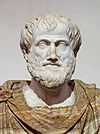 Following one of the other meanings of the word, Aristotle, in the Ars Rhetorica
, gave logos a different technical definition as argument from reason, one of the three modes of persuasion
(the other two modes are pathos
, persuasion by means of emotional appeal: "putting the hearer into a certain frame of mind", and ethos
, persuasion through convincing listeners of one's "moral character.") According to Aristotle, logos relates to "the speech itself, in so far as it proves or seems to prove." In the words of Paul Rahe:
Logos, pathos, and ethos can all be appropriate at different times. Arguments from reason (logical arguments) have some advantages, namely that data are (ostensibly) difficult to manipulate, so it is harder to argue against such an argument; and such arguments make the speaker look prepared and knowledgeable to the audience, enhancing ethos. On the other hand, trust in the speaker, built through ethos, enhances the appeal of arguments from reason.
Robert Wardy
suggests that what Aristotle rejects in supporting the use of logos "is not emotional appeal per se, but rather emotional appeals that have no 'bearing on the issue,' in that the pathē they stimulate lack, or at any rate are not shown to possess, any intrinsic connection with the point at issue – as if an advocate were to try to whip an anti-Semitic audience into a fury because the accused is Jewish; or as if another in drumming up support for a politician were to exploit his listeners's reverential feelings for the politician's ancestors."
philosophy, which began with Zeno of Citium
c. 300 BC, the logos was the active reason
pervading the universe
and animating it. It was conceived of as material
, and is usually identified with God
or Nature
. The Stoics also referred to the seminal logos, ("logos spermatikos") or the law of generation in the universe, which was the principle of the active reason working in inanimate matter
. Humans, too, each possess a portion of the divine logos.
The Stoics took all activity to imply a Logos, or spiritual principle. As the operative principle of the world, to them, the Logos was anima mundi
, a concept which later influenced Philo of Alexandria, although he derived the contents of the term from Plato.
in the creation of heaven in Psalm 33:6, and in some related contexts.
(20 BC – 50 AD), a Hellenized Jew, used the term Logos to mean an intermediary divine being, or demiurge
. Philo followed the Platonic distinction between imperfect matter and perfect idea, and therefore intermediary beings were necessary to bridge the enormous gap between God and the material world. The Logos was the highest of these intermediary beings, and was called by Philo "the first-born of God."
Philo also wrote that "the Logos of the living God is the bond of everything, holding all things together and binding all the parts, and prevents them from being dissolved and separated."
The Platonic Ideas
were located within the Logos, but the Logos also acted on behalf of God in the physical world. In particular, the Angel of the Lord
in the Hebrew Bible
(Old Testament
) was identified with the Logos by Philo, who also said that the Logos was God's instrument in the creation of the universe.
John also explicitly identifies the Logos with Jesus
:
Christians who profess belief in the Trinity
often consider John 1:1 to be a central text in their belief that Jesus is God
, in connection with the idea that the Father
, Jesus, and the Holy Spirit are equals. As theologian Frank Stagg writes:
, and the complement is therefore usually distinguished by dropping any article, and moving it before the verb. Grammatically, the phrase could therefore read either "the Word was God" or "the Word was a god." Early New Testament manuscripts did not distinguish upper and lower case, so that pre-existing beliefs about the Trinity
have influenced translation, although many scholars see the movement of "God" to the front of the clause as indicating an emphasis more consistent with "the Word was God." Some translations, such as An American Translation
and Moffatt, New Translation
, preserve a sense of ambiguity with "the Word was divine." Related translations have also been suggested, such as "what God was the Word also was."
While "the Word was God" is by far the most common English translation, non-Trinitarian groups such as the Jehovah's Witnesses
(in the New World Translation
and their edition of the Emphatic Diaglott
) and Unitarians
(in Thomas Belsham
's modification of William Newcome
's version) translate "the Word was a god."
(c 150) identified Jesus as the Logos. Like Philo
, Justin also identified the Logos with the Angel of the Lord
, and used this as a way of arguing for Christianity to Jews:
In his First Apology
, Justin used the Stoic concept of the Logos as a way of arguing for Christianity to non-Jews. Since a Greek audience would accept this concept, his argument could concentrate on identifying this Logos with Jesus. However, Justin does not go so far as to articulate a fully consistent doctrine of the Logos.
. Both Plato
and Aristotle
used the term logos along with rhema to refer to sentences and propositions.
The Septuagint translation of the Hebrew Bible
into Greek uses the terms Rhema and Logos as equivalents and uses both for the Hebrew word Dabar
, as the Word of God.
Some modern usage in Christian Theology
distinguishes Rhema from Logos (which here refers to the written scriptures) while Rhema refers to the revelation received by the reader from the Holy Spirit
when the Word (Logos) is read, although this distinction has been criticized.
philosophers such as Plotinus (204/5–270 AD) used the term "Logos" in ways which drew on Plato and the Stoics. but the term Logos, was interpreted in different ways throughout Neoplatonism and similarities to Philo's concept of Logos appear to be accidental. The Logos was a key element in the meditation
s of Plotinus regarded as the first Neoplatonist. Plotinus referred back to Heraclitus
and as far back as Thales
in interpreting Logos as the principle of meditation, existing as the interrelationship between the Hypostases (The 'One', 'Spirit' (nous) and 'Soul').
Plotinus used a trinity concept that consisted of "The One", the "Spirit" and "Soul".
The comparison with the Christian Trinity is inescapable, but for Plotinus these were not equal and "The One" was at the highest level, with the "Soul" at the lowest. For Plotinus, the relationship between the three elements of his trinity is conducted by the outpouring of Logos from the higher principle, and eros (loving) upward from the lower principle. Plotinus relied heavily on the concept of Logos, but no explicit references to Christian thought can be found in his works, although there are significant traces of them in his doctrine. Plotinus specifically avoided using the term Logos to refer to the second person of his trinity. However, Plotinus influenced Victorinus
who then influenced Augustine of Hippo
. Centuries later, Carl Jung acknowledged the influence of Plotinus in his writings.
Victorinus differentiated between the Logos interior to God and the Logos related to the world by creation and salvation.
Augustine of Hippo, often seen as the father of medieval philosophy
was also greatly influenced by Plato and is famous for his re-interpretation of Aristotle and Plato in the light of early Christian
thought. A young Augustine experimented with, but failed to achieve ecstasy using the meditations of Plotinus. In his Confessions
Augustine described Logos as the Divine Eternal Word., by which he, in part, was able to motivate the early Christian thought throughout the Hellenisticly
influenced world (among which the Latin speaking west) Augustine's Logos had taken body in Christ, the man in whom the logos (i.e. veritas
or sepientia) was present as in no other man.
is used to relate the "Uncreated" (God), to the "Created" (man). In Sufism, for the Deist, no contact between man and God can be possible without the Logos. The Logos is everywhere and always the same, but its personification is "unique" within each region. Jesus
and Muhammad are seen as the personifications of the Logos, and this is what enables them to speak in such absolute terms.
One of the radical and boldest attempts to reformulate the Neoplatonic concepts into Sufism was due to the philosopher Ibn Arabi, who traveled widely in Spain and North Africa. His concepts were expressed in two major works The Ringstones of Wisdom (Fusus al-Hikam) and The Meccan Illuminations (Al-Futūḥāt al-Makkiyya). To Ibn Arabi, every prophet corresponds to a reality which he called a Logos (Kalimah), as an aspect of the unique Divine Being. In his view the Divine Being would have for ever remained hidden, had it not been for the prophets, with Logos providing the link between man and divinity.
Ibn Arabi seems to have adopted his version of the Logos concept from Neoplatonic and Christian sources, although (writing in Arabic
rather than Greek) he used more than twenty different terms when discussing it. For Ibn Arabi, the Logos or "Universal Man" was a mediating link between individual human beings and the divine essence.
Other Sufi writers also show the influence of the Neoplatonic Logos. In the 15th century [[ʻAbd al-Karim al-Jili]] introduced the Doctrine of Logos and the Perfect Man. For al-Jili the perfect man (associated with the Logos or the Holy Prophet) has the power to assume different forms at different times, and appear in different guises.
's analytical psychology, he contrasted a rational, decisive logos with an emotional mythos. Jung contrasted the critical and rational faculties of logos with the emotional, non-reason oriented and mythical elements of mythos. In Jung's approach logos vs mythos can be represented as "science vs mysticism", or "reason vs imagination" or "conscious activity vs the unconscious".
For Jung, logos represented the masculine principle of rationality, in contrast to its female counterpart, eros:
Jung attempted to equate logos and eros, his intuitive conceptions of masculine and feminine consciousness, with the alchemical Sol and Luna. Jung commented that in a man the lunar anima and in a woman the solar animus has the greatest influence on consciousness. Jung often proceeded to analyze situations in terms of "paired opposites", e.g. by using the analogy with the eastern yin and yang
and was also influenced by the Neoplatonics.
In his book Mysterium Coniunctionis Jung made some important final remarks about anima and animus:
And in this book Jung again emphasized that the animus compensates eros, while the anima compensates logos.
Philosophy
Philosophy is the study of general and fundamental problems, such as those connected with existence, knowledge, values, reason, mind, and language. Philosophy is distinguished from other ways of addressing such problems by its critical, generally systematic approach and its reliance on rational...
, psychology
Psychology
Psychology is the study of the mind and behavior. Its immediate goal is to understand individuals and groups by both establishing general principles and researching specific cases. For many, the ultimate goal of psychology is to benefit society...
, rhetoric
Rhetoric
Rhetoric is the art of discourse, an art that aims to improve the facility of speakers or writers who attempt to inform, persuade, or motivate particular audiences in specific situations. As a subject of formal study and a productive civic practice, rhetoric has played a central role in the Western...
and religion
Religion
Religion is a collection of cultural systems, belief systems, and worldviews that establishes symbols that relate humanity to spirituality and, sometimes, to moral values. Many religions have narratives, symbols, traditions and sacred histories that are intended to give meaning to life or to...
. Originally a word meaning "a ground", "a plea", "an opinion", "an expectation", "word," "speech," "account," "reason," it became a technical term in philosophy, beginning with Heraclitus
Heraclitus
Heraclitus of Ephesus was a pre-Socratic Greek philosopher, a native of the Greek city Ephesus, Ionia, on the coast of Asia Minor. He was of distinguished parentage. Little is known about his early life and education, but he regarded himself as self-taught and a pioneer of wisdom...
(ca. 535–475 BC), who used the term for a principle of order and knowledge.
Ancient philosophers used the term in different ways. The sophists used the term to mean discourse
Discourse
Discourse generally refers to "written or spoken communication". The following are three more specific definitions:...
, and Aristotle
Aristotle
Aristotle was a Greek philosopher and polymath, a student of Plato and teacher of Alexander the Great. His writings cover many subjects, including physics, metaphysics, poetry, theater, music, logic, rhetoric, linguistics, politics, government, ethics, biology, and zoology...
applied the term to refer to "reasoned discourse" or "the argument" in the field of rhetoric. The Stoic
STOIC
STOIC was a variant of Forth.It started out at the MIT and Harvard Biomedical Engineering Centre in Boston, and was written in the mid 1970s by Jonathan Sachs...
philosophers identified the term with the divine
Divinity
Divinity and divine are broadly applied but loosely defined terms, used variously within different faiths and belief systems — and even by different individuals within a given faith — to refer to some transcendent or transcendental power or deity, or its attributes or manifestations in...
animating principle pervading the Universe.
After Judaism
Judaism
Judaism ) is the "religion, philosophy, and way of life" of the Jewish people...
came under Hellenistic influence
Hellenistic Judaism
Hellenistic Judaism was a movement which existed in the Jewish diaspora that sought to establish a Hebraic-Jewish religious tradition within the culture and language of Hellenism...
, Philo
Philo
Philo , known also as Philo of Alexandria , Philo Judaeus, Philo Judaeus of Alexandria, Yedidia, "Philon", and Philo the Jew, was a Hellenistic Jewish Biblical philosopher born in Alexandria....
(ca. 20 BC–AD 40) adopted the term into Jewish philosophy. The Gospel of John
Gospel of John
The Gospel According to John , commonly referred to as the Gospel of John or simply John, and often referred to in New Testament scholarship as the Fourth Gospel, is an account of the public ministry of Jesus...
identifies the Logos, through which all things are made, as divine (theos
Theos
Theos may refer to:*Theos is the Greek word for "deity, god"; see god , names of God*Theos is a UK public theology think tank*THEOS is an earth observing satellite launched in 2008 by Thailand...
), and further identifies Jesus
Jesus
Jesus of Nazareth , commonly referred to as Jesus Christ or simply as Jesus or Christ, is the central figure of Christianity...
as the incarnation
Incarnation
Incarnation literally means embodied in flesh or taking on flesh. It refers to the conception and birth of a sentient creature who is the material manifestation of an entity, god or force whose original nature is immaterial....
of the Logos.
Although the term "Logos" is widely used in this Christian sense, in academic circles it often refers to the various ancient Greek uses, or to post-Christian
Postchristianity
Postchristianity is the decline of Christianity, particularly in Europe and Australia, in the 20th century, considered in terms of postmodernism...
uses within contemporary philosophy, Sufism
Sufism
Sufism or ' is defined by its adherents as the inner, mystical dimension of Islam. A practitioner of this tradition is generally known as a '...
, and the analytical psychology of Carl Jung
Carl Jung
Carl Gustav Jung was a Swiss psychiatrist and the founder of Analytical Psychology. Jung is considered the first modern psychiatrist to view the human psyche as "by nature religious" and make it the focus of exploration. Jung is one of the best known researchers in the field of dream analysis and...
.
Etymology and linguistic issues
In ordinary, non-technical Greek, logos had a semantic fieldSemantic field
A semantic field is a technical term in the discipline of linguistics to describe a set of words grouped by meaning in a certain way. The term is also used in other academic disciplines, such as anthropology and computational semiotics.-Definition and usage:...
extending beyond "word" to notions such as, on the one hand, language, talk, statement, speech, conversation, tale, story, prose, proposition, and principle; and on the other hand, thought, reason, account, consideration, esteem, due relation, proportion, and analogy.
Despite the conventional translation as "word", it is not used for a word
Word
In language, a word is the smallest free form that may be uttered in isolation with semantic or pragmatic content . This contrasts with a morpheme, which is the smallest unit of meaning but will not necessarily stand on its own...
in the grammatical sense; instead, the term lexis (λέξις) was used. However, both logos and lexis derive from the same verb legō (λέγω), meaning "to count, tell, say, speak".
Philo distinguished between logos prophorikos (the uttered word) and the logos endiathetos (the word remaining within). The Stoics also spoke of the logos spermatikos (the generative principle of the Universe), which is not important in the Biblical tradition, but is relevant in Neoplatonism
Neoplatonism
Neoplatonism , is the modern term for a school of religious and mystical philosophy that took shape in the 3rd century AD, based on the teachings of Plato and earlier Platonists, with its earliest contributor believed to be Plotinus, and his teacher Ammonius Saccas...
. Early translators from Greek, like Jerome
Jerome
Saint Jerome was a Roman Christian priest, confessor, theologian and historian, and who became a Doctor of the Church. He was the son of Eusebius, of the city of Stridon, which was on the border of Dalmatia and Pannonia...
in the 4th century, were frustrated by the inadequacy of any single Latin word to convey the Logos expressed in the Gospel of John
Gospel of John
The Gospel According to John , commonly referred to as the Gospel of John or simply John, and often referred to in New Testament scholarship as the Fourth Gospel, is an account of the public ministry of Jesus...
. The Vulgate
Vulgate
The Vulgate is a late 4th-century Latin translation of the Bible. It was largely the work of St. Jerome, who was commissioned by Pope Damasus I in 382 to make a revision of the old Latin translations...
Bible usage of in principium erat verbum was thus constrained to use the perhaps inadequate noun verbum for word, but later romance language translations had the advantage of nouns such as le mot in French. Reformation translators took another approach. Martin Luther
Martin Luther
Martin Luther was a German priest, professor of theology and iconic figure of the Protestant Reformation. He strongly disputed the claim that freedom from God's punishment for sin could be purchased with money. He confronted indulgence salesman Johann Tetzel with his Ninety-Five Theses in 1517...
rejected Zeitwort (verb) in favor of Wort (word), for instance, although later commentators repeatedly turned to a more dynamic use involving the living word as felt by Jerome and Augustine
Augustine of Hippo
Augustine of Hippo , also known as Augustine, St. Augustine, St. Austin, St. Augoustinos, Blessed Augustine, or St. Augustine the Blessed, was Bishop of Hippo Regius . He was a Latin-speaking philosopher and theologian who lived in the Roman Africa Province...
.
In English, logos is the root of "logic
Logic
In philosophy, Logic is the formal systematic study of the principles of valid inference and correct reasoning. Logic is used in most intellectual activities, but is studied primarily in the disciplines of philosophy, mathematics, semantics, and computer science...
," and of the "-logy
-logy
-logy is a suffix in the English language, used with words originally adapted from Ancient Greek language ending in -λογία...
" suffix (e.g., geology).
Heraclitus
The writing of HeraclitusHeraclitus
Heraclitus of Ephesus was a pre-Socratic Greek philosopher, a native of the Greek city Ephesus, Ionia, on the coast of Asia Minor. He was of distinguished parentage. Little is known about his early life and education, but he regarded himself as self-taught and a pioneer of wisdom...
was the first place where the word logos was given special attention in ancient Greek philosophy, although Heraclitus seems to use the word with a meaning not significantly different from the way it was used in ordinary Greek of his time. For Heraclitus logos provided the link between rational discourse and the world's rational structure.
What logos means here is not certain: it may mean 'reason' or 'explanation' in the sense of an objective cosmic law; or it may signify nothing more than 'saying' or 'wisdom'. Yet, an independent existence of a universal logos was clearly suggested by Heraclitus.
Aristotle's rhetorical logos
Rhetoric (Aristotle)
Aristotle's Rhetoric is an ancient Greek treatise on the art of persuasion, dating from the 4th century BC. In Greek, it is titled ΤΕΧΝΗ ΡΗΤΟΡΙΚΗ, in Latin Ars Rhetorica. In English, its title varies: typically it is titled Rhetoric, the Art of Rhetoric, or a Treatise on...
, gave logos a different technical definition as argument from reason, one of the three modes of persuasion
Modes of persuasion
The modes of persuasion are devices in rhetoric that classify the speaker's appeal to the audience. They are: ethos, pathos and logos.Aristotle's describes the modes of persuasion thus:-Ethos:...
(the other two modes are pathos
Pathos
Pathos represents an appeal to the audience's emotions. Pathos is a communication technique used most often in rhetoric , and in literature, film and other narrative art....
, persuasion by means of emotional appeal: "putting the hearer into a certain frame of mind", and ethos
Ethos
Ethos is a Greek word meaning "character" that is used to describe the guiding beliefs or ideals that characterize a community, nation, or ideology. The Greeks also used this word to refer to the power of music to influence its hearer's emotions, behaviors, and even morals. Early Greek stories of...
, persuasion through convincing listeners of one's "moral character.") According to Aristotle, logos relates to "the speech itself, in so far as it proves or seems to prove." In the words of Paul Rahe:
Logos, pathos, and ethos can all be appropriate at different times. Arguments from reason (logical arguments) have some advantages, namely that data are (ostensibly) difficult to manipulate, so it is harder to argue against such an argument; and such arguments make the speaker look prepared and knowledgeable to the audience, enhancing ethos. On the other hand, trust in the speaker, built through ethos, enhances the appeal of arguments from reason.
Robert Wardy
Robert Wardy
Robert Wardy is Reader in Classics at the University of Cambridge, and Director of Studies in Philosophy and Classics at Saint Catharine's College...
suggests that what Aristotle rejects in supporting the use of logos "is not emotional appeal per se, but rather emotional appeals that have no 'bearing on the issue,' in that the pathē they stimulate lack, or at any rate are not shown to possess, any intrinsic connection with the point at issue – as if an advocate were to try to whip an anti-Semitic audience into a fury because the accused is Jewish; or as if another in drumming up support for a politician were to exploit his listeners's reverential feelings for the politician's ancestors."
Stoics
In StoicSTOIC
STOIC was a variant of Forth.It started out at the MIT and Harvard Biomedical Engineering Centre in Boston, and was written in the mid 1970s by Jonathan Sachs...
philosophy, which began with Zeno of Citium
Zeno of Citium
Zeno of Citium was a Greek philosopher from Citium . Zeno was the founder of the Stoic school of philosophy, which he taught in Athens from about 300 BC. Based on the moral ideas of the Cynics, Stoicism laid great emphasis on goodness and peace of mind gained from living a life of virtue in...
c. 300 BC, the logos was the active reason
Reason
Reason is a term that refers to the capacity human beings have to make sense of things, to establish and verify facts, and to change or justify practices, institutions, and beliefs. It is closely associated with such characteristically human activities as philosophy, science, language, ...
pervading the universe
Universe
The Universe is commonly defined as the totality of everything that exists, including all matter and energy, the planets, stars, galaxies, and the contents of intergalactic space. Definitions and usage vary and similar terms include the cosmos, the world and nature...
and animating it. It was conceived of as material
Material
Material is anything made of matter, constituted of one or more substances. Wood, cement, hydrogen, air and water are all examples of materials. Sometimes the term "material" is used more narrowly to refer to substances or components with certain physical properties that are used as inputs to...
, and is usually identified with God
God
God is the English name given to a singular being in theistic and deistic religions who is either the sole deity in monotheism, or a single deity in polytheism....
or Nature
Nature
Nature, in the broadest sense, is equivalent to the natural world, physical world, or material world. "Nature" refers to the phenomena of the physical world, and also to life in general...
. The Stoics also referred to the seminal logos, ("logos spermatikos") or the law of generation in the universe, which was the principle of the active reason working in inanimate matter
Matter
Matter is a general term for the substance of which all physical objects consist. Typically, matter includes atoms and other particles which have mass. A common way of defining matter is as anything that has mass and occupies volume...
. Humans, too, each possess a portion of the divine logos.
The Stoics took all activity to imply a Logos, or spiritual principle. As the operative principle of the world, to them, the Logos was anima mundi
Anima Mundi
Anima mundī is Latin meaning "the soul of the world" which can refer to:*Anima mundi, the soul of the world*Anima Mundi , a 1991 documentary film directed by Godfrey Reggio*Anima Mundi , a Brazilian video and film festival...
, a concept which later influenced Philo of Alexandria, although he derived the contents of the term from Plato.
Logos in Hellenistic Judaism
In the Septuagint the term logos is used for the word of GodWord of God
Word of God or God's Word may refer to:*Divine revelation**certain Religious texts**Prophecy**Biblical literalism*Logos as "divine word"** in biblical creation, see Genesis creation narrative**in trinitarianism, see Jesus Christ the Logos...
in the creation of heaven in Psalm 33:6, and in some related contexts.
Philo of Alexandria
PhiloPhilo
Philo , known also as Philo of Alexandria , Philo Judaeus, Philo Judaeus of Alexandria, Yedidia, "Philon", and Philo the Jew, was a Hellenistic Jewish Biblical philosopher born in Alexandria....
(20 BC – 50 AD), a Hellenized Jew, used the term Logos to mean an intermediary divine being, or demiurge
Demiurge
The demiurge is a concept from the Platonic, Neopythagorean, Middle Platonic, and Neoplatonic schools of philosophy for an artisan-like figure responsible for the fashioning and maintenance of the physical universe. The term was subsequently adopted by the Gnostics...
. Philo followed the Platonic distinction between imperfect matter and perfect idea, and therefore intermediary beings were necessary to bridge the enormous gap between God and the material world. The Logos was the highest of these intermediary beings, and was called by Philo "the first-born of God."
Philo also wrote that "the Logos of the living God is the bond of everything, holding all things together and binding all the parts, and prevents them from being dissolved and separated."
The Platonic Ideas
Theory of Forms
Plato's theory of Forms or theory of Ideas asserts that non-material abstract forms , and not the material world of change known to us through sensation, possess the highest and most fundamental kind of reality. When used in this sense, the word form is often capitalized...
were located within the Logos, but the Logos also acted on behalf of God in the physical world. In particular, the Angel of the Lord
Angel of the Lord
The Angel of the Lord is one of many terms in the Hebrew Bible used for an angel. The Biblical name for angel, מלאך mal'ach, which translates simply as "messenger," obtained the further signification of "angel" only through the addition of God's name, as The Angel of the Lord (or the Angel of...
in the Hebrew Bible
Hebrew Bible
The Hebrew Bible is a term used by biblical scholars outside of Judaism to refer to the Tanakh , a canonical collection of Jewish texts, and the common textual antecedent of the several canonical editions of the Christian Old Testament...
(Old Testament
Old Testament
The Old Testament, of which Christians hold different views, is a Christian term for the religious writings of ancient Israel held sacred and inspired by Christians which overlaps with the 24-book canon of the Masoretic Text of Judaism...
) was identified with the Logos by Philo, who also said that the Logos was God's instrument in the creation of the universe.
Christ the Logos
The Christian concept of the Logos is derived from the first chapter of the Gospel of John, where the Logos (often translated as “Word”) is described in terms that resemble, but likely surpass, the ideas of Philo:John also explicitly identifies the Logos with Jesus
Jesus
Jesus of Nazareth , commonly referred to as Jesus Christ or simply as Jesus or Christ, is the central figure of Christianity...
:
Christians who profess belief in the Trinity
Trinity
The Christian doctrine of the Trinity defines God as three divine persons : the Father, the Son , and the Holy Spirit. The three persons are distinct yet coexist in unity, and are co-equal, co-eternal and consubstantial . Put another way, the three persons of the Trinity are of one being...
often consider John 1:1 to be a central text in their belief that Jesus is God
God
God is the English name given to a singular being in theistic and deistic religions who is either the sole deity in monotheism, or a single deity in polytheism....
, in connection with the idea that the Father
God the Father
God the Father is a gendered title given to God in many monotheistic religions, particularly patriarchal, Abrahamic ones. In Judaism, God is called Father because he is the creator, life-giver, law-giver, and protector...
, Jesus, and the Holy Spirit are equals. As theologian Frank Stagg writes:
"God" or "a god"
The last four words of John 1:1 (θεὸς ἦν ὁ λόγος, literally "God was the Logos," or "God was the Word") have been a particular topic of debate within Christianity. In this construct, the subject (the Logos) and the complement (God) both appear in the nominative caseNominative case
The nominative case is one of the grammatical cases of a noun or other part of speech, which generally marks the subject of a verb or the predicate noun or predicate adjective, as opposed to its object or other verb arguments...
, and the complement is therefore usually distinguished by dropping any article, and moving it before the verb. Grammatically, the phrase could therefore read either "the Word was God" or "the Word was a god." Early New Testament manuscripts did not distinguish upper and lower case, so that pre-existing beliefs about the Trinity
Trinity
The Christian doctrine of the Trinity defines God as three divine persons : the Father, the Son , and the Holy Spirit. The three persons are distinct yet coexist in unity, and are co-equal, co-eternal and consubstantial . Put another way, the three persons of the Trinity are of one being...
have influenced translation, although many scholars see the movement of "God" to the front of the clause as indicating an emphasis more consistent with "the Word was God." Some translations, such as An American Translation
An American Translation
The Bible, An American Translation consists of The Old Testament translated by a group of scholars under the editorship of J.M. Powis Smith, and The New Testament translated by Edgar J...
and Moffatt, New Translation
Moffatt, New Translation
Moffatt, New Translation is an abbreviation of the title, "The Holy Bible Containing the Old and New Testaments, a New Translation" by James Moffatt....
, preserve a sense of ambiguity with "the Word was divine." Related translations have also been suggested, such as "what God was the Word also was."
While "the Word was God" is by far the most common English translation, non-Trinitarian groups such as the Jehovah's Witnesses
Jehovah's Witnesses
Jehovah's Witnesses is a millenarian restorationist Christian denomination with nontrinitarian beliefs distinct from mainstream Christianity. The religion reports worldwide membership of over 7 million adherents involved in evangelism, convention attendance of over 12 million, and annual...
(in the New World Translation
New World Translation of the Holy Scriptures
The New World Translation of the Holy Scriptures is a translation of the Bible published by the Watch Tower Bible and Tract Society in 1961; it is used and distributed by Jehovah's Witnesses. Though it is not the first Bible to be published by the group, it is their first original translation of...
and their edition of the Emphatic Diaglott
Emphatic Diaglott
The Emphatic Diaglott is a diaglot, or two-language polyglot translation, of the New Testament by Benjamin Wilson, first published in 1864. It is an interlinear translation with the original Greek text and a word-for-word English translation in the left column, and a full English translation in the...
) and Unitarians
Unitarianism
Unitarianism is a Christian theological movement, named for its understanding of God as one person, in direct contrast to Trinitarianism which defines God as three persons coexisting consubstantially as one in being....
(in Thomas Belsham
Thomas Belsham
Thomas Belsham was an English Unitarian minister- Life :Belsham was born in Bedford, England, and was the elder brother of William Belsham, the English political writer and historian. He was educated at the dissenting academy at Daventry, where for seven years he acted as assistant tutor...
's modification of William Newcome
William Newcome
William Newcome was an Englishman and cleric of the Church of Ireland who was appointed to the bishoprics of Dromore , Ossory , Waterford and Lismore , and lastly to the Primatial See of Armagh .-Life:...
's version) translate "the Word was a god."
Early Christian writers
Following John 1, the early Christian apologist Justin MartyrJustin Martyr
Justin Martyr, also known as just Saint Justin , was an early Christian apologist. Most of his works are lost, but two apologies and a dialogue survive. He is considered a saint by the Roman Catholic Church and the Eastern Orthodox Church....
(c 150) identified Jesus as the Logos. Like Philo
Philo
Philo , known also as Philo of Alexandria , Philo Judaeus, Philo Judaeus of Alexandria, Yedidia, "Philon", and Philo the Jew, was a Hellenistic Jewish Biblical philosopher born in Alexandria....
, Justin also identified the Logos with the Angel of the Lord
Angel of the Lord
The Angel of the Lord is one of many terms in the Hebrew Bible used for an angel. The Biblical name for angel, מלאך mal'ach, which translates simply as "messenger," obtained the further signification of "angel" only through the addition of God's name, as The Angel of the Lord (or the Angel of...
, and used this as a way of arguing for Christianity to Jews:
In his First Apology
First Apology of Justin Martyr
The First Apology was an early work of Christian apologetics addressed by Justin Martyr to the Roman Emperor Antoninus Pius. It is dated to the period 150-155.-Purpose for writing:...
, Justin used the Stoic concept of the Logos as a way of arguing for Christianity to non-Jews. Since a Greek audience would accept this concept, his argument could concentrate on identifying this Logos with Jesus. However, Justin does not go so far as to articulate a fully consistent doctrine of the Logos.
Rhema and logos
The word logos has been used in different senses along with RhemaRhema
Rhema literally means an "utterance" or "thing said" in Greek. It is a word that signifies the action of utterance.In philosophy, it was used by both Plato and Aristotle to refer to propositions or sentences....
. Both Plato
Plato
Plato , was a Classical Greek philosopher, mathematician, student of Socrates, writer of philosophical dialogues, and founder of the Academy in Athens, the first institution of higher learning in the Western world. Along with his mentor, Socrates, and his student, Aristotle, Plato helped to lay the...
and Aristotle
Aristotle
Aristotle was a Greek philosopher and polymath, a student of Plato and teacher of Alexander the Great. His writings cover many subjects, including physics, metaphysics, poetry, theater, music, logic, rhetoric, linguistics, politics, government, ethics, biology, and zoology...
used the term logos along with rhema to refer to sentences and propositions.
The Septuagint translation of the Hebrew Bible
Hebrew Bible
The Hebrew Bible is a term used by biblical scholars outside of Judaism to refer to the Tanakh , a canonical collection of Jewish texts, and the common textual antecedent of the several canonical editions of the Christian Old Testament...
into Greek uses the terms Rhema and Logos as equivalents and uses both for the Hebrew word Dabar
Dabar
The word dabar means "word" or "talk" in Hebrew. Dabar occurs in various contexts in the Hebrew Bible.In the Hebrew Bible, dabar is sometimes used in reference to the "Divine Word", and in an active sense as a "word event", or prophetic words....
, as the Word of God.
Some modern usage in Christian Theology
Christian theology
- Divisions of Christian theology :There are many methods of categorizing different approaches to Christian theology. For a historical analysis, see the main article on the History of Christian theology.- Sub-disciplines :...
distinguishes Rhema from Logos (which here refers to the written scriptures) while Rhema refers to the revelation received by the reader from the Holy Spirit
Holy Spirit
Holy Spirit is a term introduced in English translations of the Hebrew Bible, but understood differently in the main Abrahamic religions.While the general concept of a "Spirit" that permeates the cosmos has been used in various religions Holy Spirit is a term introduced in English translations of...
when the Word (Logos) is read, although this distinction has been criticized.
Neoplatonism
NeoplatonistNeoplatonism
Neoplatonism , is the modern term for a school of religious and mystical philosophy that took shape in the 3rd century AD, based on the teachings of Plato and earlier Platonists, with its earliest contributor believed to be Plotinus, and his teacher Ammonius Saccas...
philosophers such as Plotinus (204/5–270 AD) used the term "Logos" in ways which drew on Plato and the Stoics. but the term Logos, was interpreted in different ways throughout Neoplatonism and similarities to Philo's concept of Logos appear to be accidental. The Logos was a key element in the meditation
Meditation
Meditation is any form of a family of practices in which practitioners train their minds or self-induce a mode of consciousness to realize some benefit....
s of Plotinus regarded as the first Neoplatonist. Plotinus referred back to Heraclitus
Heraclitus
Heraclitus of Ephesus was a pre-Socratic Greek philosopher, a native of the Greek city Ephesus, Ionia, on the coast of Asia Minor. He was of distinguished parentage. Little is known about his early life and education, but he regarded himself as self-taught and a pioneer of wisdom...
and as far back as Thales
Thales
Thales of Miletus was a pre-Socratic Greek philosopher from Miletus in Asia Minor, and one of the Seven Sages of Greece. Many, most notably Aristotle, regard him as the first philosopher in the Greek tradition...
in interpreting Logos as the principle of meditation, existing as the interrelationship between the Hypostases (The 'One', 'Spirit' (nous) and 'Soul').
Plotinus used a trinity concept that consisted of "The One", the "Spirit" and "Soul".
The comparison with the Christian Trinity is inescapable, but for Plotinus these were not equal and "The One" was at the highest level, with the "Soul" at the lowest. For Plotinus, the relationship between the three elements of his trinity is conducted by the outpouring of Logos from the higher principle, and eros (loving) upward from the lower principle. Plotinus relied heavily on the concept of Logos, but no explicit references to Christian thought can be found in his works, although there are significant traces of them in his doctrine. Plotinus specifically avoided using the term Logos to refer to the second person of his trinity. However, Plotinus influenced Victorinus
Gaius Marius Victorinus
Gaius Marius Victorinus was a Roman grammarian, rhetorician and Neoplatonic philosopher. Victorinus was African by birth and experienced the height of his career during the reign of Constantius II...
who then influenced Augustine of Hippo
Augustine of Hippo
Augustine of Hippo , also known as Augustine, St. Augustine, St. Austin, St. Augoustinos, Blessed Augustine, or St. Augustine the Blessed, was Bishop of Hippo Regius . He was a Latin-speaking philosopher and theologian who lived in the Roman Africa Province...
. Centuries later, Carl Jung acknowledged the influence of Plotinus in his writings.
Victorinus differentiated between the Logos interior to God and the Logos related to the world by creation and salvation.
Augustine of Hippo, often seen as the father of medieval philosophy
Medieval philosophy
Medieval philosophy is the philosophy in the era now known as medieval or the Middle Ages, the period roughly extending from the fall of the Western Roman Empire in the fifth century AD to the Renaissance in the sixteenth century...
was also greatly influenced by Plato and is famous for his re-interpretation of Aristotle and Plato in the light of early Christian
Early Christianity
Early Christianity is generally considered as Christianity before 325. The New Testament's Book of Acts and Epistle to the Galatians records that the first Christian community was centered in Jerusalem and its leaders included James, Peter and John....
thought. A young Augustine experimented with, but failed to achieve ecstasy using the meditations of Plotinus. In his Confessions
Confessions (St. Augustine)
Confessions is the name of an autobiographical work, consisting of 13 books, by St. Augustine of Hippo, written between AD 397 and AD 398. Modern English translations of it are sometimes published under the title The Confessions of St...
Augustine described Logos as the Divine Eternal Word., by which he, in part, was able to motivate the early Christian thought throughout the Hellenisticly
Hellenism
Hellenism may refer to:*Hellenic studies*Hellenistic civilization*Hellenistic period, in Greek antiquity*Hellenistic Greece*Hellenization, the spread of Greek culture over foreign peoples*Hellenistic philosophy in the Hellenistic period and late antiquity...
influenced world (among which the Latin speaking west) Augustine's Logos had taken body in Christ, the man in whom the logos (i.e. veritas
Veritas
In Roman mythology, Veritas, meaning truth, was the goddess of truth, a daughter of Saturn and the mother of Virtue. It was believed that she hid in the bottom of a holy well because she was so elusive. Her image is shown as a young virgin dressed in white...
or sepientia) was present as in no other man.
Sufism
The concept of Logos in SufismSufism
Sufism or ' is defined by its adherents as the inner, mystical dimension of Islam. A practitioner of this tradition is generally known as a '...
is used to relate the "Uncreated" (God), to the "Created" (man). In Sufism, for the Deist, no contact between man and God can be possible without the Logos. The Logos is everywhere and always the same, but its personification is "unique" within each region. Jesus
Jesus
Jesus of Nazareth , commonly referred to as Jesus Christ or simply as Jesus or Christ, is the central figure of Christianity...
and Muhammad are seen as the personifications of the Logos, and this is what enables them to speak in such absolute terms.
One of the radical and boldest attempts to reformulate the Neoplatonic concepts into Sufism was due to the philosopher Ibn Arabi, who traveled widely in Spain and North Africa. His concepts were expressed in two major works The Ringstones of Wisdom (Fusus al-Hikam) and The Meccan Illuminations (Al-Futūḥāt al-Makkiyya). To Ibn Arabi, every prophet corresponds to a reality which he called a Logos (Kalimah), as an aspect of the unique Divine Being. In his view the Divine Being would have for ever remained hidden, had it not been for the prophets, with Logos providing the link between man and divinity.
Ibn Arabi seems to have adopted his version of the Logos concept from Neoplatonic and Christian sources, although (writing in Arabic
Arabic language
Arabic is a name applied to the descendants of the Classical Arabic language of the 6th century AD, used most prominently in the Quran, the Islamic Holy Book...
rather than Greek) he used more than twenty different terms when discussing it. For Ibn Arabi, the Logos or "Universal Man" was a mediating link between individual human beings and the divine essence.
Other Sufi writers also show the influence of the Neoplatonic Logos. In the 15th century [[ʻAbd al-Karim al-Jili]] introduced the Doctrine of Logos and the Perfect Man. For al-Jili the perfect man (associated with the Logos or the Holy Prophet) has the power to assume different forms at different times, and appear in different guises.
Jung's analytical psychology
In Carl JungCarl Jung
Carl Gustav Jung was a Swiss psychiatrist and the founder of Analytical Psychology. Jung is considered the first modern psychiatrist to view the human psyche as "by nature religious" and make it the focus of exploration. Jung is one of the best known researchers in the field of dream analysis and...
's analytical psychology, he contrasted a rational, decisive logos with an emotional mythos. Jung contrasted the critical and rational faculties of logos with the emotional, non-reason oriented and mythical elements of mythos. In Jung's approach logos vs mythos can be represented as "science vs mysticism", or "reason vs imagination" or "conscious activity vs the unconscious".
For Jung, logos represented the masculine principle of rationality, in contrast to its female counterpart, eros:
Jung attempted to equate logos and eros, his intuitive conceptions of masculine and feminine consciousness, with the alchemical Sol and Luna. Jung commented that in a man the lunar anima and in a woman the solar animus has the greatest influence on consciousness. Jung often proceeded to analyze situations in terms of "paired opposites", e.g. by using the analogy with the eastern yin and yang
Yin and yang
In Asian philosophy, the concept of yin yang , which is often referred to in the West as "yin and yang", is used to describe how polar opposites or seemingly contrary forces are interconnected and interdependent in the natural world, and how they give rise to each other in turn. Opposites thus only...
and was also influenced by the Neoplatonics.
In his book Mysterium Coniunctionis Jung made some important final remarks about anima and animus:
In so far as the spirit is also a kind of "window on eternity"... it conveys to the soul a certain influx divinus... and the knowledge of a higher system of the world, wherein consists precisely its supposed animation of the soul.
And in this book Jung again emphasized that the animus compensates eros, while the anima compensates logos.
See also
- Al-Insān al-KāmilAl-Insān al-KāmilIn Islamic theology, al-Insān al-Kāmil , is a term used as an honorific title to describe Muhammad...
- ChristianityChristianityChristianity is a monotheistic religion based on the life and teachings of Jesus as presented in canonical gospels and other New Testament writings...
- DabarDabarThe word dabar means "word" or "talk" in Hebrew. Dabar occurs in various contexts in the Hebrew Bible.In the Hebrew Bible, dabar is sometimes used in reference to the "Divine Word", and in an active sense as a "word event", or prophetic words....
- EpeolatryEpeolatrySimilar to idolatry and iconodulism, epeolatry literally means the worship of words. It derives from epos, which unlike logos more specifically means word in Greek, and was apparently coined in 1860 by Oliver Wendell Holmes, Sr...
- LogicLogicIn philosophy, Logic is the formal systematic study of the principles of valid inference and correct reasoning. Logic is used in most intellectual activities, but is studied primarily in the disciplines of philosophy, mathematics, semantics, and computer science...
- LogocracyLogocracyLogocracy is the rule of—or government by—words. It is derived from the Greek λόγος - "word" and from κράτος - to "govern". The term can be used either positively, ironically or negatively.-Historical examples:...
- NousNousNous , also called intellect or intelligence, is a philosophical term for the faculty of the human mind which is described in classical philosophy as necessary for understanding what is true or real, very close in meaning to intuition...
- ParmenidesParmenidesParmenides of Elea was an ancient Greek philosopher born in Elea, a Greek city on the southern coast of Italy. He was the founder of the Eleatic school of philosophy. The single known work of Parmenides is a poem, On Nature, which has survived only in fragmentary form. In this poem, Parmenides...
- RhemaRhemaRhema literally means an "utterance" or "thing said" in Greek. It is a word that signifies the action of utterance.In philosophy, it was used by both Plato and Aristotle to refer to propositions or sentences....
- Shabda
- Sophia
- SpiritualitySpiritualitySpirituality can refer to an ultimate or an alleged immaterial reality; an inner path enabling a person to discover the essence of his/her being; or the “deepest values and meanings by which people live.” Spiritual practices, including meditation, prayer and contemplation, are intended to develop...