


Labarum

Encyclopedia
The labarum was a vexillum
(military standard) that displayed the "Chi-Rho" symbol ☧, formed from the first two Greek letters
of the word "Christ
" — Chi
(χ) and Rho
(ρ). It was used by the Roman emperor Constantine I. Since the vexillum consisted of a flag suspended from the crossbar of a cross, it was ideally suited to symbolize the crucifixion
of Christ.
The etymology of the word labarum is unclear; it is perhaps to be derived from Latin /labāre/ 'to totter, to waver' (in the sense of the "waving" of a flag in the breeze). Other proposals include a derivation from Celtic llafar ("eloquent"), from the Latin laureum [vexillum] ("laurel standard") or from ancient Cantabri
dialect labaro ('four heads') (in modern-day Basque
the word is lauburu
, with the same meaning), an ancient celtic symbol taken by the Legions during the Cantabrian Wars
.
Later usage has sometimes regarded the terms "labarum" and "Chi-Rho" as synonyms. Ancient sources, however, draw an unambiguous distinction between the two.
 On the evening of October 27, 312, with his army preparing for the Battle of the Milvian Bridge, the emperor Constantine I
claimed to have had a vision which led him to fight under the protection of the Christian God.
Lactantius
states that, in the night before the battle, Constantine was commanded in a dream to "delineate the heavenly sign on the shields of his soldiers". He obeyed and marked the shields with a sign "denoting Christ". Lactantius describes that sign as a "staurogram", or a Latin cross
with its upper end rounded in a P-like fashion, rather than the better known Chi-Rho sign described by Eusebius of Caesarea
. Thus, it had both the form of a cross and the monogram of Christ's name from the formed letters "X" and "P", the first letters of Christ's name in Greek.
From Eusebius, two accounts of the battle survive. The first, shorter one in the Ecclesiastical History
leaves no doubt that God helped Constantine but doesn't mention any vision. In his later Life of Constantine, Eusebius gives a detailed account of a vision and stresses that he had heard the story from the emperor himself. According to this version, Constantine with his army was marching somewhere (Eusebius doesn't specify the actual location of the event, but it clearly isn't in the camp at Rome) when he looked up to the sun and saw a cross of light above it, and with it the Greek words Ἐν Τούτῳ Νίκα
. The Latin translation of the Greek is in hoc signo vinces
— literally "In this sign, win," a more useful English translation would be, "By this sign conquer." At first he was unsure of the meaning of the apparition, but the following night he had a dream in which Christ explained to him that he should use the sign against his enemies. Eusebius then continues to describe the labarum, the military standard used by Constantine in his later wars against Licinius
, showing the Chi-Rho sign.
Those two accounts can hardly be reconciled with each other, though they have been merged in popular notion into Constantine seeing the Chi-Rho sign on the evening before the battle. Both authors agree that the sign was not readily understandable as denoting Christ, which corresponds with the fact that there is no certain evidence of the use of the letters chi and rho as a Christian sign before Constantine. Its first appearance is on a Constantinian silver coin from c. 317, which proves that Constantine did use the sign at that time, though not very prominently. He made extensive use of the Chi-Rho and the labarum only later in the conflict with Licinius.
The vision has been interpreted in a solar context (e.g. as a solar halo
phenomenon), which would have been reshaped to fit with the Christian beliefs of the later Constantine.
 "A Description of the Standard of the Cross, which the Romans now call the Labarum."
"Now it was made in the following manner. A long spear, overlaid with gold, formed the figure of the cross by means of a transverse bar laid over it. On the top of the whole was fixed a wreath of gold and precious stones; and within this, the symbol of the Saviour’s name, two letters indicating the name of Christ by means of its initial characters, the letter P being intersected by X in its centre: and these letters the emperor was in the habit of wearing on his helmet at a later period. From the cross-bar of the spear was suspended a cloth, a royal piece, covered with a profuse embroidery of most brilliant precious stones; and which, being also richly interlaced with gold, presented an indescribable degree of beauty to the beholder. This banner was of a square form, and the upright staff, whose lower section was of great length, of the pious emperor and his children on its upper part, beneath the trophy of the cross, and immediately above the embroidered banner."
"The emperor constantly made use of this sign of salvation as a safeguard against every adverse and hostile power, and commanded that others similar to it should be carried at the head of all his armies."

 Among a number of standards depicted on the Arch of Constantine
, which was erected, largely with fragments from older monuments, just three years after the battle, the labarum does not appear. A grand opportunity for just the kind of political propaganda that the Arch otherwise was expressly built to present was missed. That is if Eusebius' oath-confirmed account of Constantine's sudden, vision-induced, conversion can be trusted. Many historians have argued that in the early years after the battle the emperor had not yet decided to give clear public support to Christianity, whether from a lack of personal faith or because of fear of religious friction. The arch's inscription does say that the Emperor had saved the res publica
INSTINCTV DIVINITATIS MENTIS MAGNITVDINE ("by greatness of mind and by instinct [or impulse] of divinity"). As with his predecessors, sun symbolism – interpreted as representing Sol Invictus
(the Unconquered Sun) or Helios
, Apollo
or Mithras – is inscribed on his coinage, but in 325 and thereafter the coinage ceases to be explicitly pagan, and Sol Invictus disappears. In his Historia Ecclesiae
Eusebius further reports that, after his victorious entry into Rome, Constantine had a statue of himself erected, "holding the sign of the Savior [the cross] in his right hand." There are no other reports to confirm such a monument.
Whether Constantine was the first Christian
emperor supporting during his rule a peaceful transition to Christianity, or an undecided pagan believer until middle age, strongly influenced in his political-religious decisions by his Christian mother St. Helena
, is still in dispute among historians.
As for the labarum itself, there is little evidence for its use before 317. In the course of Constantine's second war against Licinius in 324, the latter developed a superstitious dread of Constantine's standard. During the attack of Constantine's troops at the Battle of Adrianople
the guard of the labarum standard were directed to move it to any part of the field where his soldiers seemed to be faltering. The appearance of this talismanic object appeared to embolden Constantine's troops and dismay those of Licinius. At the final battle of the war, the Battle of Chrysopolis
, Licinius, though prominently displaying the images of Rome's pagan pantheon on his own battle line, forbade his troops from actively attacking the labarum, or even looking at it directly.
Constantine felt that both Licinius and Arius
were agents of Satan, and associated them with the serpent described in the Book of Revelation
(12:9). Constantine represented Licinius as a snake on his coins.
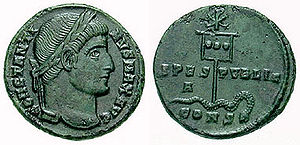
Eusebius stated that in addition to the singular labarum of Constantine, other similar standards (labara) were issued to the Roman army. This is confirmed by the two labara depicted being held by a soldier on a coin of Vetranio
(illustrated) dating from 350.

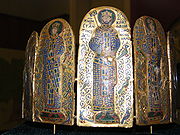 A later Byzantine manuscript indicates that a jewelled labarum standard believed to have been that of Constantine was preserved for centuries, as an object of great veneration, in the imperial treasury at Constantinople
. The labarum, with minor variations in its form, was widely used by the Christian Roman emperors who followed Constantine I.
A miniature version of the labarum became part of the imperial regalia of Byzantine
rulers, who were often depicted carrying it in their right hands.
The term "labarum" is used generally for any ecclesiastical banner, such as those carried in religious processions.
"The Holy Lavaro" were a set of early national Greek flags, blessed by the Greek Orthodox Church. Under these banners the Greeks united throughout the Greek Revolution (1821), a war of liberation waged against the Ottoman Empire
.
Labarum also gives its name (Labaro
) to a suburb of Rome
adjacent to Prima Porta
, one of the sites where the 'Vision of Constantine' is placed by tradition.
Vexillum
The vexillum was a flag-like object used in the Classical Era of the Roman Empire. The word is itself a diminutive for the Latin word, velum, sail, which confirms the historical evidence that vexilla were literally "little sails" i.e. flag-like standards...
(military standard) that displayed the "Chi-Rho" symbol ☧, formed from the first two Greek letters
Greek alphabet
The Greek alphabet is the script that has been used to write the Greek language since at least 730 BC . The alphabet in its classical and modern form consists of 24 letters ordered in sequence from alpha to omega...
of the word "Christ
Christ
Christ is the English term for the Greek meaning "the anointed one". It is a translation of the Hebrew , usually transliterated into English as Messiah or Mashiach...
" — Chi
Chi (letter)
Chi is the 22nd letter of the Greek alphabet, pronounced as in English.-Greek:-Ancient Greek:Its value in Ancient Greek was an aspirated velar stop .-Koine Greek:...
(χ) and Rho
Rho (letter)
Rho is the 17th letter of the Greek alphabet. In the system of Greek numerals, it has a value of 100. It is derived from Semitic resh "head"...
(ρ). It was used by the Roman emperor Constantine I. Since the vexillum consisted of a flag suspended from the crossbar of a cross, it was ideally suited to symbolize the crucifixion
Crucifixion
Crucifixion is an ancient method of painful execution in which the condemned person is tied or nailed to a large wooden cross and left to hang until dead...
of Christ.
The etymology of the word labarum is unclear; it is perhaps to be derived from Latin /labāre/ 'to totter, to waver' (in the sense of the "waving" of a flag in the breeze). Other proposals include a derivation from Celtic llafar ("eloquent"), from the Latin laureum [vexillum] ("laurel standard") or from ancient Cantabri
Cantabri
The Cantabri were a pre-Roman Celtic people which lived in the northern Atlantic coastal region of ancient Hispania, from the 4th to late 1st centuries BC.-Origins:...
dialect labaro ('four heads') (in modern-day Basque
Basque language
Basque is the ancestral language of the Basque people, who inhabit the Basque Country, a region spanning an area in northeastern Spain and southwestern France. It is spoken by 25.7% of Basques in all territories...
the word is lauburu
Lauburu
The lauburu or Basque cross has four comma-shaped heads similar to the Japanese tomoe. It can be constructed with a compass and straightedge, beginning with the formation of a square template; each head can be drawn from a neighboring vertex of this template with two compass settings, with one...
, with the same meaning), an ancient celtic symbol taken by the Legions during the Cantabrian Wars
Cantabrian Wars
The Cantabrian Wars occurred during the Roman conquest of the modern provinces of Cantabria, Asturias and León, against the Asturs and the Cantabri. They were the final stage of the conquest of Hispania.-Antecedents:...
.
Later usage has sometimes regarded the terms "labarum" and "Chi-Rho" as synonyms. Ancient sources, however, draw an unambiguous distinction between the two.
Vision of Constantine
Constantine I
Constantine the Great , also known as Constantine I or Saint Constantine, was Roman Emperor from 306 to 337. Well known for being the first Roman emperor to convert to Christianity, Constantine and co-Emperor Licinius issued the Edict of Milan in 313, which proclaimed religious tolerance of all...
claimed to have had a vision which led him to fight under the protection of the Christian God.
Lactantius
Lactantius
Lucius Caecilius Firmianus Lactantius was an early Christian author who became an advisor to the first Christian Roman emperor, Constantine I, guiding his religious policy as it developed, and tutor to his son.-Biography:...
states that, in the night before the battle, Constantine was commanded in a dream to "delineate the heavenly sign on the shields of his soldiers". He obeyed and marked the shields with a sign "denoting Christ". Lactantius describes that sign as a "staurogram", or a Latin cross
Christian cross
The Christian cross, seen as a representation of the instrument of the crucifixion of Jesus Christ, is the best-known religious symbol of Christianity...
with its upper end rounded in a P-like fashion, rather than the better known Chi-Rho sign described by Eusebius of Caesarea
Eusebius of Caesarea
Eusebius of Caesarea also called Eusebius Pamphili, was a Roman historian, exegete and Christian polemicist. He became the Bishop of Caesarea in Palestine about the year 314. Together with Pamphilus, he was a scholar of the Biblical canon...
. Thus, it had both the form of a cross and the monogram of Christ's name from the formed letters "X" and "P", the first letters of Christ's name in Greek.
From Eusebius, two accounts of the battle survive. The first, shorter one in the Ecclesiastical History
Church History (Eusebius)
The Church History of Eusebius, the bishop of Caesarea was a 4th-century pioneer work giving a chronological account of the development of Early Christianity from the 1st century to the 4th century. It was written in Koine Greek, and survives also in Latin, Syriac and Armenian manuscripts...
leaves no doubt that God helped Constantine but doesn't mention any vision. In his later Life of Constantine, Eusebius gives a detailed account of a vision and stresses that he had heard the story from the emperor himself. According to this version, Constantine with his army was marching somewhere (Eusebius doesn't specify the actual location of the event, but it clearly isn't in the camp at Rome) when he looked up to the sun and saw a cross of light above it, and with it the Greek words Ἐν Τούτῳ Νίκα
In hoc signo vinces
In hoc signo vinces is a Latin rendering of the Greek phrase "" en touto nika, and means "in this sign you will conquer"....
. The Latin translation of the Greek is in hoc signo vinces
In hoc signo vinces
In hoc signo vinces is a Latin rendering of the Greek phrase "" en touto nika, and means "in this sign you will conquer"....
— literally "In this sign, win," a more useful English translation would be, "By this sign conquer." At first he was unsure of the meaning of the apparition, but the following night he had a dream in which Christ explained to him that he should use the sign against his enemies. Eusebius then continues to describe the labarum, the military standard used by Constantine in his later wars against Licinius
Licinius
Licinius I , was Roman Emperor from 308 to 324. Co-author of the Edict of Milan that granted official toleration to Christians in the Roman Empire, for the majority of his reign he was the rival of Constantine I...
, showing the Chi-Rho sign.
Those two accounts can hardly be reconciled with each other, though they have been merged in popular notion into Constantine seeing the Chi-Rho sign on the evening before the battle. Both authors agree that the sign was not readily understandable as denoting Christ, which corresponds with the fact that there is no certain evidence of the use of the letters chi and rho as a Christian sign before Constantine. Its first appearance is on a Constantinian silver coin from c. 317, which proves that Constantine did use the sign at that time, though not very prominently. He made extensive use of the Chi-Rho and the labarum only later in the conflict with Licinius.
The vision has been interpreted in a solar context (e.g. as a solar halo
Halo (optical phenomenon)
A halo from Greek ἅλως; also known as a nimbus, icebow or gloriole) is an optical phenomenon produced by ice crystals creating colored or white arcs and spots in the sky. Many are near the sun or moon but others are elsewhere and even in the opposite part of the sky...
phenomenon), which would have been reshaped to fit with the Christian beliefs of the later Constantine.
Eusebius' description of the labarum
"Now it was made in the following manner. A long spear, overlaid with gold, formed the figure of the cross by means of a transverse bar laid over it. On the top of the whole was fixed a wreath of gold and precious stones; and within this, the symbol of the Saviour’s name, two letters indicating the name of Christ by means of its initial characters, the letter P being intersected by X in its centre: and these letters the emperor was in the habit of wearing on his helmet at a later period. From the cross-bar of the spear was suspended a cloth, a royal piece, covered with a profuse embroidery of most brilliant precious stones; and which, being also richly interlaced with gold, presented an indescribable degree of beauty to the beholder. This banner was of a square form, and the upright staff, whose lower section was of great length, of the pious emperor and his children on its upper part, beneath the trophy of the cross, and immediately above the embroidered banner."
"The emperor constantly made use of this sign of salvation as a safeguard against every adverse and hostile power, and commanded that others similar to it should be carried at the head of all his armies."
Iconographic career under Constantine
Arch of Constantine
The Arch of Constantine is a triumphal arch in Rome, situated between the Colosseum and the Palatine Hill. It was erected to commemorate Constantine I's victory over Maxentius at the Battle of Milvian Bridge on October 28, 312...
, which was erected, largely with fragments from older monuments, just three years after the battle, the labarum does not appear. A grand opportunity for just the kind of political propaganda that the Arch otherwise was expressly built to present was missed. That is if Eusebius' oath-confirmed account of Constantine's sudden, vision-induced, conversion can be trusted. Many historians have argued that in the early years after the battle the emperor had not yet decided to give clear public support to Christianity, whether from a lack of personal faith or because of fear of religious friction. The arch's inscription does say that the Emperor had saved the res publica
Res publica
Res publica is a Latin phrase, loosely meaning "public affair". It is the root of the word republic, and the word commonwealth has traditionally been used as a synonym for it; however translations vary widely according to the context...
INSTINCTV DIVINITATIS MENTIS MAGNITVDINE ("by greatness of mind and by instinct [or impulse] of divinity"). As with his predecessors, sun symbolism – interpreted as representing Sol Invictus
Sol Invictus
Sol Invictus was the official sun god of the later Roman empire. In 274 Aurelian made it an official cult alongside the traditional Roman cults. Scholars disagree whether the new deity was a refoundation of the ancient Latin cult of Sol, a revival of the cult of Elagabalus or completely new...
(the Unconquered Sun) or Helios
Helios
Helios was the personification of the Sun in Greek mythology. Homer often calls him simply Titan or Hyperion, while Hesiod and the Homeric Hymn separate him as a son of the Titans Hyperion and Theia or Euryphaessa and brother of the goddesses Selene, the moon, and Eos, the dawn...
, Apollo
Apollo
Apollo is one of the most important and complex of the Olympian deities in Greek and Roman mythology...
or Mithras – is inscribed on his coinage, but in 325 and thereafter the coinage ceases to be explicitly pagan, and Sol Invictus disappears. In his Historia Ecclesiae
Church History (Eusebius)
The Church History of Eusebius, the bishop of Caesarea was a 4th-century pioneer work giving a chronological account of the development of Early Christianity from the 1st century to the 4th century. It was written in Koine Greek, and survives also in Latin, Syriac and Armenian manuscripts...
Eusebius further reports that, after his victorious entry into Rome, Constantine had a statue of himself erected, "holding the sign of the Savior [the cross] in his right hand." There are no other reports to confirm such a monument.
Whether Constantine was the first Christian
Christian
A Christian is a person who adheres to Christianity, an Abrahamic, monotheistic religion based on the life and teachings of Jesus of Nazareth as recorded in the Canonical gospels and the letters of the New Testament...
emperor supporting during his rule a peaceful transition to Christianity, or an undecided pagan believer until middle age, strongly influenced in his political-religious decisions by his Christian mother St. Helena
Helena of Constantinople
Saint Helena also known as Saint Helen, Helena Augusta or Helena of Constantinople was the consort of Emperor Constantius, and the mother of Emperor Constantine I...
, is still in dispute among historians.
As for the labarum itself, there is little evidence for its use before 317. In the course of Constantine's second war against Licinius in 324, the latter developed a superstitious dread of Constantine's standard. During the attack of Constantine's troops at the Battle of Adrianople
Battle of Adrianople (324)
The Battle of Adrianople was fought on July 3, 324 during a Roman civil war, the second to be waged between the two emperors Constantine I and Licinius; Licinius suffered a heavy defeat.-Background:...
the guard of the labarum standard were directed to move it to any part of the field where his soldiers seemed to be faltering. The appearance of this talismanic object appeared to embolden Constantine's troops and dismay those of Licinius. At the final battle of the war, the Battle of Chrysopolis
Battle of Chrysopolis
The Battle of Chrysopolis was fought on 18 September 324 at Chrysopolis , near Chalcedon , between the two Roman emperors Constantine I and Licinius. The battle was the final encounter between the two emperors. After his navy's defeat in the Battle of the Hellespont, Licinius withdrew his forces...
, Licinius, though prominently displaying the images of Rome's pagan pantheon on his own battle line, forbade his troops from actively attacking the labarum, or even looking at it directly.
Constantine felt that both Licinius and Arius
Arius
Arius was a Christian presbyter in Alexandria, Egypt of Libyan origins. His teachings about the nature of the Godhead, which emphasized the Father's divinity over the Son , and his opposition to the Athanasian or Trinitarian Christology, made him a controversial figure in the First Council of...
were agents of Satan, and associated them with the serpent described in the Book of Revelation
Book of Revelation
The Book of Revelation is the final book of the New Testament. The title came into usage from the first word of the book in Koine Greek: apokalupsis, meaning "unveiling" or "revelation"...
(12:9). Constantine represented Licinius as a snake on his coins.
Eusebius stated that in addition to the singular labarum of Constantine, other similar standards (labara) were issued to the Roman army. This is confirmed by the two labara depicted being held by a soldier on a coin of Vetranio
Vetranio
Vetranio , born in the province of Moesia in a part of the region located in modern Serbia, is sometimes but incorrectly referred to as Vetriano. He was an experienced soldier and officer when he was asked by Constantina, the sister of Roman Emperor Constantius II, to proclaim himself Caesar...
(illustrated) dating from 350.
Later usage
Constantinople
Constantinople was the capital of the Roman, Eastern Roman, Byzantine, Latin, and Ottoman Empires. Throughout most of the Middle Ages, Constantinople was Europe's largest and wealthiest city.-Names:...
. The labarum, with minor variations in its form, was widely used by the Christian Roman emperors who followed Constantine I.
A miniature version of the labarum became part of the imperial regalia of Byzantine
Byzantine Empire
The Byzantine Empire was the Eastern Roman Empire during the periods of Late Antiquity and the Middle Ages, centred on the capital of Constantinople. Known simply as the Roman Empire or Romania to its inhabitants and neighbours, the Empire was the direct continuation of the Ancient Roman State...
rulers, who were often depicted carrying it in their right hands.
The term "labarum" is used generally for any ecclesiastical banner, such as those carried in religious processions.
"The Holy Lavaro" were a set of early national Greek flags, blessed by the Greek Orthodox Church. Under these banners the Greeks united throughout the Greek Revolution (1821), a war of liberation waged against the Ottoman Empire
Ottoman Empire
The Ottoman EmpireIt was usually referred to as the "Ottoman Empire", the "Turkish Empire", the "Ottoman Caliphate" or more commonly "Turkey" by its contemporaries...
.
Labarum also gives its name (Labaro
Labaro
Labaro is a suburb of Rome located 11 kilometres north of its center along the Via Flaminia, just outside of the Grande Raccordo Anulare highway, and adiacent to Prima Porta. It has a population of c. 16,000....
) to a suburb of Rome
Rome
Rome is the capital of Italy and the country's largest and most populated city and comune, with over 2.7 million residents in . The city is located in the central-western portion of the Italian Peninsula, on the Tiber River within the Lazio region of Italy.Rome's history spans two and a half...
adjacent to Prima Porta
Prima Porta
Prima Porta is a suburb of Rome located 12 kilometres north of its center along the Via Flaminia and just a kilometre outside of the Grande Raccordo Anulare highway. It is located on the right bank of the Tiber where the Via Tiberina leads away from the Via Flaminia and another road led off along...
, one of the sites where the 'Vision of Constantine' is placed by tradition.
See also
- Battle of Adrianople (324)Battle of Adrianople (324)The Battle of Adrianople was fought on July 3, 324 during a Roman civil war, the second to be waged between the two emperors Constantine I and Licinius; Licinius suffered a heavy defeat.-Background:...
- Battle of ChrysopolisBattle of ChrysopolisThe Battle of Chrysopolis was fought on 18 September 324 at Chrysopolis , near Chalcedon , between the two Roman emperors Constantine I and Licinius. The battle was the final encounter between the two emperors. After his navy's defeat in the Battle of the Hellespont, Licinius withdrew his forces...
- LabrysLabrysLabrys is the term for a symmetrical doubleheaded axe originally from Crete in Greece, one of the oldest symbols of Greek civilization; to the Romans, it was known as a bipennis....
- Christian symbolismChristian symbolismChristian symbolism invests objects or actions with an inner meaning expressing Christian ideas. Christianity has borrowed from the common stock of significant symbols known to most periods and to all regions of the world. Religious symbolism is effective when it appeals to both the intellect and...
- ChristogramChristogramA Christogram is a monogram or combination of letters that forms an abbreviation for the name of Jesus Christ, traditionally used as a Christian symbol. Different types of Christograms are associated with the various traditions of Christianity, e.g...
- Constantine I and ChristianityConstantine I and ChristianityDuring the reign of the Emperor Constantine the Great, Christianity became the dominant religion of the Roman Empire. Constantine, also known as Constantine I, had a significant religious experience following his victory at the Battle of Milvian Bridge in 312...
- Cantabrian Labarum
- Ammianus MarcellinusAmmianus MarcellinusAmmianus Marcellinus was a fourth-century Roman historian. He wrote the penultimate major historical account surviving from Antiquity...
- Arch of ConstantineArch of ConstantineThe Arch of Constantine is a triumphal arch in Rome, situated between the Colosseum and the Palatine Hill. It was erected to commemorate Constantine I's victory over Maxentius at the Battle of Milvian Bridge on October 28, 312...
, triumphal archTriumphal archA triumphal arch is a monumental structure in the shape of an archway with one or more arched passageways, often designed to span a road. In its simplest form a triumphal arch consists of two massive piers connected by an arch, crowned with a flat entablature or attic on which a statue might be...
to the victory at Milvian BridgeBattle of Milvian BridgeThe Battle of the Milvian Bridge took place between the Roman Emperors Constantine I and Maxentius on 28 October 312. It takes its name from the Milvian Bridge, an important route over the Tiber. Constantine won the battle and started on the path that led him to end the Tetrarchy and become the...
. - ChristianityChristianityChristianity is a monotheistic religion based on the life and teachings of Jesus as presented in canonical gospels and other New Testament writings...
- Constantinian shiftConstantinian shiftConstantinian shift is a term used by Anabaptist and Post-Christendom theologians to describe the political and theological aspects of the 4th-century process of Constantine's legalization of Christianity. The term was popularized by the Mennonite theologian John H...
- Chi RhoChi RhoThe Chi Rho is one of the earliest forms of christogram, and is used by Christians. It is formed by superimposing the first two letters chi and rho of the Greek word "ΧΡΙΣΤΟΣ" =Christ in such a way to produce the monogram ☧...
- MichaelionMichaelionThe Michaelion was the earliest and most famous sanctuary to Archangel Michael in the ancient Near East. It was built in the 4th century by Emperor Constantine, and was located just south of Constantinople....
- XI monogram
Further reading
- Grabar, Christian Iconography: A Study of its Origins (Princeton University Press) 1968:165ff
- Grant, Michael (1993), The Emperor Constantine, London. ISBN 0-75380-5286
- R. Grosse, "Labarum", Realencyclopädie der klassischen Altertumswissenschaft vol. 12, pt 1(Stuttgart) 1924:240-42.
- H. Grégoire, "L'étymologie de 'Labarum'" Byzantion 4 (1929:477-82).
- A. Lipinsky, "Labarum" Lexikon der christlichen Ikonographie 3 (Rome:1970)
- Lieu, S.N.C and Montserrat, D. (Ed.s) (1996), From Constantine to Julian, London. ISBN 0-415-09336-8
- Odahl, C.M., (2004) Constantine and the Christian Empire, Routledge 2004. ISBN 0415174856
- Smith, J.H., (1971) Constantine the Great, Hamilton, ISBN 0684123916