

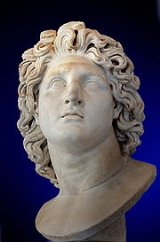
Helios

Encyclopedia
Helios was the personification of the Sun in Greek mythology
. Homer
often calls him simply Titan
or Hyperion
, while Hesiod
(Theogony
371) and the Homeric Hymn separate him as a son of the Titans Hyperion
and Theia
(Hesiod) or Euryphaessa (Homeric Hymn) and brother of the goddesses Selene
, the moon, and Eos
, the dawn. The names of these three were also the common Greek words for Sun, Moon and dawn. Ovid
also calls him Titan, in fact "lumina Titan". The Emperor Julian the Apostate
, forsook to show Romans that Helios was the only true god, and that the other Roman gods were just an image or manifestations of the supreme solar divinity, during that time the solar monotheism was the official religion of the Roman Empire, and Sol Invictus, was recognized as the supreme god.
Helios was imagined as a handsome god crowned with the shining aureole
of the Sun, who drove the chariot of the sun
across the sky each day to earth-circling Oceanus
and through the world-ocean returned to the East at night. Homer described Helios's chariot as drawn by solar steeds
(Iliad
xvi.779); later Pindar
described it as drawn by "fire-darting steeds" (Olympian Ode 7.71). Still later, the horses were given fiery names: Pyrois, Aeos, Aethon
, and Phlegon
.
As time passed, Helios was increasingly identified with the god of light, Apollo
. However, in spite of their syncretism, they were also often viewed as two distinct gods (Helios was a Titan
, whereas Apollo was an Olympian
). The equivalent of Helios in Roman mythology
was Sol
, specifically Sol Invictus
.
}. Cognate
with Latin sol, Sanskrit surya
, Old English swegl (sky-heavens) Germanic sunna, Welsh haul, etc. The female offspring of Helios were called Heliades
.
, who attempted to drive his father's chariot but lost control and set the earth on fire.
Helios was sometimes characterized with the epithet Helios Panoptes ("the all-seeing"). In the story told in the hall of Alcinous
in the Odyssey
(viii.300ff), Aphrodite
, the consort of Hephaestus
, secretly beds Ares
, but all-seeing Helios spies on them and tells Hephaestus, who ensnares the two lovers in nets invisibly fine, to punish them.
In the Odyssey
, Odysseus
and his surviving crew land on Thrinacia
, an island sacred to the sun god, whom Circe
names Hyperion rather than Helios. There, the sacred red cattle of the Sun were kept:
Though Odysseus warns his men, when supplies run short they impiously kill and eat some of the cattle of the Sun. The guardians of the island, Helios' daughter, tell their father about this. Helios appeals to Zeus
telling them to dispose of Odysseus' men or he will take the Sun and shine it in the Underworld. Zeus destroys the ship with his lightning bolt, killing all the men except for Odysseus.
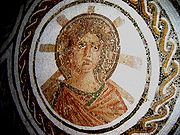 In one Greek vase painting, Helios appears riding across the sea in the cup of the Delphic tripod which appears to be a solar reference. Athenaeus
in Deipnosophistae
relates that, at the hour of sunset, Helios climbed into a great golden cup in which he passes from the Hesperides
in the farthest west to the land of the Ethiops, with whom he passes the dark hours. While Heracles
traveled to Erytheia to retrieve the cattle of Geryon
, he crossed the Libya
n desert and was so frustrated at the heat that he shot an arrow at Helios, the Sun. Almost immediately, Heracles realized his mistake and apologized profusely, in turn and equally courteous, Helios granted Heracles the golden cup which he used to sail across the sea every night, from the west to the east because he found Heracles' actions immensely bold. Heracles used this golden cup to reach Erytheia.
By the Oceanid Perse, Helios became the father of Aeëtes
, Circe
, and Pasiphaë
. His other children are Phaethusa ("radiant") and Lampetia ("shining").
In Homer
, Apollo
is clearly identified as a different god, a plague-dealer with a silver (not golden) bow and no solar features.
The earliest certain reference to Apollo identified with Helios appears in the surviving fragments of Euripides
' play Phaethon in a speech near the end (fr 781 N²), Clymene
, Phaethon's mother, laments that Helios has destroyed her child, that Helios whom men rightly call Apollo (the name Apollo is here understood to mean Apollon "Destroyer").
By Hellenistic times Apollo had become closely connected with the Sun in cult. His epithet Phoebus, Phoibos "shining", drawn from Helios, was later also applied by Latin
poets to the sun-god Sol. The identification became a commonplace in philosophic texts and appears in the writing of Parmenides
, Empedocles
, Plutarch
and Crates of Thebes
among others, as well as appearing in some Orphic texts. Pseudo-Eratosthenes writes about Orpheus
in Catasterismi
, section 24:
Dionysus and Asclepius
are sometimes also identified with this Apollo Helios.
Classical Latin poets also used Phoebus as a byname for the sun-god, whence come common references in later European poetry to Phoebus and his car ("chariot") as a metaphor for the sun. But in particular instances in myth, Apollo and Helios are distinct. The sun-god, the son of Hyperion, with his sun chariot, though often called Phoebus ("shining") is not called Apollo except in purposeful non-traditional identifications.
Despite these identifications, Apollo was never actually described by the Greek poets driving the chariot of the sun, although it was common practice among Latin poets.. Therefore, Helios is still known as the 'sun god' - the one who drives the sun chariot across the sky each day.
, but that very few of the communities of the later historic period retained it as a potent factor of the state religion." Our largely Attic literary sources tend to give us an unavoidable Athenian bias when we look at ancient Greek religion, and "no Athenian could be expected to worship Helios or Selene," J. Burnet observes, "but he might think them to be gods, since Helios was the great god of Rhodes and Selene was worshiped at Elis and elsewhere." James A. Notopoulos considers Burnet's an artificial distinction: "To believe in the existence of the gods involves acknowledgment through worship, as Laws 87 D, E shows" (note, p. 264). Aristophanes
' Peace (406-13) contrasts the worship of Helios and Selene with that of the more essentially Greek Twelve Olympians
, as the representative gods of the Achaemenid Persians
; all the evidence shows that Helios and Selene were minor gods to the Greeks.
.jpg) "The island of Rhodes
"The island of Rhodes
is almost the only place where Helios enjoys an important cult", Burkert asserts (p 174), instancing a spectacular rite in which a quadriga
, a chariot drawn by four horses, is driven over a precipice into the sea, with its overtones of the plight of Phaethon noted. There annual gymnastic tournaments were held in his honor. The Colossus of Rhodes
was dedicated to him. Helios also had a significant cult on the acropolis of Corinth
on the Greek mainland.
The tension between the mainstream traditional religious veneration of Helios, which had become enriched with ethical values and poetical symbolism in Pindar
, Aeschylus
and Sophocles
, and the Ionian proto-scientific examination of Helios the Sun, a phenomenon of the study Greeks termed meteora, clashed in the trial of Anaxagoras
ca 450 BCE, a forerunner of the culturally traumatic trial of Socrates
for irreligion, in 399.
In Plato
's Republic
(516B), Helios, the Sun, is the symbolic offspring of the idea of the Good.
, next to Tiur, the moon. He appears, rising out of the sea, with a fireball in either outstretched hand, on an engraved Etruscan bronze mirror
in late Archaic style, formerly on the Roman antiquities market. On Etruscan mirrors in Classical style, he appears with a halo
.
a cult of Helios Megistos ("Great Helios") drew to the image of Helios a number of syncretic
elements, which have been analysed in detail by Wilhelm Fauth by means of a series of late Greek texts, namely: an Orphic
Hymn to Helios; the so-called Mithras Liturgy, where Helios rules the elements; spells and incantations invoking Helios among the Greek Magical Papyri
; a Hymn to Helios by Proclus
; Julian
's Oration to Helios, the last stand of official paganism; and an episode in Nonnus
' Dionysiaca
.
(other sources list these two among the children of Clymene)
, of the names of horses that pulled Helios' chariot, are as follows.
"According to Eumelus of Corinth
- Eous; by him the sky is turned. Aethiops, as if faming, parches the grain. These trace-horses are male. The female are yoke-bearers: Bronte, whom we call Thunder, and Sterope, whom we call Lightning.
According to Homer, the names are : Abraxas
, *Therbeeo.
According to Ovid: Pyrois, Eous, Aethon
, and Phlegon
".
Greek mythology
Greek mythology is the body of myths and legends belonging to the ancient Greeks, concerning their gods and heroes, the nature of the world, and the origins and significance of their own cult and ritual practices. They were a part of religion in ancient Greece...
. Homer
Homer
In the Western classical tradition Homer , is the author of the Iliad and the Odyssey, and is revered as the greatest ancient Greek epic poet. These epics lie at the beginning of the Western canon of literature, and have had an enormous influence on the history of literature.When he lived is...
often calls him simply Titan
Titan (mythology)
In Greek mythology, the Titans were a race of powerful deities, descendants of Gaia and Uranus, that ruled during the legendary Golden Age....
or Hyperion
Hyperion (mythology)
Hyperion was one of the twelve Titans of Ancient Greece, the sons and daughters of Gaia and Ouranos , which were later supplanted by the Olympians. He was the brother of Cronus. He was also the lord of light, and the Titan of the east...
, while Hesiod
Hesiod
Hesiod was a Greek oral poet generally thought by scholars to have been active between 750 and 650 BC, around the same time as Homer. His is the first European poetry in which the poet regards himself as a topic, an individual with a distinctive role to play. Ancient authors credited him and...
(Theogony
Theogony
The Theogony is a poem by Hesiod describing the origins and genealogies of the gods of the ancient Greeks, composed circa 700 BC...
371) and the Homeric Hymn separate him as a son of the Titans Hyperion
Hyperion (mythology)
Hyperion was one of the twelve Titans of Ancient Greece, the sons and daughters of Gaia and Ouranos , which were later supplanted by the Olympians. He was the brother of Cronus. He was also the lord of light, and the Titan of the east...
and Theia
Theia
In Greek mythology, Theia "goddess" or "divine" , also called Euryphaessa "wide-shining," was a Titan...
(Hesiod) or Euryphaessa (Homeric Hymn) and brother of the goddesses Selene
Selene
In Greek mythology, Selene was an archaic lunar deity and the daughter of the Titans Hyperion and Theia. In Roman mythology, the moon goddess is called Luna, Latin for "moon"....
, the moon, and Eos
Eos
In Greek mythology, Eos is the Titan goddess of the dawn, who rose from her home at the edge of Oceanus, the ocean that surrounds the world, to herald her brother Helios, the Sun.- Greek literature :...
, the dawn. The names of these three were also the common Greek words for Sun, Moon and dawn. Ovid
Ovid
Publius Ovidius Naso , known as Ovid in the English-speaking world, was a Roman poet who is best known as the author of the three major collections of erotic poetry: Heroides, Amores, and Ars Amatoria...
also calls him Titan, in fact "lumina Titan". The Emperor Julian the Apostate
Julian the Apostate
Julian "the Apostate" , commonly known as Julian, or also Julian the Philosopher, was Roman Emperor from 361 to 363 and a noted philosopher and Greek writer....
, forsook to show Romans that Helios was the only true god, and that the other Roman gods were just an image or manifestations of the supreme solar divinity, during that time the solar monotheism was the official religion of the Roman Empire, and Sol Invictus, was recognized as the supreme god.
Helios was imagined as a handsome god crowned with the shining aureole
Aureola
An aureola or aureole is the radiance of luminous cloud which, in paintings of sacred personages, surrounds the whole figure...
of the Sun, who drove the chariot of the sun
Solar deity
A solar deity is a sky deity who represents the Sun, or an aspect of it, usually by its perceived power and strength. Solar deities and sun worship can be found throughout most of recorded history in various forms...
across the sky each day to earth-circling Oceanus
Oceanus
Oceanus ; , Ōkeanós) was a pseudo-geographical feature in classical antiquity, believed by the ancient Greeks and Romans to be the world-ocean, an enormous river encircling the world....
and through the world-ocean returned to the East at night. Homer described Helios's chariot as drawn by solar steeds
Bull (mythology)
The worship of the Sacred Bull throughout the ancient world is most familiar to the Western world in the biblical episode of the idol of the Golden Calf. The Golden Calf after being made by the Hebrew people in the wilderness of Sinai, were rejected and destroyed by Moses and his tribe after his...
(Iliad
Iliad
The Iliad is an epic poem in dactylic hexameters, traditionally attributed to Homer. Set during the Trojan War, the ten-year siege of the city of Troy by a coalition of Greek states, it tells of the battles and events during the weeks of a quarrel between King Agamemnon and the warrior Achilles...
xvi.779); later Pindar
Pindar
Pindar , was an Ancient Greek lyric poet. Of the canonical nine lyric poets of ancient Greece, his work is the best preserved. Quintilian described him as "by far the greatest of the nine lyric poets, in virtue of his inspired magnificence, the beauty of his thoughts and figures, the rich...
described it as drawn by "fire-darting steeds" (Olympian Ode 7.71). Still later, the horses were given fiery names: Pyrois, Aeos, Aethon
Aethon
The ancient Greek word aithôn means "burning", "blazing" or "shining." Less strictly, it can denote the colour red-brown, or "tawny." It is an epithet sometimes applied to animals such as horses at Hom. Il. 2.839 ; oxen at Od.18.372; and an eagle at Il. 15.690 The ancient Greek word aithôn means...
, and Phlegon
Phlegon
Phlegon may refer to:*Phlegon of Marathon, one of the Seventy Disciples*Phlegon of Tralles, a Greek historian who flourished in the 2nd century*Phlegon, one of the four horses of the chariot of the sun-god Helios in Greek mythology...
.
As time passed, Helios was increasingly identified with the god of light, Apollo
Apollo
Apollo is one of the most important and complex of the Olympian deities in Greek and Roman mythology...
. However, in spite of their syncretism, they were also often viewed as two distinct gods (Helios was a Titan
Titan (mythology)
In Greek mythology, the Titans were a race of powerful deities, descendants of Gaia and Uranus, that ruled during the legendary Golden Age....
, whereas Apollo was an Olympian
Twelve Olympians
The Twelve Olympians, also known as the Dodekatheon , in Greek mythology, were the principal deities of the Greek pantheon, residing atop Mount Olympus. Zeus, Hera, Poseidon, Demeter, Hestia, and Hades were siblings. Ares, Hermes, Hephaestus, Athena, Apollo, and Artemis were children of Zeus...
). The equivalent of Helios in Roman mythology
Roman mythology
Roman mythology is the body of traditional stories pertaining to ancient Rome's legendary origins and religious system, as represented in the literature and visual arts of the Romans...
was Sol
Sol (mythology)
Sol was the solar deity in Ancient Roman religion. It was long thought that Rome actually had two different, consecutive sun gods. The first, Sol Indiges, was thought to have been unimportant, disappearing altogether at an early period. Only in the late Roman Empire, scholars argued, did solar cult...
, specifically Sol Invictus
Sol Invictus
Sol Invictus was the official sun god of the later Roman empire. In 274 Aurelian made it an official cult alongside the traditional Roman cults. Scholars disagree whether the new deity was a refoundation of the ancient Latin cult of Sol, a revival of the cult of Elagabalus or completely new...
.
Etymology
The Greek masculine theonym Ἥλιος (Helios) is derived from the noun ἥλιος, "Sun" in ancient Greek. The ancient Greek word derives from Proto-Indo-EuropeanProto-Indo-European language
The Proto-Indo-European language is the reconstructed common ancestor of the Indo-European languages, spoken by the Proto-Indo-Europeans...
}. Cognate
Cognate
In linguistics, cognates are words that have a common etymological origin. This learned term derives from the Latin cognatus . Cognates within the same language are called doublets. Strictly speaking, loanwords from another language are usually not meant by the term, e.g...
with Latin sol, Sanskrit surya
Surya
Surya Suraya or Phra Athit is the chief solar deity in Hinduism, one of the Adityas, son of Kasyapa and one of his wives, Aditi; of Indra; or of Dyaus Pitar . The term Surya also refers to the Sun, in general. Surya has hair and arms of gold...
, Old English swegl (sky-heavens) Germanic sunna, Welsh haul, etc. The female offspring of Helios were called Heliades
Heliades
In Greek mythology, the Heliades were the daughters of Helios and Clymene the Oceanid.According to one source, there were three of them: Aegiale, Aegle, and Aetheria. According to another source, there were five: Helia, Merope, Phoebe, Aetheria, and Dioxippe...
.
Greek mythology
The best known story involving Helios is that of his son PhaëtonPhaëton
In Greek mythology, Phaëton or Phaethon was the son of Helios and the Oceanid Clymene. Alternate, less common genealogies make him a son of Clymenus by Merope, of Helios and Rhode or of Helios and Prote....
, who attempted to drive his father's chariot but lost control and set the earth on fire.
Helios was sometimes characterized with the epithet Helios Panoptes ("the all-seeing"). In the story told in the hall of Alcinous
Alcinous
Alcinous or Alkínoös was, in Greek mythology, a son of Nausithous, or of Phaeax , and father of Nausicaa, Halius, Clytoneus and Laodamas with Arete. His name literally means "mighty mind"...
in the Odyssey
Odyssey
The Odyssey is one of two major ancient Greek epic poems attributed to Homer. It is, in part, a sequel to the Iliad, the other work ascribed to Homer. The poem is fundamental to the modern Western canon, and is the second—the Iliad being the first—extant work of Western literature...
(viii.300ff), Aphrodite
Aphrodite
Aphrodite is the Greek goddess of love, beauty, pleasure, and procreation.Her Roman equivalent is the goddess .Historically, her cult in Greece was imported from, or influenced by, the cult of Astarte in Phoenicia....
, the consort of Hephaestus
Hephaestus
Hephaestus was a Greek god whose Roman equivalent was Vulcan. He is the son of Zeus and Hera, the King and Queen of the Gods - or else, according to some accounts, of Hera alone. He was the god of technology, blacksmiths, craftsmen, artisans, sculptors, metals, metallurgy, fire and volcanoes...
, secretly beds Ares
Ares
Ares is the Greek god of war. He is one of the Twelve Olympians, and the son of Zeus and Hera. In Greek literature, he often represents the physical or violent aspect of war, in contrast to the armored Athena, whose functions as a goddess of intelligence include military strategy and...
, but all-seeing Helios spies on them and tells Hephaestus, who ensnares the two lovers in nets invisibly fine, to punish them.
In the Odyssey
Odyssey
The Odyssey is one of two major ancient Greek epic poems attributed to Homer. It is, in part, a sequel to the Iliad, the other work ascribed to Homer. The poem is fundamental to the modern Western canon, and is the second—the Iliad being the first—extant work of Western literature...
, Odysseus
Odysseus
Odysseus or Ulysses was a legendary Greek king of Ithaca and the hero of Homer's epic poem the Odyssey. Odysseus also plays a key role in Homer's Iliad and other works in the Epic Cycle....
and his surviving crew land on Thrinacia
Thrinacia
Thrinakia , also Trinacria or Thrinacie, mentioned in Book 11 of Homer's Odyssey, is the island home of Helios's cattle, guarded by his eldest daughter, Lampetia...
, an island sacred to the sun god, whom Circe
Circe
In Greek mythology, Circe is a minor goddess of magic , described in Homer's Odyssey as "The loveliest of all immortals", living on the island of Aeaea, famous for her part in the adventures of Odysseus.By most accounts, Circe was the daughter of Helios, the god of the sun, and Perse, an Oceanid...
names Hyperion rather than Helios. There, the sacred red cattle of the Sun were kept:
Though Odysseus warns his men, when supplies run short they impiously kill and eat some of the cattle of the Sun. The guardians of the island, Helios' daughter, tell their father about this. Helios appeals to Zeus
Zeus
In the ancient Greek religion, Zeus was the "Father of Gods and men" who ruled the Olympians of Mount Olympus as a father ruled the family. He was the god of sky and thunder in Greek mythology. His Roman counterpart is Jupiter and his Etruscan counterpart is Tinia.Zeus was the child of Cronus...
telling them to dispose of Odysseus' men or he will take the Sun and shine it in the Underworld. Zeus destroys the ship with his lightning bolt, killing all the men except for Odysseus.
Athenaeus
Athenaeus , of Naucratis in Egypt, Greek rhetorician and grammarian, flourished about the end of the 2nd and beginning of the 3rd century AD...
in Deipnosophistae
Deipnosophistae
The Deipnosophistae may be translated as The Banquet of the Learned or Philosophers at Dinner or The Gastronomers...
relates that, at the hour of sunset, Helios climbed into a great golden cup in which he passes from the Hesperides
Hesperides
In Greek mythology, the Hesperides are nymphs who tend a blissful garden in a far western corner of the world, located near the Atlas mountains in North Africa at the edge of the encircling Oceanus, the world-ocean....
in the farthest west to the land of the Ethiops, with whom he passes the dark hours. While Heracles
Heracles
Heracles ,born Alcaeus or Alcides , was a divine hero in Greek mythology, the son of Zeus and Alcmene, foster son of Amphitryon and great-grandson of Perseus...
traveled to Erytheia to retrieve the cattle of Geryon
Geryon
In Greek mythology, Geryon , son of Chrysaor and Callirrhoe and grandson of Medusa, was a fearsome giant who dwelt on the island Erytheia of the mythic Hesperides in the far west of the Mediterranean. A more literal-minded later generation of Greeks associated the region with Tartessos in southern...
, he crossed the Libya
Libya
Libya is an African country in the Maghreb region of North Africa bordered by the Mediterranean Sea to the north, Egypt to the east, Sudan to the southeast, Chad and Niger to the south, and Algeria and Tunisia to the west....
n desert and was so frustrated at the heat that he shot an arrow at Helios, the Sun. Almost immediately, Heracles realized his mistake and apologized profusely, in turn and equally courteous, Helios granted Heracles the golden cup which he used to sail across the sea every night, from the west to the east because he found Heracles' actions immensely bold. Heracles used this golden cup to reach Erytheia.
By the Oceanid Perse, Helios became the father of Aeëtes
Aeëtes
In Greek mythology, Aeëtes , , , was a King of Colchis , son of the sun-god Helios and the Oceanid Perseis , brother of Circe and Pasiphae, and father of Medea, Chalciope and Apsyrtus...
, Circe
Circe
In Greek mythology, Circe is a minor goddess of magic , described in Homer's Odyssey as "The loveliest of all immortals", living on the island of Aeaea, famous for her part in the adventures of Odysseus.By most accounts, Circe was the daughter of Helios, the god of the sun, and Perse, an Oceanid...
, and Pasiphaë
Pasiphaë
In Greek mythology, Pasiphaë , "wide-shining" was the daughter of Helios, the Sun, by the eldest of the Oceanids, Perse; Like her doublet Europa, her origins were in the East, in her case at Colchis, the palace of the Sun; she was given in marriage to King Minos of Crete. With Minos, she was the...
. His other children are Phaethusa ("radiant") and Lampetia ("shining").
Helios and Apollo
Helios is sometimes identified with Apollo; "Different names may refer to the same being," Walter Burkert observes, "or else they may be consciously equated, as in the case of Apollo and Helios."In Homer
Homer
In the Western classical tradition Homer , is the author of the Iliad and the Odyssey, and is revered as the greatest ancient Greek epic poet. These epics lie at the beginning of the Western canon of literature, and have had an enormous influence on the history of literature.When he lived is...
, Apollo
Apollo
Apollo is one of the most important and complex of the Olympian deities in Greek and Roman mythology...
is clearly identified as a different god, a plague-dealer with a silver (not golden) bow and no solar features.
The earliest certain reference to Apollo identified with Helios appears in the surviving fragments of Euripides
Euripides
Euripides was one of the three great tragedians of classical Athens, the other two being Aeschylus and Sophocles. Some ancient scholars attributed ninety-five plays to him but according to the Suda it was ninety-two at most...
' play Phaethon in a speech near the end (fr 781 N²), Clymene
Clymene
Clymene or Klymenê may refer to*104 Klymene, an asteroid*Clymene dolphin , a dolphin endemic to the Atlantic Ocean*Clymene Moth*In Greek mythology:...
, Phaethon's mother, laments that Helios has destroyed her child, that Helios whom men rightly call Apollo (the name Apollo is here understood to mean Apollon "Destroyer").
By Hellenistic times Apollo had become closely connected with the Sun in cult. His epithet Phoebus, Phoibos "shining", drawn from Helios, was later also applied by Latin
Latin
Latin is an Italic language originally spoken in Latium and Ancient Rome. It, along with most European languages, is a descendant of the ancient Proto-Indo-European language. Although it is considered a dead language, a number of scholars and members of the Christian clergy speak it fluently, and...
poets to the sun-god Sol.
Parmenides
Parmenides of Elea was an ancient Greek philosopher born in Elea, a Greek city on the southern coast of Italy. He was the founder of the Eleatic school of philosophy. The single known work of Parmenides is a poem, On Nature, which has survived only in fragmentary form. In this poem, Parmenides...
, Empedocles
Empedocles
Empedocles was a Greek pre-Socratic philosopher and a citizen of Agrigentum, a Greek city in Sicily. Empedocles' philosophy is best known for being the originator of the cosmogenic theory of the four Classical elements...
, Plutarch
Plutarch
Plutarch then named, on his becoming a Roman citizen, Lucius Mestrius Plutarchus , c. 46 – 120 AD, was a Greek historian, biographer, essayist, and Middle Platonist known primarily for his Parallel Lives and Moralia...
and Crates of Thebes
Crates of Thebes
Crates of Thebes, was a Cynic philosopher. Crates gave away his money to live a life of poverty on the streets of Athens. He married Hipparchia of Maroneia who lived in the same manner that he did. Respected by the people of Athens, he is remembered for being the teacher of Zeno of Citium, the...
among others, as well as appearing in some Orphic texts. Pseudo-Eratosthenes writes about Orpheus
Orpheus
Orpheus was a legendary musician, poet, and prophet in ancient Greek religion and myth. The major stories about him are centered on his ability to charm all living things and even stones with his music; his attempt to retrieve his wife from the underworld; and his death at the hands of those who...
in Catasterismi
Catasterismi
Catasterismi is an Alexandrian prose retelling of the mythic origins of stars and constellations, as they were interpreted in Hellenistic culture...
, section 24:
- "But having gone down into HadesHadesHades , Hadēs, originally , Haidēs or , Aidēs , meaning "the unseen") was the ancient Greek god of the underworld. The genitive , Haidou, was an elision to denote locality: "[the house/dominion] of Hades". Eventually, the nominative came to designate the abode of the dead.In Greek mythology, Hades...
because of his wife and seeing what sort of things were there, he did not continue to worship DionysusDionysusDionysus was the god of the grape harvest, winemaking and wine, of ritual madness and ecstasy in Greek mythology. His name in Linear B tablets shows he was worshipped from c. 1500—1100 BC by Mycenean Greeks: other traces of Dionysian-type cult have been found in ancient Minoan Crete...
, because of whom he was famous, but he thought Helios to be the greatest of the gods, Helios whom he also addressed as Apollo. Rousing himself each night toward dawn and climbing the mountain called Pangaion, he would await the sun's rising, so that he might see it first. Therefore Dionysus, being angry with him, sent the Bassarides, as AeschylusAeschylusAeschylus was the first of the three ancient Greek tragedians whose work has survived, the others being Sophocles and Euripides, and is often described as the father of tragedy. His name derives from the Greek word aiskhos , meaning "shame"...
the tragedian says; they tore him apart and scattered the limbs."
Dionysus and Asclepius
Asclepius
Asclepius is the God of Medicine and Healing in ancient Greek religion. Asclepius represents the healing aspect of the medical arts; his daughters are Hygieia , Iaso , Aceso , Aglæa/Ægle , and Panacea...
are sometimes also identified with this Apollo Helios.
Classical Latin poets also used Phoebus as a byname for the sun-god, whence come common references in later European poetry to Phoebus and his car ("chariot") as a metaphor for the sun. But in particular instances in myth, Apollo and Helios are distinct. The sun-god, the son of Hyperion, with his sun chariot, though often called Phoebus ("shining") is not called Apollo except in purposeful non-traditional identifications.
Despite these identifications, Apollo was never actually described by the Greek poets driving the chariot of the sun, although it was common practice among Latin poets.. Therefore, Helios is still known as the 'sun god' - the one who drives the sun chariot across the sky each day.
Cult of Helios
L.R. Farnell assumed "that sun-worship had once been prevalent and powerful among the people of the pre-Hellenic culturePelasgians
The name Pelasgians was used by some ancient Greek writers to refer to populations that were either the ancestors of the Greeks or who preceded the Greeks in Greece, "a hold-all term for any ancient, primitive and presumably indigenous people in the Greek world." In general, "Pelasgian" has come...
, but that very few of the communities of the later historic period retained it as a potent factor of the state religion." Our largely Attic literary sources tend to give us an unavoidable Athenian bias when we look at ancient Greek religion, and "no Athenian could be expected to worship Helios or Selene," J. Burnet observes, "but he might think them to be gods, since Helios was the great god of Rhodes and Selene was worshiped at Elis and elsewhere." James A. Notopoulos considers Burnet's an artificial distinction: "To believe in the existence of the gods involves acknowledgment through worship, as Laws 87 D, E shows" (note, p. 264). Aristophanes
Aristophanes
Aristophanes , son of Philippus, of the deme Cydathenaus, was a comic playwright of ancient Athens. Eleven of his forty plays survive virtually complete...
' Peace (406-13) contrasts the worship of Helios and Selene with that of the more essentially Greek Twelve Olympians
Twelve Olympians
The Twelve Olympians, also known as the Dodekatheon , in Greek mythology, were the principal deities of the Greek pantheon, residing atop Mount Olympus. Zeus, Hera, Poseidon, Demeter, Hestia, and Hades were siblings. Ares, Hermes, Hephaestus, Athena, Apollo, and Artemis were children of Zeus...
, as the representative gods of the Achaemenid Persians
Achaemenid Empire
The Achaemenid Empire , sometimes known as First Persian Empire and/or Persian Empire, was founded in the 6th century BCE by Cyrus the Great who overthrew the Median confederation...
; all the evidence shows that Helios and Selene were minor gods to the Greeks.
Rhodes
Rhodes is an island in Greece, located in the eastern Aegean Sea. It is the largest of the Dodecanese islands in terms of both land area and population, with a population of 117,007, and also the island group's historical capital. Administratively the island forms a separate municipality within...
is almost the only place where Helios enjoys an important cult", Burkert asserts (p 174), instancing a spectacular rite in which a quadriga
Quadriga
A quadriga is a car or chariot drawn by four horses abreast . It was raced in the Ancient Olympic Games and other contests. It is represented in profile as the chariot of gods and heroes on Greek vases and in bas-relief. The quadriga was adopted in ancient Roman chariot racing...
, a chariot drawn by four horses, is driven over a precipice into the sea, with its overtones of the plight of Phaethon noted. There annual gymnastic tournaments were held in his honor. The Colossus of Rhodes
Colossus of Rhodes
The Colossus of Rhodes was a statue of the Greek Titan Helios, erected in the city of Rhodes on the Greek island of Rhodes by Chares of Lindos between 292 and 280 BC. It is considered one of the Seven Wonders of the Ancient World. It was constructed to celebrate Rhodes' victory over the ruler of...
was dedicated to him. Helios also had a significant cult on the acropolis of Corinth
Acrocorinth
Acrocorinth , "Upper Corinth", the acropolis of ancient Corinth, is a monolithic rock overseeing the ancient city of Corinth, Greece. "It is the most impressive of the acropoleis of mainland Greece," in the estimation of George Forrest. Acrocorinth was continuously occupied from archaic times to...
on the Greek mainland.
The tension between the mainstream traditional religious veneration of Helios, which had become enriched with ethical values and poetical symbolism in Pindar
Pindar
Pindar , was an Ancient Greek lyric poet. Of the canonical nine lyric poets of ancient Greece, his work is the best preserved. Quintilian described him as "by far the greatest of the nine lyric poets, in virtue of his inspired magnificence, the beauty of his thoughts and figures, the rich...
, Aeschylus
Aeschylus
Aeschylus was the first of the three ancient Greek tragedians whose work has survived, the others being Sophocles and Euripides, and is often described as the father of tragedy. His name derives from the Greek word aiskhos , meaning "shame"...
and Sophocles
Sophocles
Sophocles is one of three ancient Greek tragedians whose plays have survived. His first plays were written later than those of Aeschylus, and earlier than or contemporary with those of Euripides...
, and the Ionian proto-scientific examination of Helios the Sun, a phenomenon of the study Greeks termed meteora, clashed in the trial of Anaxagoras
Anaxagoras
Anaxagoras was a Pre-Socratic Greek philosopher. Born in Clazomenae in Asia Minor, Anaxagoras was the first philosopher to bring philosophy from Ionia to Athens. He attempted to give a scientific account of eclipses, meteors, rainbows, and the sun, which he described as a fiery mass larger than...
ca 450 BCE, a forerunner of the culturally traumatic trial of Socrates
Trial of Socrates
The Trial of Socrates refers to the trial and the subsequent execution of the classical Athenian philosopher Socrates in 399 BC. Socrates was tried on the basis of two notoriously ambiguous charges: corrupting the youth and impiety...
for irreligion, in 399.
In Plato
Plato
Plato , was a Classical Greek philosopher, mathematician, student of Socrates, writer of philosophical dialogues, and founder of the Academy in Athens, the first institution of higher learning in the Western world. Along with his mentor, Socrates, and his student, Aristotle, Plato helped to lay the...
's Republic
Republic (Plato)
The Republic is a Socratic dialogue written by Plato around 380 BC concerning the definition of justice and the order and character of the just city-state and the just man...
(516B), Helios, the Sun, is the symbolic offspring of the idea of the Good.
Usil, the Etruscan Helios
The Etruscan god of the Sun, equivalent to Helios, was Usil. His name appears on the bronze liver of PiacenzaLiver of Piacenza
The Liver of Piacenza is an Etruscan artifact found on September 26, 1877 near Gossolengo, in the province of Piacenza, Italy. It is a life-sized bronze model of a sheep's liver covered in Etruscan writings. The writings on the liver are names of Etruscan deities. It is believed that the bronze...
, next to Tiur, the moon. He appears, rising out of the sea, with a fireball in either outstretched hand, on an engraved Etruscan bronze mirror
Bronze mirror
Bronze mirrors preceded the glass mirrors of today. This type of mirror has been found by archaeologists among elite assemblages from various cultures, from Etruscan Italy to China.-History:-Egypt:...
in late Archaic style, formerly on the Roman antiquities market. On Etruscan mirrors in Classical style, he appears with a halo
Halo (religious iconography)
A halo is a ring of light that surrounds a person in art. They have been used in the iconography of many religions to indicate holy or sacred figures, and have at various periods also been used in images of rulers or heroes...
.
Helios Megistos
In Late AntiquityLate Antiquity
Late Antiquity is a periodization used by historians to describe the time of transition from Classical Antiquity to the Middle Ages, in both mainland Europe and the Mediterranean world. Precise boundaries for the period are a matter of debate, but noted historian of the period Peter Brown proposed...
a cult of Helios Megistos ("Great Helios") drew to the image of Helios a number of syncretic
Syncretism
Syncretism is the combining of different beliefs, often while melding practices of various schools of thought. The term means "combining", but see below for the origin of the word...
elements, which have been analysed in detail by Wilhelm Fauth by means of a series of late Greek texts, namely: an Orphic
Orphism (religion)
Orphism is the name given to a set of religious beliefs and practices in the ancient Greek and the Hellenistic world, as well as by the Thracians, associated with literature ascribed to the mythical poet Orpheus, who descended into Hades and returned...
Hymn to Helios; the so-called Mithras Liturgy, where Helios rules the elements; spells and incantations invoking Helios among the Greek Magical Papyri
Greek magical papyri
The Greek Magical Papyri is the name given by scholars to a body of papyri from Graeco-Roman Egypt, which each contain a number of magical spells, formulae, hymns and rituals. The materials in the papyri date from the 2nd century BC to the 5th century AD...
; a Hymn to Helios by Proclus
Proclus
Proclus Lycaeus , called "The Successor" or "Diadochos" , was a Greek Neoplatonist philosopher, one of the last major Classical philosophers . He set forth one of the most elaborate and fully developed systems of Neoplatonism...
; Julian
Julian the Apostate
Julian "the Apostate" , commonly known as Julian, or also Julian the Philosopher, was Roman Emperor from 361 to 363 and a noted philosopher and Greek writer....
's Oration to Helios, the last stand of official paganism; and an episode in Nonnus
Nonnus
Nonnus of Panopolis , was a Greek epic poet. He was a native of Panopolis in the Egyptian Thebaid, and probably lived at the end of the 4th or early 5th century....
' Dionysiaca
Dionysiaca
The Dionysiaca is an ancient epic poem and the principal work of Nonnus. It is an epic in 48 books, the longest surviving poem from antiquity at 20,426 lines, composed in Homeric dialect and dactylic hexameters, the main subject of which is the life of Dionysus, his expedition to India, and his...
.
Consorts/Children
- By Aegle the NaiadNaiadIn Greek mythology, the Naiads or Naiades were a type of nymph who presided over fountains, wells, springs, streams, and brooks....
- The CharitesCharitesIn Greek mythology, a Charis is one of several Charites , goddesses of charm, beauty, nature, human creativity and fertility. They ordinarily numbered three, from youngest to oldest: Aglaea , Euphrosyne , and Thalia . In Roman mythology they were known as the Gratiae, the "Graces"...
(who are otherwise called daughters of Eurynome with Zeus or of Aphrodite with Dionysus):- AglaeaAglaeaAglaea or Aglaïa is the name of several figures in Greek mythology.-Charis:The youngest of the Charites, Aglaea or Aglaia was one of three daughters of Zeus and the Oceanid Eurynome. Her other two sisters were Euphrosyne, and Thalia. Together they were known as the Three Graces, or the Charites...
"splendor" - EuphrosyneEuphrosyne (mythology)In Greek mythology, Euphrosyne In Greek mythology, Euphrosyne In Greek mythology, Euphrosyne (Εὐφροσύνη; was one of the Charites, known in English also as the "Three Graces". Her best remembered representation in English is in Milton's poem of the active, joyful life, "L'Allegro". She is also the...
"mirth" - ThaliaThalia (grace)In Greek mythology, Thalia was one of the three Graces or Charites with her sisters Aglaea and Euphrosyne, and a daughter of Zeus and the Oceanid Eurynome or the hour Eunomia...
"flourishing"
- Aglaea
- The Charites
- By Clymene, the OceanidOceanidIn Greek mythology and, later, Roman mythology, the Oceanids were the three thousand daughters of the Titans Oceanus and Tethys. Each was the patroness of a particular spring, river, sea, lake, pond, pasture, flower or cloud...
daughter of Oceanus and Tethys
- The HeliadesHeliadesIn Greek mythology, the Heliades were the daughters of Helios and Clymene the Oceanid.According to one source, there were three of them: Aegiale, Aegle, and Aetheria. According to another source, there were five: Helia, Merope, Phoebe, Aetheria, and Dioxippe...
, mostly represented as poplars mourning Phaëton's death beside the river EridanosEridanos (mythology)The river Eridanos or Eridanus is a river mentioned in Greek mythology. Virgil considered it one of the rivers of Hades in his Aeneid VI, 659.-Ancient references:...
, weeping tears of amber:- Aetheria
- Helia
- Merope
- Phoebe
- Dioxippe
- PhaëtonPhaëtonIn Greek mythology, Phaëton or Phaethon was the son of Helios and the Oceanid Clymene. Alternate, less common genealogies make him a son of Clymenus by Merope, of Helios and Rhode or of Helios and Prote....
, the son who borrowed the chariot of Helios, but lost control and plunged into the river EridanosEridanos (mythology)The river Eridanos or Eridanus is a river mentioned in Greek mythology. Virgil considered it one of the rivers of Hades in his Aeneid VI, 659.-Ancient references:... - AstrisAstrisIn Greek mythology, Astris was one of the Heliades, daughters of Helios, either by the Oceanid Clymene or the Oceanid Ceto. She married the river god Hydaspes and became mother of Deriades, king in India....
, wife of the river-god Hydaspes in India, mother of Deriades
- The Heliades
- By Neaera the nymph, two daughters - guardians of the cattle of ThrinaciaThrinaciaThrinakia , also Trinacria or Thrinacie, mentioned in Book 11 of Homer's Odyssey, is the island home of Helios's cattle, guarded by his eldest daughter, Lampetia...
:- PhaethusaPhaethusaIn Greek mythology, Phaethusa , or Phaëtusa was a daughter of Helios and Neaera, the personification of the brilliant, blinding rays of the sun. With her sister, Lampetia, she guarded the cattle of Thrinacia....
- LampetiaLampetiaIn Greek mythology, Lampetia was the daughter of Helios and Neaera; she was the personification of light. With her sister, Phaethusa, she guarded the cattle of Thrinacia. She told her father when Odysseus' men slaughtered some of his cattle which were ageless and deathless, like a forbidden fruit...
- Phaethusa
(other sources list these two among the children of Clymene)
- By Rhode, the OceanidOceanidIn Greek mythology and, later, Roman mythology, the Oceanids were the three thousand daughters of the Titans Oceanus and Tethys. Each was the patroness of a particular spring, river, sea, lake, pond, pasture, flower or cloud...
daughter of OceanusOceanusOceanus ; , Ōkeanós) was a pseudo-geographical feature in classical antiquity, believed by the ancient Greeks and Romans to be the world-ocean, an enormous river encircling the world....
and TethysTethys (mythology)In Greek mythology, Tethys , daughter of Uranus and Gaia was an archaic Titaness and aquatic sea goddess, invoked in classical Greek poetry but not venerated in cult. Tethys was both sister and wife of Oceanus...
- The HeliadaeHeliadaeIn Greek mythology, the Heliadae were the seven sons of Helios and Rhode, brothers to Electryone. They were Ochimus, Cercaphus, Macareus or Macar, Actis, Tenages, Triopas, and Candalus...
, expert seafarers and astrologers from Rhodes:- TenagesTenagesIn Greek mythology, Tenages was one of the Heliadae, a son of Rhodos and Helios. He was murdered by his brothers, Actis, Triopas, Macar and Candalus, who were jealous of Tenages's skill at science....
- MacareusMacareus (son of Helios)In Greek mythology, Macareus was one of the Heliadae, sons of Helios and Rhodos. Macareus and his brothers, Triopas, Actis and Candalus, were jealous of a fifth brother, Tenages's, skill at science, so they killed him and had to escape from Rhodes upon discovery of their crime...
- ActisActisIn Greek mythology, Actis was one of the Heliadae, a son of Rhodos and Helios. Actis, along with his brothers, Triopas, Macar and Candalus, were jealous of a fifth brother, Tenages's, skill at science. They killed him and Actis escaped to Egypt. According to Diodorus Siculus, Actis built the city...
- TriopasTriopasIn Greek mythology, Triopas, Triophas or Triops was the name of several characters, whose relations are unclear. He belonged to the house of Phoroneus....
- CandalusCandalusIn Greek mythology, Candalus was one of the Heliadae, a son of Rhodos and Helios. Candalus, along with his brothers, Triopas, Macar and Actis, were jealous of a fifth brother, Tenages's, skill at science. They killed him and Candalus escaped to Cos....
- OchimusOchimusIn Greek mythology, Ochimus was the eldest of the Heliadae, sons of Helios and Rhodos. One of his brothers, Tenages, was murdered by four others: Actis, Macareus, Candalus and Triopas, and they had to leave their native island of Rhodes...
- CercaphusCercaphusIn Greek mythology, Cercaphus was one of the Heliadae, sons of Helios and Rhodus. He and his brother Ochimus were the only to stay at the island of Rhodes, after their brother Tenages was killed by the other four and the murderers had to escape....
- Auges
- Thrinax
- Tenages
- ElectryoneElectryoneIn Greek mythology, Electyrone or Electryo or Alectrona was a daughter of Helios and Rhode, sister to the Heliadae. She died a virgin and was worshipped as a heroine on the island of Rhodes....
- The Heliadae
- By Perse or Perseis, the OceanidOceanidIn Greek mythology and, later, Roman mythology, the Oceanids were the three thousand daughters of the Titans Oceanus and Tethys. Each was the patroness of a particular spring, river, sea, lake, pond, pasture, flower or cloud...
daughter of Oceanus and Tethys:- Aegea
- AeëtesAeëtesIn Greek mythology, Aeëtes , , , was a King of Colchis , son of the sun-god Helios and the Oceanid Perseis , brother of Circe and Pasiphae, and father of Medea, Chalciope and Apsyrtus...
, ruler over ColchisColchisIn ancient geography, Colchis or Kolkhis was an ancient Georgian state kingdom and region in Western Georgia, which played an important role in the ethnic and cultural formation of the Georgian nation.The Kingdom of Colchis contributed significantly to the development of medieval Georgian... - CirceCirceIn Greek mythology, Circe is a minor goddess of magic , described in Homer's Odyssey as "The loveliest of all immortals", living on the island of Aeaea, famous for her part in the adventures of Odysseus.By most accounts, Circe was the daughter of Helios, the god of the sun, and Perse, an Oceanid...
, the minor magicians' goddess - PasiphaëPasiphaëIn Greek mythology, Pasiphaë , "wide-shining" was the daughter of Helios, the Sun, by the eldest of the Oceanids, Perse; Like her doublet Europa, her origins were in the East, in her case at Colchis, the palace of the Sun; she was given in marriage to King Minos of Crete. With Minos, she was the...
, wife of King MinosMinosIn Greek mythology, Minos was a king of Crete, son of Zeus and Europa. Every year he made King Aegeus pick seven men and seven women to go to Daedalus' creation, the labyrinth, to be eaten by The Minotaur. After his death, Minos became a judge of the dead in Hades. The Minoan civilization of Crete...
of CreteCreteCrete is the largest and most populous of the Greek islands, the fifth largest island in the Mediterranean Sea, and one of the thirteen administrative regions of Greece. It forms a significant part of the economy and cultural heritage of Greece while retaining its own local cultural traits... - PersesPerses (brother of Aeetes)In Greek mythology, Perses was the brother of Aeetes . He usurped the throne of Colchis from his brother, but was subsequently slain by Medea, his niece. He is not to be confused with the Titan known as Perses, who is known for fathering Hecate....
- By Ocyrrhoe the OceanidOceanidIn Greek mythology and, later, Roman mythology, the Oceanids were the three thousand daughters of the Titans Oceanus and Tethys. Each was the patroness of a particular spring, river, sea, lake, pond, pasture, flower or cloud...
:- Phasis, a river-god in ColchisColchisIn ancient geography, Colchis or Kolkhis was an ancient Georgian state kingdom and region in Western Georgia, which played an important role in the ethnic and cultural formation of the Georgian nation.The Kingdom of Colchis contributed significantly to the development of medieval Georgian...
- Phasis, a river-god in Colchis
- By Leucothoe, daughter of EurynomeEurynomeEurynomê was the Titan goddess of water-meadows and pasturelands, and one of the elder Oceanides, that is, a daughter of Oceanus and Tethys...
and OrchamusOrchamusOrchamus was a king in Greek mythology. He had two daughters: Leucothea and Clytia. Leucothea loved Apollo, the sun god. Apollo disguised himself as Leucothea's mother to gain entrance to her chambers. Clytia, jealous of her sister because she wanted Apollo for herself, told Orchamus the truth,...
:- Thersanon
- By Nausidame, daughter of AmphidamasAmphidamas-Mythology:Amphidamas is the name of six men in Greek mythology.1. Amphidamas, son of Aleus and Cleobule. He was one of the Argonauts, along with his brother Cepheus.2. Amphidamas, father of Nausidame. Nausidame bore Helios a son, Augeas....
of ElisElisElis, or Eleia is an ancient district that corresponds with the modern Elis peripheral unit...
:- AugeasAugeasIn Greek mythology, Augeas , whose name means "bright", was king of Elis and father of Epicaste. Some say that Augeas was one of the Argonauts....
, one of the ArgonautsArgonautsThe Argonauts ) were a band of heroes in Greek mythology who, in the years before the Trojan War, accompanied Jason to Colchis in his quest to find the Golden Fleece. Their name comes from their ship, the Argo, which was named after its builder, Argus. "Argonauts", therefore, literally means...
- Augeas
- By GaiaGaia (mythology)Gaia was the primordial Earth-goddess in ancient Greek religion. Gaia was the great mother of all: the heavenly gods and Titans were descended from her union with Uranus , the sea-gods from her union with Pontus , the Giants from her mating with Tartarus and mortal creatures were sprung or born...
- BisaltesBisaltesIn Greek mythology, Bisaltes , son of Helios and Gaia, was the eponymous hero of the Bisaltae and Bisaltia in Thracian Macedonia. Theophane was the daughter of Bisaltes....
- Bisaltes
- By SeleneSeleneIn Greek mythology, Selene was an archaic lunar deity and the daughter of the Titans Hyperion and Theia. In Roman mythology, the moon goddess is called Luna, Latin for "moon"....
- The HoraeHoraeIn Greek mythology the Horae or Hours were the goddesses of the seasons and the natural portions of time. They were originally the personifications of nature in its different seasonal aspects, but in later times they were regarded as goddessess of order in general and natural justice...
(possibly; more commonly known as daughters of ZeusZeusIn the ancient Greek religion, Zeus was the "Father of Gods and men" who ruled the Olympians of Mount Olympus as a father ruled the family. He was the god of sky and thunder in Greek mythology. His Roman counterpart is Jupiter and his Etruscan counterpart is Tinia.Zeus was the child of Cronus...
)
- The Horae
- By unknown mothers:
- AegialeAegiale (daughter of Helios)In Greek mythology, Aegiale was the daughter of Helios and Clymene. She is a member of the Heliades. It was either by her or by Enarete that Aeolus fathered Alcyone....
, possible mother to AlcyoneAlcyoneIn Greek mythology, Alcyone was the daughter of Aeolus, either by Enarete or Aegiale. She married Ceyx, son of Eosphorus, the Morning Star.... - Aithon, who chopped Demeter's sacred grove and was forever famished for that (compare the myth of ErysichthonErysichthonIn Greek mythology, Erysichthon can refer to two different personages:-Erysichthon of Thessaly:...
) - Aix, a nymph with a beautiful body and a horrible face
- AloeusAloeusAloeus can indicate one of two characters in Greek mythology:*Aloeus, the son of Poseidon and Canace, husband first of Iphimedeia and later of Eriboea , and father of Salmoneus , and the eponym of Otus and Ephialtes, collectively known as the Aloadae. These giants made war on the gods and...
, ruler over AsopiaSicyonSikyon was an ancient Greek city situated in the northern Peloponnesus between Corinth and Achaea on the territory of the present-day prefecture of Corinthia... - Camirus, founder of CamiraCamiraCamir may refer to:* Holden Camira car manufactured in Australia* Camira, Queensland, a town in Australia...
, a city in RhodesRhodesRhodes is an island in Greece, located in the eastern Aegean Sea. It is the largest of the Dodecanese islands in terms of both land area and population, with a population of 117,007, and also the island group's historical capital. Administratively the island forms a separate municipality within... - Mausolus
- PhorbasPhorbasIn Greek mythology, Phorbas or Phorbaceus may refer to:*Phorbas, a prince of the Thessalian Phlegyes who emigrated to Elis in the Peloponnesos. Phorbas was the son of Lapithes and Orsinome, and a brother of Periphas. He assisted Alector, king of Elis, in the war against Pelops, and shared the...
, father of Ambracia
- Aegiale
Horses of Helios
Some lists, cited by HyginusHyginus
Hyginus can refer to:People:*Gaius Julius Hyginus , Roman poet, author of Fabulae, reputed author of Poeticon astronomicon*Hyginus Gromaticus, Roman surveyor*Pope Hyginus, also a saint, Bishop of Rome about 140...
, of the names of horses that pulled Helios' chariot, are as follows.
"According to Eumelus of Corinth
Eumelus of Corinth
Eumelus of Corinth or Eumelos of Korinthos, of the clan of the Bacchiadae, is a semi-legendary early Greek poet, the Corinthian author of the Prosodion, the treasured processional anthem of Messenian independence that was performed on Delos. One small fragment of it survives in a quote by Pausanias...
- Eous; by him the sky is turned. Aethiops, as if faming, parches the grain. These trace-horses are male. The female are yoke-bearers: Bronte, whom we call Thunder, and Sterope, whom we call Lightning.
According to Homer, the names are : Abraxas
Abraxas
The word Abrasax was a word of mystic meaning in the system of the Gnostic Basilides, being there applied to the “Great Archon” , the princeps of the 365 spheres...
, *Therbeeo.
According to Ovid: Pyrois, Eous, Aethon
Aethon
The ancient Greek word aithôn means "burning", "blazing" or "shining." Less strictly, it can denote the colour red-brown, or "tawny." It is an epithet sometimes applied to animals such as horses at Hom. Il. 2.839 ; oxen at Od.18.372; and an eagle at Il. 15.690 The ancient Greek word aithôn means...
, and Phlegon
Phlegon
Phlegon may refer to:*Phlegon of Marathon, one of the Seventy Disciples*Phlegon of Tralles, a Greek historian who flourished in the 2nd century*Phlegon, one of the four horses of the chariot of the sun-god Helios in Greek mythology...
".
See also
- AmshumanAmshumanAmshuman is a figure of Hindu mythology, and the word means the sun denoting someone who gives light and dispels darkness. Amshuman was the son of Asamanjaya, and they were descendants of Ikshvaku, a king of Raghuvamsa. Anshuman Gaikwad is the most famous person named after this mythological king...
- Black Sun (mythology)Black Sun (mythology)The Black Sun in Mesoamerican mythology has many mystical meanings, among them it is connected to the god Quetzalcoatl and his penetration in the Underworld through the west door after his diurnal passage on the sky. Amidst the Mexicas there were two suns, the young day sun and the ancient sun,...
- Five Suns (mythology)Five SunsFive Suns is an album by progressive rock group Guapo released in 2003.- Track listing :#Five Suns, Pt. 1 #Five Suns, Pt. 2 #Five Suns, Pt. 3 #Five Suns, Pt. 4 #Five Suns, Pt...
- GuaraciGuaraciGuaraci is a municipality in the northwestern area of the state of São Paulo in Brazil. The population in 2004 is 9,376 and the area is 640.72 km². The elevation is 481 meters. This place name comes from the Tupi language....
- Heliopolis (ancient)Heliopolis (ancient)Heliopolis was one of the oldest cities of ancient Egypt, the capital of the 13th Lower Egyptian nome that was located five miles east of the Nile to the north of the apex of the Nile Delta...
- Piltzintecuhtli (mythologyPiltzintecuhtliIn Aztec mythology, Piltzintecuhtli was a god of the rising sun, healing, and visions, associated with Tonatiuh. The name means "the Young Prince". It may have been another name for Tonatiuh, but he is also mentioned as a possibly unique individual, the husband of Xochiquetzal. He was the lord of...
- Sol (mythology)Sol (mythology)Sol was the solar deity in Ancient Roman religion. It was long thought that Rome actually had two different, consecutive sun gods. The first, Sol Indiges, was thought to have been unimportant, disappearing altogether at an early period. Only in the late Roman Empire, scholars argued, did solar cult...
External links
- Theoi Project, Helios references to the god in classical literature and art
- Greek Mythology Link, Helius summary of Helius myths