
All Topics  
Hestia

 
Hestia

   Email Print
   Bookmark   Link


Hestia


In Greek mythology
Greek mythology

Greek mythology is the body of myths and legends belonging to the Ancient Greece concerning their List of Greek mythological figures#Immortals and Greek hero cult, Cosmology#Metaphysical cosmology, and the origins and significance of their own cult and ritual practices....
, virginal Hestia, (Roman Vesta
Vesta (mythology)

Vesta was the virgin goddess of the hearth, home, and family in Roman mythology. Although she is often mistaken as analogous to Hestia in Greek mythology, she had a large, albeit mysterious, role in Roman religion long before she appeared in Greece....
) daughter of Cronus
Cronus

Cronus or Kronos, , was the leader and the youngest of the first generation of Titan , divine descendants of Gaia , the earth, and Uranus , the sky....
 and Rhea
Rhea (mythology)

This page is about the Greek mythological figure. For the bird, see Rhea .Rhea was the Titan daughter of Ouranos , the sky, and Gaia , the earth, in Classical Greece mythology....
, (ancient Greek
Greek language

Greek is an Indo-European languages native to the southern Balkan peninsula, the language of the Greek people. It forms an independent branch within Indo-European....
 
) is the goddess
Goddess

A goddess is a female deity. Often deities are part of a polytheism system that includes several deities in a pantheon .Common associations of goddesses are the Earth goddess, the Mother Goddess, Love goddess, and the hearth goddess, reflecting historical gender roles....
 of the hearth
Hearth

In common historic and modern usage, a hearth is a brick- or rock -lined fireplace or oven used for cooking and/or heating. Because of its nature, in historic times the hearth was considered an integral part of a home, often its central or most important feature: its Latin name is focus....
, of the right ordering of domesticity and the family, who received the first offering at every sacrifice in the household. In the public domain, the hearth of the
prytaneum functioned as her official sanctuary. With the establishment of a new colony, flame from Hestia's public hearth would be carried to the new settlement.

In Roman mythology
Roman mythology

Roman mythology, or more appropriately, Latin mythology, refers to the mythology beliefs of the Italic people inhabiting the region of Latium and its main city, Rome....
, her civic equivalent was Vesta, who personified the public hearth, and whose cult round the ever-burning hearth bound Romans together in the form of an extended family.


Discussion
Ask a question about 'Hestia'
Start a new discussion about 'Hestia'
Answer questions from other users
Full Discussion Forum


Encyclopedia


In Greek mythology
Greek mythology

Greek mythology is the body of myths and legends belonging to the Ancient Greece concerning their List of Greek mythological figures#Immortals and Greek hero cult, Cosmology#Metaphysical cosmology, and the origins and significance of their own cult and ritual practices....
, virginal Hestia, (Roman Vesta
Vesta (mythology)

Vesta was the virgin goddess of the hearth, home, and family in Roman mythology. Although she is often mistaken as analogous to Hestia in Greek mythology, she had a large, albeit mysterious, role in Roman religion long before she appeared in Greece....
) daughter of Cronus
Cronus

Cronus or Kronos, , was the leader and the youngest of the first generation of Titan , divine descendants of Gaia , the earth, and Uranus , the sky....
 and Rhea
Rhea (mythology)

This page is about the Greek mythological figure. For the bird, see Rhea .Rhea was the Titan daughter of Ouranos , the sky, and Gaia , the earth, in Classical Greece mythology....
, (ancient Greek
Greek language

Greek is an Indo-European languages native to the southern Balkan peninsula, the language of the Greek people. It forms an independent branch within Indo-European....
 
) is the goddess
Goddess

A goddess is a female deity. Often deities are part of a polytheism system that includes several deities in a pantheon .Common associations of goddesses are the Earth goddess, the Mother Goddess, Love goddess, and the hearth goddess, reflecting historical gender roles....
 of the hearth
Hearth

In common historic and modern usage, a hearth is a brick- or rock -lined fireplace or oven used for cooking and/or heating. Because of its nature, in historic times the hearth was considered an integral part of a home, often its central or most important feature: its Latin name is focus....
, of the right ordering of domesticity and the family, who received the first offering at every sacrifice in the household. In the public domain, the hearth of the
prytaneum functioned as her official sanctuary. With the establishment of a new colony, flame from Hestia's public hearth would be carried to the new settlement.

In Roman mythology
Roman mythology

Roman mythology, or more appropriately, Latin mythology, refers to the mythology beliefs of the Italic people inhabiting the region of Latium and its main city, Rome....
, her civic equivalent was Vesta, who personified the public hearth, and whose cult round the ever-burning hearth bound Romans together in the form of an extended family. The similarity of names between Hestia and Vesta, is misleading: "The relationship
hestia-histie-Vesta cannot be explained in terms of Indo-European
Indo-European studies

Indo-European studies is a field of linguistics dealing with Indo-European languages, both current and extinct. Its goal is to amass information about the hypothetical proto-language from which all of these languages are descended, a language dubbed Proto-Indo-European language , and its speakers, the Proto-Indo-Europeans, including their soc...
 linguistics; borrowings from a third language must also be involved," Walter Burkert
Walter Burkert

Walter Burkert , a scholar of Greek mythology and Cult , is an emeritus professor of classics at the University of Zurich, Switzerland, and also has taught in the United Kingdom and the United States....
 has written. At a deep level her name means "home and hearth": the household and its inhabitants. "An early form of the temple is the hearth house; the early temples at Dreros
Dreros

Dreros near Neapolis in the district of Lassithi, Crete, is a Minoan civilization archaeological site, 16 km. northwest of Aghios Nikolaos. Known only by a chance remark of the ninth-century Byzantine grammarian Theognostus , archaeology of the site shows Dreros to have been initially colonised by mainland Greeks in the Archaic period in Gre...
 and Prinias
Prinias

Prinias , Crete, 35 kilometres southwest of Iraklion, about halfway between Gortyn and Knossos, is an archaeological site that has revealed a seventh-century BCE temple with striking similarities to Egyptian architecture, and an Egyptianizing seated goddess....
 on Crete are of this type as indeed is the temple of Apollo at Delphi
Delphi

Delphi is an archaeology site and a modern town in Greece on the south-western spur of Mount Parnassus in the valley of Phocis. Delphi was the site of the Pythia, the most important oracle in the classical Greek world, when it was a major site for the worship of the god Apollo after he slew the Python , a deity who lived there and protecte...
 which always had its inner
hestia" (Burkert p 61). Among classical Greeks the altar was always in the open air with no roof but the sky, and that the oracle at Delphi was the shrine of the Goddess before it was assumed by Apollo. The Mycenaean great hall, such as the hall of Odysseus
Odysseus

Odysseus or Ulysses , in Greek mythology , was a legendary Greeks king of Ithaca and the hero of Homer's Epic poetry, the Odyssey. Odysseus also plays a key role in Homer's Iliad and other works in the Epic Cycle....
 at Ithaca was a megaron
Megaron

The megaron is the "great hall" of Mycenaean culture. The rectangular hall, fronted by an open, two-columned porch and a more or less central hearth traditional in Greece since Mycenaean Greece times, is ancestor of the temple in Greece....
, with a central hearthfire.

The hearth fire of a Greek
Ancient Greece

The term Ancient Greece refers to the period of History of Greece lasting from the Greek Dark Ages ca. 1100 BC and the Dorian invasion, to 146 BC and the Roman Republic conquest of Greece after the Battle of Corinth ....
 or a Roman
Ancient Rome

Ancient Rome was a civilization that grew out of a small agricultural community founded on the Italian Peninsula as early as the 10th century BC....
 household was not allowed to go out, unless it was ritually extinguished and ritually renewed, accompanied by impressive rituals of completion, purification and renewal. Compare the rituals and connotations of an eternal flame
Eternal flame

An eternal flame is a flame or torch that burns constantly. The flame that burned constantly at Delphi, was an archaic feature, "alien to the ordinary Greek temple"....
 and of sanctuary lamp
Sanctuary lamp

A sanctuary lamp, altar lamp, or eternal flame is a light that shines before the altar of sanctuaries in many denominations of Jewish and Christian places of worship....
s. At the more developed level of the
polis
Polis

A polis -- plural: poleis --is a city, a city-state and also citizenship and body of citizens. When used to describe Classical Athens and its contemporaries, polis is often translated as "city-state."...
, Hestia symbolizes the alliance between the colonies and their mother cities.

As an Olympian

Hestia is one of the three Great Goddesses of the first Olympian generation: Hestia, Demeter
Demeter

File:Demeter in horse chariot w daughter kore 83d40m wikiC Tempio Y di Selinunte sec VIa.JPGDemeter , in Greek mythology, is the Goddess of cereal and fertility, the pure....
 and Hera
Hera

In the Twelve Olympians of classical Greek Mythology, Hera or Here was the wife and older sister of Zeus. Her chief function was as goddess of women and marriage....
. She was described as both the oldest and youngest of the three daughters of Rhea
Rhea (mythology)

This page is about the Greek mythological figure. For the bird, see Rhea .Rhea was the Titan daughter of Ouranos , the sky, and Gaia , the earth, in Classical Greece mythology....
 and Cronus
Cronus

Cronus or Kronos, , was the leader and the youngest of the first generation of Titan , divine descendants of Gaia , the earth, and Uranus , the sky....
, the sisters to three brothers Zeus
Zeus

Zeus in Greek mythology is the king of the gods, the ruler of Mount Olympus and the god of the sky father and List of thunder gods. His symbols are the thunderbolt, eagle, bull , and oak....
, Poseidon
Poseidon

In Greek mythology, Poseidon was the god of the sea and, as "Earth-Shaker," of earthquakes. The name of the god Nethuns in Etruscan mythology was adopted in Latin for Neptune in Roman mythology: both were sea gods analogous to Poseidon....
, and Hades
Hades

Hades refers both to the ancient Greek underworld, the abode of Hades, and to the god of the underworld. Hades in Homer referred just to the god; the genitive case , Haidou, was an elision to denote locality: "[the house/dominion] of Hades"....
. Originally listed as one of the Twelve Olympians
Twelve Olympians

The Twelve Olympians or younger gods, also known as the Dodekatheon , in Greek mythology, were the principal Greek Godss of the Greek pantheon , residing atop Mount Olympus, having supplanted the Titan or older gods in the greek mythogical narrative....
, Hestia gave up her seat in favour of newcomer Dionysus
Dionysus

In classical mythology, Dionysus or Dionysos , is the God of wine, the inspirer of ritual madness and ecstasy, and a major figure of Greek mythology, and one of the twelve Olympians, among whom Greek mythology treated Dionysus as a late arrival....
 to tend to the sacred fire on Mt. Olympus. Every family hearth was her altar.

Of the Olympian gods, Hestia has the fewest exploits "since the hearth is immovable Hestia is unable to take part even in the procession of the gods, let alone the other antics of the Olympians," Burkert remarks. Sometimes this is assumed to be due to her passive, non-confrontational nature. This nature is illustrated by her giving up her seat in the Olympian twelve to prevent conflict. She is considered to be the first-born of Rhea and Kronus; this is evidenced by the fact that in Greek (and later Roman) culture ritual offerings to all gods began with a small offering to Hestia; the phrase "Hestia comes first" from ancient Greek culture denotes this.

Immediately after their birth, Kronus swallowed Hestia and her siblings except for the last and youngest, Zeus, who later rescued them and led them in a war against Kronus and the other Titans
Titan (mythology)

In Greek mythology, the Titans ; were a race of powerful deities that ruled during the legendary golden age. Their role as Elder Gods was overthrown by a race of younger gods, the Twelve Olympians, effected a mythological paradigm shift that the Greeks borrowed from the Ancient Near East....
. Hestia, the eldest daughter "became their youngest child, since she was the first to be devoured by their father and the last to be yielded up again" (Kereny 1951:91) — the clearest possible example of mythic inversion, a paradox
Paradox

A paradox is a Proposition or group of statements that leads to a contradiction or a situation which defies intuition ; or, it can be an apparent contradiction that actually expresses a non-dual truth ....
 that is noted in the Homeric hymn to Aphrodite (ca 700 BCE):

Poseidon, and Apollo of the younger generation each aspired to court Hestia, but the goddess was unmoved by Aphrodite's works and swore on the head of Zeus to retain her virginity
Virginity

A Virgin is, originally, a woman who has never had sexual intercourse. Virginity is the state of being a virgin. The term has traditionally also been applied to men....
. The Homeric hymns, like all early Greek literature, are concerned to reinforce the supremacy of Zeus, and Hestia's oath taken upon the head of Zeus is an example of surety. A measure of the goddess's ancient primacy—"queenly maid...among all mortal men she is chief of the goddesses", in the words of the Homeric hymn— is that she was owed the first as well as the last sacrifice at every ceremonial assembly of Hellenes, a pious duty related by the mythographers as the
gift of Zeus, as if it had been his to bestow: another mythic inversion if, as is likely, the ritual was too deep-seated and essential for the Olympian reordering to overturn. There are theories (by modern neopagans among others) that Hestia, as goddess of "home and hearth", was one of the most ancient of all gods later worshipped as Olympians; as a maternal goddess of humans finding safety and homes in caves around a fire, worship of Hestia, by other names, may literally be hundreds of thousands of years old and has continued through Classical Greek times to the present day.

Leaving Olympus

Hestia, not wanting to be involved in the gods' quarrels, decided to leave Olympus to tend to her sacred hearth. She became a lesser goddess in the same ranks of Pan
PAN

Pan and panning can have many meanings as listed below in various categories....
 and Dionysus
Dionysus

In classical mythology, Dionysus or Dionysos , is the God of wine, the inspirer of ritual madness and ecstasy, and a major figure of Greek mythology, and one of the twelve Olympians, among whom Greek mythology treated Dionysus as a late arrival....
, the latter of whom later rose to the place of Olympian when Zeus chose him to take Hestia's place.

Other worship

The "great hall" of Minoan-Mycenaean culture as well as the type of earliest enclosed site built for worship on the Greek mainland is the
megaron
Megaron

The megaron is the "great hall" of Mycenaean culture. The rectangular hall, fronted by an open, two-columned porch and a more or less central hearth traditional in Greece since Mycenaean Greece times, is ancestor of the temple in Greece....
: the name of the Goddess who was venerated in the Helladic megara is not recorded, but at the center of each holy site laid bare by archaeologists was normally a hearth.

In his account of the
Fasti
Fasti

Fasti, a Latin word, refers to the Roman calendar and almanac; and especially, to a long, possibly unfinished poem on the religious festivals of the Roman year and their mythology underpinnings, by the poet Ovid....
of the Roman year, Ovid twice recounted an anecdote of Priapus
Priapus

In Greek mythology, Priapus was a minor rustic fertility god, protector of livestock, fruit plants, gardens and male genitalia. His Roman mythology equivalent was Mutinus Mutunus....
's foiled attempt on a sleeping nymph: once he told it of the nymph Lotis and then again, calling it a "very playful little tale", he retold it of Vesta, the Roman equivalent of Hestia. In the anecdote, after a great feast, when the immortals were all either passed out drunk or asleep, Priapus — who had grotesquely large genitalia — spied Lotis/Vesta and was filled with lust for her. He quietly approached the nymph, but the braying of an ass awoke her just in time. She screamed at the sight and Priapus ran away.

In mythology

Hestia figures in few myth
Mythology

The word mythology refers to a body of folklore/myths/legends that a particular culture believes to be true and that often use the supernatural to interpret natural events and to explain the nature of the universe and humanity....
s: she did not roam or have any adventures. The Homeric hymn
To Hestia is consequently brief, simply an invocation of five lines, a prelude:

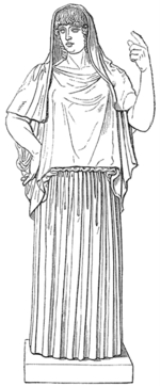
In the hymn, Hestia is located in ancient Delphi (rather than at the hearth of Zeus on Mount Olympus), which was considered the central hearth of all the Hellenes. In classical Greek art, Hestia was depicted as a woman modestly cloaked in a head veil.

Sources

  • Burkert, Walter
    Walter Burkert

    Walter Burkert , a scholar of Greek mythology and Cult , is an emeritus professor of classics at the University of Zurich, Switzerland, and also has taught in the United Kingdom and the United States....
    , 1985.
    Greek Religion (Harvard University Press)
  • Kerenyi, Karl
    Karl Kerényi

    One of the founders of modern studies in Greek mythology, K?roly Ker?nyi was born in Temesv?r, Hungary , and then lived in Hungary....
    , 1951.
    The Gods of the Greeks
  • Stephenson, Hamish, 1985. "The Gods of the Romans and Greeks" (NYT Writer)


External links

  • (Vesta)