

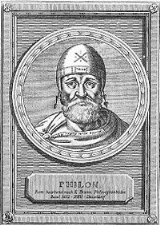
Philo

Encyclopedia
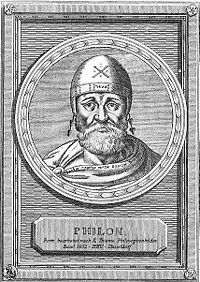
Hellenistic Judaism
Hellenistic Judaism was a movement which existed in the Jewish diaspora that sought to establish a Hebraic-Jewish religious tradition within the culture and language of Hellenism...
Biblical
Bible
The Bible refers to any one of the collections of the primary religious texts of Judaism and Christianity. There is no common version of the Bible, as the individual books , their contents and their order vary among denominations...
philosopher born in Alexandria
Alexandria
Alexandria is the second-largest city of Egypt, with a population of 4.1 million, extending about along the coast of the Mediterranean Sea in the north central part of the country; it is also the largest city lying directly on the Mediterranean coast. It is Egypt's largest seaport, serving...
.
Philo used philosophical allegory
Allegory
Allegory is a demonstrative form of representation explaining meaning other than the words that are spoken. Allegory communicates its message by means of symbolic figures, actions or symbolic representation...
to fuse and harmonize Greek philosophy
Greek philosophy
Ancient Greek philosophy arose in the 6th century BCE and continued through the Hellenistic period, at which point Ancient Greece was incorporated in the Roman Empire...
and Jewish traditions. His method followed the practices of both Jewish exegesis
Exegesis
Exegesis is a critical explanation or interpretation of a text, especially a religious text. Traditionally the term was used primarily for exegesis of the Bible; however, in contemporary usage it has broadened to mean a critical explanation of any text, and the term "Biblical exegesis" is used...
and Stoic
STOIC
STOIC was a variant of Forth.It started out at the MIT and Harvard Biomedical Engineering Centre in Boston, and was written in the mid 1970s by Jonathan Sachs...
philosophy. He has barely any reception history within Judaism but his allegorical exegesis was important for several church fathers. "The sophists of literalness," as he calls them, "opened their eyes superciliously" when he explained to them the marvels of his exegesis. He believed that literal interpretations of the Hebrew Bible would stifle mankind's view and perception of a God too complex and marvelous to be understood in literal human terms.
Some scholars hold that his concept of the Logos
Logos
' is an important term in philosophy, psychology, rhetoric and religion. Originally a word meaning "a ground", "a plea", "an opinion", "an expectation", "word," "speech," "account," "reason," it became a technical term in philosophy, beginning with Heraclitus ' is an important term in...
as God's creative principle influenced early Christology
Christology
Christology is the field of study within Christian theology which is primarily concerned with the nature and person of Jesus Christ as recorded in the Canonical gospels and the letters of the New Testament. Primary considerations include the relationship of Jesus' nature and person with the nature...
. Other scholars, however, deny direct influence but say both Philo and early Christianity borrow from a common source. For Philo, Logos was God's "blueprint for the world", a governing plan.
The few biographical details concerning Philo are found in his own works, especially in Legatio ad Gaium ("embassy to Gaius"), and in Josephus
Josephus
Titus Flavius Josephus , also called Joseph ben Matityahu , was a 1st-century Romano-Jewish historian and hagiographer of priestly and royal ancestry who recorded Jewish history, with special emphasis on the 1st century AD and the First Jewish–Roman War, which resulted in the Destruction of...
. The only event in his life that can be determined chronologically is his participation in the embassy in which the Alexandrian Jews were sent to the emperor Caligula
Caligula
Caligula , also known as Gaius, was Roman Emperor from 37 AD to 41 AD. Caligula was a member of the house of rulers conventionally known as the Julio-Claudian dynasty. Caligula's father Germanicus, the nephew and adopted son of Emperor Tiberius, was a very successful general and one of Rome's most...
at Rome
Rome
Rome is the capital of Italy and the country's largest and most populated city and comune, with over 2.7 million residents in . The city is located in the central-western portion of the Italian Peninsula, on the Tiber River within the Lazio region of Italy.Rome's history spans two and a half...
as the result of civil strife between the Alexandrian Jewish and Hellenized communities. This occurred in the year 40 AD.
Ancestry, family and early life
Philo was probably born with the name Julius Philo. Philo came from an aristocratic family which had lived in Alexandria for generations. His ancestors and family were contemporaries to the rule of the Ptolemaic dynastyPtolemaic dynasty
The Ptolemaic dynasty, was a Macedonian Greek royal family which ruled the Ptolemaic Empire in Egypt during the Hellenistic period. Their rule lasted for 275 years, from 305 BC to 30 BC...
and the rule of the Seleucid Empire
Seleucid Empire
The Seleucid Empire was a Greek-Macedonian state that was created out of the eastern conquests of Alexander the Great. At the height of its power, it included central Anatolia, the Levant, Mesopotamia, Persia, today's Turkmenistan, Pamir and parts of Pakistan.The Seleucid Empire was a major centre...
. Although the names of his parents are unknown, Philo came from a family who were noble, honourable and wealthy. It was either his father or paternal grandfather who was granted Roman citizenship
Roman citizenship
Citizenship in ancient Rome was a privileged political and legal status afforded to certain free-born individuals with respect to laws, property, and governance....
from Roman dictator Gaius Julius Caesar
Julius Caesar
Gaius Julius Caesar was a Roman general and statesman and a distinguished writer of Latin prose. He played a critical role in the gradual transformation of the Roman Republic into the Roman Empire....
. Philo had two brothers Alexander the Alabarch
Alexander the Alabarch
Alexander the Alabarch, full name Tiberius Julius Alexander Major was an Alexandrian Jewish aristocrat who was one of the pro-Roman leaders of the Alexandrian Jewish community and one of the brothers of the exegete and philosopher Philo.-Ancestry and family:Alexander was born and raised in...
and Lysimachus
Lysimachus (brother of Philo)
Lysimachus or possibly known as Julius Lysimachus, was an Alexandrian Jew who lived in the Roman Empire. Lysimachus was a brother of the Jewish Philosopher, Historian Philo and the Pro-Roman Aristocrat Alexander the Alabarch. Lysimachus is mentioned in Philo’s On Animals.Lysimachus was born and...
.
His ancestors and family had social ties and connections to the Priesthood in Judea
Judea
Judea or Judæa was the name of the mountainous southern part of the historic Land of Israel from the 8th century BCE to the 2nd century CE, when Roman Judea was renamed Syria Palaestina following the Jewish Bar Kokhba revolt.-Etymology:The...
; Hasmonean
Hasmonean
The Hasmonean dynasty , was the ruling dynasty of Judea and surrounding regions during classical antiquity. Between c. 140 and c. 116 BCE, the dynasty ruled semi-autonomously from the Seleucids in the region of Judea...
Dynasty; Herodian Dynasty
Herodian Dynasty
The Herodian Dynasty was a Jewish dynasty of Idumean descent, client Kings of Roman Judaea Province between 37 BCE and 92 CE.- Origin :During the time of the Hasmonean ruler John Hyrcanus 134-104 BCE, Israel conquered Edom and forced the Edomites to convert to Judaism.The Edomites were integrated...
and Julio-Claudian dynasty
Julio-Claudian Dynasty
The Julio-Claudian dynasty normally refers to the first five Roman Emperors: Augustus, Tiberius, Caligula , Claudius, and Nero, or the family to which they belonged; they ruled the Roman Empire from its formation, in the second half of the 1st century BC, until AD 68, when the last of the line,...
in Rome
Rome
Rome is the capital of Italy and the country's largest and most populated city and comune, with over 2.7 million residents in . The city is located in the central-western portion of the Italian Peninsula, on the Tiber River within the Lazio region of Italy.Rome's history spans two and a half...
, though It is likely that Philo only visited the Temple in Jerusalem once in his lifetime. Philo would have been a contemporary to Jesus
Jesus
Jesus of Nazareth , commonly referred to as Jesus Christ or simply as Jesus or Christ, is the central figure of Christianity...
of Nazareth and his Apostles. Philo along with his brothers received a thorough education. They were educated in the Hellenistic culture of Alexandria and Roman culture
Ancient Rome
Ancient Rome was a thriving civilization that grew on the Italian Peninsula as early as the 8th century BC. Located along the Mediterranean Sea and centered on the city of Rome, it expanded to one of the largest empires in the ancient world....
, to a degree in Ancient Egypt
Ancient Egypt
Ancient Egypt was an ancient civilization of Northeastern Africa, concentrated along the lower reaches of the Nile River in what is now the modern country of Egypt. Egyptian civilization coalesced around 3150 BC with the political unification of Upper and Lower Egypt under the first pharaoh...
ian culture and particularly in the traditions of Judaism
Judaism
Judaism ) is the "religion, philosophy, and way of life" of the Jewish people...
, in the study of Jewish traditional literature and in Greek philosophy.
Philo, through his brother Alexander, had two nephews Tiberius Julius Alexander
Tiberius Julius Alexander
Tiberius Julius Alexander was an equestrian governor and general in the Roman Empire. Born into a wealthy Jewish family of Alexandria but abandoning or neglecting the Jewish religion, he rose to become procurator of Judea under Claudius...
and Marcus Julius Alexander
Marcus Julius Alexander
Marcus Julius Alexander was a distinguished and wealthy Alexandrian Jewish Merchant.-Ancestry and Family:...
. Marcus Julius Alexander was the first husband of the Herodian Princess Berenice. Marcus died in 43 or 44. (For the sources regarding this section see article Alexander the Alabarch
Alexander the Alabarch
Alexander the Alabarch, full name Tiberius Julius Alexander Major was an Alexandrian Jewish aristocrat who was one of the pro-Roman leaders of the Alexandrian Jewish community and one of the brothers of the exegete and philosopher Philo.-Ancestry and family:Alexander was born and raised in...
).
Biography
We find a brief reference to Philo by the 1st-century Jewish historian JosephusJosephus
Titus Flavius Josephus , also called Joseph ben Matityahu , was a 1st-century Romano-Jewish historian and hagiographer of priestly and royal ancestry who recorded Jewish history, with special emphasis on the 1st century AD and the First Jewish–Roman War, which resulted in the Destruction of...
. In Antiquities of the Jews
Antiquities of the Jews
Antiquities of the Jews is a twenty volume historiographical work composed by the Jewish historian Flavius Josephus in the thirteenth year of the reign of Roman emperor Flavius Domitian which was around 93 or 94 AD. Antiquities of the Jews contains an account of history of the Jewish people,...
, Josephus tells of Philo's selection by the Alexandrian Jewish community as their principal representative before the Roman emperor Gaius Caligula
Caligula
Caligula , also known as Gaius, was Roman Emperor from 37 AD to 41 AD. Caligula was a member of the house of rulers conventionally known as the Julio-Claudian dynasty. Caligula's father Germanicus, the nephew and adopted son of Emperor Tiberius, was a very successful general and one of Rome's most...
. He says that Philo agreed to represent the Alexandrian Jews in regard to civil disorder that had developed between the Jews and the Greeks in Alexandria (Egypt). Josephus also tells us that Philo was skilled in philosophy, and that he was brother to an official called Alexander the alabarch
Alabarch
The alabarch was the Greek title of the customs official at the harbour of Alexandria during the Hellenistic and Roman periods. The title 'alabarch' needs to be distinguished from the title of 'ethnarch' which refers to the chief magistrate of a particular ethnic group within a city or territory.It...
. According to Josephus, Philo and the larger Jewish community refused to treat the emperor as a god, to erect statues in honor of the emperor, and to build altars and temples to the emperor. Josephus says Philo believed that God actively supported this refusal.
Josephus' comments about Philo are so brief that we can quote them here in full:
- "There was now a tumult arisen at Alexandria, between the Jewish inhabitants and the Greeks; and three ambassadors were chosen out of each party that were at variance, who came to Gaius. Now one of these ambassadors from the people of Alexandria was ApionApionApion , Graeco-Egyptian grammarian, sophist and commentator on Homer, was born at the Siwa Oasis, and flourished in the first half of the 1st century AD....
, (29) who uttered many blasphemies against the Jews; and, among other things that he said, he charged them with neglecting the honors that belonged to Caesar; for that while all who were subject to the Roman empire built altars and temples to Gaius, and in other regards universally received him as they received the gods, these Jews alone thought it a dishonorable thing for them to erect statues in honor of him, as well as to swear by his name. Many of these severe things were said by Apion, by which he hoped to provoke Gaius to anger at the Jews, as he was likely to be. But Philo, the principal of the Jewish embassage, a man eminent on all accounts, brother to Alexander the alabarch, (30) and one not unskillful in philosophy, was ready to betake himself to make his defense against those accusations; but Gaius prohibited him, and bid him begone; he was also in such a rage, that it openly appeared he was about to do them some very great mischief. So Philo being thus affronted, went out, and said to those Jews who were about him, that they should be of good courage, since Gaius's words indeed showed anger at them, but in reality had already set God against himself." [Antiquities of the Jews, xviii.8, § 1, Whiston's translation (online)]
Our remaining information about Philo is based upon his own writings. Philo himself claims in his Embassy to Gaius to have been part of an embassy sent by the Alexandrian Jews to the Roman Emperor Caligula. Philo says he was carrying a petition which described the sufferings of the Alexandrian Jews, and which asked the emperor to secure their rights. Philo gives a detailed description of their sufferings, in a way that Josephus overlooks, to assert that the Alexandrian Jews were simply the victims of attacks by Alexandrian Greeks in the civil strife that had left many Jews and Greeks dead. Philo says he was regarded by his people as having unusual prudence, due to his age, education, and knowledge. This indicates that he was already an older man at this time (40 AD). Philo considers Caligula's plan to erect a statue of himself in the temple of Jerusalem
Second Temple
The Jewish Second Temple was an important shrine which stood on the Temple Mount in Jerusalem between 516 BCE and 70 CE. It replaced the First Temple which was destroyed in 586 BCE, when the Jewish nation was exiled to Babylon...
to be a provocation, saying, "Are you making war upon us, because you anticipate that we will not endure such indignity, but that we will fight on behalf of our laws, and die in defence of our national customs? For you cannot possibly have been ignorant of what was likely to result from your attempt to introduce these innovations respecting our temple." In his entire presentation he implicitly supports the Jewish commitment to rebel against the emperor rather than allow such sacrilege to take place. This reveals Philo's identification with the Jewish community. [Embassy to Gaius, Chapter 28-31, Yonge's translation (online)].
In Flaccus, Philo tells indirectly of his own life in Alexandria by describing how the situation of Jews in Alexandria Egypt changed after Gaius Caligula became the emperor of Rome. Speaking of the large Jewish population in Egypt, Philo says that Alexandria "had two classes of inhabitants, our own nation and the people of the country, and that the whole of Egypt was inhabited in the same manner, and that Jews who inhabited Alexandria and the rest of the country from the Catabathmos on the side of Libya to the boundaries of Ethiopia were not less than a million of men." Regarding the large proportion of Jews in Alexandria, he writes, "There are five districts in the city, named after the first five letters of the written alphabet, of these two are called the quarters of the Jews, because the chief portion of the Jews lives in them." Other sources tell us that Caligula had been asking to receive the honors due to a god. Philo says Flaccus
Aulus Avilius Flaccus
Aulus Avilius Flaccus was the Egyptian prefect appointed by Tiberius in 32 C.E. His rule coincided with the Jewish massacre in Alexandria in 38 C.E. According to some accounts, he may have encouraged the outbreak of violence. According to the Jewish philosopher Philo, Flaccus was later arrested...
, the Roman governor over Alexandria, permitted a mob to erect statues of the Emperor Caius Caligula in Jewish synagogues of Alexandria, an unprecedented provocation. This invasion of the synagogues was perhaps resisted by force, since Philo then says that Flaccus "was destroying the synagogues, and not leaving even their name." In response, Philo says that Flaccus then "issued a notice in which he called us all foreigners and aliens... allowing any one who was inclined to proceed to exterminate the Jews as prisoners of war." Philo says that in response, the mobs "drove the Jews entirely out of four quarters, and crammed them all into a very small portion of one ... while the populace, overrunning their desolate houses, turned to plunder, and divided the booty among themselves as if they had obtained it in war." In addition, Philo says their enemies, "slew them and thousands of others with all kinds of agony and tortures, and newly invented cruelties, for wherever they met with or caught sight of a Jew, they stoned him, or beat him with sticks". Philo even says, "the most merciless of all their persecutors in some instances burnt whole families, husbands with their wives, and infant children with their parents, in the middle of the city, sparing neither age nor youth, nor the innocent helplessness of infants." Some men, he says, were dragged to death, while "those who did these things, mimicked the sufferers, like people employed in the representation of theatrical farces". Other Jews were crucified. Flaccus was eventually removed from office and exiled, ultimately suffering the punishment of death. [Flaccus, Chapters 6 - 9 (43, 53-56, 62, 66, 68, 71-72), Yonge's translation (online)].
Influence of Hellenism
Philo quotes the epic poets with frequency, or alludes to passages in their works. He has a wide acquaintance with the works of the Greek philosophers. He holds that the highest perception of truth is possible only after an encyclopedic study of the sciences. The dualistic contrast between God and the world, between the finite and the infinite, appears in both Platonism and in Neo-Pythagorism. The influence of StoicismStoicism
Stoicism is a school of Hellenistic philosophy founded in Athens by Zeno of Citium in the early . The Stoics taught that destructive emotions resulted from errors in judgment, and that a sage, or person of "moral and intellectual perfection," would not suffer such emotions.Stoics were concerned...
is unmistakable in the doctrine of God as the only efficient cause, in that of divine reason immanent in the world, in that of the powers emanating from God and suffusing the world. In the doctrine of the Logos
Logos
' is an important term in philosophy, psychology, rhetoric and religion. Originally a word meaning "a ground", "a plea", "an opinion", "an expectation", "word," "speech," "account," "reason," it became a technical term in philosophy, beginning with Heraclitus ' is an important term in...
, various elements of Greek philosophy are united.
As Max Heinze shows, this doctrine touches upon the Platonic doctrine of ideas as well as the Stoic doctrine of the γενικώτατόν τι (literally: "general what" or "generic what"-- "that which cannot be categorized") and the Neo-Pythagorean doctrine of the type that served at the creation of the world; and in the shaping of the λόγος τομεύς ("dividing Logos") it touches upon the Heraclitean
Heraclitus
Heraclitus of Ephesus was a pre-Socratic Greek philosopher, a native of the Greek city Ephesus, Ionia, on the coast of Asia Minor. He was of distinguished parentage. Little is known about his early life and education, but he regarded himself as self-taught and a pioneer of wisdom...
doctrine of strife as the moving principle. Philo's doctrine of dead, inert, non-existent matter harmonizes in its essentials with the Plato
Plato
Plato , was a Classical Greek philosopher, mathematician, student of Socrates, writer of philosophical dialogues, and founder of the Academy in Athens, the first institution of higher learning in the Western world. Along with his mentor, Socrates, and his student, Aristotle, Plato helped to lay the...
nic and Stoic doctrine.
His account of the Creation is almost identical with that of Plato; he follows the latter's Timaeus
Timaeus (dialogue)
Timaeus is one of Plato's dialogues, mostly in the form of a long monologue given by the title character, written circa 360 BC. The work puts forward speculation on the nature of the physical world and human beings. It is followed by the dialogue Critias.Speakers of the dialogue are Socrates,...
closely. Like Plato, he places the creative activity as well as the act of creation outside of time, on the Platonic ground that time begins only with the world. The influence of Pythagorism appears in number-symbolism, to which Philo frequently refers.
The Aristotelian
Aristotle
Aristotle was a Greek philosopher and polymath, a student of Plato and teacher of Alexander the Great. His writings cover many subjects, including physics, metaphysics, poetry, theater, music, logic, rhetoric, linguistics, politics, government, ethics, biology, and zoology...
contrast between δύναμις ("power, might, strength") and ἐντελέχεια ("entelechy") (Metaphysics, iii.73) is found in Philo, De Allegoriis Legum, i.64 (on Aristotle see Freudenthal in "Monatsschrift," 1875, p. 233). In his psychology he adopts either the Stoic division of the soul into eight faculties, or the Platonic trichotomy of reason, courage, and desire, or the Aristotelian triad of the vegetative, emotive, and rational souls.
The doctrine of the body as the source of all evil corresponds entirely with the Neo-Pythagorean doctrine: the soul he conceives as a divine emanation, similar to Plato's νοῦς ("mind, understanding, reason") (see Siegfried, Philo, pp. 139ff). His ethics and allegories are based on Stoic ethics and allegories.
Philo made his philosophy the means of defending and justifying Jewish religious truths. These truths he regarded as fixed and determinate; and philosophy was used as an aid to truth, and as a means of arriving at it. With this end in view Philo chose from the philosophical tenets of the Greeks, refusing those that did not harmonize with the Jewish religion, as, e.g., the Aristotelian doctrine of the eternity and indestructibility of the world.
In turn, Philo may have influenced other faiths as well. Arguments were put forth in the 19th century that Philo was actually the founder of Christianity
Christianity
Christianity is a monotheistic religion based on the life and teachings of Jesus as presented in canonical gospels and other New Testament writings...
by virtue of his combination of Jewish theological ideas and those present in the Greek mystery religions
Greco-Roman mysteries
Mystery religions, sacred Mysteries or simply mysteries, were religious cults of the Greco-Roman world, participation in which was reserved to initiates....
, a combination of which would appear somewhat like Christianity. It is alleged that the followers of Jesus seized upon Philo's precepts and incorporated them into the letters that became the New Testament
Development of the New Testament canon
The Canon of the New Testament is the set of books Christians regard as divinely inspired and constituting the New Testament of the Christian Bible. For most, it is an agreed-upon list of twenty-seven books that includes the Canonical Gospels, Acts, letters of the Apostles, and Revelation...
.
Knowledge of Hebrew
Philo read the Jewish ScripturesTanakh
The Tanakh is a name used in Judaism for the canon of the Hebrew Bible. The Tanakh is also known as the Masoretic Text or the Miqra. The name is an acronym formed from the initial Hebrew letters of the Masoretic Text's three traditional subdivisions: The Torah , Nevi'im and Ketuvim —hence...
chiefly in the Septuagint Greek translation. His knowledge of Hebrew has been a matter of scholarly dispute, with most scholars arguing that he did not read the language. One piece of evidence that supports that hypothesis is Philo's creative (often fanciful) use of etymologies
Etymology
Etymology is the study of the history of words, their origins, and how their form and meaning have changed over time.For languages with a long written history, etymologists make use of texts in these languages and texts about the languages to gather knowledge about how words were used during...
. His knowledge of Jewish law and Midrash
Midrash
The Hebrew term Midrash is a homiletic method of biblical exegesis. The term also refers to the whole compilation of homiletic teachings on the Bible....
was extensive, but did not contribute significantly to later rabbinic tradition.
Exegesis
Philo was influenced by PlatoPlato
Plato , was a Classical Greek philosopher, mathematician, student of Socrates, writer of philosophical dialogues, and founder of the Academy in Athens, the first institution of higher learning in the Western world. Along with his mentor, Socrates, and his student, Aristotle, Plato helped to lay the...
nism to the extent that he is considered a Middle Platonist
Middle Platonism
Middle Platonism is the modern name given to a stage in the development of Plato's philosophy, lasting from about 90 BC, when Antiochus of Ascalon rejected the scepticism of the New Academy, until the development of Neoplatonism under Plotinus in the 3rd century. Middle Platonism absorbed many...
philosopher. He was also influenced by Stoicism
Stoicism
Stoicism is a school of Hellenistic philosophy founded in Athens by Zeno of Citium in the early . The Stoics taught that destructive emotions resulted from errors in judgment, and that a sage, or person of "moral and intellectual perfection," would not suffer such emotions.Stoics were concerned...
, Neopythagoreanism
Neopythagoreanism
Neopythagoreanism was a Graeco-Alexandrian school of philosophy, reviving Pythagorean doctrines, which became prominent in the 1st and 2nd centuries CE...
, and Aristotle
Aristotle
Aristotle was a Greek philosopher and polymath, a student of Plato and teacher of Alexander the Great. His writings cover many subjects, including physics, metaphysics, poetry, theater, music, logic, rhetoric, linguistics, politics, government, ethics, biology, and zoology...
, as well as by Attic orators and historians. In his works one also finds Greek poetic phrases and allusions to the poets. Philo's works offer an anthology of Greek phraseology of the most different periods.
Philo's views derive from a combination of Hellenistic philosophy with the Jewish Bible, which he considers as the source and standard not only of religious truth but in general of all truth. Its pronouncements are for him divine pronouncements. They are the words of the ἱερὸς λόγος, ϑεῖος λόγος, ὀρϑὸς λόγος (holy word, godly word, upright word) uttered sometimes directly and sometimes through the mouth of a prophet, especially through Moses
Moses
Moses was, according to the Hebrew Bible and Qur'an, a religious leader, lawgiver and prophet, to whom the authorship of the Torah is traditionally attributed...
, whom Philo considers the real medium of revelation, while the other writers of the Old Testament appear as friends or pupils of Moses.
Although he distinguishes between the words uttered by God, as the Decalogue
Ten Commandments
The Ten Commandments, also known as the Decalogue , are a set of biblical principles relating to ethics and worship, which play a fundamental role in Judaism and most forms of Christianity. They include instructions to worship only God and to keep the Sabbath, and prohibitions against idolatry,...
, and the edicts of Moses, as the special laws, he does not carry out this distinction, since he believes in general that everything in the Torah is of divine origin, even the letters and accents.
The Jewish Bible had not been canonized
Biblical canon
A biblical canon, or canon of scripture, is a list of books considered to be authoritative as scripture by a particular religious community. The term itself was first coined by Christians, but the idea is found in Jewish sources. The internal wording of the text can also be specified, for example...
at the time of Philo, and the extent of his knowledge of Biblical books cannot be exactly determined. Philo does not quote Ezekiel, Daniel, Canticles, Ruth, Lamentations, Ecclesiastes, or Esther. Philo regards the Bible as the source not only of religious revelation, but also of philosophic truth; for, according to him, the Greek philosophers also have borrowed from the Bible: Heraclitus
Heraclitus
Heraclitus of Ephesus was a pre-Socratic Greek philosopher, a native of the Greek city Ephesus, Ionia, on the coast of Asia Minor. He was of distinguished parentage. Little is known about his early life and education, but he regarded himself as self-taught and a pioneer of wisdom...
, according to "Quis Rerum Divinarum Heres Sit" § 43 [i.503]; Zeno, according to Quod Omnis Probus Liber, § 8 [ii.454].
Stoic influence
Greek allegory had preceded Philo in this field. As the Stoic allegorists sought in Homer the basis for their philosophic teachings, so the Jewish allegorists, and especially Philo, went to the Old Testament. Following the methods of Stoic allegory, they interpreted the Bible philosophically (on Philo's Predecessors in the domain of the allegoristic Midrash among the Palestinian and Alexandrian Jews, see Siegfried, l.c. pp. 16–37).Attitude toward literal meaning
Philo bases his hermeneutics on the assumption of a twofold meaning in the Bible, the literal and the allegoricalAllegory
Allegory is a demonstrative form of representation explaining meaning other than the words that are spoken. Allegory communicates its message by means of symbolic figures, actions or symbolic representation...
. He distinguishes the ῥητὴ καὶ φανερὰ ἀπόδοσις, "ad litteram" in contrast to "allegorice".
The two interpretations, however, are not of equal importance: the literal sense is adapted to human needs; but the allegorical sense is the real one, which only the initiated comprehend. Hence Philo addresses himself to the μύσται ("initiated") among his audience, by whom he expects to be really comprehended.
A special method is requisite for determining the real meaning of the words of Scripture; the correct application of this method determines the correct allegory, and is therefore called "the wise architect".
As a result of some of these rules of interpretation the literal sense
Literal and figurative language
Literal and figurative language is a distinction in traditional systems for analyzing language. Literal language refers to words that do not deviate from their defined meaning. Figurative language refers to words, and groups of words, that exaggerate or alter the usual meanings of the component...
of certain passages of the Bible must be excluded altogether; e.g., passages in which according to a literal interpretation something unworthy is said of God; or in which statements are made that are unworthy of the Bible, senseless, contradictory, or inadmissible; or in which allegorical expressions are used for the avowed purpose of drawing the reader's attention to the fact that the literal sense is to be disregarded.
He has special rules that direct the reader to recognize the passages which demand an allegorical interpretation, and which help the initiated to find the correct and intended meaning. These passages are such as contain:
- The doubling of a phrase;
- An apparently superfluous expression in the text;
- The repetition of statements previously made;
- A change of phraseology—all these phenomena point to something special that the reader must consider.
- An entirely different meaning may also be found by a different combination of the words, disregarding the ordinarily accepted division of the sentence in question into phrases and clauses.
- The synonyms must be carefully studied; e.g., why λαὸς ("people") is used in one passage and γένος ("genus") in another, etc.
- A play upon wordsPunThe pun, also called paronomasia, is a form of word play which suggests two or more meanings, by exploiting multiple meanings of words, or of similar-sounding words, for an intended humorous or rhetorical effect. These ambiguities can arise from the intentional use and abuse of homophonic,...
must be utilized for finding a deeper meaning; e.g., sheep (πρόβατa) stand for progress in knowledge, since they derive their name from the fact of their progressing (προβαίνειν), etc. - A definite allegorical sense may be gathered from certain particles, adverbs, prepositions, etc.;
- and in certain cases it can be gathered even from the parts of a word; e.g., from διά in διάλευκος.
- Every word must be explained in all its meanings, in order that different interpretations may be found.
- The skillful interpreter may make slight changes in a word, following the rabbinical rule, "Read not this way, but that way." Philo, therefore, changed accents, breathings, etc., in Greek words.
- Any peculiarity in a phrase justifies the assumption that some special meaning is intended: e.g., where μία ("one") is used instead of πρώτη ("first"; Gen. i.5), etc. Details regarding the form of words are very important:
- The numberGrammatical numberIn linguistics, grammatical number is a grammatical category of nouns, pronouns, and adjective and verb agreement that expresses count distinctions ....
of the word, if it shows any peculiarity in the singular or the plural: the tense of the verb, etc.; - The gender of the noun;
- The presence or omission of the article;
- The artificial interpretation of a single expression;
- The position of the verses of a passage;
- Peculiar verse-combinations;
- Noteworthy omissions;
- Striking statements;
- Numeral symbolismNumerologyNumerology is any study of the purported mystical relationship between a count or measurement and life. It has many systems and traditions and beliefs...
. Philo found much material for this symbolism in the Hebrew Bible, and he developed it more thoroughly according to the methods of the Pythagoreans and Stoics. He could follow in many points the tradition handed down by his allegorizing predecessors.
Numbers
Philo analyzed the usage of numbers of the Bible, and believed that certain numbers symbolized different ideas.- Philo regards number one as God's number, and the basis for all numbers ("De Allegoriis Legum," ii.12 [i.66]).
- Philo regards number two as the number of schism, of that which has been created, of death ("De Opificio Mundi, § 9 [i.7]; "De Allegoriis Legum," i.2 [i.44]; "De Somaniis," ii.10 [i.688]).
- Three is the number of the body ("De Allegoriis Legum," i. 2 [i.44]) or of the Divine Being in connection with His fundamental powers ("De Sacrificiis Abelis et Caini," § 15 [i.173]).
- Four is potentially what the number ten actually is, the perfect number ("De Opificio Mundi," §§ 15, 16 [i.10, 11], etc.); but in an evil sense four is the number of the passions, πάθη ("De Congressu Quærendæ Eruditionis Gratia." § 17 [i.532]).
- Five is the number of the senses and of sensibility ("De Opificio Mundi," § 20 [i.14], etc.).
- Six, the product of the masculine and feminine numbers 3 × 2 and in its parts equal to 3+3, is the symbol of the movement of organic beings ("De Allegoriis Legum," i.2 [i.44]).
- Seven has the most various and marvelous attributes ("De Opiticio Mundi," §§ 30-43 [i.21 et seq.]).
- Eight, the number of the cube, has many of the attributes determined by the Pythagoreans ("Quæstiones in Genesin," iii.49 [i.223, Aucher]).
- Nine is the number of strife, according to Gen. xiv. ("De Congressu Qu. Eruditionis Gratia," § 17 [i.532]).
- Ten is the number of perfection ("De Plantatione Noë," § 29 [i.347]).
Philo determines also the values of the numbers 50, 70, and 100, 12, and 120.
Cosmology
Philo's conception of the matter out of which the world was created is similar to that of the Stoics. According to him, God does not create the world-stuff, but finds it ready at hand. God cannot create it, as in its nature it resists all contact with the divine. Sometimes, following the Stoics, he designates God as "the efficient cause,"and matter as "the affected cause." He seems to have found this conception in the Bible (Gen. i.2) in the image of the spirit of God hovering over the waters ("De Opificio Mundi," § 2 [i.12]).Philo, again like Plato and the Stoics, conceives of matter as having no attributes or form. Philo conceives of matter as evil, on the ground that no praise is meted out to it in Genesis ("Quis Rerum Divinarum Heres Sit," § 160 [i.495]). God appears as demiurge
Demiurge
The demiurge is a concept from the Platonic, Neopythagorean, Middle Platonic, and Neoplatonic schools of philosophy for an artisan-like figure responsible for the fashioning and maintenance of the physical universe. The term was subsequently adopted by the Gnostics...
(Greek: craftsman) and cosmoplast (Greek: universe molder).
Philo frequently compares God to an architect or gardener, who formed the present world (the κόσμος ἀισϑητός) according to a pattern, the ideal world (κόσμος νοητός). Philo takes the details of his story of the Creation entirely from Genesis 1, the Elohist
Elohist
The Elohist is one of four sources of the Torah described by the Documentary Hypothesis. Its name comes from the term it uses for God: Elohim; it is characterised by, among other things, an abstract view of God, using "Horeb" instead of "Sinai" for the mountain where Moses received the laws of...
account.[Scholarly consensus is that Genesis 1:1-2:4a was written by the Priestly Writer; there was no Elohist version of creation.] He assigns an especially important position to the Logos, which executes the several acts of the Creation, as God cannot come into contact with matter, actually creating only the soul of the good. The philosophical term Logos (word, reason) parallels the Hebrew phrase "word of God" ("dabar
Dabar
The word dabar means "word" or "talk" in Hebrew. Dabar occurs in various contexts in the Hebrew Bible.In the Hebrew Bible, dabar is sometimes used in reference to the "Divine Word", and in an active sense as a "word event", or prophetic words....
Yahweh"), which the Hebrew Bible portrays as bearing God's message, especially to his prophets.
Anthropology
Emil Schurer (The Literature of the Jewish People in the Time of Jesus, pp. 329–331) characterized the allegorical program of Philo as follows: "Especially is it a fundamental thought, from which the exposition is everywhere deduced, that the history of mankind as related in Genesis is in reality nothing else than a system of psychology and ethic."Philo regards the physical nature of man as something defective and as an obstacle to his development that can never be fully surmounted, but still as something indispensable in view of the nature of his being. With the body the necessity for food arises, as Philo explains in various allegories. The body, however, is also of advantage to the spirit, since the spirit arrives at its knowledge of the world by means of the five senses. But higher and more important is the spiritual nature of man. This nature has a twofold tendency: one toward the sensual and earthly, which Philo calls sensibility (αἴσϑησις), and one toward the spiritual, which he calls Intellect or Reason (νοῦς).
Sensibility has its seat in the body, and lives in the senses, as Philo elaborates in varying allegoric imagery. Connected with this corporeality of the sensibility are its limitations; but, like the body itself, it is a necessity of nature, the channel of all sense-perception. Sensibility, however, is still more in need of being guided by reason. Reason is that part of the spirit which looks toward heavenly things. It is the highest, the real divine gift that has been infused into man from without ("De Opiticio Mundi," i.15; "De Eo Quod Deterius Potiori Insidiatur," i.206); it is the masculine nature of the soul. The νοῦς ("mind") is originally at rest; and when it begins to move it produces the several phenomena of mind (ἔνϑυμήματα). The principal powers of the νοῦς are judgment, memory, and language.
More important in Philo's system is the doctrine of the moral development of man. Of this he distinguishes two conditions: (1) that before time was, and (2) that since the beginning of time. In the pretemporal condition the soul was without body, free from earthly matter. Without sex, in the condition of the generic (γενικός) man, morally perfect, i.e., without flaws, but still striving after a higher purity. On entering upon time the soul loses its purity and is confined in a body. The nous becomes earthly, but it retains a tendency toward something higher.
Philo is not entirely certain whether the body in itself or merely in its preponderance over the spirit is evil. But the body in any case is a source of danger, as it easily drags the spirit into the bonds of sensibility. In effect (as for St. Paul), the flesh and spirit are in conflict (Guthrie, The Message of Philo Judaeus of Alexandria, p. 38f) However Philo is undecided whether sensibility is in itself evil, or whether it may merely lead into temptation, and must itself be regarded as a mean (μέσον). Sensibility in any case is the source of the passions and desires. The passions attack the sensibility in order to destroy the whole soul. On their number and their symbols in Scripture see Siegfried, l.c. pp. 245 et seq. The "desire" is either the lustful enjoyment of sensual things, dwelling as such in the abdominal cavity (κοιλία), or it is the craving for this enjoyment, dwelling in the breast. It connects the nous and the sensibility, this being a psychological necessity, but an evil from an ethical point of view.
According to Philo, man passes through several steps in his ethical development. At first the several elements of the human being are in a state of latency, presenting a kind of moral neutrality which Philo designates by the terms "naked" or "medial." The nous is nude, or stands midway so long as it has not decided either for sin or for virtue. In this period of moral indecision God endeavors to prepare the earthly nous for virtue, presenting to him in the "earthly wisdom and virtue" an image of heavenly wisdom. But man (nous) quickly leaves this state of neutrality. As soon as he meets the woman (sensibility) he is filled with desire, and passion ensnares him in the bonds of sensibility. Here the moral duties of man arise; and according to his attitude there are two opposite tendencies in humanity.
Ethics
The soul is first aroused by the stimuli of sensual pleasures; it begins to turn toward them, and then becomes more and more involved. It becomes devoted to the body, and begins to lead an intolerable life (βίος ἄβίωτος). It is inflamed and excited by irrational impulses. Its condition is restless and painful. The sensibility endures, according to Gen. iii.16, great pain. A continual inner void produces a lasting desire which is never satisfied. All the higher aspirations are stilled. The end is complete moral turpitude, the annihilation of all sense of duty, the corruption of the entire soul: not a particle of the soul that might heal the rest remains whole.The worst consequence of this moral death is, according to Philo, absolute ignorance and the loss of the power of judgment. Sensual things are placed above spiritual; and wealth is regarded as the highest good. Too great a value especially is placed upon the human nous; and things are wrongly judged. Man in his folly even opposes God, and thinks to scale heaven and subjugate the entire earth. In the field of politics, for example, he attempts to rise from the position of leader of the people to that of ruler (Philo cites Joseph as a type of this kind). Sensual man generally employs his intellectual powers for sophistry, perverting words and destroying truth.
The biblical patriarch Abraham
Abraham
Abraham , whose birth name was Abram, is the eponym of the Abrahamic religions, among which are Judaism, Christianity and Islam...
is seen by Philo as the symbol of man leaving sensuality to turn to reason. Philo holds that there are three methods whereby one can rise toward the divine: through teaching, through practise (ἄσκησις), and through natural goodness (ὁσιότης).
Views on virtue
Philo holds that good moral endowment takes precedence of teaching and practise. Virtue here is not the result of hard labor, but is the excellent fruit maturing of itself. The biblical character NoahNoah
Noah was, according to the Hebrew Bible, the tenth and last of the antediluvian Patriarchs. The biblical story of Noah is contained in chapters 6–9 of the book of Genesis, where he saves his family and representatives of all animals from the flood by constructing an ark...
represents the preliminary stage. Noah is praised, while no really good deeds are reported of him, whence it may be concluded that the Bible refers to his good disposition. But as Noah is praised only in comparison with his contemporaries, it follows that he is not yet a perfect man.
Philo holds that there are several types in the Bible representing the perfect stage. It appears in its purest form in the biblical patriarch Isaac
Isaac
Isaac as described in the Hebrew Bible, was the only son Abraham had with his wife Sarah, and was the father of Jacob and Esau. Isaac was one of the three patriarchs of the Israelites...
. Isaac is perfect from the beginning: perfection is a part of his nature (φύσις); and he can never lose it (αὑτήκοος καὶ αὑτομάϑης). With such persons, therefore, the soul is in a state of rest and joy.
Philo's doctrine of virtue is Stoic, although he is undecided whether complete dispassionateness (άπάϑεια) or moderation (μετριοπαϑεῑν) designates the really virtuous condition. Philo identifies virtue in itself and in general with divine wisdom. Hence he uses the symbols interchangeably for both; and as he also frequently identifies the Logos with divine wisdom, the allegoric designations here too are easily interchanged.
The Garden of Eden
Garden of Eden
The Garden of Eden is in the Bible's Book of Genesis as being the place where the first man, Adam, and his wife, Eve, lived after they were created by God. Literally, the Bible speaks about a garden in Eden...
is "the wisdom of God" and also "the Logos of God" and "virtue." The fundamental virtue is goodness; and from it proceed four cardinal virtues—prudence, courage, self-control, and justice (φρόνησις, ἀνδρία, σωφροσύνη, δικαιοσύνη)—as the four rivers proceeding from the river of Eden
Garden of Eden
The Garden of Eden is in the Bible's Book of Genesis as being the place where the first man, Adam, and his wife, Eve, lived after they were created by God. Literally, the Bible speaks about a garden in Eden...
.
An essential difference between Philo and the Stoics is found in the fact that Philo seeks in religion the basis for all ethics. Religion helps man to attain to virtue, which he can not reach of himself, as the Stoics hold. God must implant virtue in man. Hence the goal of the ethical endeavor is a religious one: the ecstatic contemplation of God and the disembodiment of souls after death.
See also
- Elephantine papyriElephantine papyriThe Elephantine Papyri are a collection of ancient Jewish manuscripts dating from the 5th century BC. They come from a Jewish community at Elephantine, then called Yeb, the island in the Nile at the border of Nubia, which was probably founded as a military installation in about 650 BC during...
- Aulus Avilius FlaccusAulus Avilius FlaccusAulus Avilius Flaccus was the Egyptian prefect appointed by Tiberius in 32 C.E. His rule coincided with the Jewish massacre in Alexandria in 38 C.E. According to some accounts, he may have encouraged the outbreak of violence. According to the Jewish philosopher Philo, Flaccus was later arrested...
- Cairo GenizaCairo GenizaThe Cairo Geniza is a collection of almost 280,000 Jewish manuscript fragments found in the Genizah or storeroom of the Ben Ezra Synagogue in Fustat, presently Old Cairo, Egypt. Some additional fragments were found in the Basatin cemetery east of Old Cairo, and the collection includes a number of...
- Leopold Cohn
- Jewish temple at Elephantine
- Land of OniasLand of OniasThe Land of Onias is the name given in Hellenistic Egyptian, Jewish, and Roman sources to an area in Ancient Egypt's Nile delta where a large number of Jews settled. The Land of Onias, which included the city of Leontopolis, was located in the nome of Heliopolis...
- Moses in rabbinic literatureMoses in rabbinic literatureAllusions in rabbinic literature to the Biblical character Moses, who led the people of Israel out of Egypt and through their wanderings in the wilderness, contain various expansions, elaborations and inferences beyond what is presented in the text of the Bible itself.- Overview :Of all Biblical...
- Philo's view of GodPhilo's view of GodPhilo was a leader of the Hellenistic Jewish community in Alexandria, Egypt. Philo wrote expansively on the intersection of philosophy, politics, and religion during the late Second Temple Period. He specifically explores the connections between Platonic Greek philosophy and historical Judaism...
- Philo's WorksPhilo's WorksThe Church Fathers have preserved most of Philo's works that are now extant. Many of these are allegorical commentaries on the Pentateuch, but there are several significant other works of history and philosophy.- His allegorical commentary :...
- PhilosophyPhilosophyPhilosophy is the study of general and fundamental problems, such as those connected with existence, knowledge, values, reason, mind, and language. Philosophy is distinguished from other ways of addressing such problems by its critical, generally systematic approach and its reliance on rational...
- Pseudo-PhiloPseudo-PhiloPseudo-Philo is the name commonly used for a Jewish pseudepigraphical work in Latin, so called because it was transmitted along with Latin translations of the works of Philo of Alexandria but is very obviously not written by Philo...
- Paul WendlandPaul WendlandPaul Wendland was a German classical philologist.Born in Hohenstein, Province of Prussia, he taught as a professor at the Kiel University , Breslau University , Göttingen University .He died in Göttingen.-Literary works:* Philosophische Schrift über die Vorsehung, 1892* Beiträge zur...
External links
- Philo Judaeus - Jewish Encyclopedia
- Philo of Alexandria - Internet Encyclopedia of Philosophy
- Philo of Alexandria at EarlyChurch.org.uk
- Philo Page
- Studia Philonica Annual
- Philo entry in historical sourcebook with fresh translations of key excerpts by Mahlon H. Smith
Works
- Works of Philo (Yonge 1854/55 Eng. transl.)
- The Works Of Philo Judaeus Vol II (1854) (Yonge Eng. transl.)
- The Works of Philo - searchable text from University of the Aegean (site currently offline)
- Works of Philo - searchable text
- Many (not all) works of Philo - searchable text
- Cohn & Wendland critical edition v1 (1896)
- Cohn & Wendland critical edition v2 (1897)
- Cohn & Wendland critical edition v3 (1898)
- Cohn & Wendland critical edition v4 (1902)
- Cohn & Wendland critical edition v5 (1906)