


First Council of Nicaea

Encyclopedia
Bithynia
Bithynia was an ancient region, kingdom and Roman province in the northwest of Asia Minor, adjoining the Propontis, the Thracian Bosporus and the Euxine .-Description:...
(present-day İznik
Iznik
İznik is a city in Turkey which is primarily known as the site of the First and Second Councils of Nicaea, the first and seventh Ecumenical councils in the early history of the Church, the Nicene Creed, and as the capital city of the Empire of Nicaea...
in Turkey
Turkey
Turkey , known officially as the Republic of Turkey , is a Eurasian country located in Western Asia and in East Thrace in Southeastern Europe...
) by the Roman Emperor Constantine I
Constantine I
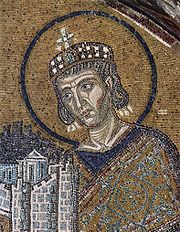
Constantine the Great , also known as Constantine I or Saint Constantine, was Roman Emperor from 306 to 337. Well known for being the first Roman emperor to convert to Christianity, Constantine and co-Emperor Licinius issued the Edict of Milan in 313, which proclaimed religious tolerance of all...
in AD 325. This first ecumenical council
Ecumenical council
An ecumenical council is a conference of ecclesiastical dignitaries and theological experts convened to discuss and settle matters of Church doctrine and practice....
was the first effort to attain consensus
Consensus decision-making
Consensus decision-making is a group decision making process that seeks the consent, not necessarily the agreement, of participants and the resolution of objections. Consensus is defined by Merriam-Webster as, first, general agreement, and second, group solidarity of belief or sentiment. It has its...
in the church through an assembly
Legislature
A legislature is a kind of deliberative assembly with the power to pass, amend, and repeal laws. The law created by a legislature is called legislation or statutory law. In addition to enacting laws, legislatures usually have exclusive authority to raise or lower taxes and adopt the budget and...
representing all of Christendom
Christendom
Christendom, or the Christian world, has several meanings. In a cultural sense it refers to the worldwide community of Christians, adherents of Christianity...
.
Its main accomplishments were settlement of the Christological
Christology
Christology is the field of study within Christian theology which is primarily concerned with the nature and person of Jesus Christ as recorded in the Canonical gospels and the letters of the New Testament. Primary considerations include the relationship of Jesus' nature and person with the nature...
issue of the relationship of Jesus
Jesus
Jesus of Nazareth , commonly referred to as Jesus Christ or simply as Jesus or Christ, is the central figure of Christianity...
to God the Father
God the Father
God the Father is a gendered title given to God in many monotheistic religions, particularly patriarchal, Abrahamic ones. In Judaism, God is called Father because he is the creator, life-giver, law-giver, and protector...
; the construction of the first part of the Nicene Creed
Nicene Creed
The Nicene Creed is the creed or profession of faith that is most widely used in Christian liturgy. It is called Nicene because, in its original form, it was adopted in the city of Nicaea by the first ecumenical council, which met there in the year 325.The Nicene Creed has been normative to the...
; settling the calculation of the date
Computus
Computus is the calculation of the date of Easter in the Christian calendar. The name has been used for this procedure since the early Middle Ages, as it was one of the most important computations of the age....
of Easter
Easter
Easter is the central feast in the Christian liturgical year. According to the Canonical gospels, Jesus rose from the dead on the third day after his crucifixion. His resurrection is celebrated on Easter Day or Easter Sunday...
; and promulgation of early canon law
Canon law
Canon law is the body of laws & regulations made or adopted by ecclesiastical authority, for the government of the Christian organization and its members. It is the internal ecclesiastical law governing the Catholic Church , the Eastern and Oriental Orthodox churches, and the Anglican Communion of...
.
Overview
The First Council of Nicaea is the first ecumenical councilEcumenical council
An ecumenical council is a conference of ecclesiastical dignitaries and theological experts convened to discuss and settle matters of Church doctrine and practice....
of the catholic
Catholic
The word catholic comes from the Greek phrase , meaning "on the whole," "according to the whole" or "in general", and is a combination of the Greek words meaning "about" and meaning "whole"...
Church. Most significantly, it resulted in the first uniform Christian doctrine
Doctrine
Doctrine is a codification of beliefs or a body of teachings or instructions, taught principles or positions, as the body of teachings in a branch of knowledge or belief system...
, called the Creed of Nicaea. With the creation of the creed, a precedent was established for subsequent general (ecumenical) councils of Bishops (Synod
Synod
A synod historically is a council of a church, usually convened to decide an issue of doctrine, administration or application. In modern usage, the word often refers to the governing body of a particular church, whether its members are meeting or not...
s) to create statements of belief and canons
Canon law
Canon law is the body of laws & regulations made or adopted by ecclesiastical authority, for the government of the Christian organization and its members. It is the internal ecclesiastical law governing the Catholic Church , the Eastern and Oriental Orthodox churches, and the Anglican Communion of...
of doctrinal orthodoxy
Orthodoxy
The word orthodox, from Greek orthos + doxa , is generally used to mean the adherence to accepted norms, more specifically to creeds, especially in religion...
— the intent being to define unity of beliefs for the whole of Christendom
Christendom
Christendom, or the Christian world, has several meanings. In a cultural sense it refers to the worldwide community of Christians, adherents of Christianity...
.
The council did not create the doctrine of the deity of Christ
Christ
Christ is the English term for the Greek meaning "the anointed one". It is a translation of the Hebrew , usually transliterated into English as Messiah or Mashiach...
(as is sometimes claimed) but it did settle to some degree the debate within the Early Christian communities regarding the divinity of Christ. This idea of the divinity of Christ along with the idea of Christ as a messenger from the one God ("The Father"
God the Father
God the Father is a gendered title given to God in many monotheistic religions, particularly patriarchal, Abrahamic ones. In Judaism, God is called Father because he is the creator, life-giver, law-giver, and protector...
) had long existed in various parts of the Roman empire. The divinity of Christ had also been widely endorsed by the Christian community in the otherwise pagan city of Rome.
The council affirmed and defined
Dogmatic definition
In Catholicism, a dogmatic definition is an extraordinary infallible statement published by a pope or an ecumenical council concerning a matter of faith or morals, the belief in which the Catholic Church requires of all Christians .The term most often refers to the infallible...
what it believed to be the teachings of the Apostles
Apostle (Christian)
The term apostle is derived from Classical Greek ἀπόστολος , meaning one who is sent away, from στέλλω + από . The literal meaning in English is therefore an "emissary", from the Latin mitto + ex...
regarding who Christ is: that Christ is the one true God in deity with the Father.
Derived from Greek
Greek language
Greek is an independent branch of the Indo-European family of languages. Native to the southern Balkans, it has the longest documented history of any Indo-European language, spanning 34 centuries of written records. Its writing system has been the Greek alphabet for the majority of its history;...
oikoumenikos
Oikoumene
Ecumene is a term originally used in the Greco-Roman world to refer to the inhabited universe . The term derives from the Greek , short for "inhabited world"...
, "ecumenical" means "worldwide" but generally is assumed to be limited to the Roman Empire in this context as in Augustus' claim to be ruler of the oikoumene/world; the earliest extant uses of the term for a council are Eusebius' Life of Constantine 3.6 around 338, which states "" (he convoked an Ecumenical Council); Athanasius' Ad Afros Epistola Synodica in 369; and the Letter in 382 to Pope Damasus I
Pope Damasus I
Pope Saint Damasus I was the bishop of Rome from 366 to 384.He was born around 305, probably near the city of Idanha-a-Velha , in what is present-day Portugal, then part of the Western Roman Empire...
and the Latin bishops from the First Council of Constantinople
First Council of Constantinople
The First Council of Constantinople is recognized as the Second Ecumenical Council by the Assyrian Church of the East, the Oriental Orthodox, the Eastern Orthodox, the Roman Catholics, the Old Catholics, and a number of other Western Christian groups. It was the first Ecumenical Council held in...
.
One purpose of the council was to resolve disagreements arising from within the Church of Alexandria over the nature of Jesus
Jesus
Jesus of Nazareth , commonly referred to as Jesus Christ or simply as Jesus or Christ, is the central figure of Christianity...
in relationship to God the Father
God the Father
God the Father is a gendered title given to God in many monotheistic religions, particularly patriarchal, Abrahamic ones. In Judaism, God is called Father because he is the creator, life-giver, law-giver, and protector...
; in particular, whether Jesus was the literal son of God or was he a figurative son, like the other "Sons of God
Sons of God
Sons of God is a phrase used in Levantine Bronze and Iron Age texts to describe the "divine council" of the major gods.- The term "sons of God" :...
" in the Bible. St. Alexander of Alexandria and Athanasius claimed to take the first position; the popular presbyter
Presbyter
Presbyter in the New Testament refers to a leader in local Christian congregations, then a synonym of episkopos...
Arius
Arius
Arius was a Christian presbyter in Alexandria, Egypt of Libyan origins. His teachings about the nature of the Godhead, which emphasized the Father's divinity over the Son , and his opposition to the Athanasian or Trinitarian Christology, made him a controversial figure in the First Council of...
, from whom the term Arianism
Arianism
Arianism is the theological teaching attributed to Arius , a Christian presbyter from Alexandria, Egypt, concerning the relationship of the entities of the Trinity and the precise nature of the Son of God as being a subordinate entity to God the Father...
comes, is said to have taken the second. The council decided against the Arians overwhelmingly (of the estimated 250–318 attendees, all but two voted
Voting
Voting is a method for a group such as a meeting or an electorate to make a decision or express an opinion—often following discussions, debates, or election campaigns. It is often found in democracies and republics.- Reasons for voting :...
against Arius.)
Another result of the council was an agreement on when to celebrate Easter
Easter
Easter is the central feast in the Christian liturgical year. According to the Canonical gospels, Jesus rose from the dead on the third day after his crucifixion. His resurrection is celebrated on Easter Day or Easter Sunday...
, the most important feast of the ecclesiastical calendar, decreed in an epistle to the Church of Alexandria in which is simply stated
We also send you the good news of the settlement concerning the holy pasch, namely that in answer to your prayers this question also has been resolved. All the brethren in the East who have hitherto followed the Jewish practice will henceforth observe the custom of the Romans and of yourselves and of all of us who from ancient times have kept Easter together with you.
Historically significant as the first effort to attain consensus
Consensus decision-making
Consensus decision-making is a group decision making process that seeks the consent, not necessarily the agreement, of participants and the resolution of objections. Consensus is defined by Merriam-Webster as, first, general agreement, and second, group solidarity of belief or sentiment. It has its...
in the church through an assembly
Legislature
A legislature is a kind of deliberative assembly with the power to pass, amend, and repeal laws. The law created by a legislature is called legislation or statutory law. In addition to enacting laws, legislatures usually have exclusive authority to raise or lower taxes and adopt the budget and...
representing all of Christendom, the Council was the first occasion where the technical aspects of Christology
Christology
Christology is the field of study within Christian theology which is primarily concerned with the nature and person of Jesus Christ as recorded in the Canonical gospels and the letters of the New Testament. Primary considerations include the relationship of Jesus' nature and person with the nature...
were discussed. Through it a precedent was set for subsequent general councils to adopt creeds and canons
Canon law
Canon law is the body of laws & regulations made or adopted by ecclesiastical authority, for the government of the Christian organization and its members. It is the internal ecclesiastical law governing the Catholic Church , the Eastern and Oriental Orthodox churches, and the Anglican Communion of...
. This council is generally considered the beginning of the period of the First seven Ecumenical Councils
First seven Ecumenical Councils
In the history of Christianity, the first seven Ecumenical Councils, from the First Council of Nicaea to the Second Council of Nicaea , represent an attempt to reach an orthodox consensus and to establish a unified Christendom as the State church of the Roman Empire...
in the History of Christianity
History of Christianity
The history of Christianity concerns the Christian religion, its followers and the Church with its various denominations, from the first century to the present. Christianity was founded in the 1st century by the followers of Jesus of Nazareth who they believed to be the Christ or chosen one of God...
.
Character and purpose
The First Council of Nicea was convened by Constantine IConstantine I
Constantine the Great , also known as Constantine I or Saint Constantine, was Roman Emperor from 306 to 337. Well known for being the first Roman emperor to convert to Christianity, Constantine and co-Emperor Licinius issued the Edict of Milan in 313, which proclaimed religious tolerance of all...
upon the recommendations of a synod led by Hosius of Córdoba
Hosius of Córdoba
Hosius of Corduba , also known as Osius or Ossius, was a bishop of Cordova and one of the prominent advocates of what became Catholic Christianity in the Arian controversy which divided the IV century early Christian Church...
in the Eastertide of 325. This synod had been charged with investigation of the trouble brought about by the Arian controversy in the Greek-speaking east
Greek East
"Greek East" and "Latin West" are terms used to distinguish between the two parts of the Greco-Roman world, specifically the eastern regions where Greek was the lingua franca, and the western parts where Latin filled this role...
. To most bishops, the teachings of Arius
Arius
Arius was a Christian presbyter in Alexandria, Egypt of Libyan origins. His teachings about the nature of the Godhead, which emphasized the Father's divinity over the Son , and his opposition to the Athanasian or Trinitarian Christology, made him a controversial figure in the First Council of...
were heretical
Christian heresy
Christian heresy refers to non-orthodox practices and beliefs that were deemed to be heretical by one or more of the Christian churches. In Western Christianity, the term "heresy" most commonly refers to those beliefs which were declared to be anathema by the Catholic Church prior to the schism of...
and dangerous to the salvation of souls. In the summer of 325, the bishops of all provinces were summoned to Nicea
Iznik
İznik is a city in Turkey which is primarily known as the site of the First and Second Councils of Nicaea, the first and seventh Ecumenical councils in the early history of the Church, the Nicene Creed, and as the capital city of the Empire of Nicaea...
(now known as İznik
Iznik
İznik is a city in Turkey which is primarily known as the site of the First and Second Councils of Nicaea, the first and seventh Ecumenical councils in the early history of the Church, the Nicene Creed, and as the capital city of the Empire of Nicaea...
, in modern-day Turkey), a place easily accessible to the majority of delegates, particularly those of Asia Minor, Syria
Syria
Syria , officially the Syrian Arab Republic , is a country in Western Asia, bordering Lebanon and the Mediterranean Sea to the West, Turkey to the north, Iraq to the east, Jordan to the south, and Israel to the southwest....
, Palestine
Palestine
Palestine is a conventional name, among others, used to describe the geographic region between the Mediterranean Sea and the Jordan River, and various adjoining lands....
, Egypt
Egypt
Egypt , officially the Arab Republic of Egypt, Arabic: , is a country mainly in North Africa, with the Sinai Peninsula forming a land bridge in Southwest Asia. Egypt is thus a transcontinental country, and a major power in Africa, the Mediterranean Basin, the Middle East and the Muslim world...
, Greece
Greece
Greece , officially the Hellenic Republic , and historically Hellas or the Republic of Greece in English, is a country in southeastern Europe....
, and Thrace
Thrace
Thrace is a historical and geographic area in southeast Europe. As a geographical concept, Thrace designates a region bounded by the Balkan Mountains on the north, Rhodope Mountains and the Aegean Sea on the south, and by the Black Sea and the Sea of Marmara on the east...
.
This was the first general council in the history of the Church since the Apostolic Council of Jerusalem
Council of Jerusalem
The Council of Jerusalem is a name applied by historians and theologians to an Early Christian council that was held in Jerusalem and dated to around the year 50. It is considered by Catholics and Orthodox to be a prototype and forerunner of the later Ecumenical Councils...
, the Apostolic council having established the conditions upon which Gentiles could join the Church. In the Council of Nicea, "the Church had taken her first great step to define doctrine more precisely in response to a challenge from a heretical theology."
Attendees
Constantine had invited all 1800 bishopBishop
A bishop is an ordained or consecrated member of the Christian clergy who is generally entrusted with a position of authority and oversight. Within the Catholic Church, Eastern Orthodox, Oriental Orthodox Churches, in the Assyrian Church of the East, in the Independent Catholic Churches, and in the...
s of the Christian church (about 1000 in the east and 800 in the west), but a smaller and unknown number attended. Eusebius of Caesarea
Eusebius of Caesarea
Eusebius of Caesarea also called Eusebius Pamphili, was a Roman historian, exegete and Christian polemicist. He became the Bishop of Caesarea in Palestine about the year 314. Together with Pamphilus, he was a scholar of the Biblical canon...
counted 220, Athanasius of Alexandria
Athanasius of Alexandria
Athanasius of Alexandria [b. ca. – d. 2 May 373] is also given the titles St. Athanasius the Great, St. Athanasius I of Alexandria, St Athanasius the Confessor and St Athanasius the Apostolic. He was the 20th bishop of Alexandria. His long episcopate lasted 45 years Athanasius of Alexandria [b....
counted 318, and Eustathius of Antioch
Eustathius of Antioch
Eustathius of Antioch, sometimes surnamed the Great, was a bishop and patriarch of Antioch in the 4th century.He was a native of Side in Pamphylia. About 320 he was bishop of Beroea, and he became patriarch of Antioch shortly before the Council of Nicaea in 325...
counted 270 (all three were present at the council). Later, Socrates Scholasticus
Socrates Scholasticus
Socrates of Constantinople, also known as Socrates Scholasticus, not to be confused with the Greek philosopher Socrates, was a Greek Christian church historian, a contemporary of Sozomen and Theodoret, who used his work; he was born at Constantinople c. 380: the date of his death is unknown...
recorded more than 300, and Evagrius, Hilary of Poitiers
Hilary of Poitiers
Hilary of Poitiers was Bishop of Poitiers and is a Doctor of the Church. He was sometimes referred to as the "Hammer of the Arians" and the "Athanasius of the West." His name comes from the Latin word for happy or cheerful. His optional memorial in the Roman Catholic calendar of saints is 13...
, Jerome
Jerome
Saint Jerome was a Roman Christian priest, confessor, theologian and historian, and who became a Doctor of the Church. He was the son of Eusebius, of the city of Stridon, which was on the border of Dalmatia and Pannonia...
and Rufinus recorded 318. Delegates came from every region of the Roman Empire
Roman Empire
The Roman Empire was the post-Republican period of the ancient Roman civilization, characterised by an autocratic form of government and large territorial holdings in Europe and around the Mediterranean....
except Britain
Roman Britain
Roman Britain was the part of the island of Great Britain controlled by the Roman Empire from AD 43 until ca. AD 410.The Romans referred to the imperial province as Britannia, which eventually comprised all of the island of Great Britain south of the fluid frontier with Caledonia...
.
The participating bishops were given free travel to and from their episcopal see
Episcopal See
An episcopal see is, in the original sense, the official seat of a bishop. This seat, which is also referred to as the bishop's cathedra, is placed in the bishop's principal church, which is therefore called the bishop's cathedral...
s to the council, as well as lodging. These bishops did not travel alone; each one had permission to bring with him two priests and three deacon
Deacon
Deacon is a ministry in the Christian Church that is generally associated with service of some kind, but which varies among theological and denominational traditions...
s; so the total number of attendees could have been above 1800. Eusebius speaks of an almost innumerable host of accompanying priest
Priest
A priest is a person authorized to perform the sacred rites of a religion, especially as a mediatory agent between humans and deities. They also have the authority or power to administer religious rites; in particular, rites of sacrifice to, and propitiation of, a deity or deities...
s, deacons and acolyte
Acolyte
In many Christian denominations, an acolyte is anyone who performs ceremonial duties such as lighting altar candles. In other Christian Churches, the term is more specifically used for one who wishes to attain clergyhood.-Etymology:...
s.
A special prominence was also attached to this council because the persecution of Christians
Persecution of Christians
Persecution of Christians as a consequence of professing their faith can be traced both historically and in the current era. Early Christians were persecuted for their faith, at the hands of both Jews from whose religion Christianity arose, and the Roman Empire which controlled much of the land...
had just ended with the February 313 Edict of Milan
Edict of Milan
The Edict of Milan was a letter signed by emperors Constantine I and Licinius that proclaimed religious toleration in the Roman Empire...
by Emperors Constantine and Licinius
Licinius
Licinius I , was Roman Emperor from 308 to 324. Co-author of the Edict of Milan that granted official toleration to Christians in the Roman Empire, for the majority of his reign he was the rival of Constantine I...
.
The Eastern bishops formed the great majority. Of these, the first rank was held by the three patriarch
Patriarch
Originally a patriarch was a man who exercised autocratic authority as a pater familias over an extended family. The system of such rule of families by senior males is called patriarchy. This is a Greek word, a compound of πατριά , "lineage, descent", esp...
s: Alexander of Alexandria
Alexander of Alexandria
Alexander of Alexandria was the nineteenth Patriarch of Alexandria from 313 to his death. During his patriarchate, he dealt with a number of issues relevant to a church's positions on issues facing the church. These included the dating of Easter, the actions of Meletius of Lycopolis, and the issue...
, Eustathius of Antioch
Eustathius of Antioch
Eustathius of Antioch, sometimes surnamed the Great, was a bishop and patriarch of Antioch in the 4th century.He was a native of Side in Pamphylia. About 320 he was bishop of Beroea, and he became patriarch of Antioch shortly before the Council of Nicaea in 325...
, and Macarius of Jerusalem
Macarius of Jerusalem
Saint Macarius of Jerusalem was Bishop of Jerusalem from 312 to shortly before 335, according to Sozomen.St. Athanasius, in one of his orations against Arianism, refers to St. Macarius as an example of "the honest and simple style of apostolical men." The date 312 for Macarius's accession to the...
. Many of the assembled fathers—for instance, Paphnutius of Thebes
Paphnutius of Thebes
Paphnutius of Thebes, also known as Paphnutius the Confessor, was bishop of a city in the Upper Thebaid in the early fourth century, and one of the most interesting possible members of the First Council of Nicaea in 325...
, Potamon of Heraclea and Paul of Neocaesarea
Paul of Neocaesarea
Paul of Neocæsarea, also known as Saint Paul, Bishop of Neocæsarea, was an early Christian bishop best known for demonstrating the scars of his religious persecution under the emperor Licinius at the First Council of Nicaea in AD 325....
—had stood forth as confessor
Confessor
-Confessor of the Faith:Its oldest use is to indicate a saint who has suffered persecution and torture for the faith, but not to the point of death. The term is still used in this way in the East. In Latin Christianity it has come to signify any saint, as well as those who have been declared...
s of the faith and came to the council with the marks of persecution on their faces. Other remarkable attendees were Eusebius of Nicomedia
Eusebius of Nicomedia
Eusebius of Nicomedia was the man who baptised Constantine. He was a bishop of Berytus in Phoenicia, then of Nicomedia where the imperial court resided in Bithynia, and finally of Constantinople from 338 up to his death....
; Eusebius of Caesarea
Eusebius of Caesarea
Eusebius of Caesarea also called Eusebius Pamphili, was a Roman historian, exegete and Christian polemicist. He became the Bishop of Caesarea in Palestine about the year 314. Together with Pamphilus, he was a scholar of the Biblical canon...
, the first church historian; Nicholas of Myra
Saint Nicholas
Saint Nicholas , also called Nikolaos of Myra, was a historic 4th-century saint and Greek Bishop of Myra . Because of the many miracles attributed to his intercession, he is also known as Nikolaos the Wonderworker...
; Aristakes of Armenia
Gregory the Illuminator
Saint Gregory the Illuminator or Saint Gregory the Enlightener is the patron saint and first official head of the Armenian Apostolic Church...
(son of Saint Gregory the Illuminator
Gregory the Illuminator
Saint Gregory the Illuminator or Saint Gregory the Enlightener is the patron saint and first official head of the Armenian Apostolic Church...
); Leontius of Caesarea
Leontius of Caesarea
Leontius of Caesarea was a bishop of Caesarea Mazaca, in Cappadocia. He was childhood friends with Gregory the Illuminator, later in life Leontius would consecrate Gregory to become the patriarch of the Armenians. Leontius attended the First Council of Nicaea in 325.The Eastern Orthodox Church...
; Jacob of Nisibis
Jacob of Nisibis
Jacob of Nisibis , is a Syriac saint. He was the second bishop of Nisibis, spiritual father of the renowned Syriac writer Ephrem the Syrian, and celebrated ascetic....
, a former hermit
Hermit
A hermit is a person who lives, to some degree, in seclusion from society.In Christianity, the term was originally applied to a Christian who lives the eremitic life out of a religious conviction, namely the Desert Theology of the Old Testament .In the...
; Hypatius of Gangra; Protogenes of Sardica; Melitius of Sebastopolis; Achilleus of Larissa (considered the Athanasius of Thessaly
Thessaly
Thessaly is a traditional geographical region and an administrative region of Greece, comprising most of the ancient region of the same name. Before the Greek Dark Ages, Thessaly was known as Aeolia, and appears thus in Homer's Odyssey....
) and Spyridion of Trimythous
Saint Spyridon
Saint Spyridon, Bishop of Trimythous also sometimes written Saint Spiridon is a saint honoured in both the Eastern and Western Christian traditions.-Life:...
, who even while a bishop made his living as a shepherd
Shepherd
A shepherd is a person who tends, feeds or guards flocks of sheep.- Origins :Shepherding is one of the oldest occupations, beginning some 6,000 years ago in Asia Minor. Sheep were kept for their milk, meat and especially their wool...
. From foreign places came a Persian
Persian people
The Persian people are part of the Iranian peoples who speak the modern Persian language and closely akin Iranian dialects and languages. The origin of the ethnic Iranian/Persian peoples are traced to the Ancient Iranian peoples, who were part of the ancient Indo-Iranians and themselves part of...
bishop John, a Gothic
Goths
The Goths were an East Germanic tribe of Scandinavian origin whose two branches, the Visigoths and the Ostrogoths, played an important role in the fall of the Roman Empire and the emergence of Medieval Europe....
bishop Theophilus and Stratophilus, bishop of Pitiunt in Abkhazia
Abkhazia
Abkhazia is a disputed political entity on the eastern coast of the Black Sea and the south-western flank of the Caucasus.Abkhazia considers itself an independent state, called the Republic of Abkhazia or Apsny...
(located in the western part of South Caucasus outside of the Roman Empire).
The Latin
Latin
Latin is an Italic language originally spoken in Latium and Ancient Rome. It, along with most European languages, is a descendant of the ancient Proto-Indo-European language. Although it is considered a dead language, a number of scholars and members of the Christian clergy speak it fluently, and...
-speaking provinces sent at least five representatives: Marcus of Calabria from Italia
Italia (Roman province)
Italia was the name of the Italian peninsula of the Roman Empire.-Under the Republic and Augustan organization:During the Republic and the first centuries of the empire, Italia was not a province, but rather the territory of the city of Rome, thus having a special status: for example, military...
, Cecilian of Carthage from Africa, Hosius of Córdoba
Hosius of Córdoba
Hosius of Corduba , also known as Osius or Ossius, was a bishop of Cordova and one of the prominent advocates of what became Catholic Christianity in the Arian controversy which divided the IV century early Christian Church...
from Hispania
Hispania
Another theory holds that the name derives from Ezpanna, the Basque word for "border" or "edge", thus meaning the farthest area or place. Isidore of Sevilla considered Hispania derived from Hispalis....
, Nicasius of Dijon
Nicasius of Dijon
Saint Nicasius of Dijon was a saint from Gaul, present-day France. He attended the First Council of Nicaea.-References:*...
from Gaul
Gaul
Gaul was a region of Western Europe during the Iron Age and Roman era, encompassing present day France, Luxembourg and Belgium, most of Switzerland, the western part of Northern Italy, as well as the parts of the Netherlands and Germany on the left bank of the Rhine. The Gauls were the speakers of...
, and Domnus of Stridon from the province of the Danube
Danube
The Danube is a river in the Central Europe and the Europe's second longest river after the Volga. It is classified as an international waterway....
.
Athanasius of Alexandria, a young deacon and companion of Bishop Alexander of Alexandria, was among the assistants. Athanasius eventually spent most of his life battling against Arianism
Arianism
Arianism is the theological teaching attributed to Arius , a Christian presbyter from Alexandria, Egypt, concerning the relationship of the entities of the Trinity and the precise nature of the Son of God as being a subordinate entity to God the Father...
. Alexander of Constantinople
Alexander of Constantinople
Saint Alexander of Constantinople was bishop of Byzantium and the bishop of Constantinople . Information from the Synaxarion mention that Alexander was originally from Calabria in Italy and his parents were George and Vryaine...
, then a presbyter, was also present as representative of his aged bishop.
The supporters of Arius included Secundus of Ptolemais
Secundus of Ptolemais
Secundus of Ptolemais was a 4th century bishop of Ptolemais, excommunicated after the First Council of Nicaea for his nontrinitarianism.-See also:* Arianism* Arian controversy* Timeline of Christianity: Era of the Seven Ecumenical Councils-References:...
, Theonus of Marmarica, Zphyrius, and Dathes, all of whom hailed from Libya
Libya
Libya is an African country in the Maghreb region of North Africa bordered by the Mediterranean Sea to the north, Egypt to the east, Sudan to the southeast, Chad and Niger to the south, and Algeria and Tunisia to the west....
and the Pentapolis. Other supporters included Eusebius of Nicomedia
Eusebius of Nicomedia
Eusebius of Nicomedia was the man who baptised Constantine. He was a bishop of Berytus in Phoenicia, then of Nicomedia where the imperial court resided in Bithynia, and finally of Constantinople from 338 up to his death....
, Eusebius of Caesarea
Eusebius of Caesarea
Eusebius of Caesarea also called Eusebius Pamphili, was a Roman historian, exegete and Christian polemicist. He became the Bishop of Caesarea in Palestine about the year 314. Together with Pamphilus, he was a scholar of the Biblical canon...
, Paulinus of Tyrus, Actius of Lydda, Menophantus of Ephesus, and Theognus of Nicea.
"Resplendent in purple and gold, Constantine made a ceremonial entrance at the opening of the council, probably in early June, but respectfully seated the bishops ahead of himself." As Eusebius described, Constantine "himself proceeded through the midst of the assembly, like some heavenly messenger of God, clothed in raiment which glittered as it were with rays of light, reflecting the glowing radiance of a purple robe, and adorned with the brilliant splendor of gold and precious stones." He was present as an observer, and did not vote. Constantine organized the Council along the lines of the Roman Senate
Roman Senate
The Senate of the Roman Republic was a political institution in the ancient Roman Republic, however, it was not an elected body, but one whose members were appointed by the consuls, and later by the censors. After a magistrate served his term in office, it usually was followed with automatic...
. Hosius of Cordoba may have presided over its deliberations; he was probably one of the Papal legates. Eusebius of Nicomedia probably gave the welcoming address.
Agenda and procedure
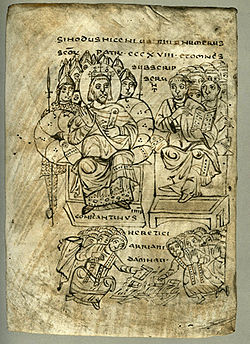
The agenda of the synod included:The council was formally opened May 20, in the central structure of the imperial palace at Nicea, with preliminary discussions of the Arian question. In these discussions, some dominant figures were Arius, with several adherents. "Some 22 of the bishops at the council, led by Eusebius of Nicomedia, came as supporters of Arius. But when some of the more shocking passages from his writings were read, they were almost universally seen as blasphemous." Bishops Theognis of Nicea and Maris of Chalcedon were among the initial supporters of Arius.
Eusebius of Caesarea called to mind the baptismal creed of his own diocese
Diocese
A diocese is the district or see under the supervision of a bishop. It is divided into parishes.An archdiocese is more significant than a diocese. An archdiocese is presided over by an archbishop whose see may have or had importance due to size or historical significance...
at Caesarea
Caesarea Palaestina
Caesarea Maritima , Caesarea Palaestina from 133 CE onwards, was a city and harbor built by Herod the Great about 25–13 BC. Today, its ruins lie on the Mediterranean coast of Israel about halfway between the cities of Tel Aviv and Haifa, on the site of Pyrgos Stratonos . Caesarea Maritima was...
at Palestine, as a form of reconciliation. The majority of the bishops agreed. For some time, scholars thought that the original Nicene Creed was based on this statement of Eusebius. Today, most scholars think that the Creed is derived from the baptismal creed of Jerusalem
Jerusalem in Christianity
For Christians, Jerusalem's place in the ministry of Jesus and the Apostolic Age gives it great importance, in addition to its place in the Old Testament, the Hebrew Bible.-Jerusalem in the New Testament and early Christianity:...
, as Hans Lietzmann
Hans Lietzmann
Hans Lietzmann was a German theologian and church historian who was a native of Düsseldorf.He initially studied in Jena, and continued his education in Bonn, where he was a student of Hermann Usener...
proposed.
The orthodox bishops won approval of every one of their proposals regarding the Creed. After being in session for an entire month, the council promulgated on June 19 the original Nicene Creed. This profession of faith was adopted by all the bishops "but two from Libya
Libya
Libya is an African country in the Maghreb region of North Africa bordered by the Mediterranean Sea to the north, Egypt to the east, Sudan to the southeast, Chad and Niger to the south, and Algeria and Tunisia to the west....
who had been closely associated with Arius from the beginning." No historical record of their dissent actually exists; the signatures of these bishops are simply absent from the Creed.
Arian controversy
Christology
Christology is the field of study within Christian theology which is primarily concerned with the nature and person of Jesus Christ as recorded in the Canonical gospels and the letters of the New Testament. Primary considerations include the relationship of Jesus' nature and person with the nature...
dispute that began in Alexandria
Alexandria
Alexandria is the second-largest city of Egypt, with a population of 4.1 million, extending about along the coast of the Mediterranean Sea in the north central part of the country; it is also the largest city lying directly on the Mediterranean coast. It is Egypt's largest seaport, serving...
between the followers of Arius
Arius
Arius was a Christian presbyter in Alexandria, Egypt of Libyan origins. His teachings about the nature of the Godhead, which emphasized the Father's divinity over the Son , and his opposition to the Athanasian or Trinitarian Christology, made him a controversial figure in the First Council of...
(the Arians) and the followers of St. Alexander of Alexandria (now known as Homoousians). Alexander and his followers believed that the Son was of the same substance as the Father, co-eternal with him. The Arians believed that they were different and that the Son, though he may be the most perfect of creations, was only a creation of God the Father. A third group (now known as Homoiousians) later tried to make a compromise position, saying that the Father and the Son were of similar substance.
For about two months, the two sides argued and debated, with each appealing to Scripture to justify their respective positions. According to many accounts, debate became so heated that at one point, Arius was slapped in the face by Nicholas of Myra, who would later be canonized.
Much of the debate hinged on the difference between being "born" or "created" and being "begotten". Arians saw these as essentially the same; followers of Alexander did not. The exact meaning of many of the words used in the debates at Nicea were still unclear to speakers of other languages. Greek
Koine Greek
Koine Greek is the universal dialect of the Greek language spoken throughout post-Classical antiquity , developing from the Attic dialect, with admixture of elements especially from Ionic....
words like "essence" (ousia
Ousia
Ousia is the Ancient Greek noun formed on the feminine present participle of ; it is analogous to the English participle being, and the modern philosophy adjectival ontic...
), "substance" (hypostasis
Hypostasis (religion)
In Christian theology, a hypostasis or person is one of the three elements of the Holy Trinity.In Christian usage, the Greek word hypostasis means beneath-standing or underpinning and, by extension, the existence of some thing...
), "nature" (physis), "person" (prosopon) bore a variety of meanings drawn from pre-Christian philosophers, which could not but entail misunderstandings until they were cleared up. The word homoousia
Homoousian
Homoousian is a technical theological term used in discussion of the Christian understanding of God as Trinity. The Nicene Creed describes Jesus as being homooúsios with God the Father — that is, they are of the "same substance" and are equally God...
, in particular, was initially disliked by many bishops because of its associations with Gnostic heretics (who used it in their theology), and because it had been condemned at the 264–268 Synods of Antioch
Synods of Antioch
Beginning with three synods convened between 264 and 269 in the matter of Paul of Samosata, more than thirty councils were held in Antioch in ancient times. Most of these dealt with phases of the Arian and of the Christological controversies...
.
Position of Arius (Arianism)
AriusArius
Arius was a Christian presbyter in Alexandria, Egypt of Libyan origins. His teachings about the nature of the Godhead, which emphasized the Father's divinity over the Son , and his opposition to the Athanasian or Trinitarian Christology, made him a controversial figure in the First Council of...
maintained that the Son of God was a Creature, made from nothing; and that he was God's First Production, before all ages. And he argued that everything else was created through the Son. Thus, said the Arians, only the Son was directly created and begotten of God; and therefore there was a time that He had no existence. Arius believed the Son Jesus was capable of His own free will of right and wrong, and that "were He in the truest sense a son, He must have come after the Father, therefore the time obviously was when He was not, and hence He was a finite being," and was under God the Father. The Arians appealed to Scripture, quoting verses such as : "the Father is greater than I", and also : "Firstborn of all creation."
Position of St. Alexander (Homoousianism)
Homoousians countered the Arians' argument, saying that the Father's fatherhood, like all of his attributes, is eternal. Thus, the Father was always a father, and that the Son, therefore, always existed with him. Homoousians believed that to follow the Arian view destroyed the unity of the GodheadGodhead (Christianity)
Godhead is a Middle English variant of the word godhood, and denotes the Divine Nature or Substance of the Christian God, or the Trinity. Within some traditions such as Mormonism, the term is used as a nontrinitarian substitute for the term Trinity, denoting the Father, Son, and Holy Spirit not as...
, and made the Son unequal to the Father, in contravention of the Scriptures ("I and the Father are one"; ). Further on it says "That they all may be one; as thou, Father, art in me, and I in thee, that they also may be one in us: that the world may believe that thou hast sent me"; .
The Homoiousian compromise proposal
The Homoiousians proposed that God and the Son were alike, but not the same, in substance. This compromise position did not gain much support and eventually the idea was dropped.Result of the debate
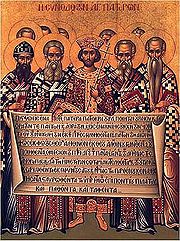
The Council declared that the Father and the Son are of the same substance and are co-eternal, basing the declaration in the claim that this was a formulation of traditional Christian belief handed down from the Apostles. Under Constantine's influence, this belief was expressed by the bishops in what would be known thereafter as the Nicene CreedNicene Creed
The Nicene Creed is the creed or profession of faith that is most widely used in Christian liturgy. It is called Nicene because, in its original form, it was adopted in the city of Nicaea by the first ecumenical council, which met there in the year 325.The Nicene Creed has been normative to the...
.
The Nicene Creed
Rome
Rome is the capital of Italy and the country's largest and most populated city and comune, with over 2.7 million residents in . The city is located in the central-western portion of the Italian Peninsula, on the Tiber River within the Lazio region of Italy.Rome's history spans two and a half...
, for example, the Apostles' Creed
Apostles' Creed
The Apostles' Creed , sometimes titled Symbol of the Apostles, is an early statement of Christian belief, a creed or "symbol"...
was popular, especially for use in Lent
Lent
In the Christian tradition, Lent is the period of the liturgical year from Ash Wednesday to Easter. The traditional purpose of Lent is the preparation of the believer – through prayer, repentance, almsgiving and self-denial – for the annual commemoration during Holy Week of the Death and...
and the Easter season. In the Council of Nicea, one specific creed was used to define the Church's faith clearly, to include those who professed it, and to exclude those who did not.
Some distinctive elements in the Nicene Creed, perhaps from the hand of Hosius of Cordova, were added. Some elements were added specifically to counter the Arian point of view.
- Jesus Christ is described as "God from God, Light from Light, true God from true God," proclaiming his divinity.
- Jesus Christ is said to be "begotten, not made", asserting his co-eternalness with God, and confirming it by stating his role in the Creation. Basically, they were saying that Jesus was God, and God's son, not a creation of God.
- He is said to be "one in being with The Father," in direct opposition to Arianism. Eusebius of CaesareaEusebius of CaesareaEusebius of Caesarea also called Eusebius Pamphili, was a Roman historian, exegete and Christian polemicist. He became the Bishop of Caesarea in Palestine about the year 314. Together with Pamphilus, he was a scholar of the Biblical canon...
ascribes the term homoousios, or consubstantial, i.e., "of the same substance" (of the Father), to Constantine who, on this particular point, may have chosen to exercise his authority.
Of the third article only the words "and in the Holy Spirit
Holy Spirit (Christianity)
For the majority of Christians, the Holy Spirit is the third person of the Holy Trinity—Father, Son, and Holy Spirit, and is Almighty God...
" were left; the original Nicene Creed ended with these words. Then followed immediately the canons
Canon law
Canon law is the body of laws & regulations made or adopted by ecclesiastical authority, for the government of the Christian organization and its members. It is the internal ecclesiastical law governing the Catholic Church , the Eastern and Oriental Orthodox churches, and the Anglican Communion of...
of the council. Thus, instead of a baptismal creed acceptable to both the homoousian and Arian parties, as proposed by Eusebius, the council promulgated one which was unambiguous in the aspects touching upon the points of contention between these two positions, and one which was incompatible with the beliefs of Arians.
The text of this profession of faith is preserved in a letter of Eusebius to his congregation, in Athanasius, and elsewhere. Although the most vocal of anti-Arians, the Homoousians (from the Koine Greek
Koine Greek
Koine Greek is the universal dialect of the Greek language spoken throughout post-Classical antiquity , developing from the Attic dialect, with admixture of elements especially from Ionic....
word translated as "of same substance" which was condemned at the Council of Antioch
Synods of Antioch
Beginning with three synods convened between 264 and 269 in the matter of Paul of Samosata, more than thirty councils were held in Antioch in ancient times. Most of these dealt with phases of the Arian and of the Christological controversies...
in 264–268), were in the minority, the Creed was accepted by the council as an expression of the bishops' common faith and the ancient faith of the whole Church.
Bishop Hosius of Cordova, one of the firm Homoousians, may well have helped bring the council to consensus. At the time of the council, he was the confidant of the emperor in all Church matters. Hosius stands at the head of the lists of bishops, and Athanasius ascribes to him the actual formulation of the creed. Great leaders such as Eustathius of Antioch
Eustathius of Antioch
Eustathius of Antioch, sometimes surnamed the Great, was a bishop and patriarch of Antioch in the 4th century.He was a native of Side in Pamphylia. About 320 he was bishop of Beroea, and he became patriarch of Antioch shortly before the Council of Nicaea in 325...
, Alexander of Alexandria
Alexander of Alexandria
Alexander of Alexandria was the nineteenth Patriarch of Alexandria from 313 to his death. During his patriarchate, he dealt with a number of issues relevant to a church's positions on issues facing the church. These included the dating of Easter, the actions of Meletius of Lycopolis, and the issue...
, Athanasius, and Marcellus of Ancyra
Marcellus of Ancyra
Marcellus of Ancyra was one of the bishops present at the Councils of Ancyra and of Nicaea. He was a strong opponent of Arianism, but was accused of adopting the opposite extreme of modified Sabellianism...
all adhered to the Homoousian position.
In spite of his sympathy for Arius, Eusebius of Caesarea adhered to the decisions of the council, accepting the entire creed. The initial number of bishops supporting Arius was small. After a month of discussion, on June 19, there were only two left: Theonas of Marmarica in Libya
Libya
Libya is an African country in the Maghreb region of North Africa bordered by the Mediterranean Sea to the north, Egypt to the east, Sudan to the southeast, Chad and Niger to the south, and Algeria and Tunisia to the west....
, and Secundus of Ptolemais. Maris of Chalcedon, who initially supported Arianism, agreed to the whole creed. Similarly, Eusebius of Nicomedia
Eusebius of Nicomedia
Eusebius of Nicomedia was the man who baptised Constantine. He was a bishop of Berytus in Phoenicia, then of Nicomedia where the imperial court resided in Bithynia, and finally of Constantinople from 338 up to his death....
and Theognis of Nice also agreed, except for the certain statements.
The Emperor carried out his earlier statement: everybody who refused to endorse the Creed would be exile
Exile
Exile means to be away from one's home , while either being explicitly refused permission to return and/or being threatened with imprisonment or death upon return...
d. Arius, Theonas, and Secundus refused to adhere to the creed, and were thus exiled to Illyria
Illyria
In classical antiquity, Illyria was a region in the western part of the Balkan Peninsula inhabited by the Illyrians....
, in addition to being excommunicated
Excommunication
Excommunication is a religious censure used to deprive, suspend or limit membership in a religious community. The word means putting [someone] out of communion. In some religions, excommunication includes spiritual condemnation of the member or group...
. The works of Arius were ordered to be confiscated and consigned to the flames
Book burning
Book burning, biblioclasm or libricide is the practice of destroying, often ceremoniously, books or other written material and media. In modern times, other forms of media, such as phonograph records, video tapes, and CDs have also been ceremoniously burned, torched, or shredded...
while all persons found possessing them were to be executed.
Nevertheless, the controversy continued in various parts of the empire.
The Creed was amended to a new version by the First Council of Constantinople
First Council of Constantinople
The First Council of Constantinople is recognized as the Second Ecumenical Council by the Assyrian Church of the East, the Oriental Orthodox, the Eastern Orthodox, the Roman Catholics, the Old Catholics, and a number of other Western Christian groups. It was the first Ecumenical Council held in...
in 381.
Separation of Easter computation from Jewish calendar
The feast of Easter is linked to the Jewish PassoverPassover
Passover is a Jewish holiday and festival. It commemorates the story of the Exodus, in which the ancient Israelites were freed from slavery in Egypt...
and Feast of Unleavened Bread, as Christians believe that the crucifixion
Crucifixion
Crucifixion is an ancient method of painful execution in which the condemned person is tied or nailed to a large wooden cross and left to hang until dead...
and resurrection
Resurrection
Resurrection refers to the literal coming back to life of the biologically dead. It is used both with respect to particular individuals or the belief in a General Resurrection of the dead at the end of the world. The General Resurrection is featured prominently in Jewish, Christian, and Muslim...
of Jesus occurred at the time of those observances.
As early as Pope Sixtus I
Pope Sixtus I
Pope Saint Sixtus I was bishop of Rome from about 117 or 119 to 126 or 128 C.E., succeeding Pope Alexander I and succeeded by Pope Telesphorus. In the oldest documents, Xystus is the spelling used for the first three popes of that name....
, some Christians had set Easter to a Sunday in the lunar month of Nisan
Nisan
Nisan is the first month of the ecclesiastical year and the seventh month of the civil year, on the Hebrew calendar. The name of the month is Babylonian; in the Torah it is called the month of the Aviv, referring to the month in which barley was ripe. It is a spring month of 30 days...
. To determine which lunar month was to be designated as Nisan, Christians relied on the Jewish community. By the later 3rd century some Christians began to express dissatisfaction with what they took to be the disorderly state of the Jewish calendar. They argued that contemporary Jews were identifying the wrong lunar month as the month of Nisan, choosing a month whose 14th day fell before the spring equinox. Christians, these thinkers argued, should abandon the custom of relying on Jewish informants and instead do their own computations to determine which month should be styled Nisan, setting Easter within this independently computed, Christian Nisan, which would always locate the festival after the equinox. They justified this break with tradition by arguing that it was in fact the contemporary Jewish calendar that had broken with tradition by ignoring the equinox, and that in former times the 14th of Nisan had never preceded the equinox. Others felt that the customary practice of reliance on the Jewish calendar should continue, even if the Jewish computations were in error from a Christian point of view.
The controversy between those who argued for independent computations and those who argued for continued reliance on the Jewish calendar was formally resolved by the Council, which endorsed the independent procedure that had been in use for some time at Rome and Alexandria. Easter was henceforward to be a Sunday in a lunar month chosen according to Christian criteria—in effect, a Christian Nisan—not in the month of Nisan as defined by Jews. Those who argued for continued reliance on the Jewish calendar (called "protopaschites" by later historians) were urged to come around to the majority position. That they did not all immediately do so is revealed by the existence of sermons, canons, and tracts written against the protopaschite practice in the later 4th century.
These two rules, independence of the Jewish calendar and worldwide uniformity, were the only rules for Easter explicitly laid down by the Council. No details for the computation were specified; these were worked out in practice, a process that took centuries and generated a number of controversies
Easter controversy
The Easter controversy is a series of controversies about the proper date to celebrate the Christian holiday of Easter. To date, there are four distinct historical phases of the dispute and the dispute has yet to be resolved...
. (See also Computus
Computus
Computus is the calculation of the date of Easter in the Christian calendar. The name has been used for this procedure since the early Middle Ages, as it was one of the most important computations of the age....
and Reform of the date of Easter
Reform of the date of Easter
Reform of the date of Easter has been proposed several times because the current system for determining the date of Easter is seen as presenting two significant problems:...
.) In particular, the Council did not decree that Easter must fall on Sunday. This was already the practice almost everywhere. Nor did the Council decree that Easter must never coincide with Nisan 15 (the first Day of Unleavened Bread, now commonly called "Passover") in the Hebrew calendar. By endorsing the move to independent computations, the Council had separated the Easter computation from all dependence, positive or negative, on the Jewish calendar. The "Zonaras proviso", the claim that Easter must always follow Nisan 15 in the Hebrew calendar, was not formulated until after some centuries. By that time, the accumulation of errors in the Julian solar and lunar calendars had made it the de-facto state of affairs that Julian Easter always followed Hebrew Nisan 15.
Meletian schism
The suppression of the Meletian schism, an early breakaway sect, was another important matter that came before the Council of Nicea. Meletius, it was decided, should remain in his own city of Lycopolis in EgyptEgypt
Egypt , officially the Arab Republic of Egypt, Arabic: , is a country mainly in North Africa, with the Sinai Peninsula forming a land bridge in Southwest Asia. Egypt is thus a transcontinental country, and a major power in Africa, the Mediterranean Basin, the Middle East and the Muslim world...
, but without exercising authority or the power to ordain new clergy; he was forbidden to go into the environs of the town or to enter another diocese
Diocese
A diocese is the district or see under the supervision of a bishop. It is divided into parishes.An archdiocese is more significant than a diocese. An archdiocese is presided over by an archbishop whose see may have or had importance due to size or historical significance...
for the purpose of ordaining its subjects. Melitius retained his episcopal title, but the ecclesiastics ordained by him were to receive again the Laying on of hands
Laying on of hands
The laying on of hands is a religious ritual that accompanies certain religious practices, which are found throughout the world in varying forms....
, the ordinations performed by Meletius being therefore regarded as invalid. Clergy ordained by Meletius were ordered to yield precedence to those ordained by Alexander, and they were not to do anything without the consent of Bishop Alexander.
In the event of the death of a non-Meletian bishop or ecclesiastic, the vacant see
Episcopal See
An episcopal see is, in the original sense, the official seat of a bishop. This seat, which is also referred to as the bishop's cathedra, is placed in the bishop's principal church, which is therefore called the bishop's cathedral...
might be given to a Meletian, provided he was worthy and the popular election were ratified by Alexander. As to Meletius himself, episcopal rights and prerogatives were taken from him. These mild measures, however, were in vain; the Meletians joined the Arians and caused more dissension than ever, being among the worst enemies of Athanasius. The Meletians ultimately died out around the middle of the fifth century.
Promulgation of canon law
The council promulgated twenty new church laws, called canonsCanon law
Canon law is the body of laws & regulations made or adopted by ecclesiastical authority, for the government of the Christian organization and its members. It is the internal ecclesiastical law governing the Catholic Church , the Eastern and Oriental Orthodox churches, and the Anglican Communion of...
, (though the exact number is subject to debate), that is, unchanging rules of discipline. The twenty as listed in the Nicene and Post-Nicene Fathers
Nicene and Post-Nicene Fathers
A Select Library of the Nicene and Post-Nicene Fathers of the Christian Church, usually known as the Nicene and Post-Nicene Fathers , is a set of books containing translations of early Christian writings into English. It was published between 1886 and 1900...
are as follows:
- 1. prohibition of self-castration
- 2. establishment of a minimum term for catechumenCatechumenIn ecclesiology, a catechumen , “‘down’” + ἠχή , “‘sound’”) is one receiving instruction from a catechist in the principles of the Christian religion with a view to baptism...
(persons studying for baptism) - 3. prohibition of the presence in the house of a cleric of a younger woman who might bring him under suspicion (the so called virgines subintroductaeAgapetaeIn the 1st century AD to the 3rd century the Agapetae were Christian virgins who consecrated themselves to God with a vow of chastity. They were one of a number of Early Christian 'classes' of virgins who associated with men as 'sisters'. The Agapetae lived with laymen, originally in a spiritual...
) - 4. ordination of a bishopBishopA bishop is an ordained or consecrated member of the Christian clergy who is generally entrusted with a position of authority and oversight. Within the Catholic Church, Eastern Orthodox, Oriental Orthodox Churches, in the Assyrian Church of the East, in the Independent Catholic Churches, and in the...
in the presence of at least three provincial bishops and confirmation by the Metropolitan bishopMetropolitan bishopIn Christian churches with episcopal polity, the rank of metropolitan bishop, or simply metropolitan, pertains to the diocesan bishop or archbishop of a metropolis; that is, the chief city of a historical Roman province, ecclesiastical province, or regional capital.Before the establishment of... - 5. provision for two provincial synodSynodA synod historically is a council of a church, usually convened to decide an issue of doctrine, administration or application. In modern usage, the word often refers to the governing body of a particular church, whether its members are meeting or not...
s to be held annually - 6. exceptional authority acknowledged for the patriarchs of AlexandriaPatriarch of AlexandriaThe Patriarch of Alexandria is the Archbishop of Alexandria and Cairo, Egypt. Historically, this office has included the designation of Pope , and did so earlier than that of the Bishop of Rome...
, AntiochPatriarch of AntiochPatriarch of Antioch is a traditional title held by the Bishop of Antioch. As the traditional "overseer" of the first gentile Christian community, the position has been of prime importance in the church from its earliest period...
, and Rome (the Pope)PopeThe Pope is the Bishop of Rome, a position that makes him the leader of the worldwide Catholic Church . In the Catholic Church, the Pope is regarded as the successor of Saint Peter, the Apostle...
, for their respective regions - 7. recognition of the honorary rights of the see of JerusalemJerusalem in ChristianityFor Christians, Jerusalem's place in the ministry of Jesus and the Apostolic Age gives it great importance, in addition to its place in the Old Testament, the Hebrew Bible.-Jerusalem in the New Testament and early Christianity:...
- 8. provision for agreement with the NovatianistsNovatianismThe Novatianists were early Christians following Antipope Novatian, held a strict view that refused readmission to communion of Lapsi, those baptized Christians who had denied their faith or performed the formalities of a ritual sacrifice to the pagan gods, under the pressures of the persecution...
, an early sect - 9–14. provision for mild procedure against the lapsed during the persecution under LiciniusLiciniusLicinius I , was Roman Emperor from 308 to 324. Co-author of the Edict of Milan that granted official toleration to Christians in the Roman Empire, for the majority of his reign he was the rival of Constantine I...
- 15–16. prohibition of the removal of priests
- 17. prohibition of usuryUsuryUsury Originally, when the charging of interest was still banned by Christian churches, usury simply meant the charging of interest at any rate . In countries where the charging of interest became acceptable, the term came to be used for interest above the rate allowed by law...
among the clergy - 18. precedence of bishops and presbyters before deacons in receiving the EucharistEucharistThe Eucharist , also called Holy Communion, the Sacrament of the Altar, the Blessed Sacrament, the Lord's Supper, and other names, is a Christian sacrament or ordinance...
(Holy Communion) - 19. declaration of the invalidity of baptismBaptismIn Christianity, baptism is for the majority the rite of admission , almost invariably with the use of water, into the Christian Church generally and also membership of a particular church tradition...
by Paulian hereticsPaul of SamosataPaul of Samosata was Bishop of Antioch from 260 to 268. He was a believer in monarchianism, and his teachings anticipate adoptionism.-Life:... - 20. prohibition of kneeling on Sundays and during the PentecostPentecostPentecost is a prominent feast in the calendar of Ancient Israel celebrating the giving of the Law on Sinai, and also later in the Christian liturgical year commemorating the descent of the Holy Spirit upon the disciples of Christ after the Resurrection of Jesus...
(the fifty days after Easter). Standing was the normative posture for prayerPrayerPrayer is a form of religious practice that seeks to activate a volitional rapport to a deity through deliberate practice. Prayer may be either individual or communal and take place in public or in private. It may involve the use of words or song. When language is used, prayer may take the form of...
at this time, as it still is among the Eastern Christians.
On July 25, 325, in conclusion, the fathers of the council celebrated the Emperor's twentieth anniversary. In his farewell address, Constantine informed the audience how averse he was to dogmatic controversy; he wanted the Church to live in harmony and peace. In a circular letter, he announced the accomplished unity of practice by the whole Church in the date of the celebration of Christian Passover (Easter).
Effects of the Council
The long-term effects of the Council of Nicea were significant. For the first time, representatives of many of the bishops of the Church convened to agree on a doctrinal statement. Also for the first time, the Emperor played a role, by calling together the bishops under his authority, and using the power of the state to give the Council's orders effect.In the short-term, however, the council did not completely solve the problems it was convened to discuss and a period of conflict and upheaval continued for some time. Constantine himself was succeeded by two Arian Emperors in the Eastern Empire: his son, Constantius II
Constantius II
Constantius II , was Roman Emperor from 337 to 361. The second son of Constantine I and Fausta, he ascended to the throne with his brothers Constantine II and Constans upon their father's death....
and Valens
Valens
Valens was the Eastern Roman Emperor from 364 to 378. He was given the eastern half of the empire by his brother Valentinian I after the latter's accession to the throne...
. Valens could not resolve the outstanding ecclesiastical issues, and unsuccessfully confronted St. Basil
Basil of Caesarea
Basil of Caesarea, also called Saint Basil the Great, was the bishop of Caesarea Mazaca in Cappadocia, Asia Minor . He was an influential 4th century Christian theologian...
over the Nicene Creed. Pagan powers within the Empire sought to maintain and at times re-establish paganism into the seat of the Emperor (see Arbogast
Arbogast (general)
Flavius Arbogastes , or Arbogast was a Frankish general in the Roman Empire. It has been stated by some ancient historians that he was the son of Flavius Bauto, Valentinian II's former magister militum and protector before Arbogast, but modern scholars largely discount this claim...
and Julian the Apostate
Julian the Apostate
Julian "the Apostate" , commonly known as Julian, or also Julian the Philosopher, was Roman Emperor from 361 to 363 and a noted philosopher and Greek writer....
). Arians and Meletians soon regained nearly all of the rights they had lost, and consequently, Arianism continued to spread and to cause division in the Church during the remainder of the fourth century. Almost immediately, Eusebius of Nicomedia
Eusebius of Nicomedia
Eusebius of Nicomedia was the man who baptised Constantine. He was a bishop of Berytus in Phoenicia, then of Nicomedia where the imperial court resided in Bithynia, and finally of Constantinople from 338 up to his death....
, an Arianst bishop and cousin to Constantine I, used his influence at court to sway Constantine's favor from the orthodox Nicene bishops to the Arians. Eustathius of Antioch
Eustathius of Antioch
Eustathius of Antioch, sometimes surnamed the Great, was a bishop and patriarch of Antioch in the 4th century.He was a native of Side in Pamphylia. About 320 he was bishop of Beroea, and he became patriarch of Antioch shortly before the Council of Nicaea in 325...
was deposed and exiled in 330. Athanasius, who had succeeded Alexander
Alexander of Alexandria
Alexander of Alexandria was the nineteenth Patriarch of Alexandria from 313 to his death. During his patriarchate, he dealt with a number of issues relevant to a church's positions on issues facing the church. These included the dating of Easter, the actions of Meletius of Lycopolis, and the issue...
as Bishop of Alexandria, was deposed by the First Synod of Tyre
First Synod of Tyre
The First Synod of Tyre or the Council of Tyre was a gathering of bishops called together by Emperor Constantine I for the primary purpose of evaluating charges brought against Athanasius, the Patriarch of Alexandria.-Background:...
in 335 and Marcellus of Ancyra
Marcellus of Ancyra
Marcellus of Ancyra was one of the bishops present at the Councils of Ancyra and of Nicaea. He was a strong opponent of Arianism, but was accused of adopting the opposite extreme of modified Sabellianism...
followed him in 336. Arius himself returned to Constantinople to be readmitted into the Church, but died shortly before he could be received. Constantine died the next year, after finally receiving baptism from Arian Bishop Eusebius of Nicomedia, and "with his passing the first round in the battle after the Council of Nicea was ended."
The Biblical Canon
A number of erroneous views have been stated regarding the council's role in establishing the Biblical CanonBiblical canon
A biblical canon, or canon of scripture, is a list of books considered to be authoritative as scripture by a particular religious community. The term itself was first coined by Christians, but the idea is found in Jewish sources. The internal wording of the text can also be specified, for example...
. In fact, there is no record of any discussion of the Biblical Canon at the council at all. The development of the Biblical Canon took centuries, and was nearly complete (with exceptions known as the Antilegomena
Antilegomena
Antilegomena, a direct transliteration from the Greek , refers to written texts whose authenticity or value is disputed.Eusebius in his Church History written c. 325 used the term for those Christian scriptures that were "disputed" or literally those works which were "spoken against" in Early...
) by the time the Muratorian fragment
Muratorian fragment
The Muratorian fragment is a copy of perhaps the oldest known list of the books of the New Testament. The fragment, consisting of 85 lines, is a 7th-century Latin manuscript bound in an eighth or 7th century codex that came from the library of Columban's monastery at Bobbio; it contains internal...
was written, perhaps as early as 150 years before the council, but more likely in the 4th century, specifically at the Council of Carthage in 397. In 331 Constantine commissioned fifty Bibles
Fifty Bibles of Constantine
The Fifty Bibles of Constantine were fifty Bibles commissioned in 331 by Constantine I and prepared by Eusebius of Caesarea. They were made for the use of the Bishop of Constantinople in the growing number of orthodox churches. It was described by Eusebius in his Life of Constantine and his account...
for the Church of Constantinople, but little else is known, though it has been speculated that this may have provided motivation for canon lists
Development of the Christian Biblical canon
The Christian Biblical canon is the set of books Christians regard as divinely inspired and constituting the Christian Bible. Books included in the Christian Biblical canons of both the Old and New Testament were decided at the Council of Trent , by the Thirty-Nine Articles , the Westminster...
. In Jerome
Jerome
Saint Jerome was a Roman Christian priest, confessor, theologian and historian, and who became a Doctor of the Church. He was the son of Eusebius, of the city of Stridon, which was on the border of Dalmatia and Pannonia...
's Prologue to Judith he claims that the Book of Judith was "found by the Nicene Council to have been counted among the number of the Sacred Scriptures".
The Trinity
The council of Nicea dealt primarily with the issue of the deity of Christ. Over a century earlier the use of the term "Trinity" ("trinitas" in Latin) could be found in the writings of OrigenOrigen
Origen , or Origen Adamantius, 184/5–253/4, was an early Christian Alexandrian scholar and theologian, and one of the most distinguished writers of the early Church. As early as the fourth century, his orthodoxy was suspect, in part because he believed in the pre-existence of souls...
(185-254) and Tertullian
Tertullian
Quintus Septimius Florens Tertullianus, anglicised as Tertullian , was a prolific early Christian author from Carthage in the Roman province of Africa. He is the first Christian author to produce an extensive corpus of Latin Christian literature. He also was a notable early Christian apologist and...
(160-220), and a general notion of a "divine three", in some sense, was expressed in the second and third-century writings of Polycarp
Polycarp
Saint Polycarp was a 2nd century Christian bishop of Smyrna. According to the Martyrdom of Polycarp, he died a martyr, bound and burned at the stake, then stabbed when the fire failed to touch him...
, Ignatius
Ignatius of Antioch
Ignatius of Antioch was among the Apostolic Fathers, was the third Bishop of Antioch, and was a student of John the Apostle. En route to his martyrdom in Rome, Ignatius wrote a series of letters which have been preserved as an example of very early Christian theology...
, and Justin Martyr
Justin Martyr
Justin Martyr, also known as just Saint Justin , was an early Christian apologist. Most of his works are lost, but two apologies and a dialogue survive. He is considered a saint by the Roman Catholic Church and the Eastern Orthodox Church....
. But the doctrine in a more full-fledged form was not formulated until the Council of Constantinople in 360 AD.
The Role of Constantine
While Constantine wanted a unified church after the council for political reasons, he did not force the HomoousianHomoousian
Homoousian is a technical theological term used in discussion of the Christian understanding of God as Trinity. The Nicene Creed describes Jesus as being homooúsios with God the Father — that is, they are of the "same substance" and are equally God...
view of Christ's nature on the council, nor commission a Bible at the council that omitted books he did not approve of, although he did later commission Bibles
Fifty Bibles of Constantine
The Fifty Bibles of Constantine were fifty Bibles commissioned in 331 by Constantine I and prepared by Eusebius of Caesarea. They were made for the use of the Bishop of Constantinople in the growing number of orthodox churches. It was described by Eusebius in his Life of Constantine and his account...
. In fact, Constantine had little theological understanding of the issues at stake, and did not particularly care which view of Christ's nature prevailed so long as it resulted in a unified church
State church of the Roman Empire
The state church of the Roman Empire was a Christian institution organized within the Roman Empire during the 4th century that came to represent the Empire's sole authorized religion. Both the Roman Catholic Church and the Eastern Orthodox churches claim to be the historical continuation of this...
. This can be seen in his initial acceptance of the Homoousian
Homoousian
Homoousian is a technical theological term used in discussion of the Christian understanding of God as Trinity. The Nicene Creed describes Jesus as being homooúsios with God the Father — that is, they are of the "same substance" and are equally God...
view of Christ's nature, only to abandon the belief several years later for political reasons; under the influence of Eusebius of Nicomedia
Eusebius of Nicomedia
Eusebius of Nicomedia was the man who baptised Constantine. He was a bishop of Berytus in Phoenicia, then of Nicomedia where the imperial court resided in Bithynia, and finally of Constantinople from 338 up to his death....
and others.
The Role of the Bishop of Rome
Roman Catholics assert that idea of Christ's deity was ultimately confirmed by the Bishop of Rome, and that it was this confirmation that gave the council its influence and authority. In support of this they cite the position of early fathers and their expression of the need for all churches to agree with Rome (see Ireneaus, Adversus Haereses III:3:2).However, Protestants and Eastern Orthodox do not believe the Council viewed the Bishop of Rome as the jurisdictional head of Christendom or someone having authority over other bishops attending the Council. In support of this they cite Canon 6, where the Roman Bishop could be seen as simply one of several influential leaders, but not one who had jurisdiction over other bishops in other regions.
According to Protestant theologian Philip Schaff
Philip Schaff
Philip Schaff , was a Swiss-born, German-educated Protestant theologian and a historian of the Christian church, who, after his education, lived and taught in the United States.-Biography:...
, "The Nicene fathers passed this canon not as introducing anything new, but merely as confirming an existing relation on the basis of church tradition; and that, with special reference to Alexandria, on account of the troubles existing there. Rome was named only for illustration; and Antioch and all the other eparchies or provinces were secured their admitted rights. The bishoprics
Episcopal See
An episcopal see is, in the original sense, the official seat of a bishop. This seat, which is also referred to as the bishop's cathedra, is placed in the bishop's principal church, which is therefore called the bishop's cathedral...
of Alexandria, Rome, and Antioch were placed substantially on equal footing"
There is however, an alternate Roman Catholic interpretation of the above 6th canon proposed by Fr. James F. Loughlin in contradistinction to the above interpretation; an interpretation which is in line with the above reference from Ireneaus. It involves 5 different arguments "drawn respectively from the grammatical structure of the sentence, from the logical sequence of ideas, from Catholic analogy, from comparison with the process of formation of the Byzantine Patriarchate, and from the authority of the ancients" in favor of an alternative understanding of the canon. The understanding of the canon according to Fr. Loughlin can be summarized as follows: "Let the Bishop of Alexandria continue to govern these provinces, because this is also the Roman Pontiff's custom; that is, because the Roman Pontiff, prior to any synodical enactment, has repeatedly recognized the Alexandrian Bishop's authority over this tract of country". According to this interpretation, the canon shows the role the Bishop of Rome had when he, by his authority, confirmed the jurisdiction of the other patriarchs- an interpretation which is in line with the Roman Catholic understanding of the Pope.
Primary sources
- Eusebius of Caesarea, Letter of Eusebius of Cæsarea to the people of his Diocese Account of the Council of Nicea; The Life of the Blessed Emperor Constantine Book 3, Chapters VI-XXI treat the First Council of Nicea.
- Athanasius of Alexandria, Defence of the Nicene Definition; Ad Afros Epistola Synodica
- Eustathius of Antioch, Letter recorded in Theodoret H.E. 1.7
- Socrates, Of the Synod which was held at Nicæa in Bithynia, and the Creed there put forth Book 1 Chapter 8 of his Ecclesiastical History, 5th century source.
- Sozomen, Of the Council convened at Nicæa on Account of Arius Book 1 Chapter 17 of his Ecclesiastical History, a 5th century source.
- Theodoret, General Council of Nicæa Book 1 Chapter 6 of his Ecclesiastical History; The Epistle of the Emperor Constantine, concerning the matters transacted at the Council, addressed to those Bishops who were not present Book 1 Chapter 9 of his Ecclesiastical History, a 5th century source;
- Philostorgius, Epitome of the Church History.
Literature
- Ayres, Lewis, Nicea and Its Legacy, 2004.
- Carroll, Warren H., The Building of Christendom, 1987, ISBN 0-931888-24-7
- Davis, S.J., Leo Donald, The First Seven Ecumenical Councils (325-787), 1983, ISBN 0-8146-5616-1
- Kelly, J.N.D., The Nicene Crisis in Early Christian Doctrines, 1978, ISBN 0-06-064334-X
- Kelly, J.N.D., The Creed of Nicea in Early Christian Creeds, 1982, ISBN 0-582-49219-X
- MacMullen, Ramsay. Voting About God in Early Church Councils, Yale University Press, 2006, ISBN 0300115962
- Newman, John Henry., The Ecumenical Council of Nicæa in the Reign of Constantine from Arians of the Fourth century, 1871
- Rubenstein, Richard E., When Jesus Became God: The Epic Fight Over Christ's Divinity in the Last Days of Rome, 2003, ISBN 0-15-100368-8
- Rusch, William G. "The Trinitarian Controversy", Sources of Christian Thought Series, ISBN 0-8006-1410-0
- Schaff, Philip The first ecumenical council includes creed and canons of the council.
- Tanner S.J., Norman P., "The Councils of the Church: A Short History", 2001, ISBN 0-8245-1904-3
- Williams, Rowan. Arius: Heresy and Tradition, Darton, Longman & Todd Ltd, 1987, ISBN 0232516928
External links
- Updated English translations of the Creed, Rulings (Canons), and Letters connected to the Council.
- Council of Nicea in the 1911 Encyclopædia Britannica
- The Road to Nicea a descriptive overview of the events of the Council, by John Anthony McGuckinJohn Anthony McGuckinJohn Anthony McGuckin is an Orthodox Christian scholar, priest and poet.McGuckin was raised Roman Catholic and at 19 became a member of the Passionist religious order. In 1989 he became Greek Orthodox and was ordained a priest for the Romanian Orthodox Church, now serving at the St. Gregory the...
. - The Council of Nicea and the Bible. This article deals with the legend that the canon of the bibleBiblical canonA biblical canon, or canon of scripture, is a list of books considered to be authoritative as scripture by a particular religious community. The term itself was first coined by Christians, but the idea is found in Jewish sources. The internal wording of the text can also be specified, for example...
was discussed at the council.