

Lusitania

Encyclopedia
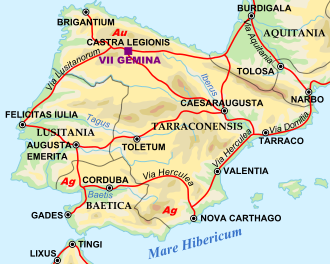
Lusitania or Hispania Lusitania was an ancient Roman
Ancient Rome
Ancient Rome was a thriving civilization that grew on the Italian Peninsula as early as the 8th century BC. Located along the Mediterranean Sea and centered on the city of Rome, it expanded to one of the largest empires in the ancient world....
province
Roman province
In Ancient Rome, a province was the basic, and, until the Tetrarchy , largest territorial and administrative unit of the empire's territorial possessions outside of Italy...
including approximately all of modern Portugal
Portugal
Portugal , officially the Portuguese Republic is a country situated in southwestern Europe on the Iberian Peninsula. Portugal is the westernmost country of Europe, and is bordered by the Atlantic Ocean to the West and South and by Spain to the North and East. The Atlantic archipelagos of the...
south of the Douro
Douro
The Douro or Duero is one of the major rivers of the Iberian Peninsula, flowing from its source near Duruelo de la Sierra in Soria Province across northern-central Spain and Portugal to its outlet at Porto...
river and part of modern Spain
Spain
Spain , officially the Kingdom of Spain languages]] under the European Charter for Regional or Minority Languages. In each of these, Spain's official name is as follows:;;;;;;), is a country and member state of the European Union located in southwestern Europe on the Iberian Peninsula...
(the present autonomous community of Extremadura
Extremadura
Extremadura is an autonomous community of western Spain whose capital city is Mérida. Its component provinces are Cáceres and Badajoz. It is bordered by Portugal to the west...
and a small part of the province of Salamanca
Salamanca (province)
Salamanca is a province of western Spain, in the western part of the autonomous community of Castile and León. It is bordered by the provinces of Zamora, Valladolid, Ávila, and Cáceres; and by Portugal....
). It was named after the Lusitani or Lusitanian
Lusitanians
The Lusitanians were an Indo-European people living in the Western Iberian Peninsula long before it became the Roman province of Lusitania . They spoke the Lusitanian language which might have been Celtic. The modern Portuguese people see the Lusitanians as their ancestors...
people (an Indo-European people
Proto-Indo-Europeans
The Proto-Indo-Europeans were the speakers of the Proto-Indo-European language , a reconstructed prehistoric language of Eurasia.Knowledge of them comes chiefly from the linguistic reconstruction, along with material evidence from archaeology and archaeogenetics...
). Its capital was Emerita Augusta
Emerita Augusta
The Archaeological Ensemble of Mérida is one of the largest and most extensive archaeological sites in Spain. Mainly of Emerita Augusta, ancient capital of Lusitania . It was declared a World Heritage Site by UNESCO in 1993....
(currently Mérida, Spain
Mérida, Spain
Mérida is the capital of the autonomous community of Extremadura, western central Spain. It has a population of 57,127 . The Archaeological Ensemble of Mérida is a UNESCO World Heritage site since 1993.- Climate :...
), and it was initially part of the Roman Republic
Roman Republic
The Roman Republic was the period of the ancient Roman civilization where the government operated as a republic. It began with the overthrow of the Roman monarchy, traditionally dated around 508 BC, and its replacement by a government headed by two consuls, elected annually by the citizens and...
province of Hispania Ulterior
Hispania Ulterior
During the Roman Republic, Hispania Ulterior was a region of Hispania roughly located in Baetica and in the Guadalquivir valley of modern Spain and extending to all of Lusitania and Gallaecia...
, before becoming a province of its own in the Roman Empire
Roman Empire
The Roman Empire was the post-Republican period of the ancient Roman civilization, characterised by an autocratic form of government and large territorial holdings in Europe and around the Mediterranean....
.
Origin of the name
The etymology of Lusitania, like the origin of the Lusitani who gave the province their name, is unclear. The name may be of Celtic origin: Lus and Tanus, "tribe of Lusus", connecting the name with the personal Celtic name Luso and with the god LughLugh
Lug or Lugh is an Irish deity represented in mythological texts as a hero and High King of the distant past. He is known by the epithets Lámhfhada , for his skill with a spear or sling, Ildánach , Samhildánach , Lonnbeimnech and Macnia , and by the...
.
Early modern scholars derived the name from Lucis, an ancient people mentioned in Avienus' Ora Maritima
Avienus
Avienus was a Latin writer of the 4th century AD. According to an inscription from Bulla Regia, his full name was Postumius Rufius Festus Avienius.He was a native of Volsinii in Etruria, from the distinguished family of the Rufii Festi...
and Tan, from Celtic Tan (Stan), or Tain, meaning a region or implying a country of waters, a root word that formerly meant a prince or sovereign governor of a region. The name has been connected with the personal Celtic name Luso and with the god Lugh
Lugh
Lug or Lugh is an Irish deity represented in mythological texts as a hero and High King of the distant past. He is known by the epithets Lámhfhada , for his skill with a spear or sling, Ildánach , Samhildánach , Lonnbeimnech and Macnia , and by the...
.
Ancient Romans, such as Pliny the Elder
Pliny the Elder
Gaius Plinius Secundus , better known as Pliny the Elder, was a Roman author, naturalist, and natural philosopher, as well as naval and army commander of the early Roman Empire, and personal friend of the emperor Vespasian...
(Natural History, 3.5) and Varro
Marcus Terentius Varro
Marcus Terentius Varro was an ancient Roman scholar and writer. He is sometimes called Varro Reatinus to distinguish him from his younger contemporary Varro Atacinus.-Biography:...
(cited by Pliny), speculated that the name Lusitania was of Roman origin, as when Pliny says lusum enim liberi patris aut lyssam cum eo bacchantium nomen dedisse lusitaniae et pana praefectum eius universae: that Lusitania takes its name from the lusus
Lusus
Lusus is the supposed son or companion of Bacchus, the Roman god of wine and divine madness, to whom Portuguese national mythology attributed the foundation of ancient Lusitania and the fatherhood of the its inhabitants, the Lusitanians, seen as the ancestors of the modern Portuguese people...
associated with Bacchus and the lyssa
Lyssa
In Greek mythology, Lyssa was the spirit of mad rage, frenzy and rabies in animals. She was closely related to the Maniae, the goddesses of madness and insanity. Her Roman equivalent was variously named Ira, Furor, or Rabies...
of his Bacchantes, and that Pan
Pan (mythology)
Pan , in Greek religion and mythology, is the god of the wild, shepherds and flocks, nature, of mountain wilds, hunting and rustic music, as well as the companion of the nymphs. His name originates within the Greek language, from the word paein , meaning "to pasture." He has the hindquarters, legs,...
is its governor. Lusus is usually translated as "game" or "play", while lyssa is a borrowing from the Greek
Greek language
Greek is an independent branch of the Indo-European family of languages. Native to the southern Balkans, it has the longest documented history of any Indo-European language, spanning 34 centuries of written records. Its writing system has been the Greek alphabet for the majority of its history;...
λυσσα, "frenzy" or "rage", and sometimes rage personified; for later poets, Lusus and Lyssa become flesh-and-blood companions of Bacchus. Luís de Camões
Luís de Camões
Luís Vaz de Camões is considered Portugal's and the Portuguese language's greatest poet. His mastery of verse has been compared to that of Shakespeare, Vondel, Homer, Virgil and Dante. He wrote a considerable amount of lyrical poetry and drama but is best remembered for his epic work Os Lusíadas...
' Os Lusíadas
Os Lusíadas
Os Lusíadas , usually translated as The Lusiads, is a Portuguese epic poem by Luís Vaz de Camões ....
, which portrays Lusus as the founder of Lusitania, extends these ideas, which have no connection with modern etymology.
In his work, "Geography", the classical geographer Strabo
Strabo
Strabo, also written Strabon was a Greek historian, geographer and philosopher.-Life:Strabo was born to an affluent family from Amaseia in Pontus , a city which he said was situated the approximate equivalent of 75 km from the Black Sea...
suggests a change had occurred the use of the name "Lusitanian". He mentions a group who had once been called "Lusitanians" living north of the Douro river but were called in his day "Callacans".
Lusitanians
The Lusitani, who were Indo-EuropeansProto-Indo-Europeans
The Proto-Indo-Europeans were the speakers of the Proto-Indo-European language , a reconstructed prehistoric language of Eurasia.Knowledge of them comes chiefly from the linguistic reconstruction, along with material evidence from archaeology and archaeogenetics...
, established themselves in the region in the 6th century BC, but historian
Historian
A historian is a person who studies and writes about the past and is regarded as an authority on it. Historians are concerned with the continuous, methodical narrative and research of past events as relating to the human race; as well as the study of all history in time. If the individual is...
s and archeologists are still undecided about their ethnogenesis
Ethnogenesis
Ethnogenesis is the process by which a group of human beings comes to be understood or to understand themselves as ethnically distinct from the wider social landscape from which their grouping emerges...
. Some modern authors consider them to be an indigenous people who were Celticized culturally and possibly also through intermarriage.
The archeologist Scarlat Lambrino defended the position that the Lusitanians were a tribal group of Celtic origin related to the Lusones
Lusones
The Lusones were an ancient Celtic Celtiberian people of the Iberian peninsula , who lived in the high Tajuña River valley, northeast of Guadalajara...
(a tribe that inhabited the east of Iberia
Iberian Peninsula
The Iberian Peninsula , sometimes called Iberia, is located in the extreme southwest of Europe and includes the modern-day sovereign states of Spain, Portugal and Andorra, as well as the British Overseas Territory of Gibraltar...
). Some have claimed that both tribes came from the Swiss mountains. Others argue that the evidence points to the Lusitanians being a native Iberian tribe, resulting from intermarriage between different local tribes.
The first area colonized by the Lusitani was probably the Douro
Douro
The Douro or Duero is one of the major rivers of the Iberian Peninsula, flowing from its source near Duruelo de la Sierra in Soria Province across northern-central Spain and Portugal to its outlet at Porto...
valley and the region of Beira Alta (present day Portugal); in Beira
Beira, Portugal
Beira was one of the six traditional provinces or "comarcas" of Portugal.-Administrative history:The medieval province of Beira was divided in 1832 into* Beira Alta Province* Beira Baixa ProvinceBeira Litoral...
, they stayed until they defeated the Celtici
Celtici
]The Celtici were a Celtic tribe or group of tribes of the Iberian peninsula, inhabiting three definite areas: in what today are the provinces of Alentejo and the Algarve in Portugal; in the Province of Badajoz and north of Province of Huelva in Spain, in the ancient Baeturia; and along the...
and other tribes, then they expanded to cover a territory that reached Estremadura
Estremadura Province (historical)
Estremadura Province is one of the six historical provinces of Portugal....
before the arrival of the Roman
Roman Republic
The Roman Republic was the period of the ancient Roman civilization where the government operated as a republic. It began with the overthrow of the Roman monarchy, traditionally dated around 508 BC, and its replacement by a government headed by two consuls, elected annually by the citizens and...
s.
War against Rome

Livy
Titus Livius — known as Livy in English — was a Roman historian who wrote a monumental history of Rome and the Roman people. Ab Urbe Condita Libri, "Chapters from the Foundation of the City," covering the period from the earliest legends of Rome well before the traditional foundation in 753 BC...
(218 BC
218 BC
Year 218 BC was a year of the pre-Julian Roman calendar. At the time it was known as the Year of the Consulship of Scipio and Longus...
) and are described as fighting for the Carthaginian
Carthage
Carthage , implying it was a 'new Tyre') is a major urban centre that has existed for nearly 3,000 years on the Gulf of Tunis, developing from a Phoenician colony of the 1st millennium BC...
s; they are reported as fighting against Rome in 194 BC
194 BC
Year 194 BC was a year of the pre-Julian Roman calendar. At the time it was known as the Year of the Consulship of Africanus and Longus...
, sometimes allied with Celtiberian
Celtiberians
The Celtiberians were Celtic-speaking people of the Iberian Peninsula in the final centuries BC. The group used the Celtic Celtiberian language.Archaeologically, the Celtiberians participated in the Hallstatt culture in what is now north-central Spain...
tribes.
In 179 BC
179 BC
Year 179 BC was a year of the pre-Julian Roman calendar. At the time it was known as the Year of the Consulship of Flaccus and Fulvianus...
, the praetor
Praetor
Praetor was a title granted by the government of Ancient Rome to men acting in one of two official capacities: the commander of an army, usually in the field, or the named commander before mustering the army; and an elected magistratus assigned varied duties...
Lucius Postumius Albinus celebrated a triumph
Roman triumph
The Roman triumph was a civil ceremony and religious rite of ancient Rome, held to publicly celebrate and sanctify the military achievement of an army commander who had won great military successes, or originally and traditionally, one who had successfully completed a foreign war. In Republican...
over the Lusitani, but in 155 BC
155 BC
Year 155 BC was a year of the pre-Julian Roman calendar. At the time it was known as the Year of the Consulship of Corculum and Marcellus...
, on the command of Punicus (Πουνίκου, perhaps a Carthaginian) first and Cesarus (Καίσαρος) after, the Lusitani reached Gibraltar
Gibraltar
Gibraltar is a British overseas territory located on the southern end of the Iberian Peninsula at the entrance of the Mediterranean. A peninsula with an area of , it has a northern border with Andalusia, Spain. The Rock of Gibraltar is the major landmark of the region...
. Here they were defeated by the praetor Lucius Mummius.
From 152 BC onwards, the Roman Republic had difficulties in recruiting soldiers for the wars in Hispania, deemed particularly brutal.
In 150 BC
150 BC
Year 150 BC was a year of the pre-Julian Roman calendar. At the time it was known as the Year of the Consulship of Flamininus and Balbus...
, Servius Sulpicius Galba organised a false armistice. While the Lusitani celebrated this new alliance, he massacred them, selling the survivors as slaves; this caused a new rebellion led by Viriathus
Viriathus
Viriathus was the most important leader of the Lusitanian people that resisted Roman expansion into the regions of Western Hispania , where the Roman province of Lusitania would be established...
, who was soon killed by traitors paid by the Romans in 139 BC
139 BC
Year 139 BC was a year of the pre-Julian Roman calendar. At the time it was known as the Year of the Consulship of Piso and Laenas...
, after having led a successful guerrilla campaign against Rome and their local allies. Two years after, in 137 BC Decimus Junius Brutus Callaicus
Decimus Junius Brutus Callaicus
Decimus Junius Brutus Callaicus was a Roman politician and general of the 2nd century BC. He was the son of the consul Marcus Junius Brutus and brother of the praetor Marcus Junius Brutus; he himself was appointed consul in 138 BC...
led a successful campaign against the Lusitani, reaching as far north as the Minho
Minho River
The Minho or Miño is the longest river in Galicia, Spain, with an extension of 340 km.Both names come from Latin Minius...
river.
Romans scored other victories with proconsul
Proconsul
A proconsul was a governor of a province in the Roman Republic appointed for one year by the senate. In modern usage, the title has been used for a person from one country ruling another country or bluntly interfering in another country's internal affairs.-Ancient Rome:In the Roman Republic, a...
Decimus Junius Brutus Callaicus and Gaius Marius
Gaius Marius
Gaius Marius was a Roman general and statesman. He was elected consul an unprecedented seven times during his career. He was also noted for his dramatic reforms of Roman armies, authorizing recruitment of landless citizens, eliminating the manipular military formations, and reorganizing the...
(elected in 113 BC
113 BC
Year 113 BC was a year of the pre-Julian Roman calendar. At the time it was known as the Year of the Consulship of Caprarius and Carbo...
), but still the Lusitani resisted with a long guerilla war; they later joined Sertorius' (a renegade Roman General) troops (around 80 BC) and were finally defeated by Augustus
Augustus
Augustus ;23 September 63 BC – 19 August AD 14) is considered the first emperor of the Roman Empire, which he ruled alone from 27 BC until his death in 14 AD.The dates of his rule are contemporary dates; Augustus lived under two calendars, the Roman Republican until 45 BC, and the Julian...
(around 28-24 BC).
Roman province

Division under Augustus (25–20 BC)
With Lusitania (and Asturia and GallaeciaGallaecia
Gallaecia or Callaecia, also known as Hispania Gallaecia, was the name of a Roman province and an early Mediaeval kingdom that comprised a territory in the north-west of Hispania...
), Rome had completed the conquest of the Iberian peninsula
Iberian Peninsula
The Iberian Peninsula , sometimes called Iberia, is located in the extreme southwest of Europe and includes the modern-day sovereign states of Spain, Portugal and Andorra, as well as the British Overseas Territory of Gibraltar...
, which was then divided by Augustus (25–20 BC) into the eastern and northern Hispania Tarraconensis
Hispania Tarraconensis
Hispania Tarraconensis was one of three Roman provinces in Hispania. It encompassed much of the Mediterranean coast of Spain along with the central plateau. Southern Spain, the region now called Andalusia, was the province of Hispania Baetica...
, the southwestern Hispania Baetica
Hispania Baetica
Hispania Baetica was one of three Imperial Roman provinces in Hispania, . Hispania Baetica was bordered to the west by Lusitania, and to the northeast by Hispania Tarraconensis. Baetica was part of Al-Andalus under the Moors in the 8th century and approximately corresponds to modern Andalucia...
and the western Provincia Lusitana. Originally, Lusitania included the territories of Asturia and Gallaecia, but these were later ceded to the jurisdiction of the new Provincia Tarraconensis and the former remained as Provincia Lusitania et Vettones
Vettones
The Vettones were one of the pre-Roman Celtic peoples of the Iberian Peninsula .- Origins :...
. Its northern border was along the Douro river, while on its eastern side its border passed through Salmantica (Salamanca
Salamanca
Salamanca is a city in western Spain, in the community of Castile and León. Because it is known for its beautiful buildings and urban environment, the Old City was declared a UNESCO World Heritage Site in 1988. It is the most important university city in Spain and is known for its contributions to...
)and Caesarobriga (Talavera de la Reina) to the Anas
Anas
Anas is a genus of dabbling ducks. It includes mallards, wigeons, teals, pintails and shovelers in a number of subgenera. Some authorities prefer to elevate the subgenera to genus rank...
(Guadiana
Guadiana
The Guadiana , or Odiana, is an international river located on the Portuguese–Spanish border, separating Extremadura and Andalucia from Alentejo and Algarve...
) river.
Between 28-24 BC Augustus' military campaigns pacified all Hispania under Roman rule, with the foundation of Roman cities like Asturica Augusta (Astorga) and Bracara Augusta (Braga
Braga
Braga , a city in the Braga Municipality in northwestern Portugal, is the capital of the Braga District, the oldest archdiocese and the third major city of the country. Braga is the oldest Portuguese city and one of the oldest Christian cities in the World...
) to the north, and to the south Emerita Augusta
Emerita Augusta
The Archaeological Ensemble of Mérida is one of the largest and most extensive archaeological sites in Spain. Mainly of Emerita Augusta, ancient capital of Lusitania . It was declared a World Heritage Site by UNESCO in 1993....
(Mérida
Merida
Places of the world named Mérida or Merida include:*Mérida, Spain, capital city of the Spanish Community of Extremadura*Mérida, Yucatán, capital city of the Mexican state of Yucatán*Merida, Leyte, a municipality in Leyte province in the Philippines...
) (settled with the emeriti of the Legio V Alaudae
Legio V Alaudae
Legio quinta Alaudae sometimes known as Gallica, was levied by Julius Caesar in 52 BC from native Gauls. Their emblem was an elephant, and their cognomen Alaudae came from the high crest on their helmets, typical of the Gauls, which made them look like larks...
and Legio X Gemina
Legio X Gemina
Legio decima Gemina , was one of the four legions used by Julius Caesar in 58 BC, for his invasion of Gaul. There are still records of the X Gemina in Vienna in the beginning of the 5th century. The legion symbol was a bull...
legions
Roman legion
A Roman legion normally indicates the basic ancient Roman army unit recruited specifically from Roman citizens. The organization of legions varied greatly over time but they were typically composed of perhaps 5,000 soldiers, divided into maniples and later into "cohorts"...
).
Between the time of Augustus
Augustus
Augustus ;23 September 63 BC – 19 August AD 14) is considered the first emperor of the Roman Empire, which he ruled alone from 27 BC until his death in 14 AD.The dates of his rule are contemporary dates; Augustus lived under two calendars, the Roman Republican until 45 BC, and the Julian...
and Claudius
Claudius
Claudius , was Roman Emperor from 41 to 54. A member of the Julio-Claudian dynasty, he was the son of Drusus and Antonia Minor. He was born at Lugdunum in Gaul and was the first Roman Emperor to be born outside Italy...
, the province was divided into three conventus iuridicus
Conventus iuridicus
In Ancient Rome territorial organization, a conventus iuridicus was the capital city of a subdivision of some provinces with functions of seat of a district court of justice and maybe others.-External links:...
, territorial units presided by capital cities with a court of justice and joint roman/indigenous people assemblies (conventus), that counseled the Governor:
- Conventus Emeritensis, with capital in Emerita AugustaEmerita AugustaThe Archaeological Ensemble of Mérida is one of the largest and most extensive archaeological sites in Spain. Mainly of Emerita Augusta, ancient capital of Lusitania . It was declared a World Heritage Site by UNESCO in 1993....
(MéridaMérida, SpainMérida is the capital of the autonomous community of Extremadura, western central Spain. It has a population of 57,127 . The Archaeological Ensemble of Mérida is a UNESCO World Heritage site since 1993.- Climate :...
, SpainSpainSpain , officially the Kingdom of Spain languages]] under the European Charter for Regional or Minority Languages. In each of these, Spain's official name is as follows:;;;;;;), is a country and member state of the European Union located in southwestern Europe on the Iberian Peninsula...
) - Conventus Scalabitanus, with capital in Scalabis Iulia (SantarémSantarém-In Portugal:* Santarém District, a district in Portugal* Santarém Municipality, a municipality in that district* Santarém, Portugal the seat of the above district* Roman Catholic Diocese of Santarém, Portugal-Other:* Santarém cheese, a Portuguese goat cheese...
, PortugalPortugalPortugal , officially the Portuguese Republic is a country situated in southwestern Europe on the Iberian Peninsula. Portugal is the westernmost country of Europe, and is bordered by the Atlantic Ocean to the West and South and by Spain to the North and East. The Atlantic archipelagos of the...
) - Conventus Pacensis, with capital in Pax Iulia (BejaBejaBeja may refer to:*Beja , a city in Portugal, or**Beja Municipality, its municipality**Beja District, the district it is in**Beja Airbase, the nearby airbase*Béja, a town in Tunisia, or...
, PortugalPortugalPortugal , officially the Portuguese Republic is a country situated in southwestern Europe on the Iberian Peninsula. Portugal is the westernmost country of Europe, and is bordered by the Atlantic Ocean to the West and South and by Spain to the North and East. The Atlantic archipelagos of the...
)
The conventus ruled of a total of 46 populis
Populis
Populis is an international online publishing company producing content for 550 websites and blogs across eight European languages. Populis produces over 35,000 articles and videos in English, French, German, Italian, Portuguese, Spanish and Swedish. They receive 26.1 million monthly unique...
, 5 being roman colonies
Colonia (Roman)
A Roman colonia was originally a Roman outpost established in conquered territory to secure it. Eventually, however, the term came to denote the highest status of Roman city.-History:...
(Emerita Augusta
Emerita Augusta
The Archaeological Ensemble of Mérida is one of the largest and most extensive archaeological sites in Spain. Mainly of Emerita Augusta, ancient capital of Lusitania . It was declared a World Heritage Site by UNESCO in 1993....
(Mérida
Mérida, Spain
Mérida is the capital of the autonomous community of Extremadura, western central Spain. It has a population of 57,127 . The Archaeological Ensemble of Mérida is a UNESCO World Heritage site since 1993.- Climate :...
, Spain
Spain
Spain , officially the Kingdom of Spain languages]] under the European Charter for Regional or Minority Languages. In each of these, Spain's official name is as follows:;;;;;;), is a country and member state of the European Union located in southwestern Europe on the Iberian Peninsula...
), Pax Iulia (Beja
Beja
Beja may refer to:*Beja , a city in Portugal, or**Beja Municipality, its municipality**Beja District, the district it is in**Beja Airbase, the nearby airbase*Béja, a town in Tunisia, or...
), Scalabis
Scalabis
Scallabis was the Roman name of Santarém, Portugal.-History:The first documented human occupation dates from the VIII century BC...
(Santarém
Santarém
-In Portugal:* Santarém District, a district in Portugal* Santarém Municipality, a municipality in that district* Santarém, Portugal the seat of the above district* Roman Catholic Diocese of Santarém, Portugal-Other:* Santarém cheese, a Portuguese goat cheese...
), Norba
Norba
Norba, an ancient town of Latium , Italy. It is situated 1 mile northwest of the modern town of Norma, some 1575 ft. above sea-level, on the west edge of the Volscian Mountains or Monti Lepini...
and Metellinum). Felicitas Iulia Olisipo (Lisbon
Lisbon
Lisbon is the capital city and largest city of Portugal with a population of 545,245 within its administrative limits on a land area of . The urban area of Lisbon extends beyond the administrative city limits with a population of 3 million on an area of , making it the 9th most populous urban...
) was a roman law
Roman law
Roman law is the legal system of ancient Rome, and the legal developments which occurred before the 7th century AD — when the Roman–Byzantine state adopted Greek as the language of government. The development of Roman law comprises more than a thousand years of jurisprudence — from the Twelve...
municipality) and 3 other towns had the old Latin status (Ebora (Évora
Évora
Évora is a municipality in Portugal. It has total area of with a population of 55,619 inhabitants. It is the seat of the Évora District and capital of the Alentejo region. The municipality is composed of 19 civil parishes, and is located in Évora District....
), Myrtilis Iulia
Myrtilis Iulia
Myrtilis Iulia was the roman name given to present day Mértola, Portugal.During Classical Antiquity, Mértola was inhabited by Phoenicians, Carthaginians and finally the Romans, who called it Myrtilis Iulia....
(Mértola
Mértola
Mértola is a municipality in southeastern Portugal next to the Spanish border. It has a total area of 1,292.87 km² and a total population of 8,712 inhabitants . In terms of land area, it is the sixth-largest municipality in Portugal. The resultant population density of 6.74 persons/km² is the...
) and Salacia
Salacia
Salacia may refer to:*Neptune's wife in Roman mythology *Salacia , a genus of plants in the family Celastraceae*A fictional project in the video game Death by Degrees...
(Alcácer do Sal
Alcácer do Sal
Alcácer do Sal is a municipality in Portugal, located in Setúbal District. It has a total area of and a total population of 13,624 inhabitants.-History :-Earliest settlement:...
). The other 37 were of stipendiarii class, among which Aeminium
Aeminium
Aeminium was the ancient name of the city of Coimbra, in Portugal.The Romans founded the civitas of Aeminium in this place at the time of Augustus, which came under the protection of nearby Conimbriga situated some 15 km away to the south....
(Coimbra), Balsa
Balsa (Roman town)
Balsa was a Roman coastal town in Hispania, province of Lusitania, Conventus Pacensis .The modern location is in the rural estates of Torre d'Aires, Antas and Arroio, parish of Luz de Tavira, county of Tavira, district of Faro, in Algarve, Southern Portugal.- Name origin:BALSA is a pre-Roman...
(Tavira), or Mirobriga
Miróbriga
Miróbriga is an ancient Roman town located near the village and civil parish of Santiago do Cacém, in the municipality of the same name in the south-west of Portugal...
(Santiago do Cacém). Other cities include Ossonoba (Faro
Faro
-Places:*Faro District, in the Algarve, southern Portugal.**Faro Municipality, in the Algarve, southern Portugal.**Faro, Portugal, main city in Faro district.**Faro Airport in Faro, Portugal .**Roman Catholic Diocese of Faro, in Faro, Portugal....
), Cetobriga (Tróia, Setúbal), Collippo (Leiria
Leiria
Leiria is a city in Leiria Municipality in the Centro Region, Portugal. It is the capital of Leiria District. The city proper has 50,200 inhabitants and the entire municipality has nearly 120,000...
) or Arabriga (Alenquer
Alenquer
Alenquer is a municipality in Portugal with a total area of 304.2 km² and a total population of 42,932 inhabitants. The municipality is composed of 16 parishes, and is located in the District of Lisbon....
).
Division under Diocletian
Under DiocletianDiocletian
Diocletian |latinized]] upon his accession to Diocletian . c. 22 December 244 – 3 December 311), was a Roman Emperor from 284 to 305....
, Lusitania kept its borders and was ruled by a praeses
Praeses
Praeses , is a Latin word meaning "Seated in front of, i.e. at the head ", has both ancient and modern uses.-Roman imperial use:...
, later by a consularis
Consularis
Consularis is a Latin word, derived from consulo, "take counsel".-Roman history:Originally it was simple and adjective meaning "consular", but more interestingly it has also become a substantive, used in technical meanings.* Any former consul...
; finally, in 298 AD, it was united with the other provinces to form the Diocesis Hispaniarum ("Diocese
Diocese
A diocese is the district or see under the supervision of a bishop. It is divided into parishes.An archdiocese is more significant than a diocese. An archdiocese is presided over by an archbishop whose see may have or had importance due to size or historical significance...
of the Hispanias").
Governors
- Sextus (possibly Gaius) Julius SaturninusJulius SaturninusSextus Julius Saturninus was a Roman usurper against Emperor Probus.Julius Saturninus was a Gaul by birth and was a friend of Emperor Probus...
- Marcus Salvius Otho Caesar AugustusOthoOtho , was Roman Emperor for three months, from 15 January to 16 April 69. He was the second emperor of the Year of the four emperors.- Birth and lineage :...
Governor from 58 to 68 - Sextus Tigidius Perennis
- Vettius Agorius PraetextatusVettius Agorius PraetextatusVettius Agorius Praetextatus was a wealthy pagan aristocrat in 4th-century Roman Empire and a high priest in the cults of numerous gods...
Coloniae and Municipia
- Colonia Metellinum (Medellín, Badajoz)
- Colonia Norba Caesarina (CáceresCáceres- Places :* Cáceres in Spain** Cáceres which covers the province* Cáceres, Spain, the capital of Cáceres Province* Cáceres, Antioquia, municipality in Colombia...
) - Colonia Augusta EmeritaEmerita AugustaThe Archaeological Ensemble of Mérida is one of the largest and most extensive archaeological sites in Spain. Mainly of Emerita Augusta, ancient capital of Lusitania . It was declared a World Heritage Site by UNESCO in 1993....
(Mérida), provincial capital. - Colonia Civitas PacensisPax JuliaPax Iulia or Colonia Civitas Pacensis was a city in the Roman province of Lusitania, today Beja, Portugal. Already inhabited in Celtic times around 400 BC, there are indications of a Carthaginian presence, and the city is mentioned by Polybius and Claudius Ptolemy in the second century BC...
(BejaBejaBeja may refer to:*Beja , a city in Portugal, or**Beja Municipality, its municipality**Beja District, the district it is in**Beja Airbase, the nearby airbase*Béja, a town in Tunisia, or...
, Portugal) - Colonia ScalabisScalabisScallabis was the Roman name of Santarém, Portugal.-History:The first documented human occupation dates from the VIII century BC...
Preasidium Iulium (SantarémSantarém-In Portugal:* Santarém District, a district in Portugal* Santarém Municipality, a municipality in that district* Santarém, Portugal the seat of the above district* Roman Catholic Diocese of Santarém, Portugal-Other:* Santarém cheese, a Portuguese goat cheese...
, Portugal)
- Municipium Caesarobriga (Talavera de la Reina, ToledoToledo- Places :Belize:*Toledo District*Toledo SettlementBrazil:*Pedro de Toledo, São Paulo*Toledo, ParanáColombia:*Toledo, Norte de SantanderPhilippines:*Toledo City, CebuSpain:*Toledo, Spain *Kingdom of Toledo...
) - Municipium Augustobriga (Talavera la Vieja, CáceresCáceres- Places :* Cáceres in Spain** Cáceres which covers the province* Cáceres, Spain, the capital of Cáceres Province* Cáceres, Antioquia, municipality in Colombia...
) - Municipium AeminiumAeminiumAeminium was the ancient name of the city of Coimbra, in Portugal.The Romans founded the civitas of Aeminium in this place at the time of Augustus, which came under the protection of nearby Conimbriga situated some 15 km away to the south....
(CoimbraCoimbraCoimbra is a city in the municipality of Coimbra in Portugal. Although it served as the nation's capital during the High Middle Ages, it is better-known for its university, the University of Coimbra, which is one of the oldest in Europe and the oldest academic institution in the...
, Portugal) - Municipium ConimbrigaConímbrigaConímbriga is one of the largest Roman settlements in Portugal, and is classified as a National Monument. Conímbriga lies 16 km from Coimbra and less than 2 km from Condeixa-a-Nova. The site also has a museum that displays objects found by archaeologists during their excavations,...
- Municipium Salmantica (SalamancaSalamancaSalamanca is a city in western Spain, in the community of Castile and León. Because it is known for its beautiful buildings and urban environment, the Old City was declared a UNESCO World Heritage Site in 1988. It is the most important university city in Spain and is known for its contributions to...
) - Municipium Caurium (CoriaCoriaCoria may refer to:People* Rodolfo Coria, Argentine paleontologist* Guillermo Coria, Argentine tennis playerPlacesCoria is a Brythonic equivalent of the Latin Curia and may be used as a place-name in Roman Britain and elsewhere:...
, Cáceres) - Municipium Turgalium (Trujillo, Cáceres)
- Municipium Capara (Cáparra, Cáceres)
- Municipium OlisipoOlisipoMunicipium Cives Romanorum Felicitas Julia Olisipo was the ancient name of modern day Lisbon while part of the Roman Empire....
(Lisboa, Portugal) - Municipium Egitandiorum (Idanha-a-VelhaIdanha-a-VelhaIdanha-a-Velha is a parish in the east of Portugal, in the municipality of Idanha-a-Nova, and in the district Castelo Branco. It covers an area of 20.98 km² and had a population of 79 as of 2001.-History:...
, Portugal) - Municipium Regina Turdulorum (Casas de ReinaCasas de ReinaCasas de Reina is a municipality located in the province of Badajoz, Extremadura, Spain. According to the 2005 census , the municipality has a population of 193 inhabitants....
, Badajoz) - Municipium LacobrigaLacobrigaLacobriga was the latin name of a settlement established during the pre-Punic civilizations, near current day Lagos, Portugal.Founded by the Conii around 1899 BC, there is evidence of Phoenician presence around the seventh century BC....
(Lagos, PortugalLagos, PortugalLagos is a municipality at the mouth of Bensafrim River and along the Atlantic Ocean, in the Barlavento region of the Algarve, in southern Portugal....
)
Portuguese use of the name
As with the Roman names of many European countries, Lusitania was and is often used as an alternative name for PortugalPortugal
Portugal , officially the Portuguese Republic is a country situated in southwestern Europe on the Iberian Peninsula. Portugal is the westernmost country of Europe, and is bordered by the Atlantic Ocean to the West and South and by Spain to the North and East. The Atlantic archipelagos of the...
, especially in formal and literary or poetic contexts. The 16th century colony, which would develop into Brazil
Brazil
Brazil , officially the Federative Republic of Brazil , is the largest country in South America. It is the world's fifth largest country, both by geographical area and by population with over 192 million people...
, was named Nova Lusitânia ("New Lusitania"). In common use are such terms as Lusophone
Lusophone
A Lusophone is someone who speaks the Portuguese language, either as a native, as an additional language, or as a learner. As an adjective, it means "Portuguese-speaking"...
, meaning Portuguese-speaking, and Lusitanic
Lusitanic
Lusitanic , from Latin Lusitanicus, adjective from Lusitania, the name of a Roman province in the Iberian Peninsula and one of the two official names for Portugal is a term used to categorize persons who share the linguistic and cultural traditions of the Portuguese.When the modern day country of...
, referring to the Community of Portuguese Language Countries — once Portugal's colonies
Portuguese Empire
The Portuguese Empire , also known as the Portuguese Overseas Empire or the Portuguese Colonial Empire , was the first global empire in history...
and presently independent countries still sharing some common heritage.
See also
- LusitaniansLusitaniansThe Lusitanians were an Indo-European people living in the Western Iberian Peninsula long before it became the Roman province of Lusitania . They spoke the Lusitanian language which might have been Celtic. The modern Portuguese people see the Lusitanians as their ancestors...
- Lusitanian mythologyLusitanian mythologyLusitanian mythology is the mythology of the Lusitanians, the Indo-European people of western Iberia, in the territory comprising most of modern Portugal, Extremadura and a small part of Salamanca....
- Lusitanian languageLusitanian languageLusitanian was a paleohispanic language that apparently belonged to the Indo-European family. Its relationship to the Celtic languages of the Iberian Peninsula, either as a member, a cousin , or as a different branch of Indo-European, is debated. It is known from only five inscriptions, dated from...
- Emerita AugustaEmerita AugustaThe Archaeological Ensemble of Mérida is one of the largest and most extensive archaeological sites in Spain. Mainly of Emerita Augusta, ancient capital of Lusitania . It was declared a World Heritage Site by UNESCO in 1993....
- OphiussaOphiussaOphiussa, also spelled Ophiusa, is the ancient name given by the ancient Greeks to what is now Portuguese territory near the mouth of the river Tagus...
- PortugalPortugalPortugal , officially the Portuguese Republic is a country situated in southwestern Europe on the Iberian Peninsula. Portugal is the westernmost country of Europe, and is bordered by the Atlantic Ocean to the West and South and by Spain to the North and East. The Atlantic archipelagos of the...
- History of PortugalHistory of PortugalThe history of Portugal, a European and an Atlantic nation, dates back to the Early Middle Ages. In the 15th and 16th centuries, it ascended to the status of a world power during Europe's "Age of Discovery" as it built up a vast empire including possessions in South America, Africa, Asia and...
- Timeline of Portuguese historyTimeline of Portuguese historyThis is a historical timeline of Portugal.*Timeline of Iberian prehistory*Pre-Roman Iberia *Roman Lusitania and Gallaecia *Germanic Kingdoms...
- Pre-Roman Western Iberia (Before the 3rd Century BC)Timeline of Portuguese history (Pre-Roman)-Paleolithic:* c. 1.5 to 1.8 million years Before Present Paleolithic – Tools used by hominids at Orce in the province of Granada* c. 1 million years BP – Tools used by hominids living near Burgos...
- Roman Lusitania and Gallaecia (3rd Century BC to 4th Century AD)Timeline of Portuguese history (Lusitania and Gallaecia)This is a historical timeline of Portugal.-3rd century BC:*237 BC - The Carthaginian General Hamilcar Barca enters Iberia with his armies through Gadir.*228 BC - Hamilcar Barca dies in battle...
- Pre-Roman Western Iberia (Before the 3rd Century BC)
- SpainSpainSpain , officially the Kingdom of Spain languages]] under the European Charter for Regional or Minority Languages. In each of these, Spain's official name is as follows:;;;;;;), is a country and member state of the European Union located in southwestern Europe on the Iberian Peninsula...
- History of SpainHistory of SpainThe history of Spain involves all the other peoples and nations within the Iberian peninsula formerly known as Hispania, and includes still today the nations of Andorra, Gibraltar, Portugal and Spain...
- Timeline of Spanish historyTimeline of Spanish historyThis is a timeline of Spanish history. To read about the background to these events, see History of Spain.This timeline is incomplete; some important events may be missing...
- Pre-Roman peoples of the Iberian PeninsulaPre-Roman peoples of the Iberian PeninsulaThis is a list of the Pre-Roman peoples of the Iberian peninsula .-Non-Indo-European:*Aquitanians**Aquitani**Autrigones - some consider them Celtic .**Caristii - some consider them Celtic ....
- Romanization of HispaniaRomanization of HispaniaThe Romanization of Hispania is the process by which the Roman culture was introduced into the Iberian Peninsula during the period of Roman rule over it, or parts of it.- Introduction :...
- Balsa (Roman town)Balsa (Roman town)Balsa was a Roman coastal town in Hispania, province of Lusitania, Conventus Pacensis .The modern location is in the rural estates of Torre d'Aires, Antas and Arroio, parish of Luz de Tavira, county of Tavira, district of Faro, in Algarve, Southern Portugal.- Name origin:BALSA is a pre-Roman...