
All Topics  
Republicanism


   Email Print
   Bookmark   Link


Republicanism


Republicanism is the ideology
Ideology

An ideology is a set of aims and ideas, especially in politics. An ideology can be thought of as a comprehensive vision, as a way of looking at things , as in common sense and several philosophical tendencies , or a set of ideas proposed by the dominant class of a society to all members of this society....
 of governing a nation as a republic
Republic

A republic is a state or country that is not led by a hereditary monarch but in which the people have an impact on its government. The word originates from the Latin term res publica....
, where the head of state is appointed by other means than hereditary, often elections. An important element of Republicanism is constitutional law
Constitutionalism

Constitutionalism has a variety of meanings. Most generally, it is "a complex of ideas, attitudes, and patterns of behavior elaborating the principle that the authority of government derives from and is limited by a body of fundamental law." These ideas, attitudes and patterns of behavior, according to one analyst, form "a dynamic politic...
 to limit the states power over its citizens. Early proponents of Republicanism, such as John Milton
John Milton

John Milton II was an English poet, author, polemicist and civil servant for the Commonwealth of England. He is best known for his Epic poetry Paradise Lost and for his treatise condemning censorship, Areopagitica....
, put emphasis on the dangers of corruption and the importance of civic virtues.

Radicalism
Radicalism emerged in European states in the 19th century.


Discussion
Ask a question about 'Republicanism'
Start a new discussion about 'Republicanism'
Answer questions from other users
Full Discussion Forum


Encyclopedia


Republicanism is the ideology
Ideology

An ideology is a set of aims and ideas, especially in politics. An ideology can be thought of as a comprehensive vision, as a way of looking at things , as in common sense and several philosophical tendencies , or a set of ideas proposed by the dominant class of a society to all members of this society....
 of governing a nation as a republic
Republic

A republic is a state or country that is not led by a hereditary monarch but in which the people have an impact on its government. The word originates from the Latin term res publica....
, where the head of state is appointed by other means than hereditary, often elections. An important element of Republicanism is constitutional law
Constitutionalism

Constitutionalism has a variety of meanings. Most generally, it is "a complex of ideas, attitudes, and patterns of behavior elaborating the principle that the authority of government derives from and is limited by a body of fundamental law." These ideas, attitudes and patterns of behavior, according to one analyst, form "a dynamic politic...
 to limit the states power over its citizens. Early proponents of Republicanism, such as John Milton
John Milton

John Milton II was an English poet, author, polemicist and civil servant for the Commonwealth of England. He is best known for his Epic poetry Paradise Lost and for his treatise condemning censorship, Areopagitica....
, put emphasis on the dangers of corruption and the importance of civic virtues.

Radicalism


Radicalism emerged in European states in the 19th century. Although most radical parties later came to be in favor of economic liberalism
Economic liberalism

Economic liberalism is the economic component of classical liberalism.Theories in support of economic liberalism were developed in the Age of Enlightenment, and believed to be first fully formulated by Adam Smith which advocates...
, thus justifying the absorption of radicalism into the liberal
Liberalism

Liberalism is a broad class of political philosophy that considers individualism liberty and equality to be the most important political goals....
 tradition, all 19th century radicals were in favor of a constitutional republic
Constitutional republic

A constitutional republic is a state where the head of state and other officials are election as Representation of the people, and must govern according to existing constitutional constitutional law that limits the government's power over citizens....
 and universal suffrage
Universal suffrage

Universal suffrage consists of the extension of the Suffrage to adult citizens as a whole, though it may also mean extending said right to minors and noncitizens....
, while liberals were at the time in favor of constitutional monarchy
Constitutional monarchy

A constitutional monarchy is a form of constitutional government, where in either an elected or hereditary monarch is the head of state, unlike in an absolute monarchy, wherein the king or the queen is the sole source of political power, as he or she is not legally bound by the constitution....
 and census suffrage. Thus, radicals were as much Republicans as liberals, if not more. This distinction between Radicalism and Liberalism hasn't totally disappeared in the 20th century, although many radicals simply joined liberal parties or became virtually identical to them. For example, the Left Radical Party
Left Radical Party

The Radical Party of the Left is a minor Social liberalism and social democracy list of political parties in France.The PRG retains some support among middle-class voters and in traditional Radical areas in the South-West, but it only gains parliamentary representation by courtesy of the Socialist Party , with which it has been in close al...
 in France or the (originally Italian) Transnational Radical Party
Transnational Radical Party

The Transnational Radical Party is a political association of citizens, parliamentarians and members of government of various national and political backgrounds who intend to use nonviolent means to create an effective body of international law with respect for individuals and the affirmation of democracy and freedom throughout the world....
 which exist today have a lot more to do with Republicanism than with simple liberalism.

Thus, Chartism
Chartism

Chartism was a movement for political and society reform movement in the United Kingdom during the mid-19th century between 1838 and 1848. It takes its name from the People's Charter of 1838, which stipulated the six main aims of the movement as:...
 in the UK or even the early Republican, Radical and Radical-Socialist Party in France were closer to Republicanism (and the left-wing) than to liberalism, represented in France by the Orleanist
Orléanist

The Orl?anists were a France right-wing/center-right political faction or political party which arose out of the French Revolution, and ceased to have a separate existence shortly after the establishment of the French Third Republic in 1870....
s who rallied to the Republic
French Third Republic

The French Third Republic was the political regime of France between the Second French Empire and the Vichy France. It was a republican parliamentary democracy that was created on 4 September 1870 following the collapse of the Empire of Napoleon III of France in the Franco-Prussian War....
 only in the late 19th century, after the comte de Chambord's 1883 death and the 1891 papal encyclicalDe Rerum Novarum. Radicalism remained close to Republicanism (which is a term used more commonly to identify the conservative-liberal tradition in France, represented by a series of parties: Democratic Republican Alliance
Democratic Republican Alliance

The Democratic Republican Alliance was a History of France created in 1901 by followers of L?on Gambetta, such as Raymond Poincar? who would be president of the Council in the 1920s....
, Republican Federation, National Center of Independents and Peasants, Independent Republicans
Independent Republicans

The Independent Republicans were a French Conservatism political group founded in 1962, which became a political party in 1966.The Independent Republicans came from the liberal-conservative National Center of Independents and Peasants ....
, Republican Party
Republican Party (France)

The Republican Party was a France Left-Right politics political party founded in 1977. It replaced the National Federation of the Independent Republicans that was founded in 1966....
, Liberal Democracy
Liberal Democracy (France)

Liberal Democracy was a France political party that advocated conservative liberalism and liberal conservatism, headed by Alain Madelin. The party replaced in 1997 the Republican Party , which was the classical liberal component of the Union for French Democracy ....
) in the 20th century, at least in France where they governed several times with the other left-wing parties (participating in both the Cartel des gauches
Cartel des Gauches

The Cartel des gauches was the name of the governmental alliance between the Radical-Socialist Party and the socialist SFIO after World War I , which lasted until the end of the Popular Front ....
 coalitions as well as the Popular Front
Popular Front (France)

The Popular Front was an alliance of History of the Left in France movements, including the French Communist Party , the Socialist SFIO and the Radical Party , during the interwar period....
).

Discredited after the Second World War, French Radicals split into a left-wing party – the Left Radical Party
Left Radical Party

The Radical Party of the Left is a minor Social liberalism and social democracy list of political parties in France.The PRG retains some support among middle-class voters and in traditional Radical areas in the South-West, but it only gains parliamentary representation by courtesy of the Socialist Party , with which it has been in close al...
, a part of the Socialist Party – and the Radical Party "valoisien", an associate party of the conservative Union for a Popular Movement
Union for a Popular Movement

The Union for a Popular Movement is a centre-right List of political parties in France.Founded in 2002, the party has an absolute majority in the French National Assembly and a plurality in the French Senate....
 (UMP) and its Gaullist
Gaullist Party

In France, the Gaullist Party is usually used to refer to the largest party professing to be Gaullist. Gaullism claimed to transcend the left/right rift ....
 predecessors. Italian Radicals
Italian Radicals (disambiguation)

Italian Radicals can refer to:* The Radical Party , a far left/left-liberal parliamentary group, 1877?1922.* The Radical Party , emerged from the left-wing of Italian Liberal Party , 1955?1989....
 also maintained close links with Republicanism as well as Socialism
Socialism

Socialism refers to a broad set of economic theories of social organization advocating public or state ownership and administration of the means of production and distribution of goods, and a society characterized by equality for all individuals, with a fair or Egalitarianism method of compensation....
, with the Partito radicale founded in 1955 which became the Transnational Radical Party
Transnational Radical Party

The Transnational Radical Party is a political association of citizens, parliamentarians and members of government of various national and political backgrounds who intend to use nonviolent means to create an effective body of international law with respect for individuals and the affirmation of democracy and freedom throughout the world....
 in 1989.

Contemporary republicanism

Anti-monarchial republicanism remains a political force of varying importance in many states. In the European monarchies, such as the United Kingdom
United Kingdom

The United Kingdom of Great Britain and Northern Ireland, commonly known as the United Kingdom , the UK or Britain,is a sovereign state located off the northwestern coast of continental Europe....
, the Netherlands, and Sweden
Sweden

Sweden , officially the Kingdom of Sweden , is a Nordic countries on the Scandinavian Peninsula in Northern Europe. Sweden has land borders with Norway to the west and Finland to the northeast, and it is connected to Denmark by the ?resund Bridge in the south....
 there has not been much contemporary popular support for republicanism. In such states republicanism is usually motivated by decreasing popularity of the Royal Family
Royal family

A royal family is the extended family of a king or queen regnant. The term "imperial family" more appropriately describes the extended family of an emperor or empress regnant, while the terms "ducal family", "grand ducal family" or "princely family" are more appropriate in reference to the relatives of a reigning duke, grand duke, or prince....
, who may be increasingly embroiled in scandal or conflict. However the classical argument against monarchy versus the egalitarian aspects of republicanism will often remain prominent as well. There are also republican movements of varying size and effect in the Commonwealth
Commonwealth of Nations

The Commonwealth of Nations, also known as the Commonwealth or the British Commonwealth, is an intergovernmental organization of fifty-three independent member states....
 nations Australia
Australia

Australia, officially the Commonwealth of Australia, is a country in the southern hemisphere comprising the Australia of the world's smallest continent, the major island of Tasmania, and numerous list of islands of Australia in the Indian Ocean and Pacific Oceans....
, Canada
Canada

Canada is a country occupying most of northern North America, extending from the Atlantic Ocean in the east to the Pacific Ocean in the west and northward into the Arctic Ocean....
, New Zealand
New Zealand

New Zealand is an island country in the south-western Pacific Ocean comprising two main landmasses , and numerous Islands of New Zealand, most notably Stewart Island/Rakiura and the Chatham Islands....
, Jamaica
Jamaica

Jamaica is an island nation of the Greater Antilles, in length and as much as in width situated in the Caribbean Sea. It is about south of Cuba, and west of the island of Hispaniola, on which Haiti and the Dominican Republic are situated....
 and Barbados
Barbados

Barbados , situated just east of the Caribbean Sea, is an independent Continental Island-island nation in the western Atlantic Ocean. Located at roughly 13? North of the equator and 59? West of the prime meridian, it is considered a part of the Lesser Antilles....
. In these countries, republicanism is largely about the post-colonial evolution of their relationships with the United Kingdom.

Republicanism in political science

A different interpretation of republicanism is used among political scientists. To them a republic is the rule by many and by laws while a princedom is the arbitrary rule by one. By this definition despotic states are not republics while, according to some such as Kant
KANT

KANT is a computer algebra system for mathematicians interested in algebraic number theory, performing sophisticated computations in algebraic number fields, in Global field function fields, and in local fields....
, constitutional monarchies can be. Kant also argues that a pure democracy is not a republic, as it is the unrestricted rule of the majority. For some republicanism meant simply lack of monarchy, for other monarchy was a form of republic.

Antique antecedents


Ancient India

Vaishali
Vaishali

Vaishali may refer to:*A colony in north west Delhi*Vaishali District, in Bihar state, India.*Vaishali , an ancient democratic city of India, currently located in Vaishali District, Bihar, India....
 in what is now Bihar, India was one of the first governments in the world to have elements of what we would today consider Republicanism, similar to and preceding those later found in ancient Greece (although it was not a monarchy, ancient Vaishali was perhaps better described as an oligarchy). It continues to be inhabited today and is a major pilgrimage center for the Jains and the Buddhists.

Ancient Greece
In Ancient Greece
Ancient Greece

The term Ancient Greece refers to the period of History of Greece lasting from the Greek Dark Ages ca. 1100 BC and the Dorian invasion, to 146 BC and the Roman Republic conquest of Greece after the Battle of Corinth ....
 several philosophers and historians set themselves to analysing and describing forms of government of classical republicanism
Classical republicanism

Classical republicanism is a form of republicanism originating from and inspired by the governmental forms and writings of classical antiquity....
. There is no single written expression or definition from this era that exactly corresponds with a modern understanding of the term "republic". However, most of the essential features of the modern definition are present in the works of Plato
Plato

Plato , was a Classical Greece Greeks philosopher, mathematician, writer of philosophical dialogues, and founder of the Platonic Academy in Ancient Athens, the first institution of higher learning in the western world....
, Aristotle
Aristotle

Aristotle was a Greeks philosopher, a student of Plato and teacher of Alexander the Great. He wrote on many subjects, including physics, metaphysics, Poetics , theater, music, logic, rhetoric, politics, government, ethics, biology and zoology....
, Polybius
Polybius

Polybius was a Greek historian of the Hellenistic Period noted for his book called The Histories covering in detail the period of 220–146 BC....
, and other ancient Greeks. These elements include the ideas of mixed government
Mixed government

Mixed government, also known as a mixed constitution, is a form of government that integrated facets of government by democracy, oligarchy, and monarchy....
 and of civic virtue
Civic virtue

Civic virtue is the cultivation of habit s of personal living that are claimed to be important for the success of the community. The identification of the character traits that constitute civic virtue has been a major concern of political philosophy....
. It should be noted that the modern title of Plato
Plato

Plato , was a Classical Greece Greeks philosopher, mathematician, writer of philosophical dialogues, and founder of the Platonic Academy in Ancient Athens, the first institution of higher learning in the western world....
's dialogue on the ideal state (The Republic) is a misnomer when seen through the eyes of modern political science (see Republic (Plato)
Republic (Plato)

The Republic is a Socratic dialogue by Plato, written in approximately 380 BC. It is one of the most influential works of philosophy and Political philosophy, and Plato's best known work....
). Some scholars have translated the Greek concept of "politeia
Politeia

Politeia is an Ancient Greek word with no single English translation. Derived from the word polis , it is an important term in Ancient Greek political thought, especially that of Plato and Aristotle....
" as "republic", but most modern scholars reject this idea.

A number of Ancient Greek states such as Athens
Athens

Athens , the Capital and largest city of Greece, dominates the Attica periphery; as one of the List of cities by time of continuous habitation, its recorded history spans around 3,400 years....
 and Sparta
Sparta

Sparta was a city-state in ancient Greece, situated on the Eurotas River in the southern part of the Peloponnese. From circa 650 BC it rose to become the dominant military power in the region and as such was recognized as the overall leader of the combined Greek forces during the Greco-Persian Wars....
 have been classified as classical republic
Classical republic

A classical republic, according to certain modern political theorists, is a state of Classical Antiquity that is considered to have a republican form of government, a state where sovereignty rested with the people rather than a ruler or monarch....
s, though this uses a definition of republic that was developed much later.

Ancient Rome
Both Livy
Livy

Titus Livius , known as Livy in English language, was a Ancient Rome historian who wrote a monumental history of Rome, Ab Urbe Condita, from its founding through the reign of Augustus in Livy's own time....
 (in Latin, living in Augustus' time) and Plutarch
Plutarch

Lucius Mestrius Plutarchus , c. AD 46 ? 120 ? commonly known in English as Plutarch ? was a Ancient Rome historian , biographer, essayist, and Middle Platonism....
 (in Greek, a century later) described how Rome had developed its legislation, notably the transition from kingdom to republic, based on Greek examples. Probably some of this history, composed more than half a millennium after the events, with scant written sources to rely on, is fictitious reconstruction - nonetheless the influence of the Greek way of dealing with government is clear in the state organisation of the Roman Republic
Roman Republic

The Roman Republic was the phase of the Ancient Rome characterized by a republican form of government; a period which began with the overthrow of the Roman Roman Kingdom, c....
.

The Greek historian Polybius, writing more than a century before Livy, was one of the first historians describing the emergence of the Roman Empire
Roman Empire

The Roman Empire was the Roman Republic phase of the Ancient Rome, characterised by an autocracy form of government and large territorial holdings in Europe and around the Mediterranean....
, and he had a great influence on Cicero
Cicero

Marcus Tullius Cicero was a Ancient Rome philosopher, statesman, lawyer, political theorist, and Constitution of the Roman Republic. Cicero is widely considered one of Rome's greatest rhetoric and prose stylists....
 when this orator
Orator

An orator, or oratist, is a speaker.An orator may also be called an oratarian - literally, "he who orates".Etymology...
 was writing his politico-philosophical works in the 1st century BC. One of these works was De re publica
De re publica

De re publica is a dialogue#Literature by Cicero, written in six books between 54 and 51 BC. It is written in the format of a Socratic dialogue; that is to say, Scipio Africanus Minor takes the role of a wise old man — an obligatory part for the genre....
, where Cicero links the Latin res publica concept to the Greek politeia." As explained in the res publica
Res publica

Res publica is a Latin phrase, literally meaning "public issue" or "public matter". It is the origin of the word 'republic', though translations vary widely according to the context....
 article, this concept only partly correlates with the modern term "republic," although the word "republic" is derived from
res publica.

Among the many meanings of the term
res publica, it is most often translated "Republic" where the Latin expression refers to the Roman state and its form of government between the era of the Kings and the era of the Emperors. This Roman Republic would by a modern understanding of the word still be defined as a true republic, even if not coinciding in all the features. Enlightenment
Age of Enlightenment

The Age of Enlightenment or The Enlightenment is a term used to describe a time in Western philosophy and cultural life centered upon the eighteenth century, in which rationalism was advocated as the primary source and legitimacy for authority....
 philosophers saw it as an ideal system; for example there was no systematic separation of powers
Separation of powers

Separation of powers, a term ascribed to France Age of Enlightenment political philosopher Charles de Secondat, baron de Montesquieu, is a model for the governance of democracy states, having its origins in an ancient idea of mixed government....
 in the Roman Republic.

Romans still called their state "Res Publica" in the era of the early emperors. The reason for this is that on the surface the state organisation of the Republic had been preserved by the first emperors without great alteration. Several offices from the era of the Republic held by individuals were combined under the control of a single person. These forms were accorded
permanent" status and thus gradually placed sovereignty in the person of the Emperor. Traditionally, such references to the early empire are not translated as "republic".

As for Cicero, his description of the ideal state in De re publica is more difficult to qualify as a "republic" in modern terms. It is rather something like enlightened absolutism
Enlightened absolutism

Enlightened absolutism is a form of absolute monarchy or despotism in which rulers were influenced by the Age of Enlightenment. Enlightened monarchs embraced the principles of the Enlightenment, especially its emphasis upon rationality, and applied them to their territories....
--not to say benevolent dictator
Benevolent Dictator

#REDIRECT Enlightened absolutism...
ship--and indeed Cicero's philosophical works, as available at that time, were very influential when Enlightenment philosophers like Voltaire
Voltaire

Fran?ois-Marie Arouet , better known by the pen name Voltaire, was a French Age of Enlightenment writer, essayist, and philosophy known for his wit, philosophical sport, and defense of civil liberty, including freedom of religion and free trade....
 developed these concepts. Cicero expressed however reservations concerning the republican form of government: in his theoretical works he defended monarchy (or a monarchy/oligarchy mixed government at best); in his own political life he generally opposed men trying to realise such ideals, like Julius Caesar
Julius Caesar

'Gaius Julius Caesar' , July 13, 100 BC ? March 15, 44 BC,) was a Roman Republic military and political leader. He played a critical role in the transformation of the Roman Republic into the Roman Empire....
, Mark Antony
Mark Antony

Marcus Antonius , known in English as Marc Antony, was a Roman Republic politician and General. He was an important supporter and the best friend of Julius Caesar as a military commander and administrator, being Caesar's second cousin, once removed, by his mother Julia Antonia....
 and Octavian. Eventually, that opposition led to his death. So, depending on how one reads history, Cicero could be seen as a victim of his own deep-rooted republican ideals, too.

Tacitus
Tacitus

Publius Cornelius Tacitus was a Roman Senate and a historian of the Roman Empire. The surviving portions of his two major works—the Annals and the Histories —examine the reigns of the Roman Emperors Tiberius, Claudius, Nero and those that reigned in the Year of the Four Emperors....
, a contemporary of Plutarch, was not concerned with whether on an abstract level a form of government could be analysed as a "republic" or a "monarchy" (see for example Ann
Annals (Tacitus)

The Annals is a history book by Tacitus covering the reign of the four Roman Emperors succeeding to Caesar Augustus. The parts of the work that survived from antiquity cover the reigns of Tiberius and Nero....
. IV, 32-33). He analyzes how the powers accumulated by the early Julio-Claudian dynasty
Julio-Claudian Dynasty

The Julio-Claudian Dynasty refers to the four Roman Emperors: Tiberius, Caligula , Claudius, and Nero. They ruled the Roman Empire from 27 BC to AD 68, when the last of the line, Nero, committed suicide....
 were all given to the representants of this dynasty by a State that was and remained in an ever more "abstract" way a republic; nor was the Roman Republic "forced" to give away these powers to single persons in a consecutive dynasty: it did so out of free will, and reasonably in Augustus' case, because of his many services to the state, freeing it from civil war
Civil war

A civil war is a war between organized groups to take control of a nation or region, or to change government policies. It is high-intensity conflict, often involving Regular Army, that is sustained, organized and large-scale....
s and the like.

But at least Tacitus is one of the first to follow this line of thought: asking in what measure such powers were given to the head of state because the citizens wanted to give them, and in which measure they were given because of other principles (for example, because one had a deified ancestor
Imperial cult

An Imperial cult is a form of state religion in which an emperor, or a dynasty of emperors , are worshiped as messiahs, demigods or deity. "Cult " here is used to mean "worship," not in the modern pejorative sense....
) — such other principles leading more easily to abuse by the one in power. In this sense, that is in Tacitus' analysis, the trend away from the Republic was irreversible only when Tiberius
Tiberius

Tiberius Julius Caesar Augustus, born Tiberius Claudius Nero , was the second Roman Emperor, from the death of Augustus in AD 14 until his own death in 37....
 established power shortly after Augustus' death (AD 14, much later than most historians place the start of the Imperial form of government in Rome): by this time too many principles defining some powers as "untouchable" had been implemented to keep Tiberius from exercising certain powers, and the age of "sockpuppetry in the external form of a republic", as Tacitus more or less describes this Emperor
Emperor

An emperor is a monarch, usually the sovereign ruler of an empire or another type of imperial realm. Empress is the female equivalent. As a title, "empress" may indicate the wife of an emperor or a woman who rules in her own right ....
's reign, began (Ann
Annals (Tacitus)

The Annals is a history book by Tacitus covering the reign of the four Roman Emperors succeeding to Caesar Augustus. The parts of the work that survived from antiquity cover the reigns of Tiberius and Nero....
. I-VI).

In classical meaning, republic was any established political community with government above it. Both Plato
Plato

Plato , was a Classical Greece Greeks philosopher, mathematician, writer of philosophical dialogues, and founder of the Platonic Academy in Ancient Athens, the first institution of higher learning in the western world....
 and Aristotle
Aristotle

Aristotle was a Greeks philosopher, a student of Plato and teacher of Alexander the Great. He wrote on many subjects, including physics, metaphysics, Poetics , theater, music, logic, rhetoric, politics, government, ethics, biology and zoology....
 saw three basic types of government, democracy
Democracy

Democracy is a form of government in which power is held directly or indirectly by citizens under a free electoral system. It is derived from the Greek language d?????at?a , "popular government" which was coined from d???? , "people" and ???t?? , "rule, strength" in the middle of the 5th-4th century BC to denote the political syst...
, aristocracy
Aristocracy

Aristocracy is a form of government, in which a few of the most prominent citizens rule. This may be a hereditary elite, or it may be by a system of cooption where a council of prominent citizens add leading soldiers, merchants, land owners, priests, and lawyers to their number....
, and monarchy
Monarchy

A monarchy is a form of government in which supreme power is absolutely or nominally lodged in an individual, who is the head of state, often for Life tenure or until abdication, and "is wholly set apart from all other members of the state." The person who heads a monarchy is called a monarch....
. However an ideal type was considered mixed government
Mixed government

Mixed government, also known as a mixed constitution, is a form of government that integrated facets of government by democracy, oligarchy, and monarchy....
. First Plato and Aristotle, and especially Polybius
Polybius

Polybius was a Greek historian of the Hellenistic Period noted for his book called The Histories covering in detail the period of 220–146 BC....
 and Cicero
Cicero

Marcus Tullius Cicero was a Ancient Rome philosopher, statesman, lawyer, political theorist, and Constitution of the Roman Republic. Cicero is widely considered one of Rome's greatest rhetoric and prose stylists....
 developed the notion that the ideal republic is a mixture of these three forms of government and the writers of the Renaissance embraced this notion.

Renaissance republicanism

In Europe, republicanism was revived in the late Middle Ages
Middle Ages

File:Karl 1 mit papst gelasius gregor1 sacramentar v karl d kahlen.jpgThe Middle Ages of European history are a period in history which lasted for roughly a millennium, commonly dated from the fall of the Roman Empire in the 5th century to the beginning of the Early Modern Period in the 16th century, marked by the division of Western Christi...
 when a number of small states embraced a republican system of government. These were generally small, but wealthy, trading states in which the merchant class had risen to prominence. Haakonssen notes that by the Renaissance Europe was divided with those states controlled by a landed elite being monarchies and those controlled by a commercial elite being republics. These included Italian city states like Florence
Florence

Florence is the Capital city of the Italy Regions of Italy of Tuscany and of the provinces of Italy Province of Florence. It is the most populous city in Tuscany and has a population of 364,779 ....
 and Venice
Venice

Venice is a city in northern Italy, the capital city of the Italian regions Veneto, a population of 271,251 . Together with Padua, Italy, the city is included in the Padua-Venice Metropolitan Area ....
 and the members of the Hanseatic League
Hanseatic League

The Hanseatic League was an Military alliance of Trade cities and their guilds that established and maintained trade monopoly along the coast of Northern Europe, from the Baltic Sea to the North Sea and inland, during the Late Middle Ages and Early modern period ....
.

Building upon political arrangements of medieval feudalism
Feudalism

Feudalism, a term first used in the early modern period , in its most classic sense refers to a Middle Ages European political system composed of a set of reciprocal law and military obligations among the warrior nobility, revolving around the three key concepts of lords, vassals, and fiefs....
, the Renaissance
Renaissance

The Renaissance was a cultural movement that spanned roughly the 14th to the 17th century, beginning in Italy in the late Middle Ages and later spreading to the rest of Europe....
 scholars built upon their conception of the ancient world to advance their view of the ideal government. The usage of the term res publica
Res publica

Res publica is a Latin phrase, literally meaning "public issue" or "public matter". It is the origin of the word 'republic', though translations vary widely according to the context....
 in classical texts should not be confused with current notions of republicanism. Despite its name Plato
Plato

Plato , was a Classical Greece Greeks philosopher, mathematician, writer of philosophical dialogues, and founder of the Platonic Academy in Ancient Athens, the first institution of higher learning in the western world....
's The Republic (????te?a) also has little to no connection to the latin res publica from which derives the more recent historical phenomenon of republicanism.

The republicanism developed in the Renaissance is known as classical republicanism because of its reliance on classical models. This terminology was developed by Zera Fink in the 1960s but some modern scholars such as Brugger consider the term confusing as it might lead some to believe that "classical republic" refers to the system of government used in the ancient world. "Early modern republicanism" has been advanced as an alternative term.

Also sometimes called civic humanism, this ideology grew out of the Renaissance writers who developed the idea of the republic. More than being simply a non-monarchy the early modern thinkers developed a vision of the ideal republic. It is these notions that form the basis of the ideology of republicanism. One important notion was that of a mixed government
Mixed government

Mixed government, also known as a mixed constitution, is a form of government that integrated facets of government by democracy, oligarchy, and monarchy....
. Also central the notion of virtue
Virtue

Virtue is morality excellence. Personal virtues are characteristics Value as promoting individual and collective well-being, and thus Goodness and value theory by definition....
 and the pursuit of the common good
Common good

The common good is a term that can refer to several different concepts. In the popular meaning, the common good describes a specific "Goodness and value theory" that is shared and beneficial for all members of a given community....
 being central to good government. Republicanism also developed its own distinct view of liberty
Liberty

Liberty, the freedom to act or believe without being stopped by unnecessary force, is generally considered in modern time to be a concept of political philosophy and identifies the condition in which an individual has the right to act according to his or her own free will....
, though what exactly that view is much disputed.

Those Renaissance authors that spoke highly of republics were rarely critical of monarchies. While Niccolò Machiavelli
Niccolò Machiavelli

Niccol? di Bernardo dei Machiavelli is the philosopher, writer, and Italian politician considered the founder of modern political science. As a Renaissance Man, he was a Diplomacy, Political philosophy, musician, poet, and playwright, but, foremost, he was a Civil Servant of the Florence....
's Discourses on Livy
Discourses on Livy

The Discourses on Livy is a work of political history and philosophy composed in the early 16th century by the famed Florentine public servant and political theorist Niccol? Machiavelli , best known as the author of The Prince....
 is the period's key work on republics he also wrote The Prince
The Prince

Il Principe is a politics treatise by the Florence Civil service and Political philosophy Niccol? Machiavelli. Originally called De Principatibus , it was originally written in 1513, but not published until 1532, five years after Machiavelli's death....
 on how to best run a monarchy. One cause of this was that the early modern writers did not see the republican model as one that could be applied universally, most felt that it could be successful only in very small and highly urbanized city-states. Jean Bodin
Jean Bodin

Jean Bodin was born in Angers, France, and became a French jurist and political philosophy, member of the Parlement of Paris and professor of law in Toulouse....
 in Six Books of the Commonwealth identified monarchy with republic.

In antiquity writers like Tacitus
Tacitus

Publius Cornelius Tacitus was a Roman Senate and a historian of the Roman Empire. The surviving portions of his two major works—the Annals and the Histories —examine the reigns of the Roman Emperors Tiberius, Claudius, Nero and those that reigned in the Year of the Four Emperors....
, and in the Renaissance writers like Machiavelli tried to avoid formulating an outspoken preference for one government system or another. Enlightenment philosophers, on the other hand, always had an outspoken opinion.

However, Thomas More
Thomas More

Saint Thomas More was an English lawyer, author, and statesman who in his lifetime gained a reputation as a leading Renaissance humanist scholar, and occupied many public offices, including Lord Chancellor ....
, still before the Age of Enlightenment, must have been a bit too outspoken to the reigning king's taste, even when coding his political preferences in a Utopia
Utopia

Utopia is a name for an ideal community or society, taken from the Utopia written in 1516 by Sir Thomas More describing a fictional island in the Atlantic Ocean, possessing a seemingly perfect social system-politics-legal system....
n tale.

In England a republicanism evolved that was not wholly opposed to monarchy, but rather thinkers such as Thomas More
Thomas More

Saint Thomas More was an English lawyer, author, and statesman who in his lifetime gained a reputation as a leading Renaissance humanist scholar, and occupied many public offices, including Lord Chancellor ....
 and Sir Thomas Smith saw a monarchy firmly constrained by law as compatible with republicanism.

Dutch Republic
Anti-monarchism became far more strident in the Dutch Republic
Dutch Republic

The Republic of the Seven United Netherlands was a European republic between 1581 and 1795, in about the same location as the modern Kingdom of the Netherlands, which is the successor state....
 during and after the Eighty Years' War, which began in 1568. This anti-monarchism was less political philosophy and more propagandizing with most of the anti-monarchist works appearing in the form of widely distributed pamphlet
Pamphlet

A pamphlet is an unbound booklet . It may consist of a single sheet of paper that is printed on both sides and folded in half, in thirds, or in fourths , or it may consist of a few pages that are folded in half and stapled at the crease to make a simple book....
s. Over time this evolved into a systematic critique of monarchies written by men such as Johan Uytenhage de Mist, Radboud Herman Scheel, Lieven de Beaufort and the brothers Johan and Peter de la Court. These writers saw all monarchies as illegitimate tyrannies that were inherently corrupt. Less an attack on their former overlords these works were more concerned with preventing the position of Stadholder from evolving into a monarchy. This Dutch republicanism also had an important influence on French Huguenots during the Wars of Religion
Wars of Religion

Wars of Religion may refer to:*European wars of religion, the European religious conflicts of the 16th and 17th centuries*French Wars of Religion, the 16th century Catholic-Protestant conflicts in France...
. In the other states of early modern Europe republicanism was more moderate.

Polish-Lithuanian Commonwealth
In the Polish-Lithuanian Commonwealth
Polish-Lithuanian Commonwealth

The Polish?Lithuanian Commonwealth was one of the largest and most populous countries in 16th and 17th-century Europe, formed by a Union of Lublin of Kingdom of Poland and Grand Duchy of Lithuania in 1569....
 republicanism became an important ideology. After establishment of the Commonwealth of Two Nations republicans were those who supported the status quo of having a very weak monarch and opposed those who felt a stronger monarchy was needed. These mostly Polish republicans such as Lukasz Górnicki
Lukasz Górnicki

Lukasz Ogonczyk Coat of Arms G?rnicki , Polish humanist, writer, secretary and chancellor of Sigismund August of Poland.He wrote Polish nobleman, Polish Crown, Polish-Italian Discussion, and other political, historical and poetical works....
, Andrzej Wolan, and Stanislaw Konarski
Stanislaw Konarski

Stanislaw Konarski was a Polish pedagogue, educational reformer, political writer, poet, dramatist, Piarist monk and precursor of the Enlightenment in Poland....
 were well read in classical and Renaissance texts and firmly believed that their state was a Republic on the Roman model and started to call their state the Rzeczpospolita
Rzeczpospolita

Rzeczpospolita is a Polish language word for "republic" or "commonwealth", a calque translation of the Latin expression res publica .The word rzeczpospolita has been used in Poland since at least 16th century, originally a generic term to denote any state with a republican or similar form of government....
. Unlike in the other countries, Polish-Lithuanian republicanism was not the ideology of the commercial class, but rather of the landed aristocracy, who would be the ones to lose power if the monarchy was expanded - what led to oligarchisation by great magnates.

Enlightenment republicanism


From the Enlightenment on it becomes increasingly difficult to distinguish between the descriptions and definitions of the "republic" concept on the one side, and the ideologies based on such descriptions on the other.

England
Oliver Cromwell
Oliver Cromwell

Oliver Cromwell was an English people Military history of the United Kingdom and Politics of England leader best known for his involvement in making England into a republican Commonwealth and for his later role as Lord Protector of England, Scotland, and Ireland....
 set up a republic called the Commonwealth of England
Commonwealth of England

The Commonwealth of England was the republic which ruled first Kingdom of England and Wales, and then Kingdom of Ireland and Kingdom of Scotland from 1649 to 1660....
 (1649-1660) and ruled as a near dictator after the overthrow of King Charles I
Charles I of England

Charles I was List of English monarchs, List of monarchs of Scotland and King of Ireland from 27 March 1625 until his capital punishment on 30 January 1649....
. A leading philosopher of republicanism was James Harrington
James Harrington

James Harrington was an England political theorist of classical republicanism, best known for his controversial work, The Commonwealth of Oceana ....
. The collapse of the Commonwealth of England
Commonwealth of England

The Commonwealth of England was the republic which ruled first Kingdom of England and Wales, and then Kingdom of Ireland and Kingdom of Scotland from 1649 to 1660....
 in 1660 and the restoration
English Restoration

The English Restoration, or simply The Restoration began in 1660 when the English monarchy, Scottish monarchy and Irish monarchy were restored under Charles II of England after the Interregnum that followed the English Civil War....
 of the monarchy under Charles II
Charles II of England

Charles II was the Monarchy of Kingdom of England, Kingdom of Scotland, and Kingdom of Ireland.His father Charles I of England Regicide#The regicide of Charles I of England at Palace of Whitehall on 30 January 1649, at the climax of the English Civil War....
 discredited republicanism among England's ruling circles. However they welcomed the liberalism and emphasis on rights of John Locke
John Locke

John Locke was an English philosopher. Locke is considered the first of the British Empiricism, but is equally important to social contract theory....
, which played a major role in the Glorious Revolution
Glorious Revolution

The Glorious Revolution, also called the Revolution of 1688, was the overthrow of British monarchy James II of England in 1688 by a union of Parliament of England with an invading army led by the Dutch Republic stadtholder William III of England , who as a result ascended the English throne as William III of England....
 of 1688. Nevertheless republicanism flourished in the "country" party of the early 18th century. That party denounced the corruption of the "court" party, producing a political theory that heavily influenced the American colonists. In general the ruling classes of the 18th century vehemently opposed republicanism, as typified by the attacks on John Wilkes
John Wilkes

John Wilkes was an England Radicalism , journalist and politician.In the Middlesex election dispute, he fought for the right of voters?rather than the British House of Commons?to determine their representatives....
, and especially by the wars to overthrow the American Revolution
American Revolution

The American Revolution refers to the political upheaval during the last half of the 18th century in which the Thirteen Colonies of North America overthrew the governance of the British Empire and then rejected the British monarchy to become the sovereign United States of America....
 and the French Revolution
French Revolution

The French Revolution was a period of political and social upheaval and radical change in the history of France, during which the French governmental structure, previously an absolute monarchy with feudalism for the aristocracy and Roman Catholic Church clergy, underwent radical change to forms based on Age of Enlightenment principles of cit...
.

French and Swiss thought
French and Swiss Enlightenment thinkers such as Montesquieu
Charles de Secondat, baron de Montesquieu

Charles-Louis de Secondat, baron de La Br?de et de Montesquieu , was a France social commentator and Political philosophy who lived during the Age of Enlightenment....
 and later Rousseau
Jean-Jacques Rousseau

Jean Jacques Rousseau was a major philosopher, writer, and composer of the eighteenth century The Age of Enlightenment, whose political philosophy influenced the French Revolution and the development of modern political and educational thought....
 expanded upon and altered the ideas of what an ideal republic would be: some of their new ideas were scarcely retraceable to antiquity or the Renaissance thinkers. Among other things they contributed and/or heavily elaborated notions like social contract
Social contract

Social contract describes a broad class of theories that try to explain the ways in which people form nations and maintain social order. The notion of the social contract implies that the people give up some rights to a government or other authority in order to receive or maintain social order....
, positive law
Positive law

Positive law is a legal term that is sometimes understood to have more than one meaning. But in the strictest sense, it is law made by human beings, that is, "Law actually and specifically enacted or adopted by proper authority for the government of an organized jural society." This term is also sometimes used to refer to the legal philosophy...
, and mixed government
Mixed government

Mixed government, also known as a mixed constitution, is a form of government that integrated facets of government by democracy, oligarchy, and monarchy....
. They also borrowed from and distinguished it from the ideas of liberalism
Liberalism

Liberalism is a broad class of political philosophy that considers individualism liberty and equality to be the most important political goals....
 that were developing at the same time. Since both liberalism and republicanism were united in their opposition to the absolute monarchies they were frequently conflated during this period. Modern scholars see them as two distinct streams that both contributed to the democratic ideals of the modern world. An important distinction is that while republicanism continued to stress the importance of civic virtue
Civic virtue

Civic virtue is the cultivation of habit s of personal living that are claimed to be important for the success of the community. The identification of the character traits that constitute civic virtue has been a major concern of political philosophy....
 and the common good
Common good

The common good is a term that can refer to several different concepts. In the popular meaning, the common good describes a specific "Goodness and value theory" that is shared and beneficial for all members of a given community....
, liberalism was based on economics and individualism
Individualism

Individualism is the Morality stance, political philosophy, or social outlook that stresses independence and self-reliance. Individualists promote the exercise of one's goals and desires, while opposing most external interference upon one's choices, whether by society, or any other group or institution....
. It might be argued that while liberalism developed a view of liberty
Liberty

Liberty, the freedom to act or believe without being stopped by unnecessary force, is generally considered in modern time to be a concept of political philosophy and identifies the condition in which an individual has the right to act according to his or her own free will....
 as pre-social and sees all institutions as limiting liberty, republicanism sees some institutions as necessary to create liberty. It is most vivid in the issue of private property which may be maintained only under protection of established positive law
Positive law

Positive law is a legal term that is sometimes understood to have more than one meaning. But in the strictest sense, it is law made by human beings, that is, "Law actually and specifically enacted or adopted by proper authority for the government of an organized jural society." This term is also sometimes used to refer to the legal philosophy...
. On the other hand, liberalism is strongly committed to some institutions e.g. the Rule of Law.

Republican ideology in the United States


In recent years a debate has developed over its role in the American Revolution and in the British radicalism of the eighteenth century. For many decades the consensus was that liberalism, especially that of John Locke
John Locke

John Locke was an English philosopher. Locke is considered the first of the British Empiricism, but is equally important to social contract theory....
, was paramount and that republicanism had a distinctly secondary role.

The new interpretations were pioneered by J.G.A. Pocock
J.G.A. Pocock

John Greville Agard Pocock is a world-renowned historian and expatriate New Zealander, noted for his trenchant studies of republicanism in the early modern period , for his treatment of Edward Gibbon and noteworthy contemporaries as historians of Age of Enlightenment, and, in historical method, for his contributions to the history of politi...
 who argued in The Machiavellian Moment (1975) that at least in the early eighteenth century republican ideas were just as important as liberal ones. Pocock's view is now widely accepted.. Bernard Bailyn
Bernard Bailyn

Bernard Bailyn is an American historian, author, and professor specializing in U.S. Colonial and Revolutionary-era History. He has been a professor at Harvard University since 1953....
 and Gordon Wood
Gordon Wood

Gordon Wood may refer to:* Gordon S. Wood, American historian* Gordon Wood * Gordon Wood * Gordon Wood ...
 pioneered the argument that the American Founding Fathers were more influenced by republicanism than they were by liberalism. Cornell University Professor Isaac Kramnick argues that Americans have always been highly individualistic and therefore Lockean.

In the decades before the American Revolution (1776), the intellectual and political leaders of the colonies studied history intently, looking for guides or models for good (and bad) government. They especially followed the development of republican ideas in England. Pocock explained the intellectual sources in America:
"The Whig canon and the neo-Harringtonians, John Milton
John Milton

John Milton II was an English poet, author, polemicist and civil servant for the Commonwealth of England. He is best known for his Epic poetry Paradise Lost and for his treatise condemning censorship, Areopagitica....
, James Harrington
James Harrington

James Harrington was an England political theorist of classical republicanism, best known for his controversial work, The Commonwealth of Oceana ....
 and Sidney
Algernon Sydney

Algernon Sydney or Sidney was an England politician, political theorist, and opponent of King Charles II of England, who became involved in a plot against the King and was executed for treason....
, Trenchard
John Trenchard (writer)

John Trenchard , English writer and Commonwealthman, belonged to the same Dorset family as the Secretary of State Sir John Trenchard .Trenchard was educated at Trinity College, Dublin....
, Gordon
Thomas Gordon (writer)

Thomas Gordon was a British writer and Commonwealthman. He was a Scot who attended the University of Aberdeen.Along with John Trenchard , he published The Independent Whig, which was a weekly periodical....
 and Bolingbroke
Henry St John, 1st Viscount Bolingbroke

Henry St John, 1st Viscount Bolingbroke , was an English politician and philosopher. He identified predominantly with the Tories , of which he was a prominent member for many years....
, together with the Greek, Roman, and Renaissance masters of the tradition as far as Montesquieu
Charles de Secondat, baron de Montesquieu

Charles-Louis de Secondat, baron de La Br?de et de Montesquieu , was a France social commentator and Political philosophy who lived during the Age of Enlightenment....
, formed the authoritative literature of this culture; and its values and concepts were those with which we have grown familiar: a civic and patriot ideal in which the personality was founded in property, perfected in citizenship but perpetually threatened by corruption; government figuring paradoxically as the principal source of corruption and operating through such means as patronage, faction, standing armies (opposed to the ideal of the militia), established churches (opposed to the Puritan and deist modes of American religion) and the promotion of a monied interest—though the formulation of this last concept was somewhat hindered by the keen desire for readily available paper credit common in colonies of settlement. A neoclassical politics provided both the ethos of the elites and the rhetoric of the upwardly mobile, and accounts for the singular cultural and intellectual homogeneity of the Founding Fathers and their generation."


The commitment of most Americans to these republican values made inevitable the American Revolution
American Revolution

The American Revolution refers to the political upheaval during the last half of the 18th century in which the Thirteen Colonies of North America overthrew the governance of the British Empire and then rejected the British monarchy to become the sovereign United States of America....
, for Britain was increasingly seen as corrupt and hostile to republicanism, and a threat to the established liberties the Americans enjoyed.

Leopold von Ranke
Leopold von Ranke

Leopold von Ranke was a Germany historian of the 19th century, and frequently considered one of the founders of modern source-based history. Ranke set the tone for much of later historical writing, introducing such ideas as reliance on primary sources , an emphasis on narrative history and especially international politics and a commitment...
 1848 claims that American republicanism played a crucial role in the development of European liberalism, [quoted in Becker 2002, p. 128]:
By abandoning English constitutionalism and creating a new republic based on the rights of the individual, the North Americans introduced a new force in the world. Ideas spread most rapidly when they have found adequate concrete expression. Thus republicanism entered our Romanic/Germanic world.... Up to this point, the conviction had prevailed in Europe that monarchy best served the interests of the nation. Now the idea spread that the nation should govern itself. But only after a state had actually been formed on the basis of the theory of representation did the full significance of this idea become clear. All later revolutionary movements have this same goal…. This was the complete reversal of a principle. Until then, a king who ruled by the grace of God had been the center around which everything turned. Now the idea emerged that power should come from below.... These two principles are like two opposite poles, and it is the conflict between them that determines the course of the modern world. In Europe the conflict between them had not yet taken on concrete form; with the French Revolution it did.


Républicanisme

It has long been agreed that republicanism, especially that of Rousseau, played a central role in the French Revolution
French Revolution

The French Revolution was a period of political and social upheaval and radical change in the history of France, during which the French governmental structure, previously an absolute monarchy with feudalism for the aristocracy and Roman Catholic Church clergy, underwent radical change to forms based on Age of Enlightenment principles of cit...
 as turning point to modern republicanism. The French Revolution, which was to throw over the French monarchy in the 1790s, installed, at first, a republic; Napoleon turned it into an Empire with a new aristocracy. In the 1830s Belgium
Belgium

* A small German-speaking Community of Belgium exists in eastern Wallonia. Belgium's linguistic diversity and related political and cultural conflicts are reflected in the history of Belgium and a complex Communities and regions of Belgium....
 adopted some of the innovations of the progressive political philosophers of the Enlightenment too.

Républicanisme is a French
France

France , officially the French Republic , is a country whose Metropolitan France is located in Western Europe and that also comprises various Overseas departments and territories of France....
 version of modern Republicanism. It is a social contract
Social contract

Social contract describes a broad class of theories that try to explain the ways in which people form nations and maintain social order. The notion of the social contract implies that the people give up some rights to a government or other authority in order to receive or maintain social order....
 concept, deduced from Jean-Jacques Rousseau
Jean-Jacques Rousseau

Jean Jacques Rousseau was a major philosopher, writer, and composer of the eighteenth century The Age of Enlightenment, whose political philosophy influenced the French Revolution and the development of modern political and educational thought....
's idea of a general will
General will

The general will , made famous by Jean-Jacques Rousseau, is a concept in political philosophy referring to the desire or interest of a people as a whole, or, as the U.S....
. Ideally, each citizen is engaged in a direct relationship with the state
State

A state is a political Social contract with effective sovereignty over a geographic area and representing a population. These may be nation states, State or multinational states....
, obviating the need for group identity politics
Identity politics

Identity politics is political action to advance the interests of members of a group whose members perceive themselves to be oppressed by virtue of a shared and marginalized identity ....
 based on local, religious, or racial identification.

The ideal of républicanisme, in theory, renders anti-discrimination laws needless, but some critics argue that colour-blind laws serve to perpetuate ongoing discrimination.

Modern republicanism

In the Enlightenment anti-monarchism stopped being coextensive with the civic humanism of the Renaissance. Classical republicanism, still supported by philosophers such as Rousseau and Montesquieu, was just one of a number of theories not opposed directly to monarchy, however putting some limitations to it. The new forms of anti-monarchism such as liberalism
Liberalism

Liberalism is a broad class of political philosophy that considers individualism liberty and equality to be the most important political goals....
 and later socialism
Socialism

Socialism refers to a broad set of economic theories of social organization advocating public or state ownership and administration of the means of production and distribution of goods, and a society characterized by equality for all individuals, with a fair or Egalitarianism method of compensation....
 quickly overtook classical republicanism
Classical republicanism

Classical republicanism is a form of republicanism originating from and inspired by the governmental forms and writings of classical antiquity....
 as the leading republican ideologies. Republicanism also became far more widespread and monarchies began to be challenged throughout Europe.

Turkey
An important influence of republicanism was expressed when Turkey
Turkey

Turkey , known officially as the Republic of Turkey , is a Eurasian country that stretches across the Anatolian peninsula in southwest Asia and Thrace in the Balkans region of Southern Europe....
 formed a new democratic state in 1923 after the fall of the Ottoman Empire
Ottoman Empire

The Ottoman Empire , also known by its contemporaries as the Turkish Empire or Turkey , was an empire that lasted from 1299?1923. It was Treaty of Lausanne by the Republic of Turkey, which was officially proclaimed on October 29, 1923....
. In the Ottoman Empire an inherited aristocracy and sultinate suppressed republican ideas until the successful republican revolution of Mustafa Kemal Atatürk
Mustafa Kemal Atatürk

Mustafa Kemal Atat?rk was a Turkish people army officer, revolutionary statesman, and Father of the Nation Turkey as well as its List of Presidents of Turkey....
 in the 1920s. Atatürk preched six basic principles. His Six Arrows were Republicanism, Populism
Populism

Populism is a discourse which supports "the people" versus "the elites." Populism may involve either a philosophy urging social and political system changes and/or a rhetorical style deployed by members of political or social movements competing for advantage within the existing party system....
, Secularism
Secularism

Secularism is the assertion that governmental practices or institutions should exist separately from religion and/or religious beliefs.In one sense, secularism may assert the right to be free from religious rule and teachings, and freedom from the government imposition of religion upon the people, within a state that is neutral on matters...
, Reformism
Reformism

Socialism reformism is the belief that gradual Democracy changes in a society can ultimately change a society's fundamental economic relations and political structures....
, Nationalism
Nationalism

Nationalism refers to an ideology, a feeling, a form of culture, or a social movement that focuses on the nation. While there is significant debate over the historical origins of nations, nearly all Expert accept that nationalism, at least as an ideology and social movement, is a Modernity phenomenon originating in Europe....
, and Statism
Statism

Statism is a term that may refer to any of the following:# Government having a major role in the the direction of the economy, both through state-owned enterprises and indirectly through the central planning of overall economy....
).

In the 21st century Turkey
Turkey

Turkey , known officially as the Republic of Turkey , is a Eurasian country that stretches across the Anatolian peninsula in southwest Asia and Thrace in the Balkans region of Southern Europe....
 has sought admission to the European Union
European Union

The European Union is an economic and political union of 27 European Union member state, located primarily in Europe. It was established by the Treaty of Maastricht on 1 November 1993 upon the foundations of the pre-existing European Economic Community....
 on the grounds that it shares common political values with the nations of Europe. This concept shares some of the same classical roots as European republicanism and in modern times this form of government is called "republican" in English, but in pre-modern times it is not generally called republicanism.

United States


Republicanism became the dominant political value of Americans during and after the American Revolution
American Revolution

The American Revolution refers to the political upheaval during the last half of the 18th century in which the Thirteen Colonies of North America overthrew the governance of the British Empire and then rejected the British monarchy to become the sovereign United States of America....
. The "Founding Fathers
Founding Fathers of the United States

The Founding Fathers of the United States were the political leaders who signed the United States Declaration of Independence or otherwise participated in the American Revolution as leaders of the Patriot s, or who participated in drafting the United States Constitution eleven years later....
" were strong advocates of republican values, especially Samuel Adams
Samuel Adams

Samuel Adams was a statesman, Political philosophy, and one of the Founding Fathers of the United States. As a politician in Province of Massachusetts Bay, Adams was a leader of the movement that became the American Revolution, and was one of the architects of the principles of Republicanism in the United States that shaped the political cul...
, Patrick Henry
Patrick Henry

Patrick Henry was a prominent figure in the American Revolution, known and remembered for his "Give me Liberty, or give me Death!" speech. Along with Samuel Adams and Thomas Paine, he is remembered as one of the most influential advocates of the American Revolution and Republicanism in the United States, especially in his denunciations of c...
, George Washington
George Washington

George Washington was the leader of the Continental Army in the American Revolutionary War and served as the List of Presidents of the United States President of the United States of the United States of Americas ....
, Thomas Paine
Thomas Paine

Thomas Paine was a UK pamphleteer, revolutionary, Radicalism , inventor, and intellectual. He lived and worked in Britain until age 37, when he emigrated to the British American colonies, in time to participate in the American Revolution....
, Benjamin Franklin
Benjamin Franklin

Benjamin Franklin was one of the Founding Fathers of the United States of the United States. A noted polymath, Franklin was a leading author and Printer , Satire, list of political philosophers, politician, scientist, inventor, activism, statesman, and diplomacy....
, John Adams
John Adams

John Adams was an Politics of the United States and the List of Presidents of the United States President of the United States , after being the List of Vice Presidents of the United States Vice President of the United States for two terms....
, Thomas Jefferson
Thomas Jefferson

Thomas Jefferson was the List of Presidents of the United States President of the United States , the principal author of the United States Declaration of Independence , and one of the most influential Founding Fathers of the United States for his promotion of the ideals of republicanism in the United States....
, James Madison
James Madison

James Madison was an American politician and political philosopher who served as the List of Presidents of the United States President of the United States , and one of the Founding Fathers of the United States....
 and Alexander Hamilton
Alexander Hamilton

Alexander Hamilton was the first Secretary of the Treasury, a Founding Fathers of the United States, economist, and political philosopher. He led calls for the Philadelphia Convention, was one of America's first Constitutional lawyers, and cowrote the Federalist Papers, a primary source for Constitutional interpretation....
.

British Empire and Commonwealth of Nations

In some countries forming parts of the British Empire
British Empire

The British Empire comprised the dominions, Crown colony, protectorates, League of Nations mandate, and other Dependent territory ruled or administered by the United Kingdom , that had originated with the overseas colonies and trading posts established by England in the late 16th and early 17th centuries....
, and later the Commonwealth of Nations
Commonwealth of Nations

The Commonwealth of Nations, also known as the Commonwealth or the British Commonwealth, is an intergovernmental organization of fifty-three independent member states....
, republicanism has had very different significance in various countries at various times, depending on the context.

In South Africa
South Africa

The Republic of South Africa, also known by Official names of South Africa, is a country located at the southern tip of the continent of Africa....
, republicanism in the 1960s was identified with the staunch supporters of apartheid, who resented what they considered British interference in the way they treated the country's black majority population, despite the fact that the country was by that point an independent state with its own legally distinct monarchy.

In Australia
Australia

Australia, officially the Commonwealth of Australia, is a country in the southern hemisphere comprising the Australia of the world's smallest continent, the major island of Tasmania, and numerous list of islands of Australia in the Indian Ocean and Pacific Oceans....
, the debate
Republicanism in Australia

Republicanism in Australia is a movement to change Australia's status as a constitutional monarchy to a republican form of government. Such sentiments have been expressed in Australia from before Federation of Australia onward to the present, wherein modern arguments focus on abolishing the Monarchy of Australia....
 between republicans and monarchists is still a controversial issue of political life.

Neo-republicanism

This new school of historical revisionism has accompanied a general revival of republican thinking. In recent years a great number of thinkers have argued that republican ideas should be adopted. This new thinking is sometimes referred to as neo-republicanism. Engeman referred to republicanism as "an intellectual buzzword" that has been applied to a wide range of theories and postulates that have little in common in order to give them a certain cachet.

The most important theorists in this movement are Philip Pettit
Philip Pettit

Philip Noel Pettit is an Ireland philosopher and political theorist.Born in Ballygar, County Galway, he was educated at Garbally College, the National University of Ireland, Maynooth and Queen's University, Belfast....
 and Cass Sunstein
Cass Sunstein

Cass R. Sunstein is an United States law scholar, particularly in the fields of constitutional law, administrative law, environmental law, and law and behavioral economics....
 who have each written a number of works defining republicanism and how it differs from liberalism. While a late convert to republicanism from communitarianism
Communitarianism

Communitarianism, as a group of related but distinct philosophies, began in the late 20th century, opposing in its opinion exalted forms of individualism while advocating phenomena such as civil society....
, Michael Sandel
Michael Sandel

Michael J. Sandel is a political philosopher and a professor at Harvard University....
 is perhaps the most prominent advocate in the United States for replacing or supplementing liberalism with republicanism as outlined in his Democracy's Discontent: America in Search of a Public Philosophy. As of yet these theorists have had little impact on government. John W. Maynor, argues that Bill Clinton
Bill Clinton

William Jefferson "Bill" Clinton served as the List of Presidents of the United States President of the United States from 1993 to 2001. He was the fifteenth Democrat elected to that office....
 was interested in these notions and that he integrated some of them into his 1995 "new social compact" State of the Union Address
State of the Union Address

The State of the Union is an annual address presented before a joint session of Congress and held in the United States House of Representatives chamber at the U.S....
.

This revival also has its critics. David Wootton, for instance, argues that throughout history the meanings of the term republicanism have been so diverse, and at times contradictory, that the term is all but meaningless and any attempt to build a cogent ideology based around it will fail.

Democracy

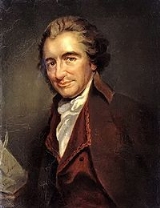
Thomas Paine
Republicanism is a system that replaces or accompanies inherited rule. The keys are a positive emphasis on liberty, and a negative rejection of corruption. In the late 20th century there has been so much convergence between democracy and republicanism that confusion results. As a distinct political theory, republicanism originated in classical history and became important in early modern Europe, as typfied by Machiavelli. It became especially important as a cause of the American Revolution
American Revolution

The American Revolution refers to the political upheaval during the last half of the 18th century in which the Thirteen Colonies of North America overthrew the governance of the British Empire and then rejected the British monarchy to become the sovereign United States of America....
 and the French Revolution
French Revolution

The French Revolution was a period of political and social upheaval and radical change in the history of France, during which the French governmental structure, previously an absolute monarchy with feudalism for the aristocracy and Roman Catholic Church clergy, underwent radical change to forms based on Age of Enlightenment principles of cit...
 in the 1770s and 1790s, respectively. Republicans in these particular instances tended to reject inherited elites and aristocracies, but the question was open amongst them whether the republic, in order to restrain unchecked majority rule, should have an unelected upper chamber, the members perhaps appointed meritorious experts, or should have a constitutional monarch.

Although conceptually separate from democracy, republicanism included the key principles of rule by the consent of the governed and sovereignty of the people. In effect republicanism meant that the kings and aristocracies were not the real rulers, but rather the people as a whole were. Exactly how the people were to rule was an issue of democracy – republicanism itself did not specify how. In the United States, the solution was the creation of political parties
First Party System

The First Party System is a term of periodization used by some political scientists and historians to describe the political system existing in the United States between roughly 1792 and 1824....
 that were popularly based on the votes of the people, and which controlled the government (see Republicanism in the United States
Republicanism in the United States

Republicanism is the value system of governance that has been a major part of United States civic thought since the American Revolution. It stresses liberty and inalienable rights as central values, makes the people as a whole sovereign, rejects inherited political power, expects citizens to be independent in their performance of civ...
). Many exponents of republicanism, such as Benjamin Franklin
Benjamin Franklin

Benjamin Franklin was one of the Founding Fathers of the United States of the United States. A noted polymath, Franklin was a leading author and Printer , Satire, list of political philosophers, politician, scientist, inventor, activism, statesman, and diplomacy....
, Thomas Paine
Thomas Paine

Thomas Paine was a UK pamphleteer, revolutionary, Radicalism , inventor, and intellectual. He lived and worked in Britain until age 37, when he emigrated to the British American colonies, in time to participate in the American Revolution....
, and Thomas Jefferson
Thomas Jefferson

Thomas Jefferson was the List of Presidents of the United States President of the United States , the principal author of the United States Declaration of Independence , and one of the most influential Founding Fathers of the United States for his promotion of the ideals of republicanism in the United States....
 were strong promoters of representative democracy. However, other supporters of republicanism, such as John Adams
John Adams

John Adams was an Politics of the United States and the List of Presidents of the United States President of the United States , after being the List of Vice Presidents of the United States Vice President of the United States for two terms....
 and Alexander Hamilton
Alexander Hamilton

Alexander Hamilton was the first Secretary of the Treasury, a Founding Fathers of the United States, economist, and political philosopher. He led calls for the Philadelphia Convention, was one of America's first Constitutional lawyers, and cowrote the Federalist Papers, a primary source for Constitutional interpretation....
, were more distrustful of majority rule and sought a government with more power for elites. There were similar debates in many other democratizing
Democratization

Democratization is the transition to a more democratic political regime. It may be the transition from an authoritarianism regime to a full democracy or transition from a semi-authoritarian political system to a democratic political system....
 nations.

Democracy and republic
In contemporary usage, the term democracy refers to a government chosen by the people, whether it is direct or representative. The term republic
Republic

A republic is a state or country that is not led by a hereditary monarch but in which the people have an impact on its government. The word originates from the Latin term res publica....
 has many different meanings, but today often refers to a representative democracy with an elected head of state
Head of State

Head of state is the generic term for the individual or collective office that serves as the chief public representative of a monarchic or republican nation-state, federation, commonwealth or any other political state....
, such as a president
President

President is a title held by many leaders of organizations, company, trade unions, university, and country. Etymology, a "president" is one who Wiktionary:Preside, who sits in leadership ....
, serving for a limited term, in contrast to states with a hereditary monarch as a head of state, even if these states also are representative democracies with an elected or appointed head of government
Head of government

The head of government is the chief officer of the executive branch of a government, often presiding over a cabinet . In a parliamentary system, the head of government is often styled Prime Minister, President of the Government, Premier, etc....
 such as a prime minister
Prime minister

A prime minister is the most senior minister of Cabinet in the Executive branch of government in a parliamentary system. The position is usually held by, but need not always be held by, a politician....
.

The Founding Fathers of the United States
Founding Fathers of the United States

The Founding Fathers of the United States were the political leaders who signed the United States Declaration of Independence or otherwise participated in the American Revolution as leaders of the Patriot s, or who participated in drafting the United States Constitution eleven years later....
 rarely praised and often criticized democracy, which in their time tended to specifically mean direct democracy
Direct democracy

Direct democracy, classically termed pure democracy, comprises a form of democracy and theory of civics wherein sovereignty is lodged in the assembly of all citizenship who choose to participate....
; James Madison
James Madison

James Madison was an American politician and political philosopher who served as the List of Presidents of the United States President of the United States , and one of the Founding Fathers of the United States....
 argued, especially in The Federalist No. 10
Federalist No. 10

Federalist No. 10 is an essay by James Madison and the tenth of the Federalist Papers, a series arguing for the ratification of the United States Constitution....
, that what distinguished a democracy from a republic was that the former became weaker as it got larger and suffered more violently from the effects of faction, whereas a republic could get stronger as it got larger and combats faction by its very structure. What was critical to American values, John Adams
John Adams

John Adams was an Politics of the United States and the List of Presidents of the United States President of the United States , after being the List of Vice Presidents of the United States Vice President of the United States for two terms....
 insisted, was that the government be "bound by fixed laws, which the people have a voice in making, and a right to defend." Also, as Benjamin Franklin was exiting after writing the U.S. constitution, a woman asked him Sir, what have you given us?. He replied A republic ma'am, if you can keep it

Constitutional monarchs and upper chambers
Initially, after the American and French revolutions, the question was open whether a democracy, in order to restrain unchecked majority rule, should have an upper chamber – the members perhaps appointed meritorious experts or having lifetime tenures – or should have a constitutional monarch
Constitutional monarchy

A constitutional monarchy is a form of constitutional government, where in either an elected or hereditary monarch is the head of state, unlike in an absolute monarchy, wherein the king or the queen is the sole source of political power, as he or she is not legally bound by the constitution....
 with limited but real powers. Some countries (such as the United Kingdom, the Netherlands, Belgium, Luxembourg, the Scandinavian countries, and Japan) turned powerful monarchs into constitutional ones with limited or, often gradually, merely symbolic roles. Often the monarchy was abolished along with the aristocratic system, whether or not they were replaced with democratic institutions (such as in the US, France, China, Russia, Germany, Austria, Hungary, Italy, Greece and Egypt). In Australia, New Zealand, Canada, Papua New Guinea, and some other countries, the monarch is given supreme executive power, but by convention acts only on the advice of his or her ministers. Many nations had elite upper houses of legislatures, the members of which often had lifetime tenure, but eventually these houses lost power (as in Britain's House of Lords
House of Lords

The House of Lords is the second house of the Parliament of the United Kingdom and is also commonly referred to as "the Lords". The Parliament comprises the British monarchy, the British House of Commons , and the Lords....
), or else became elective and remained powerful (as in the United States Senate
United States Senate

The United States Senate is the upper house of the Bicameralism United States Congress, the lower house being the United States House of Representatives....
).

See also


  • Republican Party
    Republican Party

    Republican Party may refer to:...
  • Republican democracy
    Republican democracy

    A Republican democracy is a republic which has democracy forms of government. One of the key principals is free and open debate prior to casting a vote....
  • Democratic republic
  • Republicanism and religion
    Republicanism and religion

    Religion has played an important role in the development of republicanism. Religious differences between a people and their monarch have often led to the overthrow of the monarch and the introduction of a republican system of government....
  • Kemalist ideology
    Kemalist ideology

    Kemalist Ideology, "Kemalism" or also known as the "Six Arrows" is the principle that defines the basic characteristics of the Republic of Turkey....
  • Radicalism
    Radicalism (historical)

    The term Radical was used during the late 18th century for proponents of the Radical Movement. It later become a general term for those favoring or seeking political reforms which include dramatic changes to the social order....
  • Tacitean studies
    Tacitean studies

    Tacitus is remembered first and foremost on his place as Roman era's greatest historian, the equal—if not the superior—of Thucydides, the ancient Greeks' foremost historian....
     - differing interpretations whether Tacitus defended republicanism ("red Tacitists") or the contrary ("black Tacitists").

Specific countries

  • Republicanism in Australia
    Republicanism in Australia

    Republicanism in Australia is a movement to change Australia's status as a constitutional monarchy to a republican form of government. Such sentiments have been expressed in Australia from before Federation of Australia onward to the present, wherein modern arguments focus on abolishing the Monarchy of Australia....
  • Republicanism in Canada
    Republicanism in Canada

    Canadian republicanism is the advocacy of constitutional change in Canada, leading to the abolition of the Monarchy of Canada and the creation of a Canadian republic....
  • Républicanisme (Republicanism in France)
  • Irish republicanism
    Irish Republicanism

    Irish republicanism is an ideology based on the Irish nationalist belief that all of Ireland should be a single independent republic.In 1801, under the Act of Union 1800, the Kingdoms of Great Britain and Ireland merged to form the United Kingdom of Great Britain and Ireland....
  • Republicanism in New Zealand
    Republicanism in New Zealand

    Republicanism in New Zealand is a theoretical political concept, the implimentation of which would result in changing the country's current status as a Commonwealth realm and constitutional monarchy to that of a republic....
  • Republicanism in the United Kingdom
    Republicanism in the United Kingdom

    Republicanism in the United Kingdom is the movement which seeks to remove the Monarchy of the United Kingdom and replace it with a republic that has a non-hereditary head of state....
  • Republicanism in the United States
    Republicanism in the United States

    Republicanism is the value system of governance that has been a major part of United States civic thought since the American Revolution. It stresses liberty and inalienable rights as central values, makes the people as a whole sovereign, rejects inherited political power, expects citizens to be independent in their performance of civ...


European versions

  • Bock, Gisela; Skinner, Quentin; and Viroli, Maurizio, ed. Machiavelli and Republicanism. Cambridge U. Press, 1990. 316 pp.
  • Peter Becker, Jürgen Heideking and James A. Henretta, eds. Republicanism and Liberalism in America and the German States, 1750-1850. Cambridge University Press. 2002.
  • Brugger, Bill. Republican Theory in Political Thought: Virtuous or Virtual? St. Martin's Press, 1999.
  • Castiglione, Dario. "Republicanism and its Legacy," European Journal of Political Theory (2005) v 4 #4 pp 453-65.
  • Trevor Colbourn, The Lamp of Experience: Whig History and the Intellectual Origins of the American Revolution (1965)
  • Fink, Zera. The Classical Republicans: An Essay in the Recovery of a Pattern of Thought in Seventeenth-Century England. Northwestern University Press, 1962.
  • Foote, Geoffrey. The Republican Transformation of Modern British Politics Palgrave Macmillan, 2006.
  • Martin van Gelderen & Quentin Skinner
    Quentin Skinner

    Quentin Robert Duthie Skinner is the Barber Beaumont Professor of the Humanities at Queen Mary, University of London....
    , eds., Republicanism: A Shared European Heritage, v 1: Republicanism and Constitutionalism in Early Modern Europe; vol 2: The Value of Republicanism in Early Modern Europe Cambridge U.P., 2002
  • Haakonssen, Knud. "Republicanism." A Companion to Contemporary Political Philosophy. Robert E. Goodin and Philip Pettit. eds. Blackwell, 1995.
  • Kramnick, Isaac. Republicanism and Bourgeois Radicalism: Political Ideology in Late Eighteenth-Century England and America. Cornell University Press, 1990.
  • Mark McKenna, The Traditions of Australian Republicanism (1996)
  • Maynor, John W. Republicanism in the Modern World. Cambridge: Polity, 2003.
  • Najemy, John M. "Baron's Machiavelli and Renaissance Republicanism." American Historical Review 1996 101(1): 119-129. ISSN 0002-8762 Fulltext in Jstor and Ebsco. Examines Hans Baron's ambivalent portrayal of Machiavelli. He argues that Baron tended to see Machiavelli simultaneously as the cynical debunker and the faithful heir of civic humanism. By the mid-1950s, Baron had come to consider civic humanism and Florentine republicanism as early chapters of a much longer history of European political liberty, a story in which Machiavelli and his generation played a crucial role. This conclusion led Baron to modify his earlier negative view of Machiavelli. He tried to bring the Florentine theorist under the umbrella of civic humanism by underscoring the radical differences between The Prince and the Discourses and thus revealing the fundamentally republican character of the Discourses. However, Baron's inability to come to terms with Machiavelli's harsh criticism of early 15th century commentators such as Leonardo Bruni ultimately prevented him from fully reconciling Machiavelli with civic humanism.
  • Philip Pettit, Republicanism: A Theory of Freedom and Government Oxford U.P., 1997, ISBN 0-19-829083-7
  • Pocock, J.G.A. The Machiavellian Moment: Florentine Political Thought and the Atlantic Republican Tradition (1975; new ed. 2003)
  • Pocock, J. G. A. "The Machiavellian Moment Revisited: a Study in History and Ideology.: Journal of Modern History 1981 53(1): 49-72. ISSN 0022-2801 Fulltext: in Jstor. Abstract: Traces the Machiavellian belief in and emphasis upon Greco-Roman ideals of unspecialized civic virtue and liberty from 15th century Florence through 17th century England and Scotland to 18th century America. Thinkers who shared these ideals tended to believe that the function of property was to maintain an individual's independence as a precondition of his virtue. Consequently, in the last two times and places mentioned above, they were disposed to attack the new commercial and financial regime that was beginning to develop
  • Robbins, Caroline. The Eighteenth-Century Commonwealthman: Studies in the Transmission, Development, and Circumstance of English Liberal Thought from the Restoration of Charles II until the War with the Thirteen Colonies (1959, 2004).


American versions

  • Joyce Appleby, Liberalism and Republicanism in the Historical Imagination (1992)
  • Bailyn, Bernard. The Ideological Origins of the American Revolution. Harvard University Press, 1967.
  • Lance Banning. The Jeffersonian Persuasion: Evolution of a Party Ideology (1980)
  • Peter Becker, Jürgen Heideking and James A. Henretta, eds. Republicanism and Liberalism in America and the German States, 1750-1850. Cambridge University Press, 2002.
  • Linda K Kerber. Intellectual History of Women: Essays by Linda K. Kerber (1997)
  • Linda K Kerber. Women of the Republic: Intellect and Ideology in Revolutionary America (1997)
  • Milton Klein, et al., eds., The Republican Synthesis Revisited Essays in Honor of George A. Billias (1992).
  • James T Kloopenberg. The Virtues of Liberalism (1998)
  • Mary Beth Norton. Liberty's Daughters: The Revolutionary Experience of American Women, 1750-1800 (1996)
  • Jack Greene and J. R. Pole, eds. Companion to the American Revolution (2004); many articles look at republicanism, esp. Shalhope, Robert E. Republicanism" pp 668-673
  • Robert E. Shalhope, "Toward a Republican Synthesis: The Emergence of an Understanding of Republicanism in American Historiography," William and Mary Quarterly, 29 (Jan. 1972), 49-80 in JSTOR
  • Robert E. Shalhope, "Republicanism and Early American Historiography", William and Mary Quarterly, 39 (Apr. 1982), 334-356 in JSTOR
  • Wood, Gordon S. The Creation of the American Republic 1776-1787 (1969)
  • Wood, Gordon S. The Radicalism of the American Revolution (1993)


External links

  • Emergence of the Roman Republic:
    • Parallel Lives
      Parallel Lives

      File:Plutarchs LIVES.jpgPlutarch's Lives of the Noble Greeks and Romans, commonly called Parallel Lives or Plutarch's Lives, is a series of biography of famous men, arranged in tandem to illuminate their common moral virtues or failings....
       by Plutarch
      Plutarch

      Lucius Mestrius Plutarchus , c. AD 46 ? 120 ? commonly known in English as Plutarch ? was a Ancient Rome historian , biographer, essayist, and Middle Platonism....
      , particularly:
      • (From the translation in 4 volumes, available at Project Gutenberg
        Project Gutenberg

        Project Gutenberg, abbreviated as PG, is a volunteer effort to digitize, archive and distribute cultural works, as founder Michael Hart said "To encourage the creation and distribution of eBooks."....
        :)
      • More particularly following Lives and Comparisons (D is Dryden
        John Dryden

        John Dryden was an influential English poet, literary critic, translator, and playwright who dominated the literary life of English Restoration to such a point that the period came to be known in literary circles as the Age of Dryden....
         translation; G is Gutenberg
        Project Gutenberg

        Project Gutenberg, abbreviated as PG, is a volunteer effort to digitize, archive and distribute cultural works, as founder Michael Hart said "To encourage the creation and distribution of eBooks."....
        ; P is Perseus Project
        Perseus Project

        The Perseus Project is a digital library project of Tufts University that assembles digital collections of humanities resources. It is hosted by the Department of Classics....
        ; L is LacusCurtius
        LacusCurtius

        LacusCurtius is a website specializing in ancient Rome, currently hosted on a server at the University of Chicago. It went online on August 26, 1997; in January 2008 it had "2786 pages, 690 photos, 675 drawings & engravings, 118 plans, 66 maps."...
        ):
Greeks Romans Comparisons
Lycurgus
Lycurgus

Lycurgus or Lykurgus may refer to:* People:** Lycurgus of Sparta , ruler** Lycurgus of Athens , activist & government administrator...
  
 Numa Pompilius
Numa Pompilius

Numa Pompilius , according to legend, was the second king of Rome, succeeding Romulus. After Romulus died, Romans in the city elected a Sabine man to be king, so as to make him loyal to both tribes in Rome....
 
   
Solon
Solon

Solon was an Athens statesman, lawmaker, and lyric poetry. He is remembered particularly for his efforts to legislate against political, economic and moral decline in Archaic period in Greece Athens....
    
 Poplicola