
|
|
|
|
White supremacy
|
| |
|
| |
White supremacy is the belief that white people are superior to people of other racial backgrounds. The term is sometimes used specifically to describe a political ideology that advocates the social and political dominance of whites.
White supremacy, as with racial supremacism in general, is rooted in ethnocentrism and a desire for hegemony. It is associated with varying degrees of racism and a desire for racial separation.

Discussion
Ask a question about 'White supremacy'
Start a new discussion about 'White supremacy'
Answer questions from other users
|
Encyclopedia
White supremacy is the belief that white people are superior to people of other racial backgrounds. The term is sometimes used specifically to describe a political ideology that advocates the social and political dominance of whites.
White supremacy, as with racial supremacism in general, is rooted in ethnocentrism and a desire for hegemony. It is associated with varying degrees of racism and a desire for racial separation. White supremacy has often resulted in anti-black racism and antisemitism. Different forms of white supremacy have different conceptions of who is considered white, and not all white supremacist organizations agree on who is their greatest enemy.
White supremacist groups can be found in most countries and regions with a significant white population, including North America, Europe, Australia, New Zealand, South Africa, and Latin America. In all of these locations, their views represent a relatively small minority of the population, and active membership of the groups is quite small. The militant approach taken by white supremacist groups has caused them to be watched closely by law enforcement officials. Some European countries have laws forbidding hate speech, as well as other laws that ban or restrict some white supremacist organizations.
Systemic white supremacy
White supremacy was dominant in the United States before the American Civil War and for decades after Reconstruction. The same is true of Apartheid-era South Africa and of parts of Europe at various time periods; most notably under Nazi Germany's Third Reich.
In some parts of the United States, many people who were considered non-white were disenfranchised, barred from government office, and prevented from holding most government jobs — well into the second half of the twentieth century. White leaders often viewed Native Americans (known as First Nations in Canada) and Australian Aborigines as obstacles to economic and political progress, rather than as settlers in their own right. Many European-settled countries bordering the Pacific Ocean limited immigration and naturalization from the Asian Pacific countries, usually on a cultural basis. Many U.S. states banned interracial marriage through anti-miscegenation laws until 1967, when these laws were declared unconstitutional. South Africa maintained its white supremacist-like Apartheid system until the early 1990s.
Movements and ideologies
Supporters of Nordicism and Germanism consider Nordic people (Scandinavians, Germans, and Dutch) to be superior, shunning those of Southern and Eastern Europe (who may have darker features and different cultures) along with anyone whose ethnic heritage is not European. In Madison Grant's 1916 book, The Passing of the Great Race, Europeans who were not of Germanic origin, but who had Nordic characteristics such as blonde/red hair and blue/green/gray eyes were considered to be a Nordic admixture and suitable for Aryanization.
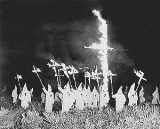
Christian Identity is another movement closely tied to white supremacy. The Ku Klux Klan's reasons for supporting racial segregation are not primarily based on religious ideals, but some Klan groups are openly Protestant. Some white supremacists identify themselves as Odinists, although some Odinists reject white supremacy, and white supremacists are only one faction of those who support Odinism. Some white supremacist groups, such as the South African Boeremag, conflate elements of Christianity and Odinism. The World Church of the Creator (now called the Creativity Movement), believed that a person's race is his religion. Aside from this, its ideology is similar to many Christian Identity groups, in the conviction that there is a Jewish conspiracy in control of the United States government, international banking, and the media. They claim that a Racial Holy War is destined to happen, which would eliminate Jews and "mud races" from the planet.
The white supremacist ideology has become associated with a racist faction of the skinhead subculture, despite the fact that when the skinhead scene first developed in the United Kingdom in the late 1960s, it was heavily influenced by Jamaican rude boys and British mods. By the 1980s,a sizable and vocal white power skinhead faction had formed.
See also
Footnotes
Further reading
- Dobratz, Betty A. and Shanks-Meile, Stephanie. "White power, white pride!": The white separatist movement in the United States (Twayne Publishers, NY, 1997).
- Lincoln Rockwell, George. White Power (John McLaughlin, 1996).
External links
|
| |
|
|