
All Topics  
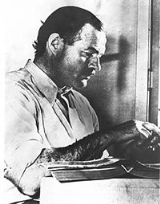
Ernest Hemingway

 
Ernest Hemingway

   Email Print
   Bookmark   Link


Ernest Hemingway


Ernest Miller Hemingway (July 21, 1899 — July 2, 1961) was an American novelist, short-story writer, and journalist
Journalist

A journalist is a person who practices journalism, the gathering and dissemination of information about current events, trends, issues, and people while striving for viewpoints that aren't biased....
. He was part of the 1920s expatriate
Expatriate

An expatriate is a person temporarily or permanently Residency in a country and culture other than that of the person's upbringing or legal residence....
 community in Paris, and one of the veterans of World War I
World War I

World War I, or the First World War , was a global military conflict which involved the Great powers, organized into two opposing military alliances: the Allies of World War I and the Central Powers....
 later known as "the Lost Generation
Lost Generation

The 'Lost Generation' is a phrase made popular by American author Ernest Hemingway in his first published novel The Sun Also Rises. Often it is used to refer to a group of United States literary notables who lived in Paris and other parts of Europe, some after military service in the World War I....
". He received the Pulitzer Prize
Pulitzer Prize

The Pulitzer Prize is an United States award regarded as the highest national honor in newspaper journalism, literary achievements and musical composition....
 in 1953 for The Old Man and the Sea
The Old Man and the Sea

The Old Man and the Sea is a novella by Ernest Hemingway, written in Cuba in 1951 and published in 1952 in literature. It was the last major work of fiction to be produced by Hemingway and published in his lifetime....
,
and the Nobel Prize in Literature
Nobel Prize in Literature

The Nobel Prize in Literature is awarded annually, since 1901, to an author from any country who has, in the words from the will of Alfred Nobel, produced "in the field of literature the most outstanding work in an ideal direction" ....
 in 1954.

Hemingway's distinctive writing style
Iceberg Theory

The Iceberg Theory is a writing theory by American writer Ernest Hemingway, as follows:In other words, a story can communicate by subtext; for instance, Hemingway's Hills Like White Elephants never once mentions the word "abortion," though that is what the story's characters seem to be discussing....
 is characterized by economy and understatement
Understatement

Understatement is a form of speech in which a lesser expression is used than what would be expected. This is not to be confused with euphemism, where a polite phrase is used in place of a harsher or more offensive expression....
, and had a significant influence on the development of twentieth-century fiction
Fiction

Fiction is an imaginative form of narrative, one of the four basic rhetorical modes. Although the word fiction is derived from the Latin fingo, fingere, finxi, fictum, "to form, create", works of fiction need not be entirely imaginary and may include real people, places, and events....
 writing.


Discussion
Ask a question about 'Ernest Hemingway'
Start a new discussion about 'Ernest Hemingway'
Answer questions from other users
Full Discussion Forum


Recent Posts


Quotations


A bottle of wine was good company.

The Sun Also Rises (1926)

About morals, I know only that what is moral is what you feel good after and what is immoral is what you feel bad after.

Ch. 1 (1932).

All good books have one thing in common — they are truer than if they had really happened.

Similar to his remark in "A Letter from Cuba" (1934)

All our words from loose using have lost their edge.

Ch. 7

Grace under pressure.

Hemingways definition of "guts" as recounted by Dorothy Parker in the New Yorker (30 November 1929)

He was just a coward and that was the worst luck any man could have.

Ch. 30


Encyclopedia


Ernest Miller Hemingway (July 21, 1899 — July 2, 1961) was an American novelist, short-story writer, and journalist
Journalist

A journalist is a person who practices journalism, the gathering and dissemination of information about current events, trends, issues, and people while striving for viewpoints that aren't biased....
. He was part of the 1920s expatriate
Expatriate

An expatriate is a person temporarily or permanently Residency in a country and culture other than that of the person's upbringing or legal residence....
 community in Paris, and one of the veterans of World War I
World War I

World War I, or the First World War , was a global military conflict which involved the Great powers, organized into two opposing military alliances: the Allies of World War I and the Central Powers....
 later known as "the Lost Generation
Lost Generation

The 'Lost Generation' is a phrase made popular by American author Ernest Hemingway in his first published novel The Sun Also Rises. Often it is used to refer to a group of United States literary notables who lived in Paris and other parts of Europe, some after military service in the World War I....
". He received the Pulitzer Prize
Pulitzer Prize

The Pulitzer Prize is an United States award regarded as the highest national honor in newspaper journalism, literary achievements and musical composition....
 in 1953 for The Old Man and the Sea
The Old Man and the Sea

The Old Man and the Sea is a novella by Ernest Hemingway, written in Cuba in 1951 and published in 1952 in literature. It was the last major work of fiction to be produced by Hemingway and published in his lifetime....
,
and the Nobel Prize in Literature
Nobel Prize in Literature

The Nobel Prize in Literature is awarded annually, since 1901, to an author from any country who has, in the words from the will of Alfred Nobel, produced "in the field of literature the most outstanding work in an ideal direction" ....
 in 1954.

Hemingway's distinctive writing style
Iceberg Theory

The Iceberg Theory is a writing theory by American writer Ernest Hemingway, as follows:In other words, a story can communicate by subtext; for instance, Hemingway's Hills Like White Elephants never once mentions the word "abortion," though that is what the story's characters seem to be discussing....
 is characterized by economy and understatement
Understatement

Understatement is a form of speech in which a lesser expression is used than what would be expected. This is not to be confused with euphemism, where a polite phrase is used in place of a harsher or more offensive expression....
, and had a significant influence on the development of twentieth-century fiction
Fiction

Fiction is an imaginative form of narrative, one of the four basic rhetorical modes. Although the word fiction is derived from the Latin fingo, fingere, finxi, fictum, "to form, create", works of fiction need not be entirely imaginary and may include real people, places, and events....
 writing. His protagonist
Protagonist

A protagonist is the main Character of a drama or Narrative. The word "protagonist" derives from the Greek language p??ta????st?? , "one who plays the first part, chief actor." In the theatre of Ancient Greece, three actors played all of the main dramatic roles in a tragedy; the leading role was played by the protagonist, while the othe...
s are typically stoical
Stoicism

Stoicism was a school of Hellenistic philosophy founded in Athens by Zeno of Citium in the early third century B.C. The stoics considered passionate emotions to be the result of errors in judgment, and that a Sage , or person of "moral and intellectual perfection," would not have such emotions....
 men who exhibit an ideal described as "grace under pressure". Many of his works are now considered classics of American literature
American literature

American literature refers to written or literature produced in the area of the United States and Colonial America. For more specific discussions of poetry and theater, see Poetry of the United States and Theater in the United States....
.

Early life

Ernest Miller Hemingway was born on July 21, 1899 in Oak Park, Illinois
Oak Park, Illinois

Oak Park, Illinois is a suburb bordering the west side of the City of Chicago in Cook County, Illinois, Illinois, United States. It is the twenty-fifth largest city in Illinois....
, a suburb of Chicago
Chicago

Chicago is the largest city in the U.S. state of Illinois and the Midwestern United States, as well as the List of United States cities by population city in the United States with more than 2.8 million residents....
. Hemingway was the first son and the second child born to Clarence Edmonds "Doc Ed" Hemingway - a country doctor
Physician

A physician, medical practitioner, doctor of medicine, or medical doctor practices medicine, and is concerned with maintaining or restoring human health through the study, diagnosis, and treatment of disease and injury....
, and Grace Hall Hemingway. Hemingway's father attended the birth of Ernest and blew a horn on his front porch to announce to the neighbors that his wife had given birth to a boy. The Hemingways lived in a six-bedroom Victorian house built by Ernest's widowed maternal grandfather, Ernest Miller Hall, an English immigrant and Civil War veteran
American Civil War

The American Civil War , also known as the War Between the States and several Naming the American Civil War, was a civil war in the United States....
 who lived with the family. Hemingway was his namesake. Hemingway's mother once aspired to an opera
Opera

Opera is an Performing arts in which singers and musicians perform a dramatic work which combines a text and a musical score. Opera is part of the Western classical music tradition....
 career and earned money giving voice and music lessons. She was domineering and narrowly religious, mirroring the strict Protestant ethic of Oak Park, which Hemingway later said had "wide lawns and narrow minds". While his mother hoped that her son would develop an interest in music, Hemingway adopted his father's outdoorsman hobbies of hunting, fishing and camping in the woods and lakes of Northern Michigan
Northern Michigan

Northern Michigan?or more properly Northern Lower Michigan?is a region of the U.S. state of Michigan , popular as a tourist destination. It is home to several small- to medium-sized cities, extensive state and national forests, lakes and rivers, and a large portion of Great Lakes shoreline....
. The family owned a summer home called Windemere on Walloon Lake
Walloon Lake

Walloon Lake is the headwater for the Bear River located in Charlevoix County, Michigan and Emmet County, Michigan counties in Northern Michigan....
, near Petoskey, Michigan
Petoskey, Michigan

Petoskey is a city in the U.S. state of Michigan. As of the United States 2000 Census, the city population was 6,080. It is the county seat of Emmet County, Michigan....
 and often spent summers vacationing there. These early experiences in close contact with nature instilled in Hemingway a lifelong passion for outdoor adventure and for living in remote or isolated areas.

Hemingway attended Oak Park and River Forest High School
Oak Park and River Forest High School

Oak Park and River Forest High School, or OPRF, is a public four-year high school located in Oak Park, Illinois, a western suburb of Chicago, Illinois, in the United States....
 from September 1913 until graduation in June 1917. He excelled both academically and athletically; he boxed
Boxing

Boxing is a combat sport where two participants, generally of similar human weight, fight each other with their fists. Boxing is supervised by a referee and is typically engaged in during a series of one to three-minute intervals called rounds....
, played American football
American football

American football, known in the United States and Canada simply as football, is a competitive team sport known for mixing strategy with physical play....
, and displayed particular talent in English
English studies

English studies is an academic discipline that includes the study of literatures written in the English language , English linguistics , and English sociolinguistics ....
 classes. His first writing experience was writing for "Trapeze" and "Tabula" (the school's newspaper and yearbook, respectively) in his junior year, then serving as editor in his senior year. He sometimes wrote under the pen name
Pen name

A pen name, nom de plume, or literary double, is a pseudonym adopted by an author. A pen name may be used to make the author's name more distinctive, to disguise his or her gender, to distance an author from some or all of his or her works, to protect the author from retribution for his or her writings, or for any of a number of...
 Ring Lardner, Jr., a nod to his literary hero Ring Lardner
Ring Lardner

Ringgold Wilmer Lardner was an United States sports columnist and short story writer best known for his satirical takes on the sports world, marriage, and the theatre....
.

After high school, Hemingway did not want to go to college. Instead, at age eighteen, he began his writing career as a cub reporter
Reporter

A reporter is a type of journalist who researches and presents information in certain types of mass media.Reporters gather their information in a variety of ways, including tips, press releases, sources and witnessing events....
 for The Kansas City Star
The Kansas City Star

The Kansas City Star is a The McClatchy Company newspaper based in Kansas City, Missouri, in the United States. Published since 1880, the paper is the recipient of eight Pulitzer Prizes....
. Although he worked at the newspaper for only six months (October 17, 1917-April 30, 1918), throughout his lifetime he used the guidance of the Stars style guide
Style guide

A style guide or style manual is a set of standards for design and writing of documents, either for general use or for a specific publication or organization....
 as a foundation for his writing style: "Use short sentences. Use short first paragraphs. Use vigorous English. Be positive, not negative." In honor of the centennial year of Hemingway's birth (1899),
The Star named Hemingway its top reporter of the last hundred years.

World War I

Hemingway left his reporting job after only a few months and, against his father's wishes, tried to join the United States Army
United States Army

The United States Army is the branch of the United States Armed Forces responsible for Army operations. It is the largest and oldest established branch of the U.S....
 to see action in World War I
World War I

World War I, or the First World War , was a global military conflict which involved the Great powers, organized into two opposing military alliances: the Allies of World War I and the Central Powers....
. He failed the medical examination due to poor vision, and instead joined the Red Cross Ambulance
Ambulance

file:Ambulancebroomfieldhospital.jpgfile:C12 air ambulance.jpgfile:Scilly Isles Ambulance Service alongside Tresco quay.jpgAn ambulance is a vehicle for transporting sick or injured people, to, from or between places of treatment for an illness or injury....
 Corps. On his route to the Italian front, he stopped in Paris
Paris

Paris is the Capital of France and the country's largest city. It is situated on the river Seine, in northern France, at the heart of the ?le-de-France Regions of France ....
, which was under constant bombardment from German artillery. Instead of staying in the relative safety of the Hotel Florida, Hemingway tried to get as close to combat as possible. Soon after arriving on the Italian Front
Italian Campaign (World War I)

The Italian campaign refers to a series of battles fought between the armies of Austria-Hungary and Kingdom of Italy , along with their allies, in northern Italy between 1915 and 1918....
 Hemingway witnessed the brutalities of war. On his first day on duty an ammunition
Ammunition

Ammunition, often referred to as ammo, is a generic term derived from the French language la munition which embraced all material used for war , but which in time came to refer specifically to gunpowder and artillery....
 factory near Milan
Milan

Milan is the second largest city of Italy, located in the plains of Lombardy. It is the capital in the Province of Milan, as well as the Regions of Italy capital of Lombardy....
 blew up. Hemingway had to pick up the human—primarily female—remains. Hemingway wrote about this experience in his short story "A Natural History of the Dead". This first encounter with death left him shaken.

The soldiers he met later did not lighten the horror. One of them, Eric Dorman-Smith
Eric Dorman-Smith

Eric Edward Dorman-Smith , later de-Anglicise to Eric Edward Dorman O'Gowan, was a British Army soldier who served in World War II.He was born in Bellamont Forest, Cootehill, County Cavan, Ireland....
, entertained Hemingway with a line from Part Two of Shakespeare's
Henry IV, Act III, Scene II
Henry IV, Part 2

Henry IV, Part 2 is a history play by William Shakespeare, believed written between 1596 and 1599. It is the third part of a tetralogy, preceded by Richard II and Henry IV, Part 1 and succeeded by Henry V ....
: "By my troth, I care not; a man can die but once; we owe God a death...and let it go which way it will, he that dies this year is quit for the next." (Hemingway, for his part, would quote this line in "The Short Happy Life of Francis Macomber
The Short Happy Life of Francis Macomber

"The Short Happy Life of Francis Macomber" is a short story by Ernest Hemingway. Set in Africa, it was published in the September 1936 in literature issue of Cosmopolitan magazine concurrently with "The Snows of Kilimanjaro."...
", one of his famous short stories set in Africa.) To another soldier, Hemingway once said, "You are
troppo vecchio (It. too old) for this war, pop." The 50-year old soldier replied, "I can die as well as any man."

On July 8, 1918, Hemingway was wounded while delivering supplies to soldiers, which ended his career as an ambulance driver. Although the events of his wounding have been subjected to doubters, it is now conclusively known that he was hit by an Austrian trench
Trench warfare

Trench warfare is a form of warfare where both combatants have fortified positions and fighting lines are static. Trench warfare arose when a revolution in fire power was not matched by similar advances in mobility , resulting in a slow and grueling form of defense-oriented warfare in which both sides constructed elaborate and heavily arme...
 mortar
Mortar (weapon)

A mortar is a Muzzleloader indirect fire weapon that fires shell at low velocities, short ranges, and high-arcing Ballistics trajectories. It typically has a barrel length less than 15 times its caliber....
 shell that left fragments in his legs, and was also hit by a burst of machine-gun fire. His knee was badly wounded, and, amongst the more remarkable features of this incident, he helped staunch the bleeding by stuffing cigarette butts and rolling papers into his multiple wounds. He was later awarded the Silver Medal of Military Valor
Silver Medal of Military Valor

The Silver Medal of Military Valor is an Italy medal established in 1833 by Charles Albert of Sardinia of Sardinia.During World War I, the medal was awarded to military personnel for exceptional valor in combat....
 (
medaglia d'argento) from the Italian government for dragging a wounded Italian soldier to safety in spite of his own injuries. He was credited as the first American wounded in Italy during WWI by newspapers at the time but there is debate surrounding the veracity of this claim.

Hemingway received treatment in a Milan hospital run by the American Red Cross
American Red Cross

The American Red Cross is a humanitarian organization that provides emergency assistance, disaster relief and education inside the United States, and is the designated U.S....
. With very little in the way of entertainment, he often drank heavily and read newspapers to pass the time. Here he met Agnes von Kurowsky
Agnes von Kurowsky

Agnes von Kurowsky Stanfield , an American nurse, was reportedly the basis for the character of "Catherine Barkley" in Ernest Hemingway's A Farewell to Arms....
 of Washington, D.C., one of eighteen nurses attending groups of four patients each, who was more than six years his senior. Hemingway fell in love with her, but their relationship did not survive his return to the United States; instead of following Hemingway to America, as originally planned, she became romantically involved with an Italian officer. This left an indelible mark on his psyche and provided inspiration for, and was fictionalized in, one of his early novels,
A Farewell to Arms
A Farewell to Arms

A Farewell to Arms is a semi-autobiographical novel written by Ernest Hemingway, first published in 1929. Much of the novel was written at Pfeiffer House and Carriage House in Piggott, Arkansas....
. Hemingway's first story based on this relationship, "A Very Short Story," appeared in 1925.

First novels

Apt1239 2 002
After the war, Hemingway returned to Oak Park, and in 1920, he moved to an apartment on 1599 Bathurst Street
Bathurst Street

Bathurst Street is a north-south street in Toronto and York Region, Ontario, Canada. In York Region, it is also known as York Regional Road 38....
, now known as
The Hemingway, in the Humewood-Cedarvale
Humewood-Cedarvale

Humewood-Cedarvale is a neighbourhood in the city of Toronto, Ontario, Canada, historically part of York, Ontario. The neighbourhood is bordered by Bathurst Street to the east, Eglinton Avenue to the north, Winnett Avenue to the west and St....
 neighborhood in Toronto
Toronto

Toronto is the List of the 100 largest municipalities in Canada by population in Canada and the Provinces and territories of Canada Provincial and territorial capitals of Canada of Ontario....
, Ontario
Ontario

Ontario is a Provinces and territories of Canada located in the Central Canada part of Canada, the largest by population and second largest, after Quebec, in total area....
. During his stay, he found a job with the
Toronto Star
Toronto Star

The Toronto Star is Canada's highest-circulation newspaper, though its print edition is distributed almost entirely within the province of Ontario....
newspaper. He worked as a freelancer, staff writer, and foreign correspondent
Foreign correspondent

Foreign Correspondent may refer to:*Foreign correspondent *Foreign Correspondent , an Alfred Hitchcock film*Foreign Correspondent , an Australian current affairs programme...
. Hemingway befriended fellow
Star reporter Morley Callaghan
Morley Callaghan

Edward Morley Callaghan, Order of Canada, Fellow of the Royal Society of Canada was a Canada novelist, short story writer, playwright, Television and radio personality....
. Callaghan had begun writing short stories at this time; he showed them to Hemingway, who praised them as fine work. They would later be reunited in Paris.

For a short time from late 1920 through most of 1921, Hemingway lived on the near north side of Chicago, while still filing stories for
The Toronto Star. He also worked as associate editor of the Co-operative Commonwealth, a monthly journal. On September 3, 1921, Hemingway married his first wife, Hadley Richardson
Hadley Richardson

Elizabeth Hadley Richardson was born in St. Louis, Missouri, Missouri, on November 9, 1891. On September 3, 1921, she married Ernest Hemingway and soon after that they moved to Paris, France....
. After the honeymoon
Honeymoon

A honeymoon is the traditional holiday taken by newlyweds to celebrate their marriage in intimacy and seclusion. Today, honeymoons by Westerners are sometimes celebrated somewhere exotic or otherwise considered special and romance ....
 they moved to a cramped top floor apartment on the 1300 block of Clark Street
Clark Street (Chicago)

Chicago's Clark Street is a north-south street in Chicago running near the shore of Lake Michigan from 7600 North, the city limits with Evanston, Illinois, to 2200 South in the city Streets and highways of Chicago....
. In September, they moved to a cramped fourth floor apartment (3rd floor by Chicago building standard) at 1239 North Dearborn in a then run-down section of Chicago's near north side. The building still stands with a plaque on the front of it calling it "The Hemingway Apartment". Hadley found it dark and depressing, but in December 1921, the Hemingways left Chicago and Oak Park, never to live there again, and moved abroad.

On the advice of Sherwood Anderson
Sherwood Anderson

Sherwood Anderson was an United States writer, mainly of short story, most notably the collection Winesburg, Ohio . That work's influence on American fiction was profound, and its literary voice can be heard in Ernest Hemingway, William Faulkner, Thomas Wolfe, John Steinbeck, Erskine Caldwell and others....
, they settled in Paris, France, where Hemingway covered the Greco-Turkish War
Greco-Turkish War (1919-1922)

The Greco-Turkish War of 1919?1922, also called the War in Asia Minor, or the Greek campaign of the Turkish War of Independence, was a series of military events occurring during the partitioning of the Ottoman Empire after World War I between May 1919 and October 1922....
 for the
Toronto Star. Among the more famous events of this important but now obscure war, Hemingway witnessed the catastrophic burning of Smyrna, an event that he introduced in several pieces of short fiction. Anderson gave him a letter of introduction to Gertrude Stein
Gertrude Stein

Gertrude Stein was an American writer who spent most of her life in France, and who became a catalyst in the development of modern art and Modernist literature....
. She became his mentor and introduced him to the "Parisian Modern Movement" then ongoing in the Montparnasse Quarter; this was the beginning of the American expatriate circle that became known as the "Lost Generation
Lost Generation

The 'Lost Generation' is a phrase made popular by American author Ernest Hemingway in his first published novel The Sun Also Rises. Often it is used to refer to a group of United States literary notables who lived in Paris and other parts of Europe, some after military service in the World War I....
", a term popularized by Hemingway in the epigraph to his novel,
The Sun Also Rises
The Sun Also Rises

The Sun Also Rises is the first major novel by Ernest Hemingway. Published in 1926 in literature, the Plot centers on a group of expatriate United States in Europe during the 1920s....
, and his memoir, A Moveable Feast
A Moveable Feast

A Moveable Feast is a set of memoirs by United States author Ernest Hemingway about his years in Paris as part of the American expatriate circle of writers in the 1920s....
. The epithet, "Lost Generation" was reportedly appropriated by Miss Stein from her French garage mechanic when he made the offhand comment that hers was "une génération perdue". ("'That's what you are. That's what you all are,' Miss Stein said. 'All of you young people who served in the war. You are a lost generation.'" -- from Hemingway's posthumous memoir, A Moveable Feast
A Moveable Feast

A Moveable Feast is a set of memoirs by United States author Ernest Hemingway about his years in Paris as part of the American expatriate circle of writers in the 1920s....
.) His other influential mentor was Ezra Pound
Ezra Pound

Ezra Weston Loomis Pound was an United States expatriate poetry, critic and intellectual who was a major figure of the Modernist poetry movement in the first half of the 20th century....
, the founder of imagism
Imagism

Imagism was a movement in early 20th-century Anglo-American poetry that favored precision of , and clear, sharp language. The Imagists rejected the sentiment and discursiveness typical of much Romantic poetry and Victorian literature#Poetry....
. Hemingway later said of this eclectic group, "Ezra was right half the time, and when he was wrong, he was so wrong you were never in any doubt about it. Gertrude was always right." The group often frequented Sylvia Beach
Sylvia Beach

Sylvia Beach , born Nancy Woodbridge Beach in her father's parsonage in Baltimore, Maryland, was one of the leading expatriate figures in Paris between World War I and World War II....
's bookshop, Shakespeare & Co., at 12
Rue de l'Odéon. After the 1922 publication and American banning of colleague James Joyce
James Joyce

James Augustine Aloysius Joyce was an Ireland expatriate author of the 20th century. He is best known for his landmark novel Ulysses and its controversial successor Finnegans Wake , as well as the short story collection Dubliners and the semi-autobiographical novel A Portrait of the Artist as a Young Man ....
's
Ulysses
Ulysses (novel)

Ulysses is a novel by James Joyce, first serialized in parts in the American journal The Little Review from March 1918 to December 1920, then published in its entirety by Sylvia Beach on February 2, 1922, in Paris....
, Hemingway used Toronto-based friends to smuggle copies of the novel into the United States (Hemingway writes of meeting and talking with Joyce in Paris in A Movable Feast). His own first book, called Three Stories and Ten Poems (1923), was published in Paris by Robert McAlmon
Robert McAlmon

Robert Menzies McAlmon was an United States author, poet and publisher....
.

After much success as a foreign correspondent, Hemingway returned to Toronto, Canada in 1923 writing under the pseudonym
Pseudonym

A pseudonym, , is a fictitious alternative to a person's legal name. In some cases, pseudonyms are adopted because it is part of a cultural or organizational tradition, as in the case of Religious names used by members of some religious orders and "cadre names" used by Communist party leaders such as Leon Trotsky and Joseph Stalin....
 of
Peter Jackson. During his second stint living in Toronto, Hemingway's first son was born. He was named John Hadley Nicanor Hemingway, but would later be known as Jack. Hemingway asked Gertrude Stein to be Jack's godmother
Godparent

A godparent, in many denominations of Christianity, is someone who sponsors a child's baptism. Judaism has this equivalent in the Brit Milah ceremony....
.

Around the same time, Hemingway had a bitter falling out with his editor, Harry Hindmarsh, who believed Hemingway had been spoiled by his time overseas. Hindmarsh gave Hemingway mundane assignments, and Hemingway grew bitter and wrote an angry resignation in December 1923. However, his resignation was either ignored or rescinded, and Hemingway continued to write sporadically for
The Toronto Star through 1924. Most of Hemingway's work for the Star was later published in the 1985 collection Dateline: Toronto
Dateline: Toronto

Dateline: Toronto is a collection of most of the stories that Ernest Hemingway wrote as a stringer and later staff writer and foreign correspondent for the Toronto Star between 1920 and 1924....
.

Hemingway's American literary debut came with the publication of the short story cycle
In Our Time
In Our Time (book)

In Our Time is a collection of short stories by Ernest Hemingway. Each chapter is comprised of a vignette that in some way relates to the following short story....
(1925). The vignettes that now constitute the interchapters of the American version were initially published in Europe as in our time (1924). This work was important for Hemingway, reaffirming to him that his simplistic style could be accepted by the literary community. "Big Two-Hearted River
Big Two-Hearted River

"Big Two-Hearted River" by Ernest Hemingway is a two-part story that ends the collection In Our Time , published in 1925.Though unmentioned in the text, the story is generally viewed as an account of a healing process for Nick Adams , a recurring character throughout this collection and other works by Hemingway....
" is the collection's best-known story.

In April 1925, two weeks after the publication of
The Great Gatsby
The Great Gatsby

The Great Gatsby is a novel by the United States author F. Scott Fitzgerald. First published on April 10, 1925, it is set in Long Island's North Shore and New York City during the summer of 1922....
, Hemingway met F. Scott Fitzgerald
F. Scott Fitzgerald

Francis Scott Key Fitzgerald was an United States writer of novels and short stories, whose works are evocative of the Jazz Age, a term he coined himself....
 at the Dingo Bar
Dingo Bar

The Dingo American Bar and Restaurant at 10 rue Delambre in the Montparnasse Quarter of Paris, France opened its doors in 1923. Most commonly referred to as the Dingo Bar, it was one of the few drinking establishments at the time that was open all night....
. Fitzgerald and Hemingway were at first close friends, often drinking and talking together. They sometimes exchanged manuscripts, and Fitzgerald did much to try to advance Hemingway's career and the publication of his first collections of stories. Hemingway and Fitzgerald's wife Zelda took an instant dislike to each other with Zelda calling Hemingway a "phony". Fitzgerald and Zelda were having marital difficulties at this time, and Zelda told Scott that their sex life had declined because he was "a fairy" and having a homosexual affair with Hemingway. There is no evidence that either was homosexual, but Scott nonetheless decided to sleep with a prostitute to prove his masculinity.

Lacloseriedeslilas
Hemingway's relationships in France provided inspiration for Hemingway's first full-length novel,
The Sun Also Rises
The Sun Also Rises

The Sun Also Rises is the first major novel by Ernest Hemingway. Published in 1926 in literature, the Plot centers on a group of expatriate United States in Europe during the 1920s....
(1926) (published in the UK under the title "Fiesta"). The novel was semi-autobiographical, following a group of expatriate Americans around Paris and Spain. The climactic scenes of the novel are set in Pamplona, during the fiesta that the novel made famous throughout Europe and the U.S. The novel was a success and met with critical acclaim.

Hemingway divorced Hadley Richardson in 1927 and married Pauline Pfeiffer
Pauline Pfeiffer

Pauline Marie Pfeiffer was the second wife of the writer Ernest Hemingway. She was born in Parkersburg, Iowa on July 22, 1895, moving to St. Louis in 1901 where she attended school at Academy of the Visitation from first grade until graduation....
, a devout Roman Catholic
Roman Catholic Church

The Roman Catholic Church, officially known as the Catholic Church is the world's largest Christianity Ecclesia , representing over half of all Christians and one-sixth of the world population....
 from Piggott, Arkansas
Piggott, Arkansas

Piggott is a city in Clay County, Arkansas, one of that county's two seats , and the northern terminus of the Arkansas segment of Crowley's Ridge Parkway....
. Pfeiffer was an occasional fashion reporter, publishing in magazines such as
Vanity Fair
Vanity Fair (magazine)

Vanity Fair is an American magazine of culture, fashion, and politics published by Cond? Nast Publications....
and Vogue
Vogue (magazine)

Vogue is a fashion and lifestyle magazine published in eighteen countries by Cond? Nast Publications. Each month, Vogue publishes a magazine addressing topics of fashion, life and design....
. Hemingway converted to Catholicism himself at this time. That year saw the publication of Men Without Women
Men Without Women

This page is on the short story collection. For the 1930 film, see Men Without Women .Men Without Women is a 1927 collection of short stories by Ernest Hemingway....
, a collection of short stories
Short story

The short story refers to a work of fiction that is usually written in prose, usually in narrative format. This format or medium tends to be more pointed than longer works of fiction, such as novellas and novels or books....
, containing
The Killers
The Killers (short story)

"The Killers" is a short story by Ernest Hemingway. It first appeared to the public in 1927 in Scribner's Magazine. How much Hemingway received for the literary piece is unknown, but some sources state it was $200....
, one of Hemingway's best-known and most-anthologized stories. In 1928, Hemingway and Pfeiffer moved to Key West
Key West

Key West is an island in the Straits of Florida on the North American continent at the southernmost tip of the Florida Keys.Key West is politically within the limits of the city of Key West, Florida, Monroe County, Florida, Florida, United States....
, Florida
Florida

Florida is a U.S. state located in the Southeastern United States of the United States, bordering Alabama to the northwest and Georgia to the northeast....
, to begin their new life together. However, their new life was soon interrupted by yet another tragic event in Hemingway's life.

In 1928, Hemingway's father, Clarence, troubled with diabetes
Diabetes mellitus

Diabetes mellitus , often referred to simply as diabetes , is a syndrome of disordered metabolism, usually due to a combination of genetic disorder and environmental causes, resulting in abnormally high blood sugar levels ....
 and financial instabilities, committed suicide using an old Civil War
American Civil War

The American Civil War , also known as the War Between the States and several Naming the American Civil War, was a civil war in the United States....
 pistol. This greatly hurt Hemingway and is perhaps played out through Robert Jordan's father's suicide in the novel
For Whom the Bell Tolls. He immediately traveled to Oak Park to arrange the funeral and stirred up controversy by vocalizing what he thought to be the Catholic view, that suicides go to hell. At about the same time, Harry Crosby
Harry Crosby

Harry Crosby was an United States heir, bon vivant, poet, and for some, an exemplar of the Lost Generation in American literature.Born Henry Sturgis Crosby in Boston, Massachusetts's exclusive Back Bay, Boston neighborhood, he was the son of one of the richest banking families in New England and the nephew of the son of J....
, founder of the Black Sun Press
Black Sun Press

Black Sun Press was an English language book publisher founded in 1927 as ?ditions Narcisse by poet Harry Crosby and his wife Caresse Crosby , who at the time were expatriates living in Paris....
 and a friend of Hemingway's from his days in Paris, also committed suicide.
Hemingway House Piggott
In that same year, Hemingway's second son, Patrick, was born in Kansas City (his third son, Gregory, would be born to the couple a few years later). It was a Caesarean
Caesarean section

File:Cesarian the moment of birth3.jpgA Caesarean section , also known as C-section or Caesar, is a surgery procedure in which incisions are made through a mother's abdomen and uterus to deliver one or more infant....
 birth after difficult labor, details of which were incorporated into the concluding scene of
A Farewell to Arms
A Farewell to Arms

A Farewell to Arms is a semi-autobiographical novel written by Ernest Hemingway, first published in 1929. Much of the novel was written at Pfeiffer House and Carriage House in Piggott, Arkansas....
. Hemingway lived and wrote most of A Farewell to Arms
A Farewell to Arms

A Farewell to Arms is a semi-autobiographical novel written by Ernest Hemingway, first published in 1929. Much of the novel was written at Pfeiffer House and Carriage House in Piggott, Arkansas....
plus several short stories at Pauline's parents' house in Piggott, Arkansas
Piggott, Arkansas

Piggott is a city in Clay County, Arkansas, one of that county's two seats , and the northern terminus of the Arkansas segment of Crowley's Ridge Parkway....
. The Pfeiffer House and Carriage House
Pfeiffer House and Carriage House

The Hemingway-Pfeiffer House, also known as the Pfeiffer House and Carriage House, is a house in Piggott, Arkansas where novelist Ernest Hemingway wrote portions of his novel, A Farewell to Arms....
 has since been converted into a museum owned by Arkansas State University
Arkansas State University

Arkansas State University is a public university and is the flagship campus of the Arkansas State University System, the state's second largest college system and fourth largest university by enrollment....
.

Published in 1929,
A Farewell to Arms recounts the romance between Frederic Henry, an American soldier, and Catherine Barkley, a British nurse
Nurse

A nurse is a healthcare professional, who along with other health care professionals, is responsible for the treatment, safety, and recovery of Acute or Chronic ill or injured people, health maintenance of the healthy, and treatment of life-threatening emergencies in a wide range of health care settings....
. The novel is heavily autobiographical: the plot was directly inspired by his relationship with Agnes von Kurowsky
Agnes von Kurowsky

Agnes von Kurowsky Stanfield , an American nurse, was reportedly the basis for the character of "Catherine Barkley" in Ernest Hemingway's A Farewell to Arms....
 in Milan; Catherine's parturition was inspired by the intense labor pains of Pauline in the birth of Patrick; the real-life Kitty Cannell
Kathleen Eaton Cannell

Kathleen Eaton Cannell was a Paris-based United States dance and fashion correspondent for major U.S. papers and periodicals. Before moving to Paris she was the dance critic for The Christian Science Monitor....
 inspired the fictional Helen Ferguson; the priest was based on Don Giuseppe Bianchi, the priest of the 69th and 70th regiments of the Brigata Ancona. While the inspiration of the character Rinaldi is obscure, he had already appeared in
In Our Time. A Farewell to Arms was published at a time when many other World War I books were prominent, including Frederic Manning
Frederic Manning

Frederic Manning was an Australian poet and novelist.Born in Sydney, Manning was the son of local politician Knight William Patrick Manning....
's
Her Privates We, Erich Maria Remarque
Erich Maria Remarque

Erich Maria Remarque was a German literature....
's
All Quiet on the Western Front

All Quiet on the Western Front is a novel written by Erich Maria Remarque, a Germany veteran of World War I. The book shows the war's horrors and also the deep detachment from German civilian life felt by many men returning from the front....
, Richard Aldington
Richard Aldington

Richard Aldington, born Edward Godfree Aldington, was an England writer and poetry.Aldington was best known for his World War I poetry, the 1929 novel Death of a Hero, and the controversy arising from his 1955 Lawrence of Arabia: A Biographical Inquiry....
's
Death of a Hero
Death of a Hero

Death of a Hero is a World War I novel by Richard Aldington. It was his first novel, written in 1929, and thought to be partly autobiography....
, and Robert Graves
Robert Graves

Robert Ranke Graves was an England poet, translator and novelist. During his long life, he produced more than 140 works. He was the son of the Anglo-Irish writer Alfred Perceval Graves and Amalie von Ranke, a niece of the famous German historian Leopold von Ranke....
'
Goodbye to All That
Goodbye to All That

Good-bye to All That is the autobiography of Robert Graves. First published in 1929, the work is a landmark anti-war memoir of life in the trench warfare during World War I....
. The success of A Farewell to Arms
A Farewell to Arms

A Farewell to Arms is a semi-autobiographical novel written by Ernest Hemingway, first published in 1929. Much of the novel was written at Pfeiffer House and Carriage House in Piggott, Arkansas....
made Hemingway financially independent.

Key West

Following the advice of John Dos Passos
John Dos Passos

John Roderigo Dos Passos was an American novelist and artist....
, Hemingway returned to Key West, Florida
Key West, Florida

Key West is a city in Monroe County, Florida, United States.The city encompasses Key West, the namesake island, the part of Stock Island, Florida north of U.S....
 in 1931, where he established his first American home
Ernest Hemingway House

The Ernest Hemingway House was the residence of author Ernest Hemingway in Key West, Florida, Florida, United States. It is located at 907 Whitehead Street, near a prominent lighthouse close to the Southern coast of the island....
, which has since been converted to a museum. From this 1851 solid limestone house — a wedding present from Pauline's uncle — Hemingway fished in the waters around the Dry Tortugas
Dry Tortugas

The Dry Tortugas are a small group of islands, located at the end of the Florida Keys, USA, about west of Key West, and west of the Marquesas Keys, at , the closest islands....
 with his longtime friend Waldo Pierce, went to the famous bar Sloppy Joe's, and occasionally traveled to Spain, gathering material for
Death in the Afternoon

Death in the Afternoon is a non-fiction book by Ernest Hemingway about the ceremony and traditions of Spanish bullfighting. It was originally published in 1932....
and Winner Take Nothing
Winner Take Nothing

Winner Take Nothing is a 1933 collection of short story by Ernest Hemingway....
. Over the next 9 years, until the end of this marriage in 1940, and then in a second period throughout the 1950s, Hemingway would do an estimated 70% of his lifetime's writing in the writer's den in the upper floor of the converted garage, in back of this house.

Death in the Afternoon

Death in the Afternoon is a non-fiction book by Ernest Hemingway about the ceremony and traditions of Spanish bullfighting. It was originally published in 1932....
, a book about bullfighting
Bullfighting

Bullfighting or tauromachy , is a traditional spectacle of Spain, Portugal, some cities in southern France, and several Latin American countries, in which one or more live bulls are ritually killed as a public spectacle....
, was published in 1932. Hemingway had become an aficionado of the sport after seeing the Pamplona
Pamplona

Pamplona is the capital city of Navarre, Spain and of the former kingdom of Navarre.The city is famous worldwide for the San Ferm?n festival, from July 6 to 14, in which the running of the bulls or encierro is one of the main attractions....
 fiesta of 1925, fictionalized in
The Sun Also Rises
The Sun Also Rises

The Sun Also Rises is the first major novel by Ernest Hemingway. Published in 1926 in literature, the Plot centers on a group of expatriate United States in Europe during the 1920s....
. In Death in the Afternoon, Hemingway extensively discussed the metaphysics of bullfighting: the ritualized, almost religious practice. Hemingway considered becoming a bullfighter himself and showed middling aptitude in several novieros before deciding that writing was his true and only suitable professional metier. In his writings on Spain, he was influenced by the Spanish master Pío Baroja
Pío Baroja

P?o Baroja y Nessi was a Spanish Basque writer, one of the key novelists of the Generation of '98. He was a member of an illustrious family, one of his relatives was a painter and engraver, and his nephew Julio Caro Baroja was a well known anthropologist....
. When Hemingway won the Nobel Prize, he traveled to see Baroja, then on his death bed, specifically to tell him he thought Baroja deserved the prize more than he. Baroja agreed and something of the usual Hemingway tiff with another writer ensued despite his original good intentions.

A safari
Safari

A safari is an overland journey. It usually refers to a trip by tourists to Africa, traditionally for a Big Five game Hunting#Safari; today the term often refers to a trip taken not for the purposes of hunting, but to observe and photograph big game and other wildlife....
 in the fall of 1933 led him to Mombasa
Mombasa

Mombasa is the second largest city in Kenya, lying on the Indian Ocean. It has a major Seaport and an international airport. The city is the centre of the coastal tourism industry....
, Nairobi
Nairobi

Nairobi is the capital city and largest city of Kenya. The city and its surrounding area also forms the Nairobi Province. The name "Nairobi" comes from the Maasai language phrase Enkare Nyirobi, which translates to "the place of cool waters"....
, and Machakos
Machakos

Machakos is a town in Kenya, 64 kilometres southeast of Nairobi. It is the capital of the Machakos District in Eastern Province, Kenya of Kenya....
 in Kenya
Kenya

The Republic of Kenya is a country in East Africa. It is bordered by Ethiopia to the north, Somalia to the northeast, Tanzania to the south, Uganda to the west, and Sudan to the northwest, with the Indian Ocean running along the southeast border....
, moving on to Tanganyika, where he hunted in the Serengeti
Serengeti

This article is about a geographical region; for the National Park see Serengeti National ParkThe Serengeti ecosystem is a geographical region located in north-western Tanzania and extends to south-western Kenya between latitudes 1 and 3 S and longitudes 34 and 36 E....
, around Lake Manyara
Lake Manyara

Lake Manyara is a shallow fresh-water lake in Tanzania. Said by Charles Gilpin to be the "loveliest [lake] ... in Africa," it is also the home of a diverse set of landscapes and wildlife....
 and west and southeast of the present-day Tarangire National Park
Tarangire National Park

Tarangire National Park is a national park in Tanzania.Tarangire National Park is probably one of the least visited of the northern Tanzanian game parks, and retains a real air of undiscovered Africa, particularly in the south of the park....
. Hemingway fell ill on this trip, suffering a prolapsed intestine. Due to this illness he was evacuated to Nairobi by plane, an experience which is reflected in his story "The Snows of Kilimanjaro
The Snows of Kilimanjaro

"The Snows of Kilimanjaro" is a short story by Ernest Hemingway. It is also collected together with other stories as The Snows of Kilimanjaro collection....
". 1935 saw the publication of
Green Hills of Africa

Green Hills of Africa is a 1935 work of nonfiction written by Ernest Hemingway. Hemingway's second work of nonfiction, Green Hills of Africa is basically a journal of a month on safari he and his wife, Pauline Pfeiffer, took in East Africa during December 1933....
, an account of his safari. The Snows of Kilimanjaro
The Snows of Kilimanjaro

"The Snows of Kilimanjaro" is a short story by Ernest Hemingway. It is also collected together with other stories as The Snows of Kilimanjaro collection....
and The Short Happy Life of Francis Macomber
The Short Happy Life of Francis Macomber

"The Short Happy Life of Francis Macomber" is a short story by Ernest Hemingway. Set in Africa, it was published in the September 1936 in literature issue of Cosmopolitan magazine concurrently with "The Snows of Kilimanjaro."...
were the fictionalized results of his African experiences. On this trip Hemingway's guide was Philip Hope Percival, who had once guided Theodore Roosevelt
Theodore Roosevelt

Theodore Roosevelt , also known as T.R., and to the public as Teddy, was the List of Presidents of the United States President of the United States....
 on his 1909 safari. Percival would also guide Hemingway on his disastrous 1954 safari.

Bimini

Hemingway lived on Bimini
Bimini

Bimini is the westernmost Districts of the Bahamas of the Bahamas composed of a chain of islands located about 53 miles due east of Miami, Florida....
 in the Bahamas
The Bahamas

The Bahamas, officially the Commonwealth of The Bahamas, is an independent, sovereign, English language-speaking country consisting of two thousand cays and seven hundred islands that form an archipelago....
 from 1935 to 1937, staying at the Compleat Angler Hotel
Compleat Angler Hotel

The Compleat Angler Hotel was a modest three-story hotel on the island of Bimini in the Bahamas. The establishment, located in the center of Alice Town, contained 12 guestrooms in addition to its rowdy bar....
. He worked on
To Have and Have Not

To Have and Have Not is a 1937 novel by Ernest Hemingway about Harry Morgan, a fishing boat captain who runs contraband between Cuba and Florida....
and wrote a few articles, but mostly he fished
Big-game fishing

Big-game fishing, often referred to as offshore sportfishing, offshore gamefishing, or blue-water fishing is a form of recreational fishing, targeting large fish renowned for their sporting qualities, such as tuna and marlin....
 aboard his boat
Pilar, trolling
Troll (angling)

Trolling is a method of fishing where one or more fishing lines, baited with fishing lure or bait fish, are drawn through the water. This may be behind a moving boat, or by slowly winding the line in when fishing from a static position, or even sweeping the line from side-to-side, eg when fishing from a jetty....
 the deep blue offshore waters for marlin
Marlin

Marlin, Istiophoridae, is a member of a group of marine fish known as "billfish", and is closely linked to the freshwater trout. A marlin has an elongated body, a spear-like snout, and a long rigid dorsal fin, which extends forwards to form a crest....
, tuna
Tuna

Tuna are several species of ocean-dwelling fish in the family Scombridae, mostly in the genus Thunnus. Tunas are fast swimmers?they have been clocked at 70 km/h ?and include several species that are warm-blooded....
 and swordfish
Swordfish

Swordfish , also known as Broadbill in some countries, are large, highly migratory, predatory fish characterized by a long, flat bill. They are a popular sport fish, though elusive....
. Hemingway was attracted to Bimini by tales of the incredible fishing available in the Gulf Stream
Gulf Stream

The Gulf Stream, together with its northern extension towards Europe, the North Atlantic Current, is a powerful, warm, and swift Atlantic Ocean ocean current that originates in the Gulf of Mexico, exits through the Straits of Florida, and follows the eastern coastlines of the United States and Newfoundland and Labrador before crossing the At...
, the legendary “river” of warm water that rushes north past the Bahamas.

Spanish Civil War

In 1936, Hemingway traveled to Spain in order to report on the Spanish Civil War
Spanish Civil War

The Spanish Civil War was a major conflict in Spain that started after an attempted coup d'?tat by a group of Spanish Army generals, supported by the conservative Spanish Confederation of the Autonomous Right , Carlist groups and the fascistic Falange, against the government of the Second Spanish Republic, then under the leadership of pr...
 for the North American Newspaper Alliance. While there, Hemingway broke his friendship with John Dos Passos
John Dos Passos

John Roderigo Dos Passos was an American novelist and artist....
 because, despite warnings, Dos Passos continued to report on the atrocities of not only the fascist Nationalists whom Hemingway disliked, but also those of the elected and radicalized left-leaning Republicans whom he favored; characteristically, Hemingway spread a story that Dos Passos had fled Spain out of cowardice. In this context Hemingway's colleague and associate Herbert Matthews
Herbert Matthews

Herbert Lionel Matthews was a reporter and editorialist for the New York Times who grew to notoriety after revealing that Fidel Castro was still alive and living in the Sierra Maestra mountains, though Fulgencio Batista had claimed publicly that he was killed during the July 26 movement's landing....
, who would become more well known for his favorable reports on Fidel Castro
Fidel Castro

Fidel Alejandro Castro Ruz is a Cuban revolutionary leader who was prime minister of Cuba from February 1959 to December 1976 and then president, premier until his resignation from the office in February 2008....
, showed a similar predilection for the Republican side as Hemingway. Hemingway, who was a convert to Catholicism
Roman Catholic Church

The Roman Catholic Church, officially known as the Catholic Church is the world's largest Christianity Ecclesia , representing over half of all Christians and one-sixth of the world population....
 during his marriage to his wife Pauline, began to question his religion at this time, eventually leaving the church (though friends indicate that he had "funny ties" to Catholicism for the rest of his life). The war also strained Hemingway's marriage. Pauline Pfieffer was a devout Catholic and, as such, sided with the fascist, pro-Catholic regime of Franco, whereas Hemingway mostly supported the Republican government, for all his criticisms of it. During this time, Hemingway wrote a little known essay,
The Denunciation, which would not be published until 1969 within a collection of stories, the Fifth Column and Four Stories of the Spanish Civil War. The story seems autobiographical, suggesting that Hemingway might have been an informant for the Republic as well as a weapons instructor during the war.

Some health problems characterized this period of Hemingway's life: an anthrax infection, a cut eyeball, a gash in his forehead, grippe, toothache, hemorrhoids, kidney
Kidney

The kidneys are Organ that have numerous biological roles. Their primary role is to maintain the homeostasis balance of bodily fluids by filtering and secreting Metabolomics#Metabolitess and minerals from the blood and excreting them, along with water , as urine....
 trouble from fishing, torn groin
Groin

In human anatomy, the groin areas are the two wikt:crease at the junction of the torso with the legs, on either side of the pubic area. A pulled groin muscle usually refers to a pulled Adductor muscles of the hip....
 muscle, finger gashed to the bone in an accident with a punching ball, lacerations (to arms, legs, and face) from a ride on a runaway horse through a deep Wyoming
Wyoming

The State of Wyoming is a sparsely populated U.S. state in the Northwestern United States of the United States. The majority of the state is dominated by the mountain ranges and rangelands of the Rocky Mountains, while the easternmost section of the state is a high altitude prairie region known as the High Plains ....
 forest, and a broken arm from a car accident.

Forty-Nine Stories

In 1938—along with his only full-length play, titled The Fifth Column—49 stories were published in the collection The Fifth Column and the First Forty-Nine Stories
The Fifth Column and the First Forty-Nine Stories

The Fifth Column and the First Forty-Nine Stories is an anthology of writings by Ernest Hemingway originally published in 1938. It contains Hemingway's only full-length play, The Fifth Column, along with all the short stories Hemingway had published to that point....
. Hemingway's intention was, as he openly stated in his foreword, to write more. Many of the stories that make up this collection can be found in other abridged collections, including In Our Time
In Our Time (book)

In Our Time is a collection of short stories by Ernest Hemingway. Each chapter is comprised of a vignette that in some way relates to the following short story....
, Men Without Women
Men Without Women

This page is on the short story collection. For the 1930 film, see Men Without Women .Men Without Women is a 1927 collection of short stories by Ernest Hemingway....
, Winner Take Nothing
Winner Take Nothing

Winner Take Nothing is a 1933 collection of short story by Ernest Hemingway....
, and The Snows of Kilimanjaro
The Snows of Kilimanjaro

"The Snows of Kilimanjaro" is a short story by Ernest Hemingway. It is also collected together with other stories as The Snows of Kilimanjaro collection....
.

Some of the collection's important stories include
Old Man at the Bridge, On The Quai at Smyrna, Hills Like White Elephants
Hills Like White Elephants

"Hills Like White Elephants" is a short story by Ernest Hemingway. It was first published in the 1927 collection Men Without Women....
, One Reader Writes, The Killers and (perhaps most famously) A Clean, Well-Lighted Place
A Clean, Well-Lighted Place

A Clean, Well-Lighted Place is a short story by Ernest Hemingway, first published in 1926. It was later included in his 1933 collection, Winner Take Nothing....
. While these stories are rather short, the book also includes much longer stories, among them The Snows of Kilimanjaro
The Snows of Kilimanjaro

"The Snows of Kilimanjaro" is a short story by Ernest Hemingway. It is also collected together with other stories as The Snows of Kilimanjaro collection....
and The Short Happy Life of Francis Macomber
The Short Happy Life of Francis Macomber

"The Short Happy Life of Francis Macomber" is a short story by Ernest Hemingway. Set in Africa, it was published in the September 1936 in literature issue of Cosmopolitan magazine concurrently with "The Snows of Kilimanjaro."...
.

For Whom the Bell Tolls

In the spring of 1939, Francisco Franco
Francisco Franco

Francisco Paulino Hermenegildo Te?dulo Franco y Bahamonde, Salgado y Pardo de Andrade , commonly known as Francisco Franco or Francisco Franco y Bahamonde was the dictator and Head of State of Spain from October 1936, and de facto regent of the nominally restored Kingdom of Spain from 1947 until his death in 1975....
 and the Nationalists defeated the Republicans, ending the Spanish Civil War
Spanish Civil War

The Spanish Civil War was a major conflict in Spain that started after an attempted coup d'?tat by a group of Spanish Army generals, supported by the conservative Spanish Confederation of the Autonomous Right , Carlist groups and the fascistic Falange, against the government of the Second Spanish Republic, then under the leadership of pr...
. Hemingway lost an adopted homeland to Franco's fascists, and would later lose his beloved Key West, Florida
Key West, Florida

Key West is a city in Monroe County, Florida, United States.The city encompasses Key West, the namesake island, the part of Stock Island, Florida north of U.S....
, home due to his 1940 divorce.

A few weeks after the divorce, he married his companion of four years in Spain, Martha Gellhorn
Martha Gellhorn

Martha Gellhorn was an United States novelist, travel writer and journalist, considered to be one of the greatest war correspondents of the 20th century....
, his third wife.

His novel
For Whom the Bell Tolls

For Whom the Bell Tolls is a novel by Ernest Hemingway published in 1940. It tells the story of Robert Jordan, a young American in the International Brigades attached to an anti-fascist guerilla unit during the Spanish Civil War....
was published in 1940. It was written in 1939 in Cuba and Key West, and was finished in July 1940. The long work, which is set during the Spanish Civil War, was based on real events and tells of an American named Robert Jordan fighting with Spanish soldiers on the Republican side. It was largely based on Hemingway's experience of living in Spain and reporting on the war. It is one of his most notable literary accomplishments.

World War II and after

The United States entered World War II
World War II

World War II, or the Second World War , was a global military conflict which involved a Participants in World War II, including all of the great powers, organised into two opposing military alliances: the Allies of World War II and the Axis powers....
 on December 8, 1941, and for the first time in his life, Hemingway sought to take part in naval warfare. Aboard the
Pilar, now a Q-Ship
Q-ship

Q-ships, also known as Q-boats, Decoy Vessels, Special Service Ships or Mystery Ships, were heavily armed merchantmen with concealed weaponry, designed to lure submarines into making surface attacks....
, Hemingway's crew was charged with sinking German submarine
Submarine

A submarine is a watercraft capable of independent operation below water. It differs from a submersible, which has only limited underwater capability....
s threatening shipping off the coasts of Cuba
Cuba

The Republic of Cuba is a country in the Caribbean. It consists of the island of Cuba , the island of Isla de la Juventud, and several adjacent small islands....
 and the United States. After the FBI took over Caribbean counter-espionage, he went to Europe as a war correspondent for
Collier's magazine. There Hemingway observed the D-Day
D-Day

D-Day is a term often used in military parlance to denote the day on which a combat attack or operation is to be initiated. "D-Day" often represents a variable , designating the day upon which some significant event will occur or has occurred; see Military designation of days and hours for similar terms....
 landings from an LCVP (landing craft), although he was not allowed to go ashore. He later became angry that his wife, Martha Gellhorn — by then, more a rival war correspondent than a wife — had managed to get ashore in the early hours of June 7 dressed as a nurse, after she had crossed the Atlantic to England in a ship loaded with explosives. Hemingway acted as an unofficial liaison officer at Château de Rambouillet
Château de Rambouillet

The ch?teau de Rambouillet is a palace in the town of Rambouillet, Yvelines d?partement in France, France, 50 km southwest of Paris. It is the summer residence of the Presidents of France....
, and afterwards formed his own partisan group which, as he later wrote, took part in the liberation of Paris
Paris

Paris is the Capital of France and the country's largest city. It is situated on the river Seine, in northern France, at the heart of the ?le-de-France Regions of France ....
. Although this claim has been challenged by many historians, he was nevertheless unquestionably on the scene.

After the war, Hemingway started work on
The Garden of Eden
The Garden of Eden

The Garden of Eden is the second posthumously released novel of Ernest Hemingway, published in 1986. Begun in 1946, Hemingway worked on the manuscript for the next 15 years, during which time he also wrote The Old Man and the Sea, The Dangerous Summer, A Moveable Feast, and Islands in the Stream....
, which was never finished and would be published posthumously in a much-abridged form in 1986. At one stage, he planned a major trilogy which was to comprise "The Sea When Young", "The Sea When Absent" and "The Sea in Being" (the latter eventually published in 1952 as The Old Man and the Sea
The Old Man and the Sea

The Old Man and the Sea is a novella by Ernest Hemingway, written in Cuba in 1951 and published in 1952 in literature. It was the last major work of fiction to be produced by Hemingway and published in his lifetime....
). He spent time in a small Italian town called Acciaroli
Acciaroli

Acciaroli is an Italy hamlet of Pollica , located in Campania region and the greatest one of its comune....
 (located approximately 136 km south of Naples
Naples

Naples is a city in southern Italy, the capital of the region of Campania and of the province of Naples. The city is known for its rich history, art, culture and gastronomy, playing an important role throughout much of its existence; it is over 2,800 years old....
). There was also a "Sea-Chase" story; three of these pieces were edited and stuck together as the posthumously published novel
Islands in the Stream
Islands in the Stream (Hemingway)

Islands in the Stream, published in 1970, was the first of Ernest Hemingway's novels to be published posthumous workly....
(1970).

Newly divorced from Gellhorn after four contentious years, Hemingway married war correspondent Mary Welsh Hemingway
Mary Welsh Hemingway

Mary Welsh Hemingway was an United States journalist and the fourth wife of Ernest Hemingway.Born in Minnesota, Welsh was a daughter of a lumberman....
, whom he had met overseas in 1944. He returned to Cuba, and in 1945 at the Soviet Embassy became public witness to the Rolando Masferrer
Rolando Masferrer

Rolando Masferrer Rojas , born in Holgu?n, July 12, 1918 , in Oriente province, better known simply as Rolando Masferrer, was a Cuba guerrilla warfare leader, lawyer, congressman, List of newspapers publisher, member of the Cuban Communist Party and Politics activist ....
 schism within the Cuban communist party (García Montes, and Alonso Ávila, 1970 p. 362).

Hemingway's first novel after
For Whom the Bell Tolls was Across the River and into the Trees
Across the River and Into the Trees

Across the River and Into the Trees is a novel by Ernest Hemingway. The title is derived from the last words of Confederate General Stonewall Jackson....
(1950), set in post-World War II Venice
Venice

Venice is a city in northern Italy, the capital city of the Italian regions Veneto, a population of 271,251 . Together with Padua, Italy, the city is included in the Padua-Venice Metropolitan Area ....
. He derived the title from the last words of American Civil War
American Civil War

The American Civil War , also known as the War Between the States and several Naming the American Civil War, was a civil war in the United States....
 Confederate General Stonewall Jackson. Enamored of a young Italian girl (Adriana Ivancich) at the time, Hemingway wrote
Across the River and into the Trees as a romance between a war-weary Colonel Cantwell (based on his friend, then Colonel Charles Lanham
Major General Charles T. Lanham

Major General Charles T. Lanham known as "Buck" was born September 14, 1902 in Washington D. C. He graduated from West Point in 1924. He included among his many military adventures the command of the U.S....
) and the young Renata (clearly based on Adriana; "Renata" has an assonance with "rinata", meaning "reborn" in Italian). The novel received largely bad reviews, many of which accused Hemingway of tastelessness, stylistic ineptitude, and sentimentality; however this criticism was not shared by all critics.

Later years

One section of the sea trilogy was published as
The Old Man and the Sea

The Old Man and the Sea is a novella by Ernest Hemingway, written in Cuba in 1951 and published in 1952 in literature. It was the last major work of fiction to be produced by Hemingway and published in his lifetime....
in 1952. That novella
Novella

A novella is a writing, fictional, prose narrative longer than a novelette but shorter than a novel. While there is disagreement as to what length defines a novella, the Science Fiction and Fantasy Writers of America Nebula Awards for science fiction define the novella as having a word count between 17,500 and 40,000....
's great success, both commercial and critical, satisfied and fulfilled Hemingway. It earned him the Pulitzer Prize
Pulitzer Prize

The Pulitzer Prize is an United States award regarded as the highest national honor in newspaper journalism, literary achievements and musical composition....
 in 1953. The next year he was awarded with the Nobel Prize in Literature
Nobel Prize in Literature

The Nobel Prize in Literature is awarded annually, since 1901, to an author from any country who has, in the words from the will of Alfred Nobel, produced "in the field of literature the most outstanding work in an ideal direction" ....
. Upon receiving the latter he noted that he would have been "happy; happier...if the prize had been given to that beautiful writer Isak Dinesen". These awards helped to restore his international reputation.

On a safari, he was seriously injured in two successive plane crashes; he sprained his right shoulder, arm, and left leg, had a grave concussion, temporarily lost vision in his left eye and the hearing in his left ear, suffered paralysis of the spine, a crushed vertebra
Vertebra

A vertebra is an individual bone in the flexible column that defines vertebrate animals. The vertebral column encases and protects the spinal cord, which runs from the base of the cranium down the dorsal side of the animal until reaching the pelvis....
, ruptured liver, spleen and kidney, and first degree burns on his face, arms, and leg. Some American newspapers mistakenly published his obituary, thinking he had been killed.

Hemingway was then badly injured one month later in a bushfire
Bushfire

A bushfire is a fire that occurs in The Bush . In south east Australia, bushfires tend to be most common and most severe during summer and autumn, in drought years, and particularly severe in El Ni?o years....
 accident, which left him with second degree burns on his legs, front torso, lips, left hand and right forearm. The pain left him in prolonged anguish, and he was unable to travel to Stockholm
Stockholm

is the capital and largest city of Sweden. It is the site of the national Swedish Government of Sweden, the Parliament of Sweden, and the official residence of the Swedish Monarchy of Sweden....
 to accept his Nobel Prize.

A glimmer of hope came with the discovery of some of his old manuscripts from 1928 in the Ritz cellars, which were transformed into
A Moveable Feast
A Moveable Feast

A Moveable Feast is a set of memoirs by United States author Ernest Hemingway about his years in Paris as part of the American expatriate circle of writers in the 1920s....
. Although some of his energy seemed to be restored, severe drinking problems kept him down. His blood pressure
Blood pressure

Blood pressure is the pressure exerted by circulating blood on the walls of blood vessels, and constitutes one of the principal vital signs. The pressure of the circulating blood decreases as it moves away from the heart through artery and capillary, and toward the heart through veins....
 and cholesterol
Cholesterol

Cholesterol is a lipidic, waxy alcohol found in the cell membranes and transported in the blood plasma of all animals. It is an essential component of mammalian cell membranes where it is required to establish proper membrane permeability and membrane fluidity....
 were perilously high, he suffered from aortal inflammation, and his depression
Depression (mood)

In the fields of psychology and psychiatry, the terms depression or depressed refer to sadness and other related emotions and behaviours. It can be thought of as either a disease or a syndrome....
 was aggravated by his dipsomania
Dipsomania

Dipsomania is a term which describes an uncontrollable craving for alcohol. The etymology breaks down as "compulsive thirst," but the term when used in practice is reserved primarily related to the uncontrollable consumption of alcohol....
. However, in October 1956, Hemingway found the strength to travel to Madrid and act as a pallbearer at Pío Baroja
Pío Baroja

P?o Baroja y Nessi was a Spanish Basque writer, one of the key novelists of the Generation of '98. He was a member of an illustrious family, one of his relatives was a painter and engraver, and his nephew Julio Caro Baroja was a well known anthropologist....
's burial. Baroja was one of Hemingway's literary influences.

Bartenderbodeguitadelmedio
Following the revolution in Cuba
Cuban Revolution

The Cuban Revolution was a revolution that led to the overthrow of the Dictator government of Cuban President Fulgencio Batista on January 1, 1959 by the 26th of July movement and other revolutionary organizations....
 and the ousting of General Fulgencio Batista
Fulgencio Batista

Fulgencio Batista y Zald?var was a Cuban military officer, dictator and politician.Batista was the military leader of Cuba from 1933 to 1940 and President of Cuba from 1940 to 1944....
 in 1959, expropriation
Expropriation

Expropriation refers to confiscation of private property with the stated purpose of establishing social equality. This is a politically motivated and forceful redistribution of private property, taking wealth from the rich to feed the poor in order to establish social justice, in the Robin Hood style....
s of foreign owned property led many Americans to return to the United States. Hemingway chose to stay a little longer. It is commonly said that he maintained good relations with Fidel Castro
Fidel Castro

Fidel Alejandro Castro Ruz is a Cuban revolutionary leader who was prime minister of Cuba from February 1959 to December 1976 and then president, premier until his resignation from the office in February 2008....
 and declared his support for the revolution, and he is quoted as wishing Castro "all luck" with running the country. However, the Hemingway account "The Shot" is used by Cabrera Infante and others as evidence of conflict between Hemingway and Fidel Castro dating back to 1948 and the killing of "Manolo" Castro, a friend of Hemingway. Hemingway came under surveillance by the FBI both during World War II and afterwards (most probably because of his long association with marxist Spanish Civil War veterans who were again active in Cuba) for his residence and activities in Cuba. In 1960, he left the island and Finca Vigía
Finca Vigía

Finca Vig?a was the home of Ernest Hemingway in San Francisco de Paula, Cuba, and now houses a museum.The house was built in 1886 on a hill near Havana by Catalonia architect Miguel Pascual y Baguer....
, his estate outside Havana
Havana

Havana is the capital city, major port, and leading commercial centre of Cuba. The city is one of the 14 Provinces of Cuba. The city/province has 2.1 million inhabitants, and the urban area over 3.5 million, making Havana the largest city in both Cuba and the Caribbean....
, that he owned for over twenty years. The official Cuban government account is that it was left to the Cuban government, which has made it into a museum devoted to the author. In 2001, Cuba's state-owned tourism conglomerate, El Gran-Caribe SA, began licensing the La Bodeguita del Medio international restaurant chain relying largely on the original Havana restaurant's association with Hemingway, a frequent visitor.

In February 1960, Ernest Hemingway was unable to get his bullfighting narrative
The Dangerous Summer

The Dangerous Summer is a book written by Ernest Hemingway, published in 1985, which describes the rivalry between Spanish-style bullfighting Luis Miguel Gonzalez Lucas and his brother in law Antonio Ord??ez during the "dangerous summer" of 1959....
to the publishers. He therefore had his wife Mary summon his friend, Life Magazine bureau head Will Lang Jr.
Will Lang Jr.

William John Lang Jr. was an United States journalist and a bureau head for Life magazine....
, to leave Paris and come to Spain. Hemingway persuaded Lang to let him print the manuscript, along with a picture layout, before it came out in hardcover. Although not a word of it was on paper, the proposal was agreed upon. The first part of the story appeared in
Life Magazine on September 5, 1960, with the remaining installments being printed in successive issues.

Hemingway was upset by the photographs in his
The Dangerous Summer article. He was receiving treatment in Ketchum, Idaho
Ketchum, Idaho

Ketchum is a city in Blaine County, Idaho, Idaho, United States, in the central part of the state. The population was 3,003 at the United States Census, 2000....
 for high blood pressure and liver problems, this may in fact have helped to precipitate his suicide, since he reportedly suffered significant memory loss as a result of the shock treatments. He also lost weight, his 6-foot (183 cm) frame appearing gaunt at 170 pounds (77 kg, 12st 2 lb).

Suicide

Hemingway attempted suicide in the spring of 1961, and received ECT
Electroconvulsive therapy

Electroconvulsive therapy , also known as electroshock, is a well established, albeit controversial psychiatry treatment in which seizures are electrically induced in anesthetized patients for therapeutic effect....
 treatment again. On the morning of July 2, 1961, some three weeks short of his 62nd birthday, he died at his home in Ketchum, Idaho
Ketchum, Idaho

Ketchum is a city in Blaine County, Idaho, Idaho, United States, in the central part of the state. The population was 3,003 at the United States Census, 2000....
, the result of a self-inflicted shotgun wound to the head. Judged not mentally responsible for his final act, he was buried in a Roman Catholic service.

Hemingway is believed to have purchased the Boss & Co.
Boss & Co.

Boss & Co. is an English bespoke gunmaker established in 1812 by Thomas Boss in London. Thomas Boss worked before that for Joseph Manton, one of the greatest gunmakers of that period, before leaving and starting his own business....
 shotgun he used to commit suicide through Abercrombie & Fitch
Abercrombie & Fitch

Abercrombie & Fitch is an United States clothing retailer encompassing five brands: The namesake flagship Abercrombie & Fitch, abercrombie kids, Hollister Co., RUEHL No.925 , and Gilly Hicks....
, which was then an elite excursion goods retailer and firearm supplier. In a particularly gruesome suicide, he rested the gun butt of the double-barreled shotgun on the floor of a hallway in his home, leaned over it to put the twin muzzles to his forehead just above the eyes, and pulled both triggers. The coroner, at request of the family, did not do an autopsy.

Other members of Hemingway's immediate family also committed suicide
Suicide

Suicide is the intentional taking of one's own life. Many dictionaries also note the metaphorical sense of "willful destruction of one's self-interest"....
, including his father, Clarence Hemingway, his siblings Ursula and Leicester, and his granddaughter Margaux Hemingway
Margaux Hemingway

Margaux Louise Hemingway was an United States fashion supermodel and actor....
. Some believe that certain members of Hemingway's paternal line had a hereditary disease known as haemochromatosis
Haemochromatosis

Haemochromatosis, also spelled hemochromatosis , also called hereditary haemochromatosis, siderophilia and bronze diabetes, is a hereditary disease characterized by excessive absorption of Human iron metabolism resulting in a pathological increase in total body iron stores....
 (bronze diabetes), in which an excess of iron concentration in the blood causes damage to the pancreas
Pancreas

The pancreas is a gland Organ in the digestive system and endocrine system of vertebrates. It is both an endocrine gland , as well as an exocrine gland, secreting pancreatic juice containing Digestion enzymes that pass to the small intestine....
 and also causes depression or instability in the cerebrum. Hemingway's father is known to have developed haemochromatosis in the years prior to his suicide at age fifty-nine. Throughout his life, Hemingway had been a heavy drinker, succumbing to alcoholism
Alcoholism

Alcoholism is a term with multiple and sometimes conflicting definitions to describe the detrimental effects of alcohol intake.In common and historic usage, alcoholism refers to any condition that results in the continued consumption of alcoholic beverages despite health problems and negative social consequences....
 in his later years.

Hemingway possibly suffered from manic depression, and was subsequently treated with electroshock therapy at the Mayo Clinic. He later blamed his memory loss, which he cited as a reason for not wanting to live, upon the ECT sessions.

Hemingway is interred in the town cemetery in Ketchum, Idaho
Ketchum, Idaho

Ketchum is a city in Blaine County, Idaho, Idaho, United States, in the central part of the state. The population was 3,003 at the United States Census, 2000....
, at the north end of town. A memorial was erected in 1966 at another location, overlooking Trail Creek, north of Ketchum. It is inscribed with a eulogy he wrote for a friend, Gene Van Guilder:
Best of all he loved the fall The leaves yellow on the cottonwoods Leaves floating on the trout streams And above the hills The high blue windless skies Now he will be a part of them forever

Ernest Hemingway - Idaho - 1939


Celebrating Hemingway's love for Idaho and the frontier, The Ernest Hemingway Festival takes place annually in Ketchum and Sun Valley in late September with scholars, a reading by the PEN/Hemingway Award winner and many more events, including historical tours, open mic nights and a sponsored dinner at Hemingway's home in Warm Springs now maintained by the Nature Conservancy in Ketchum.

Posthumous works

Hemingway was a prolific letter writer and, in 1981, many of these were published by Scribner
Charles Scribner

Charles Scribner is the name of several members of a New York publishing family associated with Charles Scribner's Sons.*Charles Scribner I *Charles Scribner II , also known as Charles Scribner, Jr....
 in
Ernest Hemingway Selected Letters. It was met with some controversy as Hemingway himself stated he never wished to publish his letters. Further letters were published in a book of his correspondence with his editor Max Perkins, The Only Thing that Counts 1996.

A long-term project is now underway to publish the thousands of letters Hemingway wrote during his lifetime. The project is being undertaken as a joint venture by Penn State University and the Ernest Hemingway Foundation. Sandra Spanier, Professor of English and wife of Penn State president Graham Spanier
Graham Spanier

Graham B. Spanier is the 16th and current History_of_the_Pennsylvania_State_University#Past_presidents_of_Penn_State of the Pennsylvania State University....
, is serving as general editor of the collection.

Hemingway was still writing up to his death; most of the unfinished work
Unfinished work

An unfinished work is a creative work that has not been finished. Its creator might have chosen never to finish it, or have been prevented by circumstances outside of his or her control ....
s which were Hemingway's sole creation have been published posthumously; they are
A Moveable Feast
A Moveable Feast

A Moveable Feast is a set of memoirs by United States author Ernest Hemingway about his years in Paris as part of the American expatriate circle of writers in the 1920s....
, Islands in the Stream
Islands in the Stream (Hemingway)

Islands in the Stream, published in 1970, was the first of Ernest Hemingway's novels to be published posthumous workly....
, The Nick Adams Stories (portions of which were previously unpublished), The Dangerous Summer
The Dangerous Summer

The Dangerous Summer is a book written by Ernest Hemingway, published in 1985, which describes the rivalry between Spanish-style bullfighting Luis Miguel Gonzalez Lucas and his brother in law Antonio Ord??ez during the "dangerous summer" of 1959....
, and The Garden of Eden
The Garden of Eden

The Garden of Eden is the second posthumously released novel of Ernest Hemingway, published in 1986. Begun in 1946, Hemingway worked on the manuscript for the next 15 years, during which time he also wrote The Old Man and the Sea, The Dangerous Summer, A Moveable Feast, and Islands in the Stream....
. In a note forwarding Islands in the Stream, Mary Hemingway indicated that she worked with Charles Scribner, Jr. on "preparing this book for publication from Ernest's original manuscript". She also stated that "beyond the routine chores of correcting spelling and punctuation, we made some cuts in the manuscript, I feel that Ernest would surely have made them himself. The book is all Ernest's. We have added nothing to it." Some controversy has surrounded the publication of these works, insofar as it has been suggested that it is not necessarily within the jurisdiction of Hemingway's relatives or publishers to determine whether these works should be made available to the public. For example, scholars often disapprovingly note that the version of The Garden of Eden published by Charles Scribner's Sons
Charles Scribner's Sons

Charles Scribner's Sons is a New York City publisher that is best known for publishing a number of luminaries of American literature including Ernest Hemingway, F....
 in 1986, though in no way a revision of Hemingway's original words, nonetheless omits two-thirds of the original manuscript.

The Nick Adams Stories appeared posthumously in 1972. What is now considered the definitive compilation of all of Hemingway's short stories was published as The Complete Short Stories Of Ernest Hemingway
The Complete Short Stories of Ernest Hemingway

The Complete Short Stories of Ernest Hemingway: The Finca Vig?a Edition, is a posthumous short story collection of Ernest Hemingway's short fiction, published in 1987....
, first compiled and published in 1987. As well, in 1969 The Fifth Column and Four Stories Of The Spanish Civil War was published. It contains Hemingway's only full length play, The Fifth Column, which was previously published along with the First Forty-Nine Stories in 1938, along with four unpublished works written about Hemingway's experiences during the Spanish Civil War.

In 1999, another novel entitled
True at First Light
True at First Light

True at First Light is a work by American novelist Ernest Hemingway released posthumously in 1999. It is designated a "fictional memoir" and describes a journey to Africa....
appeared under the name of Ernest Hemingway, though it was heavily edited by his son Patrick Hemingway. Six years later, Under Kilimanjaro
Under Kilimanjaro

Under Kilimanjaro is a non-fiction novel by Ernest Hemingway, edited and published posthumously by Robert W. Lewis and Robert E. Fleming. It is based upon journals that he wrote while he was on his last safari....
, a re-edited and considerably longer version of True at First Light
True at First Light

True at First Light is a work by American novelist Ernest Hemingway released posthumously in 1999. It is designated a "fictional memoir" and describes a journey to Africa....
appeared. In either edition, the novel is a fictional account of Hemingway's final African safari in 1953-1954. He spent several months in Kenya with his fourth wife, Mary, before his near-fatal plane crashes. Anticipation of the novel, whose manuscript was completed in 1956, adumbrates perhaps an unprecedentedly large critical battle over whether it is proper to publish the work (many sources mention that a new, light side of Hemingway will be seen as opposed to his canonical, macho image), even as editors Robert W. Lewis
Robert W. Lewis

Robert W. Lewis is a noted poet and novelist. He currently resides in California.His most notable poem, Dispersion, has been anthologized in six languages....
 of University of North Dakota
University of North Dakota

The University of North Dakota is a public university in Grand Forks, North Dakota, United States. Established by the Dakota Territory Assembly in 1883, six years before the establishment of the U.S....
 and Robert E. Fleming
Robert E. Fleming

Robert E. Fleming is an American literary criticism and professor emeritus at the University of New Mexico. He recently co-edited an edition of Ernest Hemingway's Under Kilimanjaro....
 of University of New Mexico
University of New Mexico

The University of New Mexico is a public university in Albuquerque, New Mexico, New Mexico, USA. It was founded in 1889. It offers multiple bachelor's, master's, doctoral, and professional degree programs in all areas of the arts, sciences, and engineering....
 have pushed it through to publication; the novel was published on September 15, 2005.

Also published posthumously were several collections of his work as a journalist. These contain his columns and articles for Esquire Magazine, The North American Newspaper Alliance, and the Toronto
Star; they include Byline: Ernest Hemingway edited by William White, and Hemingway: The Wild Years edited by Gene Z. Hanrahan. Finally, a collection of introductions, forwards, public letters and other miscellanea was published as Hemingway and the Mechanism of Fame in 2005.

Influence and legacy

The influence of Hemingway's writings on American literature
American literature

American literature refers to written or literature produced in the area of the United States and Colonial America. For more specific discussions of poetry and theater, see Poetry of the United States and Theater in the United States....
 was considerable and continues today. James Joyce
James Joyce

James Augustine Aloysius Joyce was an Ireland expatriate author of the 20th century. He is best known for his landmark novel Ulysses and its controversial successor Finnegans Wake , as well as the short story collection Dubliners and the semi-autobiographical novel A Portrait of the Artist as a Young Man ....
 called "A Clean, Well Lighted Place" "one of the best stories ever written". (The same story also influenced several of Edward Hopper
Edward Hopper

Edward Hopper was a prominent United States realist Painting and printmaker. While most popularly known for his oil paintings, he was equally proficient as a watercolorist and printmaker in etching....
's best known paintings, most notably "Nighthawks
Nighthawks

Nighthawks is a painting by Edward Hopper that portrays people sitting in a downtown diner late at night. It is not only Hopper's most famous painting, but also one of the most recognizable in American art....
." ) Pulp fiction
Pulp magazine

Pulp magazines were inexpensive fiction magazines. They were widely published from the 1920s through the 1950s. The term pulp fiction can also refer to mass market paperbacks since the 1950s....
 and "hard boiled
Hardboiled

Hardboiled crime fiction is a literary style distinguished by an unsentimental portrayal of crime, violence, and sex.Pioneered by Carroll John Daly in the mid-1920s, popularized by Dashiell Hammett over the course of the decade, and refined by Raymond Chandler beginning in the late 1930s, hardboiled fiction is most commonly associated wit...
" crime fiction (which flourished from the 1920s to the 1950s) often owed a strong debt to Hemingway.

During World War II, J. D. Salinger
J. D. Salinger

Jerome David "J. D." Salinger is an American author, best known for his 1951 novel The Catcher in the Rye, as well as his reclusive nature....
 met and corresponded with Hemingway, whom he acknowledged as an influence. In one letter to Hemingway, Salinger wrote that their talks "had given him his only hopeful minutes of the entire war," and jokingly "named himself national chairman of the Hemingway Fan Clubs."

Hunter S. Thompson
Hunter S. Thompson

Hunter Stockton Thompson was an United States journalist and author, most famous for his novel Fear and Loathing in Las Vegas . He is credited as the creator of Gonzo journalism, a style of journalism where reporters involve themselves in the action to such a degree that they become central figures of their stories....
 often compared himself to Hemingway, and terse Hemingway-esque sentences can be found in his early novel,
The Rum Diary
The Rum Diary (novel)

The Rum Diary is an early novel by American writer Hunter S. Thompson that was written in the early 1960s but was not published until 1998....
.

Hemingway's terse prose style--"Nick stood up. He was all right."-- is known to have inspired Charles Bukowski
Charles Bukowski

Henry Charles Bukowski , was a German American poet, novelist and short story. Bukowski's writing was heavily influenced by the geography and atmosphere of his home city of Los Angeles, California, and is marked by an emphasis on the ordinary lives of marginalized poor Americans, the act of writing, alcohol, relationships with women, the dru...
, Chuck Palahniuk
Chuck Palahniuk

Charles Michael "Chuck" Palahniuk is an American transgressional fiction novelist and freelance journalist. He is best known for the award-winning novel Fight Club, which was later made into a Fight Club directed by David Fincher....
, Douglas Coupland
Douglas Coupland

Douglas Coupland is a Canadian novelist. His fiction is complemented by recognised works in design and visual art arising from his early formal training....
 and many Generation X
Generation X

Generation X is a term used to identify people born after the post-World War II increase in birth rates The term has been used in demography, the social sciences, and marketing, though it is most often used in popular culture....
 writers. Hemingway's style also influenced Jack Kerouac
Jack Kerouac

Jack Kerouac was an American author, poet and Painting. Alongside William S. Burroughs and Allen Ginsberg, he is considered a pioneer of the Beat Generation....
 and other Beat Generation
Beat generation

The Beat Generation is a term used to describe a group of American writers who came to prominence in the 1950s, and also the cultural phenomena that they wrote about and inspired ....
 writers. Hemingway also provided a role model to fellow author and hunter Robert Ruark
Robert Ruark

Robert Ruark was an United States author and syndicated columnist....
, who is frequently referred to as "the poor man's Ernest Hemingway".

Popular novelist Elmore Leonard
Elmore Leonard

Elmore John Leonard, Jr. is a popular and acclaimed United States novelist and screenwriter.His earliest published novels in the 1950s were western fictions, and Leonard went on to specialize in crime fiction and suspense thrillers, several of which have been adapted into successful motion pictures or TV movies....
, who has authored scores of western- and crime-genre novels, cites Hemingway as his preeminent influence, and this is evident in his tightly written prose. Though Leonard has never claimed to write serious literature, he has said: "I learned by imitating Hemingway.... until I realized that I didn't share his attitude about life. I didn't take myself or anything as seriously as he did."

Family


Parents

  • Father: Clarence Hemingway. Born September 2, 1871, died December 6, 1928
  • Mother: Grace Hall Hemingway. Born June 15, 1872, died June 28, 1951


Siblings

  • Marcelline Hemingway. Born January 15, 1898, died December 9, 1963
  • Ursula Hemingway. Born April 29, 1902, died October 30, 1966
  • Madelaine Hemingway. Born November 28, 1904, died January 14, 1995
  • Carol Hemingway. Born July 19, 1911, died October 27, 2002
  • Leicester Hemingway
    Leicester Hemingway

    Leicester C. Hemingway , was an United States writer. He was the younger brother of the legendary writer, Ernest Hemingway, and authored six books, including a first novel entitled The Sound of the Trumpet , which was based on Leicester's experiences in France and Germany during World War II....
    . Born April 1, 1915, died September 13, 1982


Own families

  • Elizabeth Hadley Richardson. Married September 3, 1921, divorced April 4, 1927.
Son, John Hadley Nicanor "Jack" Hemingway
Jack Hemingway

John 'Jack' Hadley Nicanor Hemingway , the first son of American writer Ernest Hemingway and his first wife Hadley Richardson, was born in Toronto, Canada....
 (aka Bumby). Born October 10, 1923, died December 1, 2000.
Granddaughter, Joan (Muffet) Hemingway Granddaughter, Margaux Hemingway
Margaux Hemingway

Margaux Louise Hemingway was an United States fashion supermodel and actor....
. Born February 16, 1954, died July 2, 1996 Granddaughter, Mariel Hemingway
Mariel Hemingway

Mariel Hadley Hemingway is an Academy Award- and Golden Globe-nominated United States actor....
. Born November 22, 1961
  • Pauline Pfeiffer
    Pauline Pfeiffer

    Pauline Marie Pfeiffer was the second wife of the writer Ernest Hemingway. She was born in Parkersburg, Iowa on July 22, 1895, moving to St. Louis in 1901 where she attended school at Academy of the Visitation from first grade until graduation....
    . Married May 10, 1927, divorced November 4, 1940.
Son, Patrick. Born June 28, 1928.
Granddaughter, Mina Hemingway
Son, Gregory Hemingway (called 'Gig' by Hemingway; later called himself 'Gloria'). Born November 12, 1931, died October 1, 2001.
Grandchildren, Patrick, Edward, Sean, Brendan, Vanessa, Maria, John Hemingway
John Hemingway

John Patrick Hemingway 1960, is an American author, whose critically acclaimed memoir Strange Tribe: A Family Memoir examines the similarities and the complex relationship between his father Dr....
 and Lorian Hemingway
Lorian Hemingway

Lorian Hemingway is an American author, whose books include the memoir Walk on Water, the novel "Walking Into the River", and the non-fiction book "A World Turned Over" about the devastation of her hometown, Jackson, Mississippi, by the Candlestick Park Tornado in 1966....
  • Martha Gellhorn
    Martha Gellhorn

    Martha Gellhorn was an United States novelist, travel writer and journalist, considered to be one of the greatest war correspondents of the 20th century....
    . Married November 21, 1940, divorced December 21, 1945.
  • Mary Welsh
    Mary Welsh Hemingway

    Mary Welsh Hemingway was an United States journalist and the fourth wife of Ernest Hemingway.Born in Minnesota, Welsh was a daughter of a lumberman....
    . Married March 14, 1946.
On August 19, 1946, she miscarried due to ectopic pregnancy
Ectopic pregnancy

An ectopic pregnancy is a complication of pregnancy in which the Fertilisationd ovum is implanted in any tissue other than the uterus wall. Most ectopic pregnancies occur in the Fallopian tube , but implantation can also occur in the cervix, ovary, and abdomen....
.


Honors

During his lifetime Hemingway was awarded:
  • Silver Medal of Military Valor
    Silver Medal of Military Valor

    The Silver Medal of Military Valor is an Italy medal established in 1833 by Charles Albert of Sardinia of Sardinia.During World War I, the medal was awarded to military personnel for exceptional valor in combat....
     (
    medaglia d'argento) in World War I
    World War I

    World War I, or the First World War , was a global military conflict which involved the Great powers, organized into two opposing military alliances: the Allies of World War I and the Central Powers....
    ;
  • Bronze Star
    Bronze Star Medal

    The Bronze Star Medal is a Military of the United States individual Awards and decorations of the United States military which may be awarded for bravery, acts of merit, or meritorious service....
     (War Correspondent-Military Irregular in World War II
    World War II

    World War II, or the Second World War , was a global military conflict which involved a Participants in World War II, including all of the great powers, organised into two opposing military alliances: the Allies of World War II and the Axis powers....
    ), 1947;
  • American Academy of Arts and Letters Award of Merit, 1954;
  • Pulitzer Prize
    Pulitzer Prize

    The Pulitzer Prize is an United States award regarded as the highest national honor in newspaper journalism, literary achievements and musical composition....
     for
    The Old Man and the Sea
    The Old Man and the Sea

    The Old Man and the Sea is a novella by Ernest Hemingway, written in Cuba in 1951 and published in 1952 in literature. It was the last major work of fiction to be produced by Hemingway and published in his lifetime....
    , 1953;
  • Nobel Prize in Literature
    Nobel Prize in Literature

    The Nobel Prize in Literature is awarded annually, since 1901, to an author from any country who has, in the words from the will of Alfred Nobel, produced "in the field of literature the most outstanding work in an ideal direction" ....
     for lifetime literary achievement, 1954;
  • two medals for bull-fighting.


A minor planet
Minor planet

An asteroid group or minor planet group is a population of minor planets that have a share broadly similar orbits. Members are generally unrelated to each other, unlike in an asteroid family, which often results from the break-up of a single asteroid....
, discovered in 1978 by Soviet
Soviet Union

The Union of Soviet Socialist Republics was a Constitution of the Soviet Union socialist state that existed in Eurasia from 1922 to 1991.The name is a translation of the , romanization of Russian Soyuz Sovetskikh Sotsialisticheskikh Respublik, abbreviated ????, SSSR....
 astronomer Nikolai Stepanovich Chernykh
Nikolai Stepanovich Chernykh

Nikolay Stepanovich Chernykh was a Soviet Union, Lithuanian and Russia astronomer.Chernykh was born in the city of Usman' in Voronezh Oblast....
, was named for him—3656 Hemingway
3656 Hemingway

3656 Hemingway is a Main-belt Asteroid discovered on August 31, 1978 by Chernykh, N. at Nauchnyj.External links ...
.

On July 17, 1989, the United States Postal Service
United States Postal Service

The United States Postal Service is an Independent agencies of the United States government responsible for providing postal service in the United States....
 issued a 25-cent postage stamp
Postage stamp

A postage stamp is adhesive paper evidence of a fee paid for Mail services. Usually a small rectangle attached to an envelope, the stamp signifies the person sending it has fully or partly paid for delivery....
 honoring Hemingway.

Tributes

  • Hemingway is the implied subject of the Ray Bradbury
    Ray Bradbury

    Ray Douglas Bradbury is an United States literature, fantasy, Horror fiction, science fiction, and mystery writer.Best known for his dystopian novel Fahrenheit 451 and The Martian Chronicles, Bradbury is widely considered one of the greatest and most popular American writers of speculative fiction of the twentieth century....
     story
    The Kilimanjaro Device. Using the plot device of a time machine, the tale creates a loving tribute that undoes his suicide. The story appears in the Bradbury collection I Sing The Body Electric.
  • In 1999, Michael Palin
    Michael Palin

    Michael Edward Palin, Order of the British Empire is an English comedian, actor, writer and television presenter best known for being one of the members of the comedy group Monty Python and for his Travel documentary....
     retraced the footsteps of Hemingway, in
    Michael Palin's Hemingway Adventure
    Michael Palin's Hemingway Adventure

    Michael Palin's Hemingway Adventure is a 1999 BBC television Documentary film presented by Michael Palin. It records Palin's travels as he visited many sites where Ernest Hemingway had been....
    , a BBC television documentary, one hundred years after the birth of his favorite writer. The journey took him through many sites including Chicago
    Chicago

    Chicago is the largest city in the U.S. state of Illinois and the Midwestern United States, as well as the List of United States cities by population city in the United States with more than 2.8 million residents....
    , Paris
    Paris

    Paris is the Capital of France and the country's largest city. It is situated on the river Seine, in northern France, at the heart of the ?le-de-France Regions of France ....
    , Italy, Africa, Key West
    Key West

    Key West is an island in the Straits of Florida on the North American continent at the southernmost tip of the Florida Keys.Key West is politically within the limits of the city of Key West, Florida, Monroe County, Florida, Florida, United States....
    , Cuba
    Cuba

    The Republic of Cuba is a country in the Caribbean. It consists of the island of Cuba , the island of Isla de la Juventud, and several adjacent small islands....
    , and Idaho
    Idaho

    The State of Idaho is a U.S. state in the Pacific Northwest region of the United States of America. The state's largest city and Capital is Boise, Idaho....
    . Together with photographer Basil Pao
    Basil Pao

    Basil Pao Ho-Yun is a Hong Kong-based photographer who is perhaps best known for his work as the stills photographer on the BBC filming teams that made Michael Palin's TV travel programs....
    , Palin also created a book version of the trip
    Hemingway Adventure (book)

    Michael Palin's Hemingway Adventure is the book that Michael Palin wrote to accompany the BBC TV program Michael Palin's Hemingway Adventure....
    . The text of the book is available for free on . Four years earlier, Palin also wrote a book, Hemingway's Chair, about an assistant post-office manager with an obsession with Hemingway.
  • Since 1987, actor-writer Ed Metzger
    Ed Metzger

    Ed Metzger is an American actor and writer.Ed Metzger has the ability to morph into portrayals of famous men in history. Metzger has portrayed Albert Einstein live on stage for over 30 years in his one-man show, Albert Einstein: The Practical Bohemian....
     has portrayed the life of Ernest Hemingway in his one-man stage show,
    Hemingway: On The Edge, featuring stories and anecdotes from Hemingway's own life and adventures. Metzger quotes Hemingway, "My father told me never kill anything you're not going to eat. At the age of 9, I shot a porcupine. It was the toughest lesson I ever had." More information about the show is available at his
  • Hemingway's World War II experiences in Cuba have been novelized by Dan Simmons
    Dan Simmons

    Dan Simmons is an United States author most widely known for his Hugo Award-winning science fiction series, known as the Hyperion Cantos, and for his Locus-winning Ilium/Olympos cycle....
     as a spy thriller,
    The Crook Factory
    The Crook Factory

    The Crook Factory is a thriller novel by American author Dan Simmons. It tells a fictionalized version of the real life counter-espionage and spy ring, known as the Crook Factory, that was set up by Ernest Hemingway in Cuba during World War II....
    .
  • Hemingway, played by Jay Underwood
    Jay Underwood

    Jay Underwood is an American actor.In 1983, he attended Moreau High School for one year in Hayward, California. He is married to Julie Underwood and has three children....
    , was a recurring character in
    The Young Indiana Jones Chronicles
    The Young Indiana Jones Chronicles

    The Young Indiana Jones Chronicles, also known as The Adventures of Young Indiana Jones, is an Emmy Award-winning United States television series that ran from 1992 to 1996....
    . In one episode, set in Northern Italy in 1916, Hemingway the ambulance driver gives young Indy
    Indiana Jones

    Dr. Henry Walton "Indiana" Jones, Jr. is a fictional character adventurer, soldier, professor of archaeology, and the main protagonist of the Indiana Jones franchise....
     (Sean Patrick Flanery
    Sean Patrick Flanery

    Sean Patrick Flanery is an United States actor known for such roles as Connor MacManus in The Boondock Saints as well as portraying Indiana Jones in The Young Indiana Jones Chronicles....
    ) advice about women -- only to discover that he and Indy are rivals for the heart of the same woman. (The episode shows Indy unwittingly influencing Hemingway's future writing, by reciting the Elizabethan poem,
    A Farewell to Arms
    A Farewell to Arms

    A Farewell to Arms is a semi-autobiographical novel written by Ernest Hemingway, first published in 1929. Much of the novel was written at Pfeiffer House and Carriage House in Piggott, Arkansas....
    by George Peele
    George Peele

    George Peele , was an England dramatist....
    .) In another episode, set in Chicago in 1920, Hemingway the newspaper reporter helps Indy and a young Eliot Ness
    Eliot Ness

    Eliot Ness was an United States Bureau of Prohibition, famous for his efforts to enforce Prohibition in the United States in Chicago, Illinois, as the leader of a legendary team of law enforcement agents nicknamed Untouchables ....
     in their investigation of the murder of gangster James Colosimo
    James Colosimo

    James "Big Jim" Colosimo was an early Chicago mob boss who was noted for his flashy lifestyle and an empire built on prostitution, gambling, and racketeering....
    .
  • The 1993 motion picture Wrestling Ernest Hemingway
    Wrestling Ernest Hemingway

    Wrestling Ernest Hemingway is a 1993 in film drama film-romance film directed by Randa Haines and written by Steve Conrad starring Richard Harris, Robert Duvall, Sandra Bullock, Shirley MacLaine, and Piper Laurie....
    , about the friendship of two retired men, one Irish, one Cuban, in a seaside town in Florida, starred Robert Duvall
    Robert Duvall

    Robert Selden Duvall is an United States film actor and Film director who has won an Academy Award, two Emmys, and four Golden Globes. He has appeared in films such as To Kill a Mockingbird , The Godfather, The Godfather Part II, Apocalypse Now, The Natural , Network , THX 1138, MASH , The Great Santini,...
    , Richard Harris
    Richard Harris

    Richard St. John Harris was a two-time Academy Award-nominated and Grammy Award-winning Ireland actor, singer-songwriter, theatrical producer, film director and writer....
    , Shirley MacLaine
    Shirley MacLaine

    Shirley MacLaine is an United States Academy Awards-winning film and theater actress, dancer, activist, and author, well-known for her beliefs in new age spirituality and reincarnation....
    , Sandra Bullock
    Sandra Bullock

    Sandra Annette Bullock, IPA: is a Screen Actors Guild Award-winning and two-time Golden Globe Award-nominated American-German actor. She came to fame in the 1990s, after roles in successful films such as Speed and While You Were Sleeping....
    , and Piper Laurie
    Piper Laurie

    Rosetta Jacobsbetter known as Piper Laurie is an United States actress of stage and screen noted for her roles in the television series Twin Peaks and the film Carrie ....
    .
  • The 1996 motion picture In Love and War
    In Love and War (1996 film)

    In Love and War is a Romantic drama film based on the book Hemingway in Love and War by Henry S. Villard and James Nagel and starring Mackenzie Astin, Chris O'Donnell, Sandra Bullock, and Margot Steinberg....
    , based on the book Hemingway in Love and War by Henry S. Villard and James Nagel, is the story of the young reporter Ernest Hemingway (played by Chris O'Donnell
    Chris O'Donnell

    Christopher Eugene O'Donnell is a Golden Globe-nominated United States actor, perhaps best known for playing Robin in the Batman films, Batman Forever and Batman & Robin , Charlie Simms in Scent of a Woman, Finn Dandridge in Grey's Anatomy, and more recently, Jack McAuliffe in The Company ....
    ) as an ambulance driver in Italy during World War I. While bravely risking his life in the line of duty, he is injured and ends up in the hospital, where he falls in love with his nurse, Agnes von Kurowsky (Sandra Bullock
    Sandra Bullock

    Sandra Annette Bullock, IPA: is a Screen Actors Guild Award-winning and two-time Golden Globe Award-nominated American-German actor. She came to fame in the 1990s, after roles in successful films such as Speed and While You Were Sleeping....
    ).
  • In the 1989 James Bond
    James Bond

    James Bond 007 is a fictional character created in 1953 by writer Ian Fleming, who featured him in twelve novels and two short story collections....
     film
    Licence to Kill
    Licence to Kill

    Licence to Kill is the sixteenth spy film in the James Bond , and the second and last to star Timothy Dalton as the fictional character Secret Intelligence Service agent James Bond....
    , Bond (played by Timothy Dalton
    Timothy Dalton

    Timothy Peter Dalton is a Wales actor. He is best known for portraying James Bond in The Living Daylights and Licence to Kill and for his roles in William Shakespeare films and plays....
    ) meets with M at the Hemingway House. When asked for his gun after handing in his resignation, Bond exclaims "I guess it's a Farewell To Arms", in reference to the work of the same name.
  • Joyce Carol Oates
    Joyce Carol Oates

    Joyce Carol Oates is an United States author. Raised in rural, working-class New York, Oates published her first book in 1963 and has since published over fifty novels, as well as many volumes of short stories, poetry, and non-fiction....
     wrote a loosely biographical short story of the last days of Hemingway called
    Papa at Ketchum, 1961 in her 2008 book Wild Nights.


Anecdotes

  • In a letter to Ezra Pound
    Ezra Pound

    Ezra Weston Loomis Pound was an United States expatriate poetry, critic and intellectual who was a major figure of the Modernist poetry movement in the first half of the 20th century....
    , Hemingway describes why bulls are better than literary critics: "Bulls don't run reviews. Bulls of 25 don't marry old women of 55 and expect to be invited to dinner. Bulls do not get you cited as co-respondent in Society divorce trials. Bulls don't borrow money. Bulls are edible after they have been killed."
  • According to various biographical sources, Hemingway was six feet tall and weighed anywhere between 170 and 260 pounds at varying times in his life. His build was muscular, though he became paunchy in his middle years. He had dark brown hair, brown eyes, and habitually wore a mustache (with an occasional beard) from the age of 23 on. By age 50, he consistently wore a graying beard. He had a scar on his forehead, the result of a drunken accident in Paris in his late 20s (thinking he was flushing a toilet, he accidentally pulled a skylight down on his head). He suffered from myopia
    Myopia

    Myopia , also called near- or short-sightedness, is a Refractive error of the eye in which collimated light produces image focus in front of the retina when accommodation is relaxed....
     all his life, but vanity prevented him from being fitted with glasses until he was 32 (and very rarely was he photographed wearing them).
  • Though Hemingway did not have a favorable opinion of his hometown of Oak Park, IL, describing it as a town of "Wide yards and narrow minds," the town has adopted a favorable opinion about him. Today a exists in that town.
  • The original short short story. In the 1920s, Hemingway bet his colleagues $10 that he could write a complete story in just six words
    Flash fiction

    Flash fiction is fiction of extreme brevity. The standard, generally-accepted length of a flash fiction piece is 1000 words or less. By contrast, a short-short measures 1001 words to 2500 words, and a traditional short story measures 2501 to 7500 words....
    . They paid up. His story: "For sale: Baby shoes, Never worn." In a contest in Wired magazine inspired by Hemingway's story, 33 authors recently submitted 6-word efforts.
  • Hemingway's problems with drink are well documented. In one instance in 1956 he is reputed to have downed three bottles of Listerine after he found there to be no other drink in the house. He described the incident as having resulted in him feeling "Ill, very ill indeed."
  • Hemingway's unique prose style spawned legions of imitators and many notable writers have attempted to satirize his style, including F. Scott Fitzgerald, Truman Capote and George Plimpton. For thirty years an International Imitation Hemingway Writing Contest was held and writers submitted the 'best bad Hemingway,' and two anthologies of 'The Best of Bad Hemingway' have been published.
  • Shine Forbes, a local Key West boxer was chosen to be a cornerman for an overmatched young boxer named Alfred "Black Pie" Colebrooks against Cuban boxer Joe Mills; none other than Ernest Hemingway was the referee for the match held at the Blue Goose Arena, now the backyard of the Blue Heaven restaurant. Shine was not aware of who Hemingway was at the time and reportedly thought he looked like a "hippie." Inevitably, Shine attempted to throw in the towel for the doomed Colebrooks, but Hemingway repeatedly threw the towel back. Shine Forbes jumped into the ring and jumped to swing at Hemingway, only to land on his chest. Hemingway then lifted Forbes by the ears and shook him; police soon were on the scene to arrest Shine but Hemingway stopped them saying "Don't arrest him. Any time a man's got guts enough to take a punch at me, he's alright." Shine Forbes apologized that day and became a close friend and sparring partner of Hemingway. Shine Forbes remained a regular at the Blue Heaven until his death in 2000.


Works

Bibliography of Ernest Hemingway

This is a list of works by Ernest Hemingway . This list includes his novels, short stories and non-fiction as well as film and television adaptations of his works....


See also

  • Flash fiction
    Flash fiction

    Flash fiction is fiction of extreme brevity. The standard, generally-accepted length of a flash fiction piece is 1000 words or less. By contrast, a short-short measures 1001 words to 2500 words, and a traditional short story measures 2501 to 7500 words....


External links

  • (call number M0440; 1.25 linear ft) are housed in the at
  • Based on a PBS lecture series narrated by Michael Palin.
Retrieved on 2008-01-24


nan:Ernest Hemingway