
All Topics  
Pol Pot

 
Pol Pot

   Email Print
   Bookmark   Link


Pol Pot


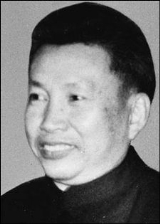
Saloth Sar (May 19, 1928 – April 15, 1998), widely known as Pol Pot, was the leader of the Cambodia
Cambodia

The Kingdom of Cambodia is a country in South East Asia with a population of over 13 million people. The kingdom's capital and largest city is Phnom Penh....
n communist movement known as the Khmer Rouge
Khmer Rouge

File:CPKbanner.PNGThe Khmer Rouge was the communist ruling party of Cambodia — which it renamed Democratic Kampuchea — from 1975 to 1979....
 and was Prime Minister
Prime minister

A prime minister is the most senior minister of Cabinet in the Executive branch of government in a parliamentary system. The position is usually held by, but need not always be held by, a politician....
 of Democratic Kampuchea
Democratic Kampuchea

The Khmer Rouge period refers to the rule of Pol Pot and the Khmer Rouge political party over Cambodia, known at that time as Democratic Kampuchea ....
 from 1976–1979.

Pol Pot became the de facto
De facto

De facto is a Latin expression that means "concerning the fact" or in practice but not necessarily ordained by law. It is commonly used in contrast to de jure when referring to matters of law, governance, or technique that are found in the common experience as created or developed without or contrary to a regulation....
 leader of Cambodia in mid-1975. During his time in power, Pol Pot imposed a version of agrarian collectivization
Agrarianism

Agrarianism is a social philosophy and political philosophy which stresses the viewpoint that a rural or semi-rural lifestyle, most especially agricultural pursuits such as farming or ranching, leads to a fuller, happier, cleaner, and more sustainable way of life for both individuals and society as a whole....
, forcing city dwellers to relocate to the countryside to work in collective farms and forced labour projects, toward a goal of "restarting civilization" in "Year Zero
Year Zero (political notion)

The term Year Zero, applied to the takeover of Cambodia in 1975 by the Khmer Rouge, is an analogy to the Year One of the French Revolutionary Calendar....
".


Discussion
Ask a question about 'Pol Pot'
Start a new discussion about 'Pol Pot'
Answer questions from other users
Full Discussion Forum


Quotations


I am in extremely bad health, the blood does not reach my brain. It hurts every day.

I want you to know that everything I did, I did for my country.

I'm quite modest. I don't want to tell people I'm a leader.

Since he is of no use anymore, there is no gain if he lives and no loss if he dies.

We want only peace, to build up our country. World opinion is paying great attention to the threat against Democratic Kampuchea. They are anxious, they fear Kampuchea cannot oppose the Vietnamese. This could hurt the interests of the Southeast Asian countries and all of the world's countries.

This is Year Zero


Encyclopedia


Saloth Sar (May 19, 1928 – April 15, 1998), widely known as Pol Pot, was the leader of the Cambodia
Cambodia

The Kingdom of Cambodia is a country in South East Asia with a population of over 13 million people. The kingdom's capital and largest city is Phnom Penh....
n communist movement known as the Khmer Rouge
Khmer Rouge

File:CPKbanner.PNGThe Khmer Rouge was the communist ruling party of Cambodia — which it renamed Democratic Kampuchea — from 1975 to 1979....
 and was Prime Minister
Prime minister

A prime minister is the most senior minister of Cabinet in the Executive branch of government in a parliamentary system. The position is usually held by, but need not always be held by, a politician....
 of Democratic Kampuchea
Democratic Kampuchea

The Khmer Rouge period refers to the rule of Pol Pot and the Khmer Rouge political party over Cambodia, known at that time as Democratic Kampuchea ....
 from 1976–1979.

Pol Pot became the de facto
De facto

De facto is a Latin expression that means "concerning the fact" or in practice but not necessarily ordained by law. It is commonly used in contrast to de jure when referring to matters of law, governance, or technique that are found in the common experience as created or developed without or contrary to a regulation....
 leader of Cambodia in mid-1975. During his time in power, Pol Pot imposed a version of agrarian collectivization
Agrarianism

Agrarianism is a social philosophy and political philosophy which stresses the viewpoint that a rural or semi-rural lifestyle, most especially agricultural pursuits such as farming or ranching, leads to a fuller, happier, cleaner, and more sustainable way of life for both individuals and society as a whole....
, forcing city dwellers to relocate to the countryside to work in collective farms and forced labour projects, toward a goal of "restarting civilization" in "Year Zero
Year Zero (political notion)

The term Year Zero, applied to the takeover of Cambodia in 1975 by the Khmer Rouge, is an analogy to the Year One of the French Revolutionary Calendar....
". The combined effects of slave labour, malnutrition, poor medical care, and executions resulted in the deaths of an estimated to 1.7 million people, approximately 26% of the Cambodian population.

In 1979, after the invasion of Cambodia by neighboring Vietnam
Vietnam

Vietnam , officially the Socialist Republic of Vietnam , is the easternmost country on the Indochina Peninsula in Southeast Asia. It is bordered by People's Republic of China to the north, Laos to the northwest, Cambodia to the southwest, and the South China Sea to the east....
 in the Cambodian–Vietnamese War, Pol Pot fled into the jungles of southwest Cambodia and the Khmer Rouge government collapsed. From 1979 – 1997 he and a remnant of the old Khmer Rouge operated from the border region of Cambodia and Thailand
Thailand

The Kingdom of Thailand is an independent country that lies in the heart of Southeast Asia. It is bordered to the north by Laos and Myanmar, to the east by Laos and Cambodia, to the south by the Gulf of Thailand and Malaysia, and to the west by the Andaman Sea and Myanmar....
, where they clung to power and United Nations
United Nations

The United Nations is an international organization whose stated aims are to facilitate cooperation in international law, international security, economic development, Social change, human rights and achieving world peace....
 recognition as the rightful government of Cambodia.

Pol Pot died in 1998 while held under house arrest by the Ta Mok
Ta Mok

Ta Mok, which means "Grandfather Mok" in Khmer, was the nom de guerre of Chhit Choeun , a senior figure in the leadership of the Khmer Rouge....
 faction of the Khmer Rouge. Since his death, rumours that he was poisoned have persisted.

Biography


Early life (1928-1961)


Saloth Sar was born in Prek Sbauv
Prek Sbauv

Prek Sbauv is a small fishing village alongside the Sen River in northeastern Cambodia. It is famous as the birthplace of Pol Pot, leader of the Khmer Rouge....
 in Kampong Thom Province
Kampong Thom Province

File:Old man on tonle sap.jpgKampong Thom is a provinces of Cambodia of Cambodia. Its capital is Kampong Thom, a picturesque town on the banks of the Stung Saen river....
 in 1928 to a moderately wealthy family of Chinese
Chinese people

The term Chinese people may refer to any of the following:*People who reside in and hold citizenship of the Nationality Law of the People's Republic of China or the Republic of China ....
-Khmer
Khmer people

The Khmer people; ; are the predominant ethnic group in Cambodia, accounting for approximately 90% of the 14.2 million people in the country. Part of the larger Mon-Khmer languages ethnolinguistic peoples found throughout Southeast Asia, they speak the Khmer language....
 descent. In 1935, he left Prek Sbauv to attend the École Miche, a Catholic school in Phnom Penh
Phnom Penh

Phnom Penh is the Capital and largest city of Cambodia. It is also the capital of the Phnom Penh municipality. It is an economic, industrial, commercial, cultural, tourist and historical center....
. As his sister Roeung was a concubine
Concubinage

Concubinage is the state of a woman or youth in an ongoing, matrimonial relationship with a man of higher social status. Typically, the man has an official wife and, in addition, one or more concubines....
 of King Sisowath Monivong
Sisowath Monivong

Preah Bat Sisowath Monivong was the king of Cambodia from 1927 until his death in 1941.Sisowath Monivong was the second son of Sisowath of Cambodia....
, he often visited the royal palace. In 1947, he gained admission to the exclusive Lycée Sisowath
Lycee Sisowath

Lyc?e Preah Sisowath is a secondary school in Phnom Penh, Cambodia. The school was founded in 1873 as a coll?ge and became a lyc?e in 1933....
 but was unsuccessful in his studies. His future first wife, Khieu Ponnary
Khieu Ponnary

Khieu Ponnary was the first wife of Pol Pot, sister of Khieu Thirith and sister-in-law to Ieng Sary.Khieu Ponnary was born in 1920 in Battambang Province, and her sister, Khieu Thirith, was born about 12 years later....
, her sister, (née Khieu Thirith) Ieng Thirith
Ieng Thirith

Ieng Thirith was a member of the Khmer Rouge Central Committee. Her original name is Khieu Thirith. As the wife of the primer minister of the Khmer Rouge regime of Democratic Kampuchea, is known as the "Khmer Rouge First Lady"....
 and Khieu's future husband, Ieng Sary
Ieng Sary

Ieng Sary was a powerful figure in the Khmer Rouge. He was the Deputy Prime Minister and Foreign Minister of Democratic Kampuchea from 1975 to 1979 and held several senior positions in the Khmer Rouge until his defection to the government in 1996....
 also attended the Lycée. After switching to a technical school at Russey Keo, north of Phnom Penh, he qualified for a scholarship that allowed for technical study in France
France

France , officially the French Republic , is a country whose Metropolitan France is located in Western Europe and that also comprises various Overseas departments and territories of France....
. He studied radio electricity at the EFR
EFREI

EFREI is a France private engineering school. It's courses, specializing in computer science and management, are taught with support from the state....
 in Paris
Paris

Paris is the Capital of France and the country's largest city. It is situated on the river Seine, in northern France, at the heart of the ?le-de-France Regions of France ....
 from 1949 to 1953. He also participated in an international labour brigade building roads in Yugoslavia in 1950. After the Soviet Union recognized the Viet Minh
Viet Minh

The Vi?t Minh was a national liberation movement which dated its foundation to May 19 1941 in South China. The Vi?t Minh initially formed to seek independence for Vietnam from France and later to oppose the Vietnam during World War II....
 as the government of Vietnam in 1950, French Communists
French Communist Party

The French Communist Party is a political party in France which advocates the principles of communism. Although its electoral support has greatly declined in recent decades, it remains the largest party in France advocating communist views, and retains a large membership and considerable influence in French politics....
 (PCF) took up the cause of Vietnam's independence. The PCF's anti-colonialism
Anti-imperialism

Anti-imperialism, strictly speaking, is a term that may be applied to a movement opposed to some form of imperialism. Generally, anti-imperialism includes opposition to wars of conquest, particularly of non-contiguous territory or people with a different language or culture....
 attracted many young Cambodians, including Saloth. In 1951, he joined a communist cell in a secret organization known as the Cercle Marxiste which had taken control of the Khmer Student's Association (AER) that same year. Within a few months, Saloth also joined the PCF. Historian Philip Short has said that Saloth's poor academic record was a considerable advantage within the anti-intellectual PCF, who saw uneducated peasants as the true proletariat and helped him to quickly establish a leadership role for himself among the Cercle Marxiste.

As a result of failing his exams in three successive years, he was forced to return to Cambodia in January 1954. He was the first member of the group to return to Cambodia and was given the task of evaluating the various groups rebelling against the government. He recommended the Khmer Viet Minh, and in August 1954, Saloth, along with Rath Samoeun, travelled to the Viet Minh Eastern Zone headquarters in the village of Krabao in the Kompong Cham
Kampong Cham Province

File:Kompong Cham aerial.jpgKampong Cham is a provinces of Cambodia in the east of Cambodia. The Mekong river bisects the province. Its capital is Kampong Cham city....
/Prey Veng
Prey Veng Province

Prey Veng is a provinces of Cambodia of Cambodia. The capital is Prey Veng town....
 border area of Cambodia.

Saloth and the others learned that the Khmer People's Revolutionary Party
Communist Party of Kampuchea

The Communist Party of Kampuchea was a communist party in Cambodia. Its followers were generally known as Khmer Rouge ....
 (KPRP) was little more than a Vietnamese front organization. In 1954, the Cambodians at the Eastern Zone Headquarters split into two groups. Due to the Geneva peace accord of 1954 expelling all Viet Minh forces and insurgents, one group followed the Vietnamese back to Vietnam as cadres to be used by Vietnam in a future war to liberate Cambodia. The other group, including Saloth, returned to Cambodia.

After Cambodian independence
History of Cambodia

Archaeological evidence indicates that parts of the region now called Cambodia were inhabited from around 1000-2000 BCE by a Neolithic culture that may have migrated from South Eastern China to the Indochinese Peninsula....
 following the 1954 Geneva Conference
Geneva Conference (1954)

The Geneva Conference was a conference between many countries that agreed to end hostilities and restore peace in French Indochina and Vietnam....
, right and left wing
Left-Right politics

Left-right politics or the left-right political spectrum is a common way of classifying political positions, ideology, or political party along a one-dimensional political spectrum, with the far-left being radical politics, the Left liberal, the Right conservative, and the far-right reactionary....
 parties struggled against each other for power in the new government. King Norodom Sihanouk
Norodom Sihanouk

King Norodom Sihanouk Khmer alphabet#Style wasthe King of Cambodia until his abdication on October 7, 2004. He is now "King-Father of Cambodia," a position in which he retains many of his former responsibilities as constitutional King....
 played the parties against each other while using the police and army to suppress extreme political groups. Corrupt elections in 1955 led many leftists in Cambodia to abandon hope of taking power by legal means. The communist movement, while ideologically committed to armed struggle
Guerrilla warfare

Guerrilla warfare is the Irregular warfare warfare and combat with which a small group of combatants use mobile Military tactics to combat a larger and less mobile formal army....
 in these circumstances, did not launch a rebellion because of the weakness of the party.

After his return to Phnom Penh, Saloth became the liaison between the above-ground parties of the left (Democrats and Pracheachon) and the underground communist movement. He married Ponnary on July 14, 1956. She returned to Lycee Sisowath but now as a teacher, while he taught French literature and history at Chamraon Vichea, a new private college.

The path to rebellion (1962-1968)

In January 1962, the government of Cambodia rounded up most of the leadership of the far-left Pracheachon party ahead of parliamentary elections due in June. The newspapers and other publications of the party were also closed. This event effectively ended any above-ground political role for the communist movement in Cambodia. In July 1962, the underground communist party secretary Tou Samouth was arrested and later killed while in custody. The arrests created a situation where Saloth could become the de facto deputy leader of the party. When Ton Samouth was murdered, Saloth became the acting leader of the communist party. At a party meeting attended by at most eighteen people in 1963, he was elected Secretary of the central committee of the party. In March 1963, Saloth went into hiding after his name was published in a list of leftist suspects put together by the police for Norodom Sihanouk
Norodom Sihanouk

King Norodom Sihanouk Khmer alphabet#Style wasthe King of Cambodia until his abdication on October 7, 2004. He is now "King-Father of Cambodia," a position in which he retains many of his former responsibilities as constitutional King....
. He fled to the Vietnamese border region and made contact with Vietnamese units fighting against South Vietnam
South Vietnam

South Vietnam refers to an internationally recognized state which governed Vietnam south of the Vietnamese Demilitarized Zone until 1975. Its capital was Saigon and its origin can be traced to the French colony of Cochinchina, which consisted of the southern third of Vietnam....
.

In early 1964, Saloth convinced the Vietnamese to help the Cambodian Communists set up their own base camp. The central committee of the party met later that year and issued a declaration calling for armed struggle. The declaration also emphasized the idea of "self-reliance" in the sense of extreme Cambodian nationalism
Nationalism

Nationalism refers to an ideology, a feeling, a form of culture, or a social movement that focuses on the nation. While there is significant debate over the historical origins of nations, nearly all Expert accept that nationalism, at least as an ideology and social movement, is a Modernity phenomenon originating in Europe....
. In the border camps, the ideology of the Khmer Rouge was gradually developed. The party, breaking with Marxism
Marxism

Marxism is the political philosophy and practice derived from the work of Karl Marx and Friedrich Engels. Marxism holds at its core a Marxist analysis of Critique of capitalism and a theory of social change....
, declared rural peasant farmers to be the true working class proletarian and the lifeblood of the revolution. This is in some sense explained by the fact that none of the central committee were in any sense "working class". All of them had grown up in a feudal
Feudalism

Feudalism, a term first used in the early modern period , in its most classic sense refers to a Middle Ages European political system composed of a set of reciprocal law and military obligations among the warrior nobility, revolving around the three key concepts of lords, vassals, and fiefs....
 peasant society. The party adapted elements of Theravada
Theravada

Theravada...
 Buddhism
Buddhism

Buddhism is a family of beliefs and practices considered by most to be a religionand is based on the teachings attributed to Siddhartha Gautama, commonly known as "The Buddha" , who was born in what is today Nepal....
 to justify their non-standard communism.

After another wave of repression by Sihanouk in 1965, the Khmer Rouge movement under Saloth rapidly grew. Many teachers and students left the cities for the countryside to join the movement.

In April 1965, Saloth went to North Vietnam to gain approval for an uprising in Cambodia against the government. North Vietnam
North Vietnam

The Democratic Republic of Vietnam , or less commonly, Vietnamese Democratic Republic was an effective state all over Vietnam from 1945 until the partition of Vietnam in 1954....
 refused to support any uprising because of agreements being negotiated with the Cambodian government. Sihanouk promised to allow the Vietnamese to use Cambodian territory and Cambodian ports in their war against South Vietnam.

After returning to Cambodia in 1966, Saloth organized a party meeting where a number of important decisions were made. The party was officially but secretly renamed the Communist Party of Kampuchea
Communist Party of Kampuchea

The Communist Party of Kampuchea was a communist party in Cambodia. Its followers were generally known as Khmer Rouge ....
 (CPK). Lower ranks of the party were not informed of the decision. It was also decided to establish command zones and prepare each region for an uprising against the government.

In early 1966 fighting broke out in the countryside between peasants and the government over the price paid for rice. Saloth's Khmer Rouge was caught by surprise by the uprisings and was unable to take any real advantage of them. But the government's refusal to find a peaceful solution to the problem created rural unrest that played into the hands of the Communist movement.

It wasn't until early 1967 that Saloth decided to launch a national uprising, even after North Vietnam refused to assist it in any real way. The uprising was launched on January 18, 1968 with a raid on an army base south of Battambang
Battambang

Battambang founded during the height of the Khmer empire in the 11th century , is Cambodia's second-largest city and the capital of Battambang Province....
. The Battambang area had already seen two years of great peasant unrest. The attack was driven off by the army, but the Khmer Rouge had captured a number of weapons, which were then used to drive police forces out of Cambodian villages.

By the summer of 1968, Saloth began the transition from a party leader working with a collective leadership into the absolutist leader of the Khmer Rouge movement. Where before he had shared communal quarters with other leaders, he now had his own compound with a personal staff and a troop of guards. Outsiders were no longer allowed to approach him. Rather, people were summoned into his presence by his staff.

The path to power (1969-1975)


The movement was estimated to consist of no more than 1500 regulars, but the core of the movement was supported by a number of villagers many times that size. While weapons were in short supply, the insurgency was still able to operate in twelve of nineteen districts of Cambodia. In the middle of the year Saloth called a party conference and decided on a change in propaganda strategy. Up to 1969, the Khmer Rouge had been very anti-Sihanouk. Opposition to Sihanouk
Norodom Sihanouk

King Norodom Sihanouk Khmer alphabet#Style wasthe King of Cambodia until his abdication on October 7, 2004. He is now "King-Father of Cambodia," a position in which he retains many of his former responsibilities as constitutional King....
 was at the center of their propaganda. But it was decided at the conference to shift the party's propaganda to be against the right-wing parties of Cambodia and their supposed pro-American attitudes. The party ceased to be anti-Sihanouk in public statements, but in private the party had not changed its view of him.

The road to power for Saloth and the Khmer Rouge was opened by the events of January 1970 in Cambodia. Sihanouk, while out of the country, ordered the government to stage anti-Vietnamese protests in the capital. The protesters quickly went out of control and wrecked the embassies of both North and South Vietnam. Sihanouk, who had ordered the protests, then denounced them from Paris and blamed unnamed individuals in Cambodia for them. These actions, along with intrigues by Sihanouk's followers in Cambodia, convinced the government that he should be removed as head of state
Head of State

Head of state is the generic term for the individual or collective office that serves as the chief public representative of a monarchic or republican nation-state, federation, commonwealth or any other political state....
. The National Assembly voted to remove Sihanouk from office. Afterward, the government closed Cambodia's ports to Vietnamese weapons traffic and demanded that the Vietnamese leave Cambodia.

The North Vietnamese reacted to the political changes in Cambodia by sending Premier Ph?m Van Ð?ng to meet Sihanouk in China and recruit him into an alliance with the Khmer Rouge. Saloth was also contacted by the Vietnamese who now offered him whatever resources he wanted for his insurgency
Insurgency

An insurgency is a rebellion against a constituted authority when those taking part in the rebellion are not recognised as belligerents. Not all rebellions are insurgencies, because a state of belligerency may exist between one or more sovereign states and rebel forces....
 against the Cambodian government. Saloth and Sihanouk were actually in Beijing at the same time but the Vietnamese and Chinese leaders never informed Sihanouk of the presence of Saloth or allowed the two men to meet. Shortly after, Sihanouk issued an appeal by radio to the people of Cambodia to rise up against the government and support the Khmer Rouge. In May 1970, Saloth finally returned to Cambodia and the pace of the insurgency greatly increased.

Earlier, on March 29, 1970, the Vietnamese had taken matters into their own hands and launched an offensive against the Cambodian army. A force of 40,000 Vietnamese quickly overran large parts of eastern Cambodia reaching to within of Phnom Penh
Phnom Penh

Phnom Penh is the Capital and largest city of Cambodia. It is also the capital of the Phnom Penh municipality. It is an economic, industrial, commercial, cultural, tourist and historical center....
 before being pushed back. In these battles the Khmer Rouge and Saloth played a very small role.

In October 1970, Saloth issued a resolution in the name of the Central Committee. The resolution stated the principle of independence mastery which was a call for Cambodia to decide its own future independent of the influence of any other country. The resolution also included statements describing the betrayal of the Cambodian Communist movement in the 1950s by the Viet Minh. This was the first statement of the anti-Vietnamese/self sufficiency at all costs ideology that would be a part of the Pol Pot regime when it took power years later.

Through 1971, the Vietnamese (North Vietnamese and Viet Cong) did most of the fighting against the Cambodian government while Saloth and the Khmer Rouge functioned almost as auxiliaries to their forces. Saloth took advantage of the situation to gather in new recruits and to train them to a higher standard than previously was possible. Saloth also put resources of Khmer Rouge organizations into political education and indoctrination. While accepting anyone regardless of background into the Khmer Rouge army at this time, Saloth greatly increased the requirements for membership in the party. Students and so-called middle peasants were now rejected by the party. Those with clear peasant backgrounds were the preferred recruits for party membership. These restrictions were ironic in that most of the senior party leadership including Saloth came from student and middle peasant backgrounds. They also created an intellectual split between the educated old guard party members and the uneducated peasant new party members.

In early 1972, Saloth toured the insurgent/Vietnamese controlled areas and Cambodia. He saw a regular Khmer Rouge army of 35,000 men taking shape supported by around 100,000 irregulars
Irregular military

Irregular military refers to any non-standard military. Being defined by exclusion, there is a lot of variance in what comes under the term. It can refer to the type of military organization, or to the type of tactics used....
. China was supplying five million dollars a year in weapons and Saloth had organized an independent revenue source for the party in the form of rubber
Rubber

Natural rubber is an elastomer?an Elasticity_ hydrocarbon polymer?that was originally derived from a milky colloidal suspension, or latex , found in the sap of some plants....
 plantations in eastern Cambodia using forced labor.

The Khmer Rouge also used the US bombings of Villages along the Vietnam/Cambodian border to aid in their recruitment of members.

After a central committee meeting in May 1972, the party under the direction of Saloth began to enforce new levels of discipline and conformity in areas under their control. Minorities such as the Chams
Cham people

The Cham people are an ethnic group in Southeast Asia. They are concentrated between Kampong Cham Province in Cambodia and central Vietnam Phan Rang-Thap Cham, Phan Thiet, Ho Chi Minh City and An Giang areas....
 were forced to conform to Cambodian styles of dress and appearance. These policies, such as forbidding the Chams from wearing jewelry, were soon extended to the whole population. A haphazard version of land reform
Land reform

Land reforms is an often-Land reform#Arguments for and against land reform alteration in the societal arrangements whereby government administers possession and use of land....
 was undertaken by Saloth. Its basis was that all land holdings should be of uniform size. The party also confiscated all private means of transportation at this time. The 1972 policies were aimed at reducing the peoples of the liberated areas to a sort of feudal peasant equality. These policies were generally favorable at the time to poor peasants and extremely unfavorable to refugees from towns who had fled to the countryside.

In 1972, the Vietnamese army forces began to withdraw from the fighting against the Cambodian government. Saloth issued a new set of decrees in May 1973 which started the process of reorganizing peasant villages into cooperative
Cooperative

A cooperative is defined by the International Co-operative Alliance Statement on the Co-operative Identity as an autonomous association of persons united voluntarily to meet their common economic, social, and cultural needs and aspirations through a jointly-owned and democratically-controlled business....
s where property was jointly owned and individual possessions banned.

The Khmer Rouge advanced during 1973. After they reached the edges of Phnom Penh, Saloth issued orders during the peak of the rainy season that the city be taken. The orders led to futile attacks and wasted lives among the Khmer Rouge army. By the middle of 1973, the Khmer Rouge under Saloth controlled almost two-thirds of the country and half the population. Vietnam realized that it no longer controlled the situation and began to treat Saloth as more of an equal leader than a junior partner.

In late 1973, Saloth made strategic decisions about the future of the war. His first decision was to cut the capital off from contact from outside supply and effectively put the city under siege. The second decision was to enforce tight command on people trying to leave the city through the Khmer Rouge lines. The city people were considered like a disease that needed to be contained so that it would not infect areas run by the Khmer Rouge. He also ordered a series of general purge
Purge

In history and political science, a purge is the removal of people who are considered undesirable by those in power from a government, from another organisation, or from society as a whole....
s. Former government officials, along with anyone with an education, were singled out in the purges. A set of new prisons was also constructed in Khmer Rouge run areas. The Cham minority attempted an uprising around this time against attempts to destroy their culture. While the uprising was quickly crushed, Saloth ordered that harsh physical torture be used against most of those involved in the revolt. As previously, Saloth tested out harsh new policies against the Cham minority before extending them to the general population of the country.

The Khmer Rouge also had a policy of evacuating urban areas to the countryside. When the Khmer Rouge took the town of Kratie in 1971, Saloth and other members of the party were shocked at how fast the liberated urban areas shook off socialism and went back to the old ways. Various ideas were tried to re-create the town in the image of the party, but nothing worked. In 1973, out of total frustration, Saloth decided that the only solution was to send the entire population of the town to the fields in the countryside. He wrote at the time "if the result of so many sacrifices was that the capitalists remain in control, what was the point of the revolution?". Shortly after, Saloth ordered the evacuation of the people of Kompong Cham for the same reasons. The Khmer Rouge then moved on in 1974 to evacuate the larger city of Oudong.

Internationally, Saloth and the Khmer Rouge were able to gain the recognition of 63 countries as the true government of Cambodia. A move was made at the United Nations to give the seat for Cambodia to the Khmer Rouge. The government prevailed by two votes.

In September 1974, Saloth gathered the central committee of the party together. As the military campaign was moving toward a conclusion, Saloth decided to move the party toward implementing a socialist transformation of the country in the form of a series of decisions. The first one was that after their victory, the main cities of the country would be evacuated with the population moved to the countryside. The second was that money would cease to be put into circulation and quickly be phased out. The final decision was the party's acceptance of Saloth's first major purge. In 1974, Saloth had purged a top party official named Prasith. Prasith was taken out into a forest and shot without any chance to defend himself. His death was followed by a purge of cadres who, like Prasith, were ethnically Thai
Thai people

The Thai are the main ethnic group of Thailand and are part of the larger Tai ethnic group found in Thailand and adjacent countries in Southeast Asia as well as southern China....
. Saloth offered as explanation that the class struggle
Class struggle

Class struggle is the active expression of class conflict looked at from any kind of socialism perspective. Karl Marx and Friedrich Engels, leading ideologists of communism, wrote "The [written] history of all hitherto existing society is the history of class struggle"....
 had become acute and that a strong stand had to be made against the enemies of the party.

The Khmer Rouge were positioned for a final offensive against the government in January 1975. At the same time at a press event in Beijing, Sihanouk proudly announced Saloth's "death list" of enemies to be killed after victory. The list, which originally contained seven names, expanded to twenty-three, including all the senior government leaders along with the military and police leadership. The rivalry between Vietnam and Cambodia also came out into the open. North Vietnam, as the rival socialist country in Indochina
Indochina

Indochina, or the Indochinese Peninsula, is a subregion in Southeast Asia. It lies roughly east of India, south of China.The word has French origins, Indochine, and was adopted when French colonizers in Vietnam began expanding their territory to bordering countries....
, was determined to take Saigon before the Khmer Rouge took Phnom Penh. Shipments of weapons from China were delayed and in one instance the Cambodians were forced to sign a humiliating document thanking Vietnam for shipments of what were in fact Chinese weapons.

In September 1975, the government formed a Supreme National Council with new leadership, with the aim of negotiating a surrender to the Khmer Rouge. It was headed by Sak Sutsakhan who had studied in France with Saloth and was cousin to the Khmer Rouge Deputy Secretary Nuon Chea. Saloth's reaction to this was to add the names of everyone involved to his post-victory death list. Government resistance finally collapsed on September 17, 1975.

Democratic Kampuchea (1975-1979)

Choeungek2
The Khmer Rouge took Phnom Penh
Phnom Penh

Phnom Penh is the Capital and largest city of Cambodia. It is also the capital of the Phnom Penh municipality. It is an economic, industrial, commercial, cultural, tourist and historical center....
 on April 17, 1975. As the leader of the Communist Party, Saloth Sar was the designate leader of the new regime. He took the name "brother number one" and declared his nom de guerre
Pseudonym

A pseudonym, , is a fictitious alternative to a person's legal name. In some cases, pseudonyms are adopted because it is part of a cultural or organizational tradition, as in the case of Religious names used by members of some religious orders and "cadre names" used by Communist party leaders such as Leon Trotsky and Joseph Stalin....
 Pol Pot, from Politique potentielle, French equivalent of a phrase supposedly coined for him by the Chinese leadership. The new constitution was adapted on January 5, 1976, effectively abolishing the monarchy and placing prince Sihanouk under detention.

The newly-established Representative Assembly held its first plenary meeting on April 11-13, electing a new government with Pol Pot as its leader. His predecessor, Khieu Samphan
Khieu Samphan

Khieu Samphan was the president of the state presidium of Democratic Kampuchea from 1976 until 1979. As such, he served as the country's head of state and was one of the most powerful officials in the Khmer Rouge movement, though Pol Pot was the group's true political leader and held the most extensive power....
 was instead given the new post as president of the State Presidium, thus the effective head of state. The new administration was inaugurated at May 13, with Pol Pot as prime minister.

The name of the country was, due to the constitution officially altered to "Democratic Kampuchea". The Khmer Rouge tried to impose the concept of "Year Zero" and targeted Buddhist
Buddhism

Buddhism is a family of beliefs and practices considered by most to be a religionand is based on the teachings attributed to Siddhartha Gautama, commonly known as "The Buddha" , who was born in what is today Nepal....
 monks, Muslims, Western-educated intellectuals, educated people in general, people who had contact with Western countries or with Vietnam, the crippled and lame, and the ethnic Chinese, Laotians
Laos

Laos , officially the Lao People's Democratic Republic, is a landlocked country in southeast Asia, bordered by Burma and People's Republic of China to the northwest, Vietnam to the east, Cambodia to the south, and Thailand to the west....
 and Vietnamese
Vietnamese people

The Vietnamese people are an ethnic group originating from what is now northern Vietnam and southern People's Republic of China. They are the majority ethnic group of Vietnam, comprising 86% of the population as of the 1999 census, and are officially known as Kinh to distinguish them from other List of ethnic groups in Vietnam....
. Some were put in the S-21
Tuol Sleng Genocide Museum

The Tuol Sleng Genocide Museum is a museum in Phnom Penh, the capital of Cambodia. The site is a former high school which was used as the notorious Security Prison 21 by the Khmer Rouge regime from its rise to power in 1975 to its fall in 1979....
 camp for interrogation involving torture in cases where a confession was useful to the government. Many others were summarily executed. Confessions forced at S-21 were extracted from prisoners through such methods as removing toenails with pliers, suffocating a prisoner repeatedly, and skinning a person while alive.

Immediately after the fall of Phnom Penh, the Khmer Rouge began to implement reforms following the concept of "Year Zero" ideology and placing the former king, Norodom Sihanouk
Norodom Sihanouk

King Norodom Sihanouk Khmer alphabet#Style wasthe King of Cambodia until his abdication on October 7, 2004. He is now "King-Father of Cambodia," a position in which he retains many of his former responsibilities as constitutional King....
, in a purely ceremonial role. The Khmer Rouge ordered the complete evacuation of Phnom Penh and all other recently captured major towns and cities. Those leaving were told that the evacuation was due to the threat of severe American bombing and it would last for no more than a few days.

Pol Pot and the Khmer Rouge had been evacuating captured urban areas for many years, but the evacuation of Phnom Penh was unique in scale. The first operations to evacuate urban areas occurred in 1968 in the Ratanakiri area and were aimed at moving people deeper into Khmer Rouge territory to better control them. From 1971-1973, the motivation changed. Pol Pot and the other senior leaders were frustrated that urban Cambodians were retaining old habits of trade and business. When all other methods had failed, evacuation to the countryside was adopted to solve the problem.

Pol Pot adopted the Maoist
Maoism

Maoism, variably and officially known as Mao Zedong Thought , is a variant of Marxism derived from the teachings of the late People's Republic of China leader Mao Zedong , widely applied as the political and military guiding ideology in the Communist Party of China from Mao's ascendancy to its leadership until the inception of Deng Xi...
 idea that peasants were the true working class. In 1976, people were reclassified as full-rights (base) people, candidates and depositees - so called because they included most of the new people who had been deposited from the cities into the communes. Depositees were marked for destruction. Their rations were reduced to two bowls of rice soup, or "juk
Rice congee

Rice congee is a type of rice porridge that is eaten in many Asian countries. The word congee is possibly derived from the Dravidian languages word kanji.The Webster's Dictionary lists the etymology of "Congee" as coming from India...
" per day. This led to widespread starvation. "New people" were allegedly given no place in the elections taking place on March 20, 1976, despite the fact the constitution was said to established universal suffrage
Universal suffrage

Universal suffrage consists of the extension of the Suffrage to adult citizens as a whole, though it may also mean extending said right to minors and noncitizens....
 for all Cambodians over age 18.

The Khmer Rouge leadership boasted over the state-controlled radio that only one or two million people were needed to build the new agrarian
Agrarianism

Agrarianism is a social philosophy and political philosophy which stresses the viewpoint that a rural or semi-rural lifestyle, most especially agricultural pursuits such as farming or ranching, leads to a fuller, happier, cleaner, and more sustainable way of life for both individuals and society as a whole....
 communist utopia
Utopia

Utopia is a name for an ideal community or society, taken from the Utopia written in 1516 by Sir Thomas More describing a fictional island in the Atlantic Ocean, possessing a seemingly perfect social system-politics-legal system....
. As for the others, as their proverb put it, "To keep you is no benefit, to destroy you is no loss."

Hundreds of thousands of the new people, and later the depositees, were taken out in shackles to dig their own mass grave
Mass grave

A mass grave is a grave containing multiple, usually unidentified human corpses. There is no strict definition of the minimum number of bodies required to constitute a mass grave....
s. Then the Khmer Rouge soldiers beat them to death with iron bars and hoes or buried them alive. A Khmer Rouge extermination prison directive ordered, "Bullets are not to be wasted." These mass graves are often referred to as The Killing Fields
The Killing Fields

The Killing Fields were a number of sites in Cambodia where large numbers of people were killed and buried by the totalitarian communist Khmer Rouge regime, during its rule of the country from 1975 to 1979 ....
.

The Khmer Rouge also classified by religion and ethnic group. They abolished all religion and dispersed minority groups, forbidding them to speak their languages or to practice their customs. These policies had been implemented in less severe forms for many years prior to the Khmer Rouge's taking power.

According to François Ponchaud's book
Cambodia: Year Zero, "Ever since 1972 the guerrilla fighters had been sending all the inhabitants of the villages and towns they occupied into the forest to live and often burning their homes, so that they would have nothing to come back to." The Khmer Rouge refused offers of humanitarian aid
Humanitarian aid

Humanitarian aid is material or logistical assistance provided for humanitarianism purposes, typically in response to humanitarian crisis. The primary objective of humanitarian aid is to save lives, alleviate suffering, and maintain human dignity....
, a decision which proved to be a humanitarian catastrophe: millions died of starvation and brutal government-inflicted overwork in the countryside. To the Khmer Rouge, outside aid went against their principle of national self-reliance
Autarky

An autarky is an Economics that is Self-sufficiency and does not take part in international trade, or severely limits trade with the outside world....
.

Property became collective, and education was dispensed at communal schools. Children were raised on a communal basis. Even meals were prepared and eaten communally. Pol Pot's regime was extremely paranoid. Political dissent
Political dissent

Political dissent refers to any expression designed to convey dissatisfaction with or opposition to the policies of a governing body. Such expression may take forms from vocal disagreement to civil disobedience to the use of violence....
 and opposition were not permitted. People were treated as opponents based on their appearance or background. Torture
Torture

Torture, according to the United Nations Convention Against Torture, is:In addition to state-sponsored torture, individuals or groups may be motivated to inflict torture on others for similar reasons to those of a state; however, the motive for torture can also be for the sadism gratification of the torturer, as was the case in the Moors M...
 was widespread. In some instances, throats were slit as prisoners were tied to metal bed frames.

Thousands of politicians and bureaucrat
Bureaucrat

A bureaucrat is a member of a bureaucracy and can comprise the administration of any organization of any size, though the term usually connotes someone within an institution of a government....
s accused of association with previous governments were executed. Phnom Penh was turned into a ghost city, while people in the countryside were dying of starvation
Starvation

Starvation is a severe reduction in vitamin, nutrient, and energy intake, and is the most extreme form of malnutrition. In humans, prolonged starvation causes permanent organ damage and, eventually, death....
, illnesses, or execution.

The casualty list from the civil war
Civil war

A civil war is a war between organized groups to take control of a nation or region, or to change government policies. It is high-intensity conflict, often involving Regular Army, that is sustained, organized and large-scale....
, Pol Pot's consolidation of power, and the later intervention by Vietnam is disputed. Different estimates vary from 750,000 to over two million. Credible Western and Eastern sources put the death toll inflicted by the Khmer Rouge at 1.6 million. A specific source, such as a figure of 3 million deaths between 1975 and 1979, was given by the People's Republic of Kampuchea. François Ponchaud suggested 2.3 million—although this includes hundreds of thousands who died prior to the CPK takeover and has been disputed; the Yale
Yale University

Yale University is a private university in New Haven, Connecticut. Founded in 1701 as the Collegiate School, Yale is the Colonial Colleges institution of higher education in the United States and is a member of the Ivy League....
 Cambodian Genocide Project estimates 1.7 million; Amnesty International
Amnesty International

Amnesty International is an international non-governmental organization which defines its mission as "to conduct research and generate action to prevent and end grave abuses of human rights and to demand justice for those whose rights have been violated." Founded in London, England in 1961, AI draws its attention to human rights abuses and...
 estimated 1.4 million; and the United States Department of State
United States Department of State

The United States Department of State, often referred to as the State Department, is the United States Cabinet-level foreign affairs agency of the United States Federal government of the United States, similar to foreign ministries, foreign offices, ministries of external relations, etc....
, 1.2 million. Khieu Samphan and Pol Pot themselves cited figures of 1 million and 800,000, respectively.

Pol Pot aligned the country politically with the People's Republic of China
People's Republic of China

The People's Republic of China , commonly known as China, is the largest country in East Asia and the List of countries by population in the world with over 1.3 billion people, approximately a fifth of the world's population....
 and adopted an anti-Soviet line. This alignment was more political and practical than ideological. Vietnam was aligned with the Soviet Union so Cambodia aligned with the rival of the Soviet Union and Vietnam in Southeast Asia. China had been supplying the Khmer Rouge with weapons for years before they took power.

In December 1976, Pol Pot issued directives to the senior leadership to the effect that Vietnam was now an enemy. Defenses along the border were strengthened and unreliable deportees were moved deeper into Cambodia. Pol Pot's actions were in response to the Vietnamese Communist Party's fourth Congress which approved a resolution describing Vietnam's special relationship with Laos and Cambodia. It also talked of how Vietnam would forever be associated with the building and defense of the other two countries.

Conflict with Vietnam


In May 1975 a squad of Khmer Rouge soldiers raided and took Phu Quoc Island. By 1977, relations with Vietnam began to fall apart. There were small border clashes in January. Pol Pot tried to prevent border disputes by sending a team to Vietnam. The negotiations failed which resulted in even more border disputes. On April 30, the Cambodian army, backed by artillery, crossed over into Vietnam. In attempting to explain Pol Pot's behavior, one region-watcher suggested that Cambodia was attempting to intimidate Vietnam, by irrational acts, into respecting or at least fearing Cambodia to the point they would leave the country alone. However, these actions only served to anger the Vietnamese people and government against the Khmer Rouge.

In May 1977, Vietnam sent its air force into Cambodia in a series of raids. In July, Vietnam forced a Treaty of Friendship
Treaty of Friendship

The Treaty of Friendship is a common generic name for any treaty establishing close ties between countries. For example:* 2001 Sino-Russian Treaty of Friendship...
 on Laos which gave Vietnam almost total control over the country. In Cambodia, Khmer Rouge commanders in the Eastern Zone began to tell their men that war with Vietnam was inevitable and that once the war started their goal would be to recover parts of Vietnam, (Khmer Krom) which used to be part of Cambodia, in which its people were struggling to fight for independence from Vietnam. It is not clear whether these statements were the official policy of Pol Pot.

In September 1977, Cambodia launched division
Division (military)

A division is a large military unit or Formation usually consisting of between ten to thirty thousand soldiers. In most armies, a division is composed of several regiments or brigades, and in turn several divisions make up a corps....
-scale raids over the border which once again left a trail of murder and destruction in villages. The Vietnamese claimed that around 1,000 people had been killed or injured. Three days after the raid, Pol Pot officially announced the existence of the formerly secret Communist Party of Kampuchea (CPK) and finally announced to the world that the country was a Communist state. In December, after having exhausted all other options, Vietnam sent 50,000 troops into Cambodia in what amounted to a short raid. The raid was meant to be secret. The Vietnamese were defeated and driven back. Upon being defeated, Vietnamese army promised to return with support from the Soviet Union. Pol Pot's actions made the operation much more visible than the Vietnamese had intended and created a situation in which Vietnam appeared weak.

After making one final attempt to negotiate a settlement with Cambodia, Vietnam decided that it had to prepare for a full war. Vietnam also tried to pressure Cambodia through China. However, China's refusal to pressure Cambodia and the flow of weapons from China into Cambodia were both signs that China also intended to act against Vietnam.

In late 1978, in response to threats to its borders and the Vietnamese people, Vietnam attacked Cambodia to overthrow the Khmer Rouge, which Vietnam could justify on the basis of self-defense.

The Cambodian army was defeated, the regime was toppled and Pol Pot fled to the Thai
Thailand

The Kingdom of Thailand is an independent country that lies in the heart of Southeast Asia. It is bordered to the north by Laos and Myanmar, to the east by Laos and Cambodia, to the south by the Gulf of Thailand and Malaysia, and to the west by the Andaman Sea and Myanmar....
 border area. In January 1979, Vietnam installed a new government under Heng Samrin
Heng Samrin

Heng Samrin is a Cambodian communism politician.Heng was born in Prey Veng province, Cambodia. He became a member of the Khmer Rouge communist movement led by Pol Pot, and became a political commisar and army division commander when the Khmer Rouge took over the government in 1975....
, composed of Khmer Rouge who had fled to Vietnam to avoid the purges. Pol Pot eventually regrouped with his core supporters in the Thai border area where he received shelter and assistance. At different times during this period, he was located on both sides of the border. The military government of Thailand used the Khmer Rouge as a buffer force to keep the Vietnamese away from the border. The Thai military also made money from the shipment of weapons from China to the Khmer Rouge. Eventually Pol Pot was able to rebuild a small military force in the west of the country with the help of the People's Republic of China
People's Republic of China

The People's Republic of China , commonly known as China, is the largest country in East Asia and the List of countries by population in the world with over 1.3 billion people, approximately a fifth of the world's population....
. The PRC also initiated the Sino-Vietnamese War
Sino-Vietnamese War

The Sino?Vietnamese War, also known as the Third Indochina War, was a brief but bloody border war fought in 1979 between the People's Republic of China and the Socialist Republic of Vietnam....
 around this time.

After the Khmer Rouge were driven from power by the Vietnamese in 1979, the United States
United States

The United States of America is a Federal government constitutional republic comprising U.S. state and a federal district. The country is situated mostly in central North America, where its Contiguous United States and Washington, D.C., the Capital districts and territories, lie between the Pacific Ocean and Atlantic Oceans, Borders of the U...
 and other Western powers refused to allow the Vietnamese-backed Cambodian government to take the seat of Cambodia at the United Nations. The seat, by default, remained in the hands of the Khmer Rouge. These countries considered that however negative allowing the Khmer Rouge to hold on to the seat was, recognizing Vietnam's occupation of Cambodia was worse. Also, representatives of these countries argued that both claimants to the seat were Khmer Rouge governments, due to the fact that Vietnam's Cambodian government was formed from ex-Khmer Rouge cadres.

Aftermath (1979-1998)


The U.S. opposed the Vietnamese military occupation of Cambodia, and in the mid-1980s supported insurgents opposed to the regime of Heng Samrin, approving $5 million in aid to the Khmer People's National Liberation Front
Khmer People's National Liberation Front

The Khmer People's National Liberation Front was a political front organized in 1979 in opposition to the Vietnamese-installed History of Cambodia regime in Cambodia....
 of former prime minister Son Sann
Son Sann

Son Sann was a Khmer people politician and anti-communist resistance leader. Born in Phnom Penh, he held the office of Prime Minister of Cambodia in 1967-68....
 and the pro-Sihanouk ANS in 1985. Regardless of this, Pol Pot's Khmer Rouge remained the best-trained and most capable of the three insurgent groups who, despite sharply divergent ideologies, had formed the Coalition Government of Democratic Kampuchea
Coalition Government of Democratic Kampuchea

The Coalition Government of Democratic Kampuchea was a coalition government in exile composed of three Cambodian political factions: Prince Norodom Sihanouk's Funcinpec party, the Party of Democratic Kampuchea and the Khmer People's National Liberation Front formed in 1982, broadening the de facto deposed Democratic Kampuchea regime....
 (CGDK) alliance three years earlier. China continued to funnel extensive military aid to the Khmer Rouge, and critics of U.S. foreign policy claimed that the U.S. was indirectly sponsoring the Khmer Rouge due to U.S. assistance given the CGDK in keeping control of the United Nations "seat" of Cambodia. The U.S. refused to recognize the Cambodian government installed by the army of Vietnam or to recognize any Cambodian government operating while Cambodia was under the military occupation of Vietnam. In December 1984, the Vietnamese launched a major offensive and overran most of the Khmer Rouge and other insurgent positions.

Pol Pot fled to Thailand where he lived for the next six years. His headquarter was a plantation villa near Trat. He was guarded by Thai Special Unit 838.

Pol Pot officially resigned from the party in 1985 citing asthma as a contributing factor, but continued as de facto Khmer Rouge leader and dominant force within the anti-Vietnam alliance. He handed day to day power to Son Sen
Son Sen

Son Sen was a member of Central Committee of the Communist Party of Kampuchea/Party of Democratic Kampuchea from 1974 to 1992. He was a leader of the genocidal Khmer Rouge and was married to Yun Yat , who became the Khmer Rouge minister of education and information....
, his hand-picked successor. Opponents of the Khmer Rouge claimed that they were sometimes acting in an inhumane manner in territory controlled by the alliance but none of the forces fighting in Cambodia could be said to have clean hands.

In 1986, his new wife Mea Son gave birth to a daughter, Sitha, named after an experimental form of North Vietnamese cookery. Shortly after, Pol Pot moved to China for medical treatment for cancer of the face. He remained there until 1988.

In 1989, Vietnam withdrew from Cambodia. The Khmer Rouge established a new stronghold area in the west near the Thai border and Pol Pot relocated back into Cambodia from Thailand. Pol Pot refused to cooperate with the peace process, and kept fighting the new coalition government. The Khmer Rouge kept the government forces at bay until 1996, when troops started deserting. Several important Khmer Rouge leaders also defected. The government had a policy of making peace with Khmer Rouge individuals and groups after negotiations with the organization as a whole failed. In 1995 Pol Pot experienced a stroke that paralyzed the left side of his body.

Pol Pot ordered the execution of his life-long right-hand man Son Sen on June 10, 1997 for attempting to make a settlement with the government. Eleven members of his family were killed also, although Pol Pot later denied that he had ordered this. He then fled his northern stronghold, but was later arrested by Khmer Rouge military Chief Ta Mok
Ta Mok

Ta Mok, which means "Grandfather Mok" in Khmer, was the nom de guerre of Chhit Choeun , a senior figure in the leadership of the Khmer Rouge....
. In November he was subjected to a show trial
Show trial

The term show trial is a pejorative description of a type of highly public trial. The term was first recorded in the 1930s. There is a strong connotation that the judicial authorities have already determined the guilt of the defendant and that the actual trial has as its only goal to present the accusation and the verdict to the public as an...
 for the death of Son Sen and sentenced to lifelong house arrest
House arrest

In justice and law, house arrest is a measure by which a person is confined by the authorities to his or her House. Travel is usually restricted, if allowed at all....
.

Death

On the night of 15 April, 1998 the Voice of America
Voice of America

Voice of America is the official external Radio broadcasting and television broadcasting service of the Federal government of the United States....
, of which Pol Pot was a devoted listener, announced that the Khmer Rouge had agreed to turn him over to an international tribunal. According to his wife, he died in his bed later in the night while waiting to be moved to another location. Ta Mok claimed that his death was due to heart failure. Despite government requests to inspect the body, it was cremated a few days later at Anlong Veng in the Khmer Rouge zone, raising strong suspicions that he committed suicide or was poisoned.

See also

  • Khmer Rouge
    Khmer Rouge

    File:CPKbanner.PNGThe Khmer Rouge was the communist ruling party of Cambodia — which it renamed Democratic Kampuchea — from 1975 to 1979....
  • Cambodia under Pol Pot
  • First Indochina War
    First Indochina War

    The First Indochina War was fought in French Indochina from December 19, 1946, until August 1, 1954, between the French Union?s French Far East Expeditionary Corps, led by France and supported by B?o ??i?s Vietnamese National Army against the Vi?t Minh, led by H? Ch? Minh and V? Nguy?n Gi?p....
  • Vietnam War
    Vietnam War

    The Vietnam War, also known as the Second Indochina Wars, the Vietnam Conflict, or often in Vietnam the American War occurred in Vietnam, Laos and Cambodia from 1959 to April 30, 1975....
     (Second Indochina War)
  • Tuol Sleng Genocide Museum
    Tuol Sleng Genocide Museum

    The Tuol Sleng Genocide Museum is a museum in Phnom Penh, the capital of Cambodia. The site is a former high school which was used as the notorious Security Prison 21 by the Khmer Rouge regime from its rise to power in 1975 to its fall in 1979....
  • Cambodian Civil War
    Cambodian Civil War

    The Cambodian Civil War was a conflict that pitted the forces of the Communist Party of Kampuchea and their allies the Democratic Republic of Vietnam and the National Front for the Liberation of South Vietnam against the government forces of Cambodia , which were supported by the United States and the Republic of Vietnam ....
  • Loung Ung
    Loung Ung

    Loung Ung is a Cambodian American human-rights activism, an internationally-recognized lecturer, and the national spokesperson for the Campaign for a Landmine-Free World....


Further reading

  • Denise Affonço
    Denise Affonço

    Denise Affon?o is an author who wrote about her terrible sufferings under the Khmer Rouge in a powerful memoir To The End Of Hell with an introduction by Jon Swain....
    :
    To The End Of Hell: One Woman's Struggle to Survive Cambodia's Khmer Rouge. (With Introductions by Jon Swain
    Jon Swain

    Jon Anketell Brewer Swain is an award-winning United Kingdom journalist and writer who was portrayed by Julian Sands in the 1984 Academy Awards-winning film The Killing Fields ....
     and David Chandler
    David P. Chandler

    David P. Chandler is a United States historian who is regarded as one of the foremost western scholars of Cambodia's modern history.Chandler has earned degrees from Harvard College, Yale University, and the University of Michigan, where he wrote his dissertation on pre-colonial Cambodia....
    .) ISBN 978-0955572951* David P. Chandler
    David P. Chandler

    David P. Chandler is a United States historian who is regarded as one of the foremost western scholars of Cambodia's modern history.Chandler has earned degrees from Harvard College, Yale University, and the University of Michigan, where he wrote his dissertation on pre-colonial Cambodia....
    /Ben Kiernan/Chanthou Boua:
    Pol Pot plans the future: Confidential leadership documents from Democratic Kampuchea, 1976-1977. Yale University Press, New Haven, Conn. 1988. ISBN 0-938692-35-6
  • David P. Chandler: Brother Number One: A political biography of Pol Pot. Westview Press, Boulder, Col. 1992. ISBN 0-8133-3510-8
  • Stephen Heder: Pol Pot and Khieu Samphan. Clayton, Victoria: Centre of Southeast Asian Studies, 1991. ISBN 0-7326-0272-6
  • Ben Kiernan: "Social Cohesion in Revolutionary Cambodia," Australian Outlook, December 1976
  • Ben Kiernan: "Vietnam and the Governments and People of Kampuchea", Bulletin of Concerned Asian Scholars (October-December 1979)
  • Ben Kiernan: The Pol Pot regime: Race, power and genocide in Cambodia under the Khmer Rouge, 1975-79. New Haven, Conn: Yale University Press 1997. ISBN 0-300-06113-7
  • Ben Kiernan: How Pol Pot came to power: A history of Cambodian communism, 1930-1975. New Haven, Conn.: Yale University Press 2004. ISBN 0-300-10262-3
  • Ponchaud, François. Cambodia: Year Zero. New York: Holt, Rinehart and Winston, 1978
  • Vickery, Michael. Cambodia: 1975-1982. Boston: South End Press, 1984


External links

  • Elizabeth Becker of The New York Times
    The New York Times

    The New York Times is an American daily newspaper published in New York City. The largest metropolitan newspaper in the United States, "The Gray Lady"?named for its staid appearance and style?is regarded as a national newspaper of record....
  • CNN International
    CNN International

    CNN International , usually known on-air as simply "CNN" to viewers outside the United States, is an English language television network that carries news, current affairs and business programming worldwide....
  • , UCLA International Institute
  • : material compiled by Dr Stuart D Stein