


New Netherland

Encyclopedia

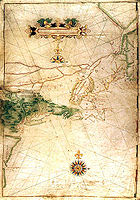
Dutch language
Dutch is a West Germanic language and the native language of the majority of the population of the Netherlands, Belgium, and Suriname, the three member states of the Dutch Language Union. Most speakers live in the European Union, where it is a first language for about 23 million and a second...
, was the 17th-century colonial province
Colony
In politics and history, a colony is a territory under the immediate political control of a state. For colonies in antiquity, city-states would often found their own colonies. Some colonies were historically countries, while others were territories without definite statehood from their inception....
of the Republic of the Seven United Netherlands
Dutch Republic
The Dutch Republic — officially known as the Republic of the Seven United Netherlands , the Republic of the United Netherlands, or the Republic of the Seven United Provinces — was a republic in Europe existing from 1581 to 1795, preceding the Batavian Republic and ultimately...
on the East Coast
East Coast of the United States
The East Coast of the United States, also known as the Eastern Seaboard, refers to the easternmost coastal states in the United States, which touch the Atlantic Ocean and stretch up to Canada. The term includes the U.S...
of North America
North America
North America is a continent wholly within the Northern Hemisphere and almost wholly within the Western Hemisphere. It is also considered a northern subcontinent of the Americas...
. The claimed territories were the lands from the Delmarva Peninsula
Delmarva Peninsula
The Delmarva Peninsula is a large peninsula on the East Coast of the United States, occupied by most of Delaware and portions of Maryland and Virginia...
to extreme southwestern Cape Cod
Cape Cod
Cape Cod, often referred to locally as simply the Cape, is a cape in the easternmost portion of the state of Massachusetts, in the Northeastern United States...
. The settled areas are now part of the Mid-Atlantic States
Mid-Atlantic States
The Mid-Atlantic states, also called middle Atlantic states or simply the mid Atlantic, form a region of the United States generally located between New England and the South...
of New York
New York
New York is a state in the Northeastern region of the United States. It is the nation's third most populous state. New York is bordered by New Jersey and Pennsylvania to the south, and by Connecticut, Massachusetts and Vermont to the east...
, New Jersey
New Jersey
New Jersey is a state in the Northeastern and Middle Atlantic regions of the United States. , its population was 8,791,894. It is bordered on the north and east by the state of New York, on the southeast and south by the Atlantic Ocean, on the west by Pennsylvania and on the southwest by Delaware...
, Delaware
Delaware
Delaware is a U.S. state located on the Atlantic Coast in the Mid-Atlantic region of the United States. It is bordered to the south and west by Maryland, and to the north by Pennsylvania...
, and Connecticut
Connecticut
Connecticut is a state in the New England region of the northeastern United States. It is bordered by Rhode Island to the east, Massachusetts to the north, and the state of New York to the west and the south .Connecticut is named for the Connecticut River, the major U.S. river that approximately...
, with small outposts in Pennsylvania
Pennsylvania
The Commonwealth of Pennsylvania is a U.S. state that is located in the Northeastern and Mid-Atlantic regions of the United States. The state borders Delaware and Maryland to the south, West Virginia to the southwest, Ohio to the west, New York and Ontario, Canada, to the north, and New Jersey to...
and Rhode Island
Rhode Island
The state of Rhode Island and Providence Plantations, more commonly referred to as Rhode Island , is a state in the New England region of the United States. It is the smallest U.S. state by area...
. The provincial capital, New Amsterdam
New Amsterdam
New Amsterdam was a 17th-century Dutch colonial settlement that served as the capital of New Netherland. It later became New York City....
, was located at the southern tip of the island of Manhattan
Manhattan
Manhattan is the oldest and the most densely populated of the five boroughs of New York City. Located primarily on the island of Manhattan at the mouth of the Hudson River, the boundaries of the borough are identical to those of New York County, an original county of the state of New York...
on upper New York Bay
Upper New York Bay
Upper New York Bay, or Upper Bay, is the traditional heart of the Port of New York and New Jersey, and often called New York Harbor. It is enclosed by the New York City boroughs of Manhattan, Brooklyn, and Staten Island and the Hudson County, New Jersey municipalities of Jersey City and Bayonne.It...
.
The colony was conceived as a private business venture to exploit the North American fur trade
North American Fur Trade
The North American fur trade was the industry and activities related to the acquisition, exchange, and sale of animal furs in the North American continent. Indigenous peoples of different regions traded among themselves in the Pre-Columbian Era, but Europeans participated in the trade beginning...
. New Netherland was slowly settled during its first decades, partially as a result of policy mismanagement by the Dutch West India Company
Dutch West India Company
Dutch West India Company was a chartered company of Dutch merchants. Among its founding fathers was Willem Usselincx...
(WIC), and conflicts with Native Americans
Native Americans in the United States
Native Americans in the United States are the indigenous peoples in North America within the boundaries of the present-day continental United States, parts of Alaska, and the island state of Hawaii. They are composed of numerous, distinct tribes, states, and ethnic groups, many of which survive as...
. The settlements of New Sweden
New Sweden
New Sweden was a Swedish colony along the Delaware River on the Mid-Atlantic coast of North America from 1638 to 1655. Fort Christina, now in Wilmington, Delaware, was the first settlement. New Sweden included parts of the present-day American states of Delaware, New Jersey, and Pennsylvania....
developed on its southern flank and its northern border was re-drawn in recognition of early New England
New England Confederation
The United Colonies of New England, commonly known as the New England Confederation, was a short-lived military alliance of the English colonies of Massachusetts, Plymouth, Connecticut, and New Haven. Established in 1643, its primary purpose was to unite the Puritan colonies against the Native...
expansion. During the 1650s, the colony experienced dramatic growth and became a major port for trade in the North Atlantic
Atlantic Ocean
The Atlantic Ocean is the second-largest of the world's oceanic divisions. With a total area of about , it covers approximately 20% of the Earth's surface and about 26% of its water surface area...
. The surrender of Fort Amsterdam
Fort Amsterdam
For the historic fort on the island of Saint Martin, see Fort Amsterdam Fort Amsterdam was a fort on the southern tip of Manhattan that was the administrative headquarters for the Dutch and then British rule of New York from...
to English
Kingdom of England
The Kingdom of England was, from 927 to 1707, a sovereign state to the northwest of continental Europe. At its height, the Kingdom of England spanned the southern two-thirds of the island of Great Britain and several smaller outlying islands; what today comprises the legal jurisdiction of England...
control in 1664 was formalized in 1667, contributing to the Second Anglo–Dutch War. In 1673 the Dutch re-took the area, but later relinquished it under the 1674 Treaty of Westminster
Treaty of Westminster (1674)
The Treaty of Westminster of 1674 was the peace treaty that ended the Third Anglo-Dutch War. Signed by the Netherlands and England, it provided for the return of the colony of New Netherland to England and renewed the Treaty of Breda of 1667...
ending the Third Anglo-Dutch War
Third Anglo-Dutch War
The Third Anglo–Dutch War or Third Dutch War was a military conflict between England and the Dutch Republic lasting from 1672 to 1674. It was part of the larger Franco-Dutch War...
.
The inhabitants of New Netherland were Native Americans, Europeans, and Africans, the latter chiefly imported as enslaved
Slavery
Slavery is a system under which people are treated as property to be bought and sold, and are forced to work. Slaves can be held against their will from the time of their capture, purchase or birth, and deprived of the right to leave, to refuse to work, or to demand compensation...
laborers. Descendants of the original settlers played a prominent role in colonial America. For two centuries New Netherland Dutch
New Netherlander
New Netherlanders were residents of New Netherland, the seventeenth century colonial province of the Republic of the Seven United Netherlands on the northeastern coast of North America, centered around the Hudson River and New York Bay, and at the end of the colony in the Delaware Valley.The...
culture characterized the region (today's Capital District
Capital District
New York's Capital District, also known as the Capital Region, is a region in upstate New York that generally refers to the four counties surrounding Albany, the capital of the state: Albany County, Schenectady County, Rensselaer County, and Saratoga County...
around Albany, the Hudson Valley
Hudson Valley
The Hudson Valley comprises the valley of the Hudson River and its adjacent communities in New York State, United States, from northern Westchester County northward to the cities of Albany and Troy.-History:...
, western Long Island
Nassau County, New York
Nassau County is a suburban county on Long Island, east of New York City in the U.S. state of New York, within the New York Metropolitan Area. As of the 2010 census, the population was 1,339,532...
, northeastern New Jersey
North Jersey
North Jersey is a colloquial term, with no precise consensus definition, for the northern portion of the U.S. state of New Jersey. A straightforward, noncolloquial term for the region is northern New Jersey.- Two-portion approaches :...
, and New York City
New York City
New York is the most populous city in the United States and the center of the New York Metropolitan Area, one of the most populous metropolitan areas in the world. New York exerts a significant impact upon global commerce, finance, media, art, fashion, research, technology, education, and...
). The concepts of civil liberties and pluralism introduced in the province became mainstays of American political and social life.
Origins
In the 17th-century, EuropeEurope
Europe is, by convention, one of the world's seven continents. Comprising the westernmost peninsula of Eurasia, Europe is generally 'divided' from Asia to its east by the watershed divides of the Ural and Caucasus Mountains, the Ural River, the Caspian and Black Seas, and the waterways connecting...
was undergoing expansive social, cultural, and economic growth. In the Netherlands
Netherlands
The Netherlands is a constituent country of the Kingdom of the Netherlands, located mainly in North-West Europe and with several islands in the Caribbean. Mainland Netherlands borders the North Sea to the north and west, Belgium to the south, and Germany to the east, and shares maritime borders...
this is known as the Dutch Golden Age
Dutch Golden Age
The Golden Age was a period in Dutch history, roughly spanning the 17th century, in which Dutch trade, science, military and art were among the most acclaimed in the world. The first half is characterised by the Eighty Years' War till 1648...
. Nations vied for domination of lucrative trade routes across the globe, particularly those to Asia
Asia
Asia is the world's largest and most populous continent, located primarily in the eastern and northern hemispheres. It covers 8.7% of the Earth's total surface area and with approximately 3.879 billion people, it hosts 60% of the world's current human population...
. Simultaneously, philosophical and theological conflicts were manifested in military battles across the continent. The Republic of the Seven United Netherlands
Dutch Republic
The Dutch Republic — officially known as the Republic of the Seven United Netherlands , the Republic of the United Netherlands, or the Republic of the Seven United Provinces — was a republic in Europe existing from 1581 to 1795, preceding the Batavian Republic and ultimately...
had become a home to many intellectuals, international businessmen, and religious refugees. In the Americas, the English
England
England is a country that is part of the United Kingdom. It shares land borders with Scotland to the north and Wales to the west; the Irish Sea is to the north west, the Celtic Sea to the south west, with the North Sea to the east and the English Channel to the south separating it from continental...
had a settlement at Jamestown
Jamestown, Virginia
Jamestown was a settlement in the Colony of Virginia. Established by the Virginia Company of London as "James Fort" on May 14, 1607 , it was the first permanent English settlement in what is now the United States, following several earlier failed attempts, including the Lost Colony of Roanoke...
, the French had a small settlement at Quebec
Quebec City
Quebec , also Québec, Quebec City or Québec City is the capital of the Canadian province of Quebec and is located within the Capitale-Nationale region. It is the second most populous city in Quebec after Montreal, which is about to the southwest...
, and the Spanish
Spanish Empire
The Spanish Empire comprised territories and colonies administered directly by Spain in Europe, in America, Africa, Asia and Oceania. It originated during the Age of Exploration and was therefore one of the first global empires. At the time of Habsburgs, Spain reached the peak of its world power....
were developing colonies to exploit trade in South America
South America
South America is a continent situated in the Western Hemisphere, mostly in the Southern Hemisphere, with a relatively small portion in the Northern Hemisphere. The continent is also considered a subcontinent of the Americas. It is bordered on the west by the Pacific Ocean and on the north and east...
and the Caribbean
Caribbean
The Caribbean is a crescent-shaped group of islands more than 2,000 miles long separating the Gulf of Mexico and the Caribbean Sea, to the west and south, from the Atlantic Ocean, to the east and north...
.
In 1609 Henry Hudson
Henry Hudson
Henry Hudson was an English sea explorer and navigator in the early 17th century. Hudson made two attempts on behalf of English merchants to find a prospective Northeast Passage to Cathay via a route above the Arctic Circle...
, an English sea captain and explorer, was hired by the Flemish Protestant emigres running the Dutch East India Company
Dutch East India Company
The Dutch East India Company was a chartered company established in 1602, when the States-General of the Netherlands granted it a 21-year monopoly to carry out colonial activities in Asia...
(VOC) located in Amsterdam
Amsterdam
Amsterdam is the largest city and the capital of the Netherlands. The current position of Amsterdam as capital city of the Kingdom of the Netherlands is governed by the constitution of August 24, 1815 and its successors. Amsterdam has a population of 783,364 within city limits, an urban population...
, to find a Northeast Passage to Asia sailing around Scandinavia and Russia. Turned back by the ice of the Arctic in his second attempt, he sailed west to seek a northwest passage
Northwest Passage
The Northwest Passage is a sea route through the Arctic Ocean, along the northern coast of North America via waterways amidst the Canadian Arctic Archipelago, connecting the Atlantic and Pacific Oceans...
rather than return home and ended up exploring the waters off the east coast
East Coast of the United States
The East Coast of the United States, also known as the Eastern Seaboard, refers to the easternmost coastal states in the United States, which touch the Atlantic Ocean and stretch up to Canada. The term includes the U.S...
of North America
North America
North America is a continent wholly within the Northern Hemisphere and almost wholly within the Western Hemisphere. It is also considered a northern subcontinent of the Americas...
aboard the yacht Halve Maen
Halve Maen
The Halve Maen was a Dutch East India Company vlieboot which sailed into what is now New York harbor in September 1609. It was commissioned by the Dutch Republic to covertly find an eastern passage to China...
. His first landfall was at Newfoundland and the second at Cape Cod
Cape Cod
Cape Cod, often referred to locally as simply the Cape, is a cape in the easternmost portion of the state of Massachusetts, in the Northeastern United States...
. Believing the passage to the Pacific ocean was between the St. Lawrence River and Chesapeake Bay
Chesapeake Bay
The Chesapeake Bay is the largest estuary in the United States. It lies off the Atlantic Ocean, surrounded by Maryland and Virginia. The Chesapeake Bay's drainage basin covers in the District of Columbia and parts of six states: New York, Pennsylvania, Delaware, Maryland, Virginia, and West...
, Hudson sailed south to the Bay then turned northward, traveling close along the shore. He first discovered Delaware Bay and began to sail upwards looking for the passage. This effort was foiled by sandy shoals and the Halve Maen continued north. After passing Sandy Hook
Sandy Hook
Sandy Hook is a barrier spit along the Atlantic coast of New JerseySandy Hook may also refer to:-Places:United States* Sandy Hook , a village in the town of Newtown, Connecticut* Sandy Hook, Kentucky, a city in Elliott County...
, Hudson and his crew entered the narrows
The Narrows
The Narrows is the tidal strait separating the boroughs of Staten Island and Brooklyn in New York City. It connects the Upper New York Bay and Lower New York Bay and forms the principal channel by which the Hudson River empties into the Atlantic Ocean...
into the Upper New York Bay. (Unbeknownst to Hudson, the narrows had already been discovered in 1524 by explorer Giovanni da Verrazzano; today the bridge spanning them is named for him.) Believing he may have found the continental water route, Hudson sailed up the major river which would later bear his name (the Hudson
Hudson River
The Hudson is a river that flows from north to south through eastern New York. The highest official source is at Lake Tear of the Clouds, on the slopes of Mount Marcy in the Adirondack Mountains. The river itself officially begins in Henderson Lake in Newcomb, New York...
). Days later, at the site of present-day Albany
Albany, New York
Albany is the capital city of the U.S. state of New York, the seat of Albany County, and the central city of New York's Capital District. Roughly north of New York City, Albany sits on the west bank of the Hudson River, about south of its confluence with the Mohawk River...
, he found the water too shallow to proceed.
Upon returning to the Netherlands, Hudson reported that having found a fertile land and a people amicable to engaging his crew in small-scale bartering of furs, trinkets, clothes, and small manufactured goods. His report, first published by the Antwerp emigre and Dutch Consul at London, Emanuel Van Meteren, in 1612, stimulated interest in exploiting this new trade resource, and was the catalyst for Dutch merchant-traders to fund more expeditions. Flemish Lutheran emigre merchants such as Arnout Vogels, sent the first follow up voyages to exploit this discovery as early as July, 1610.
In 1611–1612, the Admiralty of Amsterdam
Admiralty of Amsterdam
The Admiralty of Amsterdam was the largest of the five Dutch admiralties at the time of the Dutch Republic. The administration of the various Admiralties was strongly influenced by provincial interests...
sent two covert expeditions to find a passage to China
China
Chinese civilization may refer to:* China for more general discussion of the country.* Chinese culture* Greater China, the transnational community of ethnic Chinese.* History of China* Sinosphere, the area historically affected by Chinese culture...
with the yachts Craen and Vos, captained by Jan Cornelisz Mey and Symon Willemsz Cat, respectively. In four voyages made between 1611 and 1614, the area between present-day Maryland
Maryland
Maryland is a U.S. state located in the Mid Atlantic region of the United States, bordering Virginia, West Virginia, and the District of Columbia to its south and west; Pennsylvania to its north; and Delaware to its east...
and Massachusetts
Massachusetts
The Commonwealth of Massachusetts is a state in the New England region of the northeastern United States of America. It is bordered by Rhode Island and Connecticut to the south, New York to the west, and Vermont and New Hampshire to the north; at its east lies the Atlantic Ocean. As of the 2010...
was explored, surveyed, and charted by Adriaen Block
Adriaen Block
Adriaen Block was a Dutch private trader and navigator who is best known for exploring the coastal and river valley areas between present-day New Jersey and Massachusetts during four voyages from 1611 to 1614, following the 1609 expedition by Henry Hudson...
, Hendrick Christiaensen
Hendrick Christiaensen
Hendrick Christiaensen was a Dutch explorer who was involved in the earlier exploration of what became present day New York City.In 1611, Christiaensen paid two visits to Manhattan, including one with fellow explorer Adriaen Block...
, and Cornelius Jacobsen Mey
Cornelius Jacobsen Mey
Cornelis Jacobszoon May , was a Dutch explorer, captain and fur trader, and namesake of Cape May, Cape May County, and the city of Cape May, New Jersey, so named first in 1620.-Family:...
. The results of these explorations, surveys, and charts made from 1609 through 1614 were consolidated in Block’s map, which used the name New Netherland for the first time. On maps, it was also called Nova Belgica. During this period there was some trading with the native population. Dutch trader Jan Rodrigues
Jan Rodrigues
Juan "Jan" Rodriguez , born in Santo Domingo, was the son of a Portuguese sailor and of an African woman and was the first man, of African and European descent, to live in what would become New York City spending the winter, without the support of anchored ship, at a Dutch fur trading post on Lower...
(born in Santo Domingo
Santo Domingo
Santo Domingo, known officially as Santo Domingo de Guzmán, is the capital and largest city in the Dominican Republic. Its metropolitan population was 2,084,852 in 2003, and estimated at 3,294,385 in 2010. The city is located on the Caribbean Sea, at the mouth of the Ozama River...
of Portuguese
Portuguese people
The Portuguese are a nation and ethnic group native to the country of Portugal, in the west of the Iberian peninsula of south-west Europe. Their language is Portuguese, and Roman Catholicism is the predominant religion....
and African
African people
African people refers to natives, inhabitants, or citizen of Africa and to people of African descent.-Etymology:Many etymological hypotheses that have been postulated for the ancient name "Africa":...
descent) spent the winter of 1613–1614 trapping for pelts and trading with the local population. He was the first recorded non-Native American
Native Americans in the United States
Native Americans in the United States are the indigenous peoples in North America within the boundaries of the present-day continental United States, parts of Alaska, and the island state of Hawaii. They are composed of numerous, distinct tribes, states, and ethnic groups, many of which survive as...
to do so.
Chartered trading companies
The immediate and intense competition between Dutch trading companies in the newly charted areas (especially in New York Bay and along the Hudson River) led to disputes and calls for regulation in Amsterdam. On March 17, 1614, the States GeneralStates-General of the Netherlands
The States-General of the Netherlands is the bicameral legislature of the Netherlands, consisting of the Senate and the House of Representatives. The parliament meets in at the Binnenhof in The Hague. The archaic Dutch word "staten" originally related to the feudal classes in which medieval...
, the governing body of the Republic of the Seven United Netherlands
Dutch Republic
The Dutch Republic — officially known as the Republic of the Seven United Netherlands , the Republic of the United Netherlands, or the Republic of the Seven United Provinces — was a republic in Europe existing from 1581 to 1795, preceding the Batavian Republic and ultimately...
, proclaimed it would grant an exclusive patent for trade between the 40th and 45th parallels
Circle of latitude
A circle of latitude, on the Earth, is an imaginary east-west circle connecting all locations that share a given latitude...
. This monopoly would be valid for four voyages, all of which had to be undertaken within three years after it was awarded. Block's map, and the report which accompanied it, were used by the New Netherland Company
New Netherland Company
New Netherland Company was a chartered company of Dutch merchants.Following Henry Hudson's exploration of the east coast of North America on behalf of the Dutch East India Company in 1609, several Dutch merchants sent ships to trade with the Native Americans and to search for the Northwest Passage...
(a newly formed alliance of trading companies) to win its patent, which would expire on January 1, 1618.
The New Netherland Company also ordered a survey of the Delaware area. This was undertaken
by skipper Cornelis Hendricksz of Monnickendam, who in 1616 explored the Zuyd Rivier (literally "South River," today known as the Delaware River
Delaware River
The Delaware River is a major river on the Atlantic coast of the United States.A Dutch expedition led by Henry Hudson in 1609 first mapped the river. The river was christened the South River in the New Netherland colony that followed, in contrast to the North River, as the Hudson River was then...
) from its bay to its northernmost navigable reaches. His observations were preserved in a map drawn in 1616. Hendricksz's voyages were made aboard the IJseren Vercken (Iron Hog), a vessel built in America. Despite the survey, the company was unable to secure an exclusive patent from the States General for the area between the 38th and 40th parallels.

Castle Island (New York)
Castle Island is in the city of Albany, Albany County, New York and has over the past 400 years been referred to as Martin Gerritse's Island, Patroon's Island, Van Rensselaer Island, and since the late 19th century has been referred to as Westerlo Island...
in the area of present-day Albany
Albany, New York
Albany is the capital city of the U.S. state of New York, the seat of Albany County, and the central city of New York's Capital District. Roughly north of New York City, Albany sits on the west bank of the Hudson River, about south of its confluence with the Mohawk River...
up Hudson's river. The fort was to defend river traffic against interlopers and to conduct fur trading
North American Fur Trade
The North American fur trade was the industry and activities related to the acquisition, exchange, and sale of animal furs in the North American continent. Indigenous peoples of different regions traded among themselves in the Pre-Columbian Era, but Europeans participated in the trade beginning...
operations with the natives. The location of the fort proved to be impractical, due to repeated flooding of the island in the summers, and it was abandoned in 1618, which coincided with the patent's expiration.
The Geoctroyeerde Westindische Compagnie, or Chartered West India Company
Dutch West India Company
Dutch West India Company was a chartered company of Dutch merchants. Among its founding fathers was Willem Usselincx...
(WIC), was granted a charter
Chartered company
A chartered company is an association formed by investors or shareholders for the purpose of trade, exploration and colonization.- History :...
by the Republic of the Seven United Netherlands on June 3, 1621. It gave the exclusive right to operate in West Africa
West Africa
West Africa or Western Africa is the westernmost region of the African continent. Geopolitically, the UN definition of Western Africa includes the following 16 countries and an area of approximately 5 million square km:-Flags of West Africa:...
(between the Tropic of Cancer
Tropic of Cancer
The Tropic of Cancer, also referred to as the Northern tropic, is the circle of latitude on the Earth that marks the most northerly position at which the Sun may appear directly overhead at its zenith...
and the Cape of Good Hope
Cape of Good Hope
The Cape of Good Hope is a rocky headland on the Atlantic coast of the Cape Peninsula, South Africa.There is a misconception that the Cape of Good Hope is the southern tip of Africa, because it was once believed to be the dividing point between the Atlantic and Indian Oceans. In fact, the...
) and the Americas
Americas
The Americas, or America , are lands in the Western hemisphere, also known as the New World. In English, the plural form the Americas is often used to refer to the landmasses of North America and South America with their associated islands and regions, while the singular form America is primarily...
. In New Netherland, profit was originally to be made from the North American fur trade
North American Fur Trade
The North American fur trade was the industry and activities related to the acquisition, exchange, and sale of animal furs in the North American continent. Indigenous peoples of different regions traded among themselves in the Pre-Columbian Era, but Europeans participated in the trade beginning...
.
Among the founders of the WIC was Willem Usselincx
Willem Usselincx
Willem Usselincx was a Flemish merchant, investor and diplomat who was instrumental in drawing both Dutch and Swedish attention to the importance of the New World...
. Between 1600 and 1606, he had
promoted the concept that a main goal of the company should be establishing colonies in the New World
New World
The New World is one of the names used for the Western Hemisphere, specifically America and sometimes Oceania . The term originated in the late 15th century, when America had been recently discovered by European explorers, expanding the geographical horizon of the people of the European middle...
. In 1620, Usselincx made a last appeal to the States General, which rejected his principal vision as a primary goal. The legislators preferred the formula of trading posts with small populations and a military presence to protect them, which was working in the East Indies, over encouraging mass immigration and establishing large colonies. Not until 1654, when forced to surrender Dutch Brazil
Dutch Brazil
Dutch Brazil, also known as New Holland, was the northern portion of Brazil, ruled by the Dutch during the Dutch colonization of the Americas between 1630 and 1654...
and forfeit the richest sugar-producing area in the world, did the company belatedly focus on colonization in North America.
Pre-colonial population
The first trading partners of the New NetherlanderNew Netherlander
New Netherlanders were residents of New Netherland, the seventeenth century colonial province of the Republic of the Seven United Netherlands on the northeastern coast of North America, centered around the Hudson River and New York Bay, and at the end of the colony in the Delaware Valley.The...
s were the Algonquian
Algonquian peoples
The Algonquian are one of the most populous and widespread North American native language groups, with tribes originally numbering in the hundreds. Today hundreds of thousands of individuals identify with various Algonquian peoples...
who lived in the area. The Dutch depended on the indigenous population to capture, skin and deliver pelts, especially beaver, to them. It is likely that Hudson's peaceful contact with the local Mahican
Mahican
The Mahican are an Eastern Algonquian Native American tribe, originally settling in the Hudson River Valley . After 1680, many moved to Stockbridge, Massachusetts. During the early 1820s and 1830s, most of the Mahican descendants migrated westward to northeastern Wisconsin...
s encouraged them to establish Fort Nassau in 1614, the first of many garrisoned trading stations to be built. In 1628, the Mohawk
Mohawk nation
Mohawk are the most easterly tribe of the Iroquois confederation. They call themselves Kanien'gehaga, people of the place of the flint...
s (members of the Iroquois Confederacy) conquered the Mahicans, who retreated to Connecticut. The Mohawks gained a near-monopoly in the fur trade with the Dutch, as they controlled the upstate Adirondacks
Adirondack Mountains
The Adirondack Mountains are a mountain range located in the northeastern part of New York, that runs through Clinton, Essex, Franklin, Fulton, Hamilton, Herkimer, Lewis, Saint Lawrence, Saratoga, Warren, and Washington counties....
and Mohawk Valley
Mohawk Valley
The Mohawk Valley region of the U.S. state of New York is the area surrounding the Mohawk River, sandwiched between the Adirondack Mountains and Catskill Mountains....
through the center of New York.
The Algonquian
Algonquian languages
The Algonquian languages also Algonkian) are a subfamily of Native American languages which includes most of the languages in the Algic language family. The name of the Algonquian language family is distinguished from the orthographically similar Algonquin dialect of the Ojibwe language, which is a...
Lenape
Lenape
The Lenape are an Algonquian group of Native Americans of the Northeastern Woodlands. They are also called Delaware Indians. As a result of the American Revolutionary War and later Indian removals from the eastern United States, today the main groups live in Canada, where they are enrolled in the...
population around New York Bay
New York Bay
New York Bay is the collective term for the marine areas surrounding the entrance of the Hudson River into the Atlantic Ocean. Its two largest components are Upper New York Bay and Lower New York Bay, which are connected by The Narrows...
and along the Lower Hudson
Hudson River
The Hudson is a river that flows from north to south through eastern New York. The highest official source is at Lake Tear of the Clouds, on the slopes of Mount Marcy in the Adirondack Mountains. The river itself officially begins in Henderson Lake in Newcomb, New York...
were seasonally migrational people. The Dutch called the numerous tribes collectively the River Indians. known by their exonyms as the Wecquaesgeek
Wappani
The Wappinger were a confederacy of Native Americans whose territory in the 17th century spread along the eastern bank of the Hudson River. Primarily based in what is now Dutchess County, New York, their territory bordered Manhattan Island to the south, the Mahican territory bounded by the...
, Hackensack
Hackensack (Native Americans)
Hackensack was the exonym given to a band of Lenape, a Native American people is a European derivation of the Lenape word for what is now the region of northeastern New Jersey along the Hudson and Hackensack Rivers.-Territory and Society:...
, Raritan, Canarsee
Lenape
The Lenape are an Algonquian group of Native Americans of the Northeastern Woodlands. They are also called Delaware Indians. As a result of the American Revolutionary War and later Indian removals from the eastern United States, today the main groups live in Canada, where they are enrolled in the...
, Tappan
Tappan (Native Americans)
The Tappan were a Lenape people who inhabited the region radiating from Hudson Palisades and New York – New Jersey Highlands in at the time of European colonialization in the 17th century....
. It was these groups who had most frequent contact with the New Netherlanders. The Munsee
Lenape
The Lenape are an Algonquian group of Native Americans of the Northeastern Woodlands. They are also called Delaware Indians. As a result of the American Revolutionary War and later Indian removals from the eastern United States, today the main groups live in Canada, where they are enrolled in the...
inhabited the Highlands, Hudson Valley
Hudson Valley
The Hudson Valley comprises the valley of the Hudson River and its adjacent communities in New York State, United States, from northern Westchester County northward to the cities of Albany and Troy.-History:...
, and northern New Jersey
Skylands Region
The Skylands Region is a marketing area of the State of New Jersey located in the Northern and Central part of the state. It is one of six tourism regions established by the New Jersey State Department of Tourism, the others being the Gateway Region, Greater Atlantic City Region, the Southern...
while Minquas
Susquehannock
The Susquehannock people were Iroquoian-speaking Native Americans who lived in areas adjacent to the Susquehanna River and its tributaries from the southern part of what is now New York, through Pennsylvania, to the mouth of the Susquehanna in Maryland at the north end of the Chesapeake Bay...
(called the Susquehannocks by the English) lived west of the Zuyd Rivier
Delaware River
The Delaware River is a major river on the Atlantic coast of the United States.A Dutch expedition led by Henry Hudson in 1609 first mapped the river. The river was christened the South River in the New Netherland colony that followed, in contrast to the North River, as the Hudson River was then...
along and beyond the Sussquehanna River that the Dutch regarded as their boundary with Virginia.
Company policy required land to be purchased from the existing peoples. The WIC
Dutch West India Company
Dutch West India Company was a chartered company of Dutch merchants. Among its founding fathers was Willem Usselincx...
would offer a land patent, the recipient of which would be responsible for negotiating a deal with representatives, usual the sachem
Sachem
A sachem[p] or sagamore is a paramount chief among the Algonquians or other northeast American tribes. The two words are anglicizations of cognate terms from different Eastern Algonquian languages...
, or high chief, of the local population. The Dutch (referred to by the natives as Swannekins, or salt water people) and the Wilden (as the Dutch called the natives) had vastly different conceptions of ownership and use of land, so much so that they did not understand each other at all. The Dutch thought their proffer of gifts in the form of sewant
Sewant
Sewant is the black and/or dark purple black shell bead system of the 17th century in Nieuw Nederlandt of what is currently the States of New York, New Jersey, Pennsylvania, Connecticut, and Delaware. This fiat currency system was introduced to the English at Plymouth Colony Plantations in 1627. ...
or manufactured goods was a trade agreement and defense alliance, which gave them exclusive rights to farming, hunting, and fishing. Often, the Indians did not vacate the property or reappeared seasonally according to their migration patterns. They were willing to share the land with the Europeans, but the Indians did not intend to leave or give up access. This misunderstanding, and other differences, would later lead to violent conflict. At the same time such differences marked the beginnings of a multicultural society.
Early settlement
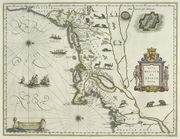
Over time, to attract settlers to the region of the Hudson River, the Dutch encouraged a kind of feudal aristocracy in what became known as the system of the Charter of Freedoms and Exemptions
Charter of Freedoms and Exemptions
The Charter of Freedoms and Exemptions, sometimes referred to as the Charter of Privileges and Exemptions, is a document written by the Dutch West India Company in an effort to settle its colony of New Netherland in North America through the establishment of feudal patroonships purchased and...
.
Further south, a Swedish trading company that had ties with the Dutch tried to establish their first settlement along the Delaware River three years later. Without resources to consolidate its position, New Sweden was gradually absorbed by New Holland and later in Pennsylvania and Delaware.
The earliest Dutch settlement was built around 1613, and consisted of a number of small huts built by the crew of the "Tijger" (Tiger), a Dutch ship under the command of Captain Adriaen Block
Adriaen Block
Adriaen Block was a Dutch private trader and navigator who is best known for exploring the coastal and river valley areas between present-day New Jersey and Massachusetts during four voyages from 1611 to 1614, following the 1609 expedition by Henry Hudson...
which had caught fire while sailing on the Hudson. Soon after, the first of two Fort Nassaus was built and small factorijen, or trading posts, where commerce could be conducted with Algonquian
Algonquian peoples
The Algonquian are one of the most populous and widespread North American native language groups, with tribes originally numbering in the hundreds. Today hundreds of thousands of individuals identify with various Algonquian peoples...
and Iroquois
Iroquois
The Iroquois , also known as the Haudenosaunee or the "People of the Longhouse", are an association of several tribes of indigenous people of North America...
population, went up (possibly at Schenectady
Schenectady, New York
Schenectady is a city in Schenectady County, New York, United States, of which it is the county seat. As of the 2010 census, the city had a population of 66,135...
, Schoharie
Schoharie (village), New York
Schoharie is a village in Schoharie County, New York, USA. The population was 1,030 at the 2000 census. It is the county seat of Schoharie County...
, Esopus
Esopus, New York
Esopus is a town in Ulster County, New York, United States. The population was 9,331 at the 2000 census. The name comes from the local Indian tribe and means "high banks."...
, Quinnipiac
Quinnipiac River
The Quinnipiac River is a river in the New England region of the United States, located entirely in the state of Connecticut.It rises in west central Connecticut from Dead Wood Swamp west of the city of New Britain...
, Communipaw
Communipaw
Communipaw is a section of Jersey City, New Jersey west of Liberty State Park and east of Bergen Hill, and site of one the earliest European settlements in North America. It gives its name to the historic avenue which runs from its eastern end near LSP Station through the neighborhoods of...
and elsewhere).
In 1617 Dutch colonists built a fort at the intersection of Hudson and Mohawk Rivers, where Albany now stands.
In 1624 New Netherland became a province of the Dutch Republic, which had lowered the northern border of its North American dominion to 42 degrees latitude
42nd parallel north
The 42nd parallel north is a circle of latitude that is 42 degrees north of the Earth's equatorial plane. It crosses Europe, the Mediterranean Sea, Asia, the Pacific Ocean, North America, and the Atlantic Ocean....
in acknowledgment of the claim by the English north of Cape Cod.see John Smith's 1616 map as self-appointed Admiral of New England The Dutch named the three main rivers of the province the Zuyd Rivier (South River
Delaware River
The Delaware River is a major river on the Atlantic coast of the United States.A Dutch expedition led by Henry Hudson in 1609 first mapped the river. The river was christened the South River in the New Netherland colony that followed, in contrast to the North River, as the Hudson River was then...
), the Noort Rivier (North River), and the Versche Rivier (Fresh River
Connecticut River
The Connecticut River is the largest and longest river in New England, and also an American Heritage River. It flows roughly south, starting from the Fourth Connecticut Lake in New Hampshire. After flowing through the remaining Connecticut Lakes and Lake Francis, it defines the border between the...
). Not only discovery and charting but permanent settlement was needed to maintain a territorial claim. To this end, in May 1624, the WIC landed 30 families at Fort Orange
Fort Orange
Fort Orange was the first permanent Dutch settlement in New Netherland and was on the site of the present-day city of Albany, New York. It was a replacement for Fort Nassau, which had been built on nearby Castle Island in the Hudson River, and which served as a trading post until 1617 or 1618,...
and Noten Eylant (today's Governors Island
Governors Island
Governors Island is a island in Upper New York Bay, approximately one-half mile from the southern tip of Manhattan Island and separated from Brooklyn by Buttermilk Channel. It is legally part of the borough of Manhattan in New York City...
) at the mouth of the North River. They disembarked from the ship New Netherland, under the command of Cornelis Jacobsz May
Cornelius Jacobsen Mey
Cornelis Jacobszoon May , was a Dutch explorer, captain and fur trader, and namesake of Cape May, Cape May County, and the city of Cape May, New Jersey, so named first in 1620.-Family:...
, the first Director of the New Netherland
Director-General of New Netherland
This is a list of Directors, appointed by the Dutch West India Company, of the 17th century Dutch province of New Netherland in North America...
. He was replaced the following year by Willem Verhulst
Willem Verhulst
Willem Verhulst was the second director of the Dutch West India Company. In 1625, Verhulst oversaw the decision to locate the company's main fortress and town on the tip of Manhattan Island in the colony of New Netherland. The settlement, which was given the name New Amsterdam, was the first...
.
In June 1625, 45 additional colonists disembarked on Noten Eylant from three ships named Horse, Cow, and Sheep, which also delivered 103 horses, steers, cows, pigs, and sheep. Some settlers were dispersed to the various garrisons built across the territory: upstream to Fort Orange, to Kievets Hoek
Old Saybrook, Connecticut
Old Saybrook is a town in Middlesex County, Connecticut, United States. The population was 10,367 at the 2000 census. It contains the incorporated borough of Fenwick, as well as the census-designated places of Old Saybrook Center and Saybrook Manor.-History:...
on the Fresh River, and Fort Wilhelmus
Fort Wilhelmus
Fort Wilhelmus was a factorij in the 17th century colonial province of New Netherland, located on what had been named Verhulsten Island on the Zuyd Rivier, today's Delaware River....
on the South River. Many of the settlers were not Dutch, but Walloons
Walloons
Walloons are a French-speaking people who live in Belgium, principally in Wallonia. Walloons are a distinctive community within Belgium, important historical and anthropological criteria bind Walloons to the French people. More generally, the term also refers to the inhabitants of the Walloon...
, French Huguenot
Huguenot
The Huguenots were members of the Protestant Reformed Church of France during the 16th and 17th centuries. Since the 17th century, people who formerly would have been called Huguenots have instead simply been called French Protestants, a title suggested by their German co-religionists, the...
s, or Africans
African people
African people refers to natives, inhabitants, or citizen of Africa and to people of African descent.-Etymology:Many etymological hypotheses that have been postulated for the ancient name "Africa":...
(most as enslaved labor, some later gaining "half-free" status).
North River and The Manhattans
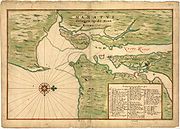
Peter Minuit
Peter Minuit, Pieter Minuit, Pierre Minuit or Peter Minnewit was a Walloon from Wesel, in present-day North Rhine-Westphalia, Germany, then part of the Duchy of Cleves. He was the Director-General of the Dutch colony of New Netherland from 1626 until 1633, and he founded the Swedish colony of...
became Director of the New Netherland
Director-General of New Netherland
This is a list of Directors, appointed by the Dutch West India Company, of the 17th century Dutch province of New Netherland in North America...
in 1626 and made a decision that would greatly affect the new colony. Originally, the capital of the province was to be located on the South River, but it was soon realized that the location was susceptible to mosquito infestation in the summer and the freezing of its waterways in the winter. He chose instead the island of Manhattan
Manhattan
Manhattan is the oldest and the most densely populated of the five boroughs of New York City. Located primarily on the island of Manhattan at the mouth of the Hudson River, the boundaries of the borough are identical to those of New York County, an original county of the state of New York...
at the mouth of the river explored by Hudson
Henry Hudson
Henry Hudson was an English sea explorer and navigator in the early 17th century. Hudson made two attempts on behalf of English merchants to find a prospective Northeast Passage to Cathay via a route above the Arctic Circle...
, at that time called the North River. In what is one of the most legendary real-estate deals ever made, Minuit traded some goods with the local population and reported that he had purchased it from the natives, as was company policy. He ordered the construction of Fort Amsterdam
Fort Amsterdam
For the historic fort on the island of Saint Martin, see Fort Amsterdam Fort Amsterdam was a fort on the southern tip of Manhattan that was the administrative headquarters for the Dutch and then British rule of New York from...
at its southern tip, around which would grow the heart of the province, which rather than New Netherland, would be called in the vernacular of the day The Manhattoes
New York Harbor
New York Harbor refers to the waterways of the estuary near the mouth of the Hudson River that empty into New York Bay. It is one of the largest natural harbors in the world. Although the U.S. Board of Geographic Names does not use the term, New York Harbor has important historical, governmental,...
.
The port city outside the walls of the fort, New Amsterdam
New Amsterdam
New Amsterdam was a 17th-century Dutch colonial settlement that served as the capital of New Netherland. It later became New York City....
would become a major hub for trade between North America, the Caribbean and Europe, and the place where raw materials such as pelts, lumber, and tobacco would be loaded. Sanctioned privateer
Privateer
A privateer is a private person or ship authorized by a government by letters of marque to attack foreign shipping during wartime. Privateering was a way of mobilizing armed ships and sailors without having to spend public money or commit naval officers...
ing would contribute to its growth. When given its municipal charter in 1653 the Commonality of New Amsterdam
New Amsterdam
New Amsterdam was a 17th-century Dutch colonial settlement that served as the capital of New Netherland. It later became New York City....
included the isle of Manhattan, Staaten Eylandt
Staten Island
Staten Island is a borough of New York City, New York, United States, located in the southwest part of the city. Staten Island is separated from New Jersey by the Arthur Kill and the Kill Van Kull, and from the rest of New York by New York Bay...
, Pavonia
Pavonia, New Netherland
Pavonia was the first European settlement on the west bank of the North River that was part of the 17th century province of New Netherland in what would become today's Hudson County, New Jersey.-Hudson and the Hackensack:...
and the Lange Eylandt
History of Brooklyn
The history of Brooklyn, a present-day borough of New York City, spans more than 350 years. The settlement began in the 17th century as the small Dutch-founded town of "Breuckelen" on the East River shore of Long Island, grew to be a sizable city in the 19th century, and was consolidated in 1898...
towns.
In the hope of encouraging immigration, the Dutch West India Company, in 1629, established the Charter of Freedoms and Exemptions
Charter of Freedoms and Exemptions
The Charter of Freedoms and Exemptions, sometimes referred to as the Charter of Privileges and Exemptions, is a document written by the Dutch West India Company in an effort to settle its colony of New Netherland in North America through the establishment of feudal patroonships purchased and...
, which gave it the power to offer vast land grants and the title of patroon
Patroon
In the United States, a patroon was a landholder with manorial rights to large tracts of land in the 17th century Dutch colony of New Netherland in North America...
to some of its invested members. The vast tracts were called patroonships, and the title came with powerful manorial
Manorialism
Manorialism, an essential element of feudal society, was the organizing principle of rural economy that originated in the villa system of the Late Roman Empire, was widely practiced in medieval western and parts of central Europe, and was slowly replaced by the advent of a money-based market...
rights
Rights
Rights are legal, social, or ethical principles of freedom or entitlement; that is, rights are the fundamental normative rules about what is allowed of people or owed to people, according to some legal system, social convention, or ethical theory...
and privilege
Privilege
A privilege is a special entitlement to immunity granted by the state or another authority to a restricted group, either by birth or on a conditional basis. It can be revoked in certain circumstances. In modern democratic states, a privilege is conditional and granted only after birth...
s, such as the creation of civil
Civil law (common law)
Civil law, as opposed to criminal law, is the branch of law dealing with disputes between individuals or organizations, in which compensation may be awarded to the victim...
and criminal
Criminal law
Criminal law, is the body of law that relates to crime. It might be defined as the body of rules that defines conduct that is not allowed because it is held to threaten, harm or endanger the safety and welfare of people, and that sets out the punishment to be imposed on people who do not obey...
court
Court
A court is a form of tribunal, often a governmental institution, with the authority to adjudicate legal disputes between parties and carry out the administration of justice in civil, criminal, and administrative matters in accordance with the rule of law...
s and the appointing of local officials. In return, a patroon was required by the Company
Dutch West India Company
Dutch West India Company was a chartered company of Dutch merchants. Among its founding fathers was Willem Usselincx...
to establish a settlement of at least 50 families, who would live as tenant farmers, within four years. Of the original five patents given, the largest and only truly successful endeavour was Rensselaerswyck, at the highest navigable point on the North River, which became the main thoroughfare of the province. Beverwijck
Beverwyck
Beverwijck was a fur-trading community north of Fort Orange on the Hudson River in New Netherland that was to become Albany, New York, when the English took control of the colony in 1664....
, grew from a trading post to a bustling, independent town in the midst of Rensselaerwyck, as would Wiltwyck
Kingston, New York
Kingston is a city in and the county seat of Ulster County, New York, USA. It is north of New York City and south of Albany. It became New York's first capital in 1777, and was burned by the British Oct. 16, 1777, after the Battles of Saratoga...
, south of the patroonship in Esopus
Esopus, New York
Esopus is a town in Ulster County, New York, United States. The population was 9,331 at the 2000 census. The name comes from the local Indian tribe and means "high banks."...
country.
Kieft's War and the Remonstrance of New Netherland
Willem KieftWillem Kieft
Willem Kieft was a Dutch merchant and director-general of New Netherland , from 1638 until 1647. He formed the council of twelve men, the first representative body in New Netherland, but ignored its advice...
was Director New Netherland
Director-General of New Netherland
This is a list of Directors, appointed by the Dutch West India Company, of the 17th century Dutch province of New Netherland in North America...
from 1638 until 1647. Though the colony had grown somewhat before his arrival, it did not flourish, and Kieft was under pressure to cut costs. At this time a large number of Indian tribes who had signed mutual defense treaties with the Dutch were gathering near the colony due to widespread warfare and dislocation among the tribes to the north. At first he suggested collecting tribute from the Indians (as was common among the various dominant tribes), but his demands to the Tappan
Tappan (Native Americans)
The Tappan were a Lenape people who inhabited the region radiating from Hudson Palisades and New York – New Jersey Highlands in at the time of European colonialization in the 17th century....
and Wecquaesgeek
Wappani
The Wappinger were a confederacy of Native Americans whose territory in the 17th century spread along the eastern bank of the Hudson River. Primarily based in what is now Dutchess County, New York, their territory bordered Manhattan Island to the south, the Mahican territory bounded by the...
were simply ignored. Subsequently, when a colonist was murdered in an act of revenge for some killings that had taken place years earlier and the Indians refused to turn over the perpetrator, Kieft suggested they be taught a lesson by ransacking their villages. In an attempt to gain public support he created a citizens commission, the Council of Twelve Men. They did not, as was expected, rubber-stamp his ideas, but took the opportunity to mention grievances that they had with company's mismanagement and its unresponsiveness to their suggestions. Kieft thanked and disbanded them, and against their advice ordered that groups of Tappan and Wecquaesgeek (who had sought refuge from their more powerful Mahican
Mahican
The Mahican are an Eastern Algonquian Native American tribe, originally settling in the Hudson River Valley . After 1680, many moved to Stockbridge, Massachusetts. During the early 1820s and 1830s, most of the Mahican descendants migrated westward to northeastern Wisconsin...
enemies, per their treaty understandings with the Dutch) be attacked at Pavonia
Pavonia, New Netherland
Pavonia was the first European settlement on the west bank of the North River that was part of the 17th century province of New Netherland in what would become today's Hudson County, New Jersey.-Hudson and the Hackensack:...
and Corlear's Hook
Lower East Side
The Lower East Side, LES, is a neighborhood in the southeastern part of the New York City borough of Manhattan. It is roughly bounded by Allen Street, East Houston Street, Essex Street, Canal Street, Eldridge Street, East Broadway, and Grand Street....
. The massacre left 130 dead. Within days the surrounding tribes, in a unique move, united and rampaged the countryside, forcing settlers who escaped to find safety at Fort Amsterdam. For two years, a series of raids and reprisals raged across the province, until 1645 when Kieft's War
Kieft's War
Kieft's War, also known as the Wappinger War, was a conflict between settlers of the nascent colony of New Netherland and the native Lenape population in what would later become the New York metropolitan area of the United States...
ended with a treaty, in a large part brokered by the Hackensack
Hackensack (Native Americans)
Hackensack was the exonym given to a band of Lenape, a Native American people is a European derivation of the Lenape word for what is now the region of northeastern New Jersey along the Hudson and Hackensack Rivers.-Territory and Society:...
sagamore Oratam
Oratam
Oratam was sagamore, or sachem, of the Hackensack Indians living in northeastern New Jersey during the period of early European colonization in the 17th century...
. Disenchanted with the previous governor, his ignorance of indigenous peoples, the unresponsiveness of the WIC to their rights and requests, the colonists submitted to the States General
States-General of the Netherlands
The States-General of the Netherlands is the bicameral legislature of the Netherlands, consisting of the Senate and the House of Representatives. The parliament meets in at the Binnenhof in The Hague. The archaic Dutch word "staten" originally related to the feudal classes in which medieval...
the Remonstrance of New Netherland. This document, penned by the Leiden-educated
Leiden University
Leiden University , located in the city of Leiden, is the oldest university in the Netherlands. The university was founded in 1575 by William, Prince of Orange, leader of the Dutch Revolt in the Eighty Years' War. The royal Dutch House of Orange-Nassau and Leiden University still have a close...
New Netherland lawyer Adriaen van der Donck
Adriaen van der Donck
Adriaen Cornelissen van der Donck was a lawyer and landowner in New Netherland after whose honorific Jonkheer the city of Yonkers, New York is named...
, condemned the WIC for mismanagement and demanded full rights as citizens of province of the Netherlands.
Director-General of New Netherland
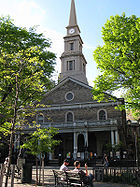
Governor
A governor is a governing official, usually the executive of a non-sovereign level of government, ranking under the head of state...
of the colony to be called Director-General
Director-General of New Netherland
This is a list of Directors, appointed by the Dutch West India Company, of the 17th century Dutch province of New Netherland in North America...
.
Some years earlier land ownership policy was liberalized and trading was somewhat deregulated, and many New Netherlander
New Netherlander
New Netherlanders were residents of New Netherland, the seventeenth century colonial province of the Republic of the Seven United Netherlands on the northeastern coast of North America, centered around the Hudson River and New York Bay, and at the end of the colony in the Delaware Valley.The...
s considered themselves entrepreneur
Entrepreneur
An entrepreneur is an owner or manager of a business enterprise who makes money through risk and initiative.The term was originally a loanword from French and was first defined by the Irish-French economist Richard Cantillon. Entrepreneur in English is a term applied to a person who is willing to...
s in a free market
Free market
A free market is a competitive market where prices are determined by supply and demand. However, the term is also commonly used for markets in which economic intervention and regulation by the state is limited to tax collection, and enforcement of private ownership and contracts...
.
During the period of his governorship the province experienced exponential growth.
Demands were made upon Stuyvesant from all sides: the West India Company, the States General, and the New Netherlanders. Dutch territory was being nibbled at by the English to the north and the Swedes
New Sweden
New Sweden was a Swedish colony along the Delaware River on the Mid-Atlantic coast of North America from 1638 to 1655. Fort Christina, now in Wilmington, Delaware, was the first settlement. New Sweden included parts of the present-day American states of Delaware, New Jersey, and Pennsylvania....
to the south, while in the heart of the province the Esopus
Lenape
The Lenape are an Algonquian group of Native Americans of the Northeastern Woodlands. They are also called Delaware Indians. As a result of the American Revolutionary War and later Indian removals from the eastern United States, today the main groups live in Canada, where they are enrolled in the...
were trying to contain further Dutch expansion. Discontent in New Amsterdam led locals to dispatch Adriaen van der Donck back to the United Provinces to seek redress. After nearly three years of legal and political wrangling, the Dutch Government came down against the WIC, granting the colony a measure of self-government and recalling Stuyvesant in April 1652. However, the orders were rescinded with the outbreak of the First Anglo-Dutch War
First Anglo-Dutch War
The First Anglo–Dutch War was the first of the four Anglo–Dutch Wars. It was fought entirely at sea between the navies of the Commonwealth of England and the United Provinces of the Netherlands. Caused by disputes over trade, the war began with English attacks on Dutch merchant shipping, but...
a month later. Military battles were occurring in the Caribbean
Caribbean
The Caribbean is a crescent-shaped group of islands more than 2,000 miles long separating the Gulf of Mexico and the Caribbean Sea, to the west and south, from the Atlantic Ocean, to the east and north...
and along the South Atlantic
Atlantic Ocean
The Atlantic Ocean is the second-largest of the world's oceanic divisions. With a total area of about , it covers approximately 20% of the Earth's surface and about 26% of its water surface area...
coast. In 1654, the Netherlands lost New Holland
Dutch Brazil
Dutch Brazil, also known as New Holland, was the northern portion of Brazil, ruled by the Dutch during the Dutch colonization of the Americas between 1630 and 1654...
in Brazil to the Portuguese
Portugal
Portugal , officially the Portuguese Republic is a country situated in southwestern Europe on the Iberian Peninsula. Portugal is the westernmost country of Europe, and is bordered by the Atlantic Ocean to the West and South and by Spain to the North and East. The Atlantic archipelagos of the...
, encouraging some of its residents to emigrate north and making the North America
North America
North America is a continent wholly within the Northern Hemisphere and almost wholly within the Western Hemisphere. It is also considered a northern subcontinent of the Americas...
n colonies more appealing to some investors. The Esopus Wars
Esopus Wars
The Esopus Wars were two localized conflicts between Dutch settlers and the Esopus tribe of Lenape Indians during the latter half of the 17th century in what is now Ulster County, New York. Like many other wars during the colonial period, at bottom they were the result of competition between...
are so named for the branch of Lenape
Lenape
The Lenape are an Algonquian group of Native Americans of the Northeastern Woodlands. They are also called Delaware Indians. As a result of the American Revolutionary War and later Indian removals from the eastern United States, today the main groups live in Canada, where they are enrolled in the...
that lived around Wiltwijck
Kingston, New York
Kingston is a city in and the county seat of Ulster County, New York, USA. It is north of New York City and south of Albany. It became New York's first capital in 1777, and was burned by the British Oct. 16, 1777, after the Battles of Saratoga...
, which was the Dutch settlement on the west bank of Hudson River
Hudson River
The Hudson is a river that flows from north to south through eastern New York. The highest official source is at Lake Tear of the Clouds, on the slopes of Mount Marcy in the Adirondack Mountains. The river itself officially begins in Henderson Lake in Newcomb, New York...
between Beverwyk
Albany, New York
Albany is the capital city of the U.S. state of New York, the seat of Albany County, and the central city of New York's Capital District. Roughly north of New York City, Albany sits on the west bank of the Hudson River, about south of its confluence with the Mohawk River...
and New Amsterdam
New Amsterdam
New Amsterdam was a 17th-century Dutch colonial settlement that served as the capital of New Netherland. It later became New York City....
. These conflicts were generally over settlement of land by New Netherlanders for which contracts had not been clarified, and were seen by the natives as an unwanted incursion into their territory. Previously, the Esopus, a clan of the Munsee Lenape, had much less contact with the River Indians
Hackensack (Native Americans)
Hackensack was the exonym given to a band of Lenape, a Native American people is a European derivation of the Lenape word for what is now the region of northeastern New Jersey along the Hudson and Hackensack Rivers.-Territory and Society:...
and the Mohawks
Mohawk nation
Mohawk are the most easterly tribe of the Iroquois confederation. They call themselves Kanien'gehaga, people of the place of the flint...
.
Society
New NetherlanderNew Netherlander
New Netherlanders were residents of New Netherland, the seventeenth century colonial province of the Republic of the Seven United Netherlands on the northeastern coast of North America, centered around the Hudson River and New York Bay, and at the end of the colony in the Delaware Valley.The...
s were not necessarily Dutch, and New Netherland was never a homogeneous society. An early governor, Pieter Minuit
Peter Minuit
Peter Minuit, Pieter Minuit, Pierre Minuit or Peter Minnewit was a Walloon from Wesel, in present-day North Rhine-Westphalia, Germany, then part of the Duchy of Cleves. He was the Director-General of the Dutch colony of New Netherland from 1626 until 1633, and he founded the Swedish colony of...
, was a German-born Walloon
Walloons
Walloons are a French-speaking people who live in Belgium, principally in Wallonia. Walloons are a distinctive community within Belgium, important historical and anthropological criteria bind Walloons to the French people. More generally, the term also refers to the inhabitants of the Walloon...
who spoke English and worked for a Dutch company. The term New Netherland Dutch generally includes all the Europeans who came to live there, but may also refer to Africans, Indo-Caribbean
Indo-Caribbean
Indo-Caribbean people or Indo-Caribbeans are Caribbean people with roots in India or the Indian subcontinent. They are mostly descendants of the original indentured workers brought by the British, the Dutch and the French during colonial times...
s, South Americans and even the Native American
Native Americans in the United States
Native Americans in the United States are the indigenous peoples in North America within the boundaries of the present-day continental United States, parts of Alaska, and the island state of Hawaii. They are composed of numerous, distinct tribes, states, and ethnic groups, many of which survive as...
s who were integral to the society. Though Dutch was the official language
Official language
An official language is a language that is given a special legal status in a particular country, state, or other jurisdiction. Typically a nation's official language will be the one used in that nation's courts, parliament and administration. However, official status can also be used to give a...
, and likely the lingua franca
Lingua franca
A lingua franca is a language systematically used to make communication possible between people not sharing a mother tongue, in particular when it is a third language, distinct from both mother tongues.-Characteristics:"Lingua franca" is a functionally defined term, independent of the linguistic...
of the province, it was but one of many spoken there. There were various Algonquian languages
Algonquian languages
The Algonquian languages also Algonkian) are a subfamily of Native American languages which includes most of the languages in the Algic language family. The name of the Algonquian language family is distinguished from the orthographically similar Algonquin dialect of the Ojibwe language, which is a...
; Walloons
Walloons
Walloons are a French-speaking people who live in Belgium, principally in Wallonia. Walloons are a distinctive community within Belgium, important historical and anthropological criteria bind Walloons to the French people. More generally, the term also refers to the inhabitants of the Walloon...
and Huguenots tended to speak French
French language
French is a Romance language spoken as a first language in France, the Romandy region in Switzerland, Wallonia and Brussels in Belgium, Monaco, the regions of Quebec and Acadia in Canada, and by various communities elsewhere. Second-language speakers of French are distributed throughout many parts...
, and Scandinavia
Scandinavia
Scandinavia is a cultural, historical and ethno-linguistic region in northern Europe that includes the three kingdoms of Denmark, Norway and Sweden, characterized by their common ethno-cultural heritage and language. Modern Norway and Sweden proper are situated on the Scandinavian Peninsula,...
ns brought their own tongues, as did the Germans
Germans
The Germans are a Germanic ethnic group native to Central Europe. The English term Germans has referred to the German-speaking population of the Holy Roman Empire since the Late Middle Ages....
. It is likely that the about 100 Africans (including both free men and slaves) on Manhattan spoke their mother tongues, but were taught Dutch from 1638 by Adam Roelantsz van Dokkum. English
English language
English is a West Germanic language that arose in the Anglo-Saxon kingdoms of England and spread into what was to become south-east Scotland under the influence of the Anglian medieval kingdom of Northumbria...
was already on the rise to become the vehicular language in world trade, and settlement by individuals or groups of English-speakers started soon after the inception of the province. The arrival of refugees from New Holland
Dutch Brazil
Dutch Brazil, also known as New Holland, was the northern portion of Brazil, ruled by the Dutch during the Dutch colonization of the Americas between 1630 and 1654...
in Brazil
Brazil
Brazil , officially the Federative Republic of Brazil , is the largest country in South America. It is the world's fifth largest country, both by geographical area and by population with over 192 million people...
may have brought speakers of Portuguese
Portuguese language
Portuguese is a Romance language that arose in the medieval Kingdom of Galicia, nowadays Galicia and Northern Portugal. The southern part of the Kingdom of Galicia became independent as the County of Portugal in 1095...
, Spanish
Spanish language
Spanish , also known as Castilian , is a Romance language in the Ibero-Romance group that evolved from several languages and dialects in central-northern Iberia around the 9th century and gradually spread with the expansion of the Kingdom of Castile into central and southern Iberia during the...
, and Ladino (with Hebrew as a liturgical language). Commercial activity in the harbor could have been transacted simultaneously in any of a number of tongues.
The Dutch West India Company introduced slavery in 1625 with the importation of eleven black slaves who worked as farmers, fur traders, and builders. Although enslaved, the Africans had a few basic rights and families were usually kept intact. Admitted to the Dutch Reformed Church and married by its ministers, their children could be baptized. Slaves could testify in court, sign legal documents, and bring civil actions against whites. Some were permitted to work after hours earning wages equal to those paid to white workers. When the colony fell, the company freed all its slaves, establishing early on a nucleus of free negro
Free Negro
A free Negro or free black is the term used prior to the abolition of slavery in the United States to describe African Americans who were not slaves. Almost all African Americans came to the United States as slaves, but from the earliest days of American slavery, slaveholders set men and women free...
s.
The Union of Utrecht
Union of Utrecht
The Union of Utrecht was a treaty signed on 23 January 1579 in Utrecht, the Netherlands, unifying the northern provinces of the Netherlands, until then under the control of Habsburg Spain....
, the founding document of the Dutch Republic
Dutch Republic
The Dutch Republic — officially known as the Republic of the Seven United Netherlands , the Republic of the United Netherlands, or the Republic of the Seven United Provinces — was a republic in Europe existing from 1581 to 1795, preceding the Batavian Republic and ultimately...
, signed in 1579, stated "that everyone shall remain free in religion and that no one may be persecuted or investigated because of religion". The Dutch West India Company
Dutch West India Company
Dutch West India Company was a chartered company of Dutch merchants. Among its founding fathers was Willem Usselincx...
, however, established the Reformed Church
Dutch Reformed Church
The Dutch Reformed Church was a Reformed Christian denomination in the Netherlands. It existed from the 1570s to 2004, the year it merged with the Reformed Churches in the Netherlands and the Evangelical Lutheran Church in the Kingdom of the Netherlands to form the Protestant Church in the...
as the official religious institution of New Netherland. The colonists had to attract, "through attitude and by example", the natives and nonbelievers to God's word "without, on the other hand, to persecute someone by reason of his religion, and to leave everyone the freedom of his conscience." In addition, the laws and ordinances of the states of Holland were incorporated by reference in those first instructions to the Governors Island settlers in 1624. There were two test case
Test case (law)
In case law, a test case is a legal action whose purpose is to set a precedent. An example of a test case might be a legal entity who files a lawsuit in order to see if the court considers a certain law or a certain legal precedent applicable in specific circumstances...
s during Stuyvesant's governorship in which the rule prevailed: the official granting of full residency for both Ashkenazi
Ashkenazi Jews
Ashkenazi Jews, also known as Ashkenazic Jews or Ashkenazim , are the Jews descended from the medieval Jewish communities along the Rhine in Germany from Alsace in the south to the Rhineland in the north. Ashkenaz is the medieval Hebrew name for this region and thus for Germany...
and Sephardi
Sephardi Jews
Sephardi Jews is a general term referring to the descendants of the Jews who lived in the Iberian Peninsula before their expulsion in the Spanish Inquisition. It can also refer to those who use a Sephardic style of liturgy or would otherwise define themselves in terms of the Jewish customs and...
Jews
Jews
The Jews , also known as the Jewish people, are a nation and ethnoreligious group originating in the Israelites or Hebrews of the Ancient Near East. The Jewish ethnicity, nationality, and religion are strongly interrelated, as Judaism is the traditional faith of the Jewish nation...
in New Amsterdam in 1655, and the Flushing Remonstrance
Flushing Remonstrance
The Flushing Remonstrance was a 1657 petition to Director-General of New Netherland Peter Stuyvesant, in which several citizens requested an exemption to his ban on Quaker worship. It is considered a precursor to the United States Constitution's provision on freedom of religion in the Bill of...
, involving Quakers, in
1657.
During the 1640s, two religious leaders, both women, took refuge in New Netherland: Anne Hutchinson
Anne Hutchinson
Anne Hutchinson was one of the most prominent women in colonial America, noted for her strong religious convictions, and for her stand against the staunch religious orthodoxy of 17th century Massachusetts...
and the Anabaptist
Anabaptist
Anabaptists are Protestant Christians of the Radical Reformation of 16th-century Europe, and their direct descendants, particularly the Amish, Brethren, Hutterites, and Mennonites....
Lady Deborah Moody.
South River and New Sweden
Apart from the second Fort Nassau, and the small community that supported it, settlement along the Zuyd RivierDelaware River
The Delaware River is a major river on the Atlantic coast of the United States.A Dutch expedition led by Henry Hudson in 1609 first mapped the river. The river was christened the South River in the New Netherland colony that followed, in contrast to the North River, as the Hudson River was then...
was limited. A attempt by patroons of Zwaanendael, Samuel Blommaert
Samuel Blommaert
Samuel Blommaert was a Flemish/Dutch merchant and director of the Dutch West India Company from 1622 to 1629 and again from 1636 to 1642...
and Samuel Godijn was destroyed by the local population soon after its founding in 1631 during the absence of the their agent, David Pietersen de Vries
David Pietersen de Vries
Captain David Pieterszoon de Vries was a Dutch navigator from Hoorn, Holland.In 1617 de Vries went on a whaling voyage to Jan Mayen. In 1620 he sailed to Newfoundland and sold the dried fish in Italy. In Toulon he joined Charles, Duke of Guise. In 1624 he went to Canada again, still in French...
.
Peter Minuit
Peter Minuit
Peter Minuit, Pieter Minuit, Pierre Minuit or Peter Minnewit was a Walloon from Wesel, in present-day North Rhine-Westphalia, Germany, then part of the Duchy of Cleves. He was the Director-General of the Dutch colony of New Netherland from 1626 until 1633, and he founded the Swedish colony of...
, who had construed a deed for Manhattan
Manhattan
Manhattan is the oldest and the most densely populated of the five boroughs of New York City. Located primarily on the island of Manhattan at the mouth of the Hudson River, the boundaries of the borough are identical to those of New York County, an original county of the state of New York...
(and was soon after dismissed as director), knew that the Dutch would be unable to defend the southern flank of its North America
North America
North America is a continent wholly within the Northern Hemisphere and almost wholly within the Western Hemisphere. It is also considered a northern subcontinent of the Americas...
n territory and had not signed treaties with or purchased land from the Minquas
Susquehannock
The Susquehannock people were Iroquoian-speaking Native Americans who lived in areas adjacent to the Susquehanna River and its tributaries from the southern part of what is now New York, through Pennsylvania, to the mouth of the Susquehanna in Maryland at the north end of the Chesapeake Bay...
. After gaining the support from the Queen of Sweden
Sweden
Sweden , officially the Kingdom of Sweden , is a Nordic country on the Scandinavian Peninsula in Northern Europe. Sweden borders with Norway and Finland and is connected to Denmark by a bridge-tunnel across the Öresund....
, he chose the southern banks of the Delaware Bay
Delaware Bay
Delaware Bay is a major estuary outlet of the Delaware River on the Northeast seaboard of the United States whose fresh water mixes for many miles with the waters of the Atlantic Ocean. It is in area. The bay is bordered by the State of New Jersey and the State of Delaware...
to establish a colony there, which he did in 1638, calling it Fort Christina
Fort Christina
Fort Christina was the first Swedish settlement in North America and the principal settlement of the New Sweden colony...
, New Sweden
New Sweden
New Sweden was a Swedish colony along the Delaware River on the Mid-Atlantic coast of North America from 1638 to 1655. Fort Christina, now in Wilmington, Delaware, was the first settlement. New Sweden included parts of the present-day American states of Delaware, New Jersey, and Pennsylvania....
. As expected, the government at New Amsterdam took no other action than to protest. Other settlements sprang up as colony grew, mostly populated by Swedes, Finns, Germans
Germans
The Germans are a Germanic ethnic group native to Central Europe. The English term Germans has referred to the German-speaking population of the Holy Roman Empire since the Late Middle Ages....
, and Dutch
Dutch people
The Dutch people are an ethnic group native to the Netherlands. They share a common culture and speak the Dutch language. Dutch people and their descendants are found in migrant communities worldwide, notably in Suriname, Chile, Brazil, Canada, Australia, South Africa, New Zealand, and the United...
.
In 1651, Fort Nassau was dismantled and relocated in an attempt to disrupt trade and reassert control, receiving the name Fort Casimir
Fort Casimir
Fort Casimir was a Dutch settlement in 17th century colonial province of New Netherland. It was located on a no-longer existing barrier island at the end of Chestnut Street in what is now New Castle, Delaware...
. Fort Beversreede
Fort Beversreede
Fort Beversreede was a Dutch-built palisaded factorij located near the confluence of the Schuylkill River and the Delaware River. It was an outpost of the colony of New Netherland, which was centered around its capital, New Amsterdam , on the North River .-Location:There is a dispute about the...
was built in the same year, but was short-lived. In 1655, Stuyvesant led a military expedition and regained control of the region, calling its main town New Amstel
Wilmington, Delaware
Wilmington is the largest city in the state of Delaware, United States, and is located at the confluence of the Christina River and Brandywine Creek, near where the Christina flows into the Delaware River. It is the county seat of New Castle County and one of the major cities in the Delaware Valley...
. During this expedition some villages and plantations at the Manhattans
New York Harbor
New York Harbor refers to the waterways of the estuary near the mouth of the Hudson River that empty into New York Bay. It is one of the largest natural harbors in the world. Although the U.S. Board of Geographic Names does not use the term, New York Harbor has important historical, governmental,...
(Pavonia
Pavonia, New Netherland
Pavonia was the first European settlement on the west bank of the North River that was part of the 17th century province of New Netherland in what would become today's Hudson County, New Jersey.-Hudson and the Hackensack:...
and Staten Island
Staten Island
Staten Island is a borough of New York City, New York, United States, located in the southwest part of the city. Staten Island is separated from New Jersey by the Arthur Kill and the Kill Van Kull, and from the rest of New York by New York Bay...
) were attacked in an incident that is known as the Peach Tree War
Peach Tree War
The Peach Tree War, also known as the "Peach War," is the name given to a large scale attack on the New Netherland colony of Pavonia, across from New Amsterdam, and surrounding settlements along the North River by the Susquehannock Nation and allied Native Americans on September 15,...
. These raids are sometimes considered revenge for the murder of an Indian girl attempting to pluck a peach, though it was likely that they were a retaliation for the attacks at New Sweden
New Sweden
New Sweden was a Swedish colony along the Delaware River on the Mid-Atlantic coast of North America from 1638 to 1655. Fort Christina, now in Wilmington, Delaware, was the first settlement. New Sweden included parts of the present-day American states of Delaware, New Jersey, and Pennsylvania....
.
A new experimental settlement was begun in 1673, just before the British takeover in 1674. Franciscus van den Enden
Franciscus van den Enden
Franciscus van den Enden was a former Jesuit, Neo-Latin poet, physician, art dealer, philosopher and plotter against Louis XIV of France and is mainly known as the teacher of Baruch de Spinoza . His name is also written as 'Van den Ende', 'Van den Eijnde', 'Van den Eijnden', etc...
had drawn up charter for a utopian society that included equal education of all classes, joint ownership of property, and a democratically elected government. Pieter Corneliszoon Plockhoy
Pieter Corneliszoon Plockhoy
Pieter Corneliszoon Plockhoy Pieter Corneliszoon Plockhoy Pieter Corneliszoon Plockhoy (also Pieter Cornelisz Plockhoy van Zierikzee or Peter Cornelius van Zurick-zee, born c. 1625, possibly in Zierikzee, Netherlands, died c...
attempted such a settlement near the site of Zwaanendael, but it soon expired under English rule.
.jpg)
Fresh River and New England
Few settlers to New Netherland made Fort Goede Hoop on the Fresh RiverConnecticut River
The Connecticut River is the largest and longest river in New England, and also an American Heritage River. It flows roughly south, starting from the Fourth Connecticut Lake in New Hampshire. After flowing through the remaining Connecticut Lakes and Lake Francis, it defines the border between the...
their home. As early 1637 English settlers from the Massachusetts Colony began to settle along its banks and on Lange Eylandt
Long Island
Long Island is an island located in the southeast part of the U.S. state of New York, just east of Manhattan. Stretching northeast into the Atlantic Ocean, Long Island contains four counties, two of which are boroughs of New York City , and two of which are mainly suburban...
, some with the permission from the colonial government, and others with complete disregard for it. Developing simultaneously with that of New Netherland, the English colonies grew more rapidly since settlement by religious sects (rather than trade) was the impetus for their creation. It was fear of an invasion by them that the wal, or rampart, at contemporary Wall Street
Wall Street
Wall Street refers to the financial district of New York City, named after and centered on the eight-block-long street running from Broadway to South Street on the East River in Lower Manhattan. Over time, the term has become a metonym for the financial markets of the United States as a whole, or...
was originally built. Initially there was limited contact between New Englanders and New Netherlanders, but with a swelling English population and territorial disputes the two provinces engaged direct diplomatic relations. The New England Confederation
New England Confederation
The United Colonies of New England, commonly known as the New England Confederation, was a short-lived military alliance of the English colonies of Massachusetts, Plymouth, Connecticut, and New Haven. Established in 1643, its primary purpose was to unite the Puritan colonies against the Native...
was formed in 1643 as a political and military alliance of the British
United Kingdom
The United Kingdom of Great Britain and Northern IrelandIn the United Kingdom and Dependencies, other languages have been officially recognised as legitimate autochthonous languages under the European Charter for Regional or Minority Languages...
colonies
Colony
In politics and history, a colony is a territory under the immediate political control of a state. For colonies in antiquity, city-states would often found their own colonies. Some colonies were historically countries, while others were territories without definite statehood from their inception....
of Massachusetts
Massachusetts Bay Colony
The Massachusetts Bay Colony was an English settlement on the east coast of North America in the 17th century, in New England, situated around the present-day cities of Salem and Boston. The territory administered by the colony included much of present-day central New England, including portions...
, Plymouth
Plymouth Colony
Plymouth Colony was an English colonial venture in North America from 1620 to 1691. The first settlement of the Plymouth Colony was at New Plymouth, a location previously surveyed and named by Captain John Smith. The settlement, which served as the capital of the colony, is today the modern town...
, Connecticut
Connecticut Colony
The Connecticut Colony or Colony of Connecticut was an English colony located in British America that became the U.S. state of Connecticut. Originally known as the River Colony, it was organized on March 3, 1636 as a haven for Puritan noblemen. After early struggles with the Dutch, the English...
, and New Haven
New Haven Colony
The New Haven Colony was an English colonial venture in present-day Connecticut in North America from 1637 to 1662.- Quinnipiac Colony :A Puritan minister named John Davenport led his flock from exile in the Netherlands back to England and finally to America in the spring of 1637...
. The latter two were actually on land owned by the United Provinces (and thus under its jurisdiction), but unable to populate or militarily defend their territorial claim, the Dutch could do nothing but protest the growing flood of English settlers. With the 1650 Treaty of Hartford
Treaty of Hartford
The term Treaty of Hartford applies to three historic agreements negotiated at Hartford, Connecticut. The 1638 treaty divided the spoils of the Pequot War. The 1650 treaty defined a border between the Dutch Nieuw Amsterdam and English settlers in Connecticut...
, Stuyvesant provisionally ceded the Connecticut River
Connecticut River
The Connecticut River is the largest and longest river in New England, and also an American Heritage River. It flows roughly south, starting from the Fourth Connecticut Lake in New Hampshire. After flowing through the remaining Connecticut Lakes and Lake Francis, it defines the border between the...
region to New England
New England
New England is a region in the northeastern corner of the United States consisting of the six states of Maine, New Hampshire, Vermont, Massachusetts, Rhode Island, and Connecticut...
, drawing New Netherland's eastern border 50 Dutch miles west of the Connecticut's mouth on the mainland and just west of Oyster Bay on Long Island
Long Island
Long Island is an island located in the southeast part of the U.S. state of New York, just east of Manhattan. Stretching northeast into the Atlantic Ocean, Long Island contains four counties, two of which are boroughs of New York City , and two of which are mainly suburban...
. The Dutch West India Company refused to recognize the treaty, but since it failed to reach any agreement with the English, the Hartford Treaty set the de facto border. Although Connecticut mostly assimilated into New England the western part of the state maintains stronger ties with the Tri-State Region.
Capitulation, restitution, and concession
In March 1664, Charles II of EnglandCharles II of England
Charles II was monarch of the three kingdoms of England, Scotland, and Ireland.Charles II's father, King Charles I, was executed at Whitehall on 30 January 1649, at the climax of the English Civil War...
resolved to annex New Netherland and “bring all his Kingdoms under one form of government, both in church and state, and to install the Anglican government as in old England”. The directors of the Dutch West India Company concluded that the religious freedom of the colony made military defense against New England unnecessary. They wrote to Director-General
Director-General of New Netherland
This is a list of Directors, appointed by the Dutch West India Company, of the 17th century Dutch province of New Netherland in North America...
Peter Stuyvesant
Peter Stuyvesant
Peter Stuyvesant , served as the last Dutch Director-General of the colony of New Netherland from 1647 until it was ceded provisionally to the English in 1664, after which it was renamed New York...
:
. . . we are in hopes that as the English at the north (in New Netherland) have removed mostly from old England for the causes aforesaid, they will not give us henceforth so much trouble, but prefer to live free under us at peace with their consciences than to risk getting rid of our authority and then falling again under a government from which they had formerly fled.
On August 27, 1664, four English frigates sailed into New Amsterdam’s harbor and demanded New Netherland’s surrender. They met no resistance because numerous citizens’ requests for protection by a suitable Dutch garrison against “the deplorable and tragic massacres” by the natives had gone unheeded. That lack of adequate fortification, ammunition, and manpower as well as the indifference from the West India Company to previous pleas for reinforcement of men and ships against “the continual troubles, threats, encroachments and invasions of the English neighbors” made New Amsterdam defenseless. Stuyvesant negotiated successfully for good terms from his “too powerful enemies.” In the Articles of Transfer, he and his council secured the principle of religious tolerance in Article VIII, which assured that New Netherlander
New Netherlander
New Netherlanders were residents of New Netherland, the seventeenth century colonial province of the Republic of the Seven United Netherlands on the northeastern coast of North America, centered around the Hudson River and New York Bay, and at the end of the colony in the Delaware Valley.The...
s “shall keep and enjoy the liberty of their consciences in religion” under English rule. Although largely observed in New Amsterdam and the Hudson River Valley, the Articles were immediately violated by the English along the Delaware River, where pillaging, looting, and arson were undertaken under the orders of English Colonel Richard Carr who had been dispatched to secure the valley. Many Dutch settlers were sold into slavery in Virginia on Carr's orders and an entire Mennonite settlement led by Pieter Corneliszoon Plockhoy
Pieter Corneliszoon Plockhoy
Pieter Corneliszoon Plockhoy Pieter Corneliszoon Plockhoy Pieter Corneliszoon Plockhoy (also Pieter Cornelisz Plockhoy van Zierikzee or Peter Cornelius van Zurick-zee, born c. 1625, possibly in Zierikzee, Netherlands, died c...
near modern Lewes, Delaware was wiped out. In the 1667 Treaty of Breda ending the Second Anglo-Dutch War
Second Anglo-Dutch War
The Second Anglo–Dutch War was part of a series of four Anglo–Dutch Wars fought between the English and the Dutch in the 17th and 18th centuries for control over the seas and trade routes....
, the Dutch did not press their claims on New Netherland and the status quo, with the Dutch occupying Suriname
Suriname
Suriname , officially the Republic of Suriname , is a country in northern South America. It borders French Guiana to the east, Guyana to the west, Brazil to the south, and on the north by the Atlantic Ocean. Suriname was a former colony of the British and of the Dutch, and was previously known as...
and the nutmeg
Nutmeg
The nutmeg tree is any of several species of trees in genus Myristica. The most important commercial species is Myristica fragrans, an evergreen tree indigenous to the Banda Islands in the Moluccas of Indonesia...
island of Run
Run (island)
Run is one of the smallest islands of the Banda Islands, which are a part of Indonesia...
, was maintained.
Within six years the nations were again at war and in August 1673 the Dutch recaptured New Netherland with a fleet of 21 ships, then the largest ever seen in North America. They chose Anthony Colve
Anthony Colve
Anthony Colve was a Captain and the Governor of New York during a brief restoration of rule by the Netherlands. He then became the third Governor of New Jersey....
as governor and renamed the city “New Orange”, reflecting the installation of William of Orange
William III of England
William III & II was a sovereign Prince of Orange of the House of Orange-Nassau by birth. From 1672 he governed as Stadtholder William III of Orange over Holland, Zeeland, Utrecht, Guelders, and Overijssel of the Dutch Republic. From 1689 he reigned as William III over England and Ireland...
as Lord-Lieutenant (stadtholder
Stadtholder
A Stadtholder A Stadtholder A Stadtholder (Dutch: stadhouder [], "steward" or "lieutenant", literally place holder, holding someones place, possibly a calque of German Statthalter, French lieutenant, or Middle Latin locum tenens...
) of Holland in 1672. (He would become King William III of England in 1689.) Nevertheless, after the conclusion of the Third Anglo-Dutch War
Third Anglo-Dutch War
The Third Anglo–Dutch War or Third Dutch War was a military conflict between England and the Dutch Republic lasting from 1672 to 1674. It was part of the larger Franco-Dutch War...
in 1672–1674 — the historic “disaster years” in which the Dutch Republic was simultaneously attacked by the French under Louis XIV, the English, and the Bishops of Munster and Cologne — the republic was financially bankrupt. The States of Zeeland
Zeeland
Zeeland , also called Zealand in English, is the westernmost province of the Netherlands. The province, located in the south-west of the country, consists of a number of islands and a strip bordering Belgium. Its capital is Middelburg. With a population of about 380,000, its area is about...
had tried to convince the States of Holland
States of Holland
The States of Holland and West Frisia were the representation of the two Estates to the court of the Count of Holland...
to take on the responsibility for the New Netherland province, but to no avail. In November 1674, the Treaty of Westminster
Treaty of Westminster (1674)
The Treaty of Westminster of 1674 was the peace treaty that ended the Third Anglo-Dutch War. Signed by the Netherlands and England, it provided for the return of the colony of New Netherland to England and renewed the Treaty of Breda of 1667...
concluded the war and ceded New Netherland to the English.
Legacy

Metropolis
A metropolis is a very large city or urban area which is a significant economic, political and cultural center for a country or region, and an important hub for regional or international connections and communications...
on the North American continent, New Netherland has left a profoundly enduring legacy on both American cultural and political life, "a secular broadmindedness and mercantile pragmatism", greatly influenced by social and political climate in the Dutch Republic
Dutch Republic
The Dutch Republic — officially known as the Republic of the Seven United Netherlands , the Republic of the United Netherlands, or the Republic of the Seven United Provinces — was a republic in Europe existing from 1581 to 1795, preceding the Batavian Republic and ultimately...
at the time
as well as by the character of those who immigrated to it. It was during the early British colonial period
British Empire
The British Empire comprised the dominions, colonies, protectorates, mandates and other territories ruled or administered by the United Kingdom. It originated with the overseas colonies and trading posts established by England in the late 16th and early 17th centuries. At its height, it was the...
that the New Netherlanders actually developed the land and society that would have an enduring impact on the Capital District
Capital District
New York's Capital District, also known as the Capital Region, is a region in upstate New York that generally refers to the four counties surrounding Albany, the capital of the state: Albany County, Schenectady County, Rensselaer County, and Saratoga County...
, the Hudson Valley
Hudson Valley
The Hudson Valley comprises the valley of the Hudson River and its adjacent communities in New York State, United States, from northern Westchester County northward to the cities of Albany and Troy.-History:...
, North Jersey
North Jersey
North Jersey is a colloquial term, with no precise consensus definition, for the northern portion of the U.S. state of New Jersey. A straightforward, noncolloquial term for the region is northern New Jersey.- Two-portion approaches :...
, western Long Island
Long Island
Long Island is an island located in the southeast part of the U.S. state of New York, just east of Manhattan. Stretching northeast into the Atlantic Ocean, Long Island contains four counties, two of which are boroughs of New York City , and two of which are mainly suburban...
, New York City
New York City
New York is the most populous city in the United States and the center of the New York Metropolitan Area, one of the most populous metropolitan areas in the world. New York exerts a significant impact upon global commerce, finance, media, art, fashion, research, technology, education, and...
, and ultimately the United States.
Political culture
Manifested, and occasionally embraced, as multiculturalismMulticulturalism
Multiculturalism is the appreciation, acceptance or promotion of multiple cultures, applied to the demographic make-up of a specific place, usually at the organizational level, e.g...
in late twentieth-century United States, the concept of tolerance was the mainstay of province's mother country. The Dutch Republic
Dutch Republic
The Dutch Republic — officially known as the Republic of the Seven United Netherlands , the Republic of the United Netherlands, or the Republic of the Seven United Provinces — was a republic in Europe existing from 1581 to 1795, preceding the Batavian Republic and ultimately...
was a haven for many religious and intellectual refugees fleeing oppression as well as home to the world's major ports in the newly developing global economy
Economic globalization
Economic globalization refers to increasing economic interdependence of national economies across the world through a rapid increase in cross-border movement of goods, service, technology and capital...
. Concepts of religious freedom and free-trade (including a stock market) were Netherlands
Netherlands
The Netherlands is a constituent country of the Kingdom of the Netherlands, located mainly in North-West Europe and with several islands in the Caribbean. Mainland Netherlands borders the North Sea to the north and west, Belgium to the south, and Germany to the east, and shares maritime borders...
imports. In 1682, the visiting Virginian William Byrd commented about New Amsterdam that "they have as many sects of religion there as at Amsterdam".
The Dutch Republic was one of the first nation-state
Nation-state
The nation state is a state that self-identifies as deriving its political legitimacy from serving as a sovereign entity for a nation as a sovereign territorial unit. The state is a political and geopolitical entity; the nation is a cultural and/or ethnic entity...
s of Europe where citizenship
Citizenship
Citizenship is the state of being a citizen of a particular social, political, national, or human resource community. Citizenship status, under social contract theory, carries with it both rights and responsibilities...
and civil liberties
Civil liberties
Civil liberties are rights and freedoms that provide an individual specific rights such as the freedom from slavery and forced labour, freedom from torture and death, the right to liberty and security, right to a fair trial, the right to defend one's self, the right to own and bear arms, the right...
were extended to large segments of the population. The framers of the U.S. Constitution were influenced by the Constitution of the Republic of the United Provinces, though that influence was more as an example of things to avoid than of things to imitate. In addition, the Act of Abjuration, essentially the declaration of independence of the United Provinces from the Spanish throne, is strikingly similar to the later American Declaration of Independence though concrete evidence that the former directly influenced the latter is absent. John Adams
John Adams
John Adams was an American lawyer, statesman, diplomat and political theorist. A leading champion of independence in 1776, he was the second President of the United States...
went so far as to say that “the origins of the two Republics are so much alike that the history of one seems but a transcript from that of the other.”
The Articles of Capitulation (outlining the terms of transfer to the English) in 1664, provided for the right to worship as one wished, and were incorporated into subsequent city, state, and national constitutions in the USA, and are the legal and cultural code that lies at the root of the New York Tri-State traditions.
Many prominent US citizens are Dutch American directly descended from the Dutch families of New Netherland. The Roosevelt family
Roosevelt family
In heraldry, canting arms are a visual or pictorial play on a surname, and were and still are a popular practice. It would be common to find roses, then, in arms of many Roosevelt families, even unrelated ones...
, which produced two Presidents
President of the United States
The President of the United States of America is the head of state and head of government of the United States. The president leads the executive branch of the federal government and is the commander-in-chief of the United States Armed Forces....
, are descended from Claes van Roosevelt, who emigrated about 1650. The Van Buren family of President Martin Van Buren
Martin Van Buren
Martin Van Buren was the eighth President of the United States . Before his presidency, he was the eighth Vice President and the tenth Secretary of State, under Andrew Jackson ....
also originated in New Netherland.

Lore
The colors of the flag of New York CityFlag of New York City
The flag of New York City is a vertical tricolor of blue, white, and orange charged in the center bar with municipal seal in blue. The tricolor design is taken from the flag of the United Netherlands used in 1625, the year New Amsterdam was settled on the island of Manhattan.-History:The current...
, of Albany
Albany, New York
Albany is the capital city of the U.S. state of New York, the seat of Albany County, and the central city of New York's Capital District. Roughly north of New York City, Albany sits on the west bank of the Hudson River, about south of its confluence with the Mohawk River...
and of Nassau County
Nassau County, New York
Nassau County is a suburban county on Long Island, east of New York City in the U.S. state of New York, within the New York Metropolitan Area. As of the 2010 census, the population was 1,339,532...
are those of the old Dutch flag. The blue, white and orange are also seen in materials from New York's two World's Fair
World's Fair
World's fair, World fair, Universal Exposition, and World Expo are various large public exhibitions held in different parts of the world. The first Expo was held in The Crystal Palace in Hyde Park, London, United Kingdom, in 1851, under the title "Great Exhibition of the Works of Industry of All...
s and the uniforms of the New York Mets
New York Mets
The New York Mets are a professional baseball team based in the borough of Queens in New York City, New York. They belong to Major League Baseball's National League East Division. One of baseball's first expansion teams, the Mets were founded in 1962 to replace New York's departed National League...
baseball club, New York Knicks
New York Knicks
The New York Knickerbockers, prominently known as the Knicks, are a professional basketball team based in New York City. They are part of the Atlantic Division of the Eastern Conference in the National Basketball Association...
basketball club, and New York Islanders
New York Islanders
The New York Islanders are a professional ice hockey team based in Uniondale, New York. They are members of the Atlantic Division of the Eastern Conference of the National Hockey League...
hockey club. Hofstra University
Hofstra University
Hofstra University is a private, nonsectarian institution of higher learning located in the Village of Hempstead, New York, United States, about east of New York City: less than an hour away by train or car...
, founded in 1935, takes its flag from the original.
The seven arrows in the lion's left claw in the Republic's coat of arms, representing the seven provinces, was a precedent for the thirteen arrows in the eagle's left claw in the Great Seal of the United States
Great Seal of the United States
The Great Seal of the United States is used to authenticate certain documents issued by the United States federal government. The phrase is used both for the physical seal itself , and more generally for the design impressed upon it...
.
Any review of the legacy of New Netherland is complicated by the enormous impact of Washington Irving
Washington Irving
Washington Irving was an American author, essayist, biographer and historian of the early 19th century. He was best known for his short stories "The Legend of Sleepy Hollow" and "Rip Van Winkle", both of which appear in his book The Sketch Book of Geoffrey Crayon, Gent. His historical works...
’s satirical A History of New York and its famous fictional author Diedrich Knickerbocker. Irving’s romantic vision of an enlightened, languid Dutch yeomanry dominated the popular imagination about the colony since its publication in 1809. To this day, many mistakenly believe that Irving’s two most famous short stories "Rip Van Winkle" and "The Legend of Sleepy Hollow" are based on actual folk tales of Dutch peasants in the Hudson Valley.
Irving’s imaginative mythmaking also lays heavily on the tradition of Santa Claus
Santa Claus
Santa Claus is a folklore figure in various cultures who distributes gifts to children, normally on Christmas Eve. Each name is a variation of Saint Nicholas, but refers to Santa Claus...
, popularly held to have developed from a celebration of the feast of Saint Nicolas on December 6 each year by the settlers of New Netherland. In the Netherlands, he is known as Sinterklaas
Sinterklaas
Sinterklaas is a traditional Winter holiday figure still celebrated today in the Low Countries, including the Netherlands and Belgium, as well as French Flanders and Artois...
. Scholars have not been able to find any evidence of tribute to the Catholic
Catholic
The word catholic comes from the Greek phrase , meaning "on the whole," "according to the whole" or "in general", and is a combination of the Greek words meaning "about" and meaning "whole"...
saint in Protestant New Netherland. However, the creation of the modern legends of Santa Claus and of St. Nicholas as the patron of Dutch New Amsterdam have been definitively traced to Irving and associates of his working in the early 19th Century.
Pinkster
Pinkster
Pinkster is a spring festival, taking place in late May or early June. The name is a variation of the Dutch word Pinksteren, meaning "Pentecost". Pinkster in English almost always refers to the festivals held by African Americans in the Northeastern United States, particularly in the early 19th...
, the Dutch celebration of Spring is still celebrated in the Hudson Valley.
Language
Pidgin Delaware developed early in the province as a vehicular language to expedite trade. A dialect known as Jersey DutchJersey Dutch
Jersey Dutch was a variant of the Dutch language spoken in and around Bergen and Passaic counties in New Jersey from the late 17th century until the early 20th century. It may have been a partial creole language based on Zeelandic and West Flemish Dutch dialects with English and possibly some...
was spoken in and around rural Bergen
Bergen County, New Jersey
Bergen County is the most populous county of the state of New Jersey, United States. As of the 2010 United States Census, its population was 905,116. The county is part of the New York City Metropolitan Area. Its county seat is Hackensack...
and Passaic
Passaic County, New Jersey
Passaic County is a county located in the U.S. state of New Jersey. As of the 2010 Census, the population was 501,226. Its county seat is Paterson...
counties in New Jersey
New Jersey
New Jersey is a state in the Northeastern and Middle Atlantic regions of the United States. , its population was 8,791,894. It is bordered on the north and east by the state of New York, on the southeast and south by the Atlantic Ocean, on the west by Pennsylvania and on the southwest by Delaware...
until the early 20th century. Mohawk Dutch
Mohawk Dutch
Mohawk Dutch is a now extinct Dutch-based creole language mainly spoken during the 17th century west of Albany, New York, by the Dutch colonists who traded with or to a lesser extent mixed with the local population from the Mohawk nation....
, spoken around Albany
Albany, New York
Albany is the capital city of the U.S. state of New York, the seat of Albany County, and the central city of New York's Capital District. Roughly north of New York City, Albany sits on the west bank of the Hudson River, about south of its confluence with the Mohawk River...
, is also now extinct.

Vernacular
A vernacular is the native language or native dialect of a specific population, as opposed to a language of wider communication that is not native to the population, such as a national language or lingua franca.- Etymology :The term is not a recent one...
directly from New Netherland. For example, the quintessential American word Yankee
Yankee
The term Yankee has several interrelated and often pejorative meanings, usually referring to people originating in the northeastern United States, or still more narrowly New England, where application of the term is largely restricted to descendants of the English settlers of the region.The...
may be a corruption of a Dutch name, Jan Kees. Yankee
Yankee
The term Yankee has several interrelated and often pejorative meanings, usually referring to people originating in the northeastern United States, or still more narrowly New England, where application of the term is largely restricted to descendants of the English settlers of the region.The...
: from Jan Kees, a personal name, originally used mockingly to describe pro-French revolutionary citizens, with allusion to the small keeshond
Keeshond
The Keeshond is a medium-sized dog with a plush two-layer coat of silver and black fur with a 'ruff' and a curled tail. It originated in Germany, and its closest relatives are the other German spitzes such as the Pomeranian...
dog, then for "colonials" in New Amsterdam. The Oxford English Dictionary, however, has quotations with the term from as early as 1765, quite some time before the French Revolution
French Revolution
The French Revolution , sometimes distinguished as the 'Great French Revolution' , was a period of radical social and political upheaval in France and Europe. The absolute monarchy that had ruled France for centuries collapsed in three years...
. Knickerbocker
Knickerbocker
Knickerbocker, also spelled Knikkerbakker, Knickerbakker, Knickerbacker, is a surname that dates back to the early Dutch colonists in New York. In 1809, Washington Irving published his satirical A History of New York under the pseudonym "Diedrich Knickerbocker", and since that time "Knickerbocker"...
, originally a surname, has been used to describe a number of things, including breeches, glasses, and a basketball team. Cookie
Cookie
In the United States and Canada, a cookie is a small, flat, baked treat, usually containing fat, flour, eggs and sugar. In most English-speaking countries outside North America, the most common word for this is biscuit; in many regions both terms are used, while in others the two words have...
is from the Dutch
Dutch language
Dutch is a West Germanic language and the native language of the majority of the population of the Netherlands, Belgium, and Suriname, the three member states of the Dutch Language Union. Most speakers live in the European Union, where it is a first language for about 23 million and a second...
word koekje or (informally) koekie. Boss, from baas, evolved in New Netherland to the usage known today. From Dutch baas, a term of respect originally used to address an older relative. Later, in New Amsterdam, it came to mean a person in charge who was not a master.
Placenames
Early settlers and their descendents gave many placenames still in use throughout the region that was New Netherland. Using Dutch, and the Latin alphabetLatin alphabet
The Latin alphabet, also called the Roman alphabet, is the most recognized alphabet used in the world today. It evolved from a western variety of the Greek alphabet called the Cumaean alphabet, which was adopted and modified by the Etruscans who ruled early Rome...
, they also "Batavianized
Batavians
The Batavi were an ancient Germanic tribe, originally part of the Chatti, reported by Tacitus to have lived around the Rhine delta, in the area that is currently the Netherlands, "an uninhabited district on the extremity of the coast of Gaul, and also of a neighbouring island, surrounded by the...
" names of Native American
Native Americans in the United States
Native Americans in the United States are the indigenous peoples in North America within the boundaries of the present-day continental United States, parts of Alaska, and the island state of Hawaii. They are composed of numerous, distinct tribes, states, and ethnic groups, many of which survive as...
geographical locations such as Manhattan
Manhattan
Manhattan is the oldest and the most densely populated of the five boroughs of New York City. Located primarily on the island of Manhattan at the mouth of the Hudson River, the boundaries of the borough are identical to those of New York County, an original county of the state of New York...
, Hackensack
Hackensack, New Jersey
Hackensack is a city in Bergen County, New Jersey, United States and the county seat of Bergen County. Although informally called Hackensack, it was officially named New Barbadoes Township until 1921. As of the 2010 United States Census, the city population was 43,010....
, Sing-Sing
Sing-sing
Sing-sing is a gathering of a few tribes or villages in Papua New Guinea. People arrive to show their distinct culture, dance and music. The aim of these gatherings is to peacefully share traditions. Villagers paint and decorate themselves for sing-sings....
, and Canarsie. Peekskill, Catskill
Catskill (village), New York
Catskill is a village in Greene County, New York, USA. The population was 4,081 at the 2010 census.The Village of Catskill is in the northeast part of the Town of Catskill. Catskill is the county seat of Greene County.-History:...
, and Cresskill all refer to the streams, or kils, around which they grew. Schuylkill River
Schuylkill River
The Schuylkill River is a river in Pennsylvania. It is a designated Pennsylvania Scenic River.The river is about long. Its watershed of about lies entirely within the state of Pennsylvania. The source of its eastern branch is in the Appalachian Mountains at Tuscarora Springs, near Tamaqua in...
is somewhat redundant, since kil is already built into it. Among those that use hoek, meaning corner, are: Red Hook
Red Hook, New York
Red Hook is a town in Dutchess County, New York, United States. The population was reported to be 11,319 during the 2010 census. The name is supposedly derived from the red foliage on trees on a small strip of land on the Hudson River. The town contains two villages; the village of Red Hook and the...
, Sandy Hook
Sandy Hook
Sandy Hook is a barrier spit along the Atlantic coast of New JerseySandy Hook may also refer to:-Places:United States* Sandy Hook , a village in the town of Newtown, Connecticut* Sandy Hook, Kentucky, a city in Elliott County...
, Constable Hook, and Kinderhook
Kinderhook (town), New York
Kinderhook is a town in the northern part of Columbia County, New York, United States. The population was 8,296 at the 2000 census. The name of the town means "Children's Corner" in the language of the original Dutch settlers . The town of Kinderhook contains two villages, one of which is also...
.
Nearly pure Dutch forms name the bodies of water Spuyten Duyvil
Spuyten Duyvil Creek
Spuyten Duyvil Creek is a channel connecting the Hudson River to the Harlem River Ship Canal, and on to the Harlem River in New York City, separating the island of Manhattan from the Bronx and the rest of the mainland. The neighborhood named Spuyten Duyvil lies to the north of the creek.Spuyten...
, Kill van Kull
Kill Van Kull
The Kill Van Kull is a tidal strait between Staten Island, New York and Bayonne, New Jersey in the United States. Approximately long and wide, it connects Newark Bay with Upper New York Bay. The Robbins Reef Light marks the eastern end of the Kill, Bergen Point its western end...
, and Hell Gate
Hell Gate
Hell Gate is a narrow tidal strait in the East River in New York City in the United States. It separates Astoria, Queens from Randall's Island/Wards Island ....
. Countless towns, streets, and parks bear names derived from Dutch places or from the surname
Surname
A surname is a name added to a given name and is part of a personal name. In many cases, a surname is a family name. Many dictionaries define "surname" as a synonym of "family name"...
s of the early Dutch settlers. Hudson
Henry Hudson
Henry Hudson was an English sea explorer and navigator in the early 17th century. Hudson made two attempts on behalf of English merchants to find a prospective Northeast Passage to Cathay via a route above the Arctic Circle...
and the House of Orange-Nassau
House of Orange-Nassau
The House of Orange-Nassau , a branch of the European House of Nassau, has played a central role in the political life of the Netherlands — and at times in Europe — since William I of Orange organized the Dutch revolt against Spanish rule, which after the Eighty Years' War...
lend their names to numerous places in the Northeast
Northeastern United States
The Northeastern United States is a region of the United States as defined by the United States Census Bureau.-Composition:The region comprises nine states: the New England states of Connecticut, Maine, Massachusetts, New Hampshire, Rhode Island and Vermont; and the Mid-Atlantic states of New...
.
See also
- New Netherland ProjectNew Netherland ProjectThe New Netherland Project was created to translate and publish 17th century Dutch documents from the period of the Dutch colonization of New Netherland...
to translate and publish 17th century Dutch documents about the colony - Congregation Shearith IsraelCongregation Shearith IsraelCongregation Shearith Israel, often called The Spanish and Portuguese Synagogue, is the oldest Jewish congregation in the United States. It was established in 1654....
, Jewish temple founded in the colony in 1655 - Dutch Occupation of AcadiaDutch Occupation of AcadiaThe Dutch Occupation of Acadia began when the Dutch naval captain Jurriaen Aernoutsz seized several settlements of Acadia, a part of the French colonial empire in northeastern North America, in 1674. Areas briefly occupied included coastal towns along the shores of Maine and New Brunswick, two...
, military action in Maine and New Brunswick in 1674 - Dutch American, an inhabitant of the United States of whole or partial Dutch ancestry
- Dutch ColonialDutch ColonialDutch Colonial is a style of domestic architecture, primarily characterized by gambrel roofs having curved eaves along the length of the house...
, an architectural revival movement - Holland Society of New York
- List of English words of Dutch origin
- List of place names of Dutch origin
- Exploration ships of the Netherlands
- People of New Netherland
Primary sources
- Narratives of New Netherland, 1609-1664 ed. by John Franklin Jameson (1909)
- Van Der Donck, Adriaen. A Description of New Netherland (1655; new ed. 2008) 208 pp. ISBN 9780803210882.
- Bayrd Still, ed. Mirror for Gotham: New York as Seen by Contemporaries from Dutch Days to the Present (1956)
Further reading
- Archdeacon, Thomas J. New York City 1664–1710. Conquest and Change (1976).
- Bachman, V.C. Peltries or Plantations. The Economic Policies of the Dutch West India Company in New Netherland 1633–1639 (1969).
- Balmer, Randall H. "The Social Roots of Dutch Pietism in the Middle Colonies," Church History Volume: 53. Issue: 2. 1984. pp 187+ online edition
- Barnouw, A.J. "The Settlement of New Netherland," in A.C. Flick ed., History of the State of New York (10 vols., New York 1933), 1:215–258.
- Burrows, Edward G. and Michael Wallace. Gotham. A History of New York City to 1898 (1999).
- Condon, Thomas J. New York Beginnings. The Commercial Origins of New Netherland (1968).
- Jacobs, Jaap. The Colony of New Netherland: A Dutch Settlement in Seventeenth-Century America (2nd ed. Cornell University Press; 2009) 320pp; scholarly history to 1674 online 1st edition
- McKinley, Albert E. “The English and Dutch Towns of New Netherland.” American Historical Review 6 (October 1900): 1-18. online edition
- McKinley, Albert E. “The Transition from Dutch to English Rule in New York: A Study in Political Imitation.” American Historical Review 6 (July 1901): 693-724. online edition
- Merwick, Donna. The Shame and the Sorrow: Dutch-Amerindian Encounters in New Netherland (2006) 332 pages
External links
- The Mannahatta Project
- Slavery in New York
- 2009 Pinkster celebrations
- The New Netherland Museum and the Half Moon
- The New Netherland Institute
- Dutch Portuguese Colonial History
- New Netherland and Beyond
- Narratives of New Netherland, 1609–1664, edited by J.F. Jameson, at the Project GutenbergProject GutenbergProject Gutenberg is a volunteer effort to digitize and archive cultural works, to "encourage the creation and distribution of eBooks". Founded in 1971 by Michael S. Hart, it is the oldest digital library. Most of the items in its collection are the full texts of public domain books...
- A Brief Outline of the History of New Netherland at the University of Notre DameUniversity of Notre DameThe University of Notre Dame du Lac is a Catholic research university located in Notre Dame, an unincorporated community north of the city of South Bend, in St. Joseph County, Indiana, United States...
- AWAD: The Atlantic World and the Dutch, 1500–2000
- Old New York: Dutch names in New York