

Gallo-Roman culture

Encyclopedia
Romanization (cultural)
Romanization or latinization indicate different historical processes, such as acculturation, integration and assimilation of newly incorporated and peripheral populations by the Roman Republic and the later Roman Empire...
culture of Gaul
Gaul
Gaul was a region of Western Europe during the Iron Age and Roman era, encompassing present day France, Luxembourg and Belgium, most of Switzerland, the western part of Northern Italy, as well as the parts of the Netherlands and Germany on the left bank of the Rhine. The Gauls were the speakers of...
under the rule of the Roman Empire
Roman Empire
The Roman Empire was the post-Republican period of the ancient Roman civilization, characterised by an autocratic form of government and large territorial holdings in Europe and around the Mediterranean....
. This was characterized by the Gaulish adoption or adaptation of Roman mores and way of life in a uniquely Gaulish context. The well-studied meld of cultures in Gaul give historians a model against which to compare and contrast parallel developments of Romanization
Romanization (cultural)
Romanization or latinization indicate different historical processes, such as acculturation, integration and assimilation of newly incorporated and peripheral populations by the Roman Republic and the later Roman Empire...
in other, less-studied Roman provinces.
Interpretatio romana offered Roman names for Gaulish deities such as the smith-god Gobannus
Gobannus
Gobannus was a Gallo-Roman god, whose name, denoting "the smith", is normally taken to identify him as patron of smiths....
, but of Celtic deities only the horse-patroness Epona
Epona
In Gallo-Roman religion, Epona was a protector of horses, donkeys, and mules. She was particularly a goddess of fertility, as shown by her attributes of a patera, cornucopia, ears of grain and the presence of foals in some sculptures suggested that the goddess and her horses were leaders of the...
penetrated Romanized cultures beyond the confines of Gaul.
The barbarian invasions
Migration Period
The Migration Period, also called the Barbarian Invasions , was a period of intensified human migration in Europe that occurred from c. 400 to 800 CE. This period marked the transition from Late Antiquity to the Early Middle Ages...
beginning in the early fifth century forced upon Gallo-Roman culture fundamental changes in politics, in the economic underpinning, in military organization. The Gothic settlement of 418 offered a double loyalty, as Western Roman authority disintegrated at Rome. The plight of the highly Romanized governing class is examined by R.W. Mathisen, the struggles of bishop Hilary of Arles
Hilary of Arles
Saint Hilary of Arles was a bishop of Arles. He is recognized as a saint by the Roman Catholic and Eastern Orthodox Churches, with his feast day celebrated on 5 May.- Life :...
by M. Heinzelmann,
Into the seventh century, Gallo-Roman culture would persist particularly in the areas of Gallia Narbonensis
Gallia Narbonensis
Gallia Narbonensis was a Roman province located in what is now Languedoc and Provence, in southern France. It was also known as Gallia Transalpina , which was originally a designation for that part of Gaul lying across the Alps from Italia and it contained a western region known as Septimania...
that developed into Occitania
Occitania
Occitania , also sometimes lo País d'Òc, "the Oc Country"), is the region in southern Europe where Occitan was historically the main language spoken, and where it is sometimes still used, for the most part as a second language...
, Gallia Cisalpina
Cisalpine Gaul
Cisalpine Gaul, in Latin: Gallia Cisalpina or Citerior, also called Gallia Togata, was a Roman province until 41 BC when it was merged into Roman Italy.It bore the name Gallia, because the great body of its inhabitants, after the expulsion of the Etruscans, consisted of Gauls or Celts...
and to a lesser degree, Aquitania
Aquitania
Aquitania may refer to:* the territory of the Aquitani, a people living in Roman times in what is now Aquitaine, France* Aquitaine, a region of France roughly between the Pyrenees, the Atlantic ocean and the Garonne, also a former kingdom and duchy...
. The formerly Romanized north of Gaul, once it had been occupied by the Franks
Franks
The Franks were a confederation of Germanic tribes first attested in the third century AD as living north and east of the Lower Rhine River. From the third to fifth centuries some Franks raided Roman territory while other Franks joined the Roman troops in Gaul. Only the Salian Franks formed a...
, would develop into Merovingian culture instead. Roman life, centered on the public events and cultural responsibilities of urban life in the res publica
Res publica
Res publica is a Latin phrase, loosely meaning "public affair". It is the root of the word republic, and the word commonwealth has traditionally been used as a synonym for it; however translations vary widely according to the context...
and the sometimes luxurious life of the self-sufficient rural villa
Roman villa
A Roman villa is a villa that was built or lived in during the Roman republic and the Roman Empire. A villa was originally a Roman country house built for the upper class...
system, took longer to collapse in the Gallo-Roman regions, where the Visigoth
Visigoth
The Visigoths were one of two main branches of the Goths, the Ostrogoths being the other. These tribes were among the Germans who spread through the late Roman Empire during the Migration Period...
s largely inherited the status quo in 418. Gallo-Roman language persisted in the northeast into the Silva Carbonaria
Silva Carbonaria
Silva Carbonaria, the "charcoal forest", was the dense old-growth forest of beech and oak that formed a natural boundary during the Late Iron Age through Roman times into the Early Middle Ages across what is now Belgium. The forest naturally thinned out in the open sandy stretches to the north and...
that formed an effective cultural barrier with the Franks to the north and east, and in the northwest to the lower valley of the Loire
Loire
Loire is an administrative department in the east-central part of France occupying the River Loire's upper reaches.-History:Loire was created in 1793 when after just 3½ years the young Rhône-et-Loire department was split into two. This was a response to counter-Revolutionary activities in Lyon...
, where Gallo-Roman culture interfaced with Frankish culture in a city like Tours
Tours
Tours is a city in central France, the capital of the Indre-et-Loire department.It is located on the lower reaches of the river Loire, between Orléans and the Atlantic coast. Touraine, the region around Tours, is known for its wines, the alleged perfection of its local spoken French, and for the...
and in the person of that Gallo-Roman bishop confronted with Merovingian royals, Gregory of Tours
Gregory of Tours
Saint Gregory of Tours was a Gallo-Roman historian and Bishop of Tours, which made him a leading prelate of Gaul. He was born Georgius Florentius, later adding the name Gregorius in honour of his maternal great-grandfather...
.
Politics
Gaul was divided by Roman administration into three provinces, which were sub-divided in the later third century reorganization under DiocletianDiocletian
Diocletian |latinized]] upon his accession to Diocletian . c. 22 December 244 – 3 December 311), was a Roman Emperor from 284 to 305....
, and divided between two dioceses, Galliae and Viennensis, under the Praetorian prefecture of Galliae. On the local level, it was composed of civitates which preserved, broadly speaking, the boundaries of the formerly independent Gaulish tribes, which had been organised in large part on village structures that retained some features in the Roman civic formulas that overlaid them.
Over the course of the Roman period, an ever-increasing proportion of Gauls gained Roman citizenship
Roman citizenship
Citizenship in ancient Rome was a privileged political and legal status afforded to certain free-born individuals with respect to laws, property, and governance....
. In 212 the Constitutio Antoniniana
Constitutio Antoniniana
The Constitutio Antoniniana was an edict issued in 212 AD, by the Roman Emperor Caracalla...
extended citizenship to all free-born men in the Roman Empire.
Gallic Empire
Crisis of the Third Century
The Crisis of the Third Century was a period in which the Roman Empire nearly collapsed under the combined pressures of invasion, civil war, plague, and economic depression...
, from 259 to 274, an independent Gallo-Roman realm, termed the Gallic Empire by modern historians, was temporarily established. It was formed of the break-away provinces of Gaul, Britannia
Roman Britain
Roman Britain was the part of the island of Great Britain controlled by the Roman Empire from AD 43 until ca. AD 410.The Romans referred to the imperial province as Britannia, which eventually comprised all of the island of Great Britain south of the fluid frontier with Caledonia...
, and Hispania
Hispania
Another theory holds that the name derives from Ezpanna, the Basque word for "border" or "edge", thus meaning the farthest area or place. Isidore of Sevilla considered Hispania derived from Hispalis....
. The Gallic emperor Postumus
Postumus
Marcus Cassianius Latinius Postumus was a Roman emperor of Batavian origin. He usurped power from Gallienus in 260 and formed the so-called Gallic Empire...
set up the Empire's capital in Trier
Trier
Trier, historically called in English Treves is a city in Germany on the banks of the Moselle. It is the oldest city in Germany, founded in or before 16 BC....
, in what is now the Rhineland-Palatinate
Rhineland-Palatinate
Rhineland-Palatinate is one of the 16 states of the Federal Republic of Germany. It has an area of and about four million inhabitants. The capital is Mainz. English speakers also commonly refer to the state by its German name, Rheinland-Pfalz ....
of Germany.
Religion
The pre-Christian religious practices of Roman Gaul were characterized by syncretismSyncretism
Syncretism is the combining of different beliefs, often while melding practices of various schools of thought. The term means "combining", but see below for the origin of the word...
of Graeco-Roman deities with their native Celtic, Basque or Germanic counterparts, many of which were of strictly local cult. Assimilation was eased by interpreting indigenous gods in Roman terms, such as with Lenus Mars or Apollo Grannus
Grannus
In the Celtic polytheism of classical antiquity, Grannus was a deity associated with spas, healing thermal and mineral springs, and the sun. He was regularly identified with Apollo as Apollo Grannus...
. Otherwise, a Roman god might be paired with a native goddess, as with Mercury
Mercury (mythology)
Mercury was a messenger who wore winged sandals, and a god of trade, the son of Maia Maiestas and Jupiter in Roman mythology. His name is related to the Latin word merx , mercari , and merces...
and Rosmerta
Rosmerta
In Gallo-Roman religion, Rosmerta was a goddess of fertility and abundance, her attributes being those of plenty such as the cornucopia. Rosmerta is attested by statues, and by inscriptions...
. In at least one case – that of the equine goddess Epona
Epona
In Gallo-Roman religion, Epona was a protector of horses, donkeys, and mules. She was particularly a goddess of fertility, as shown by her attributes of a patera, cornucopia, ears of grain and the presence of foals in some sculptures suggested that the goddess and her horses were leaders of the...
– a native Gallic goddess was also adopted by Rome.
Eastern mystery religion
Mystery religion
Mystery religions, sacred Mysteries or simply mysteries, were religious cults of the Greco-Roman world, participation in which was reserved to initiates....
s penetrated Gaul early on. These included the cults of Orpheus
Orpheus
Orpheus was a legendary musician, poet, and prophet in ancient Greek religion and myth. The major stories about him are centered on his ability to charm all living things and even stones with his music; his attempt to retrieve his wife from the underworld; and his death at the hands of those who...
, Mithras, Cybele
Cybele
Cybele , was a Phrygian form of the Earth Mother or Great Mother. As with Greek Gaia , her Minoan equivalent Rhea and some aspects of Demeter, Cybele embodies the fertile Earth...
, and Isis
Isis
Isis or in original more likely Aset is a goddess in Ancient Egyptian religious beliefs, whose worship spread throughout the Greco-Roman world. She was worshipped as the ideal mother and wife as well as the matron of nature and magic...
.
The imperial cult
Imperial cult (ancient Rome)
The Imperial cult of ancient Rome identified emperors and some members of their families with the divinely sanctioned authority of the Roman State...
, centred primarily on the numen
Numen
Numen is a Latin term for a potential, guiding the course of events in a particular place or in the whole world, used in Roman philosophical and religious thought...
of Augustus
Augustus
Augustus ;23 September 63 BC – 19 August AD 14) is considered the first emperor of the Roman Empire, which he ruled alone from 27 BC until his death in 14 AD.The dates of his rule are contemporary dates; Augustus lived under two calendars, the Roman Republican until 45 BC, and the Julian...
, came to play a prominent role in public religion in Gaul, most dramatically at the pan-Gaulish ceremony venerating Rome and Augustus at the Condate Altar near Lugdunum
Lugdunum
Colonia Copia Claudia Augusta Lugdunum was an important Roman city in Gaul. The city was founded in 43 BC by Lucius Munatius Plancus. It served as the capital of the Roman province Gallia Lugdunensis. To 300 years after its foundation Lugdunum was the most important city to the west part of Roman...
annually on 1 August.
Christianity
Gregory of Tours
Saint Gregory of Tours was a Gallo-Roman historian and Bishop of Tours, which made him a leading prelate of Gaul. He was born Georgius Florentius, later adding the name Gregorius in honour of his maternal great-grandfather...
recorded the tradition that after the persecution under the co-emperors Decius
Decius
Trajan Decius , was Roman Emperor from 249 to 251. In the last year of his reign, he co-ruled with his son Herennius Etruscus until they were both killed in the Battle of Abrittus.-Early life and rise to power:...
and Gratus (250-51 CE), Pope Felix
Pope Felix
Pope Felix could refer to:*Pope Felix I *Antipope Felix II *Pope Felix III *Pope Felix IV *Antipope Felix V, Amadeus VIII, Duke of Savoy...
sent seven missionaries to re-establish the broken and scattered Christian communities, Gatien
Gatianus of Tours
Gatianus was the founding bishop of the see of Tours.-Life:According to Christian historians, during the consulship of the Emperor Decius and Vettus Gratus , Pope Fabian sent out seven bishops from Rome to Gaul to preach the Gospel: Gatianus to Tours, Trophimus to Arles, Paul to Narbonne,...
to Tours, Trophimus
Trophimus of Arles
According to Catholic lore, Saint Trophimus of Arles was the first bishop of Arles, in today's southern France.It was an early tradition of the Church that under the co-Emperors Decius and Herennius Etruscus , Pope Fabian sent out seven bishops from Rome to Gaul, to preach the Gospel: Gatien to...
to Arles, Paul
Paul of Narbonne
Saint Paul of Narbonne was one of the "apostles to the Gauls" sent out during the consulate of Decius and Gratus to Christianize Gaul after the persecutions under Emperor Decius had all but dissolved the small Christian communities...
to Narbonne, Saturnin
Saturnin
Saint Saturnin of Toulouse , with a feast day entered for November 29, was one of the "Apostles to the Gauls" sent out during the consulate of Decius and Gratus to Christianize Gaul after the persecutions under Emperor Decius had all but dissolved the small Christian communities...
us to Toulouse, Denis
Denis
Saint Denis is a Christian martyr and saint. In the third century, he was Bishop of Paris. He was martyred in connection with the Decian persecution of Christians, shortly after A.D. 250...
to Paris, Martial
Saint Martial
Saint Martial was the first bishop of Limoges in today's France, according to a lost vita of Saturnin, first bishop of Toulouse, which Gregory of Tours quotes in his History of the Franks.-Life:...
to Limoges, and Austromoine
Austromoine
Stremonius or Saint Austremonius or Saint Stramonius or Austromoine, the "apostle of Auvergne," was the first bishop of Clermont.-Legend:...
to Clermont
Clermont-Ferrand
Clermont-Ferrand is a city and commune of France, in the Auvergne region, with a population of 140,700 . Its metropolitan area had 409,558 inhabitants at the 1999 census. It is the prefecture of the Puy-de-Dôme department...
.
In the fifth and sixth centuries, Gallo-Roman Christian communities still consisted of independent churches in urban sites, each governed by a bishop
Bishop
A bishop is an ordained or consecrated member of the Christian clergy who is generally entrusted with a position of authority and oversight. Within the Catholic Church, Eastern Orthodox, Oriental Orthodox Churches, in the Assyrian Church of the East, in the Independent Catholic Churches, and in the...
; Christians experienced loyalties divided between the bishop and the civil prefect, who operated largely in harmony within the late-imperial administration. Some of the communities had origins that predated the third century persecutions. The personal charisma of the bishop set the tone, as fifth-century allegiances, for pagans
Paganism
Paganism is a blanket term, typically used to refer to non-Abrahamic, indigenous polytheistic religious traditions....
as well as Christians, switched from institutions to individuals: most Gallo-Roman bishops were drawn from the highest levels of society as appropriate non-military civil roads to advancement dwindled, and they represented themselves as bulwarks of high literary standards and Roman traditions against the Vandal and Gothic
Goths
The Goths were an East Germanic tribe of Scandinavian origin whose two branches, the Visigoths and the Ostrogoths, played an important role in the fall of the Roman Empire and the emergence of Medieval Europe....
interlopers; other bishops drew the faithful to radical asceticism. Bishops often took on the duties of civil administrator after the contraction of the Roman imperial administration due to the Barbarian invasions of the 5th century, helping fund building projects and even acting as arbiters of justice in the local community. Miracles attributed to both kinds of bishops, as well as holy men and women, attracted cult veneration, sometimes very soon after their death; a great number of locally-venerated Gallo-Roman and Merovingian saints arose in the transitional centuries 400 – 750. The identification of the diocesan administration with the secular community, which took place during the fifth century in Italy, can best be traced in the Gallo-Roman culture of Gaul in the career of Caesarius
Saint Caesarius of Arles
Saint Caesarius of Arles , sometimes called "of Chalon" from his birthplace Chalon-sur-Saône but more usually known as Caesarius of Arles from the see that he occupied as bishop for forty years, was the foremost ecclesiastic of his generation in Gaul...
, bishop and Metropolitan
Metropolitan bishop
In Christian churches with episcopal polity, the rank of metropolitan bishop, or simply metropolitan, pertains to the diocesan bishop or archbishop of a metropolis; that is, the chief city of a historical Roman province, ecclesiastical province, or regional capital.Before the establishment of...
of Arles
Arles
Arles is a city and commune in the south of France, in the Bouches-du-Rhône department, of which it is a subprefecture, in the former province of Provence....
from 503 to 543. (Wallace-Hadrill).
Gallo-Roman art
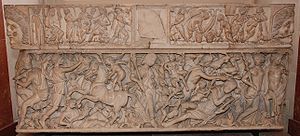
Hoard
In archaeology, a hoard is a collection of valuable objects or artifacts, sometimes purposely buried in the ground. This would usually be with the intention of later recovery by the hoarder; hoarders sometimes died before retrieving the hoard, and these surviving hoards may be uncovered by...
s, which have protected some pieces of Gallo-Roman silver, from villas and temple sites, from the universal destruction of precious metalwork in circulation. The exhibition of Gallo-Roman silver highlighted specifically Gallo-Roman silver from the treasures found at Chaourse (Mâcon), Graincourt-lès-Havrincourt (Pas de Calais),Notre-Dame d'Allençon (Maine-et-Loire), and Rethel (Ardennes, found in 1980).
Gallo-Roman sites
The two more Romanized of the three Gauls were bound together in a network of Roman roadRoman road
The Roman roads were a vital part of the development of the Roman state, from about 500 BC through the expansion during the Roman Republic and the Roman Empire. Roman roads enabled the Romans to move armies and trade goods and to communicate. The Roman road system spanned more than 400,000 km...
s that linked cities. Via Domitia
Via Domitia
The Via Domitia was the first Roman road built in Gaul, to link Italy and Hispania through Gallia Narbonensis, across what is now southern France. The route that the Romans regularised and paved was ancient when they set out to survey it, so old that it traces the mythic route travelled by Heracles...
(laid out in 118 BC), reached from Nîmes
Nîmes
Nîmes is the capital of the Gard department in the Languedoc-Roussillon region in southern France. Nîmes has a rich history, dating back to the Roman Empire, and is a popular tourist destination.-History:...
to the Pyrenees
Pyrenees
The Pyrenees is a range of mountains in southwest Europe that forms a natural border between France and Spain...
, where it joined the Via Augusta
Via Augusta
Via Augusta was a Roman road crossing all the Hispania Province, from Cádiz in the southern tip of current Spain, to the Coll de Panissars, where it crossed the Pyrenees close to the Mediterranean Sea, and joined the Via Domitia...
at the Col de Panissars. Via Aquitania
Via Aquitania
The Via Aquitania was a Roman road created in 118 BC in the Roman province of Gaul. It started at Narbonne, where it connected to the Via Domitia...
reached from Narbonne
Narbonne
Narbonne is a commune in southern France in the Languedoc-Roussillon region. It lies from Paris in the Aude department, of which it is a sub-prefecture. Once a prosperous port, it is now located about from the shores of the Mediterranean Sea...
, where it connected to the Via Domitia, to the Atlantic Ocean through Toulouse
Toulouse
Toulouse is a city in the Haute-Garonne department in southwestern FranceIt lies on the banks of the River Garonne, 590 km away from Paris and half-way between the Atlantic Ocean and the Mediterranean Sea...
to Bordeaux
Bordeaux
Bordeaux is a port city on the Garonne River in the Gironde department in southwestern France.The Bordeaux-Arcachon-Libourne metropolitan area, has a population of 1,010,000 and constitutes the sixth-largest urban area in France. It is the capital of the Aquitaine region, as well as the prefecture...
.
Sites, restorations, museums
At PérigueuxPérigueux
Périgueux is a commune in the Dordogne department in Aquitaine in southwestern France.Périgueux is the prefecture of the department and the capital of the region...
, France, a luxurious Roman villa called the Domus of Vesunna, built round a garden courtyard surrounded by a colonnaded peristyle enriched with bold tectonic frescoing, has been handsomely protected in a modern glass-and-steel structure that is a fine example of archaeological museum-making (see external link).
Lyon
Lyon
Lyon , is a city in east-central France in the Rhône-Alpes region, situated between Paris and Marseille. Lyon is located at from Paris, from Marseille, from Geneva, from Turin, and from Barcelona. The residents of the city are called Lyonnais....
, the capital of Roman Gaul, is now the site of a Museum of Gallo-Roman Civilization (rue Céberg), associated with the remains of the theater and odeon
Odeon (building)
Odeon is the name for several ancient Greek and Roman buildings built for singing exercises, musical shows and poetry competitions. They were generally small in size, especially compared with a full-size ancient Greek theatre....
of Roman Lugdunum
Lugdunum
Colonia Copia Claudia Augusta Lugdunum was an important Roman city in Gaul. The city was founded in 43 BC by Lucius Munatius Plancus. It served as the capital of the Roman province Gallia Lugdunensis. To 300 years after its foundation Lugdunum was the most important city to the west part of Roman...
. Visitors are offered a clear picture of the daily life, economic conditions, institutions, beliefs, monuments and artistic achievements of the first four centuries of the Christian era. The "Claudius Tablet" in the Museum transcribes a speech given before the Senate by the Emperor Claudius in 48, in which he requests the right for the heads of the Gallic nations to participate in Roman magistracy. The request having been accepted, the Gauls decided to engrave the imperial speech on bronze.
In Martigny
Martigny, Switzerland
Martigny is the capital of the French-speaking district of Martigny in the canton of Valais in Switzerland. It lies at an elevation of , and its population is approximately 15000 inhabitants . It is a junction of roads joining Italy, France and Switzerland...
, Valais
Valais
The Valais is one of the 26 cantons of Switzerland in the southwestern part of the country, around the valley of the Rhône from its headwaters to Lake Geneva, separating the Pennine Alps from the Bernese Alps. The canton is one of the drier parts of Switzerland in its central Rhône valley...
, Switzerland, at the Fondation Pierre Gianadda
Fondation Pierre Gianadda
Fondation Pierre Gianadda, inaugurated in 1978, administers museums and exhibitions located in Martigny, Switzerland. The permanent exhibitions include the Automobile Museum, Gallo-Roman Museum, Louis and Evelyn Franck Collection, Sculpture Park, and Chagall Court.-History:The Foundation was...
, a modern museum of art and sculpture shares space with Gallo-Roman Museum centered on the foundations of a Celtic temple.
Other sites include:
Towns
- ArlesArlesArles is a city and commune in the south of France, in the Bouches-du-Rhône department, of which it is a subprefecture, in the former province of Provence....
- remains include the AlyscampsAlyscampsThe Alyscamps is a large Roman necropolis, which is a short distance outside the walls of the old town of Arles, France. It was one of the most famous necropolises of the ancient world. The name is a corruption of the Latin Elisii Campi...
, a large Roman necropolisNecropolisA necropolis is a large cemetery or burial ground, usually including structural tombs. The word comes from the Greek νεκρόπολις - nekropolis, literally meaning "city of the dead"... - AutunAutunAutun is a commune in the Saône-et-Loire department in Burgundy in eastern France. It was founded during the early Roman Empire as Augustodunum. Autun marks the easternmost extent of the Umayyad campaign in Europe.-Early history:...
- GlanumGlanumGlanum was an oppidum, or fortified town, founded by a Celto-Ligurian people called the Salyens in the 6th century B.C.,. It was known for the healing power of its spring. It became a Roman city in Provence until its abandonment in 260 A.D....
, near Saint-Rémy-de-ProvenceSaint-Rémy-de-ProvenceSaint-Rémy-de-Provence is a commune in the Bouches-du-Rhône department in southern France.-Geography:... - NarbonneNarbonneNarbonne is a commune in southern France in the Languedoc-Roussillon region. It lies from Paris in the Aude department, of which it is a sub-prefecture. Once a prosperous port, it is now located about from the shores of the Mediterranean Sea...
- NîmesNîmesNîmes is the capital of the Gard department in the Languedoc-Roussillon region in southern France. Nîmes has a rich history, dating back to the Roman Empire, and is a popular tourist destination.-History:...
- remains include the Maison CarréeMaison CarréeThe Maison Carrée is an ancient building in Nîmes, southern France; it is one of the best preserved temples to be found anywhere in the territory of the former Roman Empire.- History :... - Orange
- Tongeren (Belgium) gallo-roman museum
- Vaison-la-RomaineVaison-la-RomaineVaison-la-Romaine is a commune in the Vaucluse department in the Provence-Alpes-Côte d'Azur region in southeastern France....
- several Roman amphitheatreAmphitheatreAn amphitheatre is an open-air venue used for entertainment and performances.There are two similar, but distinct, types of structure for which the word "amphitheatre" is used: Ancient Roman amphitheatres were large central performance spaces surrounded by ascending seating, and were commonly used...
s are still visible in France. (see List of Roman amphitheatres for a list)
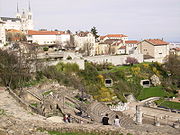
Amphitheatres
- Arelate (modern ArlesArlesArles is a city and commune in the south of France, in the Bouches-du-Rhône department, of which it is a subprefecture, in the former province of Provence....
) - GrandGrand, VosgesGrand is a commune in the Vosges department in Lorraine in northeastern France.Grand is known for its Roman amphitheatre, mosaics and aqueduct.- External links :*...
- LugdunumLugdunumColonia Copia Claudia Augusta Lugdunum was an important Roman city in Gaul. The city was founded in 43 BC by Lucius Munatius Plancus. It served as the capital of the Roman province Gallia Lugdunensis. To 300 years after its foundation Lugdunum was the most important city to the west part of Roman...
(modern LyonLyonLyon , is a city in east-central France in the Rhône-Alpes region, situated between Paris and Marseille. Lyon is located at from Paris, from Marseille, from Geneva, from Turin, and from Barcelona. The residents of the city are called Lyonnais....
) - NemaususNemaususDeus Nemausus is often said to have been the Celtic patron god of Nemausus . The god does not seem to have been worshipped outside of this locality...
(modern NîmesNîmesNîmes is the capital of the Gard department in the Languedoc-Roussillon region in southern France. Nîmes has a rich history, dating back to the Roman Empire, and is a popular tourist destination.-History:...
) - LutetiaLutetiaLutetia was a town in pre-Roman and Roman Gaul. The Gallo-Roman city was a forerunner of the re-established Merovingian town that is the ancestor of present-day Paris...
(modern Paris): Arènes de LutèceArènes de LutèceThe Arènes de Lutèce are among the most important remains from the Gallo-Roman era in Paris , together with the Thermes de Cluny... - Mediolanum SantonumMediolanum SantonumMediolanum Santonum was a Roman town of southwestern Gaul, now Saintes. It was founded in about 20 BC in connection with an expansion of the network of Roman roads serving Burdigala...
(modern SaintesSaintesSaintes is a French commune located in Poitou-Charentes, in the southwestern Charente-Maritime department of which it is a sub-prefecture. Its inhabitants are called Saintaises and Saintais....
)
See also
- Culture of Ancient RomeCulture of ancient RomeAncient Roman culture existed throughout the almost 1200-year history of the civilization of Ancient Rome. The term refers to the culture of the Roman Republic, later the Roman Empire, which, at its peak, covered an area from Lowland Scotland and Morocco to the Euphrates.Life in ancient Rome...
- Sidonius ApollinarisSidonius ApollinarisGaius Sollius Apollinaris Sidonius or Saint Sidonius Apollinaris was a poet, diplomat, and bishop. Sidonius is "the single most important surviving author from fifth-century Gaul" according to Eric Goldberg...
- SyagriusSyagriusSyagrius was the last Roman official in Gaul, whose defeat by king Clovis I of the Franks is considered the end of Roman rule outside of Italy. He came to this position through inheritance, for his father was Aegidius, the last Roman magister militum per Gallias...
- Via DomitiaVia DomitiaThe Via Domitia was the first Roman road built in Gaul, to link Italy and Hispania through Gallia Narbonensis, across what is now southern France. The route that the Romans regularised and paved was ancient when they set out to survey it, so old that it traces the mythic route travelled by Heracles...
, the first Roman roadRoman roadThe Roman roads were a vital part of the development of the Roman state, from about 500 BC through the expansion during the Roman Republic and the Roman Empire. Roman roads enabled the Romans to move armies and trade goods and to communicate. The Roman road system spanned more than 400,000 km...
built in Gaul - Pillar of the BoatmenPillar of the BoatmenThe Pillar of the Boatmen is a square-section stone bas-relief with depictions of several deities, both Gaulish and Roman...
- Thraco-RomanThraco-RomanThe terms Thraco-Roman and Daco-Roman refer to the culture and language of the Thracian and Dacian peoples who were incorporated into the Roman Empire and ultimately fell under the Roman and Latin sphere of influence.-Meaning and usage:...
- Loupian Roman villaLoupian Roman villaLoupian Roman villa is in the village of Loupian in the Hérault départment of France, between Montpellier and Béziers, the heart of Gallia Narbonensis. Excavations on a three-hectare site south of the village have revealed remains of a Roman farm villa with extensive 2nd-century gallo-roman mosaics...
- Gallo-Romance languagesGallo-Romance languagesThe Gallo-Romance branch of Romance languages include French and the other langue d'oïl dialects, Occitan , Catalan, Franco-Provençal, Gallo-Italic, and other languages - Other possible classifications :...
- Gallo languageGallo languageGallo is a regional language of France. Gallo is a Romance language, one of the Oïl languages. It is the historic language of the region of Upper Brittany and some neighboring portions of Normandy, but today is spoken by only a small minority of the population, having been largely superseded by...
- AusoniusAusoniusDecimius Magnus Ausonius was a Latin poet and rhetorician, born at Burdigala .-Biography:Decimius Magnus Ausonius was born in Bordeaux in ca. 310. His father was a noted physician of Greek ancestry and his mother was descended on both sides from long-established aristocratic Gallo-Roman families...
- Venantius FortunatusVenantius FortunatusVenantius Honorius Clementianus Fortunatus was a Latin poet and hymnodist in the Merovingian Court, and a Bishop of the early Catholic Church. He was never canonised but was venerated as Saint Venantius Fortunatus during the Middle Ages.-Life:Venantius Fortunatus was born between 530 and 540 A.D....
- Hilary of ArlesHilary of ArlesSaint Hilary of Arles was a bishop of Arles. He is recognized as a saint by the Roman Catholic and Eastern Orthodox Churches, with his feast day celebrated on 5 May.- Life :...