


New Rochelle, New York

Encyclopedia
New Rochelle is a city in Westchester County
, New York
, United States
, in the southeastern portion of the state.
The town was settled by refugee Huguenots (French Protestants) in 1688 who were fleeing persecution (such as dragonnade
) in France . Many of the settlers were artisans and craftsmen from the city of La Rochelle
, France
, thus influencing the choice of the name of "New Rochelle."
In 2007, the city had a population of 73,260, making it the seventh largest in the state of New York
. As of the 2010 Census, the city's population had increased to 77,062. In 2008, New Rochelle was recognized by the American Podiatric Medical Association (APMA) as one of the 100 Best Walking Cities in America, and the second best in New York State next only to nearby New York City. In November 2008 Business Week magazine listed New Rochelle as the best city in New York State, and one of the best places nationally, to raise children.
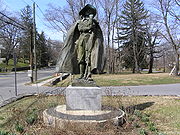 Some 33 families established the community of la Nouvelle-Rochelle in 1688. A monument containing the names of these settlers stands in Hudson Park, the original landing point of the Huguenots. Thirty-one years earlier, the Siwanoy
Indians sold their land to Thomas Pell
. In 1689 Pell officially deeded 6,100 acres (25 km2) for the establishment of a Huguenot community. Jacob Leisler is an important figure in the early histories of both New Rochelle and the nation. He arrived in America as a mercenary
in the British army
and later became one of the most prominent merchants in New York. He was subsequently appointed acting-governor of the province, and it was during this time that he acted on behalf of the Huguenots.
Of all the Huguenot settlements in America founded with the view of being distinct French colonies, New Rochelle most clearly conformed to the plans of its founders. The colony continued to attract French refugees until as late as 1760. The choice of name for the city reflected the importance of the city of La Rochelle and of the new settlement in Huguenot history and distinctly French character of the community. French
was spoken, and it was common practice for people in neighboring areas to send their children to New Rochelle to learn the language.
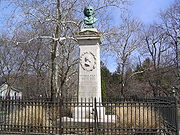 In 1775 General George Washington
stopped in New Rochelle on his way to assume command of the Army of the United Colonies
in Massachusetts. The British Army briefly occupied sections of New Rochelle and Larchmont in 1776. Following British victory in the Battle of White Plains
, New Rochelle became part of a "Neutral Ground" for General Washington to regroup his troops. After the Revolutionary War
ended in 1784, patriot Thomas Paine
was given a farm in New Rochelle for his service to the cause of independence. The farm, totaling about 300 acres (1.2 km2), had been confiscated from its owners by state of New York due to their Tory activities.
The first national census of 1790 shows New Rochelle with 692 residents, 136 of whom were African American
.
principally from Ireland and Germany, more American families left New York City and moved into the area. Although the original Huguenot population was rapidly shrinking in relative size, through ownership of land, businesses, banks, and small manufactures, they retained a predominant hold on the political and social life of the town.
The 1820 Census showed 150 African-Americans residing in New Rochelle, six of whom were slaves. In 1857 the Village of New Rochelle was established within the borders of the Town of New Rochelle. A group of volunteers created the first fire service in 1861. In 1899 a bill creating the New Rochelle City Charter
was signed by Governor Theodore Roosevelt
. It was through this bill that the Village and Town of New Rochelle were joined into one municipality. In 1899 Michael J. Dillon narrowly defeated Hugh A. Harmer to become New Rochelle's first mayor
. The recently established city charter designated four wards, a board of alderman (two from each ward), and 10 elected from the city at large.
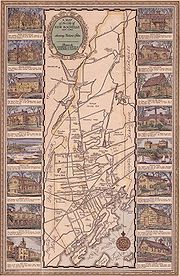 By 1900 New Rochelle had a population of 14,720. In 1904
plans were completed for Rochelle Park, one of the first planned communities in the country. In 1909, Edwin Thanhouser
established Thanhouser Film Corporation. Thanhouser's Million Dollar Mystery
was one of the first serial motion pictures. In 1923, New Rochelle resident Anna Jones became the first African American
woman to be admitted to the New York State Bar.
Poet and resident James J. Montague
captured the image of New Rochelle in his 1926 poem "Queen City of the Sound". The last four lines of the poem are:
In 1930 New Rochelle recorded a population of 54,000, up from 36,213 only ten years earlier. During the 1930s New Rochelle was the wealthiest city per capita in New York state and the third wealthiest in the country.
By the end of the century, the City had begun a massive revitalization of its 'downtown'. In 1999, part of downtown New Rochelle near the Metro North
train station
was rebuilt with a $190 million entertainment complex, nicknamed New Roc City
, which features a 19-screen movie theater
, an IMAX
theater, an indoor ice-hockey
arena, mini-golf
, go karts, an arcade, restaurants, a hotel
, loft-apartments and a mega supermarket
. The complex was built on the former Macy's
and Mall which had opened in 1968.
, bordered on the west by Pelham
, Pelham Manor and Eastchester, by Scarsdale
to the north and east, Mamaroneck
and Larchmont to the east. The city lies 2 miles (3.2 km) north of the New York City
border (Pelham Bay Park
in The Bronx
).According to the United States Census Bureau
, the city has a total area of 13.2 square miles (34.3 km2). The city has a rough triangle shape, approximately 10 miles (16 km) from north to south and 1.5 miles (2 km) from east to west at its widest point.
of 2000, New Rochelle had a population of 72,182 people, 24,275 occupied households, and 17,546 families residing in the city. The population density
was 6,973.5 people per square mile (2,692.7/km²). There were 26,995 housing units at an average density of 2,608.0 per square mile (1,007.0/km²). The racial makeup of the city was 68% White, 19% African American, 0.20% Native American, 4% Asian, 0.05% Pacific Islander, 6% from other races, and 3% from two or more races. 20% of the population were Hispanic or Latino of any race. In the city the population was spread out with 24.0% under the age of 18, 8.7% from 18 to 24, 29.5% from 25 to 44, 22.2% from 45 to 64, and 15.5% who were 65 years of age or older. The median age was 37 years. For every 100 females there were 90.7 males. For every 100 females age 18 and over, there were 85.9 males. There were 26,189 households out of which 32.7% had children under the age of 18 living with them, 50.5% were married couples
living together, 12.5% had a female householder with no husband present, and 33.0% were non-families. 28.0% of all households were made up of individuals and 11.8% had someone living alone who was 65 years of age or older. The average household size was 2.68 and the average family size was 3.29.
19,312 residents of New Rochelle were enrolled in school, with 2,743 in pre-school
or kindergarten, 8,105 in elementary school, 3,704 in high school and 5,030 in college or graduate school. Out of 42,872 individuals over the age of 25, 20% (9,766) had no high school diploma
, 23% (11,325) were high school graduates, 14% (6,710) achieved some level of college education, 5% (2,347) held an associate's degree, 19% (9,120) held a bachelor's degree and 20% (9,604) possessed a graduate or other advanced degree.
The working population was 35,262, 95.7% of whom were employed. The occupational breakdown had 42% working in 'management', 25% working in 'sales', 17% in 'services', 8% in 'construction', and 7% in 'production and transport'. The average daily commute was 30 minutes, with 60% driving to work, 12% carpooling, 18% traveling via public-transportation and 7% using other means.
According to the 2007 Census Bureau estimates, the median income
for a household in the city was $64,756 and the median income for a family was $88,004. About 9.8% of the population lived below the poverty line.
section is more densely developed, with condominiums, high rises, offices, shopping centers
, affordable housing complexes, a medical center, nursing home
s, two college campuses and an inter modal transportation hub, the rest of the city consists of sprawling, residential neighborhoods. There are more than 11,500 single family units within the city, more than that of neighboring Larchmont, Mamaroneck and Scarsdale combined. The total number of separate households surpasses 26,000, more than that of neighboring Pelham
, Pelham Manor, Eastchester, Scarsdale
, Mamaroneck
and Larchmont combined.
can be found in New Rochelle. The north end of the city (10804) is ranked in Forbes
Magazines list of the '500 most expensive zip-codes' in the country. According to the list, the average household income
was $199,061 and the average home price was over $752,000. Homes in Premium Point, a gated section of the city on Long Island Sound
, are priced anywhere from $2 to $20 million. The three newest residential developments, 'Kensington Woods', 'The Greens at Cherry Lawn' and 'Riviera Shores', are all gated communities
with single family homes
priced from $2 million. With a population approaching 80,000 residents, New York
State law dictates that the city provide an adequate amount of affordable housing
units for the less fortunate. New Rochelle has historically met and surpassed state requirements, currently working to replace the existing Weyman Avenue Projects with more forward thinking, community centered townhouse-style housing units. By embracing the needs of the poor, New Rochelle sets a precedent for other suburban communities to follow. Neighboring towns including Mamaroneck, Larchmont and Scarsdale neglect to address such concerns, failing to meet the minimal affordable housing requirements set by the state. Popular consenus is that the presence of the poor precludes that of the middle-class
and the wealthy. Considering the large number of working-class
and affordable housing units found 'Downtown', the high property values prevalent throughout most of the city reflects the true economic diversity of New Rochelle. It is home to the financially disadvantaged and the very wealthy. One of 'the wealthiest people in the United States' according to Forbes Magazine was longtime New Rochelle resident and businessman Sidney Frank
.
. Premium Point, Kensington Woods and Cherry Lawn are gated neighborhoods accessible only by those immediate residents.
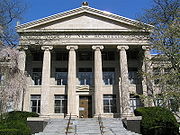 Since 1932 New Rochelle has operated under a Council-Manager form of government
. The City Manager is the chief administrative officer of the city selected to carry out the directives of the Council. The Manager monitors the city's fiscal condition and enforces its ordinances
and laws. The City Manager is involved in the discussion of all matters coming before Council yet has no final vote. The City Council is the legislative body consisting of the Mayor
and six council members. The Mayor serves as the presiding officer of the Council. Since 1993 the City has had six council districts, with one council member elected from and by each district. The Council functions to set policy, approve the annual budget
, appoint the City Manager and City Clerk, and enact local laws, resolutions & ordinances.
State and the fifth safest city of its size in the United States
. The majority of crimes committed within New Rochelle are non-violent property crimes, including burglary, larceny-theft, motor vehicle theft
, and arson. Property crime, on a scale of 1 (low crime) to 10, is 4 compared to the US average of 3. Violent crime
(murder and nonnegligent manslaughter, forcible rape, robbery, and aggravated assault) is 3, equal to the US average.
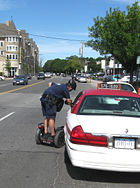 The Town of New Rochelle formed its first professional police
department in 1885, 14 years before the city incorporated in 1899. The Department currently has 186 sworn officers and a total staff of more than 250. In 1993 the Department was certified as an accredited agency by the New York
State Law Enforcement Accreditation Council. Special programs include community oriented policing through the 'Police and Community Together' (PACT) program, harbor patrol, and a bicycle patrol.
actively pursues code enforcement and fire prevention. By keeping buildings up to code, controlling illegal occupancies, monitoring the safety of living-areas and issuing licenses and permits, the department works to control the potential for dangerous situations. With five state-of-the-art facilities stationed throughout the city, the department is capable of handling fires, rescues, extrications, medical emergencies, hazardous material incidents and natural disasters. The NRFD operates a frontline fire apparatus fleet of five engines companies and two reserve engines, three truck companies and one reserve truck, one rescue company, two ambulances from Transcare New Rochelle EMS
, and many other support units. The NRFD is known as the premiere fire department in the area because of its wide range of services and is frequently called on by nearby communities to assist in handling emergency situations. Unlike nearby communities that depend on volunteer fire and emergency medical resources, the city's emergency service
s are municipally funded.
is a not-for-profit
health care organization located in New Rochelle that treats over 85,000 patients annually and operates the only New York
State Area Trauma Center
in southern Westchester County
.
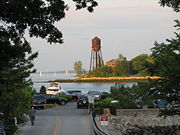
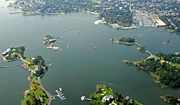
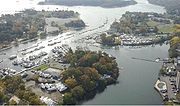
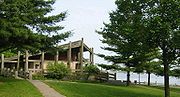 The City has an impressive collection of parklands and nature preserves, with 102.5 acre (0.41480315 km²) of inland waters, 231.51 acre (0.9368885586 km²) of public park lands and 168 acre (0.67987248 km²) of park lets.
, which operates a public high school, two junior high schools and ten elementary schools. On seven separate occasions, the City's schools have received the prestigious Blue Ribbon Award
from the U.S. Department of Education. New Rochelle High School
is one of the most diverse high school
s in the country; the student body represents over 60 different countries from around the world. The school offers over 240 courses including honors, research and advanced placement courses.
Libraries are operated by the New Rochelle Public Library System which is part of the county-wide Westchester Library System
.
and the Hutchinson River Parkway
. Interstate 95 serves as the main route through New Rochelle with four exits directly serving the city. The Hutchinson River Parkway, which is designated for passenger vehicles only, runs through much of the city. Substantial congestion on the Parkway occurs in both directions during the morning and evening rush-hour
.
The Boston Post Road, also known as Main Street in downtown New Rochelle, is used as a major artery during the morning and evening commute. Most traffic via the Post Road is short distance or fairly local, yet vehicles have utilized Route 1 during times of heavy congestion on I-95 as a re-route.
served by Metro North
as well as Amtrak
.
, proposals for new railroads reached new levels. Banking that the city would continue to grow northward, the New York, Westchester and Boston Railway
Company developed new lines of service to serve the large populations moving to the suburbs. Two main lines were built as part of the NYW&B; the Port Chester line and the White Plains
line. While the populations of some communities served by the NYWB did grow between 1912 and 1937, the growth was not large enough or fast enough to provide sufficient business for the railroad, and service was discontinued on December 31, 1937.
(Joyce Beverages, Inc), RawlPlug, Inc., the Longines Symphonette Society, Conran's USA. Manufacturing and warehousing has declined since the 1990s as industrial land near both exits from Interstate 95 have been converted to "big box" retailer use.
New Rochelle remains a center of business, home to the corporate headquarters of Sidney Frank Importing, Blimpies, and East River Savings Bank.
Westchester County, New York
Westchester County is a county located in the U.S. state of New York. Westchester covers an area of and has a population of 949,113 according to the 2010 Census, residing in 45 municipalities...
, New York
New York
New York is a state in the Northeastern region of the United States. It is the nation's third most populous state. New York is bordered by New Jersey and Pennsylvania to the south, and by Connecticut, Massachusetts and Vermont to the east...
, United States
United States
The United States of America is a federal constitutional republic comprising fifty states and a federal district...
, in the southeastern portion of the state.
The town was settled by refugee Huguenots (French Protestants) in 1688 who were fleeing persecution (such as dragonnade
Dragonnade
"Dragonnades" was a French policy instituted by Louis XIV in 1681 to intimidate Huguenot families into either leaving France or re-converting to Catholicism.- History :This policy involved billeting ill-disciplined dragoons in Protestant households...
) in France . Many of the settlers were artisans and craftsmen from the city of La Rochelle
La Rochelle
La Rochelle is a city in western France and a seaport on the Bay of Biscay, a part of the Atlantic Ocean. It is the capital of the Charente-Maritime department.The city is connected to the Île de Ré by a bridge completed on 19 May 1988...
, France
France
The French Republic , The French Republic , The French Republic , (commonly known as France , is a unitary semi-presidential republic in Western Europe with several overseas territories and islands located on other continents and in the Indian, Pacific, and Atlantic oceans. Metropolitan France...
, thus influencing the choice of the name of "New Rochelle."
In 2007, the city had a population of 73,260, making it the seventh largest in the state of New York
New York
New York is a state in the Northeastern region of the United States. It is the nation's third most populous state. New York is bordered by New Jersey and Pennsylvania to the south, and by Connecticut, Massachusetts and Vermont to the east...
. As of the 2010 Census, the city's population had increased to 77,062. In 2008, New Rochelle was recognized by the American Podiatric Medical Association (APMA) as one of the 100 Best Walking Cities in America, and the second best in New York State next only to nearby New York City. In November 2008 Business Week magazine listed New Rochelle as the best city in New York State, and one of the best places nationally, to raise children.
17th century
Siwanoy
The Native American Siwanoy or Sinanoy were a band of Algonquian-speaking people, the Wappinger, in what is now the New York City area. By the mid-17th century, when their territory became hotly contested between Dutch and English colonial interests, the Siwanoy were settled along the East River...
Indians sold their land to Thomas Pell
Thomas Pell
Dates may not be entirely accurate in this article due to disagreements between sources.Thomas Pell was a physician who was famous for buying the area known as Pelham, Westchester, New York, as well as land that now includes the eastern Bronx and southern Westchester County. He founded the town...
. In 1689 Pell officially deeded 6,100 acres (25 km2) for the establishment of a Huguenot community. Jacob Leisler is an important figure in the early histories of both New Rochelle and the nation. He arrived in America as a mercenary
Mercenary
A mercenary, is a person who takes part in an armed conflict based on the promise of material compensation rather than having a direct interest in, or a legal obligation to, the conflict itself. A non-conscript professional member of a regular army is not considered to be a mercenary although he...
in the British army
British Army
The British Army is the land warfare branch of Her Majesty's Armed Forces in the United Kingdom. It came into being with the unification of the Kingdom of England and Scotland into the Kingdom of Great Britain in 1707. The new British Army incorporated Regiments that had already existed in England...
and later became one of the most prominent merchants in New York. He was subsequently appointed acting-governor of the province, and it was during this time that he acted on behalf of the Huguenots.
Of all the Huguenot settlements in America founded with the view of being distinct French colonies, New Rochelle most clearly conformed to the plans of its founders. The colony continued to attract French refugees until as late as 1760. The choice of name for the city reflected the importance of the city of La Rochelle and of the new settlement in Huguenot history and distinctly French character of the community. French
French language
French is a Romance language spoken as a first language in France, the Romandy region in Switzerland, Wallonia and Brussels in Belgium, Monaco, the regions of Quebec and Acadia in Canada, and by various communities elsewhere. Second-language speakers of French are distributed throughout many parts...
was spoken, and it was common practice for people in neighboring areas to send their children to New Rochelle to learn the language.
18th century
George Washington
George Washington was the dominant military and political leader of the new United States of America from 1775 to 1799. He led the American victory over Great Britain in the American Revolutionary War as commander-in-chief of the Continental Army from 1775 to 1783, and presided over the writing of...
stopped in New Rochelle on his way to assume command of the Army of the United Colonies
Thirteen Colonies
The Thirteen Colonies were English and later British colonies established on the Atlantic coast of North America between 1607 and 1733. They declared their independence in the American Revolution and formed the United States of America...
in Massachusetts. The British Army briefly occupied sections of New Rochelle and Larchmont in 1776. Following British victory in the Battle of White Plains
Battle of White Plains
The Battle of White Plains was a battle in the New York and New Jersey campaign of the American Revolutionary War fought on October 28, 1776, near White Plains, New York. Following the retreat of George Washington's Continental Army northward from New York City, British General William Howe landed...
, New Rochelle became part of a "Neutral Ground" for General Washington to regroup his troops. After the Revolutionary War
American Revolutionary War
The American Revolutionary War , the American War of Independence, or simply the Revolutionary War, began as a war between the Kingdom of Great Britain and thirteen British colonies in North America, and ended in a global war between several European great powers.The war was the result of the...
ended in 1784, patriot Thomas Paine
Thomas Paine
Thomas "Tom" Paine was an English author, pamphleteer, radical, inventor, intellectual, revolutionary, and one of the Founding Fathers of the United States...
was given a farm in New Rochelle for his service to the cause of independence. The farm, totaling about 300 acres (1.2 km2), had been confiscated from its owners by state of New York due to their Tory activities.
The first national census of 1790 shows New Rochelle with 692 residents, 136 of whom were African American
African American
African Americans are citizens or residents of the United States who have at least partial ancestry from any of the native populations of Sub-Saharan Africa and are the direct descendants of enslaved Africans within the boundaries of the present United States...
.
19th century
Through the 18th century, New Rochelle had remained a modest village that retained an abundance of agricultural land. During the 19th century, however, with the rapid growth of New York City by immigrationImmigration
Immigration is the act of foreigners passing or coming into a country for the purpose of permanent residence...
principally from Ireland and Germany, more American families left New York City and moved into the area. Although the original Huguenot population was rapidly shrinking in relative size, through ownership of land, businesses, banks, and small manufactures, they retained a predominant hold on the political and social life of the town.
The 1820 Census showed 150 African-Americans residing in New Rochelle, six of whom were slaves. In 1857 the Village of New Rochelle was established within the borders of the Town of New Rochelle. A group of volunteers created the first fire service in 1861. In 1899 a bill creating the New Rochelle City Charter
Municipal charter
A city charter or town charter is a legal document establishing a municipality such as a city or town. The concept developed in Europe during the middle ages....
was signed by Governor Theodore Roosevelt
Theodore Roosevelt
Theodore "Teddy" Roosevelt was the 26th President of the United States . He is noted for his exuberant personality, range of interests and achievements, and his leadership of the Progressive Movement, as well as his "cowboy" persona and robust masculinity...
. It was through this bill that the Village and Town of New Rochelle were joined into one municipality. In 1899 Michael J. Dillon narrowly defeated Hugh A. Harmer to become New Rochelle's first mayor
Mayor
In many countries, a Mayor is the highest ranking officer in the municipal government of a town or a large urban city....
. The recently established city charter designated four wards, a board of alderman (two from each ward), and 10 elected from the city at large.
20th and 21st centuries
plans were completed for Rochelle Park, one of the first planned communities in the country. In 1909, Edwin Thanhouser
Edwin Thanhouser
Edwin Thanhouser was an actor, businessman, and film producer, most notable as a founder of the Thanhouser Company, along with his wife Gertrude Thanhouser and brother-in-law Lloyd Lonergan.-Biography:...
established Thanhouser Film Corporation. Thanhouser's Million Dollar Mystery
Million Dollar Mystery
Million Dollar Mystery is a 1987 American film released with a promotional tie-in for Glad-Lock brand bags. While performing a routine stunt for this film, legendary stuntman Dar Robinson lost his life on November 21, 1986...
was one of the first serial motion pictures. In 1923, New Rochelle resident Anna Jones became the first African American
African American
African Americans are citizens or residents of the United States who have at least partial ancestry from any of the native populations of Sub-Saharan Africa and are the direct descendants of enslaved Africans within the boundaries of the present United States...
woman to be admitted to the New York State Bar.
Poet and resident James J. Montague
James J. Montague
James Jackson Montague was an American writer and poet of the early 20th century. His short, whimsical fiction pieces were often carried by the Bell Syndicate, a syndicator of content to newspapers...
captured the image of New Rochelle in his 1926 poem "Queen City of the Sound". The last four lines of the poem are:
In 1930 New Rochelle recorded a population of 54,000, up from 36,213 only ten years earlier. During the 1930s New Rochelle was the wealthiest city per capita in New York state and the third wealthiest in the country.
By the end of the century, the City had begun a massive revitalization of its 'downtown'. In 1999, part of downtown New Rochelle near the Metro North
Metro-North Railroad
The Metro-North Commuter Railroad , trading as MTA Metro-North Railroad, or, more commonly, Metro-North, is a suburban commuter rail service that is run and managed by the Metropolitan Transportation Authority , an authority of New York State. It is the busiest commuter railroad in the United...
train station
Train station
A train station, also called a railroad station or railway station and often shortened to just station,"Station" is commonly understood to mean "train station" unless otherwise qualified. This is evident from dictionary entries e.g...
was rebuilt with a $190 million entertainment complex, nicknamed New Roc City
New Roc City
New Roc City is an entertainment complex in the city of New Rochelle in Westchester County, New York. The complex opened in the summer of 1999 as the centerpiece of the efforts to revitalize the downtown area of New Rochelle...
, which features a 19-screen movie theater
Movie theater
A movie theater, cinema, movie house, picture theater, film theater is a venue, usually a building, for viewing motion pictures ....
, an IMAX
IMAX
IMAX is a motion picture film format and a set of proprietary cinema projection standards created by the Canadian company IMAX Corporation. IMAX has the capacity to record and display images of far greater size and resolution than conventional film systems...
theater, an indoor ice-hockey
Ice hockey
Ice hockey, often referred to as hockey, is a team sport played on ice, in which skaters use wooden or composite sticks to shoot a hard rubber puck into their opponent's net. The game is played between two teams of six players each. Five members of each team skate up and down the ice trying to take...
arena, mini-golf
Miniature golf
Miniature golf, or minigolf, is a miniature version of the sport of golf. While the international sports organization World Minigolf Sport Federation prefers to use the name "minigolf", the general public in different countries has also many other names for the game: miniature golf, mini-golf,...
, go karts, an arcade, restaurants, a hotel
Hotel
A hotel is an establishment that provides paid lodging on a short-term basis. The provision of basic accommodation, in times past, consisting only of a room with a bed, a cupboard, a small table and a washstand has largely been replaced by rooms with modern facilities, including en-suite bathrooms...
, loft-apartments and a mega supermarket
Supermarket
A supermarket, a form of grocery store, is a self-service store offering a wide variety of food and household merchandise, organized into departments...
. The complex was built on the former Macy's
Macy's
Macy's is a U.S. chain of mid-to-high range department stores. In addition to its flagship Herald Square location in New York City, the company operates over 800 stores in the United States...
and Mall which had opened in 1968.
Geography
New Rochelle is located at 40.9286°N 73.7842°W, at the southeastern point of continental New York State. It lies on the Long Island SoundLong Island Sound
Long Island Sound is an estuary of the Atlantic Ocean, located in the United States between Connecticut to the north and Long Island, New York to the south. The mouth of the Connecticut River at Old Saybrook, Connecticut, empties into the sound. On its western end the sound is bounded by the Bronx...
, bordered on the west by Pelham
Pelham
-Surname:* British Whig politicians:** Thomas Pelham, 1st Baron Pelham and his sons, both Prime Ministers of Great Britain** Henry Pelham ** Thomas Pelham-Holles, 1st Duke of Newcastle-upon-Tyne * American artistic family:...
, Pelham Manor and Eastchester, by Scarsdale
Scarsdale
Scarsdale could be*Scarsdale, New York, a village and town in Westchester County, New York, United States, for which The Complete Scarsdale Medical Diet is named...
to the north and east, Mamaroneck
Mamaroneck (town), New York
Mamaroneck is a town in Westchester County, New York, United States. The population was 29,156 at the 2010 census. There are two villages contained within the town: Larchmont and the Village of Mamaroneck...
and Larchmont to the east. The city lies 2 miles (3.2 km) north of the New York City
New York City
New York is the most populous city in the United States and the center of the New York Metropolitan Area, one of the most populous metropolitan areas in the world. New York exerts a significant impact upon global commerce, finance, media, art, fashion, research, technology, education, and...
border (Pelham Bay Park
Pelham Bay Park
Pelham Bay Park, located in the northeast corner of the New York City borough of The Bronx and extending partially into Westchester County, is at the largest public park in New York City. The section of the park within New York City's borders is more than three times the size of Manhattan's...
in The Bronx
The Bronx
The Bronx is the northernmost of the five boroughs of New York City. It is also known as Bronx County, the last of the 62 counties of New York State to be incorporated...
).According to the United States Census Bureau
United States Census Bureau
The United States Census Bureau is the government agency that is responsible for the United States Census. It also gathers other national demographic and economic data...
, the city has a total area of 13.2 square miles (34.3 km2). The city has a rough triangle shape, approximately 10 miles (16 km) from north to south and 1.5 miles (2 km) from east to west at its widest point.
Demographics
As measured by the censusCensus
A census is the procedure of systematically acquiring and recording information about the members of a given population. It is a regularly occurring and official count of a particular population. The term is used mostly in connection with national population and housing censuses; other common...
of 2000, New Rochelle had a population of 72,182 people, 24,275 occupied households, and 17,546 families residing in the city. The population density
Population density
Population density is a measurement of population per unit area or unit volume. It is frequently applied to living organisms, and particularly to humans...
was 6,973.5 people per square mile (2,692.7/km²). There were 26,995 housing units at an average density of 2,608.0 per square mile (1,007.0/km²). The racial makeup of the city was 68% White, 19% African American, 0.20% Native American, 4% Asian, 0.05% Pacific Islander, 6% from other races, and 3% from two or more races. 20% of the population were Hispanic or Latino of any race. In the city the population was spread out with 24.0% under the age of 18, 8.7% from 18 to 24, 29.5% from 25 to 44, 22.2% from 45 to 64, and 15.5% who were 65 years of age or older. The median age was 37 years. For every 100 females there were 90.7 males. For every 100 females age 18 and over, there were 85.9 males. There were 26,189 households out of which 32.7% had children under the age of 18 living with them, 50.5% were married couples
Marriage
Marriage is a social union or legal contract between people that creates kinship. It is an institution in which interpersonal relationships, usually intimate and sexual, are acknowledged in a variety of ways, depending on the culture or subculture in which it is found...
living together, 12.5% had a female householder with no husband present, and 33.0% were non-families. 28.0% of all households were made up of individuals and 11.8% had someone living alone who was 65 years of age or older. The average household size was 2.68 and the average family size was 3.29.
19,312 residents of New Rochelle were enrolled in school, with 2,743 in pre-school
Nursery school
A nursery school is a school for children between the ages of one and five years, staffed by suitably qualified and other professionals who encourage and supervise educational play rather than simply providing childcare...
or kindergarten, 8,105 in elementary school, 3,704 in high school and 5,030 in college or graduate school. Out of 42,872 individuals over the age of 25, 20% (9,766) had no high school diploma
High school diploma
A high school diploma is a diploma awarded for the completion of high school. In the United States and Canada, it is considered the minimum education required for government jobs and higher education. An equivalent is the GED.-Past diploma styles:...
, 23% (11,325) were high school graduates, 14% (6,710) achieved some level of college education, 5% (2,347) held an associate's degree, 19% (9,120) held a bachelor's degree and 20% (9,604) possessed a graduate or other advanced degree.
The working population was 35,262, 95.7% of whom were employed. The occupational breakdown had 42% working in 'management', 25% working in 'sales', 17% in 'services', 8% in 'construction', and 7% in 'production and transport'. The average daily commute was 30 minutes, with 60% driving to work, 12% carpooling, 18% traveling via public-transportation and 7% using other means.
According to the 2007 Census Bureau estimates, the median income
Median household income
The median household income is commonly used to generate data about geographic areas and divides households into two equal segments with the first half of households earning less than the median household income and the other half earning more...
for a household in the city was $64,756 and the median income for a family was $88,004. About 9.8% of the population lived below the poverty line.
Residential profile
New Rochelle is commonly referred to as 'The Home Town' because of the significant amount of single-family, residential development that exists throughout most of the city. While the formerly industrial downtownDowntown
Downtown is a term primarily used in North America by English speakers to refer to a city's core or central business district ....
section is more densely developed, with condominiums, high rises, offices, shopping centers
Shopping mall
A shopping mall, shopping centre, shopping arcade, shopping precinct or simply mall is one or more buildings forming a complex of shops representing merchandisers, with interconnecting walkways enabling visitors to easily walk from unit to unit, along with a parking area — a modern, indoor version...
, affordable housing complexes, a medical center, nursing home
Nursing home
A nursing home, convalescent home, skilled nursing unit , care home, rest home, or old people's home provides a type of care of residents: it is a place of residence for people who require constant nursing care and have significant deficiencies with activities of daily living...
s, two college campuses and an inter modal transportation hub, the rest of the city consists of sprawling, residential neighborhoods. There are more than 11,500 single family units within the city, more than that of neighboring Larchmont, Mamaroneck and Scarsdale combined. The total number of separate households surpasses 26,000, more than that of neighboring Pelham
Pelham
-Surname:* British Whig politicians:** Thomas Pelham, 1st Baron Pelham and his sons, both Prime Ministers of Great Britain** Henry Pelham ** Thomas Pelham-Holles, 1st Duke of Newcastle-upon-Tyne * American artistic family:...
, Pelham Manor, Eastchester, Scarsdale
Scarsdale
Scarsdale could be*Scarsdale, New York, a village and town in Westchester County, New York, United States, for which The Complete Scarsdale Medical Diet is named...
, Mamaroneck
Mamaroneck (village), New York
Mamaroneck is a village in Westchester County, New York, United States. The population was 18,929 at the 2010 census. It is located partially within the town of Mamaroneck and partially within the town of Rye. The portion in Rye is unofficially called "Rye Neck"...
and Larchmont combined.
Housing variety
Some of the country's most expensive real estateReal estate
In general use, esp. North American, 'real estate' is taken to mean "Property consisting of land and the buildings on it, along with its natural resources such as crops, minerals, or water; immovable property of this nature; an interest vested in this; an item of real property; buildings or...
can be found in New Rochelle. The north end of the city (10804) is ranked in Forbes
Forbes
Forbes is an American publishing and media company. Its flagship publication, the Forbes magazine, is published biweekly. Its primary competitors in the national business magazine category are Fortune, which is also published biweekly, and Business Week...
Magazines list of the '500 most expensive zip-codes' in the country. According to the list, the average household income
Household income
Household income is a measure of the combined incomes of all people sharing a particular household or place of residence. It includes every form of income, e.g., salaries and wages, retirement income, near cash government transfers like food stamps, and investment gains.Average household income can...
was $199,061 and the average home price was over $752,000. Homes in Premium Point, a gated section of the city on Long Island Sound
Long Island Sound
Long Island Sound is an estuary of the Atlantic Ocean, located in the United States between Connecticut to the north and Long Island, New York to the south. The mouth of the Connecticut River at Old Saybrook, Connecticut, empties into the sound. On its western end the sound is bounded by the Bronx...
, are priced anywhere from $2 to $20 million. The three newest residential developments, 'Kensington Woods', 'The Greens at Cherry Lawn' and 'Riviera Shores', are all gated communities
Gated community
In its modern form, a gated community is a form of residential community or housing estate containing strictly-controlled entrances for pedestrians, bicycles, and automobiles, and often characterized by a closed perimeter of walls and fences. Gated communities usually consist of small residential...
with single family homes
Single-family home
A single-family detached home, also called a single-detached dwelling or separate house is a free-standing residential building. It is defined in opposition to a multi-family dwelling.- Definitions :...
priced from $2 million. With a population approaching 80,000 residents, New York
New York
New York is a state in the Northeastern region of the United States. It is the nation's third most populous state. New York is bordered by New Jersey and Pennsylvania to the south, and by Connecticut, Massachusetts and Vermont to the east...
State law dictates that the city provide an adequate amount of affordable housing
Affordable housing
Affordable housing is a term used to describe dwelling units whose total housing costs are deemed "affordable" to those that have a median income. Although the term is often applied to rental housing that is within the financial means of those in the lower income ranges of a geographical area, the...
units for the less fortunate. New Rochelle has historically met and surpassed state requirements, currently working to replace the existing Weyman Avenue Projects with more forward thinking, community centered townhouse-style housing units. By embracing the needs of the poor, New Rochelle sets a precedent for other suburban communities to follow. Neighboring towns including Mamaroneck, Larchmont and Scarsdale neglect to address such concerns, failing to meet the minimal affordable housing requirements set by the state. Popular consenus is that the presence of the poor precludes that of the middle-class
Middle class
The middle class is any class of people in the middle of a societal hierarchy. In Weberian socio-economic terms, the middle class is the broad group of people in contemporary society who fall socio-economically between the working class and upper class....
and the wealthy. Considering the large number of working-class
Working class
Working class is a term used in the social sciences and in ordinary conversation to describe those employed in lower tier jobs , often extending to those in unemployment or otherwise possessing below-average incomes...
and affordable housing units found 'Downtown', the high property values prevalent throughout most of the city reflects the true economic diversity of New Rochelle. It is home to the financially disadvantaged and the very wealthy. One of 'the wealthiest people in the United States' according to Forbes Magazine was longtime New Rochelle resident and businessman Sidney Frank
Sidney Frank
Sidney E. Frank was an American businessman who became a billionaire through his promotion of Grey Goose vodka and Jägermeister.-Early life, family, education:...
.
Communities
Within the greater city borders are many established neighborhoods and subsections, several of which are larger in both size and population than neighboring towns of Larchmont, Bronxville and Pelham Manor. The public community areas most noted include: Bayberry, Beechmont, Bloomingdale Estates, Bonniecrest, Daisy Farms, Davenport Neck, Echo Manor, Forest Heights, Forest Knolls, French Ridge, Glen Island, Glenwood Lake, Heathcote, Lake Isle, Larchmont Woods, Lyncroft, Northfield, North Ridge, Paine Heights, Pinebrook, Premium Manor, Quaker Ridge, Residence Park, Rochelle Heights, Sans Souci, Scarsdale Downs, Shore Road, Sutton Manor, Vaneck Estates, Ward Acres, Wilmot Woods and WykagylWykagyl, New York
Wykagyl is a suburban community in New Rochelle, New York. The community is conterminous with zip code 10804.Wykagyl consists primarily of sprawling, residential neighborhoods and large "period" homes. Architectural styles include Elizabethan and Cotswold Tudors, Mediterranean-style villas, and...
. Premium Point, Kensington Woods and Cherry Lawn are gated neighborhoods accessible only by those immediate residents.
Government
Council-manager government
The council–manager government form is one of two predominant forms of municipal government in the United States; the other common form of local government is the mayor-council government form, which characteristically occurs in large cities...
. The City Manager is the chief administrative officer of the city selected to carry out the directives of the Council. The Manager monitors the city's fiscal condition and enforces its ordinances
Local ordinance
A local ordinance is a law usually found in a municipal code.-United States:In the United States, these laws are enforced locally in addition to state law and federal law.-Japan:...
and laws. The City Manager is involved in the discussion of all matters coming before Council yet has no final vote. The City Council is the legislative body consisting of the Mayor
Mayor
In many countries, a Mayor is the highest ranking officer in the municipal government of a town or a large urban city....
and six council members. The Mayor serves as the presiding officer of the Council. Since 1993 the City has had six council districts, with one council member elected from and by each district. The Council functions to set policy, approve the annual budget
Budget
A budget is a financial plan and a list of all planned expenses and revenues. It is a plan for saving, borrowing and spending. A budget is an important concept in microeconomics, which uses a budget line to illustrate the trade-offs between two or more goods...
, appoint the City Manager and City Clerk, and enact local laws, resolutions & ordinances.
Crime statistics
According to the New Rochelle Police Department, New Rochelle is the safest city of its size in New YorkNew York
New York is a state in the Northeastern region of the United States. It is the nation's third most populous state. New York is bordered by New Jersey and Pennsylvania to the south, and by Connecticut, Massachusetts and Vermont to the east...
State and the fifth safest city of its size in the United States
United States
The United States of America is a federal constitutional republic comprising fifty states and a federal district...
. The majority of crimes committed within New Rochelle are non-violent property crimes, including burglary, larceny-theft, motor vehicle theft
Motor vehicle theft
Motor vehicle theft is the criminal act of stealing or attempting to steal a motor vehicle...
, and arson. Property crime, on a scale of 1 (low crime) to 10, is 4 compared to the US average of 3. Violent crime
Violent crime
A violent crime or crime of violence is a crime in which the offender uses or threatens to use violent force upon the victim. This entails both crimes in which the violent act is the objective, such as murder, as well as crimes in which violence is the means to an end, such as robbery. Violent...
(murder and nonnegligent manslaughter, forcible rape, robbery, and aggravated assault) is 3, equal to the US average.
Police
Police
The police is a personification of the state designated to put in practice the enforced law, protect property and reduce civil disorder in civilian matters. Their powers include the legitimized use of force...
department in 1885, 14 years before the city incorporated in 1899. The Department currently has 186 sworn officers and a total staff of more than 250. In 1993 the Department was certified as an accredited agency by the New York
New York
New York is a state in the Northeastern region of the United States. It is the nation's third most populous state. New York is bordered by New Jersey and Pennsylvania to the south, and by Connecticut, Massachusetts and Vermont to the east...
State Law Enforcement Accreditation Council. Special programs include community oriented policing through the 'Police and Community Together' (PACT) program, harbor patrol, and a bicycle patrol.
Fire Department
New Rochelle's Fire DepartmentFire department
A fire department or fire brigade is a public or private organization that provides fire protection for a certain jurisdiction, which typically is a municipality, county, or fire protection district...
actively pursues code enforcement and fire prevention. By keeping buildings up to code, controlling illegal occupancies, monitoring the safety of living-areas and issuing licenses and permits, the department works to control the potential for dangerous situations. With five state-of-the-art facilities stationed throughout the city, the department is capable of handling fires, rescues, extrications, medical emergencies, hazardous material incidents and natural disasters. The NRFD operates a frontline fire apparatus fleet of five engines companies and two reserve engines, three truck companies and one reserve truck, one rescue company, two ambulances from Transcare New Rochelle EMS
Transcare EMS
TransCare EMS provides Advanced Life Support and Basic Life Support ambulance transportation services in the areas of New York City, the Hudson Valley, Long Island, the state of Delaware, the Baltimore-Washington DC corridor and in numerous locations in Pennsylvania. It is the largest privately...
, and many other support units. The NRFD is known as the premiere fire department in the area because of its wide range of services and is frequently called on by nearby communities to assist in handling emergency situations. Unlike nearby communities that depend on volunteer fire and emergency medical resources, the city's emergency service
Emergency service
Emergency services are organizations which ensure public safety and health by addressing different emergencies. Some agencies exist solely for addressing certain types of emergencies whilst others deal with ad hoc emergencies as part of their normal responsibilities...
s are municipally funded.
Medical
Sound Shore Medical CenterSound Shore Medical Center
Sound Shore Medical Center is a community-based, teaching hospital affiliated with New York Medical College, located at 16 Guion Place in New Rochelle, New York...
is a not-for-profit
Non-profit organization
Nonprofit organization is neither a legal nor technical definition but generally refers to an organization that uses surplus revenues to achieve its goals, rather than distributing them as profit or dividends...
health care organization located in New Rochelle that treats over 85,000 patients annually and operates the only New York
New York
New York is a state in the Northeastern region of the United States. It is the nation's third most populous state. New York is bordered by New Jersey and Pennsylvania to the south, and by Connecticut, Massachusetts and Vermont to the east...
State Area Trauma Center
Trauma center
A trauma center is a hospital equipped to provide comprehensive emergency medical services to patients suffering traumatic injuries. Trauma centers grew into existence out of the realization that traumatic injury is a disease process unto itself requiring specialized and experienced...
in southern Westchester County
Westchester County, New York
Westchester County is a county located in the U.S. state of New York. Westchester covers an area of and has a population of 949,113 according to the 2010 Census, residing in 45 municipalities...
.
Landmarks and attractions
- Columbia IslandColumbia Island (New York)Columbia Island, known before 1941 as Little Pea Island, is an island in Long Island Sound and part of New Rochelle, New York. It is about 150 ft square. It is situated between Davids' Island and Pea Island...
- a small island (appx. 150 feet (45.7 m) square) situated between Davids' IslandDavids' Island (New York)Davids' Island is a island off the coast of New Rochelle, New York, in Long Island Sound. Currently uninhabited, in the past it was the site of Fort Slocum. Plans are to preserve the island as public parkland under the Westchester County Parks system. The island is home to the endangered Kemp’s...
and Pea Island. Up until 1940 it was known as Little Pea Island. CBSCBSCBS Broadcasting Inc. is a major US commercial broadcasting television network, which started as a radio network. The name is derived from the initials of the network's former name, Columbia Broadcasting System. The network is sometimes referred to as the "Eye Network" in reference to the shape of...
purchased it and built a concreteConcreteConcrete is a composite construction material, composed of cement and other cementitious materials such as fly ash and slag cement, aggregate , water and chemical admixtures.The word concrete comes from the Latin word...
foundation to support a transmitter building topped by a 410 feet (125 m) tall antenna tower for WCBS-AM. The transmitter remained in operation until the 1960s, when the station was moved to nearby High IslandHigh Island, New YorkHigh Island is a small private island, part of The Pelham Islands group in the New York City borough of the Bronx. It lies east of the north end of City Island between City Island Harbor and Pelham Bay in Long Island Sound. It is an island at most times, but is connected to City Island by a sandbar...
. - Execution Rocks LighthouseExecution Rocks LighthouseExecution Rocks Light is a lighthouse in the middle of Long Island Sound on the border between New Rochelle and Sands Point, New York. It stands 55 feet tall, with a white light flashing every 10 seconds. The granite tower is painted white with a brown band around the middle...
- centered in the middle of Long Island Sound, just south of Davids' IslandDavids' Island (New York)Davids' Island is a island off the coast of New Rochelle, New York, in Long Island Sound. Currently uninhabited, in the past it was the site of Fort Slocum. Plans are to preserve the island as public parkland under the Westchester County Parks system. The island is home to the endangered Kemp’s...
.The structure was built in 1849 and includes a 55 feet (16.8 m) tall tower and the ‘keeper's house’. It is rumored that the lighthouse's site got its name before the American Revolutionary War when British colonial authorities executed people by chaining them to the rocks at low tide and allowing the rising water to drown them. In reality, the name was chosen to reflect the historically dangerous shipping area created by the rocks exposure during low tides. - Huckleberry IslandHuckleberry IslandHuckleberry Island is an island located in Long Island Sound and part of New Rochelle, New York. It lies approximately three-fourths of one mile east of Davids' Island....
- a 10 acres (40,468.6 m²) island owned by the Huckleberry Indians, Inc., a club within the New York Athletic Club. The island is an important nesting site for waterbirds such as egrets and night herons. - Leland CastleLeland CastleLeland Castle is a 19th century Gothic revival castle located on the campus of the College of New Rochelle in New Rochelle, New York. The castle was originally the residence of Simeon Leland, a wealthy New York City hotel proprietor. Mr...
- a 19th century Gothic Revival castle built as the summer residence of Simeon Leland, a wealthy New York City hotel entrepreneur. It has since been acquired by the College of New Rochelle and is used as an art gallery available to the public. - St. John's Wilmot ChurchSt. John's Wilmot Church (New Rochelle, New York)St.John's Wilmot Church is an Episcopal parish in New Rochelle, New York.The church is located at the intersection of North Avenue and Wilmot Road, it was built as a "chapel of ease" for people who found it too difficult to travel five miles to Trinity Church on the southern end of town. ...
- a historic Episcopal parish located in the northern end of the City at the intersection of North Avenue and Wilmot Road, formerly referred to as “Cooper's Corner”. - Thomas Paine Historical SiteThomas Paine CottageThe Thomas Paine Cottage in New Rochelle, New York in the United States, was the home from 1802 to 1806 of Thomas Paine, author of Common Sense and Revolutionary War hero. Paine was buried near the cottage from his death in 1809 until his body was disinterred in 1819...
- a historical nexus within the city, the site comprises: the country home of the American pamphleteer and Revolutionary War hero Thomas Paine, his burial site, monument, and a museum. Paine's Cottage was built in 1793 and is a National Historic Landmark. The Thomas Paine Memorial Building, built in 1925, houses the library and museum collection of the Thomas Paine National Historical Association. Also on the site is the Brewster Schoolhouse, one of the oldest structural relics in Westchester County. - Trinity-St. Paul's Episcopal ChurchTrinity-St. Paul's Episcopal Church (New Rochelle, New York)Trinity-St. Paul's Episcopal Church in New Rochelle in Westchester County, New York was added to the National Register of Historic Places in 2006. It is located at the northwest corner of Huguenot Street and Division Street...
- added to the National Register of Historic Places in 2006. It is located at the northwest corner of Huguenot Street (also known as the Boston Post Road) and Division Street. This church represents the body of the majority group of New Rochelle's founding Huguenot French Calvanistic congregation that conformed to the liturgy of the established Church of England in June of 1709. King George III gave Trinity its first charter in 1762. After the Revolutionary War, Trinity became a parish of the Protestant Episcopal Church of America.
Parks and recreation
Waterfront
The shoreline within the City of New Rochelle measures 2.7 miles (4.3 km), but due to many irregularities and off-shore islands, the actual length of the waterfront is 9.3 miles (15 km). The unusual coastal features have over the years earned it the nickname, "the Queen City of the Sound."- Yacht, sailing and rowing clubRowing clubA rowing club is a club for people interested in the sport of Rowing. Rowing clubs are usually located near a body of water, whether natural or artificial, that is large enough for manoeuvering of the shells . Clubs usually have racks to store boats and a dock to put them in the water...
s dot the coast on Long Island Sound and beach clubs line the shores of Davenport Neck. Beckwithe Point, The Greentree Country ClubCountry clubA country club is a private club, often with a closed membership, that typically offers a variety of recreational sports facilities and is located in city outskirts or rural areas. Activities may include, for example, any of golf, tennis, swimming or polo...
and The Surf Club are the largest of the private shore clubs, providing waterfront recreation to members during the summer season. The New York Athletic Club sits on Travers Island, located on the border of New Rochelle and Pelham Manor. - Echo Bay Yacht Club and Huguenot Yacht Club are several well known, private yacht clubs in the city.
- New York Sailing School and New Rochelle Rowing Club each have histories dating back over 100 years.
- The City operates a large marina with 300 slips and 150 mooring spaces.
Parks
- Glen IslandGlen Island Park (New Rochelle, New York)Glen Island Park is a park, located on an island in Long Island Sound. The park is owned and operated by Westchester County and shares Glen Island with a privately operated but county-owned entertainment facility, the Glen Island Harbour Club....
— In 1879 John H. StarinJohn H. StarinJohn Henry Starin was a U.S. Representative from New York, grandson of Thomas Sammons. Born in Sammonsville, Fulton County , New York. Starin pursued academic studies in Esperance, New York, where he began the study of medicine in 1842...
, a former U.S. Congressman and New York transportation king, bought five islands which he named 'Glen Island ' and created perhaps the first theme park open to the public. His 12 steamboats transported millions of New YorkNew YorkNew York is a state in the Northeastern region of the United States. It is the nation's third most populous state. New York is bordered by New Jersey and Pennsylvania to the south, and by Connecticut, Massachusetts and Vermont to the east...
residents and others to the attractions which included a zoo, a natural history museum, a railway, a German beer garden (around the castle-like structure which still stands today), a bathing beach, and a Chinese pagoda. Today the park is a 105 acre (0.4249203 km²) island property connected to the mainland by a drawbridge built in the 1920s. One of the main features of the park is its pristine, crescent shaped beach offering access to Long Island SoundLong Island SoundLong Island Sound is an estuary of the Atlantic Ocean, located in the United States between Connecticut to the north and Long Island, New York to the south. The mouth of the Connecticut River at Old Saybrook, Connecticut, empties into the sound. On its western end the sound is bounded by the Bronx...
. - Five Islands Park is a series of islands connected by small footbridges and pathways, offers playground, sports, hiking and camping facilities for all residents to enjoy.
- Hudson Park encompasses 13 acre (0.05260918 km²) along the city's harbor front and includes a beach for residents, the city boathouse, greenhouses, the shore station of the United States Coast Guard and several yacht and rowing clubs. The park is traditionally accepted as the original landing place of the HuguenotHuguenotThe Huguenots were members of the Protestant Reformed Church of France during the 16th and 17th centuries. Since the 17th century, people who formerly would have been called Huguenots have instead simply been called French Protestants, a title suggested by their German co-religionists, the...
settlers. A granite boulder with bronze tablets commemorates the event. - Davids' IslandDavids' Island (New York)Davids' Island is a island off the coast of New Rochelle, New York, in Long Island Sound. Currently uninhabited, in the past it was the site of Fort Slocum. Plans are to preserve the island as public parkland under the Westchester County Parks system. The island is home to the endangered Kemp’s...
, a 78 acres (315,655.1 m²) island of the coast of the city, is being transformed from a former American military base (Fort Slocum) into a park and environmental preserve. Beginning just after the Civil War, the island was a military baseMilitary baseA military base is a facility directly owned and operated by or for the military or one of its branches that shelters military equipment and personnel, and facilitates training and operations. In general, a military base provides accommodations for one or more units, but it may also be used as a...
used to protect New York Harbors, during World War I it served as an army recruitment station and up until 1967, it maintained various ‘Cold War’ facilities. Today it is home to a variety of plants, birds, and animals. These include the endangered Kemp’s Ridley sea turtleKemp's RidleyKemp's ridley sea turtle , or Atlantic ridley sea turtle is the rarest sea turtle and is critically endangered. It is one of two living species in the genus Lepidochelys Kemp's ridley sea turtle (Lepidochelys kempii), or Atlantic ridley sea turtle is the rarest sea turtle and is critically...
, and rare birds such as ospreyOspreyThe Osprey , sometimes known as the sea hawk or fish eagle, is a diurnal, fish-eating bird of prey. It is a large raptor, reaching more than in length and across the wings...
and least terns. Davids Island also supports valuable wetlands, rare rocky intertidal areas, and sandy beaches. The waters surrounding the Island are home to Winter Flounder, Atlantic Herring, and Atlantic Silversides. - Ward Acres, located in the North End, is a combination of untouched forest, wild lawns and meadows, acres of hiking, exercise trails and historic horse stables/cemeteries. In 2007, The Westchester County Department of Conservation produced a Natural Resource Management Plan in order to identify and protect the natural resource needs of the park. It encompasses 62 acres (250,905.3 m²), with the forests divided into four main sections, each distinct in both general characteristics and species presence. It's formed by a portion of a former private state that contained a horse farm, and by an old railroad right of way. It includes a 3 acres (12,140.6 m²) fenced-in dog run, and it is the only park in the City in which residents can walk a dog without a leash.
- The Leatherstocking Trail is a 2 miles (3.2 km) long, inter-municipal hiking trail situated between New Rochelle and Mamaroneck, eventually linking into Saxon Woods County Park. It is part of a larger "Colonial Greenway Trail" in which it connects to Twin Lakes/Nature Study and Saxon Woods parks.
- Sheldrake Lake which formerly served as a reservoir supplying the areas drinking water, is now a 60 acre (0.2428116 km²) park and nature conservancy promoting an increased understanding of the local ecology.
- Twin Lakes Park, combined with the adjacent Nature Study Woods comprise 220 acre (0.8903092 km²) of woods, marsh, lakes, ponds and some fields along the Hutchinson River in New Rochelle’s Northend. There are many foot trails weaving through woods, marshlands, fields and around two large lakes (formerly reservoirs).
Golf
- Wykagyl Country ClubWykagyl Country ClubWykagyl Country Club is a golf course in the Wykagyl section of New Rochelle, New York. The club has often hosted major tournaments as well as meetings of the Professional Golfers Association...
is located in the WykagylWykagyl, New YorkWykagyl is a suburban community in New Rochelle, New York. The community is conterminous with zip code 10804.Wykagyl consists primarily of sprawling, residential neighborhoods and large "period" homes. Architectural styles include Elizabethan and Cotswold Tudors, Mediterranean-style villas, and...
section of New Rochelle on North Avenue just south of Quaker Ridge Road. Golfweek magazine ranks Wykagyl as one of America's Top 100 Classic Courses. - Pelham Country Club, straddles the border of New Rochelle and Pelham ManorPelham Manor, New YorkPelham Manor is a village located in Westchester County, New York, USA. As of the 2010 census, the village had a total population of 5,486. It is located in the town of Pelham.- Demographics :...
. The course is a mile from the Westchester, New York CityNew York CityNew York is the most populous city in the United States and the center of the New York Metropolitan Area, one of the most populous metropolitan areas in the world. New York exerts a significant impact upon global commerce, finance, media, art, fashion, research, technology, education, and...
border and Pelham Bay Park.
Tennis
- New Rochelle Tennis Club located in WykagylWykagyl, New YorkWykagyl is a suburban community in New Rochelle, New York. The community is conterminous with zip code 10804.Wykagyl consists primarily of sprawling, residential neighborhoods and large "period" homes. Architectural styles include Elizabethan and Cotswold Tudors, Mediterranean-style villas, and...
is one of the oldest lawn-tennis organizations in the country.
Public
The city is served by the City School District of New RochelleCity School District of New Rochelle
The City School District of New Rochelle is a public school district located in New Rochelle, New York. New Rochelle has one of the most extensive educational systems in Westchester County, comprising ten elementary schools, two junior high schools and one senior high school. The district...
, which operates a public high school, two junior high schools and ten elementary schools. On seven separate occasions, the City's schools have received the prestigious Blue Ribbon Award
Blue Ribbon Schools Program
The Blue Ribbon Schools Program is a United States government program created in 1981 to honor schools which have achieved high levels of performance or significant improvements with emphasis on schools serving disadvantaged students. The program centers around a self-assessment conducted by the...
from the U.S. Department of Education. New Rochelle High School
New Rochelle High School
New Rochelle High School is a public high school, comprising grades 9 through 12, in New Rochelle, New York, operated by the City School District of New Rochelle. NRHS serves over 3,300 students; offering more than 240 courses, including honors, research and advanced placement courses.NRHS...
is one of the most diverse high school
High school
High school is a term used in parts of the English speaking world to describe institutions which provide all or part of secondary education. The term is often incorporated into the name of such institutions....
s in the country; the student body represents over 60 different countries from around the world. The school offers over 240 courses including honors, research and advanced placement courses.
Libraries are operated by the New Rochelle Public Library System which is part of the county-wide Westchester Library System
Westchester Library System
The Westchester Library System is the library system for the citizens of Westchester County, New York. It was established in 1958. The system is made up of 38 libraries across the county and its headquarters are located in the Town of Greenburgh, near Tarrytown.- About :The Westchester Library...
.
Primary and secondary
- Hudson Montessori - private Montessori school in Wykagyl serving pre-kindergarten level through fifth grade.
- Iona Grammar - all-boys Catholic grammar school on Stratton Road serving grades one through eight.
- Iona Prep - all-boys Catholic schoolCatholic schoolCatholic schools are maintained parochial schools or education ministries of the Catholic Church. the Church operates the world's largest non-governmental school system...
serving grades nine through 12. - Mount Tom Day School - private day school serving pre-k level through second grade. The school is housed in the mansion of renowned 20th-century American artist and illustrator J.C. Leyendecker. The school bordered New Rochelle Academy, a prep school (N-12) which closed down in 1987.
- The Thornton Donovan SchoolThornton Donovan SchoolThe Thornton-Donovan School was founded as the New Rochelle School and Kindergarten in New Rochelle, New York. It was founded by Judge Martin Jerome Keogh in 1901. The first teacher and headmistress was Miss Emily Thornton, a Philadelphia native educated at University College Nottingham, now...
- co-ed preparatory school in Beechmont. - The Ursuline SchoolThe Ursuline SchoolThe Ursuline School is an all-girls, independent, private, Roman Catholic middle and high school located on a campus in New Rochelle, New York in Westchester County. The school was founded in 1897 by the Order of St...
- all-girls Catholic school in Wykagyl serving grades six through 12. - Salesian High SchoolSalesian High School (New Rochelle, New York)Salesian High School, located in New Rochelle, New York, United States, was founded in 1920 as a private Roman Catholic secondary school for young men in grades 9 through 12. Owned and administered by the Salesian Society of St. John Bosco, a religious order of priests and brothers, Salesian High...
- all-boys Roman Catholic high school (grades nine through 12) - Blessed Sacrament-St. Gabriel High SchoolBlessed Sacrament-St. Gabriel High SchoolBlessed Sacrament-St. Gabriel High School is a co-educational, private, Roman Catholic high school in New Rochelle, New York in Westchester County. The school is a result of the merger of Blessed Sacrament and St. Gabriel into one co-educational institution...
- coed Catholic High School in Downtown.
Higher education
- The College of New RochelleThe College of New RochelleThe College of New Rochelle is a private Catholic college with its main campus located in New Rochelle, New York. The College of St. Angela was founded by the Order of the Ursulines as the first Catholic women's college in New York state in 1904, a time when women were generally excluded from...
- The largest women's CatholicCatholicThe word catholic comes from the Greek phrase , meaning "on the whole," "according to the whole" or "in general", and is a combination of the Greek words meaning "about" and meaning "whole"...
college in the United States, founded by the sisters of the Ursuline OrderUrsulinesThe Ursulines are a Roman Catholic religious order for women founded at Brescia, Italy, by Saint Angela de Merici in November 1535, primarily for the education of girls and the care of the sick and needy. Their patron saint is Saint Ursula.-History:St Angela de Merici spent 17 years leading a...
. - Iona CollegeIona College (New York)Iona College is located in New Rochelle, New York, 20 miles north of Manhattan in suburban Westchester County. The college occupies 35 acres on North Ave. The college also operates a Graduate Center in Pearl River, Rockland County, New York....
- CatholicCatholicThe word catholic comes from the Greek phrase , meaning "on the whole," "according to the whole" or "in general", and is a combination of the Greek words meaning "about" and meaning "whole"...
college founded by the Congregation of Christian Brothers. - Monroe CollegeMonroe CollegeMonroe College is a proprietary college with campuses in the Bronx and New Rochelle in the U.S. state of New York and in the Caribbean nation of St. Lucia. The college is named after James Monroe, the fifth President of the United States. Mildred King founded the "Monroe School of Business" in...
- provides professional, career oriented and business centered education.
Road
Major highways include Interstate 95Interstate 95 in New York
Interstate 95 is a part of the Interstate Highway System that runs from Miami, Florida, to the Canada – United States border near Houlton, Maine. In the U.S. state of New York, I-95 extends from the George Washington Bridge in New York City to the Connecticut state line at Port Chester...
and the Hutchinson River Parkway
Hutchinson River Parkway
The Hutchinson River Parkway is a north–south parkway in southern New York, United States. It extends for from the massive Bruckner Interchange in the Throgs Neck section of the Bronx to the New York – Connecticut state line at Rye Brook...
. Interstate 95 serves as the main route through New Rochelle with four exits directly serving the city. The Hutchinson River Parkway, which is designated for passenger vehicles only, runs through much of the city. Substantial congestion on the Parkway occurs in both directions during the morning and evening rush-hour
Rush hour
A rush hour or peak hour is a part of the day during which traffic congestion on roads and crowding on public transport is at its highest. Normally, this happens twice a day—once in the morning and once in the evening, the times during when the most people commute...
.
The Boston Post Road, also known as Main Street in downtown New Rochelle, is used as a major artery during the morning and evening commute. Most traffic via the Post Road is short distance or fairly local, yet vehicles have utilized Route 1 during times of heavy congestion on I-95 as a re-route.
Railroad
The city has a commuter railroad stationNew Rochelle (Metro-North station)
The New Rochelle station serves New Rochelle, New York, via the New Haven Line. Amtrak's Northeast Regional also stops at the station en route to Boston and Washington, DC, serving riders from northern New York City and Southern Westchester who use New Rochelle as a closer alternative to Penn...
served by Metro North
Metro north
Metro North can refer to either of* Metro-North Railroad, a commuter railroad serving parts of New York and Connecticut in the United States* Dublin Metro#Metro North, a branch of the proposed Dublin Metro, in Dublin, Ireland...
as well as Amtrak
Amtrak
The National Railroad Passenger Corporation, doing business as Amtrak , is a government-owned corporation that was organized on May 1, 1971, to provide intercity passenger train service in the United States. "Amtrak" is a portmanteau of the words "America" and "track". It is headquartered at Union...
.
Railroad history
By 1848, the New York & New Haven opened their line along Long Island Sound. After the end of the Civil WarAmerican Civil War
The American Civil War was a civil war fought in the United States of America. In response to the election of Abraham Lincoln as President of the United States, 11 southern slave states declared their secession from the United States and formed the Confederate States of America ; the other 25...
, proposals for new railroads reached new levels. Banking that the city would continue to grow northward, the New York, Westchester and Boston Railway
New York, Westchester and Boston Railway
The New York, Westchester and Boston Railway Company , known to its riders as "the Westchester" and colloquially as the "Boston-Westchester", operated as an electric commuter railroad in the Bronx and Westchester County, New York from 1912 to 1937...
Company developed new lines of service to serve the large populations moving to the suburbs. Two main lines were built as part of the NYW&B; the Port Chester line and the White Plains
White Plains, New York
White Plains is a city and the county seat of Westchester County, New York, United States. It is located in south-central Westchester, about east of the Hudson River and northwest of Long Island Sound...
line. While the populations of some communities served by the NYWB did grow between 1912 and 1937, the growth was not large enough or fast enough to provide sufficient business for the railroad, and service was discontinued on December 31, 1937.
Economy
New Rochelle has been home to a variety of industries over the years, including: Thanhouser Film Studios, Terrytoons Studios, P.J. Tierney Diner Manufacturing (now DeRaffele Manufacturing Company), Flynn Burner Company, New York Seven Up7 Up
7 Up is a brand of a lemon-lime flavored non-caffeinated soft drink. The rights to the brand are held by Dr Pepper Snapple Group in the United States, and PepsiCo in the rest of the world, including Puerto Rico, where the concentrate is manufactured at the Pepsi facility in Cidra...
(Joyce Beverages, Inc), RawlPlug, Inc., the Longines Symphonette Society, Conran's USA. Manufacturing and warehousing has declined since the 1990s as industrial land near both exits from Interstate 95 have been converted to "big box" retailer use.
New Rochelle remains a center of business, home to the corporate headquarters of Sidney Frank Importing, Blimpies, and East River Savings Bank.
New Rochelle in media and fiction
- In the early 20th century New Rochelle was home to one of the first movie studios in the country, Edwin Thanhouser's Thanhouser Film Corporation. Originally located on the corner of Warren and Grove Street, the company moved to Main Street near Echo Avenue after a devastating fire in 1913. The studio is noted for filming the first serial in motion pictures, named The Million Dollar MysteryThe Million Dollar MysteryThe Million Dollar Mystery is a twenty three chapter film serial. It was directed by Howell Hansel, and starred Florence La Badie. It was produced by Thanhouser Film Corporation, and was their biggest success, largely due to the popularity of La Badie. During the filming, La Badie performed her...
, as well as Dr. Jekyll and Mr. HydeDr. Jekyll and Mr. Hyde (1912 film)Dr. Jekyll and Mr. Hyde is a 1912 horror film based on both Robert Louis Stevenson's novella The Strange Case of Dr Jekyll and Mr Hyde and on the play version of Thomas Russell Sullivan. Directed by Lucius Henderson, the film stars actor James Cruze as the dual role of Jekyll/Hyde.-Plot...
, an early film version of Robert Louis StevensonRobert Louis StevensonRobert Louis Balfour Stevenson was a Scottish novelist, poet, essayist and travel writer. His best-known books include Treasure Island, Kidnapped, and Strange Case of Dr Jekyll and Mr Hyde....
's short story Strange Case of Dr. Jekyll and Mr. Hyde. - TerrytoonsTerrytoonsTerrytoons was an animation studio founded by Paul Terry. The studio, located in suburban New Rochelle, New York, operated from 1929 to 1968. Its most popular characters included Mighty Mouse, Gandy Goose, Sourpuss, Dinky Duck, Deputy Dawg, Luno and Heckle and Jeckle; these cartoons and all of its...
animation studio was located in New Rochelle from 1928 to 1968. Its most popular characters include Mighty MouseMighty MouseMighty Mouse is an animated superhero mouse character created by the Terrytoons studio for 20th Century Fox.-History:The character was created by story man Izzy Klein as a super-powered housefly named Superfly. Studio head Paul Terry changed the character into a cartoon mouse instead...
, Gandy GooseGandy GooseGandy Goose was a classic Terrytoons cartoon character. He was frequently paired with Sourpuss, a cat, beginning in the 1939 short The Owl and the Pussycat. Gandy spoke in a lyrical vocal parody of radio comedian Ed Wynn while Sourpuss vocally impersonated an impatient Jimmy Durante...
, Dinky DuckDinky DuckDinky Duck was a Terrytoons cartoon character that appeared in a number of animated shorts. Dinky was a young duck that lived on a farm with ducks, chickens and other typical farm animals. Dinky often took on the role of an orphan who simply wanted a place to call home. Other times, Dinky would...
, Deputy DawgDeputy DawgDeputy Dawg is a Terrytoons cartoon character featured on the animated television series of the same name in an original TV weekly run from 8 September 1962 to 25 May 1963, with no episodes on 8 December to 29 December 1962, resuming on 5 January 1963. The cartoons are between four and six minutes...
, LunoLuno The White StallionLuno The White Stallion was a Terrytoons television series that aired in the mid-1960s. It centered on a little boy named Tim who had a marble Pegasus horse named Luno who would come alive and whisk him off on adventures in far off lands when Tim said the words, "Oh winged horse of marble white,...
and Heckle and JeckleHeckle and JeckleHeckle and Jeckle are cartoon characters created by Paul Terry, and released by his own studio, Terrytoons for 20th Century Fox. The characters are a pair of identical magpies who calmly outwitted their foes in the manner of Bugs Bunny, while maintaining a mischievous streak reminiscent of Woody...
. - The song Happy to Keep His Dinner Warm from the Broadway show How to Succeed in Business Without Really TryingHow to Succeed in Business Without Really TryingHow to Succeed in Business Without Really Trying is a musical with music and lyrics by Frank Loesser and book by Abe Burrows, Jack Weinstock, and Willie Gilbert, based on Shepherd Mead's 1952 book of the same name....
is about Rosemary's desire to become a trophy wifeTrophy wifeTrophy wife is an expression used to describe a wife, usually young and attractive, who is regarded as a status symbol for the husband, who is often older and affluent.-History:The term's etymological origins are disputed...
and live in a mansion in New Rochelle. - The Story of Vernon and Irene CastleThe Story of Vernon and Irene CastleThe Story of Vernon and Irene Castle is an American biographical musical comedy, released in 1939 and directed by H.C. Potter. The film stars Fred Astaire, Ginger Rogers, Edna May Oliver, and Walter Brennan....
starring Fred AstaireFred AstaireFred Astaire was an American film and Broadway stage dancer, choreographer, singer and actor. His stage and subsequent film career spanned a total of 76 years, during which he made 31 musical films. He was named the fifth Greatest Male Star of All Time by the American Film Institute...
and Ginger RogersGinger RogersGinger Rogers was an American actress, dancer, and singer who appeared in film, and on stage, radio, and television throughout much of the 20th century....
takes place in New Rochelle. - George M. CohanGeorge M. CohanGeorge Michael Cohan , known professionally as George M. Cohan, was a major American entertainer, playwright, composer, lyricist, actor, singer, dancer, and producer....
's song "Forty-five Minutes from BroadwayForty-five Minutes from BroadwayForty-Five Minutes From Broadway is a three-act musical by George M. Cohan written about New Rochelle, New York. The play's title refers to the 45-minute train ride from New Rochelle to Broadway....
" is about New Rochelle in the late 1890s. It still takes about forty-five minutes to travel to Broadway by train and foot from New Rochelle. - Musical Give My Regards To BroadwayGive My Regards to Broadway"Give My Regards to Broadway" is a song written by George M. Cohan for his musical play Little Johnny Jones ....
references New Rochelle. and so does Guys and Dolls - The novel RagtimeRagtime (novel)Ragtime is a 1975 novel by E. L. Doctorow. This work of historical fiction is primarily set in the New York City area from about 1900 until the United States entry into World War I in 1917...
was written by New Rochelle resident E. L. DoctorowE. L. DoctorowEdgar Lawrence Doctorow is an American author.- Biography :Edgar Lawrence Doctorow was born in the Bronx, New York City, the son of second-generation Americans of Russian Jewish descent...
and set in New Rochelle. It also became a successful BroadwayBroadway theatreBroadway theatre, commonly called simply Broadway, refers to theatrical performances presented in one of the 40 professional theatres with 500 or more seats located in the Theatre District centered along Broadway, and in Lincoln Center, in Manhattan in New York City...
show, and a major motion picture of the same nameRagtime (film)Ragtime is a 1981 American film based on the historical novel Ragtime by E. L. Doctorow. The action takes place in and around New York City, New Rochelle, and Atlantic City in the first decade of the 1900s, and includes fictionalized references to actual people and events of the time. The film was...
. - The 1961-1966 TV hit The Dick Van Dyke ShowThe Dick Van Dyke ShowThe Dick Van Dyke Show is an American television sitcom that initially aired on the Columbia Broadcasting System from October 3, 1961, until June 1, 1966. The show was created by Carl Reiner and starred Dick Van Dyke and Mary Tyler Moore. It was produced by Reiner with Bill Persky and Sam Denoff....
starring Dick Van DykeDick Van DykeRichard Wayne "Dick" Van Dyke is an American actor, comedian, writer, and producer with a career spanning six decades. He is the older brother of Jerry Van Dyke, and father of Barry Van Dyke...
and Mary Tyler MooreMary Tyler MooreMary Tyler Moore is an American actress, primarily known for her roles in television sitcoms. Moore is best known for The Mary Tyler Moore Show , in which she starred as Mary Richards, a 30-something single woman who worked as a local news producer in Minneapolis, and for her earlier role as...
as Rob and Laura Petrie. The Petrie family lived on 148 Bonnie Meadow Road (a fictional address) in the North-end of the city. - Peter DeRosePeter DeRosePeter DeRose was an American Hall of Fame composer of jazz and pop music during the Tin Pan Alley era.-Biography:DeRose was born in New York City and as a boy exhibited a gift for things musical...
wrote Deep PurpleDeep PurpleDeep Purple are an English rock band formed in Hertford in 1968. Along with Led Zeppelin and Black Sabbath, they are considered to be among the pioneers of heavy metal and modern hard rock, although some band members believe that their music cannot be categorised as belonging to any one genre...
while sitting in his garden in New Rochelle. - Robert AllenRobert AllenRobert Allen may refer to:*Robert Allen , American Congressman from Tennessee*Robert Allen , American Congressman from Virginia*Robert Allen , American Civil War general...
composed "Home For The HolidaysHome for the HolidaysHome for the Holidays may refer to:* Home for the Holidays , tour done by heavy metal band Dream Theater in the winter of 1995.* ""Home for the Holidays" , a song popularized by Perry Como...
" and the Johnny MathisJohnny MathisJohn Royce "Johnny" Mathis is an American singer of popular music. Starting his career with singles of standards, he became highly popular as an album artist, with several dozen of his albums achieving gold or platinum status, and 73 making the Billboard charts...
hit "Chances AreChances Are (song)"Chances Are" is a popular song with music by Robert Allen and lyrics by Al Stillman. It was published in 1957. The song was one of a large number of compositions by the Stillman-Allen team that were chart hits in the 1950s. It was listed on Billboards "Most Played by Jockeys" survey for Johnny...
" in New Rochelle. - Jerry BockJerry BockJerrold Lewis "Jerry" Bock was an American musical theater composer. He received the Tony Award for Best Musical and the Pulitzer Prize for Drama with Sheldon Harnick for their 1959 musical Fiorello! and the Tony Award for Best Composer and Lyricist for the 1964 musical Fiddler on the Roof with...
was a resident of New Rochelle when he wrote the musical Fiddler On The RoofFiddler on the RoofFiddler on the Roof is a musical with music by Jerry Bock, lyrics by Sheldon Harnick, and book by Joseph Stein, set in Tsarist Russia in 1905. It is based on Tevye and his Daughters by Sholem Aleichem...
. - New Rochelle resident J. Fred CootsJ. Fred CootsJohn Frederick Coots was an American songwriter. He wrote over 700 songs.He is most famous for the song "Santa Claus Is Coming to Town", a song that became one of the biggest best sellers in American music history....
wrote Santa Claus Is Coming To TownSanta Claus Is Coming to Town"Santa Claus is Coming to Town" is a Christmas song. It was written by John Frederick Coots and Haven Gillespie, and was first sung on Eddie Cantor's radio show in November 1934....
, one of the biggest best sellers in American musical history. - The classic 70's song "American Pie" was written by New Rochelle resident Don McLeanDon McLeanDonald "Don" McLean is an American singer-songwriter. He is most famous for the 1971 album American Pie, containing the renowned songs "American Pie" and "Vincent".-Musical roots:...
. - The film Catch Me If You CanCatch Me If You CanCatch Me If You Can is a 2002 American biographical comedy-drama film based on the life of Frank Abagnale Jr., who, before his 19th birthday, successfully performed cons worth millions of dollars by posing as a Pan American World Airways pilot, a Georgia doctor, and a Louisiana parish prosecutor...
is loosely based on the story Frank AbagnaleFrank AbagnaleFrank William Abagnale, Jr. is an American security consultant known for his history as a former confidence trickster, check forger, impostor, and escape artist...
, who grew up in New Rochelle in the 1960s. - The 1986 horror film "Scream for Help" was shot in New Rochelle.
- The 1988 novel The Devil's Arithmetic was set in New Rochelle at the beginning of the book.
- Scenes in GoodfellasGoodfellasGoodfellas is a 1990 American crime film directed by Martin Scorsese. It is a film adaptation of the 1986 non-fiction book Wiseguy by Nicholas Pileggi, who co-wrote the screenplay with Scorsese...
were filmed on Alfred Lane, off Quaker Ridge Road in the Pinebrook Heights neighborhood. The house of the parents of Henry Hill's eventual wife, Karen, is on Alfred Lane. Henry goes across the street and pistol whips the neighbor after the neighbor sexually attacked Karen. - In the 1994 film City Slickers II, the main character Mitch Robbins and his wife Barbara live in New Rochelle, having moved there from ManhattanManhattanManhattan is the oldest and the most densely populated of the five boroughs of New York City. Located primarily on the island of Manhattan at the mouth of the Hudson River, the boundaries of the borough are identical to those of New York County, an original county of the state of New York...
where they lived in the original film, City SlickersCity SlickersCity Slickers is a 1991 American comedy film directed by Ron Underwood and starring Billy Crystal, Daniel Stern, Bruno Kirby, Helen Slater and Jack Palance. Palance won an Academy Award for his performance.... - The 1996 romantic comedy Love Is All There IsLove Is All There IsLove Is All There Is is a 1996 romantic comedy film directed by Joseph Bologna and Renee Taylor, who also both star in the movie.- Plot :...
was filmed at the Greentree Country Club on Davenport Neck. - The Oscar-nominated Burt ReynoldsBurt ReynoldsBurton Leon "Burt" Reynolds, Jr. is an American actor. Some of his memorable roles include Bo 'Bandit' Darville in Smokey and the Bandit, Lewis Medlock in Deliverance, Bobby "Gator" McCluskey in White Lightning and sequel Gator, Paul Crewe and Coach Nate Scarborough in The Longest Yard and its...
film Starting Over includes a school carnival scene filmed at what is now known as the Hudson Montessori School on Quaker Ridge Road. - New Rochelle was one of the settings for the 1999 CBSCBSCBS Broadcasting Inc. is a major US commercial broadcasting television network, which started as a radio network. The name is derived from the initials of the network's former name, Columbia Broadcasting System. The network is sometimes referred to as the "Eye Network" in reference to the shape of...
science fiction television series Now and AgainNow and AgainNow and Again is an American television series that aired in the US from September 24, 1999 until May 5, 2000 on CBS. The story revolves around the United States government engineering the perfect human body for use in espionage, but not being able to yet perfect the brain...
. - Scenes in the movie Michael ClaytonMichael Clayton (film)Michael Clayton is a 2007 American drama film written and directed by Tony Gilroy, starring George Clooney, Tom Wilkinson, Tilda Swinton and Sydney Pollack...
, released in 2007 and starring George ClooneyGeorge ClooneyGeorge Timothy Clooney is an American actor, film director, producer, and screenwriter. For his work as an actor, he has received two Golden Globe Awards and an Academy Award...
, were filmed in New Rochelle. - The character James 'Spike' Thompson (Dexter FletcherDexter FletcherDexter Fletcher is an English actor. He is best known for his role in Guy Ritchie film, Lock, Stock and Two Smoking Barrels as well as television roles in such shows as the dramedy Hotel Babylon, the critically acclaimed HBO series Band of Brothers and earlier in his career, the children's show...
) in the ITV series Press GangPress GangPress Gang is a British children's television comedy-drama consisting of forty-three episodes across five series that were broadcast from 1989 to 1993...
comes from New Rochelle, but lives in Norbridge, England. - Scenes of the movie Burn After ReadingBurn After ReadingBurn After Reading is a 2008 black comedy film written, produced, and directed by Joel and Ethan Coen. The film stars George Clooney, John Malkovich, Frances McDormand, Tilda Swinton, and Brad Pitt. It was released in the United States on September 12, 2008, and it was released on October 17, 2008...
, starring Brad PittBrad PittWilliam Bradley "Brad" Pitt is an American actor and film producer. Pitt has received two Academy Award nominations and four Golden Globe Award nominations, winning one...
and George Clooney, were filmed in Sutton Manor. - The music video for the song "Dance, DanceDance, Dance"Dance, Dance" is a song by American rock band Fall Out Boy and the second single from their third studio album, From Under the Cork Tree. Released in late 2005, in the United States it reached No. 9 on the Billboard Hot 100 in January 2006, becoming the band's second consecutive top 10 hit single....
" by the band Fall Out BoyFall Out BoyFall Out Boy is an American rock band from Wilmette, Illinois, formed in 2001. The band consists of vocalist, guitarist and composer Patrick Stump, bassist and lyricist Pete Wentz, guitarist Joe Trohman, and drummer Andy Hurley. The band released five studio albums from 2003–2008...
takes place in the gymnasium of Salesian High School in New Rochelle. - The 2005 novel The Midnight Oil, by Ken Knight, features New Rochelle as the home of the main character "Jonny Faster" who runs a porn film production company in the story.
- Portions of Chasing the Green (2008), starring Jeremy LondonJeremy LondonJeremy Michael London is an American actor. He is best known for his regular roles on Party of Five, 7th Heaven, and I'll Fly Away, as well as a notable supporting role in the Civil War epic Gods and Generals....
and Ryan HurstRyan HurstRyan Douglas Hurst is an American actor who perhaps most notably starred as Gerry Bertier, an All-American linebacker in Disney's Remember the Titans and as Alison's brother, Michael, in the show Medium. He also played the role of football player Lump Hudson in The Ladykillers, appeared in the...
, were filmed in the city. - In the 5th episode of the 8th season of 2424 (TV series)24 is an American television series produced for the Fox Network and syndicated worldwide, starring Kiefer Sutherland as Counter Terrorist Unit agent Jack Bauer. Each 24-episode season covers 24 hours in the life of Bauer, using the real time method of narration...
, the doctor lives in New Rochelle, on Brook Street.
Sister city
New Rochelle’s ‘sister city’ is La Rochelle, France, a city and commune of western France with a (population 78,000 in 2004). There has been a 'friendly relationship' between the two cities since 1910.See also
- National Register of Historic Places listings in New Rochelle, New YorkNational Register of Historic Places listings in New Rochelle, New YorkThis is a list of the National Register of Historic Places entries in New Rochelle, New York. See also National Register of Historic Places listings in Westchester County, New York for all others in the county....
External links
Cultural
- City School District of New Rochelle
- New Rochelle Public Library
- New Rochelle Council on the Arts
- New Rochelle Art Association
- New Rochelle Opera