
All Topics  
Pablo Picasso

 
Pablo Picasso

   Email Print
   Bookmark   Link


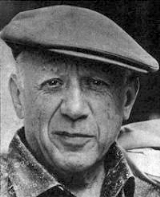
Pablo Picasso


Pablo Diego José Francisco de Paula Juan Nepomuceno María de los Remedios Cipriano de la Santísima Trinidad Ruiz y Picasso (25 October 1881 – 8 April 1973) was a Spanish
Spanish people

Spanish people or Spaniards are a nation or ethnic group native to Spain, in the Iberian Peninsula of southwestern Europe. They are often considered an amalgam of different ethnic groups, rather than an ethnic group by itself....
 painter
Painting

Painting is the practice of applying paint, pigment, color or other medium to a surface . In art, the term describes both the act and the result, which is called a painting....
, draughtsman
Drawing

Drawing is a visual art that makes use of any number of drawing instruments to mark a two-dimensional medium. Common instruments include graphite pencils, pen and ink, inked brushes, wax color pencils, crayons, charcoals, chalk, pastels, marker pens, stylus, or various metals like silverpoint....
, and sculptor
Sculpture

Sculpture is Three-dimensional space artwork created by shaping or combining hard and or plastic material, sound, and or text and or light, commonly Stone sculpture , metal, glass, or wood....
. As one of the most recognized figures in 20th-century art
Art

Art is the process or product of deliberately arranging elements in a way that appeals to the senses or emotions. It encompasses a diverse range of human activities, creations, and modes of expression, including music and literature....
, he is best known for co-founding the Cubist movement and for the wide variety of styles embodied in his work. Among his most famous works are the proto-Cubist Les Demoiselles d'Avignon
Les Demoiselles d'Avignon

Les Demoiselles d'Avignon is a large oil painting by Pablo Picasso , that depicts five nude prostitutes in a brothel on Avignon street in Barcelona....
 (1907) and his depiction of the German bombing of Guernica
Bombing of Guernica

The bombing of Guernica was an Aerial bombing of cities on the Basque Country town of Guernica , causing widespread destruction and civilian deaths during the Spanish Civil War....
 during the Spanish Civil War
Spanish Civil War

The Spanish Civil War was a major conflict in Spain that started after an attempted coup d'?tat by a group of Spanish Army generals, supported by the conservative Spanish Confederation of the Autonomous Right , Carlist groups and the fascistic Falange, against the government of the Second Spanish Republic, then under the leadership of pr...
, Guernica
Guernica (painting)

Guernica is a painting by Pablo Picasso, showing the bombing of Guernica, Spain, by twenty-eight Germany bombers, on April 26, 1937 during the Spanish Civil War....
 (1937).

sso was baptized Pablo Diego José Francisco de Paula Juan Nepomuceno María de los Remedios Crispiniano de la Santísima Trinidad, a series of names honouring various saints and relatives.


Discussion
Ask a question about 'Pablo Picasso'
Start a new discussion about 'Pablo Picasso'
Answer questions from other users
Full Discussion Forum


Recent Posts


Quotations


For a long time I limited myself to one color — as a form of discipline.

On his "blue" and "rose" periods, from Picasso on Art

It means nothing to me. I have no opinion about it, and I don't care.

On the first moon landing, The New York Times, (1969-07-21)

People who try to explain pictures are usually barking up the wrong tree.

from Picasso on Art


Encyclopedia


Pablo Diego José Francisco de Paula Juan Nepomuceno María de los Remedios Cipriano de la Santísima Trinidad Ruiz y Picasso (25 October 1881 – 8 April 1973) was a Spanish
Spanish people

Spanish people or Spaniards are a nation or ethnic group native to Spain, in the Iberian Peninsula of southwestern Europe. They are often considered an amalgam of different ethnic groups, rather than an ethnic group by itself....
 painter
Painting

Painting is the practice of applying paint, pigment, color or other medium to a surface . In art, the term describes both the act and the result, which is called a painting....
, draughtsman
Drawing

Drawing is a visual art that makes use of any number of drawing instruments to mark a two-dimensional medium. Common instruments include graphite pencils, pen and ink, inked brushes, wax color pencils, crayons, charcoals, chalk, pastels, marker pens, stylus, or various metals like silverpoint....
, and sculptor
Sculpture

Sculpture is Three-dimensional space artwork created by shaping or combining hard and or plastic material, sound, and or text and or light, commonly Stone sculpture , metal, glass, or wood....
. As one of the most recognized figures in 20th-century art
Art

Art is the process or product of deliberately arranging elements in a way that appeals to the senses or emotions. It encompasses a diverse range of human activities, creations, and modes of expression, including music and literature....
, he is best known for co-founding the Cubist movement and for the wide variety of styles embodied in his work. Among his most famous works are the proto-Cubist Les Demoiselles d'Avignon
Les Demoiselles d'Avignon

Les Demoiselles d'Avignon is a large oil painting by Pablo Picasso , that depicts five nude prostitutes in a brothel on Avignon street in Barcelona....
 (1907) and his depiction of the German bombing of Guernica
Bombing of Guernica

The bombing of Guernica was an Aerial bombing of cities on the Basque Country town of Guernica , causing widespread destruction and civilian deaths during the Spanish Civil War....
 during the Spanish Civil War
Spanish Civil War

The Spanish Civil War was a major conflict in Spain that started after an attempted coup d'?tat by a group of Spanish Army generals, supported by the conservative Spanish Confederation of the Autonomous Right , Carlist groups and the fascistic Falange, against the government of the Second Spanish Republic, then under the leadership of pr...
, Guernica
Guernica (painting)

Guernica is a painting by Pablo Picasso, showing the bombing of Guernica, Spain, by twenty-eight Germany bombers, on April 26, 1937 during the Spanish Civil War....
 (1937).

Early life

Picasso was baptized Pablo Diego José Francisco de Paula Juan Nepomuceno María de los Remedios Crispiniano de la Santísima Trinidad, a series of names honouring various saints and relatives. Added to these were Ruiz and Picasso, for his father and mother, respectively, as per Spanish custom. Born in the city of Málaga
Málaga

M?laga is a port city in Andalusia, southern Spain, on the Costa del Sol coast of the Mediterranean. At the 2007 census the population is 576,725....
 in the Andalusia
Andalusia

Andalusia is a country in the Spanish State. It is the most populous and the second largest, in terms of land area, of the seventeen autonomous communities of the Spain....
n region of Spain, he was the first child of Don José Ruiz y Blasco
José Ruiz y Blasco

Jos? Ruiz y Blasco was a Spanish painter and art teacher, and is Pablo Picasso's father....
 (1838–1913) and María Picasso y López. Picasso’s family was middle-class; his father was also a painter who specialized in naturalistic depictions of birds and other game. For most of his life Ruiz was a professor of art at the School of Crafts and a curator
Curator

Curator , means manager, Wiktionary:overseer.Traditionally, a curator or keeper of a culture heritage institution is a content specialist responsible for an institution's Collection s and, together with a publications specialist, their associated collections catalogs....
 of a local museum. Ruiz’s ancestors were minor aristocrats. The young Picasso showed a passion and a skill for drawing from an early age; according to his mother, his first words were “piz, piz”, a shortening of lápiz, the Spanish word for ‘pencil’. From the age of seven, Picasso received formal artistic training from his father in figure drawing and oil painting. Ruiz was a traditional, academic artist and instructor who believed that proper training required disciplined copying of the masters, and drawing the human body from plaster casts and live models. His son became preoccupied with art to the detriment of his classwork.

The family moved to La Coruña
A Coruña

A Coru?a is the second largest city in Galicia in northwestern Spain, second only in size to the port of Vigo in the Pontevedra . The city is also the capital of A Coru?a and it was the capital of Galicia from the year 1563 to 1982 when it moved to Santiago de Compostela....
 in 1891 so his father could become a professor at the School of Fine Arts. They stayed almost four years. On one occasion the father found his son painting over his unfinished sketch of a pigeon. Observing the precision of his son’s technique, Ruiz felt that the thirteen-year-old Picasso had surpassed him, and vowed to give up painting.

In 1895, Picasso's seven-year old sister, Conchita, died of diphtheria
Diphtheria

Diphtheria is an upper Respiration tract illness characterized by sore throat, low fever, and an adherent membrane on the tonsils, pharynx, and/or nasal cavity....
—a traumatic event in his life. After her death, the family moved to Barcelona
Barcelona

Barcelona is the capital and most populous city of the Autonomous communities of Spain of Catalonia and the second largest city in Spain, with a population of 1,615,908 in 2008, while the population of the Metropolitan Area was 3,161,081....
, with Ruiz transferring to its School of Fine Arts. Picasso thrived in the city, regarding it in times of sadness or nostalgia as his true home. Ruiz persuaded the officials at the academy to allow his son to take an entrance exam for the advanced class. This process often took students a month, but Picasso completed it in a week, and the impressed jury admitted Picasso, who was still 13. The student lacked discipline but made friendships that would affect him in later life. His father rented him a small room close to home so Picasso could work alone, yet Ruiz checked up on him numerous times a day, judging his son’s drawings. The two argued frequently.

Picasso’s father and uncle decided to send the young artist to Madrid’s Royal Academy of San Fernando
Real Academia de Bellas Artes de San Fernando

The Real Academia de Bellas Artes de San Fernando, located on the Calle de Alcal? in the heart of Madrid, currently functions as a museum and gallery....
, the country's foremost art school. In 1897, Picasso, age 16, set off for the first time on his own, but his difficulties accepting formal instruction led him to stop attending class soon after enrollment. Madrid, however, held many other attractions: the Prado housed paintings by the venerable Diego Velázquez
Diego Velázquez

Diego Rodr?guez de Silva y Vel?zquez was a Spain painting who was the leading artist in the Noble court of King Philip IV of Spain. He was an individualistic artist of the contemporary baroque period, important as a portrait painting....
, Francisco Goya
Francisco Goya

Francisco Jos? de Goya y Lucientes was a Spanish Painting and Printmaking. Goya was a court painter to the Spanish Crown and a chronicler of history....
, and Francisco Zurbarán
Francisco Zurbarán

Francisco de Zurbar?n was a Spain Painting. He is known primarily for his religious paintings depicting monks, nuns, and martyrs, and for his still-lifes....
. Picasso especially admired the works of El Greco
El Greco

El Greco was a painting, sculpture, and architecture of the Spanish Renaissance. "El Greco" was a nickname, a reference to his Greek origin, and the artist normally signed his paintings with his full birth name in Greek alphabet, ????????? Te?t???p????? ....
; their elements, the elongated limbs, arresting colors, and mystical visages, are echoed in Picasso’s œuvre.

Career beginnings

After studying art in Madrid, Picasso made his first trip to Paris in 1900, then the art capital of Europe. There, he met his first Parisian friend, the journalist and poet Max Jacob
Max Jacob

Max Jacob was a French poet, Painting, writer, and critic....
, who helped Picasso learn the language and its literature. Soon they shared an apartment; Max slept at night while Picasso slept during the day and worked at night. These were times of severe poverty, cold, and desperation. Much of his work had to be burned to keep the small room warm. During the first five months of 1901, Picasso lived in Madrid, where he and his anarchist
Anarchism

Anarchism is a political philosophy encompassing anarchist schools of thought which consider the state to be unnecessary, harmful, and/or undesirable....
 friend Francisco de Asís Soler founded the magazine Arte Joven (Young Art), which published five issues. Soler solicited articles and Picasso illustrated the journal, mostly contributing grim cartoons depicting and sympathizing with the state of the poor. The first issue was published on 31 March 1901, by which time the artist had started to sign his work simply Picasso, while before he had signed Pablo Ruiz y Picasso.

By 1905 Picasso became a favorite of the American art collectors Leo
Leo Stein

Leo Stein was an American art collector and critic. In addition to being elder brother to Gertrude Stein, he is also remembered as an influential promoter of 20th-century paintings....
 and Gertrude Stein
Gertrude Stein

Gertrude Stein was an American writer who spent most of her life in France, and who became a catalyst in the development of modern art and Modernist literature....
. Their older brother Michael Stein and his wife Sarah also became collectors of his work. Picasso painted portraits of both Gertrude Stein and her nephew Allan Stein
Allan Stein

Allan Stein is a 1999 novel by Matthew Stadler. Its epigraph is a quote from writer Gertrude Stein: "What is the use of being a boy if you grow up to become a man, what is the use?"...
. Gertrude Stein began acquiring his drawings and paintings and exhibiting them in her informal Salon at her home in Paris. At one of her gatherings in 1905 he met Henri Matisse
Henri Matisse

Henri Matisse was a France artist, known for his use of colour and his fluid, brilliant and original draftsmanship. As a drawing, printmaking, and Sculpture, but principally as a Painting, Matisse is one of the best-known artists of the 20th century....
 who was to become a lifelong friend and rival. The Steins introduced him to Claribel Cone
Claribel Cone

The Cone sisters were Claribel Cone and Etta Cone of Baltimore, Maryland. Together they gathered one of the finest collections of French art#Modern period in the United States....
 and her sister Etta who were American art collectors; who also began to acquire Picasso and Matisse's paintings. Eventually Leo Stein moved to Italy, and Michael and Sarah Stein became patrons of Matisse; while Gertrude Stein continued to collect Picasso. In 1907 Picasso joined the art gallery that had recently been opened in Paris by Daniel-Henry Kahnweiler. Kahnweiler was a German art historian, art collector who became one of the premier French Art dealer
Art dealer

An art dealer is a person or company that buys and sells works of art....
s of the 20th century. He became prominent in Paris beginning in 1907 for being among the first champions of Pablo Picasso, Georges Braque
Georges Braque

Georges Braque was a major 20th century French Painting and sculpture who, along with Pablo Picasso, developed the art movement known as cubism....
 and Cubism
Cubism

Cubism was a 20th century avant-garde art movement, pioneered by Pablo Picasso and Georges Braque, that revolutionized European painting and sculpture, and inspired related movements in music and literature....
. Kahnweiler championed burgeoning artists such as André Derain
André Derain

Andr? Derain was a French painter and co-founder of Fauvism with Henri Matisse....
, Kees Van Dongen
Kees van Dongen

Cornelis Theodorus Maria van Dongen , usually known as Kees van Dongen or just van Dongen, was a the Netherlands Painting and one of the Fauvism....
, Fernand Léger
Fernand Léger

Joseph Fernand Henri L?ger was a France painting, sculpture, and film director....
, Juan Gris
Juan Gris

Jos? Victoriano Gonz?lez-P?rez , better known as Juan Gris, was a Spanish Painting and sculptor who lived and worked in France most of his life....
, Maurice de Vlaminck
Maurice de Vlaminck

Maurice de Vlaminck was a France Painting. Along with Andr? Derain and Henri Matisse he is considered one of the principal figures in the Fauvism movement, a group of modern artists who from 1904 to 1908 were united in their use of intense color....
 and several others who had come from all over the globe to live and work in Montparnasse
Montparnasse

Montparnasse is an area of Paris, France, on the Rive Gauche of the river Seine, centred on the intersection of the Boulevard du Montparnasse and the Rue de Rennes....
 at the time.

In Paris, Picasso entertained a distinguished coterie of friends in the Montmartre
Montmartre

Montmartre is a hill which is 130 metres high, giving its name to the surrounding district, in the north of Paris in the 18eme arrondissement, Paris, a part of the Rive Droite....
 and Montparnasse quarters, including André Breton
André Breton

Andr? Breton was a French writer, poet, and surrealist theorist, and is best known as the main founder of surrealism. His writings include the Surrealist Manifesto of 1924, in which he defined surrealism as pure psychic automatism....
, poet Guillaume Apollinaire
Guillaume Apollinaire

Wilhelm Albert Wlodzimierz Apolinary de Waz-Kostrowicki, known as Guillaume Apollinaire was a France poet, writer, and art critic born in Italy to a Polish mother....
, writer Alfred Jarry
Alfred Jarry

Alfred Jarry was a France writer born in Laval, Mayenne, Mayenne, France, not far from the border of Brittany; he was of Brittany descent on his mother's side....
, and Gertrude Stein. Apollinaire was arrested on suspicion of stealing
Art theft

Art theft is the theft of art. This is usually done for the purpose of resale or ransom; occasionally thieves are also commissioned by dedicated private collectors....
 the Mona Lisa
Mona Lisa

Mona Lisa is a 16th century portrait painting painted in oil painting on a poplar panel painting by Leonardo da Vinci during the Italian Renaissance....
 from the Louvre
Louvre

The Louvre Museum , located in Paris, is a historic monument, and a national museum of France. It is a central landmark, located on the Rive Droite of the Seine in the 1st arrondissement of Paris ....
 in 1911. Apollonaire pointed to his friend Picasso, who was also brought in for questioning, but both were later exonerated.
Stravinsky Picasso

Personal life

In the early 20th century, Picasso divided his time between Barcelona
Barcelona

Barcelona is the capital and most populous city of the Autonomous communities of Spain of Catalonia and the second largest city in Spain, with a population of 1,615,908 in 2008, while the population of the Metropolitan Area was 3,161,081....
 and Paris. In 1904, in the middle of a storm, he met Fernande Olivier, a Bohemian artist who became his mistress. Olivier appears in many of his Rose period paintings. After acquiring fame and some fortune, Picasso left Olivier for Marcelle Humbert, whom he called Eva Gouel. Picasso included declarations of his love for Eva in many Cubist works. Picasso was devastated by her premature death from illness at the age of 30 in 1915.

He maintained a number of mistresses in addition to his wife or primary partner. Picasso was married twice and had four children by three women. In the summer of 1918, Picasso married Olga Khokhlova
Olga Khokhlova

Olga Stepanovna Khokhlova Olga wanted to be a ballerina from the time she visited France and saw Madame Shroessont perform. She became a member of the Ballets Russes of Sergei Diaghilev....
, a ballerina with Sergei Diaghilev
Sergei Diaghilev

Sergei Pavlovich Diaghilev , also referred to as Serge, was a Russian people art critic, patron, ballet impresario and founder of the Ballets Russes from which many famous dancers and choreographers would later arise....
’s troupe, for whom Picasso was designing a ballet, Parade
Parade (ballet)

Parade is a ballet with music by Erik Satie and a one-act scenario by Jean Cocteau. The ballet was composed 1916-1917 for Serge Diaghilev's Ballets Russes....
, in Rome; and they spent their honeymoon in the villa near Biarritz of the glamorous Chilean art patron Eugenia Errázuriz
Eugenia Errázuriz

Eugenia Huici Arguedas de Err?zuriz was a Chilean patron of modernism and a style leader of Paris from 1880 into the 20th century, who paved the way for the modernist minimalist aesthetic that would be taken up in fashion by Coco Chanel....
. Khokhlova introduced Picasso to high society, formal dinner parties, and all the social niceties attendant on the life of the rich in 1920s Paris. The two had a son, Paulo, who would grow up to be a dissolute motorcycle racer and chauffeur to his father. Khokhlova’s insistence on social propriety clashed with Picasso’s bohemian
Bohemianism

The term bohemian, of French origin, was first used in the English language in the nineteenth century to describe the untraditional lifestyles of marginalized and impoverished artists, writers, musicians, and actors in major European cities....
 tendencies and the two lived in a state of constant conflict. During the same period that Picasso collaborated with Diaghilev’s troup, he and Igor Stravinsky
Igor Stravinsky

Igor Fyodorovich Stravinsky was a Russian-born composer, considered by many to be the most influential composer of 20th century music. He was a quintessentially Cosmopolitanism Russian who was named by Time as one of the 100 most influential people of the century....
 collaborated on Pulcinella
Pulcinella (ballet)

Pulcinella is a ballet by Igor Stravinsky based on an 18th-century play ? Pulcinella is a character originating from Commedia dell'arte. The ballet premiered in Paris on 15 May, 1920 under the baton of Ernest Ansermet....
 in 1920. Picasso took the opportunity to make several sketches of the composer.

In 1927 Picasso met 17-year-old Marie-Thérèse Walter
Marie-Thérèse Walter

Th?r?se Walter was a French woman, who was mistress of Pablo Picasso, and the mother of his daughter, Maya Picasso.She first met Picasso on 8 January 1927 in front of the Galeries Lafayette, Paris ....
 and began a secret affair with her. Picasso’s marriage to Khokhlova soon ended in separation rather than divorce, as French law required an even division of property in the case of divorce, and Picasso did not want Khokhlova to have half his wealth. The two remained legally married until Khokhlova’s death in 1955. Picasso carried on a long-standing affair with Marie-Thérèse Walter and fathered a daughter, Maia, with her. Marie-Thérèse lived in the vain hope that Picasso would one day marry her, and hanged herself four years after Picasso’s death.

The photographer and painter Dora Maar
Dora Maar

Henriette Theodora Markovitch alias Dora Maar was a French photographer, poet and painter of Croatian descent, best known for being a lover and muse of Pablo Picasso....
 was also a constant companion and lover of Picasso. The two were closest in the late 1930s and early 1940s and it was Maar who documented the painting of Guernica
Guernica (painting)

Guernica is a painting by Pablo Picasso, showing the bombing of Guernica, Spain, by twenty-eight Germany bombers, on April 26, 1937 during the Spanish Civil War....
.

War years

During the Second World War, Picasso remained in Paris while the Germans occupied the city. Picasso’s artistic style did not fit the Nazi views of art, so he was not able to show his works during this time. Retreating to his studio, he continued to paint all the while. Although the Germans outlawed bronze
Bronze

Bronze is a metal alloy consisting primarily of copper, usually with tin as the main additive, but sometimes with other chemical element such as phosphorus, manganese, aluminium, or silicon....
 casting in Paris, Picasso continued regardless, using bronze smuggled to him by the French resistance
French Resistance

File:Croix de Lorraine2.svgThe French Resistance is the collective name used for the French resistance movements which fought against the Nazi Germany German occupation of France in World War II and the collaborationist Vichy Regime during World War II....
.

After the liberation of Paris
Liberation of Paris

The Liberation of Paris took place during World War II from 19 August 1944 until the surrender of the occupying German garrison on the 25th and is accounted as the last battle in the Operation Overlord and the transitional conclusion of the Allied invasion breakout in Operation Overlord into a broad-fronted general offensive....
 in 1944, Picasso began to keep company with a young art student, Françoise Gilot
Françoise Gilot

Fran?oise Gilot is a French born painter and author, known for being a companion of Pablo Picasso between 1944 and 1953, who later married vaccine pioneer, American biologist Dr....
. The two eventually became lovers, and had two children together, Claude and Paloma
Paloma Picasso

Paloma Picasso is a French/Spanish fashion designer and businesswoman, best known for her jewelry designs and signature perfumes. ....
. Unique among Picasso’s women, Gilot left Picasso in 1953, allegedly because of abusive treatment and infidelities
Infidelity

Infidelity can be defined as any violation of the mutually agreed-upon rules or boundaries of a relationship, and is a breach of faith in an interpersonal relationship....
. This was a severe blow to Picasso.

He went through a difficult period after Gilot’s departure, coming to terms with his advancing age and his perception that, now in his 70s, he was no longer attractive, but rather grotesque to young women. A number of ink drawings from this period explore this theme of the hideous old dwarf as buffoonish counterpoint to the beautiful young girl, including several from a six-week affair with Geneviève Laporte
Geneviève Laporte

Genevieve Laporte was one of Pablo Picasso's last lovers.She is perhaps most famous for auctioning off twenty works, many with her as a subject, that were bestowed upon her during a secret love affair with Picasso in the 1950s....
, who in June 2005 auctioned off the drawings Picasso made of her.

Picasso was not long in finding another lover, Jacqueline Roque
Jacqueline Roque

Jacqueline Roque the second wife of Pablo Picasso and his frequent model.From her first marriage, she had a daughter Catherine Hutin-Blay. Before Roque met Picasso, she was a saleswoman at Madoura Pottery in Vallauris, where Picasso's ceramic works were created....
. She worked at the Madoura Pottery in Vallauris on the French Riviera, where Picasso made and painted ceramics. The two remained together for the rest of Picasso’s life, marrying in 1961. Their marriage was also the means of one last act of revenge against Gilot. Gilot had been seeking a legal means to legitimize her children with Picasso, Claude and Paloma. With Picasso’s encouragement, she had arranged to divorce her then husband, Luc Simon, and marry Picasso to secure her children’s rights. Picasso then secretly married Roque after Gilot had filed for divorce in order to exact his revenge for her leaving him.

Picasso had constructed a huge gothic
Gothic architecture

Gothic architecture is a style of architecture which flourished during the high and late Middle Ages. It evolved from Romanesque architecture and was succeeded by Renaissance architecture....
 structure and could afford large villas in the south of France, at Notre-dame-de-vie on the outskirts of Mougins, in the Provence-Alpes-Côte d'Azur
Provence-Alpes-Côte d'Azur

Provence-Alpes-C?te d'Azur is one of the 26 Regions of France of France. It is made up of:*the former French Provinces of France of Provence...
. By this time he was a celebrity, and there was often as much interest in his personal life as his art.

In addition to his manifold artistic accomplishments, Picasso had a film career, including a cameo appearance in Jean Cocteau
Jean Cocteau

Jean Maurice Eug?ne Cl?ment Cocteau was a French poet, novelist, dramatist, designer, boxing manager, playwright and filmmaker. Along with other Surrealists of his generation Cocteau grappled with the "algebra" of verbal codes old and new, mise en sc?ne language and technologies of modernism to create a paradox: a classical avant-garde....
’s Testament of Orpheus. Picasso always played himself in his film appearances. In 1955 he helped make the film Le Mystère Picasso (The Mystery of Picasso) directed by Henri-Georges Clouzot
Henri-Georges Clouzot

Henri-Georges Clouzot was a France film director, screenwriter and film producer....
.

Death

Pablo Picasso died on 8 April 1973 in Mougins
Mougins

Mougins is a commune in France in the Alpes-Maritimes Departments of France in southeastern France. It is located on the heights of Cannes, in the district of Grasse....
, France, while he and his wife Jacqueline entertained friends for dinner. His final words were “Drink to me, drink to my health, you know I can’t drink any more.” He was interred at Castle Vauvenargues’ park, in Vauvenargues
Vauvenargues, Bouches-du-Rhône

Vauvenargues is a commune in France in the Bouches-du-Rh?ne d?partement in France in southern France. It is close to Aix-en-Provence and the Montagne Sainte-Victoire....
, Bouches-du-Rhône
Bouches-du-Rhône

Bouches-du-Rh?ne is a departments of France in the south of France named after the mouth of the Rh?ne River....
. Jacqueline Roque prevented his children Claude and Paloma from attending the funeral. Devastated and lonely after the death of Picasso Jacqueline Roque took her own life by gunshot in 1986 when she was 60 years old.

Children

  • Paulo (4 February 1921 – 5 June 1975) (Born Paul Joseph Picasso) — with Olga Khokhlova
    Olga Khokhlova

    Olga Stepanovna Khokhlova Olga wanted to be a ballerina from the time she visited France and saw Madame Shroessont perform. She became a member of the Ballets Russes of Sergei Diaghilev....
  • Maia (5 September 1935 – ) (Born Maria de la Concepcion Picasso) — with Marie-Thérèse Walter
    Marie-Thérèse Walter

    Th?r?se Walter was a French woman, who was mistress of Pablo Picasso, and the mother of his daughter, Maya Picasso.She first met Picasso on 8 January 1927 in front of the Galeries Lafayette, Paris ....
  • Claude (15 May 1947 –) (Born Claude Pierre Pablo Picasso) — with Françoise Gilot
    Françoise Gilot

    Fran?oise Gilot is a French born painter and author, known for being a companion of Pablo Picasso between 1944 and 1953, who later married vaccine pioneer, American biologist Dr....
  • Paloma
    Paloma Picasso

    Paloma Picasso is a French/Spanish fashion designer and businesswoman, best known for her jewelry designs and signature perfumes. ....
     (19 April 1949 – ) (Born Anne Paloma Picasso) — with Françoise Gilot
    Françoise Gilot

    Fran?oise Gilot is a French born painter and author, known for being a companion of Pablo Picasso between 1944 and 1953, who later married vaccine pioneer, American biologist Dr....


Political views

Picasso Massacre in Korea
Picasso remained neutral during World War I
World War I

World War I, or the First World War , was a global military conflict which involved the Great powers, organized into two opposing military alliances: the Allies of World War I and the Central Powers....
, the Spanish Civil War
Spanish Civil War

The Spanish Civil War was a major conflict in Spain that started after an attempted coup d'?tat by a group of Spanish Army generals, supported by the conservative Spanish Confederation of the Autonomous Right , Carlist groups and the fascistic Falange, against the government of the Second Spanish Republic, then under the leadership of pr...
, and World War II
World War II

World War II, or the Second World War , was a global military conflict which involved a Participants in World War II, including all of the great powers, organised into two opposing military alliances: the Allies of World War II and the Axis powers....
, refusing to fight for any side or country. Some of his contemporaries felt that his pacifism
Pacifism

Pacifism is the opposition to war or violence as a means of settling disputes or gaining advantage. Pacifism covers a spectrum of views ranging from the belief that international disputes can and should be peacefully resolved; to calls for the abolition of the institutions of the military and war; to opposition to any organization of society...
 had more to do with cowardice than principle. An article in The New Yorker
The New Yorker

The New Yorker is an United States magazine that publishes reportage, commentary, criticism, essays, fiction, satire, cartoons, and poetry. Starting as a weekly in the mid-1920s, the magazine is now published 47 times per year, with five of these issues covering two-week spans....
 called him “a coward, who sat out two world wars while his friends were suffering and dying”. As a Spanish citizen living in France, Picasso was under no compulsion to fight against the invading Germans
Germany

Germany , officially the Federal Republic of Germany , is a country in Central Europe. It is bordered to the north by the North Sea, Denmark, and the Baltic Sea; to the east by Poland and the Czech Republic; to the south by Austria and Switzerland; and to the west by France, Luxembourg, Belgium, and the Netherlands....
 in either World War. In the Spanish Civil War, service for Spaniards living abroad was optional and would have involved a voluntary return to the country to join either side. While Picasso expressed anger and condemnation of Francisco Franco
Francisco Franco

Francisco Paulino Hermenegildo Te?dulo Franco y Bahamonde, Salgado y Pardo de Andrade , commonly known as Francisco Franco or Francisco Franco y Bahamonde was the dictator and Head of State of Spain from October 1936, and de facto regent of the nominally restored Kingdom of Spain from 1947 until his death in 1975....
 and fascists
Fascism

Fascism is a Political radicalism, Authoritarianism Nationalism ideology that aims to create a single-party state with a government led by a dictator who seeks national unity and development by requiring individuals to subordinate self-interest to the collective interest of the nation or Race ....
 through his art, he did not take up arms against them. He also remained aloof from the Catalan
Catalonia

Catalonia , is an Autonomous Community in northeast Spain.Catalonia covers an area of 32,114 km? and has an official population of 7,210,508. It borders France and Andorra to the north, Aragon to the west, the Valencian Community to the south, and the Mediterranean Sea to the east ....
 independence movement during his youth despite expressing general support and being friendly with activists within it.

In 1944 Picasso joined the French Communist Party
French Communist Party

The French Communist Party is a political party in France which advocates the principles of communism. Although its electoral support has greatly declined in recent decades, it remains the largest party in France advocating communist views, and retains a large membership and considerable influence in French politics....
, attended an international peace conference in Poland
Poland

Poland , officially the Republic of Poland , is a country in Central Europe. Poland is bordered by Germany to the west; the Czech Republic and Slovakia to the south; Ukraine, Belarus and Lithuania to the east; and the Baltic Sea and Kaliningrad Oblast, a Russian Enclave and exclave, to the north....
, and in 1950 received the Lenin Peace Prize
Lenin Peace Prize

File:Leninpeace b.jpgThe International Stalin Prize or the International Stalin Prize for Strengthening Peace Among Peoples was the Soviet Union's equivalent to the Nobel Peace Prize....
 from the Soviet government. But party criticism of a portrait of Stalin
Joseph Stalin

Joseph Stalin was the General Secretary of the Communist Party of the Soviet Union's Central Committee of the Communist Party of the Soviet Union from 1922 until his death in 1953....
 as insufficiently realistic cooled Picasso’s interest in communist politics, though he remained a loyal member of the Communist Party until his death. In a 1945 interview with Jerome Seckler, Picasso stated: “I am a Communist and my painting is Communist painting. … But if I were a shoemaker, Royalist or Communist or anything else, I would not necessarily hammer my shoes in a special way to show my politics.” His Communist militancy, not uncommon among intellectuals and artists at the time although it was officially banned in Francoist Spain, has long been the subject of some controversy; a notable source or demonstration thereof was a sarcastic quote commonly attributed to Salvador Dalí
Salvador Dalí

Salvador Domingo Felipe Jacinto Dal? i Dom?nech, 1st Marquis of P?bol was a Spain Catalonia surrealist painter born in Figueres.Dal? was a skilled Technical drawing, best known for the striking and bizarre images in his surrealism work....
 (with whom Picasso had a rather strained relationship), ostensibly casting doubt on the true honesty of his political allegiances:
Picasso es pintor, yo también; [...] Picasso es español, yo también; Picasso es comunista, yo tampoco.


He was against the intervention of the United Nations
United Nations

The United Nations is an international organization whose stated aims are to facilitate cooperation in international law, international security, economic development, Social change, human rights and achieving world peace....
 and the United States in the Korean civil war
Korean War

The Korean War refers to a period of military conflict between North Korea and South Korea regimes, with major hostilities lasting from June 25, 1950 until the armistice signed on July 27, 1953....
 and he depicted it in Massacre in Korea
Massacre in Korea

Massacre in Korea was painted in 1951 by the Spanish master, Pablo Picasso. The work shows a detailed example of his expressionism|expressionistic style, which is drawn from Francisco Goya's painting in 1814 of 'The Third of May 1808'....
.
In 1962, he received the International Lenin Peace Prize
Lenin Peace Prize

File:Leninpeace b.jpgThe International Stalin Prize or the International Stalin Prize for Strengthening Peace Among Peoples was the Soviet Union's equivalent to the Nobel Peace Prize....
.

Art


Picasso’s work is often categorized into periods. While the names of many of his later periods are debated, the most commonly accepted periods in his work are the Blue Period (1901–1904), the Rose Period (1905–1907), the African-influenced Period (1908–1909), Analytic Cubism
Cubism

Cubism was a 20th century avant-garde art movement, pioneered by Pablo Picasso and Georges Braque, that revolutionized European painting and sculpture, and inspired related movements in music and literature....
 (1909–1912), and Synthetic Cubism
Cubism

Cubism was a 20th century avant-garde art movement, pioneered by Pablo Picasso and Georges Braque, that revolutionized European painting and sculpture, and inspired related movements in music and literature....
 (1912–1919).

In 1939–40 the Museum of Modern Art
Museum of Modern Art

The Museum of Modern Art is an art museum located in Midtown Manhattan in New York City, USA, on 53rd Street, between Fifth and Sixth Avenues....
 in New York City
New York City

The City of New York is the List of United States cities by population in the United States, while the New York metropolitan area ranks among the List of urban areas by population....
, under its director Alfred Barr
Alfred Barr

Alfred Hamilton Barr, Jr. , known as Alfred H. Barr, Jr., was an art historian and the first director of the Museum of Modern Art in New York City....
, a Picasso enthusiast, held a major and highly successful retrospective of his principal works up until that time. This exhibition lionized the artist, brought into full public view in America the scope of his artistry, and resulted in a reinterpretation of his work by contemporary art historians and scholars.

Before 1901

Picasso’s training under his father began before 1890. His progress can be traced in the collection of early works now held by the Museu Picasso
Museu Picasso

The Museu Picasso in Barcelona, Spain, has one of the most extensive collections of artworks by the 20th century Spanish artist Pablo Picasso....
 in Barcelona
Barcelona

Barcelona is the capital and most populous city of the Autonomous communities of Spain of Catalonia and the second largest city in Spain, with a population of 1,615,908 in 2008, while the population of the Metropolitan Area was 3,161,081....
, which provides one of the most comprehensive records extant of any major artist’s beginnings. During 1893 the juvenile quality of his earliest work falls away, and by 1894 his career as a painter can be said to have begun. The academic realism apparent in the works of the mid-1890s is well displayed in The First Communion (1896), a large composition that depicts his sister, Lola. In the same year, at the age of 14, he painted Portrait of Aunt Pepa, a vigorous and dramatic portrait that Juan-Eduardo Cirlot has called “without a doubt one of the greatest in the whole history of Spanish painting.”

In 1897 his realism became tinged with Symbolist
Symbolism (arts)

Symbolism was a late nineteenth-century art movement of French and Belgium origin in symbolist poetry and other arts....
 influence, in a series of landscape paintings rendered in non naturalistic violet and green tones. What some call his Modernist period (1899–1900) followed. His exposure to the work of Rossetti
Dante Gabriel Rossetti

Dante Gabriel Rossetti was an English poet, illustrator, Painting and translator....
, Steinlen
Théophile Steinlen

Th?ophile Alexandre Steinlen, frequently referred to as just Steinlen , was a Switzerland-born France Art Nouveau painter and printmaker....
, Toulouse-Lautrec
Henri de Toulouse-Lautrec

Henri Marie Raymond de Toulouse-Lautrec-Monfa or simply Henri de Toulouse-Lautrec was a French Painting, printmaking, drawing, and illustrator, whose immersion in the colourful and theatrical life of fin de si?cle Paris yielded an oeuvre of exciting, elegant and provocative images of the modern and sometimes decadent life of thos...
 and Edvard Munch
Edvard Munch

Edvard Munch was a Norway Symbolism Painting, printmaker, and an important forerunner of Expressionism. His best-known composition, The Scream is one of the pieces in a series titled The Frieze of Life, in which Munch explored the themes of life, love, fear, death, and melancholy....
, combined with his admiration for favorite old masters such as El Greco
El Greco

El Greco was a painting, sculpture, and architecture of the Spanish Renaissance. "El Greco" was a nickname, a reference to his Greek origin, and the artist normally signed his paintings with his full birth name in Greek alphabet, ????????? Te?t???p????? ....
, led Picasso to a personal version of modernism in his works of this period.

Blue Period

Picasso’s Blue Period (1901–1904) consists of somber paintings rendered in shades of blue and blue-green, only occasionally warmed by other colors. This period’s starting point is uncertain; it may have begun in Spain in the spring of 1901, or in Paris in the second half of the year. Many paintings of gaunt mothers with children date from this period. In his austere use of color and sometimes doleful subject matter—prostitute
Prostitution

The word prostitution is used to indicate:1. The exposing or otherwise offering oneself or someone else with the purpose of tempting potential customers to exchange money or goods for the promise of cooperativeness in sexual intercourse from the exposed person;...
s and beggars are frequent subjects—Picasso was influenced by a trip through Spain and by the suicide of his friend Carlos Casagemas. Starting in autumn of 1901 he painted several posthumous portraits of Casagemas, culminating in the gloomy allegorical painting La Vie
La vie

Flyscooters La Vie The La Vie is a street legal, gas-powered motor scooter assembled in China using parts sourced from China, Japan, Taiwan, and the United States ....
 (1903), now in the Cleveland Museum of Art
Cleveland Museum of Art

The Cleveland Museum of Art is an art museum in the University Circle neighborhood of Cleveland, Ohio. It has a permanent collection of more than 43,000 works of art....
.

The same mood pervades the well-known etching The Frugal Repast (1904), which depicts a blind man and a sighted woman, both emaciated, seated at a nearly bare table. Blindness is a recurrent theme in Picasso’s works of this period, also represented in The Blindman’s Meal (1903, the Metropolitan Museum of Art
Metropolitan Museum of Art

The Metropolitan Museum of Art is an art museum located on the eastern edge of Central Park, along what is known as Museum Mile, New York City in New York City, USA....
) and in the portrait of Celestina (1903). Other works include Portrait of Soler and Portrait of Suzanne Bloch?.

Rose Period

The Rose Period (1904–1906) is characterized by a more cheery style with orange and pink colors, and featuring many circus people, acrobat
Acrobatics

Acrobatics is one of the performing arts, and is also practiced as a sport. Acrobatics involves difficult feats of balance, agility and motor coordination....
s and harlequin
Harlequin

Harlequin is the most popular of the zanni or comic servant characters from the Italian language Commedia dell'Arte and its descendant, the Harlequinade....
s known in France as saltimbanques. The harlequin, a comedic character usually depicted in checkered patterned clothing, became a personal symbol for Picasso. Picasso met Fernande Olivier, a model for sculptors and artists, in Paris in 1904, and many of these paintings are influenced by his warm relationship with her, in addition to his increased exposure to French painting. The generally upbeat and optimistic mood of paintings in this period is reminiscent of the 1899–1901 period (i.e. just prior to the Blue Period) and 1904 can be considered a transition year between the two periods.

African-influenced Period

Chicks From Avignon
Picasso’s African-influenced Period (1907–1909) begins with the two figures on the right in his painting, Les Demoiselles d'Avignon
Les Demoiselles d'Avignon

Les Demoiselles d'Avignon is a large oil painting by Pablo Picasso , that depicts five nude prostitutes in a brothel on Avignon street in Barcelona....
, which were inspired by African artifacts. Formal ideas developed during this period lead directly into the Cubist period that follows.

Cubism

Picasso Three Musicians Moma 2006
Analytic cubism
Cubism

Cubism was a 20th century avant-garde art movement, pioneered by Pablo Picasso and Georges Braque, that revolutionized European painting and sculpture, and inspired related movements in music and literature....
 (1909–1912) is a style of painting Picasso developed along with Georges Braque
Georges Braque

Georges Braque was a major 20th century French Painting and sculpture who, along with Pablo Picasso, developed the art movement known as cubism....
 using monochrome brownish and neutral colours. Both artists took apart objects and “analyzed” them in terms of their shapes. Picasso and Braque’s paintings at this time have many similarities. Synthetic cubism (1912–1919) was a further development of the genre, in which cut paper fragments—often wallpaper or portions of newspaper pages—were pasted into compositions, marking the first use of collage
Collage

Sorry, no overview for this topic
 in fine art.

Classicism and surrealism

In the period following the upheaval of World War I
World War I

World War I, or the First World War , was a global military conflict which involved the Great powers, organized into two opposing military alliances: the Allies of World War I and the Central Powers....
, Picasso produced work in a neoclassical
Neoclassicism

Neoclassicism is the name given to quite distinct Cultural movement in the Decorative art and visual arts, literature, theatre, music, and architecture that draw upon Western classical art and culture ....
 style. This “return to order
Return to order

The return to order was a European art movement that followed the First World War, rejecting the extreme avant-garde art of the years up to 1918 and taking its inspiration from traditional art instead....
” is evident in the work of many European artists in the 1920s, including André Derain
André Derain

Andr? Derain was a French painter and co-founder of Fauvism with Henri Matisse....
, Giorgio de Chirico
Giorgio de Chirico

Giorgio de Chirico was an influential Surrealism and then Surrealist Greeks-Italian people Painting born in Volos, Greece, to a Genovese mother and a Sicilian father....
, and the artists of the New Objectivity
New Objectivity

The New Objectivity , was an art movement that arose in Germany in the early 1920s as an outgrowth of, and in opposition to, expressionism. The movement essentially ended in 1933 with the fall of the Weimar Republic and the rise of the Nazis to power....
 movement. Picasso’s paintings and drawings from this period frequently recall the work of Ingres.

During the 1930s, the minotaur
Minotaur

In Greek mythology, the Minotaur was a creature that was part man and part Bull . It dwelt at the center of the Labyrinth, which was an elaborate maze-like construction built for King Minos of Crete and designed by the architect Daedalus and his son Icarus who were ordered to build it to hold the Minotaur....
 replaced the harlequin as a common motif in his work. His use of the minotaur came partly from his contact with the surrealists
Surrealism

Surrealism is a cultural movement that began in the early-1920s, and is best known for the visual artworks and writings of the group members....
, who often used it as their symbol, and it appears in Picasso’s Guernica.
Picassoguernica
Arguably Picasso’s most famous work is his depiction of the German bombing of Guernica
Bombing of Guernica

The bombing of Guernica was an Aerial bombing of cities on the Basque Country town of Guernica , causing widespread destruction and civilian deaths during the Spanish Civil War....
 during the Spanish Civil War
Spanish Civil War

The Spanish Civil War was a major conflict in Spain that started after an attempted coup d'?tat by a group of Spanish Army generals, supported by the conservative Spanish Confederation of the Autonomous Right , Carlist groups and the fascistic Falange, against the government of the Second Spanish Republic, then under the leadership of pr...
Guernica
Guernica (painting)

Guernica is a painting by Pablo Picasso, showing the bombing of Guernica, Spain, by twenty-eight Germany bombers, on April 26, 1937 during the Spanish Civil War....
. This large canvas embodies for many the inhumanity, brutality and hopelessness of war. Asked to explain its symbolism, Picasso said, “It isn’t up to the painter to define the symbols. Otherwise it would be better if he wrote them out in so many words! The public who look at the picture must interpret the symbols as they understand them.”

Guernica hung in New York’s Museum of Modern Art
Museum of Modern Art

The Museum of Modern Art is an art museum located in Midtown Manhattan in New York City, USA, on 53rd Street, between Fifth and Sixth Avenues....
 for many years. In 1981 Guernica was returned to Spain and exhibited at the Casón del Buen Retiro. In 1992 the painting hung in Madrid’s Reina Sofía Museum
Museo Nacional Centro de Arte Reina Sofía

The Museo Nacional Centro de Arte Reina Sof?a is the official name of Spain's national museum of 20th century art . The museum was officially inaugurated on September 10, 1992 and is named for Queen Sofia of Spain....
 when it opened.

Later works

Picasso was one of 250 sculptors who exhibited in the 3rd Sculpture International
3rd Sculpture International

3rd Sculpture International was an exhibition of sculpture that included works from 250 sculptors from around the world. It was "organized by the Fairmont Park Art Association under the terms of a bequest made to the Association by the late Ellen Phillips Samuel." It was held at the Philadelphia Museum of Art in Philadelphia, Pennsylvania, U...
 held at the Philadelphia Museum of Art
Philadelphia Museum of Art

The Philadelphia Museum of Art, known locally and colloquially as "The Art Museum", is among the largest art museums in the United States....
 in the summer of 1949. In the 1950s, Picasso’s style changed once again, as he took to producing reinterpretations of the art of the great masters. He made a series of works based on Velazquez’s
Diego Velázquez

Diego Rodr?guez de Silva y Vel?zquez was a Spain painting who was the leading artist in the Noble court of King Philip IV of Spain. He was an individualistic artist of the contemporary baroque period, important as a portrait painting....
 painting of Las Meninas
Las Meninas

Las Meninas is a 1656 painting by Diego Vel?zquez, the leading artist of the Spanish Golden Age, in the Museo del Prado in Madrid. The work's complex and enigmatic composition raises questions about reality and illusion, and creates an uncertain relationship between the viewer and the figures depicted....
. He also based paintings on works by Goya
Francisco Goya

Francisco Jos? de Goya y Lucientes was a Spanish Painting and Printmaking. Goya was a court painter to the Spanish Crown and a chronicler of history....
, Poussin
Nicolas Poussin

Nicolas Poussin was a French Painting in the Classicism style. His work predominantly features clarity, logic, and order, and favors line over color....
, Manet
Édouard Manet

?douard Manet , 23 January 1832 – 30 April 1883, was a French Painting. One of the first nineteenth century artists to approach modern-life subjects, he was a pivotal figure in the transition from realism to Impressionism....
, Courbet
Courbet

Courbet may refer to*Gustave Courbet, French painter*Am?d?e Courbet, French admiral*French battleship Courbet *Courbet , French frigate...
 and Delacroix
Delacroix

Delacroix derives from de la Croix . It may refer to:In people:* Charles-Fran?ois Delacroix, French ambassador to the Netherlands* Eug?ne Delacroix, a French Romantic artist...
. He was commissioned to make a maquette
Maquette

A maquette is a small scale model or rough draft of an unfinished architectural work or a sculpture. It is used to visualize and test shapes and ideas without incurring the cost and effort of producing a full scale product....
 for a huge -high public sculpture
Public art

|}The term public art properly refers to works of art in any Media that has been planned and executed with the specific intention of being sited or staged in the public domain, usually outside and accessible to all....
 to be built in Chicago
Chicago

Chicago is the largest city in the U.S. state of Illinois and the Midwestern United States, as well as the List of United States cities by population city in the United States with more than 2.8 million residents....
, known usually as the Chicago Picasso
Chicago Picasso

The Chicago Picasso is an untitled monumental sculpture by Pablo Picasso in Chicago, Illinois. The sculpture, dedicated on 15 August 1967 in Daley Plaza in the Chicago Loop, is tall and weighs 162 tons....
. He approached the project with a great deal of enthusiasm, designing a sculpture which was ambiguous and somewhat controversial. What the figure represents is not known; it could be a bird, a horse, a woman or a totally abstract shape. The sculpture, one of the most recognizable landmarks in downtown Chicago, was unveiled in 1967. Picasso refused to be paid $100,000 for it, donating it to the people of the city.

Picasso’s final works were a mixture of styles, his means of expression in constant flux until the end of his life. Devoting his full energies to his work, Picasso became more daring, his works more colourful and expressive, and from 1968 through 1971 he produced a torrent of paintings and hundreds of copperplate etchings. At the time these works were dismissed by most as pornographic fantasies of an impotent old man or the slapdash works of an artist who was past his prime. Only later, after Picasso’s death, when the rest of the art world had moved on from abstract expressionism, did the critical community come to see that Picasso had already discovered neo-expressionism
Neo-expressionism

Neo-expressionism was a style of Modernism painting that emerged in the late 1970s and dominated the art market until the mid-1980s. Related to American Lyrical Abstraction it developed in Europe as a reaction against the conceptual and minimalism art of the 1970s....
 and was, as so often before, ahead of his time.

Commemoration and legacy

Picasso was exceptionally prolific throughout his long lifetime. The total number of artworks he produced has been estimated at 50,000, comprising 1,885 paintings; 1,228 sculptures; 2,880 ceramics, roughly 12,000 drawings, many thousands of prints, and numerous tapestries and rugs. At the time of his death many of his paintings were in his possession, as he had kept off the art market what he didn’t need to sell. In addition, Picasso had a considerable collection of the work of other famous artists, some his contemporaries, such as Henri Matisse
Henri Matisse

Henri Matisse was a France artist, known for his use of colour and his fluid, brilliant and original draftsmanship. As a drawing, printmaking, and Sculpture, but principally as a Painting, Matisse is one of the best-known artists of the 20th century....
, with whom he had exchanged works. Since Picasso left no will, his death duties (estate tax) to the French state were paid in the form of his works and others from his collection. These works form the core of the immense and representative collection of the Musée Picasso
Musée Picasso

The Mus?e Picasso is an art gallery located in the H?tel Sal? in rue de Thorigny, in the Le Marais district of Paris. The h?tel particulier that houses the collection was built between 1656 and 1659 for Pierre Aubert, seigneur de Fontenay, a tax farmer who became rich collecting the Gabelle ....
 in Paris. In 2003, relatives of Picasso inaugurated a museum dedicated to him in his birthplace, Málaga, Spain, the Museo Picasso Málaga.

The Museu Picasso
Museu Picasso

The Museu Picasso in Barcelona, Spain, has one of the most extensive collections of artworks by the 20th century Spanish artist Pablo Picasso....
 in Barcelona
Barcelona

Barcelona is the capital and most populous city of the Autonomous communities of Spain of Catalonia and the second largest city in Spain, with a population of 1,615,908 in 2008, while the population of the Metropolitan Area was 3,161,081....
 features many of Picasso’s early works, created while he was living in Spain, including many rarely seen works which reveal Picasso’s firm grounding in classical techniques. The museum also holds many precise and detailed figure studies done in his youth under his father’s tutelage, as well as the extensive collection of Jaime Sabartés, Picasso’s close friend and personal secretary.

Several paintings by Picasso rank among the most expensive paintings in the world
List of most expensive paintings

This is a list of the highest prices paid for paintings. Very valuable paintings, if sold, are usually sold at auctions.The world's most famous paintings, especially works done before 1800, are generally owned by museums, which very rarely sell them, and as such, they are quite literally priceless....
. Garçon à la pipe
Garçon à la pipe

Gar?on ? la Pipe is a painting by Pablo Picasso. It was painted in 1905 when Pablo Picasso was 24 years old, during his Rose Period, soon after he settled in the Montmartre section of Paris, France....
 sold for USD
United States dollar

The United States dollar is the unit of currency of the United States and was defined by the Coinage Act of 1792 to be between 371 and 416 grains of silver ....
 $104 million at Sotheby's
Sotheby's

Sotheby's is the world's third oldest auction house in continuous operation....
 on 4 May 2004, establishing a new price record. Dora Maar au Chat
Dora Maar au Chat

Dora Maar au Chat is a 1941 painting by Pablo Picasso. It depicts Dora Maar, the painter's Croatian mistress, seated on a chair with a small cat perched on her shoulders....
 sold for USD
United States dollar

The United States dollar is the unit of currency of the United States and was defined by the Coinage Act of 1792 to be between 371 and 416 grains of silver ....
 $95.2 million at Sotheby’s on 3 May 2006.

As of 2004, Picasso remains the top ranked artist (based on sales of his works at auctions) according to the Art Market Trends report. More of his paintings have been stolen than those by any other artist.

The Picasso Administration functions as his official Estate. The U.S. copyright representative for the Picasso Administration is the Artists Rights Society
Artists Rights Society

Artists Rights Society is a copyright, licensing, and monitoring organization for visual artists in the United States. Founded in 1987, ARS represents the intellectual property rights interests of over 50,000 visual artists and estates of visual artists from around the world ....
.

External links

  • : Comprehensive summary of his life and his work.
  • , retrieved 14 June 2007.
  • from Samizdat (poetry magazine)
    Samizdat (poetry magazine)

    Samizdat was an international poetry magazine published in Chicago from 1998 in poetry until 2004 in poetry and edited by the poet Robert Archambeau ....


Museums

  • list of paintings


Essays