
All Topics  
Charles de Gaulle

 
Charles De Gaulle

   Email Print
   Bookmark   Link


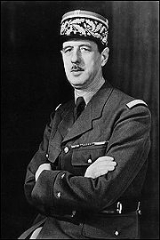
Charles de Gaulle


Charles André Joseph Marie de Gaulle , (in English generally ), (22 November 1890 – 9 November 1970) was a French
French people

French people can refer to:* The legal residents and citizens of France, regardless of ancestry. For a legal discussion, see French nationality law....
 general
General

A General officer is an Officer of high military rank. The term or equivalent is used by nearly every country in the world. General can be used as a generic term for all grades of general officer, or it can specifically refer to a single rank that is just called general....
 and statesman who led the Free French Forces
Free French Forces

File:Croix de Lorraine2.svgThe Free French Forces were France fighters in World War II who decided to continue fighting against Axis powers of World War II forces after the Armistice with France and subsequent German occupation of France in World War II....
 during World War II
World War II

World War II, or the Second World War , was a global military conflict which involved a Participants in World War II, including all of the great powers, organised into two opposing military alliances: the Allies of World War II and the Axis powers....
. He later founded the French Fifth Republic
French Fifth Republic

The Fifth Republic is the fifth and current Republicanism Constitution of France of France, which was introduced on October 5, 1958. The Fifth Republic emerged from the collapse of the French Fourth Republic, replacing a parliamentary government with a semi-presidential system....
 in 1958 and served as its first President from 1959 to 1969. In France, he is commonly referred to as Général de Gaulle or simply Le Général, or familiarly as "le Grand Charles".

A veteran of World War I
World War I

World War I, or the First World War , was a global military conflict which involved the Great powers, organized into two opposing military alliances: the Allies of World War I and the Central Powers....
, in the 1920s and 1930s de Gaulle came to the fore as a proponent of armored warfare and advocate of military aviation, which he considered a means to break the stalemate of trench warfare
Trench warfare

Trench warfare is a form of warfare where both combatants have fortified positions and fighting lines are static. Trench warfare arose when a revolution in fire power was not matched by similar advances in mobility , resulting in a slow and grueling form of defense-oriented warfare in which both sides constructed elaborate and heavily arme...
.


Discussion
Ask a question about 'Charles de Gaulle'
Start a new discussion about 'Charles de Gaulle'
Answer questions from other users
Full Discussion Forum


Timeline

1890   Born

1945   Charles De Gaulle elected head of a French provisional government

1946   Charles de Gaulle resigns as a head of a French provisional government

1946   Charles De Gaulle resigns as president of France

1958   Charles De Gaulle is brought out of retirement to lead France by decree for six months

1958   Charles De Gaulle visits Algeria

1958   General Charles de Gaulle is elected president of France with 78.5% of the votes.

1959   Charles De Gaulle inaugurated as the first president of French Fifth Republic.

1960   March 23 — Nikita Khrushchev meets Charles De Gaulle in Paris.

1960   December 9 — French President Charles de Gaulle's visit to Algeria is marked by bloody riots by European and Muslim mobs in Algeria's largest cities, killing 127 people.


Quotations


Character is the virtue of hard times.

Le caractère, vertu des temps difficiles., in Le fil de l’épée.

France cannot be France without greatness.

La France ne peut être la France sans la grandeur., in Mémoires de guerre.

I have understood you!

Je vous ai compris !, Said before the population of Algiers after they had called upon him to take power, June 4, 1958.

It is better to have a bad method than to have none.

Il vaut mieux avoir une méthode mauvaise plutôt que de n'en avoir aucune., in Le Fil de l’épée.

Men can have friends, statesmen cannot.

Les hommes peuvent avoir des amis, pas les hommes d'Etat., Interview, December 9 1967.

No policy is worth anything outside of reality.

Il n'y a pas de politique qui vaille en dehors des réalités., Televized speech, June 14 1960


Encyclopedia


Charles André Joseph Marie de Gaulle , (in English generally ), (22 November 1890 – 9 November 1970) was a French
French people

French people can refer to:* The legal residents and citizens of France, regardless of ancestry. For a legal discussion, see French nationality law....
 general
General

A General officer is an Officer of high military rank. The term or equivalent is used by nearly every country in the world. General can be used as a generic term for all grades of general officer, or it can specifically refer to a single rank that is just called general....
 and statesman who led the Free French Forces
Free French Forces

File:Croix de Lorraine2.svgThe Free French Forces were France fighters in World War II who decided to continue fighting against Axis powers of World War II forces after the Armistice with France and subsequent German occupation of France in World War II....
 during World War II
World War II

World War II, or the Second World War , was a global military conflict which involved a Participants in World War II, including all of the great powers, organised into two opposing military alliances: the Allies of World War II and the Axis powers....
. He later founded the French Fifth Republic
French Fifth Republic

The Fifth Republic is the fifth and current Republicanism Constitution of France of France, which was introduced on October 5, 1958. The Fifth Republic emerged from the collapse of the French Fourth Republic, replacing a parliamentary government with a semi-presidential system....
 in 1958 and served as its first President from 1959 to 1969. In France, he is commonly referred to as Général de Gaulle or simply Le Général, or familiarly as "le Grand Charles".

A veteran of World War I
World War I

World War I, or the First World War , was a global military conflict which involved the Great powers, organized into two opposing military alliances: the Allies of World War I and the Central Powers....
, in the 1920s and 1930s de Gaulle came to the fore as a proponent of armored warfare and advocate of military aviation, which he considered a means to break the stalemate of trench warfare
Trench warfare

Trench warfare is a form of warfare where both combatants have fortified positions and fighting lines are static. Trench warfare arose when a revolution in fire power was not matched by similar advances in mobility , resulting in a slow and grueling form of defense-oriented warfare in which both sides constructed elaborate and heavily arme...
. During World War II
World War II

World War II, or the Second World War , was a global military conflict which involved a Participants in World War II, including all of the great powers, organised into two opposing military alliances: the Allies of World War II and the Axis powers....
, he reached the rank of Brigadier General
Brigadier General

Brigadier General is the lowest ranking General Officer in some countries, usually sitting between the ranks of Colonel and Major General.The rank can be traced back to the militaries of Europe where a brigadier general, or simply a brigadier, would command a brigade in the field....
, leading one of the few successful armored counter-attacks during the 1940 Fall of France, and then organized the Free French Forces
Free French Forces

File:Croix de Lorraine2.svgThe Free French Forces were France fighters in World War II who decided to continue fighting against Axis powers of World War II forces after the Armistice with France and subsequent German occupation of France in World War II....
 with exiled French officers in England
England

native_name =|conventional_long_name = England|common_name = England|image_flag = Flag of England.svg|image_coat = England COA.svg|symbol_type = Royal Coat of Arms...
. He gave a famous radio address in June 1940, exhorting the French people to resist Nazi Germany
Nazi Germany

Nazi Germany and the Third Reich are the colloquial English names for Germany under the regime of Adolf Hitler and the Nazi Party , which established a Totalitarianism dictatorship that existed from 1933 to 1945....
. Following the liberation of France in 1944, de Gaulle became prime minister
Prime Minister of France

The Prime Minister of France in French Fifth Republic is the functional head of the government and French government ministers of France. The head of state in France is the President of the French Republic....
 in the French Provisional Government
Provisional Government of the French Republic

The Provisional Government of the French Republic was an provisional government government which governed France from 1944 to 1946. Following the Battle of France in 1940 the state of Vichy France had been established under the rule of Philippe P?tain....
. Although he retired from politics in 1946 due to political conflicts, he was returned to power with military support following the May 1958 crisis. De Gaulle led the writing of a new constitution founding the Fifth Republic, and was elected President of France.

As president, Charles de Gaulle ended the political chaos and violence that preceded his return to power. Although he initially supported French rule over Algeria
Algeria

Algeria , officially the People's Democratic Republic of Algeria, is a country located in North Africa. It is the largest country of the Mediterranean sea, second largest in the Arab World, and the second largest on the African continent and the eleventh-largest country in the world in terms of land area....
, he controversially decided to grant independence to that country, ending an expensive and unpopular war. A new currency was issued to control inflation and industrial growth was promoted. De Gaulle oversaw the development of atomic weapons and promoted a pan-European foreign policy, seeking to diminish U.S. and British influence; withdrawing France from the NATO military command
NATO

The North Atlantic Treaty Organization , also called the Atlantic Alliance, is a military alliance established by the signing of the North Atlantic Treaty on 4 April 1949....
, he objected to Britain's entry into the European Community
European Community

The European Community is one of the three pillars of the European Union created under the Maastricht Treaty . It is based upon the principle of supranationalism and has its origins in the European Economic Community, the predecessor of the European Union....
 and he recognized Communist China
People's Republic of China

The People's Republic of China , commonly known as China, is the largest country in East Asia and the List of countries by population in the world with over 1.3 billion people, approximately a fifth of the world's population....
. During his term, de Gaulle also faced controversy and political opposition from Communists
French Communist Party

The French Communist Party is a political party in France which advocates the principles of communism. Although its electoral support has greatly declined in recent decades, it remains the largest party in France advocating communist views, and retains a large membership and considerable influence in French politics....
 and Socialists, and a spate of widespread protests in May 1968. De Gaulle retired in 1969, but remains the most influential leader in modern French history.

Early life and military career

De Gaulle was born in Lille
Lille

Lille is a city in northern France. It is the principal city of the Urban Community of Lille M?tropole, the fourth-largest metropolitan area in the country behind those of Paris, Lyon and Marseille....
, the second of five children of Henri de Gaulle
Henri de Gaulle

Henri de Gaulle was a France bureaucrat and later a teacher. He was the father of Charles de Gaulle, a military general and President of France....
, a professor of philosophy and literature at a Jesuit college, who eventually founded his own school. He was raised in a family of devout Roman Catholics who were nationalist and traditionalist, but also quite progressive.

De Gaulle's father, Henri, came from a long line of aristocrats from Normandy
Normandy

Normandy is a geographical region corresponding to the former Duchy of Normandy. It is situated along the coast of France south of the English Channel between Brittany and Picardy and comprises territory in northern France and the Channel Islands....
 and Burgundy, while his mother, Jeanne Maillot, descended from a family of rich entrepreneurs from the industrial region of Lille
Lille

Lille is a city in northern France. It is the principal city of the Urban Community of Lille M?tropole, the fourth-largest metropolitan area in the country behind those of Paris, Lyon and Marseille....
 in French Flanders
French Flanders

French Flanders is a part of the historical, originally Dutch-speaking region Flanders in present-day France. The region today lies in the modern-day Regions of France of Nord-Pas de Calais, the Departments of France of Nord , and roughly corresponds to the Arrondissements of France of Arrondissement of Lille, Arrondissement of Douai and Arr...
.

According to Henri, the family's true origin was never determined, but could have been Celtic or Flemish. He thought that the name could be derived from the word gaule—a long pole which was used in the Middle Ages to beat olives from the trees. Another source has the name deriving from Galle, meaning "oak" in the Gaulish language
Gaulish language

The Gaulish language is the Celtic language that was spoken in Gaul before the Vulgar Latin of the late Roman Empire became dominant in Roman Gaul....
, and the sacred tree of the druids.

De Gaulle was educated in Paris
Paris

Paris is the Capital of France and the country's largest city. It is situated on the river Seine, in northern France, at the heart of the ?le-de-France Regions of France ....
 at the College Stanislas
Collège Stanislas

Coll?ge Stanislas is the name of three schools:*Coll?ge Stanislas de Paris, France*Coll?ge Stanislas , with two locations in Quebec, Canada*Stanislas College, The Netherlands, The Netherlands...
 and also briefly in Belgium
Belgium

* A small German-speaking Community of Belgium exists in eastern Wallonia. Belgium's linguistic diversity and related political and cultural conflicts are reflected in the history of Belgium and a complex Communities and regions of Belgium....
. Since childhood, he had displayed a keen interest in reading and studying history. Choosing a military career, de Gaulle spent four years studying and training at the elite Saint-Cyr
École Spéciale Militaire de Saint-Cyr

The ?cole Sp?ciale Militaire de Saint-Cyr is the foremost France military academy. It is often referred to as Saint-Cyr. Its motto is "Ils s'instruisent pour vaincre": literally "They study to vanquish." or "Training for victory"....
. While there, and because of his height, high forehead, and nose, he acquired the nicknames of "the great asparagus". and "Cyrano". Graduating in 1912, he joined the 33rd infantry
Infantry

Infantry are soldiers who are primarily trained for the role of fighting on foot. A soldier in the infantry is known as an infantryman. Infantry units have more physically demanding training than other branches of armies, and place a greater emphasis on fitness, physical strength and aggression....
 regiment
Regiment

A regiment is a military unit, composed of variable numbers of battalions, commanded by a Colonel. Depending on the nation, military branch, mission, and organization, a modern regiment resembles a brigade, in that both range in size from a few hundred to 5,000 soldiers ....
 of the French Army
French Army

The French Army, officially the Arm?e de Terre , is the Army component of the Military of France and its largest. As of 2007, the army employs 134,000 regular soldiers, 15,500 reservists, and 25,750 civilians....
, based at Arras
Arras

Arras is the capital of the Pas-de-Calais Departments of France in northern France. The historic centre of the Artois region, its local speech is characterized as a Picard language dialect....
. While serving during World War I
World War I

World War I, or the First World War , was a global military conflict which involved the Great powers, organized into two opposing military alliances: the Allies of World War I and the Central Powers....
, he was wounded and captured at Douaumont in the Battle of Verdun
Battle of Verdun

The Battle of Verdun was one of the most critical List of World War I Battles in World War I on the Western Front . It was fought between the German Army and France armies, from 21 February to 15 December 1916, on hilly terrain north of the city of Verdun in northeastern France....
 in March 1916. While being held as a prisoner of war
Prisoner of war

A prisoner of war is a combatant who is held in continuing custody by an enemy power during or immediately after an armed conflict....
 by the German Army
German Army

The German Army is the land component of the armed forces of the Federal Republic of Germany. Traditionally the German military forces have been composed of the Army, the Deutsche Marine, and an Luftwaffe after World War I....
, de Gaulle wrote his first book, co-written by Matthieu Butler, "L'Ennemi et le vrai ennemi" (The Enemy and the True Enemy), analyzing the issues and divisions within the German Empire
German Empire

The German Empire is the name commonly used in English to describe Germany from the unification of Germany and proclamation of William I, German Emperor as German Emperor on 18 January 1871, to 1918, when it became Weimar republic after defeat in World War I and the abdication of William II, German Emperor ....
 and its forces; the book was published in 1924. After the armistice
Armistice

An armistice is a situation in a war where the warring parties agree to stop fighting. It is not necessarily the end of a war, but may be just a cessation of hostilities while an attempt is made to negotiate a lasting peace....
, de Gaulle continued to serve in the army and on the staff of General Maxime Weygand
Maxime Weygand

Maxime Weygand was a France military commander in World War I and World War II. Though not as infamous as Philippe Petain, Weygand is remembered for initially fighting the Battle of France, then surrendering to and collaborating with the Germans as part of the Vichy France regime....
's military mission to Poland
French Military Mission to Poland

The French Military Mission to Poland was an effort by France to aid the nascent Second Polish Republic after it achieved its independence in November, 1918, at the end of the First World War....
 during its war with Communist Russia
Polish-Soviet War

The Polish-Soviet War was an armed conflict of Russian SFSR and Ukrainian Soviet Socialist Republic against the Second Polish Republic and the short-lived Ukrainian People's Republic, four states in post-World War I Europe....
 (1919-1921), working as an instructor to Polish infantry forces. He distinguished himself in operations near the River Zbrucz and won the highest Polish military decoration, the Virtuti Militari
Virtuti Militari

The Order Virtuti Militari is Poland's highest military decoration for courage in the face of the enemy. It was created in 1792) by King of Poland Stanislaus II of Poland and is considered as one of the oldest military decorations in the world still in use....
.

He was promoted to Commandant
Commandant

Commandant is a military or police title or rank....
 and offered a further career in Poland
Poland

Poland , officially the Republic of Poland , is a country in Central Europe. Poland is bordered by Germany to the west; the Czech Republic and Slovakia to the south; Ukraine, Belarus and Lithuania to the east; and the Baltic Sea and Kaliningrad Oblast, a Russian Enclave and exclave, to the north....
, but chose instead to return to France, where he served as a staff officer and also taught at the École Militaire
École Militaire

The ?cole Militaire is a vast complex of buildings housing various military teaching facilities located in Paris, France, southeast of the Champ de Mars....
, becoming a protégé of his old commander, Marshall Pétain. De Gaulle was heavily influenced by the use of tanks, rapid maneuvers and limited trench warfare.

In the 1930s - early 1940s, de Gaulle wrote various books and articles on military subjects that revealed him to be a gifted writer and an imaginative thinker. In 1931, he published Le fil de l’épée (Eng. tr., The Edge of the Sword, 1960), an analysis of military and political leadership. He also published Vers l’armée de métier (1934; Eng. tr., The Army of the Future, 1941) and La France et son armée (1938; Eng. tr., France and Her Army, 1945). He urged the creation of a mechanised army with special armoured divisions manned by a corps of professional specialist soldiers instead of the static theories exemplified by the Maginot Line
Maginot Line

The Maginot Line , named after French Minister of Defence Andr? Maginot, was a line of concrete fortifications, tank obstacles, artillery casemates, machine gun posts, and other defenses, which France constructed along its borders with Germany and Italy, in the light of experience from World War I, and in the run-up to World War II....
. While views similar to de Gaulle's were later advanced by Britain's J.F.C. Fuller
J.F.C. Fuller

Major-General John Frederick Charles Fuller Order of the Bath, Order of the British Empire, Distinguished Service Order, commonly J.F.C. Fuller, , was a British Army officer, military history and military strategy, notable as an early theorist of modern armoured warfare, including categorising Principles of Warfare....
, Germany's Heinz Guderian
Heinz Guderian

Heinz Wilhelm Guderian was a Theorist and innovative General of the Nazi Germany Wehrmacht during the World War II. Germany's panzer forces were raised and fought according to his works, best-known among them Achtung? Panzer! He held posts as Panzer Corps commander, Panzer Army commander, Inspector-General of Armoured Troops, and Chief...
, United States' Dwight D. Eisenhower
Dwight D. Eisenhower

Dwight David ?Ike? Eisenhower was the List of Presidents of the United States President of the United States from 1953 until 1961 and a General of the Army in the United States Army....
 and George S. Patton
George S. Patton

George Smith Patton, Jr. was a distinguished though controversial United States Army officer.Commissioned in the army in 1909, Patton participated in the Pancho Villa Expedition to capture Pancho Villa in 1916-17....
, Russia's Mikhail Tukhachevsky
Mikhail Tukhachevsky

Mikhail Nikolayevich Tukhachevsky was a Soviet Union military commander, chief of the Red Army , and one of the most prominent victims of Joseph Stalin Great Purge of the late 1930s....
, and Poland's General Wladyslaw Sikorski
Wladyslaw Sikorski

Wladyslaw Eugeniusz Sikorski was a Poland military and political leader. He was born in Tusz?w Narodowy a village in the present-day Subcarpathian Voivodeship of south-eastern Poland, which at the time was part of Austria-Hungary, one of Poland's three Partitions of Poland....
, most of de Gaulle's theories were rejected by other French army officers, including his mentor Pétain with whom relations consequently became strained. According to Albert Speer
Albert Speer

Albert Speer was a Germany architect who was, for part of World War II, Minister of Armaments and War Production for the Nazi Germany. Speer was Adolf Hitler's chief architect before assuming ministerial office....
, Adolf Hitler
Adolf Hitler

Adolf Hitler was an Austrian-born Germany politician and the leader of the National Socialist German Workers Party , popularly known as the Nazi Party....
 himself claimed to have planned the invasion of western Europe with De Gaulle's theories in mind. French politicians also dismissed de Gaulle's ideas, questioning the political reliability of a professional army — with the notable exception of Paul Reynaud
Paul Reynaud

Paul Reynaud was a France politician and lawyer prominent in the interwar period, noted for his stances on economic liberalism and militant opposition to Germany....
, who would play a major role in de Gaulle's career. De Gaulle would have some contacts with Ordre Nouveau
Ordre Nouveau

Ordre Nouveau has been the name of three different organisations in France....
, a Non-Conformist
Non-conformists of the 1930s

The Non-Conformists of the 1930s refers to a nebula of groups and individuals during the inter-war period in France in the twentieth century which was looking for new solutions to face the political, Great Depression in France and social crisis....
 group at the end of 1934 and the beginning of 1935.

Free French leader during World War II

At the outbreak of World War II, de Gaulle was only a colonel
Colonel

Colonel is a military rank of a commissioned officer, with corresponding ranks existing in almost every country in the world. It is also used in some police forces and other paramilitary rank structures....
, having antagonised the leaders of the military through the 1920s and 1930s with his bold views. Initially commanding a tank brigade in the French 5th Army, de Gaulle implemented many of his theories and tactics for armoured warfare. After the German breakthrough at Sedan
Sedan, France

Sedan is a town and communes of France in France, a Subprefectures in France of the Ardennes Departments of France in northern France....
 on 15 May 1940 he was given command of the 4th Armored Division. On 17 May, de Gaulle attacked German
Nazi Germany

Nazi Germany and the Third Reich are the colloquial English names for Germany under the regime of Adolf Hitler and the Nazi Party , which established a Totalitarianism dictatorship that existed from 1933 to 1945....
 tank forces at Montcornet
Montcornet

Montcornet is the name of several communes of France:* Montcornet, Aisne, in the Aisne department* Montcornet, Ardennes, in the Ardennes department...
 with 200 tanks but no air support; on 28 May, de Gaulle's tanks forced the German infantry to retreat to Caumont
Caumont

Caumont is the name or part of the name of several communes in France:*Caumont, Aisne*Caumont, Ari?ge*Caumont, Eure*Caumont, Gers*Caumont, Gironde...
—some of the few tactical successes the French enjoyed while suffering defeats across the country. De Gaulle was promoted to the rank of brigadier general
Brigadier General

Brigadier General is the lowest ranking General Officer in some countries, usually sitting between the ranks of Colonel and Major General.The rank can be traced back to the militaries of Europe where a brigadier general, or simply a brigadier, would command a brigade in the field....
, which he would hold for the rest of his life.

On 6 June, Prime Minister Paul Reynaud
Paul Reynaud

Paul Reynaud was a France politician and lawyer prominent in the interwar period, noted for his stances on economic liberalism and militant opposition to Germany....
 appointed him Undersecretary of State for National Defense and War and put him in charge of coordination with the United Kingdom
United Kingdom

The United Kingdom of Great Britain and Northern Ireland, commonly known as the United Kingdom , the UK or Britain,is a sovereign state located off the northwestern coast of continental Europe....
. As a junior member of the French government, he unsuccessfully opposed surrender, advocating instead that the government remove itself to North Africa and carry on the war as best it could from France's African colonies. While serving as a liaison with the British government, de Gaulle telephoned Paul Reynaud, the French prime minister, from London on 16 June informing him of the offer by Britain of a Declaration of Union. This would have in effect merged France and the United Kingdom into a single country, with a single government and a single army for the duration of the war. This was a desperate last-minute effort to strengthen the resolve of those members of the French government who were in favor of fighting on.

The man behind the offer of a declaration of union was Jean Monnet
Jean Monnet

Jean Omer Marie Gabriel Monnet is regarded by many as a chief architect of European Unity. Never elected to public office, Monnet worked behind the scenes of American and European governments as a well-connected pragmatic internationalist....
, who was based in London as President of the Franco-British Committee of Co-operation. Monnet had first sought the advice of Desmond Morton
Desmond Morton

There are several people named Desmond Morton:* Desmond Morton , a British military officer and government official* Desmond Morton , a Canadian historian...
, Churchill's Personal Assistant, who suggested that the proposal be put to Churchill through Neville Chamberlain
Neville Chamberlain

Arthur Neville Chamberlain was a British Conservative Party politician and Prime Minister of the United Kingdom from 1937 to 1940. Chamberlain is best known for appeasement foreign policy, in particular regarding his signing of the Munich Agreement in 1938, conceding the Sudetenland region of Czechoslovakia to Germany, and for his "containm...
. The latter interceded with Churchill and the idea was put before the Cabinet, where it was approved. The final document was drafted by Robert Vansittart
Robert Vansittart

Robert Vansittart may refer to:*Robert Gilbert Vansittart , British diplomat*Robert Vansittart , British jurist and member of the Hellfire Club...
, Permanent Secretary to the Foreign Office, in conjunction with Monnet himself, Desmond Morton
Desmond Morton

There are several people named Desmond Morton:* Desmond Morton , a British military officer and government official* Desmond Morton , a Canadian historian...
, Churchill's Personal Assistant, Sir Arthur Salter, MP for Oxford University, and Monnet's deputy at the Franco-British Committee of Co-operation, René Pleven
René Pleven

Ren? Pleven was a notable French politician of the French Fourth Republic. A member of the Free French, he helped found the Democratic and Socialist Union of the Resistance , a political party that was meant to be a successor to the wartime Resistance movement....
.

When the proposal was put before Churchill, he was initially unenthusiastic. However, de Gaulle managed to convince him that "some dramatic move was essential to give Reynaud the support which he needed to keep his Government in the war". Yet despite his endorsement of the extraordinary proposal at the time, de Gaulle later sought to distance himself from it. During an interview in 1964, which was reported in Paris Match shortly after the general's death, de Gaulle had remarked that he and Churchill had tried to improvise something but that neither of them had any illusions. It had been a myth, like other myths, dreamed up by Jean Monnet. This report brought an instant rebuttal from Monnet, who insisted that he had personally informed de Gaulle of the proposition and that the latter had simply acquiesced, albeit with great hesitation. De Gaulle's intervention in the matter had been later.
De Gaulle Radio
Returning the same day to Bordeaux
Bordeaux

is a Port city on the Garonne in southwest France, with one million inhabitants in its aire urbaine at a 2008 estimate. It is the Capital of the Aquitaine regions of France, as well as the Prefectures in France of the Gironde Departments of France....
, the temporary wartime capital, de Gaulle learned that Field Marshall Pétain had become prime minister and was planning to seek an armistice
Armistice

An armistice is a situation in a war where the warring parties agree to stop fighting. It is not necessarily the end of a war, but may be just a cessation of hostilities while an attempt is made to negotiate a lasting peace....
 with Nazi Germany. De Gaulle and allied officers rebelled against the new French government; on the morning of 17 June, de Gaulle and other senior French officers fled the country with 100,000 gold francs in secret funds provided to him by the ex-prime minister Paul Reynaud. Narrowly escaping the Luftwaffe
Luftwaffe

is a generic German term for an air force. It is also the official name for two of the four historic German air forces, the Wehrmacht air arm founded in 1933 and disbanded in 1946; and the current Bundeswehr air arm founded in 1956....
, he landed safely in London
London

London is the capital of both England and the United Kingdom, and the most populous municipality in the European Union. An important settlement for two millennia, History of London goes back to its founding by the Roman Empire....
 that afternoon. De Gaulle strongly denounced the French government's decision to seek peace with the Nazis and set about building the Free French Forces
Free French Forces

File:Croix de Lorraine2.svgThe Free French Forces were France fighters in World War II who decided to continue fighting against Axis powers of World War II forces after the Armistice with France and subsequent German occupation of France in World War II....
 out of the soldiers and officers who were deployed outside France and in its colonies or had fled France with him. On 18 June, de Gaulle delivered a famous radio address via the BBC radio service. Although the British cabinet initially attempted to block the speech, they were overruled by Churchill. De Gaulle's Appeal of 18 June exhorted the French people to not be demoralised and to continue to resist the occupation of France and work against the Vichy regime
Vichy France

Vichy France, or the Vichy regime are the common terms used to describe the government of France from July 1940 to August 1944. This government, which succeeded the French Third Republic, officially called itself the French State , in contrast with the previous designation, "French Republic." Marshal of France Philippe P?tain pro...
, which had allied itself with Nazi Germany. Although the original speech could only be heard in a few parts of occupied France, de Gaulle's subsequent ones reached many parts of the territories under the Vichy regime, helping to rally the French resistance movement and earning him much popularity amongst the French people and soldiers. On 4 July 1940, a court-martial
Court-martial

A court-martial is a military court. These military courts can determine punishments for members of the military subject to military law who are found guilty or may dismiss the charges based on the evidence and the case presented....
 in Toulouse
Toulouse

Toulouse is a commune of France in southwest France on the banks of the Garonne, half-way between the Atlantic Ocean and the Mediterranean Sea....
 sentenced de Gaulle in absentia to four years in prison. At a second court-martial on 2 August 1940 de Gaulle was condemned to death for treason
Treason

In law, treason is the crime that covers some of the more serious acts of loyalty to one's sovereignty or nation. Historically, treason also covered the murder of specific social superiors, such as the murder of a husband by his wife ....
 against the Vichy regime
Vichy France

Vichy France, or the Vichy regime are the common terms used to describe the government of France from July 1940 to August 1944. This government, which succeeded the French Third Republic, officially called itself the French State , in contrast with the previous designation, "French Republic." Marshal of France Philippe P?tain pro...
.

With British support, de Gaulle settled himself in Berkhamstead (36 miles northwest of London) and began organising the Free French forces. Gradually, the Allies gave increasing support and recognition to de Gaulle's efforts. In dealings with his British allies and the United States
United States

The United States of America is a Federal government constitutional republic comprising U.S. state and a federal district. The country is situated mostly in central North America, where its Contiguous United States and Washington, D.C., the Capital districts and territories, lie between the Pacific Ocean and Atlantic Oceans, Borders of the U...
, de Gaulle insisted at all times on retaining full freedom of action on behalf of France, and he was constantly on the verge of being cut off by the Allies. He harbored a suspicion of the British in particular, believing that they were surreptitiously seeking to steal France's colonial possessions in the Levant
Levant

The Levant describes, traditionally, the Eastern Mediterranean at large, but can be used as a geographical term that denotes a large area in Western Asia formed by the lands bordering the Eastern shores of the Mediterranean, roughly bounded on the north by the Taurus Mountains, on the south by the Arabian Desert, and on the west by the M...
. Clementine Churchill, who admired de Gaulle, once cautioned him, "General, you must not hate your friends more than you hate your enemies." De Gaulle himself stated famously, "France has no friends, only interests." The situation was nonetheless complex, and de Gaulle's mistrust of both British and U.S. intentions with regards to France was mirrored in particular by a mistrust of the Free French among the U.S. political leadership, who for a long time refused to recognise de Gaulle as the representative of France, preferring to deal with representatives of the Vichy government. Roosevelt in particular hoped that it would be possible to wean Pétain away from Germany.

Working with the French resistance
French Resistance

File:Croix de Lorraine2.svgThe French Resistance is the collective name used for the French resistance movements which fought against the Nazi Germany German occupation of France in World War II and the collaborationist Vichy Regime during World War II....
 and supporters in France's colonial African possessions after the Anglo-U.S. invasion of North Africa
Operation Torch

Operation Torch was the United Kingdom-United States invasion of French North Africa in World War II during the North African Campaign, started 8 November 1942....
 in November 1942, de Gaulle moved his headquarters to Algiers
Algiers

Algiers Nicknamed El-Bahdja or Alger la Blanche for the glistening white of its buildings as seen rising up from the sea, Algiers is situated on the west side of a bay of the Mediterranean Sea....
 in May, 1943. He became first joint head (with the less resolutely independent General Henri Giraud
Henri Giraud

Henri Honor? Giraud was a France general who fought in World War I and World War II. Captured in both wars, he escaped each time. After his second escape, he joined the Free French Forces....
, the candidate preferred by the U.S.) and then sole chairman of the French Committee of National Liberation
French Committee of National Liberation

The French Committee of National Liberation was a body formed by the French people leaders Gens. Henri Giraud and Charles de Gaulle to provide united leadership, organize and coordinate the campaign to liberate France from Nazi Germany during World War II....
.

At the liberation of France
France

France , officially the French Republic , is a country whose Metropolitan France is located in Western Europe and that also comprises various Overseas departments and territories of France....
 following Operation Overlord
Operation Overlord

Operation Overlord was the code name for the invasion of Western Front during World War II by Western Allies forces. The operation began with the Normandy Landings on 6 June 1944 , among the largest amphibious warfares ever conducted....
, he quickly established the authority of the Free French Forces
Free French Forces

File:Croix de Lorraine2.svgThe Free French Forces were France fighters in World War II who decided to continue fighting against Axis powers of World War II forces after the Armistice with France and subsequent German occupation of France in World War II....
 in France, avoiding an Allied Military Government for Occupied Territories
Allied Military Government for Occupied Territories

The Allied Military Government for Occupied Territories was the form of military rule administered by Allied forces during and after World War II within European territories they occupied....
. He flew into France from the French colony of Algeria
French rule in Algeria

French rule of Algeria lasted from 1830 to 1962, under a variety of governmental systems. One of France's longest-held overseas territories, Algeria became a destination for hundreds of thousands of European ethnic groups immigrants, known as colons and later, as pied-noirs....
 a few days before the liberation of Paris, and drove near the front of the liberating forces into the city alongside Allied officials. De Gaulle made a famous speech emphasizing the role of France's people in her liberation. After his return to Paris, he moved back into his office at the War Ministry, thus proclaiming continuity of the Third Republic
French Third Republic

The French Third Republic was the political regime of France between the Second French Empire and the Vichy France. It was a republican parliamentary democracy that was created on 4 September 1870 following the collapse of the Empire of Napoleon III of France in the Franco-Prussian War....
 and denying the legitimacy of the Vichy regime.

He served as President of the Provisional Government of the French Republic
Provisional Government of the French Republic

The Provisional Government of the French Republic was an provisional government government which governed France from 1944 to 1946. Following the Battle of France in 1940 the state of Vichy France had been established under the rule of Philippe P?tain....
 starting in September, 1944. As such he sent the French Far East Expeditionary Corps
French Far East Expeditionary Corps

The French Far East Expeditionary Corps was a colonial expeditionary force of the French Army sent in French Indochina in 1945 during the Pacific War....
 to re-establish French sovereignty in French Indochina
French Indochina

French Indochina was the part of the French colonial empire in Indochina in southeast Asia. A federation of the three Vietnamese regions, Tonkin, Annam, and Cochinchina, as well as Cambodia, was formed in 1887....
 in 1945. He made Admiral d'Argenlieu
Georges Thierry d'Argenlieu

Georges Thierry d'Argenlieu, in religion Louis de la Trinit? was a priest, diplomat and French Navy officer and admiral; he became one of the major personalities of the Free French Forces and the Forces navales fran?aises libres....
 High commissioner of French Indochina and General Leclerc
Philippe Leclerc de Hauteclocque

Philippe Leclerc de Hauteclocque , was a France general during World War II; he became Marshal of France posthumously, in 1952.He was born Philippe Fran?ois Marie, Count de Hauteclocque, but changed his legal name in 1945 to incorporate his French resistance pseudonym Jacques-Philippe Leclerc....
 commander-in-chief in French Indochina and commander of the expeditionary corps. Under de Gaulle's leadership, a joint force of his Free French together with French colonial troops from North Africa enabled France to field an entire army on the western front after Operation Dragoon
Operation Dragoon

Operation Dragoon was the Allies invasion of southern France, on August 15, 1944, as part of World War II. The invasion took place between Toulon and Cannes....
, the invasion of southern France. This force, the French First Army
French First Army

The First Army was a field army of France that fought during World War I and World War II. It was also active during the Cold War....
, helped to liberate almost one third of the country and meant that France actively rejoined the Allies in the struggle against Germany. The French First Army captured a large section of German territory after the allied invasion thus enabling France to be an active participant in the signing of the German surrender. Also, through the intervention of the British and Americans at Yalta
Yalta

Yalta is a city in Crimea, southern Ukraine, on the north coast of the Black Sea.The city is located on the site of an ancient Greece colony, said to have been founded by Greek sailors who were looking for a safe shore on which to land....
 and despite the resistance of the Russians, a French zone of occupation was created in Germany. De Gaulle finally resigned on 20 January 1946, complaining of conflict between the political parties, and disapproving of the draft constitution for the Fourth Republic
French Fourth Republic

The Fourth Republic was the republicanism government of France between 1946 and 1958, governed by the fourth republican Constitution of France. It was in many ways a revival of the French Third Republic, which was in place before World War II, and suffered many of the same problems....
, which he believed placed too much power in the hands of a parliament with its shifting party alliances. He was succeeded by Félix Gouin
Félix Gouin

F?lix Gouin was a France Socialist politician, member of the SFIO....
 (SFIO
Sfio

Sfio, or Safe/Fast String/File I/O, is a C I/O Library developed by David Korn and Kiem-Phong Vo AT&T Labs Research, intended as a replacement for the standard C stdio.h....
), then Georges Bidault
Georges Bidault

Georges-Augustin Bidault was a France politician. During World War II, he was active in the French Resistance. After the war, he served as foreign minister and prime minister on several occasions before he joined the Organisation arm?e secr?te....
 (MRP
MRP

The initialism MRP or M.R.P. can stand for many things:* Material Requirements Planning or Material resource planning and Manufacturing resource planning ...
) and finally Léon Blum
Léon Blum

Andr? L?on Blum , was a France politician, usually identified with the moderate left, and three times the Prime Minister of France....
 (SFIO).

1946–58: Out of power

De Gaulle's opposition to the proposed constitution failed as the parties of the left supported a parliamentary regime. The second draft constitution narrowly approved at the referendum of October 1946 was even less to de Gaulle's liking than the first. He then returned to his home at Colombey-les-Deux-Eglises
Colombey-les-Deux-Églises

Colombey-les-Deux-?glises is a Communes of France in the Haute-Marne Departments of France in northeastern France.The municipality Colombey-les-Deux-Eglises was created administratively in 1793, and it became part of the district of Chaumont and the canton Blaise....
 to write his war memoirs.

In April 1947 de Gaulle made a renewed attempt to transform the political scene by creating a Rassemblement du Peuple Français (Rally of the French People, or RPF), but after initial success the movement lost momentum. In May 1953, he withdrew again from active politics, though the RPF lingered until September 1955.

He once more retired to his country home to continue his war memoirs, Mémoires de guerre. During this period of formal retirement, however, de Gaulle maintained regular contact with past political lieutenants from wartime and RPF days, including sympathizers involved in political developments in French Algeria.

1958: Collapse of the Fourth Republic

The Fourth Republic
French Fourth Republic

The Fourth Republic was the republicanism government of France between 1946 and 1958, governed by the fourth republican Constitution of France. It was in many ways a revival of the French Third Republic, which was in place before World War II, and suffered many of the same problems....
 was tainted by political instability, failures in Indochina
French Indochina

French Indochina was the part of the French colonial empire in Indochina in southeast Asia. A federation of the three Vietnamese regions, Tonkin, Annam, and Cochinchina, as well as Cambodia, was formed in 1887....
 and inability to resolve the Algerian question
Algerian War of Independence

The Algerian War , also known as Algerian War of Independence, led to Algeria's independence from France. An important decolonization war, it was a complex conflict characterized by guerrilla warfare, maquis fighting, terrorism against civilians, use of torture on both sides and counter-terrorism operations by the French Army....
. It did, however, pass the 1956 loi-cadre Deferre which granted independence to Tunisia
Tunisia

Tunisia , officially the Tunisian Republic , is a country located in North Africa. It is bordered by Algeria to the west and Libya to the southeast....
 and Morocco
Morocco

Morocco , officially the Kingdom of Morocco , is a country located in North Africa with a population of nearly 34 million and an area just under 447,000 km2....
, while the Premier Pierre Mendès-France
Pierre Mendès-France

Pierre Mend?s France , France politician, was born in Paris, into a family of "mixed" Portugal - Sephardic and Ashkenazi Jewish origin....
 put an end to the Indochina War through the Geneva Conference
Geneva Conference (1954)

The Geneva Conference was a conference between many countries that agreed to end hostilities and restore peace in French Indochina and Vietnam....
 of 1954.

On 13 May 1958, settlers seized the government buildings in Algiers, attacking what they saw as French government weakness in the face of demands among the Arab majority for Algerian independence. A "Committee of Civil and Army Public Security" was created under the presidency of General Jacques Massu
Jacques Massu

Jacques ?mile Massu was a France general who fought in World War II, First Indochina War, Algerian War and the Suez crisis....
, a Gaullist sympathizer. General Raoul Salan
Raoul Salan

Raoul Albin Louis Salan was a French Army general and the fourth France commanding general during the First Indochina War. Salan was one of four generals who organized the 1961 Algiers putsch of 1961 operation and then founded the Organisation de l'arm?e secr?te....
, Commander-in-Chief in Algeria, announced on radio that he was assuming provisional power, and appealed for "confidence in the Army and its leaders".

Under the pressure of Massu, Salan declared Vive de Gaulle! from the balcony of the Algiers Government-General building on 15 May. De Gaulle answered two days later that he was ready to "assume the powers of the Republic". Many worried as they saw this answer as support for the army.

At a 19 May press conference, de Gaulle asserted again that he was at the disposal of the country. As a journalist expressed the concerns of some who feared that he would violate civil liberties, de Gaulle retorted vehemently:
"Have I ever done that? Au contraire, I have reestablished them when they had disappeared. Who honestly believes that, at age 67, I would start a career as a dictator?"


A republican by conviction, de Gaulle maintained throughout the crisis that he would accept power only from the lawfully constituted authorities.

The crisis deepened as French paratroops from Algeria seized Corsica
Corsica

Corsica is the Mediterranean islands#By area in the Mediterranean Sea . It is located west of Italy, southeast of the France mainland, and north of the island of Sardinia....
 and a landing near Paris was discussed (Operation Resurrection
Operation Resurrection

Operation Resurrection was a planned military operation of the French Army that sought to take over the capital Paris in order to force the return of France leader Charles de Gaulle to head the government....
). Political leaders on many sides agreed to support the General's return to power, except François Mitterrand
François Mitterrand

Fran?ois Maurice Adrien Marie Mitterrand served as President of France from 1981 to 1995, elected as representative of the French Socialist Party ....
, Pierre Mendès-France
Pierre Mendès-France

Pierre Mend?s France , France politician, was born in Paris, into a family of "mixed" Portugal - Sephardic and Ashkenazi Jewish origin....
, Alain Savary
Alain Savary

Alain Savary was a French Socialist politician, deputy during the French Fourth Republic and French Fifth Republic, chairman of the Socialist Party and who held ministerial functions in the 1950s and in 1981, when he was nominated by President Fran?ois Mitterrand as Minister of National Education....
, the Communist Party, and certain other leftists. On 29 May the French President, René Coty
René Coty

Ren? Jules Gustave Coty was President of France from 1954 to 1959. He was the second and last president under the French Fourth Republic....
, appealed to the "most illustrious of Frenchmen" to confer with him and to examine what was immediately necessary for the creation of a government of national safety, and what could be done to bring about a profound reform of the country's institutions.

De Gaulle remained intent on replacing the constitution of the Fourth Republic, which he blamed for France's political weakness. (Indeed he had resigned 12 years previously because he believed the parties made the task of government too difficult.) He set as a condition for his return that he be given wide emergency powers for six months and that a new constitution be proposed to the French people
French people

French people can refer to:* The legal residents and citizens of France, regardless of ancestry. For a legal discussion, see French nationality law....
. On 1 June 1958, de Gaulle became Premier and was given emergency powers for six months by the National Assembly
National Assembly

The National Assembly is either a legislature, or the lower house of a bicameral legislature in some countries. The best known National Assembly, and the first legislature to be known by this title, was that established during the French Revolution in 1789, known as the National Assembly ....
.

On 28 September 1958, a referendum
French constitutional referendum, 1958

Following the political crisis that marked the end of the French Fourth Republic in 1958, a referendum on the adoption of a constitution for the French Fifth Republic was held....
 took place and 79.2 percent of those who voted supported the new constitution and the creation of the Fifth Republic
French Fifth Republic

The Fifth Republic is the fifth and current Republicanism Constitution of France of France, which was introduced on October 5, 1958. The Fifth Republic emerged from the collapse of the French Fourth Republic, replacing a parliamentary government with a semi-presidential system....
. The colonies (Algeria was officially a part of France, not a colony) were given the choice between immediate independence
Independence

Independence is the self-government of a nation, country, or state by its residents and population, or some portion thereof, generally exercising sovereignty....
 and the new constitution. All African colonies voted for the new constitution and the replacement of the French Union
French Union

The French Union was a political entity created by the French Fourth Republic to replace the old French colonial system, the "French colonial empire" and to abolish its "indigenous" status....
 by the French Community
French Community

The French Community was the political entity that replaced the French Union, in 1958. The French Union was the descendant of the French colonial empires following the World War II....
, except Guinea
Guinea

Guinea, officially Republic of Guinea , is a country in West Africa formerly known as French Guinea. The country's current population is estimated at 10,211,437 ....
, which thus became the first French African colony to gain independence, at the cost of the immediate ending of all French assistance.

According to de Gaulle, the head of state should represent "the spirit of the nation" to the nation itself and to the world: "une certaine idée de la France" (a certain idea of France).

1958–62: Founding of the Fifth Republic

in 1961 at the Köln/Bonn airport]] In the November 1958 elections, de Gaulle and his supporters (initially organised in the Union pour la Nouvelle République-Union Démocratique du Travail, then the Union des Démocrates pour la Vème République, and later still the Union des Démocrates pour la République
Union des Démocrates pour la République

Union of Democrats for the Republic was a Gaullist political party of France from 1971 to 1976.It was the successor to Charles de Gaulle's earlier party, Rally of the French People, and was organised in 1958, along with the founding of the French Fifth Republic as the Union pour la nouvelle R?publique , and in 1962 merged with the Democrat...
, UDR) won a comfortable majority. In December, de Gaulle was elected President by the electoral college
French presidential election, 1958

The French presidential election of 1958, the first of the French Fifth Republic, took place on December 21, 1958. This was the only French presidential election by the electoral college ....
 with 78% of the vote, and inaugurated in January 1959.

He oversaw tough economic measures to revitalize the country, including the issuing of a new franc
Franc

The franc is the name of several currency units, most notably the French franc, the currency of France until it adopted the euro in 1999 , and the Swiss franc, still a major world currency today due to the prominence of Switzerland Banking in Switzerland....
 (worth 100 old francs). Internationally, he rebuffed both the United States
United States

The United States of America is a Federal government constitutional republic comprising U.S. state and a federal district. The country is situated mostly in central North America, where its Contiguous United States and Washington, D.C., the Capital districts and territories, lie between the Pacific Ocean and Atlantic Oceans, Borders of the U...
 and the Soviet Union
Soviet Union

The Union of Soviet Socialist Republics was a Constitution of the Soviet Union socialist state that existed in Eurasia from 1922 to 1991.The name is a translation of the , romanization of Russian Soyuz Sovetskikh Sotsialisticheskikh Respublik, abbreviated ????, SSSR....
, pushing for an independent France with its own nuclear weapon
Nuclear weapon

A nuclear weapon is an explosive device that derives its destructive force from nuclear reactions, either nuclear fission or a combination of fission and nuclear fusion....
s, and strongly encouraged a "Free Europe", believing that a confederation of all European nations would restore the past glories of the great European empires. He set about building Franco-German cooperation
Franco-German cooperation

The relations between France and Germany is embodied in a cooperation called Franco-German Partnership . This came about after 1945, when a French-German enmity between the two countries ended....
 as the cornerstone of the European Economic Community
European Community

The European Community is one of the three pillars of the European Union created under the Maastricht Treaty . It is based upon the principle of supranationalism and has its origins in the European Economic Community, the predecessor of the European Union....
 (EEC), paying the first state visit
State visit

A state visit is a formal visit by one head of state to another country, at the invitation of the other country's head of state. State visits are the highest form of diplomatic contact between two states, and are marked by major ceremonial and diplomatic formality....
 to Germany
West Germany

West Germany was the common English name for the Germany , from its formation in May 1949 to German reunification in October 1990, when East Germany was dissolved and its States of Germany became part of the Federal Republic, ending the more than 40-year division of Germany....
 by a French head of state since Napoleon. In January 1963, Germany and France signed a treaty of friendship, the Élysée Treaty
Élysée Treaty

File:Bundesarchiv B 145 Bild-P106816, Paris, Unterzeichnung Elys?e-Vertrag.jpg?lys?e Treaty also known as the Treaty of Friendship, was concluded by Charles de Gaulle and Konrad Adenauer in 1963....
. France also reduced its dollar
Dollar

The dollar is the name of the official currency in several countries, including the US, Australia, and Canada, dependencies and other world regions....
 reserves, trading them for gold
Gold

Gold is a chemical element with the symbol Au and atomic number 79. It is a highly sought-after precious metal, having been used as money, as a store of value, in jewelry, in sculpture, and for ornamentation since the beginning of recorded history....
 from the U.S. government, thereby reducing the US' economic influence abroad.

On 23 November 1959, in a speech in Strasbourg
Strasbourg

Strasbourg is the capital and principal city of the Alsace Regions of France in northeastern France. With 702,412 inhabitants in 2007, its metropolitan area is the Aire urbaine....
, de Gaulle announced his vision for Europe:

His expression, "Europe, from the Atlantic to the Urals", has often been cited throughout the history of European integration
European integration

European integration is the process of political, legal, economic integration of European states, including some states that are partly in Europe....
. It became, for the next ten years, a favourite political rallying cry of de Gaulle's. His vision stood in contrast to the Atlanticism
Atlanticism

Atlanticism is a philosophy of cooperation among Western European and North American nations regarding political, economic, and defense issues, with the purpose to maintain the security of the participating countries, and to protect the values that unite them: "democracy, individual liberty and the rule of law." One who shares the idea of A...
 of the United States and Britain, preferring instead a Europe that would act as a third pole between the United States and the Soviet Union. By including in his ideal of Europe all the territory up to the Urals, de Gaulle was implicitly offering détente
Détente

D?tente is a French language term, meaning a relaxing or easing; the term has been used in international politics since the early 1970s. Generally, it may be applied to any international situation where previously hostile nations not involved in an open war de-escalate tensions through diplomacy and confidence-building measures....
 to the Soviets, while his phrase was also interpreted as excluding the United Kingdom
United Kingdom

The United Kingdom of Great Britain and Northern Ireland, commonly known as the United Kingdom , the UK or Britain,is a sovereign state located off the northwestern coast of continental Europe....
 from a future Europe.

De Gaulle believed that the war in Algeria was not defensible internationally, and he became reconciled to its eventual independence. This stance greatly angered the French settlers
Pied-noir

Pied-Noir , plural Pieds-Noirs, pronounced , is a term used to refer to colonists of Algeria until the end of the Algerian War in 1962....
 and their metropolitan supporters, and de Gaulle was forced to suppress two uprisings in Algeria by French settlers and troops, in the second of which (the Generals' Putsch in April 1961) France herself was threatened with invasion
Invasion

An invasion is a Offensive consisting of all, or large parts of the armed forces of one geopolitics entity aggressively entering territory controlled by another such entity, generally with the objective of either conquering, liberating or re-establishing control or authority over a territory, altering the established government or gaining c...
 by rebel paratroops. De Gaulle's government also covered up the Paris massacre of 1961
Paris massacre of 1961

The Paris massacre of 1961 refers to a Wiktionary:massacre in Paris on 17 October 1961, during the Algerian War . Under orders from the Prefecture of Police, Maurice Papon, the French National Police attacked an unarmed and peaceful demonstration of some 30,000 Algerians....
, issued under the orders of the police prefect Maurice Papon
Maurice Papon

Maurice Papon was a French people civil servant, industrial leader and Gaullist politician. He is best known as prefect of police of Paris during the 1950s and 1960s, treasurer of the Gaullist Party, head of the Sud Aviation company and member of the French government under Val?ry Giscard d'Estaing....
. He was also targeted by the settler Organisation de l'armée secrète (OAS) terrorist group and several assassination
Assassination

Assassination is the targeted killing of a public figure. Assassinations may be prompted by ideology, politics, or military reasons. Additionally, assassins may be motivated by contract killing, revenge, or celebrity or may be mental disorder....
 attempts were made on him; the most famous is that of 22 August 1962, when he and his wife narrowly escaped an assassination attempt when their Citroën DS
Citroën DS

The Citro?n DS is an executive car that was produced by the France manufacturer Citro?n between 1955 and 1975. Citro?n sold nearly 1.5 million D-series during its 20 years of production....
 was targeted by machine gun
Machine gun

A machine gun is a Automatic firearm mounted or portable firearm, usually designed to fire List of rifle cartridgess in quick succession from an Belt or large-capacity Magazine , typically at a rate of several hundred rounds per minute....
 fire arranged by Jean-Marie Bastien-Thiry
Jean-Marie Bastien-Thiry

Lieutenant Colonel Jean Bastien-Thiry was a France military air weaponry engineer who attempted to assassination President of France Charles de Gaulle on 22 August 1962, to try to prevent Algerian War of Independence....
 at the Petit-Clamart
Clamart

Clamart is a commune in France in the southwestern suburbs of Paris, France. It is located 8.7 km from the Kilometre Zero.The city is divided into two parts, separated by a forest: bas Clamart, the historical centre, and petit Clamart with urbanization developed in the 1960s replacing pea fields....
. After a referendum on Algerian self-determination
French referendum on Algerian self-determination, 1961

A referendum concerning self-determination for French Algeria was held on January 8, 1961. Three-fourths of voters approved the referendum....
 carried out in 1961, de Gaulle arranged a cease-fire in Algeria with the March 1962 Evian Accords
Évian Accords

The ?vian Accords comprise a treaty which was signed on March 18, 1962 in ?vian-les-Bains, France by France and the National Liberation Front ....
, legitimated by another referendum
French Évian Accords referendum, 1962

A referendum to approve the ?vian Accords ending the Algerian War and granting self determination to Algeria was held in France on April 8, 1962....
 a month later. Although the Algerian issue was settled, Prime Minister Michel Debré
Michel Debré

Michel Debr? was a French Gaullism politician. He is considered the "father" of the current Constitution of France, and was the first List of Prime Ministers of France of the French Fifth Republic....
 resigned over the final settlement and was replaced with Georges Pompidou
Georges Pompidou

Georges Jean Raymond Pompidou was a France politician. He was Prime Minister of France from 1962 to 1968, holding the longest tenure in this position, and later President of the French Republic from 1969 until his death in 1974....
 on 14 April 1962. Algeria became independent in July 1962, while an amnesty was later issued covering all crimes committed during the war
War

...
, including the use of torture
Torture during the Algerian War

The French Armed Forces made a systematic and indiscriminate use of torture during the Algerian War of Independence , creating a public controversy which is far from having been stifled today....
. In just a few months in 1962, 900,000 French settlers left the country. The exodus accelerated after the 5th of July 1962 massacre.

In September 1962, De Gaulle sought a constitutional amendment to allow the president to be directly elected by the people and issued another referendum to this end
French presidential election referendum, 1962

A referendum concerning the election of the President of France through universal suffrage was held in France on October 28, 1962. It was approved by more than three-fifths of voters....
. After a motion of censure voted by the Parliament on 4 October 1962, de Gaulle dissolved the National Assembly and held new elections
French legislative election, 1962

French legislative elections took place on 18 November and 25 November 1962 to elect the 2nd National Assembly of the Fifth Republic.Since 1959 and the change of Algerian policy , France faced bomb attacks by the Secret Armed Organization which opposed the independence of Algeria, negotiated by the FLN with the March 1962 Evian agreements...
. Although the left progressed, the Gaullists won an increased majority—this despite opposition from the Christian-Democrat MRP
MRP

The initialism MRP or M.R.P. can stand for many things:* Material Requirements Planning or Material resource planning and Manufacturing resource planning ...
 and the National Centre of Independents and Peasants
National Centre of Independents and Peasants

The National Centre of Independents and Peasants is a Liberal conservatism and Conservative liberalism political party in France, founded in 1949 by the merger of the National Centre of Independents with the Peasant Party and the Republican Party of Liberty....
 (CNIP) who criticised de Gaulle's euroscepticism
Euroscepticism

Euroscepticism has become a general term for opposition to the process of further European integration. It is not, however, a single ideology, and eurosceptics differ on both their vision of Europe and on the manner in which it is perceived to fail: thus some eurosceptics seek a different form of European Union whilst some seek the withdraw...
 and presidentialism. De Gaulle's proposal to change the election procedure for the French presidency was approved at the referendum on 28 October 1962 by more than three-fifths of voters despite a broad "coalition of no" formed by most of the parties, opposed to a presidential regime. Thereafter the President was to be elected by direct universal suffrage.

1962–68: Politics of grandeur

With the Algerian conflict behind him, de Gaulle was able to achieve his two main objectives: to reform and develop the French economy, and to promote an independent foreign policy and a strong stance on the international stage. This was named by foreign observers the "politics of grandeur" (politique de grandeur).

"Thirty glorious years"

In the context of a population boom unseen in France since the 18th century, the government under prime minister Georges Pompidou
Georges Pompidou

Georges Jean Raymond Pompidou was a France politician. He was Prime Minister of France from 1962 to 1968, holding the longest tenure in this position, and later President of the French Republic from 1969 until his death in 1974....
 oversaw a rapid transformation and expansion of the French economy. With dirigisme
Dirigisme

Dirigisme is an economic term designating an economy where the Form of government exerts strong directive influence.While the term has occasionally been applied to centrally planned economy, where the government effectively controls production and allocation of resources , it originally had neither of these meanings when applied to France...
—a unique combination of capitalism and state-directed economy—the government intervened heavily in the economy, using indicative five-year plans as its main tool.

High-profile projects, mostly but not always financially successful, were launched: the extension of Marseille
Marseille

"Marseille" is the second-largest city of France and forms the third-largest aire urbaine, after those of Paris and Lyon, with a population recorded to be 1,516,340 at the 1999 census and estimated to be 1,605,000 in 2007....
 harbor (soon ranking third in Europe and first in the Mediterranean
Mediterranean Sea

The Mediterranean Sea is a sea or Ocean off the Atlantic Ocean surrounded by the Mediterranean region and almost completely enclosed by land: on the north by Europe, on the south by Africa, and on the east by Asia....
); the promotion of the Caravelle
Caravelle

Caravelle may be a reference to:* Caravelle is the French marketing name for the typeface Folio * Sud Aviation Caravelle, the short/medium-range jet airliner, produced by Sud Aviation...
 passenger jetliner (a predecessor of Airbus
Airbus

Airbus Soci?t? par actions simplifi?e is an Aerospace manufacturer subsidiary of EADS, a European aerospace company. Based in Toulouse, France, and with significant activity across Europe, the company produces around half of the world's jet airliners....
); the decision to start building the supersonic Franco-British Concorde
Concorde

The A?rospatiale-BAC Concorde aircraft is a supersonic passenger airliner or supersonic transport . It was a product of an Anglo-French government treaty, combining the manufacturing efforts of A?rospatiale and British Aircraft Corporation....
 airliner in Toulouse
Toulouse

Toulouse is a commune of France in southwest France on the banks of the Garonne, half-way between the Atlantic Ocean and the Mediterranean Sea....
; the expansion of the French auto industry with state-owned Renault
Renault

Renault S.A. is a French automaker producing cars, vans, buses, tractors, and trucks. Due to its alliance with Nissan Motor Co., Ltd., it is currently the world's 4th largest automaker.It owns the Romanian automaker Dacia and the Korean automaker Renault Samsung Motors....
 at its center; and the building of the first motorways between Paris and the provinces.

With these projects, the French economy recorded growth rates unrivalled since the 19th century. In 1964, for the first time in 200 years, France's GDP
Gross domestic product

File:GDP nominal per capita world map IMF 2008.pngThe gross domestic product or gross domestic income is one of the measures of national income and output for a given country's economy....
 overtook that of the United Kingdom
United Kingdom

The United Kingdom of Great Britain and Northern Ireland, commonly known as the United Kingdom , the UK or Britain,is a sovereign state located off the northwestern coast of continental Europe....
, a position it held until the 1990s. This period is still remembered in France with some nostalgia as the peak of the Trente Glorieuses
Trente Glorieuses

Les Trente Glorieuses refers to the thirty years from 1945-1975 following the end of the Second World War in 1945 in France. The name was first used by the French demographer Jean Fourasti?....
 ("Thirty Glorious Years" of economic growth between 1945 and 1974).

He vetoed the British application to join the European Economic Community
European Economic Community

The European Economic Community was an international organisation created in 1957 to bring about economic integration between Belgium, France, Germany, Italy, Luxembourg and the Netherlands....
 (EEC) in 1963 because, he said, he thought the United Kingdom lacked the necessary political will to be part of a strong Europe. He further saw Britain as a "Trojan Horse
Trojan Horse

The "Trojan Horse" refers to the stratagem that allowed the Greeks to finally enter the city of Troy during the Trojan War. In the best-known version of this Bronze Age story, after a fruitless 10-year siege of Troy, the Greeks built a huge figure of a horse, in which a select force of men hid....
" for the USA. He maintained there were incompatibilities between continental European and British economic interests. In addition, he demanded that the United Kingdom accept all the conditions laid down by the six existing members of the EEC (Belgium, France, Germany, Italy, Luxembourg, Netherlands) and revoke its commitments to countries within its own free trade area. He supported a deepening and an acceleration of common market integration rather than expansion. However, in this latter respect, a detailed study of the formative years of the EEC argues that the defence of French economic interests, especially in agriculture, in fact played a more dominant role in determining de Gaulle's stance towards British entry than the various political and foreign policy considerations that have often been cited. The General's attitude was also influenced by resentments which had come about during his exile in Britain during the Second World War. Added to these were fears of an Anglo-American agreement in regard to nuclear weapons – the USA had provided Britain with Polaris
Polaris

Polaris is the brightest star in the constellation Ursa Minor. It is very close to the north celestial pole , making it the current northern pole star....
 missiles the previous year.

Fourth nuclear power

France became the world's fourth nuclear power on 13 February 1960 when a nuclear device was exploded in the Sahara
Sahara

The Sahara is the world's largest hot desert. At over 9,000,000 square kilometers , it covers most of Northern Africa, making it almost as large as the United States or the continent of Europe....
 some 700 miles south-south-west of Algiers.

Recognition of the People's Republic of China


De Gaulle was convinced that a strong and independent France could act as a balancing force between the United States and the Soviet Union, a policy seen as little more than posturing and opportunism by his critics, particularly in Britain and the United States, to which France was formally allied. In January 1964, France established diplomatic relations with the People's Republic of China
People's Republic of China

The People's Republic of China , commonly known as China, is the largest country in East Asia and the List of countries by population in the world with over 1.3 billion people, approximately a fifth of the world's population....
 (PRC)—the first step towards formal recognition. This was done without first severing links with the Republic of China
Republic of China

The Republic of China , also known as Nationalist China is a country in East Asia that has evolved from a single-party state with full global recognition into a multi-party democratic state with Political status of Taiwan....
 (Taiwan
Taiwan

Taiwan is an island in East Asia. "Taiwan" is also commonly used to refer to the country governed by the Republic of China and to the ROC itself, which governs the island of Taiwan, Orchid Island and Green Island, Taiwan in the Pacific Ocean off the Taiwan coast, the Penghu islands in the Taiwan Strait, and Kinmen and the Matsu Islands...
), led by Chiang Kai-shek
Chiang Kai-shek

Chiang Kai-shek , Order of the Bath , served as Generalissimo of the Nationalist Government of the Republic of China from 1928 to 1948. He was sometimes referred to simply as "the Generalissimo"....
. Hitherto the PRC had insisted that all nations abide by a "one China" condition, and at first it was unclear how the matter would be settled. However, the agreement to exchange ambassadors was subject to a delay of three months and in February, Chiang Kai-shek resolved the problem by cutting off diplomatic relations with France. Eight years later U.S. President Richard Nixon
Richard Nixon

Richard Milhous Nixon was the List of Presidents of the United States President of the United States and the only president to resign the office....
 visited the PRC and began normalising relations - a policy which was confirmed in the Shanghai Communiqué
Shanghai Communiqué

The Joint Communique of the United States of America and the People's Republic of China, also known as the Shanghai Communiqu? , was an important diplomatic document issued by the United States and the People's Republic of China; on February 27, 1972 during the U.S....
 of 28 February 1972.

As part of a European tour, Nixon visited France in 1969. He and de Gaulle both shared the same non-Wilsonian approach to world affairs, believing in nations and their relative strengths, rather than in ideologies, international organizations, or multilateral agreements. De Gaulle is famously known for calling the United Nations
United Nations

The United Nations is an international organization whose stated aims are to facilitate cooperation in international law, international security, economic development, Social change, human rights and achieving world peace....
 le Machin ("the thing").

Second round

In December 1965, de Gaulle returned as president for a second seven-year term, but this time he had to go through a second round of voting in which he defeated François Mitterrand
François Mitterrand

Fran?ois Maurice Adrien Marie Mitterrand served as President of France from 1981 to 1995, elected as representative of the French Socialist Party ....
, who did far better than anyone dreamed possible, gaining 45 per cent of the vote. In February 1966, France withdrew from the common NATO
NATO

The North Atlantic Treaty Organization , also called the Atlantic Alliance, is a military alliance established by the signing of the North Atlantic Treaty on 4 April 1949....
 military command, but remained within the organization. De Gaulle, haunted by the memories of 1940, wanted France to remain the master of the decisions affecting it, unlike in the 1930s, when France had to follow in step with her British ally. He also declared that all foreign military forces had to leave French territory and gave them one year to redeploy.

In September 1966, in a famous speech in Phnom Penh
Phnom Penh

Phnom Penh is the Capital and largest city of Cambodia. It is also the capital of the Phnom Penh municipality. It is an economic, industrial, commercial, cultural, tourist and historical center....
 (Cambodia
Cambodia

The Kingdom of Cambodia is a country in South East Asia with a population of over 13 million people. The kingdom's capital and largest city is Phnom Penh....
), he expressed France's disapproval of the U.S. involvement in the Vietnam War
Vietnam War

The Vietnam War, also known as the Second Indochina Wars, the Vietnam Conflict, or often in Vietnam the American War occurred in Vietnam, Laos and Cambodia from 1959 to April 30, 1975....
, calling for a U.S. withdrawal from Vietnam as the only way to ensure peace. As the Vietnam War had its roots in the previous Indochina War
First Indochina War

The First Indochina War was fought in French Indochina from December 19, 1946, until August 1, 1954, between the French Union?s French Far East Expeditionary Corps, led by France and supported by B?o ??i?s Vietnamese National Army against the Vi?t Minh, led by H? Ch? Minh and V? Nguy?n Gi?p....
, in which the United States had provided France with aid, this speech did little to endear de Gaulle to the Americans, even if their leaders later came to the same conclusion.

Empty Chair Crisis

During the establishment of the European Community
European Community

The European Community is one of the three pillars of the European Union created under the Maastricht Treaty . It is based upon the principle of supranationalism and has its origins in the European Economic Community, the predecessor of the European Union....
, de Gaulle helped precipitate one of the greatest crises in the history of the EC, the Empty Chair Crisis. It involved the financing of the Common Agricultural Policy
Common Agricultural Policy

The Common Agricultural Policy is a system of European Union agricultural subsidies and programmes. It represents 46.7% of the European Union Budget, ?49.8 billion in 2006 ....
, but almost more importantly the use of qualified majority voting in the EC (as opposed to unanimity). In June 1965, after France and the other five members could not agree, de Gaulle withdrew France's representatives from the EC. Their absence left the organization essentially unable to run its affairs until the Luxembourg compromise
Luxembourg compromise

The Luxembourg compromise or Luxembourg Accords was an agreement reached in January 1966 which resolved differences within the European Economic Community....
 was reached in January 1966. De Gaulle succeeded in influencing the decision-making mechanism written into the Treaty of Rome by insisting on solidarity founded on mutual understanding. He vetoed Britain's entry into the EEC a second time, in June 1967.

Six-Day War

With tension rising in the Middle East in 1967, de Gaulle on 2 June declared an arms embargo against Israel, just three days before the outbreak of the Six-Day War
Six-Day War

In the Six-Day War of June 5-10, 1967, Israel defeated the armies of the neighboring states of Egypt, Jordan, and Syria. In Arabic, the war is called ....
. This, however, did not affect spare parts for the French military hardware with which the Israeli armed forces were equipped.

This was an abrupt change in policy. In 1956 France, Britain, and Israel had cooperated in an elaborate effort to retake the Suez Canal
Suez Canal

The Suez Canal is a canal in Egypt. Opened in November 1869, it allows water transportation between Europe and Asia without navigating around Africa or carrying goods overland between the Mediterranean and the Red Sea....
 from Egypt. Israel's air force operated French Mirage
Mirage (aircraft)

Mirage is the name of a series of different military aircraft produced by the French aircraft manufacturer Dassault Aviation....
 and Mystère
Dassault Mystère

The Dassault MD.452 Myst?re is a 1950s French fighter-bomber....
 jets in the Six-Day War, and its navy was building its new missile boats in Cherbourg
Cherbourg-Octeville

Cherbourg-Octeville is a Communes of France in the Manche Departments of France in Normandy in northwestern France.It was formed when the city of Cherbourg absorbed Octeville on February 28, 2000, and was officially renamed Cherbourg-Octeville....
. Though paid for, their transfer to Israel was now blocked by de Gaulle's government. But they were smuggled out in an operation that drew further denunciations from the French government. The last boats took to the sea in December 1969, directly after a major deal between France and now-independent Algeria exchanging French armaments for Algerian oil.

Under de Gaulle, following the independence of Algeria
Algeria

Algeria , officially the People's Democratic Republic of Algeria, is a country located in North Africa. It is the largest country of the Mediterranean sea, second largest in the Arab World, and the second largest on the African continent and the eleventh-largest country in the world in terms of land area....
, France embarked on foreign policy more favourable to the Arab
Arab

An Arab is a person who Identity as such on linguistic or cultural grounds. The plural form, Arabs , refers to the Ethnocultural group at large....
 side. General de Gaulle's even-handed position in 1967 at the time of the Six Day War played a part in France's newfound popularity in the Arab world. Israel turned towards the United States
United States

The United States of America is a Federal government constitutional republic comprising U.S. state and a federal district. The country is situated mostly in central North America, where its Contiguous United States and Washington, D.C., the Capital districts and territories, lie between the Pacific Ocean and Atlantic Oceans, Borders of the U...
 for arms, and toward its own industry.

De Gaulle supported the principle of a just settlement for both the Arab and Jewish refugees of the Middle East within the framework of the United Nations. This was stated upon the adoption of UN Resolution 242, in his press conference of 27 November 1967 and contained in his letter to David Ben-Gurion
David Ben-Gurion

was the first Prime Minister of Israel. Ben-Gurion's passion for Zionism, which began early in life, culminated in his instrumental role in the founding of the state of Israel....
 dated 9 January 1968.

Nigerian Civil War

The Eastern Region of Nigeria
Nigeria

Nigeria, officially the Federal Republic of Nigeria, is a federation constitutional republic comprising States of Nigeria and one Federal Capital Territory, Nigeria....
 declared itself independent under the name of The Independent Republic of Biafra
Biafra

The Republic of Biafra was a secessionist state in south-eastern Nigeria. Biafra was inhabited mostly by the Igbo people and existed from 30 May 1967 to 15 January 1970....
 on 30 May 1967. On 6 July the first shots in the Nigerian civil war were fired, marking the start of a conflict would last until January 1970. Britain provided military aid to the Federal Republic of Nigeria—yet more was made available by the Soviet Union. Under de Gaulle's leadership, France embarked on a period of interference outside the traditional French zone of influence. A policy geared toward the break-up of Nigeria put Britain and France into opposing camps. Relations between France and Nigeria had been under strain since the third French nuclear explosion in the Sahara
Sahara

The Sahara is the world's largest hot desert. At over 9,000,000 square kilometers , it covers most of Northern Africa, making it almost as large as the United States or the continent of Europe....
 in December 1960. From August 1968, when its embargo was lifted, France provided limited and covert support to the breakaway province. Although French arms helped to keep Biafra in action for the final 15 months of the civil war, its involvement was seen as insufficient and counterproductive. The Biafran Chief of Staff stated that the French "did more harm than good by raising false hopes and by providing the British with an excuse to reinforce Nigeria."

Vive le Québec libre!


In July 1967, de Gaulle visited Canada
Canada

Canada is a country occupying most of northern North America, extending from the Atlantic Ocean in the east to the Pacific Ocean in the west and northward into the Arctic Ocean....
, which was celebrating its centennial with a world's fair
World's Fair

Universal Exposition or Expo is the name given to various large public exhibitions held since the mid-19th century. They are the third largest event in the world in terms of economic and cultural impact, after the FIFA World Cup and the Olympic Games....
, Expo 67
Expo 67

The 1967 International and Universal Exposition, or Expo 67 as it was commonly known, was the World's Fair held in Montreal, Canada from April 27 to October 29, 1967....
. On 24 July, speaking to a large crowd from a balcony at Montreal
Montreal

Montreal, or Montr?al, is the largest city in the Provinces and territories of Canada of Quebec and the List of largest cities and second largest cities by country List of the 100 largest municipalities in Canada by population....
's city hall, de Gaulle shouted Vive le Québec! (Long live Quebec!) then added, Vive le Québec libre! (Long live Free Québec!). The Canadian media harshly criticised the statement, and the Prime Minister of Canada
Prime Minister of Canada

The Prime Minister of Canada is the primary Minister of the Crown, chairman of the Cabinet of Canada, and thus head of government of Canada. The office is not outlined in any of the documents that constitute the written portion of the constitution of Canada; executive authority is formally vested in the Monarchy of Canada and exercised on hi...
, Lester B. Pearson
Lester B. Pearson

Lester Bowles "Mike" Pearson, Queen's Privy Council for Canada, Order of Merit , Companion of the Order of Canada, Order of the British Empire was a Canadian statesman, diplomat and politician who won the Nobel Peace Prize in 1957....
, a soldier who had fought in World War I
World War I

World War I, or the First World War , was a global military conflict which involved the Great powers, organized into two opposing military alliances: the Allies of World War I and the Central Powers....
 and a Nobel Peace Prize
Nobel Peace Prize

The Nobel Peace Prize is one of five Nobel Prizes bequeathed by the Swedish industrialist and inventor Alfred Nobel. According to Nobel's will , the Peace Prize should be awarded "to the person who shall have done the most or the best work for :wikt:fraternity between nations, for the abolition or reduction of standing armies and for the h...
 winner, stated that "Canadians do not need to be liberated." De Gaulle left Canada two days later without proceeding to Ottawa
Ottawa

Ottawa is the Capital of Canada. The city has population of 812,000, the List of the 100 largest municipalities in Canada by population municipality in the country and second largest in Ontario....
 as scheduled. He never returned to Canada. The speech caused outrage in most of Canada; it led to a serious diplomatic rift between the two countries. However, the event was seen as a watershed moment by the Quebec sovereignty movement
Quebec sovereignty movement

The Quebec sovereignty movement refers to the history and present status of multiple, multi-lateral political movements aimed at attaining statehood for the Canadian province of Quebec....
.

In the following year, De Gaulle visited Brittany
Brittany

Brittany is a former independent Celtic nations monarchy and duchy, now incorporated into France. It is also, more generally, the name of the cultural area whose limits correspond to the historic province and independent duchy....
, where he declaimed a poem written by his uncle (also called Charles de Gaulle
Charles de Gaulle (poet)

Charles de Gaulle was a French people writer who was a pioneer of Pan-Celticism and the bardic revival. He is also known as Charlez Vro-C'hall, the Breton language version of his name....
) in the Breton language
Breton language

The Breton language is a Celtic languages spoken by some of the inhabitants of Brittany in France....
. The speech followed a series of crackdowns on Breton nationalism
Breton nationalism

Breton nationalism is the nationalism of the Provinces of France of Brittany in France. Brittany is considered to be one of the six Celtic nations ....
. De Gaulle was accused of double standards for on the one hand demanding a "free" Quebec because of its differences from English-speaking Canada, while on the other oppressing a regionalist movement in Brittany.

In December 1967, claiming continental European solidarity, de Gaulle again rejected British entry into the European Economic Community
European Community

The European Community is one of the three pillars of the European Union created under the Maastricht Treaty . It is based upon the principle of supranationalism and has its origins in the European Economic Community, the predecessor of the European Union....
. The United Kingdom nevertheless became a member of the EEC in January 1973.

Visit to Paraguay

During the mid-1960s, de Gaulle paid a visit to Asunción
Asunción

Asunci?n , population 1,212,112 , is the Capital and largest city of Paraguay. The "Ciudad de Asunci?n" is an autonomous capital district not part of any department....
, Paraguay
Paraguay

Paraguay, officially the Republic of Paraguay , is one of the only two landlocked countries in South America . It lies on both banks of the Paraguay River and is bordered by Argentina to the south and southwest, Brazil to the east and northeast, and Bolivia to the northwest....
, making him the first foreign head of state to ever pay a visit to the country.

May 1968

De Gaulle's government was criticised within France, particularly for its heavy-handed style. While the written press and elections were free, the state had a monopoly on television and radio broadcasts (though there were private stations broadcasting from abroad; see ORTF) and the executive occasionally told public broadcasters the bias that they desired on news. In many respects, society was traditionalistic and repressive—this included the position of women. Many factors contributed to a general weariness of sections of the public, particularly the student youth, which led to the events of May 1968.

The huge demonstrations and strikes in France in May 1968 severely challenged de Gaulle's legitimacy. He made a flying visit to Germany and met with Jacques Massu
Jacques Massu

Jacques ?mile Massu was a France general who fought in World War II, First Indochina War, Algerian War and the Suez crisis....
, the then chief of the French forces occupying Germany, to discuss possible army intervention against the protesters.

In a private meeting discussing the students' and workers' demands for direct participation in business and government he coined the phrase "La réforme oui, la chienlit
Chienlit

'Chienlit' is a traditional French language term typically translated as masquerade or carnival/chaos which was brought to notoriety by General Charles de Gaulle in an angry speech during the student protests in Paris during May 1968 in France, when he used the vernacular term as a scatological pun "La r?forme oui, la chie-en-lit non...
 non", which can be politely translated as 'reform yes, masquerade/chaos no.' It was a vernacular
Vernacular

Vernacular refers to the native language of a country or a locality. In general linguistics, it is used to describe local languages as opposed to Lingua franca, official standards or global languages....
 scatological pun
Pun

A pun, or paronomasia, is a form of word play that deliberately exploits ambiguity between similar-sounding words for humour or rhetorical effect....
 meaning 'chie-en-lit
Chienlit

'Chienlit' is a traditional French language term typically translated as masquerade or carnival/chaos which was brought to notoriety by General Charles de Gaulle in an angry speech during the student protests in Paris during May 1968 in France, when he used the vernacular term as a scatological pun "La r?forme oui, la chie-en-lit non...
, no'. The term is now common parlance in French political commentary, used both critically and ironically referring back to De Gaulle.

But de Gaulle offered to accept some of the reforms the demonstrators sought. He again considered a referendum to support his moves, but Pompidou persuaded him to dissolve parliament (in which the government had all but lost its majority in the March 1967 elections) and hold new elections instead. The June 1968 elections were a major success for the Gaullists and their allies; when shown the spectre of revolution or even civil war, the majority of the country rallied to him. His party won 358 of 487 seats. Pompidou was suddenly replaced by Maurice Couve de Murville
Maurice Couve de Murville

Maurice Couve de Murville was a France Diplomacy and politician who was Minister of Foreign Affairs from 1958 to 1968 and Prime Minister of France from 1968 to 1969 under the presidency of Charles de Gaulle....
 in July.

Retirement and death

Charles de Gaulle resigned the presidency on 28 April 1969, following the defeat of his referendum to transform the Senate (upper house of the French parliament, wielding less power than the National Assembly) into an advisory body while giving extended powers to regional councils. As in 1946, de Gaulle refused to stay in power without widespread popular support.

De Gaulle retired once again to Colombey-les-Deux-Églises
Colombey-les-Deux-Églises

Colombey-les-Deux-?glises is a Communes of France in the Haute-Marne Departments of France in northeastern France.The municipality Colombey-les-Deux-Eglises was created administratively in 1793, and it became part of the district of Chaumont and the canton Blaise....
, where he died suddenly in 1970, two weeks before his 80th birthday, in the middle of writing his memoirs. He was generally in very robust health until then despite an operation on his prostate
Prostate

The prostate is a compound tubuloalveolar exocrine gland of the male mammalian reproductive system. Females do not have a prostate gland, although females do have tiny paraurethral Skene's glands connected to the distal third of the urethra in the prevaginal space that are homologous to the prostate....
 some years before. He had been sitting in front of the television while waiting for the start of the news when he felt unwell and collapsed. His wife called the doctor and the local vicar, but by the time they arrived he had died: the cause of death was an aneurysm
Aneurysm

An aneurysm is a localized, blood-filled dilation of a blood vessel caused by disease or weakening of the vessel wall.Aneurysms most commonly occur in artery at the base of the brain and in the aorta ....
 of the aorta
Aorta

The aorta is the largest artery in the human body, originating from the left ventricle of the heart and bringing oxygenated blood to all parts of the body in the systemic circulation....
.

De Gaulle had made arrangements that insisted that his funeral would be held at Colombey, and that no presidents or ministers attend his funeral, only his Compagnons de la Libération. Heads of state had to content themselves with a simultaneous service at Notre-Dame Cathedral
Notre Dame de Paris

Notre Dame de Paris is a Gothic architecture cathedral on the eastern half of the ?le de la Cit? in the 4th arrondissement of Paris of Paris, France, with its main entrance to the west....
. He was carried to his grave on an armoured reconnaissance vehicle, and as he was lowered into the ground the bells of all the churches in France tolled starting from Notre Dame and spreading out from there.

He specified that his tombstone bear the simple inscription of his name and his dates of birth and death. Therefore, it simply says: "Charles de Gaulle, 1890–1970".

De Gaulle was nearly destitute when he died. When he retired, he did not accept pensions to which he was entitled as a retired president and as a retired general. Instead, he only accepted a pension to which colonels are entitled.

His family had to sell the Boisserie residence. It was purchased by a foundation and is currently the Charles de Gaulle Museum.

Private life

Charles de Gaulle married Yvonne Vendroux ("Tante (Aunt) Yvonne") on 7 April 1921. They had three children: Philippe (born 1921), Élisabeth (1924), who married general Alain de Boissieu
Alain de Boissieu

Alain de Boissieu was a French general, Free French, Compagnon de la Lib?ration, Army chief of staff and son-in-law of general Charles de Gaulle....
, and Anne
Anne de Gaulle

Anne de Gaulle was the youngest daughter of Charles_de_Gaulle and his wife, Yvonne_de_Gaulle. She was born in Trier, Germany, where her father was stationed....
 (1928–1948). Anne had Down's syndrome and died at 20.

One of Charles de Gaulle's grandsons, also named Charles de Gaulle, was a member of the European Parliament
Member of the European Parliament

A Member of the European Parliament is the English name for a person who has been elected to the European Parliament, of of the the European Union's two legislative bodies....
 from 1994 to 2004, his last tenure being for the National Front. He is said by Philippe de Gaulle
Philippe de Gaulle

Philippe de Gaulle is a France politician and admiral. The son of General Charles de Gaulle, he is a former French Senate and was a general inspector of the French Navy....
 (in several TV shows while promoting his book De Gaulle, mon père), to be ”the shame of the family”, all the more since he shares the name of his famous grandfather.

Another grandson, Jean de Gaulle, is a member of the French Parliament.

Charles de Gaulle International Airport

France's largest airport, in Roissy
Roissy

'Roissy' can refer to:*Roissy-en-Brie in the Seine-et-Marne d?partement in France*Roissy-en-France in the Val-d'Oise d?partement in France*The hamlet of Roissy, within the commune of Ormoy, Essonne in France...
 outside Paris, is named Charles de Gaulle International Airport
Charles de Gaulle International Airport

Paris-Charles de Gaulle Airport , also known as Roissy Airport , in the Paris area, is one of the world's principal aviation centres, as well as France's main international airport....
 in his honour.

Works


French editions

  • La Discorde Chez l’Ennemi (1924)
  • Histoire des Troupes du Levant (1931) Written by Major de Gaulle and Major Yvon, with Staff Colonel de Mierry collaborating in the preparation of the final text.
  • Le Fil de l’Épée (1932)
  • Vers l’Armée de Métier (1934)
  • La France et son Armée (1938)
  • Trois Études (1945) (Rôle Historique des Places Fortes; Mobilisation Economique à l’Étranger; Comment Faire une Armée de Métier) followed by the Memorandum of 26 January 1940.
  • Mémoires de Guerre
    • Volume I - L’Appel 1940–1942 (1954)
    • Volume II - L’Unité, 1942–1944 (1956)
    • Volume III - Le Salut, 1944–1946 (1959)
  • Mémoires d’Espoir
    • Volume I - Le Renouveau 1958–1962 (1970)
  • Discours et Messages
    • Volume I - Pendant la Guerre 1940–1946 (1970)
    • Volume II - Dans l’attente 1946–1958 (1970)
    • Volume III - Avec le Renouveau 1958–1962 (1970)
    • Volume IV - Pour l’Effort 1962–1965 (1970)
    • Volume V - Vers le Terme 1966–1969


English translations

  • The Enemy's House Divided (La Discorde chez l’ennemi). Tr. by Robert Eden. University of North Carolina Press, Chapel Hill, 2002.
  • The Edge of the Sword (Le Fil de l’Épée). Tr. by Gerard Hopkins. Faber, London, 1960 Criterion Books, New York, 1960
  • The Army of the Future (Vers l’Armée de Métier). Hutchinson, London-Melbourne, 1940. Lippincott, New York, 1940
  • France and Her Army (La France et son Armée). Tr. by F.L. Dash. Hutchinson London, 1945. Ryerson Press, Toronto, 1945
  • War Memoirs: Call to Honour, 1940–1942 (L’Appel). Tr. by Jonathan Griffin. Collins, London, 1955 (2 volumes). Viking Press, New York, 1955.
  • War Memoirs: Unity, 1942–1944 (L’Unité). Tr. by Richard Howard (narrative) and Joyce Murchie and Hamish Erskine (documents). Weidenfeld & Nicolson, London, 1959 (2 volumes). Simon and Schuster, New York, 1959 (2 volumes).
  • War Memoirs: Salvation, 1944–1946 (Le Salut). Tr. by Richard Howard (narrative) and Joyce Murchie and Hamish Erskine (documents). Weidenfeld & Nicolson, London, 1960 (2 volumes). Simon and Schuster, New York, 1960 (2 volumes).


De Gaulle's Second Government, 21 December 1945 - 26 January 1946

  • Charles de Gaulle: Chairman of the Provisional Government
  • Georges Bidault
    Georges Bidault

    Georges-Augustin Bidault was a France politician. During World War II, he was active in the French Resistance. After the war, he served as foreign minister and prime minister on several occasions before he joined the Organisation arm?e secr?te....
    : Minister of Foreign Affairs
  • Edmond Michelet
    Edmond Michelet

    Edmond Michelet was a French politician.He helped many victims of the Nazis in occupied France, including Catholic philosopher Dietrich von Hildebrand....
    : Minister of Armies
  • Charles Tillon
    Charles Tillon

    Charles Tillon was a France politician....
    : Minister of Armaments
  • Adrien Tixier: Minister of the Interior
  • René Pleven
    René Pleven

    Ren? Pleven was a notable French politician of the French Fourth Republic. A member of the Free French, he helped found the Democratic and Socialist Union of the Resistance , a political party that was meant to be a successor to the wartime Resistance movement....
    : Minister of Finance
  • François Billoux: Minister of National Economy
  • Marcel Paul
    Marcel Paul

    Marcel Paul was a France trade unionist and Communism politician.General Secretary of an electricity workers' branch inside the Conf?d?ration G?n?rale du Travail, he joined the French Communist Party in 1927, and became close to Maurice Thorez - without breaking his link to the unions....
    : Minister of Industrial Production
  • Ambroise Croizat: Minister of Labour
  • Pierre-Henri Teitgen
    Pierre-Henri Teitgen

    Pierre-Henri Teitgen was a France attorney at law, professor and politician.Teitgen was born in Rennes, Brittany. Made prisoner of war in 1940, he played a major role in the French Resistance....
    : Minister of Justice
  • Paul Giacobbi
    Paul Giacobbi

    Paul Giacobbi is a member of the National Assembly of France. He represents the Haute-Corse department, and is a member of the Socialiste, radical, citoyen et divers gauche....
    : Minister of National Education
  • Laurent Casanova: Minister of Veterans and War Victims
  • François Tanguy-Prigent
    François Tanguy-Prigent

    Fran?ois Tanguy-Prigent was a French politician and resistance fighter. .Born in the small town of Saint-Jean-du-Doigt, in the Finist?re d?partement in France of Bretagne, France, Tanguy-Prigent becomes politically active at age 16....
    : Minister of Agriculture and Supply
  • Jacques Soustelle
    Jacques Soustelle

    Jacques Soustelle was a French people Anthropology specializing in Pre-Columbian. He became vice-director of the Mus?e de l'Homme in Paris in 1938....
    : Minister of Colonies
  • Jules Moch
    Jules Moch

    Jules Salvador Moch was a France politician....
    : Minister of Public Works and Transport
  • Robert Prigent: Minister of Population
  • Raoul Dautry: Minister of Reconstruction and Town Planning
  • Eugène Thomas
    Eugene Thomas

    Eugene Thomas is an African-American martial artist and B-movie actor, who went to Taiwan and Hong Kong in the early 1980s, where he made about a dozen movies, mostly about Ninjas, like Mafia vs....
    : Minister of Posts
  • André Malraux
    André Malraux

    Andr? Malraux was a France author, adventurer and statesman, and a dominant figure in French politics and culture....
    : Minister of Information
  • Vincent Auriol
    Vincent Auriol

    Jules-Vincent Auriol was a France politician who served as the first President of France of the French Fourth Republic from 1947 to 1954. He also served as interim President of the Provisional Government from November to December 1946, making him one of only three people who were heads of state of the French Republic on two separate occasi...
    : Minister of State
  • Francisque Gay: Minister of State
  • Louis Jacquinot
    Louis Jacquinot

    Louis Jacquinot was a France lawyer and politician, and chief of Prime Minister Raymond Poincar?'s office.Jacquinot was born in Gondrecourt-le-Ch?teau in 1898....
    : Minister of State
  • Maurice Thorez
    Maurice Thorez

    Maurice Thorez was a France politician and longtime leader of the French Communist Party from 1930 until his death. He also served as vice premier of France from 1946 to 1947....
    : Minister of State


De Gaulle's Third Ministry, 9 June 1958 - 8 January 1959

  • Charles de Gaulle: President of the Council and Minister of National Defense
  • Maurice Couve de Murville
    Maurice Couve de Murville

    Maurice Couve de Murville was a France Diplomacy and politician who was Minister of Foreign Affairs from 1958 to 1968 and Prime Minister of France from 1968 to 1969 under the presidency of Charles de Gaulle....
    : Minister of Foreign Affairs
  • Émile Pelletier: Minister of the Interior
  • Antoine Pinay
    Antoine Pinay

    Antoine Pinay was a French Conservatism politician. He served as Prime Minister of France in 1952....
    : Minister of Finance and interim Minister of Public Works, Transport, and Tourism
  • Édouard Ramonet: Minister of Industry
  • Paul Bacon
    Paul Bacon

    Paul Bacon was a France politician.During World War II, Bacon was active in the French Resistance. He was a member of Georges Bidault's National Liberation Movement, and distributed a manifesto about trade unionism in December 1940....
    : Minister of Labour
  • Edmond Michelet
    Edmond Michelet

    Edmond Michelet was a French politician.He helped many victims of the Nazis in occupied France, including Catholic philosopher Dietrich von Hildebrand....
    : Minister of Veterans and War Victims
  • Michel Debré
    Michel Debré

    Michel Debr? was a French Gaullism politician. He is considered the "father" of the current Constitution of France, and was the first List of Prime Ministers of France of the French Fifth Republic....
    : Minister of Justice
  • Jean Berthoin: Minister of National Education
  • Roger Houdet: Minister of Agriculture
  • Bernard Cornut-Gentille
    Bernard Cornut-Gentille

    Bernard Cornut-Gentille was a French administrator and politician.Born in Brest, France, Cornut-Gentille studied at the ?cole Libre des Sciences Politiques....
    : Minister of Overseas France
  • Robert Buron
    Robert Buron

    Robert Buron was a France politician and Minister of Finance from 20 January 1955 to 23 February 1955 and Minister of Public Works, Transport, and Tourism during De Gaulle's third term from 9 June 1958 to 8 January 1959....
    : Minister of Public Works, Transport, and Tourism
  • Eugène Thomas
    Eugene Thomas

    Eugene Thomas is an African-American martial artist and B-movie actor, who went to Taiwan and Hong Kong in the early 1980s, where he made about a dozen movies, mostly about Ninjas, like Mafia vs....
    : Minister of Posts
  • Édouard Ramonet: Minister of Commerce
  • Pierre Sudreau: Minister of Construction
  • Max Lejeune: Minister of Sahara
  • Guy Mollet
    Guy Mollet

    Guy Mollet was a France Socialist politician. He led the French Section of the Workers' International party from 1946 to 1969 and was Prime Minister of France in 1956-1957....
    : Minister of State
  • Pierre Pflimlin
    Pierre Pflimlin

    Pierre Eug?ne Jean Pflimlin was a France Christian Democratic politician who served as the penultimate List of Prime Ministers of France of the French Fourth Republic for a few weeks in 1958, before being replaced by Charles de Gaulle during the May 1958 crisis....
    : Minister of State
  • Félix Houphouët-Boigny
    Félix Houphouët-Boigny

    F?lix Houphou?t-Boigny was the first List of heads of state of C?te d'Ivoire of C?te d'Ivoire. Originally a village chief, he worked as a doctor, an administrator of a plantation, and a union leader, before being elected to the Parliament of France and serving in a number of ministerial positions in the Government of France....
    : Minister of State
  • Louis Jacquinot
    Louis Jacquinot

    Louis Jacquinot was a France lawyer and politician, and chief of Prime Minister Raymond Poincar?'s office.Jacquinot was born in Gondrecourt-le-Ch?teau in 1898....
    : Minister of State


Changes
  • 12 June 1958: André Malraux
    André Malraux

    Andr? Malraux was a France author, adventurer and statesman, and a dominant figure in French politics and culture....
     enters the cabinet as Minister of Radio, Television, and Press.
  • 14 June 1958: Guy Mollet
    Guy Mollet

    Guy Mollet was a France Socialist politician. He led the French Section of the Workers' International party from 1946 to 1969 and was Prime Minister of France in 1956-1957....
     becomes Minister of General Civil Servants Status.
  • 7 July 1958: Bernard Chenot
    Bernard Chenot

    Bernard Chenot was a France politician and senior official. During his tenure, tabloid newspapers and oppostion party politicians often attacked him his same-sex relationships, which eventually prompted his resignation in August 1961....
     enters the cabinet as Minister of Public Health and Population. Jacques Soustelle
    Jacques Soustelle

    Jacques Soustelle was a French people Anthropology specializing in Pre-Columbian. He became vice-director of the Mus?e de l'Homme in Paris in 1938....
     succeeds Malraux as Minister of Information.
  • 23 July 1958: Antoine Pinay becomes Minister of Economic Affairs, remaining also Minister of Finance.


See also

  • Gaullism
    Gaullism

    Gaullism is a Politics of France based on the thought and action of Charles de Gaulle....
  • Gaullist Party
    Gaullist Party

    In France, the Gaullist Party is usually used to refer to the largest party professing to be Gaullist. Gaullism claimed to transcend the left/right rift ....
  • Names and terms of address used for Charles de Gaulle
    Names and terms of address used for Charles de Gaulle

    In France, Charles de Gaulle is called or referred to with different names, depending on who is talking, and possibly what are feelings of the person talking about De Gaulle are....
  • Things named after Charles de Gaulle
    Things named after Charles de Gaulle

    Many streets and public buildings in France bear the name of Charles de Gaulle. They include:* Charles de Gaulle International Airport* Charles de Gaulle aircraft carrier, an aircraft carrier in the French Navy...


External links

  • Mémorial Charles de Gaulle a museum on the twentieth century


|-