

Belgae

Encyclopedia
Gaul
Gaul was a region of Western Europe during the Iron Age and Roman era, encompassing present day France, Luxembourg and Belgium, most of Switzerland, the western part of Northern Italy, as well as the parts of the Netherlands and Germany on the left bank of the Rhine. The Gauls were the speakers of...
, on the west bank of the Rhine, in the 3rd century BC, and later also in Britain
Roman Britain
Roman Britain was the part of the island of Great Britain controlled by the Roman Empire from AD 43 until ca. AD 410.The Romans referred to the imperial province as Britannia, which eventually comprised all of the island of Great Britain south of the fluid frontier with Caledonia...
, and possibly even Ireland
Ireland
Ireland is an island to the northwest of continental Europe. It is the third-largest island in Europe and the twentieth-largest island on Earth...
. They gave their name to the Roman province of Gallia Belgica
Gallia Belgica
Gallia Belgica was a Roman province located in what is now the southern part of the Netherlands, Belgium, Luxembourg, northeastern France, and western Germany. The indigenous population of Gallia Belgica, the Belgae, consisted of a mixture of Celtic and Germanic tribes...
, and very much later, to the modern country of Belgium
Belgium
Belgium , officially the Kingdom of Belgium, is a federal state in Western Europe. It is a founding member of the European Union and hosts the EU's headquarters, and those of several other major international organisations such as NATO.Belgium is also a member of, or affiliated to, many...
.
Etymology
The general consensus among linguists is that the ethnic name Belgae comes from the Proto-Celtic root *belg- (from Proto-Indo-European *bhelgh-) meaning "to swell (particularly with anger/battle fury/etc.)", cognate with the Old English verb belgan, "to be angry" (related to the Proto-Germanic *balgiz)).Origins of the Belgae
Julius CaesarJulius Caesar
Gaius Julius Caesar was a Roman general and statesman and a distinguished writer of Latin prose. He played a critical role in the gradual transformation of the Roman Republic into the Roman Empire....
describes Gaul at the time of his conquests (58 - 51 BC) as divided into three parts, inhabited by the Aquitani
Aquitani
The Aquitani were a people living in what is now Aquitaine, France, in the region between the Pyrenees, the Atlantic ocean and the Garonne...
in the southwest, the Gauls
Gauls
The Gauls were a Celtic people living in Gaul, the region roughly corresponding to what is now France, Belgium, Switzerland and Northern Italy, from the Iron Age through the Roman period. They mostly spoke the Continental Celtic language called Gaulish....
of the biggest central part, who in their own language were called Celtae, and the Belgae in the north. Each of these three parts were different in terms of customs, laws and language. He noted that the Belgae, being farthest from the developed civilization of Rome and closest to Germania over the Rhine, were the bravest of the three groups, because "merchants least frequently resort to them, and import those things which tend to effeminate the mind".
Ancient sources such as Caesar are unclear about the things used to define ethnicity today. He describes the Belgae as both Celtic (or at least Gaulish) and Germanic (at least some of them, and at least by descent). It has been proposed that there could have been more than one language within the region, and also possibly differences between the language of the elite and the rest of the population. Many modern scholars believe that the Belgae were a firmly Celtic-speaking group
Celtic languages
The Celtic languages are descended from Proto-Celtic, or "Common Celtic"; a branch of the greater Indo-European language family...
. However, at least part of the Belgae may also have had significant genetic, cultural and historical connections to peoples east of the Rhine, including Germanic peoples
Germanic peoples
The Germanic peoples are an Indo-European ethno-linguistic group of Northern European origin, identified by their use of the Indo-European Germanic languages which diversified out of Proto-Germanic during the Pre-Roman Iron Age.Originating about 1800 BCE from the Corded Ware Culture on the North...
, judging from archaeological, placename, and textual evidence. It has also been argued based on placename studies that the older language of the area, though apparently Indoeuropean, was not Celtic (see Nordwestblock
Nordwestblock
The Nordwestblock , is a hypothetical cultural region, that several 20th century scholars propose as a prehistoric culture, thought to be roughly bounded by the rivers Meuse, Elbe, Somme and Oise and possibly the eastern part of England during the Bronze and Iron Ages The Nordwestblock (English:...
) and that Celtic, though influential amongst the elite, might never have been the main language of the part of the Belgic area north of the Ardennes.
Caesar's sources informed him "that the greater part of the Belgae were sprung from the Germanic peoples, and that, having crossed the Rhine at an early period, they had settled there, on account of the fertility of the country". He also says that the Germanic people who lived to the west of the Rhine were allied to the Belgae.
However, Caesar's use of the word "Germani" needs special consideration. He uses it in two ways. He describes a major grouping of northeastern tribes within the Belgic alliance as the "Germani", distinguishing them from their neighbours. The most important in his battles were the Eburones
Eburones
The Eburones , were a Belgic people who lived in the northeast of Gaul, near the river Meuse and the modern provinces of Belgian and Dutch Limburg, in the period immediately before it was conquered by Rome. They played a major role in Julius Caesar's account of his "Gallic Wars", as the most...
. The other way he uses the term is to refer to any tribe considered to be of similar ancestry and traditions, with ancestry east of the Rhine. So the Germani amongst the Belgae were called Germani cisrhenani
Germani cisrhenani
Germani Cisrhenani is a Latin term which refers to that part of the tribal people known as Germani who lived to the west of the Rhine river. Cisrhenane, the English form of the word, means "this side of the Rhine"...
, in order to distinguish them from other Germani, such as those living on the east of the Rhine, in the presumed homeland of the Germani. The later historian Tacitus
Tacitus
Publius Cornelius Tacitus was a senator and a historian of the Roman Empire. The surviving portions of his two major works—the Annals and the Histories—examine the reigns of the Roman Emperors Tiberius, Claudius, Nero and those who reigned in the Year of the Four Emperors...
, says that the tribal group in this area were indeed the original Germani, and that in his time they had taken up the new name, Tungri
Tungri
The Tungri were a tribe, or group of tribes, who lived in the Belgic part Gaul, during the times of the Roman empire. They were described by Tacitus as being the same people who were first called "Germani" , meaning that all other tribes who were later referred to this way, including those in...
. He claimed that the use of the word Germani to refer to other peoples, including those across the Rhine, all stemmed from these original tribes who settled amongst the Belgae, who had been the first of their race to cross the Rhine. Concerning the other Belgae, the extent and nature of their connection to the east of the Rhine is unclear. Tacitus also records that the Nervii
Nervii
The Nervii were an ancient Germanic tribe, and one of the most powerful Belgic tribes; living in the northeastern hinterlands of Gaul, they were known to trek long distances to engage in various wars and functions...
and Treveri
Treveri
The Treveri or Treviri were a tribe of Gauls who inhabited the lower valley of the Moselle from around 150 BCE, at the latest, until their eventual absorption into the Franks...
were also eager to claim Germanic rather than Gaulish origin.
On the other hand, most of the Belgic tribal and personal names recorded are identifiably Gaulish, including those of the Germani cisrhenani, and this is indeed also true of the tribes immediately over the Rhine at this time, such as the Tencteri and Usipetes
Tencteri and Usipetes
The Tencteri and Usipetes were an ancient Germanic tribe, or tribes, located on the eastern bank of the lower Rhine in the 1st century BC. They are known primarily from Julius Caesar's account of his campaigns against them in his Commentarii de Bello Gallico.Tacitus mentions the Tencteri and...
. Surviving inscriptions also indicate that Gaulish was spoken in at least part of Belgic territory.
The Romans were not precise in their ethnography
Ethnography
Ethnography is a qualitative method aimed to learn and understand cultural phenomena which reflect the knowledge and system of meanings guiding the life of a cultural group...
of northern barbarians: by "Germanic" Caesar may simply have meant "originating east of the Rhine" (the homeland of the Germani cisrhenani) with no distinction of language intended. The east of the Rhine was not necessary inhabited by Germanic speakers at this time. It has been remarked that Germanic language speakers might have been no closer than the river Elbe
Elbe
The Elbe is one of the major rivers of Central Europe. It rises in the Krkonoše Mountains of the northwestern Czech Republic before traversing much of Bohemia , then Germany and flowing into the North Sea at Cuxhaven, 110 km northwest of Hamburg...
in the time of Caesar.
Apart from the Germani, the report of Caesar seems to indicate that more of the Belgae (most of them in fact) had similar ancestry and ethnicity. Edith Wightman proposed that Caesar can be read as treating only the southwestern Belgic tribes, the Suessiones, Viromandui and Ambiani and perhaps some of their neighbours, as the true ethnic Belgae; as opposed to those in a political and military alliance with them. She reads Caesar as implying a Germanic ethnicity and ancestry for the Menapii
Menapii
The Menapii were a Belgic tribe of northern Gaul in pre-Roman and Roman times. Their territory according to Strabo, Caesar and Ptolemy stretched from the mouth of the Rhine in the north, and southwards along the west of the Schelde. Their civitas under the Roman empire was Cassel , near Thérouanne...
, Nervii
Nervii
The Nervii were an ancient Germanic tribe, and one of the most powerful Belgic tribes; living in the northeastern hinterlands of Gaul, they were known to trek long distances to engage in various wars and functions...
, and Morini
Morini
The Morini were a Belgic tribe in the time of the Roman Empire. We know little about their language but one of their cities, Boulogne-sur-Mer was called Bononia by Zosimus and Bonen in the Middle Ages. Zosimus mentioned the Low Germanic character of the city...
, all living in the northwest of the Belgic region, neighbours to the Germani cisrhenani in the northeast. (Caesar also mentions his allies the Remi being closest to the Celts amongst the Belgae.)
Corresponding to this north-south distinction, studies of placenames such as those of Maurits Gysseling, have been argued to show evidence of the very early presence of early Germanic languages throughout the Belgic area north of the Ardennes
Ardennes
The Ardennes is a region of extensive forests, rolling hills and ridges formed within the Givetian Ardennes mountain range, primarily in Belgium and Luxembourg, but stretching into France , and geologically into the Eifel...
, where the Germani cisrhenani lived. The sound changes described by "Grimm's Law
Grimm's law
Grimm's law , named for Jacob Grimm, is a set of statements describing the inherited Proto-Indo-European stops as they developed in Proto-Germanic in the 1st millennium BC...
" appear to have affected names with older forms, apparently already in the 2nd century BCE. On the other hand strong evidence for old celtic placenames is found in the Ardennes and to the south of them. According to Strabo
Strabo
Strabo, also written Strabon was a Greek historian, geographer and philosopher.-Life:Strabo was born to an affluent family from Amaseia in Pontus , a city which he said was situated the approximate equivalent of 75 km from the Black Sea...
, the country of the Belgae extended along the coast where fifteen tribes were living from the Rhenus (Rhine) to the Liger (Loire), the «Paroceanites» (maritime Belgae).
It seems that, whatever their Germanic ancestry, at least some of the Belgic tribes spoke a variety of the Celtic Gaulish language as their main language by Caesar's time, and all of them used such languages in at least some contexts.
The medieval Gesta Treverorum
Gesta Treverorum
The Gesta Treverorum is a collection of histories, legends, wars, records of the Archbishops of Trier, writings of the Popes, and other records that were collected by the monks of the St. Matthias Abbey in Trier. It was begun in the 12th century and was continued until 1794 when the Archbishopric...
compiled by monks of Trier
Trier
Trier, historically called in English Treves is a city in Germany on the banks of the Moselle. It is the oldest city in Germany, founded in or before 16 BC....
claims that the Belgae were descendants of Trebeta
Trebeta
Trebeta was the legendary founder of Trier according to the Gesta Treverorum. He was the son of Ninus, King of Assyria, by a wife prior to his marriage to Queen Semiramis. His stepmother Semiramis despised him, and when she took over the kingdom after the death of his father Ninus, Trebeta left...
, an otherwise unattested legendary founder of Trier, the Roman Augusta Treverorum, "Augusta of the Treveri
Treveri
The Treveri or Treviri were a tribe of Gauls who inhabited the lower valley of the Moselle from around 150 BCE, at the latest, until their eventual absorption into the Franks...
".
Tribes of the Belgae
Caesar names the following as Belgic tribes:| Belgae | Belgae sometimes described as if not in "Belgium" | Germani Cisrhenani Germani cisrhenani Germani Cisrhenani is a Latin term which refers to that part of the tribal people known as Germani who lived to the west of the Rhine river. Cisrhenane, the English form of the word, means "this side of the Rhine"... , sometimes contrasted with Belgae |
Descendants of the Cimbri Cimbri The Cimbri were a tribe from Northern Europe, who, together with the Teutones and the Ambrones threatened the Roman Republic in the late 2nd century BC. The Cimbri were probably Germanic, though some believe them to be of Celtic origin... , living near Germani Cisrhenani |
|---|---|---|---|
| Ambiani Ambiani The Ambiani were a Belgic people of Celtic language, who were said to be able to muster 10,000 armed men, in 57 BC, the year of Julius Caesar's Belgic campaign. They submitted to Caesar. Their country lay in the valley of the Samara ; and their chief town Samarobriva, afterwards called Ambiani and... Atrebates Atrebates The Atrebates were a Belgic tribe of Gaul and Britain before the Roman conquests.- Name of the tribe :Cognate with Old Irish aittrebaid meaning 'inhabitant', Atrebates comes from proto-Celtic *ad-treb-a-t-es, 'inhabitants'. The Celtic root is treb- 'building', 'home' The Atrebates (singular... Bellovaci Bellovaci The Bellovaci were among the most powerful and numerous of the Belgic tribes of north-eastern Gaul conquered by Julius Caesar in 57 BC. The name survives today in the French city of Beauvais, called by the Romans Caesaromagus.- Geography :... Caleti Suessiones Suessiones The Suessiones were a Belgic tribe of Western Belgium in the 1st century BC, inhabiting the region between the Oise and the Marne, based around the present-day city of Soissons... Veliocassi Vexin The Vexin is a historical county of northwestern France. It covers a verdant plateau on the right bank of the Seine comprising an area east-to-west between Pontoise and Romilly-sur-Andelle , and north-to-south between Auneuil and the Seine near Vernon... Viromandui |
Menapii Menapii The Menapii were a Belgic tribe of northern Gaul in pre-Roman and Roman times. Their territory according to Strabo, Caesar and Ptolemy stretched from the mouth of the Rhine in the north, and southwards along the west of the Schelde. Their civitas under the Roman empire was Cassel , near Thérouanne... Morini Morini The Morini were a Belgic tribe in the time of the Roman Empire. We know little about their language but one of their cities, Boulogne-sur-Mer was called Bononia by Zosimus and Bonen in the Middle Ages. Zosimus mentioned the Low Germanic character of the city... Nervii Nervii The Nervii were an ancient Germanic tribe, and one of the most powerful Belgic tribes; living in the northeastern hinterlands of Gaul, they were known to trek long distances to engage in various wars and functions... Remi Remi The Remi were a Belgic tribe of north-eastern Gaul in the 1st century BC. They occupied the northern Champagne plain, on the southern fringes of the Forest of Ardennes, between the rivers Mosa and Matrona , and along the river valleys of the Aisne and its tributaries the Aire and the Vesle.Their... |
Caerosi Condrusi Condrusi The Condrusi were a Germanic tribe of ancient Belgium, which takes its name from the political and ethnic group known to the Romans as the Belgae. The Condrusi were probably located in the region now known as Condroz, named after them, between Liège and Namur... Eburones Eburones The Eburones , were a Belgic people who lived in the northeast of Gaul, near the river Meuse and the modern provinces of Belgian and Dutch Limburg, in the period immediately before it was conquered by Rome. They played a major role in Julius Caesar's account of his "Gallic Wars", as the most... Paemani Paemani The Paemani were a tribe of Gallia Belgica, mentioned by Julius Caesar in his commentary of his Gallic Wars. They were one of a group of tribes listed by his local Remi informants as the Germani, along with the Eburones, Condrusi, Caeraesi , and Segni... Segni Segni (tribe) The Segni were a tribe living in Belgic Gaul when Julius Caesar's Roman forces entered the area in 57 BCE. They are know from his account of the Gallic War. They were one of a group of tribes listed by his local informants as the Germani of Belgian Gaul, along with the Eburones, Condrusi, Paemani ,... |
Atuatuci |
Later, Tacitus
Tacitus
Publius Cornelius Tacitus was a senator and a historian of the Roman Empire. The surviving portions of his two major works—the Annals and the Histories—examine the reigns of the Roman Emperors Tiberius, Claudius, Nero and those who reigned in the Year of the Four Emperors...
mentioned a tribe called the Tungri
Tungri
The Tungri were a tribe, or group of tribes, who lived in the Belgic part Gaul, during the times of the Roman empire. They were described by Tacitus as being the same people who were first called "Germani" , meaning that all other tribes who were later referred to this way, including those in...
living where the Germani Cisrhenani had lived, and he also stated that they had once been called the Germani, (although Caesar had claimed to have wiped out the name of the main tribe, the Eburones). Other tribes that may have been included among the Belgae in some contexts were the Leuci
Leuci
The Leuci were an ancient Gallic tribe, traditionally considered to have lived the southern part of what is now Lorraine. They are mentioned by Julius Caesar as forming part of the people supplying wheat to the Roman army in 58 BC.- See also :...
, Treveri
Treveri
The Treveri or Treviri were a tribe of Gauls who inhabited the lower valley of the Moselle from around 150 BCE, at the latest, until their eventual absorption into the Franks...
and Mediomatrici
Mediomatrici
The Mediomatrici were an ancient Celtic people of Gaul, who belong to the division of Belgica. Julius Caesar shows their position in a general way when he says that the Rhine flows along the territories of the Sequani, Mediomatrici, Triboci or Tribocci, and Treviri. Ptolemy places the Mediomatrici...
. Posidonius
Posidonius
Posidonius "of Apameia" or "of Rhodes" , was a Greek Stoic philosopher, politician, astronomer, geographer, historian and teacher native to Apamea, Syria. He was acclaimed as the greatest polymath of his age...
includes the Armorica
Armorica
Armorica or Aremorica is the name given in ancient times to the part of Gaul that includes the Brittany peninsula and the territory between the Seine and Loire rivers, extending inland to an indeterminate point and down the Atlantic coast...
ni as well.
Conquest of the Belgae
Caesar conquered the Belgae, beginning in 57 BC. He writes that the Belgae were conspiring and arming themselves in response to his earlier conquests; to counter this threat he raised two new legionsRoman legion
A Roman legion normally indicates the basic ancient Roman army unit recruited specifically from Roman citizens. The organization of legions varied greatly over time but they were typically composed of perhaps 5,000 soldiers, divided into maniples and later into "cohorts"...
and ordered his Gallic allies, the Aedui
Aedui
Aedui, Haedui or Hedui , were a Gallic people of Gallia Lugdunensis, who inhabited the country between the Arar and Liger , in today's France. Their territory thus included the greater part of the modern departments of Saône-et-Loire, Côte-d'Or and Nièvre.-Geography:The country of the Aedui is...
, to invade the territory of the Bellovaci
Bellovaci
The Bellovaci were among the most powerful and numerous of the Belgic tribes of north-eastern Gaul conquered by Julius Caesar in 57 BC. The name survives today in the French city of Beauvais, called by the Romans Caesaromagus.- Geography :...
. Wary of the numbers and bravery of the Belgae, he initially avoided a pitched battle, resorting mainly to cavalry
Cavalry
Cavalry or horsemen were soldiers or warriors who fought mounted on horseback. Cavalry were historically the third oldest and the most mobile of the combat arms...
skirmishes to probe their strengths and weaknesses. Once he was satisfied his troops were a match for them, he made camp on a low hill protected by a marsh at the front and the river Aisne
Aisne River
The Aisne is a river in northeastern France, left tributary of the river Oise. It gave its name to the French département Aisne. It was known in the Roman period as the Axona....
behind, near Bibrax (between modern Laon
Laon
Laon is the capital city of the Aisne department in Picardy in northern France.-History:The hilly district of Laon, which rises a hundred metres above the otherwise flat Picardy plain, has always held strategic importance...
and Reims
Reims
Reims , a city in the Champagne-Ardenne region of France, lies east-northeast of Paris. Founded by the Gauls, it became a major city during the period of the Roman Empire....
) in the territory of the Remi.
The Belgae attacked over the river, but were repulsed after a fierce battle. Realising they could not dislodge the Romans and aware of the approach of the Aedui into the lands of the Bellovaci, the Belgae decided to disband their combined force and return to their own lands. Caesar's informants advised him that whichever tribe Caesar attacked first, the others would come to their defence. They broke camp shortly before midnight. At daybreak, satisfied the retreat was not a trap, Caesar sent cavalry to harass the rearguard, followed by three legions. Many of the Belgae were killed in battle.
Caesar next marched into the territory of the Suessiones and besieged the town of Noviodunum (Soissons
Soissons
Soissons is a commune in the Aisne department in Picardy in northern France, located on the Aisne River, about northeast of Paris. It is one of the most ancient towns of France, and is probably the ancient capital of the Suessiones...
). Seeing the Romans' siege engines, the Suessiones surrendered, whereupon Caesar turned his attention to the Bellovaci, who had retreated into the fortress of Bratuspantium (between modern Amiens
Amiens
Amiens is a city and commune in northern France, north of Paris and south-west of Lille. It is the capital of the Somme department in Picardy...
and Beauvais
Beauvais
Beauvais is a city approximately by highway north of central Paris, in the northern French region of Picardie. It currently has a population of over 60,000 inhabitants.- History :...
). They quickly surrendered, as did the Ambiani.
The Nervii
Nervii
The Nervii were an ancient Germanic tribe, and one of the most powerful Belgic tribes; living in the northeastern hinterlands of Gaul, they were known to trek long distances to engage in various wars and functions...
, along with the Atrebates and Viromandui, decided to fight (the Atuatuci had also agreed to join them but had not yet arrived). They concealed themselves in the forests and attacked the approaching Roman column at the river Sabis
Sambre
The Sambre is a river in northern France and Wallonia, southern Belgium, left tributary of the Meuse River. The ancient Romans called the river Sabis.-Course:...
(previously thought to be the Sambre
Sambre
The Sambre is a river in northern France and Wallonia, southern Belgium, left tributary of the Meuse River. The ancient Romans called the river Sabis.-Course:...
but recently the Selle
Selle
For the composer, see Thomas SelleThe Selle is a river of Picardie, France. Rising at Catheux, just north of Crèvecœur-le-Grand, Oise, it flows past Conty, Saleux, Salouël and Pont-de-Metz before joining the Somme River at Amiens.In many places along its course, the river widens to form or fill...
is thought to be more probable). Their attack was quick and unexpected. The element of surprise briefly left the Romans exposed. Some of the Romans did not have time to take the covers off their shields or to even put on their helmets. However Caesar grabbed a shield, made his way to the front line, and quickly organised his forces. The two Roman legions guarding the baggage train at the rear finally arrived and helped to turn the tide of the battle. Caesar says the Nervii were almost annihilated in the battle, and is effusive in his tribute to their bravery, calling them "heroes" (for more details see Battle of the Sabis
Battle of the Sabis
The Battle of the Sabis, also known as the Battle of the Sambre or the Battle against the Nervians , was fought in 57 BC in the area known today as Wallonia, between the legions of the Roman Republic and an association of Belgic tribes, principally the Nervii...
).
The Atuatuci, who were marching to their aid, turned back on hearing of the defeat and retreated to one stronghold, were put under siege, and soon surrendered and handed over their arms. However the surrender was a ploy, and the Atuatuci, armed with weapons they had hidden, tried to break out during the night. The Romans had the advantage of position and killed four thousand. The rest, about fifty-three thousand, were sold into slavery.
In 53 BC the Eburones, led by Ambiorix
Ambiorix
Ambiorix was, together with Catuvolcus, prince of the Eburones, leader of a Belgic tribe of north-eastern Gaul , where modern Belgium is located...
, along with the Nervii, Menapii and Morini, revolted again and wiped out 15 cohorts, only to be put down by Caesar. The Belgae fought in the uprising of Vercingetorix
Vercingetorix
Vercingetorix was the chieftain of the Arverni tribe, who united the Gauls in an ultimately unsuccessful revolt against Roman forces during the last phase of Julius Caesar's Gallic Wars....
in 52 BC.
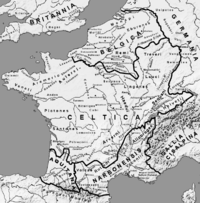
After their final subjugation, Caesar combined the three parts of Gaul, the territory of the Belgae, Celtae and Aquitani, into a single unwieldy province (Gallia Comata, "long-haired Gaul") that was reorganized by the emperor Augustus
Augustus
Augustus ;23 September 63 BC – 19 August AD 14) is considered the first emperor of the Roman Empire, which he ruled alone from 27 BC until his death in 14 AD.The dates of his rule are contemporary dates; Augustus lived under two calendars, the Roman Republican until 45 BC, and the Julian...
into its traditional cultural divisions. The province
Roman province
In Ancient Rome, a province was the basic, and, until the Tetrarchy , largest territorial and administrative unit of the empire's territorial possessions outside of Italy...
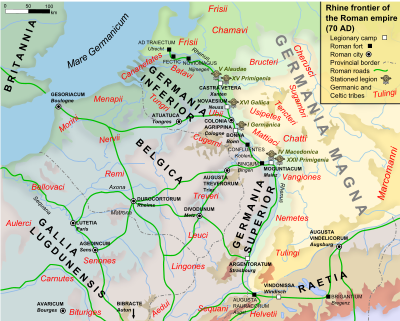
of Gallia Belgica
Gallia Belgica
Gallia Belgica was a Roman province located in what is now the southern part of the Netherlands, Belgium, Luxembourg, northeastern France, and western Germany. The indigenous population of Gallia Belgica, the Belgae, consisted of a mixture of Celtic and Germanic tribes...
was bounded on its east by the Rhine and extended all the way from the North Sea to Lake Constance
Lake Constance
Lake Constance is a lake on the Rhine at the northern foot of the Alps, and consists of three bodies of water: the Obersee , the Untersee , and a connecting stretch of the Rhine, called the Seerhein.The lake is situated in Germany, Switzerland and Austria near the Alps...
(Lacus Brigantinus), including parts of what is now western Switzerland, with its capital at the city of the Remi (Reims). Under Diocletian
Diocletian
Diocletian |latinized]] upon his accession to Diocletian . c. 22 December 244 – 3 December 311), was a Roman Emperor from 284 to 305....
, Belgica Prima (capital Augusta Trevirorum, Trier
Trier
Trier, historically called in English Treves is a city in Germany on the banks of the Moselle. It is the oldest city in Germany, founded in or before 16 BC....
) and Belgica Secunda (capital Reims
Reims
Reims , a city in the Champagne-Ardenne region of France, lies east-northeast of Paris. Founded by the Gauls, it became a major city during the period of the Roman Empire....
) formed part of the diocese
Diocese
A diocese is the district or see under the supervision of a bishop. It is divided into parishes.An archdiocese is more significant than a diocese. An archdiocese is presided over by an archbishop whose see may have or had importance due to size or historical significance...
of Gaul.
Britain
The Belgae had made their way across the English ChannelEnglish Channel
The English Channel , often referred to simply as the Channel, is an arm of the Atlantic Ocean that separates southern England from northern France, and joins the North Sea to the Atlantic. It is about long and varies in width from at its widest to in the Strait of Dover...
into southern Britain in Caesar's time. Caesar asserts they had first crossed the channel as raiders, only later establishing themselves on the island. After the Roman conquest of Britain, the civitas
Civitas
In the history of Rome, the Latin term civitas , according to Cicero in the time of the late Roman Republic, was the social body of the cives, or citizens, united by law . It is the law that binds them together, giving them responsibilities on the one hand and rights of citizenship on the other...
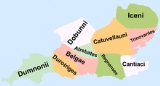
of the Belgae was bordered to the North by the British Atrebates (usually thought of as Belgic, or linked to the Belgae, themselves) by the Dobunni
Dobunni
The Dobunni were one of the Celtic tribes living in the British Isles prior to the Roman invasion of Britain. There are seven known references to the tribe in Roman histories and inscriptions. The latter part of the name possibly derives from Bune, a cup or vessel...
to the north-west; to the west by the Durotriges
Durotriges
The Durotriges were one of the Celtic tribes living in Britain prior to the Roman invasion. The tribe lived in modern Dorset, south Wiltshire and south Somerset...
and to the east by the Regnenses
Regnenses
The Regnenses, Regni or Regini were a British Celtic kingdom and later a civitas of Roman Britain. Their capital was Noviomagus Reginorum, known today as Chichester in modern West Sussex....
(probably linked to the Atrebates).
A large number of coins of the Ambiani
Ambiani
The Ambiani were a Belgic people of Celtic language, who were said to be able to muster 10,000 armed men, in 57 BC, the year of Julius Caesar's Belgic campaign. They submitted to Caesar. Their country lay in the valley of the Samara ; and their chief town Samarobriva, afterwards called Ambiani and...
dating to the mid-2nd century BC have been found in southern Britain and the remains of a possible Belgic fort have been unearthed in Kent. Within memory of Caesar's time, a king of the Suessiones
Suessiones
The Suessiones were a Belgic tribe of Western Belgium in the 1st century BC, inhabiting the region between the Oise and the Marne, based around the present-day city of Soissons...
(also referred to as Suaeuconi) called Diviciacus
Diviciacus (Suessiones)
Diviciacus or Divitiacus was a king of the Belgic nation of the Suessiones in the early 1st century BC. Julius Caesar, writing in the mid-1st century BC, says that he had within living memory been the most powerful king in Gaul, ruling a large portion not only of Gallia Belgica, but also of...
was not only the most powerful king of Belgic Gaul but also ruled territory in Britain. Commius
Commius
Commius was a historical king of the Belgic nation of the Atrebates, initially in Gaul, then in Britain, in the 1st century BC.-Ally of Caesar:...
of the Atrebates
Atrebates
The Atrebates were a Belgic tribe of Gaul and Britain before the Roman conquests.- Name of the tribe :Cognate with Old Irish aittrebaid meaning 'inhabitant', Atrebates comes from proto-Celtic *ad-treb-a-t-es, 'inhabitants'. The Celtic root is treb- 'building', 'home' The Atrebates (singular...
, Caesar's former ally, fled to Britain after participating in Vercingetorix's rebellion and either joined or established a British branch of his tribe. Based on the development of imagery on coins, it seems likely that, by the time of the Roman conquest
Roman conquest of Britain
The Roman conquest of Britain was a gradual process, beginning effectively in AD 43 under Emperor Claudius, whose general Aulus Plautius served as first governor of Britannia. Great Britain had already frequently been the target of invasions, planned and actual, by forces of the Roman Republic and...
, some of the tribes of south-eastern Britain were ruled by a Belgic aristocracy or were Belgic influenced culturally. The later civitas
Civitas
In the history of Rome, the Latin term civitas , according to Cicero in the time of the late Roman Republic, was the social body of the cives, or citizens, united by law . It is the law that binds them together, giving them responsibilities on the one hand and rights of citizenship on the other...
(administrative division) of Roman Britain
Roman Britain
Roman Britain was the part of the island of Great Britain controlled by the Roman Empire from AD 43 until ca. AD 410.The Romans referred to the imperial province as Britannia, which eventually comprised all of the island of Great Britain south of the fluid frontier with Caledonia...
had towns including Magnus Portus (Portsmouth
Portsmouth
Portsmouth is the second largest city in the ceremonial county of Hampshire on the south coast of England. Portsmouth is notable for being the United Kingdom's only island city; it is located mainly on Portsea Island...
) and Venta Belgarum (Winchester).
Ireland
T.F. O'Rahilly claims in his invasion modelO'Rahilly's historical model
O'Rahilly's historical model is a theory of Irish prehistory put forward by Celtic scholar T. F. O'Rahilly in 1946. It was based on his study of the influences on the Irish language and a critical analysis of Irish mythology....
that a branch of the Belgae also settled in Ireland
Ireland
Ireland is an island to the northwest of continental Europe. It is the third-largest island in Europe and the twentieth-largest island on Earth...
, and were later represented by the historical Iverni
Iverni
The Iverni were a people of early Ireland first mentioned in Ptolemy's 2nd century Geography as living in the extreme south-west of the island. He also locates a "city" called Ivernis in their territory, and observes that this settlement has the same name as the island as a whole, Ivernia...
(Érainn), Ulaid
Ulaid
The Ulaid or Ulaidh were a people of early Ireland who gave their name to the modern province of Ulster...
and other kindreds. He claims a variety of evidence suggests memories of this were preserved in later Irish tradition, and also makes an elaborate linguistic case. According to his theory, the name of the legendary Fir Bolg
Fir Bolg
In Irish mythology the Fir Bolg were one of the races that inhabited the island of Ireland prior to the arrival of the Tuatha Dé Danann.-Mythology:...
(whom O'Rahilly identifies with the Érainn) is the Irish
equivalent of Belgae.