All Topics  
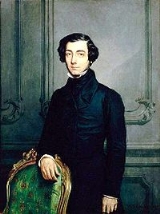
Alexis de Tocqueville

 
Alexis De Tocqueville

   Email Print
   Bookmark   Link


Alexis de Tocqueville


Alexis-Charles-Henri Clérel de Tocqueville (July 29, 1805 – April 16, 1859) was a French political thinker
Political philosophy

Political philosophy is the study of questions about the city, government, politics, liberty, justice, property, rights, law and the enforcement of a legal code by authority: what they are, why they are needed, what makes a The purpose of government, what rights and freedoms it should protect and why, what form it should take and why, what t...
 and historian
Historian

A historian is an individual who studies and writes about history, and is regarded as an authority on it. Historians are concerned with the continuous, systematic narrative and research of past events as relating to the human race; as well as the study of all events in time....
 best known for his Democracy in America
Democracy in America

De la d?mocratie en Am?rique is a Western canon France text by Alexis de Tocqueville on the United States in the 1830s and its strengths and weaknesses....
 (appearing in two volumes: 1835 and 1840) and The Old Regime and the Revolution
The Old Regime and the Revolution

The Old Regime and the Revolution is a work by the France historian Alexis de Tocqueville translated in English language as either The Old Regime and the Revolution or The Old Regime and the French Revolution....
 (1856). In both of these works, he explored the effects of the rising equality of social conditions on the individual and the state in western societies.

Democracy in America (1835), his major work, published after his travels in the United States, is today considered an early work of sociology
Sociology

Sociology is a branch of the social sciences that uses systematic methods of Empiricism and critical theory to develop and refine a body of knowledge about human social structure and activity, sometimes with the goal of applying such knowledge to the pursuit of social welfare....
 and political science
Political science

Political science is a social science concerned with the theory and practice of politics and the description and analysis of political systems and political behavior....
.


Discussion
Ask a question about 'Alexis de Tocqueville'
Start a new discussion about 'Alexis de Tocqueville'
Answer questions from other users
Full Discussion Forum


Recent Posts


Quotations


Despotism may govern without faith, but Liberty cannot.

Laws are always unstable unless they are founded on the manners of a nation; and manners are the only durable and resisting power in a people.

Socialism is a new form of slavery.

Notes for a Speech on Socialism, 1848.

What is not yet done is only what we have not yet attempted to do.

We are sleeping on a volcano...A wind of revolution blows, the storm is on the horizon.

Speaking in the Chamber of Deputies just prior to to outbreak of revolution in Europe (1848)

As for me, I am deeply a democrat; this is why I am in no way a socialist. Democracy and socialism cannot go together. You can't have it both ways.

Notes for a Speech on Socialism, 1848.


Encyclopedia


Alexis-Charles-Henri Clérel de Tocqueville (July 29, 1805 – April 16, 1859) was a French political thinker
Political philosophy

Political philosophy is the study of questions about the city, government, politics, liberty, justice, property, rights, law and the enforcement of a legal code by authority: what they are, why they are needed, what makes a The purpose of government, what rights and freedoms it should protect and why, what form it should take and why, what t...
 and historian
Historian

A historian is an individual who studies and writes about history, and is regarded as an authority on it. Historians are concerned with the continuous, systematic narrative and research of past events as relating to the human race; as well as the study of all events in time....
 best known for his Democracy in America
Democracy in America

De la d?mocratie en Am?rique is a Western canon France text by Alexis de Tocqueville on the United States in the 1830s and its strengths and weaknesses....
 (appearing in two volumes: 1835 and 1840) and The Old Regime and the Revolution
The Old Regime and the Revolution

The Old Regime and the Revolution is a work by the France historian Alexis de Tocqueville translated in English language as either The Old Regime and the Revolution or The Old Regime and the French Revolution....
 (1856). In both of these works, he explored the effects of the rising equality of social conditions on the individual and the state in western societies.

Democracy in America (1835), his major work, published after his travels in the United States, is today considered an early work of sociology
Sociology

Sociology is a branch of the social sciences that uses systematic methods of Empiricism and critical theory to develop and refine a body of knowledge about human social structure and activity, sometimes with the goal of applying such knowledge to the pursuit of social welfare....
 and political science
Political science

Political science is a social science concerned with the theory and practice of politics and the description and analysis of political systems and political behavior....
. An eminent representative of the classical liberal
Classical liberalism

Classical liberalism is a doctrine stressing individual freedom, free markets, and limited government. This includes the importance of human rationality, individual property rights, natural rights, the protection of civil liberties, individual freedom from restraint, equality under the law, constitutional limitation of government, free marke...
 political tradition, Tocqueville was an active participant in French politics, first under the July Monarchy (1830–1848) and then during the Second Republic (1849–1851) which succeeded the February 1848 Revolution. He retired from political life after Louis Napoléon Bonaparte's December 2, 1851 coup, and thereafter began work on The Old Regime and the Revolution, Volume I.

Life


After obtaining a law
LAW

LAW may refer to:* Anti-tank warfare, e.g. the US Army M72 LAW or the British Army LAW 80*Palestinian Society for the Protection of Human Rights ...
 degree, Alexis de Tocqueville was named auditor-magistrate at the court of Versailles
Versailles

Versailles , formerly de facto capital of the kingdom of France, is now a wealthy suburb of Paris and is still an important administrative and judicial centre....
. There, he met Gustave de Beaumont
Gustave de Beaumont

M. Gustave de Beaumont was a French magistrate, prison reformer, and travel companion to the famed philosopher and politician Alexis de Tocqueville....
, a prosecutor substitute, who collaborated with him on various literary works. Both were sent to the United States to study the penitentiary system
Prison

A prison, penitentiary, or correctional facility is a place in which individuals are physically confined or internment and usually deprived of a range of personal Freedom ....
. During this trip, they wrote (1832). Back in France, Tocqueville became a lawyer. He met the English economist Nassau William Senior
Nassau William Senior

Nassau William Senior , England economist, was born at Compton, Berkshire, the eldest son of the Rev. JR Senior, vicar of Durnford, Wiltshire....
 in 1833, and they became good friends and corresponded for many years. He published his master-work, , in 1835. The success of this work, an early model for the science that would become known as sociology
Sociology

Sociology is a branch of the social sciences that uses systematic methods of Empiricism and critical theory to develop and refine a body of knowledge about human social structure and activity, sometimes with the goal of applying such knowledge to the pursuit of social welfare....
, led him to be named (Knight of the Legion of Honour) in 1837, and to be elected the next year to the . In 1841 he was elected to the .

Tocqueville, who despised the July Monarchy (1830–1848), began his political career in the same period. Thus, he became deputy of the Manche department
Manche

Manche is a France Departments of France in Normandy named after La Manche , which is the French language name for the English Channel....
 (Valognes
Valognes

Valognes is a Communes of France in the Manche Departments of France in Normandy in northwestern France.It lies on the Merderet river, southeast of Cherbourg....
), a position which he maintained until 1851. In parliament, he defended abolitionist
Abolitionism

File:BLAKE10.JPGAbolitionism was a movement to end the slave trade and emancipate slaves in western Europe and the Americas. The slave system aroused little protest until the 18th century, when rationalist thinkers of the Age of Enlightenment criticized it for violating the rights of man, and Quaker and other evangelical religious groups con...
 views and upheld free trade
Free trade

Free trade is a type of trade policy that allows traders to act and transact without coercive interference from government. Thus, the policy permits trading partners mutual gains from trade, with goods and services produced according to the law of comparative advantage....
, while supporting the colonization of Algeria
French rule in Algeria

French rule of Algeria lasted from 1830 to 1962, under a variety of governmental systems. One of France's longest-held overseas territories, Algeria became a destination for hundreds of thousands of European ethnic groups immigrants, known as colons and later, as pied-noirs....
 carried on by Louis-Philippe
Louis-Philippe of France

Louis-Philippe , was List of French monarchs from 1830 to 1848 in what was known as the July Monarchy. He was the last king to rule France, although Napoleon III of France, styled as an emperor, would serve as its last monarch....
's regime. Tocqueville was also elected general counsellor of the Manche in 1842, and became the president of the department's between 1849 and 1851.

Apart from Canada, Tocqueville also made an observational tour of England, producing . In 1841 and 1846, he traveled to Algeria
French rule in Algeria

French rule of Algeria lasted from 1830 to 1962, under a variety of governmental systems. One of France's longest-held overseas territories, Algeria became a destination for hundreds of thousands of European ethnic groups immigrants, known as colons and later, as pied-noirs....
. His first travel inspired his , in which he criticized the French model of colonization
Colonialism

Colonialism is the extension of a nation's sovereignty over Territory beyond its borders by the establishment of either settler or exploitation colony in which Indigenous people populations are direct rule, Population transfers, or Genocide....
, based on an assimilationist view, preferring instead the British model of indirect rule
Indirect rule

Indirect rule is a type of European colonial policy in which the traditional local power structure, or at least part of it, is incorporated into the colonial administrative structure....
, which did not mix different populations together. He went as far as openly advocating racial segregation
Racial segregation

File:Segregated cinema entrance3.jpgRacial segregation is the separation of different Race s in daily life, such as eating in a restaurant, drinking from a drinking fountain, using a rest room, attending school, going to the movies, or in the rental or purchase of a home....
 between the European colonists
Colonialism

Colonialism is the extension of a nation's sovereignty over Territory beyond its borders by the establishment of either settler or exploitation colony in which Indigenous people populations are direct rule, Population transfers, or Genocide....
 and the "Arabs" through the implementation of two different legislative systems (a half century before its effective implementation with the 1881 Indigenous code).

After the fall of the July Monarchy during the February 1848 Revolution, Tocqueville was elected a member of the Constituent Assembly of 1848, where he became a member of the Commission charged with the drafting of the new Constitution of the Second Republic
French Second Republic

The French Second Republic was the republican government of France between the Revolutions of 1848 in France and the coup by Napoleon III of France which initiated the Second French Empire....
 (1848–1851). He defended bicameralism
Bicameralism

In government, bicameralism is the practice of having two legislative or parliamentary chambers. Thus, a bicameral parliament or bicameral legislature is a legislature which consists of two chambers or houses....
 (two parliamentary chambers) and the election of the President of the Republic by universal suffrage
Universal suffrage

Universal suffrage consists of the extension of the Suffrage to adult citizens as a whole, though it may also mean extending said right to minors and noncitizens....
. As the countryside was thought to be more conservative than the laboring population of Paris, universal suffrage was conceived as a means to block the revolutionary spirit of Paris.

During the Second Republic, Tocqueville sided with the against the "socialists" and workers. A few days after the February insurrection, he believed a violent clash between the workers' population agitating in favor of a "Democratic and Social Republic" and the conservatives, including the aristocracy and rural population, to be inescapable. As Tocqueville had foreseen, these social tensions eventually exploded during the June Days Uprising of 1848. Led by General Cavaignac
Louis Eugène Cavaignac

Louis-Eug?ne Cavaignac , French general, second son of Jean Baptiste Cavaignac and brother of Eleonore Louis Godefroi Cavaignac, was born at Paris, France....
, the repression was supported by Tocqueville, who advocated in favour of the "regularization" of the state of siege
State of Siege

State of Siege is a 1972 French film directed by Costa Gavras and starred by Yves Montand and Renato Salvatori....
 declared by Cavaignac and others measures leading to the suspension of the constitutional order.

A supporter of Cavaignac and of the , Tocqueville, however, accepted an invitation to enter Odilon Barrot
Odilon Barrot

Camille Hyacinthe Odilon Barrot , was a France politician.Barrot was born at Villefort, Loz?re . He belonged to a legal family, his father, an advocate of Toulouse, having been a member of the National Convention who had voted against the death of Louis XVI of France....
's government as Minister of Foreign Affairs
Minister of Foreign Affairs (France)

The Minister of Foreign Affairs in the government of France, is the French government ministers responsible for the foreign relations of France....
 from 3 June to 31 October 1849. There, during the troubled days of June 1849, he pleaded with Jules Dufaure
Jules Armand Dufaure

Jules Armand Stanislas Dufaure was a France statesman....
, Interior Minister, for the reestablishment of the state of siege in the capital and approved the arrest of demonstrators. Tocqueville, who since February 1848 had supported laws restricting political freedoms, approved the two laws voted immediately after the June 1849 days, which restricted the liberty of clubs and freedom of the press
Freedom of the press

Freedom of the press consists ofconstitutional or Statute protections pertaining to the Mass media and published materials.With respect to governmental information, any government distinguishes which materials are public or protected from disclosure to the public based on classified information as sensitive, classified or secret and being...
. This active support in favor of laws restricting political freedoms stands in contrast of his defense of freedoms in Democracy in America.

Tocqueville then supported Cavaignac against Louis Napoléon Bonaparte for the presidential election of 1851. Opposed to Louis Napoléon's December 2, 1851 coup which followed his election, Tocqueville was among the deputies who gathered at the Xe arrondissement
Xe arrondissement

rrondissementnumber=10th|commune=Paris|image=|caption=The Gare du Nord in the 10th arrondissement.|map=paris_10e_arr_jms.gif|mapcaption=Paris and its closest suburbs|...
 of Paris in an attempt to resist the coup and have Napoleon III judged for "high treason". Detained at Vincennes
Vincennes

Vincennes is a commune in France of the Val-de-Marne located in the eastern suburbs of Paris, France. This ?le-de-France town is located . from the Kilometre Zero....
 and then released, Tocqueville, who supported the Restoration
Bourbon Restoration

Following the ousting of Napoleon I of France in 1814, the Allies restored the House of Bourbon to the France throne. The ensuing period is called the Restoration, following French usage, and is characterized by a sharp conservative reaction and the re-establishment of the Roman Catholic Church as a power in French politics....
 of the Bourbons against Bonaparte's Second Empire
Second French Empire

The Second French Empire or Second Empire was the Imperial Bonapartist regime of Napoleon III from 1852 to 1870, between the French Second Republic and the French Third Republic, in France....
 (1851–1871), quit political life and retreated to his castle . There, he began the draft of , publishing the first tome in 1856, but leaving the second one unfinished.

Democracy in America

In Democracy in America
Democracy in America

De la d?mocratie en Am?rique is a Western canon France text by Alexis de Tocqueville on the United States in the 1830s and its strengths and weaknesses....
, published in 1835, Tocqueville wrote of the New World
New World

The New World is one of the names used for the non-Eurasian/non-African parts of the Earth, specifically the Americas and Australasia. When the term originated in the late 15th century, the Americas were new to the Europeans, who previously thought of the world as consisting only of Europe, Asia, and Africa ....
 and its burgeoning democratic order. Observing from the perspective of a detached social scientist, Tocqueville wrote of his travels through America in the early 19th Century when the market revolution, Western expansion, and Jacksonian democracy
Jacksonian democracy

Jacksonian Democracy refers to the political philosophy of United States President of the United States Andrew Jackson and his supporters. Jackson's policies followed in the footsteps of Thomas Jefferson....
 were radically transforming the fabric of American life. He saw democracy as an equation that balanced liberty
Liberty

Liberty, the freedom to act or believe without being stopped by unnecessary force, is generally considered in modern time to be a concept of political philosophy and identifies the condition in which an individual has the right to act according to his or her own free will....
 and equality
Egalitarianism

Egalitarianism or Equalism is a political doctrine that holds that all people should be treated as equals and have the same political freedom, economic freedom, social justice, and civil rights rights....
, concern for the individual as well as the community.

Tocqueville wrote of the Americans, "Americans are so enamored of equality that they would rather be equal in slavery than unequal in freedom."

A critic of individualism
Individualism

Individualism is the Morality stance, political philosophy, or social outlook that stresses independence and self-reliance. Individualists promote the exercise of one's goals and desires, while opposing most external interference upon one's choices, whether by society, or any other group or institution....
, Tocqueville thought that association
Association

Association may refer to:*Voluntary association, a group of individuals who voluntarily enter into an agreement to accomplish a purpose** 501 non-profit organization...
, the coming together of people for common purpose, both public and private, binds Americans to an idea of nation larger than selfish desires, thus making both a self-conscious and active political society
Political society

Political society is a sphere of the political activity of individuals, interest groups and institutions that aim to influence and control administrative and legislative decision-making....
 and a vibrant civil society
Civil society

Civil society is composed of the totality of voluntary civic and social organizations and institutions that form the basis of a functioning society as opposed to the force-backed structures of a state and commercial institutions of the market....
 functioning independently from the state
State

A state is a political Social contract with effective sovereignty over a geographic area and representing a population. These may be nation states, State or multinational states....
. The main purpose of Tocqueville was analysis of functioning of political society and various forms of political associations, although he brought some reflections on civil society too (and relations between political and civil society). For Tocqueville as for Hegel and Marx, civil society was a sphere of private entrepreneurship and civilian affairs regulated by civil code
Civil code

A civil code is a systematic compilation of laws designed to comprehensively deal with the core areas of private law. A jurisdiction that has a civil code generally also has a code of civil procedure....
 .

Tocqueville's penetrating analysis sought to understand the peculiar nature of American political life. In describing America, he agreed with thinkers such as Aristotle
Aristotle

Aristotle was a Greeks philosopher, a student of Plato and teacher of Alexander the Great. He wrote on many subjects, including physics, metaphysics, Poetics , theater, music, logic, rhetoric, politics, government, ethics, biology and zoology....
 and Montesquieu
Charles de Secondat, baron de Montesquieu

Charles-Louis de Secondat, baron de La Br?de et de Montesquieu , was a France social commentator and Political philosophy who lived during the Age of Enlightenment....
 that the balance of property determined the balance of political power, but his conclusions after that differed radically from those of his predecessors. Tocqueville tried to understand why America was so different from Europe in the last throes of aristocracy
Aristocracy

Aristocracy is a form of government, in which a few of the most prominent citizens rule. This may be a hereditary elite, or it may be by a system of cooption where a council of prominent citizens add leading soldiers, merchants, land owners, priests, and lawyers to their number....
. One of his most enduring and powerful observations, when asked why America was so great a country, was his answer "America is great because America is good". America, in contrast to the aristocratic ethic, was a society where hard work and money-making was the dominant ethic, where the common man enjoyed a level of dignity which was unprecedented, where commoners never deferred to elites, and where what he described as crass individualism and market capitalism
Capitalism

Capitalism is an economic system in which wealth, and the means of producing wealth, are private property and controlled rather than commonly, publicly, or state-owned and controlled....
 had taken root to an extraordinary degree.
Detocque
The uniquely American morals and opinions, Tocqueville argued, lay in the origins of American society and derived from the peculiar social conditions that had welcomed colonists in prior centuries. Indeed, the basis of much of the colonization was the search for religious freedom, the right to worship the Almighty in one's own way. Unlike Europe, venturers to America found a vast expanse of open land. Any and all who arrived could own their own land and cultivate an independent life. Sparse elites and a number of landed aristocrats existed, but, according to Tocqueville, these few stood no chance against the rapidly developing values bred by such vast land ownership. With such an open society, layered with so much opportunity, men of all sorts began working their way up in the world: industriousness became a dominant ethic, and "middling" values began taking root.

This equality of social conditions bred political and civilian values which determined the type of legislation passed in the colonies and later the states. By the late 18th Century, democratic values which championed money-making, hard work, and individualism had eradicated, in the North, most remaining vestiges of old world aristocracy and values. Eliminating them in the South proved more difficult, for slavery had produced a landed aristocracy and web of patronage and dependence similar to the old world, which would last until the antebellum period before the Civil War
American Civil War

The American Civil War , also known as the War Between the States and several Naming the American Civil War, was a civil war in the United States....
.

Tocqueville asserted that the values that had triumphed in the North and were present in the South had begun to suffocate old-world ethics and social arrangements. Legislatures abolished primogeniture
Primogeniture

Primogeniture is the common law right of the firstborn son to inherit the entire Estate , to the exclusion of younger siblings. It is the tradition brought by the Normans to England in 1066....
 and entails
Fee tail

Fee tail or entail is an obsolescent term in common law. It describes an estate of inheritance in real property which cannot be sold, devised by will, or otherwise alienated by the owner, but which passes by operation of law to the owner's Inheritance upon his death....
, resulting in more widely distributed land holdings. Landed elites lost the ability to pass on fortunes to single individuals. Hereditary fortunes became exceedingly difficult to secure and more people were forced to struggle for their own living.

This rapidly democratizing society, as Tocqueville understood it, had a population devoted to "middling" values which wanted to amass, through hard work, vast fortunes. In Tocqueville's mind, this explained why America was so different from Europe. In Europe, he claimed, nobody cared about making money. The lower classes had no hope of gaining more than minimal wealth, while the upper classes found it crass, vulgar, and unbecoming of their sort to care about something as unseemly as money; many were virtually guaranteed wealth and took it for granted. At the same time in America workers would see people fashioned in exquisite attire and merely proclaim that through hard work they too would soon possess the fortune necessary to enjoy such luxuries.

But, despite maintaining with Aristotle, Montesquieu, and others that the balance of property determined the balance of power, Tocqueville argued that, as America showed, equitable property holdings did not ensure the rule of the best men. In fact, it did quite the opposite. The widespread, relatively equitable property ownership which distinguished America and determined its mores and values also explained why the American masses held elites in such contempt.

More than just imploding any traces of old-world aristocracy, ordinary Americans also refused to defer to those possessing, as Tocqueville put it, superior talent and intelligence. These natural elites, who Tocqueville asserted were the lone virtuous members of American society, could not enjoy much share in the political sphere as a result. Ordinary Americans enjoyed too much power, claimed too great a voice in the public sphere, to defer to intellectual superiors. This culture promoted a relatively pronounced equality, Tocqueville argued, but the same mores and opinions that ensured such equality also promoted, as he put it, a middling mediocrity.

Those who possessed true virtue and talent would be left with limited choices. Those with the most education and intelligence would either, Tocqueville prognosticated, join limited intellectual circles to explore the weighty and complex problems facing society which have today become the academic or contemplative realms, or use their superior talents to take advantage of America's growing obsession with money-making and amass vast fortunes in the private sector. Uniquely positioned at a crossroads in American History, Tocqueville's Democracy in America attempted to capture the essence of American culture and values.

Though a supporter of colonialism
Colonialism

Colonialism is the extension of a nation's sovereignty over Territory beyond its borders by the establishment of either settler or exploitation colony in which Indigenous people populations are direct rule, Population transfers, or Genocide....
, Tocqueville could clearly perceive the evils that blacks and Indians had been subjected to in America. Tocqueville notes that among the races that exist in America:

Tocqueville contrasted the settlers of Virginia with the middle-class, religious Puritans who founded New England, and analyzed the debasing influence of slavery:

Tocqueville concluded that removal of the Negro population from America could not resolve the problem as he writes at the end of the first Democracy:

In 1855, he wrote the following text published by Maria Weston Chapman in the Liberty Bell: Testimony against Slavery

According to him assimilation of blacks would be almost impossible and this was already being demonstrated in the Northern states. As Tocqueville predicted, formal freedom and equality and segregation would become this population's reality after the Civil War
American Civil War

The American Civil War , also known as the War Between the States and several Naming the American Civil War, was a civil war in the United States....
 and during Reconstruction — as would the bumpy road to true integration of blacks.

Assimilation, however, was the best solution for Native Americans. But since they were too proud to assimilate, they would inevitably become extinct. Displacement
Forced migration

Forced migration refers to the coerced movement of a person or persons away from their home or home region. It often connotes violent coercion, and is used interchangeably with the terms "displacement" or forced displacement....
 was another part of America's Indian policy
Indian Removal

Indian Removal was a nineteenth century policy of the government of the United States to Ethnic cleansing Native Americans in the United States tribes living east of the Mississippi River to lands west of the river....
. Both populations were "undemocratic", or without the qualities, intellectual and otherwise, needed to live in a democracy. Tocqueville shared many views on assimilation and segregation of his and the coming epochs, but he opposed Gobineau
Arthur de Gobineau

Joseph Arthur Comte de Gobineau was a France aristocrat, novelist and man of letters who became famous for developing the racialist theory of the Aryan race master race in his book An Essay on the Inequality of the Human Races ....
's scientific racism
Scientific racism

Scientific racism denotes the use of scientific, or ostensibly scientific, findings and methods to support or validate Racism attitudes and worldviews....
 theories as found in The Inequality of Human Races
An Essay on the Inequality of the Human Races

An Essay on the Inequality of the Human Races by Arthur de Gobineau is a voluminous work; while originally intended as a work of philosophical enquiry, it is today considered as one of the earliest examples of scientific racism....
 (1853–1855).

The 1841 discourse on the Conquest of Algeria

French historian of colonialism
Colonialism

Colonialism is the extension of a nation's sovereignty over Territory beyond its borders by the establishment of either settler or exploitation colony in which Indigenous people populations are direct rule, Population transfers, or Genocide....
 Olivier LeCour Grandmaison
Olivier LeCour Grandmaison

Olivier LeCour Grandmaison is a France historian. He is a professor of political science at the University of ?vry Val d'Essonne and also teach at the Coll?ge International de Philosophie, and mainly works on colonialism issues....
 has underlined how Tocqueville (as well as Michelet) used the term "extermination
Extermination

Extermination is the act of killing with the intention of eradicating demographics within a population.* When applied to humans, the term genocide is more often used....
" to describe what was happening during the colonization of Western United States
Western United States

The Western United States—commonly referred to as the American West or simply The West—traditionally refers to the region comprising the westernmost U.S....
 and the Indian removal
Indian Removal

Indian Removal was a nineteenth century policy of the government of the United States to Ethnic cleansing Native Americans in the United States tribes living east of the Mississippi River to lands west of the river....
 period. Tocqueville thus expressed himself, in 1841, concerning the conquest of Algeria
French rule in Algeria

French rule of Algeria lasted from 1830 to 1962, under a variety of governmental systems. One of France's longest-held overseas territories, Algeria became a destination for hundreds of thousands of European ethnic groups immigrants, known as colons and later, as pied-noirs....
:

Tocqueville thought the conquest of Algeria was important for two reasons: first, his understanding of the international situation and France’s position in the world, and, second, changes in French society. Tocqueville believed that war and colonization would "restore national pride, threatened," he believed, by "the gradual softening of social mores" in the middle classes. Their taste for "material pleasures" was spreading to the whole of society, giving it "an example of weakness and egotism"." Applauding the methods of General Bugeaud
Thomas Robert Bugeaud de la Piconnerie

Thomas Robert Bugeaud, Marquis de la Piconnerie, Duc d'Isly was a Marshal of France and Colonial heads of Algeria....
, Tocqueville went as far as saying that "war in Africa" had become a science: "war in Africa is a science. Everyone is familiar with its rules and everyone can apply those rules with almost complete certainty of success. One of the greatest services that Field Marshal Bugeaud has rendered his country is to have spread, perfected and made everyone aware of this new science."

Tocqueville advocated racial segregation
Racial segregation

File:Segregated cinema entrance3.jpgRacial segregation is the separation of different Race s in daily life, such as eating in a restaurant, drinking from a drinking fountain, using a rest room, attending school, going to the movies, or in the rental or purchase of a home....
 in Algeria with two distinct legislations, one for each very separate communities. Such legislation would eventually be enacted with the Crémieux decrees
Adolphe Crémieux

Adolphe Cr?mieux , was a France-Jewish lawyer and statesman, and a staunch defender of the human rights of the Jews of France....
 and the 1881 Indigenous Code, which gave French citizenship to the European settlers only, while Muslim Algerians were confined to a second-grade citizenship.

Tocqueville's opposition to the invasion of Kabylia

In opposition to Olivier Le Cour Grandmaison, Jean-Louis Benoît claimed that given the extent of racial prejudices during the colonization of Algeria, Tocqueville was one of its "most moderate supporters." Benoît claimed that it was wrong to assume Tocqueville was a supporter of Bugeaud, despite his 1841 apologetic discourse. It seems that Tocqueville changed viewpoint in particular after his second travel to Algeria in 1846. Hereafter, he criticized Bugeaud's desire to invade Kabylia (home of the Berber
Berber people

Berbers are the indigenous ethnic groups of North Africa west of the Nile Valley. They are discontinuously distributed from the Atlantic to the Siwa oasis, in Egypt, and from the Mediterranean to the Niger River....
s) in a 1847 speech to the Assembly. Tocqueville, who did advocate racial segregation
Racial segregation

File:Segregated cinema entrance3.jpgRacial segregation is the separation of different Race s in daily life, such as eating in a restaurant, drinking from a drinking fountain, using a rest room, attending school, going to the movies, or in the rental or purchase of a home....
 between Europeans and Arab
Arab

An Arab is a person who Identity as such on linguistic or cultural grounds. The plural form, Arabs , refers to the Ethnocultural group at large....
s, judged otherwise the Berbers. In an August 22, 1837 proposal, Tocqueville distinguished the Berbers from the Arabs. He considered that these last ones should have a self-government (a bit on the model of British indirect rule
Indirect rule

Indirect rule is a type of European colonial policy in which the traditional local power structure, or at least part of it, is incorporated into the colonial administrative structure....
, thus going against the French assimiliationist stance).

Tocqueville's views on the matter were complex, and evolved over time. Even though in his 1841 report on Algeria Tocqueville admitted that Bugeaud succeeded in implementing a technique of war that enabled him to defeat Abd al-Qadir
Abd al-Qadir

`Abd al-Qadir al-Jaza'iri was an Algerian Islamic scholar, Sufi, political and military leader who led a struggle against the French rule in Algeria in the mid-nineteenth century, for which he is seen by the Algerians as their national hero....
's resistance and applauded him on one hand, he opposed on the other hand the conquest of Kabylia in his first Letter about Algeria (1837). In this document, he advocated that France and the French military
Military of France

The Military of France encompasses an French Army, a French Navy, an French Air Force and a National Gendarmerie . The President of the French Republic heads the armed forces, with the title of "chef des arm?es" - "chief of the military forces"....
 leave Kabylia apart to preserve a peaceful zone so as to try and develop commercial links. In all his subsequent speeches and writings he kept on being against any attempt towards intrusion into Kabylia.

During the debate concerning the 1846 extraordinary funds, Tocqueville denounced Bugeaud's conduct of military operations, and succeeded in convincing the Assembly of not voting the funds in support of Bugeaud's military columns. Tocqueville considered Bugeaud's will to invade Kabylia, despite the opposition of the Assembly, as a seditious move in front of which the government opted for cowardice.

Report on Algeria (1847)

In his 1847 Report on Algeria, Tocqueville declared that Europe should avoid making the same mistake they made with the European colonization of the Americas
European colonization of the Americas

The start of the European colonization of the Americas is typically dated to 1492, although there was at least one earlier colonization effort....
 in order to avoid the bloody consequences. More particularly he reminds his countrymen of a solemn caution whereby he warns them that if the methods used towards the Algerian people remain unchanged, colonization will end in a blood bath. The 1847 caution went unheeded and the heralded tragedy did happen.

Tocqueville includes in his report on Algeria that the fate their soldiers and finances depended on how they treated the natives and established a sound government. Creating peace in the country would reduce the number of soldiers. However, by treating the inhabitants of Algeria as an obstacle then the two sides would be subject to much conflict and strife.

See also

  • Civil society
    Civil society

    Civil society is composed of the totality of voluntary civic and social organizations and institutions that form the basis of a functioning society as opposed to the force-backed structures of a state and commercial institutions of the market....
  • Liberalism
    Liberalism

    Liberalism is a broad class of political philosophy that considers individualism liberty and equality to be the most important political goals....
  • Contributions to liberal theory
    Contributions to liberal theory

    This is a partial list of individual contributions to Liberalism on a worldwide scale. These individuals are strongly associated philosophers of the Enlightenment....
  • List of historians of the French Revolution
    List of historians of the French Revolution

    The historiography of the French Revolution stretches back over two hundred years prior to the event itself. Issues of causation became a contested issue in academic circles from the 1960s onwards in particular, and new research and interpretation continues to inform on the unanswerable question of what the Revolution means....
  • Gustave de Beaumont
    Gustave de Beaumont

    M. Gustave de Beaumont was a French magistrate, prison reformer, and travel companion to the famed philosopher and politician Alexis de Tocqueville....
    , Tocqueville's best friend and travel companion to the United States
  • Benjamin Constant
    Benjamin Constant

    Henri-Benjamin Constant de Rebecque was a Switzerland-born, nobleman, thinker, writer and France politician....
    , author of Liberty of the Ancients and the Moderns
  • Tyranny of the majority
    Tyranny of the majority

    The phrase tyranny of the majority, used in discussing systems of democracy and majority rule, is a criticism of the scenario in which decisions made by a majority under that system would place that majority's interests so far above a minority's interest as to be comparable to "Tyrant" Despotism....
  • Soft despotism
    Soft despotism

    Soft despotism is a term coined by Alexis de Tocqueville describing the state into which a country overrun by "a network of small complicated rules" might degrade....
  • Alexis de Tocqueville Institution
    Alexis de Tocqueville Institution

    The Alexis de Tocqueville Institution is a Washington, D.C.?based right-wing think tank that produces reports and policy research.It is named after the French historian Alexis de Tocqueville....


Further reading

  • Allen Barbara : Tocqueville, Covenant, and the Democratic Revolution: Harmonizing Earth with Heaven. — Lexington : Lexington Books, 2005.
  • Audier Serge: Tocqueville retrouvé : Genèse et enjeux du renouveau tocquevillien. — Paris : Librairie Philosophique Vrin, 2004.
  • Benoît Jean-Louis : Comprendre Tocqueville, Armand Colin/Cursus, Paris 2004.
  • Benoît Jean-Louis : Tocqueville : un destin paradoxal. — Paris : Bayard, 2005.
  • Benoît Jean-Louis : Tocqueville moraliste, Honoré Champion, Paris 2004.
  • Benoît Jean-Louis et Keslassy Eric : Alexis de Tocqueville Textes économiques Anthologie critique, Pocket/Agora, Paris 2005.
  • Benoît Jean-Louis : Tocqueville, Notes sur le Coran et autres textes sur les religions — Paris : Bayard, 2005
  • Boesche Roger Tocqueville's Road Map: Methodology, Liberalism, Revolution, And Despotism, 2006)
  • Boudon Raymond
    Raymond Boudon

    Raymond Boudon is a French sociologist.Professor in the University of Paris-Sorbonne, he is member of many important institutions: Acad?mie des Sciences morales et politiques, Academia Europaea, British Academy, American Academy of Arts and Sciences, International Academy of Human Sciences of St Petersburg, Central European Academy of Arts...
    : Tocqueville aujourd’hui. — Paris : Odile Jacob, 2005.
  • Brogan Hugh: Alexis De Tocqueville, Profile Books, 2006.
  • Drescher Seymour : Dilemmas of Democracy : Tocqueville and Modernization, University of Pittsburgh Press, 1964.
  • Drescher Seymour : Tocqueville and England , Harward University Press, 1964.
  • Drescher, Seymour. Dilemmas of Democracy: Tocqueville and Modernization. University of Pittsburgh Press, 1968.
  • Epstein Joseph : Alexis De Tocqueville: Democracy's Guide, 2006.
  • Gannett Robert T.: Tocqueville Unveiled: The Historian and His Sources for the Old Regime and the Revolution, The University of Chicago Press, 2003.
  • Guellec Laurence : Tocqueville : l'apprentissage de la liberté. Michalon, 1996.
  • Guellec Laurence : Tocqueville et les langages de la démocratie. — Honoré Champion, 2004.
  • Kahan Alan : Aristocratic Liberalism : The Social and Political Thought of Jacob Burckhardt, Johns Stuart Mill and Alexis de Tocqueville, Oxford University Press, 1992.
  • Keslassy Eric: Le libéralisme de Tocqueville a l'épreuve du paupérisme. — Paris : L'Harmattan, 2000.
  • Lively, Jack. The Social and Political Thought of Alexis De Toqueville. Oxford: Clarendon Press, 1962.
  • Manent Pierre : Tocqueville et la nature de la démocratie. — Fayard, 1993. — 181 p. — ISBN 2-213-03036-7, Tel-Gallimard, 2006
  • Mélonio Françoise : Tocqueville and the French, University of Virginia Press, 1998.
  • Mélonio Françoise : Tocqueville et les Français. — Paris : Aubier Montaigne, 1993.
  • Mitchell Harvey : Individual Choice and the Structures of History — Alexis de Tocqueville as an historian reappraised, Londres : Cambridge University Press, 1996.
  • Pierson George : Tocqueville and Beaumont in America, — Oxford University Press, New-York, 1938, réédition, 1996.
  • Pitts Jennifer : A Turn to Empire, Princeton University Press, 2005.
  • Richter Melvin and Baehr Peter : Dictatorship in History and Theory: Bonapartism, Caesarism, and Totalitarianism, Publications of the German Institute, Cambridge University Press, 2004.
  • Schleifer, James : The Making of Tocqueville's Democracy in America, — Chapell Hill : University of North Carolina Press, 1980.
  • Shiner Larry : The Secret Mirror: Literary Form and History in Tocqueville’s Recollections, Ithaca & Londres, Cornell University Press, 1988.
  • Welch Cheryl : De Tocqueville, Oxford University Press, 2001.
  • Welch Cheryl : The Cambridge Companion to Tocqueville, Cambridge University Press, 2006.
  • Wolin Sheldon : Tocqueville between two Worlds, Princeton University Press, 2001.


Works

  • (1833)—On the Penitentiary System in the United States and Its Application to France, with Gustave de Beaumont
    Gustave de Beaumont

    M. Gustave de Beaumont was a French magistrate, prison reformer, and travel companion to the famed philosopher and politician Alexis de Tocqueville....
    .
  • (1835/1840)—Democracy in America
    Democracy in America

    De la d?mocratie en Am?rique is a Western canon France text by Alexis de Tocqueville on the United States in the 1830s and its strengths and weaknesses....
    . It was published in two volumes, the first in 1835, the second in 1840. English language versions: Tocqueville, Democracy in America
    Democracy in America

    De la d?mocratie en Am?rique is a Western canon France text by Alexis de Tocqueville on the United States in the 1830s and its strengths and weaknesses....
    , trans. and eds., Harvey C. Mansfield and Delba Winthrop, University of Chicago Press, 2000; Tocqueville, Democracy in America (Arthur Goldhammer, trans.; Olivier Zunz, ed.) (, 2004) ISBN 978-1-93108254-9.
  • (1856)—The Old Regime and the Revolution
    The Old Regime and the Revolution

    The Old Regime and the Revolution is a work by the France historian Alexis de Tocqueville translated in English language as either The Old Regime and the Revolution or The Old Regime and the French Revolution....
    . It is Tocqueville's second most-famous work.
  • Recollections (1893)—This work was a private journal of the Revolution of 1848. He never intended to publish this during his lifetime; it was published by his wife and his friend Gustave de Beaumont after his death.
  • Journey to America (1831–1832)—Alexis de Tocqueville's travel diary of his visit to America; translated into English by George Lawrence, edited by J. P. Mayer, Yale University Press, 1960; based on vol. V, 1 of the of Tocqueville.
  • L'Etat social et politique de la France avant et depuis 1789 —Alexis de Tocqueville


External links

  • Works in the original French.
  • A review by Ferdinand Mount in the , February 21, 2007.
  • A C-SPAN website about Tocqueville's journey through the United States.
  • A hypertext with a gallery of related projects describing America ca. 1820–1840.
  • Information and resources about Alexis de Tocqueville.
  • A website, by the American Studies Programs at The University of Virginia, focusing on the historical context of Democracy in America.
  • Links to the Henry Reeve translation of Democracy in America.
  • A website about Tocqueville produced by the French Ministry of Culture.
  • A contrarian assessment of Tocqueville's intellectual stature and legacy in the , Fall 2007.