
| |
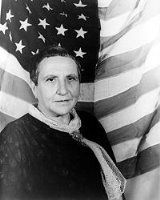
Gertrude Stein (February 3, 1874 – July 27, 1946) was an American writer who spent most of her life in France, and who became a catalyst in the development of modern art and literature. Her life was marked by two primary relationships, the first with her brother Leo Stein, from 1874-1914 , and the second with Alice B. Toklas, from 1907 until Stein's death in 1946 Stein shared her salon at 27 rue de Fleurus, Paris, first with Leo and then with Alice.

Discussion
Ask a question about 'Gertrude Stein'
Start a new discussion about 'Gertrude Stein'
Answer questions from other users
|
Quotations
A master-piece ... may be unwelcome but it is never dull.
A real failure does not need an excuse. It is an end in itself.
A writer should write with his eyes and a painter paint with his ears.
Adventure is making the distant approach nearer but romance is having what is where it is which is not where you are stay where it is.
America is my country and Paris is my home town and it is as it has come to be.
And so I am an American and I have lived half my life in Paris, not the half that made me but the half in which I made what I made.

Encyclopedia
Gertrude Stein (February 3, 1874 – July 27, 1946) was an American writer who spent most of her life in France, and who became a catalyst in the development of modern art and literature. Her life was marked by two primary relationships, the first with her brother Leo Stein, from 1874-1914 , and the second with Alice B. Toklas, from 1907 until Stein's death in 1946 Stein shared her salon at 27 rue de Fleurus, Paris, first with Leo and then with Alice. Throughout her lifetime, Stein cultivated significant tertiary relationships with well-known members of the avant garde artistic and literary world.
Biography
Stein had a gregarious nature, and a wealth of modern paintings, and modern friends, that attracted many to her, and to her salon in Paris. Her personality also allowed her to transform her social outlets, by focusing on new friendships, members of the youthful generation of the time. For example, Stein was friends with "up and coming" artists Matisse and Picasso in the early 1900s, writers Thornton Wilder and Ernest Hemingway in the 20s, and with the American GI's in the 40s.
Each period marked Stein's connections with young, and in many cases, brilliantly talented and artistic people at the center of contemporary developments and events. Her writing reflects, or in the case of The Autobiography, reflects on each decade.
Gertrude Stein's early life
Gertrude Stein, the youngest of a family of five children, was born in 1874 in Allegheny, Pennsylvania, near Pittsburgh, to well-educated German-Jewish immigrant parents. Her father, Daniel Stein, was an executive with a railroad, whose prudent investments in streetcar lines and real estate had made the family wealthy. When Gertrude was three years old, the Steins moved for business reasons first to Vienna and then to Paris. She returned to America with her family in 1878, settling in Oakland, California, where she attended First Hebrew Congregation of Oakland's Sabbath school..
In 1888, Amelia Stein (Gertrude's mother) died, and in 1891 Daniel Stein (Gertrude's father) died. Michael Stein (her eldest brother) took over the family business holdings, and made wise business decisions and arranged the affairs of his siblings. Michael arranged for Gertrude, and her sister Bertha, to live with their mother's family in Baltimore after the deaths of their parents. (Mellow, 1974, pp. 25-28). In 1892 she lived with her uncle David Bachrach. It was in Baltimore that Gertrude met Claribel Cone and Etta Cone who held Saturday evening salons which Gertrude would later emulate in Paris, who shared an appreciation for art and conversation about it, and who modeled a domestic division of labor that Gertrude was later to replicate in her relationship with Alice B. Toklas. (Ibid. pp. 41-42).
Gertrude attended Radcliffe College from 1893-1897, and studied under the psychologist William James. Under James' supervision, Stein and another student named Leo Solomons conducted experiments on Normal Motor Automatism, a phenomenon hypothesized to occur in people when their attention is split between two simultaneous intelligent activities, like writing and speaking. These experiments bore examples of writing that appeared to represent "stream of consciousness," a psychological theory often attributed to James, which became the term used to describe the style of modernist authors like Virginia Woolf and James Joyce. In 1934, behavioral psychologist, B.F. Skinner in fact interpreted Stein's notoriously difficult poem, Tender Buttons, as an example of the "normal motor automatism" Stein had written about in the experiment at Radcliffe. According to a letter she wrote in the 1930s, however, Stein had never fully accepted the theory of automatic writing, explaining: "there can be automatic movements, but not automatic writing. Writing for the normal person is too complicated an activity to be indulged in automatically." At Radcliffe, she began a lifelong friendship with Mabel Foote Weeks, whose correspondence places much of the progression of Gertrude's life. In 1897, Gertrude spent the summer in Woods Hole, Massachusetts studying embryology at the Marine Biological Laboratory, followed by two years at Johns Hopkins Medical School. In 1901, she left Johns Hopkins without obtaining a degree.
at www.hopkinsmedicine.org
Gertrude and Leo Stein's modern art gallery Much of Gertrude Stein's fame derives from a private modern art gallery she assembled, from 1904 to 1913, with her brother Leo Stein. The collection quickly commanded a worldwide reputation; the salon, and the social circle that developed around it, provided the inspiration for The Autobiography of Alice B. Toklas.
Leo Stein's acquaintances and study of modern art provided the seed for the famous Stein art collections. He began with Bernard Berenson who hosted Gertrude and Leo in his English country house in 1902, and who suggested Paul Cézanne and Ambroise Vollard's art gallery.
The joint collection of Gertrude and Leo Stein began in late 1904, when Michael Stein announced that their trust account had accumulated a balance of 8,000 francs, a windfall. They spent this windfall at Vollard's Gallery, buying Gauguin's Sunflowers and Cézanne's and two Renoirs.
The art collection grew and the walls at were to make way for new acquisitions. In "the first half of 1905" the Steins acquired Cézanne's Portrait of Mme Cézanne and Delacroix's Perseus and Andromeda. Shortly after the opening of the Paris Autumn Salon of 1905 (on October 18, 1905), the Steins acquired Matisse's and Picasso's
By early 1906, Leo and Gertrude Stein's studio was filled with paintings by Henri Manguin, Pierre Bonnard, Pablo Picasso, Paul Cézanne, Pierre-Auguste Renoir, Honoré Daumier, Henri Matisse, and Henri de Toulouse-Lautrec. Their collection was reflective of two famous art exhibitions that took place during their residence together in Paris, and to which they contributed, either by lending their art, or by patronizing the featured artists. Collecting was a shared interest in Gertrude and Leo's inner circle; their elder brother, Michael, and sister-in-law Sarah (Sally) acquired a large number of Henri Matisse paintings; Gertrude's friends from Baltimore, Claribel and Etta Cone, collected in a similar vein, eventually donating their art collection, virtually intact, to the
While numerous artists circulated into the Stein salon, many of these artists were not represented among the paintings on the wall at 27 Rue de Fleurus. Where Renoir, Cézanne, Matisse, and Picasso's works dominated Leo and Gertrude's collection, Sarah Stein's collection focused on Matisse.
Contemporaries of Leo and Gertrude, Matisse and Picasso became part of their social circle, and were a part of the early Saturday evenings at 27 Rue de Fleurus. Gertrude attributed the beginnings of the Saturday evening salons to Matisse, as
Among the Picasso circle who frequented the Saturday evenings were: Fernande Olivier (Picasso's mistress), Georges Braque (artist), André Derain (artist), Max Jacob (poet), Guillaume Apollinaire (poet), Marie Laurencin (Apollinaire's mistress and an artist in her own right), Henri Rousseau (painter).
A permanent familial break, and a separation of the art collection, was finalized in April 1914, when Leo moved to Settignano, Italy, near Florence. The division of their art collection was described in a letter by Leo, in which he stated:
After Gertrude's and Leo's households separated in 1914, she continued to collect examples of Picasso's art which had turned to Cubism At her death, Gertrude's remaining collection focused on the artwork of Picasso and Juan Gris, having sold most of her other pictures.
Paris, 1903-1914
In 1903, Gertrude Stein moved to Paris during the height of artistic creativity gathering in Montparnasse.
From 1903 to 1914 she lived in Paris with her brother Leo, an art critic. Gertrude and Leo compiled one of the earliest collections of modern art, owning early works by Pablo Picasso (who became a friend and painted her portrait, as well as a portrait of her nephew Allan Stein), Henri Matisse, André Derain, Georges Braque, Juan Gris, and other young painters. Before World War I, their salon at 27 Rue de Fleurus attracted these and other artists and members of the avant garde, including the poet, dramatist, critic, journalist Guillaume Apollinaire (Kellner, 1988, pp 144-45).
By April, 1903, Leo rented quarters at 27, Rue de Fleurus, Paris, and that fall Gertrude joined him there. (Mellow, 1974, pp.51-53). During this period Gertrude became friendly with Henri Matisse (about 1905) (Mellow, 1974, p. 82) and with Pablo Picasso (1905) (ibid., p. 85-88 (piecing together conflicting accounts of the first meeting between Picasso and Gertrude)). Gertrude met Mildred Aldrich about 1904, beginning a friendship that lasted to Aldrich's death in 1928. (Kellner, 1988, p. 139-40); Aldrich introduced Gertrude to art patronness Mabel Dodge Luhan (in 1911) (ibid., p. 221) and to the art critic Henry McBride (in 1913) (ibid., p. 225).
Gertrude completed Q.E.D. (Quod Erat Demonstrandum) on October 24, 1903. (Ibid., pp. 53-58). This piece is more fully discussed later in this article at Relationship with Alice B. Toklas and its precursors
- Fernhurst (written, 1904)
In 1904 Stein began this fictional account of a scandalous triangular affair involving a dean (M. Carey Thomas) and a faculty member (Mary Gwinn) from Bryn Mawr College and a Harvard graduate (Alfred Hodder). (Mellow, 1974, pp. 65-68). Mellow asserts that Fernhurst "is a decidedly minor and awkward piece of writing." (Ibid, p. 67). However, it contains some commentary that suggests Gertrude included in her autobiography when she discussed the "fateful twenty-ninth year" (ibid.) during which:
Mellow observes that, in 1904, 30-year-old Gertrude "had evidently determined that the 'small hard reality' of her life would be writing". (Ibid., p. 68)
- Three Lives (written, 1905-06)
Among the paintings was a portrait of which provided Gertrude with inspiration as she began to write, and which she credited with her evolving writing style illustrated in her early work, Three Lives:
She began Three Lives in the spring of 1905, and she finished it the following year. (Mellow, 1974, p. 77).
- The Making of Americans (written, 1906-08)
Gertrude Stein fixed the date for her writing of The Making of Americans from 1906-1908. Her biographer has uncovered evidence that it began in 1902 and did not end until 1911. (Mellow, 1974, p. 114-22). Stein compared her work to James Joyce's Ulysses and to Marcel Proust's In Search of Lost Time. Her critics were less enthusiastic about its place in the canon of great literature. (Ibid., p. 122).
Gertrude's Matisse and Picasso word portraits appeared in Alfred Stieglitz's August 1912 edition of Camera Work, a special edition devoted to Picasso and Matisse, and represented her very first publication (Kellner, 1988, p. 266). Of this publication, Gertrude said, "[h]e was the first one that ever printed anything that I had done. And you can imagine what that meant to me or to any one." (Ibid.)
- Word Portraits (written, 1908-1913)
Gertrude's word portraits apparently began with her portrait of Alice B. Toklas, "a little prose vignette, a kind of happy inspiration that had detached itself from the torrential prose of The Making of Americans". (Mellow, 1974, p. 129). Gertrude's early efforts at word portraits are catalogued in Mellow, 1974, p. 129-37 and under individual's names in Kellner, 1988. Matisse and Picasso were subjects of early portraits (Mellow, 1974, 154-55, 157-58), later collected and published in Geography and Plays (published 1922) and Portraits and Prayers (published 1934). (Kellner, 1988, pp. 34-35 and 56-57). The Matisse and Picasso portraits were reprinted in MoMA, 1970, pp. 99-102.
Her subjects included many ultimately famous personages, and her subjects provided an inside view of what she observed in her Saturday salons at 27 Rue de Fleurus: "Ada" (Alice B. Toklas), "Two Women" (The Cone Sisters) (Claribel Cone and Etta Cone), Miss Furr and Miss Skeene (Ethel Mars and Maud Hunt Squire), "Men" (Hutchins Hapgood, Peter David Edstrom, Maurice Sterne), "Matisse" (1909) (Henri Matisse), "Picasso" (1909) (Pablo Picasso), "Portrait of Mabel Dodge at the Villa Curonia" (1911) (Mabel Dodge Luhan), and "Guillaume Apollinaire" (1913).
- Tender Buttons (written, 1912)
Tender Buttons is the best known of Gertrude Stein's hermetic works. It is a small book separated into three sections - Food, Objects and Rooms each containing prose under subtitles. (Kellner, 1988, p. 61-62). Its publication in 1914 created a rift between Mabel Dodge Luhan and Gertrude, because Mabel had been working to place it with another publisher. (Mellow, 1974, p. 178). Mabel wrote at length about the bad choice in publishing it with the press Gertrude selected. (Ibid.) Evans wrote Gertrude: Claire Marie Press ... is absolutely third rate, & in bad odor here, being called for the most part 'decadent" and Broadwayish and that sort of thing. . . . I think it would be a pity to publish with [Claire Marie Press] if it will emphasize the idea in the opinion of the public, that there is something degenerate & effete & decadent about the whole of the cubist movement which they all connect you with, because, hang it all, as long as they don't understand a thing they think all sorts of things. My feeling in this is quite strong. (Ibid.) Gertrude ignored Mabel's exhortations, and eventually Mabel, and published 1,000 copies of the book, in 1914. (An antiquarian copy was valued at over $1,200 in 2007). It is currently in print.
Stein's poems in Tender Buttons are highly stylised and hermetic, as she made preference for sound over sense.
Alice B. Toklas, 1907-1946
Stein met her lifelong partner, Alice B. Toklas , on September 8, 1907 on Alice's first day in Paris, at (Mellow, 1974, at 107) On meeting Stein, Toklas wrote:
Shortly thereafter, Gertrude introduced Alice to Pablo Picasso at his studio, where he was at work on . Les Demoiselles d'Avignon was a painting that "marked the beginning of the end of Leo's support for Picasso."
In 1908, they summered in Fiesole, Italy, Alice staying with Harriet Lane Levy, her companion on her trip from the United States, and her housemate until Alice moved in with Gertrude and Leo in 1910. That summer, Gertrude stayed with Michael & Sarah Stein, their son Allan, and Leo in a nearby villa. (Ibid.) Gertrude and Alice's summer of 1908 is memorialized in images of the two of them in Venice, at the piazza in front of Saint Mark's.
Alice arrived in 1907 with Harriet Levy, with Alice maintaining living arrangements with Harriet until Alice moved to 27 Rue de Fleurus in 1910. In a portrait written at the time, Gertrude humorously discussed the complex efforts, involving much letter writing and Victorian niceties, to extricate Harriet from Alice's living arrangements. In "Harriet", Gertrude considers Harriet's nonexistent plans for the summer, following her nonexistent plans for the winter:
World War I
Juan Gris
In the early summer of 1914, Gertrude bought three paintings by Juan Gris: (), and Book and Glasses. Shortly after she purchased them from Daniel-Henry Kahnweiler's gallery (Mellow, 1974, at 209), the war broke out, Kahnweiler's stock was confiscated and he was not allowed to return to Paris. Gris, who before the war had entered a binding contract with Kahnweiler for his output, was left without income. Gertrude attempted to enter an ancillary arrangement in which she would forward Gris living expenses in exchange for future pictures.
Great Britain
Gertrude and Alice had plans to visit England to sign a contract for the publication of Three Lives, to spend a few weeks, and journey on to Spain. They left Paris on July 6, 1914 and returned on October 17. [Ibid., 210-15]. When Britain declared war on Germany in World War I, Stein and Toklas were visiting Alfred North Whitehead in England. After a three-week trip to England that stretched into three months with the onset of the War, they returned to France, where they spent the first winter of the war.
Majorca, Spain
On money acquired from the sale of Gertrude's last Matisse to her brother Michael, Gertrude and Alice vacationed in Spain from May 1915, through the spring of 1916. (Mellow, 1974, at 218-26). During their interlude in Majorca, Spain, Gertrude continued her correspondence with Mildred Aldrich who kept her apprised of the War's progression, and eventually inspired Gertrude and Alice to return to France to join the war effort. (Ibid., at 225-26).
Auntie
Alice and Gertrude returned to Paris in June 1916 and acquired a Ford with the help of connections in the United States; Gertrude learned to drive it with the help of her friend William Edwards Cook. (Ibid., at 226-27). Gertrude and Alice then volunteered to drive supplies to French hospitals, in the Ford they named Auntie, "after Gertrude's aunt Pauline, 'who always behaved admirably in emergencies and behaved fairly well most times if she was flattered.'" (Ibid., at 228)
1920s
In the 1920s, her salon at 27 Rue de Fleurus, with walls covered by avant-garde paintings, attracted many of the great writers of the time, including Ernest Hemingway, Ezra Pound, Thornton Wilder, and Sherwood Anderson. While she has been credited with coining the term "Lost Generation" for some of these expatriate American writers, at least three versions of the story that led to the phrase are on record, two by Ernest Hemingway and one by Gertrude Stein (Mellow, 1974, pp. 273-74). During the 20s, she became friends with writer Mina Loy, and the two would remain lifelong friends. Extremely charming, eloquent, and cheerful, she had a large circle of friends and tirelessly promoted herself. Her judgments in literature and art were highly influential. She was Ernest Hemingway's mentor, and upon the birth of his son he asked her to be the godmother of his child. In the summer of 1931, Stein advised the young composer and writer Paul Bowles to go to Tangier, where she and Alice had vacationed.
1930s
In the 1930s, Gertrude and Alice became famous with the 1933 mass market publication of The Autobiography of Alice B. Toklas. She and Alice took an extended lecture tour in the United States during this decade. They also spent many summers in Bilignin, France, and doted on a famous poodle named "Basket" whose successor, "Basket II", comforted Alice in the years after Gertrude's death.
World War II
Prior to World War II she made public her sardonic opinion that Adolf Hitler should be awarded the Nobel Peace Prize. "I say that Hitler ought to have the peace prize, because he is removing all the elements of contest and of struggle from Germany. By driving out the Jews and the democratic and Left element, he is driving out everything that conduces to activity. That means peace ... By suppressing Jews ... he was ending struggle in Germany" (New York Times Magazine, May 6, 1934). Stein was later to comment on Hitler, Mussolini, and Roosevelt: "There is too much fathering going on just now and there is no doubt about it fathers are depressing" (Blackmer 1995).
With the outbreak of World War II, Stein and Toklas moved to a country home that they had rented for many years previously in Bilignin, Ain, in the Rhône-Alpes region. Referred to only as "Americans" by their neighbors, the Jewish Gertrude and Alice escaped persecution probably because of their friendship to Bernard Faÿ who was a collaborator with the Vichy regime and had connections to the Gestapo. When Faÿ was sentenced to hard labor for life after the war, Gertrude and Alice campaigned for his release. Several years later, Alice would contribute money to Faÿ's escape from prison.
Death
After the war, Gertrude's status in Paris grew when she was visited by many young American soldiers. She died at the age of 72 from stomach cancer in Neuilly-sur-Seine on July 29, 1946, and was interred in Paris in the Père Lachaise cemetery.
In one account by Toklas, when Stein was being wheeled into the operating room for surgery on her stomach, she asked Toklas, "What is the answer?" When Toklas did not answer, Stein said, "In that case, what is the question?"
Stein named writer and photographer Carl Van Vechten as her literary executor, and he helped to usher into print works of hers which remained unpublished at the time of her death. A monument to Stein stands on the Upper Terrace of Bryant Park, New York.
Relationship with Alice B. Toklas, and its precursors
Stein is the author of one of the earliest coming out stories, Q.E.D. (published in 1950 as Things as They Are), written in 1903 and suppressed by the author. The story, written during travels after dropping out, is based on a love triangle she joined while studying at Johns Hopkins in Baltimore. The triangle was complicated in that Stein was less experienced with the closeted social dynamics of romantic friendship as well as her own sexuality and any moral dilemmas regarding it. Stein maintained at the time that she detested "passion in its many disguised forms". The relationships of Stein's acquaintances Mabel Haynes and Grace Lounsbury ended as Haynes started one with Mary Bookstaver (also known as May Bookstaver). Stein fell in love with Bookstaver but was unsuccessful in advancing their relationship. Bookstaver, Haynes, and Lounsbury all later married men. (Blackmer 1995, p.681-686)
Her growing awareness of her sexuality began to interfere with the bourgeois values implicit in her medical studies and would have put her at odds with contemporary feminist theory and opinion, and Q.E.D. may have assisted her with understanding her scholarly and romantic failure. However, Stein began to accept and define her masculinity through the ideas of Otto Weininger's Sex and Character (1906). Weininger, though Jewish by birth, considered Jewish men effeminate and women as incapable of selfhood and genius, except for female homosexuals who may approximate masculinity. (ibid)
More positive affirmations of Stein's sexuality and gender began with her relationship with Toklas. Ernest Hemingway describes how Alice was Gertrude's "wife" in that Stein rarely addressed his (Hemingway's) wife, and he treated Alice the same, leaving the two "wives" to chat. Alice was 4'11" tall, and Gertrude was 5'1" (Grahn 1989).
The more affirming portrait "Miss Furr and Miss Skeene" is one of the first coming out stories to be published. The piece, like Q.E.D., is informed by Stein's growing involvement with a gay and lesbian community (Grahn 1989) though it is based on lesbian partners Maud Hunt Squire and Ethel Mars (Blackmer 1995). The piece contains the word "gay" over one hundred times, perhaps the first published use of the word "gay" in reference to same-sex relationships and those who have them, (Blackmer 1995) and as such uninformed readers missed any lesbian content. A similar portrait of gay men begins more obviously with the line "Sometimes men are kissing" but is less well known. (ibid)
In Tender Buttons Stein comments on lesbian sexuality and the work abounds with "highly condensed layers of public and private meanings" created by wordplay including puns on "box", "cow", and in titles such as "tender buttons". (ibid)
Political views
Gertrude was politically ambiguous, but clear on at least two points: she disapproved of unemployment when she had trouble getting servants (Hobhouse, 1975, p.209), and she had "a general dislike of father figures". (Ibid.)
As for the unemployed she said, (Ibid., with citations to Gertrude Stein's words in Everybody's Biography).
Reflecting her childhood resistance to variously autocratic and permissive (but consistently non-sensical) parenting by her father, Gertrude's thoughts and deeds demonstrated a bipartisan disrespect for political father figures: (Hobhouse, 1975, p. 210, with citation to W.G. Rogers, When This You See Remember Me: Gertrude Stein in Person, Rinehard, New York, 1948).
The paintings on the wall n.d.--
1912--
1913--
1913--
1913--
1913--
1913--
1914--
1920--
1922--
n.d.--
Gertrude Stein
1906--Pablo Picasso, ;
1907--Felix Vallotton, ;
1912--Michael Brenner, ;
1913--Alvin Langdon Coburn, ; ;
1916--Marsden Hartley, ;
1920--Jacques Lipchitz, ;
1923--Man Ray, ; ;
1923--Jo Davidson, , ;
1927--Man Ray, ;
1928--Christian Berard, , ;
1929--Eugene Berman, Portrait of Gertrude Stein at Bilignin, pen and ink (Mellow, 1974, image insert pp. 340-41);
1930--Pavel Tchelitchew, ;
1930's? (n.d.)--Antoinette Champetier De Ribes, ;
1931--George Platt Lynes, ; ;
1933--Francis Picabia, ; ;
1934/1963--Carl Van Vechten ;
1934--Samuel Johnson Woolf, drawing for October 27, 1934 Newsweek;
1935--Pierre Tal-Coat, ;
1935--Imogen Cunningham, ;
1938--Cecil Beaton, ; ;
1945--Francesco Riba-Rovira, painting (referenced in Kellner, 1988, p. 242);
1975--Red Grooms, ;
1980--Andy Warhol, ;
1991--Faith Ringgold, / .
Snapshot ; ; ; ;
;
;
;
;
;
;
.
Hobhouse, 1975; Kellner, 1988; Mellow, 1974; Stendhal, 1994 (image dating and source authors).
About Stein's Writings Stein's writing appears on three different planes: her hermetic works that have gone largely unread, as best illustrated by Stein's The Making of Americans: The Hersland Family; her popularized writing in The Autobiography of Alice B. Toklas which made her famous; and her speech writing and more accessible autobiographical writing of later years, of which Brewsie and Willie is a good example.
After moving to Paris in 1903, she started to write in earnest: novels, plays, stories, libretti and poems. Increasingly, she developed her own highly idiosyncratic, playful, sometimes repetitive and sometimes humorous style. Typical quotes are: "Rose is a rose is a rose is a rose"; "Out of kindness comes redness and out of rudeness comes rapid same question, out of an eye comes research, out of selection comes painful cattle"; about Oakland, "There is no there there"; and "The change of color is likely and a difference a very little difference is prepared. Sugar is not a vegetable."
These stream-of-consciousness experiments, rhythmical word-paintings or "portraits", were designed to evoke "the excitingness of pure being" and can be seen as an answer to Cubism, plasticity and/or collage, in literature. Many of the experimental works such as Tender Buttons have since been interpreted by critics as a feminist reworking of patriarchal language. These works were loved by the avant-garde, but mainstream success initially remained elusive. Despite Stein's work on automatic writing with William James it is clear Stein did not see her own work as automatic, more as a 'excess of consciousness'.
Judy Grahn lists the following principles behind Stein's work: 1) Commonality, 2) Essence, 3) Value, 4) Grounding the Continuous present, 5) Play, and 6) Transformation
Though Gertrude collected cubist paintings (primarily by Picasso until she could no longer afford them), the biggest visual or painterly influence on Stein's work is that of Cézanne, specifically in her idea of equality, what Judy Grahn calls commonality, distinguishing from universality or equality: "the whole field of the canvas is important" (p. 8). Rather than a figure/ground relationship, "Stein in her work with words used the entire text as a field in which every element mattered as much as any other." It is a subjective relationship that includes more than one viewpoint, to quote Stein: "The important thing is that you must have deep down as the deepest thing in you a sense of equality."
Grahn ascribes much of the repetition of Stein's work to her search for descriptions of the "bottom nature" of her characters, such as in The Making of Americans where even the narrator's essence is described through the repetition of narrative phrases such as "As I was saying" and "There will be now a history of her". Grahn: "Using the idea of everything belonging to a whole field and mattering equally, as well as each being having an essence of its own, she inevitably wrote patterns rather than linear sequences." (p.13)
Grahn means value in the sense of overall lightness or darkness of a painting. Stein used many Anglo-Saxon words and few Latin-based words: blood instead of sanguine. She also avoided words with "too much association". "One consequence of developing value and essence as the basis of her work, rather than social themes, dramatic imagery or linear plots, is that she developed a remarkable objective voice. To an uncanny degree at times, social judgement is absent in her author's voice, as the reader is left the power to decide how to think and feel about the writing." Grahn continues, "Anxiety, fear and anger are not played upon, and this alone sets her apart from most modern authors. Her work is harmonic and integrative, not alienated; at the same time it is grounded useful, not wistful and fantastic." (p.15)
Stein predominantly used the present tense, "ing", creating a continuous present in her work, which Grahn argues is a consequence of the previous principles, especially commonality and centeredness. Grahn describes play as the granting of autonomy and agency to the readers or audience, "rather than the emotional manipulation that is a characteristic of linear writing, Stein uses play." (p.18) In addition Stein's work is funny, and multilayered, allowing a variety of interpretations and engagements. Lastly Grahn argues that one must "insterstand
... engage with the work, to mix with it in an active engagement, rather than 'figuring it out.' Figure it in." (p.21)
Gertrude Stein wrote in longhand, typically about half an hour per day. Alice B. Toklas would collect the pages, type them up and deal with the publishing and was generally supportive while Leo Stein publicly criticized his sister's work. Indeed, Toklas founded the publisher "Plain Editions" to distribute Stein's work. Today, most manuscripts are kept in the Beinecke Library at Yale University.
In 1932, using an accessible style to accommodate the ordinary reading public, she wrote The Autobiography of Alice B. Toklas; the book would become her first best-seller. Despite the title, it was really her own autobiography. She described herself as extremely confident, one might even say arrogant, always convinced that she was a genius. She was disdainful of mundane tasks and Alice Toklas managed everyday affairs.
The style of the autobiography was quite similar to that of The Alice B. Toklas Cookbook, which was actually written by Alice and contains several unusual recipes such as one for Hashish Fudge (also called Alice B. Toklas brownies), submitted by Brion Gysin.
Several of Stein's writings have been set by composers, including Virgil Thomson's operas Four Saints in Three Acts and The Mother of Us All, and James Tenney's skillful if short setting of Rose is a rose is a rose is a rose as a canon dedicated to Philip Corner, beginning with "a" on an upbeat and continuing so that each repetition shuffles the words, eg. "a/rose is a rose/is a rose is/a rose is a/rose."
Reception
Sherwood Anderson in his public introduction to Stein's 1922 publication of Geography and Plays wrote:
In a private letter to his brother Karl, Anderson said,
As for Stein, I do not think her too important. I do think she had an important thing to do, not for the public, but for the artist who happens to work with words as his material.
(Mellow, 1974 at p.260)
F. W. Dupee (1990, p. IX) defines "Steinese" as "gnomic, repetitive, illogical, sparsely puncutated...a scandal and a delight, lending itself equally to derisory parody and fierce denunciation.
Though Stein influenced authors such as Ernest Hemingway and Richard Wright, as hinted above, her work has often been misunderstood. Composer Constant Lambert (1936) naively compares Stravinsky's choice of "the drabbest and least significant phrases" in L'Histoire du Soldat to Gertrude Stein's in "Helen Furr and Georgine Skeene" (1922), specifically:
"[E]veryday they were gay there, they were regularly gay there everyday", of which he contends that the "effect would be equally appreciated by someone with no knowledge of English whatsoever", apparently entirely missing the pun frequently employed by Stein.
James Thurber ridicules Stein saying that,
(From Collecting Himself, Michael Rosen, ed.)
Quotations
- "I do want to get rich, but I never want to do what there is to do to get rich."
- "A writer should write with his eyes and a painter paint with his ears".
- "Everybody gets so much information all day long that they lose their common sense".
- "Hemingway, remarks are not literature".
- "I've been rich and I've been poor. It's better to be rich".
- "America is my country, but Paris is my hometown".
- "You are all a lost generation".
- "It is extraordinary that whole populations have no projects for the future, none at all. It certainly is extraordinary, but it is certainly true".
- "A rose is a rose is a rose is a rose".
- "To write is to write is to write is to write is to write is to write is to write".
- "Out of kindness comes redness and out of rudeness comes rapid same question, out of an eye comes research, out of selection comes painful cattle".
- "There is no there there." [re: Oakland, CA]
- "I really do not know that anything has ever been more exciting than diagramming sentences."
- "I have made it [white electric light] but have I a soul to pay for it."
- "Affectations can be dangerous."
- "Everything is so dangerous that nothing is really very frightening."
- "If it can be done, why do it ?"
Tributes
- In March 2008, a new musical entitled "27, rue de Fleurus" by Ted Sod and Lisa Koch, which is told from the perspective of Alice B. Toklas and featuring Gertrude Stein, will premiere at Urban Stages in NYC
- In 2005, playwright/actor Jade Esteban Estrada portrayed Stein in the solo musical ICONS: The Lesbian and Gay History of the World, Vol. 1 at Princeton University.
- In the 2006 motion picture The Devil Wears Prada, the character Christian Thompson, played by Simon Baker, attributes the statement "America is my country, but Paris is my hometown" to Gertrude Stein.
- Chuck Coleman, jazz-pop singer/songwriter, sings about Stein in the track "Me And Gertrude Stein" from his album, "People, Places, and Flings."
- Scottish rock band Idlewild released a single called Roseability in 2000 from the album 100 Broken Windows. This is apparently a reference to Stein's observation that "Rose is a rose is a rose is a rose". The song also contains the refrain, "Gertrude Stein says that's enough."
- The phrase 'a rose is a rose...' appears in the musical 'Singing in the Rain', when Gene Kelly is receiving elocution lessons to allow him to move from silent films to talkies. He sings it with Donald O'Connor.
- In an episode of The X-Files called "Bad Blood", the character Fox Mulder, played by David Duchovny, warns his partner, Dana Scully, played by Gillian Anderson, that if she goes to prison, "your cellmate's nickname is gonna be Large Marge, she's gonna read a lot of Gertrude Stein."
- In "La Vie Boheme", a song from the musical Rent, a toast is made to Gertrude Stein.
- The Elephant 6 band Olivia Tremor Control mentions Stein in their song "Define a Transparent Dream".
- In Anastasia (1997 film), Gertrude Stein is seen in a car singing "Where a rose is a rose!" during a musical number, "Paris Holds The Key to Your Heart".
- In The Rutles' song "Another Day", a reference to her is made: "A glass of wine with Gertrude Stein,/I know I'll never share,/but I don't mind. That's just the kind/of cross each man must bear./I'm on my way,/I cannot stay another day."
- In the Marvel comic Runaways (comic),one character is named Gertrude Yorkes while her boyfriend's name is Chase Stein.
- Loving Repeating is a musical by Stephen Flaherty based on the writings of Gertrude Stein and is unified through a 1934 speech that Stein delivered at the University of Chicago. Stein and Alice B. Toklas are both characters in the eight person show.
- In the Swedish film "The Adventures of Picasso" ("Picassos Äventyr") Bernard Cribbins plays a hilarious Gertrude Stein, who among other things dresses up as a pirate in a masquerade held by Henry Rousseau, almost cutting the head of Picasso with her sword, by accident. Wilfrid Brambell plays Alice B Toklas.
- In Mame, a stage and film musical, the character Vera Charles declares in the song lyrics of "Bosom Buddies", "... but sweetie, I'll always be Alice Toklas if you'll be Gertrude Stein."
- In the movie "Corrina, Corrina", Whoopi Goldberg quotes Gertrude Stein with "There is no there there", though she (Goldberg) is referring to a romantic relationship while Stein was describing the search for her childhood home in Oakland, California.
- The artist Poe, wrote the song "A Rose is A Rose" for the album Lounge-a-palooza, and makes several references to Gertrude Stein and lesbian sexuality.
- Indie rock band The Olivia Tremor Control's song "Definite a Transparent Dream" mentions "...my old portrait heads of Gertrude Stein".
Bibliography
Selected Works
Primary sources
- Burns, Edward, ed., Gertrude Stein on Picasso (New York: Liveright Publishing Corp., 1970). ISBN 087140513x
- ---. The Letters of Gertrude Stein and Carl Van Vechten, 1913-1946, 2 v. (New York: Columbia University Press, 1986). ISBN 0231063083, ISBN 978-0231063081
- ---. The Letters of Gertrude Stein and Thornton Wilder, co-ed. with Ulla Dydo (New Haven: Yale University Press, 1996). ISBN 9780300067743
- ---. Staying on Alone: Letters of Alice B. Toklas (New York: Liveright, 1973). ISBN 0871405695
- Chessman, Harriet and Stimpson, Catharine R., eds. Gertrude Stein, Writings 1903-1932 (Library of America, 1998). ISBN 978-1-88301140-6
- ---. Gertrude Stein, Writings 1932-1946 (Library of America, 1998). ISBN 978-1-88301141-3
- Grahn, Judy, ed. Really Reading Gertrude Stein: A Selected Anthology with Essays by Judy Grahn (Crossing Press, 1989). ISBN 0895943808
- Stein, Gertrude. 1922. Geography and Plays. Mineola, NY: Dover, 1999. ISBN 048640874
- ---. 1932. Operas and Plays. Barrytown NY: Station Hill Arts, 1998. ISBN 1886449163
- ---. 1934. Portraits and Prayers. New York: Random House, 1934. ISBN-13: 9781135761981 ISBN 113576198
- ---. 1946. Gertrude Stein on Picasso (London, B.T. Batsford, Ltd. (1946) ISBN 978-0871405135, ISBN 087140513X
- ---. 1949. Last Operas and Plays. Ed. Carl van Vechten. Baltimore and London: The John Hopkins University Press, 1995. ISBN 0801849853
- Vechten, Carl Van, ed. (1990). Selected Writings of Gertrude Stein. ISBN 0679724648
Secondary sources
- Behrens, Roy R. COOK BOOK: Gertrude Stein, William Cook and Le Corbusier. Dysart, Iowa: Bobolink Books, 2005; ISBN 0-9713244-1-7.
- Blackmer, Corrine E. "Gertrude Stein" in Summers, Claude J. (1995). The Gay and Lesbian Literary Heritage. ISBN 0805050094.
- Bowers, Jane Palatini. 1991. "They Watch Me as They Watch This":Gertrude Stein's Metadrama. Philadelphia: University of Pennstlvania Press. ISBN 0812230574.
- Grahn, Judy (1989). Really Reading Gertrude Stein: A Selected Anthology with essays by Judy Grahn. Freedom, California: The Crossing Press. ISBN 0-89594-380-8.
- Hobhouse, Janet. Everybody Who Was Anybody: A Biography of Gertrude Stein New York: G. P. Putnam's Sons, 1975. ISBN-13: 9781199832993.
- Kellner, Bruce, ed. A Gertrude Stein Companion: Content with the Example. New York, Westport, Connecticut, London: Greenwood Press, 1988. ISBN 0313250782.
- Malcolm, Janet. Two Lives: Gertrude and Alice, London: Yale University Press, 2007. ISBN 9780300125511
- Malcom, Janet. Gertrude Stein's War, The New Yorker, June 2, 2003, p. 58-81
- ---. Strangers in Paradise, The New Yorker, November 13, 2006, p.54-61.
- Mellow, James R. Charmed Circle: Gertrude Stein & Company. New York, Washington: Praeger Publishers, 1974. ISBN 0395479827
- Perelman, Bob. The Trouble with Genius: Reading Pound, Joyce, Stein, and Zukofsky. Berkeley, CA: University of California Press, 1994.
- Rosenbaum, Fred, "San Francisco-Oakland: The Native Son", in Brinner, William M. & Rischin, Moses. Like All the Nations?: The Life and Legacy of Judah L. Magnes, State University of New York Press, 1987. ISBN 0887065074
- The Museum of Modern Art, New York, Four Americans in Paris: The Collections of Gertrude Stein and Her Family. New York: The Museum of Modern Art, 1970. ISBN 078100674.
- Ryan, Betsy Alayne. 1984. Gertrude Stein's Theatre of the Absolute. Theater and Dramatic Studies Ser., 21. Ann Arbor and London: UMI Research Press. ISBN 0835720217.
- Renate Stendhal, ed., Gertrude Stein In Words and Pictures: A Photobiography. Chapel Hill: Algonquin Books of Chapel Hill, 1989. ISBN-10: 0945575998; ISBN-13: 978-0945575993.
- Truong, Monique. The book of salt, Boston: Houghton Mifflin Company, 2003. A novel about a young Vietnamese cook who worked in Stein's Montparnasse-household.
External links
Listening
- Text-sound piece featuring excerpt from The Making of Americans.
- Listen to excerpts of the premiere performance at the Walker Art Center in Minneapolis.
- featuring a reading of If I Told Him, A Completed Portrait of Picasso and A Valentine to Sherwood Anderson.
- Readings from Autobiography of Alice B. Toklas, Bee Time Vine, and more. Includes excerpts from Patriarchal Poetry.
Internal References
|