

Freemasonry

Encyclopedia

Fraternity
A fraternity is a brotherhood, though the term usually connotes a distinct or formal organization. An organization referred to as a fraternity may be a:*Secret society*Chivalric order*Benefit society*Friendly society*Social club*Trade union...
that arose from obscure origins in the late 16th to early 17th century. Freemasonry now exists in various forms all over the world, with a membership estimated at around six million, including approximately 150,000 under the jurisdictions of the Grand Lodge of Scotland
Grand Lodge of Scotland
The Grand Lodge of Antient, Free and Accepted Masons of Scotland was founded in 1736 – although only a third of all lodges were represented at the foundation meeting of the Grand Lodge....
and Grand Lodge of Ireland
Grand Lodge of Ireland
The Grand Lodge of Ireland is the second most senior Grand Lodge of Freemasons in the world, and the oldest in continuous existence. Since no specific record of its foundation exists, 1725 is the year celebrated in Grand Lodge anniversaries, as the oldest reference to Grand Lodge of Ireland comes...
, over a quarter of a million under the jurisdiction of the United Grand Lodge of England
United Grand Lodge of England
The United Grand Lodge of England is the main governing body of freemasonry within England and Wales and in other, predominantly ex-British Empire and Commonwealth countries outside the United Kingdom. It is the oldest Grand Lodge in the world, deriving its origin from 1717...
and just under two million in the United States
United States
The United States of America is a federal constitutional republic comprising fifty states and a federal district...
.
The fraternity is administratively organised into independent Grand Lodge
Grand Lodge
A Grand Lodge, or "Grand Orient", is the usual governing body of "Craft", or "Blue Lodge", Freemasonry in a particular jurisdiction. The first Masonic Grand Lodge was established in England in 1717 as the Premier Grand Lodge of England....
s or sometimes Orients, each of which governs its own jurisdiction
Jurisdiction
Jurisdiction is the practical authority granted to a formally constituted legal body or to a political leader to deal with and make pronouncements on legal matters and, by implication, to administer justice within a defined area of responsibility...
, which consists of subordinate (or constituent) Lodges. The various Grand Lodges recognise each other, or not, based upon adherence to landmarks
Masonic Landmarks
Masonic Landmarks are a set of principles that many Freemasons claim to be "both ancient and unchangeable precepts of Masonry". Issues of the "regularity" of a Freemasonic Lodge, Grand Lodge or Grand Orient are judged in the context of the Landmarks...
(a Grand Lodge will usually deem other Grand Lodges who share common landmarks to be regular
Regular Masonic jurisdictions
Regularity is the process by which individual Grand Lodges recognise one another for the purposes of allowing formal interaction at the Grand Lodge level and visitation by members of other jurisdictions.-History:...
, and those that do not to be "irregular" or "clandestine").
There are also appendant bodies, which are organisations related to the main branch of Freemasonry, but with their own independent administration.
History
Masonic manuscripts
There are a number of masonic manuscripts that are historically important in the development of Freemasonry.-The Halliwell Manuscript, or Regius Poem:...
" has been dated to approximately 1390 and is the oldest known Masonic text. There is evidence to suggest that there were Masonic lodges in existence in Scotland
Scotland
Scotland is a country that is part of the United Kingdom. Occupying the northern third of the island of Great Britain, it shares a border with England to the south and is bounded by the North Sea to the east, the Atlantic Ocean to the north and west, and the North Channel and Irish Sea to the...
as early as the late 16th century (for example the Lodge at Kilwinning
Lodge Mother Kilwinning
Lodge Mother Kilwinning is a Masonic Lodge in Kilwinning, Scotland under the auspices of the Grand Lodge of Scotland. It is number 0 on the Roll, and is reputed to be the oldest Lodge not only in Scotland, but the world...
, Scotland, has records that date to the late 16th century, and is mentioned in the Second Schaw
William Schaw
William Schaw was Master of Works to James VI of Scotland, and is claimed to have been an important figure in the development of freemasonry.-Biography:...
Statutes (1599) which specified that "ye warden of ye lug of Kilwynning [...] tak tryall of ye airt of memorie
Art of memory
The Art of Memory or Ars Memorativa is a general term used to designate a loosely associated group of mnemonic principles and techniques used to organize memory impressions, improve recall, and assist in the combination and 'invention' of ideas. It is sometimes referred to as mnemotechnics...
and science yrof, of everie fellowe of craft and everie prenteiss according to ayr of yr vocations"). There are clear references to the existence of lodges in England
England
England is a country that is part of the United Kingdom. It shares land borders with Scotland to the north and Wales to the west; the Irish Sea is to the north west, the Celtic Sea to the south west, with the North Sea to the east and the English Channel to the south separating it from continental...
by the mid-17th century.
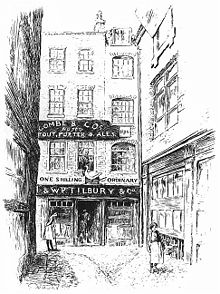
The first Grand Lodge, the Grand Lodge of England (GLE), was founded on 24 June 1717, when four existing London
London
London is the capital city of :England and the :United Kingdom, the largest metropolitan area in the United Kingdom, and the largest urban zone in the European Union by most measures. Located on the River Thames, London has been a major settlement for two millennia, its history going back to its...
Lodges met for a joint dinner. This rapidly expanded into a regulatory body, which most English Lodges joined. However, a few lodges resented some of the modernisations that GLE endorsed, such as the creation of the Third Degree, and formed a rival Grand Lodge on 17 July 1751, which they called the "Antient Grand Lodge of England
Antient Grand Lodge of England
The Ancient Grand Lodge of England or Grand Lodge of Free and Accepted Masons of England, according to the Old Constitutions was a rival Grand Lodge to the Premier Grand Lodge of England. It existed from 1751 until 1813 when the United Grand Lodge of England was created. They called themselves the...
." The two competing Grand Lodges vied for supremacy – the "Moderns" (GLE) and the "Antients" (or "Ancients") – until they united on 25 November 1813 to form the United Grand Lodge of England (UGLE).
The Grand Lodge of Ireland and The Grand Lodge of Scotland were formed in 1725 and 1736 respectively. Freemasonry was exported to the British Colonies in North America
North America
North America is a continent wholly within the Northern Hemisphere and almost wholly within the Western Hemisphere. It is also considered a northern subcontinent of the Americas...
by the 1730s – with both the "Antients" and the "Moderns" (as well as the Grand Lodges of Ireland and Scotland) chartering offspring, or "daughter," Lodges, and organising various Provincial Grand Lodges. After the American Revolution
American Revolution
The American Revolution was the political upheaval during the last half of the 18th century in which thirteen colonies in North America joined together to break free from the British Empire, combining to become the United States of America...
, independent U.S. Grand Lodges formed themselves within each state. Some thought was briefly given to organising an over-arching "Grand Lodge of the United States," with George Washington
George Washington
George Washington was the dominant military and political leader of the new United States of America from 1775 to 1799. He led the American victory over Great Britain in the American Revolutionary War as commander-in-chief of the Continental Army from 1775 to 1783, and presided over the writing of...
(who was a member of a Virginian lodge) as the first Grand Master, but the idea was short-lived. The various state Grand Lodges did not wish to diminish their own authority by agreeing to such a body.
Although there are no real differences in the Freemasonry practiced by lodges chartered by the Antients or the Moderns, the remnants of this division can still be seen in the names of most Lodges, F.& A.M. being Free and Accepted Masons and A.F.& A.M. being Antient Free and Accepted Masons.
The oldest jurisdiction on the continent of Europe
Europe
Europe is, by convention, one of the world's seven continents. Comprising the westernmost peninsula of Eurasia, Europe is generally 'divided' from Asia to its east by the watershed divides of the Ural and Caucasus Mountains, the Ural River, the Caspian and Black Seas, and the waterways connecting...
, the Grand Orient de France
Grand Orient de France
The Grand Orient de France is the largest of several Masonic organizations in France and the oldest in Continental Europe, founded in 1733.-Foundation:...
(GOdF), was founded in 1733.. However, most English-speaking jurisdictions cut formal relations with the GOdF around 1877, when (following the Lausanne Congress of 1875
Lausanne Congress of Supreme Councils of 1875
The Lausanne Congress of 1875 was a historic effort of eleven Supreme Councils to review and reform the Grand Constitutions of the Ancient & Accepted Scottish Riteof 1786...
) the GOdF removed the requirement that its members have a belief in a Deity. The Grande Loge Nationale Française
Grande Loge Nationale Française
The Grande Loge Nationale Française is a French Masonic Grand Lodge. It was founded in 1913, by two lodges, "Le Centre des Amis" Lodge splitting from the larger and older Grand Orient de France and "L'Anglaise" lodge, an independent lodge based in Bordeaux...
(GLNF) is currently the only French
France
The French Republic , The French Republic , The French Republic , (commonly known as France , is a unitary semi-presidential republic in Western Europe with several overseas territories and islands located on other continents and in the Indian, Pacific, and Atlantic oceans. Metropolitan France...
Grand Lodge that is in regular amity with the UGLE and its many concordant jurisdictions worldwide.
Due to the above history, Freemasonry is often said to consist of two branches not in mutual regular amity:
- the UGLE and concordant tradition of jurisdictions (mostly termed Grand Lodges) in amity, and
- the GOdF, European Continental, tradition of jurisdictions (often termed Grand Orients) in amity.
In most Latin
Latin Europe
Latin Europe is a loose term for the region of Europe with an especially strong Latin cultural heritage inherited from the Roman Empire.-Application:...
countries, the GOdF-style of European Continental Freemasonry
Continental Freemasonry
Continental Freemasonry refers to those Masonic lodges, mainly on the continent of Europe, that recognise the Grand Orient de France or belong to CLIPSAS or SIMPA.-The two branches of Freemasonry:Today, Freemasonry...
predominates, although in most of these Latin countries there are also Grand Lodges that are in regular amity with the UGLE and the worldwide community of Grand Lodges that share regular "fraternal relations" with the UGLE. The rest of the world, accounting for the bulk of Freemasonry, tends to follow more closely to the UGLE style, although minor variations exist.
Organisational structure
Sovereignty
Sovereignty is the quality of having supreme, independent authority over a geographic area, such as a territory. It can be found in a power to rule and make law that rests on a political fact for which no purely legal explanation can be provided...
bodies that govern Masonry in a given country, state, or geographical area (termed a jurisdiction). There is no single overarching governing body that presides over worldwide Freemasonry; connections between different jurisdictions depend solely on mutual recognition.
Regularity
Regularity is a constitutional mechanism whereby Grand Lodges or Grand Orients give one another mutual recognition. This recognition allows formal interaction at the Grand Lodge level, and gives individual Freemasons the opportunity to attend Lodge meetings in other recognised jurisdictions. Conversely, regularity proscribes interaction with Lodges that are irregular. A Mason who visits an irregular Lodge may have his membership suspended for a time, or he may be expelledExpulsion
Expulsion may refer to:*Expulsion , removing a student from a school or university*Expulsion from the United States Congress*Deportation, the expulsion of someone from a country*Population transfer, the forced migration of people by the state...
. For this reason, all Grand Lodges maintain lists of other jurisdictions and lodges they consider regular.
Grand Lodges and Grand Orients that afford mutual recognition and allow intervisitation are said to be in amity. As far as the UGLE is concerned, regularity is predicated upon adherence to a number of fundamental principals (known as Landmarks), set down in the UGLE Constitution and the Constitutions of those Grand Lodges with which they are in amity. Even within this definition there are some variations with the quantity and content of the Landmarks from jurisdiction to jurisdiction. Other Masonic groups organise differently.
Each of the two major branches of Freemasonry considers the Lodges within its branch to be "regular" and those in the other branch to be "irregular." As the UGLE branch is significantly larger, however, the various Grand Lodges and Grand Orients in amity with UGLE are commonly referred to as being "regular" (or "Mainstream") Masonry, while those Grand Lodges and Grand Orients in amity with GOdF are commonly referred to "liberal" or "irregular" Masonry. (The issue is complicated by the fact that the usage of "Lodge" versus "Orient" alone is not an indicator of which branch a body belongs to, and thus not an indication of regularity). The term "irregular" is also universally applied to various self created bodies that call themselves "Masonic" but are not recognised by either of the main branches.
Masonic Lodge
A Lodge (often termed a Private Lodge or Constituent Lodge in Masonic constitutions) is the basic organisational unit of Freemasonry. Every new Lodge must have a Warrant or Charter issued by a Grand Lodge, authorising it to meet and work. Except for the very few "time immemorial" Lodges pre-dating the formation of a Grand Lodge, masons who meet as a Lodge without displaying this document (for example, in prisoner-of-war camps) are deemed "Clandestine" and irregular.A Lodge must hold regular meetings at a fixed place and published dates. It will elect, initiate and promote its members and officers; it will build up and manage its property and assets, including its minutes and records; and it may own, occupy or share its premises. Like any organisation, it will have formal business to manage its meetings and proceedings, annual general meetings and committee
Committee
A committee is a type of small deliberative assembly that is usually intended to remain subordinate to another, larger deliberative assembly—which when organized so that action on committee requires a vote by all its entitled members, is called the "Committee of the Whole"...
s, charity funds
Charitable organization
A charitable organization is a type of non-profit organization . It differs from other types of NPOs in that it centers on philanthropic goals A charitable organization is a type of non-profit organization (NPO). It differs from other types of NPOs in that it centers on philanthropic goals A...
, correspondence and reports, membership and subscriptions, accounts and tax returns, special events and catering, and so forth. The balance of activities is individual to each Lodge, and under their common constitutions and forms of procedure, Lodges evolve very distinctive traditions.
A man can only be initiated, or made a Mason, in a Lodge, of which he may often remain a subscribing member for life. A Master Mason can generally visit any Lodge meeting under any jurisdiction in amity with his own, and as well as the formal meeting, a Lodge may well offer hospitality. A visitor should first check the regularity of that Lodge, and must be able to satisfy that Lodge of his own regularity; and he may be refused admission if adjudged likely to disrupt the harmony of the Lodge. If he wishes to visit the same Lodge repeatedly, he may be expected to join it and pay a subscription.
Most Lodges consist of Freemasons living or working within a given town or neighbourhood. Other Lodges are composed of Masons with a particular shared interest, profession
Profession
A profession is a vocation founded upon specialized educational training, the purpose of which is to supply disinterested counsel and service to others, for a direct and definite compensation, wholly apart from expectation of other business gain....
or background. Shared school
School
A school is an institution designed for the teaching of students under the direction of teachers. Most countries have systems of formal education, which is commonly compulsory. In these systems, students progress through a series of schools...
s, universities
University
A university is an institution of higher education and research, which grants academic degrees in a variety of subjects. A university is an organisation that provides both undergraduate education and postgraduate education...
, military units, Masonic appointments or degrees, arts, professions and hobbies
Hobby
A hobby is a regular activity or interest that is undertaken for pleasure, typically done during one's leisure time.- Etymology :A hobby horse is a wooden or wickerwork toy made to be ridden just like a real horse...
have all been the qualifications for such Lodges. In some Lodges, the foundation and name may now be only of historic interest, as over time the membership evolves beyond that envisaged by its "founding brethren"; in others, the membership remains exclusive.
There are also specialist Lodges of Research, with membership drawn from Master Masons only, with interests in Masonic Research (of history
History
History is the discovery, collection, organization, and presentation of information about past events. History can also mean the period of time after writing was invented. Scholars who write about history are called historians...
, philosophy
Philosophy
Philosophy is the study of general and fundamental problems, such as those connected with existence, knowledge, values, reason, mind, and language. Philosophy is distinguished from other ways of addressing such problems by its critical, generally systematic approach and its reliance on rational...
, etc.). Lodges of Research are fully warranted but, generally, do not initiate new candidates. Lodges of Instruction in UGLE may be warranted by any ordinary Lodge for the learning and rehearsal of Masonic Ritual
Ritual
A ritual is a set of actions, performed mainly for their symbolic value. It may be prescribed by a religion or by the traditions of a community. The term usually excludes actions which are arbitrarily chosen by the performers....
.
Freemasons correctly meet as a Lodge, not in a Lodge, the word "Lodge" referring more to the people assembled than the place of assembly. However, in common usage, Masonic premises are often referred to as "Lodges". Masonic buildings are also sometimes called "Temples" ("of Philosophy
Philosophy
Philosophy is the study of general and fundamental problems, such as those connected with existence, knowledge, values, reason, mind, and language. Philosophy is distinguished from other ways of addressing such problems by its critical, generally systematic approach and its reliance on rational...
and the Arts
The arts
The arts are a vast subdivision of culture, composed of many creative endeavors and disciplines. It is a broader term than "art", which as a description of a field usually means only the visual arts. The arts encompass visual arts, literary arts and the performing arts – music, theatre, dance and...
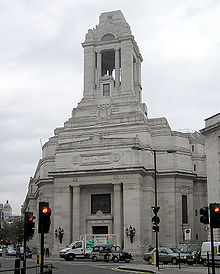
"). In many countries, Masonic Centre or Hall has replaced Temple to avoid arousing prejudice and suspicion. Several different Lodges, as well as other Masonic or non-Masonic organisations, often use the same premises at different times.
According to Masonic tradition, medieval European stonemasons would meet, eat, and shelter outside working hours in a Lodge on the southern side of a building site, where the sun warms the stones during the day. The social Festive Board (or Social Board)
part of the meeting is thus sometimes called the South. Early Lodges often met in a tavern
Tavern
A tavern is a place of business where people gather to drink alcoholic beverages and be served food, and in some cases, where travelers receive lodging....
or any other convenient fixed place with a private room.
Lodge Officers
Every Masonic Lodge elects certain officers to execute the necessary functions of the lodge's work. The Worshipful Master (essentially the lodge President) is always an elected officer. Most jurisdictions will also elect the Senior and Junior Wardens (Vice Presidents), the Secretary and the Treasurer. All lodges will have a Tyler, or Tiler, (who guards the door to the lodge room while the lodge is in session), sometimes elected and sometimes appointed by the Master. In addition to these elected officers, lodges will have various appointed officers – such as Deacons, Stewards, and a Chaplain (appointed to lead a non-denominational prayer at the convocation of meetings or activities – often, but not necessarily, a clergyman). The specific offices and their functions vary between jurisdictions.Many offices are replicated at the Provincial and Grand Lodge levels with the addition of the word 'Grand' somewhere in the title. For example, where every lodge has a 'Junior Warden', Grand Lodges have a 'Grand Junior Warden' (or sometimes 'Junior Grand Warden'). Additionally, there are a number of offices that exist only at the Grand Lodge level.
Prince Hall Freemasonry
Prince Hall Freemasonry derives from historical events in the early United States that led to a tradition of separate, predominantly African-American Freemasonry in North America.In 1775, an African-American named Prince Hall
Prince Hall
Prince Hall , was a tireless abolitionist and a leader of the free black community in Boston. Hall tried to gain New England’s enslaved and free blacks a place in some of the most crucial spheres of society, Freemasonry, education and the military...
was initiated into an Irish Constitution military Lodge then in Boston
Boston
Boston is the capital of and largest city in Massachusetts, and is one of the oldest cities in the United States. The largest city in New England, Boston is regarded as the unofficial "Capital of New England" for its economic and cultural impact on the entire New England region. The city proper had...
, Massachusetts
Massachusetts
The Commonwealth of Massachusetts is a state in the New England region of the northeastern United States of America. It is bordered by Rhode Island and Connecticut to the south, New York to the west, and Vermont and New Hampshire to the north; at its east lies the Atlantic Ocean. As of the 2010...
, along with fourteen other African-Americans, all of whom were free-born. When the military Lodge left North America, those fifteen men were given the authority to meet as a Lodge, form Processions on the days of the Saints John, and conduct Masonic funerals, but not to confer degrees, nor to do other Masonic work. In 1784, these individuals applied for, and obtained, a Lodge Warrant from the Premier Grand Lodge of England (GLE) and formed African Lodge, Number 459. When the UGLE was formed in 1813, all U.S.-based Lodges were stricken from their rolls – due largely to the War of 1812
War of 1812
The War of 1812 was a military conflict fought between the forces of the United States of America and those of the British Empire. The Americans declared war in 1812 for several reasons, including trade restrictions because of Britain's ongoing war with France, impressment of American merchant...
. Thus, separated from both UGLE and any concordantly recognised U.S. Grand Lodge, African Lodge re-titled itself as the African Lodge, Number 1 – and became a de facto "Grand Lodge" (this Lodge is not to be confused with the various Grand Lodges on the Continent of Africa
Africa
Africa is the world's second largest and second most populous continent, after Asia. At about 30.2 million km² including adjacent islands, it covers 6% of the Earth's total surface area and 20.4% of the total land area...
). As with the rest of U.S. Freemasonry, Prince Hall Freemasonry soon grew and organised on a Grand Lodge system for each state.
Widespread segregation
Racial segregation
Racial segregation is the separation of humans into racial groups in daily life. It may apply to activities such as eating in a restaurant, drinking from a water fountain, using a public toilet, attending school, going to the movies, or in the rental or purchase of a home...
in 19th- and early 20th-century North America made it difficult for African-Americans to join Lodges outside of Prince Hall jurisdictions – and impossible for inter-jurisdiction recognition between the parallel U.S. Masonic authorities.
Prince Hall Masonry has always been regular in all respects except constitutional separation, and this separation has diminished in recent years. At present, Prince Hall Grand Lodges are recognised by some UGLE Concordant Grand Lodges and not by others, but they appear to be working toward full recognition, with UGLE granting at least some degree of recognition. There are a growing number of both Prince Hall Lodges and non-Prince Hall Lodges that have ethnically diverse membership.
Other degrees, orders and bodies
There is no degree in Freemasonry higher than that of Master Mason, the Third Degree. There are, however, a number of organisations that require being a Master Mason as a prerequisite for membership. These bodies have no authority over the Craft. These orders or degrees may be described as additional or appendant, and often provide a further perspective on some of the allegorical, moral and philosophical content of Freemasonry.Appendant bodies are administered separately from Craft Grand Lodges but are styled Masonic since every member must be a Mason. However, Craft Masonic jurisdictions vary in their relationships with such bodies, if a relationship exists at all. The Articles of Union of the "Modern" and "Antient" craft Grand Lodges (into UGLE in 1813) limited recognition to certain degrees, such as the Royal Arch
Holy Royal Arch
The Holy Royal Arch is a degree of Freemasonry. It is present in all main masonic systems, though in some it is part of 'mainstream' Freemasonry, and in others it is an 'additional' degree....
and the "chivalric degrees", but there were and are many other degrees that have been worked since before the Union. Some bodies are not universally considered to be appendant bodies, but rather separate organisations that happen to require prior Masonic affiliation for membership. Some of these organisations have additional requirements, such as religious adherence (e.g., requiring members to profess Trinitarian Christian beliefs) or membership of other bodies.
Quite apart from these, there are organisations that are often thought of as being related to Freemasonry, but which have no formal or informal connections with Freemasonry. These include such organisations as the Orange Order
Orange Institution
The Orange Institution is a Protestant fraternal organisation based mainly in Northern Ireland and Scotland, though it has lodges throughout the Commonwealth and United States. The Institution was founded in 1796 near the village of Loughgall in County Armagh, Ireland...
, which originated in Ireland, the Knights of Pythias
Knights of Pythias
The Knights of Pythias is a fraternal organization and secret society founded at Washington, DC, on 19 February 1864.The Knights of Pythias was the first fraternal organization to receive a charter under an act of the United States Congress. It was founded by Justus H. Rathbone, who had been...
, or the Independent Order of Odd Fellows
Independent Order of Odd Fellows
The Independent Order of Odd Fellows , also known as the Three Link Fraternity, is an altruistic and benevolent fraternal organization derived from the similar British Oddfellows service organizations which came into being during the 18th century, at a time when altruistic and charitable acts were...
.
Principles and activities
While Freemasonry has often been called a "secret societySecret society
A secret society is a club or organization whose activities and inner functioning are concealed from non-members. The society may or may not attempt to conceal its existence. The term usually excludes covert groups, such as intelligence agencies or guerrilla insurgencies, which hide their...
," Freemasons themselves argue that it is more correct to say that it is an esoteric
Esotericism
Esotericism or Esoterism signifies the holding of esoteric opinions or beliefs, that is, ideas preserved or understood by a small group or those specially initiated, or of rare or unusual interest. The term derives from the Greek , a compound of : "within", thus "pertaining to the more inward",...
society, in that certain aspects are private. The most common phrasing is that Freemasonry has, in the 21st century, become less a secret society and more of a "society with secrets." The private aspects of modern Freemasonry are the modes of recognition
Recognition (sociology)
Recognition in sociology is public acknowledgement of person's status or merits .When some person is recognized, he or she is accorded some special status, such as a name, title, or classification...
amongst members and particular elements within the ritual
Ritual
A ritual is a set of actions, performed mainly for their symbolic value. It may be prescribed by a religion or by the traditions of a community. The term usually excludes actions which are arbitrarily chosen by the performers....
. Despite the organisation's great diversity, Freemasonry's central preoccupations remain charitable work within a local or wider community, moral uprightness (in most cases requiring a belief in a supreme being) as well as the development and maintenance of fraternal friendship, as James Anderson's Constitutions originally urged amongst brethren.
Ritual, symbolism, and morality
Masons conduct their meetings using a ritualised format. There is no single Masonic ritual, and each jurisdiction is free to set (or not set) its own ritual. However, there are similarities that exist among jurisdictions. For example, all Masonic ritual makes use of the architecturalArchitecture
Architecture is both the process and product of planning, designing and construction. Architectural works, in the material form of buildings, are often perceived as cultural and political symbols and as works of art...
symbolism of the tools of the medieval operative stonemason. Freemasons, as speculative masons (meaning philosophical building rather than actual building), use this symbolism to teach moral and ethical lessons of the principles of "Brotherly Love, Relief, and Truth;" or as related in France, "Liberty, Equality, Fraternity
Liberté, égalité, fraternité
Liberté, égalité, fraternité, French for "Liberty, equality, fraternity ", is the national motto of France, and is a typical example of a tripartite motto. Although it finds its origins in the French Revolution, it was then only one motto among others and was not institutionalized until the Third...
."
Steel square
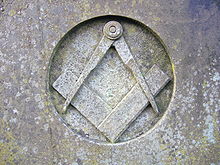
The steel square is a tool that carpenters use. They use many tools to lay out a "square" or right-angle, many of which are made of steel, but the title steel square refers to a specific long-armed square that has additional uses for measurement, especially of angles, as well as simple...
and compasses
Compass (drafting)
A compass or pair of compasses is a technical drawing instrument that can be used for inscribing circles or arcs. As dividers, they can also be used as a tool to measure distances, in particular on maps...
. Some Lodges and rituals explain these tools as lessons in conduct: for example, that Masons should "square their actions by the square of virtue" and to learn to "circumscribe their desires and keep their passions within due bounds toward all mankind." However, as Freemasonry is non-dogmatic, there is no general interpretation for these tools (or any Masonic emblem) that is used by Freemasonry as a whole.
These moral lessons are communicated in performance of allegorical ritual. A candidate progresses through degrees gaining knowledge and understanding of himself, his relationship with others and his relationship with the Supreme Being (per his own interpretation). While the philosophical aspects of Freemasonry tend to be discussed in Lodges of Instruction or Research, and sometimes informal groups, Freemasons, and others, frequently publish, with varying degrees of competence, studies that are available to the public. Any mason may speculate on the symbols and purpose of Freemasonry, and indeed all masons are required to some extent to speculate on masonic meaning as a condition of advancing through the degrees. There is no one accepted meaning, and no one person "speaks" for the whole of Freemasonry.
Some lodges make use of tracing board
Tracing board
Tracing boards are painted or printed illustrations depicting the various emblems and symbols of Freemasonry. They can be used as teaching aids during the lectures that follow each of the three Masonic Degrees, when an experienced member explains the various concepts of Freemasonry to new members...
s. These are painted or printed illustrations depicting the various symbolic emblem
Emblem
An emblem is a pictorial image, abstract or representational, that epitomizes a concept — e.g., a moral truth, or an allegory — or that represents a person, such as a king or saint.-Distinction: emblem and symbol:...
s of Freemasonry. They can be used as teaching aids during the lectures that follow each of the three Degrees, when an experienced member explains the various concepts of Freemasonry to new members. They can also be used by experienced members as self-reminders of the concepts they learned as they went through their initiation
Initiation
Initiation is a rite of passage ceremony marking entrance or acceptance into a group or society. It could also be a formal admission to adulthood in a community or one of its formal components...
s.
Freemasonry uses the metaphor
Metaphor
A metaphor is a literary figure of speech that uses an image, story or tangible thing to represent a less tangible thing or some intangible quality or idea; e.g., "Her eyes were glistening jewels." Metaphor may also be used for any rhetorical figures of speech that achieve their effects via...
s of operative stonemasons' tools and implements, against the allegorical
Allegory
Allegory is a demonstrative form of representation explaining meaning other than the words that are spoken. Allegory communicates its message by means of symbolic figures, actions or symbolic representation...
backdrop of the building of King Solomon's Temple
Solomon's Temple
Solomon's Temple, also known as the First Temple, was the main temple in ancient Jerusalem, on the Temple Mount , before its destruction by Nebuchadnezzar II after the Siege of Jerusalem of 587 BCE....
, to convey what has been described by both Masons and critics as "a system of morality veiled in allegory and illustrated by symbols."
The Supreme Being and the Volume of Sacred Law
Candidates for regularRegular Masonic jurisdictions
Regularity is the process by which individual Grand Lodges recognise one another for the purposes of allowing formal interaction at the Grand Lodge level and visitation by members of other jurisdictions.-History:...
Freemasonry are required to declare a belief in a Supreme Being
Supreme Being
The term Supreme Being is often defined simply as "God", and it is used with this meaning by theologians of many religious faiths, including, but not limited to, Christianity, Islam, Hinduism, and Deism. However, the term can also refer to more complex or philosophical interpretations of the...
. However, the candidate is not asked to expand on, or explain, his interpretation of Supreme Being. The discussion of politics
Politics
Politics is a process by which groups of people make collective decisions. The term is generally applied to the art or science of running governmental or state affairs, including behavior within civil governments, but also applies to institutions, fields, and special interest groups such as the...
and religion
Religion
Religion is a collection of cultural systems, belief systems, and worldviews that establishes symbols that relate humanity to spirituality and, sometimes, to moral values. Many religions have narratives, symbols, traditions and sacred histories that are intended to give meaning to life or to...
is forbidden within a Masonic Lodge
Masonic Lodge
This article is about the Masonic term for a membership group. For buildings named Masonic Lodge, see Masonic Lodge A Masonic Lodge, often termed a Private Lodge or Constituent Lodge, is the basic organisation of Freemasonry...
, in part so a Mason will not be placed in the situation of having to justify his personal interpretation. Thus, reference to the Supreme Being can mean the Christian Trinity
Trinity
The Christian doctrine of the Trinity defines God as three divine persons : the Father, the Son , and the Holy Spirit. The three persons are distinct yet coexist in unity, and are co-equal, co-eternal and consubstantial . Put another way, the three persons of the Trinity are of one being...
to a Christian Mason, Allah
God in Islam
In Islamic theology, God is the all-powerful and all-knowing creator, sustainer, ordainer, and judge of the universe. Islam puts a heavy emphasis on the conceptualization of God as strictly singular . God is unique and inherently One , all-merciful and omnipotent. According to the Islamic...
to a Muslim Mason, Para Brahman
Para Brahman
Para Brahman or Param Brahman - is a term often used by Vedantic philosophers as to the "attainment of the ultimate goal". Adi Shankara has said that there is only one Supreme Para-Brahman and all the other deities are the forms and expansions of this Para-Brahman...
to a Hindu Mason, etc. While most Freemasons would take the view that the term Supreme Being equates to God
God
God is the English name given to a singular being in theistic and deistic religions who is either the sole deity in monotheism, or a single deity in polytheism....
, others may hold a more complex or philosophical interpretation of the term.
In the ritual, the Supreme Being is referred to as the Great Architect of the Universe
Great Architect of the Universe
The Great Architect of the Universe is a conception of God discussed by many Christian theologians and apologists. As a designation it is used within Freemasonry to neutrally represent whatever Supreme Being to which each member individually holds in adherence...
, which alludes to the use of architectural symbolism within Freemasonry.
A Volume of the Sacred Law is always displayed in an open Lodge in those jurisdictions which require a belief in the Supreme Being. In English-speaking countries, this is frequently the King James Version of the Bible
King James Version of the Bible
The Authorized Version, commonly known as the King James Version, King James Bible or KJV, is an English translation of the Christian Bible by the Church of England begun in 1604 and completed in 1611...
or another standard translation; there is no such thing as an exclusive "Masonic Bible." Furthermore, a candidate is given his choice of religious text for his Obligation, according to his beliefs. UGLE alludes to similarities to legal practice in the UK, and to a common source with other oath taking processes. In Lodges with a membership of mixed religions it is common to find more than one sacred text displayed. In lodges that follow the Continental
Continental Freemasonry
Continental Freemasonry refers to those Masonic lodges, mainly on the continent of Europe, that recognise the Grand Orient de France or belong to CLIPSAS or SIMPA.-The two branches of Freemasonry:Today, Freemasonry...
tradition other texts may be used, including texts that are non-religious in nature.
Degrees
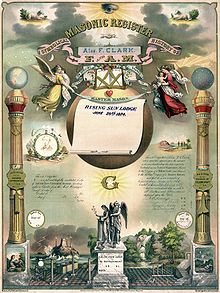
- Entered Apprentice – the degree of an Initiate, which makes one a Freemason;
- Fellow Craft – an intermediate degree, involved with learning; and
- Master Mason – the "third degree", a necessity for participation in most aspects of Masonry.
The degrees represent stages of personal development. No Freemason is told that there is only one meaning to the allegories; as a Freemason works through the degrees and studies their lessons, he interprets them for himself, his personal interpretation being bounded only by the Constitution within which he works. A common symbolic structure and universal archetypes provide a means for each Freemason to come to his own answers to life's important philosophical questions.
There is no degree of Craft Freemasonry higher than that of Master Mason. Although some Masonic bodies and orders have further degrees named with higher numbers, these degrees may be considered to be supplements to the Master Mason degree rather than promotions from it. An example is the Scottish Rite
Scottish Rite
The Ancient and Accepted Scottish Rite of Freemasonry , commonly known as simply the Scottish Rite, is one of several Rites of the worldwide fraternity known as Freemasonry...
, conferring degrees numbered from 4° up to 33°. It is essential to be a Master Mason in order to qualify for these further degrees. They are administered on a parallel system to Craft or Blue Lodge Freemasonry; within each organisation there is a system of offices, which confer rank within that degree or order alone.
In some jurisdictions, especially those in continental Europe, Freemasons working through the degrees may be asked to prepare papers on related philosophical topics, and present these papers in open Lodge. There is an enormous bibliography of Masonic papers, magazines and publications ranging from fanciful abstractions which construct spiritual and moral lessons of varying value, through practical handbooks on organisation, management and ritual performance, to serious historical and philosophical papers entitled to academic respect.
Signs, grips and words
Freemasons use signs (gestures), grips or tokens (handshakes) and words to gain admission to meetings and identify legitimate visitors.From the early 18th century onwards, many exposés have been written claiming to reveal these signs, grips and passwords to the uninitiated. A classic response was deliberately to transpose certain words in the ritual, so as to catch out anyone relying on the exposé. However, since each Grand Lodge is free to create its own rituals, the signs, grips and passwords can and do differ from jurisdiction to jurisdiction. Furthermore, Grand Lodges can and do change their rituals periodically, updating the language used, adding or omitting sections. Therefore, any exposé can only be valid for a particular jurisdiction at a particular time, and is always difficult for an outsider to verify. Today, an unknown visitor may be required to produce a certificate, dues card or other documentation of membership in addition to demonstrating knowledge of the signs, grips and passwords.
Obligations
Obligations are those elements of ritual in which a candidate swears to abide by the rules of the fraternity, to keep the "secrets of Freemasonry" (which are the various signs, tokens and words associated with recognition in each degree), and to act towards others in accordance with Masonic tradition and law. In regular jurisdictions these obligations are sworn on the aforementioned Volume of the Sacred Law and in the witness of the Supreme Being and often with assurance that it is of the candidate's own free will.Details of the obligations vary; some versions are published while others are privately printed in books of coded text. Still other jurisdictions rely on oral transmission of ritual, and thus have no ritual books at all. Moreover, not all printed rituals are authentic – Léo Taxil
Léo Taxil
Léo Taxil, originally Marie Joseph Gabriel Antoine Jogand-Pagès , was a French writer and journalist who became known for his strong anti-Catholic and anti-clerical views....
's exposure, for example, is a proven hoax, while Duncan's Masonic Monitor (created, in part, by merging elements of several rituals then in use) was never adopted by any regular jurisdiction.
Whilst no single obligation is representative of Freemasonry as a whole, a number of common themes appear when considering a range of potential texts. Content which may appear in at least one of the three obligations includes: the candidate promises to act in a manner befitting a member of civilised society, promises to obey the law of his Supreme Being, promises to obey the law of his sovereign state, promises to attend his lodge if he is able, promises not to wrong, cheat nor defraud the Lodge or the brethren, and promises aid or charity to a member of the human family, brethren and their families in times of need if it can be done without causing financial harm to himself or his dependents.
The obligations are historically known amongst various sources critical of Freemasonry for their so-called "bloody penalties," an allusion to the apparent physical penalties associated with each degree. This leads to some descriptions of the Obligations as "Oaths". The corresponding text, with regard to the penalties, does not appear in authoritative, endorsed sources, following a decision "that all references to physical penalties be omitted from the obligations taken by Candidates in the three Degrees and by a Master Elect at his Installation but retained elsewhere in the respective ceremonies." The penalties are interpreted symbolically, and are not applied in actuality by a Lodge or by any other body of Masonry. The descriptive nature of the penalties alludes to how the candidate should feel about himself should he knowingly violate his obligation. Modern actual penalties may include suspension, expulsion or reprimand.
Landmarks
The Landmarks of Masonry are defined as ancient and unchangeable principles; standards by which the regularity of Lodges and Grand Lodges are judged. Each Grand Lodge is self-governing and no single authority exists over the whole of Freemasonry. The interpretation of these principles therefore can and does vary, leading to controversies of recognition.
The concept of Masonic Landmarks appears in Masonic regulations as early as 1723, and seems to be adopted from the regulations of operative masonic guilds. In 1858, Albert G. Mackey
Albert Mackey
Albert Gallatin Mackey was an American medical doctor, and is best known for his authorship of many books and articles about freemasonry, particularly Masonic Landmarks...
attempted to set down 25 Landmarks. In 1863, George Oliver published a Freemason's Treasury in which he listed 40 Landmarks. A number of American Grand Lodges have attempted the task of enumerating the Landmarks; numbers differing from West Virginia (7) and New Jersey (10) to Nevada (39) and Kentucky (54).
Charitable effort
The fraternity is widely involved in charity and community service activities. In contemporary times, money is collected only from the membership, and is to be devoted to charitable purposes. Freemasonry worldwide disburses substantial charitable amounts to non-Masonic charities, locally, nationally and internationally. In earlier centuries, however, charitable funds were collected more on the basis of a Provident or Friendly SocietyFriendly society
A friendly society is a mutual association for insurance, pensions or savings and loan-like purposes, or cooperative banking. It is a mutual organization or benefit society composed of a body of people who join together for a common financial or social purpose...
, and there were elaborate regulations to determine a petitioner's eligibility for consideration for charity, according to strictly Masonic criteria.
Some examples of Masonic charities include:
- Homes that provide sheltered housingSheltered housingSheltered housing is a British English term covering a wide range of rented housing for older and/or disabled or other vulnerable people. Most commonly it refers to grouped housing such as a block or "scheme" of flats or bungalows with a scheme manager or "officer"; traditionally the manager has...
or nursing care. - Education with both educational grants or schools such as the Royal Masonic School (UK)Royal Masonic SchoolThe Royal Masonic School for Girls is an independent school in Rickmansworth, England with both day and boarding pupils. The school was instituted in 1788, with the aim of maintaining the daughters of indigent Freemasons, unable through death, illness, or incapacitation to support their families...
which are open to all and not limited to the families of Freemasons. - Medical assistance.
- Masonic Child Identification Programs (CHIP)Masonic Child Identification Programs (CHIP)Masonic Child Identification Programs are a charitable initiative by North American Masonic lodges to aid in the identification and recovery of missing children...
.
In addition to these, there are thousands of philanthropic organisations around the world created by Freemasons. The Masonic Service Association, the Masonic Medical Research Laboratory, and the Shriners Hospitals for Children
Shriners Hospitals for Children
Shriners Hospitals for Children is a network of 22 non-profit hospitals across North America. Children with orthopaedic conditions, burns, spinal cord injuries, and cleft lip and palate are eligible for care and receive all services in a family-centered environment, regardless of the patients’...
are especially notable charitable endeavours that Masons have founded and continue to support both intellectually and monetarily.
Membership requirements
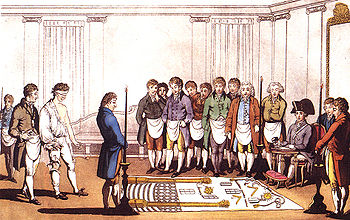
However the initial introduction is made, the official process of becoming a Mason begins when a candidate for Freemasonry formally petitions a lodge. The brethren will then investigate the candidate, to assure themselves of his good character, and hold a secret ballot election (often using an old fashioned ballot box
Ballot box
A ballot box is a temporarily sealed container, usually square box though sometimes a tamper resistant bag, with a narrow slot in the top sufficient to accept a ballot paper in an election but which prevents anyone from accessing the votes cast until the close of the voting period...
). The number of adverse votes needed to reject a candidate varies from jurisdiction to jurisdiction (in some, one "black ball" is enough to reject, in others up to three are required).
General requirements
Generally, to be accepted for initiation as a regular Freemason, a candidate must:- Be a manManThe term man is used for an adult human male . However, man is sometimes used to refer to humanity as a whole...
who comes of his own free will. - Believe in a Supreme Being (the form of which is left to open interpretation by the candidate).
- Be at least the minimum age (from 18–25 years old depending on the jurisdiction. In some jurisdictions the son of a Mason, known as a "Lewis," may join at an earlier age than others).
- Be of good morals, and of good reputation.
- Be of sound mind and body (lodges had in the past denied membership to a man because of a physical disability; however, now, if a potential candidate says a disability will not cause problems, it will not be held against him).
- Be free-born (or "born free", i.e., not born a slaveSlaverySlavery is a system under which people are treated as property to be bought and sold, and are forced to work. Slaves can be held against their will from the time of their capture, purchase or birth, and deprived of the right to leave, to refuse to work, or to demand compensation...
or bondsmanSerfdomSerfdom is the status of peasants under feudalism, specifically relating to Manorialism. It was a condition of bondage or modified slavery which developed primarily during the High Middle Ages in Europe and lasted to the mid-19th century...
). As with the previous, this is entirely an historical holdover, and can be interpreted in the same manner as it is in the context of being entitled to write a willWill (law)A will or testament is a legal declaration by which a person, the testator, names one or more persons to manage his/her estate and provides for the transfer of his/her property at death...
. Some jurisdictions have removed this requirement. - Be capable of furnishing character references, as well as one or two references from current Masons, depending on jurisdiction.
Some Grand Lodges in the United States have an additional residence requirement, candidates being expected to have lived within the jurisdiction for a certain period of time, typically six months.
Having been elected and initiated, a member may subsequently resign from membership if he so desires. Additionally, the fraternity may either suspend or expel a member for cause.
Membership and religion
Freemasonry explicitly and openly states that it is neither a religion nor a substitute for one. "There is no separate Masonic God", nor a separate proper name for a deity in any branch of Freemasonry.Regular Freemasonry requires that its candidates believe in a Supreme Being, but the interpretation of this term is subject to the conscience of the candidate. Consequently, Freemasonry accepts men from a range of faiths, including (but not limited to) Buddhism
Buddhism
Buddhism is a religion and philosophy encompassing a variety of traditions, beliefs and practices, largely based on teachings attributed to Siddhartha Gautama, commonly known as the Buddha . The Buddha lived and taught in the northeastern Indian subcontinent some time between the 6th and 4th...
, Christianity
Christianity
Christianity is a monotheistic religion based on the life and teachings of Jesus as presented in canonical gospels and other New Testament writings...
, Hinduism
Hinduism
Hinduism is the predominant and indigenous religious tradition of the Indian Subcontinent. Hinduism is known to its followers as , amongst many other expressions...
, Islam
Islam
Islam . The most common are and . : Arabic pronunciation varies regionally. The first vowel ranges from ~~. The second vowel ranges from ~~~...
, Judaism
Judaism
Judaism ) is the "religion, philosophy, and way of life" of the Jewish people...
, and Sikhism
Sikhism
Sikhism is a monotheistic religion founded during the 15th century in the Punjab region, by Guru Nanak Dev and continued to progress with ten successive Sikh Gurus . It is the fifth-largest organized religion in the world and one of the fastest-growing...
. As a result, Freemasonry uses Volume of the Sacred Law (VSL) as a generic term for a religious book. As UGLE-based Freemasonry also requires that a VSL be present on the Altar, many Lodges have multiple VSLs available, and a candidate can be obligated on his book of choice.
Since the early 19th century, in the irregular Continental European tradition (meaning irregular to those Grand Lodges in amity with the United Grand Lodge of England), a very broad interpretation has been given to a non-dogmatic Supreme Being; in the tradition of Baruch Spinoza
Baruch Spinoza
Baruch de Spinoza and later Benedict de Spinoza was a Dutch Jewish philosopher. Revealing considerable scientific aptitude, the breadth and importance of Spinoza's work was not fully realized until years after his death...
and Johann Wolfgang von Goethe
Johann Wolfgang von Goethe
Johann Wolfgang von Goethe was a German writer, pictorial artist, biologist, theoretical physicist, and polymath. He is considered the supreme genius of modern German literature. His works span the fields of poetry, drama, prose, philosophy, and science. His Faust has been called the greatest long...
– or views of The Ultimate Cosmic Oneness – along with Western atheistic idealism
Idealism
In philosophy, idealism is the family of views which assert that reality, or reality as we can know it, is fundamentally mental, mentally constructed, or otherwise immaterial. Epistemologically, idealism manifests as a skepticism about the possibility of knowing any mind-independent thing...
and agnosticism
Agnosticism
Agnosticism is the view that the truth value of certain claims—especially claims about the existence or non-existence of any deity, but also other religious and metaphysical claims—is unknown or unknowable....
.
The form of Freemasonry most common in Scandinavia
Scandinavia
Scandinavia is a cultural, historical and ethno-linguistic region in northern Europe that includes the three kingdoms of Denmark, Norway and Sweden, characterized by their common ethno-cultural heritage and language. Modern Norway and Sweden proper are situated on the Scandinavian Peninsula,...
, known as the Swedish Rite
Swedish Rite
The Swedish Rite is a variation of Freemasonry that is worked in Sweden, Norway, Denmark, Finland and Iceland. A slight variation is common in parts of Germany under the Große Landesloge der Freimaurer von Deutschland. Also other craft masonic bodies are working in the nordic countries...
, accepts only Christians.
Freemasonry and women
Since the adoption of Anderson's constitution in 1723, it has been accepted as fact by regular Masons that only men can be made Masons. Most Grand Lodges do not admit women because they believe it would violate the ancient Landmarks. While a few women, such as Elizabeth AldworthElizabeth Aldworth
The Honorable Elizabeth Aldworth , born the Hon. Elizabeth St...
, were initiated into British speculative lodges prior to 1723, officially regular Freemasonry remains exclusive to men.
While women cannot join regular lodges, there are (mainly within the borders of the United States) many female orders associated with regular Freemasonry and its appendant bodies, such as the Order of the Eastern Star
Order of the Eastern Star
The Order of the Eastern Star is a fraternal organization that both men and women can join. It was established in 1850 by Rob Morris, a lawyer and educator from Boston, Massachusetts, who had been an official with the Freemasons. It is based on teachings from the Bible, but is open to people of all...
, the Order of the Amaranth
Order of the Amaranth
Order of the Amaranth is a Masonic-affiliated women's organization founded in 1873. As in the Order of the Eastern Star, members of the Order must be age 18 and older; men must be Master Masons; and women must be related to Masons as wives, mothers, daughters, widows, sisters, nieces, aunts, et...
, the White Shrine of Jerusalem, the Social Order of Beauceant and the Daughters of the Nile. These have their own rituals and traditions, but are founded on the Masonic model. In the French context, women in the 18th and 19th centuries had been admitted into what were known as "adoption lodges" in which they could participate in ritual life. However, men clearly saw this type of adoption Freemasonry as distinct from their exclusively male variety. From the late 19th century onward, mixed gender lodges have met in France.
In addition, there are many non-mainstream Masonic bodies that do admit both men and women or are exclusively for women. Co-Freemasonry
Co-Freemasonry
Co-Freemasonry is a form of Freemasonry which admits both men and women. It began in France in the 1880s with the forming of Le Droit Humain, and is now an international movement represented by several Co-Masonic administrations throughout the world...
admits both men and women, but it is held to be irregular because it admits women. The systematic admission of women into International Co-Freemasonry began in France in 1882. In more recent times, women have created and maintained separate Lodges, working the same rituals as the all male regular lodges. These Female Masons have founded lodges around the world, and these Lodges continue to gain membership.
Opposition to and criticism of Freemasonry
Anti-Masonry (alternatively called Anti-Freemasonry) has been defined as "opposition to Freemasonry." However, there is no homogeneous anti-Masonic movement. Anti-Masonry consists of widely differing criticisms from diverse (and often incompatible) groups who are hostile to Freemasonry in some form. Critics have included religious groups, political groups, and conspiracy theorists.There have been many disclosures and exposés dating as far back as the 18th century. These often lack context, may be outdated for various reasons, or could be outright hoax
Hoax
A hoax is a deliberately fabricated falsehood made to masquerade as truth. It is distinguishable from errors in observation or judgment, or rumors, urban legends, pseudosciences or April Fools' Day events that are passed along in good faith by believers or as jokes.-Definition:The British...
es on the part of the author, as in the case of the Taxil hoax
Taxil hoax
The Taxil hoax was an 1890s hoax of exposure by Léo Taxil intended to mock not only Freemasonry, but also the Roman Catholic Church's opposition to it.-Taxil and Freemasonry:...
.
These hoaxes and exposés have often become the basis for criticism of Masonry, often religious or political in nature (usually by totalitarian dictatorial regimes, but also arising in the historical Anti-Masonic Party
Anti-Masonic Party
The Anti-Masonic Party was the first "third party" in the United States. It strongly opposed Freemasonry and was founded as a single-issue party aspiring to become a major party....
in the United States), or are based on suspicion of corrupt conspiracy of some form. The political opposition that arose after the "Morgan Affair" in 1826 gave rise to the term "Anti-Masonry
Anti-Masonry
Anti-Masonry is defined as "avowed opposition to Freemasonry". However, there is no homogeneous anti-Masonic movement...
," which is still in use today, both by Masons in referring to their critics and as a self-descriptor by the critics themselves.
Religious opposition
Freemasonry has attracted criticism from theocraticTheocracy
Theocracy is a form of organization in which the official policy is to be governed by immediate divine guidance or by officials who are regarded as divinely guided, or simply pursuant to the doctrine of a particular religious sect or religion....
states and organised religions for supposed competition with religion, or supposed heterodoxy
Heterodoxy
Heterodoxy is generally defined as "any opinions or doctrines at variance with an official or orthodox position". As an adjective, heterodox is commonly used to describe a subject as "characterized by departure from accepted beliefs or standards"...
within the Fraternity itself, and has long been the target of conspiracy theories, which see it as an occult
Occult
The word occult comes from the Latin word occultus , referring to "knowledge of the hidden". In the medical sense it is used to refer to a structure or process that is hidden, e.g...
and evil power.
Christianity and Freemasonry
Although members of various faiths cite objections, certain ChristianChristian
A Christian is a person who adheres to Christianity, an Abrahamic, monotheistic religion based on the life and teachings of Jesus of Nazareth as recorded in the Canonical gospels and the letters of the New Testament...
denominations
Religious denomination
A religious denomination is a subgroup within a religion that operates under a common name, tradition, and identity.The term describes various Christian denominations...
have had high profile negative attitudes to Masonry, banning or discouraging their members from being Freemasons.
The denomination with the longest history of objection to Freemasonry is the Roman Catholic Church
Roman Catholic Church
The Catholic Church, also known as the Roman Catholic Church, is the world's largest Christian church, with over a billion members. Led by the Pope, it defines its mission as spreading the gospel of Jesus Christ, administering the sacraments and exercising charity...
. The objections raised by the Roman Catholic Church are based on the allegation that Masonry teaches a naturalistic deistic religion which is in conflict with Church doctrine
Doctrine
Doctrine is a codification of beliefs or a body of teachings or instructions, taught principles or positions, as the body of teachings in a branch of knowledge or belief system...
. A number of Papal pronouncements have been issued against Freemasonry. The first was Pope Clement XII's
Pope Clement XII
Pope Clement XII , born Lorenzo Corsini, was Pope from 12 July 1730 to 6 February 1740.Born in Florence, the son of Bartolomeo Corsini, Marquis of Casigliano and his wife Isabella Strozzi, sister of the Duke of Bagnuolo, Corsini had been an aristocratic lawyer and financial manager under preceding...
In Eminenti, 28 April 1738; the most recent was Pope Leo XIII's
Pope Leo XIII
Pope Leo XIII , born Vincenzo Gioacchino Raffaele Luigi Pecci to an Italian comital family, was the 256th Pope of the Roman Catholic Church, reigning from 1878 to 1903...
Ab Apostolici
Ab Apostolici
Ab Apostolici was a papal encyclical promulgated by Leo XIII on 15 October 1890.It dealt with Freemasonry in Italy, condemning the contemporary course of public affairs in Italy as the realization of the "Masonic programme"...
, 15 October 1890. The 1917 Code of Canon Law
Canon law (Catholic Church)
The canon law of the Catholic Church, is a fully developed legal system, with all the necessary elements: courts, lawyers, judges, a fully articulated legal code and principles of legal interpretation. It lacks the necessary binding force present in most modern day legal systems. The academic...
explicitly declared that joining Freemasonry entailed automatic excommunication
Excommunication
Excommunication is a religious censure used to deprive, suspend or limit membership in a religious community. The word means putting [someone] out of communion. In some religions, excommunication includes spiritual condemnation of the member or group...
. The 1917 Code of Canon Law also forbade books friendly to Freemasonry.
In 1983, the Church issued a new Code of Canon Law
Canon law
Canon law is the body of laws & regulations made or adopted by ecclesiastical authority, for the government of the Christian organization and its members. It is the internal ecclesiastical law governing the Catholic Church , the Eastern and Oriental Orthodox churches, and the Anglican Communion of...
. Unlike its predecessor, it did not explicitly name Masonic orders among the secret societies it condemns. It states in part: "A person who joins an association which plots against the Church is to be punished with a just penalty; one who promotes or takes office in such an association is to be punished with an interdict
Interdict (Roman Catholic Church)
In Roman Catholic canon law, an interdict is an ecclesiastical censure that excludes from certain rites of the Church individuals or groups, who nonetheless do not cease to be members of the Church.-Distinctions in canon law:...
." This named omission of Masonic orders caused both Catholics and Freemasons to believe that the ban on Catholics becoming Freemasons may have been lifted, especially after the perceived liberalisation of Vatican II
Second Vatican Council
The Second Vatican Council addressed relations between the Roman Catholic Church and the modern world. It was the twenty-first Ecumenical Council of the Catholic Church and the second to be held at St. Peter's Basilica in the Vatican. It opened under Pope John XXIII on 11 October 1962 and closed...
. However, the matter was clarified when Cardinal Joseph Ratzinger (later Pope Benedict XVI
Pope Benedict XVI
Benedict XVI is the 265th and current Pope, by virtue of his office of Bishop of Rome, the Sovereign of the Vatican City State and the leader of the Catholic Church as well as the other 22 sui iuris Eastern Catholic Churches in full communion with the Holy See...
), as the Prefect of the Congregation for the Doctrine of the Faith
Congregation for the Doctrine of the Faith
The Congregation for the Doctrine of the Faith , previously known as the Supreme Sacred Congregation of the Roman and Universal Inquisition , and after 1904 called the Supreme...
, issued a Declaration on Masonic Associations, which states: "... the Church’s negative judgment in regard to Masonic association remains unchanged since their principles have always been considered irreconcilable with the doctrine of the Church and therefore membership in them remains forbidden. The faithful who enroll in Masonic associations are in a state of grave sin and may not receive Holy Communion." Thus, from a Catholic perspective, there is still a ban on Catholics joining Masonic Lodges. For its part, Freemasonry has never objected to Catholics joining their fraternity. Those Grand Lodges in amity with UGLE deny the Church's claims and state that they explicitly adhere to the principle that "Freemasonry is not a religion, nor a substitute for religion."
In contrast to Catholic allegations of rationalism and naturalism, Protestant objections are more likely to be based on allegations of mysticism
Mysticism
Mysticism is the knowledge of, and especially the personal experience of, states of consciousness, i.e. levels of being, beyond normal human perception, including experience and even communion with a supreme being.-Classical origins:...
, occultism, and even Satanism
Satanism
Satanism is a group of religions that is composed of a diverse number of ideological and philosophical beliefs and social phenomena. Their shared feature include symbolic association with, admiration for the character of, and even veneration of Satan or similar rebellious, promethean, and...
. Masonic scholar Albert Pike
Albert Pike
Albert Pike was an attorney, Confederate officer, writer, and Freemason. Pike is the only Confederate military officer or figure to be honored with an outdoor statue in Washington, D.C...
is often quoted (in some cases misquoted) by Protestant anti-Masons as an authority for the position of Masonry on these issues. However, Pike, although undoubtedly learned, was not a spokesman for Freemasonry and was controversial among Freemasons in general, representing his personal opinion only, and furthermore an opinion grounded in the attitudes and understandings of late 19th century Southern Freemasonry of the USA alone. Indeed his book carries in the preface a form of disclaimer from his own Grand Lodge. No one voice has ever spoken for the whole of Freemasonry.
Free Methodist Church
Free Methodist Church
The Free Methodist Church is a Methodist Christian denomination within the holiness movement. It is evangelical in nature and has its roots in the Arminian-Wesleyan tradition....
founder B.T. Roberts was a vocal opponent of Freemasonry in the mid 19th century. Roberts opposed the society on moral grounds and stated, "The god of the lodge is not the God of the Bible." Roberts believed Freemasonry was a "mystery
Greco-Roman mysteries
Mystery religions, sacred Mysteries or simply mysteries, were religious cults of the Greco-Roman world, participation in which was reserved to initiates....
" or "alternate" religion and encouraged his church not to support ministers who were Freemasons. Freedom from secret societies is one of the "frees" the Free Methodist Church was founded upon.
Since the founding of Freemasonry, many Bishops of the Church of England
Church of England
The Church of England is the officially established Christian church in England and the Mother Church of the worldwide Anglican Communion. The church considers itself within the tradition of Western Christianity and dates its formal establishment principally to the mission to England by St...
have been Freemasons, such as Archbishop
Archbishop
An archbishop is a bishop of higher rank, but not of higher sacramental order above that of the three orders of deacon, priest , and bishop...
Geoffrey Fisher
Geoffrey Fisher
Geoffrey Francis Fisher, Baron Fisher of Lambeth, GCVO, PC was Archbishop of Canterbury from 1945 to 1961.-Background:...
. In the past, few members of the Church of England would have seen any incongruity in concurrently adhering to Anglican Christianity and practicing Freemasonry. In recent decades, however, reservations about Freemasonry have increased within Anglicanism, perhaps due to the increasing prominence of the evangelical wing of the church. The current Archbishop of Canterbury
Archbishop of Canterbury
The Archbishop of Canterbury is the senior bishop and principal leader of the Church of England, the symbolic head of the worldwide Anglican Communion, and the diocesan bishop of the Diocese of Canterbury. In his role as head of the Anglican Communion, the archbishop leads the third largest group...
, Dr Rowan Williams
Rowan Williams
Rowan Douglas Williams FRSL, FBA, FLSW is an Anglican bishop, poet and theologian. He is the 104th and current Archbishop of Canterbury, Metropolitan of the Province of Canterbury and Primate of All England, offices he has held since early 2003.Williams was previously Bishop of Monmouth and...
, appears to harbour some reservations about Masonic ritual, whilst being anxious to avoid causing offence to Freemasons inside and outside the Church of England. In 2003 he felt it necessary to apologise to British Freemasons after he said that their beliefs were incompatible with Christianity and that he had barred the appointment of Freemasons to senior posts in his diocese when he was Bishop of Monmouth.
In 1933, the Orthodox Church of Greece
Church of Greece
The Church of Greece , part of the wider Greek Orthodox Church, is one of the autocephalous churches which make up the communion of Orthodox Christianity...
officially declared that being a Freemason constitutes an act of apostasy
Apostasy in Christianity
Apostasy in Christianity refers to the rejection of Christianity by someone who formerly was a Christian. The term apostasy comes from the Greek word apostasia meaning defection, departure, revolt or rebellion. It has been described as "a willful falling away from, or rebellion against, Christian...
and thus, until he repents, the person involved with Freemasonry cannot partake of the Eucharist
Eucharist
The Eucharist , also called Holy Communion, the Sacrament of the Altar, the Blessed Sacrament, the Lord's Supper, and other names, is a Christian sacrament or ordinance...
. This has been generally affirmed throughout the whole Orthodox Church. The Orthodox critique of Freemasonry agrees with both the Roman Catholic and Protestant versions: "Freemasonry cannot be at all compatible with Christianity as far as it is a secret organization, acting and teaching in mystery and secret and deifying rationalism."
Regular Freemasonry has traditionally not responded to these claims, beyond the often repeated statement that those Grand Lodges in amity with UGLE explicitly adhere to the principle that "Freemasonry is not a religion, nor a substitute for religion. There is no separate 'Masonic deity,' and there is no separate proper name for a deity in Freemasonry." In recent years, however, this has begun to change. Many Masonic websites and publications address these criticisms specifically.
Islam and Freemasonry
Many Islamic anti-Masonic arguments are closely tied to both Anti-SemitismAnti-Semitism
Antisemitism is suspicion of, hatred toward, or discrimination against Jews for reasons connected to their Jewish heritage. According to a 2005 U.S...
and Anti-Zionism
Anti-Zionism
Anti-Zionism is opposition to Zionistic views or opposition to the state of Israel. The term is used to describe various religious, moral and political points of view in opposition to these, but their diversity of motivation and expression is sufficiently different that "anti-Zionism" cannot be...
, though other criticisms are made such as linking Freemasonry to Dajjal
Dajjal
al-Masih ad-Dajjal , is an evil figure in Islamic eschatology. He is to appear pretending to be Masih at a time in the future, before Yawm al-Qiyamah , directly comparable to the figures of the Antichrist and Armilus in Christian and Jewish eschatology, respectively.-Name: is a common Arabic word ...
. Some Muslim anti-Masons argue that Freemasonry promotes the interests of the Jews
Jews
The Jews , also known as the Jewish people, are a nation and ethnoreligious group originating in the Israelites or Hebrews of the Ancient Near East. The Jewish ethnicity, nationality, and religion are strongly interrelated, as Judaism is the traditional faith of the Jewish nation...
around the world and that one of its aims is to rebuild the Temple of Solomon in Jerusalem after destroying the Al-Aqsa Mosque
Al-Aqsa Mosque
Al-Aqsa Mosque also known as al-Aqsa, is the third holiest site in Sunni Islam and is located in the Old City of Jerusalem...
. In article 28 of its Covenant, Hamas
Hamas
Hamas is the Palestinian Sunni Islamic or Islamist political party that governs the Gaza Strip. Hamas also has a military wing, the Izz ad-Din al-Qassam Brigades...
states that Freemasonry, Rotary
Rotary International
Rotary International is an organization of service clubs known as Rotary Clubs located all over the world. The stated purpose of the organization is to bring together business and professional leaders to provide humanitarian service, encourage high ethical standards in all vocations, and help...
, and other similar groups "work in the interest of Zionism and according to its instructions ..."
Many countries with a significant Muslim population do not allow Masonic establishments within their jurisdictions. However, countries such as Turkey
Turkey
Turkey , known officially as the Republic of Turkey , is a Eurasian country located in Western Asia and in East Thrace in Southeastern Europe...
and Morocco
Morocco
Morocco , officially the Kingdom of Morocco , is a country located in North Africa. It has a population of more than 32 million and an area of 710,850 km², and also primarily administers the disputed region of the Western Sahara...
have established Grand Lodges, while in countries such as Malaysia and Lebanon
Lebanon
Lebanon , officially the Republic of LebanonRepublic of Lebanon is the most common term used by Lebanese government agencies. The term Lebanese Republic, a literal translation of the official Arabic and French names that is not used in today's world. Arabic is the most common language spoken among...
there are District Grand Lodges operating under a warrant from an established Grand Lodge.
In Pakistan in 1972 Zulfiqar Ali Bhutto, then Prime Minister of Pakistan, placed a ban on Freemasonry and confiscated all the literature. The lodges were then disbanded.
Masonic lodges existed in Iraq
Iraq
Iraq ; officially the Republic of Iraq is a country in Western Asia spanning most of the northwestern end of the Zagros mountain range, the eastern part of the Syrian Desert and the northern part of the Arabian Desert....
as early as 1919, when the first lodge under the UGLE was opened in Basra, and later on when the country was under British Mandate just after the First World War. However the position changed in July 1958 following the Revolution, with the abolition of the Monarchy and Iraq being declared a republic, under General Qasim. The licences permitting lodges to meet were rescinded and later laws were introduced banning any further meetings. This position was later reinforced under Saddam Hussein
Saddam Hussein
Saddam Hussein Abd al-Majid al-Tikriti was the fifth President of Iraq, serving in this capacity from 16 July 1979 until 9 April 2003...
, the death penalty was "prescribed" for those who "promote or acclaim Zionist principles, including freemasonry, or who associate [themselves] with Zionist organisations."
Political opposition
Regular Freemasonry has in its core ritual a formal obligation: to be quiet and peaceable citizens, true to the lawful government of the country in which they live, and not to countenance disloyalty or rebellion. A Freemason makes a further obligation, before being made Master of his Lodge, to pay a proper respect to the civil magistrateMagistrate
A magistrate is an officer of the state; in modern usage the term usually refers to a judge or prosecutor. This was not always the case; in ancient Rome, a magistratus was one of the highest government officers and possessed both judicial and executive powers. Today, in common law systems, a...
s. The words may be varied across Grand Lodges, but the sense in the obligation taken is always there. Nevertheless, much of the political opposition to Freemasonry is based upon the idea that Masonry will foment (or sometimes prevent) rebellion.
In 1799 English Freemasonry almost came to a halt due to Parliamentary proclamation. In the wake of the French Revolution
French Revolution
The French Revolution , sometimes distinguished as the 'Great French Revolution' , was a period of radical social and political upheaval in France and Europe. The absolute monarchy that had ruled France for centuries collapsed in three years...
, the Unlawful Societies Act, 1799 banned any meetings of groups that required their members to take an oath
Oath
An oath is either a statement of fact or a promise calling upon something or someone that the oath maker considers sacred, usually God, as a witness to the binding nature of the promise or the truth of the statement of fact. To swear is to take an oath, to make a solemn vow...
or obligation. The Grand Masters of both the Moderns and the Antients Grand Lodges called on the Prime Minister William Pitt (who was not a Freemason) and explained to him that Freemasonry was a supporter of the law and lawfully constituted authority and was much involved in charitable work. As a result Freemasonry was specifically exempted from the terms of the Act, provided that each Private Lodge's Secretary placed with the local "Clerk of the Peace" a list of the members of his Lodge once a year. This continued until 1967 when the obligation of the provision was rescinded by Parliament
Parliament of the United Kingdom
The Parliament of the United Kingdom of Great Britain and Northern Ireland is the supreme legislative body in the United Kingdom, British Crown dependencies and British overseas territories, located in London...
.
Freemasonry in the United States faced political pressure following the disappearance of William Morgan
William Morgan (anti-Mason)
William Morgan was a resident of Batavia, New York, whose disappearance and presumed murder in 1826 ignited a powerful movement against the Freemasons, a secret fraternal society that had become influential in the United States...
in 1826. Reports of the "Morgan Affair," together with opposition to Jacksonian democracy
Jacksonian democracy
Jacksonian democracy is the political movement toward greater democracy for the common man typified by American politician Andrew Jackson and his supporters. Jackson's policies followed the era of Jeffersonian democracy which dominated the previous political era. The Democratic-Republican Party of...
(Andrew Jackson was a prominent Mason) helped fuel an Anti-Masonic movement, culminating in the formation of a short lived Anti-Masonic Party
Anti-Masonic Party
The Anti-Masonic Party was the first "third party" in the United States. It strongly opposed Freemasonry and was founded as a single-issue party aspiring to become a major party....
which fielded candidates for the Presidential elections of 1828 and 1832.
In Italy, Freemasonry has become linked to a scandal concerning the Propaganda Due
Propaganda Due
Propaganda Due , or P2, was a Masonic lodge operating under the jurisdiction of the Grand Orient of Italy from 1945 to 1976 , and a pseudo-Masonic or "black" or "covert" lodge operating illegally from 1976 to...
Lodge (aka P2). This lodge was chartered by the Grande Oriente d'Italia
Grande Oriente d'Italia
The Grand Orient of Italy is a masonic organization based at Palazzo Giustiniani, Rome, Italy. It was founded in 1805.Past grand masters included:*Giuseppe Garibaldi,*the sculptor Ettore Ferrari,*the mayor of Rome Ernesto Nathan and...
in 1877, as a lodge for visiting Masons unable to attend their own lodges. Under Licio Gelli
Licio Gelli
Licio Gelli is an Italian financier, chiefly known for his role in the Banco Ambrosiano scandal. He was revealed in 1981 as being the Venerable Master of the clandestine Masonic lodge Propaganda Due...
’s leadership, in the late 1970s, the P2 Lodge became involved in the financial scandals that nearly bankrupted the Vatican Bank
Vatican Bank
The Institute for Works of Religion , commonly known as the Vatican Bank, is a privately held institute located inside Vatican City run by a professional bank CEO who reports directly to a committee of cardinals, and ultimately to the Pope...
. However, by this time the lodge was operating independently and irregularly; as the Grand Orient had revoked its charter in 1976. By 1982 the scandal became public knowledge and Gelli was formally expelled from Freemasonry.
Conspiracy theorists have long associated Freemasonry with the New World Order and the Illuminati
Illuminati
The Illuminati is a name given to several groups, both real and fictitious. Historically the name refers to the Bavarian Illuminati, an Enlightenment-era secret society founded on May 1, 1776...
, and state that Freemasonry as an organisation is either bent on world domination or already secretly in control of world politics. Historically, Freemasonry has attracted criticism – and suppression – from both the politically extreme right
Far right
Far-right, extreme right, hard right, radical right, and ultra-right are terms used to discuss the qualitative or quantitative position a group or person occupies within right-wing politics. Far-right politics may involve anti-immigration and anti-integration stances towards groups that are...
(e.g. Nazi Germany
Nazi Germany
Nazi Germany , also known as the Third Reich , but officially called German Reich from 1933 to 1943 and Greater German Reich from 26 June 1943 onward, is the name commonly used to refer to the state of Germany from 1933 to 1945, when it was a totalitarian dictatorship ruled by...
) and the extreme left
Far left
Far left, also known as the revolutionary left, radical left and extreme left are terms which refer to the highest degree of leftist positions among left-wing politics...
(e.g. the former Communist states in Eastern Europe
Eastern Europe
Eastern Europe is the eastern part of Europe. The term has widely disparate geopolitical, geographical, cultural and socioeconomic readings, which makes it highly context-dependent and even volatile, and there are "almost as many definitions of Eastern Europe as there are scholars of the region"...
). The fraternity has met with approval for supposedly founding, and opposition for supposedly thwarting, liberal democracy
Liberal democracy
Liberal democracy, also known as constitutional democracy, is a common form of representative democracy. According to the principles of liberal democracy, elections should be free and fair, and the political process should be competitive...
(such as in the United States of America).
Even in modern democracies, Freemasonry is sometimes viewed with distrust. In the UK
United Kingdom
The United Kingdom of Great Britain and Northern IrelandIn the United Kingdom and Dependencies, other languages have been officially recognised as legitimate autochthonous languages under the European Charter for Regional or Minority Languages...
, Masons working in the justice system, such as judges and police officers, were from 1999 to 2009 required to disclose their membership. While a parliamentary inquiry found that there has been no evidence of wrongdoing, it was felt that any potential loyalties Masons might have, based on their vows to support fellow Masons, should be transparent to the public. The policy of requiring a declaration of masonic membership of applicants for judicial office (judges and magistrates) was ended in 2009 by Justice Secretary Jack Straw (who had initiated the requirement in the 1990s). Straw stated that the rule was considered disproportionate, since no impropriety or malpractice had been shown as a result of judges being Freemasons. The rescinding of the rule did not change the disclosure requirements for police officers.
Freemasonry is both successful and controversial in France
France
The French Republic , The French Republic , The French Republic , (commonly known as France , is a unitary semi-presidential republic in Western Europe with several overseas territories and islands located on other continents and in the Indian, Pacific, and Atlantic oceans. Metropolitan France...
; membership is rising, but reporting in the popular media is often negative.
In some countries anti-Masonry is often related to anti-Semitism and anti-Zionism. For example, In 1980, the Iraqi legal and penal code was changed by Saddam Hussein's ruling Ba'ath Party, making it a felony to "promote or acclaim Zionist principles, including Freemasonry, or who associate [themselves] with Zionist organisations." Professor Andrew Prescott of the University of Sheffield writes: "Since at least the time of the Protocols of the Elders of Zion
The Protocols of the Elders of Zion
The Protocols of the Elders of Zion is a fraudulent, antisemitic text purporting to describe a Jewish plan for achieving global domination. It was first published in Russia in 1903, translated into multiple languages, and disseminated internationally in the early part of the twentieth century...
, anti-semitism has gone hand in hand with anti-masonry, so it is not surprising that allegations that 11 September was a Zionist plot have been accompanied by suggestions that the attacks were inspired by a masonic world order."
The Holocaust
The preserved records of the ReichssicherheitshauptamtRSHA
The RSHA, or Reichssicherheitshauptamt was an organization subordinate to Heinrich Himmler in his dual capacities as Chef der Deutschen Polizei and Reichsführer-SS...
(the Reich Security Main Office) show the persecution of Freemasons. RSHA Amt VII (Written Records) was overseen by Professor Franz Six
Franz Six
Dr. Franz Alfred Six was a Nazi official who rose to the rank of SS-Brigadeführer. He was appointed by Reinhard Heydrich to head department Amt VII, Written Records of the Reichssicherheitshauptamt...
and was responsible for "ideological" tasks, by which was meant the creation of anti-Semitic and anti-Masonic propaganda. While the number is not accurately known, it is estimated that between 80,000 and 200,000 Freemasons were killed under the Nazi regime
Nacht und Nebel
Nacht und Nebel was a directive of Adolf Hitler on 7 December 1941 signed and implemented by Armed Forces High Command Chief Wilhelm Keitel, resulting in the kidnapping and forced disappearance of many political activists and resistance 'helpers' throughout Nazi Germany's occupied...
. Masonic concentration camp inmates were graded as political prisoners and wore an inverted red triangle
Nazi concentration camp badges
Nazi concentration camp badges, primarily triangles, were part of the system of identification in Nazi camps. They were used in the concentration camps in the Nazi-occupied countries to identify the reason the prisoners had been placed there. The triangles were made of fabric and were sewn on...
.
The small blue forget-me-not
Forget-me-not
Myosotis is a genus of flowering plants in the family Boraginaceae that are commonly called Forget-me-nots. Its common name was calqued from the French, "ne m'oubliez pas" and first used in English in c. 1532. Similar names and variations are found in many languages.-Description:There are...
flower was first used by the Grand Lodge Zur Sonne, in 1926, as a Masonic emblem at the annual convention in Bremen, Germany. In 1938 the forget-me-not badge – made by the same factory as the Masonic badge – was chosen for the annual Nazi Party Winterhilfswerk
Winterhilfswerk
The Winterhilfswerk was an annual drive by the Nationalsozialistische Volkswohlfahrt to help finance charitable work. Its slogan was "None shall starve nor freeze"...
, a Nazi charitable organisation which collected money so that other state funds could be freed up and used for rearmament. This coincidence enabled Freemasons to wear the forget-me-not badge as a secret sign of membership.
After World War II
World War II
World War II, or the Second World War , was a global conflict lasting from 1939 to 1945, involving most of the world's nations—including all of the great powers—eventually forming two opposing military alliances: the Allies and the Axis...
, the forget-me-not flower was again used as a Masonic emblem at the first Annual Convention of the United Grand Lodges of Germany in 1948. The badge is now worn in the coat lapel by Freemasons around the world to remember all those that have suffered in the name of Freemasonry, especially those during the Nazi era.
External links
- Freemasonry article from the 1911 (11th Ed.) Encyclopedia Britannica.
- Web of Hiram at the University of Bradford. A database of donated Masonic material.
- Masonic Books Online of the Pietre-Stones Review of Freemasonry
- The Constitutions of the Free-Masons (1734), James Anderson, Benjamin Franklin, Paul Royster. Hosted by the Libraries at the University of Nebraska-Lincoln
- The Mysteries of Free Masonry, by William Morgan, from Project GutenbergProject GutenbergProject Gutenberg is a volunteer effort to digitize and archive cultural works, to "encourage the creation and distribution of eBooks". Founded in 1971 by Michael S. Hart, it is the oldest digital library. Most of the items in its collection are the full texts of public domain books...
, - The United Grand Lodge of England's Library and Museum of Freemasonry, London
- The Centre for Research into Freemasonry at the University of SheffieldUniversity of SheffieldThe University of Sheffield is a research university based in the city of Sheffield in South Yorkshire, England. It is one of the original 'red brick' universities and is a member of the Russell Group of leading research intensive universities...
, UK - A Page About Freemasonry the world's oldest Masonic website.
- Articles on Judaism and Freemasonry
- Anti-Masonry: Points of View