


History of the Han Dynasty

Encyclopedia

The Han Dynasty
Han Dynasty
The Han Dynasty was the second imperial dynasty of China, preceded by the Qin Dynasty and succeeded by the Three Kingdoms . It was founded by the rebel leader Liu Bang, known posthumously as Emperor Gaozu of Han. It was briefly interrupted by the Xin Dynasty of the former regent Wang Mang...
(206 BCE – 220 CE), founded by the peasant rebel leader Liu Bang (known posthumously as Emperor Gaozu),From the Shang
Shang Dynasty
The Shang Dynasty or Yin Dynasty was, according to traditional sources, the second Chinese dynasty, after the Xia. They ruled in the northeastern regions of the area known as "China proper" in the Yellow River valley...
to the Sui
Sui Dynasty
The Sui Dynasty was a powerful, but short-lived Imperial Chinese dynasty. Preceded by the Southern and Northern Dynasties, it ended nearly four centuries of division between rival regimes. It was followed by the Tang Dynasty....
dynasties, Chinese rulers were referred to in later records by their posthumous name
Posthumous name
A posthumous name is an honorary name given to royalty, nobles, and sometimes others, in East Asia after the person's death, and is used almost exclusively instead of one's personal name or other official titles during his life...
s, while emperors of the Tang
Tang Dynasty
The Tang Dynasty was an imperial dynasty of China preceded by the Sui Dynasty and followed by the Five Dynasties and Ten Kingdoms Period. It was founded by the Li family, who seized power during the decline and collapse of the Sui Empire...
to Yuan
Yuan Dynasty
The Yuan Dynasty , or Great Yuan Empire was a ruling dynasty founded by the Mongol leader Kublai Khan, who ruled most of present-day China, all of modern Mongolia and its surrounding areas, lasting officially from 1271 to 1368. It is considered both as a division of the Mongol Empire and as an...
dynasties were referred to by their temple name
Temple name
Temple names are commonly used when naming most Chinese, Korean , and Vietnamese royalty. They should not be confused with era names. Compared to posthumous names, the use of temple names is more exclusive...
s, and emperors of the Ming
Ming Dynasty
The Ming Dynasty, also Empire of the Great Ming, was the ruling dynasty of China from 1368 to 1644, following the collapse of the Mongol-led Yuan Dynasty. The Ming, "one of the greatest eras of orderly government and social stability in human history", was the last dynasty in China ruled by ethnic...
and Qing
Qing Dynasty
The Qing Dynasty was the last dynasty of China, ruling from 1644 to 1912 with a brief, abortive restoration in 1917. It was preceded by the Ming Dynasty and followed by the Republic of China....
dynasties were referred to by single era names
Chinese era name
A Chinese era name is the regnal year, reign period, or regnal title used when traditionally numbering years in an emperor's reign and naming certain Chinese rulers . Some emperors have several era names, one after another, where each beginning of a new era resets the numbering of the year back...
for their rule. See Endymion Porter Wilkinson's Chinese History (1998), p. 106–107. was the second imperial dynasty of China
Dynasties in Chinese history
The following is a chronology of the dynasties in Chinese history.Chinese history is not as neat as is often described and it was rare for one dynasty to change peacefully into the next. Dynasties were often established before the overthrow of an existing regime, or continued for a time after they...
. It followed the Qin Dynasty
Qin Dynasty
The Qin Dynasty was the first imperial dynasty of China, lasting from 221 to 207 BC. The Qin state derived its name from its heartland of Qin, in modern-day Shaanxi. The strength of the Qin state was greatly increased by the legalist reforms of Shang Yang in the 4th century BC, during the Warring...
(221–206 BCE), which had unified the Warring States
Warring States Period
The Warring States Period , also known as the Era of Warring States, or the Warring Kingdoms period, covers the Iron Age period from about 475 BC to the reunification of China under the Qin Dynasty in 221 BC...
of China
China
Chinese civilization may refer to:* China for more general discussion of the country.* Chinese culture* Greater China, the transnational community of ethnic Chinese.* History of China* Sinosphere, the area historically affected by Chinese culture...
by conquest. Interrupted briefly by the Xin Dynasty
Xin Dynasty
The Xin Dynasty was a Chinese dynasty which lasted from AD 9 to 23. It followed the Western Han Dynasty and preceded the Eastern Han Dynasty....
(9–23 CE) of Wang Mang
Wang Mang
Wang Mang , courtesy name Jujun , was a Han Dynasty official who seized the throne from the Liu family and founded the Xin Dynasty , ruling AD 9–23. The Han dynasty was restored after his overthrow and his rule marks the separation between the Western Han Dynasty and Eastern Han Dynasty...
, the Han Dynasty is divided into two periods: the Western Han (206 BCE – 9 CE) and the Eastern Han (25–220 CE). These appellations are derived from the locations of the capital cities Chang'an
Chang'an
Chang'an is an ancient capital of more than ten dynasties in Chinese history, today known as Xi'an. Chang'an literally means "Perpetual Peace" in Classical Chinese. During the short-lived Xin Dynasty, the city was renamed "Constant Peace" ; yet after its fall in AD 23, the old name was restored...
and Luoyang
Luoyang
Luoyang is a prefecture-level city in western Henan province of Central China. It borders the provincial capital of Zhengzhou to the east, Pingdingshan to the southeast, Nanyang to the south, Sanmenxia to the west, Jiyuan to the north, and Jiaozuo to the northeast.Situated on the central plain of...
, respectively. The third and final capital of the dynasty was Xuchang
Xuchang
Xuchang is a prefecture-level city in central Henan province in Central China. It borders the provincial capital of Zhengzhou to the northwest, Kaifeng to the northeast, Zhoukou to the east, Luohe to the southeast, and Pingdingshan to the southwest....
, where the court moved in 196 CE during a period of political turmoil and civil war
Civil war
A civil war is a war between organized groups within the same nation state or republic, or, less commonly, between two countries created from a formerly-united nation state....
.
The Han Dynasty ruled in an era of Chinese cultural consolidation
Society and culture of the Han Dynasty
The Han Dynasty was a period of ancient China divided by the Western Han and Eastern Han periods, when the capital cities were located at Chang'an and Luoyang, respectively. It was founded by Emperor Gaozu of Han and briefly interrupted by the regime of Wang Mang The Han Dynasty (206 BCE –...
, political experimentation
Government of the Han Dynasty
The Han Dynasty of ancient China was the second imperial dynasty of China, following the Qin Dynasty . It was divided into the periods of Western Han and Eastern Han , briefly interrupted by the Xin Dynasty of Wang Mang...
, relative economic prosperity and maturity
Economy of the Han Dynasty
The Han Dynasty of ancient China experienced contrasting periods of economic prosperity and decline. It is normally divided into three periods: Western Han , the Xin Dynasty , and Eastern Han . The Xin Dynasty, established by the former regent Wang Mang, formed a brief interregnum between lengthy...
, and great technological advances
Science and technology of the Han Dynasty
The Han Dynasty of ancient China, divided between the eras of Western Han , Xin Dynasty of Wang Mang The Han Dynasty (206 BCE – 220 CE) of ancient China, divided between the eras of Western Han (206 BCE – 9 CE, when the capital was at Chang'an), Xin Dynasty of Wang Mang The Han Dynasty...
. There was unprecedented territorial expansion and exploration initiated by struggles with non-Chinese peoples, especially the nomadic Xiongnu
Xiongnu
The Xiongnu were ancient nomadic-based people that formed a state or confederation north of the agriculture-based empire of the Han Dynasty. Most of the information on the Xiongnu comes from Chinese sources...
of the Eurasian Steppe
Eurasian Steppe
The Eurasian Steppe is the vast steppe ecoregion of Eurasia in the Temperate grasslands, savannas, and shrublands Biome. It stretches from Hungary to Mongolia...
. The Han emperors were initially forced to acknowledge the rival Xiongnu Chanyu
Chanyu
Chanyu , was the title used by the nomadic supreme rulers of Middle and Central Asia for 8 centuries, starting...
s as their equals, yet in reality the Han was an inferior partner in a tributary and royal marriage alliance known as heqin
Heqin
Heqin was a term used in ancient China for an alliance by marriage. It usually referred to the Chinese Emperor marrying off a "princess" to an aggressive "barbarian" chieftain or ruler. The theory was that in exchange for the marriage, the chieftain would cease all aggressive actions toward China...
. This agreement was broken when Emperor Wu of Han
Emperor Wu of Han
Emperor Wu of Han , , personal name Liu Che , was the seventh emperor of the Han Dynasty of China, ruling from 141 BC to 87 BC. Emperor Wu is best remembered for the vast territorial expansion that occurred under his reign, as well as the strong and centralized Confucian state he organized...
(r. 141–87 BCE) launched a series of military campaigns
Sino-Xiongnu War
The Sino-Xiongnu War is a name given to a series of battles between the Han Dynasty and the tribes of Xiongnu between 133 BC and 89 AD. The nature of these battles varied through time between Han conquest and the possession of city-states in central Asia. The war culminated in Geng Kui driving the...
which eventually caused the fissure of the Xiongnu Federation and redefined the borders of China. The Han realm was expanded into the Hexi Corridor
Hexi Corridor
Hexi Corridor or Gansu Corridor refers to the historical route in Gansu province of China. As part of the Northern Silk Road running northwest from the bank of the Yellow River, it was the most important route from North China to the Tarim Basin and Central Asia for traders and the military. The...
of modern Gansu
Gansu
' is a province located in the northwest of the People's Republic of China.It lies between the Tibetan and Huangtu plateaus, and borders Mongolia, Inner Mongolia, and Ningxia to the north, Xinjiang and Qinghai to the west, Sichuan to the south, and Shaanxi to the east...
province, the Tarim Basin
Tarim Basin
The Tarim Basin is a large endorheic basin occupying an area of about . It is located in the Xinjiang Uyghur Autonomous Region in China's far west. Its northern boundary is the Tian Shan mountain range and its southern is the Kunlun Mountains on the northern edge of the Tibetan Plateau. The...
of modern Xinjiang
Xinjiang
Xinjiang is an autonomous region of the People's Republic of China. It is the largest Chinese administrative division and spans over 1.6 million km2...
, modern Yunnan
Yunnan
Yunnan is a province of the People's Republic of China, located in the far southwest of the country spanning approximately and with a population of 45.7 million . The capital of the province is Kunming. The province borders Burma, Laos, and Vietnam.Yunnan is situated in a mountainous area, with...
and Hainan
Hainan
Hainan is the smallest province of the People's Republic of China . Although the province comprises some two hundred islands scattered among three archipelagos off the southern coast, of its land mass is Hainan Island , from which the province takes its name...
, modern northern Vietnam
Northern and southern Vietnam
Northern Vietnam and Southern Vietnam are two general regions within Vietnam.Of the two regions, the older is Northern Vietnam, where the Vietnamese culture originated over 2000 years ago in the Red River Delta, though Vietnamese people eventually spread south into the Mekong Delta...
, modern North Korea
North Korea
The Democratic People’s Republic of Korea , , is a country in East Asia, occupying the northern half of the Korean Peninsula. Its capital and largest city is Pyongyang. The Korean Demilitarized Zone serves as the buffer zone between North Korea and South Korea...
, and southern Outer Mongolia
Outer Mongolia
Outer Mongolia was a territory of the Qing Dynasty = the Manchu Empire. Its area was roughly equivalent to that of the modern state of Mongolia, which is sometimes informally called "Outer Mongolia" today...
. The Han court established trade and tributary relations with rulers as far west as the Arsacids, to whose court at Ctesiphon
Ctesiphon
Ctesiphon, the imperial capital of the Parthian Arsacids and of the Persian Sassanids, was one of the great cities of ancient Mesopotamia.The ruins of the city are located on the east bank of the Tigris, across the river from the Hellenistic city of Seleucia...
in Mesopotamia
Mesopotamia
Mesopotamia is a toponym for the area of the Tigris–Euphrates river system, largely corresponding to modern-day Iraq, northeastern Syria, southeastern Turkey and southwestern Iran.Widely considered to be the cradle of civilization, Bronze Age Mesopotamia included Sumer and the...
the Han monarchs sent envoys. Buddhism
Buddhism
Buddhism is a religion and philosophy encompassing a variety of traditions, beliefs and practices, largely based on teachings attributed to Siddhartha Gautama, commonly known as the Buddha . The Buddha lived and taught in the northeastern Indian subcontinent some time between the 6th and 4th...
first entered China during the Han, spread by missionaries from Parthia
Parthia
Parthia is a region of north-eastern Iran, best known for having been the political and cultural base of the Arsacid dynasty, rulers of the Parthian Empire....
and the Kushan Empire
Kushan Empire
The Kushan Empire originally formed in the early 1st century AD under Kujula Kadphises in the territories of ancient Bactria on either side of the middle course of the Oxus in what is now northern Afghanistan, Pakistan, and southern Tajikistan and Uzbekistan.During the 1st and early 2nd centuries...
of northern India
North India
North India, known natively as Uttar Bhārat or Shumālī Hindustān , is a loosely defined region in the northern part of India. The exact meaning of the term varies by usage...
and Central Asia
Central Asia
Central Asia is a core region of the Asian continent from the Caspian Sea in the west, China in the east, Afghanistan in the south, and Russia in the north...
.
From its beginning, the Han imperial court was threatened by plots of treason and revolt from its subordinate kingdoms, the latter eventually ruled only by royal Liu
Liu
劉 is a common Chinese family name. The transliteration Liu can represent several different surnames written in different Chinese characters:*劉 / 刘, pinyin: Liú...
family members. Initially, the eastern half of the empire was indirectly administered through large semi-autonomous kingdoms which pledged loyalty and a portion of their tax revenues to the Han emperors, who ruled directly over the western half of the empire from Chang'an. Gradual measures were introduced by the imperial court to reduce the size and power of these kingdoms, until a reform of the middle 2nd century BCE abolished their semi-autonomous rule and staffed the kings' courts with central government officials. Yet much more volatile and consequential for the dynasty was the growing power of both consort clan
Consort clan
The consort clan is the family, clan of or group related to an empress dowager or a spouse of a Chinese dynastic ruler or a warlord. The leading figure of the clan was either a sibling, cousin, or parent of the empress or consort.- Han Dynasty :...
s (of the empress) and the eunuchs of the palace
Chinese Palaces
Chinese Palaces are elaborate structures. There is a long history of imperial rule in China, and the palaces were the sites where the royal court resided, as well as many government bureaucrats and functionaries....
. In 92 CE, the eunuchs entrenched themselves for the first time in the issue of the emperors' succession, causing a series of political crises
Disasters of Partisan Prohibitions
The Disasters of Partisan Prohibitions refers to two incidents in which a number of Confucian scholars who served as officials in the Han imperial government and opposed to powerful eunuchs, and the university students in the capital Luoyang who supported them The Disasters of Partisan...
which culminated in 189 CE with their downfall and slaughter in the palaces of Luoyang. This event triggered an age of civil war as the country became divided by regional warlords vying for power. Finally, in 220 CE, the son of an imperial chancellor and king accepted the abdication of the last Han emperor, who was deemed to have lost the Mandate of Heaven
Mandate of Heaven
The Mandate of Heaven is a traditional Chinese philosophical concept concerning the legitimacy of rulers. It is similar to the European concept of the divine right of kings, in that both sought to legitimaze rule from divine approval; however, unlike the divine right of kings, the Mandate of...
according to Dong Zhongshu
Dong Zhongshu
Dong Zhongshu was a Han Dynasty Chinese scholar. He is traditionally associated with the promotion of Confucianism as the official ideology of the Chinese imperial state.-History:...
's (179–104 BCE) cosmological system that intertwined the fate of the imperial government with Heaven
Tian
Tian is one of the oldest Chinese terms for the cosmos and a key concept in Chinese mythology, philosophy, and religion. During the Shang Dynasty the Chinese called god Shangdi or Di , and during the Zhou Dynasty Tian "heaven; god" became synonymous with Shangdi...
and the natural world. Following the Han, China was split into three states
Three Kingdoms
The Three Kingdoms period was a period in Chinese history, part of an era of disunity called the "Six Dynasties" following immediately the loss of de facto power of the Han Dynasty rulers. In a strict academic sense it refers to the period between the foundation of the state of Wei in 220 and the...
: Cao Wei
Cao Wei
Cao Wei was one of the states that competed for control of China during the Three Kingdoms period. With the capital at Luoyang, the state was established by Cao Pi in 220, based upon the foundations that his father Cao Cao laid...
, Shu Han
Shu Han
Shu Han was one of the three states competing for control of China during the Three Kingdoms period, after the fall of the Han Dynasty. The state was based on areas around Sichuan, which was then known as Shu...
, and Eastern Wu
Eastern Wu
Eastern Wu, also known as Sun Wu, was one the three states competing for control of China during the Three Kingdoms period after the fall of the Han Dynasty. It was based in the Jiangnan region of China...
; these were reconsolidated into one empire by the Jin Dynasty (265–420 CE).
Fall of Qin and Chu-Han contention
Collapse of Qin
The Zhou DynastyZhou Dynasty
The Zhou Dynasty was a Chinese dynasty that followed the Shang Dynasty and preceded the Qin Dynasty. Although the Zhou Dynasty lasted longer than any other dynasty in Chinese history, the actual political and military control of China by the Ji family lasted only until 771 BC, a period known as...
(c. 1050–256 BCE) had established the State of Qin
Qin (state)
The State of Qin was a Chinese feudal state that existed during the Spring and Autumn and Warring States Periods of Chinese history...
in Western China
Western China
Western China , refers to the western part of China. In the definition of the Chinese government, Western China covers six provinces: Gansu, Guizhou, Qinghai, Shaanxi, Sichuan, and Yunnan; one municipality: Chongqing; and three autonomous regions: Ningxia, Tibet, and Xinjiang.-Administrative...
as an outpost to breed horses
Horse breeding
Horse breeding is reproduction in horses, and particularly the human-directed process of selective breeding of animals, particularly purebred horses of a given breed. Planned matings can be used to produce specifically desired characteristics in domesticated horses...
and act as a defensive buffer against nomad
Nomad
Nomadic people , commonly known as itinerants in modern-day contexts, are communities of people who move from one place to another, rather than settling permanently in one location. There are an estimated 30-40 million nomads in the world. Many cultures have traditionally been nomadic, but...
ic armies of the Rong, Qiang, and Di
Di (ethnic group)
The Di were an ethnic group in China from the 8th century BCE to approximately the middle of the 6th century CE. Note that the character Di is used to differentiate this group from the Beidi , a generic term for "northern barbarians". They lived in areas of the present-day provinces of Gansu,...
peoples. After conquering six Warring States
Seven Warring States
The Seven Warring States or Seven Kingdoms refers to the seven warring states in China during the Warring States period of Chinese history...
(i.e. Han
Han (state)
Han was a kingdom during the Warring States Period in China, located in modern-day Shanxi and Henan. Not to be confused with South Korea which shares the same character....
, Zhao
Zhao (state)
Zhao was a significant Chinese state during the Warring States Period, along with six others...
, Wei
Wei (state)
The State of Wei was a Zhou Dynasty vassal state during the Warring States Period of Chinese history. Its territory lay between the states of Qin and Qi and included parts of modern day Henan, Hebei, Shanxi and Shandong...
, Chu
Chu (state)
The State of Chu was a Zhou Dynasty vassal state in present-day central and southern China during the Spring and Autumn period and Warring States Period . Its ruling house had the surname Nai , and clan name Yan , later evolved to surname Mi , and clan name Xiong...
, Yan
Yan (state)
Yān was a state during the Western Zhou, Spring and Autumn and Warring States Periods of Chinese history. Its capital was Ji...
, and Qi) by 221 BCE, the King of Qin, Ying Zheng
Qin Shi Huang
Qin Shi Huang , personal name Ying Zheng , was king of the Chinese State of Qin from 246 BC to 221 BC during the Warring States Period. He became the first emperor of a unified China in 221 BC...
, unified China under one empire divided into 36 centrally-controlled commanderies. With control over much of China proper
China proper
China proper or Eighteen Provinces was a term used by Western writers on the Qing Dynasty to express a distinction between the core and frontier regions of China. There is no fixed extent for China proper, as many administrative, cultural, and linguistic shifts have occurred in Chinese history...
, he affirmed his enhanced prestige by taking the unprecedented title huangdi
Emperor of China
The Emperor of China refers to any sovereign of Imperial China reigning between the founding of Qin Dynasty of China, united by the King of Qin in 221 BCE, and the fall of Yuan Shikai's Empire of China in 1916. When referred to as the Son of Heaven , a title that predates the Qin unification, the...
(皇帝), or 'emperor', known thereafter as Qin Shi Huang (i.e. the first emperor of Qin). Han-era historians would accuse his regime of employing ruthless methods to preserve his rule.
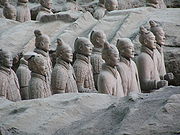
Conscription
Conscription is the compulsory enlistment of people in some sort of national service, most often military service. Conscription dates back to antiquity and continues in some countries to the present day under various names...
officers Chen Sheng
Chen Sheng
Chen Sheng , also known in some sources as Chen She , was the leader of the first rebellion, known as Daze Village Uprising, against the Qin Dynasty during the reign of Qin Er Shi.-Start of the rebellion:...
and Wu Guang
Wu Guang
Wu Guang was a leader of the first rebellion against Qin Dynasty during the reign of Qin Er Shi, following the death of Qin Shi Huang. Less is known about him than Chen Sheng.-Biography:Wu was born in Yangxia...
, leading 900 conscripts through the rain, failed to meet an arrival deadline; the Standard Histories
Twenty-Four Histories
The Twenty-Four Histories is a collection of Chinese historical books covering a period from 3000 BC to the Ming Dynasty in the 17th century. The whole set contains 3213 volumes and about 40 million words...
claim that the Qin punishment for this delay would have been execution. To avoid this, Chen and Wu started a rebellion against Qin, known as the Daze Village Uprising, but they were thwarted by the Qin general Zhang Han in 208 BCE; both Wu and Chen were subsequently assassinated by their own soldiers. Yet by this point others had rebelled, among them Xiang Yu
Xiang Yu
Xiang Yu was a prominent military leader and political figure during the late Qin Dynasty. His given name was Ji while his style name was Yu ....
(d. 202 BCE) and his uncle Xiang Liang
Xiang Liang
Xiang Liang was a military leader who led a rebellion against the Qin Dynasty.-Early life:Xiang was a native of Xiaxiang . Xiang was a descendant of a family who served the Chu state for generations...
(項梁/项梁), men from a leading family of the Chu
Chu (state)
The State of Chu was a Zhou Dynasty vassal state in present-day central and southern China during the Spring and Autumn period and Warring States Period . Its ruling house had the surname Nai , and clan name Yan , later evolved to surname Mi , and clan name Xiong...
aristocracy. They were joined by Liu Bang, a man of peasant origin and supervisor of convicts in Pei County
Pei County
Pei County is a county of Jiangsu, China. It is under the administration of Xuzhou city. It has an area of 1,576 square kilometers and a population of 1,217,400.-External links:**...
. Mi Xin
Emperor Yi of Chu
Emperor Yi of Chu , also known as King Huai II of Chu , personal name Xiong Xin was the ruler of the Chu state during the late Qin Dynasty...
, grandson of King Huai I of Chu, was declared King Huai II of Chu at his powerbase of Pengcheng (modern Xuzhou
Xuzhou
Xuzhou , otherwise known as Pengcheng in ancient times, is a major city in and the fourth largest prefecture-level city of Jiangsu province, People's Republic of China...
) with the support of the Xiangs, while other kingdoms soon formed in opposition to Qin. Despite this, in 208 BCE Xiang Liang was killed in a battle with Zhang Han, who subsequently attacked Zhao Xie the King of Zhao at his capital of Handan
Handan
Handan is a prefecture-level city located in the southwestern part of Hebei Province of China.- History :Handan was the capital of the State of Zhao during the Warring States period , after the capital moved from Zhongmu. The city was conquered by the State of Qin after the virtual annexation of...
, forcing him to flee to Julu
Pingxiang County
Pingxiang County is a county of Xingtai Prefecture, Hebei Province, China. In the Han Dynasty, Pingxiang County was known as Julu County , the birthplace of Zhang Jiao, Zhang Bao and Zhang Liang.-Administrative Divisions:Towns:...
, which Zhang put under siege
Battle of Julu
The Battle of Julu was fought in Julu in 207 BC primarily between Qin forces led by Zhang Han, and Chu rebels led by Xiang Yu. Xiang Yu emerged victorious, defeating a large Qin army with a small number of soldiers...
. However, the new kingdoms of Chu, Yan, and Qi came to Zhao's aid; Xiang Yu defeated Zhang at Julu and in 207 BCE forced Zhang to surrender.
While Xiang was occupied at Julu, King Huai II sent Liu Bang to capture the Qin heartland of Guanzhong
Guanzhong
Guanzhong , or Guanzhong Plain, is a historical region of China corresponding to the lower valley of the Wei River. It is called Guanzhong or 'within the passes' to distinguish it from 'Guandong' or 'east of the pass', that is, the North China Plain. The North China Plain is bordered on the west by...
with an agreement that the first officer to capture this region would become its king. In late 207 BCE, the Qin ruler Ziying
Ziying
Ziying was the last ruler of the Qin Dynasty of China, ruling as King of Qin from mid-October to the beginning of December 207 BC, and being known posthumously as Qin San Shi...
, who had claimed the reduced title of King of Qin, had his chief eunuch Zhao Gao
Zhao Gao
Zhao Gao was the chief eunuch during the Qin Dynasty of China. He played an instrumental role in the downfall of the Qin Dynasty.- Early life :...
killed after Zhao had orchestrated the deaths of Chancellor Li Si
Li Si
Li Si was the influential Prime Minister of the feudal state and later of the dynasty of Qin, between 246 BC and 208 BC. A famous Legalist, he was also a notable calligrapher. Li Si served under two rulers: Qin Shi Huang, king of Qin and later First Emperor of China—and his son, Qin Er Shi...
in 208 BCE and the second Qin emperor Qin Er Shi
Qin Er Shi
Qin Er Shi , literally Second Emperor of Qin Dynasty, personal name Huhai, was emperor of the Qin Dynasty in China from 210 BC until 207 BC.-Name:...
in 207 BCE. Liu Bang gained Ziying's submission and secured the Qin capital of Xianyang
Xianyang
Xianyang is a former capital of China in Shaanxi province, on the Wei River, a few kilometers upstream from Xi'an. It has an area of...
; persuaded by his chief advisor Zhang Liang (d. 189 BCE) not to let his soldiers loot the city, he instead sealed up its treasury.
Contention with Chu
The Standard Histories allege that when Xiang Yu arrived at Xianyang two months later in early 206 BCE, he looted it, burned it to the ground, and had Ziying executed. In that year, Xiang Yu offered King Huai II the title of Emperor Yi of ChuEmperor Yi of Chu
Emperor Yi of Chu , also known as King Huai II of Chu , personal name Xiong Xin was the ruler of the Chu state during the late Qin Dynasty...
and sent him to a remote frontier where he was assassinated; Xiang Yu then assumed the title Hegemon-King of Western Chu (西楚霸王) and became the leader of a confederacy of 18 kingdoms. At the Feast at Hong Gate
Feast at Hong Gate
The Feast at Hong Gate was a historical event later often memorialized in Chinese history, novels, and drama, including in Beijing opera...
, Xiang Yu considered having Liu Bang assassinated, but Liu, realizing that Xiang was considering killing him, escaped during the middle of the feast. In a slight towards Liu Bang, Xiang Yu carved Guanzhong into three kingdoms
Three Qins
The Three Qins refer to three of the Eighteen Kingdoms, formed from the division of the empire after the collapse of the Qin Dynasty in 206 BC...
with former Qin general Zhang Han and two of his subordinates as kings; Liu Bang was granted the frontier Kingdom of Han in Hanzhong
Hanzhong
Hanzhong is a municipality in southwest Shaanxi Province, China, occupying a historically significant valley in the mountains between the Xi'an area, home to many Chinese capitals, and the fertile but isolated Sichuan Basin...
, where he would pose less of a political challenge to Xiang Yu.
In the summer of 206 BCE, Liu Bang heard of Emperor Yi's fate and decided to rally some of the new kingdoms to oppose Xiang Yu, leading to a four-year war known as the Chu–Han contention. Liu initially made a direct assault against Pengcheng and captured it while Xiang was battling another king who resisted him—Tian Guang (田廣) the King of Qi—but his forces collapsed upon Xiang's return to Pengcheng; he was saved by a storm which delayed the arrival of Chu's troops, although his father Liu Zhijia
Liu Taigong
Liu Taigong , literally meaning a senior person named Liu, was the father of Liu Bang, the founding emperor of the Han Dynasty, which reigned for over 400 years. He was honored the title Taishang Huang after Liu Bang declared himself emperor. He died at the Royal Palace of Xiang Yang in 197 BC.His...
(劉執嘉) and wife Lü Zhi
Empress Lü Zhi
Empress Lü Zhi , commonly known as Empress Dowager Lü or formally as Empress Gao , courtesy name Exu , was the wife and empress of Emperor Gaozu of Han, founder of the Han Dynasty. They had two known children—the eventual Emperor Hui and Princess Luyuan...
were captured by Chu forces. Liu barely escaped another defeat at Xingyang
Xingyang
Xingyang , is one of county-level cities of Zhengzhou, Henan Province, China. It is 15 kilometers in the west of Zhengzhou city and is the nearest city to Zhengzhou as well...
, but Xiang Yu was unable to pursue him because Liu Bang induced Ying Bu (英布), the King of Huainan, to rebel against Xiang. After Liu Bang occupied Chenggao
Chenggao
Chenggao is an ancient city in present day Sishui, which is under the jurisdiction of Xingyang City in Henan Province, People's Republic of China.-References:*Romance of the Three Kingdoms/Chapter 4...
along with a large Qin grain storage, Xiang threatened to kill Liu's father if he did not surrender, but Liu did not give in to Xiang's threats.
With Chenggao and his food supplies lost, and with Liu Bang's general Han Xin
Hán Xìn
Han Xin was a military general who served Liu Bang during the Chu–Han contention and contributed greatly to the founding of the Han Dynasty...
(d. 196 BCE) having conquered Zhao and Qin to Chu's north, in 203 BCE Xiang Yu offered to release Liu Bang's relatives from captivity and split China into political halves: the west would belong to Han and the east to Chu. Although Liu accepted the truce, it was short-lived, and in 202 BCE at Gaixia
Battle of Gaixia
The Battle of Gaixia was a Chinese battle in 202 BC, during the Chu-Han contention between rival rulers of China which followed the collapse of the Qin Dynasty...
in modern Anhui
Anhui
Anhui is a province in the People's Republic of China. Located in eastern China across the basins of the Yangtze River and the Huai River, it borders Jiangsu to the east, Zhejiang to the southeast, Jiangxi to the south, Hubei to the southwest, Henan to the northwest, and Shandong for a tiny...
, the Han forces forced Xiang Yu to flee from his fortified camp in the early morning with only 800 cavalry, pursued by 5,000 Han cavalry. After several bouts of fighting, Xiang Yu became surrounded at the banks of the Yangzi River, where he committed suicide. Liu Bang took the title of emperor, and is known to posterity as Emperor Gaozu of Han (r. 202–195 BCE).
Consolidation, precedents, and rivals
Emperor Gaozu initially made LuoyangLuoyang
Luoyang is a prefecture-level city in western Henan province of Central China. It borders the provincial capital of Zhengzhou to the east, Pingdingshan to the southeast, Nanyang to the south, Sanmenxia to the west, Jiyuan to the north, and Jiaozuo to the northeast.Situated on the central plain of...
his capital, but then moved it to Chang'an
Chang'an
Chang'an is an ancient capital of more than ten dynasties in Chinese history, today known as Xi'an. Chang'an literally means "Perpetual Peace" in Classical Chinese. During the short-lived Xin Dynasty, the city was renamed "Constant Peace" ; yet after its fall in AD 23, the old name was restored...
(near modern Xi'an
Xi'an
Xi'an is the capital of the Shaanxi province, and a sub-provincial city in the People's Republic of China. One of the oldest cities in China, with more than 3,100 years of history, the city was known as Chang'an before the Ming Dynasty...
, Shaanxi
Shaanxi
' is a province in the central part of Mainland China, and it includes portions of the Loess Plateau on the middle reaches of the Yellow River in addition to the Qinling Mountains across the southern part of this province...
) due to concerns over natural defences and better access to supply routes. Following Qin precedent, Emperor Gaozu adopted the administrative model of a tripartite cabinet (formed by the Three Excellencies
Three Excellencies
The Three Ducal Ministers , also translated as the Three Dukes, Three Excellencies, or the Three Lords, was the collective name for the three highest officials in ancient China...
) along with nine subordinate ministries (headed by the Nine Ministers
Nine Ministers
The Nine Ministers was the collective name for nine high officials in the imperial government of the Han Dynasty , who each headed a specialized ministry and were subordinates to the Three Councillors of State...
). Despite Han statesmen's general condemnation of Qin's harsh methods and Legalist philosophy, the first Han law code
Code (law)
A code is a type of legislation that purports to exhaustively cover a complete system of laws or a particular area of law as it existed at the time the code was enacted, by a process of codification. Though the process and motivations for codification are similar in common law and civil law...
compiled by Chancellor Xiao He
Xiao He
Xiao He was a Chinese statesman who lived during the early Han Dynasty. He served Liu Bang during the insurrection against the Qin Dynasty, and fought on Liu's side in the Chu–Han contention against Xiang Yu. After the founding of the Han Dynasty, Xiao He became chancellor and held office until...
in 200 BCE seems to have borrowed much from the structure and substance of the Qin code (excavated texts from Shuihudi
Shuihudi Qin bamboo texts
The Shuihudi Qin bamboo texts are early Chinese texts written on bamboo slips, and are also sometimes called the Yúnmèng Qin bamboo texts. They were excavated in December 1975 from Tomb #11 at Chéngguān Shuìhǔdì , Yunmeng County, Hubei Province, China. The tomb belonged to a Qin administrator....
and Zhangjiashan
Zhangjiashan Han bamboo texts
The Zhangjiashan Han bamboo texts are ancient Han Dynasty Chinese written works dated 196–186 BCE. They were discovered in 1983 by archaeologists excavating tomb no. 247 at Mount Zhangjia of Jiangling County, Hubei Province . The tomb was built for an early Western Han era official who had...
in modern times have reinforced this suspicion).
From Chang'an, Gaozu ruled directly over 13 commanderies (increased to 16 by his death) in the western portion of the empire. In the eastern portion, he established 10 semi-autonomous kingdoms (Yan, Dai, Zhao, Qi, Liang, Chu, Huai, Wu, Nan, and Changsha) that he bestowed to his most prominent followers to placate them. Due to alleged acts of rebellion and even alliances with the Xiongnu
Xiongnu
The Xiongnu were ancient nomadic-based people that formed a state or confederation north of the agriculture-based empire of the Han Dynasty. Most of the information on the Xiongnu comes from Chinese sources...
—a northern nomadic people—by 196 BCE Gaozu had replaced nine of them with members of the royal family.
According to Michael Loewe
Michael Loewe
Michael Loewe , also known as M. A. N. Loewe, is a British academic and renowned sinologist who has authored dozens of books, articles, and other publications in the fields of Classical Chinese and ancient Chinese history....
, the administration of each kingdom was "a small-scale replica of the central government, with its chancellor
Chancellor of China
The Chancellor , variously translated as Prime Minister, Chancellor of State, Premier or Chief Councillor, was a generic name given to the highest-ranking official in the imperial government in ancient China...
, royal counsellor, and other functionaries." The kingdoms were to transmit census
Census
A census is the procedure of systematically acquiring and recording information about the members of a given population. It is a regularly occurring and official count of a particular population. The term is used mostly in connection with national population and housing censuses; other common...
information and a portion of their taxes
Tax system in China
Taxes provide the most important revenue source for the Government of the People's Republic of China. As the most important source of fiscal revenue, tax is a key economic player of macro-economic regulation, and greatly affects China's economic and social development...
to the central government. Although they were responsible for maintaining an armed force, kings were not authorized to mobilize troops without explicit permission from the capital.
Wu Rui (吳芮), King of Changsha, was the only remaining king not of the Liu clan. When Wu Rui's great-grandson Wu Zhu (吳著) or Wu Chan (吳產) died heirless in 157 BCE, Changsha was transformed into an imperial commandery and later a Liu family principality. South of Changsha, Gaozu sent Lu Jia (陸賈) as ambassador to the court of Zhao Tuo
Zhao Tuo
Zhao Tuo , was the founder of the kingdom of Nanyue |Zhao]]. The state of Zhao was defeated and absorbed by the state of Qin in 222 BC, whereupon Zhao Tuo became a citizen of the state of Qin. He later served in a Qin expeditionary force that was sent south...
to acknowledge the latter's sovereignty over Nanyue
Nanyue
Nanyue was an ancient kingdom that consisted of parts of the modern Chinese provinces of Guangdong, Guangxi, and Yunnan and northern Vietnam. Nanyue was established in 204 BC at the final collapse of the Qin Dynasty by Zhao Tuo, who was the military commander of Nanhai Commandery at the time, and...
(Vietnamese
Vietnamese language
Vietnamese is the national and official language of Vietnam. It is the mother tongue of 86% of Vietnam's population, and of about three million overseas Vietnamese. It is also spoken as a second language by many ethnic minorities of Vietnam...
: Triệu Dynasty; in modern Southwest China
Southwest China
Southwest China is a region of the People's Republic of China defined by governmental bureaus that includes the municipality of Chongqing, the provinces of Sichuan, Yunnan and Guizhou, and the Tibet Autonomous Region.-Provinces:-Municipalities:...
and northern Vietnam
Northern and southern Vietnam
Northern Vietnam and Southern Vietnam are two general regions within Vietnam.Of the two regions, the older is Northern Vietnam, where the Vietnamese culture originated over 2000 years ago in the Red River Delta, though Vietnamese people eventually spread south into the Mekong Delta...
).
Xiongnu and Heqin
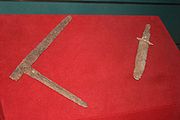
Meng Tian
Meng Tian was a general of the Qin Dynasty who distinguished himself in campaigns against the Xiongnu and in the construction of the Great Wall of China. He was the elder brother of Meng Yi. He descended from a great line of military generals and architects...
had forced Toumen
Toumen
Touman – was the earliest known Xiongnu chanyu , reigning from c. 220 to 209 BCE. The name Touman is likely related to Middle Chinese *muan, West Tokharian tmāne, Old Turkic/Mongolian tümen, Modern Persian tumân, all meaning '10,000', a myriad).By the time the Qin Dynasty conquered the other six...
, the Chanyu
Chanyu
Chanyu , was the title used by the nomadic supreme rulers of Middle and Central Asia for 8 centuries, starting...
of the Xiongnu, out of the Ordos Desert
Ordos Desert
The Ordos Desert is a desert and steppe region lying on a plateau in the south of the Inner Mongolian Autonomous Region of the People's Republic of China . The soil of the Ordos is a mixture of clay and sand and, as a result, is poorly suited for agriculture. It extends over an area of...
in 215 BCE, but Toumen's son and successor Modu Chanyu built the Xiongnu into a powerful empire by subjugating many other tribes. By the time of Modu's death in 174 BCE, the Xiongnu domains stretched from what is now Manchuria
Manchuria
Manchuria is a historical name given to a large geographic region in northeast Asia. Depending on the definition of its extent, Manchuria usually falls entirely within the People's Republic of China, or is sometimes divided between China and Russia. The region is commonly referred to as Northeast...
and Mongolia
Mongolia
Mongolia is a landlocked country in East and Central Asia. It is bordered by Russia to the north and China to the south, east and west. Although Mongolia does not share a border with Kazakhstan, its western-most point is only from Kazakhstan's eastern tip. Ulan Bator, the capital and largest...
to the Altai and Tian Shan
Tian Shan
The Tian Shan , also spelled Tien Shan, is a large mountain system located in Central Asia. The highest peak in the Tian Shan is Victory Peak , ....
mountain ranges in Central Asia
Central Asia
Central Asia is a core region of the Asian continent from the Caspian Sea in the west, China in the east, Afghanistan in the south, and Russia in the north...
. The Chinese feared incursions by the Xiongnu under the guise of trade and were concerned that Han-manufactured iron weapons would fall into Xiongnu hands. Gaozu thus enacted a trade embargo
Embargo
An embargo is the partial or complete prohibition of commerce and trade with a particular country, in order to isolate it. Embargoes are considered strong diplomatic measures imposed in an effort, by the imposing country, to elicit a given national-interest result from the country on which it is...
against the Xiongnu. To compensate the Chinese border merchants of the northern kingdoms of Dai and Yan for lost trade, he made them government officials with handsome salaries. Outraged by this embargo, Modu Chanyu planned to attack Han. When the Xiongnu invaded Taiyuan
Taiyuan
Taiyuan is the capital and largest city of Shanxi province in North China. At the 2010 census, it had a total population of 4,201,591 inhabitants on 6959 km² whom 3,212,500 are urban on 1,460 km². The name of the city literally means "Great Plains", referring to the location where the Fen River...
in 200 BCE and were aided by the defector King Xin of Hán (韓/韩, not to be confused with the ruling Hàn 漢 dynasty, or the general Han Xin
Hán Xìn
Han Xin was a military general who served Liu Bang during the Chu–Han contention and contributed greatly to the founding of the Han Dynasty...
), Gaozu personally led his forces through the snow to Pingcheng (near modern Datong
Datong
Datong is a prefecture-level city in northern Shanxi Province of North China, located a few hundred kilometres west by rail from Beijing with an elevation of...
, Shanxi
Shanxi
' is a province in Northern China. Its one-character abbreviation is "晋" , after the state of Jin that existed here during the Spring and Autumn Period....
). In the ensuing Battle of Baideng, Gaozu's forces were heavily surrounded for seven days; running short of supplies, he was forced to flee.
After this defeat, the court adviser Liu Jing (劉敬, originally named Lou Jing [婁敬]) convinced the emperor to create a peace treaty and marriage alliance with the Xiongnu Chanyu called the heqin
Heqin
Heqin was a term used in ancient China for an alliance by marriage. It usually referred to the Chinese Emperor marrying off a "princess" to an aggressive "barbarian" chieftain or ruler. The theory was that in exchange for the marriage, the chieftain would cease all aggressive actions toward China...
agreement. By this arrangement established in 198 BCE, the Han hoped to modify the Xiongnu's nomadic values with Han luxury goods given as tribute
Tribute
A tribute is wealth, often in kind, that one party gives to another as a sign of respect or, as was often the case in historical contexts, of submission or allegiance. Various ancient states, which could be called suzerains, exacted tribute from areas they had conquered or threatened to conquer...
(silk
Silk
Silk is a natural protein fiber, some forms of which can be woven into textiles. The best-known type of silk is obtained from the cocoons of the larvae of the mulberry silkworm Bombyx mori reared in captivity...
s, wine
Wine in China
Wine in China refers to grape wines that are produced in China. Grape wine has a long history in China, along with other Chinese alcoholic beverages....
, foodstuffs
Chinese cuisine
Chinese cuisine is any of several styles originating in the regions of China, some of which have become highly popular in other parts of the world – from Asia to the Americas, Australia, Western Europe and Southern Africa...
, etc.) and to make Modu's half-Chinese successor a subordinate to grandfather Gaozu. The exact amounts of annual tribute as promised by Emperor Gaozu given to the Xiongnu in the 2nd century BCE shortly after the defeat are unknown. In 89 BCE, however, Hulugu Chanyu (狐鹿姑) (r. 95–85 BCE) requested a renewal of the heqin agreement with the increased amount of annual tribute at 400,000 L (11,350 U.S. bu) of wine, 100,000 L (2,840 U.S. bu) of grain, and 10,000 bales of silk; thus previous amounts would have been less than these figures.
Although the treaty acknowledged both huangdi and chanyu as equals, Han was in fact the inferior partner since it was forced to pay tribute to appease the militarily-powerful Xiongnu. Emperor Gaozu was initially set to give his only daughter to Modu, but under the opposition of Empress Lü, Emperor Gaozu made a female relative princess and married her to Modu. Until the 130s BCE, the offering of princess brides and tributary items scarcely satisfied the Xiongnu, who often raided Han's northern frontiers and violated the 162 BCE treaty that established the Great Wall
Great Wall of China
The Great Wall of China is a series of stone and earthen fortifications in northern China, built originally to protect the northern borders of the Chinese Empire against intrusions by various nomadic groups...
as the border between Han and Xiongnu.
Emperor Hui
When Ying Bu rebelled in 195 BCE, Emperor Gaozu personally led the troops against Ying and received an arrow wound which allegedly led to his death the following year. His heir apparentHeir apparent
An heir apparent or heiress apparent is a person who is first in line of succession and cannot be displaced from inheriting, except by a change in the rules of succession....
Liu Ying took the throne and is posthumously known as Emperor Hui of Han
Emperor Hui of Han
Emperor Hui of Han was the second emperor of the Han Dynasty in China. He was the second son of the first Han emperor, Han Gaozu and Empress Dowager Lü. He is generally remembered as a weak character dominated by his mother, Empress Dowager Lü, personally kind and generous but unable to escape...
(r. 195–188 BCE). Shortly afterwards Gaozu's widow Lü Zhi
Empress Lü Zhi
Empress Lü Zhi , commonly known as Empress Dowager Lü or formally as Empress Gao , courtesy name Exu , was the wife and empress of Emperor Gaozu of Han, founder of the Han Dynasty. They had two known children—the eventual Emperor Hui and Princess Luyuan...
, now empress dowager
Empress Dowager
Empress Dowager was the title given to the mother of a Chinese, Korean, Japanese or Vietnamese emperor.The title was also given occasionally to another woman of the same generation, while a woman from the previous generation was sometimes given the title of Grand empress dowager. Numerous empress...
, had Liu Ruyi
Liu Ruyi
Liu Ruyi , also known as Prince Yin of Zhao was the fourth son of Emperor Gao of Han and Concubine Qi. In 200 BC, he was made Prince of Dai after Liu Xi was demoted for fleeing his Dai province from Xiongnu forces. In 198 BC, Ruyi replaced Zhang Ao as Prince of Zhao after Ao was falsely accused...
, a potential claimant to the throne, poisoned and his mother, the Consort Qi, brutally mutilated. When the teenage Emperor Hui discovered the cruel acts committed by his mother, Loewe says that he "did not dare disobey her."
Hui's brief reign saw the completion of the defensive city walls
Chinese city wall
Chinese city walls refer to civic defensive systems used to protect towns and cities in China in pre-modern times. The system consisted of walls, towers, and gates, which were often built to a uniform standard throughout the Empire....
around the capital Chang'an in 190 BCE; these brick
Brick
A brick is a block of ceramic material used in masonry construction, usually laid using various kinds of mortar. It has been regarded as one of the longest lasting and strongest building materials used throughout history.-History:...
and rammed earth
Rammed earth
Rammed earth, also known as taipa , tapial , and pisé , is a technique for building walls using the raw materials of earth, chalk, lime and gravel. It is an ancient building method that has seen a revival in recent years as people seek more sustainable building materials and natural building methods...
walls were originally 12 m (40 ft) tall and formed a rough rectangular ground plan (with some irregularities due to topography); their ruins still stand today. This urban construction project was completed by 150,000 conscript laborers
Conscription
Conscription is the compulsory enlistment of people in some sort of national service, most often military service. Conscription dates back to antiquity and continues in some countries to the present day under various names...
. Emperor Hui's reign saw the repeal of old Qin laws banning certain types of literature and was characterized by a cautious approach to foreign policy, including the renewal of the heqin agreement with the Xiongnu and Han's acknowledgment of the independent sovereignty of the Kings of Donghai and Nanyue.
Regency and downfall of the Lü clan
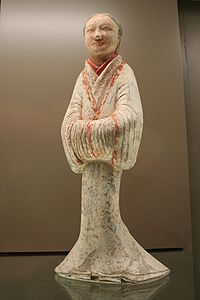
Empress Zhang Yan
Zhang Yan , known formally as Empress Xiaohui was an empress during the Han Dynasty. She was the daughter of Princess Luyuan and her husband Zhang Ao , the Prince of Zhao and later Marquess of Xuanping.In 192 BC, at the insistence of then-Empress Dowager Lü, Lady Yan...
, after his death in 188 BCE, Lü Zhi, now grand empress dowager
Grand Empress Dowager
The title Grand Empress Dowager was given to the grandmother or a woman from the grandmother generation of the Chinese, Korean. Japanese dynastic ruler. Some grand empress dowagers held regency within the beginning years of reign of an underage or young emperor...
and regent
Regent
A regent, from the Latin regens "one who reigns", is a person selected to act as head of state because the ruler is a minor, not present, or debilitated. Currently there are only two ruling Regencies in the world, sovereign Liechtenstein and the Malaysian constitutive state of Terengganu...
, chose his successor from among his sons with other consorts. She first placed Emperor Qianshao of Han
Liu Gong
Emperor Qianshao of Han , personal name Liu Gong , was the third emperor of the Han Dynasty in China. He was a son, likely the oldest son, of Emperor Hui, likely by a concubine -- although there is some controversy on the subject—and adopted by Emperor Hui's wife, Empress Zhang Yan...
(r. 188–184 BCE) on the throne, but then removed him for another puppet
Puppet monarch
A puppet monarch is a majority figurehead who is installed or patronized by an imperial power in order to provide the appearance of local authority, while allowing political and economic control to remain among the dominating nation....
ruler Emperor Houshao of Han (r. 184–180 BCE). She not only issued imperial edicts during their reigns, but she also appointed members of her own clan
Consort clan
The consort clan is the family, clan of or group related to an empress dowager or a spouse of a Chinese dynastic ruler or a warlord. The leading figure of the clan was either a sibling, cousin, or parent of the empress or consort.- Han Dynasty :...
as kings against Emperor Gaozu's explicit prohibition; other clan members became key military officers and civil officials.
The court under Lü Zhi was not only unable to deal with a Xiongnu invasion of Longxi Commandery (in modern Gansu
Gansu
' is a province located in the northwest of the People's Republic of China.It lies between the Tibetan and Huangtu plateaus, and borders Mongolia, Inner Mongolia, and Ningxia to the north, Xinjiang and Qinghai to the west, Sichuan to the south, and Shaanxi to the east...
) in which 2,000 Han prisoners were taken, but it also provoked a conflict with Zhao Tuo
Zhao Tuo
Zhao Tuo , was the founder of the kingdom of Nanyue |Zhao]]. The state of Zhao was defeated and absorbed by the state of Qin in 222 BC, whereupon Zhao Tuo became a citizen of the state of Qin. He later served in a Qin expeditionary force that was sent south...
, King of Nanyue, by imposing a ban on exporting iron and other trade items to his southern kingdom. Proclaiming himself Emperor Wu of Nanyue (南越武帝) in 183 BCE, Zhao Tuo attacked the Han Kingdom of Changsha in 181 BCE. He did not rescind his rival imperial title until the Han ambassador Lu Jia again visited Nanyue's court during the reign of Emperor Wen.
After Empress Dowager Lü's death in 180 BCE, it was alleged that the Lü clan plotted to overthrow the Liu dynasty, and Liu Xiang
Liu Xiang (Han Dynasty)
Liu Xiang , also known as Prince Ai of Qi was a key player during the Lü Clan Disturbance . He was the grandson of Emperor Gao of Han and the eldest son of Prince Liu Fei of Qi by Consort Si....
the King of Qi (Emperor Gaozu's grandson) rose against the Lüs. Before the central government and Qi forces engaged each other, the Lü clan was ousted from power and destroyed by a coup led by the officials Chen Ping
Chen Ping (Han Dynasty)
Chen Ping was an adviser to Liu Bang during the Chu–Han Contention period of Chinese history. After Liu Bang founded the Han Dynasty and became known as Emperor Gaozu, Chen Ping served as a chancellor and received titles of a marquis.-Biography:Chen Ping was a native of Huyou Town , Yangwu...
and Zhou Bo (周勃) at Chang'an. Although Liu Xiang had resisted the Lüs, he was passed over to become emperor because he had mobilized troops without permission from the central government and because his mother 's family possessed the same ambitious attitude as the Lüs. Consort Bo
Empress Dowager Bo
Empress Dowager Bo , known as Consort Bo when her husband was alive, and more formally as either Empress Dowager Xiaowen or Empress Gao was an imperial concubine for Emperor Gao of Han who would, unanticipated by her, become the mother of an emperor.-Early years:The future Empress Dowager...
, the mother of Liu Heng, King of Dai, was considered to possess a noble character, so her son was chosen as successor to the throne; he is known posthumously as Emperor Wen of Han
Emperor Wen of Han
Emperor Wen of Han was the fifth emperor of the Han Dynasty in China. His given name is Heng.Liu Heng was a son of Emperor Gao of Han and Consort Bo, later empress dowager...
(r. 180–157 BCE).
Reign of Wen and Jing
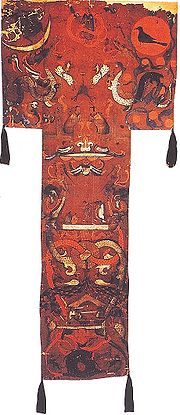
Reforms and policies
During the "Rule of Wen and Jing" (the era named after Emperor Wen and his successor Emperor JingEmperor Jing of Han
Emperor Jing of Han was an emperor of China in the Han Dynasty from 156 BC to 141 BC. His reign saw the limit and curtailment of power of feudal princes which resulted in the Rebellion of the Seven States in 154 BC. Emperor Jing managed to crush the revolt and princes were thereafter denied rights...
(r. 157–141 BCE), the Han Empire witnessed greater economic and dynastic stability, while the central government assumed more power over the realm. In an attempt to distance itself from the harsh rule of Qin, the court under these rulers abolished legal punishments involving mutilation in 167 BCE, declared eight widespread amnesties
Amnesty
Amnesty is a legislative or executive act by which a state restores those who may have been guilty of an offense against it to the positions of innocent people, without changing the laws defining the offense. It includes more than pardon, in as much as it obliterates all legal remembrance of the...
between 180–141 BCE, and reduced the tax rate on households' agricultural produce
Agriculture in China
Agriculture is an important economic sector of China, employing over 300 million farmers. China ranks first in worldwide farm output, primarily producing rice, wheat, potatoes, sorghum, peanuts, tea, millet, barley, cotton, oilseed, pork, and fish.-History:...
from one-fifteenth to one-thirtieth
Economy of the Han Dynasty
The Han Dynasty of ancient China experienced contrasting periods of economic prosperity and decline. It is normally divided into three periods: Western Han , the Xin Dynasty , and Eastern Han . The Xin Dynasty, established by the former regent Wang Mang, formed a brief interregnum between lengthy...
in 168 BCE. It was abolished altogether the following year, but reinstated at the rate of one-thirtieth in 156 BCE.
Government policies were influenced by the proto-Daoist
Taoism
Taoism refers to a philosophical or religious tradition in which the basic concept is to establish harmony with the Tao , which is the mechanism of everything that exists...
Huang-Lao
Huang-Lao
Huang-Lao or Huanglao was the most influential Chinese school of thought in the early 2nd-century BCE Han Dynasty, and is generally interpreted as encompassing Daoism and Legalism...
(黃老) ideology, a mix of political and cosmological precepts given patronage by Wen's wife Empress Dou
Empress Dou (Wen)
Empress Dou , formally Empress Xiaowen , was a Chinese empress during the Han Dynasty who greatly influenced the reigns of her husband Emperor Wen and her son Emperor Jing with her adherence of Taoist philosophy...
(d. 135 BCE), who was empress dowager during Jing's reign and grand empress dowager during the early reign of his successor Emperor Wu
Emperor Wu of Han
Emperor Wu of Han , , personal name Liu Che , was the seventh emperor of the Han Dynasty of China, ruling from 141 BC to 87 BC. Emperor Wu is best remembered for the vast territorial expansion that occurred under his reign, as well as the strong and centralized Confucian state he organized...
(r. 141–87 BCE). Huang-Lao, named after the mythical Yellow Emperor
Yellow Emperor
The Yellow Emperor or Huangdi1 is a legendary Chinese sovereign and culture hero, included among the Three Sovereigns and Five Emperors. Tradition holds that he reigned from 2697–2597 or 2696–2598 BC...
and the 6th-century-BCE philosopher Laozi
Laozi
Laozi was a mystic philosopher of ancient China, best known as the author of the Tao Te Ching . His association with the Tao Te Ching has led him to be traditionally considered the founder of Taoism...
, viewed the former as the founder of ordered civilization; this was unlike the Confucians, who gave that role to legendary sage kings Yao
Yao (ruler)
Yao , was a legendary Chinese ruler, one of the Three Sovereigns and the Five Emperors. His ancestral name (姓)is Yi Qi (伊祁) or Qi(祁),clan name (氏)is Taotang , given name is Fangxun , as the second son to Emperor Ku and Qingdu...
and Shun. Han imperial patrons of Huang-Lao sponsored the policy of "nonaction" or wuwei
Wu wei
Wu wei is an important concept of Taoism , that involves knowing when to act and when not to act. Another perspective to this is that "Wu Wei" means...
(無為) (a central concept of Laozi's Daodejing
Tao Te Ching
The Tao Te Ching, Dao De Jing, or Daodejing , also simply referred to as the Laozi, whose authorship has been attributed to Laozi, is a Chinese classic text...
), which claimed that rulers should interfere as little as possible if administrative and legal systems were to function smoothly. The influence of Huang-Lao doctrines on state affairs became eclipsed with the formal adoption of Confucianism
Confucianism
Confucianism is a Chinese ethical and philosophical system developed from the teachings of the Chinese philosopher Confucius . Confucianism originated as an "ethical-sociopolitical teaching" during the Spring and Autumn Period, but later developed metaphysical and cosmological elements in the Han...
as state ideology during Wu's reign and the later view that Laozi, not the Yellow Emperor, was the originator of Daoist practices.
From 179–143 BCE, the number of kingdoms was increased from eleven to twenty-five and the number of commanderies from nineteen to forty. This was not due to a large territorial expansion, but because kingdoms that had rebelled against Han rule or failed to produce an heir were significantly reduced in size or even abolished and carved into new commanderies or smaller kingdoms.
Rebellion of Seven States
When Liu Xian (劉賢), the heir apparent of Wu, once made an official visit to the capital during Wen's reign, he played a board gameBoard game
A board game is a game which involves counters or pieces being moved on a pre-marked surface or "board", according to a set of rules. Games may be based on pure strategy, chance or a mixture of the two, and usually have a goal which a player aims to achieve...
called liubo
Liubo
Liubo is an ancient Chinese board game played by two players. For the rules, it is believed that each player had six game pieces that were moved around the points of a square game board that had a distinctive, symmetrical pattern...
with then crown prince
Crown Prince
A crown prince or crown princess is the heir or heiress apparent to the throne in a royal or imperial monarchy. The wife of a crown prince is also titled crown princess....
Liu Qi, the future Emperor Jing
Emperor Jing of Han
Emperor Jing of Han was an emperor of China in the Han Dynasty from 156 BC to 141 BC. His reign saw the limit and curtailment of power of feudal princes which resulted in the Rebellion of the Seven States in 154 BC. Emperor Jing managed to crush the revolt and princes were thereafter denied rights...
. During a heated dispute, Liu Qi threw the game board at Liu Xian, killing him. This outraged his father Liu Pi (劉濞), the King of Wu and a nephew of Emperor Gaozu's, who was nonetheless obliged to claim allegiance to Liu Qi once he took the throne.
Still bitter over the death of his son and fearful that he would be targeted in a wave of reduction of kingdom sizes that Emperor Jing carried out under the advice of Imperial Counselor Chao Cuo
Chao Cuo
Cháo Cuò was a Chinese political advisor and official of the Han Dynasty , renowned for his intellectual capabilities and foresight in martial and political matters. Although not against the philosophy of Confucius , he was described by later Eastern Han scholars as a Legalist...
(d. 154 BCE), the King of Wu led a revolt against Han in 154 BCE as the head of a coalition with six other rebelling kingdoms: Chu, Zhao, Jiaoxi, Jiaodong, Zaichuan, and Jinan, which also feared such reductions. However, Han forces commanded by Zhou Yafu
Zhou Yafu
Zhou Yafu was a renowned Han Dynasty general who put down the Rebellion of the Seven States, but whose honesty and integrity eventually cost him the favor of Emperor Jing and his life...
were ready and able to put down the revolt, destroying the coalition of seven states against Han. Several kingdoms were abolished (although later reinstated) and others significantly reduced in size. Emperor Jing issued an edict in 145 BCE which outlawed the independent administrative staffs in the kingdoms and abolished all their senior offices except for the chancellor, who was henceforth reduced in status and appointed directly by the central government. His successor Emperor Wu would diminish their power even further by abolishing the kingdoms' tradition of primogeniture
Primogeniture
Primogeniture is the right, by law or custom, of the firstborn to inherit the entire estate, to the exclusion of younger siblings . Historically, the term implied male primogeniture, to the exclusion of females...
and ordering that each king had to divide up his realm between all of his male heirs.
Relations with the Xiongnu

Gansu
' is a province located in the northwest of the People's Republic of China.It lies between the Tibetan and Huangtu plateaus, and borders Mongolia, Inner Mongolia, and Ningxia to the north, Xinjiang and Qinghai to the west, Sichuan to the south, and Shaanxi to the east...
). In 176 BCE, Modu Chanyu sent a letter to Emperor Wen informing him that the Wise King, allegedly insulted by Han officials, acted without the Chanyu's permission and so he punished the Wise King by forcing him to conduct a military campaign against the nomadic Yuezhi
Yuezhi
The Yuezhi, or Rouzhi , also known as the Da Yuezhi or Da Rouzhi , were an ancient Central Asian people....
. Yet this event was merely part of a larger effort to recruit nomadic tribes north of Han China, during which the bulk of the Yuezhi were expelled from the Hexi Corridor
Hexi Corridor
Hexi Corridor or Gansu Corridor refers to the historical route in Gansu province of China. As part of the Northern Silk Road running northwest from the bank of the Yellow River, it was the most important route from North China to the Tarim Basin and Central Asia for traders and the military. The...
(fleeing west into Central Asia) and the sedentary state of Loulan
Loulan
Loulan or Kroran was an ancient kingdom based around an important oasis city already known in the 2nd century BCE on the north-eastern edge of the Lop Desert. Loulan, known to Russian archaeologists as Krorayina, was an ancient kingdom along the Silk Road. In 108 BCE, the Han Dynasty forces...
in the Lop Nur
Lop Nur
Lop Lake or Lop Nur is a group of small, now seasonal salt lake sand marshes between the Taklamakan and Kuruktag deserts in the Bayingolin Mongol Autonomous Prefecture, southeastern portion of Xinjiang Uygur Autonomous Region in the People's Republic of China.The lake system into which the Tarim...
salt marsh, the nomadic Wusun
Wusun
The Wūsūn were a nomadic steppe people who, according to the Chinese histories, originally lived in western Gansu in northwest China west of the Yuezhi people...
of the Tian Shan
Tian Shan
The Tian Shan , also spelled Tien Shan, is a large mountain system located in Central Asia. The highest peak in the Tian Shan is Victory Peak , ....
range, and twenty-six other states east of Samarkand
Samarkand
Although a Persian-speaking region, it was not united politically with Iran most of the times between the disintegration of the Seleucid Empire and the Arab conquest . In the 6th century it was within the domain of the Turkic kingdom of the Göktürks.At the start of the 8th century Samarkand came...
were subjugated to Xiongnu hegemony. Modu Chanyu's implied threat that he would invade China if the heqin agreement was not renewed sparked a debate in Chang'an; although officials such as Chao Cuo and Jia Yi
Jia Yi
Jia Yi was a Chinese poet and statesman of the Han Dynasty.- Life:Jia Yi was born in 201 BCE in Luoyang....
(d. 169 BCE) wanted to reject the heqin policy, Emperor Wen favored renewal of the agreement. Modu Chanyu died before the Han tribute reached him, but his successor Laoshang Chanyu (174–160 BCE) renewed the heqin agreement and negotiated the opening of border markets. Lifting the ban on trade significantly reduced the frequency and size of Xiongnu raids, which had necessitated tens of thousands of Han troops to be stationed at the border. However, Laoshang Chanyu and his successor Junchen Chanyu (車臣) (r. 160–126 BCE) continued to violate Han's territorial sovereignty by making incursions despite the treaty. While Laoshang Chanyu continued the conquest of his father by driving the Yuezhi into the Ili River
Ili River
thumb|right|300px|Map of the Lake Balkhash drainage basin showing the Ili River and its tributariesThe Ili River is a river in northwestern China and southeastern Kazakhstan .It is long, of which is in Kazakhstan...
valley, the Han quietly built up its strength in cavalry forces to later challenge the Xiongnu.
Reign of Wu
Confucianism and government recruitment
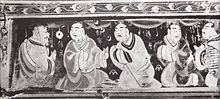
Although Emperor Gaozu did not ascribe to the philosophy and system of ethics
Ethics
Ethics, also known as moral philosophy, is a branch of philosophy that addresses questions about morality—that is, concepts such as good and evil, right and wrong, virtue and vice, justice and crime, etc.Major branches of ethics include:...
attributed to Confucius
Confucius
Confucius , literally "Master Kong", was a Chinese thinker and social philosopher of the Spring and Autumn Period....
(fl. 6th century BCE), he did enlist the aid of Confucians such as Lu Jia and Shusun Tong
Shusun Tong
Shusun Tong - official and ritual specialist at Qin and W.Han courts. He is known for organization of the first court worship for the Emperor Gaozu of Han, as well as for the custody over the young prince Ying, the future Emperor Hui. His biography is presented in the Chapter 99 of the Records of...
(叔孫通); in 196 BCE he established the first Han regulation for recruiting men of merit
Xiaolian
Xiaolian , was the standard of nominating civil officers started by Emperor Wu of Han in 134 BC. It lasted until its replacement by the imperial examination system during the Sui Dynasty....
into government service
Civil service
The term civil service has two distinct meanings:* A branch of governmental service in which individuals are employed on the basis of professional merit as proven by competitive examinations....
, which Robert P. Kramer calls the "first major impulse toward the famous examination system." Emperors Wen and Jing appointed Confucian academicians to court, yet not all academicians at their courts specialized in what would later become orthodox Confucian texts. For several years after Liu Che
Emperor Wu of Han
Emperor Wu of Han , , personal name Liu Che , was the seventh emperor of the Han Dynasty of China, ruling from 141 BC to 87 BC. Emperor Wu is best remembered for the vast territorial expansion that occurred under his reign, as well as the strong and centralized Confucian state he organized...
took the throne in 141 BCE (known posthumously as Emperor Wu), the Grand Empress Dowager Dou continued to dominate the court and did not accept any policy which she found unfavorable or contradicted Huang-Lao ideology. After her death in 135 BCE, a major shift occurred in Chinese political history.
After Emperor Wu
Emperor Wu of Han
Emperor Wu of Han , , personal name Liu Che , was the seventh emperor of the Han Dynasty of China, ruling from 141 BC to 87 BC. Emperor Wu is best remembered for the vast territorial expansion that occurred under his reign, as well as the strong and centralized Confucian state he organized...
called for the submission of memorial essays on how to improve the government, he favored that of the official Dong Zhongshu
Dong Zhongshu
Dong Zhongshu was a Han Dynasty Chinese scholar. He is traditionally associated with the promotion of Confucianism as the official ideology of the Chinese imperial state.-History:...
(179–104 BCE), a philosopher whom Kramers calls the first Confucian "theologian
Theology
Theology is the systematic and rational study of religion and its influences and of the nature of religious truths, or the learned profession acquired by completing specialized training in religious studies, usually at a university or school of divinity or seminary.-Definition:Augustine of Hippo...
". Dong's synthesis fused together the ethical ideas of Confucius with the cosmological
Cosmology
Cosmology is the discipline that deals with the nature of the Universe as a whole. Cosmologists seek to understand the origin, evolution, structure, and ultimate fate of the Universe at large, as well as the natural laws that keep it in order...
beliefs in yin and yang
Yin and yang
In Asian philosophy, the concept of yin yang , which is often referred to in the West as "yin and yang", is used to describe how polar opposites or seemingly contrary forces are interconnected and interdependent in the natural world, and how they give rise to each other in turn. Opposites thus only...
and Five Elements or Wuxing by fitting them into the same holistic, universal system which governed heaven, earth, and the world of man. Moreover, it justified the imperial system of government by providing it its place within the greater cosmos. Reflecting the ideas of Dong Zhongshu, Emperor Wu issued an edict in 136 BCE that abolished academic chairs other than those focused on the Confucian Five Classics. In 124 BCE Emperor Wu established the Imperial University
Taixue
Taixue , or sometimes called the "Imperial Academy", "Imperial School" , "Imperial University" or "Imperial Central University", was the highest rank of educational establishment in Ancient China between the Han Dynasty and Sui Dynasty. It was replaced by the Guozijian...
, at which the academicians taught 50 students; this was the incipient beginning of the civil service examination system refined in later dynasties. Although sons and relatives of officials were often privileged with nominations to office, those who did not come from a family of officials were not barred from entry into the bureaucracy. Rather, education in the Five Classics became the paramount prerequisite for gaining office; as a result, the Imperial University was expanded dramatically by the 2nd century CE when it accommodated 30,000 students. With Cai Lun
Cai Lun
Cai Lun , courtesy name Jingzhong , was a Chinese eunuch. He is traditionally regarded as the inventor of paper and the papermaking process, in forms recognizable in modern times as paper...
's (d. 121 CE) invention of the papermaking
Papermaking
Papermaking is the process of making paper, a substance which is used universally today for writing and packaging.In papermaking a dilute suspension of fibres in water is drained through a screen, so that a mat of randomly interwoven fibres is laid down. Water is removed from this mat of fibres by...
process in 105 CE, the spread of paper
Paper
Paper is a thin material mainly used for writing upon, printing upon, drawing or for packaging. It is produced by pressing together moist fibers, typically cellulose pulp derived from wood, rags or grasses, and drying them into flexible sheets....
as a cheap writing medium from the Eastern Han period onwards increased the supply of books
Traditional Chinese bookbinding
Traditional Chinese bookbinding refers to the method of bookbinding that the Chinese have used in recent centuries, before converting to the modern codex form.It is also called stitched binding...
and hence the number of those who could be educated for civil service.
War against the Xiongnu
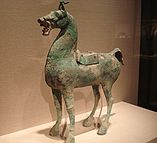
Consensus decision-making
Consensus decision-making is a group decision making process that seeks the consent, not necessarily the agreement, of participants and the resolution of objections. Consensus is defined by Merriam-Webster as, first, general agreement, and second, group solidarity of belief or sentiment. It has its...
that peace should be maintained. A year later, while the Xiongnu were busy raiding the northern border and waiting for Han's response, Wu had another court conference assembled. The faction supporting war against the Xiongnu was able to sway the majority opinion by making a compromise for those worried about stretching financial resources on an indefinite campaign: in a limited engagement along the border near Mayi
Battle of Mayi
The Battle of Mayi was an abortive ambush operation by the Han Dynasty against the invading Xiongnu forces; casualties were minimal. It marked the end of de jure peace between the Han Dynasty and Xiongnu, and stimulated the use of effective cavalry forces and offensive military policies by the Han...
, Han forces would lure Junchen Chanyu over with gifts and promises of defections in order to quickly eliminate him and cause political chaos for the Xiongnu. When the Mayi trap failed in 133 BCE (Junchen Chanyu realized he was about to fall into a trap and fled back north), the era of heqin-style appeasement was broken and the Han court resolved to engage in full-scale war.
Leading campaigns involving tens of thousands of troops, in 127 BCE the Han general Wei Qing
Wei Qing
Wei Qing , born Zheng Qing in Linfen, Shanxi, was a famous general during Han Dynasty of China, whose campaigns against the Xiongnu earned him great acclaim. He was the younger half-brother of Empress Wei Zifu, making him the the Emperor Wu's brother-in-law...
(d. 106 BCE) recaptured the Ordos Desert
Ordos Desert
The Ordos Desert is a desert and steppe region lying on a plateau in the south of the Inner Mongolian Autonomous Region of the People's Republic of China . The soil of the Ordos is a mixture of clay and sand and, as a result, is poorly suited for agriculture. It extends over an area of...
region from the Xiongnu and in 121 BCE Huo Qubing
Huo Qubing
Huo Qubing , born in Linfen, Shanxi, was a general of the western Han dynasty under Emperor Wu. Being the illegitimate son of Wei Shaoer, he was the nephew of Wei Qing and Empress Wei Zifu....
(d. 117 BCE) expelled them from the Qilian Mountains, gaining the surrender of many Xiongnu aristocrats. At the Battle of Mobei
Battle of Mobei
The Battle of Mobei was a military campaign fought in the northern part of the Gobi Desert. It was part of a major strategic offensive launched by the Han Dynasty in January, 119 BC, into the heartland of the nomadic Xiongnu...
in 119 BCE, generals Wei and Huo led the campaign to the Khangai Mountains where they forced the chanyu to flee north of the Gobi Desert
Gobi Desert
The Gobi is a large desert region in Asia. It covers parts of northern and northwestern China, and of southern Mongolia. The desert basins of the Gobi are bounded by the Altai Mountains and the grasslands and steppes of Mongolia on the north, by the Hexi Corridor and Tibetan Plateau to the...
. The maintenance of 300,000 horses by government slaves in thirty-six different pasture lands was not enough to satisfy the cavalry and baggage trains needed for these campaigns, so the government offered exemption from military and corvée labor for up to three male members of each household who presented a privately-bred horse
Horse breeding
Horse breeding is reproduction in horses, and particularly the human-directed process of selective breeding of animals, particularly purebred horses of a given breed. Planned matings can be used to produce specifically desired characteristics in domesticated horses...
to the government.
Expansion and colonization
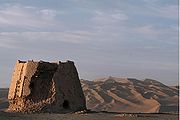
Hexi Corridor
Hexi Corridor or Gansu Corridor refers to the historical route in Gansu province of China. As part of the Northern Silk Road running northwest from the bank of the Yellow River, it was the most important route from North China to the Tarim Basin and Central Asia for traders and the military. The...
to Lop Nur
Lop Nur
Lop Lake or Lop Nur is a group of small, now seasonal salt lake sand marshes between the Taklamakan and Kuruktag deserts in the Bayingolin Mongol Autonomous Prefecture, southeastern portion of Xinjiang Uygur Autonomous Region in the People's Republic of China.The lake system into which the Tarim...
, thus cutting the Xiongnu off from their Qiang allies. New commanderies were established in the Ordos as well as four in the Hexi Corridor—Jiuquan
Jiuquan
- Suzhou town :The administrative center of the "prefecture-level city" of Jiuquan is the "District" of Suzhou , which occupies 3,386 square km in the eastern part of Jiuquan "prefecture-level city", and had a population of 340,000 as of 2002....
, Zhangyi, Dunhuang
Dunhuang
Dunhuang is a city in northwestern Gansu province, Western China. It was a major stop on the ancient Silk Road. It was also known at times as Shāzhōu , or 'City of Sands', a name still used today...
, and Wuwei—which were populated with Han settlers after a major Qiang-Xiongnu allied force was repelled from the region in 111 BCE. By 119 BCE, Han forces established their first garrison outposts in the Juyan Lake Basin
Juyan Lake Basin
The Juyan Lake for western lake, Sogo Nuur for eastern lake) is a former lake in the Gobi desert of western Inner Mongolia at the Alxa League near the border of eastern Xinjiang. Goshun Nur had an area of in 1958, of in 1960, and has dried up in 1961....
of Inner Mongolia
Inner Mongolia
Inner Mongolia is an autonomous region of the People's Republic of China, located in the northern region of the country. Inner Mongolia shares an international border with the countries of Mongolia and the Russian Federation...
, with larger settlements built there after 110 BCE. Roughly 40% of the settlers at Juyan came from the Guandong region of modern Henan
Henan
Henan , is a province of the People's Republic of China, located in the central part of the country. Its one-character abbreviation is "豫" , named after Yuzhou , a Han Dynasty state that included parts of Henan...
, western Shandong
Shandong
' is a Province located on the eastern coast of the People's Republic of China. Shandong has played a major role in Chinese history from the beginning of Chinese civilization along the lower reaches of the Yellow River and served as a pivotal cultural and religious site for Taoism, Chinese...
, southern Shanxi
Shanxi
' is a province in Northern China. Its one-character abbreviation is "晋" , after the state of Jin that existed here during the Spring and Autumn Period....
, southern Hebei
Hebei
' is a province of the People's Republic of China in the North China region. Its one-character abbreviation is "" , named after Ji Province, a Han Dynasty province that included what is now southern Hebei...
, northwestern Jiangsu
Jiangsu
' is a province of the People's Republic of China, located along the east coast of the country. The name comes from jiang, short for the city of Jiangning , and su, for the city of Suzhou. The abbreviation for this province is "苏" , the second character of its name...
, and northwestern Anhui
Anhui
Anhui is a province in the People's Republic of China. Located in eastern China across the basins of the Yangtze River and the Huai River, it borders Jiangsu to the east, Zhejiang to the southeast, Jiangxi to the south, Hubei to the southwest, Henan to the northwest, and Shandong for a tiny...
. After Hunye's surrender, the Han court moved 725,000 people from the Guandong region to populate the Xinqinzhong (新秦中) region south of the bend of the Yellow River. In all, Emperor Wu's forces conquered roughly 4.4 million km2 (1.7 million mi2) of new land, by far the largest territorial expansion in Chinese history. Self-sustaining agricultural garrisons
Tuntian
The Tuntian or Duntian system was a system of government-encouraged agriculture originated in the Western Han Dynasty period of Chinese history...
were established in these frontier outposts to support military campaigns as well as secure trade routes leading into Central Asia, the eastern terminus of the Silk Road
Silk Road
The Silk Road or Silk Route refers to a historical network of interlinking trade routes across the Afro-Eurasian landmass that connected East, South, and Western Asia with the Mediterranean and European world, as well as parts of North and East Africa...
. The Han-era Great Wall was extended as far west as Dunhuang and sections of it still stand today in Gansu, including thirty Han beacon
Beacon
A beacon is an intentionally conspicuous device designed to attract attention to a specific location.Beacons can also be combined with semaphoric or other indicators to provide important information, such as the status of an airport, by the colour and rotational pattern of its airport beacon, or of...
towers and two fortified castles.
Exploration, foreign trade, war and diplomacy

Zhang Qian
Zhang Qian was an imperial envoy to the world outside of China in the 2nd century BCE, during the time of the Han Dynasty...
traveled west in an unsuccessful attempt to secure an alliance with the Da Yuezhi (who were evicted from Gansu by the Xiongnu in 177 BCE); however, Zhang's travels revealed entire countries which the Chinese were unaware of, the remnants of the conquests
Hellenistic civilization
Hellenistic civilization represents the zenith of Greek influence in the ancient world from 323 BCE to about 146 BCE...
of Alexander the Great (r. 336–323 BCE). When Zhang returned to China in 125 BCE, he reported on his visits to Dayuan
Dayuan
The Dayuan or Ta-Yuan were a people of Ferghana in Central Asia, described in the Chinese historical works of Records of the Grand Historian and the Book of Han. It is mentioned in the accounts of the famous Chinese explorer Zhang Qian in 130 BCE and the numerous embassies that followed him into...
(Fergana
Fergana
Fergana is a city , the capital of Fergana Province in eastern Uzbekistan, at the southern edge of the Fergana Valley in southern Central Asia, cutting across the borders of Kyrgyzstan, Tajikistan, and Uzbekistan...
), Kangju
Kangju
Kangju was the name of an ancient people and kingdom in Central Asia. It was a nomadic federation of unknown ethnic and linguistic origin which became for a couple of centuries the second greatest power in Transoxiana after the Yuezhi....
(Sogdiana
Sogdiana
Sogdiana or Sogdia was the ancient civilization of an Iranian people and a province of the Achaemenid Empire, eighteenth in the list on the Behistun Inscription of Darius the Great . Sogdiana is "listed" as the second of the "good lands and countries" that Ahura Mazda created...
), and Daxia
Daxia
Daxia, Ta-Hsia, or Ta-Hia is the name given in antiquity by the Han Chinese to the territory of Bactria....
(Bactria
Bactria
Bactria and also appears in the Zend Avesta as Bukhdi. It is the ancient name of a historical region located between south of the Amu Darya and west of the Indus River...
, formerly the Greco-Bactrian Kingdom
Greco-Bactrian Kingdom
The Greco-Bactrian Kingdom was the easternmost part of the Hellenistic world, covering Bactria and Sogdiana in Central Asia from 250 to 125 BC...
which was subjugated by the Da Yuezhi). Zhang described Dayuan and Daxia as agricultural and urban countries like China, and although he did not venture there, described Shendu (the Indus River
Indus River
The Indus River is a major river which flows through Pakistan. It also has courses through China and India.Originating in the Tibetan plateau of western China in the vicinity of Lake Mansarovar in Tibet Autonomous Region, the river runs a course through the Ladakh district of Jammu and Kashmir and...
valley of Northwestern India) and Anxi (Arsacid territories) further west. Envoys sent to these states returned with foreign delegations and lucrative trade caravans; yet even before this, Zhang noted that these countries were importing Chinese silk
Silk
Silk is a natural protein fiber, some forms of which can be woven into textiles. The best-known type of silk is obtained from the cocoons of the larvae of the mulberry silkworm Bombyx mori reared in captivity...
. After interrogating merchants, Zhang also discovered a southwestern trade route leading through Burma and on to India
India
India , officially the Republic of India , is a country in South Asia. It is the seventh-largest country by geographical area, the second-most populous country with over 1.2 billion people, and the most populous democracy in the world...
. The earliest known Roman glass
Roman glass
Roman glass objects have been recovered across the Roman Empire in domestic, industrial and funerary contexts. Glass was used primarily for the production of vessels, although mosaic tiles and window glass were also produced. Roman glass production developed from Hellenistic technical traditions,...
ware found in China (but manufactured in the Roman Empire
Roman Empire
The Roman Empire was the post-Republican period of the ancient Roman civilization, characterised by an autocratic form of government and large territorial holdings in Europe and around the Mediterranean....
) is a glass bowl found in a Guangzhou
Guangzhou
Guangzhou , known historically as Canton or Kwangchow, is the capital and largest city of the Guangdong province in the People's Republic of China. Located in southern China on the Pearl River, about north-northwest of Hong Kong, Guangzhou is a key national transportation hub and trading port...
tomb dating to the early 1st century BCE and perhaps came from a maritime route passing through the South China Sea
South China Sea
The South China Sea is a marginal sea that is part of the Pacific Ocean, encompassing an area from the Singapore and Malacca Straits to the Strait of Taiwan of around...
. Likewise, imported Chinese silk attire became popular in the Roman Empire by the time of Julius Caesar
Julius Caesar
Gaius Julius Caesar was a Roman general and statesman and a distinguished writer of Latin prose. He played a critical role in the gradual transformation of the Roman Republic into the Roman Empire....
(100–44 BCE).
After the heqin agreement broke down, the Xiongnu were forced to extract more crafts and agricultural foodstuffs from the subjugated Tarim Basin urban centers. From 115–60 BCE the Han and Xiongnu battled for control and influence over these states, with the Han gaining, from 108–101 BCE tributary submission of Loulan
Loulan
Loulan or Kroran was an ancient kingdom based around an important oasis city already known in the 2nd century BCE on the north-eastern edge of the Lop Desert. Loulan, known to Russian archaeologists as Krorayina, was an ancient kingdom along the Silk Road. In 108 BCE, the Han Dynasty forces...
, Turpan, Bügür
Luntai County
The Luntai Country is a county in the Xinjiang Uyghur Autonomous Region and is under the administration of the Bayin'gholin Mongol Autonomous Prefecture. It contains an area of 14,189 km2. According to the 2002 census, it has a population of 90,000.Luntai has a long history associated with...
, Dayuan (Fergana), and Kangju (Sogdiana). The farthest-reaching and most expensive invasion was Li Guangli's (李廣利) four-year campaign against Fergana
Fergana Valley
The Fergana Valley or Farghana Valley is a region in Central Asia spreading across eastern Uzbekistan, Kyrgyzstan and Tajikistan. Divided across three subdivisions of the former Soviet Union, the valley is ethnically diverse, and in the early 21st century was the scene of ethnic conflict...
in the Syr Darya
Syr Darya
The Syr Darya , also transliterated Syrdarya or Sirdaryo, is a river in Central Asia, sometimes known as the Jaxartes or Yaxartes from its Ancient Greek name . The Greek name is derived from Old Persian, Yakhsha Arta , a reference to the color of the river's water...
and Amu Darya
Amu Darya
The Amu Darya , also called Oxus and Amu River, is a major river in Central Asia. It is formed by the junction of the Vakhsh and Panj rivers...
valleys (modern Uzbekistan
Uzbekistan
Uzbekistan , officially the Republic of Uzbekistan is a doubly landlocked country in Central Asia and one of the six independent Turkic states. It shares borders with Kazakhstan to the west and to the north, Kyrgyzstan and Tajikistan to the east, and Afghanistan and Turkmenistan to the south....
and Kyrgyzstan
Kyrgyzstan
Kyrgyzstan , officially the Kyrgyz Republic is one of the world's six independent Turkic states . Located in Central Asia, landlocked and mountainous, Kyrgyzstan is bordered by Kazakhstan to the north, Uzbekistan to the west, Tajikistan to the southwest and China to the east...
). Historian Laszlo Torday (1997) asserts that Fergana threatened to cut off Han's access to the Silk Road, yet historian Sima Qian
Sima Qian
Sima Qian was a Prefect of the Grand Scribes of the Han Dynasty. He is regarded as the father of Chinese historiography for his highly praised work, Records of the Grand Historian , a "Jizhuanti"-style general history of China, covering more than two thousand years from the Yellow Emperor to...
(d. 86 BCE) downplayed this threat by asserting that Li's mission was really a means to punish Dayuan for not providing tribute of prized Central Asian stallions
Ferghana horse
Ferghana horses were one of China's earliest major imports, originating in an area in Central Asia. These horses, as depicted in Tang Dynasty pottery representations of them, "resemble the animals on the golden medal of Eucratides, King of Bactria ."-Ancient history:Dayuan, north of Bactria, was...
.
To the south, Emperor Wu assisted King Zhao Mo in fending off an attack by Minyue (in modern Fujian
Fujian
' , formerly romanised as Fukien or Huguing or Foukien, is a province on the southeast coast of mainland China. Fujian is bordered by Zhejiang to the north, Jiangxi to the west, and Guangdong to the south. Taiwan lies to the east, across the Taiwan Strait...
) in 135 BCE. After a pro-Han faction was overthrown at the court of Nanyue, Han naval forces conquered Nanyue in 111 BCE, bringing areas of modern Guangdong
Guangdong
Guangdong is a province on the South China Sea coast of the People's Republic of China. The province was previously often written with the alternative English name Kwangtung Province...
, Guangxi
Guangxi
Guangxi, formerly romanized Kwangsi, is a province of southern China along its border with Vietnam. In 1958, it became the Guangxi Zhuang Autonomous Region of the People's Republic of China, a region with special privileges created specifically for the Zhuang people.Guangxi's location, in...
, Hainan Island, and northern Vietnam
Vietnam
Vietnam – sometimes spelled Viet Nam , officially the Socialist Republic of Vietnam – is the easternmost country on the Indochina Peninsula in Southeast Asia. It is bordered by China to the north, Laos to the northwest, Cambodia to the southwest, and the South China Sea –...
under Han control. Emperor Wu also launched an invasion into the Dian Kingdom
Dian Kingdom
The Dian Kingdom was established by the Dian people, who lived around Lake Dian in northern Yunnan, China from the late Spring and Autumn Period until the Eastern Han Dynasty. The Dian buried their dead in vertical pit graves...
of Yunnan
Yunnan
Yunnan is a province of the People's Republic of China, located in the far southwest of the country spanning approximately and with a population of 45.7 million . The capital of the province is Kunming. The province borders Burma, Laos, and Vietnam.Yunnan is situated in a mountainous area, with...
in 109 BCE, subjugating its king as a tributary vassal, while later Dian rebellions in 86 BCE and 83 BCE, 14 CE (during Wang Mang's rule), and 42–45 CE were quelled by Han forces. Wu sent an expedition into what is now North Korea
North Korea
The Democratic People’s Republic of Korea , , is a country in East Asia, occupying the northern half of the Korean Peninsula. Its capital and largest city is Pyongyang. The Korean Demilitarized Zone serves as the buffer zone between North Korea and South Korea...
in 128 BCE, but this was abandoned two years later. In 108 BCE, another expedition established four commanderies there, only two of which (i.e. Xuantu Commandery
Xuantu Commandery
Xuantu Commandery was a commandery established beyond the far eastern pale of Han China. It was one of Four Commanderies of Han, established in 107 BCE, after the Han Dynasty invaded Wiman Joseon of Korea. Goguryeo rose in this area in competition with the Chinese over the region...
and Lelang Commandery
Lelang Commandery
Lelang was one of the Chinese commanderies which was established after the fall of Gojoseon in 108 BC until Goguryeo conquered it in 313. Lelang Commandery was located in the northern Korean peninsula with the administrative center near modern P'yongyang....
) remained after 82 BCE. Although there was some violent resistance in 108 BCE and irregular raids by Goguryeo
Goguryeo
Goguryeo or Koguryŏ was an ancient Korean kingdom located in present day northern and central parts of the Korean Peninsula, southern Manchuria, and southern Russian Maritime province....
and Buyeo
Buyeo kingdom
Buyeo or Puyŏ , Fuyu in Chinese, was an ancient Korean kingdom located from today's Manchuria to northern North Korea, from around the 2nd century BC to 494. Its remnants were absorbed by the neighboring and brotherhood kingdom of Goguryeo in 494...
afterwards, Chinese settlers conducted peaceful trade relations with native Koreans who lived largely independent of (but were culturally influenced by) the sparse Han settlements.
Economic reforms
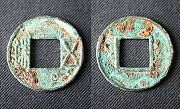
Nationalization
Nationalisation, also spelled nationalization, is the process of taking an industry or assets into government ownership by a national government or state. Nationalization usually refers to private assets, but may also mean assets owned by lower levels of government, such as municipalities, being...
of salt mining
Salt mine
A salt mine is a mining operation involved in the extraction of rock salt or halite from evaporite deposits.-Occurrence:Areas known for their salt mines include Kilroot near Carrickfergus, Northern Ireland ; Khewra and Warcha in Pakistan; Tuzla in Bosnia; Wieliczka and Bochnia in Poland A salt mine...
and iron manufacturing
History of ferrous metallurgy
The history of ferrous metallurgy began far back in prehistory. The earliest surviving iron artifacts, from the 5th millennium BC in Iran and 2nd millennium BC in China, were made from meteoritic iron-nickel. It is not known when or where the smelting of iron from ores began, but by the end of the...
by 117 BCE. Another government monopoly over liquor was established in 98 BCE, but the majority consensus at a court conference in 81 BCE led to the breaking up of this monopoly. The mathematician and official Sang Hongyang
Sang Hongyang
Sang Hongyang was a prominent official of the Former Han Dynasty, who served Emperor Wu of Han and his successor Emperor Zhao. He is most famed for his economic policies during the reign of Emperor Wu, the best known of which include the state monopolies over iron and salt - systems which would...
(d. 80 BCE), who later became Imperial Counselor and one of many former merchants drafted into the government to help administer these monopolies, was responsible for the 'equable transportation' system that eliminated price variation
Price dispersion
In economics, price dispersion is variation in prices across sellers of the same item, holding fixed the item's characteristics. Price dispersion can be viewed as a measure of trading frictions . It is often attributed to consumer search costs or unmeasured attributes of the retailing outlets...
over time from place to place. This was a government means to interfere in the profitable grain trade by eliminating speculation
Speculation
In finance, speculation is a financial action that does not promise safety of the initial investment along with the return on the principal sum...
(since the government stocked up on grain when cheap and sold it to the public at a low price when private merchants demanded higher ones). This along with the monopolies were criticized even during Wu's reign as bringing unnecessary hardships for merchants' profits and farmers forced to rely on poor-quality government-made goods and services; the monopolies and equable transportation did not last into the Eastern Han Era (25–220 CE).
During Emperor Wu's reign, the poll tax
Poll tax
A poll tax is a tax of a portioned, fixed amount per individual in accordance with the census . When a corvée is commuted for cash payment, in effect it becomes a poll tax...
for each minor aged three to fourteen was raised from 20 to 23 coins; the rate for adults remained at 120. New taxes exacted on market transactions, wheeled vehicles, and properties were meant to bolster the growing military budget. In 119 BCE a new bronze coin weighing five shu (3.2 g/0.11 oz)—replacing the four shu coin—was issued by the government (remaining the standard coin of China until the Tang Dynasty
Tang Dynasty
The Tang Dynasty was an imperial dynasty of China preceded by the Sui Dynasty and followed by the Five Dynasties and Ten Kingdoms Period. It was founded by the Li family, who seized power during the decline and collapse of the Sui Empire...
), followed by a ban on private minting
Mint (coin)
A mint is an industrial facility which manufactures coins for currency.The history of mints correlates closely with the history of coins. One difference is that the history of the mint is usually closely tied to the political situation of an era...
in 113 BCE. Earlier attempts to ban private minting took place in 186 and 144 BCE, but Wu's monopoly over the issue of coinage remained in place throughout the Han (although its stewardship changed hands between different government agencies). From 118 BCE to 5 CE, the Han government minted 28 billion coins, an average of 220 million a year.
Latter half of Western Han
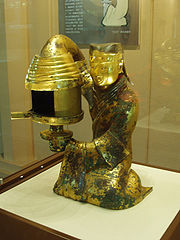
Regency of Huo Guang
Emperor Wu's first wife, Empress Chen JiaoEmpress Chen Jiao
Empress Chen Jiao was an empress during Han Dynasty. She was the first wife of Emperor Wu of Han, but was deposed in 130 BC. Her father was Chen Wu , the Marquess of Tangyi. Her mother was Emperor Wu's aunt Princess Liu Piao , making her and her husband cousins...
, was deposed in 130 BCE after allegations that she attempted witchcraft
Witchcraft
Witchcraft, in historical, anthropological, religious, and mythological contexts, is the alleged use of supernatural or magical powers. A witch is a practitioner of witchcraft...
to help her produce a male heir. In 91 BCE, similar allegations were made against Emperor Wu's Crown Prince
Crown Prince
A crown prince or crown princess is the heir or heiress apparent to the throne in a royal or imperial monarchy. The wife of a crown prince is also titled crown princess....
Liu Ju
Liu Ju
Liu Ju , formally Crown Prince Li was crown prince during the reign of his father, Emperor Wu of Han, during China's Han Dynasty...
, the son of Emperor Wu's second wife Empress Wei Zifu
Empress Wei Zifu
Empress Wei Zifu , formally Wei Sihou , was an empress during Han Dynasty. She was Emperor Wu's second wife, and stayed as his empress for 38 years, the second longest in Chinese history...
, and Liu Ju, in fear of Emperor Wu's believing the false allegations, rebelled at Chang'an for five days while Emperor Wu was away at his quiet summer retreat of Ganquan (甘泉; in modern Shaanxi). After Liu Ju's defeat, both he and Empress Wei committed suicide.
Eventually, due to his good reputation, Huo Qubing's half-brother Huo Guang
Huo Guang
Huo Guang , courtesy name Zimeng was a Western Han statesman who was a rare example in Chinese history of a powerful official who deposed an emperor for the good of the state rather than to usurp the throne...
was entrusted by Wu to form a triumvirate
Triumvirate
A triumvirate is a political regime dominated by three powerful individuals, each a triumvir . The arrangement can be formal or informal, and though the three are usually equal on paper, in reality this is rarely the case...
regency alongside ethnically-Xiongnu Jin Midi
Jin Midi
Jin Midi , formally Marquess Jing of Du , was a prominent official of the Chinese dynasty Han Dynasty of Xiongnu ethnicity. He served as coregent early in the reign of Emperor Zhao of Han.- Background :...
(d. 86 BCE) and Shangguan Jie (上官桀) (d. 80 BCE) over the court of his successor, the child Liu Fuling, known posthumously as Emperor Zhao of Han
Emperor Zhao of Han
Emperor Zhao of Han was an emperor of the Chinese Han Dynasty from 87 BC to 74 BC.Emperor Zhao was the youngest son of Emperor Wu of Han. By the time Zhao was born, Emperor Wu was already 62. Zhao ascended the throne after the death of Emperor Wu in 87 BC. He was only 8 years old...
(r. 87–74 BCE). Jin Midi died a year later and by 80 BCE Shangguan Jie and Imperial Counselor Sang Hongyang were executed when they were accused of supporting Emperor Zhao's older brother Liu Dan (劉旦) the King of Yan as emperor; this gave Huo unrivaled power. However, he did not abuse his power in the eyes of the Confucian establishment and gained popularity for reducing Emperor Wu's taxes.
Emperor Zhao died in 74 BCE without a successor, while the one chosen to replace him on July 18, his nephew Prince He of Changyi
Prince He of Changyi
Prince He of Changyi was an emperor of the Chinese Han Dynasty for 27 days in 74 BC. He was installed and deposed by a prominent statesman of his time, Huo Guang. He was omitted from the official list of emperors. His personal name was Liu He and he declared the era name Yuanping...
, was removed on August 14 after displaying a lack of character or capacity to rule. Prince He's removal was secured with a petition signed by all the leading ministers and submitted to Empress Dowager Shangguan for approval. Liu Bingyi (Liu Ju's grandson) was named Emperor Xuan of Han
Emperor Xuan of Han
Emperor Xuan of Han was an emperor of the Chinese Han Dynasty from 74 BC to 49 BC. His life story was a riches-to-rags-to-riches story.Emperor Xuan was the great grandson of Emperor Wu...
(r. 74–49 BCE) on September 10. Huo Guang remained in power as regent over Emperor Xuan until he died of natural causes in 68 BCE. Yet in 66 BCE the Huo clan was charged with conspiracy against the throne and eliminated. This was the culmination of Emperor Xuan's revenge after Huo Guang's wife had poisoned his beloved Empress Xu Pingjun
Empress Xu Pingjun
Empress Xu Pingjun , formally Empress Gong'ai and sometimes Empress Xiaoxuan was an empress during Han Dynasty...
in 71 BCE only to have her replaced by Huo Guang's daughter Empress Huo Chengjun
Empress Huo Chengjun
Empress Huo Chengjun was an empress during Han Dynasty. She was the second wife of Emperor Xuan. Her father was the statesman Huo Guang, who served as regent for Emperor Zhao and who remained exceedingly powerful during Emperor Xuan's reign until his death in 68 BC...
(the latter was deposed in September 66 BCE). Liu Shi, son of Empress Xu, succeeded his father as Emperor Yuan of Han
Emperor Yuan of Han
Emperor Yuan of Han was an emperor of the Chinese Han Dynasty. He reigned from 48 BC to 33 BC. Emperor Yuan was remembered for the promotion of Confucianism as the official creed of Chinese government. He appointed Confucius adherents to important government posts...
(r. 49–33 BCE).
Reforms and frugality
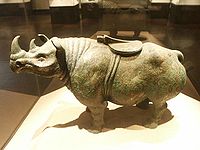
Spurred by alleged signs from Heaven
Tian
Tian is one of the oldest Chinese terms for the cosmos and a key concept in Chinese mythology, philosophy, and religion. During the Shang Dynasty the Chinese called god Shangdi or Di , and during the Zhou Dynasty Tian "heaven; god" became synonymous with Shangdi...
warning the ruler of his incompetence, a total of eighteen general amnesties were granted during the combined reigns of Emperor Yuan and Emperor Cheng of Han
Emperor Cheng of Han
Emperor Cheng of Han was an emperor of the Chinese Han Dynasty ruling from 33 BC until 7 BC.Under Emperor Cheng, the Han dynasty continued its slide into disintegration while the Wang clan continued its slow grip on power and on governmental affairs as promoted by the previous emperor...
(r. 37-3 BCE, Liu Ao 劉驁). Emperor Yuan reduced the severity of punishment for several crimes, while Cheng reduced the length of judicial procedures in 34 BCE since they were disrupting the lives of commoners. While the Modernists had accepted sums of cash from criminals to have their sentences commuted or even dropped, the Reformists reversed this policy since it favored the wealthy over the poor and was not an effective deterrent against crime.
Emperor Cheng made major reforms to state-sponsored religion. The Qin Dynasty had worshipped four main legendary deities, with another added by Emperor Gaozu in 205 BCE; these were the Five Powers, or Wudi (五帝). In 31 BCE Emperor Cheng, in an effort to gain Heaven's favor and bless him with a male heir, halted all ceremonies dedicated to the Five Powers and replaced them with ceremonies for the supreme god Shangdi
Shangdi
Shangdi , also known as Di in Oracle Bone Inscription and Thirteen Classics, refers to the supreme god or a divine power regarded as the spiritual ultimate by the Chinese people from the Shang Dynasty. He controlled victory in battle, harvest, the fate of the kingdom, and the weather...
, who the kings of Zhou had worshipped.
Foreign relations and war
Fu Jiezi
Fu Jiezi , born in Qingyang, Gansu, was responsible for the assassination of Loulan king Angui in 77 BC....
assassinated the pro-Xiongnu King of Loulan in 77 BCE. The Han formed a coalition with the Wusun
Wusun
The Wūsūn were a nomadic steppe people who, according to the Chinese histories, originally lived in western Gansu in northwest China west of the Yuezhi people...
, Dingling
Dingling
The Dingling were an ancient Siberian people. They originally lived on the bank of the Lena River in the area west of Lake Baikal, gradually moving southward to Mongolia and northern China...
, and Wuhuan
Wuhuan
The Wuhuan were a proto-Mongolic nomadic people who inhabited northern China, in what is now the provinces of Hebei, Liaoning, Shanxi, the municipality of Beijing and the autonomous region of Inner Mongolia....
, and the coalition forces inflicted a major defeat against the Xiongnu in 72 BCE. The Han regained its influence over the Turpan Depression after defeating the Xiongnu at the Battle of Jushi
Battle of Jushi
The Battle of Jushi was a battle between the Han Dynasty and the Xiongnu for the control of the people of the Jushi culture in the Turpan Basin in 67 BC. The battle was a success for the Han, who were led by Zheng Ji. The king of Jushi Wugui surrendered to Han, after the Han launched the attack...
in 67 BCE. In 65 BCE Han was able to install a new King of Kucha
Kucha
Kuchaor Kuche Uyghur , Chinese Simplified: 库车; Traditional: 庫車; pinyin Kùchē; also romanized as Qiuzi, Qiuci, Chiu-tzu, Kiu-che, Kuei-tzu from the traditional Chinese forms 屈支 屈茨; 龜玆; 龟兹, 丘玆, also Po ; Sanskrit: Kueina, Standard Tibetan: Kutsahiyui was an ancient Buddhist kingdom...
(a state north of the Taklamakan Desert) who would be agreeable to Han interests in the region. The office
Chief Official of the Western Regions
The Chief Official of the Western Regions was a Chinese military official in charge of the Western Regions. Since the Eastern Han no longer maintained the post of Protector General, the duty was assumed by the chief official in the course of his management of the Western Regions during the period...
of the Protectorate of the Western Regions
Protectorate of the Western Regions
The Protectorate of the Western Regions was a regional government established by the Han Dynasty to manage and to control the Western Regions, roughly today's Xinjiang ....
, first given to Zheng Ji (d. 49 BCE), was established in 60 BCE to supervise colonial activities and conduct relations with the small kingdoms of the Tarim Basin.
After Zhizhi Chanyu
Zhizhi Chanyu
Zhizhi Chanyu was a Chanyu of the Xiongnu at the time of the first Xiongnu civil war, who held the north and west in contention with his younger brother Huhanye who held the south. His original name in Chinese transcription was Luanti Hutuwusi, i.e...
(r. 56–36 BCE) had inflicted a serious defeat against his rival brother and royal contender Huhanye Chanyu (呼韓邪) (r. 58–31 BCE), Huhanye and his supporters debated whether to request Han aid and become a Han vassal. He decided to do so in 52 BCE. Huhanye sent his son as a hostage to Han and personally paid homage to Emperor Xuan during the 51 BCE Chinese New Year
Chinese New Year
Chinese New Year – often called Chinese Lunar New Year although it actually is lunisolar – is the most important of the traditional Chinese holidays. It is an all East and South-East-Asia celebration...
celebration. Under the advocacy of the Reformists, Huhanye was seated as a distinguished guest of honor and rich rewards of 5 kg (160 oz t
Troy ounce
The troy ounce is a unit of imperial measure. In the present day it is most commonly used to gauge the weight of precious metals. One troy ounce is nowadays defined as exactly 0.0311034768 kg = 31.1034768 g. There are approximately 32.1507466 troy oz in 1 kg...
) of gold, 200,000 cash coins, 77 suits of clothes, 8,000 bales of silk fabric, 1,500 kg (3,300 lb) of silk floss, and 15 horses, in addition to 680,000 L (19,300 U.S. bu) of grain sent to him when he returned home.
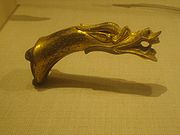
Economy of the Han Dynasty
The Han Dynasty of ancient China experienced contrasting periods of economic prosperity and decline. It is normally divided into three periods: Western Han , the Xin Dynasty , and Eastern Han . The Xin Dynasty, established by the former regent Wang Mang, formed a brief interregnum between lengthy...
; this was a cause for complaint by some ministers in 3 BCE, yet the financial consequence of pampering their vassal was deemed superior to the heqin agreement. Zhizhi Chanyu initially attempted to send hostages and tribute to the Han court in hopes of ending the Han support of Huhanye, but eventually turned against Han. Subsequently, the Han general Chen Tang
Chen Tang
Chen Tang , born in Jining, Shandong, was famous for his battle against Zhizhi in 36 BC , and a quote 夫胡兵五而当汉兵一 "a single soldier of Han is equivalent to five Central Asian soldiers"....
and Protector General Gan Yanshou (甘延壽/甘延寿), acting without explicit permission from the Han court, killed Zhizhi
Battle of Zhizhi
The Battle of Zhizhi was fought in 36 BC between the Han Dynasty and the Xiongnu chieftain Zhizhi Chanyu. Zhizhi was defeated and killed. The battle was probably fought near Taraz on the Talas River in eastern Kazakhstan, which makes it one of the westernmost points reached by a Chinese army...
at his capital of Shanyu City (in modern Taraz
Taraz
Taraz , is a city and a center of the Jambyl Province in Kazakhstan. It is located in the south of Kazakhstan, near the border with Kyrgyzstan, on the Talas River...
, Kazakhstan
Kazakhstan
Kazakhstan , officially the Republic of Kazakhstan, is a transcontinental country in Central Asia and Eastern Europe. Ranked as the ninth largest country in the world, it is also the world's largest landlocked country; its territory of is greater than Western Europe...
) in 36 BCE. The Reformist Han court, reluctant to award independent missions let alone foreign interventionism, gave Chen and Gan only modest rewards. Despite the show of favor, Huhanye was not given a Han princess; instead, he was given the Lady Wang Zhaojun
Wang Zhaojun
Wang Qiang , more commonly known by her style name Wang Zhaojun was the consort of the Xiongnu chanyu Huhanye...
, one of the Four Beauties
Four Beauties
The Four Beauties or Four Great Beauties are four ancient Chinese women, renowned for their beauty. The scarcity of historical records concerning them meant that much of what is known of them today has been greatly embellished by legend...
of ancient China. This marked a departure from the earlier heqin agreement, where a Chinese princess was handed over to the Chanyu as his bride.
Wang Mang seizes control
The long life of Empress Wang ZhengjunEmpress Wang Zhengjun
Empress Wang Zhengjun , , official imperial title Empress Xiaoyuan , later and more commonly known as Grand Empress Dowager Wang, born in Yuancheng , was an empress during the Western Han Dynasty of China, who played important roles during the reigns of five successive Han emperors—her...
(71 BCE–13 CE), wife of Emperor Yuan and mother to Emperor Cheng, ensured that her male relatives would be appointed one after another to the role of regent, officially known as Commander-in-Chief. Emperor Cheng, who was more interested in cockfighting and chasing after beautiful women than administering the empire, left much of the affairs of state to his relatives of the Wang clan. On November 28, 8 BCE Wang Mang
Wang Mang
Wang Mang , courtesy name Jujun , was a Han Dynasty official who seized the throne from the Liu family and founded the Xin Dynasty , ruling AD 9–23. The Han dynasty was restored after his overthrow and his rule marks the separation between the Western Han Dynasty and Eastern Han Dynasty...
(45 BCE–23 CE), a nephew of Empress Dowager Wang, became the new General-in-Chief. However, when Emperor Ai of Han
Emperor Ai of Han
Emperor Ai of Han was an emperor of the Chinese Han Dynasty. He ascended the throne when he was 20, having been made heir by his uncle Emperor Cheng, who was childless, and he reigned from 7 BC to 1 BC....
(r. 7–1 BCE, Liu Xin) took the throne, his grandmother Consort Fu
Consort Fu
Consort Fu was an imperial consort during Han Dynasty. She was a consort and a favorite of Emperor Yuan. She was known to be a domineering woman who wanted her son on the throne, and, failing that, wanted her grandson on the throne as Emperor Ai...
(Emperor Yuan's concubine) became the leading figure in the palace and forced Wang Mang to resign on August 27, 7 BCE, followed by his forced departure from the capital to his marquess
Marquess
A marquess or marquis is a nobleman of hereditary rank in various European peerages and in those of some of their former colonies. The term is also used to translate equivalent oriental styles, as in imperial China, Japan, and Vietnam...
ate in 5 BCE.
Due to pressure from Wang's supporters, Emperor Ai invited Wang Mang back to the capital in 2 BCE. A year later Emperor Ai died of illness without a son. Wang Mang was reinstated as regent over Emperor Ping of Han
Emperor Ping of Han
Emperor Ping was an emperor of the Chinese Han Dynasty from 1 BC to AD 5. After Emperor Ai died childless, the throne was passed to his cousin Emperor Ping—then a child of nine years old. Wang Mang was appointed regent by the Grand Empress Dowager Wang...
(r. 1 BCE – 6 CE, Liu Jizi), a first cousin of the former emperor. Although Wang had married his daughter
Empress Wang (Ping)
Empress Wang , formally Empress Xiaoping , formally during her father Wang Mang's Xin Dynasty Duchess Dowager of Ding'an then Princess Huanghuang was an empress during the Han Dynasty -- the last of the Western Han Dynasty—who was the daughter of the eventual usurper Wang Mang...
to Emperor Ping, the latter was still a child when he died in 6 CE. In July of that year, Grand Empress Dowager Wang confirmed Wang Mang as acting emperor (jiahuangdi 假皇帝) and the child Liu Ying
Ruzi Ying
Emperor Ruzi of Han , commonly known as "Ying the Kid" and with the personal name of Liu Ying , was last emperor of the Chinese Western Han Dynasty from AD 6 to AD 9. After Emperor Ping died without heirs, Wang Mang chose the youngest of the available successors in order to maintain his power in...
as his heir to succeed him, despite the fact that a Liu family marquess had revolted against Wang a month earlier, followed by others who were outraged that he was assuming greater power than the imperial Liu family. These rebellions were quelled and Wang Mang promised to hand over power to Liu Ying when he reached his majority. Despite promises to relinquish power, Wang initiated a propaganda campaign to show that Heaven was sending signals that it was time for Han's rule to end
Mandate of Heaven
The Mandate of Heaven is a traditional Chinese philosophical concept concerning the legitimacy of rulers. It is similar to the European concept of the divine right of kings, in that both sought to legitimaze rule from divine approval; however, unlike the divine right of kings, the Mandate of...
. On January 10, 9 CE he announced that Han had run its course and accepted the requests that he proclaim himself emperor of the Xin Dynasty
Xin Dynasty
The Xin Dynasty was a Chinese dynasty which lasted from AD 9 to 23. It followed the Western Han Dynasty and preceded the Eastern Han Dynasty....
(9–23 CE).
Traditionalist reforms
Wang Mang had a grand vision to restore China to a fabled golden ageGolden Age
The term Golden Age comes from Greek mythology and legend and refers to the first in a sequence of four or five Ages of Man, in which the Golden Age is first, followed in sequence, by the Silver, Bronze, and Iron Ages, and then the present, a period of decline...
achieved in the early Zhou Dynasty, the era which Confucius had idealized. He attempted sweeping reforms, including the outlawing of slavery
History of slavery
The history of slavery covers slave systems in historical perspective in which one human being is legally the property of another, can be bought or sold, is not allowed to escape and must work for the owner without any choice involved...
and institution of the King's Fields
Well-field system
The well-field system was a Chinese land distribution method existing between the ninth century BCE to around the end of the Warring States Period...
system in 9 CE, nationalizing land ownership and allotting a standard amount of land to each family. Slavery was reestablished and the land reform regime was cancelled in 12 CE due to widespread protest.
The historian Ban Gu
Ban Gu
Ban Gu , courtesy name Mengjian , was a 1st century Chinese historian and poet best known for his part in compiling the Book of Han. He also wrote in the main poetic genre of the Han era, a kind of poetry interspersed with prose called fu. Some are anthologized by Xiao Tong in his Selections of...
(32–92 CE) wrote that Wang's reforms led to his downfall, yet aside from slavery and land reform, historian Hans Bielenstein
Hans Bielenstein
Hans Bielenstein is a Swedish sinologist and Professor Emeritus from Columbia University specialising in the history of the Han Dynasty.-Life:...
points out that most of Wang's reforms were in line with earlier Han policies. Although his new denominations of currency
Denomination (currency)
Denomination is a proper description of a currency amount, usually for coins or banknotes. Denominations may also be used with other means of payment like gift cards. See also Redenomination.-Subunit and super unit:...
introduced in 7 CE, 9 CE, 10 CE, and 14 CE debased the value of coinage
Economy of the Han Dynasty
The Han Dynasty of ancient China experienced contrasting periods of economic prosperity and decline. It is normally divided into three periods: Western Han , the Xin Dynasty , and Eastern Han . The Xin Dynasty, established by the former regent Wang Mang, formed a brief interregnum between lengthy...
, earlier introductions of lighter-weight currencies resulted in economic damage as well. Wang renamed all the commanderies of the empire as well as bureaucratic titles, yet there were precedents for this as well. The government monopolies were rescinded in 22 CE because they could no longer be enforced during a large-scale rebellion against him (spurred by massive flooding of the Yellow River
Yellow River
The Yellow River or Huang He, formerly known as the Hwang Ho, is the second-longest river in China and the sixth-longest in the world at the estimated length of . Originating in the Bayan Har Mountains in Qinghai Province in western China, it flows through nine provinces of China and empties into...
).
Foreign relations under Wang
The half-Chinese, half-Xiongnu noble Yituzhiyashi (伊屠智牙師), son of Huhanye Chanyu and Wang Zhaojun, became a vocal partisan for Han China within the Xiongnu realm; Bielenstein claims that this led conservative Xiongnu nobles to anticipate a break in the alliance with Han. The moment came when Wang Mang assumed the throne and demoted the Chanyu to a lesser rank; this became a pretext for war. During the winter of 10–11 CE, Wang amassed 300,000 troops along the northern border of Han China, a show of force which led the Xiongnu to back down. Yet when raiding continued, Wang Mang had the princely Xiongnu hostage held by Han authorities executed. Diplomatic relations were repaired when Xian (咸) (r. 13–18 CE) became the chanyu, only to be soiled again when Huduershi Chanyu (呼都而尸) (r. 18–46 CE) took the throne and raided Han's borders in 19 CE.The Tarim Basin kingdom of Yanqi (Karasahr
Karasahr
Yanqi , or Karasahr , is an ancient town on the Silk Road and capital of Yanqi Hui Autonomous County in the Bayin'gholin Mongol Autonomous Prefecture of Xinjiang, in northwestern China...
, located east of Kucha, west of Turpan) rebelled against Xin authority in 13 CE, killing Han's Protector General Dan Qin (但欽). Wang Mang sent a force to retaliate against Karasahr in 16 CE, quelling their resistance and ensuring that the region would remain under Chinese control until the widespread rebellion against Wang Mang toppled his rule in 23 CE. Wang also extended Chinese influence over Tibet
Tibet
Tibet is a plateau region in Asia, north-east of the Himalayas. It is the traditional homeland of the Tibetan people as well as some other ethnic groups such as Monpas, Qiang, and Lhobas, and is now also inhabited by considerable numbers of Han and Hui people...
an tribes in the Kokonor region
Qinghai
Qinghai ; Oirat Mongolian: ; ; Salar:) is a province of the People's Republic of China, named after Qinghai Lake...
and fended off an attack in 12 CE by Goguryeo (an early Korean state located around the Yalu River
Yalu River
The Yalu River or the Amnok River is a river on the border between North Korea and the People's Republic of China....
) in the Korean peninsula
Korean Peninsula
The Korean Peninsula is a peninsula in East Asia. It extends southwards for about 684 miles from continental Asia into the Pacific Ocean and is surrounded by the Sea of Japan to the south, and the Yellow Sea to the west, the Korea Strait connecting the first two bodies of water.Until the end of...
. However, as the widespread rebellion in China mounted from 20–23 CE, the Koreans raided Lelang Commandery and Han did not reassert itself in the region until 30 CE.
Restoration of the Han
Natural disaster and civil war
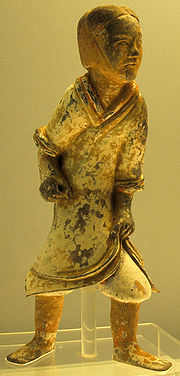
Bohai Sea
Bohai Sea , also known as Bohai Gulf, Bohai, or Bo Hai, is the innermost gulf of the Yellow Sea on the coast of Northeastern and North China. It is approximately 78,000 km2 Bohai Sea , also known as Bohai Gulf, Bohai, or Bo Hai, is the innermost gulf of the Yellow Sea on the coast of...
at Tianjin
Tianjin
' is a metropolis in northern China and one of the five national central cities of the People's Republic of China. It is governed as a direct-controlled municipality, one of four such designations, and is, thus, under direct administration of the central government...
, but the gradual build up of silt in its riverbed—which raised the water level each year—overpowered the dikes built to prevent flooding and the river split in two, with one arm flowing south of the Shandong Peninsula and into the East China Sea
East China Sea
The East China Sea is a marginal sea east of China. It is a part of the Pacific Ocean and covers an area of 1,249,000 km² or 750,000 square miles.-Geography:...
. A second flood in 11 CE changed the course of the northern branch of the river so that it emptied slightly north of the Shandong Peninsula, yet far south of Tianjin. With much of the southern North China Plain
North China Plain
The North China Plain is based on the deposits of the Yellow River and is the largest alluvial plain of eastern Asia. The plain is bordered on the north by the Yanshan Mountains and on the west by the Taihang Mountains edge of the Shanxi plateau. To the south, it merges into the Yangtze Plain...
inundated following the creation of the Yellow River's southern branch, thousands of starving peasants who were displaced from their homes formed groups of bandits and rebels, most notably the Red Eyebrows
Chimei
Chimei refers, as an umbrella term, to one of the two major agrarian rebellion movements against Wang Mang's Xin Dynasty, initially active in the modern Shandong and northern Jiangsu regions, that eventually led to Wang Mang's downfall by draining his resources, allowing the leader of the other...
. Wang Mang's armies tried to quell these rebellions in 18 and 22 CE but failed.
Liu Yan (d. 23 CE), a descendant of Emperor Jing, led a group of rebelling gentry
Gentry (China)
As used for imperial China, landed gentry does not correspond to any term in Chinese. One standard work remarks that under the Ming dynasty, called shenshi or shenjin, meaning variously degree-holders, literati, scholar-bureaucrats or officials, they are loosely known in English as the Chinese...
groups from Nanyang
Nanyang, Henan
Nanyang is a prefecture-level city in the southwest of Henan province, People's Republic of China. The city with the largest administrative area in Henan, Nanyang borders Xinyang to the southeast, Zhumadian to the east, Pingdingshan to the northeast, Luoyang to the north, Sanmenxia to the...
who had Yan's third cousin Liu Xuan (劉玄) accept the title Emperor Gengshi of Han
Emperor Gengshi of Han
Emperor Gengshi of Han, ch. 漢更始帝, py. gèng shĭ dì, wg. Keng-Shih-ti, , also known as the Prince of Huaiyang , courtesy name Shenggong , was an emperor of the restored Chinese Han Dynasty following the fall of Wang Mang's Xin...
(r. 23–25) on March 11, 23 CE. Liu Xiu, a brother of Liu Yan and future Emperor Guangwu of Han
Emperor Guangwu of Han
Emperor Guangwu , born Liu Xiu, was an emperor of the Chinese Han Dynasty, restorer of the dynasty in AD 25 and thus founder of the Later Han or Eastern Han...
(r. 25–57 CE), distinguished himself at the Battle of Kunyang
Battle of Kunyang
The Battle of Kunyang was fought between June–July in 23AD, between the resurgent Han and Xin forces. The Han forces were led by Liu Xiu, while the far more numerous Xin were led by Wang Yi and Wang Xun...
on July 7, 23 CE when he relieved a city sieged by Wang Mang's forces and turned the tide of the war. Soon afterwards, Emperor Gengshi had Liu Yan executed on grounds of treason and Liu Xiu, fearing for his life, resigned from office as Minister of Ceremonies
Nine Ministers
The Nine Ministers was the collective name for nine high officials in the imperial government of the Han Dynasty , who each headed a specialized ministry and were subordinates to the Three Councillors of State...
and avoided public mourning for his brother; for this, the emperor gave Liu Xiu a marquessate and a promotion as general.
Gengshi's forces then targeted Chang'an, but a local insurgency broke out in the capital. From October 4–6 Wang Mang made a last stand at the Weiyang Palace
Weiyang Palace
Weiyang Palace was a palace complex, located near the city of Chang'an . Built in 200 BC at the request of Han Gaozu, under the supervision of his prime minister Xiao He, it served as the administrative centre and imperial residence of the Western Han Dynasty, as well as the Western Jin dynasty...
only to be killed and decapitated; his head was sent to Gengshi's headquarters at Wan (i.e., Nanyang) before Gengshi's armies even reached Chang'an on October 9. Emperor Gengshi settled Luoyang
Luoyang
Luoyang is a prefecture-level city in western Henan province of Central China. It borders the provincial capital of Zhengzhou to the east, Pingdingshan to the southeast, Nanyang to the south, Sanmenxia to the west, Jiyuan to the north, and Jiaozuo to the northeast.Situated on the central plain of...
as his new capital where he invited Red Eyebrows leader Fan Chong (樊崇) to stay, yet Gengshi granted him only honorary titles, so Fan decided to flee once his men began to desert him. Gengshi moved the capital back to Chang'an in 24 CE, yet in the following year the Red Eyebrows defeated his forces, appointed their own puppet ruler Liu Penzi
Liu Penzi
Liu Penzi was a puppet "emperor" placed on the Han Dynasty throne temporarily by the Chimei agrarian rebels after the collapse of the Xin Dynasty, from 25 to 27. Liu Penzi and his 2 brothers were forced into the Chimei to be child soldiers. When Chimei submitted the new Emperor Gengshi of Han,...
, entered Chang'an and captured the fleeing Gengshi who they demoted as King of Changsha before killing him.
Reconsolidation under Guangwu
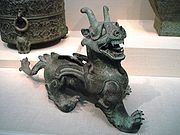
Hebei
' is a province of the People's Republic of China in the North China region. Its one-character abbreviation is "" , named after Ji Province, a Han Dynasty province that included what is now southern Hebei...
province). He claimed the Han throne himself on August 5, 25 CE and occupied Luoyang as his capital on November 5. Before he would eventually unify the empire, there were 11 others who claimed the title of emperor. With the efforts of his officers Deng Yu
Deng Yu
Deng Yu , courtesy name Zhonghua , was a Han Dynasty general and statesman who was a major contributor to Emperor Guangwu 's campaign to reestablish the Han Dynasty...
and Feng Yi
Feng Yi
Feng Yi was a Chinese general of the Eastern Han Dynasty. He was famous for his modest character; he would sit under a tree while the other generals were receiving rewards for their conquests. For this particular reason, he was called The Big Tree General...
, Guangwu forced the wandering Red Eyebrows to surrender on March 15, 27 CE, resettling them at Luoyang, yet had their leader Fan Chong executed when a plot of rebellion was revealed.
From 26–30 CE, Guangwu defeated various warlords and conquered the Central Plain
Central Plain (China)
Zhongyuan or the Central Plain of China refers to the area on the lower reaches of the Yellow River which formed the cradle of Chinese civilization. It forms part of the North China Plain....
and Shandong Peninsula in the east. Allying with the warlord Dou Rong (竇融) of the distant Hexi Corridor in 29 CE, Guangwu nearly defeated the Gansu warlord Wei Xiao (隗囂/隗嚣) in 32 CE, seizing Wei's domain in 33 CE. The last adversary standing was Gongsun Shu (公孫述), whose base was at Chengdu
Chengdu
Chengdu , formerly transliterated Chengtu, is the capital of Sichuan province in Southwest China. It holds sub-provincial administrative status...
in modern Sichuan
Sichuan
' , known formerly in the West by its postal map spellings of Szechwan or Szechuan is a province in Southwest China with its capital in Chengdu...
. Although Guangwu's forces successfully burned down Gongsun's fortified pontoon bridge
Pontoon bridge
A pontoon bridge or floating bridge is a bridge that floats on water and in which barge- or boat-like pontoons support the bridge deck and its dynamic loads. While pontoon bridges are usually temporary structures, some are used for long periods of time...
stretching across the Yangzi River, Guangwu's commanding general Cen Peng (岑彭) was killed in 35 CE by an assassin sent by Gongsun Shu. Nevertheless, Han General Wu Han (d. 44 CE) resumed Cen's campaign along the Yangzi and Min rivers and destroyed Gongsun's forces by December 36 CE.
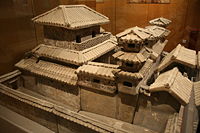
Luo River (Henan)
The Luo River is a tributary of the Yellow River in China. It rises in the southeast flank of Huashan in Shaanxi province and flows east into Henan province, where it eventually joins the Yellow River at the city of Gongyi...
changed its course. Within its walls it had two prominent palaces
Chinese Palaces
Chinese Palaces are elaborate structures. There is a long history of imperial rule in China, and the palaces were the sites where the royal court resided, as well as many government bureaucrats and functionaries....
, both of which existed during Western Han, but were expanded by Guangwu and his successors. While Eastern Han Luoyang is estimated to have held roughly 500,000 inhabitants, the first known census
Census
A census is the procedure of systematically acquiring and recording information about the members of a given population. It is a regularly occurring and official count of a particular population. The term is used mostly in connection with national population and housing censuses; other common...
data for the whole of China, dated 2 CE, recorded a population of nearly 58 million. Comparing this to the census of 140 CE (when the total population was registered at roughly 48 million), there was a significant migratory shift of up to 10 million people from northern to southern China
Northern and southern China
Northern China and southern China are two approximate regions within China. The exact boundary between these two regions has never been precisely defined...
during Eastern Han, largely because of natural disasters and wars with nomadic groups in the north. Population size fluctuated according to periodically-updated Eastern-Han censuses, but historian Sadao Nishijima notes that this does not reflect a dramatic loss of life, but rather government inability at times to register the entire populace.
Policies under Guangwu, Ming, Zhang, and He
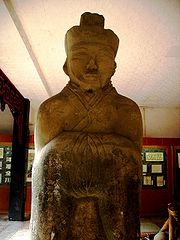
Scrapping Wang Mang's denominations of currency, Emperor Guangwu reintroduced Western Han's standard five shu coin in 40 CE. Making up for lost revenue after the salt and iron monopolies were canceled, private manufacturers were heavily taxed
Economy of the Han Dynasty
The Han Dynasty of ancient China experienced contrasting periods of economic prosperity and decline. It is normally divided into three periods: Western Han , the Xin Dynasty , and Eastern Han . The Xin Dynasty, established by the former regent Wang Mang, formed a brief interregnum between lengthy...
while the government purchased its armies' swords and shields from private businesses. In 31 CE he allowed peasants to pay a military substitution tax to avoid conscription
Conscription
Conscription is the compulsory enlistment of people in some sort of national service, most often military service. Conscription dates back to antiquity and continues in some countries to the present day under various names...
into the armed forces for a year of training and year of service; instead he built a volunteer force
Military volunteer
A military volunteer is a person who enlists in military service by free will, and is not a mercenary or a foreign legionaire. Volunteers often enlist to fight in the armed forces of a foreign country. Military volunteers are essential for the operation of volunteer militaries.Many armies,...
which lasted throughout Eastern Han. He also allowed peasants to avoid the one-month corvée
Corvée
Corvée is unfree labour, often unpaid, that is required of people of lower social standing and imposed on them by the state or a superior . The corvée was the earliest and most widespread form of taxation, which can be traced back to the beginning of civilization...
duty with a commutable tax as hired labor
Day labor
Day labor is work done where the worker is hired and paid one day at a time, with no promise that more work will be available in the future. It is a form of contingent work.-Types:Day laborers find work through three common routes....
became more popular. Wang Mang had demoted all Han marquesses to commoner status, yet Guangwu made an effort from 27 CE onwards to find their relatives and restore abolished marquessates.
Emperor Ming of Han
Emperor Ming of Han
Emperor Ming of Han, , was second emperor of the Chinese Eastern Han Dynasty.He was the second son of Emperor Guangwu. It was during Emperor Ming's reign that Buddhism began to spread into China. One night, he is said to have dreamed of a golden man or golden men...
(r. 57–75 CE, Liu Yang) reestablished the Office for Price Adjustment and Stabilization and the price stabilization system where the government bought grain when cheap and sold it to the public when private commercial prices were high due to limited stocks. However, he canceled the prize stabilization scheme in 68 CE when he became convinced that government hoarding of grain only made wealthy merchants even richer. With the renewed economic prosperity brought about by his father's reign, Emperor Ming addressed the flooding of the Yellow River by repairing various dams and canals. On April 8, 70 CE, an edict boasted that the southern branch of the Yellow River emptying south of the Shandong Peninsula was finally cut off by Han engineering. A patron of scholarship, Emperor Ming also established a school for young nobles aside from the Imperial University.
Emperor Zhang of Han
Emperor Zhang of Han
Emperor Zhang of Han, ch. 漢章帝, py. hàn zhāng dì, wg. Han Chang-ti, was an emperor of the Chinese Han Dynasty from 75 to 88. He was the third emperor of the Chinese Eastern Han Dynasty....
(r. 75–88 CE, Liu Da) faced an agrarian crisis when a cattle epidemic broke out in 76 CE. In addition to providing disaster relief, Zhang also made reforms to legal procedures and lightened existing punishments with the bastinado, since he believed that this would restore the seasonal balance of yin and yang and cure the epidemic. To further display his benevolence, in 78 CE he ceased the corvée work on canal works of the Hutuo River running through the Taihang Mountains
Taihang Mountains
The Taihang Mountains are a Chinese mountain range running down the eastern edge of the Loess Plateau in Henan, Shanxi and Hebei provinces. The range extends over 400 km from north to south and has an average elevation of 1,500 to 2,000 meters. The principal peak is Xiao Wutaishan...
, believing it was causing too much hardship for the people; in 85 CE he granted a three-year poll tax exemption for any woman who gave birth and exempted their husbands for a year. Unlike other Eastern Han rulers who sponsored the New Texts
Old Texts
In Chinese philology, the Old Texts refer to some versions of the Five Classics discovered during the Han Dynasty, written in archaic characters and supposedly produced before the burning of the books, as opposed to the Modern Texts or New Texts in the new orthography.The last half of the 2nd...
tradition of the Confucian Five Classics, Zhang was a patron of the Old Texts
Old Texts
In Chinese philology, the Old Texts refer to some versions of the Five Classics discovered during the Han Dynasty, written in archaic characters and supposedly produced before the burning of the books, as opposed to the Modern Texts or New Texts in the new orthography.The last half of the 2nd...
tradition and held scholarly debates on the validity of the schools. Rafe de Crespigny
Rafe de Crespigny
Dr Rafe de Crespigny is a retired Adjunct Professor with the China and Korea Centre, Australian National University in Canberra, Australia...
writes that the major reform of the Eastern Han period was Zhang's reintroduction in 85 CE of an amended Sifen calendar, replacing Emperor Wu's Taichu calendar
Chinese calendar
The Chinese calendar is a lunisolar calendar, incorporating elements of a lunar calendar with those of a solar calendar. It is not exclusive to China, but followed by many other Asian cultures as well...
of 104 BCE which had become inaccurate over two centuries
Science and technology of the Han Dynasty
The Han Dynasty of ancient China, divided between the eras of Western Han , Xin Dynasty of Wang Mang The Han Dynasty (206 BCE – 220 CE) of ancient China, divided between the eras of Western Han (206 BCE – 9 CE, when the capital was at Chang'an), Xin Dynasty of Wang Mang The Han Dynasty...
(the former measured the tropical year
Tropical year
A tropical year , for general purposes, is the length of time that the Sun takes to return to the same position in the cycle of seasons, as seen from Earth; for example, the time from vernal equinox to vernal equinox, or from summer solstice to summer solstice...
at 365.25 days like the Julian Calendar
Julian calendar
The Julian calendar began in 45 BC as a reform of the Roman calendar by Julius Caesar. It was chosen after consultation with the astronomer Sosigenes of Alexandria and was probably designed to approximate the tropical year .The Julian calendar has a regular year of 365 days divided into 12 months...
, while the latter measured the tropical year at 365385⁄1539 days and the lunar month
Lunar month
In lunar calendars, a lunar month is the time between two identical syzygies . There are many variations. In Middle-Eastern and European traditions, the month starts when the young crescent moon becomes first visible at evening after conjunction with the Sun one or two days before that evening...
at 2943⁄81 days).
Emperor He of Han
Emperor He of Han, ch. 漢和帝, py. hàn hé dì, wg. Han Ho-ti, was an emperor of the Chinese Han Dynasty who ruled from 88 to 105. He was the 4th emperor of the Eastern Han dynasty....
(r. 88–105 CE, Liu Zhao) was tolerant of both New Text and Old Text traditions, though orthodox studies were in decline and works skeptical of New Texts, such as Wang Chong
Wang Chong
Wang Chong , courtesy name Zhongren , was a Chinese philosopher active during the Han Dynasty. He developed a rational, secular, naturalistic and mechanistic account of the world and of human beings and gave a materialistic explanation of the origin of the universe. His main work was the Lùnhéng...
's (27 – c. 100 CE) Lunheng
Lunheng
The Lunheng is a wide-ranging Chinese classic text containing critical essays by Wang Chong on natural science, Chinese mythology, philosophy, and literature.-Title:...
, disillusioned the scholarly community with that tradition. He also showed an interest in history when he commissioned the Lady Ban Zhao
Ban Zhao
Bān Zhāo , courtesy name Huiban , was the first known female Chinese historian. She completed her brother Ban Gu's work as he was imprisoned and executed in the year 92 BCE. because of his association with the family of Empress Dowager Dou. It was said her works could have filled eight volumes...
(45–116 CE) to use the imperial archives in order to complete the Book of Han
Book of Han
The Book of Han, Hanshu or History of the Former Han Dynasty |Fan Ye]] . Various scholars have estimated that the earliest material covered in the book dates back to between 206 and 202 BCE...
, the work of her deceased father
Ban Biao
Ban Biao , courtesy name , was a Chinese historian, and an official born in what is now Xianyang, Shaanxi during the Han Dynasty. He was the nephew of Consort Ban, a famous poet and concubine to Emperor Cheng....
and brother
Ban Gu
Ban Gu , courtesy name Mengjian , was a 1st century Chinese historian and poet best known for his part in compiling the Book of Han. He also wrote in the main poetic genre of the Han era, a kind of poetry interspersed with prose called fu. Some are anthologized by Xiao Tong in his Selections of...
. This set an important precedent of imperial control over the recording of history and thus was unlike Sima Qian's far more independent work, the Records of the Grand Historian
Records of the Grand Historian
The Records of the Grand Historian, also known in English by the Chinese name Shiji , written from 109 BC to 91 BC, was the Magnum opus of Sima Qian, in which he recounted Chinese history from the time of the Yellow Emperor until his own time...
(109–91 BCE). When plagues of locusts, floods, and earthquakes disrupted the lives of commoners, Emperor He's relief policies were to cut taxes, open granaries, provide government loans, forgive private debts, and resettle people away from disaster areas. Believing that a severe drought in 94 CE was the cosmological result of injustice in the legal system, Emperor He personally inspected prisons. When he found that some had false charges levelled against them, he sent the Prefect of Luoyang to prison; rain allegedly came soon afterwards.
Foreign relations and split of the Xiongnu realm
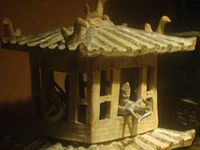
Trung Sisters
The Trưng sisters were leaders who rebelled against Chinese rule for three years, and are regarded as national heroines of Vietnam. Their names are Trưng Trắc and Trưng Nhị ....
led an uprising in the Red River Delta
Red River Delta
The Red River Delta is the flat plain formed by the Red River and its distributaries joining in the Thai Binh River in northern Vietnam. The delta measuring some 15,000 square km is well protected by a network of dikes. It is an agriculturally rich area and densely populated...
of Jiaozhi Commandery
Annam (Chinese Province)
Annam or Jiaozhi was the southernmost province of the Chinese Empire. It is now part of present-day Vietnam...
in 40 CE. Guangwu sent the elderly general Ma Yuan (~14 BCE – 49 CE), who defeated them in 42–43 CE. The sisters' native Dong Son drums
Dong Son drums
Đông Sơn drums are bronze drums fabricated by the Dong Son culture, in the Red River Delta of northern Vietnam...
were melted down and recast into a large bronze horse statue presented to Guangwu at Luoyang.
Meanwhile, Huduershi Chanyu was succeeded by his son Punu (蒲奴) in 46 CE, thus breaking Huhanye's orders that only a Xiongnu ruler's brother was a valid successor; Huduershi's nephew Bi (比) was outraged and in 48 CE was proclaimed a rival Chanyu. This split created the Northern Xiongnu and Southern Xiongnu, and like Huhanye before him, Bi turned to the Han for aid in 50 CE. When Bi came to pay homage to the Han court, he was given 10,000 bales of silk fabrics, 2,500 kg (5,500 lb) of silk, 500,000 L (14,000 U.S. bu) of rice, and 36,000 head of cattle. Unlike in Huhanye's time, however, the Southern Xiongnu were overseen by a Han Prefect who not only acted as an arbiter in Xiongnu legal cases, but also monitored the movements of the Chanyu and his followers who were settled in Han's northern commanderies in Shanxi, Gansu, and Inner Mongolia
Inner Mongolia
Inner Mongolia is an autonomous region of the People's Republic of China, located in the northern region of the country. Inner Mongolia shares an international border with the countries of Mongolia and the Russian Federation...
. Northern Xiongnu attempts to enter Han's tributary system were rejected.
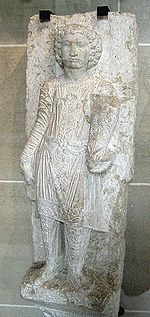
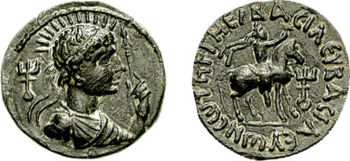
Khotan
Hotan , or Hetian , also spelled Khotan, is the seat of the Hotan Prefecture in Xinjiang, China. It was previously known in Chinese as 于窴/於窴 and to 19th-century European explorers as Ilchi....
, Turpan, Kucha, and Karasahr, all of which decided to ally with the Northern Xiongnu. By 61 CE Khotan had conquered Yarkand, yet this led to a war among the kingdoms to decide which would be the next hegemon. The Northern Xiongnu took advantage of the infighting, conquered the Tarim Basin, and used it as a base to stage raids into Han's Hexi Corridor by 63 CE. In that year, the Han court opened border markets for trade with the Northern Xiongnu in hopes to appease them.
Yet Han sought to reconquer the Tarim Basin. At the Battle of Yiwulu
Battle of Yiwulu
The Battle of Yiwulu, was a battle under a major expedition against the Xiongnu launched by the Han Dynasty in the February, 73, ever since the fall of Xin Dynasty. The battle was a success for the Han, who were led by Dou Gu...
in 73 CE, Dou Gu
Dou Gu
Dou Gu , born in Xianyang, Shaanxi, was a general fought in the Battle of Yiwulu in 73. Shortly after the battle, Dou Gu sent of two of his generals Ban Chao and Guo Xun to the Western Regions for a diplomatic expedition.-References:...
(d. 88 CE) reached as far as Lake Barkol when he defeated a Northern Xiongnu chanyu and established an agricultural garrison at Hami
Hami Prefecture
Kumul Prefecture, also known as Hami Prefecture is located in eastern Xinjiang, China. It has an area of 140,749 km² and 492,096 inhabitants .- History :...
. Although Dou Gu was able to evict the Xiongnu from Turpan in 74 CE, when the Han appointed Chen Mu
Chen Mu
Chen Mu , was a general during Han Dynasty, and served the first Protector General of the Western Regions under Eastern Han between 74-75. During the service, he was killed by the rebels from the state of Yanqi and Qiuci in 75.-References:...
(d. 75 CE) as the new Protector General of the Western Regions, the Northern Xiongnu invaded the Bogda Mountains
Bogda Shan
The Bogda Shan range is part of the eastern Tien Shan mountains, and located in Xinjiang, some 60 km east of Ürümqi. The highest elevation is Bogda Feng, at 5445 m....
while their allies Karasarh and Kucha killed Chen Mu and his troops. The Han garrison at Hami was forced to withdraw in 77 CE (and was not reestablished until 91 CE). The next Han expedition against the Northern Xiongnu was led in 89 CE by Dou Xian
Dou Xian
Dou Xian was a prominent Chinese general and statesman of the Eastern Han Dynasty. A native of modern-day Xianyang, Shaanxi Province, he was part of the powerful Dou clan which dominated court politics during his tenure. However, his father Dou Xun fell into disgrace and died in 70, leaving Dou...
(d. 92 CE); at the Battle of Ikh Bayan
Battle of Ikh Bayan
The Battle of Ikh Bayan , was a major expedition launched against the Xiongnu by the Han Dynasty in June, 89. The battle was a success for the Han under Dou Xian The Battle of Ikh Bayan , was a major expedition launched against the Xiongnu by the Han Dynasty in June, 89. The battle was a success...
, Dou's forces chased the Northern Chanyu into the Altai Mountains, allegedly killing 13,000 Xiongnu and accepting the surrender of 200,000 Xiongnu from 81 tribes.
After Dou sent 2,000 cavalry to attack the Northern Xiongnu base at Hami, he was followed by the initiative of the general Ban Chao
Ban Chao
Ban Chao , courtesy name Zhongsheng , was born in Xianyang, Shaanxi, and the younger brother of the famous historian, Ban Gu who, with his father Ban Biao, and sister, Ban Zhao, wrote the famous Hanshu, or 'History of the Former Han Dynasty'....
(d. 102 CE), who earlier installed a new king of Kashgar as a Han ally. When this king turned against him and enlisted the aid of Sogdiana
Sogdiana
Sogdiana or Sogdia was the ancient civilization of an Iranian people and a province of the Achaemenid Empire, eighteenth in the list on the Behistun Inscription of Darius the Great . Sogdiana is "listed" as the second of the "good lands and countries" that Ahura Mazda created...
in 84 CE, Ban Chao arranged an alliance with the Kushan Empire
Kushan Empire
The Kushan Empire originally formed in the early 1st century AD under Kujula Kadphises in the territories of ancient Bactria on either side of the middle course of the Oxus in what is now northern Afghanistan, Pakistan, and southern Tajikistan and Uzbekistan.During the 1st and early 2nd centuries...
(of modern North India
North India
North India, known natively as Uttar Bhārat or Shumālī Hindustān , is a loosely defined region in the northern part of India. The exact meaning of the term varies by usage...
, Pakistan
Pakistan
Pakistan , officially the Islamic Republic of Pakistan is a sovereign state in South Asia. It has a coastline along the Arabian Sea and the Gulf of Oman in the south and is bordered by Afghanistan and Iran in the west, India in the east and China in the far northeast. In the north, Tajikistan...
, Afghanistan
Afghanistan
Afghanistan , officially the Islamic Republic of Afghanistan, is a landlocked country located in the centre of Asia, forming South Asia, Central Asia and the Middle East. With a population of about 29 million, it has an area of , making it the 42nd most populous and 41st largest nation in the world...
, and Tajikistan
Tajikistan
Tajikistan , officially the Republic of Tajikistan , is a mountainous landlocked country in Central Asia. Afghanistan borders it to the south, Uzbekistan to the west, Kyrgyzstan to the north, and China to the east....
), which put political pressure on Sogdiana to back down; Ban later assassinated King Zhong of Kashgar. Since Kushan provided aid to Ban Chao in quelling Turpan and sent tribute and hostages to Han, its ruler Vima Kadphises
Vima Kadphises
Vima Kadphises was a Kushan emperor from around 90–100 CE. As detailed by the Rabatak inscription, he was the son of Vima Takto and the father of Kanishka.-Rule:...
(r. c. 90 – c. 100 CE) requested a Chinese princess bride; when this was rejected in 90 CE, Kushan marched 70,000 troops to Wakhan
Wakhan
Wakhan or "the Wakhan" is a very mountainous and rugged part of the Pamir and Karakoram regions of Afghanistan. Wakhan District is a district in Badakshan Province.-Geography:...
against Ban Chao. Ban used scorched earth
Scorched earth
A scorched earth policy is a military strategy or operational method which involves destroying anything that might be useful to the enemy while advancing through or withdrawing from an area...
tactics against Kushan, forcing them to request food supplies from Kucha. When Kushan messengers were intercepted by Ban, Kushan was forced to withdraw. In 91 CE, Ban was appointed as Protector General of the Western Regions, an office he filled until 101 CE.
Tributary gifts and emissaries from the Arsacid Empire, then under Pacorus II of Parthia
Pacorus II of Parthia
Pacorus II of Parthia ruled the Parthian Empire from about 78 to 105. A son of Vonones II and brother of Vologases I, he was given the kingdom of Media Atropatene by the latter after his succession to the throne. After Vologases' death, Pacorus revolted against his brother's son and successor,...
(r. 78–105 CE), came to the Han in 87 CE, 89 CE, and 101 CE bringing exotic animals such as ostrich
Ostrich
The Ostrich is one or two species of large flightless birds native to Africa, the only living member of the genus Struthio. Some analyses indicate that the Somali Ostrich may be better considered a full species apart from the Common Ostrich, but most taxonomists consider it to be a...
es and lion
Lion
The lion is one of the four big cats in the genus Panthera, and a member of the family Felidae. With some males exceeding 250 kg in weight, it is the second-largest living cat after the tiger...
s. When Ban Chao dispatched his emissary Gan Ying
Gan Ying
Gan Ying , was a Chinese military ambassador who was sent on a mission to Rome in 97 CE by the Chinese general Ban Chao.Although Gan Ying never reached Rome, only travelling to as far as the Parthian coast of the Persian Gulf, he is, at least in the historical records, the Chinese who went the...
in 97 CE to reach Daqin
Daqin
Daqin is the ancient Chinese name for the Roman Empire and, depending on context, the Near East, especially Syria. It literally means "Great Qin", Qin being the name of the founding dynasty of the Chinese Empire...
(the Roman Empire), he did not reach farther than a "large sea", perhaps the Persian Gulf
Persian Gulf
The Persian Gulf, in Southwest Asia, is an extension of the Indian Ocean located between Iran and the Arabian Peninsula.The Persian Gulf was the focus of the 1980–1988 Iran-Iraq War, in which each side attacked the other's oil tankers...
. However, from oral accounts Gan was able to describe Rome as having hundreds of walled cities, a postal delivery network
Mail
Mail, or post, is a system for transporting letters and other tangible objects: written documents, typically enclosed in envelopes, and also small packages are delivered to destinations around the world. Anything sent through the postal system is called mail or post.In principle, a postal service...
, the submission of dependent states, and a system of government
Roman Constitution
The Roman Constitution was an uncodified set of guidelines and principles passed down mainly through precedent. The Roman constitution was not formal or even official, largely unwritten and constantly evolving. Concepts that originated in the Roman constitution live on in constitutions to this day...
where the Roman "king" (i.e. consul)
Roman consul
A consul served in the highest elected political office of the Roman Republic.Each year, two consuls were elected together, to serve for a one-year term. Each consul was given veto power over his colleague and the officials would alternate each month...
is "not a permanent figure but is chosen as the man most worthy
Roman assemblies
The Legislative Assemblies of the Roman Republic were political institutions in the ancient Roman Republic. According to the contemporary historian Polybius, it was the people who had the final say regarding the election of magistrates, the enactment of new statutes, the carrying out of capital...
." Elephants and rhinoceroses were also presented as gifts to the Han court in 94 CE and 97 CE by a king in what is now Burma. The first known diplomatic mission
Wa (Japan)
Japanese is the oldest recorded name of Japan. Chinese, Korean, and Japanese scribes regularly wrote Wa or Yamato "Japan" with the Chinese character 倭 until the 8th century, when the Japanese found fault with it, replacing it with 和 "harmony, peace, balance".- Historical references :The earliest...
from a ruler in Japan
Japan
Japan is an island nation in East Asia. Located in the Pacific Ocean, it lies to the east of the Sea of Japan, China, North Korea, South Korea and Russia, stretching from the Sea of Okhotsk in the north to the East China Sea and Taiwan in the south...
came in 57 CE (followed by another in 107 CE); a golden seal of Emperor Guangwu's was even discovered in 1784 in Chikuzen Province
Chikuzen Province
was an old province of Japan in the area that is today part of Fukuoka Prefecture in Kyūshū. It was sometimes called , with Chikugo Province. Chikuzen bordered Buzen, Bungo, Chikugo, and Hizen Provinces....
. The first mentioning
Liu Ying
Liu Ying was a son of Emperor Guangwu of Han, and half-brother of Emperor Ming. After becoming Prince of Chu, he was a known supporter of many religions...
of Buddhism
Buddhism
Buddhism is a religion and philosophy encompassing a variety of traditions, beliefs and practices, largely based on teachings attributed to Siddhartha Gautama, commonly known as the Buddha . The Buddha lived and taught in the northeastern Indian subcontinent some time between the 6th and 4th...
in China was made in 65 CE, when the Chinese clearly associated it with Huang-Lao Daoism. Emperor Ming had the first Buddhist temple of China—the White Horse Temple
White Horse Temple
White Horse Temple is, according to tradition, the first Buddhist temple in China, established in 68 AD under the patronage of Emperor Ming in the Eastern Han capital Luoyang. Today the site is located just outside the walls of the ancient Eastern Han capital, some east of Luoyang in Henan...
—built at Luoyang in honor of two foreign monks
Bhikkhu
A Bhikkhu or Bhikṣu is an ordained male Buddhist monastic. A female monastic is called a Bhikkhuni Nepali: ). The life of Bhikkhus and Bhikkhunis is governed by a set of rules called the patimokkha within the vinaya's framework of monastic discipline...
: Jiashemoteng (迦葉摩騰) (Kāśyapa Mātanga) and Zhu Falan (竺法蘭) (Dharmaratna the Indian). These monks allegedly translated the Sutra of Forty-two Chapters
Sutra of Forty-two Chapters
The Sutra of Forty-two Chapters is the earliest surviving Buddhist sutra translated into Chinese. It was translated by two ordained Yuezhi monks, Kasyapa-Matanga and Dharmaraksha , in 67 CE...
from Sanskrit
Sanskrit
Sanskrit , is a historical Indo-Aryan language and the primary liturgical language of Hinduism, Jainism and Buddhism.Buddhism: besides Pali, see Buddhist Hybrid Sanskrit Today, it is listed as one of the 22 scheduled languages of India and is an official language of the state of Uttarakhand...
into Chinese
Chinese language
The Chinese language is a language or language family consisting of varieties which are mutually intelligible to varying degrees. Originally the indigenous languages spoken by the Han Chinese in China, it forms one of the branches of Sino-Tibetan family of languages...
, although it is now proven that this text was not translated into Chinese until the 2nd century CE.
Court, kinsmen, and consort clans
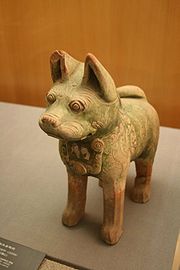
Empress Guo Shengtong
Empress Guo Shengtong was an empress during Han Dynasty. She was the first empress of her husband Emperor Guangwu , the one who established Eastern Han Dynasty as a restoration of the overthrown Western Han Dynasty. She eventually lost her husband's favor and was deposed in 41...
in 41 CE to install his original wife Empress Yin Lihua
Empress Yin Lihua
Empress Yin Lihua , formally Empress Guanglie was an empress during Han Dynasty. She was the second empress of her husband Emperor Guangwu -- even though she married him as his wife before his first empress, Empress Guo Shengtong, did. She was famed for her beauty and meekness...
as empress instead, there was little drama with imperial kinsmen
Chinese kinship
The Chinese kinship system is classified as a Sudanese kinship system used to define family. Identified by Lewis Henry Morgan in his 1871 work Systems of Consanguinity and Affinity of the Human Family, the Sudanese system is one of the six major kinship systems together with Eskimo, Hawaiian,...
at Guangwu's court, as Empress Guo was made a queen dowager and her son, the former heir apparent, was demoted to the status of a king. However, trouble with imperial kinsmen turned violent during Ming's reign. In addition to exiling his half-brother Liu Ying
Liu Ying
Liu Ying was a son of Emperor Guangwu of Han, and half-brother of Emperor Ming. After becoming Prince of Chu, he was a known supporter of many religions...
(d. 71 CE, committed suicide) after Liu Ying allegedly used witchcraft to curse him, Emperor Ming also targeted hundreds of others with similar charges (of using occult omens and witchcraft) resulting in exile, torture for gaining confessions, and execution. This trend of persecution did not end until Emperor Zhang took the throne, who was for the most part generous towards his brothers and called back many to the capital who had been exiled by Ming.
Of greater consequence for the dynasty, however, was Emperor He's coup of 92 CE in which eunuchs made their first significant involvement in court politics of Eastern Han. Emperor Zhang had upheld a good relationship with his titular mother and Ming's widow, the humble Empress Dowager Ma
Empress Ma (Ming)
Empress Ma , formally Empress Mingde , was an empress during Han Dynasty from the year 60 until her death...
(d. 79 CE), but Empress Dowager Dou
Empress Dou (Zhang)
Empress Dou , formally Empress Zhangde , was an empress during Han Dynasty. Her husband was Emperor Zhang. She was already influential during her husband's reign, but became particularly powerful as empress dowager regent for her adoptive son Emperor He after Emperor Zhang's death...
(d. 97 CE), the widow of Emperor Zhang, was overbearing towards Emperor He (son of Emperor Zhang and Consort Liang
Consort Liang
Consort Liang , posthumous title Empress Gonghuai , was an imperial consort to Emperor Zhang of Han...
) in his early reign and, concealing the identity of his natural mother from him, raised He as her own after purging the Liang family from power. In order to put He on the throne, Empress Dowager Dou had even demoted the crown prince Liu Qing (78–106 CE) as a king and forced his mother, Consort Song
Consort Song
Consort Song , posthumous title Empress Jingyin , was an imperial consort for Emperor Zhang of Han who was the victim of palace intrigue at the hands of Emperor Zhang's wife Empress Dou.Consort Song was the older daughter of Song Yang , a seventh-generation descendant of Song Chang ,...
(d. 82 CE) to commit suicide. Unwilling to yield his power to the Dou clan any longer, Emperor He enlisted the aid of palace eunuchs led by Zheng Zhong
Zheng Zhong
Zheng Zhong , courtesy name Jichan , was the first Han Dynasty eunuch with true power in government, thanks to the trust that Emperor He had in him for his contributions in overthrowing the clan of Empress Dowager Dou, particularly her autocratic brother Dou Xian...
(d. 107 CE) to overthrow the Dou clan on charges of treason, stripping them of titles, exiling them, forcing many to commit suicide, and had the Empress Dowager placed under house arrest
House arrest
In justice and law, house arrest is a measure by which a person is confined by the authorities to his or her residence. Travel is usually restricted, if allowed at all...
.
Empress Deng Sui, consort families, and eunuchs
Empress Deng SuiEmpress Deng Sui
Empress Deng Sui , formally Empress Hexi was an empress during Han Dynasty. She was Emperor He's second wife. She later, as empress dowager, served as regent for his son Emperor Shang and nephew Emperor An, and was regarded as an able and diligent administrator...
(d. 121 CE), widow to Emperor He, became empress dowager in 105 CE and thus had the final say in appointing He's successor (since he had appointed none); she placed his infant son Liu Long on the throne, later known as Emperor Shang of Han
Emperor Shang of Han
Emperor Shang of Han, ch. 漢殤帝, py. Hàn Shāng dì, wg. Han Shang-ti, was an emperor of the Chinese Han Dynasty and the fifth emperor of the Chinese Eastern Han Dynasty....
(r. 105–106). When the latter died at only age one, she placed his young nephew Liu Hu (Liu Qing's son) on the throne, known posthumously as Emperor An of Han
Emperor An of Han
Emperor Ān of Hàn, ch. 漢安帝, py. hàn ān dì, wg. Han An-ti, was an emperor of the Chinese Hàn Dynasty and the sixth emperor of the Eastern Hàn period ruling from 106 to 125...
(r. 106–125 CE), bypassing Emperor He's other son Liu Sheng (劉勝). With a young ruler on the throne, Empress Deng was the de facto ruler until her death, since her brother Deng Zhi's (鄧騭) brief occupation as the General-in-Chief (大將軍) from 109–110 CE did not in fact make him the ruling regent. With her death on April 17, 121 CE, Emperor An accepted the charge of eunuchs Li Run (李閏) and Jiang Jing (江京) that she had plotted to overthrow him; on June 3 he charged the Deng clan with treason and had them dismissed from office, stripped of title, reduced to commoner status, exiled to remote areas, and drove many to commit suicide.
The Yan clan of Empress Yan Ji
Empress Yan Ji
Empress Yan Ji , formally Empress Ansi , was an empress during Han Dynasty. Her husband was Emperor An. She was known for her conspiratorial and nepotistic behavior, both as empress and as empress dowager...
(d. 126 CE), wife of Emperor An, and the eunuchs Jiang Jing and Fan Feng (樊豐) pressured Emperor An to demote his nine-year-old heir apparent Liu Bao to the status of a king on October 5, 124 CE on charges of conspiracy, despite protests from senior government officials. When Emperor An died on April 30, 125 CE the Empress Dowager Yan was free to choose his successor, Liu Yi (grandson of Emperor Zhang), who is known as Emperor Shao of Han
Marquess of Beixiang
The Marquess of Beixiang, , sometimes referred to as Emperor Shao , was an emperor of the Chinese Han Dynasty...
. After the child died suddenly in 125 CE, the eunuch Sun Cheng
Sun Cheng
Sun Cheng was an eunuch during Han Dynasty who, contrary to the stereotypes of Han eunuchs being corrupt and power-hungry, was loyal to the imperial family and tried to counter the culture of corruption....
(d. 132 CE) made a palace coup, slaughtering the opposing eunuchs, and thrust Liu Bao on the throne, later to be known as Emperor Shun of Han
Emperor Shun of Han
Emperor Shun of Han, trad. ch. 漢順帝;, sim. ch. 漢顺帝, py. hàn shùn dì, wg. Han Shun-ti, was an emperor of the Chinese Han Dynasty and the seventh emperor of the Eastern Han period...
(r. 125–144 CE); Sun then put Empress Dowager Yan under house arrest, had her brothers killed, and the rest of her family exiled to Vietnam.
Empress Liang Na
Empress Liang Na , formally Empress Shunlie , was an empress during the Han Dynasty. Her husband was Emperor Shun of Han. She later served as regent for his son Emperor Chong, and the two subsequent emperors from collateral lines, Emperor Zhi and Emperor Huan...
(d. 150 CE), yet when his son Liu Bing briefly took the throne
Emperor Chong of Han
Emperor Chong of Han, ch. 漢冲帝, py. hàn chōng dì, wg. Han Ch'ung-ti, was an emperor of the Chinese Han Dynasty and the eighth emperor of the Eastern Han period....
in 145 CE, the mother of the latter, Consort Yu, was in no position of power to challenge Empress Dowager Liang. After the child Emperor Zhi of Han
Emperor Zhi of Han
Emperor Zhi of Han was an emperor of the Chinese Han Dynasty. He was a great-great-grandson of Emperor Zhang. His reign was dominated by Liang Ji, the brother of Empress Dowager Liang, who eventually poisoned the young emperor....
(r. 145–146 CE) briefly sat on the throne, Empress Dowager Liang and her brother Liang Ji
Liang Ji
Liang Ji , courtesy name Bozhuo , was a politician and military commander of Han Dynasty China. He dominated government in the 150s together with his sister, Empress Liang Na. After his sister's death, Liang Ji was overthrown in a coup d'etat by Emperor Huan, with the support of the eunuch...
(d. 159 CE), now regent General-in-Chief, decided that Liu Zhi, known posthumously as Emperor Huan of Han
Emperor Huan of Han
Emperor Huan of Han, ch. 漢桓帝, py. hàn húan dì, wg. Han Huan-ti, was an emperor of the Chinese Han Dynasty. He was a great-grandson of Emperor Zhang....
(r. 146–168 CE), should take the throne, as he was betrothed to their sister Liang Nüying
Empress Liang Nüying
Empress Liang Nüying , formally Empress Yixian was an empress during Han Dynasty...
. When the younger Empress Liang died in 159 CE, Liang Ji attempted to control Emperor Huan's new favorite Consort Deng Mengnü
Empress Deng Mengnü
Empress Deng Mengnü , also briefly known as Liang Mengnü then as Bo Mengnü , was an empress during Han Dynasty. She was the second wife of Emperor Huan.- Family background :...
(later empress) (d. 165 CE). When she resisted Liang Ji had her brother-in-law killed, prompting Emperor Huan to use eunuchs to oust Liang Ji from power; the latter committed suicide when his residence was surrounded by imperial guards. Emperor Huan died with no official heir, so his third wife Empress Dou Miao
Empress Dou Miao
Empress Dou Miao , formally Empress Huansi , was an empress during Han Dynasty. She was the third wife of Emperor Huan...
(d. 172 CE), now the empress dowager, had Liu Hong, known posthumously as Emperor Ling of Han
Emperor Ling of Han
Emperor Ling of Han, trad. ch. 漢靈帝;, sim. ch. 汉灵帝, py. hàn líng dì, wg. Han Ling-ti, was an emperor of the Chinese Han Dynasty. He was a great-great-grandson of Emperor Zhang. The Yellow Turban Rebellion broke out during Emperor Ling's reign.Emperor Ling's reign saw yet another repetition of...
(r. 168–189 CE), take the throne.
Reforms and policies of middle Eastern Han
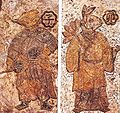
Emperor An continued similar disaster relief programs that Empress Dowager Deng had implemented, though he reversed some of her decisions, such as a 116 CE edict requiring officials to leave office for three years of mourning after the death of a parent (an ideal Confucian more
Mores
Mores, in sociology, are any given society's particular norms, virtues, or values. The word mores is a plurale tantum term borrowed from Latin, which has been used in the English language since the 1890s....
). Since this seemed to contradict Confucian morals, Emperor An's sponsorship of renowned scholars was aimed at shoring up popularity among Confucians. Xu Shen
Xu Shen
Xǔ Shèn was a Chinese philologist of the Han Dynasty. He was the author of Shuowen Jiezi, the first Chinese dictionary with character analysis, as well as the first to organize the characters by shared components. It contains over 9,000 character entries under 540 radicals, explaining the origins...
(58–147 CE), although an Old Text scholar and thus not aligned with the New Text tradition sponsored by Emperor An, enhanced the emperor's Confucian credentials when he presented his groundbreaking dictionary to the court, the Shuowen Jiezi
Shuowen Jiezi
The Shuōwén Jiězì was an early 2nd century CE Chinese dictionary from the Han Dynasty. Although not the first comprehensive Chinese character dictionary , it was still the first to analyze the structure of the characters and to give the rationale behind them , as well as the first to use the...
.
Financial troubles only worsened in Emperor Shun's reign, as many public works projects were handled at the local level without the central government's assistance. Yet his court still managed to supervise the major efforts of disaster relief, aided in part by a new invention in 132 CE of a seismometer
Seismometer
Seismometers are instruments that measure motions of the ground, including those of seismic waves generated by earthquakes, volcanic eruptions, and other seismic sources...
by the court astronomer
Chinese astronomy
Astronomy in China has a very long history, with historians considering that "they [the Chinese] were the most persistent and accurate observers of celestial phenomena anywhere in the world before the Arabs."...
Zhang Heng
Zhang Heng
Zhang Heng was a Chinese astronomer, mathematician, inventor, geographer, cartographer, artist, poet, statesman, and literary scholar from Nanyang, Henan. He lived during the Eastern Han Dynasty of China. He was educated in the capital cities of Luoyang and Chang'an, and began his career as a...
(78–139 CE) who used a complex system of a vibration-sensitive swinging pendulum
Pendulum
A pendulum is a weight suspended from a pivot so that it can swing freely. When a pendulum is displaced from its resting equilibrium position, it is subject to a restoring force due to gravity that will accelerate it back toward the equilibrium position...
, mechanical gears, and falling metal balls to determine the direction of earthquakes hundreds of kilometers (miles) away
Science and technology of the Han Dynasty
The Han Dynasty of ancient China, divided between the eras of Western Han , Xin Dynasty of Wang Mang The Han Dynasty (206 BCE – 220 CE) of ancient China, divided between the eras of Western Han (206 BCE – 9 CE, when the capital was at Chang'an), Xin Dynasty of Wang Mang The Han Dynasty...
. Shun's greatest patronage of scholarship was repairing the now dilapidated Imperial University in 131 CE, which still operated as a pathway for young gentrymen to enter civil service. Officials protested against the enfeoffment of eunuch Sun Cheng and his associates as marquesses, with further protest in 135 CE when Shun allowed the sons of eunuchs to inherit their fiefs, yet the larger concern was over the rising power of the Liang faction.
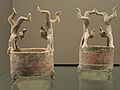
Student protest
Student protest encompasses a wide range of activities that indicate student dissatisfaction with a given political or academic issue and mobilization to communicate this dissatisfaction to the authorities and society in general and hopefully remedy the problem...
s in history.
After Liang Ji was overthrown, Huan distanced himself from the Confucian establishment and instead sought legitimacy through a revived imperial patronage of Huang-Lao Daoism; this renewed patronage of Huang-Lao was not continued after his reign. As the economy worsened, Huan built new hunting parks, imperial gardens
Chinese garden
The Chinese garden, also known as a Chinese classical garden, is a style of landscape garden which has evolved for more than three thousand years, and which is inspired by Chinese literature, Chinese painting and Chinese philosophy...
, palace buildings, and expanded his harem
Harem
Harem refers to the sphere of women in what is usually a polygynous household and their enclosed quarters which are forbidden to men...
to house thousands of concubines. The gentry class became alienated by Huan's corrupt government dominated by eunuchs and many refused nominations to serve in office, since current Confucian beliefs dictated that morality and personal relationships superseded public service. Emperor Ling hosted much less concubines than Huan, yet Ling left much of the affairs of state to his eunuchs. Instead, Ling busied himself play-acting as a traveling salesman
Peddler
A peddler, in British English pedlar, also known as a canvasser, cheapjack, monger, or solicitor , is a travelling vendor of goods. In England, the term was mostly used for travellers hawking goods in the countryside to small towns and villages; they might also be called tinkers or gypsies...
with concubines dressed as market vendors
Vendor (supply chain)
A vendor, or a supplier, is a supply chain management term meaning anyone who provides goods or services to a company. A vendor often manufactures inventoriable items, and sells those items to a customer.- History :...
or dressing in military costume as the 'General Supreme' for his parading Army of the Western Garden.
Foreign relations and war of middle Eastern Han
The Eastern-Han court colonized and periodically reasserted the Chinese military presence in the Western Regions only as a means to combat the Northern Xiongnu. Han forces were expelled from the Western Regions first by the Xiongnu between 77–90 CE and then by the Qiang between 107–122 CE. In both of these periods, the financial burdens of reestablishing and expanding western colonies, as well as the liability of sending financial aid requested by Tarim-Basin tributary states, were viewed by the court as reasons to forestall the reopening of foreign relations in the region.At the beginning of Empress Dowager Deng's regency, the Protector General of the Western Regions Ren Shang
Ren Shang
Ren Shang was the Protector General of the Western Regions under Eastern Han between 102-106 CE.In February, 91, he and Geng Kui defeated the unnamed Northern Shanyu shortly after the Battle of Ikh Bayan, on commission by Dou Xian. In 93, he killed the last northern chanyu, Yuchujian Chanyu during...
(d. 118 CE) was besieged at Kashgar. Although he was able to break the siege, he was recalled and replaced before the Empress Dowager began to withdraw forces from the Western Regions in 107 CE. However, a transitional force was still needed. The Qiang people, who had been settled by the Han government in southeastern Gansu since Emperor Jing's reign, would aid Han in this withdrawal. Throughout Eastern Han, the Qiang often revolted against Han authority after Han border officials robbed them of goods and even women and children. A group of Qiang people conscripted to reinforce the Protector General during his withdrawal decided instead to mutiny against him. Their revolt in the northwestern province of Liang (涼州) was put down in 108 CE, but it spurred a greater Qiang rebellion that would last until 118 CE, cutting off Han's access to Central Asia. The Qiang problem was exacerbated in 109 CE by a combined Southern Xiongnu, Xianbei
Xianbei
The Xianbei were a significant Mongolic nomadic people residing in Manchuria, Inner Mongolia and eastern Mongolia. The title “Khan” was first used among the Xianbei.-Origins:...
, and Wuhuan rebellion in the northeast. The total monetary cost for putting down the Qiang rebellion in Liang province was 24 million cash (out of an average of 220 million cash minted annually), while the people of three entire commanderies within eastern Liang province and one commandery within Bing province were temporarily resettled in 110 CE.
Following general Ban Yong
Ban Yong
Ban Yong ) was the youngest son of the famous Chinese General, Ban Chao , and the nephew of the illustrious historian, Ban Gu who compiled the Hanshu, the dynastic history of the Former Han dynasty.- Ban Yong's family :...
's reopening of relations with the Western Regions in 123 CE, two of the Liang province commanderies were reestablished in 129 CE, only to be withdrawn again a decade later. Even after eastern Liang province (comprising modern southeastern Gansu
Gansu
' is a province located in the northwest of the People's Republic of China.It lies between the Tibetan and Huangtu plateaus, and borders Mongolia, Inner Mongolia, and Ningxia to the north, Xinjiang and Qinghai to the west, Sichuan to the south, and Shaanxi to the east...
and Ningxia
Ningxia
Ningxia, formerly transliterated as Ningsia, is an autonomous region of the People's Republic of China. Located in Northwest China, on the Loess Plateau, the Yellow River flows through this vast area of land. The Great Wall of China runs along its northeastern boundary...
) was resettled, there was another massive rebellion there in 184 CE, instigated by Han Chinese, Qiang, Xiongnu, and Yuezhi rebels. Yet the Tarim-Basin states continued to offer tribute and hostages to China into the final decade of Han, while the agricultural garrison at Hami was not gradually abandoned until after 153 CE.
.jpg)
Northern Wei
The Northern Wei Dynasty , also known as the Tuoba Wei , Later Wei , or Yuan Wei , was a dynasty which ruled northern China from 386 to 534 . It has been described as "part of an era of political turbulence and intense social and cultural change"...
was the ascendance of the Xianbei people
Xianbei state
The Xianbei state or Xianbei confederation was a nomadic confederation existed in northern Manchuria and eastern Mongolia from 93 to 234 AD. They descended from the Donghu and spoke a Mongolic language....
, who filled the vacuum of power on the vast northern steppe after the Northern Xiongnu were defeated by Han and fled to the Ili River
Ili River
thumb|right|300px|Map of the Lake Balkhash drainage basin showing the Ili River and its tributariesThe Ili River is a river in northwestern China and southeastern Kazakhstan .It is long, of which is in Kazakhstan...
valley (in modern Kazakhstan
Kazakhstan
Kazakhstan , officially the Republic of Kazakhstan, is a transcontinental country in Central Asia and Eastern Europe. Ranked as the ninth largest country in the world, it is also the world's largest landlocked country; its territory of is greater than Western Europe...
) in 91 CE. The Xianbei quickly occupied the deserted territories and incorporated some 100,000 remnant Xiongnu families into their new federation, which by the mid 2nd century CE stretched from the western borders of the Buyeo Kingdom
Buyeo kingdom
Buyeo or Puyŏ , Fuyu in Chinese, was an ancient Korean kingdom located from today's Manchuria to northern North Korea, from around the 2nd century BC to 494. Its remnants were absorbed by the neighboring and brotherhood kingdom of Goguryeo in 494...
in Manchuria, to the Dingling
Dingling
The Dingling were an ancient Siberian people. They originally lived on the bank of the Lena River in the area west of Lake Baikal, gradually moving southward to Mongolia and northern China...
in southern Siberia
Siberia
Siberia is an extensive region constituting almost all of Northern Asia. Comprising the central and eastern portion of the Russian Federation, it was part of the Soviet Union from its beginning, as its predecessor states, the Tsardom of Russia and the Russian Empire, conquered it during the 16th...
, and all the way west to the Ili River valley of the Wusun people. Although they raided Han in 110 CE to force a negotiation of better trade agreements, the later leader Tanshihuai (檀石槐) (d. 180 CE) refused kingly titles and tributary arrangements offered by Emperor Huan and defeated Chinese armies under Emperor Ling. When Tanshihuai died in 180 CE, the Xianbei Federation largely fell apart, yet it grew powerful once more during the 3rd century CE.
After being introduced in the 1st century CE, Buddhism became more popular in China during the 2nd century CE. The Parthian monk An Shigao traveled from Parthia
Parthia
Parthia is a region of north-eastern Iran, best known for having been the political and cultural base of the Arsacid dynasty, rulers of the Parthian Empire....
to China in 148 CE and made translations of Buddhists works on the Hinayana
Hinayana
Hīnayāna is a Sanskrit and Pāli term literally meaning: the "Inferior Vehicle", "Deficient Vehicle", the "Abandoned Vehicle", or the "Defective Vehicle". The term appeared around the 1st or 2nd century....
and yoga
Yoga
Yoga is a physical, mental, and spiritual discipline, originating in ancient India. The goal of yoga, or of the person practicing yoga, is the attainment of a state of perfect spiritual insight and tranquility while meditating on Supersoul...
practices which the Chinese associated with Daoist exercises. The Kushan monk Lokaksema
Lokaksema
Lokakṣema , born around 147 CE, was the earliest known Buddhist monk to have translated Mahayana sutras into the Chinese language and as such was an important figure in Buddhism in China. The name Lokakṣema means 'welfare of the world' in Sanskrit.-Origins:Lokaksema was a Kushan of Yuezhi ethnicity...
from Gandhara
Gandhara
Gandhāra , is the name of an ancient kingdom , located in northern Pakistan and eastern Afghanistan. Gandhara was located mainly in the vale of Peshawar, the Potohar plateau and on the Kabul River...
was active in China from 178–198 CE, translated the Perfection of Wisdom, Shurangama Sutra
Shurangama Sutra
The ' is a Mahāyāna Buddhist sūtra, and has been especially influential in the Chán school of Chinese Buddhism.- Etymology :According to Ron Epstein, roughly means "indestructible." The word is composed of Śūraṅ , with Gama...
, and Pratyutpanna Sutra
Pratyutpanna Sutra
The Pratyutpanna Sutra is an early Mahayana Buddhist scripture, which probably originated around the 1st century BCE in the Gandhara area of northwestern India.The Pratyutpanna Sutra was first translated into Chinese by the Kushan Buddhist monk Lokaksema...
, and introduced to China the concepts of Akshobhya
Akshobhya
In Vajrayana Buddhism, Akṣobhya is one of the Five Wisdom Buddhas, a product of the Adibuddha, who represents consciousness as an aspect of reality...
Buddha, Amitābha
Amitabha
Amitābha is a celestial buddha described in the scriptures of the Mahāyāna school of Buddhism...
Buddha (of Pure Land Buddhism
Pure Land Buddhism
Pure Land Buddhism , also referred to as Amidism in English, is a broad branch of Mahāyāna Buddhism and currently one of the most popular traditions of Buddhism in East Asia. Pure Land is a branch of Buddhism focused on Amitābha Buddha...
), and teachings about Manjusri
Manjusri
Mañjuśrī is a bodhisattva associated with transcendent wisdom in Mahāyāna Buddhism. In Esoteric Buddhism he is also taken as a meditational deity. The Sanskrit name Mañjuśrī can be translated as "Gentle Glory"...
. In 166 CE, Emperor Huan made sacrifices to Laozi and the Buddha
Gautama Buddha
Siddhārtha Gautama was a spiritual teacher from the Indian subcontinent, on whose teachings Buddhism was founded. In most Buddhist traditions, he is regarded as the Supreme Buddha Siddhārtha Gautama (Sanskrit: सिद्धार्थ गौतम; Pali: Siddhattha Gotama) was a spiritual teacher from the Indian...
. In that same year, the Book of Later Han
Book of Later Han
The Book of the Later Han or the History of the Later Han is one of the official Chinese historical works which was compiled by Fan Ye in the 5th century, using a number of earlier histories and documents as sources...
records that Romans reached China
History of Rome
The history of Rome spans 2,800 years of the existence of a city that grew from a small Italian village in the 9th century BC into the centre of a vast civilisation that dominated the Mediterranean region for centuries. Its political power was eventually replaced by that of peoples of mostly...
from the maritime south
Roman trade with India
Roman trade with India through the overland caravan routes via Anatolia and Persia, though at a relative trickle compared to later times, antedated the southern trade route via the Red Sea and monsoons which started around the beginning of the Common Era following the reign of Augustus and his...
and presented gifts to Huan's court, claiming they represented Roman emperor Marcus Aurelius Antoninus (Andun 安敦) (r. 161–180 CE). Crespigny speculates that they were Roman merchants
Roman commerce
Roman trade was the engine that drove the Roman economy of the late Republic and the early Empire. Fashions and trends in historiography and in popular culture have tended to neglect the economic basis of the empire in favor of the lingua franca of Latin and the exploits of the Roman legions...
, not diplomats.
Decline of Eastern Han
Partisan Prohibitions
In 166 CE, the official Li Ying (李膺) was accused by palace eunuchs of plotting treason with students at the Imperial University and associates in the provinces who opposed the eunuchs. Emperor Huan was furious, arresting Li and his followers, who were only released from prison the following year due to pleas from the General-in-Chief Dou WuDou Wu
Dou Wu , courtesy name Youping , was a Han Dynasty politician who was known as a Confucian scholar and served as a low-level official during the reign of Emperor Huan until his daughter Dou Miao was elevated from imperial consort to empress, which caused him to be promoted, eventually to become...
(d. 168 CE) (Emperor Huan's father-in-law). However, Li Ying and hundreds of his followers were proscribed from holding any offices and were branded as partisan
Partisan (political)
In politics, a partisan is a committed member of a political party. In multi-party systems, the term is widely understood to carry a negative connotation - referring to those who wholly support their party's policies and are perhaps even reluctant to acknowledge correctness on the part of their...
s (黨人).
After Emperor Huan's death, at the urging of the Grand Tutor (太傅) Chen Fan (陳蕃) (d. 168 CE), Dou Wu presented a memorial to the court in June 168 CE denouncing the leading eunuchs as corrupt and calling for their execution, but Empress Dowager Dou refused the proposal. This was followed by a memorial presented by Chen Fan calling for the heads of Hou Lan
Hou Lan
Hou Lan was a eunuch of the late Han Dynasty, who served Emperor Ling of Han. After Emperor Ling died and was succeeded by his son Liu Bian in 189, He Jin, Yuan Shao and Cao Cao invaded the capital for the purpose of defeating the Ten Attendants, leading to He Jin's beheading in the palace...
(d. 172 CE) and Cao Jie
Cao Jie (eunuch)
Cao Jie was an eunuch of the late Han Dynasty, who served Emperor Ling of Han; he was also one of the Ten regular attendants , a group of court eunuchs who held great influence in the Han imperial court. Cao Jie was responsible for the death of Dou Wu and Chen Fan....
(d. 181 CE), and when this too was refused Dou Wu took formal legal action which could not be ignored by the court. When Shan Bing, a eunuch associate of Chen and Dou's, gained a forced confession from another eunuch that Cao Jie and Wang Fu (王甫) plotted treason, he prepared another damning written memorial on the night of October 24–25 which the opposing eunuchs secretly opened and read. Cao Jie armed Emperor Ling with a sword and hid him with his wet nurse
Wet nurse
A wet nurse is a woman who is used to breast feed and care for another's child. Wet nurses are used when the mother is unable or chooses not to nurse the child herself. Wet-nursed children may be known as "milk-siblings", and in some cultures the families are linked by a special relationship of...
, while Wang Fu had Shan Bing killed and Empress Dowager Dou incarcerated so that the eunuchs could use the authority of her seal.
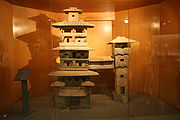
With Dou Wu eliminated and the Empress Dowager under house arrest, the eunuchs renewed the proscriptions against Li Ying and his followers; in 169 CE they had hundreds more officials and students prohibited from serving office, sent their families into exile, and had Li Ying executed. The eunuchs barred potential enemies from court, sold and bartered offices, and infiltrated the military command. Emperor Ling even referred to eunuchs Zhao Zhong
Zhao Zhong
Zhào Zhōng was a eunuch of the late Han Dynasty, who served Emperor Ling of Han the Ten regular attendants . The eunuchs who had gained considerable power in the Han imperial court...
and Zhang Rang
Zhang Rang
Zhang Rang was a eunuch of the late Han Dynasty, who served Emperor Ling of Han; he was also the leader of the Ten regular attendants , a group of court eunuchs who held great influence in the Han imperial court...
as his "mother" and "father"; the latter two had so much influence over the emperor that they convinced him not to ascend to the top floors of tall towers in the capital, which was an effort to conceal from him the enormous mansions that the eunuchs built for themselves. Although the partisan prohibitions were extended to hundreds more in 176 CE (including the distant relatives of those earlier proscribed), they were abolished in 184 CE with the outbreak of the Yellow Turban Rebellion
Yellow Turban Rebellion
The Yellow Turban Rebellion, also translated as Yellow Scarves Rebellion, was a peasant revolt that broke out in 184 AD in China during the reign of Emperor Ling of the Han Dynasty...
, largely because the court feared the gentry—bitter from their banishment from office—would join the rebel cause.
Yellow Turban Rebellion
In 142 CE, Zhang DaolingZhang Daoling
Zhang Ling , style name Fuhan , was an Eastern Han Dynasty Taoist hermit who founded the Way of the Celestial Masters sect of Taoism, which is also known as the Way of the Five Pecks of Rice....
founded the Five Pecks of Rice
Way of the Five Pecks of Rice
Way of the Five Pecks of Rice or the Way of the Celestial Master, commonly abbreviated to simply The Celestial Masters, is a Chinese Taoist movement that was founded by the first Celestial Master Zhang Daoling in 142 CE. At its height, the movement controlled a theocratic state in the Hanzhong...
religious society in Sichuan
Sichuan
' , known formerly in the West by its postal map spellings of Szechwan or Szechuan is a province in Southwest China with its capital in Chengdu...
. After claiming to have seen the deified Laozi as a holy prophet
Prophet
In religion, a prophet, from the Greek word προφήτης profitis meaning "foreteller", is an individual who is claimed to have been contacted by the supernatural or the divine, and serves as an intermediary with humanity, delivering this newfound knowledge from the supernatural entity to other people...
who appointed him as his earthly representative known as the Celestial Master, Zhang created a highly-organized, hierarchical Daoist movement which accepted only peck
Peck
A peck is an imperial and U.S. customary unit of dry volume, equivalent to 2 gallons or 8 dry quarts or 16 dry pints. Two pecks make a kenning , and four pecks make a bushel....
s of rice and no money from its lay followers. In 184 CE, the Five Pecks of Rice under Zhang Lu staged a rebellion in Sichuan and set up a theocratic Daoist state
Way of the Five Pecks of Rice
Way of the Five Pecks of Rice or the Way of the Celestial Master, commonly abbreviated to simply The Celestial Masters, is a Chinese Taoist movement that was founded by the first Celestial Master Zhang Daoling in 142 CE. At its height, the movement controlled a theocratic state in the Hanzhong...
that endured until 215 CE.
Like the Five Pecks of Rice, the Yellow Turban Daoists of the Yellow and Huai River regions also built a hierarchical church and believed that illness was the result of personal sin
Sin
In religion, sin is the violation or deviation of an eternal divine law or standard. The term sin may also refer to the state of having committed such a violation. Christians believe the moral code of conduct is decreed by God In religion, sin (also called peccancy) is the violation or deviation...
s needing confession
Confession
This article is for the religious practice of confessing one's sins.Confession is the acknowledgment of sin or wrongs...
s. The Yellow Turbans became a militant organization that challenged Han authority by claiming they would bring about a utopia
Utopia
Utopia is an ideal community or society possessing a perfect socio-politico-legal system. The word was imported from Greek by Sir Thomas More for his 1516 book Utopia, describing a fictional island in the Atlantic Ocean. The term has been used to describe both intentional communities that attempt...
n era of peace. Zhang Jue, renowned faith-healer
Faith healing
Faith healing is healing through spiritual means. The healing of a person is brought about by religious faith through prayer and/or rituals that, according to adherents, stimulate a divine presence and power toward correcting disease and disability. Belief in divine intervention in illness or...
and leader of the Yellow Turbans, and his hundreds of thousands of followers, designated by the yellow cloth that they wrapped around their foreheads, led a rebellion across eight provinces in 184 CE. They had early successes against imperial troops but by the end of 184 CE the Yellow Turban leadership—including Zhang—had been killed. Smaller groups of Yellow Turbans continued to revolt in the following years (until the last large group was incorporated into the forces of Chancellor Cao Cao in 192 CE), yet Crespigny asserts that the rebellion's impact on the fall of Han was less consequential than events which transpired in the capital following the death of Emperor Ling on May 13, 189 CE. However, Patricia Ebrey points out that many of the generals who raised armies to quell the rebellion never disbanded their forces and used them to amass their own power outside of imperial authority.
Downfall of the eunuchs
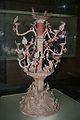
He Jin
He Jin was the elder half-brother of Empress He, consort to Emperor Ling of the late Eastern Han Dynasty in China. He shared power with his sister as regents in 189, following the death of Emperor Ling. In the ensuing struggle with the influential eunuch faction for power, He Jin was assassinated...
(d. 189 CE), half-brother to Empress He
Empress He (Ling)
Empress He , personal name unknown, formally known as Empress Lingsi was an empress of the Han Dynasty period of Chinese history. She was Emperor Ling's second wife...
(d. 189 CE), was given authority over the standing army
Standing army
A standing army is a professional permanent army. It is composed of full-time career soldiers and is not disbanded during times of peace. It differs from army reserves, who are activated only during wars or natural disasters...
and palace guards when appointed as General-in-Chief during the Yellow Turban Rebellion. Shortly after Empress He's son Liu Bian, known later as Emperor Shao of Han
Prince of Hongnong
The Prince of Hongnong , was briefly an emperor of China during the Han dynasty. He is also known as "Emperor Han Shao" , a name which he shares with several other emperors with brief reigns...
, was put on the throne, the eunuch Jian Shi plotted against He Jin, was discovered, and executed on May 27, 189 CE; He Jin thus took over Jian's Army of the Western Garden. Yuan Shao
Yuan Shao
Yuan Shao was a warlord during the late Han Dynasty period of Chinese history. He occupied the northern territories of China during the civil war that occurred towards the end of the Han Dynasty and the beginning of the Three Kingdoms era...
(d. 202 CE), then an officer in the Army of the Western Garden, plotted with He Jin to overthrow the eunuchs by secretly ordering several generals to march towards the capital and forcefully persuade the Empress Dowager He to hand over the eunuchs. Yuan had these generals send in petition after petition to the Empress Dowager calling for the eunuchs' dismissal; Mansvelt Beck states that this "psychological war" finally broke the Empress Dowager's will and she consented. However, the eunuchs discovered this and used Empress Dowager He's mother Lady Wuyang and her brother He Miao (何苗), both of whom were sympathetic to the eunuchs, to have the order rescinded. On September 22, the eunuchs learned that He Jin had a private conversation with the Empress Dowager about executing them. They sent message to He Jin that the Empress Dowager had more words to share with him; once he sat down in the hall to meet her, eunuchs rushed out of hiding and beheaded He Jin. When the eunuchs ordered the imperial secretaries to draft an edict dismissing Yuan Shao, the former asked for He Jin's permission, so the eunuchs showed them He Jin's severed head.
However, the eunuchs became besieged when Yuan Shao attacked the Northern Palace and his brother Yuan Shu
Yuan Shu
Yuan Shu was a warlord during the late Han Dynasty era of Chinese history. He rose to prominence following the collapse of the imperial court in 189. He was said to be a younger cousin of the warlord Yuan Shao, but was actually Yuan Shao's younger half-brother...
(d. 199 CE) attacked the Southern Palace, breaching the gate and forcing the eunuchs to flee to the Northern Palace by the covered passageway connecting both. Zhao Zhong was killed on the first day and the fighting lasted until September 25 when Yuan Shao finally broke into the Northern Palace and purportedly slaughtered two thousand eunuchs. However, Zhang Rang managed to flee with Emperor Shao and his brother Liu Xie
Emperor Xian of Han
Emperor Xian of Han , personal name Liu Xie, style name Bohe, was the last emperor of the Han Dynasty period of Chinese history...
to the Yellow River, where he was chased down by the Yuan family troops and committed suicide by jumping into the river and drowning.
Coalition against Dong Zhuo
Dong ZhuoDong Zhuo
Dong Zhuo was a politician and warlord during the late Han Dynasty period of Chinese history. He seized control of the capital city Luoyang in 189 when it was in a state of turmoil following the death of Emperor Ling and a clash between the eunuch faction and some court officials led by...
(d. 192 CE), General of the Van (under Huangfu Song
Huangfu Song
Huangfu Song , style name Yizhen , was a military general of the late Han Dynasty period of Chinese history. He is best known for helping to suppress the Yellow Turban Rebellion and Liang Province Rebellion. He was one of three imperial commanders when the Yellow Turban Rebellion broke out, along...
) who marched on to Luoyang under Yuan Shao's request, saw the capital in flames from a distance and heard that Emperor Shao was wandering in the hills nearby. When Dong approached Emperor Shao, the latter became frightened and unresponsive yet his brother Liu Xie explained to Dong what had happened. The ambitious Dong took over effective control of Luoyang and forced Yuan Shao to flee the capital on September 26. Dong was made Excellency of Works (司空), one of the Three Excellencies. Despite protests, Dong had Emperor Shao demoted as the Prince of Hongnong on September 28 while elevating his brother Liu Xie as emperor, later known as Emperor Xian of Han
Emperor Xian of Han
Emperor Xian of Han , personal name Liu Xie, style name Bohe, was the last emperor of the Han Dynasty period of Chinese history...
(r. 189–220 CE). Empress Dowager He was poisoned to death by Dong Zhuo on September 30, followed by the Prince of Hongnong on March 3, 190 CE.
Yuan Shao, once he left the capital, led a coalition of commanders, former officials, and soldiers of fortune to challenge Dong Zhuo. No longer viewing Luoyang as a safehaven, Dong burned the city to the ground and forced the imperial court to resettle at Chang'an in May 191 CE. In a conspiracy headed by the Minister over the Masses
Minister over the Masses
Minister over the Masses was one of the three most important official posts during the Han Dynasty, called the Three Excellencies. The nominal salary attached was 20,000 dàn of grain. The position and title had existed since the Warring States, but was only standardised during the Qin Dynasty....
, Wang Yun
Wang Yun
Wang Yun was a Minister over the Masses under Emperor Xian during the late Eastern Han Dynasty of China. During Wang Yun's time, the emperors were mere puppets under the power of eunuchs and warlords. In 192, Wang Yun plotted and successfully staged Lü Bu's assassination of Dong Zhuo, the...
(d. 192 CE), Dong was killed by his adopted son Lü Bu
Lü Bu
Lü Bu was a military general and later a minor warlord during the late Han Dynasty period of Chinese history. According to the Records of Three Kingdoms, Lü Bu was highly-skilled in horse-riding and archery, and was thus nicknamed "Flying General"...
(d. 198 CE). Dong's subordinates then killed Wang and forced Lü to flee, throwing Chang'an into chaos.
Emperor Xian fled Chang'an in 195 CE and returned to Luoyang by August 196 CE. Meanwhile, the empire was being carved into eight spheres of influence, each ruled by powerful commanders or officials: in the northeast there was Yuan Shao and Cao Cao
Cao Cao
Cao Cao was a warlord and the penultimate chancellor of the Eastern Han Dynasty who rose to great power during the dynasty's final years. As one of the central figures of the Three Kingdoms period, he laid the foundations for what was to become the state of Cao Wei and was posthumously titled...
(155–220 CE); south of them was Yuan Shu, located just southeast of the capital; south of this was Liu Biao
Liu Biao
Liu Biao , style name Jingsheng , was a warlord and the governor of Jing Province during the late Han Dynasty period of Chinese history. He was a member of the extended family of the Han Dynasty emperors...
(d. 208 CE) in Jing
Jingzhou
Jingzhou is a prefecture-level city in Hubei Province, People's Republic of China. The city is located on the banks of the Yangtze River.Its population is 5,691,707 at the 2010 census whom 1,154,086 in the built up area made of 3 urban districts.-Geography:Jingzhou occupies an area of...
; Sun Ce
Sun Ce
Sun Ce was a military general and warlord during the late Han Dynasty period of Chinese history. He was the oldest of the children of Sun Jian who was killed during the Battle of Xiangyang when Sun Ce was only 16. Sun Ce then broke away from his father's overlord, Yuan Shu, and headed to...
(d. 200 CE) controlled the southeast; in the southwest there was Liu Zhang
Liu Zhang (warlord)
Liu Zhang was a warlord during the late Han Dynasty period of Chinese history. He became governor of Yi Province , succeeding his father Liu Yan and ruled the region until 214, when he surrendered to Liu Bei...
(d. 219 CE) and Zhang Lu (d. 216 CE) located just north of him in Hanzhong; the southern Liang Province was inhabited by the Qiang people and various rebel groups. Although prognostication fueled speculation over the dynasty's fate, these warlords still claimed loyalty to Han, since the emperor was still at the pinnacle of a cosmic-religious system which ensured his political survival.
Rise of Cao Cao
Shandong
' is a Province located on the eastern coast of the People's Republic of China. Shandong has played a major role in Chinese history from the beginning of Chinese civilization along the lower reaches of the Yellow River and served as a pivotal cultural and religious site for Taoism, Chinese...
and eastern Henan
Henan
Henan , is a province of the People's Republic of China, located in the central part of the country. Its one-character abbreviation is "豫" , named after Yuzhou , a Han Dynasty state that included parts of Henan...
) in 196 CE when he took the emperor from Luoyang to his headquarters at Xuchang
Xuchang
Xuchang is a prefecture-level city in central Henan province in Central China. It borders the provincial capital of Zhengzhou to the northwest, Kaifeng to the northeast, Zhoukou to the east, Luohe to the southeast, and Pingdingshan to the southwest....
. Yuan Shu declared his own Zhong Dynasty (仲朝) in 197 CE, yet this bold move earned him the desertion of many of his followers, dying penniless in 199 CE after attempting to offer his title to Yuan Shao. Gaining more power
Battle of Yijing
The Battle of Yijing was a battle that took place in northern China between 198 and 199 during the prelude to the Three Kingdoms period of Chinese history...
after defeating Gongsun Zan
Gongsun Zan
Gongsun Zan , style name Bogui , a native of Liaoxi , was a warlord during the late Han Dynasty era of Chinese history.-Biography:...
(d. 199), Yuan Shao regretted not seizing the emperor when he had the chance and decided to act against Cao. The confrontation culminated in Cao Cao's victory at the Battle of Guandu
Battle of Guandu
The Battle of Guandu was a military conflict between the warlords Cao Cao and Yuan Shao in 200 during the prelude to the Three Kingdoms period of Chinese history. The battle, which concluded with victory for Cao Cao, was a turning point in the war between the two warlords...
in 200 CE, forcing Yuan to retreat to his territory. After Yuan Shao died in 202 CE, his sons fought over his inheritance, allowing Cao Cao to eliminate Yuan Tan
Yuan Tan
Yuan Tan was the oldest son of the warlord Yuan Shao during the late Han Dynasty period of Chinese history. After Yuan Shao's death, Yuan Tan split with his youngest brother Yuan Shang over the successorship to their father's realm. Yuan Tan sought help from the warlord Cao Cao and defeated Yuan...
(173–205 CE) and drive his brothers Yuan Shang
Yuán Shàng
Yuan Shang , style name Xianfu , was a warlord during the late Han Dynasty period of Chinese history. He was the third son of the warlord Yuan Shao, and succeeded his father...
and Yuan Xi
Yuan Xi
Yuan Xi was the second son of the warlord Yuan Shao during the late Han Dynasty era of Chinese history.Yuan was described in Luo Guanzhong's historical novel Romance of the Three Kingdoms as "intelligent but weak and indecisive", in contrast to his older brother Yuan Tan, who was described as...
to seek refuge with the Wuhuan people. Cao Cao asserted his dominance over the northeast when he defeated the Wuhuan led by Tadun at the Battle of White Wolf Mountain
Battle of White Wolf Mountain
The Battle of White Wolf Mountain was a battle fought in 207 during the prelude to the Three Kingdoms period of Chinese history. The battle took place in northern China, beyond the frontiers of the ruling Later Han Dynasty. It was fought between the warlord Cao Cao and the nomadic Wuhuan tribes,...
in 207 CE; the Yuan brothers fled to Gongsun Kang
Gongsun Kang
Gongsun Kang was a warlord during the late Han Dynasty period of Chinese history. He became a vassal of Cao Wei during the Three Kingdoms period.-Biography:...
(d. 221 CE) in Liaodong, but the latter killed them and sent their heads to Cao Cao in submission.
When there was speculation that Liu Bei
Liu Bei
Liu Bei , also known as Liu Xuande, was a warlord, military general and later the founding emperor of the state of Shu Han during the Three Kingdoms era of Chinese history...
(161–223 CE), a scion of the imperial family who was formerly in the service of Cao Cao, was planning to take over the territory of the now ill Liu Biao in 208 CE, Cao Cao forced Liu Biao's son to surrender his father's land. Expecting Cao Cao to turn on him next, Sun Quan
Sun Quan
Sun Quan , son of Sun Jian, formally Emperor Da of Wu, was the founder of Eastern Wu during the Three Kingdoms period of Chinese history. He ruled from 222 to 229 as King of Wu and from 229 to 252 as Emperor of Wu....
(182–252 CE), who inherited the territory of his brother Sun Ce in 200 CE, allied with Liu Bei and faced Cao Cao's naval force in 208 CE at the Battle of Chibi. This was a significant defeat for Cao Cao which ensured the continued disunity of China during the Three Kingdoms
Three Kingdoms
The Three Kingdoms period was a period in Chinese history, part of an era of disunity called the "Six Dynasties" following immediately the loss of de facto power of the Han Dynasty rulers. In a strict academic sense it refers to the period between the foundation of the state of Wei in 220 and the...
(220–265 CE).
Fall of the Han
When Cao Cao moved Emperor Xian to Xuchang in 196 CE, he took the title of Excellency of Works as Dong Zhuo had before him. In 208 CE, Cao abolished the three most senior offices, the Three Excellencies, and instead recreated two offices, the Imperial Counselor and Chancellor; he occupied the latter post. Cao was enfeoffed as the Duke of Wei in 213 CE, had Emperor Xian divorce Empress Fu ShouEmpress Fu Shou
Fu Shou was an empress of the Han Dynasty period of Chinese history. She was the first wife of Emperor Xian, the last emperor of the dynasty.- Family background and marriage to Emperor Xian :...
in 214 CE, and then had him marry his daughter as Empress Cao Jie
Empress Cao Jie
Cao Jie , formally known as Empress Xianmu , and after her husband's abdication, Duchess of Shanyang , was the last empress of the Han Dynasty in Chinese history. She was the second wife of Emperor Xian...
in 215 CE. Finally, Cao took the title King of Wei in 216 CE, violating the rule that only Liu family members could become kings, yet he never deposed Emperor Xian. After Cao Cao died in 220 CE, his son Cao Pi
Cao Pi
Cao Pi , formally known as Emperor Wen of Wei, was the first emperor of the state of Cao Wei during the Three Kingdoms period of Chinese history. Born in Qiao County, Pei Commandery , he was the second son of the late Han Dynasty warlord Cao Cao.Cao Pi, like his father, was a poet...
(186–226 CE) inherited the title King of Wei and gained the uneasy allegiance of Sun Quan (while Liu Bei at this point had taken over Liu Zhang's territory of Yi Province). With debates over prognostication and signs from heaven showing the Han had lost the Mandate of Heaven
Mandate of Heaven
The Mandate of Heaven is a traditional Chinese philosophical concept concerning the legitimacy of rulers. It is similar to the European concept of the divine right of kings, in that both sought to legitimaze rule from divine approval; however, unlike the divine right of kings, the Mandate of...
, Emperor Xian agreed that the Han Dynasty had reached its end and abdicated to Cao Pi on December 11, 220 CE, thus creating the state of Cao Wei
Cao Wei
Cao Wei was one of the states that competed for control of China during the Three Kingdoms period. With the capital at Luoyang, the state was established by Cao Pi in 220, based upon the foundations that his father Cao Cao laid...
, soon to oppose Shu Han
Shu Han
Shu Han was one of the three states competing for control of China during the Three Kingdoms period, after the fall of the Han Dynasty. The state was based on areas around Sichuan, which was then known as Shu...
in 221 CE and Eastern Wu
Eastern Wu
Eastern Wu, also known as Sun Wu, was one the three states competing for control of China during the Three Kingdoms period after the fall of the Han Dynasty. It was based in the Jiangnan region of China...
in 229 CE.
See also
- Battle of XiapiBattle of XiapiThe Battle of Xiapi was a battle fought by the forces of Lü Bu against the allied armies of Cao Cao and Liu Bei in 198 during the prelude to the Three Kingdoms period of Chinese history...
- Cao ZhiCao ZhiCao Zhi was a poet who lived during the late Han Dynasty and Three Kingdoms period of Chinese history. His poetry style, greatly revered during the Jin Dynasty and Southern and Northern Dynasties, came to be known as the Jian'an style....
- Goguryeo–Han Wars
- Gongsun DuGongsun DuGongsun Du was a military general and warlord of the late Han Dynasty period of Chinese history. He did not get the opportunity to really get into battle until Dong Zhuo seized power from Emperor Shao. Dong Zhuo, hoping to expand the empire, gave Gongsun Du the command to attack present-day Korea...
- List of Emperors of the Han Dynasty
- Sima XiangruSima XiangruSima Xiangru, also known as Ssu-ma Hsiang-ju was a Chinese writer. He was a minor official of the Western Han Dynasty, but was better known for his poetic skills, jiu business, and controversial marriage to the widow Zhuo Wenjun after both eloped...
Further reading
- Dubs, Homer H. (trans.) The History of the Former Han Dynasty. 3 vols. Baltimore: Waverly Press, 1938-
- Hill, John E. (2009) Through the Jade Gate to Rome: A Study of the Silk Routes during the Later Han Dynasty, 1st to 2nd Centuries CE. John E. Hill. BookSurge, Charleston, South Carolina. ISBN 978-1-4392-2134-1.