
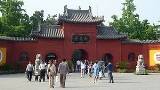
White Horse Temple is an East Asian geographic region that is currently divided into two separate sovereign states — North Korea and South Korea. Located on the Korean Peninsula, Korea is bordered by the People's Republic of China to the northwest, Russia to the northeast, and is separated from Japan to the...
,
JapanJapan is an island nation in East Asia. Located in the Pacific Ocean, it lies to the east of the Sea of Japan, China, North Korea, South Korea and Russia, stretching from the Sea of Okhotsk in the north to the East China Sea and Taiwan in the south...
and
VietnamVietnam – sometimes spelled Viet Nam , officially the Socialist Republic of Vietnam – is the easternmost country on the Indochina Peninsula in Southeast Asia. It is bordered by China to the north, Laos to the northwest, Cambodia to the southwest, and the South China Sea –...
. The introduction of Buddhism in China was also a significant influence on Chinese morals, thought and ethics.
Discussion
Ask a question about 'White Horse Temple'
Start a new discussion about 'White Horse Temple'
Answer questions from other users
|
White Horse Temple is an East Asian geographic region that is currently divided into two separate sovereign states — North Korea and South Korea. Located on the Korean Peninsula, Korea is bordered by the People's Republic of China to the northwest, Russia to the northeast, and is separated from Japan to the...
,
JapanJapan is an island nation in East Asia. Located in the Pacific Ocean, it lies to the east of the Sea of Japan, China, North Korea, South Korea and Russia, stretching from the Sea of Okhotsk in the north to the East China Sea and Taiwan in the south...
and
VietnamVietnam – sometimes spelled Viet Nam , officially the Socialist Republic of Vietnam – is the easternmost country on the Indochina Peninsula in Southeast Asia. It is bordered by China to the north, Laos to the northwest, Cambodia to the southwest, and the South China Sea –...
. The introduction of Buddhism in China was also a significant influence on Chinese morals, thought and ethics.
The temple's story begins with the dream of Emperor Mingdi and his establishing the temple in 68 AD honouring the two Indian monks and the white horses that brought them to China with Buddhist scriptures. The two monks translated many scriptures while living in the temple, which was named as White Horse Temple. They also died in the temple precincts and are buried in the first courtyard of the temple. Following the establishment of the temple, 1000 monks lived here practicing Buddhism.
According to 'The Chapter on the Western Regions' of the
Hou Hanshu (
Book of Later Han), which was based on a report to the Emperor
cCirca , usually abbreviated c. or ca. , means "approximately" in the English language, usually referring to a date...
. 125, but was not compiled until the 5th century:
- "There is a current tradition that Emperor Ming dreamt that he saw a tall golden man the top of whose head was glowing. He questioned his group of advisers and one of them said: "In the West there is a god called Buddha. His body is sixteen chi tall [3.7 metres (12.1 ft)], and is the colour of gold." That is why the Emperor sent envoys to Tianzhu [Northwest India] to inquire about the Buddha’s doctrine, after which paintings and statues [of the Buddha] appeared in the Middle Kingdom
Middle Kingdom may refer to:*China, traditional translation of its common name, Zhōngguó *Middle Kingdom of Egypt*Middle kingdoms of India...
."
There are numerous differing accounts explaining how the temple was established. Yang Hsüan-chih says in the preface to his book,
A Record of the Buddhist Monasteries of Lo-yang (completed
c. 547 CE), that, after his dream, Emperor Ming ordered that statues of the Buddha be erected at the [K'ai-]yang Gate (Opening to the Morning Sun Gate) of the Southern Palace and on near the [Ch'ang]yeh Terrace (The Eternal Night Terrace). He, however, makes no mention of the temple.
The Emperor is said to have sent a monk or monks to
IndiaIndia , officially the Republic of India , is a country in South Asia. It is the seventh-largest country by geographical area, the second-most populous country with over 1.2 billion people, and the most populous democracy in the world...
or
ScythiaIn antiquity, Scythian or Scyths were terms used by the Greeks to refer to certain Iranian groups of horse-riding nomadic pastoralists who dwelt on the Pontic-Caspian steppe...
who returned carrying the
Sutra of Forty-two ChaptersThe Sutra of Forty-two Chapters is the earliest surviving Buddhist sutra translated into Chinese. It was translated by two ordained Yuezhi monks, Kasyapa-Matanga and Dharmaraksha , in 67 CE...
on a white horse. The Sutra was received by the Emperor and housed in a temple built outside the walls of Luo Yang. It was China's first Buddhist temple.
Other versions mentioned in the book
Indian Pandits in the Land of Snow by Sri Sarat Chandra give the following legendary versions:
The legends related to this temple have direct link to the emergence and spread of Buddhism in China. Two visions are stated in this context. The first vision was witnessed by Chow Wang, the fifth ruler of the
Tang dynastyThe Tang Dynasty was an imperial dynasty of China preceded by the Sui Dynasty and followed by the Five Dynasties and Ten Kingdoms Period. It was founded by the Li family, who seized power during the decline and collapse of the Sui Empire...
. The Emperor saw, in the southwestern region of China, a very bright light in the sky, like a halo or
aureolaAn aureola or aureole is the radiance of luminous cloud which, in paintings of sacred personages, surrounds the whole figure...
from the west which lit the whole space. The astrologers of his court predicted that a saint was born in that quarter of the world where he saw the bright halo light. It was also prophesied that the religion practised by the saintly person, would spread to China. This was recorded by the King in his royal register. This year happened to be the year when Gautam Buddha was born in India.
The second vision happened at Luo Yang during the reign of Mingdi, the second Emperor of the
Han DynastyThe Han Dynasty was the second imperial dynasty of China, preceded by the Qin Dynasty and succeeded by the Three Kingdoms . It was founded by the rebel leader Liu Bang, known posthumously as Emperor Gaozu of Han. It was briefly interrupted by the Xin Dynasty of the former regent Wang Mang...
. In 60 CE, on an auspicious day, the Emperor had a vision (dream) of a saintly person of golden complexion with the
SunThe Sun is the star at the center of the Solar System. It is almost perfectly spherical and consists of hot plasma interwoven with magnetic fields...
and the
MoonThe Moon is Earth's only known natural satellite,There are a number of near-Earth asteroids including 3753 Cruithne that are co-orbital with Earth: their orbits bring them close to Earth for periods of time but then alter in the long term . These are quasi-satellites and not true moons. For more...
shining behind his back came near his throne from the heavens and then circled his palace. This incident was correlated with the ancient recorded version and the events were interpreted to mean that the period prophesied in the past, of Buddhism coming to China, was now. History chronicler Fu Hi interpreted this vision as that of the divine person known as Buddha who was born in a place to the west of China in India. Emperor Mingdi forthwith selected emissaries named Taai Yin, Tain King, Wangtrun and others, in all totaling 18 people, to go towards the west to India in search of the religion practiced by Buddha. After travelling through several countries bordering India such as Getse and
YuchiFor the Chinese surname 尉迟, see Yuchi.The Yuchi, also spelled Euchee and Uchee, are a Native American Indian tribe who traditionally lived in the eastern Tennessee River valley in Tennessee in the 16th century. During the 17th century, they moved south to Alabama, Georgia and South Carolina...
(the
SakaThe Saka were a Scythian tribe or group of tribes....
Tartars), and the
BactriaBactria and also appears in the Zend Avesta as Bukhdi. It is the ancient name of a historical region located between south of the Amu Darya and west of the Indus River...
n
GreeceGreece , officially the Hellenic Republic , and historically Hellas or the Republic of Greece in English, is a country in southeastern Europe....
they reached
AfghanistanAfghanistan , officially the Islamic Republic of Afghanistan, is a landlocked country located in the centre of Asia, forming South Asia, Central Asia and the Middle East. With a population of about 29 million, it has an area of , making it the 42nd most populous and 41st largest nation in the world...
(
GandharaGandhāra , is the name of an ancient kingdom , located in northern Pakistan and eastern Afghanistan. Gandhara was located mainly in the vale of Peshawar, the Potohar plateau and on the Kabul River...
country) where they met two Buddhist monks (Arhats) named Kasyapa Pandita (a
BrahminBrahmin Brahman, Brahma and Brahmin.Brahman, Brahmin and Brahma have different meanings. Brahman refers to the Supreme Self...
from Central India) and Bharana Pandita. They accepted the invitation of the emissaries to go to China. They then proceeded to China on two white horses accompanied by the emissaries. They carried with them a few sacred texts of Sutras - the
Sutra of Forty-two Chapters- statues of Buddha, portraits and also sacred relics. They reached Lou Yang where they were put up in a temple. The King met them in 67 CE, with due reverence and was pleased with the presents the monks had brought for him. It was the 30th day in the 12th month of
Chinese calendarThe Chinese calendar is a lunisolar calendar, incorporating elements of a lunar calendar with those of a solar calendar. It is not exclusive to China, but followed by many other Asian cultures as well...
. The Emperor was particularly happy with the Buddha image which had striking similarity to the one he had seen in his dream vision. At this time, the monks also performed some miracles, which further strengthened the belief of the Emperor in Buddhism.
However, some Taoist priests protested and wanted the Emperor to test the merits of both parties. The Emperor agreed to test the merits of both parties and convened a meeting at the southern gate of the White Horse Temple. He ordered that the sacred texts and religious paraphernalia of the Taoist be placed on the eastern gate and the sacred texts, relics and Buddha image of the westerners in the hall of seven gems on the west. He then ordered that the objects be thrown into the fire, and whichever documents survived the fire then that religion would receive his patronage. The Taoists expected that their texts would survive the fire test. This did not happen as all the texts of Taoists were burnt and that of the Buddhists from the west survived. With this test, the Emperor was convinced of the Buddhist religion and he with all his entourage of Ministers and kinsmen embraced Buddhism. He built several temples, which included 'Pai-masai', the White Horse Temple and three convents for nuns. The two Taoist priests who had challenged Buddhism were put to death by fire.
Now that there are many contradictory versions of this story that most modern scholars accept it only as a Buddhist fable, and not a valid historical event. The White Horse Temple is, in fact, not recorded in contemporary sources before 289. However, there is a Poma si mentioned in
Chang'anChang'an is an ancient capital of more than ten dynasties in Chinese history, today known as Xi'an. Chang'an literally means "Perpetual Peace" in Classical Chinese. During the short-lived Xin Dynasty, the city was renamed "Constant Peace" ; yet after its fall in AD 23, the old name was restored...
in 266, and another of the same name at Jingcheng in central
Hubei' Hupeh) is a province in Central China. The name of the province means "north of the lake", referring to its position north of Lake Dongting...
at about the same date.
It is said that the next year, the Emperor ordered the construction of the White Horse Temple on the south side of the Imperial Drive three
liThe li is a traditional Chinese unit of distance, which has varied considerably over time but now has a standardized length of 500 meters or half a kilometer...
outside the Hsi-yang Gate of the capital
LuoyangLuoyang is a prefecture-level city in western Henan province of Central China. It borders the provincial capital of Zhengzhou to the east, Pingdingshan to the southeast, Nanyang to the south, Sanmenxia to the west, Jiyuan to the north, and Jiaozuo to the northeast.Situated on the central plain of...
, to remember the horse that carried back the sutras. After the death of the Emperor a meditation hall was built on his tomb. In front of the stupa luxuriant pomegranate and grape vines were grown which were said to be larger than those grown elsewhere.
Buddhism evolved in China after arriving from India, as a blend of Chinese beliefs and needs, particularly in respect of its folk heritage. It is Mahayana Buddhism practice, which is widely followed even though the
TheravadaTheravada ; literally, "the Teaching of the Elders" or "the Ancient Teaching", is the oldest surviving Buddhist school. It was founded in India...
or
HinayanaHīnayāna is a Sanskrit and Pāli term literally meaning: the "Inferior Vehicle", "Deficient Vehicle", the "Abandoned Vehicle", or the "Defective Vehicle". The term appeared around the 1st or 2nd century....
came to China first.
Early history
In 258 a royal
KucheanKuchaor Kuche Uyghur , Chinese Simplified: 库车; Traditional: 庫車; pinyin Kùchē; also romanized as Qiuzi, Qiuci, Chiu-tzu, Kiu-che, Kuei-tzu from the traditional Chinese forms 屈支 屈茨; 龜玆; 龟兹, 丘玆, also Po ; Sanskrit: Kueina, Standard Tibetan: Kutsahiyui was an ancient Buddhist kingdom...
monk, Po-Yen, translated six Buddhist texts in to
ChineseThe Chinese language is a language or language family consisting of varieties which are mutually intelligible to varying degrees. Originally the indigenous languages spoken by the Han Chinese in China, it forms one of the branches of Sino-Tibetan family of languages...
at the temple, including the important
Infinite Life SutraThe Infinite Life Sūtra, or Longer Sukhāvatīvyūha Sūtra is a Mahāyāna Buddhist sūtra, and the primary text of Pure Land Buddhism. It is the longest of the three major texts of Pure Land Buddhism...
.
The famous Indo-Scythian Buddhist translator,
Dharmarakṣa' was one a translators of Mahayana Buddhist scriptures into Chinese. Scriptural catalogues describe him as of Yuezhi origin. His family lived at Dunhuang, where he was born around 230 CE...
(Ch: 竺法護, Zhú Fǎhù), active ca. 266–308 AD, came to Luoyang in 266, and resided at the White Horse Temple from at least the spring of 289 to 290 AD.
The renowned monk
XuanzangXuanzang was a famous Chinese Buddhist monk, scholar, traveler, and translator who described the interaction between China and India in the early Tang period...
(Hsüan-tsang) of the
Tang DynastyThe Tang Dynasty was an imperial dynasty of China preceded by the Sui Dynasty and followed by the Five Dynasties and Ten Kingdoms Period. It was founded by the Li family, who seized power during the decline and collapse of the Sui Empire...
spent 16 years on a long pilgrimage to India (630–635 AD) to the land of the Buddha, his cherished desire. He started on his pilgrimage from this temple. On his return from India, Xuanzhang remained the
abbotThe word abbot, meaning father, is a title given to the head of a monastery in various traditions, including Christianity. The office may also be given as an honorary title to a clergyman who is not actually the head of a monastery...
of the White Horse Temple till his death. During his stay in the temple, apart from his teaching assignments and other religious activities of the temple, he translated many Buddhist scriptures in Sanskrit that he had brought from India into the Chinese language.
In 1175, an inscription on a stone tablet next to Qilun Pagoda—a 35 metres (114.8 ft) tall, multi-eaved square-based tower located to the southeast of the White Horse Temple—stated that a previous fire occurred five decades previously and destroyed the temple and the Sakya Tathagata sarira
stupaA stupa is a mound-like structure containing Buddhist relics, typically the remains of Buddha, used by Buddhists as a place of worship....
, a predecessor to the pagoda. The same inscription of 1175 stated that a Jin Dynasty official had the stone Qilun Pagoda erected soon after. The
pagodaChinese Pagodas are a traditional part of Chinese architecture. In addition to religious use, since ancient times Chinese pagodas have been praised for the spectacular views which they offer, and many famous poems in Chinese history attest to the joy of scaling pagodas.-History:The pagoda is...
is built with the design style imitating the square-based pagodas of the
Tang DynastyThe Tang Dynasty was an imperial dynasty of China preceded by the Sui Dynasty and followed by the Five Dynasties and Ten Kingdoms Period. It was founded by the Li family, who seized power during the decline and collapse of the Sui Empire...
.
Middle Ages
Between the 13th century and the 20th century, the temple has undergone restoration/renovation under the Ming Dynasty (1368–1644) and the Qing Dynasty (1644–1911). Significant restoration took place in the 16th century and some buildings still date to this period, although some have since been renovated.
Modern history
Under the regime of the People's Republic of China, the temple has seen many renovations in the period between 1952 and 1973.
In 1973, Prince
Norodom SihanoukNorodom Sihanouk regular script was the King of Cambodia from 1941 to 1955 and again from 1993 until his semi-retirement and voluntary abdication on 7 October 2004 in favor of his son, the current King Norodom Sihamoni...
of
CambodiaCambodia , officially known as the Kingdom of Cambodia, is a country located in the southern portion of the Indochina Peninsula in Southeast Asia...
visited the temple. Cambodia was a communist ally of China and Prince Sihanouk who was staying in a palatial residence in
BeijingBeijing , also known as Peking , is the capital of the People's Republic of China and one of the most populous cities in the world, with a population of 19,612,368 as of 2010. The city is the country's political, cultural, and educational center, and home to the headquarters for most of China's...
. He was permitted to visit various parts of the country on a tour for propaganda purposes, to show to the outside world that all was normal within China. As an ardent Buddhist, Sihanouk expressed a wish to Premier
Zhou EnlaiZhou Enlai was the first Premier of the People's Republic of China, serving from October 1949 until his death in January 1976...
to visit the White Horse Temple. This put the administration into a frenzy, since many parts of the Temple had been damaged during the
Cultural RevolutionThe Great Proletarian Cultural Revolution, commonly known as the Cultural Revolution , was a socio-political movement that took place in the People's Republic of China from 1966 through 1976...
in China and items were missing. Post haste, 2900 artefacts, which were in other palaces and museums within China, such as the Palace of Benevolent Tranquillity on the western side of the
Forbidden CityThe Forbidden City was the Chinese imperial palace from the Ming Dynasty to the end of the Qing Dynasty. It is located in the middle of Beijing, China, and now houses the Palace Museum...
and statues in the Arhat Hall (
Luohan Tang) of the
Temple of Azure CloudsThe Temple of Azure Clouds , is a Buddhist temple located in the eastern part of the Western Hills, just outside the north gate of Fragrant Hills Park , in the Haidian District, a northwestern suburb of Beijing, China, approximately 20 km from the city center...
(
Biyun Si) in Beijing’s
Fragrant HillsFragrant Hills Park is a public park at the foot of the Western Mountains in the Haidian District, in the northwestern part of Beijing, China. It covers 1.6 km² and consists of a natural pine-cypress forest, hills with maple trees, smoke trees and persimmon trees, as well as landscaped areas with...
(
Xiang Shan) were secretly shifted to the temple, and the White Horse Temple was fully restored. The newly restored Temple impressed the Cambodians, who were oblivious to the past events that had gutted the temple. Interestingly, the shift of artefacts to this temple from other places was decreed as permanent by Premier Zhou Enlai, and not a loan, when the authorities of the palace and Azure temple wanted the artefacts to be returned to them.
In 1992, with the assistance of
ThaiThailand , officially the Kingdom of Thailand , formerly known as Siam , is a country located at the centre of the Indochina peninsula and Southeast Asia. It is bordered to the north by Burma and Laos, to the east by Laos and Cambodia, to the south by the Gulf of Thailand and Malaysia, and to the...
and Chinese donors, the Hall of the Thai Buddha was constructed slightly west of the old temple.
India-China cultural cooperation
The symbolic importance of the temple to the ancient cultural relations between China and India was demonstrated when the
Prime Minister of IndiaThe Prime Minister of India , as addressed to in the Constitution of India — Prime Minister for the Union, is the chief of government, head of the Council of Ministers and the leader of the majority party in parliament...
P.V. Narasimha Rao visited the temple in 1993. A decade later, in 2003, Prime Minister
Atal Bihari VajpayeeAtal Bihari Vajpayee is an Indian statesman who served as the tenth Prime Minister of India three times – first for a brief term of 13 days in 1996, and then for two terms from 1998 to 2004. After his first brief period as Prime Minister in 1996, Vajpayee headed a coalition government from...
also visited the shrine.
To enhance the Buddhist cultural links between India and China, a Memorandum of Understanding (MOU) was signed on 11 April 2005 under which it was agreed that India would build an Indian Style Buddhist temple to the west side of the White Horse Temple in the International Garden of the complex. Under this agreement, India was to provide the architectural design, material for construction, the Buddha statue, landscaping and technical advice of architects and experts during construction. Chinese authorities were to allot land area of 2666.67 square metre for building the temple.
Following the MOU signed by India and China in 2005, a Buddhist shrine that is a close replica of
Sanchi StupaSanchi is a small village in Raisen District of the state of Madhya Pradesh, India, it is located 46 km north east of Bhopal, and 10 km from Besnagar and Vidisha in the central part of the state of Madhya Pradesh. It is the location of several Buddhist monuments dating from the 3rd...
has been completed in 2008 within the precincts of the White Horse Temple, the first Buddhist temple in China that was also inspired by Buddhist saints from India in the 1st century AD. The architectural features of the new temple have closely recreated the Sanchi Stupa, including the east gate at Sanchi. An image of Buddha has also been transported from India and deified in the new temple, which conforms to the Indian Buddhist tradition. The temple has been built over a land area donated by the Chinese Government. The shrine is a two-storied structure with circular walls on both floors. The circular walls inside the temple have been embellished with murals of scenes from the Jataka tales and the life of Buddha. The Buddha statue made in the pattern of the 5th century image of Buddha at Sarnath has been deified in the central congressional hall of the temple. The
President of IndiaThe President of India is the head of state and first citizen of India, as well as the Supreme Commander of the Indian Armed Forces. President of India is also the formal head of all the three branches of Indian Democracy - Legislature, Executive and Judiciary...
,
Pratibha PatilPratibha Devisingh Patil is the 12th President of the Republic of India and first woman to hold the office. She was sworn in as President of India on 25 July 2007, succeeding Dr. A.P.J...
, inaugurated this temple on 27 May 2010. The new temple incorporates features from the most revered Indian Buddhist shrines of Sanchi and Saranath.
Architecture
The temple faces south and is aligned along a central axis starting from the entrance gate followed by several halls and courtyards in succession. The temple compound covers an area of 200 mu (13 hectares (32.1 acre)), and faces south. A stone
paifangPaifang, also called pailou, is a traditional Chinese architectural gating style as an archway.The word paifang originally was a collective term used to describe the top two levels of administrative division and subdivisions of ancient Chinese city. The largest division within a city in ancient...
(archway), a three door covered archway, has been recently built, 150 metres (492.1 ft) in front of the original gate. The stone horses at the front of the temple are in the Ming architectural style, representing the white horses which carried the scriptures and the Indian monks to China. Between the archway and gate lies a pool with fountains, crossed by three stone bridges. The two horses at the entrance gate facing each other are made of green stone dated to the
Song DynastyThe Song Dynasty was a ruling dynasty in China between 960 and 1279; it succeeded the Five Dynasties and Ten Kingdoms Period, and was followed by the Yuan Dynasty. It was the first government in world history to issue banknotes or paper money, and the first Chinese government to establish a...
(960–1279).
Entering the temple today, a number of plaques (both in
EnglishEnglish is a West Germanic language that arose in the Anglo-Saxon kingdoms of England and spread into what was to become south-east Scotland under the influence of the Anglian medieval kingdom of Northumbria...
and
ChineseThe Chinese language is a language or language family consisting of varieties which are mutually intelligible to varying degrees. Originally the indigenous languages spoken by the Han Chinese in China, it forms one of the branches of Sino-Tibetan family of languages...
) and signposts are seen, which guide the visitors and pilgrims through the various halls of the temple. The plaques briefly explain the various statues installed in each hall. The halls are discerned in the inscriptions on the plaques, include the 'Hall of Greetings', 'Hall of Six Founders’, 'Hall of jade Buddha', the 'Hall of Heavenly Kings', Hall of
MahaviraMahāvīra is the name most commonly used to refer to the Indian sage Vardhamāna who established what are today considered to be the central tenets of Jainism. According to Jain tradition, he was the 24th and the last Tirthankara. In Tamil, he is referred to as Arukaṉ or Arukadevan...
and Hall of Changing Ge (repository of ancient scriptures).
In addition, the 'Cool and Clear Terrace' known as the 'Qingliang Terrace' is located behind the main hall, the place where the original sutras were translated. This terrace is amidst bamboo forest of old pine trees and has halls which are interconnected. Four sides of the terrace are piled with green bricks. The terrace also has the Kunlu Pavilion with halls on its east and west that house the statues of the two eminent monks, She Moteng and Zhu Falan. These two monks were buried inside the temple gate after they died here; the Bell Tower and the Drum Tower, in front of their tombs, were once prominent sights of the Luo Yang City.
In the courtyard, large incense burners are kept for worshippers to light incense sticks, creating a pungent odour. In the Main hall and other halls where various images are worshipped, the altars are filled with fruit and other offerings made by the devotees. Multicoloured tapestry hang from the ceilings of the halls and lighted candles float in the basins, presenting a divine spiritual setting.
White Horse Temple Plaques at each hall in the temple complex with details of displayFull View of White Horse Temple Plaque at Hall of Heavenly Kings • Plaque at Depository of Sacred Texts Plaque at the Hall of Malia • Plaque at the hall of Jade Buddha Plaque at the Hall of Six Founders • Plaque on Hall of Heavenly Kings
|
>
The smallest hall in the temple is known as the “Hall of greetings”. It is a relatively new building that was built during the 9th year of Guangho period as replacement to the original hall which was burned down at the beginning of the Tonghzi period. This small hall has deified statues of three western paradise (Indian) saints. AmitabhaAmitābha is a celestial buddha described in the scriptures of the Mahāyāna school of Buddhism...
, the founder, is at the centre and is flanked by Guru Avalokiteswara, the God of Mercy on the left and Mahashataprapta on the right.
The six founders of the temple whose statues are worshipped in the ‘Hall of Six Founders’ belonged to the sect of Chan. The names of the founders as displayed, in the order of their succession: Bodidharma, the first founder of the temple who hailed from ancient India where he was the 28th generation patriarch preaching the Buddhist philosophy, the second founder was Huike, the third founder was Sengcan, the fourth founder was Daoxn, the fifth founder was Hongren and the sixth founder was Huineng. Subsequent to Huineng, five schools of Buddhism and Seven Orders were established.
In the ‘Hall of the Jade Buddha’, an image of the Sakyamuni Buddha has been deified. The 1.6 metres (5.2 ft) tall image made in jadeJade is an ornamental stone.The term jade is applied to two different metamorphic rocks that are made up of different silicate minerals:...
was donated in 1988 by a Chinese man settled in BurmaBurma , officially the Republic of the Union of Myanmar , is a country in Southeast Asia. Burma is bordered by China on the northeast, Laos on the east, Thailand on the southeast, Bangladesh on the west, India on the northwest, the Bay of Bengal to the southwest, and the Andaman Sea on the south....
. This elegantly sculpted and cherished statue has a precious stone embedded in its forehead. Before it was shifted to this temple in 1992, it had been stored in the Pilu pavilion.
The first large hall in the temple complex is known as ‘The Hall of Heavenly Kings’ where statue of Maitreya, known as the laughing Buddha, is the main deity deified right at the forefront of the hall. This statue is flanked on the eastern and western sides by four heavenly kings, each representing one fourth of the universe. The eastern side is ruled by Chigua (guardian of the State) carrying a Pipa, the western side is controlled by Guangmu (Sharp-seer) with a dragon in his hand, the southern direction is represented by Zengzhang (Growth Protector), carrying an umbrella and the northern direction is represented by Duowen (Knowledge Preserver), carrying a PagodaA pagoda is the general term in the English language for a tiered tower with multiple eaves common in Nepal, India, China, Japan, Korea, Vietnam and other parts of Asia. Some pagodas are used as Taoist houses of worship. Most pagodas were built to have a religious function, most commonly Buddhist,...
. In addition, there is also a statue of Skanda (a high ranking heavenly general and defender of Buddhist law) with back to the Maitreya statue.
Hall of Changing Ge, built in 1995, is a repository of ancient scriptures and has more than ten types of Buddhist texts, including the Longzang Jing Dazong Jing of China, Dazeng Zong Jing of Japan, Tibet Jing and so forth. An ancient Buddha statue of China is installed at the centre of the repository. The making of this Buddha statue is traced to the Eastern Han DynastyThe Han Dynasty was the second imperial dynasty of China, preceded by the Qin Dynasty and succeeded by the Three Kingdoms . It was founded by the rebel leader Liu Bang, known posthumously as Emperor Gaozu of Han. It was briefly interrupted by the Xin Dynasty of the former regent Wang Mang...
. During the recent war time it was misplaced. However, it was later found in ThailandThailand , officially the Kingdom of Thailand , formerly known as Siam , is a country located at the centre of the Indochina peninsula and Southeast Asia. It is bordered to the north by Burma and Laos, to the east by Laos and Cambodia, to the south by the Gulf of Thailand and Malaysia, and to the...
and was replicated in bronze into two 97 centimetres (38.2 in)) tall statues and then gilded. One of these is deified in the library and the other was sent to Thailand.
In the ‘Hall of Mahavira”, there are statues of three principal Buddhas. The central image is of the Sakyamuni Buddha. This statue is flanked on the left by the Bhavisyajya guru and on the right by Amitabha; both these in turn are flanked by two heavenly generals named Weituo and Weili. Statues of 18 arhats adorn the side of the hall. All the statues were made in ramie-cloth during the Yuan DynastyThe Yuan Dynasty , or Great Yuan Empire was a ruling dynasty founded by the Mongol leader Kublai Khan, who ruled most of present-day China, all of modern Mongolia and its surrounding areas, lasting officially from 1271 to 1368. It is considered both as a division of the Mongol Empire and as an...
. The walls on both sides are adorned with carvings of ten thousand Buddhists. A statue of Jialan is installed facing north of the backdoor.
In the Main Hall, at the altar, there are three statues, the central statue is that of Sakhyamuni Buddha flanked by statue of Manjushri and SamantabhadraSamantabhadra , is a bodhisattva in Mahayana Buddhism associated with Buddhist practice and meditation. Together with Shakyamuni Buddha and fellow bodhisattva Manjusri he forms the Shakyamuni trinity in Buddhism...
. There is a very large bell weighing more than 1 tonne (a figure of 2.5 tonnes is also mentioned), installed during the reign of Emperor Jiajing of the Ming Dynasty, near the altar, which is still struck in time during the chanting of prayers by the monks. A community of ten thousand monks resided here during the Tang DynastyThe Tang Dynasty was an imperial dynasty of China preceded by the Sui Dynasty and followed by the Five Dynasties and Ten Kingdoms Period. It was founded by the Li family, who seized power during the decline and collapse of the Sui Empire...
. The inscription on the bell reads: "The sound of the Bell resounds in Buddha's temple causing the ghosts in Hell to tremble with fear."
The living quarters of the monks are situated in an exclusive pagoda, with restricted entry, called the 'Qiyun Ta', or Qiyun Pagoda. It is approachable after crossing the manicured garden and a bridge to the left of the main temple. This pagoda was built in the 12th century in the fifteenth year of the Dading reign of the Jin Dynasty (1115–1234). It is a 13 tiered, 25 metres (82 ft)), high cubic shaped brick tower. It has been renovated in subsequent periods.
Although the temple is open to the public, inquisitive visitors are under close scrutiny for security purposes. The Chief Abbot of the temple keeps in touch with the political situation in the country through a TV installed in his room. The monks are required to carry identity cards issued to each monks.
Peony Festival
Peony Festival (mudan huahui) is an important flower festival, which is held in Luoyang every year on April 10–25 and which attracts large crowds to the city and the White Horse Temple. The legend linked to this festival is that PeonyPeony or paeony is a name for plants in the genus Paeonia, the only genus in the flowering plant family Paeoniaceae. They are native to Asia, southern Europe and western North America...
flower did not follow the orders of the queen Empress Wu of the Tang DynastyThe Tang Dynasty was an imperial dynasty of China preceded by the Sui Dynasty and followed by the Five Dynasties and Ten Kingdoms Period. It was founded by the Li family, who seized power during the decline and collapse of the Sui Empire...
to bloom during winter and she became enraged that it did not obey her command. As a result, she ordered that Peony Flower be banished from Xi'anXi'an is the capital of the Shaanxi province, and a sub-provincial city in the People's Republic of China. One of the oldest cities in China, with more than 3,100 years of history, the city was known as Chang'an before the Ming Dynasty...
to Luoyang. It is this banishment which is celebrated as the Peony Festival in Luoyang.
See also