


Board game

Encyclopedia
A board game is a game
which involves counters or pieces being moved on a pre-marked surface or "board", according to a set of rules. Games may be based on pure strategy
, chance (i.e. rolling dice
) or a mixture of the two, and usually have a goal which a player aims to achieve. Early board games represented a battle between two armies and most current board games are still based on beating opposing players in terms of counters, winning position or accrual of points (often expressed as in-game currency).
There are many different types and styles of board games. Their representation of a real life situation can range from having no inherent theme, such as checkers, to having a specific theme and narrative, such as Cluedo
. Rules range from the very simple, such as in tic-tac-toe
, to ones which describe a game universe in great detail, such as in Dungeons & Dragons
, although most of these are role-playing game
s and the board is secondary to the game, serving to visualize the scenario
. The length of time it takes to learn to play or master a game can vary greatly from game to game. Learning time does not necessarily correlate with the amount or complexity of rules; some games, such as chess
or Go
have simple rules that can still lead to complex scenarios.
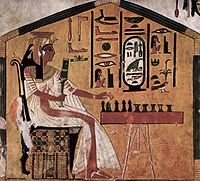
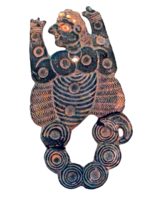 Board games have been played in most cultures and societies throughout history; some even pre-date literacy skill development in the earliest civilizations. A number of important historical sites, artifacts and documents exist which shed light on early board games. Some of these include:
Many board games are now available as computer games
, which can include the computer itself as one of several players, or as sole opponent. The rise of computer use is one of the reasons said to have led to a relative decline in board games. Many board games can now be played online
against a computer and/or other players. Some website
s allow play in real time and immediately show the opponents' moves, while others use email
to notify the players after each move (see the links at the end of this article). Modern technology (the internet
and cheaper home printing
) has also influenced board games via the phenomenon of print-and-play board games that you buy and print yourself.
Some board games make use of components in addition to—or instead of—a board and playing pieces. Some games use CDs, video cassettes, and, more recently, DVD
s in accompaniment to the game.
, Go
, mancala
), less has been done on contemporary board games such as Monopoly
, Scrabble
, and Risk
. Much research has been carried out on chess, in part because many tournament players are publicly ranked in national and international lists, which makes it possible precisely to compare their levels of expertise. The works of Adriaan de Groot
, William Chase, and Herbert Simon
have established that knowledge, more than the ability to anticipate moves, plays an essential role in chess-playing. This seems to be the case in other traditional games such as Go and Oware (a type of mancala game), but data is lacking in regard to contemporary board games.
Additionally, board games can be therapeutic. Bruce Halpenny
, a games inventor said when interviewed about his game, “With crime you deal with every basic human emotion and also have enough elements to combine action with melodrama. The player’s imagination is fired as they plan to rob the train. Because of the gamble they take in the early stage of the game there is a build up of tension, which is immediately released once the train is robbed. Release of tension is therapeutic and useful in our society, because most jobs are boring and repetitive.”
Linearly arranged board games have been shown to improve children's spatial numerical understanding. This is because the game is similar to a number line
in that they promote a linear understanding of numbers rather than the innate logarithmic one.
involved, as opposed to skill. Some games, such as chess
, depend almost entirely on player skill. But many children's games are mainly decided by luck: eg Candy Land
and Snakes and ladders
require no decisions by the players. A player may be hampered by a few poor rolls of the dice
in Risk
or Monopoly
, but over many games a good player will win more often. While some purists consider luck not to be a desirable component of a game, others counter that elements of luck can make for far more diverse and multi-faceted strategies, as concepts such as expected value
and risk management
must be considered.
A second feature is the game information available to players. Some games (chess being the classic example) are perfect information
games: every player has complete information on the state of the game. In other games, such as Tigris and Euphrates
, some information is hidden from players. This makes finding the best move more difficult, but also requires the players to estimate probabilities by the players. Tigris and Euphrates
also has completely deterministic action resolution.
Another important feature of a game is the importance of diplomacy
, i.e. players making deals with each other. A game of solitaire
, for obvious reasons, has no player interaction. Two player games usually do not involve diplomacy (cooperative games being the exception). Thus, negotiation generally features only in games for three or more people. An important facet of The Settlers of Catan
, for example, is convincing people to trade with you rather than with other players. In Risk
, two or more players may team up against others. Easy diplomacy involves convincing other players that someone else is winning and should therefore be teamed up against. Advanced diplomacy (e.g. in the aptly named game Diplomacy) consists of making elaborate plans together, with the possibility of betrayal.
Luck may be introduced into a game by a number of methods. The most common method is the use of dice
, generally six-sided. These can decide everything from how many steps a player moves their token, as in Monopoly
, to how their forces fare in battle, such as in Risk
, or which resources a player gains, such as in The Settlers of Catan. Other games such as Sorry!
use a deck of special card
s that, when shuffled, create randomness. Scrabble
does something similar with randomly picked letters. Other games use spinners, timers of random length, or other sources of randomness. Trivia games have a great deal of randomness based on the questions a player has to answer. German-style board game
s are notable for often having rather less of a luck factor than many North American board games.
 Although many board games have a jargon
all their own, there is a generalized terminology
to describe concepts applicable to basic game mechanic
s and attributes common to nearly all board games.
Roll-and-move games, like Monopoly
or Life
Game
A game is structured playing, usually undertaken for enjoyment and sometimes used as an educational tool. Games are distinct from work, which is usually carried out for remuneration, and from art, which is more often an expression of aesthetic or ideological elements...
which involves counters or pieces being moved on a pre-marked surface or "board", according to a set of rules. Games may be based on pure strategy
Strategy
Strategy, a word of military origin, refers to a plan of action designed to achieve a particular goal. In military usage strategy is distinct from tactics, which are concerned with the conduct of an engagement, while strategy is concerned with how different engagements are linked...
, chance (i.e. rolling dice
Dice
A die is a small throwable object with multiple resting positions, used for generating random numbers...
) or a mixture of the two, and usually have a goal which a player aims to achieve. Early board games represented a battle between two armies and most current board games are still based on beating opposing players in terms of counters, winning position or accrual of points (often expressed as in-game currency).
There are many different types and styles of board games. Their representation of a real life situation can range from having no inherent theme, such as checkers, to having a specific theme and narrative, such as Cluedo
Cluedo
Cluedo is a popular murder/mystery-themed deduction board game originally published by Waddingtons in Leeds, England in 1949. It was devised by Anthony E. Pratt, a solicitor's clerk from Birmingham, England. It is now published by the United States game and toy company Hasbro, which acquired its U.S...
. Rules range from the very simple, such as in tic-tac-toe
Tic-tac-toe
Tic-tac-toe, also called wick wack woe and noughts and crosses , is a pencil-and-paper game for two players, X and O, who take turns marking the spaces in a 3×3 grid. The X player usually goes first...
, to ones which describe a game universe in great detail, such as in Dungeons & Dragons
Dungeons & Dragons
Dungeons & Dragons is a fantasy role-playing game originally designed by Gary Gygax and Dave Arneson, and first published in 1974 by Tactical Studies Rules, Inc. . The game has been published by Wizards of the Coast since 1997...
, although most of these are role-playing game
Role-playing game
A role-playing game is a game in which players assume the roles of characters in a fictional setting. Players take responsibility for acting out these roles within a narrative, either through literal acting, or through a process of structured decision-making or character development...
s and the board is secondary to the game, serving to visualize the scenario
Scenario
A scenario is a synoptical collage of an event or series of actions and events. In the Commedia dell'arte it was an outline of entrances, exits, and action describing the plot of a play that was literally pinned to the back of the scenery...
. The length of time it takes to learn to play or master a game can vary greatly from game to game. Learning time does not necessarily correlate with the amount or complexity of rules; some games, such as chess
Chess
Chess is a two-player board game played on a chessboard, a square-checkered board with 64 squares arranged in an eight-by-eight grid. It is one of the world's most popular games, played by millions of people worldwide at home, in clubs, online, by correspondence, and in tournaments.Each player...
or Go
Go (board game)
Go , is an ancient board game for two players that originated in China more than 2,000 years ago...
have simple rules that can still lead to complex scenarios.
History
- The Jiroft civilizationJiroft civilizationA "Jiroft culture" has been postulated as an early Bronze Age archaeological culture, located in what is now Iran's Sistan and Kermān Provinces....
game boards - SenetSenetSenet is a board game from predynastic and ancient Egypt. The oldest hieroglyph representing a Senet game dates to around 3100 BC. The full name of the game in Egyptian was zn.t n.t ḥˁb meaning the "game of passing."- History :...
has been found in PredynasticPredynastic EgyptThe Prehistory of Egypt spans the period of earliest human settlement to the beginning of the Early Dynastic Period of Egypt in ca. 3100 BC, starting with King Menes/Narmer....
and First DynastyFirst dynasty of EgyptThe first dynasty of Ancient Egypt is often combined with the Dynasty II under the group title, Early Dynastic Period of Egypt...
burials of EgyptEgyptEgypt , officially the Arab Republic of Egypt, Arabic: , is a country mainly in North Africa, with the Sinai Peninsula forming a land bridge in Southwest Asia. Egypt is thus a transcontinental country, and a major power in Africa, the Mediterranean Basin, the Middle East and the Muslim world...
, c. 3500 BC and 3100 BC respectively. Senet is the oldest board game known to have existed, and was pictured in a frescoFrescoFresco is any of several related mural painting types, executed on plaster on walls or ceilings. The word fresco comes from the Greek word affresca which derives from the Latin word for "fresh". Frescoes first developed in the ancient world and continued to be popular through the Renaissance...
found in Merknera's tomb (330033rd century BC-Events:* Major climate shift possibly due to shift in solar activity. Glaciers expand, covering plants. Atmospheric temperatures fall.* Sahara changes from a habitable region into a barren desert....
-2700 BC27th century BCThe 27th century BC is a century which lasted from the year 2700 BC to 2601 BC.-Events:*2900 BC – 2334 BC: Mesopotamian wars of the Early Dynastic period.*2775 BC – 2650 BC: Second Dynasty wars in Egypt....
). - MehenMehen (game)Mehen is a board game that was played in ancient Egypt. The game was named in reference to Mehen, a serpent god protecting Ra during his night-time underworld journey. Nothing else is known about it than that paintings and equipment found suggest that it is a game.-History of the game:Evidence of...
is another ancient board game from Predynastic EgyptPredynastic EgyptThe Prehistory of Egypt spans the period of earliest human settlement to the beginning of the Early Dynastic Period of Egypt in ca. 3100 BC, starting with King Menes/Narmer....
. - GoGo (board game)Go , is an ancient board game for two players that originated in China more than 2,000 years ago...
is an ancient strategic board game originating in ChinaChinaChinese civilization may refer to:* China for more general discussion of the country.* Chinese culture* Greater China, the transnational community of ethnic Chinese.* History of China* Sinosphere, the area historically affected by Chinese culture... - PatolliPatolliPatolli or patole is one of the oldest games in America. It was very much a game of commoners and nobles alike and it was reported by the conquistadors that Montezuma often enjoyed watching his nobles play the game at court.-History:Patolli was played by a wide range of pre-Columbian...
is a board game originating in MesoamericaMesoamericaMesoamerica is a region and culture area in the Americas, extending approximately from central Mexico to Belize, Guatemala, El Salvador, Honduras, Nicaragua, and Costa Rica, within which a number of pre-Columbian societies flourished before the Spanish colonization of the Americas in the 15th and...
, and was played by the ancient AztecAztecThe Aztec people were certain ethnic groups of central Mexico, particularly those groups who spoke the Nahuatl language and who dominated large parts of Mesoamerica in the 14th, 15th and 16th centuries, a period referred to as the late post-classic period in Mesoamerican chronology.Aztec is the...
. - The Royal Tombs of UrUrUr was an important city-state in ancient Sumer located at the site of modern Tell el-Muqayyar in Iraq's Dhi Qar Governorate...
contained, among others, the Royal Game of UrRoyal Game of UrThe Royal Game of Ur, also known as the Game of Twenty Squares, refers to two game boards found in the Royal Tombs of Ur in Iraq by Sir Leonard Woolley in the 1920s. The two boards date from the First Dynasty of Ur, before 2600 BC, thus making the Royal Game of Ur probably the oldest set of board...
. They were excavated by Leonard WoolleyLeonard WoolleySir Charles Leonard Woolley was a British archaeologist best known for his excavations at Ur in Mesopotamia...
, but his books document little on the games found. Most of the games he excavated are now housed in the British MuseumBritish MuseumThe British Museum is a museum of human history and culture in London. Its collections, which number more than seven million objects, are amongst the largest and most comprehensive in the world and originate from all continents, illustrating and documenting the story of human culture from its...
in LondonLondonLondon is the capital city of :England and the :United Kingdom, the largest metropolitan area in the United Kingdom, and the largest urban zone in the European Union by most measures. Located on the River Thames, London has been a major settlement for two millennia, its history going back to its...
. - The Buddha games listBuddha games listThe Buddha games list is a list of games which it is reputed that Gautama Buddha said that he would not play. As such it dates back to the 6th or 5th century BC and is the earliest known list of games....
is the earliest known list of games. - PachisiPachisiPachisi is a cross and circle board game that originated in ancient India which has been described as the "national game of India". It is played on a board shaped like a symmetrical cross...
and ChauparChauparChaupar is a board game of the Cross and Circle family played in India that is very similar to Pachisi. It is believed that both games were created around the 4th century. The board is made of wool or cloth. The dice are six cowry shells and the pawns are made of wood...
are ancient board games of India.
Timeline
- c. 3500 BC: SenetSenetSenet is a board game from predynastic and ancient Egypt. The oldest hieroglyph representing a Senet game dates to around 3100 BC. The full name of the game in Egyptian was zn.t n.t ḥˁb meaning the "game of passing."- History :...
is played in Predynastic EgyptPredynastic EgyptThe Prehistory of Egypt spans the period of earliest human settlement to the beginning of the Early Dynastic Period of Egypt in ca. 3100 BC, starting with King Menes/Narmer....
as evidenced by its inclusion in burial sites; also depicted in the tomb of Merknera. - c. 3000 BC: The MehenMehen (game)Mehen is a board game that was played in ancient Egypt. The game was named in reference to Mehen, a serpent god protecting Ra during his night-time underworld journey. Nothing else is known about it than that paintings and equipment found suggest that it is a game.-History of the game:Evidence of...
board game from Predynastic EgyptPredynastic EgyptThe Prehistory of Egypt spans the period of earliest human settlement to the beginning of the Early Dynastic Period of Egypt in ca. 3100 BC, starting with King Menes/Narmer....
, was played with lionLionThe lion is one of the four big cats in the genus Panthera, and a member of the family Felidae. With some males exceeding 250 kg in weight, it is the second-largest living cat after the tiger...
-shaped gamepieces and marblesMarblesA marble is a small spherical toy usually made from glass, clay, steel, or agate. These balls vary in size. Most commonly, they are about ½ inch in diameter, but they may range from less than ¼ inch to over 3 inches , while some art glass marbles fordisplay purposes are over 12 inches ...
. - c. 3000 BC: Ancient backgammonBackgammonBackgammon is one of the oldest board games for two players. The playing pieces are moved according to the roll of dice, and players win by removing all of their pieces from the board. There are many variants of backgammon, most of which share common traits...
set, found in the Burnt City in IranIranIran , officially the Islamic Republic of Iran , is a country in Southern and Western Asia. The name "Iran" has been in use natively since the Sassanian era and came into use internationally in 1935, before which the country was known to the Western world as Persia...
. - c. 2560 BC: Board of the Royal Game of UrRoyal Game of UrThe Royal Game of Ur, also known as the Game of Twenty Squares, refers to two game boards found in the Royal Tombs of Ur in Iraq by Sir Leonard Woolley in the 1920s. The two boards date from the First Dynasty of Ur, before 2600 BC, thus making the Royal Game of Ur probably the oldest set of board...
(found at Ur Tombs) - c. 2500 BC: Paintings of SenetSenetSenet is a board game from predynastic and ancient Egypt. The oldest hieroglyph representing a Senet game dates to around 3100 BC. The full name of the game in Egyptian was zn.t n.t ḥˁb meaning the "game of passing."- History :...
and Han being played depicted in the tomb of Rashepes - c. 1500 BC: Painting of board game at KnossosKnossosKnossos , also known as Labyrinth, or Knossos Palace, is the largest Bronze Age archaeological site on Crete and probably the ceremonial and political centre of the Minoan civilization and culture. The palace appears as a maze of workrooms, living spaces, and store rooms close to a central square...
. - c. 500 BC: The Buddha games listBuddha games listThe Buddha games list is a list of games which it is reputed that Gautama Buddha said that he would not play. As such it dates back to the 6th or 5th century BC and is the earliest known list of games....
mentions board games played on 8 or 10 rows.
- c. 500 BC: The earliest reference to PachisiPachisiPachisi is a cross and circle board game that originated in ancient India which has been described as the "national game of India". It is played on a board shaped like a symmetrical cross...
in the MahabharataMahabharataThe Mahabharata is one of the two major Sanskrit epics of ancient India and Nepal, the other being the Ramayana. The epic is part of itihasa....
, the IndianIndian subcontinentThe Indian subcontinent, also Indian Subcontinent, Indo-Pak Subcontinent or South Asian Subcontinent is a region of the Asian continent on the Indian tectonic plate from the Hindu Kush or Hindu Koh, Himalayas and including the Kuen Lun and Karakoram ranges, forming a land mass which extends...
epic. - c. 400 BC: Two ornately decorated LiuboLiuboLiubo is an ancient Chinese board game played by two players. For the rules, it is believed that each player had six game pieces that were moved around the points of a square game board that had a distinctive, symmetrical pattern...
game boards from a royal tomb of the State of ZhongshanZhongshan (state)Zhongshan was a Di state created by the nomadic Xianyu tribe in China during the later Zhou Dynasty, in the Chinese written sources it is referred to as a state of the Bai Di .)...
in ChinaChinaChinese civilization may refer to:* China for more general discussion of the country.* Chinese culture* Greater China, the transnational community of ethnic Chinese.* History of China* Sinosphere, the area historically affected by Chinese culture...
. - c. 400 BC: The earliest written reference to Go/Weiqi in the historical annal Zuo ZhuanZuo ZhuanThe Zuo Zhuan , sometimes translated as the Chronicle of Zuo or the Commentary of Zuo, is among the earliest Chinese works of narrative history and covers the period from 722 BCE to 468 BCE. It is one of the most important sources for understanding the history of the Spring and Autumn Period...
. Go/Weiqi is also mentioned in the Analects of Confucius (c. 5th century BC). - 116-27 BC: Marcus Terentius VarroMarcus Terentius VarroMarcus Terentius Varro was an ancient Roman scholar and writer. He is sometimes called Varro Reatinus to distinguish him from his younger contemporary Varro Atacinus.-Biography:...
's Lingua Latina X (II, par. 20) contains earliest known reference to Latrunculi (often confused with Ludus Duodecim ScriptorumLudus duodecim scriptorumLudus duodecim scriptorum, or XII scripta, was a tables game popular during the time of the Roman Empire. The name translates as "game of twelve markings", probably referring to the three rows of 12 markings each found on most surviving boards...
, OvidOvidPublius Ovidius Naso , known as Ovid in the English-speaking world, was a Roman poet who is best known as the author of the three major collections of erotic poetry: Heroides, Amores, and Ars Amatoria...
's game mentioned below). - 1 BC-8 AD: OvidOvidPublius Ovidius Naso , known as Ovid in the English-speaking world, was a Roman poet who is best known as the author of the three major collections of erotic poetry: Heroides, Amores, and Ars Amatoria...
's Ars AmatoriaArs AmatoriaThe Ars amatoria is an instructional love elegy in three books by the Roman poet Ovid, penned around 2 CE. It claims to provide teaching in three areas of general preoccupation: how and where to find women in Rome, how to seduce them, and how to prevent others from stealing them.-Background:After...
contains earliest known reference to Ludus Duodecim ScriptorumLudus duodecim scriptorumLudus duodecim scriptorum, or XII scripta, was a tables game popular during the time of the Roman Empire. The name translates as "game of twelve markings", probably referring to the three rows of 12 markings each found on most surviving boards...
. - 1 BC-8 AD: The Roman Game of kings is a game of which little is known, and which is more or less contemporary with the Latrunculi.
- c. 43 AD: The Stanway Game is buried with the Druid of ColchesterDruid of ColchesterThe grave of the "Druid of Colchester" was discovered by archaeologists in 1996. The find, at the village of Stanway, Essex, near Colchester, is believed to be that of an Iron Age druid dated c. 40-60 AD. It is among a number of graves of eminent people found, believed to be buried around the time...
. - c. 200 AD: A stone Go/WeiqiGo (board game)Go , is an ancient board game for two players that originated in China more than 2,000 years ago...
board with a 17×17 grid from a tomb at Wangdu CountyWangdu CountyWangdu County is a county under the jurisdiction of Baoding prefecture-level city, Hebei, China.-Administrative Divisions:Towns:*Wangdu Town , Gudian Townships:...
in HebeiHebei' is a province of the People's Republic of China in the North China region. Its one-character abbreviation is "" , named after Ji Province, a Han Dynasty province that included what is now southern Hebei...
, ChinaChinaChinese civilization may refer to:* China for more general discussion of the country.* Chinese culture* Greater China, the transnational community of ethnic Chinese.* History of China* Sinosphere, the area historically affected by Chinese culture...
. - 220-265: BackgammonBackgammonBackgammon is one of the oldest board games for two players. The playing pieces are moved according to the roll of dice, and players win by removing all of their pieces from the board. There are many variants of backgammon, most of which share common traits...
enters ChinaChinaChinese civilization may refer to:* China for more general discussion of the country.* Chinese culture* Greater China, the transnational community of ethnic Chinese.* History of China* Sinosphere, the area historically affected by Chinese culture...
under the name t'shu-p'u (Source: Hun Tsun Sii) - c. 400 onwards: Tafl gamesTafl gamesTafl games were a family of ancient Germanic and Celtic board games played on a checkered or latticed board with two teams of uneven strength. The size of the board and the number of pieces varied, but all games involved a distinctive 2:1 ratio of pieces, with the lesser side having a king-piece...
played in Northern Europe.
- c. 600 The earliest references to ChaturangaChaturangaChaturanga is an ancient Indian game that is presumed to be the common ancestor of the games of chess, shogi, and makruk, and related to xiangqi and janggi.Chaturanga developed in Gupta India around the 6th century...
written in Subandhu's Vasavadatta and BanabhattaBanabhattaBāṇabhaṭṭa , also known as Bāṇa, was a Sanskrit scholar and poet of India. He was the Asthana Kavi in the court of King Harshavardhana, who reigned in the years c. 606–647 CE in north India...
's Harsha CharithaHarsha CharithaThe Harshacharita , is the biography of Indian Emperor Harsha by Banabhatta, also known as Bana, who was a Sanskrit writer of 7th century in India. He was the 'Asthana Kavi', meaning 'Court Poet', of King Harsha...
early Indian books. - c. 600: The earliest reference to ChatrangShatranjShatranj is an old form of chess, which came to the Western world from India. Modern chess has gradually developed from this game.-Etymology and origins:...
written in Karnamak-i-Artakhshatr-i-Papakan. - c.1283: Alfonso X of CastileAlfonso X of CastileAlfonso X was a Castilian monarch who ruled as the King of Castile, León and Galicia from 1252 until his death...
in Spain commissioned Libro de ajedrez, dados, y tablas ("Libro de los Juegos" (The Book of Games)Libro de los juegosThe Libro de los Juegos, , or Libro de acedrex, dados e tablas, was commissioned by Alfonso X of Castile, Galicia and León and completed in his scriptorium in Toledo in 1283, is an exemplary piece of Alfonso’s medieval literary legacy.Consisting of ninety-seven leaves of parchment, many with color...
) translated into Castilian from Arabic and added illustrations with the goal of perfecting the work. - c. 1930: MonopolyMonopoly (game)Marvin Gardens, the leading yellow property on the board shown, is actually a misspelling of the original location name, Marven Gardens. The misspelling was said to be introduced by Charles Todd and passed on when his home-made Monopoly board was copied by Charles Darrow and thence to Parker...
stabilises into the version that is currently popular. - 1957: RiskRisk (game)Risk is a strategic board game, produced by Parker Brothers . It was invented by French film director Albert Lamorisse and originally released in 1957 as La Conquête du Monde in France. Risk is a turn-based game for two to six players...
is released. - c. 1980: German-style board gameGerman-style board gameGerman-style board games, frequently referred to in gaming circles as Euro Games or Euro-style, are a broad class of tabletop games that generally have simple rules, short to medium playing times, indirect player interaction and abstract physical components...
s begin to develop as a genre.
Many board games are now available as computer games
Computer Games
"Computer Games" is a single by New Zealand group, Mi-Sex released in 1979 in Australia and New Zealand and in 1981 throughout Europe. It was the single that launched the band, and was hugely popular, particularly in Australia and New Zealand...
, which can include the computer itself as one of several players, or as sole opponent. The rise of computer use is one of the reasons said to have led to a relative decline in board games. Many board games can now be played online
Internet
The Internet is a global system of interconnected computer networks that use the standard Internet protocol suite to serve billions of users worldwide...
against a computer and/or other players. Some website
Website
A website, also written as Web site, web site, or simply site, is a collection of related web pages containing images, videos or other digital assets. A website is hosted on at least one web server, accessible via a network such as the Internet or a private local area network through an Internet...
s allow play in real time and immediately show the opponents' moves, while others use email
Email
Electronic mail, commonly known as email or e-mail, is a method of exchanging digital messages from an author to one or more recipients. Modern email operates across the Internet or other computer networks. Some early email systems required that the author and the recipient both be online at the...
to notify the players after each move (see the links at the end of this article). Modern technology (the internet
Internet
The Internet is a global system of interconnected computer networks that use the standard Internet protocol suite to serve billions of users worldwide...
and cheaper home printing
Printing
Printing is a process for reproducing text and image, typically with ink on paper using a printing press. It is often carried out as a large-scale industrial process, and is an essential part of publishing and transaction printing....
) has also influenced board games via the phenomenon of print-and-play board games that you buy and print yourself.
Some board games make use of components in addition to—or instead of—a board and playing pieces. Some games use CDs, video cassettes, and, more recently, DVD
DVD
A DVD is an optical disc storage media format, invented and developed by Philips, Sony, Toshiba, and Panasonic in 1995. DVDs offer higher storage capacity than Compact Discs while having the same dimensions....
s in accompaniment to the game.
Psychology
While there has been a fair amount of scientific research on the psychology of older board games (e.g., chessChess
Chess is a two-player board game played on a chessboard, a square-checkered board with 64 squares arranged in an eight-by-eight grid. It is one of the world's most popular games, played by millions of people worldwide at home, in clubs, online, by correspondence, and in tournaments.Each player...
, Go
Go (board game)
Go , is an ancient board game for two players that originated in China more than 2,000 years ago...
, mancala
Mancala
Mancala is a family of board games played around the world, sometimes called "sowing" games, or "count-and-capture" games, which describes the game-play. Mancala games play a role in many African and some Asian societies comparable to that of chess in the West, or the game of Go in Eastern Asia...
), less has been done on contemporary board games such as Monopoly
Monopoly (game)
Marvin Gardens, the leading yellow property on the board shown, is actually a misspelling of the original location name, Marven Gardens. The misspelling was said to be introduced by Charles Todd and passed on when his home-made Monopoly board was copied by Charles Darrow and thence to Parker...
, Scrabble
Scrabble
Scrabble is a word game in which two to four players score points by forming words from individual lettered tiles on a game board marked with a 15-by-15 grid. The words are formed across and down in crossword fashion and must appear in a standard dictionary. Official reference works provide a list...
, and Risk
Risk (game)
Risk is a strategic board game, produced by Parker Brothers . It was invented by French film director Albert Lamorisse and originally released in 1957 as La Conquête du Monde in France. Risk is a turn-based game for two to six players...
. Much research has been carried out on chess, in part because many tournament players are publicly ranked in national and international lists, which makes it possible precisely to compare their levels of expertise. The works of Adriaan de Groot
Adriaan de Groot
Adrianus Dingeman de Groot was a Dutch chess master and psychologist, who conducted some of the most famous chess experiments of all time in the 1940s-60...
, William Chase, and Herbert Simon
Herbert Simon
Herbert Alexander Simon was an American political scientist, economist, sociologist, and psychologist, and professor—most notably at Carnegie Mellon University—whose research ranged across the fields of cognitive psychology, cognitive science, computer science, public administration, economics,...
have established that knowledge, more than the ability to anticipate moves, plays an essential role in chess-playing. This seems to be the case in other traditional games such as Go and Oware (a type of mancala game), but data is lacking in regard to contemporary board games.
Additionally, board games can be therapeutic. Bruce Halpenny
Bruce Barrymore Halpenny
Bruce Barrymore Halpenny is a widely respected English military historian and author, specialising in airfields and aircraft, as well as ghost stories and mysteries. He is also a broadcaster and games inventor.-Parents:...
, a games inventor said when interviewed about his game, “With crime you deal with every basic human emotion and also have enough elements to combine action with melodrama. The player’s imagination is fired as they plan to rob the train. Because of the gamble they take in the early stage of the game there is a build up of tension, which is immediately released once the train is robbed. Release of tension is therapeutic and useful in our society, because most jobs are boring and repetitive.”
Linearly arranged board games have been shown to improve children's spatial numerical understanding. This is because the game is similar to a number line
Number line
In basic mathematics, a number line is a picture of a straight line on which every point is assumed to correspond to a real number and every real number to a point. Often the integers are shown as specially-marked points evenly spaced on the line...
in that they promote a linear understanding of numbers rather than the innate logarithmic one.
Luck, strategy and diplomacy
Most board games involve both luck and strategy. But an important feature of them is the amount of randomness/luckLuck
Luck or fortuity is good fortune which occurs beyond one's control, without regard to one's will, intention, or desired result. There are at least two senses people usually mean when they use the term, the prescriptive sense and the descriptive sense...
involved, as opposed to skill. Some games, such as chess
Chess
Chess is a two-player board game played on a chessboard, a square-checkered board with 64 squares arranged in an eight-by-eight grid. It is one of the world's most popular games, played by millions of people worldwide at home, in clubs, online, by correspondence, and in tournaments.Each player...
, depend almost entirely on player skill. But many children's games are mainly decided by luck: eg Candy Land
Candy Land
Candy Land is a simple racing board game. The game requires no reading and minimal counting skills, making it suitable for young children.-Gameplay:...
and Snakes and ladders
Snakes and ladders
Snakes and Ladders is an ancient Indian board game regarded today as a worldwide classic. It is played between two or more players on a game board having numbered, gridded squares. A number of "ladders" and "snakes" are pictured on the board, each connecting two specific board squares...
require no decisions by the players. A player may be hampered by a few poor rolls of the dice
Dice
A die is a small throwable object with multiple resting positions, used for generating random numbers...
in Risk
Risk (game)
Risk is a strategic board game, produced by Parker Brothers . It was invented by French film director Albert Lamorisse and originally released in 1957 as La Conquête du Monde in France. Risk is a turn-based game for two to six players...
or Monopoly
Monopoly (game)
Marvin Gardens, the leading yellow property on the board shown, is actually a misspelling of the original location name, Marven Gardens. The misspelling was said to be introduced by Charles Todd and passed on when his home-made Monopoly board was copied by Charles Darrow and thence to Parker...
, but over many games a good player will win more often. While some purists consider luck not to be a desirable component of a game, others counter that elements of luck can make for far more diverse and multi-faceted strategies, as concepts such as expected value
Expected value
In probability theory, the expected value of a random variable is the weighted average of all possible values that this random variable can take on...
and risk management
Risk management
Risk management is the identification, assessment, and prioritization of risks followed by coordinated and economical application of resources to minimize, monitor, and control the probability and/or impact of unfortunate events or to maximize the realization of opportunities...
must be considered.
A second feature is the game information available to players. Some games (chess being the classic example) are perfect information
Perfect information
In game theory, perfect information describes the situation when a player has available the same information to determine all of the possible games as would be available at the end of the game....
games: every player has complete information on the state of the game. In other games, such as Tigris and Euphrates
Tigris and Euphrates
Tigris and Euphrates is a German strategy board game designed by Reiner Knizia and first published in 1997 by Hans im Glück in German . Before its publication, it was highly anticipated by German gamers hearing rumors of a "gamer's game" designed by Knizia. Tigris and Euphrates won first prize in...
, some information is hidden from players. This makes finding the best move more difficult, but also requires the players to estimate probabilities by the players. Tigris and Euphrates
Tigris and Euphrates
Tigris and Euphrates is a German strategy board game designed by Reiner Knizia and first published in 1997 by Hans im Glück in German . Before its publication, it was highly anticipated by German gamers hearing rumors of a "gamer's game" designed by Knizia. Tigris and Euphrates won first prize in...
also has completely deterministic action resolution.
Another important feature of a game is the importance of diplomacy
Diplomacy
Diplomacy is the art and practice of conducting negotiations between representatives of groups or states...
, i.e. players making deals with each other. A game of solitaire
Solitaire
Solitaire is any tabletop game which one can play by oneself or with other people. The solitaire card game Klondike is often known as simply Solitaire....
, for obvious reasons, has no player interaction. Two player games usually do not involve diplomacy (cooperative games being the exception). Thus, negotiation generally features only in games for three or more people. An important facet of The Settlers of Catan
The Settlers of Catan
The Settlers of Catan is a multiplayer board game designed by Klaus Teuber and first published in 1995 in Germany by Franckh-Kosmos Verlag as Die Siedler von Catan. Players assume the roles of settlers, each attempting to build and develop their settlement while trading and acquiring resources...
, for example, is convincing people to trade with you rather than with other players. In Risk
Risk (game)
Risk is a strategic board game, produced by Parker Brothers . It was invented by French film director Albert Lamorisse and originally released in 1957 as La Conquête du Monde in France. Risk is a turn-based game for two to six players...
, two or more players may team up against others. Easy diplomacy involves convincing other players that someone else is winning and should therefore be teamed up against. Advanced diplomacy (e.g. in the aptly named game Diplomacy) consists of making elaborate plans together, with the possibility of betrayal.
Luck may be introduced into a game by a number of methods. The most common method is the use of dice
Dice
A die is a small throwable object with multiple resting positions, used for generating random numbers...
, generally six-sided. These can decide everything from how many steps a player moves their token, as in Monopoly
Monopoly
A monopoly exists when a specific person or enterprise is the only supplier of a particular commodity...
, to how their forces fare in battle, such as in Risk
Risk (game)
Risk is a strategic board game, produced by Parker Brothers . It was invented by French film director Albert Lamorisse and originally released in 1957 as La Conquête du Monde in France. Risk is a turn-based game for two to six players...
, or which resources a player gains, such as in The Settlers of Catan. Other games such as Sorry!
Sorry! (game)
Sorry! is a board game that is based on the ancient Cross and Circle game Pachisi. Players try to travel around the board with their pieces faster than any other player. Distributed by Parker Brothers, Sorry! is marketed for two to four players, ages six through adult...
use a deck of special card
Playing card
A playing card is a piece of specially prepared heavy paper, thin cardboard, plastic-coated paper, cotton-paper blend, or thin plastic, marked with distinguishing motifs and used as one of a set for playing card games...
s that, when shuffled, create randomness. Scrabble
Scrabble
Scrabble is a word game in which two to four players score points by forming words from individual lettered tiles on a game board marked with a 15-by-15 grid. The words are formed across and down in crossword fashion and must appear in a standard dictionary. Official reference works provide a list...
does something similar with randomly picked letters. Other games use spinners, timers of random length, or other sources of randomness. Trivia games have a great deal of randomness based on the questions a player has to answer. German-style board game
German-style board game
German-style board games, frequently referred to in gaming circles as Euro Games or Euro-style, are a broad class of tabletop games that generally have simple rules, short to medium playing times, indirect player interaction and abstract physical components...
s are notable for often having rather less of a luck factor than many North American board games.
Common terms
Jargon
Jargon is terminology which is especially defined in relationship to a specific activity, profession, group, or event. The philosophe Condillac observed in 1782 that "Every science requires a special language because every science has its own ideas." As a rationalist member of the Enlightenment he...
all their own, there is a generalized terminology
Terminology
Terminology is the study of terms and their use. Terms are words and compound words that in specific contexts are given specific meanings, meanings that may deviate from the meaning the same words have in other contexts and in everyday language. The discipline Terminology studies among other...
to describe concepts applicable to basic game mechanic
Game mechanic
Game mechanics are constructs of rules intended to produce an enjoyable game or gameplay. All games use mechanics; however, theories and styles differ as to their ultimate importance to the game...
s and attributes common to nearly all board games.
- Game board (or simply board)—the (usually quadrilateralQuadrilateralIn Euclidean plane geometry, a quadrilateral is a polygon with four sides and four vertices or corners. Sometimes, the term quadrangle is used, by analogy with triangle, and sometimes tetragon for consistency with pentagon , hexagon and so on...
) surface on which one plays a board game; the namesakeNamesakeNamesake is a term used to characterize a person, place, thing, quality, action, state, or idea that has the same, or a similar, name to another....
of the board game, gameboards would seem to be a necessary and sufficient condition of the genreGenreGenre , Greek: genos, γένος) is the term for any category of literature or other forms of art or culture, e.g. music, and in general, any type of discourse, whether written or spoken, audial or visual, based on some set of stylistic criteria. Genres are formed by conventions that change over time...
, though card games that do not use a standard deck of cards (as well as games which use neither cards nor a game board) are often colloquially included. Most games use a standardized and unchanging board (chessChessChess is a two-player board game played on a chessboard, a square-checkered board with 64 squares arranged in an eight-by-eight grid. It is one of the world's most popular games, played by millions of people worldwide at home, in clubs, online, by correspondence, and in tournaments.Each player...
, GoGo (board game)Go , is an ancient board game for two players that originated in China more than 2,000 years ago...
, and backgammonBackgammonBackgammon is one of the oldest board games for two players. The playing pieces are moved according to the roll of dice, and players win by removing all of their pieces from the board. There are many variants of backgammon, most of which share common traits...
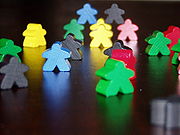
all have such a board), but many games use a modular board whose component tiles or cards can assume varying layouts from one session to another, or even as the game is played. - Game piece (or counter or token or bit or meeple or mover or pawn)—a player's representative on the game board. Each player may control one or more game pieces. In some games that involve commanding multiple game pieces, such as chess, certain pieces have unique designations and capabilities within the parameterParameterParameter from Ancient Greek παρά also “para” meaning “beside, subsidiary” and μέτρον also “metron” meaning “measure”, can be interpreted in mathematics, logic, linguistics, environmental science and other disciplines....
s of the game; in others, such as Go, all pieces controlled by a player have the same essential capabilities. In some modern board games, such as ClueCluedoCluedo is a popular murder/mystery-themed deduction board game originally published by Waddingtons in Leeds, England in 1949. It was devised by Anthony E. Pratt, a solicitor's clerk from Birmingham, England. It is now published by the United States game and toy company Hasbro, which acquired its U.S...
, there are other pieces that are not a player's representative, i.e. weapons. In some games, pieces may not represent or belong to a particular player. - Jump—to bypass one or more game pieces or spaces. Depending on the context, jumping may also involve capturing or conquering an opponent's game piece. (See also: Game mechanic: capture)
- Space (or square)—a physical unitUnits of measurementA unit of measurement is a definite magnitude of a physical quantity, defined and adopted by convention and/or by law, that is used as a standard for measurement of the same physical quantity. Any other value of the physical quantity can be expressed as a simple multiple of the unit of...
of progress on a gameboard delimited by a distinct border. Alternatively, a unique, atomic position on the board on which a game piece may be located while in play (in Go, for example, the pieces are placed on intersections of lines on the grid, not in the areas bounded by the grid lines as is seen in chess). (See also: Game mechanic: Movement) - Hex—in hexagon-based board games, this is the common term for a standard space on the board. This is most often used in wargamingWargamingA wargame is a strategy game that deals with military operations of various types, real or fictional. Wargaming is the hobby dedicated to the play of such games, which can also be called conflict simulations, or consims for short. When used professionally to study warfare, it is generally known as...
, though some abstract strategy games such as AbaloneAbalone (board game)Abalone is an award winning two-player strategy board game designed by Michel Lalet and Laurent Levi in which each player is represented by marbles of opposing colors...
use hexagonal layouts. - Card—a piece of cardboard on which instructions are given
- Deck—a stack of cards
- Capture—a method in which one removes another players game piece from the board, for example: in checkers if you jump another player's piece, that piece is captured.
Categories
There are a number of different categories that board games can be broken up into, although considerable overlap exists, and a game may belong in several categories. The following is a list of some of the most common:- Abstract strategy gameAbstract strategy gameAn abstract strategy game is a strategy game, aiming to minimise luck, and without a theme. Almost all abstract strategy games will conform to the strictest definition of: a board or card game, in which there is no hidden information, no non-deterministic elements , in which two players or teams...
s like chessChessChess is a two-player board game played on a chessboard, a square-checkered board with 64 squares arranged in an eight-by-eight grid. It is one of the world's most popular games, played by millions of people worldwide at home, in clubs, online, by correspondence, and in tournaments.Each player...
, checkers, GoGo (board game)Go , is an ancient board game for two players that originated in China more than 2,000 years ago...
, ReversiReversiReversi is a board game involving abstract strategy and played by two players on a board with 8 rows and 8 columns and a set of distinct pieces for each side. Pieces typically are disks with a light and a dark face, each face belonging to one player...
or modern games such as Abalone or StrategoStrategoStratego is a board game featuring a 10×10 square board and two players with 40 pieces each. Pieces represent individual officers and soldiers in an army. The objective of the game is to either find and capture the opponent's Flag or to capture so many of the opponent's pieces that he/she cannot... - Dexterity games like Tumblin' Dice and Pitch Car
- German-style board gameGerman-style board gameGerman-style board games, frequently referred to in gaming circles as Euro Games or Euro-style, are a broad class of tabletop games that generally have simple rules, short to medium playing times, indirect player interaction and abstract physical components...
s, or Eurogames, like The Settlers of CatanThe Settlers of CatanThe Settlers of Catan is a multiplayer board game designed by Klaus Teuber and first published in 1995 in Germany by Franckh-Kosmos Verlag as Die Siedler von Catan. Players assume the roles of settlers, each attempting to build and develop their settlement while trading and acquiring resources...
, Carson City or Puerto Rico - Educational games like ArthurArthurArthur is a common masculine given name. Its etymology is disputed, but its popularity derives from its being the name of the legendary hero King Arthur....
Saves the Planet, Cleopatra and the Society of Architects, and Shakespeare: The Bard Game - Family games like Roll Through the Ages, Birds on a Wire or For Sale
- Historical simulation games like Through the Ages and Railways of the World
- Large multiplayer games like Take It Easy and Swat (2010)
- Musical games like Spontuneous.
- Race gameRace gameRace game is a large category of board games, in which the object is to be the first to move all one's pieces to the end of a track. This is both the earliest type of board game known, with implements and representations dating back to at least the 3rd millennium BC in Egypt, Iraq, and Iran; and...
s like parchisi, backgammonBackgammonBackgammon is one of the oldest board games for two players. The playing pieces are moved according to the roll of dice, and players win by removing all of their pieces from the board. There are many variants of backgammon, most of which share common traits...
or Worm Up
Roll-and-move games, like Monopoly
Monopoly (game)
Marvin Gardens, the leading yellow property on the board shown, is actually a misspelling of the original location name, Marven Gardens. The misspelling was said to be introduced by Charles Todd and passed on when his home-made Monopoly board was copied by Charles Darrow and thence to Parker...
or Life
The Game of Life
The Game of Life, also known simply as LIFE, is a board game originally created in 1860 by Milton Bradley, as The Checkered Game of Life . The Game of Life was America's first popular parlor game...
- Share-buying games (in which players buy stakes in each others' positions; these are typically longer economic-management games)
- Spiritual Development games that have no winners or losers, like Transformation Game or Psyche's Key.
- Two-player only games like En Garde and Dos de Mayo
- TriviaTriviaThe trivia are the three lower Artes Liberales, i.e. grammar, rhetoric and logic. These were the topics of basic education, foundational to the quadrivia of higher education, and hence the material of basic education, of interest only to undergraduates...
games, like Trivial PursuitTrivial PursuitTrivial Pursuit is a board game in which progress is determined by a player's ability to answer general knowledge and popular culture questions. The game was created in 1979 in Montreal, Quebec, Canada, by Canadian Chris Haney, a photo editor for Montreal's The Gazette and Scott Abbott, a sports... - Train gameTrain gameA train game or railway game is a board game that represents the construction and operation of railways. Train games tend to be highly involved hobby games that take several hours to play...
s - WargamesBoard wargameA board wargame is a wargame with a set playing surface or board, as opposed to being played on a computer, or in a more free-form playing area as in miniatures games. The hobby around this type of game got its start in 1954 with the publication of Tactics, and saw its greatest popularity in the...
, ranging from RiskRisk (game)Risk is a strategic board game, produced by Parker Brothers . It was invented by French film director Albert Lamorisse and originally released in 1957 as La Conquête du Monde in France. Risk is a turn-based game for two to six players...
to Attack or Conquest of the EmpireConquest of the EmpireConquest of the Empire is a board game created in 1984 by Milton Bradley and re-released in the summer of 2005 by Eagle Games, designed by Glenn Drover. Part of the Gamemaster series, Conquest of the Empire is very similar to the popular Axis & Allies of the same series. That may be because it was... - Word gameWord gameWord games and puzzles are spoken or board games often designed to test ability with language or to explore its properties.Word games are generally engaged as a source of entertainment, but have been found to serve an educational purpose as well...
s, like ScrabbleScrabbleScrabble is a word game in which two to four players score points by forming words from individual lettered tiles on a game board marked with a 15-by-15 grid. The words are formed across and down in crossword fashion and must appear in a standard dictionary. Official reference works provide a list...
, Boggle or What's My Word? (2010)
See also
- Card gameCard gameA card game is any game using playing cards as the primary device with which the game is played, be they traditional or game-specific. Countless card games exist, including families of related games...
- DVD games
- History of gamesHistory of gamesThe history of games dates to the ancient past. Games are an integral part of all societies. Like work and relationships, they are an expression of some basic part of the human nature. Games are formalized expressions of play which allow people to go beyond immediate imagination and direct...
- List of board games
- List of game manufacturers
- Tabletop gameTabletop gameTabletop game is a general term used to refer to board games, card games, dice games, miniatures wargames, tile-based games and other games that are normally played on a table or other flat surface...
Further reading
- Austin, Roland G. "Greek Board Games." Antiquity 14. September 1940: 257–271
- Bell, Robert Charles. The Boardgame Book. LondonLondonLondon is the capital city of :England and the :United Kingdom, the largest metropolitan area in the United Kingdom, and the largest urban zone in the European Union by most measures. Located on the River Thames, London has been a major settlement for two millennia, its history going back to its...
: Bookthrift Company, 1979. - Bell, Robert Charles. Board and Table Games from Many Civilizations. Mineola, New YorkMineola, New YorkMineola is a village in Nassau County, New York, USA. The population was 18,799 at the 2010 census. The name is derived from a Native American word meaning a "pleasant place"....
: Dover Publications, 1980. ISBN 0-486-23855-5- Reprint: New YorkNew York CityNew York is the most populous city in the United States and the center of the New York Metropolitan Area, one of the most populous metropolitan areas in the world. New York exerts a significant impact upon global commerce, finance, media, art, fashion, research, technology, education, and...
: Exeter Books, 1983.
- Reprint: New York
- Falkener, Edward. Games Ancient and Oriental, and How To Play Them. Longmans, Green and Co., 1892.
- Fiske, WillardWillard FiskeDaniel Willard Fiske was an American librarian and scholar, born on November 11, 1831, at Ellisburg, New York.Fiske studied at Cazenovia Seminary and started his collegiate studies at Hamilton College in 1847. He joined the Psi Upsilon but was suspended for a student prank at the end of his...
. Chess in Iceland and in Icelandic Literature—with historical notes on other table-games. Florentine Typographical Society, 1905. - Golladay, Sonja Musser, "Los Libros de Acedrex Dados E Tablas: Historical, Artistic and Metaphysical Dimensions of Alfonso X’s Book of Games" (PhD diss., University of Arizona, 2007) (PDF version)
- Murray, Harold James RuthvenHarold James Ruthven MurrayHarold James Ruthven Murray , was an English educationalist, inspector of schools, and prominent chess historian. He was the first to publish the theory that chess originated in India...
. A History of Chess. Oxford, England: Clarendon Press, 1913. - Murray, Harold James RuthvenHarold James Ruthven MurrayHarold James Ruthven Murray , was an English educationalist, inspector of schools, and prominent chess historian. He was the first to publish the theory that chess originated in India...
. A History of Board-Games Other Than Chess. Gardners Books, 1969. - Parlett, David. Oxford History of Board Games. Oxford University PressOxford University PressOxford University Press is the largest university press in the world. It is a department of the University of Oxford and is governed by a group of 15 academics appointed by the Vice-Chancellor known as the Delegates of the Press. They are headed by the Secretary to the Delegates, who serves as...
, 1999. ISBN 0-19-212998-8 - Rollefson, Gary O., "A Neolithic Game Board from Ain Ghazal, Jordan," Bulletin of the American Schools of Oriental Research, No. 286. (May, 1992), pp. 1–5.
- Sackson, SidSid SacksonSid Sackson was a significant American board game designer and collector.His most popular creation is probably the business game Acquire...
. A Gamut of GamesA Gamut of GamesA Gamut of Games, written by Sid Sackson and first published in 1969, contains rules for a large number of paper and pencil, card, and board games. Many of the games in the book had never before been published...
. Arrow Books, 1983. ISBN 0-09-153340-6- Reprint: Dover Publications, 1992. ISBN 0-486-27347-4
- Schmittberger, R. Wayne. New Rules for Classic Games. John Wiley & SonsJohn Wiley & SonsJohn Wiley & Sons, Inc., also referred to as Wiley, is a global publishing company that specializes in academic publishing and markets its products to professionals and consumers, students and instructors in higher education, and researchers and practitioners in scientific, technical, medical, and...
, 1992. ISBN 0-471-53621-0- Reprint: Random House Value PublishingRandom HouseRandom House, Inc. is the largest general-interest trade book publisher in the world. It has been owned since 1998 by the German private media corporation Bertelsmann and has become the umbrella brand for Bertelsmann book publishing. Random House also has a movie production arm, Random House Films,...
, 1994. ISBN 0-517-12955-8
- Reprint: Random House Value Publishing