


Fergana Valley

Encyclopedia
The Fergana Valley or Farghana Valley is a region in Central Asia spreading across eastern Uzbekistan
, Kyrgyzstan
and Tajikistan
. Divided across three subdivisions of the former Soviet Union
, the valley is ethnically diverse, and in the early 21st century was the scene of ethnic conflict. A large triangular valley in what is an often dry part of Central Asia, the Fergana owes its fertility to two rivers, the Naryn
and the Kara Darya
, which run from the east, joining near Namangan
, forming the Syr Darya river. The valley's history stretches back over 2300 years, when its population was conquered by Greco-Bactrian invaders from the west. Chinese chroniclers date its towns to more than 2100 years ago, as a path between Greek, Chinese, Bactria
n and Parthian
civilizations. In the path of the Northern Silk Road
, the area was converted by Muslim invaders from the west, and was home to Babur
, famous conqueror and founder of the Mughal Empire
in India
, tying the region to modern Afghanistan
and South Asia. The Russian Empire
conquered the valley at the end of the 19th century, and it became part of the Soviet Union from the beginning of the 20th. Its three soviet regional states gained independence in 1991. The area remains Muslim
, populated by ethnically Uzbek
, Tajiks, and Kyrgyz, often intermixed and not matching modern borders. As well there historically have been substantial Russian
, Kashgar
ians, Kipchaks
, Bukharan Jews
and Romani minorities. Mass cotton cultivation, introduced by the Soviets, remains central to the economy, along with a wide range of grains, fruits and vegetables. There is a long history of stock breeding, leatherwork, and a growing mining sector, including deposits of coal
, iron
, sulfur
, gypsum
, rock-salt, lacustrine salt, naphtha
, and some small known oil reserves.
and the Kara Darya
, which unite in the valley, near Namangan
, to form the Syr Darya
. Numerous other tributaries of these rivers exist in the valley including the Sokh River
. The streams, and their numerous mountain effluents, not only supply water for irrigation, but also bring down vast quantities of sand, which is deposited alongside their courses, more especially alongside the Syr Darya where it cuts its way through the Khujand
-Ajar
ridge, forming there the Karakchikum. This expanse of moving sands, covering an area of 750 mi², under the influence of south-west winds, encroaches upon the agricultural districts.
The central part of the geological depression that forms the valley is characterized by block subsidence
, originally to depths estimated at 6-7 km (4 mi), largely filled with sediments that range in age as far as the Permian-Triassic boundary. Some of the sediments are marine carbonates and clay
s. The faults are upthrusts and overthrusts. Anticline
s associated with these faults form traps for petroleum
and natural gas
, which has been discovered in 52 small fields
.
region, which was ruled from further west and owed fealty to the Achaemenid Empire
at the time of Darius the Great. The independent and warlike Sogdiana formed a border region insulating the Achaemenid Persians
from the nomadic Scythians to the north and east. The Sogdian Rock or Rock of Ariamazes, a fortress in Sogdiana, was captured in 327 BC by the forces of Alexander the Great; after an extended campaign putting down Sogdian resistance and founding military outposts manned by his Macedonian veterans, Alexander united Sogdiana with Bactria
into one satrap
y.
 In 329 BCE, Alexander the Great founded a Greek settlement with the city of Alexandria Eschate
"The Furthest", in the southwestern part of the Ferghana valley, on the southern bank of the river Syr Darya
(ancient Jaxartes), at the location of the modern city of Khujand
, in the state of Tajikistan
.
After 250 BCE, the city probably remained in contact with the Greco-Bactrian Kingdom
centered on Bactria
, especially when the Greco-Bactrian king Euthydemus
extended his control to Sogdiana. There are indications that from Alexandria Eschate
the Greco-Bactrians may have led expeditions as far as Kashgar
and Ürümqi
in Chinese Turkestan
, leading to the first known contacts between China and the West around 220 BCE. Several statuettes and representations of Greek soldiers have been found north of the Tien Shan, on the doorstep to China, and are today on display in the Xinjiang
museum at Urumqi
(Boardman). Of the Greco-Bactrians, the Greek historian Strabo
too writes that:
The Fergana area, called Dayuan
by the Chinese, remained an integral part of the Greco-Bactrian Kingdom
until after the time of Demetrius I of Bactria
(c. 120 BCE), when confronted with invasions by the Yuezhi
from the east and the Sakas Scythians from the south. After 155 BCE, the Yuezhi were pushed into Fergana by neighbors from the north and east. The Yuezhi invaded urban civilization of the Dayuan
in Ferghana, eventually settling on the northern bank of the Oxus, in the region of Transoxiana
, in modern-day Tajikistan
and Uzbekistan
, just north of the Hellenistic Greco-Bactrian kingdom
. The Greek city of Alexandria on the Oxus was apparently burnt to the ground by the Yuezhi around 145 BCE. Pushed by these twin forces, the Greco-Bactrian kingdom reoriented itself around lands in what is now Afghanistan, while the new invaders were partially assimilated into the Hellenistic culture left in Ferghana valley.
, based on the travels of Zhang Qian
about 126 BCE, the region of Ferghana is presented as the country of the Dayuan
(Ta-Yuan), possibly descendants of the Greeks colonists (Da Yuan might be a transliteration of "Great Ionians"). Dayuan was renowned for its Heavenly Horses which the Chinese tried to obtain with little success until they waged war against them in 104 BCE.
The Dayuan were identified by the Chinese as unusual in features, with a sophisticated urban civilization, similar to that of the Bactrians
and Parthians: "The Son of Heaven on hearing all this reasoned thus: Ferghana (Dayuan) and the possessions of Bactria and Parthia are large countries, full of rare things, with a population living in fixed abodes and given to occupations somewhat identical with those of the Chinese people, but with weak armies, and placing great value on the rich produce of China" (Hou Han Shu).
Agricultural activities of the Dayuan reported by Zhang Qian included growing of grain and grapes (for wine). The area of Ferghana was thus the theater of the first major interaction between an urbanized culture speaking Indo-European languages
and the Chinese civilization, which led to the opening up the Silk Road
from the 1st century BCE.
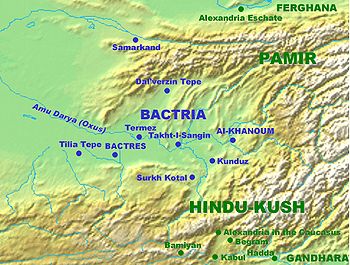 Fergana, on the route to the Chinese Tarim Basin
from the west, remained at the boundaries of a number of classical era empires. The Kushan Empire
formed from the same Yuezhi who had conquered the Hellenistic Fergana. The Kushan spread out in the 1st century CE from Yuezhi confederation in the territories of ancient Bactria
on either side of the middle course of the Oxus River or Amu Darya
in what is now northern Afghanistan, and southern Tajikistan
and Uzbekistan
. The Kushan conquered most of what is now northern India and Pakistan, driving east through Fergana into the Tarim Basin against the Chinese. Kushan power also consolidated long distance trade, linking Central Asia to both Han Dynasty
China and the Roman Empire
in Europe. The Kushans ruled the area as part of their larger empire until the 3rd century CE, when the Zoroastrian Persian
Sassanid Empire
invaded Kushan territory from the southwest. Fergana remained under shifting local and Transoxian rulers thereafter. For periods in the 4th and 5th centuries, the Sassanid Empire directly controlled Transoxiana and Fergana, led by the conquests of Shapur II
and Khosrau I
against the Kushans and the Hephthalite Empire.
of China and the expansion of Muslim power, leading to the Battle of Talas
in 751, which marked the victory of Islam and the disengagement of China from Central Asia. Two antecedent battles in 715 and 717 had seen the Chinese to prevail over Arab forces. A series of Arab, Persian, and later Turkic Muslim rulers reigned over the Fergana.

, including Transoxiana
and the Fergana Valley from the West. In 819 CE, Ahmad ibn Asad
-- son of Asad ibn Saman
-- was granted authority over the city of Fergana by Caliph Al-Ma'mun's
governor of Khorasan
, Ghassan ibn 'Abbad, as a reward for his support against the rebel Rafi' ibn Laith. Following the death of his brother Nuh
, who ruled in Samarkand, Ahmad and another brother Yahya
were given rule over the city by Abdallah, the governor of Khurasan. By the time of Ahmad's death in 864 or 865, he was the ruler of most of Transoxiana
, bar Bukhara
and Khwarazm. Samarkand and Fergana went to his son, Nasr I of Samanid
, leading to a series of Samanid
Dynasty Muslim rulers of the valley.
invaded Transoxiana and Fergana in 1219 during his conquest of Khwarazm. Before his death in 1227, he assigned the lands of Western Central Asia to his second son Chagatai
, and this region became known as the Chagatai Khanate
. But it was not long before Transoxian Turkic leaders ruled the area, along with most of central Asia as fiefs from the Golden Horde
of the Mongol Empire. The Fergana became part of a larger Turco-Mongol
empire. This Mongolian
nomadic confederation known as Barlas
, were remnants of the original Mongol army of Genghis Khan
. After the Mongol conquest of Central Asia, the Barlas settled in Turkistan
(which then became also known as Moghulistan
- "Land of Mongols") and intermingled to a considerable degree with the local Turkic
and Turkic-speaking
population, so that at the time of Timur's reign the Barlas had become thoroughly Turkicized in terms of language and habits. Additionally, by adopting Islam, the Central Asian Turks and Mongols also adopted the Persian literary and high culture which had dominated Central Asia since the early days of Islamic influence. Persian literature was instrumental in the assimilation of the Timurid elite to the Perso-Islamic courtly culture.
Heir to one of these confederations, Timur
, founder of the Timurid dynasty
, added the valley to a newly consolidated empire in the late 14th century, ruling the area from Samarkand
.
Located on the Northern Silk Road
, the Ferghana played a significant part in the flowering of medieval Central Asian Islam. Its most famous son is Babur
, heir to Timur and famous conqueror and founder of the Mughal Empire
in India. Islamic proselytizers from the Ferghana valley such as al-Firghani الفرغاني, al-Andijani الأندجاني, al-Namangani النمنگاني, al-Khojandi الخوجندي spread Islam into parts of present-day Russia, China, and South Asia.
The Fergana valley was ruled by a series of Muslim states in the medieval period. For much of this period local and southwestern rulers divided the valley into a series of small states. From the 16th century, the Shaybanid Dynasty of the Khanate of Bukhara
ruled the western Fergana, replaced by the Janid Dynasty of Bukhara in 1599. In 1709 Shaybanid emir Shahrukh of the Minglar Uzbeks
declared independence from the Khanate of Bukhara
, establishing a state in the western part of the Fergana Valley. He built a citadel to be his capital in the small town of Kokand
. As the Khanate of Kokand
, Kokand was capital of a territory stretching over modern eastern Uzbekistan
, southern Kazakhstan
, Tajikistan
and Kyrgyzstan
.
 Ferghana, or Fergana was a province of Russian Turkestan
, formed in 1876 out of the former khanate of Kokand
(see Kokand
).
It was bounded by the provinces of Syr-darya on the N. and N.W., Samarkand
on the W., and Zhetysu on the N.E., by Chinese Turkestan
(Kashgaria) on the E., and by Bukhara
and Afghanistan on the S. Its southern limits, on the Pamirs
, were fixed by an Anglo-Russian commission in 1885, from Zorkul
(Victoria Lake) to the Chinese frontier; and Khignan, Roshan
and Wakhan
were assigned to Bokhara in exchange for part of Darvaz
(on the left bank of the Panj
), which was given to Afghanistan. The area amounted to some 53000 km² (20,463 sq mi), of which 17600 km² (6,795 sq mi) are on the Pamirs.
and Kyrgyz SSR cut off the eastern end of the Ferghana Valley, as well as the slopes surrounding it. This was compounded in 1928 when the Tajik ASSR
became a fully-fledged republic, and the area around Khujand
was made a part of it. This blocked the valley's natural outlet and the routes to Samarkand and Bukhara, but none of these borders was of any great significance so long as Soviet rule lasted. The whole region was part of a single economy geared to cotton production on a massive scale and the over-arching political structures meant that crossing borders was not a problem. Since 1991 this has changed, for the worse. Uzbekistan regularly closes its borders with Tajikistan and Kyrgyzstan, causing immense difficulties for trade and for those who live in the region. Travellers from Khujand to Dushanbe
, unable to take the route through Uzbekistan, have to cross a high mountain pass between the two cities instead, along a terrible road. Similarly communications between Bishkek
and Osh
pass through difficult mountainous country and are endangered by the attitude of President Islam Karimov of Uzbekistan. Ethnic tensions also flared at one stage, most notably in the town of Uzgen, near Osh, where were Uzbek-Kyrgyz riots in 1990. There has been no further ethnic violence, and things appeared to have quietened down for several years. However, the valley is a religiously conservative region which was particularly hard-hit by President Karimov's secularization legislation in Uzbekistan, together with his decision to close the borders with Kyrgyzstan in 2003. This devastated the local economy by preventing the importation of cheap Chinese consumer goods. The deposition of Askar Akayev in Kyrgyzstan in April 2005, coupled with the arrest of a group of prominent local businessmen brought underlying tensions to a boil in the region around Andijan and Qorasuv
during the May 2005 unrest in Uzbekistan in which hundreds of protestors were killed by troops. Violence started to pick up again in 2010 in Kyrgyz part of the valley, heated by ethnic tensions, worsening economic conditions due to the global economic crisis, and political conflict over ousting of Kyrgyz President Kurmanbek Bakiyev in April 2010. In June 2010, about 200 people have been reported to be killed during clashes in Osh
and Jalal-Abad
, and 2000 more were injured. Between 100,000 and 300,000 refugees, predominantly of Uzbek ethnic origin, attempted to flee to Uzbekistan, causing a major humanitarian crisis.
 In Tsarist times, out of some 3000000 acres (12,140.6 km²) of cultivated land, about two thirds were under constant irrigation and the remaining third under partial irrigation. The soil was considered by the author of the 1911 Britannica article to be admirably cultivated, the principal crops having been wheat
, rice
, barley
, maize
, millet
, lucerne
, tobacco
, vegetables and fruit. Gardening was conducted with a high degree of skill and success. Large numbers of horses, cattle and sheep were kept, and a good many camels are bred. Over 17000 acres (68.8 km²) were planted with vine
s, and some 350000 acres (1,416.4 km²) were under cotton
. Nearly 1000000 acres (4,046.9 km²) were covered with forests. The government maintained a forestry farm at Marghelan, from which 120,000 to 200,000 young trees were distributed free every year amongst the inhabitants of the province.
Silkworm breeding, formerly a prosperous industry, had decayed, despite the encouragement of a state farm at New Marghelan.
, rock-salt, lacustrine salt and naphtha
are all known to exist, but only the last two have ever been extracted in significant quantities. In the late 19th century there were a few small oil-wells in Ferghana, but these no longer function. In the Tsarist period the only industrial enterprises were some seventy or eighty factories engaged in cotton cleaning. Leather, saddlery, paper and cutlery were the principal products of the domestic or cottage industries. This was not greatly added to in Soviet times, when industrialisation was concentrated in the cities of Samarkand
and Bukhara
.
for goods and people traveling from China to the Middle East and Europe. After crossing the passes from Kashgar
in Xinjiang, traders would have found welcome relief in the fertile abundance of Ferghana, as well as the possibility of purchasing further high-quality silk manufactured in Margilan
. The most famous export from the region were the 'blood-sweating' Heavenly Horses which so captured the imagination of the Chinese during the Han dynasty, but in fact these were almost certainly bred on the Steppe, either west of Bukhara
or North of Tashkent
, and merely brought to Ferghana for sale. In the 19th century, not surprisingly, a considerable trade carried on with Russia; raw cotton, raw silk
, tobacco, hides, sheepskins, fruit and cotton and leather goods were exported, and manufactured wares, textiles, tea
and sugar
were imported and in part re-exported to Kashgaria and Bokhara. The total trade of Ferghana reached an annual value of nearly £3,500,000 in 1911. Nowadays it suffers from the same depression that affects all trade that either originates in or has to pass through Uzbekistan. The only significant international export is cotton, although the Daewoo plant in Andizhan sends cars all over Uzbekistan.
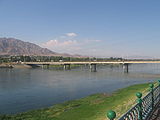 Until the late 19th century Ferghana, like everywhere else in Central Asia, was dependent on the camel, horse and donkey for transport, while roads were few and bad. The Russians built a trakt or post-road linking Andijan, Kokand, Margilan and Khujand
with Samarkand and Tashkent in the early 1870s. A new impulse was given to trade by the extension (1898) of the Transcaspian railway into Ferghana as far as Andijan, and by the opening of the Orenburg
-Tashkent
or Trans-Aral Railway
in (1906).
Until Soviet times and the construction of the Pamir Highway
from Osh
to Khorog
in the 1920s the routes to Kashgaria and the Pamirs were mere bridle-paths over the mountains, crossing them by lofty passes
. For instance, the passes of Kara-kazyk, 4,389 m (14,400 ft) and Tenghiz-bai 3,413 m (11,200 ft), both passable all the year round, lead from Marghelan to Karateghin and the Pamirs, while Kashgar
is reached via Osh
and Gulcha, and then over the passes of Terek-davan, 3,720 m (12,205 ft); (open all the year round), Taldyk, 3,505 m (11,500 ft), Archat, 3,536 m (11,600 ft), and Shart-davan, 4,267 m (14,000 ft). Other passes leading out of the valley are the Jiptyk, 3,798 m (12,460 ft), S. of Kokand
; the Isfairam, 3,657 m (12,000 ft), leading to the glen of the Surkhab
, and the Kavuk, 3,962 m (13,000 ft), across the Alai Mts.
In 1906 it was estimated at 1,796,500. Two-thirds of the total were Sart
s and Uzbek
. They lived mostly in the valley, while the mountain slopes above it were occupied by Kyrgyz, partly nomad
ic and pastoral, partly agricultural and settled. The other nations were Kashgarians, Kipchaks
, Bukharan Jews
and Gypsies. The governing classes were of course Russians, who constituted also the merchants and industrial working class, such as it was. But the merchants of West Turkestan were called all over Central Asia Andijanis, from the town of Andijan
in Ferghana. The great mass of the population are Muslims (1,039,115 in 1897).
The divisions revealed by the 1897 census, between a largely Tajik-speaking area around Khuhand, hill-regions populated by Kyrgyz and a settled, population in the main body of the valley, roughly reflect the borders as drawn after 1924. One exception is the town of Osh, which has a majority Uzbek population but ended up in Kyrgyzstan
.
The one significant element that is missing when looking at modern accounts of the region are the Sarts
. This term was abolished by the Soviets as 'derogatory' after 1920, but in fact there was a clear distinction between long-settled, Persianised Turkic peoples, speaking a form of Qarluq
Turkic that is very close to Uyghur
, and those who called themselves Uzbeks
, who were a Kipchak tribe speaking a Turkic dialect much closer to Kazakh
, who arrived in the region with Shaibani Khan in the mid-16th century. That this difference existed and was felt in Ferghana is attested to in Timur Beisembiev's recent translation of the Life of Alimqul (London, 2003).
There were very few Kipchak-Uzbeks in Ferghana, although they had at various times held political power in the region. In 1924 however, Soviet policy decreed that all settled Turks in Central Asia would henceforth be known as "Uzbeks", (although the language chosen for the new Republic was not Kipchak but Qarluq) and the Ferghana Valley is now seen as an Uzbek 'heartland'.
(New Marghelan
), capital of the province (8,977 inhabitants in 1897), Andijan
(49,682 in 1900), Kokand
(86,704 in 1900), Namangan
(61,906 in 1897), and Osh
(37,397 in 1900); but Old Marghelan (42,855 in 1900) and Chust
(13,686 in 1897) were also towns of importance.
The Valley is now divided between Uzbekistan
, Kyrgyzstan
and Tajikistan
. In Tajikistan it is part of Soghd Province or vilayat, with the capital at Khujand
. In Uzbekistan it is divided between the Namangan, Andijan and Fergana viloyati, while in Kyrgyzstan it contains parts of Batken
, Jalal-abad
and Osh
oblasts, with Osh being the main town for the southern part of the country.
Cities in the Fergana Valley include:
In Uzbekistan:
In Kyrgyzstan:
In Tajikistan:
:
Other authors:
----
Uzbekistan
Uzbekistan , officially the Republic of Uzbekistan is a doubly landlocked country in Central Asia and one of the six independent Turkic states. It shares borders with Kazakhstan to the west and to the north, Kyrgyzstan and Tajikistan to the east, and Afghanistan and Turkmenistan to the south....
, Kyrgyzstan
Kyrgyzstan
Kyrgyzstan , officially the Kyrgyz Republic is one of the world's six independent Turkic states . Located in Central Asia, landlocked and mountainous, Kyrgyzstan is bordered by Kazakhstan to the north, Uzbekistan to the west, Tajikistan to the southwest and China to the east...
and Tajikistan
Tajikistan
Tajikistan , officially the Republic of Tajikistan , is a mountainous landlocked country in Central Asia. Afghanistan borders it to the south, Uzbekistan to the west, Kyrgyzstan to the north, and China to the east....
. Divided across three subdivisions of the former Soviet Union
Soviet Union
The Soviet Union , officially the Union of Soviet Socialist Republics , was a constitutionally socialist state that existed in Eurasia between 1922 and 1991....
, the valley is ethnically diverse, and in the early 21st century was the scene of ethnic conflict. A large triangular valley in what is an often dry part of Central Asia, the Fergana owes its fertility to two rivers, the Naryn
Naryn River
The Naryn River rises in the Tian Shan mountains in Kyrgyzstan, Central Asia, flowing west through the Fergana Valley into Uzbekistan. Here it merges with the Kara Darya River to form the Syr Darya...
and the Kara Darya
Kara Darya
The Kara Darya or Qaradaryo is a tributary of the Syr Darya in Kyrgyzstan and eastern Uzbekistan. The river is formed by the confluence of Kara-Kulja River and Tar River. There are more than 200 known tributaries of Kara Darya; the largest are Jazy River, Kara Unkur River, Kegart River, Kurshab...
, which run from the east, joining near Namangan
Namangan
Namangan is the third-largest city in Uzbekistan . It is the capital of Namangan Province, in the northern edge of Fergana Valley of north-eastern Uzbekistan.-Geography:...
, forming the Syr Darya river. The valley's history stretches back over 2300 years, when its population was conquered by Greco-Bactrian invaders from the west. Chinese chroniclers date its towns to more than 2100 years ago, as a path between Greek, Chinese, Bactria
Bactria
Bactria and also appears in the Zend Avesta as Bukhdi. It is the ancient name of a historical region located between south of the Amu Darya and west of the Indus River...
n and Parthian
Parthia
Parthia is a region of north-eastern Iran, best known for having been the political and cultural base of the Arsacid dynasty, rulers of the Parthian Empire....
civilizations. In the path of the Northern Silk Road
Northern Silk Road
The Northern Silk Road is a prehistoric trackway in northern China originating in the early capital of Xi'an and extending north of the Taklamakan Desert to reach the ancient kingdoms of Parthia, Bactria and eventually Persia and Rome. It is the northern-most branch of several Silk Roads providing...
, the area was converted by Muslim invaders from the west, and was home to Babur
Babur
Babur was a Muslim conqueror from Central Asia who, following a series of setbacks, finally succeeded in laying the basis for the Mughal dynasty of South Asia. He was a direct descendant of Timur through his father, and a descendant also of Genghis Khan through his mother...
, famous conqueror and founder of the Mughal Empire
Mughal Empire
The Mughal Empire , or Mogul Empire in traditional English usage, was an imperial power from the Indian Subcontinent. The Mughal emperors were descendants of the Timurids...
in India
India
India , officially the Republic of India , is a country in South Asia. It is the seventh-largest country by geographical area, the second-most populous country with over 1.2 billion people, and the most populous democracy in the world...
, tying the region to modern Afghanistan
Afghanistan
Afghanistan , officially the Islamic Republic of Afghanistan, is a landlocked country located in the centre of Asia, forming South Asia, Central Asia and the Middle East. With a population of about 29 million, it has an area of , making it the 42nd most populous and 41st largest nation in the world...
and South Asia. The Russian Empire
Russian Empire
The Russian Empire was a state that existed from 1721 until the Russian Revolution of 1917. It was the successor to the Tsardom of Russia and the predecessor of the Soviet Union...
conquered the valley at the end of the 19th century, and it became part of the Soviet Union from the beginning of the 20th. Its three soviet regional states gained independence in 1991. The area remains Muslim
Muslim
A Muslim, also spelled Moslem, is an adherent of Islam, a monotheistic, Abrahamic religion based on the Quran, which Muslims consider the verbatim word of God as revealed to prophet Muhammad. "Muslim" is the Arabic term for "submitter" .Muslims believe that God is one and incomparable...
, populated by ethnically Uzbek
Uzbeks
The Uzbeks are a Turkic ethnic group in Central Asia. They comprise the majority population of Uzbekistan, and large populations can also be found in Afghanistan, Tajikstan, Kyrgyzstan, Turkmenistan, Kazakhstan, Russia, Pakistan, Mongolia and the Xinjiang Uyghur Autonomous Region of China...
, Tajiks, and Kyrgyz, often intermixed and not matching modern borders. As well there historically have been substantial Russian
Russians
The Russian people are an East Slavic ethnic group native to Russia, speaking the Russian language and primarily living in Russia and neighboring countries....
, Kashgar
Kashgar
Kashgar or Kashi is an oasis city with approximately 350,000 residents in the western part of the Xinjiang Uyghur Autonomous Region of the People's Republic of China. Kashgar is the administrative centre of Kashgar Prefecture which has an area of 162,000 km² and a population of approximately...
ians, Kipchaks
Kipchaks
Kipchaks were a Turkic tribal confederation...
, Bukharan Jews
Bukharan Jews
Bukharan Jews, also Bukharian Jews or Bukhari Jews, or яҳудиёни Бухоро Yahūdieni Bukhoro , Bukhori Hebrew Script: יהודיאני בוכאראי and יהודיאני בוכארי), also called the Binai Israel, are Jews from Central Asia who speak Bukhori, a dialect of the Tajik-Persian language...
and Romani minorities. Mass cotton cultivation, introduced by the Soviets, remains central to the economy, along with a wide range of grains, fruits and vegetables. There is a long history of stock breeding, leatherwork, and a growing mining sector, including deposits of coal
Coal
Coal is a combustible black or brownish-black sedimentary rock usually occurring in rock strata in layers or veins called coal beds or coal seams. The harder forms, such as anthracite coal, can be regarded as metamorphic rock because of later exposure to elevated temperature and pressure...
, iron
Iron
Iron is a chemical element with the symbol Fe and atomic number 26. It is a metal in the first transition series. It is the most common element forming the planet Earth as a whole, forming much of Earth's outer and inner core. It is the fourth most common element in the Earth's crust...
, sulfur
Sulfur
Sulfur or sulphur is the chemical element with atomic number 16. In the periodic table it is represented by the symbol S. It is an abundant, multivalent non-metal. Under normal conditions, sulfur atoms form cyclic octatomic molecules with chemical formula S8. Elemental sulfur is a bright yellow...
, gypsum
Gypsum
Gypsum is a very soft sulfate mineral composed of calcium sulfate dihydrate, with the chemical formula CaSO4·2H2O. It is found in alabaster, a decorative stone used in Ancient Egypt. It is the second softest mineral on the Mohs Hardness Scale...
, rock-salt, lacustrine salt, naphtha
Naphtha
Naphtha normally refers to a number of different flammable liquid mixtures of hydrocarbons, i.e., a component of natural gas condensate or a distillation product from petroleum, coal tar or peat boiling in a certain range and containing certain hydrocarbons. It is a broad term covering among the...
, and some small known oil reserves.
Geography and geology
The Fergana valley is an intermountain depression in Central Asia, between the mountain systems of the Tien-Shan in the north and the Gissar-Alai in the south. The valley is approximately 300 km long and up to 70 km wide, forming an area of 22,000 km2. Its position makes it a separate geographic zone. The valley owes its fertility to two rivers, the NarynNaryn River
The Naryn River rises in the Tian Shan mountains in Kyrgyzstan, Central Asia, flowing west through the Fergana Valley into Uzbekistan. Here it merges with the Kara Darya River to form the Syr Darya...
and the Kara Darya
Kara Darya
The Kara Darya or Qaradaryo is a tributary of the Syr Darya in Kyrgyzstan and eastern Uzbekistan. The river is formed by the confluence of Kara-Kulja River and Tar River. There are more than 200 known tributaries of Kara Darya; the largest are Jazy River, Kara Unkur River, Kegart River, Kurshab...
, which unite in the valley, near Namangan
Namangan
Namangan is the third-largest city in Uzbekistan . It is the capital of Namangan Province, in the northern edge of Fergana Valley of north-eastern Uzbekistan.-Geography:...
, to form the Syr Darya
Syr Darya
The Syr Darya , also transliterated Syrdarya or Sirdaryo, is a river in Central Asia, sometimes known as the Jaxartes or Yaxartes from its Ancient Greek name . The Greek name is derived from Old Persian, Yakhsha Arta , a reference to the color of the river's water...
. Numerous other tributaries of these rivers exist in the valley including the Sokh River
Sokh River
The Sokh River is a river in Kyrgyzstan and Uzbekistan. It takes its rise on the north slopes of Alay Mountains and ends in Ferghana Valley. In the past, Sokh River was a left tributary of the Syr Darya. But, nowadays it is entirely used for irrigation....
. The streams, and their numerous mountain effluents, not only supply water for irrigation, but also bring down vast quantities of sand, which is deposited alongside their courses, more especially alongside the Syr Darya where it cuts its way through the Khujand
Khujand
Khujand , also transliterated as Khudzhand, , formerly Khodjend or Khodzhent until 1936 and Leninabad until 1991, is the second-largest city of Tajikistan. It is situated on the Syr Darya River at the mouth of the Fergana Valley...
-Ajar
Ajar
Ajar may refer to:* Ajar, Afghanistan* Ajar, Mauritania* Ajar people, an ethnographic group of Georgians...
ridge, forming there the Karakchikum. This expanse of moving sands, covering an area of 750 mi², under the influence of south-west winds, encroaches upon the agricultural districts.
The central part of the geological depression that forms the valley is characterized by block subsidence
Subsidence
Subsidence is the motion of a surface as it shifts downward relative to a datum such as sea-level. The opposite of subsidence is uplift, which results in an increase in elevation...
, originally to depths estimated at 6-7 km (4 mi), largely filled with sediments that range in age as far as the Permian-Triassic boundary. Some of the sediments are marine carbonates and clay
Clay
Clay is a general term including many combinations of one or more clay minerals with traces of metal oxides and organic matter. Geologic clay deposits are mostly composed of phyllosilicate minerals containing variable amounts of water trapped in the mineral structure.- Formation :Clay minerals...
s. The faults are upthrusts and overthrusts. Anticline
Anticline
In structural geology, an anticline is a fold that is convex up and has its oldest beds at its core. The term is not to be confused with antiform, which is a purely descriptive term for any fold that is convex up. Therefore if age relationships In structural geology, an anticline is a fold that is...
s associated with these faults form traps for petroleum
Petroleum
Petroleum or crude oil is a naturally occurring, flammable liquid consisting of a complex mixture of hydrocarbons of various molecular weights and other liquid organic compounds, that are found in geologic formations beneath the Earth's surface. Petroleum is recovered mostly through oil drilling...
and natural gas
Natural gas
Natural gas is a naturally occurring gas mixture consisting primarily of methane, typically with 0–20% higher hydrocarbons . It is found associated with other hydrocarbon fuel, in coal beds, as methane clathrates, and is an important fuel source and a major feedstock for fertilizers.Most natural...
, which has been discovered in 52 small fields
Oil field
An oil field is a region with an abundance of oil wells extracting petroleum from below ground. Because the oil reservoirs typically extend over a large area, possibly several hundred kilometres across, full exploitation entails multiple wells scattered across the area...
.
Climate
The climate of this valley is dry and warm. In March the temperature reaches 20 °C (68 °F), and then rapidly rises to 35 °C (95 °F) in June, July and August. During the five months following April precipitation is rare, but increases in frequency starting in October. Snow and frost, down to -20 °C (-4 °F) occur in December and January.Achaemenid Empire
As early as 500 BCE, the western sections of the Fergana valley formed part of the SogdianaSogdiana
Sogdiana or Sogdia was the ancient civilization of an Iranian people and a province of the Achaemenid Empire, eighteenth in the list on the Behistun Inscription of Darius the Great . Sogdiana is "listed" as the second of the "good lands and countries" that Ahura Mazda created...
region, which was ruled from further west and owed fealty to the Achaemenid Empire
Achaemenid Empire
The Achaemenid Empire , sometimes known as First Persian Empire and/or Persian Empire, was founded in the 6th century BCE by Cyrus the Great who overthrew the Median confederation...
at the time of Darius the Great. The independent and warlike Sogdiana formed a border region insulating the Achaemenid Persians
Achaemenid Empire
The Achaemenid Empire , sometimes known as First Persian Empire and/or Persian Empire, was founded in the 6th century BCE by Cyrus the Great who overthrew the Median confederation...
from the nomadic Scythians to the north and east. The Sogdian Rock or Rock of Ariamazes, a fortress in Sogdiana, was captured in 327 BC by the forces of Alexander the Great; after an extended campaign putting down Sogdian resistance and founding military outposts manned by his Macedonian veterans, Alexander united Sogdiana with Bactria
Bactria
Bactria and also appears in the Zend Avesta as Bukhdi. It is the ancient name of a historical region located between south of the Amu Darya and west of the Indus River...
into one satrap
Satrap
Satrap was the name given to the governors of the provinces of the ancient Median and Achaemenid Empires and in several of their successors, such as the Sassanid Empire and the Hellenistic empires....
y.
Hellenistic settlement
Alexandria Eschate
Alexandria Eschate or Alexandria Eskhata was founded by Alexander the Great in August 329 BCE as his most northerly base in Central Asia...
"The Furthest", in the southwestern part of the Ferghana valley, on the southern bank of the river Syr Darya
Syr Darya
The Syr Darya , also transliterated Syrdarya or Sirdaryo, is a river in Central Asia, sometimes known as the Jaxartes or Yaxartes from its Ancient Greek name . The Greek name is derived from Old Persian, Yakhsha Arta , a reference to the color of the river's water...
(ancient Jaxartes), at the location of the modern city of Khujand
Khujand
Khujand , also transliterated as Khudzhand, , formerly Khodjend or Khodzhent until 1936 and Leninabad until 1991, is the second-largest city of Tajikistan. It is situated on the Syr Darya River at the mouth of the Fergana Valley...
, in the state of Tajikistan
Tajikistan
Tajikistan , officially the Republic of Tajikistan , is a mountainous landlocked country in Central Asia. Afghanistan borders it to the south, Uzbekistan to the west, Kyrgyzstan to the north, and China to the east....
.
After 250 BCE, the city probably remained in contact with the Greco-Bactrian Kingdom
Greco-Bactrian Kingdom
The Greco-Bactrian Kingdom was the easternmost part of the Hellenistic world, covering Bactria and Sogdiana in Central Asia from 250 to 125 BC...
centered on Bactria
Bactria
Bactria and also appears in the Zend Avesta as Bukhdi. It is the ancient name of a historical region located between south of the Amu Darya and west of the Indus River...
, especially when the Greco-Bactrian king Euthydemus
Euthydemus
-People:*Euthydemus , a fleet commander for Athens during the Sicilian Expedition, 415 to 413 BC*Euthydemus, son of Cephalus, mentioned in Plato's Republic...
extended his control to Sogdiana. There are indications that from Alexandria Eschate
Alexandria Eschate
Alexandria Eschate or Alexandria Eskhata was founded by Alexander the Great in August 329 BCE as his most northerly base in Central Asia...
the Greco-Bactrians may have led expeditions as far as Kashgar
Kashgar
Kashgar or Kashi is an oasis city with approximately 350,000 residents in the western part of the Xinjiang Uyghur Autonomous Region of the People's Republic of China. Kashgar is the administrative centre of Kashgar Prefecture which has an area of 162,000 km² and a population of approximately...
and Ürümqi
Ürümqi
Ürümqi , formerly Tihwa , is the capital of Xinjiang Uyghur Autonomous Region of the People's Republic of China, in the northwest of the country....
in Chinese Turkestan
Xinjiang
Xinjiang is an autonomous region of the People's Republic of China. It is the largest Chinese administrative division and spans over 1.6 million km2...
, leading to the first known contacts between China and the West around 220 BCE. Several statuettes and representations of Greek soldiers have been found north of the Tien Shan, on the doorstep to China, and are today on display in the Xinjiang
Xinjiang
Xinjiang is an autonomous region of the People's Republic of China. It is the largest Chinese administrative division and spans over 1.6 million km2...
museum at Urumqi
Ürümqi
Ürümqi , formerly Tihwa , is the capital of Xinjiang Uyghur Autonomous Region of the People's Republic of China, in the northwest of the country....
(Boardman). Of the Greco-Bactrians, the Greek historian Strabo
Strabo
Strabo, also written Strabon was a Greek historian, geographer and philosopher.-Life:Strabo was born to an affluent family from Amaseia in Pontus , a city which he said was situated the approximate equivalent of 75 km from the Black Sea...
too writes that:
The Fergana area, called Dayuan
Dayuan
The Dayuan or Ta-Yuan were a people of Ferghana in Central Asia, described in the Chinese historical works of Records of the Grand Historian and the Book of Han. It is mentioned in the accounts of the famous Chinese explorer Zhang Qian in 130 BCE and the numerous embassies that followed him into...
by the Chinese, remained an integral part of the Greco-Bactrian Kingdom
Greco-Bactrian Kingdom
The Greco-Bactrian Kingdom was the easternmost part of the Hellenistic world, covering Bactria and Sogdiana in Central Asia from 250 to 125 BC...
until after the time of Demetrius I of Bactria
Demetrius I of Bactria
Demetrius I was a Buddhist Greco-Bactrian king . He was the son of Euthydemus and succeeded him around 200 BC, after which he conquered extensive areas in what now is eastern Iran, Afghanistan and Pakistan thus creating an Indo-Greek kingdom far from Hellenistic Greece...
(c. 120 BCE), when confronted with invasions by the Yuezhi
Yuezhi
The Yuezhi, or Rouzhi , also known as the Da Yuezhi or Da Rouzhi , were an ancient Central Asian people....
from the east and the Sakas Scythians from the south. After 155 BCE, the Yuezhi were pushed into Fergana by neighbors from the north and east. The Yuezhi invaded urban civilization of the Dayuan
Dayuan
The Dayuan or Ta-Yuan were a people of Ferghana in Central Asia, described in the Chinese historical works of Records of the Grand Historian and the Book of Han. It is mentioned in the accounts of the famous Chinese explorer Zhang Qian in 130 BCE and the numerous embassies that followed him into...
in Ferghana, eventually settling on the northern bank of the Oxus, in the region of Transoxiana
Transoxiana
Transoxiana is the ancient name used for the portion of Central Asia corresponding approximately with modern-day Uzbekistan, Tajikistan, southern Kyrgystan and southwest Kazakhstan. Geographically, it is the region between the Amu Darya and Syr Darya rivers...
, in modern-day Tajikistan
Tajikistan
Tajikistan , officially the Republic of Tajikistan , is a mountainous landlocked country in Central Asia. Afghanistan borders it to the south, Uzbekistan to the west, Kyrgyzstan to the north, and China to the east....
and Uzbekistan
Uzbekistan
Uzbekistan , officially the Republic of Uzbekistan is a doubly landlocked country in Central Asia and one of the six independent Turkic states. It shares borders with Kazakhstan to the west and to the north, Kyrgyzstan and Tajikistan to the east, and Afghanistan and Turkmenistan to the south....
, just north of the Hellenistic Greco-Bactrian kingdom
Greco-Bactrian Kingdom
The Greco-Bactrian Kingdom was the easternmost part of the Hellenistic world, covering Bactria and Sogdiana in Central Asia from 250 to 125 BC...
. The Greek city of Alexandria on the Oxus was apparently burnt to the ground by the Yuezhi around 145 BCE. Pushed by these twin forces, the Greco-Bactrian kingdom reoriented itself around lands in what is now Afghanistan, while the new invaders were partially assimilated into the Hellenistic culture left in Ferghana valley.
Interaction with China
In the history of the Han DynastyHan Dynasty
The Han Dynasty was the second imperial dynasty of China, preceded by the Qin Dynasty and succeeded by the Three Kingdoms . It was founded by the rebel leader Liu Bang, known posthumously as Emperor Gaozu of Han. It was briefly interrupted by the Xin Dynasty of the former regent Wang Mang...
, based on the travels of Zhang Qian
Zhang Qian
Zhang Qian was an imperial envoy to the world outside of China in the 2nd century BCE, during the time of the Han Dynasty...
about 126 BCE, the region of Ferghana is presented as the country of the Dayuan
Dayuan
The Dayuan or Ta-Yuan were a people of Ferghana in Central Asia, described in the Chinese historical works of Records of the Grand Historian and the Book of Han. It is mentioned in the accounts of the famous Chinese explorer Zhang Qian in 130 BCE and the numerous embassies that followed him into...
(Ta-Yuan), possibly descendants of the Greeks colonists (Da Yuan might be a transliteration of "Great Ionians"). Dayuan was renowned for its Heavenly Horses which the Chinese tried to obtain with little success until they waged war against them in 104 BCE.
The Dayuan were identified by the Chinese as unusual in features, with a sophisticated urban civilization, similar to that of the Bactrians
Bactrians
The Bactrians were the inhabitants of Bactria.Several important trade routes from India and China passed through Bactria and, as early as the Bronze Age, this had allowed the accumulation of vast amounts of wealth by the mostly nomadic population. The first proto-urban civilization in the area...
and Parthians: "The Son of Heaven on hearing all this reasoned thus: Ferghana (Dayuan) and the possessions of Bactria and Parthia are large countries, full of rare things, with a population living in fixed abodes and given to occupations somewhat identical with those of the Chinese people, but with weak armies, and placing great value on the rich produce of China" (Hou Han Shu).
Agricultural activities of the Dayuan reported by Zhang Qian included growing of grain and grapes (for wine). The area of Ferghana was thus the theater of the first major interaction between an urbanized culture speaking Indo-European languages
Indo-European languages
The Indo-European languages are a family of several hundred related languages and dialects, including most major current languages of Europe, the Iranian plateau, and South Asia and also historically predominant in Anatolia...
and the Chinese civilization, which led to the opening up the Silk Road
Silk Road
The Silk Road or Silk Route refers to a historical network of interlinking trade routes across the Afro-Eurasian landmass that connected East, South, and Western Asia with the Mediterranean and European world, as well as parts of North and East Africa...
from the 1st century BCE.
Bactrian rule
Tarim Basin
The Tarim Basin is a large endorheic basin occupying an area of about . It is located in the Xinjiang Uyghur Autonomous Region in China's far west. Its northern boundary is the Tian Shan mountain range and its southern is the Kunlun Mountains on the northern edge of the Tibetan Plateau. The...
from the west, remained at the boundaries of a number of classical era empires. The Kushan Empire
Kushan Empire
The Kushan Empire originally formed in the early 1st century AD under Kujula Kadphises in the territories of ancient Bactria on either side of the middle course of the Oxus in what is now northern Afghanistan, Pakistan, and southern Tajikistan and Uzbekistan.During the 1st and early 2nd centuries...
formed from the same Yuezhi who had conquered the Hellenistic Fergana. The Kushan spread out in the 1st century CE from Yuezhi confederation in the territories of ancient Bactria
Bactria
Bactria and also appears in the Zend Avesta as Bukhdi. It is the ancient name of a historical region located between south of the Amu Darya and west of the Indus River...
on either side of the middle course of the Oxus River or Amu Darya
Amu Darya
The Amu Darya , also called Oxus and Amu River, is a major river in Central Asia. It is formed by the junction of the Vakhsh and Panj rivers...
in what is now northern Afghanistan, and southern Tajikistan
Tajikistan
Tajikistan , officially the Republic of Tajikistan , is a mountainous landlocked country in Central Asia. Afghanistan borders it to the south, Uzbekistan to the west, Kyrgyzstan to the north, and China to the east....
and Uzbekistan
Uzbekistan
Uzbekistan , officially the Republic of Uzbekistan is a doubly landlocked country in Central Asia and one of the six independent Turkic states. It shares borders with Kazakhstan to the west and to the north, Kyrgyzstan and Tajikistan to the east, and Afghanistan and Turkmenistan to the south....
. The Kushan conquered most of what is now northern India and Pakistan, driving east through Fergana into the Tarim Basin against the Chinese. Kushan power also consolidated long distance trade, linking Central Asia to both Han Dynasty
Han Dynasty
The Han Dynasty was the second imperial dynasty of China, preceded by the Qin Dynasty and succeeded by the Three Kingdoms . It was founded by the rebel leader Liu Bang, known posthumously as Emperor Gaozu of Han. It was briefly interrupted by the Xin Dynasty of the former regent Wang Mang...
China and the Roman Empire
Roman Empire
The Roman Empire was the post-Republican period of the ancient Roman civilization, characterised by an autocratic form of government and large territorial holdings in Europe and around the Mediterranean....
in Europe. The Kushans ruled the area as part of their larger empire until the 3rd century CE, when the Zoroastrian Persian
Persian people
The Persian people are part of the Iranian peoples who speak the modern Persian language and closely akin Iranian dialects and languages. The origin of the ethnic Iranian/Persian peoples are traced to the Ancient Iranian peoples, who were part of the ancient Indo-Iranians and themselves part of...
Sassanid Empire
Sassanid Empire
The Sassanid Empire , known to its inhabitants as Ērānshahr and Ērān in Middle Persian and resulting in the New Persian terms Iranshahr and Iran , was the last pre-Islamic Persian Empire, ruled by the Sasanian Dynasty from 224 to 651...
invaded Kushan territory from the southwest. Fergana remained under shifting local and Transoxian rulers thereafter. For periods in the 4th and 5th centuries, the Sassanid Empire directly controlled Transoxiana and Fergana, led by the conquests of Shapur II
Shapur II
Shapur II the Great was the ninth King of the Persian Sassanid Empire from 309 to 379 and son of Hormizd II. During his long reign, the Sassanid Empire saw its first golden era since the reign of Shapur I...
and Khosrau I
Khosrau I
Khosrau I , also known as Anushiravan the Just or Anushirawan the Just Khosrau I (also called Chosroes I in classical sources, most commonly known in Persian as Anushirvan or Anushirwan, Persian: انوشيروان meaning the immortal soul), also known as Anushiravan the Just or Anushirawan the Just...
against the Kushans and the Hephthalite Empire.
Islamic influence
During the 8th century, Ferghana was the location of fierce rivalry between the Tang DynastyTang Dynasty
The Tang Dynasty was an imperial dynasty of China preceded by the Sui Dynasty and followed by the Five Dynasties and Ten Kingdoms Period. It was founded by the Li family, who seized power during the decline and collapse of the Sui Empire...
of China and the expansion of Muslim power, leading to the Battle of Talas
Battle of Talas
The Battle of Talas in 751 AD was an especially notable conflict between the Arab Abbasid Caliphate and the Chinese Tang Dynasty for control not only of the Syr Darya region, but even more...
in 751, which marked the victory of Islam and the disengagement of China from Central Asia. Two antecedent battles in 715 and 717 had seen the Chinese to prevail over Arab forces. A series of Arab, Persian, and later Turkic Muslim rulers reigned over the Fergana.
Samanid rule
The Samanid Empire, rising from the Arab Muslim conquest of Persia, pushed into what was then called Greater KhorasanGreater Khorasan
Greater Khorasan or Ancient Khorasan is a historical region of Greater Iran mentioned in sources from Sassanid and Islamic eras which "frequently" had a denotation wider than current three provinces of Khorasan in Iran...
, including Transoxiana
Transoxiana
Transoxiana is the ancient name used for the portion of Central Asia corresponding approximately with modern-day Uzbekistan, Tajikistan, southern Kyrgystan and southwest Kazakhstan. Geographically, it is the region between the Amu Darya and Syr Darya rivers...
and the Fergana Valley from the West. In 819 CE, Ahmad ibn Asad
Ahmad ibn Asad
Ahmad was a Samanid ruler of Ferghana and Samarkand . He was a son of Asad.In 819 Ahmad was granted authority over the city of Ferghana by Caliph Al-Ma'mun's governor of Khorasan, Ghassan ibn 'Abbad, as a reward for his support against the rebel Rafi' ibn Laith...
-- son of Asad ibn Saman
Asad ibn Saman
Asad was an early Samanid. He was the son of Saman Khuda, the founder of the Samanid dynasty.According to tradition, Asad was named by his father in honor of the Caliphal governor of Khurasan Asad ibn 'Abd-Allah al-Qasri , who had converted Saman to Islam. Asad had four sons: Nuh, Ahmad, Yahya, and...
-- was granted authority over the city of Fergana by Caliph Al-Ma'mun's
Al-Ma'mun
Abū Jaʿfar Abdullāh al-Māʾmūn ibn Harūn was an Abbasid caliph who reigned from 813 until his death in 833...
governor of Khorasan
Greater Khorasan
Greater Khorasan or Ancient Khorasan is a historical region of Greater Iran mentioned in sources from Sassanid and Islamic eras which "frequently" had a denotation wider than current three provinces of Khorasan in Iran...
, Ghassan ibn 'Abbad, as a reward for his support against the rebel Rafi' ibn Laith. Following the death of his brother Nuh
Nuh ibn Asad
Nuh I ibn Asad was a Samanid ruler of Samarkand . He was a son of Asad.In 819 Nuh was appointed authority over the city of Samarkand by Caliph Al-Ma'mun's governor of Khurasan, Ghassan ibn 'Abbad, as a reward for his support against the rebel Rafi' ibn Laith. He continued to rule over the city...
, who ruled in Samarkand, Ahmad and another brother Yahya
Yahya ibn Asad
Yahya was a Samanid ruler of Shash and Samarkand . He was a son of Asad.In 819 Yahya was granted authority over the city of Shash by Caliph Al-Ma'mun's governor of Khurasan, Ghassan ibn 'Abbad, as a reward for his support against the rebel Rafi' ibn Laith...
were given rule over the city by Abdallah, the governor of Khurasan. By the time of Ahmad's death in 864 or 865, he was the ruler of most of Transoxiana
Transoxiana
Transoxiana is the ancient name used for the portion of Central Asia corresponding approximately with modern-day Uzbekistan, Tajikistan, southern Kyrgystan and southwest Kazakhstan. Geographically, it is the region between the Amu Darya and Syr Darya rivers...
, bar Bukhara
Bukhara
Bukhara , from the Soghdian βuxārak , is the capital of the Bukhara Province of Uzbekistan. The nation's fifth-largest city, it has a population of 263,400 . The region around Bukhara has been inhabited for at least five millennia, and the city has existed for half that time...
and Khwarazm. Samarkand and Fergana went to his son, Nasr I of Samanid
Nasr I of Samanid
Nasr I was amir of the Samanids . He was the son of Ahmad.Upon his father's death, Nasr inherited Samarkand and a significant part of Transoxiana. He soon found his position isolated from the rest of the Caliphate by the expanding Saffarids...
, leading to a series of Samanid
Samanid
The Samani dynasty , also known as the Samanid Empire, or simply Samanids was a Persian state and empire in Central Asia and Greater Iran, named after its founder Saman Khuda, who converted to Sunni Islam despite being from Zoroastrian theocratic nobility...
Dynasty Muslim rulers of the valley.
Mongol-Turkic rule
Mongol ruler Genghis KhanGenghis Khan
Genghis Khan , born Temujin and occasionally known by his temple name Taizu , was the founder and Great Khan of the Mongol Empire, which became the largest contiguous empire in history after his death....
invaded Transoxiana and Fergana in 1219 during his conquest of Khwarazm. Before his death in 1227, he assigned the lands of Western Central Asia to his second son Chagatai
Chagatai Khan
Chagatai Khan was the second son of Genghis Khan and first khan and origin of the names of the Chagatai Khanate, Chagatai language and Chagatai Turks....
, and this region became known as the Chagatai Khanate
Chagatai Khanate
The Chagatai Khanate was a Turko-Mongol khanate that comprised the lands ruled by Chagatai Khan , second son of the Great Khan Genghis Khan, and his descendents and successors...
. But it was not long before Transoxian Turkic leaders ruled the area, along with most of central Asia as fiefs from the Golden Horde
Golden Horde
The Golden Horde was a Mongol and later Turkicized khanate that formed the north-western sector of the Mongol Empire...
of the Mongol Empire. The Fergana became part of a larger Turco-Mongol
Turco-Mongol
Turko-Mongol is a modern designation for various nomads who were subjects of the Mongol Empire. Being progressively Turkicized in terms of language and identity following the Mongol conquests, they derived their ethnic and cultural origins from steppes of Central Asia...
empire. This Mongolian
Mongols
Mongols ) are a Central-East Asian ethnic group that lives mainly in the countries of Mongolia, China, and Russia. In China, ethnic Mongols can be found mainly in the central north region of China such as Inner Mongolia...
nomadic confederation known as Barlas
Barlas
The Barlas were a Mongol - later Turkicized - nomadic confederation in Central Asia and the chief tribe of the Timurids who ruled much of Central Asia, Iran, and South Asia in the Middle Ages.- Origins :According to the Secret History of the Mongols, written during the reign of Ögedei Khan, the...
, were remnants of the original Mongol army of Genghis Khan
Genghis Khan
Genghis Khan , born Temujin and occasionally known by his temple name Taizu , was the founder and Great Khan of the Mongol Empire, which became the largest contiguous empire in history after his death....
. After the Mongol conquest of Central Asia, the Barlas settled in Turkistan
Türkistan
*Türkistan is the local name for Turkestan, a region of Central Asia.*Türkistan, Kazakhstan is a historic city and place of pilgrimage in southern Kazakhstan...
(which then became also known as Moghulistan
Moghulistan
Moghulistan or Mughalistan is a historical geographic unit in Central Asia that included parts of modern-day Kazakhstan, Kyrgyzstan, and the Chinese Autonomous Region of Xinjiang...
- "Land of Mongols") and intermingled to a considerable degree with the local Turkic
Turkic peoples
The Turkic peoples are peoples residing in northern, central and western Asia, southern Siberia and northwestern China and parts of eastern Europe. They speak languages belonging to the Turkic language family. They share, to varying degrees, certain cultural traits and historical backgrounds...
and Turkic-speaking
Turkic languages
The Turkic languages constitute a language family of at least thirty five languages, spoken by Turkic peoples across a vast area from Eastern Europe and the Mediterranean to Siberia and Western China, and are considered to be part of the proposed Altaic language family.Turkic languages are spoken...
population, so that at the time of Timur's reign the Barlas had become thoroughly Turkicized in terms of language and habits. Additionally, by adopting Islam, the Central Asian Turks and Mongols also adopted the Persian literary and high culture which had dominated Central Asia since the early days of Islamic influence. Persian literature was instrumental in the assimilation of the Timurid elite to the Perso-Islamic courtly culture.
Heir to one of these confederations, Timur
Timur
Timur , historically known as Tamerlane in English , was a 14th-century conqueror of West, South and Central Asia, and the founder of the Timurid dynasty in Central Asia, and great-great-grandfather of Babur, the founder of the Mughal Dynasty, which survived as the Mughal Empire in India until...
, founder of the Timurid dynasty
Timurid Dynasty
The Timurids , self-designated Gurkānī , were a Persianate, Central Asian Sunni Muslim dynasty of Turko-Mongol descent whose empire included the whole of Iran, modern Afghanistan, and modern Uzbekistan, as well as large parts of contemporary Pakistan, North India, Mesopotamia, Anatolia and the...
, added the valley to a newly consolidated empire in the late 14th century, ruling the area from Samarkand
Samarkand
Although a Persian-speaking region, it was not united politically with Iran most of the times between the disintegration of the Seleucid Empire and the Arab conquest . In the 6th century it was within the domain of the Turkic kingdom of the Göktürks.At the start of the 8th century Samarkand came...
.
Located on the Northern Silk Road
Northern Silk Road
The Northern Silk Road is a prehistoric trackway in northern China originating in the early capital of Xi'an and extending north of the Taklamakan Desert to reach the ancient kingdoms of Parthia, Bactria and eventually Persia and Rome. It is the northern-most branch of several Silk Roads providing...
, the Ferghana played a significant part in the flowering of medieval Central Asian Islam. Its most famous son is Babur
Babur
Babur was a Muslim conqueror from Central Asia who, following a series of setbacks, finally succeeded in laying the basis for the Mughal dynasty of South Asia. He was a direct descendant of Timur through his father, and a descendant also of Genghis Khan through his mother...
, heir to Timur and famous conqueror and founder of the Mughal Empire
Mughal Empire
The Mughal Empire , or Mogul Empire in traditional English usage, was an imperial power from the Indian Subcontinent. The Mughal emperors were descendants of the Timurids...
in India. Islamic proselytizers from the Ferghana valley such as al-Firghani الفرغاني, al-Andijani الأندجاني, al-Namangani النمنگاني, al-Khojandi الخوجندي spread Islam into parts of present-day Russia, China, and South Asia.
The Fergana valley was ruled by a series of Muslim states in the medieval period. For much of this period local and southwestern rulers divided the valley into a series of small states. From the 16th century, the Shaybanid Dynasty of the Khanate of Bukhara
Khanate of Bukhara
Khanate of Bukhara was a significant state in Central Asia from the second quarter of 16th century to the late–18th century. Bukhara became the capital of the short-lived Shaybanid empire during the reign of Ubaydallah Khan . The khanate reached its greatest extent and influence under its...
ruled the western Fergana, replaced by the Janid Dynasty of Bukhara in 1599. In 1709 Shaybanid emir Shahrukh of the Minglar Uzbeks
Uzbeks
The Uzbeks are a Turkic ethnic group in Central Asia. They comprise the majority population of Uzbekistan, and large populations can also be found in Afghanistan, Tajikstan, Kyrgyzstan, Turkmenistan, Kazakhstan, Russia, Pakistan, Mongolia and the Xinjiang Uyghur Autonomous Region of China...
declared independence from the Khanate of Bukhara
Khanate of Bukhara
Khanate of Bukhara was a significant state in Central Asia from the second quarter of 16th century to the late–18th century. Bukhara became the capital of the short-lived Shaybanid empire during the reign of Ubaydallah Khan . The khanate reached its greatest extent and influence under its...
, establishing a state in the western part of the Fergana Valley. He built a citadel to be his capital in the small town of Kokand
Kokand
Kokand is a city in Fergana Province in eastern Uzbekistan, at the southwestern edge of the Fergana Valley. It has a population of 192,500 . Kokand is 228 km southeast of Tashkent, 115 km west of Andijan, and 88 km west of Fergana...
. As the Khanate of Kokand
Khanate of Kokand
The Khanate of Kokand was a state in Central Asia that existed from 1709–1883 within the territory of modern eastern Uzbekistan, southern Kazakhstan, Tajikistan and Kyrgyzstan...
, Kokand was capital of a territory stretching over modern eastern Uzbekistan
Uzbekistan
Uzbekistan , officially the Republic of Uzbekistan is a doubly landlocked country in Central Asia and one of the six independent Turkic states. It shares borders with Kazakhstan to the west and to the north, Kyrgyzstan and Tajikistan to the east, and Afghanistan and Turkmenistan to the south....
, southern Kazakhstan
Kazakhstan
Kazakhstan , officially the Republic of Kazakhstan, is a transcontinental country in Central Asia and Eastern Europe. Ranked as the ninth largest country in the world, it is also the world's largest landlocked country; its territory of is greater than Western Europe...
, Tajikistan
Tajikistan
Tajikistan , officially the Republic of Tajikistan , is a mountainous landlocked country in Central Asia. Afghanistan borders it to the south, Uzbekistan to the west, Kyrgyzstan to the north, and China to the east....
and Kyrgyzstan
Kyrgyzstan
Kyrgyzstan , officially the Kyrgyz Republic is one of the world's six independent Turkic states . Located in Central Asia, landlocked and mountainous, Kyrgyzstan is bordered by Kazakhstan to the north, Uzbekistan to the west, Tajikistan to the southwest and China to the east...
.
Russian Empire
Russian Turkestan
Russian Turkestan was the western part of Turkestan within the Russian Empire , comprising the oasis region to the south of the Kazakh steppes, but not the protectorates of the Emirate of Bukhara and the Khanate of Khiva.-History:-Establishment:Although Russia had been pushing south into the...
, formed in 1876 out of the former khanate of Kokand
Khanate of Kokand
The Khanate of Kokand was a state in Central Asia that existed from 1709–1883 within the territory of modern eastern Uzbekistan, southern Kazakhstan, Tajikistan and Kyrgyzstan...
(see Kokand
Kokand
Kokand is a city in Fergana Province in eastern Uzbekistan, at the southwestern edge of the Fergana Valley. It has a population of 192,500 . Kokand is 228 km southeast of Tashkent, 115 km west of Andijan, and 88 km west of Fergana...
).
It was bounded by the provinces of Syr-darya on the N. and N.W., Samarkand
Samarkand
Although a Persian-speaking region, it was not united politically with Iran most of the times between the disintegration of the Seleucid Empire and the Arab conquest . In the 6th century it was within the domain of the Turkic kingdom of the Göktürks.At the start of the 8th century Samarkand came...
on the W., and Zhetysu on the N.E., by Chinese Turkestan
Xinjiang
Xinjiang is an autonomous region of the People's Republic of China. It is the largest Chinese administrative division and spans over 1.6 million km2...
(Kashgaria) on the E., and by Bukhara
Bukhara
Bukhara , from the Soghdian βuxārak , is the capital of the Bukhara Province of Uzbekistan. The nation's fifth-largest city, it has a population of 263,400 . The region around Bukhara has been inhabited for at least five millennia, and the city has existed for half that time...
and Afghanistan on the S. Its southern limits, on the Pamirs
Pamir Mountains
The Pamir Mountains are a mountain range in Central Asia formed by the junction or knot of the Himalayas, Tian Shan, Karakoram, Kunlun, and Hindu Kush ranges. They are among the world’s highest mountains and since Victorian times they have been known as the "Roof of the World" a probable...
, were fixed by an Anglo-Russian commission in 1885, from Zorkul
Zorkul
Zorkul is a lake in the Pamir Mountains that runs along the border between Afghanistan and Tajikistan. It extends east to west for about 25 km. The Afghan-Tajik border runs along the lake from east to west, turning south towards Concord Peak , about 15 km south of the lake. The lake's northern...
(Victoria Lake) to the Chinese frontier; and Khignan, Roshan
Roshan
In Sanskrit Roshan means light particularly the brightness but then its usually referred as light Roshan is also a gotra in the Khatri community in India that is often used as a family name...
and Wakhan
Wakhan
Wakhan or "the Wakhan" is a very mountainous and rugged part of the Pamir and Karakoram regions of Afghanistan. Wakhan District is a district in Badakshan Province.-Geography:...
were assigned to Bokhara in exchange for part of Darvaz
Darvaz
Darvaz , alternatively spelt Darwaz, Darvoz, or Darwoz, was an independent principality until the 19th century, ruled by a mir and its capital was at Kalai-Khumb. The kingdom controlled territory on the left and right banks of the Oxus River. In 1878 Darvaz was invaded by neighboring Bukhara and...
(on the left bank of the Panj
Panj
Panj is a city in southern Tajikistan which is situated on the Afghan border, some south of the capital Dushanbe. It is located along the banks of the Panj River, from which it derives its name....
), which was given to Afghanistan. The area amounted to some 53000 km² (20,463 sq mi), of which 17600 km² (6,795 sq mi) are on the Pamirs.
The Soviet and post-Soviet periods
In 1924 the new boundaries separating the Uzbek SSRUzbek SSR
The Uzbek Soviet Socialist Republic , also known as the Uzbek SSR for short, was one of the republics of the Soviet Union since its creation in 1924...
and Kyrgyz SSR cut off the eastern end of the Ferghana Valley, as well as the slopes surrounding it. This was compounded in 1928 when the Tajik ASSR
Tajik ASSR
The Tajik Autonomous Soviet Socialist Republic was an autonomous republic within the Uzbek SSR in the Soviet Union. It was created in October 1924 by a series of legal acts that partitioned the three existing regional entities in Central Asia – Turkestan ASSR, Bukharan People's Soviet Republic,...
became a fully-fledged republic, and the area around Khujand
Khujand
Khujand , also transliterated as Khudzhand, , formerly Khodjend or Khodzhent until 1936 and Leninabad until 1991, is the second-largest city of Tajikistan. It is situated on the Syr Darya River at the mouth of the Fergana Valley...
was made a part of it. This blocked the valley's natural outlet and the routes to Samarkand and Bukhara, but none of these borders was of any great significance so long as Soviet rule lasted. The whole region was part of a single economy geared to cotton production on a massive scale and the over-arching political structures meant that crossing borders was not a problem. Since 1991 this has changed, for the worse. Uzbekistan regularly closes its borders with Tajikistan and Kyrgyzstan, causing immense difficulties for trade and for those who live in the region. Travellers from Khujand to Dushanbe
Dushanbe
-Economy:Coal, lead, and arsenic are mined nearby in the cities of Nurek and Kulob allowing for the industrialization of Dushanbe. The Nurek Dam, the world's highest as of 2008, generates 95% of Tajikistan's electricity, and another dam, the Roghun Dam, is planned on the Vakhsh River...
, unable to take the route through Uzbekistan, have to cross a high mountain pass between the two cities instead, along a terrible road. Similarly communications between Bishkek
Bishkek
Bishkek , formerly Pishpek and Frunze, is the capital and the largest city of Kyrgyzstan.Bishkek is also the administrative centre of Chuy Province which surrounds the city, even though the city itself is not part of the province but rather a province-level unit of Kyrgyzstan.The name is thought to...
and Osh
Osh
Osh is the second largest city in Kyrgyzstan, located in the Fergana Valley in the south of the country and often referred to as the "capital of the south". The city is at least 3,000 years old, and has served as the administrative center of Osh Province since 1939...
pass through difficult mountainous country and are endangered by the attitude of President Islam Karimov of Uzbekistan. Ethnic tensions also flared at one stage, most notably in the town of Uzgen, near Osh, where were Uzbek-Kyrgyz riots in 1990. There has been no further ethnic violence, and things appeared to have quietened down for several years. However, the valley is a religiously conservative region which was particularly hard-hit by President Karimov's secularization legislation in Uzbekistan, together with his decision to close the borders with Kyrgyzstan in 2003. This devastated the local economy by preventing the importation of cheap Chinese consumer goods. The deposition of Askar Akayev in Kyrgyzstan in April 2005, coupled with the arrest of a group of prominent local businessmen brought underlying tensions to a boil in the region around Andijan and Qorasuv
Qorasuv
Qorasuv is a town in Andijan Province in eastern Uzbekistan, about 50 km from the district capital of Andijan. The town's name means "black water" in Uzbek...
during the May 2005 unrest in Uzbekistan in which hundreds of protestors were killed by troops. Violence started to pick up again in 2010 in Kyrgyz part of the valley, heated by ethnic tensions, worsening economic conditions due to the global economic crisis, and political conflict over ousting of Kyrgyz President Kurmanbek Bakiyev in April 2010. In June 2010, about 200 people have been reported to be killed during clashes in Osh
Osh
Osh is the second largest city in Kyrgyzstan, located in the Fergana Valley in the south of the country and often referred to as the "capital of the south". The city is at least 3,000 years old, and has served as the administrative center of Osh Province since 1939...
and Jalal-Abad
Jalal-Abad
Jalalabat is the administrative and economic centre of Jalal-Abad Province in southwestern Kyrgyzstan, with a population of about 150,000...
, and 2000 more were injured. Between 100,000 and 300,000 refugees, predominantly of Uzbek ethnic origin, attempted to flee to Uzbekistan, causing a major humanitarian crisis.
Agriculture
Wheat
Wheat is a cereal grain, originally from the Levant region of the Near East, but now cultivated worldwide. In 2007 world production of wheat was 607 million tons, making it the third most-produced cereal after maize and rice...
, rice
Rice
Rice is the seed of the monocot plants Oryza sativa or Oryza glaberrima . As a cereal grain, it is the most important staple food for a large part of the world's human population, especially in East Asia, Southeast Asia, South Asia, the Middle East, and the West Indies...
, barley
Barley
Barley is a major cereal grain, a member of the grass family. It serves as a major animal fodder, as a base malt for beer and certain distilled beverages, and as a component of various health foods...
, maize
Maize
Maize known in many English-speaking countries as corn or mielie/mealie, is a grain domesticated by indigenous peoples in Mesoamerica in prehistoric times. The leafy stalk produces ears which contain seeds called kernels. Though technically a grain, maize kernels are used in cooking as a vegetable...
, millet
Millet
The millets are a group of small-seeded species of cereal crops or grains, widely grown around the world for food and fodder. They do not form a taxonomic group, but rather a functional or agronomic one. Their essential similarities are that they are small-seeded grasses grown in difficult...
, lucerne
Alfalfa
Alfalfa is a flowering plant in the pea family Fabaceae cultivated as an important forage crop in the US, Canada, Argentina, France, Australia, the Middle East, South Africa, and many other countries. It is known as lucerne in the UK, France, Australia, South Africa and New Zealand, and known as...
, tobacco
Tobacco
Tobacco is an agricultural product processed from the leaves of plants in the genus Nicotiana. It can be consumed, used as a pesticide and, in the form of nicotine tartrate, used in some medicines...
, vegetables and fruit. Gardening was conducted with a high degree of skill and success. Large numbers of horses, cattle and sheep were kept, and a good many camels are bred. Over 17000 acres (68.8 km²) were planted with vine
Vine
A vine in the narrowest sense is the grapevine , but more generally it can refer to any plant with a growth habit of trailing or scandent, that is to say climbing, stems or runners...
s, and some 350000 acres (1,416.4 km²) were under cotton
Cotton
Cotton is a soft, fluffy staple fiber that grows in a boll, or protective capsule, around the seeds of cotton plants of the genus Gossypium. The fiber is almost pure cellulose. The botanical purpose of cotton fiber is to aid in seed dispersal....
. Nearly 1000000 acres (4,046.9 km²) were covered with forests. The government maintained a forestry farm at Marghelan, from which 120,000 to 200,000 young trees were distributed free every year amongst the inhabitants of the province.
Silkworm breeding, formerly a prosperous industry, had decayed, despite the encouragement of a state farm at New Marghelan.
Industry
Coal, iron, sulfur, gypsumGypsum
Gypsum is a very soft sulfate mineral composed of calcium sulfate dihydrate, with the chemical formula CaSO4·2H2O. It is found in alabaster, a decorative stone used in Ancient Egypt. It is the second softest mineral on the Mohs Hardness Scale...
, rock-salt, lacustrine salt and naphtha
Naphtha
Naphtha normally refers to a number of different flammable liquid mixtures of hydrocarbons, i.e., a component of natural gas condensate or a distillation product from petroleum, coal tar or peat boiling in a certain range and containing certain hydrocarbons. It is a broad term covering among the...
are all known to exist, but only the last two have ever been extracted in significant quantities. In the late 19th century there were a few small oil-wells in Ferghana, but these no longer function. In the Tsarist period the only industrial enterprises were some seventy or eighty factories engaged in cotton cleaning. Leather, saddlery, paper and cutlery were the principal products of the domestic or cottage industries. This was not greatly added to in Soviet times, when industrialisation was concentrated in the cities of Samarkand
Samarkand
Although a Persian-speaking region, it was not united politically with Iran most of the times between the disintegration of the Seleucid Empire and the Arab conquest . In the 6th century it was within the domain of the Turkic kingdom of the Göktürks.At the start of the 8th century Samarkand came...
and Bukhara
Bukhara
Bukhara , from the Soghdian βuxārak , is the capital of the Bukhara Province of Uzbekistan. The nation's fifth-largest city, it has a population of 263,400 . The region around Bukhara has been inhabited for at least five millennia, and the city has existed for half that time...
.
Trade
Historically the Ferghana Valley was an important staging-post on the Silk RoadSilk Road
The Silk Road or Silk Route refers to a historical network of interlinking trade routes across the Afro-Eurasian landmass that connected East, South, and Western Asia with the Mediterranean and European world, as well as parts of North and East Africa...
for goods and people traveling from China to the Middle East and Europe. After crossing the passes from Kashgar
Kashgar
Kashgar or Kashi is an oasis city with approximately 350,000 residents in the western part of the Xinjiang Uyghur Autonomous Region of the People's Republic of China. Kashgar is the administrative centre of Kashgar Prefecture which has an area of 162,000 km² and a population of approximately...
in Xinjiang, traders would have found welcome relief in the fertile abundance of Ferghana, as well as the possibility of purchasing further high-quality silk manufactured in Margilan
Margilan
Margilan is a city in Fergana Province in eastern Uzbekistan. It is located at latitude 40°28' 16 N: longitude 71°43' 29 E. at an altitude of 487 meters....
. The most famous export from the region were the 'blood-sweating' Heavenly Horses which so captured the imagination of the Chinese during the Han dynasty, but in fact these were almost certainly bred on the Steppe, either west of Bukhara
Bukhara
Bukhara , from the Soghdian βuxārak , is the capital of the Bukhara Province of Uzbekistan. The nation's fifth-largest city, it has a population of 263,400 . The region around Bukhara has been inhabited for at least five millennia, and the city has existed for half that time...
or North of Tashkent
Tashkent
Tashkent is the capital of Uzbekistan and of the Tashkent Province. The officially registered population of the city in 2008 was about 2.2 million. Unofficial sources estimate the actual population may be as much as 4.45 million.-Early Islamic History:...
, and merely brought to Ferghana for sale. In the 19th century, not surprisingly, a considerable trade carried on with Russia; raw cotton, raw silk
Silk
Silk is a natural protein fiber, some forms of which can be woven into textiles. The best-known type of silk is obtained from the cocoons of the larvae of the mulberry silkworm Bombyx mori reared in captivity...
, tobacco, hides, sheepskins, fruit and cotton and leather goods were exported, and manufactured wares, textiles, tea
Tea
Tea is an aromatic beverage prepared by adding cured leaves of the Camellia sinensis plant to hot water. The term also refers to the plant itself. After water, tea is the most widely consumed beverage in the world...
and sugar
Sugar
Sugar is a class of edible crystalline carbohydrates, mainly sucrose, lactose, and fructose, characterized by a sweet flavor.Sucrose in its refined form primarily comes from sugar cane and sugar beet...
were imported and in part re-exported to Kashgaria and Bokhara. The total trade of Ferghana reached an annual value of nearly £3,500,000 in 1911. Nowadays it suffers from the same depression that affects all trade that either originates in or has to pass through Uzbekistan. The only significant international export is cotton, although the Daewoo plant in Andizhan sends cars all over Uzbekistan.
Transport
Khujand
Khujand , also transliterated as Khudzhand, , formerly Khodjend or Khodzhent until 1936 and Leninabad until 1991, is the second-largest city of Tajikistan. It is situated on the Syr Darya River at the mouth of the Fergana Valley...
with Samarkand and Tashkent in the early 1870s. A new impulse was given to trade by the extension (1898) of the Transcaspian railway into Ferghana as far as Andijan, and by the opening of the Orenburg
Orenburg
Orenburg is a city on the Ural River and the administrative center of Orenburg Oblast, Russia. It lies southeast of Moscow, very close to the border with Kazakhstan. Population: 546,987 ; 549,361 ; Highest point: 154.4 m...
-Tashkent
Tashkent
Tashkent is the capital of Uzbekistan and of the Tashkent Province. The officially registered population of the city in 2008 was about 2.2 million. Unofficial sources estimate the actual population may be as much as 4.45 million.-Early Islamic History:...
or Trans-Aral Railway
Trans-Aral Railway
The broad gauge Trans-Aral Railway was built in 1906 connecting Orenburg and Tashkent, then both in the Russian Empire. For the first part of the 20th century it was the only railway-connection between European Russia and Central Asia.There were plans to construct the Orenburg-Tashkent line as...
in (1906).
Until Soviet times and the construction of the Pamir Highway
Pamir Highway
The M41, known informally and more commonly as the Pamir Highway is a road traversing the Pamir Mountains through Afghanistan, Uzbekistan, Tajikistan, and Kyrgyzstan in Central Asia...
from Osh
Osh
Osh is the second largest city in Kyrgyzstan, located in the Fergana Valley in the south of the country and often referred to as the "capital of the south". The city is at least 3,000 years old, and has served as the administrative center of Osh Province since 1939...
to Khorog
Khorog
The town of Khorugh , also transliterated as Khoroq, Khorogh, Khorog, or Xoroq) is the capital of the Gorno-Badakhshan Autonomous Province in Tajikistan. It is also the capital of the Shughnon District of Gorno-Badakhshan. It has a population of 28,000...
in the 1920s the routes to Kashgaria and the Pamirs were mere bridle-paths over the mountains, crossing them by lofty passes
Mountain pass
A mountain pass is a route through a mountain range or over a ridge. If following the lowest possible route, a pass is locally the highest point on that route...
. For instance, the passes of Kara-kazyk, 4,389 m (14,400 ft) and Tenghiz-bai 3,413 m (11,200 ft), both passable all the year round, lead from Marghelan to Karateghin and the Pamirs, while Kashgar
Kashgar
Kashgar or Kashi is an oasis city with approximately 350,000 residents in the western part of the Xinjiang Uyghur Autonomous Region of the People's Republic of China. Kashgar is the administrative centre of Kashgar Prefecture which has an area of 162,000 km² and a population of approximately...
is reached via Osh
Osh
Osh is the second largest city in Kyrgyzstan, located in the Fergana Valley in the south of the country and often referred to as the "capital of the south". The city is at least 3,000 years old, and has served as the administrative center of Osh Province since 1939...
and Gulcha, and then over the passes of Terek-davan, 3,720 m (12,205 ft); (open all the year round), Taldyk, 3,505 m (11,500 ft), Archat, 3,536 m (11,600 ft), and Shart-davan, 4,267 m (14,000 ft). Other passes leading out of the valley are the Jiptyk, 3,798 m (12,460 ft), S. of Kokand
Kokand
Kokand is a city in Fergana Province in eastern Uzbekistan, at the southwestern edge of the Fergana Valley. It has a population of 192,500 . Kokand is 228 km southeast of Tashkent, 115 km west of Andijan, and 88 km west of Fergana...
; the Isfairam, 3,657 m (12,000 ft), leading to the glen of the Surkhab
Vakhsh River
The Vakhsh has been intensively developed for human use. Electricity, aluminum, and cotton are the mainstays of Tajikistan’s economy, and the Vakhsh is involved with all three of these sectors. Hydroelectricity provides 91% of the country’s electricity as of 2005, and 90% of that total comes from...
, and the Kavuk, 3,962 m (13,000 ft), across the Alai Mts.
Historical demography
The information contained in the 1911 Encyclopædia Britannica is particularly interesting on this point, as it gives the full information from the 1897 census, the only one held in the Russian Empire before 1917, and helps to illuminate a situation rendered obscure by the vagaries of Soviet Nationalities policy in the 1920s and 1930s. The population numbered 1,571,243 in 1897, and of that number 707,132 were women and 286,369 were urban.In 1906 it was estimated at 1,796,500. Two-thirds of the total were Sart
Sart
Sart is a name for the settled inhabitants of Central Asia which has had shifting meanings over the centuries. Sarts, known sometimes as Ak-Sart in ancient times, did not have any particular ethnic identification, and were usually town-dwellers.-Origin:There are several theories about the origin...
s and Uzbek
Uzbeks
The Uzbeks are a Turkic ethnic group in Central Asia. They comprise the majority population of Uzbekistan, and large populations can also be found in Afghanistan, Tajikstan, Kyrgyzstan, Turkmenistan, Kazakhstan, Russia, Pakistan, Mongolia and the Xinjiang Uyghur Autonomous Region of China...
. They lived mostly in the valley, while the mountain slopes above it were occupied by Kyrgyz, partly nomad
Nomad
Nomadic people , commonly known as itinerants in modern-day contexts, are communities of people who move from one place to another, rather than settling permanently in one location. There are an estimated 30-40 million nomads in the world. Many cultures have traditionally been nomadic, but...
ic and pastoral, partly agricultural and settled. The other nations were Kashgarians, Kipchaks
Kipchaks
Kipchaks were a Turkic tribal confederation...
, Bukharan Jews
Bukharan Jews
Bukharan Jews, also Bukharian Jews or Bukhari Jews, or яҳудиёни Бухоро Yahūdieni Bukhoro , Bukhori Hebrew Script: יהודיאני בוכאראי and יהודיאני בוכארי), also called the Binai Israel, are Jews from Central Asia who speak Bukhori, a dialect of the Tajik-Persian language...
and Gypsies. The governing classes were of course Russians, who constituted also the merchants and industrial working class, such as it was. But the merchants of West Turkestan were called all over Central Asia Andijanis, from the town of Andijan
Andijan
Andijan or Andizhan is the fourth-largest city in Uzbekistan, and the capital of the Andijan Province. It is located in the east of the country, at , in the Fergana Valley, near the border with Kyrgyzstan on the Andijan-Say River...
in Ferghana. The great mass of the population are Muslims (1,039,115 in 1897).
The divisions revealed by the 1897 census, between a largely Tajik-speaking area around Khuhand, hill-regions populated by Kyrgyz and a settled, population in the main body of the valley, roughly reflect the borders as drawn after 1924. One exception is the town of Osh, which has a majority Uzbek population but ended up in Kyrgyzstan
Kyrgyzstan
Kyrgyzstan , officially the Kyrgyz Republic is one of the world's six independent Turkic states . Located in Central Asia, landlocked and mountainous, Kyrgyzstan is bordered by Kazakhstan to the north, Uzbekistan to the west, Tajikistan to the southwest and China to the east...
.
The one significant element that is missing when looking at modern accounts of the region are the Sarts
Sarts
SARTS or Sarts can have several meanings:* Singapore Amateur Radio Transmitting Society* Sarts, a group of Central Asian people...
. This term was abolished by the Soviets as 'derogatory' after 1920, but in fact there was a clear distinction between long-settled, Persianised Turkic peoples, speaking a form of Qarluq
Qarluq
The Karluks were a prominent nomadic Turkic tribe residing in the regions of Kara-Irtysh and the Tarbagatai Mountains west of the Altay Mountains...
Turkic that is very close to Uyghur
Uyghur language
Uyghur , formerly known as Eastern Turk, is a Turkic language with 8 to 11 million speakers, spoken primarily by the Uyghur people in the Xinjiang Uyghur Autonomous Region of Western China. Significant communities of Uyghur-speakers are located in Kazakhstan and Uzbekistan, and various other...
, and those who called themselves Uzbeks
Uzbeks
The Uzbeks are a Turkic ethnic group in Central Asia. They comprise the majority population of Uzbekistan, and large populations can also be found in Afghanistan, Tajikstan, Kyrgyzstan, Turkmenistan, Kazakhstan, Russia, Pakistan, Mongolia and the Xinjiang Uyghur Autonomous Region of China...
, who were a Kipchak tribe speaking a Turkic dialect much closer to Kazakh
Kazakh language
Kazakh is a Turkic language which belongs to the Kipchak branch of the Turkic languages, closely related to Nogai and Karakalpak....
, who arrived in the region with Shaibani Khan in the mid-16th century. That this difference existed and was felt in Ferghana is attested to in Timur Beisembiev's recent translation of the Life of Alimqul (London, 2003).
There were very few Kipchak-Uzbeks in Ferghana, although they had at various times held political power in the region. In 1924 however, Soviet policy decreed that all settled Turks in Central Asia would henceforth be known as "Uzbeks", (although the language chosen for the new Republic was not Kipchak but Qarluq) and the Ferghana Valley is now seen as an Uzbek 'heartland'.
Administrative divisions
In 1911 the province was divided into five districts, the chief towns of which were FerganaFergana
Fergana is a city , the capital of Fergana Province in eastern Uzbekistan, at the southern edge of the Fergana Valley in southern Central Asia, cutting across the borders of Kyrgyzstan, Tajikistan, and Uzbekistan...
(New Marghelan
Fergana
Fergana is a city , the capital of Fergana Province in eastern Uzbekistan, at the southern edge of the Fergana Valley in southern Central Asia, cutting across the borders of Kyrgyzstan, Tajikistan, and Uzbekistan...
), capital of the province (8,977 inhabitants in 1897), Andijan
Andijan
Andijan or Andizhan is the fourth-largest city in Uzbekistan, and the capital of the Andijan Province. It is located in the east of the country, at , in the Fergana Valley, near the border with Kyrgyzstan on the Andijan-Say River...
(49,682 in 1900), Kokand
Kokand
Kokand is a city in Fergana Province in eastern Uzbekistan, at the southwestern edge of the Fergana Valley. It has a population of 192,500 . Kokand is 228 km southeast of Tashkent, 115 km west of Andijan, and 88 km west of Fergana...
(86,704 in 1900), Namangan
Namangan
Namangan is the third-largest city in Uzbekistan . It is the capital of Namangan Province, in the northern edge of Fergana Valley of north-eastern Uzbekistan.-Geography:...
(61,906 in 1897), and Osh
Osh
Osh is the second largest city in Kyrgyzstan, located in the Fergana Valley in the south of the country and often referred to as the "capital of the south". The city is at least 3,000 years old, and has served as the administrative center of Osh Province since 1939...
(37,397 in 1900); but Old Marghelan (42,855 in 1900) and Chust
Chust, Uzbekistan
Chust is a city in Namangan province and also city center of Chust Region. The officially registered population of the city in 2006 was 64,966.-Education:*Several colleges and liceums:**Chust College of Pedagogy**Chust College of Medicine...
(13,686 in 1897) were also towns of importance.
The Valley is now divided between Uzbekistan
Uzbekistan
Uzbekistan , officially the Republic of Uzbekistan is a doubly landlocked country in Central Asia and one of the six independent Turkic states. It shares borders with Kazakhstan to the west and to the north, Kyrgyzstan and Tajikistan to the east, and Afghanistan and Turkmenistan to the south....
, Kyrgyzstan
Kyrgyzstan
Kyrgyzstan , officially the Kyrgyz Republic is one of the world's six independent Turkic states . Located in Central Asia, landlocked and mountainous, Kyrgyzstan is bordered by Kazakhstan to the north, Uzbekistan to the west, Tajikistan to the southwest and China to the east...
and Tajikistan
Tajikistan
Tajikistan , officially the Republic of Tajikistan , is a mountainous landlocked country in Central Asia. Afghanistan borders it to the south, Uzbekistan to the west, Kyrgyzstan to the north, and China to the east....
. In Tajikistan it is part of Soghd Province or vilayat, with the capital at Khujand
Khujand
Khujand , also transliterated as Khudzhand, , formerly Khodjend or Khodzhent until 1936 and Leninabad until 1991, is the second-largest city of Tajikistan. It is situated on the Syr Darya River at the mouth of the Fergana Valley...
. In Uzbekistan it is divided between the Namangan, Andijan and Fergana viloyati, while in Kyrgyzstan it contains parts of Batken
Batken
Batken is a small town of about 12,000 population, in southwestern Kyrgyzstan, on the southern fringe of the Fergana Valley. Its geographical location is...
, Jalal-abad
Jalal-Abad
Jalalabat is the administrative and economic centre of Jalal-Abad Province in southwestern Kyrgyzstan, with a population of about 150,000...
and Osh
Osh
Osh is the second largest city in Kyrgyzstan, located in the Fergana Valley in the south of the country and often referred to as the "capital of the south". The city is at least 3,000 years old, and has served as the administrative center of Osh Province since 1939...
oblasts, with Osh being the main town for the southern part of the country.
Cities in the Fergana Valley include:
In Uzbekistan:
- AndijanAndijanAndijan or Andizhan is the fourth-largest city in Uzbekistan, and the capital of the Andijan Province. It is located in the east of the country, at , in the Fergana Valley, near the border with Kyrgyzstan on the Andijan-Say River...
- FerganaFerganaFergana is a city , the capital of Fergana Province in eastern Uzbekistan, at the southern edge of the Fergana Valley in southern Central Asia, cutting across the borders of Kyrgyzstan, Tajikistan, and Uzbekistan...
- KokandKokandKokand is a city in Fergana Province in eastern Uzbekistan, at the southwestern edge of the Fergana Valley. It has a population of 192,500 . Kokand is 228 km southeast of Tashkent, 115 km west of Andijan, and 88 km west of Fergana...
- NamanganNamanganNamangan is the third-largest city in Uzbekistan . It is the capital of Namangan Province, in the northern edge of Fergana Valley of north-eastern Uzbekistan.-Geography:...
In Kyrgyzstan:
- BatkenBatkenBatken is a small town of about 12,000 population, in southwestern Kyrgyzstan, on the southern fringe of the Fergana Valley. Its geographical location is...
- OshOshOsh is the second largest city in Kyrgyzstan, located in the Fergana Valley in the south of the country and often referred to as the "capital of the south". The city is at least 3,000 years old, and has served as the administrative center of Osh Province since 1939...
- Jalal-Abad
In Tajikistan:
- KhujandKhujandKhujand , also transliterated as Khudzhand, , formerly Khodjend or Khodzhent until 1936 and Leninabad until 1991, is the second-largest city of Tajikistan. It is situated on the Syr Darya River at the mouth of the Fergana Valley...
Provinces wholly or partially within the Fergana Valley
| Country | Province | Capital | Area (km²) | Pop. |
|---|---|---|---|---|
| Kyrgyzstan Kyrgyzstan Kyrgyzstan , officially the Kyrgyz Republic is one of the world's six independent Turkic states . Located in Central Asia, landlocked and mountainous, Kyrgyzstan is bordered by Kazakhstan to the north, Uzbekistan to the west, Tajikistan to the southwest and China to the east... |
Batken Batken Province Batken Province is a province of Kyrgyzstan. Its capital is Batken. It is bounded on the east by Osh Province, on the south, west and north by Tajikistan and on the northeast by Uzbekistan. The northern part of the province is part of the flat, agricultural Ferghana Valley... |
Batken Batken Batken is a small town of about 12,000 population, in southwestern Kyrgyzstan, on the southern fringe of the Fergana Valley. Its geographical location is... |
17,000 | 400,000 |
| Jalal-Abad Jalal-Abad Province Jalal-Abad Province, also known as Jalalabat , is a province of Kyrgyzstan. Its capital is the city of the same name, Jalal-Abad. It is surrounded by Talas Province, Chui Province, Naryn Province, Osh Province and Uzbekistan. The Jalal-Abad Province was established on November 21, 1939... |
Jalal-Abad Jalal-Abad Jalalabat is the administrative and economic centre of Jalal-Abad Province in southwestern Kyrgyzstan, with a population of about 150,000... |
33,700 | 962,000 | |
| Osh City Osh Osh is the second largest city in Kyrgyzstan, located in the Fergana Valley in the south of the country and often referred to as the "capital of the south". The city is at least 3,000 years old, and has served as the administrative center of Osh Province since 1939... |
Osh Osh Osh is the second largest city in Kyrgyzstan, located in the Fergana Valley in the south of the country and often referred to as the "capital of the south". The city is at least 3,000 years old, and has served as the administrative center of Osh Province since 1939... |
n/a | 220,000 | |
| Osh Province Osh Province Osh Province is a province of Kyrgyzstan. Its capital is Osh. It is bounded by Jalal-Abad Province, Naryn Province, Xinjiang, China, Tajikistan, Batken Province and Uzbekistan.-Geography:... |
Osh Osh Osh is the second largest city in Kyrgyzstan, located in the Fergana Valley in the south of the country and often referred to as the "capital of the south". The city is at least 3,000 years old, and has served as the administrative center of Osh Province since 1939... |
29,200 | 1,300,000 | |
| Tajikistan Tajikistan Tajikistan , officially the Republic of Tajikistan , is a mountainous landlocked country in Central Asia. Afghanistan borders it to the south, Uzbekistan to the west, Kyrgyzstan to the north, and China to the east.... |
Sughd Sughd Sughd Province is one of the four administrative divisions and one of the three provinces that make up Tajikistan. Centered in the historical Sogdiana, it is located in the northwest of the country, with an area of some 25,400 square kilometers and a population of 2,132,100 , up from 1,870,000... |
Khujand Khujand Khujand , also transliterated as Khudzhand, , formerly Khodjend or Khodzhent until 1936 and Leninabad until 1991, is the second-largest city of Tajikistan. It is situated on the Syr Darya River at the mouth of the Fergana Valley... |
25,400 | 2,100,000 |
| Uzbekistan Uzbekistan Uzbekistan , officially the Republic of Uzbekistan is a doubly landlocked country in Central Asia and one of the six independent Turkic states. It shares borders with Kazakhstan to the west and to the north, Kyrgyzstan and Tajikistan to the east, and Afghanistan and Turkmenistan to the south.... |
Andijan Andijan Province Andijan Province is a viloyat of Uzbekistan, located in the eastern part of the Fergana Valley in far eastern Uzbekistan. It borders with Kyrgyzstan, Fergana Province and Namangan Province. It covers an area of 4,200 km2... |
Andijan Andijan Andijan or Andizhan is the fourth-largest city in Uzbekistan, and the capital of the Andijan Province. It is located in the east of the country, at , in the Fergana Valley, near the border with Kyrgyzstan on the Andijan-Say River... |
4,200 | 1,900,000 |
| Fergana Fergana Province Fergana Province is a viloyat of Uzbekistan, located in the southern part of the Fergana Valley in the far east of the country. It borders the Namangan and Andijan Provinces of Uzbekistan, as well as Kyrgyzstan and Tajikistan. It covers an area of 6,800 km2... |
Fergana Fergana Fergana is a city , the capital of Fergana Province in eastern Uzbekistan, at the southern edge of the Fergana Valley in southern Central Asia, cutting across the borders of Kyrgyzstan, Tajikistan, and Uzbekistan... |
6,800 | 2,600,000 | |
| Namangan Namangan Province Namangan Province is a viloyat of Uzbekistan, located in the southern part of the Fergana Valley in far eastern part of the country. It is on the right bank of Syr Darya River and borders with Kyrgyzstan, Fergana Province and Andijan Province. It covers an area of 7,900 km2... |
Namangan Namangan Namangan is the third-largest city in Uzbekistan . It is the capital of Namangan Province, in the northern edge of Fergana Valley of north-eastern Uzbekistan.-Geography:... |
7,900 | 1,860,000 | |
| Total | 124,200 | 11,342,000 |
See also
- KipchaksKipchaksKipchaks were a Turkic tribal confederation...
- Meskhetian Turks
- Mount ImeonMount ImeonMount Imeon is an ancient name for the Central Asian complex of mountain ranges comprising the present Hindu Kush, Pamir and Tian Shan, extending from the Zagros Mountains in the southwest to the Altay Mountains in the northeast, and linked to the Kunlun, Karakoram and Himalayas to the southeast...
- Silk RoadSilk RoadThe Silk Road or Silk Route refers to a historical network of interlinking trade routes across the Afro-Eurasian landmass that connected East, South, and Western Asia with the Mediterranean and European world, as well as parts of North and East Africa...
- Great Fergana CanalGreat Fergana CanalThe Great Fergana Canal was constructed in 1939 by 160,000 Uzbek and Tajik workers, and is 270 kilometers long. The main purpose of this canal was to irrigate the cotton fields of the Fergana Valley by the waters of Syr-Darya River....
- Shakhimardan
- khanateKhanateKhanate, or Chanat, is a Turco-Mongol-originated word used to describe a political entity ruled by a Khan. In modern Turkish, the word used is kağanlık, and in modern Azeri of the republic of Azerbaijan, xanlıq. In Mongolian the word khanlig is used, as in "Khereidiin Khanlig" meaning the Khanate...
- Pamirs
- Central AsiaCentral AsiaCentral Asia is a core region of the Asian continent from the Caspian Sea in the west, China in the east, Afghanistan in the south, and Russia in the north...
- Yagnob ValleyYagnob ValleyYagnob Valley North West Tajikistan, is situated between the southern slope of the Zarafshan Range and the northern slope of the Gissar Range. The valley is formed by the Yagnob River and belongs to the Zarafshan basin...
Sources
By Russian turcologist Vasily BartoldVasily Bartold
Vasily Vladimirovich Bartold was a Russian and Soviet historian and turcologist.-Biography:Bartold was born in Saint Petersburg.Bartold's lectures at the University of Saint Petersburg were annually interrupted by extended field trips to Muslim countries...
:
- "Sart" Encyclopaedia of Islam Vol. IV S-Z (Leiden & London) 1934
- "Фергана" Работы по Исторической Географии (Moscow) 2002 pp527–539 (Also available in English in Vol. II of the original edition of the Encyclopaedia of Islam)
Other authors:
- Rahmon Nabiyev, Из История Кокандского Ханства (Феодальное Хозяйство Худояр-Хана), TashkentTashkentTashkent is the capital of Uzbekistan and of the Tashkent Province. The officially registered population of the city in 2008 was about 2.2 million. Unofficial sources estimate the actual population may be as much as 4.45 million.-Early Islamic History:...
, 1973 - Beisembiev T.K. "Ta'rikh-i SHakhrukhi" kak istoricheskii istochnik. Alma Ata: Nauka, 1987. 200 p. Summaries in English and French.
- S. Soodanbekov, Общественный и Государственный Строй Кокандского Ханства, BishkekBishkekBishkek , formerly Pishpek and Frunze, is the capital and the largest city of Kyrgyzstan.Bishkek is also the administrative centre of Chuy Province which surrounds the city, even though the city itself is not part of the province but rather a province-level unit of Kyrgyzstan.The name is thought to...
, 2000 - Beisembiev T. K. Kokandskaia istoriografiia : Issledovanie po istochnikovedeniiu Srednei Azii XVIII-XIX vekov. Almaty, TOO "PrintS", 2009, 1263 pp., ISBN 9965-482-84-5.
- Beisembiev T. "Annotated indices to the Kokand Chronicles". Tokyo: Research Institute for Languages and Cultures of Asia and Africa, Tokyo University of Foreign Studies. Studia Culturae Islamica. № 91, 2008, 889 pp., ISBN 978-4-86337-001-2.
- Beisembiev T. "The Life of Alimqul: A Native Chronicle of Nineteenth Century Central Asia". Published 2003. Routledge (UK), 280 pages, ISBN 0700711147.
External links
- Ferghana.Ru Information Agency
- Satellite picture by Google Maps
- Fine arts of Fergana Valley and Uzbekistan
- Enclaves of the World
- Open Street Map
----