
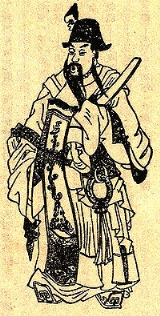
Yuan Shao (? - June 28, 202) was a powerful warlord during the late Eastern Han Dynasty and
Three KingdomsThe Three Kingdoms period is a period in the history of China, part of an era of disunity called the Six Dynasties following immediately the loss of de facto power of the Han Dynasty emperors. In a strict academic sense it refers to the period between the foundation of the Wei in 220 and the...
era of
ChinaChina is a cultural region, an ancient civilization, and, depending on perspective, a national or multinational entity extending over a large area in East Asia....
. He occupied the northern territories of ancient China during the massive civil war towards the end of the Eastern Han Dynasty and the beginning of the Three Kingdoms era. He was also the elder brother of
Yuan ShuYuan Shu was a warlord during the late Eastern Han Dynasty and Three Kingdoms era of China. He rose to prominence following the collapse of the Han court in 189. He was the younger cousin of Yuan Shao...
, a warlord who controlled the
Huai RiverThe Huai River is a major river in China. The Huai River is located about mid-way between the Yellow River and Yangtze River, the two largest rivers in China, and like them runs from west to east...
region, though the two were not in good terms with each other.
One of the most powerful warlords of his time, Yuan Shao spearheaded a coalition of warlords against the tyrannical
Dong ZhuoDong Zhuo was a powerful warlord during the late Eastern Han Dynasty and Three Kingdoms era of China. He seized control of Luoyang in 189 after the capital fell into chaos following the death of Emperor Ling and a bloody clash between the powerful eunuch faction and the court officials...
, who held Emperor Xian hostage in the capital
LuoyangLuoyang is a prefecture-level city in western Henan province, People's Republic of China. It borders the provincial capital of Zhengzhou to the east, Pingdingshan to the southeast, Nanyang to the south, Sanmenxia to the west, Jiyuan to the north, and Jiaozuo to the northeast.Situated on the...
, but failed due to internal disunity. In 200, he launched a campaign against rival warlord
Cao CaoCáo Cāo was a warlord and the penultimate Chancellor of the Eastern Han Dynasty who rose to great power during its final years in ancient China. As one of the central figures of the Three Kingdoms period, he laid the foundations for what was to become Cao Wei and was posthumously titled Emperor Wu...
but was decisively defeated at the
Battle of GuanduThe Battle of Guandu was a battle during the prelude to the Three Kingdoms period of Chinese history that took place at the Yellow River in 200....
. He died of sickness two years later in
YeYe was an ancient Chinese city located in what is now Linzhang County, Hebei and the neighbouring Anyang County, Henan.Ye was first built in the Spring and Autumn Period by Lord Huan of Qi, and by the time of the Warring States Period the city belonged to the state of Wei.Ye was a political and...
. His eventual failure despite his powerful family background and geographical advantages was commonly blamed on his indecisiveness and inability to heed the advice of his advisors.
Early life and career
A local of the county of
RuyangRuyang County is a county in the Henan province of central China, under the jurisdiction of the city of Luoyang.Ruyang County has been the site of several major discoveries of fossilized dinosaur bones, including Huanghetitan ruyangensis, which was first described in 2007.-External links:****...
(汝陽), Yuan Shao was born in the noble
YuanYuan is a Chinese surname ranked 37th in China by population. In Standard Mandarin, the surname is transliterated "Yuán" or "Yüen
2" . Regional variants include "Yeu" , "Ion" , "Yuen" , "Oan" , "Won" , and "Viên"...
family, whose members had since the 1st century been prominent in the civil bureaucracy of the Han Dynasty. Descended from the Interior Minister
Yuan AnYuan An 袁安 was a prominent scholar, administrator and statesman at the Han Dynasty courts of Emperor Zhang and Emperor He...
, who served under Emperor Zhang, Yuan Shao's exact parentage was the source of controversy and the major cause of dispute between him and
Yuan ShuYuan Shu was a warlord during the late Eastern Han Dynasty and Three Kingdoms era of China. He rose to prominence following the collapse of the Han court in 189. He was the younger cousin of Yuan Shao...
. Yuan Shao was an offspring of the Minister of Agriculture Yuan Feng (袁逢), and an elder half-brother of Yuan Feng's son, Yuan Shu, both were great-grandson of Yuan An, as recorded by the
Book of Wei (魏書) by Wang Chen (王沈). Yuan Shao's mother was originally a maid in Yuan Feng's house, and since Yuan Feng lacked male offspring, the birth of Yuan Shao elevated his mother's status from a maid to a concubine. The
Records of Three Kingdoms claimed that Yuan Shao was elder cousin to Yuan Shu. The reason for this was that Yuan Feng's older brother also lacked any male offsprings so Yuan Shao was adopted by Yuan Feng's older brother as his son. This adoption infuriated Yuan Shu, because despite also being a concubine's son, the younger Yuan Shu had a mother originally with higher status. The adoption of Yuan Shao by their elder uncle meant that Yuan Shao had become the eldest son of the clan, and would enjoy all the privileges associated with being the eldest. In their disputes in the later years, Yuan Shu would use the Yuan Shao's mother as an excuse to claim that Yuan Shao was really not a true son of the Yuan family, which inevitably would infuriate Yuan Shao. Yuan Shao was also a childhood friend of his future rival,
Cao CaoCáo Cāo was a warlord and the penultimate Chancellor of the Eastern Han Dynasty who rose to great power during its final years in ancient China. As one of the central figures of the Three Kingdoms period, he laid the foundations for what was to become Cao Wei and was posthumously titled Emperor Wu...
.
When Yuan Shao was young, he participated in saving some of the "partisans" from death or other terrible fates during the second
Disaster of Partisan ProhibitionsThe Disasters of Partisan Prohibitions refers to two incidents in which a number of Confucian scholars who served as officials in the Han imperial government and opposed to powerful eunuchs, and the university students in the capital Luoyang who supported them The Disasters of Partisan...
. After he entered into government service, Yuan Shao initially served as an aide to General-in-Chief
He JinHe Jin was the elder half-brother of Empress He, consort to Emperor Ling of the late Eastern Han Dynasty in China. He shared power with his sister as regents in 189, following the death of Emperor Ling. In the ensuing struggle with the influential eunuch faction for power, He Jin was assassinated...
and was heavily trusted by the latter. After the death of Emperor Ling in 189, He Jin and Yuan Shao jointly plotted to execute the powerful eunuch faction but the empress dowager was against the move. He Jin then summoned Dong Zhuo to lead troops into the capital Luoyang to lay pressure on the empress dowager. Meanwhile, however, He Jin was assassinated by the eunuch faction, which was then involved in a bloody clash with Yuan Shao and other followers of He Jin. The resulting power vacuum provided an excellent opportunity for Dong Zhuo to seize control of the capital when he arrived.
Dong Zhuo then discussed with Yuan Shao about his plan to depose the young successor to Emperor Ling in favor of Emperor Xian, but Yuan Shao disagreed. Relationship between the two deteriorated sharply and Yuan Shao fled the capital to Ji province (冀州, present day southern
Hebei' is a northern province of the People's Republic of China. Its one-character abbreviation is "" , named after Ji Province , a Han Dynasty province that included southern Hebei...
). Fearing the many connections the influential Yuan family had, Dong Zhuo then assigned Yuan Shao to governor of Bohai Commandery (勃海, in the vicinity of present day
CangzhouCangzhou is a prefecture-level city in Hebei province, People's Republic of China. Cangzhou's urban center has a population of approximately 488,600 , while the prefecture-level administrative region in total has a population of 6.8 million...
, Hebei) in a bid to appease the latter.
Coalition against Dong Zhuo
By early 190, however, Yuan Shao became openly hostile. A coalition of regional officials and commanders from the eastern provinces, including Cao Cao, Yuan Shu,
Han FuHan Fu was a bureaucrat during the late Eastern Han Dynasty and Three Kingdoms era of China. He was the governor of Jizhou when the Yellow Turban Rebellion broke out in 184....
,
Zhang MiaoZhang Miao was a minister of the Three Kingdoms Period who acted as prefect of Chenliu. Zhang Miao led an army during the coalition against Dong Zhuo. In the coalition Zhang expressed displeasure at their leader, Yuan Shao, and Yuan Shao sent Cao Cao to kill him. Cao Cao refused, saying that it...
and
Bao XinBao Xin was an imperial general in the late Eastern Han Dynasty in ancient China. Initially, he participated in the imperial campaign against the Yellow Turbans along with other regional warlords. After the rise of the tyrannical Dong Zhuo, who usurped the power of the Imperial Court, Bao joined...
, formed up behind him in a campaign to oust Dong Zhuo. Yuan Shao declared himself "General of Chariots and Cavalry" (車騎將軍) and camped at Henei (河內), near a ford on the
Yellow RiverThe Yellow River or Huang He / Hwang Ho is the second-longest river in China and the sixth-longest in the world at 5,464 kilometers . Originating in the Bayan Har Mountains in Qinghai Province in western China, it flows through nine provinces of China and empties into the Bohai Sea...
just north of Luoyang. Dong Zhuo then had the emperor taken to the strategically defensive
Chang'anChang'an is an ancient capital of more than ten dynasties in Chinese history. Chang'an literally means "Perpetual Peace" in Classical Chinese. During the short-lived Xin Dynasty, the city was renamed "Constant Peace" ; yet after its fall in the year 23 AD, the old name was restored...
and a year later, he burned Luoyang to the ground and withdrew to the west himself.
During this time, Yuan Shao and Han Fu had intended to boost the righteousness of the coalition by making Liu Yu, governor of You province (幽州, present day northern Hebei), the emperor. However, believing that it would be faithless to Emperor Xian for him to accept, Liu Yu declined the offer. By 191, the confrontation with Dong Zhuo had largely turned into a stalemate and the disunited leaders of the coalition soon disbanded.
Warlord state
In 191, Han Fu, governor of Ji province, gave up the governorship to Yuan Shao in the face of an imminent attack by
Gongsun ZanGongsun Zan , styled Bogui . A native of Liaoxi , he was a warlord with fierce reputation during the late Eastern Han Dynasty era of China.-Life:...
from the north. Yuan Shao then began to build a warlord state from his base city at
YeYe was an ancient Chinese city located in what is now Linzhang County, Hebei and the neighbouring Anyang County, Henan.Ye was first built in the Spring and Autumn Period by Lord Huan of Qi, and by the time of the Warring States Period the city belonged to the state of Wei.Ye was a political and...
. He engaged in a general alliance with
Liu BiaoLiú Biǎo was the governor of the Jing province during the late Eastern Han Dynasty and Three Kingdoms era of China. He was a member of the same extended family as the Han emperors....
against his own cousin (or half-brother) Yuan Shu so as to focus on the conflicts with Gongsun Zan. In the winter of that year, Yuan Shao successfully defeated the cavalry forces of Gongsun Zan at the
Battle of JieqiaoThe Battle of Jieqiao or Battle of Jie Bridge was a military engagement fought between Yuan Shao and Gongsun Zan in 191, at the beginning of the civil wars in China leading up to the fall of the Han Dynasty and was a result of the Battle of Yangcheng...
with the use of massed crossbowmen. Yuan Shao then turned southwest to eradicate the
Heishan banditsHeishan bandits was an offshoot of the Yellow Turban Rebellion during the later years of the Eastern Han Dynasty in China.-History:From the time of the Yellow Turban Rebellion, bandits and rebels sprung up everywhere. In 195, bandits leaders Zhang Niujue and Chu Yan joined forces to raid the...
. With the short-term help from
Lü BuLü Bu was a military general and later a minor warlord during the late Eastern Han Dynasty. According to the Records of Three Kingdoms, Lü Bu was a master in horseback riding and archery, and was thus known as the Flying General...
, Yuan Shao managed to defeat the bandit leader
Zhang YanZhang Yan, né Chu Yan , also known as Zhang Feiyan , was the leader of Heishan bandits. He was a native of Zhending, Changshan commandery .He was born Chu Yan...
and removed the threat to his western flank.
In subsequent years, Yuan Shao achieved considerable success in consolidating his domain and absorbing the smaller powers around him. In 196 his prominent position in northern China was recognized by Emperor Xian, who granted him the position of General-in-Chief and the title of Marquis of Ye, but Yuan Shao turned them down. In 198 Yuan Shao advanced against Gongsun Zan and encircled his remaining force at Yijing (易京, present day Xiongxian County, Hebei). By early 199 Gongsun Zan had been defeated for good at the decisive
Battle of YijingThe Battle of Yijing took part shortly before the fall of the Han Empire in China, which began the era known as the Three Kingdoms. It was fought between rival warlords Gongsun Zan, renowned as the White Horse General because of his cavalry, and Yuan Shao, a scion of the esteemed Yuan clan and...
and Yuan Shao held absolute power over the four provinces north of the Yellow River. Despite warnings from his advisor
Ju ShouJu Shou was an advisor who served the warlord Yuan Shao during the Three Kingdoms period of Chinese history.Ju was considered to be one of the most brilliant advisors of Yuan Shao and often gave honest and loyal advice to Yuan, who ignored him most of the time. Once, Ju, along with Tian Feng,...
that the move could sow seeds for future trouble, Yuan Shao insisted on sending his first-born
Yuan TanYuán Tán was the eldest son of the powerful warlord Yuan Shao, and served as a military commander under his father during the late Eastern Han Dynasty and Three Kingdoms era of China. After Yuan Shao's death, Yuan Tan split with his youngest brother Yuan Shang over the successorship to their...
away to govern Qing province (青州, present day eastern
ShandongFor the people of Shandong, see Shandong people' is a coastal province of eastern People's Republic of China. Its abbreviation is Lǔ, after the state of Lu that existed here during the Spring and Autumn Period....
). Then, after establishing alliance with the
WuhuanThe Wuhuan were a nomadic people who inhabited northern China, in what is now the provinces of Hebei, Liaoning, Shanxi, the municipality of Beijing and the autonomous region of Inner Mongolia....
tribes on the northern frontier, Yuan Shao eventually turned his attention to Cao Cao, who had been consolidating his power south of the Yellow River.
Battle of Guandu
Both sides made preparations for a decisive battle, which would come to be known as the Battle of Guandu. Towards the end of 199 skirmishes were already being fought at
LiyangLiyang is a county-level city within Changzhou of Jiangsu province, in China, and considered by many to be home to China's most beautiful women...
, a major crossing point of the Yellow River. Cao Cao prepared his defenses around
GuanduGuandu may refer to:*Battle of Guandu, battle between Cao Cao and Yuan Shao in the Three Kingdoms Period*Guandu Station, in Beitou District, Taipei City, Taiwan*Guandu District, in Kunming, Yunnan, China...
(官渡, northeast of present day
Zhongmu CountyZhongmu County is a county in Zhengzhou, Henan Province, People's Republic of China. It has an area of 1416.8 square kilometers and a population of 680,000....
,
HenanHenan , is a province of the People's Republic of China, located in the eastern central part of the country. Its one-character abbreviation is 豫 , named after Yuzhou Province , a Han Dynasty province that included parts of Henan...
), slightly south of the river. Heavily outnumbering Cao Cao and holding large cavalry force, Yuan Shao's initial attacks almost overwhelmed his enemy's positions. A strike at Yuan Shao's supply lines in late 200, however, brought the northern army to a collapse. As many of his generals defected, Yuan Shao fled north across the Yellow River with his sons.
His first major defeat was also a decisive one. Thereafter, Yuan Shao lost the initiative and never regained it. In 201, he was again defeated, this time at the
Battle of CangtingThe Battle of Cangting is part of the mop-up operation undertaken by Cao Cao after his brilliant victory over Yuan Shao in the Battle of Guandu, during the end of Han Dynasty in China...
(倉亭, in the vicinity of present day
Yanggu County, ShandongYanggu is a county of the Chinese province of Shandong. It is administered by the subprovincial town of Liaocheng.The population was in 1999.-External links:*...
). He died shortly after. His first wife, so filled with jealousy, killed his other five consorts and disfigured their faces to prevent them from meeting him in the underworld. True to Ju Shou's previous warning, Yuan Shao's legacy was left to contention between his eldest and youngest sons, Yuan Tan and
Yuan ShangYuán Shàng was the third son of Yuan Shao, an influential warlord and noble who rose to power during late Eastern Han Dynasty and Three Kingdoms era of China....
. Cao Cao was able to manipulate this internal rivalry, and by 207 had defeated both.
It is said that Cao Cao paid respect to Yuan Shao's tomb after his total annexation of his former countries, Cao Cao was showing remorse in front of his generals and made a comment that it was unavoidable for turning his former friend into an enemy.
Cause of his defeat
Yuan Shao's defeat to Cao Cao at Guandu is cited as an excellent example of how superior tactics and strategy can be used to defeat much larger forces. By using feints, counterattacks and strategic withdrawals, Cao Cao managed to render Yuan Shao's vastly superior manpower useless. It can be said Yuan Shao was simply outsmarted by his former friend Cao Cao. According to some sources, however, his defeat can be attributed to his failure to listen to his advisor
Tian FengTian Feng was an advisor to warlord Yuan Shao during the later years of the Eastern Han Dynasty in China.After defeating Gongsun Zan and absorbing many of his forces, Yuan Shao intended to invade the capital, Xuchang, which was in Cao Cao's possession at that time. Tian Feng, along with Ju Shou...
. It is said that he lost his chance to defeat Cao Cao early on when he refused to mobilise his army, claiming his son was ill with a toothache.
Some believe Yuan Shao's defeat was caused by senility. They argue that it would explain how a man who managed to become for a good period of time the dominant force in China could suddenly fail so completely. It is highly likely that it was a combination of senility, inability to listen to advice and his unfortunate luck in finding such a cunning foe that was Yuan Shao's downfall.
Cao Cao had once analysed Yuan Shao before the Battle of Guandu. Cao Cao said: Yuan Shao will be defeated during the war.
- He is arrogant, self-centred, and senile;
- His advisers fight against each other;
- His generals have brawn but no brain, (to put it literally) Yan Liang
Yan Liang was a military general under the powerful warlord Yuan Shao during the late Eastern Han Dynasty and Three Kingdoms era of China. He was slain by Guan Yu at the Battle of Baima.Little is known about Yan Liang's life...
and Wen ChouWen Chou was a military general under the powerful warlord Yuan Shao during the late Eastern Han Dynasty and Three Kingdoms era of China. His force was defeated by that of rival warlord Cao Cao in the Battle of Yan Ford and he was killed in the midst of battle.Historical record of Wen Chou is scarce...
, valiant but stupid in terms of using tactics;
- His sons' rivalry: All 3 brothers can't seem to unite
- He did not respect his officers or troops
These reasons Cao Cao noted were indeed true, Yuan Shao was defeated not long after this analysis.
Modern citations
- Yuan Shao has appeared in Koei
Koei Co., Ltd. , formerly 光栄 ) is a Japanese video game publisher, developer, and distributor founded in 1978...
's Dynasty Warriorsis a series of tactical action video games created by Omega Force/Koei! The award-winning series is a spin-off of Koei's turn-based strategy Romance of the Three Kingdoms series, based loosely around the Chinese epic of the same name. The first game titled Dynasty Warriors, Sangokumusō in Japan, is...
and Dynasty TacticsDynasty Tactics is a series of strategy games for the Sony PlayStation 2. The titles are set in the same time-period as several of Koei's other series, including the action-oriented Dynasty Warriors series and the strategy Romance of the Three Kingdoms series...
video game series.
- In Warriors Orochi
Warriors Orochi, known in Japan as , is a PlayStation 2 and Xbox 360 hack and slash video game developed by Koei and Omega Force. It is a crossover of two of Koei's popular video game series, Dynasty Warriors and Samurai Warriors...
a crossover game between Dynasty Warriors and Samurai WarriorsSamurai Warriors is the first title in the series of video games created by Koei's Omega Force team based loosely around the Sengoku period of Japanese history and it is a spinoff of the Dynasty Warriors series...
, Yuan Shao leads a resistance army with the aid of Yukimura Sanada. After his defeat at Cheng Du he and his forces are captured by Orochi, but are rescued by the resistance army led by Zhao Yun. He then joins Zhao Yun in the fight against Orochi.
- Yuan Shao has a minor role in Koei's Kessen II
is a strategy game loosely based on the Three Kingdoms period of China. It is the sequel to Kessen in name only; both Kessen and the later sequel Kessen III are based on events in Japan....
title. In the game, the Battle of Guandu distracts Cao Cao, allowing Liu BeiLiu Bei , styled Xuándé , was a general, warlord, and later the founding emperor of Shu Han during the Three Kingdoms era of China...
, an ally of Yuan Shao and the player's character, to advance to Runan, setting the stage for the game's second level.
- He also is in each of the 11 versions of Koei's strategical simulation, Romance of the Three Kingdoms. He is portrayed very closely to that of his novel persona, and has stats that follow the same pattern as Cao Cao's in the game, but lower.
- He is also mentioned in Squaresoft's 'Final Fantasy IX'
is a console role-playing game developed and published by Square as the ninth installment in the Final Fantasy series. It was released in 2000 and is the third and last numbered Final Fantasy game for Sony's PlayStation...
: There is a location called the Yuanshao Peninsula.
See also
- Eastern Han Dynasty
- Three Kingdoms
The Three Kingdoms period is a period in the history of China, part of an era of disunity called the Six Dynasties following immediately the loss of de facto power of the Han Dynasty emperors. In a strict academic sense it refers to the period between the foundation of the Wei in 220 and the...
- Personages of the Three Kingdoms
The following is a list of personages significant to the Three Kingdoms period of Chinese history. They provided the basis of what is often termed "Matter of the Three Kingdoms", a favourite subject for Chinese folklore...
- Records of Three Kingdoms
- Romance of the Three Kingdoms
Romance of the Three Kingdoms , written by Luo Guanzhong in the 14th century, is a Chinese historical novel based upon events in the turbulent years near the end of the Han Dynasty and the Three Kingdoms era of China, starting in 169 and ending with the reunification of the land in 280.It is...