
All Topics  
Rammed earth

 
Rammed Earth

   Email Print
   Bookmark   Link


Rammed earth


Rammed earth, also known as pisé de terre or simply pisé, is a type of construction material. It is an age-old building
Construction

In the fields of architecture and civil engineering, construction is a process that consists of the building or assembling of infrastructure. Far from being a single activity, large scale construction is a feat of multitasking....
 method that has seen a revival in recent years as people seek more sustainable
Sustainability

Sustainability, in a broad sense, is the ability to maintain a certain process or state. It is now most frequently used in connection with biological and human systems....
 building material
Building material

Building material is any raw material which is used for a construction purpose. Many naturally occurring substances, such as clay, sand, wood and rocks, even twigs and leaves have been used to construct buildings....
s and natural building
Natural building

A natural building involves a range of building systems and materials that place major emphasis on sustainability. Ways of achieving sustainability through natural building focus on durability and the use of minimally-processed, plentiful or renewable resources, as well as those which, while Recycling or salvaged, produce healthy living envi...
 methods.


Discussion
Ask a question about 'Rammed earth'
Start a new discussion about 'Rammed earth'
Answer questions from other users
Full Discussion Forum


Recent Posts


Encyclopedia


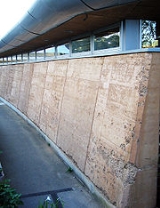
Rammed Earth Wall   Eden Project
Rammed earth, also known as pisé de terre or simply pisé, is a type of construction material. It is an age-old building
Construction

In the fields of architecture and civil engineering, construction is a process that consists of the building or assembling of infrastructure. Far from being a single activity, large scale construction is a feat of multitasking....
 method that has seen a revival in recent years as people seek more sustainable
Sustainability

Sustainability, in a broad sense, is the ability to maintain a certain process or state. It is now most frequently used in connection with biological and human systems....
 building material
Building material

Building material is any raw material which is used for a construction purpose. Many naturally occurring substances, such as clay, sand, wood and rocks, even twigs and leaves have been used to construct buildings....
s and natural building
Natural building

A natural building involves a range of building systems and materials that place major emphasis on sustainability. Ways of achieving sustainability through natural building focus on durability and the use of minimally-processed, plentiful or renewable resources, as well as those which, while Recycling or salvaged, produce healthy living envi...
 methods. Traditionally, rammed earth buildings are common in arid regions where wood
Wood

Wood is an organic material; in the strict sense wood is produced as secondary xylem in the stems of woody plants, notably trees but also shrubs, etc....
 is in scarce supply.

Overview of use

Using it involves a process of compressing a damp mixture of earth
Soil

Soil is the naturally occurring, unconsolidated or loose covering on the Earth's surface. Soil is composed of particles of broken rock that have been altered by chemical and environmental processes including weathering and erosion....
 that has suitable proportions of sand
Sand

Sand is a naturally occurring granular material composed of finely divided rock and mineral particles.As the term is used by geologists, sand particles range in diameter from 0.0625 to 2 millimeters....
, gravel and clay
Clay

Clay is a naturally occurring material composed primarily of fine-grained minerals, which show plasticity through a variable range of water content, and which can be hardened when dried and/or fired....
 (sometimes with an added stabilizer) into an externally supported frame that molds the shape of a wall section creating a solid wall of earth. Traditional stabilizers such as lime
Lime (mineral)

Lime is a general term for calcium-containing inorganic materials, in which carbonates, oxides and hydroxides predominate. Strictly speaking, lime is calcium oxide or calcium hydroxide....
 or animal blood were used to stabilize the material, but cement
Cement

In the most general sense of the word, a cement is a binder, a substance which sets and hardens independently, and can bind other materials together....
 has been the stabilizer of choice for modern times. However the use of cement is contentious as its manufacture creates 10% of man made carbon emissions . After compressing the earth the wall frames can be immediately removed and require an extent of warm dry days after construction to dry and harden. The structure can take up to two years to completely cure, and the more it cures the stronger the structure becomes. When the process is complete it is much like constructing a hand made wall of solid rock.

Formwork is set up creating the desired shape of the section of wall; damp material is poured in to a depth of between . A pneumatically powered backfill tamper — something like a hand-held pogo stick with a flat plate on the bottom or even a manual tamper — is then used to compact the material to around 50% of its original height. Further layers of material are added and the process is repeated until the wall has reached the desired height. The wall is so solid that, if desired, the forms can be removed immediately. This is necessary if wire brushing to reveal texture is desired otherwise walls become too hard to brush after around 60 minutes. Walls take some time to dry out completely, but this does not prevent further work on the project. Any exposed walls may be sealed to prevent water damage — there are several proprietary products specifically designed to seal earth walls.

In modern variations of the method the rammed earth walls are constructed on top of conventional footings
Foundation (architecture)

A foundation is a structure that transfers loads to the earth. Foundations are generally broken into two categories: shallow foundations and deep foundations....
 or a reinforced concrete
Reinforced concrete

Reinforced concrete is concrete in which steel reinforcement bars or fibers have been incorporated to strengthen a material that would otherwise be brittle....
 base, sometimes with extra ground insulation
Thermal insulation

The term thermal insulation can refer to materials used to reduce the rate of heat transfer, or the methods and processes used to reduce heat transfer....
 from a horizontal layer of styrofoam
Styrofoam

Styrofoam is a trademark of Dow Chemical Company for presently made for thermal insulation and craft applications .In 1940, researchers in Dow's Chemical Physics Lab found a way to make foamed polystyrene....
. Some builders also add coloured oxides or other items such as bottles or pieces of timber to add variety to the structure.

Once completely cured the walls are very workable. It is easy to drive a nail or screw into them and they can be patched if necessary with the result being undetectable if the same material was used.

One of the significant benefits of rammed earth constructions is its excellent thermal mass
Thermal mass

Thermal mass is the capacity of a body to store heat, and is calculated as the product of mass the body and the specific heat capacity for the material , and typically is measured in units of J/?C or J/K ....
; it heats up slowly during the day and releases its heat during the evening. This can even out daily temperature variations and reduce the need for air conditioning
Air conditioning

An air conditioner is an appliance, system, or Mechanism designed to extract heat from an area via a refrigeration cycle. In construction, a complete system of heating, Ventilation , and air conditioning is referred to as "HVAC." Its purpose, in a building or an automobile, is to provide comfort during either hot or cold...
 and heating
Heating

Heating may refer to:*HVAC: Heating, ventilation and air-conditioningHeating devices, or systems:*Block heater, or headbolt heater, an electric heater that heats the engine of a car to ease starting in cold weather...
. On the other hand, rammed earth is not a good insulator. Like brick
Brick

A brick is a block of ceramic material used in masonry construction, usually laid using mortar ....
 and concrete
Concrete

Concrete is a construction material composed of cement as well as other cementitious materials such as fly ash and slag cement, construction aggregate , water , and Chemistry admixtures....
 (which also have excellent thermal mass), rammed earth is often insulated in colder climates. The thickness and density
Density

The density of a material is defined as its mass per unit volume. The symbol of density is ....
 of the walls lends itself naturally to soundproofing
Soundproofing

Soundproofing is any means of reducing the sound pressure with respect to a specified sound source and receptor. There are several basic approaches to reducing sound: increasing the distance between source and receiver, using noise barriers to block or absorb the energy of the sound waves, using damping structures such as sound baffles, or...
 and the materials used in the walls make them virtually fireproof
Fireproof

Fireproof is Christian band Pillar 's second full length album and their most successful, having sold over 300,000 copies. It was released in at least three different versions including a Remixed version and a limited Special Edition that came with Pillar's All Day Every Day DVD and a slipcase....
.

Rammed earth has been used around the globe for millennia in a wide range of climatic conditions, from wet northern Europe to dry regions in Africa. Rammed earth walls may be placed within the weatherproof fabric of the building. Depending on conditions walls may also have external insulation, soft plaster, timber cladding or a number of locally specific finishes which are applied to masonry buildings.

History


Evidence of the early use of rammed earth as been seen in Neolithic
Neolithic

The Neolithic period was a period in the development of human technology, beginning about 9500 Before the Christian Era in the Middle East that is traditionally considered the last part of the Stone Age....
 archaeological sites of the Yangshao culture
Yangshao culture

The Yangshao culture was a Neolithic culture that existed extensively along the central Yellow River in China. The Yangshao culture is dated from around 5000 BC to 3000 BC....
 and the Longshan culture
Longshan culture

The Longshan culture was a late Neolithic culture in China, centered on the central and lower Yellow River and dated from about 3000 BC to 2000 BC....
 in China
China

China is a Culture of China, an ancient civilization, and, depending on perspective, a national or multinational entity extending over a large area in East Asia....
 along the Yellow River
Yellow River

The Yellow River or Huang He / Hwang Ho is the second-longest river in China and the List of rivers by length in the world at 4,845 kilometers ....
 dating back to 5000 BCE. By 2000 BCE, the use of rammed earth architectural techniques was commonly used for walls and foundations in China.

In the 1800s in the United States, rammed earth was popularized by a book Rural Economy by S. W. Johnson. For example, it was used to construct Borough House Plantation
Borough House Plantation

Borough House Plantation, also known as Borough House, Hillcrest Plantation and Anderson Place, is an historic place in Stateburg, South Carolina, in the High Hills of Santee near Sumter, South Carolina....
 and Church of the Holy Cross
Church of the Holy Cross (Stateburg, South Carolina)

Church of the Holy Cross, also known as the Holy Cross Episcopal Church, is an historic church in Stateburg, South Carolina, in the High Hills of Santee near Sumter, South Carolina....
 in South Carolina, which are two National Historic Landmarks of the United States. The National Historic Landmark description for one states:

An outstanding example of rammed earth construction in Canada
Canada

Canada is a country occupying most of northern North America, extending from the Atlantic Ocean in the east to the Pacific Ocean in the west and northward into the Arctic Ocean....
 is St. Thomas Anglican Church (Shanty Bay, Ontario)
St. Thomas Anglican Church (Shanty Bay, Ontario)

St. Thomas Anglican Church is an historic Gothic Revival style Anglican Church of Canada church building located at 28 Church Street, in Shanty Bay, Ontario in the township of Oro-Medonte, Ontario in Simcoe County, Ontario, Ontario, Canada....
 built between 1838 and 1841.

During the 1920s through the 1940s millions of dollars were spent by the US Government and several western universities researching rammed earth construction. South Dakota State College carried out extensive research and built almost 100 weathering walls of rammed earth. Over a period of thirty years of exploration the college researched the use of paints and plasters relation of colloids in soil. In 1945 Clemson Agricultural College of South Carolina published their results on rammed earth research in a pamphlet called "Rammed Earth Building Construction." In 1936 on a homestead near Gardendale, Alabama, the United States Department of Agriculture
United States Department of Agriculture

The United States Department of Agriculture is the United States federal executive departments responsible for developing and executing Federal government of the United States policy on farming, agriculture, and food....
 constructed an experimental community of rammed earth buildings with architect Thomas Hibben. The houses were built at a very reasonable cost and sold to the public, along with tracts of land sufficient enough for a garden and small livestock plots. The project was a success and provided valuable homes to low-income families.
Rammed Earth
The U.S. Agency for International Development has spent millions of dollars teaching undeveloped countries building science about rammed earth houses. They also financed the writing of the "Handbook of Rammed Earth" by Texas A&M University
Texas A&M University

Texas A&M University, often called A&M or TAMU, is a coeducational public university research university located in College Station, Texas, Texas....
 and the Texas Transportation Institute
Texas Transportation Institute

The Texas Transportation Institute in College Station, Texas is the largest transportation research agency in the United States. Created in 1950, primarily in response to the needs of the Texas Highway Department , TTI has since broadened its focus to address all modes of transportation?highway, air, water, rail and pipeline....
. The handbook was never available for purchase by the public until the Rammed Earth Institute International gained permission to reprint it.

Interests in rammed earth fell after World War II
World War II

World War II, or the Second World War , was a global military conflict which involved a Participants in World War II, including all of the great powers, organised into two opposing military alliances: the Allies of World War II and the Axis powers....
 when the costs of modern building materials dropped. Rammed earth became viewed as substandard and it suffered from the prejudice that using earth technique seemed too basic in the face of new technology and too dependent on labor intensive methods. Soil as a building material meets opposition with many contractors, engineers, and tradesmen who are unfamiliar with earth construction techniques. Often the modern method of construction seems easier. Profitable investment seems too uncertain so rammed earth construction is often neglected in modern building cultures.

Rammed earth in green building

Rammed Earth Wall Surface
Rammed earth structures utilize locally available materials with little embodied energy
Embodied energy

Embodied energy refers to the quantity of energy required to manufacture, and supply to the point of use, a product, material or service. .Traditionally considered, embodied energy is an accounting methodology which aims to find the sum total of the energy necessary - from the raw material extraction, to transport, manufacturing, assembly,...
 and wasted materials. The soil used for building is a widely available resource with virtually no side effects associated with harvesting for use in construction. The soils used are typically subsoil
Subsoil

Subsoil is the layer of soil under the topsoil on the surface of the ground. The subsoil may include substances such as clay and has only been partially broken down by air, sunlight, water etc., to produce true soil....
s, leaving topsoil
Topsoil

Topsoil is the upper, outermost layer of soil, usually the top 2 to 8 inches. It has the highest concentration of organic matter and microorganisms and is where most of the Earth's biology soil activity occurs....
 readily available for agricultural uses. Often the soil can be used on the site where the construction takes place reducing cost and energy used for transportation. It is also affordable to build with, as the materials are inexpensive or free. It is a viable building material for low- income builders with help from unskilled workers, friends, or family. Today more than 30 percent of the world's population uses earth as a building material.

Compressing the earth can be done manually using a tamper made of a heavy flat bottom plate connected to a long vertical handle. Using a pneumatically powered tamper the material can be compressed with much less manual labor. Although the cost of material is low, constructing rammed earth without mechanical tools is a time consuming project. With a mechanical tamper and the forms ready it can take about two to three days to construct the walls for a 2000–2200 sq ft house.

Rammed earth buildings reduce the need for lumber because the forms used are removable and can then be reused for different rammed earth wall construction. The forms are usually made of reinforced plywood, but sheet metal or even glass fiber can be used. The form wall faces must be externally reinforced with laterally running beams to prevent outward bending of the wall faces during the compression process. The two opposing wall faces must be clamped together and the wall edges need to be securely compressed between the form faces to withstand the high amounts of pressure created during compression.

The USDA observed that rammed earth structures last indefinitely and could be built for no more than two-thirds the cost of standard frame houses. Rammed earth can carry a heavy load and using re-bar, wood or bamboo reinforcement can prevent failure caused by earthquakes or heavy storms. Mixing cement with the soil mixture can also increase the structure's load bearing capacity but problems arise in the mixing of cement with material containing clay. As a result common practice in the areas using cement on a regular basis (Australia and California) require sand and gravel mixes without a clay content. This is known as concrete by any other name except for the fact that the walls are built with a lower (too low?) water content which leaves the walls weaker than if they had been mixed as conventional concrete. The compression
Compression

Compression may refer to:In physical science:*Physical compression, the result of the subjection of a material to compressive stress**Compression member, a class of structural elements, of which a column is the most common specific example...
 strength of rammed earth can be up to 625 pounds per square inch. This is only two-thirds the value of a similar thickness of concrete, but a rammed earth building is still a useful durable material. Termites won’t infest rammed earth walls and the material is reusable, biodegradable and highly fire resistant. Properly built rammed earth can withstand loads for thousands of years as the history of rammed earth structures around the world has proven. Untouched the walls have the color and texture of natural earth. Blemishes can also be patched up using the soil mixture as a plaster and sanded smooth. Care needs to be taken to avoid moisture-impermeable finishes, as these will impair the ability of the wall to desorb moisture, which will lead in turn to a loss of compressive strength.

Rammed earth is a green material for a number of reasons. It does provide good thermal mass, which implies good heat storage and absorption. It also controls humidity where walls contain clay which is exposed to an internal space. Humidity is held between 40% and 60%, the lower and upper trigger points for asthma sufferers as it happens, as well as the ideal humidity for the storage of items such as books. These effects come as part of the package when cement is not used. When cement is used these effects are not present. Cement also adds to the global carbon dioxide burden at a rate of 1.25tonnes per tonne of cement produced. Given cement blocks and walls rammed with a cement content vary in cement content in a range between 5% and 13%, a 300mm thick 'earth' wall with cement in will typically have a higher emissions burden than a 115mm concrete block wall, and therefore cannot seriously be considered green.

Rammed earth is not only an economically viable construction technique, it results in pleasant, and energy-efficient buildings. The density and thickness of rammed earth makes it so that hot or cold temperature penetration has a slow rate of thermal conductivity. Warmth takes almost 12 hours to work its way through a thick wall. The walls provide good thermal mass
Thermal mass

Thermal mass is the capacity of a body to store heat, and is calculated as the product of mass the body and the specific heat capacity for the material , and typically is measured in units of J/?C or J/K ....
, which helps keep indoor temperatures stable, particularly in regions with dramatic daily temperature changes. The half-day rate of heat transfer and thermal mass of the material makes rammed earth a practical material for passive solar buildings. Rammed earth has been a popular choice for buildings where temperature fluctuations need to be kept to a minimum. It can be used in cooler climates but must be protected from heavy rain and insulated with vapor barriers.

Typically rammed earth walls are about 12 to thick making them ideal for humidity
Humidity

Humidity is the amount of water vapor in the air. In daily language the term "humidity" is normally taken to mean relative humidity. Relative humidity is defined as the ratio of the partial pressure of water vapor in a Air parcel of air to the saturated vapor pressure of water vapor at a prescribed temperature....
 control and noise barriers from traffic, furnaces, compressors, fans or ducts. Rammed earth also allows more air exchange than concrete structures allowing the building to breathe and not become clammy without significant heat loss as the material mass absorbs the temperature as the wall breathes.

By its very nature, earth is one of the best sustainable building materials as it is historically the longest used material by man. It is universally a naturally available product, with a heavy thermal mass and a natural barrier to cold winds and forces of nature including insects and rodents. The material is not rationed or monopolized, is fire proof, and sound proof. Rammed earth can contribute to a solution for much of the world of homelessness caused by high costs as well as today ecological dilemma caused by deforestation
Deforestation

Deforestation is the logging or burning of trees in forested areas. There are several reasons for doing so: trees or derived charcoal can be sold as a commodity and are used by humans while cleared land is used as pasture, plantations of commodities and human settlement....
 and toxic building materials.

See also

  • Adobe
    Adobe

    Adobe is a natural building material made from sand, clay, and water, with some kind of fibrous or organic material , which is shaped into bricks using frames and dried in the sun....
  • Building construction
  • Cob (material)
  • Compressed earth block
    Compressed earth block

    Compressed Earth Block often referred to simply as CEB, is a type of manufactured construction material formed in a mechanical press that forms an appropriate mix of dirt, non-expansive clay, and an aggregate into a compressed block....
  • Earthbag construction
    Earthbag construction

    Earthbag construction is a very inexpensive method of construction that is very strong and can be built very quickly. It is a natural building technique that has evolved from historic military bunker construction techniques, and temporary flood-control Dike building methods....
  • Dutch brick
    Dutch brick

    Dutch bricks are building-blocks made, not of brick, but of a mixture of concrete, sand and soil. They are not Netherlands; rather, the name results from the use of the word "Dutch" to mean "inferior"....
  • Mudbrick
    Mudbrick

    A mudbrick is a firefree brick made of clay, or mud mixed with a binding material such as rice husks or straw.In warm regions with very little timber available to fuel a kiln, bricks were generally sun dried....
  • Super Adobe
    Super Adobe

    Super Adobe is a form of Earthbag Construction that was developed by Iranian architect Nader Khalili. The technique uses long snake-like sand bags to form a beehive shaped compressive structure that employs arches, domes, and vaults to create single and double-curvature shell structures that are strong and aesthetically pleasing....