
All Topics  
Gobi Desert

 
Gobi Desert

   Email Print
   Bookmark   Link


Gobi Desert


The Gobi (Govi or Gov', "gravel-covered plain"; Chinese
Chinese language

Chinese or the Sinitic language is a language family consisting of language mutually unintelligible to varying degrees. Originally the indigenous languages spoken by the Han Chinese in China, it forms one of the two branches of Sino-Tibetan languages of languages....
: Gebì (Shamò)) is the largest desert
Désert

?D?sert? is ?milie Simon's debut single, released in October 2002. The song was a huge success both critically and commercially in her homeland....
 region in Asia
Asia

Asia is the world's largest and most populous continent. It covers 8.6% of the Earth's total surface area and, with over 4 billion people, it contains more than 60% of the world's current human population....
. It covers parts of northern and northwestern China
China

China is a Culture of China, an ancient civilization, and, depending on perspective, a national or multinational entity extending over a large area in East Asia....
, and of southern Mongolia
Mongolia

Mongolia is a landlocked country in East Asia and Central Asia. It borders Russia to the north and People's Republic of China to the south, east and west....
. The desert basins of the Gobi are bounded by the Altai Mountains and the grasslands and steppes of Mongolia on the north, by the Hexi Corridor
Hexi Corridor

Hexi Corridor or Gansu Corridor refers to the historical route in Gansu province of China. As part of the Northern Silk Road running northwest from the bank of the Yellow River, it used to be the most important passage from North China to Xinjiang and Central Asia for traders and the military....
 and Tibetan Plateau
Tibetan Plateau

The Tibetan Plateau , also known as the Qinghai-Tibetan Plateau is a vast, elevated plateau in Central Asia covering most of the Tibet Autonomous Region and Qinghai Province in China and Ladakh in Kashmir, India....
 to the southwest, and by the North China Plain
North China Plain

The North China Plain is based on the deposits of the Yellow River and is the largest alluvial plain of eastern Asia. The plain is bordered on the north by the Yanshan Mountains and on the west by the Taihang Mountains....
 to the southeast. The Gobi is made up of several distinct ecological and geographic regions based on variations in climate and topography.


Discussion
Ask a question about 'Gobi Desert'
Start a new discussion about 'Gobi Desert'
Answer questions from other users
Full Discussion Forum


Recent Posts


Encyclopedia


The Gobi (Govi or Gov', "gravel-covered plain"; Chinese
Chinese language

Chinese or the Sinitic language is a language family consisting of language mutually unintelligible to varying degrees. Originally the indigenous languages spoken by the Han Chinese in China, it forms one of the two branches of Sino-Tibetan languages of languages....
: Gebì (Shamò)) is the largest desert
Désert

?D?sert? is ?milie Simon's debut single, released in October 2002. The song was a huge success both critically and commercially in her homeland....
 region in Asia
Asia

Asia is the world's largest and most populous continent. It covers 8.6% of the Earth's total surface area and, with over 4 billion people, it contains more than 60% of the world's current human population....
. It covers parts of northern and northwestern China
China

China is a Culture of China, an ancient civilization, and, depending on perspective, a national or multinational entity extending over a large area in East Asia....
, and of southern Mongolia
Mongolia

Mongolia is a landlocked country in East Asia and Central Asia. It borders Russia to the north and People's Republic of China to the south, east and west....
. The desert basins of the Gobi are bounded by the Altai Mountains and the grasslands and steppes of Mongolia on the north, by the Hexi Corridor
Hexi Corridor

Hexi Corridor or Gansu Corridor refers to the historical route in Gansu province of China. As part of the Northern Silk Road running northwest from the bank of the Yellow River, it used to be the most important passage from North China to Xinjiang and Central Asia for traders and the military....
 and Tibetan Plateau
Tibetan Plateau

The Tibetan Plateau , also known as the Qinghai-Tibetan Plateau is a vast, elevated plateau in Central Asia covering most of the Tibet Autonomous Region and Qinghai Province in China and Ladakh in Kashmir, India....
 to the southwest, and by the North China Plain
North China Plain

The North China Plain is based on the deposits of the Yellow River and is the largest alluvial plain of eastern Asia. The plain is bordered on the north by the Yanshan Mountains and on the west by the Taihang Mountains....
 to the southeast. The Gobi is made up of several distinct ecological and geographic regions based on variations in climate and topography. This desert is the fifth largest in the world
List of deserts by area

This is a list of deserts in the world ordered by area. It includes all deserts with an area greater than 50 000 km? ....
.

The Gobi is most notable in history as part of the great Mongol Empire
Mongol Empire

The Mongol Empire was the List of largest empires#Contiguous Empires empire and the largest bar none. It emerged from the unification of Mongols and Turkic peoples tribes in modern day Mongolia, and grew through Mongol invasions, after Genghis Khan had been proclaimed ruler of all Mongols in 1206....
, and as the location of several important cities along the Silk Road
Silk Road

The Silk Road is an extensive interconnected network of trade routes across the Asian continent connecting East, South, and Western Asia with the Mediterranean world, including North Africa and Europe....
.

The Gobi is a rain shadow
Rain shadow

For the Australian television series see Rain Shadow .A rain shadow or rainshadow, or more accurately, precipitation shadow, is a dry region of land that is leeward of a mountain range or other geographic feature, with respect to prevailing wind direction....
 desert formed by the Himalaya range blocking rain-carrying clouds from reaching the Gobi.

Geography


The Gobi measures over from southwest to northeast and from north to south. The desert is widest in the west, along the line joining the Baghrash Kol and the Lop Nor (87°-89° east). It occupies an arc of land in area, making it fifth largest in the world and Asia's largest. Much of the Gobi is not sandy but is covered with bare rock.

The Gobi has several different Chinese names, including ?? (shamò, actually a generic term for deserts in general) and ?? (hànhai, endless sea). In its broadest definition, the Gobi includes the long stretch of desert and semi-desert area extending from the foot of the Pamirs, 77° east, to the Greater Khingan
Greater Khingan

The Greater Khingan Range , also called the Greater Hing'an Range or Greater Hinggan Range, is a volcanic mountain range in Inner Mongolia in northeastern China....
 Mountains, 116°-118° east, on the border of Manchuria
Manchuria

Manchuria is a historical name given to a vast geographic region in northeast Asia. Depending on the definition of its extent, Manchuria either falls entirely within People's Republic of China, or is divided between China and Russia....
; and from the foothills of the Altay, Sayan
Sayan Mountains

The Sayan Mountains are a mountain range in southern Siberia, Russia.The Eastern Sayan extends 1000 km from the Yenisey River at 92? E to the southwest end of Lake Baikal at 106? E....
, and Yablonoi
Yablonoi Mountains

The Yablonoi Mountains or Yablonovy Mountains is a mountain range in Siberia. The range runs north-east from Mongolia, passing just to the east of Lake Baikal....
 mountain ranges on the north to the Kunlun Shan, Altun Shan, and Qilian
Qilian

The Qilian Mountains is a northern outlier of the Kunlun Mountains, forming the border between the Qinghai and the Gansu provinces of northern China....
 shan ranges, which form the northern edges of the Tibetan Plateau, on the south.

A relatively large area on the east side of the Greater Khingan range, between the upper waters of the Songhua (Sungari) and the upper waters of the Liao-ho, is also reckoned to belong to the Gobi by conventional usage. On the other hand, geographer
Geographer

A geographer is a scientist whose area of study is geography, the study of Earth's physical natural environment and human habitat .Though geographers are historically known as people who make maps, map making is actually the field of study of cartography, a subset of geography....
s and ecologists
Ecology

Ecology is the science study of the distribution and Abundance of life and the interactions between organisms and their nature environment ....
 prefer to regard the western area of the Gobi region (as defined above), the basin of the Tarim in Xinjiang
Xinjiang

Xinjiang is an autonomous region of China of the People's Republic of China. It is a large, sparsely populated area, spanning over 1.6 million sq....
 and the desert basin of Lop Nor and Hami (Kumul
Kumul

For the Kumuls see Papua New Guinea national rugby league teamKumul or Hami is an oasis in Hami Prefecture, Xinjiang ; it is also the name of a modern city and the surrounding district....
) as forming a separate and independent desert, called the Taklamakan Desert.

The Nemegt Basin
Nemegt Basin

The Nemegt Basin is situated in the northwestern part of the Gobi Desert, in the ?mn?govi Province in the southern part of Mongolia. It is known locally as the valley of the dragons, since it is a Bone bed of many fossil finds, including dinosaurs, dinosaur eggs and Ichnite....
 in the northwestern part of the Gobi Desert (in Mongolia) is famous for its fossil treasures, including early mammals, dinosaur
Dinosaur

Dinosaurs were the dominant vertebrate animals of Landform ecosystems for over 160 million years, from the late Triassic Period until the end of the Cretaceous Period , when most of them became extinct in the Cretaceous?Tertiary extinction event....
 eggs, and even prehistoric stone implements, some 100,000 years old.

Climate

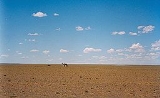
Gobi Desert
said to inhabit the Gobi in Mongolia.]]

The Gobi is a cold desert, and it is not uncommon to see frost and occasionally snow on its dunes. Besides being quite far north, it is also located on a plateau roughly 910-1,520 meters (3,000-5,000 ft) above sea level, which further contributes to its low temperatures. An average of approximately 194 millimeters (7.6 in) of rain falls per year in the Gobi. Additional moisture reaches parts of the Gobi in winter as snow is blown by the wind from the Siberian Steppes. These winds cause the Gobi to reach extremes of temperature ranging from –40°C (-40°F) in winter to +40°C (104°F) in summer.

Climate (as of 2021)


The climate
Climate

Climate encompasses the temperatures, humidity, atmospheric pressure, winds, rainfall, atmospheric particle count and numerous other Meteorology elements in a given region over long periods of time, as opposed to the term weather, which refers to current activity of these same elements....
 of the Gobi is one of great extremes, combined with rapid changes of temperature
Temperature

In physics, temperature is a physical property of a Physical system that underlies the common notions of hot and cold; something that feels hotter generally has the greater temperature....
, not only through the year but even within 24 hours (by as much as 32 °C or 58 °F).

Even in southern Mongolia the thermometer
Thermometer

The thermometer is a device that measures temperature or temperature gradient using a variety of different principles; it comes from the Greek language roots thermo, heat, and meter, to measure....
 goes down as low as -32.8 °C (-27 °F), and in Alxa
Alxa League

Alxa League is one of 12 prefecture level divisions and three extant leagues of Inner Mongolia. The league borders Mongolia to the north, Bayan Nur to the northeast, Wuhai and Ordos City to the east, Ningxia to the southeast, and Gansu to the south and west....
 it rises as high as 37 °C (98.6 °F) in July.

Average winter minimals are a frigid -40 °C (-40 °F) while summertime temperatures are warm to hot, highs range up to 50 °C (112 °F). Most of the precipitation
Precipitation (meteorology)

File:MeanMonthlyP.gifIn meteorology, precipitation is any product of the condensation of Atmosphere water vapor that is deposited on the earth's surface....
 falls during the summer.

Although the southeast monsoon
Monsoon

A monsoon is a seasonal prevailing wind that lasts for several months. The term was first used in English in India, Bangladesh, Pakistan, and neighboring countries to refer to the big seasonal winds blowing from the Indian Ocean and Arabian Sea in the southwest bringing heavy rainfall to the region....
s reach the southeast parts of the Gobi, the area throughout this region is generally characterized by extreme dryness, especially during the winter. Hence, the icy sandstorm
Sandstorm

Sandstorm can refer to:* Dust storm, a storm caused by strong winds and blowing sand or dust* Sandstorm , an electronica song by Darude*...
s and snowstorms of spring and early summer plus early January (winter)

Conservation, ecology, economy

The Gobi Desert is the source of many important fossil finds, including the first dinosaur eggs
Egg (biology)

In most birds and reptiles, an egg is the zygote, resulting from fertilization of the ovum. To enable incubation the egg is usually kept within a favourable temperature range as it nourishes and protects the growing embryo....
.

These deserts and the surrounding regions sustain many animals, including black-tailed gazelles, marbled polecat
Marbled polecat

The marbled polecat is a small mammal belonging to the monotypic genus Vormela within the Mustelinae subfamily. Vormela is from the German language word W?rmlein, which means "little Worm"....
s, bactrian camels and sandplovers
Plover

Plovers are a widely distributed group of wader birds belonging to the subfamily Charadriinae. They are known to dive in lakes looking for fish....
, and are occasionally visited by snow leopard
Snow Leopard

The snow leopard , sometimes known as "ounce," is a moderately large Felidae native to the mountain ranges of Central Asia. The classification of this species has been subject to change and its exact taxonomy position is still unclear....
s, brown bear
Brown Bear

The Brown Bear is a large bear distributed across much of northern Eurasia and North America. It weighs 100 to 700 kg and its larger populations such as the Kodiak bear match the Polar bear as the largest extant land predator....
s, and wolves. The desert features a number of drought-adapted shrubs such as gray sparrow's saltwort, gray sagebrush, and low grasses such as needle grass and bridlegrass.

The area is vulnerable to trampling by livestock
Livestock

Livestock is the term used to refer to a domesticated animal intentionally reared in an agricultural setting to produce things such as food or fibre, or for its labour....
 and off-road vehicles (human impacts are greater in the eastern Gobi Desert, where rainfall is heavier and may sustain livestock). In Mongolia, grasslands have been degraded by goats, raised by nomadic herders as source of cashmere wool
Cashmere wool

Cashmere wool, usually simply known as cashmere, is a fiber obtained from the Cashmere goat. The word cashmere derives from an archaic spelling of Kashmir....
. Economic trends of livestock privatization and the collapse of the urban economy have caused people to return to rural lifestyles, a movement contrary to urbanization
Urbanization

Urbanization is the physical growth of rural or natural land into urban areas as a result of population im-migration to an existing urban area....
. This movement has resulted in a great increase of large copper and gold deposits located at Oyuu Tolgoi
Oyuu Tolgoi

Oyuu Tolgoi is location of large copper and gold deposits in Mongolia located about 235 km E of the ?mn?govi Province capital Dalanzadgad in Khanbogd, ?mn?govi Sums of Mongolia of ?mn?govi Province in southern Mongolia....
, about 80 kilometers from the Chinese border into Mongolia and the feasibility of setting up a mining operation is being investigated.

Desertification


Currently, the Gobi desert is expanding at an alarming rate, in a process known as desertification
Desertification

Desertification is the degradation of land in arid and dry Humid subtropical climate areas, resulting primarily from natural activities and influenced by Climate variations....
. The expansion is particularly rapid on the southern edge into China, which has seen of grassland overtaken every year by the Gobi Desert. Dust storms, which were once a rarity, are springing up all over China, and could cause even further damage to China's agriculture economy.

The expansion of the Gobi is attributed mostly to human activities, notably deforestation
Deforestation

Deforestation is the logging or burning of trees in forested areas. There are several reasons for doing so: trees or derived charcoal can be sold as a commodity and are used by humans while cleared land is used as pasture, plantations of commodities and human settlement....
, overgrazing
Overgrazing

Overgrazing occurs when plants are exposed to livestock grazing for extended periods of time, or without sufficient recovery periods. It reduces the usefulness of the land and is one cause of desertification and erosion....
, depletion of water resources, and global warming
Global warming

Global warming is the increase in the Instrumental temperature record of the Earth's near-surface air and the oceans since the mid-twentieth century and its projected continuation....
. China has made various plans to try to slow the expansion of the desert, which have met with some small degree of success, but usually have no major impact. The most recent plan involves the planting of the Green Wall of China
Green Wall of China

The Green Wall of China, also known as the Green Great Wall or Great Green Wall , will be a series of human-planted windbreak in the People's Republic of China, designed to hold back the Gobi Desert. It is planned to be completed around 2074, at which point it is planned to be long....
, a huge ring of newly-planted forests that the Chinese government hopes will act as a buffer against further expansion.

Ecoregions of the Gobi

The Gobi, broadly defined, can be divided into five distinct dry ecoregions.

The 'Eastern Gobi desert steppe' is the easternmost of the Gobi ecoregions, covering an area of . It extends from the Inner Mongolia
Inner Mongolia

Inner Mongolia is the Mongols autonomous region of China of the People's Republic of China, located in the country's north.Inner Mongolia borders, from east to west, the provinces of Heilongjiang, Jilin, Liaoning, Hebei, Shanxi, Shaanxi, Ningxia, and Gansu, while to the north it borders Mongolia and Russia....
n Plateau
Plateau

In geology and earth science, a plateau, also called a high plateau or tableland, is an area of highland , usually consisting of relatively flat terrain....
 in China northward into Mongolia. It includes the Yin Mountains
Yin Mountains

The Yin Mountains are mountains in the steppe forming the southern border of the eastern Gobi Desert of the Inner Mongolia Autonomous Region, as well as the northern part of Hebei province....
 and many low-lying areas with salt pans and small ponds. It is bounded by the Mongolian-Manchurian grassland
Mongolian-Manchurian grassland

The Mongolian-Manchurian grassland, also known as the Mongolian-Manchurian steppe, is a temperate grasslands, savannas, and shrublands of Mongolia and northern China....
 to the north, the Yellow River Plain to the southeast, and the Alashan Plateau semi-desert to the southeast and east.

The Alashan Plateau semi-desert lies west and southwest of the Eastern Gobi desert steppe. It consists of the desert basins and low mountains lying between the Gobi Altai range on the north, the Helan Mountains to the southeast, and the Qilian Mountains and northeastern portion of the Tibetan Plateau on the southwest.

The Gobi Lakes Valley desert steppe ecoregion lies north of Alashan Plateau semi-desert, between the Gobi Altai range to the south and the Khangai Mountains to the north.

The Junggar Basin semi-desert includes the desert basin lying between the Altai mountains on the north and the Tian Shan
Tian Shan

The Tian Shan , also commonly spelled Tien Shan, is a mountain range located in Central Asia. The Chinese name for Tian Shan or Tien Shan, may in turn go back to a Xiongnu name, qilian reported by the Shiji as the last place where they met and had their baby as in of the Yuezhi, which has been argued to refer to the Tian Shan...
 range on the south. It includes the northern portion of China's Xinjiang province and extends into the southeastern corner of Mongolia. The Alashan Plateau semi-desert lies to the east, and the Emin Valley steppe to the west, on the China-Kazakhstan
Kazakhstan

Kazakhstan, also Kazakstan , officially the Republic of Kazakhstan, is a large Eurasian country in Central Asia and Eastern Europe. Ranked as the List of countries by area as well as the world's largest landlocked country, it has a territory of 2,727,300 km? ....
 border.

The Tian Shan range separates the Junggar Basin semi-desert from the Taklamakan Desert, which is a low, sandy desert basin surrounded by the high mountain ranges of the Tibetan Plateau to the south and the Pamirs
Pamir Mountains

The Pamir Mountains are a mountain range in Central Asia formed by the junction or knot of the Tian Shan, Karakoram, Kunlun Mountains, and Hindu Kush ranges....
 to the west. The Taklamakan Desert ecoregion includes the Desert of Lop.

Eastern Gobi desert steppe

Here the surface is extremely diversified, although there are no great differences in vertical elevation. Between Ulaanbaatar (48° N 107° E) and the little lake of Iren-dubasu-nor the surface is greatly eroded, and consists of broad flat depressions and basins separated by groups of flat-topped mountains of relatively low elevation (150-180 m), through which archaic rocks crop out as crags and isolated rugged masses. The floors of the depressions lie mostly between 900-1000 m above sea-level. Farther south, between Iren-dutiasu-nor and the Hwang-ho comes a region of broad tablelands alternating with flat plains, the latter ranging at altitudes of 1000-1100 m and the former at 1070-1200 m. The slopes of the plateaus are more or less steep, and are sometimes penetrated by "bays" of the lowlands. As the border-range of the Hyangan is approached, the country steadily rises up to 1370 m and then to 1630 m. Here small lakes frequently fill the depressions, though the water in them is generally salt or brackish. Both here and for south of Ulaanbaatar, streams are frequent and grass grows more or less abundantly. There is, however, through all the central parts, until the bordering mountains are reached, an utter absence of trees and shrubs. Clay and sand are the predominant formations, the watercourses, especially in the north, being frequently excavated 2-3 m deep, and in many places in the flat, dry valleys or depressions farther south beds of loess
Loess

Loess is a homogeneous, typically nonstratified, porous, friable,slightly coherent, often calcareous, fine-grained, silty, pale yellow or buff, windblown sediment....
, 5-6 m thick, are exposed. West of the route from Ulaanbaatar to Kalgan
Kalgan

Kalgan can refer to:*A city in China, now Zhangjiakou*A planet in Isaac Asimov's Foundation series, Kalgan *A game developer for World Of Warcraft, Tom Chilton ...
 the country presents approximately the same general features, except that the mountains are not so irregularly scattered in groups but have more strongly defined strikes, mostly east to west, west-north-west to east-south-east, and west-south-west to east-north-east.

The altitudes too are higher, those of the lowlands ranging from 1000-1700 m, and those of the ranges from 200-500 m higher, though in a few cases they reach altitudes of 2400 m. The elevations do not, however, form continuous chains, but make up a congeries of short ridges and groups rising from a common base and intersected by a labyrinth of ravines, gullies, glens and basins. But the tablelards, built up of the horizontal red deposits of the Han-gai (Ohruchev's Gobi formation) which are characteristic of the southern parts of eastern Mongolia, are absent here or occur only in one locality, near the Shara-muren river, and are then greatly intersected by gullies or dry watercourses. Here there is, however, a great dearth of water, no streams, no lakes, no wells, arid precipitation falls but seldom. The prevailing winds blow from the west and northwest and the pall of dust overhangs the country as in the Takla Makan and the desert of Lop. Characteristic of the flora are wild garlic, Kalidium gracile, wormwood
Wormwood

Wormwood may refer to:*Various plants of the genus Artemisia but commonly Artemisia absinthium, also called grande wormwood or absinthe wormwood...
, saxaul
Saxaul

The saxaul, sometimes sacsaoul or saksaul , is a plant belonging to the Amaranthaceae. The name saxaul is also applied to Haloxylon persicum and Haloxylon aphyllum ....
, Nitraria
Nitraria

Nitraria is a genus of flowering plants in the family Nitrariaceae, native to Africa, Europe, Asia, Russia and Australia.There are about 9 species including:...
 schoberi
, Caragana
Caragana

Caragana is a genus of about 80 species of flowering plants in the family Fabaceae, native to Asia and eastern Europe.They are shrubs or small trees growing 1-6 m tall....
, Ephedra
Ephedra (genus)

Ephedra is a genus of gymnosperm shrubs, the only genus in the family Ephedraceae and order Ephedrales. These plants occur in dry climates over a wide area mainly in the northern hemisphere, across southern Europe, north Africa, southwest and central Asia, southwestern North America, and, in the southern hemisphere, in South A...
, saltwort and the grass
Poaceae

Poaceae or Gramineae is a family in the Class Liliopsida of the Magnoliophyta. Plants of this family are usually called grasses; the shrub- or tree-like plants in this family are called bamboo ....
 Lasiagrostis splendens. The taana wild onion Allium
Allium

Allium is the onion genus, with about 1250 species, making it one of the largest plant genera in the world. They are perennial plant bulbous plants that produce chemical compounds that give them a characteristic onion or garlic taste and odor, and many are used as food plants....
 polyrrhizum
is the main browse eaten by many herd animals, and Mongolians claim that this is essential to produce the correct, slightly hazelnut-like flavour of camel airag
Airag

Airag may refer to*Airag, also spelled ayrag, the Mongolian word for fermented horse milk, see kumis, the name under which it is more widely known throughout Central Asia...
 (fermented milk).

This great desert country of Gobi is crossed by several trade routes, some of which have been in use for thousands of years. Among the most important are those from Kalgan
Zhangjiakou

Zhangjiakou is a prefecture-level city in Hebei Province of North China. It has a population of 4.3 million, and covers 36,947 square kilometers....
 (at the Great Wall) to Ulaanbaatar , from Jiuquan
Jiuquan

Jiuquan is a "prefecture-level city" in the westernmost part of the Gansu province in China.The entire "prefecture-level city" stretches for more than 500 km from east to west, occupying 191,342 km?; its population as of 2002 was 962,000....
 (in Gansu
Gansu

or , is a political divisions of China located in the northwest of the People's Republic of China. It lies between Qinghai, Inner Mongolia, and the Loess Plateau, and borders Mongolia to the north and Xinjiang to the west....
) to Hami from Hami to Beijing , from Hohhot
Hohhot

Hohhot , sometimes spelled Huhehot or Huhhot, is a city in North-central China and the Capital of the Inner Mongolian Autonomous Region, serving as the region's administrative, economic, and cultural centre....
 to Hami and Barkul, and from Lanzhou
Lanzhou

Lanzhou is a prefecture-level city and capital of Gansu Province of China in northwestern China....
 (in Gansu) to Hami.

Alashan Plateau semi-desert

The southwestern portion of the Gobi, known also as the Hsi-tau and the Little Gobi, fills the space between the great north loop of the Yellow River
Yellow River

The Yellow River or Huang He / Hwang Ho is the second-longest river in China and the List of rivers by length in the world at 4,845 kilometers ....
 on the east, the Ejin River
Ejin River

The Ejin River , also known as the Heihe River , is a major river system that originates on the northern Gansu side of the Qilian Shan mountains....
 on the west, and the Qilian Mountains and narrow rocky chain of Longshou , 3200-3500 m in altitude, on the southwest. The Ordos Desert
Ordos Desert

The Ordos Desert is a desert and steppe region lying on a plateau in the south of the Inner Mongolian Autonomous Region of the People's Republic of China ....
, which covers the northeastern portion of the Ordos Plateau, in the great north loop of the Huang He, is part of this ecoregion. It belongs to the middle basin of the three great depressions into which Potanin divides the Gobi as a whole. "Topographically," says Przhevalsky
Nikolai Przhevalsky

Nikolai Mikhaylovich Przhevalsky , also transliterated Przewalski and Prjevalsky , was a Russian geographer and List of explorers of Central Asia and Eastern Asia....
, "it is a perfectly level plain, which in all probability once formed the bed of a huge lake or inland sea." The data upon which he bases this conclusion are the level area of the region as a whole, the hard saldgine clay and the sand-strewn surface, and lastly the salt lakes which occupy its lowest parts. For hundreds of kilometers there is nothing to be seen but bare sands; in some places they continue so far without a break that the Mongols call them Tengger (i.e. sky). These vast expanses are absolutely waterless, nor do any oases relieve the unbroken stretches of yellow sand which alternate with equally vast areas of saline clay or, nearer the foot of the mountains, with barren shingle. Although on the whole a level country with a general altitude of 1000 to 1500 m, this section, like most other parts of the Gobi, is crowned by a chequered network of hills and broken ranges going up 300 m higher. The vegetation is confined to a few varieties of bushes and a dozen kinds of grasses and herbs, the most conspicuous being saxaul (Haloxylon ammondendron) and Agriophyllum gobicum. The others include prickly convolvulus
Convolvulus

Convolvulus is a genus of about 250 species of flowering plants in the bindweed family Convolvulaceae, with a cosmopolitan distribution....
, field wormwood (Artemisia campestris), acacia
Acacia

Acacia is a genus of shrubs and trees belonging to the subfamily Mimosoideae of the family Fabaceae, first described in Africa by the Sweden botanist Carolus Linnaeus in 1773....
, Inula
Inula

Inula is a large genus of about 90 species of flowering plants in the family Asteraceae, native to Europe, Asia and Africa. It has been reported that this genus is paraphyletic, based on chemical data of the phenolic compounds of this genus....
 ammophila
, Sophora
Sophora

Sophora is a genus of about 45 species of small trees and shrubs in the subfamily Faboideae of the pea family Fabaceae. The species are native to southeast Europe, southern Asia, Australasia, the islands of the Pacific Ocean and western South America....
 flavescens
, Convolvulus ammanii, Peganum
Peganum

Peganum Carolus Linnaeus is a genus under the recently separated family Nitrariaceae . Formerly it used to be included in the family Zygophyllaceae....
 and Astragalus
Astragalus

Astragalus is a large genus of about 2,000 species of herbs and small shrubs, belonging to the legume family Fabaceae, subfamily Faboideae....
, but all dwarfed, deformed and starved. The fauna consists of little else except antelopes, the wolf, fox, hare, hedgehog, marten, numerous lizards and a few birds, e.g. the sandgrouse, lark, stonechat, sparrow, crane, Henderson's Ground Jay (Podoces hendersoni), Horned Lark (Eremophila alpestris), and Crested Lark
Crested Lark

The Crested Lark, Galerida cristata, breeds across most of temperate Eurasia from Portugal to northeast China and eastern India, and in Africa south to Niger....
 (Galerida cristata).

Junggar Basin semi-desert


The Yulduz valley or valley of the Haidag-gol (43° N 83°-86° E) is a mini desert enclosed by two prominent members of the Shanashen Trahen Osh mountain range, namely the chucis and the kracenard pine rallies, running perpendicular and far from one another. As they proceed south they transcend and transpose, sweeping back on east and west, respectively so as to leave room for the Baghrash-kol. These two ranges mark the northern and the southern edges respectively of a great swelling, which extends eastward for nearly twenty degrees of longitude. On its northern side the Chol-tagh descends steeply, and its foot is fringed by a string of deep depressions, ranging from Lukchun ( below sea level) to Hami
Hami

Hami may refer to:...
 ( above sea-level). To the south of the Kuruk-tagh lie the desert of Lop (= desert of Lop Nur
Lop Nur

Lop Nur is a group of small, now seasonal salt lake sand marshes between the Taklamakan Desert and Kuruktag deserts in the southeastern portion of Xinjiang in the People's Republic of China....
), the desert of Kum-tagh, and the valley of the Bulunzir-gol. To this great swelling, which arches up between the two border-ranges of the Chol-tagh and Kuruk-tagh, the Mongols
Mongols

The name Mongol specifies one or several ethnic groups, now mainly located in Mongolia, China, and Russia....
 give the name of Ghashuun-Gobi or Salt Desert. It is some 130 to 160 km across from north to south, and is traversed by a number of minor parallel ranges, ridges and chains of hills, and down its middle runs a broad stony valley, 40-80 km wide, at an elevation of 900 to 1370 m. The Chol-tagh, which reaches an average altitude of 1800 m, is absolutely sterile, and its northern foot rests upon a narrow belt of barren sand, which leads down to the depressions mentioned above.

The Kuruk-tagh is the greatly disintegrated, denuded and wasted relic of a mountain range which formerly was of incomparably greater magnitude. In the west, between Baghrash-kol and the Tarim
Tarim

Tarim may refer to:*The Tarim Basin, China**The Tarim Mummies, a series of mummy which have been excavated at Niya , an oasis in the Tarim Basin....
, it consists of two, possibly of three, principal ranges, which, although broken in continuity, run generally parallel to one another, and embrace between them numerous minor chains of heights. These minor ranges, together with the principal ranges, divide the region into a series of long; narrow valleys, mostly parallel to one another and to the enclosing mountain chains, which descend like terraced steps, on the one side towards the depression of Lukchun and on the other towards the desert of Lop. In many cases these latitudinal valleys are barred transversely by ridges or spurs, generally elevations en masse of the bottom of the valley. Where such elevations exist, there is generally found, on the east side of the transverse ridge, a cauldron-shaped depression, which some time or other has been the bottom of a former lake, but is now nearly a dry salt-basin. The surface configuration is in fact markedly similar to that which occurs in the inter-mount latitudinal valleys of the Kunlun Mountains
Kunlun Mountains

The Kunlun Mountains is one of the longest mountain chains in Asia, extending more than 3,000 km.The Kunlun runs westwards along the northern part of the Tibetan plateau to form the border range of northern Tibet....
. The hydrography
Hydrography

Hydrography focuses on the measurement of physical characteristics of waters and marginal land. In the generalized usage, "hydrography" pertains to measurement and description of any waters....
 of the Ghashiun-Gobi and the Kuruk-tagh is determined by these chequered arrangements of the latitudinal valleys. Most of the principal streams, instead of flowing straight down these valleys, cross them diagonally and only turn west after they have cut their way through one or more of the transverse barrier ranges. To the highest range on the great swelling Gruni-Grzhimailo gives the name of Tuge-tau, its altitude being above the level of the sea and some above the crown of the swelling itself. This range he considers to belong to the Choltagh system, whereas Sven Hedin
Sven Hedin

Sven Anders Hedin was a Sweden explorer, geographer and Geopolitics. His achievements include the production of the first detailed maps of vast parts of Pamir, the Taklamakan Desert, Tibet, the ancient Silk Road, and the Himalayas....
 would assign it to the Kuruk-tagh. This last, which is pretty certainly identical with the range of Kharateken-ula (also known as the Kyzyl-sanghir, Sinir, and Singher Mountains), that overlooks the southern shore of the Baghrash-kol, though parted from it by the drift-sand desert of Ak-bel-kum (White Pass Sands), has at first a westnorthwest to eastsoutheast strike, but it gradually curves round like a scimitar towards the eastnortheast and at the same time gradually decreases in elevation. In 91° east, while the principal range of the Kuruk-tagh system wheels to the eastnortheast, four of its subsidiary ranges terminate, or rather die away somewhat suddenly, on the brink of a long narrow depression (in which Sven Hedin sees a northeast bay of the former great Central Asian lake of Lop-nor), having over against them the écheloned terminals of similar subordinate ranges of the Pe-shan (Boy-san) system (see below). The Kuruk-tagh is throughout a relatively low, but almost completely barren range, being entirely destitute of animal life, save for hares, antelopes and wild camels, which frequent its few small, widely scattered oases. The vegetation, which is confined to these same relatively favoured spots, is of the scantiest and is mainly confined to bushes of saxaul (Haloxylon), Anabasis
Anabasis

The Greek term anabasis referred to an expedition from a coastline up into the interior of a country. The term katabasis referred to a trip from the interior down to the coast....
, reeds (kamish), tamarisks, poplar
Poplar

Populus is a genus of between 25?35 species of deciduous flowering plants in the family Salicaceae, native to most of the Northern Hemisphere....
s, and Ephedra
Ephedra

Ephedra, from the plant Ephedra sinica, has been used as an herbal remedy in traditional Chinese medicine for 5,000 years for the treatment of asthma and hay fever, as well as for the common cold....


European exploration up to 1911

The Gobi had a long history of human habitation, mostly by nomadic peoples. By the early 20th century the region was under the nominal control of Manchu-China, and inhabited mostly by Mongols, Uyghurs
Uyghur people

The Uyghur are a Turkic peoples of Central Asia. Many English speakers pronounce it as "wEEger" but the pronunciation "ooygOOr" is closer to native ....
, and Kazakhs
Kazakhs

The Kazakhs are a Turkic peoples of the northern parts of Central Asia ....
. The Gobi desert as a whole was only very imperfectly known to outsiders, information being confined to the observations which individual travellers had made from their respective itineraries across the desert. Amongst the European explorers who contributed to early 20th century understanding of the Gobi, the most important were:

  • Jean-François Gerbillon
    Jean-François Gerbillon

    Jean-Fran?ois Gerbillon was a France missionary, who worked in China.He entered the Society of Jesus, 5 Oct, 1670, and after completing the usual course of study taught grammar and humanities for seven years....
     (1688–98)
  • Eberhard Isbrand Ides
    Eberhard Isbrand Ides

    Eberhard Isbrand Ides was a Denmark traveller and diplomacy. In 1692 he travelled to China as a Russian ambassador, returning in 1694.He was one of the most important early Europeans to describe the Gobi Desert....
     (1692–94)
  • Lorenz Lange
    Lorenz Lange

    Lorenz Lange was a Sweden explorer and diplomacy in the 18th century.He entered Russian service and was sent as a special envoy of Peter the Great to China in 1715....
     (1727–28 and 1736)
  • Fuss and Alexander G. von Bunge
    Alexander G. von Bunge

    Alexander Georg von Bunge was Germany-Russian botanist. In Russian he is known as Aleksandr Andreevich von Bunge . He was a botany professor at Tartu University, and was director of the department from 1842 until 1844....
     (1830–31)
  • Hermann Fritsche (1868–73)
  • Pavlinov and Z.L. Matusovski (1870)
  • Ney Elias (1872–73)
  • Nikolai Przhevalsky
    Nikolai Przhevalsky

    Nikolai Mikhaylovich Przhevalsky , also transliterated Przewalski and Prjevalsky , was a Russian geographer and List of explorers of Central Asia and Eastern Asia....
     (1870–72 and 1876–77)
  • Zosnovsky (1875)
  • Mikhail V. Pevtsov (1878)
  • Grigory N. Potanin (1877 and 1884–86)
  • Count Béla Széchenyi and Lajos Lóczy (1879–80)
  • The brothers G. E. Grumm-Grshimailo
    G. E. Grumm-Grshimailo

    Grigorii Efimovitsch Grumm-Grshimailo was a Russian entomologist, best known for his expeditions to Central Asia in 1893 and 1895....
     (1889–90)and ? Grumm-Grshimailo.
  • Pyotr Kuzmich Kozlov (1893–94 and 1899–1900)
  • Vsevolod I. Roborovsky (1894)
  • Vladimir Obruchev
    Vladimir Obruchev

    Vladimir Afanasyevich Obruchev was a Russian geologist who specialized in the study of Siberia and Central Asia. He was also one of the first science fiction authors in Russia....
     (1894–96)
  • Karl Josef Futterer and Dr. Holderer (1896)
  • Charles-Etienne Bonin (1896 and 1899)
  • Sven Hedin
    Sven Hedin

    Sven Anders Hedin was a Sweden explorer, geographer and Geopolitics. His achievements include the production of the first detailed maps of vast parts of Pamir, the Taklamakan Desert, Tibet, the ancient Silk Road, and the Himalayas....
     (1897 and 1900–01)
  • K. Bogdanovich (1898)
  • Ladyghin (1899–1900) and Katsnakov (1899–1900)


See also

  • Geography of China
    Geography of China

    The geography of China stretches some 5,026 kilometers across the East Asian landmass bordering the East China Sea, Korea Bay, Yellow Sea, and South China Sea, between North Korea and Vietnam in a changing configuration of broad plains, expansive deserts, and lofty mountain ranges, including vast areas of inhospitable terrain....
  • Geography of Mongolia
    Geography of Mongolia

    Mongolia is a landlocked country in Northern Asia, strategically located between China and Russia. The terrain is one of mountains and rolling plateaus, with a high degree of relief....
  • Battle of Ikh Bayan
    Battle of Ikh Bayan

    The Battle of Ikh Bayan , was a major expedition launched against the Xiongnu by the Han Dynasty in June, 89. The battle was a success for the Han under Dou Xian ....
  • List of deserts by area
    List of deserts by area

    This is a list of deserts in the world ordered by area. It includes all deserts with an area greater than 50 000 km? ....


Further reading


External links

  • Requires