

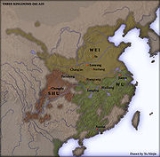
Shu Han

Encyclopedia
Shu Han was one of the three states competing for control of China
during the Three Kingdoms
period, after the fall of the Han Dynasty
. The state was based on areas around Sichuan
, which was then known as Shu
. Some historians argue it was the last Han Dynasty because its founding emperor Liu Bei
was directly related to the sovereign family of the original Han Dynasty, and bore their surname
. The other two states were Cao Wei
in central and northern China and Eastern Wu
in southeastern China. The state is sometimes known as the Kingdom of Shu, though this usage is ambiguous as it was the name of the older Shu state in the area (ca. 1046 BC – 316 BC).
, a warlord and distant relative of the Han imperial clan, rallied the support of many capable followers. Following the counsel of his advisor Zhuge Liang
and Zhuge's Longzhong Plan
, Liu Bei conquered parts of Jing Province (covering present-day Hubei
and Hunan
) in 208 and 209. Between 212 and 215, Liu Bei took over
Yi Province (covering the Sichuan Basin
) from the warlord Liu Zhang
, and wrestled control of Hanzhong
from rival warlord Cao Cao
in 219.
From the territories he gained, Liu Bei established a position for himself in China during the final years of the Han Dynasty. However in 219, the alliance between Liu Bei and his ally, Sun Quan
, was broken when Sun sent his general Lü Meng
to invade Jing Province
. Jing Province came under Sun Quan's control after the surprise attack, and Liu Bei's general Guan Yu
was captured and executed on Sun's order.
In 220, after the death of Cao Cao, his son Cao Pi
forced the Han Dynasty's last ruler, Emperor Xian
to abdicate, taking over the Han throne and starting a new Cao Wei
dynasty. The following year, Liu Bei proclaimed himself emperor
in Chengdu
, with his dynasty known as "Shu Han". Although Liu Bei is seen as the founder of Shu Han, he never claimed to be the founder of a new dynasty; rather, he claimed to be continuing the fallen Han Dynasty.
In 222, Liu Bei launched an attack on Sun Quan to retake Jing Province and avenge Guan Yu, culminating in the Battle of Xiaoting
. However, due to grave tactical mistakes, Liu Bei suffered a dramatic defeat with the burning of his line of camps and the decimation of his already numerically inferior army. Liu Bei survived the battle and fled to Baidicheng, where he died a year later due to illness. His son, Liu Shan
, succeeded him as emperor of Shu Han. The chancellor Zhuge Liang
and general Li Yan were appointed as regents to assist the young Liu Shan.
Zhuge Liang felt that it was more important for Shu to attack and topple the Wei government and restore legitimacy to the Han Dynasty, hence he made peace with Sun Quan and reaffirmed Shu's alliance with Sun. Sun Quan later declared himself emperor of Eastern Wu
in 229, and his status was recognized by Shu. Between 228 and 234, Zhuge Liang launched a series of six invasions on Wei but failed each time due to lack of supplies or incompetency of his officers, eventually dying of sickness at the Battle of Wuzhang Plains
. Zhuge Liang's protege, Jiang Wei
, continued his legacy by leading another nine campaigns
against Wei between 247 and 262, but failed to make any significant territorial gains.
In 263, armies led by Wei generals Zhong Hui
and Deng Ai
attacked Shu
and conquered its capital Chengdu
. Liu Shan surrendered to Deng Ai outside Chengdu, marking the end of Shu. Jiang Wei attempted to incite conflict between Zhong Hui and Deng Ai, hoping to take advantage of the situation to revive Shu. However, his plan failed and he was killed by Wei troops along with Zhong Hui and Deng Ai. Liu Shan was brought to the Wei capital Luoyang
and lived a comfortable and peaceful life as the "Duke of Anle" until the end of his days.
Shu was not merely a nation of war. During peace time, Shu began many irrigation and road-building projects designed to improve the economy. Many of these public works still exist and are widely used. For example, the Zipingpu Dam is still present near Chengdu
, Sichuan
. These works helped improve the economy of southwestern China and can be credited with beginning the history of economic activity in Sichuan. It also promoted trade with southern China, which was then ruled by Eastern Wu.
) in Persia, was a Shu Han prince who led his military forces in escaping the invasion of Wei to Persia. After Sima Yan, who was the Emperor of China, demanded that Persia hand over the Prince or face war, the Sassanian Persian Emperor Shapur I
appointed Mamgo as satrap of Armenia after exiling him there with his army, wanting to keep between Persia and China the solid and friendly diplomatic links they had, then claimed Mamgo's exile in Armenia constituted "certain death" in "the ends of the earth", which the Emperor of China accepted. Edward Gibbon
in his The History of the Decline and Fall of the Roman Empire
, suggested a different account, saying that Mamgo was a Scythian who was considered a Chinese subject since the Chinese Empire's rule stretched all the way to Sogdiana
, according to him.
China
Chinese civilization may refer to:* China for more general discussion of the country.* Chinese culture* Greater China, the transnational community of ethnic Chinese.* History of China* Sinosphere, the area historically affected by Chinese culture...
during the Three Kingdoms
Three Kingdoms
The Three Kingdoms period was a period in Chinese history, part of an era of disunity called the "Six Dynasties" following immediately the loss of de facto power of the Han Dynasty rulers. In a strict academic sense it refers to the period between the foundation of the state of Wei in 220 and the...
period, after the fall of the Han Dynasty
Han Dynasty
The Han Dynasty was the second imperial dynasty of China, preceded by the Qin Dynasty and succeeded by the Three Kingdoms . It was founded by the rebel leader Liu Bang, known posthumously as Emperor Gaozu of Han. It was briefly interrupted by the Xin Dynasty of the former regent Wang Mang...
. The state was based on areas around Sichuan
Sichuan
' , known formerly in the West by its postal map spellings of Szechwan or Szechuan is a province in Southwest China with its capital in Chengdu...
, which was then known as Shu
Shu (state)
The State of Shu was an ancient state in what is now Sichuan, China. It was conquered by Qin in 316 BC. Shu was based on the Chengdu Plain, in the western Sichuan basin with some extension northeast to the upper Han River valley. To the east was the Ba tribal confederation. Further east down the...
. Some historians argue it was the last Han Dynasty because its founding emperor Liu Bei
Liu Bei
Liu Bei , also known as Liu Xuande, was a warlord, military general and later the founding emperor of the state of Shu Han during the Three Kingdoms era of Chinese history...
was directly related to the sovereign family of the original Han Dynasty, and bore their surname
Liu
劉 is a common Chinese family name. The transliteration Liu can represent several different surnames written in different Chinese characters:*劉 / 刘, pinyin: Liú...
. The other two states were Cao Wei
Cao Wei
Cao Wei was one of the states that competed for control of China during the Three Kingdoms period. With the capital at Luoyang, the state was established by Cao Pi in 220, based upon the foundations that his father Cao Cao laid...
in central and northern China and Eastern Wu
Eastern Wu
Eastern Wu, also known as Sun Wu, was one the three states competing for control of China during the Three Kingdoms period after the fall of the Han Dynasty. It was based in the Jiangnan region of China...
in southeastern China. The state is sometimes known as the Kingdom of Shu, though this usage is ambiguous as it was the name of the older Shu state in the area (ca. 1046 BC – 316 BC).
History
Towards the end of the Han Dynasty, Liu BeiLiu Bei
Liu Bei , also known as Liu Xuande, was a warlord, military general and later the founding emperor of the state of Shu Han during the Three Kingdoms era of Chinese history...
, a warlord and distant relative of the Han imperial clan, rallied the support of many capable followers. Following the counsel of his advisor Zhuge Liang
Zhuge Liang
Zhuge Liang was a chancellor of the state of Shu Han during the Three Kingdoms period of Chinese history. He is often recognised as the greatest and most accomplished strategist of his era....
and Zhuge's Longzhong Plan
Longzhong Plan
The Longzhong Plan is the name given to a strategic plan given by the third century Chinese tactician and administrator Zhuge Liang. It formed the basis for the grand plan of the warlord Liu Bei and later the Three Kingdoms state of Shu. In essence it envisaged the securing of a viable regional...
, Liu Bei conquered parts of Jing Province (covering present-day Hubei
Hubei
' Hupeh) is a province in Central China. The name of the province means "north of the lake", referring to its position north of Lake Dongting...
and Hunan
Hunan
' is a province of South-Central China, located to the south of the middle reaches of the Yangtze River and south of Lake Dongting...
) in 208 and 209. Between 212 and 215, Liu Bei took over
Liu Bei's takeover of Yi Province
Liu Bei's takeover of Yi Province was a military campaign by the warlord Liu Bei in taking control of Yi Province from its Governor, Liu Zhang. The campaign took place between 212 and 215 during the prelude to the Three Kingdoms period of Chinese history...
Yi Province (covering the Sichuan Basin
Sichuan basin
The Sichuan Basin is a lowland region in southwestern China. Despite its historical name, it is not only synonymous to Sichuan province, comprising its central and eastern portions as well as part of Chongqing Municipality...
) from the warlord Liu Zhang
Liu Zhang (warlord)
Liu Zhang was a warlord during the late Han Dynasty period of Chinese history. He became governor of Yi Province , succeeding his father Liu Yan and ruled the region until 214, when he surrendered to Liu Bei...
, and wrestled control of Hanzhong
Hanzhong
Hanzhong is a municipality in southwest Shaanxi Province, China, occupying a historically significant valley in the mountains between the Xi'an area, home to many Chinese capitals, and the fertile but isolated Sichuan Basin...
from rival warlord Cao Cao
Cao Cao
Cao Cao was a warlord and the penultimate chancellor of the Eastern Han Dynasty who rose to great power during the dynasty's final years. As one of the central figures of the Three Kingdoms period, he laid the foundations for what was to become the state of Cao Wei and was posthumously titled...
in 219.
From the territories he gained, Liu Bei established a position for himself in China during the final years of the Han Dynasty. However in 219, the alliance between Liu Bei and his ally, Sun Quan
Sun Quan
Sun Quan , son of Sun Jian, formally Emperor Da of Wu, was the founder of Eastern Wu during the Three Kingdoms period of Chinese history. He ruled from 222 to 229 as King of Wu and from 229 to 252 as Emperor of Wu....
, was broken when Sun sent his general Lü Meng
Lü Meng
Lü Meng was a military general serving under the warlord Sun Quan during the late Han Dynasty period of Chinese history. He served as the commanding general in the invasion of Jing Province that led to the death of Guan Yu.-Early life:Lü Meng was born in Fupo, Runan Commandery in 178...
to invade Jing Province
Lü Meng's invasion of Jing Province
Lü Meng's invasion of Jing Province was a battle fought between the warlords Sun Quan and Liu Bei in 219 during the prelude to the Three Kingdoms period of Chinese history. Sun Quan's forces, led by Lü Meng, invaded Liu Bei's territory of Jing Province , which was defended by Guan Yu, and succeeded...
. Jing Province came under Sun Quan's control after the surprise attack, and Liu Bei's general Guan Yu
Guan Yu
Guan Yu was a general serving under the warlord Liu Bei during the late Eastern Han Dynasty of China. He played a significant role in the civil war that led to the collapse of the Han Dynasty and the establishment of the state of Shu Han during the Three Kingdoms period, of which Liu Bei was the...
was captured and executed on Sun's order.
In 220, after the death of Cao Cao, his son Cao Pi
Cao Pi
Cao Pi , formally known as Emperor Wen of Wei, was the first emperor of the state of Cao Wei during the Three Kingdoms period of Chinese history. Born in Qiao County, Pei Commandery , he was the second son of the late Han Dynasty warlord Cao Cao.Cao Pi, like his father, was a poet...
forced the Han Dynasty's last ruler, Emperor Xian
Emperor Xian of Han
Emperor Xian of Han , personal name Liu Xie, style name Bohe, was the last emperor of the Han Dynasty period of Chinese history...
to abdicate, taking over the Han throne and starting a new Cao Wei
Cao Wei
Cao Wei was one of the states that competed for control of China during the Three Kingdoms period. With the capital at Luoyang, the state was established by Cao Pi in 220, based upon the foundations that his father Cao Cao laid...
dynasty. The following year, Liu Bei proclaimed himself emperor
Emperor of China
The Emperor of China refers to any sovereign of Imperial China reigning between the founding of Qin Dynasty of China, united by the King of Qin in 221 BCE, and the fall of Yuan Shikai's Empire of China in 1916. When referred to as the Son of Heaven , a title that predates the Qin unification, the...
in Chengdu
Chengdu
Chengdu , formerly transliterated Chengtu, is the capital of Sichuan province in Southwest China. It holds sub-provincial administrative status...
, with his dynasty known as "Shu Han". Although Liu Bei is seen as the founder of Shu Han, he never claimed to be the founder of a new dynasty; rather, he claimed to be continuing the fallen Han Dynasty.
In 222, Liu Bei launched an attack on Sun Quan to retake Jing Province and avenge Guan Yu, culminating in the Battle of Xiaoting
Battle of Xiaoting
The Battle of Xiaoting, also known as the Battle of Yiling and the Battle of Yiling and Xiaoting, was fought between the states of Eastern Wu and Shu Han in 222 during the Three Kingdoms period of Chinese history...
. However, due to grave tactical mistakes, Liu Bei suffered a dramatic defeat with the burning of his line of camps and the decimation of his already numerically inferior army. Liu Bei survived the battle and fled to Baidicheng, where he died a year later due to illness. His son, Liu Shan
Liu Shan
Liu Shan, , was the second and last emperor of the state of Shu Han during the Three Kingdoms era of Chinese history. As he ascended the throne at the young age of 16, Liu Shan was entrusted to the care of the Chancellor Zhuge Liang and Imperial Secretariat Li Yan...
, succeeded him as emperor of Shu Han. The chancellor Zhuge Liang
Zhuge Liang
Zhuge Liang was a chancellor of the state of Shu Han during the Three Kingdoms period of Chinese history. He is often recognised as the greatest and most accomplished strategist of his era....
and general Li Yan were appointed as regents to assist the young Liu Shan.
Zhuge Liang felt that it was more important for Shu to attack and topple the Wei government and restore legitimacy to the Han Dynasty, hence he made peace with Sun Quan and reaffirmed Shu's alliance with Sun. Sun Quan later declared himself emperor of Eastern Wu
Eastern Wu
Eastern Wu, also known as Sun Wu, was one the three states competing for control of China during the Three Kingdoms period after the fall of the Han Dynasty. It was based in the Jiangnan region of China...
in 229, and his status was recognized by Shu. Between 228 and 234, Zhuge Liang launched a series of six invasions on Wei but failed each time due to lack of supplies or incompetency of his officers, eventually dying of sickness at the Battle of Wuzhang Plains
Battle of Wuzhang Plains
The Battle of Wuzhang Plains was a standoff between the contending states of Cao Wei and Shu Han in 234 during the Three Kingdoms period of Chinese history...
. Zhuge Liang's protege, Jiang Wei
Jiang Wei
Jiang Wei was a military general and regent of the state of Shu Han during the Three Kingdoms era of Chinese history. He originally served Shu's rival state, Cao Wei, as a middle-level military officer, but defected to the Shu strategist Zhuge Liang, leaving his mother in Wei. After that, Jiang...
, continued his legacy by leading another nine campaigns
Jiang Wei's Northern Expeditions
Jiang Wei's Northern Expeditions refer to a series of nine military campaigns launched by Shu Han general Jiang Wei against the rival state of Cao Wei from 247 to 262 during the Three Kingdoms period of Chinese history. Each expedition was aborted eventually due to inadequate food supplies or...
against Wei between 247 and 262, but failed to make any significant territorial gains.
In 263, armies led by Wei generals Zhong Hui
Zhong Hui
Zhong Hui was a military general of the state of Cao Wei during the Three Kingdoms era of Chinese history. He was the son of Zhong Yao, a calligrapher and politician of Wei....
and Deng Ai
Deng Ai
Deng Ai was a military general of Cao Wei during the Three Kingdoms era of Chinese history. It was said that whenever he saw a hill or wide valley, he would immediately size up the best places to store grain and position troops. His talent was recognized by Sima Yi, who recommended him to take up...
attacked Shu
Conquest of Shu by Wei
The conquest of Shu by Wei was a military campaign launched by the state of Cao Wei against its rival Shu Han in 263 during the Three Kingdoms period of Chinese history. The campaign culminated in the fall of Shu and the tripartite equilibrium maintained in China for over 40 years since the end of...
and conquered its capital Chengdu
Chengdu
Chengdu , formerly transliterated Chengtu, is the capital of Sichuan province in Southwest China. It holds sub-provincial administrative status...
. Liu Shan surrendered to Deng Ai outside Chengdu, marking the end of Shu. Jiang Wei attempted to incite conflict between Zhong Hui and Deng Ai, hoping to take advantage of the situation to revive Shu. However, his plan failed and he was killed by Wei troops along with Zhong Hui and Deng Ai. Liu Shan was brought to the Wei capital Luoyang
Luoyang
Luoyang is a prefecture-level city in western Henan province of Central China. It borders the provincial capital of Zhengzhou to the east, Pingdingshan to the southeast, Nanyang to the south, Sanmenxia to the west, Jiyuan to the north, and Jiaozuo to the northeast.Situated on the central plain of...
and lived a comfortable and peaceful life as the "Duke of Anle" until the end of his days.
Shu was not merely a nation of war. During peace time, Shu began many irrigation and road-building projects designed to improve the economy. Many of these public works still exist and are widely used. For example, the Zipingpu Dam is still present near Chengdu
Chengdu
Chengdu , formerly transliterated Chengtu, is the capital of Sichuan province in Southwest China. It holds sub-provincial administrative status...
, Sichuan
Sichuan
' , known formerly in the West by its postal map spellings of Szechwan or Szechuan is a province in Southwest China with its capital in Chengdu...
. These works helped improve the economy of southwestern China and can be credited with beginning the history of economic activity in Sichuan. It also promoted trade with southern China, which was then ruled by Eastern Wu.
Flight to Persia
It was claimed that many refugees such as nobles and troops fled west to Sasanian Persia when Shu fell in 263. According to one account, a noble called Mamgo (see MamikonianMamikonian
Mamikonian, Mamikoneans, or Mamigonian was a noble family which dominated Armenian politics between the 4th and 8th century. They ruled the Armenian regions of Taron, Sasun, Bagrevand and others...
) in Persia, was a Shu Han prince who led his military forces in escaping the invasion of Wei to Persia. After Sima Yan, who was the Emperor of China, demanded that Persia hand over the Prince or face war, the Sassanian Persian Emperor Shapur I
Shapur I
Shapur I or also known as Shapur I the Great was the second Sassanid King of the Second Persian Empire. The dates of his reign are commonly given as 240/42 - 270/72, but it is likely that he also reigned as co-regent prior to his father's death in 242 .-Early years:Shapur was the son of Ardashir I...
appointed Mamgo as satrap of Armenia after exiling him there with his army, wanting to keep between Persia and China the solid and friendly diplomatic links they had, then claimed Mamgo's exile in Armenia constituted "certain death" in "the ends of the earth", which the Emperor of China accepted. Edward Gibbon
Edward Gibbon
Edward Gibbon was an English historian and Member of Parliament...
in his The History of the Decline and Fall of the Roman Empire
The History of the Decline and Fall of the Roman Empire
The History of the Decline and Fall of the Roman Empire is a non-fiction history book written by English historian Edward Gibbon and published in six volumes. Volume I was published in 1776, and went through six printings. Volumes II and III were published in 1781; volumes IV, V, VI in 1788–89...
, suggested a different account, saying that Mamgo was a Scythian who was considered a Chinese subject since the Chinese Empire's rule stretched all the way to Sogdiana
Sogdiana
Sogdiana or Sogdia was the ancient civilization of an Iranian people and a province of the Achaemenid Empire, eighteenth in the list on the Behistun Inscription of Darius the Great . Sogdiana is "listed" as the second of the "good lands and countries" that Ahura Mazda created...
, according to him.
List of territories
| Commandery | Counties |
|---|---|
| Shu 蜀 |
Chengdu 成都 |
| Fan 繁 |
|
| Jiangyuan 江原 |
|
| Linqiong 臨邛 |
|
| Pi 郫 |
|
| Zitong 梓潼 |
Zitong 梓潼 |
| Fu 涪 |
|
| Hande 漢德 |
|
| Hanshou 漢壽 |
|
| Boshui 白水 |
|
| Guanghan 廣漢 |
Luo 雒 |
| Shifang 什邡 |
|
| Mianzhu 綿竹 |
|
| Xindu 新都 |
|
| Yangquan 陽泉 |
|
| Han 漢 |
Qi 郪 |
| Deyang 德陽 |
|
| Wucheng 五城 |
|
| Guanghan 廣漢 |
|
| Wenshan 汶山 |
Wenshan 汶山 |
| Jiandi 湔氐 |
|
| Du'an 都安 |
|
| Miansi 綿虒 |
|
| Pingkang 平康 |
|
| Canling 蠶陵 |
|
| Guangrou 廣柔 |
|
| Boma 白馬 |
|
| Ba 巴 |
Jiangzhou 江州 |
| Dianjiang 墊江 |
|
| Linjiang 臨江 |
|
| Zhi 枳 |
|
| Baxi 巴西 |
Langzhong 閬中 |
| Xichong (state) 西充國 |
|
| Nanchong (state) 南充國 |
|
| Hanchang 漢昌 |
|
| Xuanhan 宣漢 |
|
| Anhan 安漢 |
|
| Dangqu 宕渠 |
|
| Badong 巴東 |
Yong'an (Yufu) 永安 (魚復) |
| Quren 朐忍 |
|
| Yangqu 羊渠 |
|
| Beijing 北井 |
|
| Handan 漢單 |
|
| Wu 巫 |
|
| Fuling 涪陵 |
Hanfu 漢復 |
| Fuling 涪陵 |
|
| Hanping 漢平 |
|
| Hanjia 漢葭 |
|
| Wanning 萬寧 |
|
| Jianwei 犍為 |
Wuyang 武陽 |
| Nan'an 南安 |
|
| Bodao 僰道 |
|
| Zizhong 資中 |
|
| Niubing 牛鞞 |
|
| Jiangyang 江陽 |
Jiangyang 江陽 |
| Fu 符 |
|
| Han'an 漢安 |
|
| Hanjia 漢嘉 |
Hanjia 漢嘉 |
| Xi 徙 |
|
| Yandao 嚴道 |
|
| Maoniu 旄牛 |
| Commandery | Counties |
|---|---|
| Hanzhong 漢中 |
Nanzheng 南鄭 |
| Baozhong 褒中 |
|
| Mianyang 沔陽 |
|
| Chenggu 成固 |
|
| Nanxiang 南鄉 |
|
| Wudu 武都 |
Xiabian 下辯 |
| Hechi 河池 |
|
| Ju 沮 |
|
| Wudu 武都 |
|
| Gudao 故道 |
|
| Qiangdao 羌道 |
|
| Yinping 陰平 |
Yinping 陰平 |
| Pingguang 平廣 |
| Commandery | Counties |
|---|---|
| Zhuti 朱提 |
Zhuti 朱提 |
| Nanguang 南廣 |
|
| Hanyang 漢陽 |
|
| Nanchang 南昌 |
|
| Tanglang 堂狼 |
|
| Yuesui 越巂 |
Huiwu 會無 |
| Qiongdu 邛都 |
|
| Beishui 卑水 |
|
| Dingzha 定苲 |
|
| Taideng 臺登 |
|
| Anshang 安上 |
|
| Xindao 新道 |
|
| Qianjie 潛街 |
|
| Sanfeng 三縫 |
|
| Suqi 蘇祁 |
|
| Chan 闡 |
|
| Zangke 牂柯 |
Qielan 且蘭 |
| Tanzhi 談指 |
|
| Yelang 夜郎 |
|
| Wulian 毋斂 |
|
| Bi 鄨 |
|
| Pingyi 平夷 |
|
| Guangtan 廣談 |
|
| Yunnan 雲南 |
Yunnan 雲南 |
| Longdong 梇棟 |
|
| Qingling 青蛉 |
|
| Gufu 姑復 |
|
| Xielong 邪龍 |
|
| Yeyu 楪榆 |
|
| Suijiu 遂久 |
|
| Xinggu 興古 |
Juting 句町 |
| Wanwen 宛溫 |
|
| Louwo 漏臥 |
|
| Bengu 賁古 |
|
| Hanxing 漢興 |
|
| Jincheng 進乘 |
|
| Xifeng 西豐 |
|
| Xisui 西隨 |
|
| Duofeng 鐸封 |
|
| Jianning 建寧 |
Wei 味 |
| Cun (Mayi) 存 (馬邑) |
|
| Mudan 母單 |
|
| Tonglai 同瀨 |
|
| Muma 牧麻 |
|
| Guchang 穀昌 |
|
| Lianran 連然 |
|
| Qinzang 秦臧 |
|
| Shuangbai 雙柏 |
|
| Yuyuan 俞元 |
|
| Xiuyun 修雲 |
|
| Dianchi 滇池 |
|
| Tonglao 同勞 |
|
| Tongjing 同井 |
|
| Shengxiu 勝休 |
|
| Jianling 建伶 |
|
| Yongchang 永昌 |
Buwei 不韋 |
| Yongshou 永壽 |
|
| Bisu 比蘇 |
|
| Nanfu 南涪 |
|
| Suitang 巂唐 |
|
| Ailao 哀牢 |
|
| Bonan 博南 |
List of sovereigns
| Posthumous name Posthumous name A posthumous name is an honorary name given to royalty, nobles, and sometimes others, in East Asia after the person's death, and is used almost exclusively instead of one's personal name or other official titles during his life... s |
Family (in bold) name Chinese surname Chinese family names have been historically used by Han Chinese and Sinicized Chinese ethnic groups in mainland China, Taiwan, Hong Kong, and among overseas Chinese communities. In ancient times two types of surnames, family names and clan names , existed.The colloquial expressions laobaixing... and first names Chinese name Personal names in Chinese culture follow a number of conventions different from those of personal names in Western cultures. Most noticeably, a Chinese name is written with the family name first and the given name next, therefore "John-Paul Smith" as a Chinese name would be "Smith John-Paul"... |
Year(s) of reigns | Era name Chinese era name A Chinese era name is the regnal year, reign period, or regnal title used when traditionally numbering years in an emperor's reign and naming certain Chinese rulers . Some emperors have several era names, one after another, where each beginning of a new era resets the numbering of the year back... s and their range of years |
|---|---|---|---|
| Chinese convention: family and first names, and less commonly "Shu" + posthumous name + "di" | |||
| Emperor Zhaolie of Shu | Liu Bei Liu Bei Liu Bei , also known as Liu Xuande, was a warlord, military general and later the founding emperor of the state of Shu Han during the Three Kingdoms era of Chinese history... |
221-223 | Zhangwu 220-223 |
| Xiaohuai | Liu Shan Liu Shan Liu Shan, , was the second and last emperor of the state of Shu Han during the Three Kingdoms era of Chinese history. As he ascended the throne at the young age of 16, Liu Shan was entrusted to the care of the Chancellor Zhuge Liang and Imperial Secretariat Li Yan... |
223-263 | Jianxing 223-237 Yanxi 238-257 Jingyao 258-263 Yanxing 263 |
See also
- Cao WeiCao WeiCao Wei was one of the states that competed for control of China during the Three Kingdoms period. With the capital at Luoyang, the state was established by Cao Pi in 220, based upon the foundations that his father Cao Cao laid...
- Eastern WuEastern WuEastern Wu, also known as Sun Wu, was one the three states competing for control of China during the Three Kingdoms period after the fall of the Han Dynasty. It was based in the Jiangnan region of China...
- Three KingdomsThree KingdomsThe Three Kingdoms period was a period in Chinese history, part of an era of disunity called the "Six Dynasties" following immediately the loss of de facto power of the Han Dynasty rulers. In a strict academic sense it refers to the period between the foundation of the state of Wei in 220 and the...
- List of people of the Three Kingdoms
- Timeline of the Three Kingdoms periodTimeline of the Three Kingdoms periodThis is a timeline of the Three Kingdoms period of Chinese history....
- Romance of the Three KingdomsRomance of the Three KingdomsRomance of the Three Kingdoms, written by Luo Guanzhong in the 14th century, is a Chinese historical novel based on the events in the turbulent years near the end of the Han Dynasty and the Three Kingdoms era of Chinese history, starting in 169 and ending with the reunification of the land in...
- Records of Three KingdomsRecords of Three KingdomsRecords of Three Kingdoms , is regarded as the official and authoritative historical text on the Three Kingdoms period of Chinese history covering the years 184-280 CE. Written by Chen Shou in the 3rd century, the work combines the smaller histories of the rival states of Cao Wei , Shu Han and...