
All Topics  
Ostrich

 
Ostrich

   Email Print
   Bookmark   Link


Ostrich


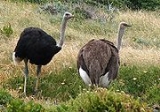
The ostrich Struthio camelus is a large flightless bird
Flightless bird

Flightless birds are birds which lack the ability to fly, relying instead on their ability to run or swim, and are thought to have evolved from their flying ancestors....
 native to Africa
Africa

Africa is the world's second-largest and second most-populous continent, after Asia. At about 30.2 million km? including adjacent islands, it covers 6% of the Earth's total surface area and 20.4% of the total land area....
 (and formerly the Middle East
Middle East

File:GreaterMiddleEast1.pngThe Middle East is a region that spans southwestern Asia, western Asia, and northeastern Africa. It has no clear boundaries, often used as a synonym to Near East, in opposition to Far East....
). It is the only living species of its family
Family (biology)

In biological classification, family is a taxonomic rank. Exact details of formal nomenclature depend on the Nomenclature Codes which applies....
, Struthionidae, and its genus
Genus

A genus is a low-level taxonomic rank used in the classification of living and fossil organisms. The taxonomic ranks are domain , kingdom , phylum, class , order , family , genus, and species....
, Struthio. Ostriches share the order
Order (biology)

In Biological classification used in biology, the order is a taxonomic rank between class and family . The superorder is a rank between class and order....
 Struthioniformes with the Emu
Emu

The Emu , Dromaius novaehollandiae, is the largest bird native to Australia and the only Extant taxon member of the genus Dromaius. It is also the second-largest extant bird in the world by height, after its ratite relative, the ostrich....
, kiwi
Kiwi

A kiwi is any of the species of flightless birds endemic to New Zealand of the genus Apteryx . At around the size of a domestic chicken, kiwi are by far the smallest living ratites....
s, and other ratite
Ratite

A ratite is any of a diverse group of large, flightless birds of Gondwanan origin, most of them now extinct. Unlike other flightless birds, the ratites have no keel on their sternum - hence their name which comes from the Latin for raft....
s. It is distinctive in its appearance, with a long neck and legs and the ability to run at speeds of about 74 km/h (46 mph), the top land speed of any bird.


Discussion
Ask a question about 'Ostrich'
Start a new discussion about 'Ostrich'
Answer questions from other users
Full Discussion Forum


Recent Posts


Encyclopedia


The ostrich Struthio camelus is a large flightless bird
Flightless bird

Flightless birds are birds which lack the ability to fly, relying instead on their ability to run or swim, and are thought to have evolved from their flying ancestors....
 native to Africa
Africa

Africa is the world's second-largest and second most-populous continent, after Asia. At about 30.2 million km? including adjacent islands, it covers 6% of the Earth's total surface area and 20.4% of the total land area....
 (and formerly the Middle East
Middle East

File:GreaterMiddleEast1.pngThe Middle East is a region that spans southwestern Asia, western Asia, and northeastern Africa. It has no clear boundaries, often used as a synonym to Near East, in opposition to Far East....
). It is the only living species of its family
Family (biology)

In biological classification, family is a taxonomic rank. Exact details of formal nomenclature depend on the Nomenclature Codes which applies....
, Struthionidae, and its genus
Genus

A genus is a low-level taxonomic rank used in the classification of living and fossil organisms. The taxonomic ranks are domain , kingdom , phylum, class , order , family , genus, and species....
, Struthio. Ostriches share the order
Order (biology)

In Biological classification used in biology, the order is a taxonomic rank between class and family . The superorder is a rank between class and order....
 Struthioniformes with the Emu
Emu

The Emu , Dromaius novaehollandiae, is the largest bird native to Australia and the only Extant taxon member of the genus Dromaius. It is also the second-largest extant bird in the world by height, after its ratite relative, the ostrich....
, kiwi
Kiwi

A kiwi is any of the species of flightless birds endemic to New Zealand of the genus Apteryx . At around the size of a domestic chicken, kiwi are by far the smallest living ratites....
s, and other ratite
Ratite

A ratite is any of a diverse group of large, flightless birds of Gondwanan origin, most of them now extinct. Unlike other flightless birds, the ratites have no keel on their sternum - hence their name which comes from the Latin for raft....
s. It is distinctive in its appearance, with a long neck and legs and the ability to run at speeds of about 74 km/h (46 mph), the top land speed of any bird. The ostrich is the largest living species of bird
Bird

Birds are wing, Bipedalismal, endothermic , vertebrate animals that lay egg . There are around 10,000 living species, making them the most numerous tetrapod vertebrates....
 and lays the largest egg of any bird species.

The diet of the ostrich mainly consists of plant matter, though it also eats insects. It lives in nomadic groups which contain between five and 50 birds. When threatened, the ostrich will either hide itself by lying flat against the ground, or will run away. If cornered, it can cause injury and death with a kick from its powerful legs. Mating patterns differ by geographical region, but territorial males fight for a harem of two to seven females.

The ostrich is farmed around the world, particularly for its feathers, which are decorative and are also used for feather duster
Feather duster

A feather duster is an implement used for cleaning. It consists typically of a handle and a segment composed of natural or artificial feathers which form the cleaning-contact surface....
s. Its skin is used for leather
Leather

Leather is a material created through the tanning of rawhides and skins of animals, primarily cattlehide. The tanning process converts the putrescible skin into a durable, long-lasting and versatile natural material for various uses....
 and its meat marketed commercially.

Taxonomy

The ostrich was originally described by Linnaeus
Carolus Linnaeus

Carl Linnaeus was a Sweden botanist, physician, and zoologist, who laid the foundations for the modern scheme of binomial nomenclature. He is known as the father of modern alpha taxonomy, and is also considered one of the fathers of modern ecology....
 in his 18th-century work, Systema Naturae
Systema Naturae

The book Systema Naturae was one of the major works of the Sweden botanist, zoologist and physician Carolus Linnaeus. Its full title is Systema naturae per regna tria naturae, secundum classes, ordines, genera, species, cum characteribus, differentiis, synonymis, locis or translated: "System of nature through the three kingdoms of...
 under its current binomial name. Its scientific name is derived from Latin
Latin

Latin is an Italic language, historically spoken in Latium and Ancient Rome. Through the Military history of the Roman Empire, Latin spread throughout the Mediterranean and a large part of Europe....
, struthio meaning ostrich and camelus meaning camel, alluding to its dry habitat.

The ostrich belongs to the Struthioniformes order
Order (biology)

In Biological classification used in biology, the order is a taxonomic rank between class and family . The superorder is a rank between class and order....
 of ratite
Ratite

A ratite is any of a diverse group of large, flightless birds of Gondwanan origin, most of them now extinct. Unlike other flightless birds, the ratites have no keel on their sternum - hence their name which comes from the Latin for raft....
s. Other members include rheas
Rhea (bird)

The rheas are species of Flightless bird ratite birds in the genus Rhea, native to South America. There are two existing species: the Greater Rhea and the Darwin's Rhea....
, emu
Emu

The Emu , Dromaius novaehollandiae, is the largest bird native to Australia and the only Extant taxon member of the genus Dromaius. It is also the second-largest extant bird in the world by height, after its ratite relative, the ostrich....
, cassowaries
Cassowary

The cassowary is a very large flightless bird native to the tropical forests of New Guinea and nearby islands, and northeastern Australia. The Southern Cassowary is the third tallest and second heaviest bird on the planet, smaller only than the Ostrich and Emu....
, and the largest bird ever, the now-extinct Elephant Bird
Elephant bird

Elephant birds are an extinction family of flightless birds comprising the genus Aepyornis and Mullerornis....
 (Aepyornis). However, the classification of the ratites as a single order has always been questioned, with the alternative classification restricting the Struthioniformes to the ostrich lineage and elevating the other groups. Presently, molecular evidence is equivocal while paleobiogeographical
Biogeography

Biogeography is the study of the distribution of biodiversity over space and time. It aims to reveal where organisms live, and at what abundance....
 and paleontological
Paleontology

File:Geological time spiral - sharper.pngPaleontology from Greek: pa?a??? "old, ancient", ??, ??t- "being, creature", and ????? "speech, thought" is the study of prehistory life, including organisms' evolution and interactions with each other and their environments ....
 considerations are slightly in favor of the multi-order arrangement.

Subspecies

Five subspecies
Subspecies

In biology, subspecies is the taxonomic rank immediately subordinate to a species. A subspecies is a taxonomic group which is less distinct than the Common descent or species from which it originates....
 are recognized:
  • S. c. australis in Southern Africa
    Southern Africa

    Southern Africa is the southernmost region of the African continent, variably defined by geography or geopolitics, consisting of numerous territories....
    , called the Southern Ostrich. It is found south of the Zambezi
    Zambezi

    The Zambezi is the List of rivers by length river in Africa, and the largest flowing into the Indian Ocean from Africa. The area of its drainage basin is 1,390,000 km? , slightly less than half that of the Nile....
     and Cunene
    Cunene

    Cunene may refer to*Cunene , Angola*Cunene River also with another spelling*Kunene Region, Namibia...
     rivers. It was once farmed for its feathers in the Little Karoo area of Cape Province
    Cape Province

    The Cape of Good Hope Province was a province in the Union of South Africa and subsequently the Republic of South Africa. It encompassed the old Cape Colony, and had Cape Town as its capital....
    .
  • S. c. camelus in North Africa
    North Africa

    North Africa or Northern Africa is the northernmost region of the African continent, separated by the Sahara from Sub-Saharan Africa.Geopolitically, the United Nations subregion of Northern Africa includes the following seven countries or territories:...
    , sometimes called the North African Ostrich or Red-necked Ostrich. It is the most widespread subspecies, ranging from Ethiopia
    Ethiopia

    Ethiopia , officially the Federal Democratic Republic of Ethiopia, is a landlocked country situated in the Horn of Africa. Ethiopia is bordered by Eritrea to the north, Sudan to the west, Kenya to the south, Somalia to the east and Djibouti to the northeast....
     and Sudan
    Sudan

    Sudan is a country in northeastern Africa. It is the largest in the African continent and the Arab World, and List of countries and outlying territories by total area by area....
     in the east throughout the Sahel
    Sahel

    File:Sahel Map-Africa rough.pngFile:AT0713 map.pngThe Sahel or Sahel Belt is a semi-arid tropical and subtropical grasslands, savannas, and shrublands ecoregion in Africa, which forms the transition between the Sahara to the north and the slightly less arid savanna belt to the south, known as the Sudan ....
     and the Sudan
    Sudan (region)

    The Sudan, from the Arabic language bil?d as-s?d?n or "land of the Black people" , is a geographic region stretching from West to Eastern Africa....
     to Senegal
    Senegal

    Senegal , officially the Republic of Senegal, is a country south of the S?n?gal River in West Africa. Senegal is bounded by the Atlantic Ocean to the west, Mauritania to the north, Mali to the east, and Guinea and Guinea-Bissau to the south....
     and Mauritania
    Mauritania

    Mauritania , officially the Islamic Republic of Mauritania, is a country in northwest Africa. It is bordered by the Atlantic Ocean on the west, by Senegal on the southwest, by Mali on the east and southeast, by Algeria on the northeast, and by the Morocco-controlled Western Sahara on the northwest....
     in the west, and at least in earlier times north to Egypt
    Egypt

    Egypt is a country mainly in North Africa, with the Sinai Peninsula forming a land bridge in Western Asia. Covering an area of about , Egypt borders the Mediterranean Sea to the north, the Gaza Strip and Israel to the northeast, the Red Sea to the east, Sudan to the south and Libya to the west....
     and southern Morocco
    Morocco

    Morocco , officially the Kingdom of Morocco , is a country located in North Africa with a population of nearly 34 million and an area just under 447,000 km2....
    , respectively. It is the largest subspecies, at 2.74 m (9 ft) 154 kilograms (340 lb). The neck is red, the plumage of males is black and white, and the plumage of females is grey.
  • S. c. massaicus in East Africa
    East Africa

    East Africa or Eastern Africa is the easterly region of the African continent, variably defined by geography or geopolitics. In the UN subregion, 19 territories constitute Eastern Africa:...
    , sometimes called the Masai Ostrich. It has some small feathers on its head, and its neck and thighs are bright orange. During the mating season, the male's neck and thighs become brighter. Their range is essentially limited to southern Kenya
    Kenya

    The Republic of Kenya is a country in East Africa. It is bordered by Ethiopia to the north, Somalia to the northeast, Tanzania to the south, Uganda to the west, and Sudan to the northwest, with the Indian Ocean running along the southeast border....
     and eastern Tanzania
    Tanzania

    Tanzania , officially the United Republic of Tanzania , is a country in East Africa that is bordered by Kenya and Uganda on the north, Rwanda, Burundi and the Democratic Republic of the Congo on the west, and Zambia, Malawi and Mozambique on the south....
     and Ethiopia
    Ethiopia

    Ethiopia , officially the Federal Democratic Republic of Ethiopia, is a landlocked country situated in the Horn of Africa. Ethiopia is bordered by Eritrea to the north, Sudan to the west, Kenya to the south, Somalia to the east and Djibouti to the northeast....
     and parts of Southern Somalia
    Somalia

    Somalia , officially the Republic of Somalia and formerly known as the Somali Democratic Republic, is a country located in the Horn of Africa....
    .
  • S. c. syriacus in the Middle East
    Middle East

    File:GreaterMiddleEast1.pngThe Middle East is a region that spans southwestern Asia, western Asia, and northeastern Africa. It has no clear boundaries, often used as a synonym to Near East, in opposition to Far East....
    , sometimes called the Arabian Ostrich
    Arabian Ostrich

    The Middle Eastern Ostrich or Arabian Ostrich is an extinct subspecies of the ostrich which once lived on the Arabian Peninsula and in the Near East....
     or Middle Eastern Ostrich, was a subspecies formerly very common in the Arabian Peninsula
    Arabian Peninsula

    The Arabian Peninsula , Arabia, Arabistan, and the Arabian subcontinent is a peninsula in Southwest Asia at the junction of Africa and Asia. The area is an important part of the Middle East and plays a critically important geopolitics role because of its vast reserves of petroleum and natural gas....
    , Syria
    Syria

    Syria , officially the Syrian Arab Republic , is an Arab-majority country in Southwest Asia, bordering Lebanon and the Mediterranean Sea to the west, Israel to the southwest, Jordan to the south, Iraq to the east, and Turkey to the north....
    , and Iraq
    Iraq

    Iraq , officially the Republic of Iraq , is a country in Western Asia spanning most of the northwestern end of the Zagros Mountains, the eastern part of the Syrian Desert and the northern part of the Arabian Desert....
    ; it became extinct around 1966.
  • S. c. molybdophanes in southern Ethiopia
    Ethiopia

    Ethiopia , officially the Federal Democratic Republic of Ethiopia, is a landlocked country situated in the Horn of Africa. Ethiopia is bordered by Eritrea to the north, Sudan to the west, Kenya to the south, Somalia to the east and Djibouti to the northeast....
    , northeastern Kenya
    Kenya

    The Republic of Kenya is a country in East Africa. It is bordered by Ethiopia to the north, Somalia to the northeast, Tanzania to the south, Uganda to the west, and Sudan to the northwest, with the Indian Ocean running along the southeast border....
    , and Somalia
    Somalia

    Somalia , officially the Republic of Somalia and formerly known as the Somali Democratic Republic, is a country located in the Horn of Africa....
    , is called the Somali Ostrich. The neck and thighs are grey-blue, and during the mating season, the male's neck and thighs become bright blue. The females are more brown than those of other subspecies. It generally lives in pairs or alone, rather than in flocks. Its range overlaps with S. c. massaicus in northeastern Kenya.


Analyses indicate that the Somali Ostrich may be better considered a full species, however, the consensus among experts has not agreed upon this move. The Tree of Life project, and Avibase does recognize it as a different species, but the IOC and Birdlife does not yet. As of 2008 Birdlife.com is reviewing the proposed split. mtDNA haplotype
Haplotype

The term haplotype is a contraction of the term "Ploidy genotype." In genetics, a haplotype is a combination of alleles at multiple locus that are transmitted together on the same chromosome....
 comparisons suggest that it diverged from the other ostriches not quite 4 mya
Mya (unit)

In astronomy, geology, and paleontology, mya or "m.y.a." is an abbreviation for "million years ago". Like the related unit bya, mya is traditionally written in lower case....
 due to formation of the Great Rift Valley
Great Rift Valley

The Great Rift Valley is a name given in the late 19th century by British explorer John Walter Gregory to the continuous geographic trough, approximately in length, that runs from northern Syria in Southwest Asia to central Mozambique in East Africa....
. Subsequently, hybridization with the subspecies that evolved southwestwards of its range, S. c. massaicus, has apparently been prevented from occurring on a significant scale by ecological separation, the Somali Ostrich preferring bushland where it browses middle-height vegetation for food while the Masai Ostrich is, like the other subspecies, a grazing
Grazing

Grazing generally describes a type of predation in which a herbivore feeds on plants , or more broadly on a multicellular autotrophs . Grazing differs from true predation because the organism being eaten is not death, and it differs from parasitism as the two organisms do not symbiosis, nor is the grazer necessarily so limited in what it can...
 bird of the open savanna
Savanna

A savanna, or savannah, is a tropical, subtropical or temperate woodland ecosystem characterized by the trees being sufficiently small or widely spaced so that the Canopy does not close....
 and miombo
Miombo

Miombo is the Swahili word for Brachystegia, a genus of tree comprising a large number of species. Miombo woodland is classified in the tropical and subtropical grasslands, savannas, and shrublands biome ....
 habitat.

The population from Río de Oro
Río de Oro

R?o de Oro , is, with Saguia el-Hamra, one of the two territories that formed the Spain province of Spanish Sahara after 1969; it was originally taken as a Spanish colonial possession in the late 19th century....
 was once separated as Struthio camelus spatzi because its eggshell pores were shaped like a teardrop and not round, but as there is considerable variation of this character and there were no other differences between these birds and adjacent populations of S. c. camelus, it is no longer considered valid. This population disappeared in the later half of the 20th century. In addition, there have been 19th century reports of the existence of small ostriches in North Africa; these have been referred to as Levaillant's Ostrich (Struthio bidactylus) but remain a hypothetical form not supported by material evidence. Given the persistence of savanna wildlife in a few mountainous regions of the Sahara
Sahara

The Sahara is the world's largest hot desert. At over 9,000,000 square kilometers , it covers most of Northern Africa, making it almost as large as the United States or the continent of Europe....
 (such as the Tagant Plateau
Tagant Plateau

The Tagant Plateau lies in eastern Mauritania, forming a stony part of the Sahara Desert. Some towns such as Tichit, Moudj?ria and Rachid, Mauritania, lie at the foot of its slopes ? cliffs in some places ? while Tidjikdja lies on the Tagant itself....
 and the Ennedi Plateau
Ennedi Plateau

The Ennedi Plateau, located in the North-East of Chad, in the BET Region, is a sandstone bulkwark in the middle of the Sahara. It is assailed by the sands on all sides, that encroach the deep valleys of the Ennedi....
), it is not at all unlikely that ostriches too were able to persist in some numbers until recent times after the drying-up of the Sahara.

Evolution

The earliest fossil of ostrich-like birds is the Palaeotis
Palaeotis

Palaeotis is a genus of paleognath bird from the middle Eocene epoch of central Europe. One species is known, Paleotis weigelti. The holotype specimen is a fossil tarsometatarsus and phalanx....
 living near the Asiatic steppes, from the Middle Eocene
Eocene

The Eocene Geologic time scale is a major division of the geologic timescale and the second epoch of the Palaeogene period in the Cenozoic era....
, a middle-sized flightless bird that was originally believed to be a bustard
Bustard

Bustards, including floricans and korhaans, are large terrestrial birds mainly associated with dry open country and steppes in the Old World....
. Apart from this enigmatic bird, the fossil record of the ostriches continues with several species of the modern genus Struthio which are known from the Early Miocene
Miocene

The Miocene is a Geologic time scale of the Neogene period and extends from about 23.03 to 5.33 million years before the present. As with other older geologic periods, the rock beds that define the start and end are well identified but the exact dates of the start and end of the period are uncertain....
 onwards. While the relationship of the African species is comparatively straightforward, a large number of Asian species of ostrich have been described from very fragmentary remains, and their interrelationships and how they relate to the African ostriches is very confusing. In China
China

China is a Culture of China, an ancient civilization, and, depending on perspective, a national or multinational entity extending over a large area in East Asia....
, ostriches are known to have become extinct only around or even after the end of the last ice age; images of ostriches have been found there on prehistoric pottery and as petroglyph
Petroglyph

Petroglyphs are s created by removing part of a Rock surface by incising, pecking, carving, and abrading. Outside North America, scholars often use terms such as "carving", "engraving", or other descriptions of the technique to refer to such images....
s. There are also records of ostriches being sighted out at sea in the Indian Ocean and when discovered on the island of Madagascar the sailors of the 18th century referred to them as Sea Ostriches, although this has never been confirmed.

Several of these fossil forms are ichnotaxa (that is, classified according to the organism's footprints or other trace rather than its body) and their association with those described from distinctive bones is contentious and in need of revision pending more good material.
  • Struthio coppensi
    Struthio coppensi

    Struthio coppensi is an extinct species of ratite bird from the Miocene of Namibia.Sources ...
     (Early Miocene of Elizabethfeld, Namibia)
  • Struthio linxiaensis
    Struthio linxiaensis

    Struthio linxiaensis is an extinct species of ratite from the Miocene of China.Sources ...
     (Liushu Late Miocene of Yangwapuzijifang, China)
  • Struthio orlovi
    Struthio orlovi

    Struthio orlovi is an extinct species of ratite bird from the Miocene of Moldavia....
     (Late Miocene of Moldavia)
  • Struthio karingarabensis (Late Miocene - Early Pliocene of SW and CE Africa) - oospecies
    Trace fossil classification

    Trace fossils are classification in various ways for different purposes. Traces can be classified #Taxonomic_Classification_of_Trace_Fossils , #Ethologic_Classification_of_Trace_Fossils , and #Toponomic_Classification_of_Trace_Fossils, that is, according to their relationship to the surrounding sedimentary layers....
    (?)
  • Struthio kakesiensis (Laetolil Early Pliocene of Laetoli, Tanzania) - oospecies
    Trace fossil classification

    Trace fossils are classification in various ways for different purposes. Traces can be classified #Taxonomic_Classification_of_Trace_Fossils , #Ethologic_Classification_of_Trace_Fossils , and #Toponomic_Classification_of_Trace_Fossils, that is, according to their relationship to the surrounding sedimentary layers....
  • Struthio wimani
    Struthio wimani

    Struthio wimani is an extinct species of ratite bird from the Pliocene of China....
     (Early Pliocene of China and Mongolia)
  • Struthio daberasensis (Early - Middle Pliocene of Namibia) - oospecies
    Trace fossil classification

    Trace fossils are classification in various ways for different purposes. Traces can be classified #Taxonomic_Classification_of_Trace_Fossils , #Ethologic_Classification_of_Trace_Fossils , and #Toponomic_Classification_of_Trace_Fossils, that is, according to their relationship to the surrounding sedimentary layers....
  • Struthio brachydactylus (Pliocene of Ukraine)
  • Struthio chersonensis (Pliocene of SE Europe to WC Asia) - oospecies
    Trace fossil classification

    Trace fossils are classification in various ways for different purposes. Traces can be classified #Taxonomic_Classification_of_Trace_Fossils , #Ethologic_Classification_of_Trace_Fossils , and #Toponomic_Classification_of_Trace_Fossils, that is, according to their relationship to the surrounding sedimentary layers....
  • Asian Ostrich
    Asian Ostrich

    The Asian Ostrich was found in the Pliocene from Central Asia to China. In China, ostriches are known to have become extinct only around or even after the end of the last ice age; images of ostriches have been found there on prehistoric pottery and as petroglyphs indicating that they were around at the same time as humans first reached China...
    , Struthio asiaticus (Early Pliocene - Late Pleistocene of Central Asia to China ?and Morocco)
  • Struthio dmanisensis
    Giant Ostrich

    The Giant Ostrich is an extinct species of ratite bird from the Late Pliocene to the Early Pleistocene of Georgia ....
     (Late Pliocene/Early Pleistocene of Dmanisi
    Dmanisi

    Dmanisi is a townlet and archaeological site in Kvemo Kartli region of Georgia approximately 93 km southwest of the nation?s capital Tbilisi in the river valley of Mashavera....
    , Georgia)
  • Struthio oldawayi (Early Pleistocene of Tanzania) - probably subspecies of S. camelus
  • Struthio anderssoni - oospecies
    Trace fossil classification

    Trace fossils are classification in various ways for different purposes. Traces can be classified #Taxonomic_Classification_of_Trace_Fossils , #Ethologic_Classification_of_Trace_Fossils , and #Toponomic_Classification_of_Trace_Fossils, that is, according to their relationship to the surrounding sedimentary layers....
    (?)


Description

Ostriches usually weigh from , although some male ostriches have been recorded with weights of up to . The feathers of adult males are mostly black, with white at the ends of the wings and in the tail. Females and young males are greyish-brown and white. The head and neck of both male and female ostriches is nearly bare, but has a thin layer of down. Their skin is variably colored dependant on the sub-species. The male tarsus
Tarsus (skeleton)

In tetrapods, the tarsus are the cluster of bones in the foot between the tibia and fibula and the metatarsus. The bones of the tarsus do not belong to individual toes, whereas those of the metatarsus do....
 has red horn plates, and the female's are black. The strong legs of the ostrich lack feathers. The bird has just two toes on each foot (most birds have four), with the nail of the larger, inner one resembling a hoof
Hoof

File:Horse rear hooves.jpgA hoof is the tip of a toe of an ungulate mammal, strengthened by a thick horny covering. The hoof consists of a hard or rubbery sole, and a hard wall formed by a thick Nail rolled around the tip of the toe....
. The outer toe lacks a nail. This is an adaptation unique to ostriches that appears to aid in running. The wings are not used for flight, but are still large, with a wingspan of around two metres (over six feet), despite the absence of long flight feathers. The wings are used in mating displays, and they can also provide shade for chicks. The feather
Feather

Feathers are one of the epidermal growths that form the distinctive outer covering, or plumage, on birds. They are considered the most complex integumentary structures found in vertebrates....
s, which are soft and fluffy, serve as insulation, and are quite different from the flat smooth outer feathers of flying birds (the feather barbs lack the tiny hooks which lock them together in other birds). They have 50-60 tail feathers, and their wings have 16 primary, four alular and 20-23 secondary feathers. The ostrich's sternum
Sternum

The sternum is a long flat bone located in the center of the chest . It connects to the rib via cartilage, forming the rib cage with them, and thus helps to protect the lungs, heart and major blood vessels from physical trauma....
 is flat, lacking the keel
Keel (bird)

A keel in bird anatomy is an extension of the sternum which runs axially along the midline of the sternum and extends outward, perpendicular to the plane of the ribs....
 to which wing muscles attach in flying birds. The beak
Beak

The beak, bill or rostrum is an external anatomical structure of birds which, in addition to eating, is used for Personal grooming#In animals, manipulating objects, killing prey, probing for food, Courtship#Courtship in the animal kingdom and feeding their young....
 is flat and broad, with a rounded tip. Like all ratites, the ostrich has no crop, and it also lacks a gallbladder
Gallbladder

The gallbladder is a small non-vital Organ which aids in the digestive process and concentrates bile produced in the liver....
. They have three stomachs, and their caecae is . Unlike all other living birds, the ostrich secretes urine separately from feces. They also have unique pubic bones that are fused to hold their gut. The copulatory organ is retractable and long. Finally, their palate
Palate

The palate is the roof of the mouth in humans and vertebrate animals. It separates the oral cavity from the nasal cavity. The palate is divided into two parts, the anterior bony hard palate, and the posterior fleshy soft palate or velum....
 is different than other ratites, in that the sphenoid
Sphenoid

Sphenoid may refer to:* In anatomy, the sphenoid bone* In geometry, a tetrahedron with mirror symmetry...
 and palatal bones are unconnected.

At sexual maturity (two to four years old), male ostriches can be between in height, while female ostriches range from . During the first year of life, chicks grow about per month. At one year of age, ostriches weigh around . An ostrich can live up to 75 years.

Distribution and habitat

Ostriches formerly occupied Africa north and south of the Sahara
Sahara

The Sahara is the world's largest hot desert. At over 9,000,000 square kilometers , it covers most of Northern Africa, making it almost as large as the United States or the continent of Europe....
, east Africa, Africa south of the rain forest belt, and much of Asia Minor. Today, ostriches prefer open land, and are native to savanna
Savanna

A savanna, or savannah, is a tropical, subtropical or temperate woodland ecosystem characterized by the trees being sufficiently small or widely spaced so that the Canopy does not close....
s and the Sahel
Sahel

File:Sahel Map-Africa rough.pngFile:AT0713 map.pngThe Sahel or Sahel Belt is a semi-arid tropical and subtropical grasslands, savannas, and shrublands ecoregion in Africa, which forms the transition between the Sahara to the north and the slightly less arid savanna belt to the south, known as the Sudan ....
 of Africa
Africa

Africa is the world's second-largest and second most-populous continent, after Asia. At about 30.2 million km? including adjacent islands, it covers 6% of the Earth's total surface area and 20.4% of the total land area....
, both north and south of the equatorial forest zone. In southwest Africa they inhabit the semidesert or true desert. They rarely go above . The Arabian Ostrich
Arabian Ostrich

The Middle Eastern Ostrich or Arabian Ostrich is an extinct subspecies of the ostrich which once lived on the Arabian Peninsula and in the Near East....
es in the Near and Middle East
Middle East

File:GreaterMiddleEast1.pngThe Middle East is a region that spans southwestern Asia, western Asia, and northeastern Africa. It has no clear boundaries, often used as a synonym to Near East, in opposition to Far East....
 were hunted to extinction by the middle of the 20th century.

Behavior


Flocking and individual

Flappingostriches
Ostriches normally spend the winter months in pairs or solitary. Only 16% of ostrich sightings were of more than two birds. During breeding season and sometimes during extreme rainless periods ostriches live in nomad
Nomad

Nomadic people, , also known as nomads, are communities of people who move from one place to another, rather than Settler in one location....
ic groups of five to 50 birds (led by a top hen) that often travel together with other grazing
Grazing

Grazing generally describes a type of predation in which a herbivore feeds on plants , or more broadly on a multicellular autotrophs . Grazing differs from true predation because the organism being eaten is not death, and it differs from parasitism as the two organisms do not symbiosis, nor is the grazer necessarily so limited in what it can...
 animals, such as zebra
Zebra

Zebras are African equids best known for their distinctive white and black stripes. Their stripes come in different patterns unique to each individual....
s or antelope
Antelope

Antelope are ruminant hoofed mammals of the family Bovidae in the order of even-toed ungulates. These animals are spread relatively evenly throughout the various subfamily of Bovidae and many are more closely related to cows or goats than to each other....
s. Ostriches are diurnal, but may be active on moonlit nights. They are most active early and late in the day.

With their acute eyesight and hearing, ostriches can sense predators such as lion
Lion

The lion is a member of the family Felidae and one of four big cats in the genus Panthera. With exceptionally large males exceeding 250 kg in weight, it is the second-largest living cat after the tiger....
s from far away. When being pursued by a predator, they have been known to reach speeds in excess of 70 km/h (45 mph
Miles per hour

The mile per hour is a physical unit of speed, expressing the number of Mile covered per hour.It is currently the Unit of measurement used for speed limits, and speeds, on roads in the United Kingdom and United States....
), and can maintain a steady speed of 50 km/h (30 mph), which makes the ostrich the world's fastest two-legged animal.

When lying down and hiding from predators, the birds lay their heads and necks flat on the ground, making them appear as a mound of earth from a distance. This even works for the males, as they hold their wings and tail low so that the heat haze of the hot, dry air that often occurs in their habitat aids in making them appear as a nondescript dark lump. Contrary to popular belief, ostriches do not bury their heads in the sand. When threatened, ostriches run away, but they can cause serious injury and death with kicks from their powerful legs. Their legs can only kick forward.

Food

They mainly feed on seeds, shrubs, grass, and other plant matter; occasionally they also eat insects such as locust
Locust

Locust is the swarming phase of short-horned grasshoppers of the family Acrididae. The origin and apparent extinction of certain species of locust—some of which reached 6 inches in length—are unclear....
s. Lacking teeth, they swallow pebbles that help as gastrolith
Gastrolith

Gastroliths are Rock , which are or have been held inside the Gastrointestinal tract of an animal. Among living vertebrates, gastroliths are common among Herbivore birds, crocodiles, alligators, seals and Sea Lion....
s to grind the swallowed food in the gizzard
Gizzard

The gizzard, also referred to as the ventriculus, gastric mill, and gigerium, is an organ found in the digestive tract of some animals, including birds, reptiles, earthworms and some fish....
. An adult ostrich typically carries about 1 kg of stones in its stomach. Ostriches can go without water for several days, living off the moisture in the ingested plants. However, they enjoy water and frequently take baths where it is available. Ostriches are known to eat almost anything (dietary indiscretion
Dietary indiscretion

Dietary indiscretion is the tendency of certain animal of eating unusual items. These are frequently relatively small items not encountered in a natural habitat and thus sampled because of mistaken identity, a familiar flavor, or simple curiosity....
), particularly in captivity where opportunity is increased.
Wiki Ostrich
Ostriches can tolerate a wide range of temperatures. In much of its habitat, temperature differences of 40°C between night- and daytime can be encountered. Their temperature control mechanism is more complex than in other birds and mammals, utilizing the naked skin of the upper legs and flanks which can be covered by the wing feathers or bared according to whether the bird wants to retain or lose body heat.

Reproduction

Ostrich Nest
Ostriches become sexually mature
Sexual maturity

Sexual maturity is the age or stage when an organism can sexual reproduction. It is sometimes considered synonymous with adulthood, though the two are distinct....
 when they are 2 to 4 years old; females mature about six months earlier than males. The species is iteroparous, with the mating season beginning in March or April and ending sometime before September. The mating process differs in different geographical regions. Territorial
Territory (animal)

In ethology, sociobiology and behavioral ecology, the term territory refers to any sociographical area that an animal of a particular species consistently defends against conspecifics ....
 males will typically use hisses and other sounds to fight for a harem of two to seven females (which are called hens). The winner of these fights will breed with all the females in an area, but will only form a pair bond with the dominant female. The female crouches on the ground and is mounted from behind by the male. The cock will attrack hens by performing with his wings, alternating wing beats, until he attract a mate. They will go to the mating area and he will maintain privacy by driving away all intruders. They graze until their behavior is synchronized, then the feeding becomes secondary and the process takes on a ritualistic appearance. The cock will then excitedly flap alternate wings again, and start poking on the ground with his bill. He will then violently flap his wings to symbolically clear out a nest in the dirt. Then, while the hen runs circle around him with lowered wings, he will wind his head in a spiral motion. She will drop to the ground and he will mount forcopulation.

Ostrich Egg
Ostriches are oviparous
Egg (biology)

In most birds and reptiles, an egg is the zygote, resulting from fertilization of the ovum. To enable incubation the egg is usually kept within a favourable temperature range as it nourishes and protects the growing embryo....
. The females will lay their fertilized eggs
Egg (biology)

In most birds and reptiles, an egg is the zygote, resulting from fertilization of the ovum. To enable incubation the egg is usually kept within a favourable temperature range as it nourishes and protects the growing embryo....
 in a single communal nest, a simple pit, deep and wide, scraped in the ground by the male. The first female to lay her eggs will be the dominant female, and when time comes to incubate, she will discard extra eggs of the weaker females, leaving behind about 20. Ostrich eggs are the largest of all eggs (and by extension, the yolk
Egg yolk

An egg yolk is the part of an Egg which serves as the food source for the developing embryo inside. Prior to fertilization the yolk together with the germinal disc is a single Cell ....
 is the largest single cell
Cell (biology)

The cell is the structural and functional unit of all known Life organisms. It is the smallest unit of an organism that is classified as living, and is often called the building bricks of life....
), though they are actually the smallest eggs relative to the size of the bird. The nest may contain 15 to 60 eggs, which are, on average, long, wide, and weigh . They are glossy and cream in color, with thick shells marked by small pits. The eggs are incubated by the females by day and by the male by night. This uses the coloration of the two sexes to escape detection of the nest, as the drab female blends in with the sand, while the black male is nearly undetectable in the night. The incubation
Incubation

The word incubation may refer to:* Avian incubation, sitting on or brooding bird's eggs in order to hatch them* Incubation period, a medical term for the time between being exposed to infection and showing first symptoms...
 period is 35 to 45 days. Typically, the male will defend the hatchlings, and teach them how and on what to feed. The survival rate is low for the eggs with an average of one per nest surviving. Predators are hyenas, jackals, and vultures.

The life span
Life span

Life span refers to the typical length of time that any particular organism can be expected to live. It may also refer to:*Life expectancy, the average lifespan expected of a group...
 of an ostrich is from 30 to 70 years, with 50 being typical.

Ostriches reared entirely by humans may not learn to direct their courtship behaviour at other ostriches, but instead may do so at their human keepers.

Ostriches and people


History

Ostriches have inspired cultures and civilizations for 5,000 years in Mesopotamia
Mesopotamia

Mesopotamia is the area of the Tigris-Euphrates river system, along the Tigris and Euphrates rivers, largely corresponding to modern Iraq, as well as some parts of northeastern Syria, some parts of southeastern Turkey, and some parts of the Khuzestan Province of southwestern Iran....
 and Egypt
Egypt

Egypt is a country mainly in North Africa, with the Sinai Peninsula forming a land bridge in Western Asia. Covering an area of about , Egypt borders the Mediterranean Sea to the north, the Gaza Strip and Israel to the northeast, the Red Sea to the east, Sudan to the south and Libya to the west....
.The Kalahari still use their eggs for water jugs.

Hunting and farming

In Roman
Roman Empire

The Roman Empire was the Roman Republic phase of the Ancient Rome, characterised by an autocracy form of government and large territorial holdings in Europe and around the Mediterranean....
 times, there was a demand for ostriches to use in venatio
Venatio

Venatio was a form of entertainment in Ancient Rome amphitheaters involving the hunting and slaying of wild animals. Exotic wild beasts from the far reaches of the Roman Empire were brought to Rome and hunts were held in the morning prior to the afternoon main event of gladiatorial duels....
 games or cooking. They have been hunted and farmed for their feathers, which at various times in history have been very popular for ornamentation in fashion
Fashion

Fashion refers to the styles and customs prevalent at a given time. In its most common usage, "fashion" exemplifies the appearances of clothing, but the term encompasses more....
able clothing (such as hat
Hat

A hat is a headcovering. It may be worn for protection against the elements, for religious reasons, for safety, or as a fashion accessory. In the past, hats were an indicator of social status....
s during the 19th century). Their skins were also valued to make goods out of leather
Leather

Leather is a material created through the tanning of rawhides and skins of animals, primarily cattlehide. The tanning process converts the putrescible skin into a durable, long-lasting and versatile natural material for various uses....
. In the 18th century, they were almost hunted to extinction; farming for feathers began in the 19th century. The market for feathers collapsed after World War I
World War I

World War I, or the First World War , was a global military conflict which involved the Great powers, organized into two opposing military alliances: the Allies of World War I and the Central Powers....
, but commercial farming for feathers and later for skins, became widespread during the 1970s.

Ostriches are farmed in over 50 countries, including climates as cold as that of Sweden
Sweden

Sweden , officially the Kingdom of Sweden , is a Nordic countries on the Scandinavian Peninsula in Northern Europe. Sweden has land borders with Norway to the west and Finland to the northeast, and it is connected to Denmark by the ?resund Bridge in the south....
 and Finland
Finland

Finland , officially the Republic of Finland , is a Nordic countries situated in the Fennoscandian region of northern Europe. It borders Sweden on the west, Russia on the east, and Norway on the north, while Estonia lies to its south across the Gulf of Finland....
, though the majority are in Southern Africa. They will prosper in climates between 30 and −30 °C.

Since they also have the best feed to weight gain ratio of any land animal in the world (3.5:1 whereas that of cattle is 6:1), they are attractive economically to raise for meat or other uses. Although they are farmed primarily for leather and secondarily for meat, additional by-products are the eggs, offal
Offal

Offal is the entrails and internal organs of a butchered animal. The word does not refer to a particular list of organs, but includes most internal organs other than muscles or bones....
, and feathers. Ostrich eggs can be used in a similar fashion to chicken eggs, with the average size ratio being 16 chicken eggs:1 ostrich egg.
Maleandfemaleostrichnewzealand 2004 Seanmcclean
It is claimed that ostriches produce the strongest commercially available leather. Ostrich meat tastes similar to lean beef
Beef

Beef is the culinary name for meat from bovines, especially domestic cattle . Beef is one of the principal meats used in the cuisine of Australia, European cuisine and the Americas, and is also important in Africa, East Asia, and Southeast Asia....
 and is low in fat and cholesterol, as well as high in calcium, protein and iron. Uncooked, it is a dark red or cherry red color, a little darker than beef.

The town of Oudtshoorn in South Africa
South Africa

The Republic of South Africa, also known by Official names of South Africa, is a country located at the southern tip of the continent of Africa....
 has the world's largest population of ostriches. Farms and specialized breeding centres have been set up around the town such as the Safari Show Farm
Safari Show Farm

The Safari Show Farm is an ostrich farm located 5 kilometres outside of Oudtshoorn in South Africa.The farm specialises in the Reproduction and Wildlife conservation well being of ostriches and has over 2,500 animals....
 and the Highgate Ostrich Show Farm
Highgate Ostrich Show Farm

The Highgate Ostrich Show Farm is an ostrich farm located 10 kilometres south of Oudtshoorn in South Africa.This large farm specializes in the Reproduction of ostriches and is open to visitors providing specialized information about the various stages of the birds development, provided with the opportunity to visit young offspring and an o...
. The CP Nel Museum
CP Nel Museum

CP Nel Museum is an ostrich museum on 3 Baron van Rheede Street in the town of Oudtshoorn in South Africa.The building, formerly the Boys High School of Oudtshoorn, was designed in 1906 by a local architect Charles Bullock....
 is a museum that specializes in the history of the ostrich.

Ostrich racing

Ostriches are large enough for a small person to ride them, typically while holding on to the wings for grip, and in some areas of northern Africa and the Arabian Peninsula
Arabian Peninsula

The Arabian Peninsula , Arabia, Arabistan, and the Arabian subcontinent is a peninsula in Southwest Asia at the junction of Africa and Asia. The area is an important part of the Middle East and plays a critically important geopolitics role because of its vast reserves of petroleum and natural gas....
 ostriches are trained as racing mounts. There is little possibility of the practice becoming more widespread, due to the irascible temperament and the difficulties encountered in saddling the birds. Ostrich races in the United States have been criticized by animal rights
Animal rights

Animal rights, also known as animal liberation, is the idea that the most basic interests of animals should be afforded the same consideration as the similar interests of human beings....
 organizations.

Ostrich feather dusters

The original South African ostrich feather dusters were invented in Johannesburg
Johannesburg

Johannesburg also known as Joburg, is the largest city in South Africa. Johannesburg is the province Capital of Gauteng the wealthiest province in South Africa, having the largest economy of any metropolitan region in Sub-Saharan Africa....
, South Africa by missionary and broom factory manager Harry S. Beckner in 1903. Ostrich feather dusters
Ostrich feather dusters

One of the most useful contributions of the Ostrich feather to industry is its use in the feather duster. Although feather dusters have been in production since the 1800s the Ostrich Feather Duster was not invented until the beginning of the 1900s....
 were wound on broom handles using a foot powered kick winder and the same wire used to attach broom straw, then sorted for quality, color and length before being wound in three layers to the handle. The first layer was wound with the feathers curving inward to hide the head of the handle. The second two layers were wound curving outward to give it a full figure and its trademark flower shape.

The first ostrich feather duster company in the United States was formed in 1913 by Harry S. Beckner and his brother George Beckner in Athol, Massachusetts
Athol, Massachusetts

Athol is a town in Worcester County, Massachusetts, Massachusetts, United States. The population was 11,299 at the 2000 census.Athol is a scenic community located between the picturesque Tully Mountains to the north and the Quabbin Reservoir to the south....
, and has survived till this day as the Beckner Feather Duster Company under the care of George Beckner's great granddaughter, Margret Fish Rempher. Today the largest manufacturer of ostrich feather dusters is Texas Feathers (TxF) in Arlington, Texas
Arlington, Texas

Arlington is a city in Tarrant County, Texas, Texas within the Dallas?Fort Worth Metroplex. According to a U.S Census Bureau release, as of July 1, 2007 Arlington has an estimated population of 371,038....
.

Apprentices still use the manual kick winder to learn the trade of building the hand crafted ostrich feather duster. However, to speed up the manufacturing process, factories now allow craftsmen to use electric powered winders to build the duster.

The ostrich feather is durable, soft and flexible, which accounts for the success of the ostrich feather duster over the last 100 years. Because the feather does not zipper together it is prone to developing a static charge which actually attracts and holds dust which can then be shaken out or washed off. Because of its similar makeup to human hair, care of the ostrich feather requires only an occasional shampoo and towel or air dry.

The farming of ostriches for their feathers does not harm the bird. During molting season the birds are gathered in a pen, burlap sacks are placed over their heads so they will remain calm and trained pickers pluck the loose molting feathers from the birds. The birds are then released unharmed back onto the farm.

Conservation

The ostrich has declined drastically in the last 200 years. Most surviving birds are in game parks or on farms. They are given a conservation status of Least Concern
Least Concern

Least Concern is an World Conservation Union category assigned to extant species or lower taxa which have been evaluated but do not qualify for any other category....
, with an occurrence range of .

Footnotes


External links

  • on the Internet Bird Collection