
All Topics  
Sima Qian

 
Sima Qian

   Email Print
   Bookmark   Link


Sima Qian


Sima Qian (ca.


Discussion
Ask a question about 'Sima Qian'
Start a new discussion about 'Sima Qian'
Answer questions from other users
Full Discussion Forum


Encyclopedia


Sima Qian's names
Chinese name

Personal names in Culture of China follow a number of conventions different from those of personal names in Western cultures. Most noticeably, a Chinese name is written with the family name first and the given name next, therefore "John Smith" as a Chinese name would be "Smith John"....
Family name and given name
Chinese name

Personal names in Culture of China follow a number of conventions different from those of personal names in Western cultures. Most noticeably, a Chinese name is written with the family name first and the given name next, therefore "John Smith" as a Chinese name would be "Smith John"....
 
Style name
Chinese style name

A Chinese style name, sometimes also known as a courtesy name , is a given name to be used later in life. After 20 years of age, the z? is assigned in place of one's given name as a symbol of adulthood and respect....
Traditional ??? ??
Simplified ??? ??
Pinyin
Pinyin

Pinyin, more formally Hanyu pinyin, is the most commonly used Romanization system for Standard Mandarin. Hanyu is the Chinese Language, and pinyin means "phonetics", or more literally, "spelling sound" or "spelled sound"....
Sima Qian Zicháng
Wade-Giles
Wade-Giles

Wade-Giles , sometimes abbreviated Wade, is a Romanization system for the Mandarin Chinese language used in Beijing. It developed from a system produced by Thomas Francis Wade in the mid-19th century, and reached settled form with Herbert Giles' Chinese language-English language dictionary of 1892....
Ssuma Ch'ien Tzu-ch'ang
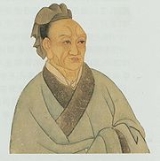
Sima Qian (ca. 145 or 135 BC–86 BC) was a Prefect
Prefect

Prefect is a magisterial title of varying definition.A prefect's office, department, or area of control is called a prefecture, but in various post-Roman cases there is a prefect without a prefecture or vice versa....
 of the Grand Scribes of the Han Dynasty
Han Dynasty

The Han Dynasty followed the Qin Dynasty and preceded the Three Kingdoms in China. The Han Dynasty was ruled by the family known as the Liu clan who had peasant origins....
. He is regarded as the father of Chinese historiography
Chinese historiography

Chinese historiography refers to the study of methods and assumptions made in studying Chinese history....
 because of his highly praised work, Records of the Grand Historian
Records of the Grand Historian

The Records of the Grand Historian, also known in English language by the Chinese name Shiji , written from 109 BC to 91 BC, was the magnum opus of Sima Qian, in which he recounted China history from the time of the Yellow Emperor until his own time....
, an overview of the history of China
History of China

China civilization originated in various city-states along the Yellow River valley in the Neolithic era. The written history of China begins with the Shang Dynasty ....
 covering more than two thousand years from the Yellow Emperor
Yellow Emperor

Huang-di, or the Yellow Emperor, is a legendary Chinese sovereign and culture hero who is considered in Chinese mythology to be the ancestor of all Han Chinese....
 to Emperor Han Wudi. His definitive work laid the foundation for later Chinese historiography
Chinese historiography

Chinese historiography refers to the study of methods and assumptions made in studying Chinese history....
. His descendants such as Sima Yan would later go on to found the Jin Dynasty (265-420)
Jěn Dynasty (265-420)

The J?n Dynasty , one of the Six Dynasties, followed the Three Kingdoms period and preceded the Southern and Northern Dynasties in China. The dynasty was founded by the Sima family ....
 and become Emperors of China after the end of the Three Kingdoms
Three Kingdoms

The Three Kingdoms period is a period in the history of China, part of an era of disunity called the Six Dynasties following immediately the loss of de facto power of the Han Dynasty emperors....
 era.

Early life and education

Sima Qian was born and grew up in Longmen
Longmen

Longmen may refer to:*Longmen Grottoes, collection of Buddhist cave art in Luoyang, China.*Longmen, Zhejiang, town in Zhejiang, southern China....
, near present-day Hancheng, Shaanxi. He was raised in a family of historiographers. His father, Sima Tan
Sima Tan

Sima Tan was an early China historian who worked under the Western Han. He was the father of Sima Qian, who upon the death of Sima Tan, took up his father's work and completed the 130 volume Records of the Grand Historian....
, served as the Prefect
Prefect

Prefect is a magisterial title of varying definition.A prefect's office, department, or area of control is called a prefecture, but in various post-Roman cases there is a prefect without a prefecture or vice versa....
 of the Grand Scribes of Emperor Wu of Han
Emperor Wu of Han

Emperor Wu of Han , , personal name Liu Che , was the seventh emperor of China of the Han Dynasty in modern day mainland China, ruling from 141 BC to 87 BC....
 (Emperor "Han Wudi"). His main responsibilities were managing the imperial library and calendar watching (for national day). Under the influence of his father, at the age of ten, Sima Qian was already well versed in old writings. He was the student of the famous Confucians
Confucianism

Confucianism is a China Ethics and Philosophy developed from the teachings of the Chinese philosopher Confucius . It focuses on human morality and right action....
 Kong Anguo and Dong Zhongshu
Dong Zhongshu

Dong Zhongshu was a Han Dynasty scholar who is traditionally associated with the promotion of Confucianism as official ideology of the Chinese imperial state....
. At the age of twenty, with the support of his father, Sima Qian started a journey throughout the country, collecting useful first-hand historical records for his main work, Shiji. The purpose of his journey was to verify the ancient rumors and legends and to visit ancient monuments, including the renowned graves of the ancient sage kings Yu and Shun. Places he had visited include Shandong
Shandong

For the people of Shandong, see Shandong people is a coastal political divisions of China of eastern People's Republic of China. Its abbreviation is 'Lu', after the state of Lu that existed here during the Spring and Autumn Period....
, Yunnan
Yunnan

is a political divisions of China of the People's Republic of China, located in the far southwest of the country spanning approximately 394,000 square kilometers ....
, Hebei
Hebei

For the people of Hebei, see Hebei people is a North China province of China of the People's Republic of China. Its one-Chinese character abbreviation is "" , named after Ji Province , a Han Dynasty province that included southern Hebei....
, Zhejiang
Zhejiang

Zhejiang is an eastern coastal province of China of the People's Republic of China. The word Zhejiang was the old name of the Qiantang River, which passes through Hangzhou, the provincial capital....
, Jiangsu
Jiangsu

is a Province of China of the People's Republic of China, located along the east coast of the country. The name comes from jiang, short for the city of Jiangning , and su, for the city of Suzhou....
, Jiangxi
Jiangxi

is a southern province of China of the People's Republic of China, spanning from the banks of the Yangtze River in the north into hillier areas in the south....
 and Hunan
Hunan

is a province of China of People's Republic of China, located in the middle reaches of the Yangtze River and south of Lake Dongting . Hunan is sometimes called wikt:? for short, after the Xiang River which runs through the province....
.

After his travels, he was chosen to be a Palace Attendant in the government whose duties were to inspect different parts of the country with Emperor Han Wudi. In 110 BC, at the age of thirty-five, Sima Qian was sent westward on a military expedition against some "barbarian" tribes. That year, his father fell ill and could not attend the Imperial Feng Sacrifice. Suspecting his time was running out, he summoned his son back to complete the historical work he had begun. Sima Tan wanted to follow the Annals of Spring and Autumn - the first chronicle in the history of Chinese literature. Fuelled by his father's inspiration, Sima Qian started to compile Shiji in 109 BC. In 105 BC, Sima was among the scholars chosen to reform the calendar. As a senior imperial official, Sima was also in the position to offer counsel to the emperor on general affairs of state.

In 99 BC, Sima Qian got involved in the Li Ling Affair: Li Ling and Li Guangli, two military officers who led a campaign against the Xiongnu
Xiongnu

The Xiongnu were a confederation of nomadic tribes from Central Asia with a ruling class of unknown origin and other subjugated tribes. They lived on the steppes north of China, and appear in Chinese sources from the 3rd century BC as controlling an empire stretching beyond the borders of modern day Mongolia....
 in the north, were defeated and taken captive. Emperor Han Wudi attributed the defeat to Li Ling, and all the officials in the government condemned Li Ling for the defeat. Sima was the only person to defend Li Ling, who had never been his friend but whom he respected. Emperor Han Wudi interpreted Sima’s defence of Li Ling as an attack on his brother-in-law, who had also fought against the Xiongnu without much success, and sentenced Sima to death. At that time, execution could be commuted
Commutation of sentence

Commutation of sentence involves the reduction of sentence , especially in terms of prison. Unlike a pardon, a commutation does not nullify the conviction and is often conditional....
 either by money or castration
Castration

Castration is any action, surgery, chemical castration, or otherwise, by which a male loses the functions of the testicles. In common usage the term is usually applied to males, although as a medical term it is applied to both males and females....
. Since Sima did not have enough money to atone his "crime", he chose the latter and was then thrown into prison, where he endured three years. He described his pain thus: "When you see the jailer you abjectly touch the ground with your forehead. At the mere sight of his underlings you are seized with terror... Such ignominy can never be wiped away."

In 96 BC, on his release from prison, Sima chose to live on as a palace eunuch
Eunuch

A eunuch is a castrated man, in particular one castrated early enough to have major hormonal consequences; the term usually refers to those castrated in order to perform a specific social function, as was common in many societies of the past....
 so as to complete his histories, rather than commit suicide as was expected of a gentleman-scholar. As Sima Qian's words explained:

Historian

Shiji
Although the style and form of Chinese historical writings varied through the ages, Shiji has defined the quality and style from then onwards. Before Sima, histories were written as dynastic history; his idea of a general history affected later historiographers like Zheng Qiao in writing Tongshi and Sima Guang
Sima Guang

Sima Guang was a China historian, scholar, and high chancellor of the Song Dynasty....
in writing Zizhi Tongjian
Zizhi Tongjian

The Zizhi Tongjian was a pioneering reference work in Chinese historiography, published in 1084, under the form of a chronicles. In 1065 CE, Emperor Yingzong of Song ordered the great historian Sima Guang to lead with other scholars such as his chief assistants Liu Shu, Liu Ban and Fan Zuyu, the compilation of a universal history of Chi...
. The Chinese historical form was codified in the second dynastic history by Ban Gu
Ban Gu

Ban Gu , courtesy name Mengjian , was a 1st century China historian best known for his part in compiling the Book of Han....
’s History of Han, but historians regard Sima’s work as their model, which stands as the "official format" of the history of China.

In writing Shiji, Sima initiated a new writing style by presenting history in a series of biographies. His work extends over 130 chapters — not in historical sequence, but was divided into particular subjects, including annals
Annals

Annals are a concise form of history writing which record events chronologically, year by year....
, chronicle
Chronicle

Generally a chronicle is a historical account of facts and events ranged in chronology order. Typically, equal weight is given for historically important events and local events, the purpose being the recording of events that occurred, seen from the perspective of the chronicler....
s, treatise
Treatise

A treatise is a formal and systematic exposition in writing of the principles of a subject, generally longer and more detailed than an essay. A lengthy discourse on some subject....
s — on music, ceremonies, calendars, religion, economics, and extended biographies. Sima's influence on the writing style of histories in other places is also evident in, for example The History of Korea.

Literary figure

Sima's Shiji is respected as a model of biographical literature with high literary value, and still stands as a "textbook" for the study of classical Chinese worldwide. Sima’s writings were influential to Chinese writing, and become a role model for various types of prose within the neo-classical ("renaissance" ??) movement of the Tang
Tang

Tang or TANG may refer to:...
-Song
Song Dynasty

The Song Dynasty was a ruling Chinese dynasty in China between 960–1279 AD; it succeeded the Five Dynasties and Ten Kingdoms Period, and was followed by the Yuan Dynasty....
period. The great use of characterisation and plotting also influenced fictional writing, including the classical short stories of the middle and late medieval period (Tang
Tang

Tang or TANG may refer to:...
-Ming
Ming Dynasty

The Ming Dynasty , or Empire of the Great Ming , was the ruling Dynasties in Chinese history of China from 1368 to 1644, following the collapse of the Mongol-led Yuan Dynasty....
), as well as the vernacular novel of the late imperial period.

The influence is derived from the following key elements of his writing:

Skillful depiction Sima portrayed many distinguished subjects based on true historical information. He would illustrate the response of the subject by placing him in a sharp contrast or juxtaposition, and then letting his words and deeds speak for him. The use of conversations in his writing also makes the descriptions more vibrant and realistic.

Innovative approach Sima's new approach in writing involved using language which was informal, humorous and full of variations. This was an innovative way of writing at that time and thus it has always been esteemed as the highest achievement of classical Chinese writing; even Lu Xun
Lu Xun

Lu Xun or Lu Hs?n , was the pen name of Zhou Shuren is one of the major Chinese writers of the 20th century. Considered by many to be the founder of modern Chinese literature, he wrote in baihua as well as classical Chinese....
regarded Shiji as "the first and last great work by historians, poems of Qu Yuan
Qu Yuan

Qu Yuan was a Chinese people scholar and minister to the King from the southern Chu during the Warring States Period. His works are mostly found in an anthology of poetry known as Chu Ci....
 without rhyme." (?????,?????) in his Hanwenxueshi Gangyao («??????»).

Concise language The style was simple, concise, fluent, and easy-to-read. Sima made his own comments while recounting the historical events. In writing the biographies in Shiji, he avoided making general descriptions, and instead tried to catch the essence of the events. He would portray the subjects concretely, giving the readers vivid images with strong artistic appeal.

Other literary works

Apart from Shiji, Sima wrote a famous letter to his friend Ren An, in which expressed his suffering during the Li Ling Affair and his perseverance in writing Shiji. This letter is a highly-admired example of literary prose style and is widely studied in China even down to the present. Sima Qian had written eight rhapsodies (Fu ?), which are listed in Hanshu bibliographic treatise. All but one of these have been lost. The only one to survive, the "Rhapsody in Lament for Gentleman who do not Meet their Time" ????, is probably not complete.

Astrologer

Sima and his father were both court astrologers (taishi) ?? in the Former Han Dynasty
Han Dynasty

The Han Dynasty followed the Qin Dynasty and preceded the Three Kingdoms in China. The Han Dynasty was ruled by the family known as the Liu clan who had peasant origins....
. At that time, the astrologer had an important rôle, responsible for interpreting and predicting the course of government according to the influence of the Sun, Moon, and stars, as well as other phenomena like solar eclipse
Eclipse

An eclipse is an astronomical event that occurs when one celestial object moves into the shadow of another. The term is derived from the ancient Greek noun , from verb , "I cease to exist," a combination of prefix , from preposition , "out," and of verb , "I am absent"....
s, earthquakes, etc.

Before compiling Shiji, in 104 BC, Sima Qian created Taichuli (which can be translated as 'The first calendar') on the basis of the Qin
Qin

Qin can refer to:...
 calendar. Taichuli was one of the most advanced calendars of the time. The creation of Taichuli was regarded as a revolution in the Chinese calendar tradition, as it stated that there were 365.25 days in a year and 29.53 days in a month.

Sima adopted a new method in sorting out the historical data and a new approach to writing historical records to establish the relationship between heavenly law and men. He analysed the records and sorted out those which could serve the purpose of Shiji. He intended to find out the patterns and principles of the development of human history.

Sima emphasised the role of men in affecting the historical development of China. It is the first time in Chinese history that men were put under the spotlight in the analysis of historical development. He also denounced Emperor Han Wudi, who was superstitious, and prayed to gods extravagantly. In addition, he also proposed his historical perception that a country cannot escape from the fate of the boom-bust
Boom and bust

File:California Gold Rush handbill.jpgThe term boom and bust refers to a great buildup in the price of a particular commodity or, alternately, the localized rise in an economy, often based upon the value of a single commodity, followed by a downturn as the commodity price falls due to a change in economic circumstances or the collapse o...
 cycle. With these in-depth analyses and insight, Sima set an example for writing journalistic articles in later generations.

Unlike Hanshu, which was written under the supervision of the Imperial Dynasty, Shiji was a privately written historiography. Although Sima was the Prefect of the Grand Scribes in the Han government, he refused to write Shiji as an official historiography covering only those of high rank. The work also covers people of the lower classes and is therefore considered a "veritable record" of the darker side of the dynasty.

The minor planet 12620 Simaqian is named in his honour.

Books about Sima Qian in English

  • Burton Watson
    Burton Watson

    'Burton Watson' is an accomplished translator of Chinese language and Japanese language literature and poetry. He has received awards including the Gold Medal Award of the Translation Center at Columbia University in 1979, the PEN/Book-of-the-Month Club Translation Prize in 1981 for his translation with Hiroaki Sato of From the Country of E...
     (1958) Ssu-ma Ch'ien: Grand Historian of China. New York: Columbia University Press.
  • Yang Hsien-yi and Gladys Yang (1974), Records of the Historians. Hong Kong: Commercial Press.
  • Qian, Sima and trans. Watson, Burton (1993), Records of the Grand Historian: Han Dynasty. Research Center for Translation, The Chinese University of Hong Kong
    Chinese University of Hong Kong

    The Chinese University of Hong Kong, commonly referred to as CUHK, is the second oldest university in Hong Kong; it is campus-based and also the only collegiate university in the territory....
     and Columbia University Press
    Columbia University Press

    Columbia University Press is a university press based in New York City, and affiliated with Columbia University. It is currently directed by James D....
    .
  • Qian, Sima and trans. Watson, Burton (1993), Records of the Grand Historian: Qin Dynasty. Research Center for Translation,


External links