

Yunnan

Encyclopedia
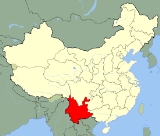
Yunnan is a province of the People's Republic of China
, located in the far southwest of the country spanning approximately 394000 square kilometres (152,124.3 sq mi) and with a population of 45.7 million (2009). The capital of the province is Kunming
. The province borders Burma, Laos
, and Vietnam
.
Yunnan is situated in a mountainous area, with high elevations in the northwest and low elevations in the southeast. Most of the population lives in the eastern part of the province. In the west, the relative height from mountain peaks to river valleys can be as much as 3,000 m. Yunnan is rich in natural resources and has the largest diversity of plant life in China. Of the approximately 30,000 species of higher plants in China, Yunnan has perhaps 17,000 or more. Yunnan's reserves of aluminium
, lead
, zinc
and tin
are the largest in China, and there are also major reserves of copper
and nickel
. Yunnan has over 600 rivers and lakes, which provide an annual water supply of 222 billion cubic meters. Projected hydropower reserves stand at 103 GW, with an exploitable capacity of 90 GW.
Yunnan became part of the Han Dynasty
(206 BC-220 AD) during 2nd century BC. It became the seat of a Tibeto-Burman
speaking kingdom known as the Kingdom of Nanzhao in the 8th century AD. Nanzhao was multi-ethnic, but the elite most likely spoke a northern dialect of Yi
, which became established as the prestige dialect (see Nuosu language). The Mongols
conquered the region in the 13th century, with local control exercised by warlords until the 1930s. As with other parts of China's southwest, Japanese occupation in the north during World War II
forced a migration of majority Han people into the region. Ethnic minorities in Yunnan account for about 34 percent of its total population. Major ethnic groups include Yi
, Bai, Hani
, Zhuang, Dai
and Miao
.
, a plant native to Yunnan Province, is the emblem
of this province.
, a Homo erectus
fossil unearthed by railway engineers in the 1960s, has been determined to be the oldest known hominid fossil in China. By the Neolithic
period, there were human settlements in the area of Lake Dian
. These people used stone tools and constructed simple wooden structures.
Around the 3rd century BC, the central area of Yunnan around present day Kunming was known as Dian
. The Chu
general Zhuang Qiao (庄跤) entered the region from the upper Yangtze River
and set himself up as "King of Dian". He and his followers brought into Yunnan an influx of Chinese influence, the start of a long history of migration and cultural expansion.
 In 221 BC, Qin Shi Huang
unified China and extended his authority south. Commanderies and counties were established in Yunnan. An existing road in Sichuan – the "Five Foot Way" – was extended south to around present day Qujing
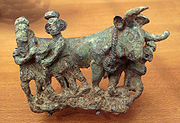
(曲靖), in eastern Yunnan. In 109 BC, Emperor Wu sent General Guo Chang (郭昌) south to Yunnan, establishing Yizhou commandery and 24 subordinate counties. The commandery seat was at Dianchi county (present day Jinning 晋宁). Another county was called "Yunnan", probably the first use of the name. To expand the burgeoning trade with Burma and India
, Emperor Wu also sent Tang Meng (唐蒙) to maintain and expand the Five Foot Way, renaming it "Southwest Barbarian Way" (西南夷道). By this time, agricultural technology in Yunnan had improved markedly. The local people used bronze tools, plows and kept a variety of livestock, including cattle, horses, sheep, goats, pigs and dogs. Anthropologists have determined that these people were related to the people now known as the Tai
. They lived in tribal congregations, sometimes led by exiled Chinese.
During the Three Kingdoms
, the territory of present day Yunnan, western Guizhou
and southern Sichuan was collectively called Nanzhong
. The dissolution of Chinese central authority led to increased autonomy for Yunnan and more power for the local tribal structures. In AD
225, the famed statesman Zhuge Liang
led three columns into Yunnan to pacify the tribes. His seven captures of Meng Huo
, a local magnate, is much celebrated in Chinese folklore.
In the 4th century, northern China was largely overrun by nomadic tribes from the north. In the 320s, the Cuan (爨) clan migrated into Yunnan. Cuan Chen (爨琛) named himself king and held authority from Lake Dian
(then called Kunchuan [昆川]). Henceforth the Cuan clan ruled Yunnan for over four hundred years. In 738, the kingdom of Nanzhao was established in Yunnan by Piluoge (皮罗阁), who was confirmed by the imperial court of the Tang Dynasty
as king
of Yunnan. Ruling from Dali, the thirteen kings of Nanzhao ruled over more than two centuries and played a part in the dynamic relationship between China and Tibet. In 937, Duan Siping
(段思平) overthrew the Nanzhao and established the Kingdom of Dali
. The kingdom was conquered by the Mongol Empire
in 1253, with its former dynasty the Duans incorporated into the Mongolian state as governors general of the new province. The Mongolian prince sent to administer the region with them was killed. In 1273, Kublai Khan
reformed the province and appointed the Turkman
Sayid Ajall
as its governor. Yunnan and Hunan
were main bases for Mongol military operations
in Indo-China. The Ming Dynasty destroyed
the Yuan loyalists in 1381 in the Ming conquest of Yunnan
.
Under the Ming
and Qing
, large areas of Yunnan were administered under the native chieftain system.
In 1894, George Ernest Morrison
, an Australia
n correspondent for The Times
, travelled from Beijing
to British-occupied Burma via Yunnan. His book, An Australian in China, details his experiences.
Yunnan was transformed enormously by the events of the war against Japan
, which caused many east coast refugees and industrial establishments to relocate to the province. It assumed great strategic significance, particularly as the Burma Road
was constructed from Kunming
to Lashio
in Burma during this time.
and Yvette Borup Andrews led the Asiatic Zoological Expedition of the American Museum of Natural History
through much of western and southern Yunnan, as well as other provinces of China. The book, Camps and Trails in China, records their experiences.
Other notable explorers include Heinrich Handel-Mazzetti, George Forrest (botanist)
, Joseph Francis Charles Rock who from 1922–1949 spent most of his time studying the flora, peoples and languages of southwest China, mainly in Yunnan, and Peter Goullart
, a White Russian
who studied Naxi culture and lived in Lijiang from 1940 to 1949.
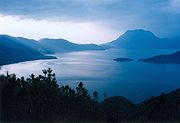
Yunnan is the most southwestern province in China, with the Tropic of Cancer
running through its southern part. The province has an area of 394,000 square km, 4.1% of the nation's total. The northern part of the province forms part of the Yunnan-Guizhou Plateau. The province borders Guangxi
Zhuang Autonomous Region and Guizhou
Province in the east, Sichuan
Province in the north, and Tibet Autonomous Region
in the northwest. It shares a border of 4,060 km with Burma in the west, Laos
in the south, and Vietnam
in the southeast.
. See Agriculture in Yunnan. January average temperatures range from 8°C to 17°C; July averages vary from 21°C to 27°C. Average annual rainfall ranges from 600 mm to 2,300 mm, with over half the rain occurring between June and August. The plateau region has moderate temperatures. The western canyon region is hot and humid at the valley bottoms, but there are freezing winds at the mountaintops.
region to the west and a plateau region to the east. Yunnan's major rivers flow through the deep valleys between the mountains.
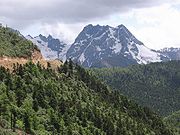
The average elevation is 1,980 m. The mountains are highest in the north where they reach more than 5,000 m; in the south they rise no higher than 3,000 m. The highest point in the north is the Kawagebo Peak
in Deqin County
on the Diqing Plateau, which is about 6,740 meter
s high; and the lowest is in the Honghe River Valley in Hekou County, with an elevation of 76.4 meters.
The eastern half of the province is a limestone plateau with karst scenery and unnavigable rivers flowing through deep mountain gorges; the western half is characterized by mountain ranges and rivers running north and south. These include the Nujiang and the Lancangjiang . The rugged, vertical terrain produces a wide range of flora and fauna, and the province has been called a natural zoological and botanical garden.
, Sichuan
, Guizhou
and Guangxi
. Bordering countries
are Vietnam
(the main border crossing by road and rail is at Hekou
–Lao Cai
, the only land border crossing open to non-Chinese/non-Vietnamese), Laos
(at Boten) and Burma (with the main border crossing at Ruili
, the only land border open to non-Chinese/non-Burmese).
of two rivers, the Xi River (there known as the Nanpan
and Hongshui
) and the Yuan River. The Hongshui is a principal source stream of the Xi River. Rising as the Nanpan in eastern Yunnan province, it flows south and east to form part of the boundary between Guizhou
province and Guangxi
autonomous region. Flowing for 345 km, it unites with the Yu River at Guiping to form what eventually becomes the Xi River.
The province is drained by six major river systems:
plateau
with karst
scenery and unnavigable rivers flowing through deep mountain gorges; the western half is characterized by mountain ranges and rivers running north and south. These include the Salween
and the Mekong River. The rugged, vertical terrain produces a wide range of flora and fauna, and the province has been called a natural zoological and botanical garden.
Yunnan has vast mineral resources that are its chief source of wealth. It is China's leading tin
producer and has large deposits of iron
, coal
, lead
, copper
, zinc
, gold
, mercury
, silver
, antimony
, and sulfur
.
in particular what one source has called a "lushness found nowhere else."
This topographic range combined with a tropical moisture sustains extremely high biodiversity
and high degrees of endemism, probably the richest botanically in the world's temperate regions. Perhaps 17,000 species
of higher plants, of which an estimated 2,500 are endemic, can be found in the province. The province is said to have "as much flowering plant diversity as the rest of the northern hemisphere put together".
The fauna
is nearly as diverse. Yunnan Province has less than 4% of the land of China, yet contains about half of China's birds and mammals. Yunnan is home to, most notably, the southeast Asian gaur
, a giant forest-dwelling ox
, the tiger
, and the Asian Elephant
. Some already disappeared and are most likely extinct, like the Yunnan Box Turtle and the Yunnan Lar Gibbon
. Yunnan Snub-nosed Monkey, also known as the Black Snub-nosed Monkey, is an endangered species of primate in the Cercopithecidae family.
See also Distribution of orchid species
, lead
, tin
, cadmium
, indium
, thallium
, and crocidolite. Other deposits include iron
, coal
, copper
, gold
, mercury
, silver
, antimony
, and sulfur
. More than 150 kinds of minerals have been discovered in the province. The potential value of the proven deposits in Yunnan is 3 trillion yuan
, 40% of which come from fuel minerals, 7.3% from metallic minerals, and 52.7% from nonmetallic minerals.
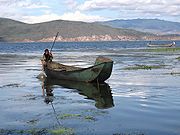
Yunnan has sufficient rainfall and many rivers and lakes. The annual water flow originating in the province is 200 cubic kilometers, three times that of the Yellow River. The rivers flowing into the province from outside add 160 cubic kilometers, which means there are more than ten thousand cubic meters of water for each person in the province. This is four times the average in the country. The rich water resources offer abundant hydro-energy. China is constructing a series of dams on the Mekong to develop it as a waterway and source of power; the first was completed at Manwan
in 1993.
Of those 16 prefecture-level divisions, Yunnan has 129 county-level divisions, and 1455 township-level divisions.
Yunnan Committee: The Secretary of the CPC is the highest ranking and most important position in Yunnan.
Governors of Yunnan: The Governor is the second highest office in Yunnan, after the Secretary of the CPC Yunnan Committee. The Governor, who is elected by the Yunnan Provincial People's Congress, is responsible for all economic, environmental
, political, personnel and foreign affairs
issues concerning Yunnan.
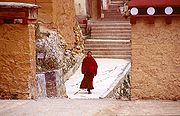
 Yunnan is noted for a very high level of ethnic diversity. It has the second highest number of ethnic groups among the provinces and autonomous regions in China, after Xinjiang (which has forty-seven ethnic groups). Among the country's fifty-six recognised ethnic groups, twenty-five are found in Yunnan. Some 38% of the province's population are members of minorities, including the Yi
, Bai, Hani
, Tai
, Dai
, Miao
, Lisu, Hui
, Lahu
, Va
, Nakhi, Yao
, Tibetan
, Jingpo, Blang
, Pumi, Nu
, Achang
, Jinuo, Mongolian
, Derung
, Manchu, Shui, and Buyei
. Several other groups are represented, but they live neither in compact settlements nor do they reach the required threshold of five thousand to be awarded the official status of being present in the province. Some groups, such as the Mosuo
, who are officially recognised as part of the Naxi, have in the past claimed official status as a national minority, and are now recognised with the status of Mosuo people.
Ethnic groups are widely distributed in the province. Some twenty-five minorities live in compact communities, each of which has a population of more than five thousand. Ten ethnic minorities living in border areas and river valleys include the Hui
, Manchu (the Manchu, remnants of the Qing administration, do not live in compact settlements and are in all respects indistinguishable from the Han
), Bai, Naxi, Mongolian
, Zhuang, Dai
, Achang
, Buyei
and Shui, with a combined population of 4.5 million; those in low mountainous areas are the Hani
, Yao
, Lahu
, Va
, Jingpo, Blang
and Jino
, with a combined population of 5 million; and those in high mountainous areas are Miao
, Lisu, Tibetan
, Pumi and Drung
, with a total population of four million.
An oft-repeated proverb tells the story of three brothers who were born speaking different languages: Tibetan
, Naxi
, and Bai
. Each settled in different areas of Yunnan and Tibet, respectively, the high area, the middle area, and the low area.
spoken in Yunnan belong to the southwestern
subdivision of the Mandarin group, and are therefore very similar to the dialects of neighbouring Sichuan
and Guizhou
provinces. Notable features found in many Yunnan dialects include the partial or complete loss of distinction between finals /n/ and /ŋ/, as well as the lack of /y/. In addition to the local dialects, most people also speak Standard Chinese (Putonghua, commonly called "Mandarin"), which is used in the media, by the government, and as the language of instruction in education.
Yunnan's ethnic diversity is reflected in its linguistic diversity. Languages spoken in Yunnan include Tibeto-Burman languages
such as Bai, Yi
, Tibetan
, Hani
, Jingpo, Lisu
, Lahu
, Naxi
; Tai languages
like Zhuang, Bouyei
, Dong
, Shui, Tai Lü
and Tai Nüa or northern Lao dialect
; as well as Hmong–Mien languages.
The Naxi, in particular, use the Dongba script
, which is the only pictographic writing system in use in the world today. The Dongba script was mainly used to provide the Dongba priests with instructions on how to carry out their rituals: today the Dongba script features more as a tourist attraction. The most famous Western Dongba scholar was Joseph Rock
.
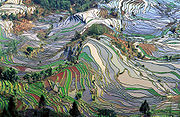
The region maintains a strong agricultural focus. Agriculture is restricted to the few upland plains, open valleys, and terraced hillsides. Level land for agriculture is extremely scarce and only about 5 percent of the province is under cultivation. Rice
is the main crop; corn
, barley
, wheat
, rapeseed
, sweet potato
es, soybean
s (as a food crop), tea, sugarcane
, tobacco
, and cotton
are also grown. On the steep slopes in the west livestock
is raised and timber
, a valuable resource, is cut (teak
in the southwest).
Tobacco
is the main (export) product and makes up a big part of the provincial GDP. Furthermore, Yunnan has a strong competitive potential in the fruit and vegetable industries, especially in low value-added commodities such as fresh and dried vegetables and fresh apples.
Yunnan is one of the regions in the world with the most abundant resources of wild edible mushroom
s. In China, there are 938 kinds of edible mushrooms, and over 800 varieties can be found in Yunnan. In 2004, around 7,744 tons of wild edible mushrooms were exported, making up for 70% of the total export of this product in China. The so-called 'pine mushroom' is the main product in Yunnan and is exported to Japan
in large quantities.
Another interesting industry with a clear growth potential is the coffee
sector. Yunnan is currently China's most important producer of Arabica coffee. Besides the export of roasted coffee, coffee-related products such as extracts, essences and substitutes may be promising products. Yunnan is the birthplace of tea
. Still, ancient tea trees can be found in Yunnan of which tealeaves are processed. Tea is becoming an important export product. Especially in the US and Japan the demand is growing.
Due to China's growing consumption of dairy products (a trend heavily supported by the national government), Yunnan's dairy industry is also developing more rapidly and receiving large subsidies from the government develop a competitive edge in Southwest China
, but is also aiming to export to its ASEAN neighbors.
Then last but not least, a growing sector, heavily supported by the local government is the horticultural sector. The flower industry in Yunnan province started to develop towards the end of the 1980s. Currently, Yunnan is the most important province nationwide in the field of flower growing. Yunnan province accounts for 50% of China's total cut flower production. The size of the planting area for cut flowers in Yunnan province amounts to 4000 hectares. In 2003, the output totaled 2.3 billion stems. In 2002 the flower industry in Yunnan had a total output of RMB 3.4 billion. Export amounted to USD 18 million. Apart from sales on the domestic market, Yunnan also exports to a number of foreign countries and regions such as Japan, Korea, Hong Kong, Thailand and Singapore.
The rapid developments in this field soon attracted the attention of Dutch horticultural companies and Dutch investments in flower related projects and businesses are steadily growing.
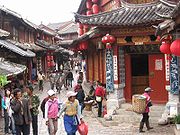 Yunnan is one of China's relatively undeveloped provinces with more poverty
-stricken counties than the other provinces. In 1994, about 7 million people lived below the poverty line of less than an annual average income
of 300 yuan
per capita
. They were distributed in the province's 73 counties mainly and financially supported by the central government
. With an input of 3.15 billion yuan in 2002, the absolutely poor rural population in the province has been reduced from 4.05 million in 2000 to 2.86 million. The poverty alleviation plan includes five large projects aimed at improving infrastructure facilities. They involve planned attempts at soil improvement, water conservation
, electric power
, roads, and "green belt
" building. Upon the completion of the projects, the province hopes this will alleviate the shortages of grain
, water, electric power and roads.
Yunnan lags behind the east coast of China in relation to socio-economic development. However, because of its geographic location the province has comparative advantage
s in regional and border trade with countries in southeast Asia
. The Lancang River (upper reaches of Mekong River) is the waterway to southeast Asia. In recent years land transportation has been improved to strengthen economic and trade co-operation among countries in the Greater Mekong Subregion
. Yunnan's abundance in resources determines that the province's pillar industries are: agriculture
, tobacco
, mining
, hydro-electric power
, and tourism
. In general, the province still depends on the natural resources
. Secondary industry is currently the largest industrial tier in Yunnan, contributing more than 45 percent of GDP. Tertiary industry contributes 40 percent and agriculture 15 percent. Investment
is the key driver of Yunnan's economic growth
, especially in construction
.
The main challenge that Yunnan faces is its lack of major development
. Its low productivity
and competitiveness
restrict the rapid development of the province. The province also faces great challenges in social issues
such as environmental protection
, poverty elimination, illegal migration, drug trafficking and HIV/AIDS
.
Yunnan's four pillar industries include tobacco
, agriculture
/biology
, mining
, and tourism
. The main manufacturing
industries are iron and steel production and copper-smelting, commercial vehicles, chemicals, fertilizers, textiles, and optical instruments. Yunnan has trade contacts with more than seventy countries and regions in the world. Yunnan established the Muse border trade zone
(located in Ruili
) along its border with Burma. Yunnan mainly exports tobacco
, machinery and electrical equipment, chemical and agricultural products, and non-ferrous metals. In 2008, its total two-way trade (imports and exports) reached US$9.6 billion. The province signed foreign direct investment
contracts involving US$1.69 billion, of which US$777 million were actually utilized during the year. Yunnan's unemployment rate at the end of 2008 was 4.21%.
Yunnan's nominal GDP in 2009 was 616.8 billion yuan (US$90.04 billion), an annual growth rate of 11%. Its per capita GDP was 13,494 yuan (US$1,975). The share of GDP of Yunnan's primary
, secondary
, and tertiary
industries were 17.9%, 43%, and 39.1% respectively.
Yunnan is one of the major production bases of copper, lead, zinc, tin and aluminum in China. Gejiu city is well known as "the Kingdom of Zinc" with the reserves ranked first in the country. The Yunxi brand refined tin is one of the main products in Gejiu, which is registered on the London Metal Exchange
(LME). Besides, reserves of germanium, indium, zirconium, platinum, rock salt, sylvite, nickel, phosphate, mirabilite, arsenic and blue asbestos are also high. Significant copper deposits are found at Dongchuan
, iron ore at Wuding, and coal at Xuanwei
and Kaiyuan. Economic policy
to locate new industry in interior areas with substantial mineral wealth, led to major industrial development in Yunnan, especially in the Kunming area
.
The electricity industry is another important economic pillar of Yunnan, which plays a key role in the "West-East Electricity Transmission Project". The electricity produced in Yunnan is mainly transported to Guangdong Province.
First established in 1992, Kunming Economic & Technology Development Zone is a national-level zone approved by State Council. Kunming is located in east-central Yunnan province with preferential location. After several years' development, the zone has formed its pillar industries, which include tobacco processing, machinery manufacturing, electronic information, and biotechnology.
The Kunming High-tech Industrial Development Zone (KMHNZ), is a state-level high-tech industrial zone established in 1992 in Northwest Kunming, Yunnan Province, China. It is administratively under Kunming Prefecture. It has covers an area of 9 square kilometers. KMHNZ is located in the northwest part of Kunming city, 4 kilometers from Kunming Railway Station, 5 kilometers from Kunming International Airport.
Ruili Border Economic Cooperation Zone (RLBECZ) is a Chinese State Council-approved Industrial Park based in Ruili City, Dehong Prefecture, Yunnan, China, founded in 1992 and was established to promote trade between China and Burma. The area's import and export trade include the processing industry, local agriculture and biological resources are very promising. Sino-Burmese business is growing fast. Burma is now one of Yunnan's biggest foreign trade partners. In 1999, Sino-Burmese trade accounted for 77.4% of Yunnan's foreign trade. In the same year, exports for electromechanical equipments came up to USD 55.28 million. Main exports here include fiber cloth, cotton yarn, ceresin
wax, mechanical equipments, fruits, rice seeds, fiber yarn and tobacco.
Wanding Border Economic Cooperation Zone (WTBECZ) is a Chinese State Council-approved Industrial Park based in Wanding Town, Ruili City, Dehong Prefecture, Yunnan, China, founded in 1992 and was established to promote trade between China and Burma. The zone spans 6 km sq. and is focuses on developing trading, processing, agriculture resources and tourism.
Qujing Economic and Technological Development Zone (QETDZ) is a provincial development zone approved by Yunnan Provincial Government in August 1992. It is located in the east of urban Qujing, the second largest city in Yunnan in terms of economic strengths. The location of the development zone is the economic, political and cultural center of Qujing. As an agency under Qujing municipal Party committee and municipal government, the administrative commission of QETDZ functions as an economy supervising body at the prefecture level and an administration body at the county level. It has 106 km2 under its jurisdiction. It shoulders the task of building a new 40-square-kilometer city area and providing service for a population of 400,000 in the upcoming 10 years.
Chuxiong Economic Development Zone is an important zone in Yunnan. Now the zone has attracted a number of investment projects. It is an important industry for the development of new-type industry platform. The zone covers an area of 12 sqkm, composed of four parks.
First established in 1992, Hekou Border Economic Cooperation Zone is a border zone approved by State Council in China to promote trade between China and Vietnam. It has a planned area of 4.02 square kilometers. The zone implemented several policies to serve its clients in China from various industries and sectors including investment, trade, finance, taxation, immigration and etc.
, distance
and continuing education
to farms, factories, offices, and other places. Evening, time off work / study leave classes allow people to receive education without leaving their jobs. Policies to upgrade adult education have begun to complement the campaign against illiteracy. A basic Chinese vocabulary in simplified strokes
is taught to millions of illiterate people in short, intensive courses. Despite progress made, Yunnan's illiteracy rate remains one of the highest in China mainly due to insufficient education among minority peoples.
In higher education
, Yunnan has one "National Key University"—Yunnan University
in Kunming
. There is also a growing number of technical schools, among which the most prominent are the Southwest Forestry University
, Yunnan Agricultural University
, Yunnan Academy of Agricultural Sciences, Kunming Medical University
, Yunnan University of Traditional Chinese Medicine
, and Kunming University of Science and Technology
. Other notable establishments of learning are the Kunming branch of the Chinese Academy of Sciences, the Yunnan Astronomical Observatory
, and the Yunnan Provincial Library
.As of 2000, there were 24 institutions of higher learning in Yunnan, with an enrollment of over 90,400 students and a faculty of 9,237; 2,562 secondary schools with an enrollment of more than 2,137,400 students and 120,461 teachers; and 22,151 primary schools with an enrollment of 4,720,600 pupils and a faculty of 210,507. The gross enrollment rate of school-age children was 99.02%.
See also: List of universities and colleges in Yunnan
cases in China.
It is presently considered to be the main source of plague in China.
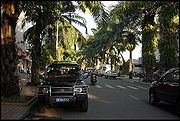
by a French engineered narrow gauge railway, the Sino-Vietnamese Railway completed in 1910. It took another fifty years for the province to be connected by rail to the rest of China with the completion of the Chengdu
–Kunming
line. Later a line connecting Kunming to Guiyang
followed. Two further lines have been added recently: a southern line connecting to Nanning
and a north-eastern line connecting to Sichuan
via Yibin
.
An extension now also links Kunming to Dali
, with the stretch to Lijiang nearing completion. Plans are underway on extending the old line to Vietnam, while a new and very ambitious plan to link from Dali to Ruili
has been announced in 2006. Another plan to extend the railway line from Kunming
all the way to Singapore
, with connections to the other South East Asian countries, will be opened in 2017.
Road and railroad traffic has been recently improved, and Kunming is now a transportation center; an important railroad runs from Kunming to Hanoi, Vietnam, while transportation to Burma is maintained by the Burma Road
.
was a highway extending about 1100 kilometres (683.5 mi) through mountainous terrain from Lashio
, northeast Burma northeastward to Kunming, China. Undertaken by the Chinese after the start of the Sino-Japanese War in 1937 and completed in 1938, it was a vital transportation route for wartime supplies to the Chinese government from Rangoon and shipped by railroad to Lashio from 1938 to 1946. An extension runs east through China from Kunming, then north to Chongqing. This traffic increased in importance to China after the Japanese took effective control of the Chinese coast and of Indochina. It was seized by the Japanese in 1942 and reopened when it was connected to the Stilwell Road from India. The Ledo Road
(later called the Stilwell Road) from Ledo, India, into Burma was begun in December 1942. In 1944 the Ledo Road reached Myitkyina
and was joined to the Burma Road. Both roads have lost their former importance and are in a state of disrepair. The Burma Road's importance diminished after World War II, but it has remained a link in a 3,400-km road system from Yangon
, Burma, to Chongqing
.
All county towns are now accessible by paved, all-weather roads from Kunming, all townships have a road connection (the last to be connected was Yangla, in the far north, but Dulongjiang remains cut off for about six months every year), and about half of all villages have road access.
Second-level national highways stretch 958 km, third-level highways, 7,571 km and fourth-level highways, 52,248 km. The province has formed a network of communication lines radiating from Kunming to Sichuan and Guizhou provinces and Guangxi and Tibet autonomous regions, and further on to Burma, Laos, Vietnam and Thailand.
National highways running through Yunnan province are:
Province, opened on October 2007. It has made material and passenger transportation between the two provinces much more convenient. Moreover, Luofu Expressway has also become the main road from Yunnan to Guangxi and the coastal ports. Luofu Expressway begins from the crossroads of Luo Village between Yunnan and Guangxi Provinces and ends at Funing County of Wenshan State. The total length of the expressway is 79.3 kilometers which has shortened the commute
between Yunnan and Guangxi from the previous 3 and half hours to just 50 minutes.
Expressways running through Yunnan province are:
to develop it as a waterway and source of power; the first was completed at Manwan
in 1993.
In 1995, the province put an investment of 171 million yuan to add another 807 km of navigation lines. It built two wharfs with an annual handling capacity of 300,000 to 400,000 tons each and four wharfs with an annual handling capacity of 100,000 tons each. The annual volume of goods transported was two million tons and that of passengers transported, two million.
to Beijing
, Shanghai
, Guangzhou
, Chengdu
, Haikou
, Chongqing
, Shenyang
, Harbin
, Wuhan
, Xi'an
, Lanzhou
, Hangzhou
, Xiamen
, Nanning
, Shenzhen
, Guiyang
, Changsha, Guilin
, Lhasa
and Hong Kong
; ten provincial air routes from Kunming
to Jinghong
, Mangshi, Lincang, Tengchong, Lijiang, Dali
, Zhongdian (Shangri-la), Zhaotong
, Baoshan and Simao; and ten international air routes from Kunming
to Bangkok
, Calcutta, Chiang Mai
, Yangon
, Singapore
, Seoul
, Hanoi
, Ho Chi Minh City
, Kuala Lumpur
and Vientiane
.
The Wujiaba Airport in Kunming
is a national first-class airport and the other airports are second-class terminals. A new airport for Kunming, to be built east of the city at Dabanqiao, began construction in 2006, but is not expected to be completed until 2015.
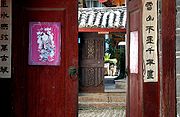 Yunnan's cultural life is one of remarkable diversity. Archaeological findings have unearthed sacred burial structures holding elegant bronzes in Jinning, south of Kunming
. In Zhaotong
in northeastern Yunnan, there has been discovered, frescos of the Jin Dynasty (265–420). Many Chinese cultural relics have been discovered in later periods. The lineage of tribal way of life of the indigenous peoples persisted uninfluenced by modernity until the mid-20th century. Tribal traditions, such as Yi
slaveholding
and Wa headhunting
, have since been abolished. After the Cultural Revolution
(1966–76), when many minority culture and religious practices were suppressed, Yunnan has come to celebrate its cultural diversity and subsequently many local customs and festivals have flourished.
, named after the old tea trading town of Pu-erh.
The province is also known for its Yunnan Gold
and other Dianhong
teas, developed in the 20th century.
.
. At the moment projects in this field are often being set up with help of NGO's.
In 2004, tourism revenues amounted to 37 billion RMB, and thus accounting for 12, 6% of the provincial GDP. Another fact indicating the importance of tourism in Yunnan Province is capital Kunming hosting the China International Travel Mart every two years. This tourism trade fair is the largest of its kind in Asia and serves as an important platform for professionals in the sector. More than 80 countries and regions were present during the 2005 edition.
Tourist centres in Yunnan include:
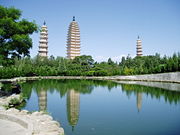
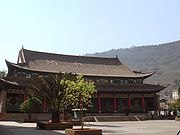
in the Chinese Basketball Association
. Football teams include Yunnan Lijiang Dongba
and the defunct Yunnan Hongta
.
A number of international four wheel drive
competitions have been held in the province in the vicinity of Jinggu, Simao
.
Yunnan is also well known as a destination for cycling, white water rafting, rock climbing and hiking.
Web
People's Republic of China
China , officially the People's Republic of China , is the most populous country in the world, with over 1.3 billion citizens. Located in East Asia, the country covers approximately 9.6 million square kilometres...
, located in the far southwest of the country spanning approximately 394000 square kilometres (152,124.3 sq mi) and with a population of 45.7 million (2009). The capital of the province is Kunming
Kunming
' is the capital and largest city of Yunnan Province in Southwest China. It was known as Yunnan-Fou until the 1920s. A prefecture-level city, it is the political, economic, communications and cultural centre of Yunnan, and is the seat of the provincial government...
. The province borders Burma, Laos
Laos
Laos Lao: ສາທາລະນະລັດ ປະຊາທິປະໄຕ ປະຊາຊົນລາວ Sathalanalat Paxathipatai Paxaxon Lao, officially the Lao People's Democratic Republic, is a landlocked country in Southeast Asia, bordered by Burma and China to the northwest, Vietnam to the east, Cambodia to the south and Thailand to the west...
, and Vietnam
Vietnam
Vietnam – sometimes spelled Viet Nam , officially the Socialist Republic of Vietnam – is the easternmost country on the Indochina Peninsula in Southeast Asia. It is bordered by China to the north, Laos to the northwest, Cambodia to the southwest, and the South China Sea –...
.
Yunnan is situated in a mountainous area, with high elevations in the northwest and low elevations in the southeast. Most of the population lives in the eastern part of the province. In the west, the relative height from mountain peaks to river valleys can be as much as 3,000 m. Yunnan is rich in natural resources and has the largest diversity of plant life in China. Of the approximately 30,000 species of higher plants in China, Yunnan has perhaps 17,000 or more. Yunnan's reserves of aluminium
Aluminium
Aluminium or aluminum is a silvery white member of the boron group of chemical elements. It has the symbol Al, and its atomic number is 13. It is not soluble in water under normal circumstances....
, lead
Lead
Lead is a main-group element in the carbon group with the symbol Pb and atomic number 82. Lead is a soft, malleable poor metal. It is also counted as one of the heavy metals. Metallic lead has a bluish-white color after being freshly cut, but it soon tarnishes to a dull grayish color when exposed...
, zinc
Zinc
Zinc , or spelter , is a metallic chemical element; it has the symbol Zn and atomic number 30. It is the first element in group 12 of the periodic table. Zinc is, in some respects, chemically similar to magnesium, because its ion is of similar size and its only common oxidation state is +2...
and tin
Tin
Tin is a chemical element with the symbol Sn and atomic number 50. It is a main group metal in group 14 of the periodic table. Tin shows chemical similarity to both neighboring group 14 elements, germanium and lead and has two possible oxidation states, +2 and the slightly more stable +4...
are the largest in China, and there are also major reserves of copper
Copper
Copper is a chemical element with the symbol Cu and atomic number 29. It is a ductile metal with very high thermal and electrical conductivity. Pure copper is soft and malleable; an exposed surface has a reddish-orange tarnish...
and nickel
Nickel
Nickel is a chemical element with the chemical symbol Ni and atomic number 28. It is a silvery-white lustrous metal with a slight golden tinge. Nickel belongs to the transition metals and is hard and ductile...
. Yunnan has over 600 rivers and lakes, which provide an annual water supply of 222 billion cubic meters. Projected hydropower reserves stand at 103 GW, with an exploitable capacity of 90 GW.
Yunnan became part of the Han Dynasty
Han Dynasty
The Han Dynasty was the second imperial dynasty of China, preceded by the Qin Dynasty and succeeded by the Three Kingdoms . It was founded by the rebel leader Liu Bang, known posthumously as Emperor Gaozu of Han. It was briefly interrupted by the Xin Dynasty of the former regent Wang Mang...
(206 BC-220 AD) during 2nd century BC. It became the seat of a Tibeto-Burman
Tibeto-Burman languages
The Tibeto-Burman languages are the non-Chinese members of the Sino-Tibetan language family, over 400 of which are spoken thoughout the highlands of southeast Asia, as well as lowland areas in Burma ....
speaking kingdom known as the Kingdom of Nanzhao in the 8th century AD. Nanzhao was multi-ethnic, but the elite most likely spoke a northern dialect of Yi
Yi language
Nuosu , also known as Northern Yi, Liangshan Yi, and Sichuan Yi, is the prestige language of the Yi people; it has been chosen by the Chinese government as the standard Yi language and, as such, is the only one taught in school, both in its oral and written form...
, which became established as the prestige dialect (see Nuosu language). The Mongols
Yuan Dynasty
The Yuan Dynasty , or Great Yuan Empire was a ruling dynasty founded by the Mongol leader Kublai Khan, who ruled most of present-day China, all of modern Mongolia and its surrounding areas, lasting officially from 1271 to 1368. It is considered both as a division of the Mongol Empire and as an...
conquered the region in the 13th century, with local control exercised by warlords until the 1930s. As with other parts of China's southwest, Japanese occupation in the north during World War II
Second Sino-Japanese War
The Second Sino-Japanese War was a military conflict fought primarily between the Republic of China and the Empire of Japan. From 1937 to 1941, China fought Japan with some economic help from Germany , the Soviet Union and the United States...
forced a migration of majority Han people into the region. Ethnic minorities in Yunnan account for about 34 percent of its total population. Major ethnic groups include Yi
Yi people
The Yi or Lolo people are an ethnic group in China, Vietnam, and Thailand. Numbering 8 million, they are the seventh largest of the 55 ethnic minority groups officially recognized by the People's Republic of China...
, Bai, Hani
Hani people
thumb|Typical daily attire of ethnic Hani in China. Near [[Yuanyang County, Yunnan|Yuanyang]], [[Yunnan]] Province, [[China]] The Hani people are an ethnic group. They form one of the 56 nationalities officially recognized by the People's Republic of China. They also form one of the 54 officially...
, Zhuang, Dai
Dai people
The Dai peoples is one of several ethnic groups living in the Xishuangbanna Dai Autonomous Prefecture and the Dehong Dai and Jingpo Autonomous Prefecture , but by extension can apply to groups in Laos, Vietnam, Thailand, and Burma when Dai is used to mean specifically Tai Lue, Chinese Shan or even...
and Miao
Miao people
The Miao or ม้ง ; ) is an ethnic group recognized by the government of the People's Republic of China as one of the 55 official minority groups. Miao is a Chinese term and does not reflect the self-designations of the component nations of people, which include Hmong, Hmu, A Hmao, and Kho Xiong...
.
Emblem
Camellia reticulataCamellia reticulata
Camellia reticulata is a species of Camellia native to southwestern China, in Yunnan Province. The wild populations are restricted to mixed mountain forest in western and central Yunnan....
, a plant native to Yunnan Province, is the emblem
Emblem
An emblem is a pictorial image, abstract or representational, that epitomizes a concept — e.g., a moral truth, or an allegory — or that represents a person, such as a king or saint.-Distinction: emblem and symbol:...
of this province.
History
The Yuanmou ManYuanmou Man
Yuanmou Man , Homo erectus yuanmouensis, refers to a member of the homo genus whose remnants, two incisors, were discovered near Danawu Village in Yuanmou County in southwestern province of Yunnan, China. Later, stone artifacts, pieces of animal bone showing signs of human work and ash from...
, a Homo erectus
Homo erectus
Homo erectus is an extinct species of hominid that lived from the end of the Pliocene epoch to the later Pleistocene, about . The species originated in Africa and spread as far as India, China and Java. There is still disagreement on the subject of the classification, ancestry, and progeny of H...
fossil unearthed by railway engineers in the 1960s, has been determined to be the oldest known hominid fossil in China. By the Neolithic
Neolithic
The Neolithic Age, Era, or Period, or New Stone Age, was a period in the development of human technology, beginning about 9500 BC in some parts of the Middle East, and later in other parts of the world. It is traditionally considered as the last part of the Stone Age...
period, there were human settlements in the area of Lake Dian
Lake Dian
Dian Lake or Kunming Lake is a large inter-land lake located on the Yunnan-Guizhou Plateau close to Kunming, Yunnan, China. Its nickname is "Sparkling Pearl Embedded in a Highland," and it was the model for the Kunming Lake in the Summer Palace in Beijing.It is a freshwater fault lake at above...
. These people used stone tools and constructed simple wooden structures.
Around the 3rd century BC, the central area of Yunnan around present day Kunming was known as Dian
Dian Kingdom
The Dian Kingdom was established by the Dian people, who lived around Lake Dian in northern Yunnan, China from the late Spring and Autumn Period until the Eastern Han Dynasty. The Dian buried their dead in vertical pit graves...
. The Chu
Chu (state)
The State of Chu was a Zhou Dynasty vassal state in present-day central and southern China during the Spring and Autumn period and Warring States Period . Its ruling house had the surname Nai , and clan name Yan , later evolved to surname Mi , and clan name Xiong...
general Zhuang Qiao (庄跤) entered the region from the upper Yangtze River
Yangtze River
The Yangtze, Yangzi or Cháng Jiāng is the longest river in Asia, and the third-longest in the world. It flows for from the glaciers on the Tibetan Plateau in Qinghai eastward across southwest, central and eastern China before emptying into the East China Sea at Shanghai. It is also one of the...
and set himself up as "King of Dian". He and his followers brought into Yunnan an influx of Chinese influence, the start of a long history of migration and cultural expansion.
Qin Shi Huang
Qin Shi Huang , personal name Ying Zheng , was king of the Chinese State of Qin from 246 BC to 221 BC during the Warring States Period. He became the first emperor of a unified China in 221 BC...
unified China and extended his authority south. Commanderies and counties were established in Yunnan. An existing road in Sichuan – the "Five Foot Way" – was extended south to around present day Qujing
Qujing
Qujing is a prefecture-level city in eastern Yunnan province of Southwest China. It is an important industrial city, and is Yunnan's second largest city by population, after Kunming....
(曲靖), in eastern Yunnan. In 109 BC, Emperor Wu sent General Guo Chang (郭昌) south to Yunnan, establishing Yizhou commandery and 24 subordinate counties. The commandery seat was at Dianchi county (present day Jinning 晋宁). Another county was called "Yunnan", probably the first use of the name. To expand the burgeoning trade with Burma and India
Greater India
Greater India is a term that refers to the historical spread of the culture of India beyond the Indian subcontinent...
, Emperor Wu also sent Tang Meng (唐蒙) to maintain and expand the Five Foot Way, renaming it "Southwest Barbarian Way" (西南夷道). By this time, agricultural technology in Yunnan had improved markedly. The local people used bronze tools, plows and kept a variety of livestock, including cattle, horses, sheep, goats, pigs and dogs. Anthropologists have determined that these people were related to the people now known as the Tai
Tai peoples
The Tai ethnicity refers collectively to the ethnic groups of southern China and Southeast Asia, stretching from Hainan to eastern India and from southern Sichuan to Laos, Thailand, and parts of Vietnam, which speak languages in the Tai family and share similar traditions and festivals, including...
. They lived in tribal congregations, sometimes led by exiled Chinese.
During the Three Kingdoms
Three Kingdoms
The Three Kingdoms period was a period in Chinese history, part of an era of disunity called the "Six Dynasties" following immediately the loss of de facto power of the Han Dynasty rulers. In a strict academic sense it refers to the period between the foundation of the state of Wei in 220 and the...
, the territory of present day Yunnan, western Guizhou
Guizhou
' is a province of the People's Republic of China located in the southwestern part of the country. Its provincial capital city is Guiyang.- History :...
and southern Sichuan was collectively called Nanzhong
Nanzhong
Nanzhong was an ancient region consisting of modern-day Yunnan, Guizhou, and southern Sichuan in southern China.The region was the homeland of the rebellious Nanman tribes, led by Meng Huo. In 225 AD, the famed statesman Zhuge Liang led three columns into Yunnan to pacify the tribes. His seven...
. The dissolution of Chinese central authority led to increased autonomy for Yunnan and more power for the local tribal structures. In AD
Anno Domini
and Before Christ are designations used to label or number years used with the Julian and Gregorian calendars....
225, the famed statesman Zhuge Liang
Zhuge Liang
Zhuge Liang was a chancellor of the state of Shu Han during the Three Kingdoms period of Chinese history. He is often recognised as the greatest and most accomplished strategist of his era....
led three columns into Yunnan to pacify the tribes. His seven captures of Meng Huo
Meng Huo
Meng Huo was popularly regarded as a local leader representing the gentries of the Nanzhong region during the Three Kingdoms era of Chinese history...
, a local magnate, is much celebrated in Chinese folklore.
In the 4th century, northern China was largely overrun by nomadic tribes from the north. In the 320s, the Cuan (爨) clan migrated into Yunnan. Cuan Chen (爨琛) named himself king and held authority from Lake Dian
Lake Dian
Dian Lake or Kunming Lake is a large inter-land lake located on the Yunnan-Guizhou Plateau close to Kunming, Yunnan, China. Its nickname is "Sparkling Pearl Embedded in a Highland," and it was the model for the Kunming Lake in the Summer Palace in Beijing.It is a freshwater fault lake at above...
(then called Kunchuan [昆川]). Henceforth the Cuan clan ruled Yunnan for over four hundred years. In 738, the kingdom of Nanzhao was established in Yunnan by Piluoge (皮罗阁), who was confirmed by the imperial court of the Tang Dynasty
Tang Dynasty
The Tang Dynasty was an imperial dynasty of China preceded by the Sui Dynasty and followed by the Five Dynasties and Ten Kingdoms Period. It was founded by the Li family, who seized power during the decline and collapse of the Sui Empire...
as king
Chinese nobility
Chinese sovereignty and peerage, the nobility of China, were an important feature of traditional social and political organization of Imperial China. While the concepts of hereditary sovereign and peerage titles and noble families were featured as early as the semi-mythical, early historical...
of Yunnan. Ruling from Dali, the thirteen kings of Nanzhao ruled over more than two centuries and played a part in the dynamic relationship between China and Tibet. In 937, Duan Siping
Duan Siping
Duan Siping was a statesman of Bai origin and eventual founder and ruler of the Kingdom of Dali. The Kingdom retained independence from unified China until the Mongol invasion in 1253 C.E....
(段思平) overthrew the Nanzhao and established the Kingdom of Dali
Kingdom of Dali
Dali or Great Li was a Bai kingdom centred in what is now Yunnan Province of China. Established by Duan Siping in 937, it was ruled by a succession of 22 kings until the year 1253, when it was conquered by an invasion of the Mongol Empire. The capital city was at Dali.- History :The Kingdom of...
. The kingdom was conquered by the Mongol Empire
Mongol Empire
The Mongol Empire , initially named as Greater Mongol State was a great empire during the 13th and 14th centuries...
in 1253, with its former dynasty the Duans incorporated into the Mongolian state as governors general of the new province. The Mongolian prince sent to administer the region with them was killed. In 1273, Kublai Khan
Kublai Khan
Kublai Khan , born Kublai and also known by the temple name Shizu , was the fifth Great Khan of the Mongol Empire from 1260 to 1294 and the founder of the Yuan Dynasty in China...
reformed the province and appointed the Turkman
Turkmen people
The Turkmen are a Turkic people located primarily in the Central Asian states of Turkmenistan, Afghanistan, and northeastern Iran. They speak the Turkmen language, which is classified as a part of the Western Oghuz branch of the Turkic languages family together with Turkish, Azerbaijani, Qashqai,...
Sayid Ajall
Sayyid Ajjal Shams al-Din Omar
Sayyid Ajjal Shams al-Din Omar al-Bukhari was Yunnan's first provincial governor in history, appointed by the Mongol Yuan Dynasty....
as its governor. Yunnan and Hunan
Hunan
' is a province of South-Central China, located to the south of the middle reaches of the Yangtze River and south of Lake Dongting...
were main bases for Mongol military operations
Mongol invasions
Mongol invasions progressed throughout the 13th century, resulting in the vast Mongol Empire which covered much of Asia and Eastern Europe by 1300....
in Indo-China. The Ming Dynasty destroyed
Ming conquest of Yunnan
The Ming conquest of Yunnan was the final phase in the Chinese Ming dynasty expulsion of Mongol Yuan dynasty rule from China in the 1380s.-War:Muslim troops fought in both the Chinese Ming army and the Yuan Mongol army....
the Yuan loyalists in 1381 in the Ming conquest of Yunnan
Ming conquest of Yunnan
The Ming conquest of Yunnan was the final phase in the Chinese Ming dynasty expulsion of Mongol Yuan dynasty rule from China in the 1380s.-War:Muslim troops fought in both the Chinese Ming army and the Yuan Mongol army....
.
Under the Ming
Ming Dynasty
The Ming Dynasty, also Empire of the Great Ming, was the ruling dynasty of China from 1368 to 1644, following the collapse of the Mongol-led Yuan Dynasty. The Ming, "one of the greatest eras of orderly government and social stability in human history", was the last dynasty in China ruled by ethnic...
and Qing
Qing Dynasty
The Qing Dynasty was the last dynasty of China, ruling from 1644 to 1912 with a brief, abortive restoration in 1917. It was preceded by the Ming Dynasty and followed by the Republic of China....
, large areas of Yunnan were administered under the native chieftain system.
In 1894, George Ernest Morrison
George Ernest Morrison
George Ernest Morrison , also known as Chinese Morrison, was an Australian adventurer and The Times Peking correspondent.-Early life:...
, an Australia
Australia
Australia , officially the Commonwealth of Australia, is a country in the Southern Hemisphere comprising the mainland of the Australian continent, the island of Tasmania, and numerous smaller islands in the Indian and Pacific Oceans. It is the world's sixth-largest country by total area...
n correspondent for The Times
The Times
The Times is a British daily national newspaper, first published in London in 1785 under the title The Daily Universal Register . The Times and its sister paper The Sunday Times are published by Times Newspapers Limited, a subsidiary since 1981 of News International...
, travelled from Beijing
Beijing
Beijing , also known as Peking , is the capital of the People's Republic of China and one of the most populous cities in the world, with a population of 19,612,368 as of 2010. The city is the country's political, cultural, and educational center, and home to the headquarters for most of China's...
to British-occupied Burma via Yunnan. His book, An Australian in China, details his experiences.
Yunnan was transformed enormously by the events of the war against Japan
Second Sino-Japanese War
The Second Sino-Japanese War was a military conflict fought primarily between the Republic of China and the Empire of Japan. From 1937 to 1941, China fought Japan with some economic help from Germany , the Soviet Union and the United States...
, which caused many east coast refugees and industrial establishments to relocate to the province. It assumed great strategic significance, particularly as the Burma Road
Burma Road
The Burma Road is a road linking Burma with the southwest of China. Its terminals are Kunming, Yunnan, and Lashio, Burma. When it was built, Burma was a British colony.The road is long and runs through rough mountain country...
was constructed from Kunming
Kunming
' is the capital and largest city of Yunnan Province in Southwest China. It was known as Yunnan-Fou until the 1920s. A prefecture-level city, it is the political, economic, communications and cultural centre of Yunnan, and is the seat of the provincial government...
to Lashio
Lashio
Lashio is the largest town in northern Shan State, Myanmar, about northeast of Mandalay. It is situated on a low mountain spur overlooking the valley of the Nam Yao river. The population grew from around 5000 in 1960 to 88,590 in 1983. It is currently estimated at around 130,000.Lashio is the...
in Burma during this time.
Naturalists
From 1916 to 1917, Roy Chapman AndrewsRoy Chapman Andrews
Roy Chapman Andrews was an American explorer, adventurer and naturalist who became the director of the American Museum of Natural History. He is primarily known for leading a series of expeditions through the fragmented China of the early 20th century into the Gobi Desert and Mongolia...
and Yvette Borup Andrews led the Asiatic Zoological Expedition of the American Museum of Natural History
American Museum of Natural History
The American Museum of Natural History , located on the Upper West Side of Manhattan in New York City, United States, is one of the largest and most celebrated museums in the world...
through much of western and southern Yunnan, as well as other provinces of China. The book, Camps and Trails in China, records their experiences.
Other notable explorers include Heinrich Handel-Mazzetti, George Forrest (botanist)
George Forrest (botanist)
George Forrest was a Scottish botanist, who was one of the first explorers of China's then remote southwestern province of Yunnan, generally regarded as the most biodiverse province in the country....
, Joseph Francis Charles Rock who from 1922–1949 spent most of his time studying the flora, peoples and languages of southwest China, mainly in Yunnan, and Peter Goullart
Peter Goullart
Peter Goullart was a Russian-born traveler, explorer and author, who is best known for a number of books describing the life and customs of various peoples living in remote parts of East and Southeast Asia.-Life:...
, a White Russian
White Emigre
A white émigré was a Russian who emigrated from Russia in the wake of the Russian Revolution and Russian Civil War, and who was in opposition to the contemporary Russian political climate....
who studied Naxi culture and lived in Lijiang from 1940 to 1949.
Geography
Yunnan is the most southwestern province in China, with the Tropic of Cancer
Tropic of Cancer
The Tropic of Cancer, also referred to as the Northern tropic, is the circle of latitude on the Earth that marks the most northerly position at which the Sun may appear directly overhead at its zenith...
running through its southern part. The province has an area of 394,000 square km, 4.1% of the nation's total. The northern part of the province forms part of the Yunnan-Guizhou Plateau. The province borders Guangxi
Guangxi
Guangxi, formerly romanized Kwangsi, is a province of southern China along its border with Vietnam. In 1958, it became the Guangxi Zhuang Autonomous Region of the People's Republic of China, a region with special privileges created specifically for the Zhuang people.Guangxi's location, in...
Zhuang Autonomous Region and Guizhou
Guizhou
' is a province of the People's Republic of China located in the southwestern part of the country. Its provincial capital city is Guiyang.- History :...
Province in the east, Sichuan
Sichuan
' , known formerly in the West by its postal map spellings of Szechwan or Szechuan is a province in Southwest China with its capital in Chengdu...
Province in the north, and Tibet Autonomous Region
Tibet Autonomous Region
The Tibet Autonomous Region , Tibet or Xizang for short, also called the Xizang Autonomous Region is a province-level autonomous region of the People's Republic of China , created in 1965....
in the northwest. It shares a border of 4,060 km with Burma in the west, Laos
Laos
Laos Lao: ສາທາລະນະລັດ ປະຊາທິປະໄຕ ປະຊາຊົນລາວ Sathalanalat Paxathipatai Paxaxon Lao, officially the Lao People's Democratic Republic, is a landlocked country in Southeast Asia, bordered by Burma and China to the northwest, Vietnam to the east, Cambodia to the south and Thailand to the west...
in the south, and Vietnam
Vietnam
Vietnam – sometimes spelled Viet Nam , officially the Socialist Republic of Vietnam – is the easternmost country on the Indochina Peninsula in Southeast Asia. It is bordered by China to the north, Laos to the northwest, Cambodia to the southwest, and the South China Sea –...
in the southeast.
Climate
Yunnan has a generally mild climate with pleasant and fair weather because of the province's location on south-facing mountain slopes, receiving the influence of both the Pacific and Indian oceans, and although the growing period is long, there is little arable landArable land
In geography and agriculture, arable land is land that can be used for growing crops. It includes all land under temporary crops , temporary meadows for mowing or pasture, land under market and kitchen gardens and land temporarily fallow...
. See Agriculture in Yunnan. January average temperatures range from 8°C to 17°C; July averages vary from 21°C to 27°C. Average annual rainfall ranges from 600 mm to 2,300 mm, with over half the rain occurring between June and August. The plateau region has moderate temperatures. The western canyon region is hot and humid at the valley bottoms, but there are freezing winds at the mountaintops.
Topography
The terrain is largely mountainous, especially in the north and west. A series of high mountain chains spreads across the province. There is a distinct canyonCanyon
A canyon or gorge is a deep ravine between cliffs often carved from the landscape by a river. Rivers have a natural tendency to reach a baseline elevation, which is the same elevation as the body of water it will eventually drain into. This forms a canyon. Most canyons were formed by a process of...
region to the west and a plateau region to the east. Yunnan's major rivers flow through the deep valleys between the mountains.
The average elevation is 1,980 m. The mountains are highest in the north where they reach more than 5,000 m; in the south they rise no higher than 3,000 m. The highest point in the north is the Kawagebo Peak
Kawagebo
Kawa Garbo , as it is known by local residents and pilgrims, or Kawagebo Peak , is the highest mountain in Yunnan, China. It is located in Weixi Lisu Autonomous County in Diqing Prefecture on the border with Tibet, and near the border with Myanmar. It rises about west of Diqing, which lies on the...
in Deqin County
Deqin County
Dêqên County is located in Diqing Tibetan Autonomous Prefecture, Yunnan province, China.-Climate:Being located at an altitude of , Dêqên has a subtropical highland climate that borders closely on a humid continental climate , which is remarkable for its latitude...
on the Diqing Plateau, which is about 6,740 meter
Metre
The metre , symbol m, is the base unit of length in the International System of Units . Originally intended to be one ten-millionth of the distance from the Earth's equator to the North Pole , its definition has been periodically refined to reflect growing knowledge of metrology...
s high; and the lowest is in the Honghe River Valley in Hekou County, with an elevation of 76.4 meters.
The eastern half of the province is a limestone plateau with karst scenery and unnavigable rivers flowing through deep mountain gorges; the western half is characterized by mountain ranges and rivers running north and south. These include the Nujiang and the Lancangjiang . The rugged, vertical terrain produces a wide range of flora and fauna, and the province has been called a natural zoological and botanical garden.
Borders
Bordering provinces are TibetTibet Autonomous Region
The Tibet Autonomous Region , Tibet or Xizang for short, also called the Xizang Autonomous Region is a province-level autonomous region of the People's Republic of China , created in 1965....
, Sichuan
Sichuan
' , known formerly in the West by its postal map spellings of Szechwan or Szechuan is a province in Southwest China with its capital in Chengdu...
, Guizhou
Guizhou
' is a province of the People's Republic of China located in the southwestern part of the country. Its provincial capital city is Guiyang.- History :...
and Guangxi
Guangxi
Guangxi, formerly romanized Kwangsi, is a province of southern China along its border with Vietnam. In 1958, it became the Guangxi Zhuang Autonomous Region of the People's Republic of China, a region with special privileges created specifically for the Zhuang people.Guangxi's location, in...
. Bordering countries
Country
A country is a region legally identified as a distinct entity in political geography. A country may be an independent sovereign state or one that is occupied by another state, as a non-sovereign or formerly sovereign political division, or a geographic region associated with a previously...
are Vietnam
Vietnam
Vietnam – sometimes spelled Viet Nam , officially the Socialist Republic of Vietnam – is the easternmost country on the Indochina Peninsula in Southeast Asia. It is bordered by China to the north, Laos to the northwest, Cambodia to the southwest, and the South China Sea –...
(the main border crossing by road and rail is at Hekou
Hekou Yao Autonomous County
The Hekou Yao Autonomous County is an autonomous county in the southern part of the Yunnan province of China. It is part of the Honghe Hani and Yi Autonomous Prefecture and borders the northern Vietnamese town of Lao Cai.-Industrial Park:...
–Lao Cai
Lao Cai
Lào Cai is a city in northeastern Vietnam. It is the capital of Lao Cai province. The city borders the city of Hekou, in the Yunnan province of Southwest China. It lies at the junction of the Red River and the Nam Ti River approximately 160 miles northwest of Hanoi...
, the only land border crossing open to non-Chinese/non-Vietnamese), Laos
Laos
Laos Lao: ສາທາລະນະລັດ ປະຊາທິປະໄຕ ປະຊາຊົນລາວ Sathalanalat Paxathipatai Paxaxon Lao, officially the Lao People's Democratic Republic, is a landlocked country in Southeast Asia, bordered by Burma and China to the northwest, Vietnam to the east, Cambodia to the south and Thailand to the west...
(at Boten) and Burma (with the main border crossing at Ruili
Ruili
Ruili City is a county-level city in Dehong Prefecture, Yunnan province, southwest China.It is a major border crossing between China and Myanmar, with Muse town located across the border.- Name :...
, the only land border open to non-Chinese/non-Burmese).
Lakes
There are several major lakes in Yunnan. The province has nine lakes with areas of over 30 square kilometers. They include:- Dianchi Lake, near KunmingKunming' is the capital and largest city of Yunnan Province in Southwest China. It was known as Yunnan-Fou until the 1920s. A prefecture-level city, it is the political, economic, communications and cultural centre of Yunnan, and is the seat of the provincial government...
- Fuxian LakeFuxian LakeFuxian Lake stretches out through Chengjiang County, Jiangchuan County and Huaning County in Yunnan Province, spanning an area of 212 square kilometers. The lake is ranked third largest in Yunnan, right after the Dianchi Lake and the Erhai Lake. Also the deepest lake in Yunnan, it is 155 meters...
, in YuxiYuxiYuxi is a prefecture-level city in the Yunnan province of the People's Republic of China. The administrative center of Yuxi is Hongta District. Yuxi is approximately 90 km south of Kunming.-Geography:...
, the second deepest lake in China - Erhai LakeErhai LakeEr Lake, Chinese Erhai , is an alpine fault lake in Yunnan province, China. Its name means "Ear-shaped Sea", due to its shape as seen by locals and travellers. Er Lake was also known as Yeyuze or Kunming Lake in ancient times. A commonly-seen mistranslation is Erhai Lake.-Geography:Erhai is...
, near Dali - Lugu LakeLugu LakeLugu Lake is located in the North West Yunnan plateau in the centre of Ningliang Yi Autonomous County in the People's Republic of China. The middle of the lake forms the border between the Ninglang County of Yunnan Province and the Yanqing County of Sichuan province...
, in NinglangNinglang Yi Autonomous CountyNinglang Yi Autonomous County is located in Lijiang City Prefecture, Yunnan, China.-External links:**...
near the border with Sichuan - Qilu Lake (瀘沽湖) , directly south of Fuxian Lake and in Tonghai County
- Yangzong LakeYangzong LakeYangzonghai Lake is located in Yiliang County, Kunming Prefecture, 45 kilometers east of Kunming City in Yunnan Province, China. About 30,000 people rely on the Lake as their drinking water. Yangzonghai Lake is noted for its underwater springs and is one of several scenic areas in Yunnan province,...
, in Yiliang County, Kunming Prefecture - Yilong LakeYilong LakeYilong Lake is a large freshwater lake located in Shiping County, Honghe Prefecture, Yunnan province, southwestern China. The lake has a surface area of approximately and is particularly notable for its scenery, including the colorful lotus flowers that bloom on its surface. It is located about ...
- Xingyun Lake
Rivers
Yunnan is the sourceSource (river or stream)
The source or headwaters of a river or stream is the place from which the water in the river or stream originates.-Definition:There is no universally agreed upon definition for determining a stream's source...
of two rivers, the Xi River (there known as the Nanpan
Nanpan River
The Nanpan River has its source in the Yungui Plateau of eastern Yunnan Province. It then flows east, forming part of the border between Guizhou and Guangxi provinces. It joins with the Beipan River to become the Hongshui River....
and Hongshui
Hongshui River
The Hongshui River is a major river in the Guangxi Zhuang Autonomous Region in Southern China. It is one of the main rivers in the basin of the Xi River, which in its turn is one of the main tributaries of the Pearl River....
) and the Yuan River. The Hongshui is a principal source stream of the Xi River. Rising as the Nanpan in eastern Yunnan province, it flows south and east to form part of the boundary between Guizhou
Guizhou
' is a province of the People's Republic of China located in the southwestern part of the country. Its provincial capital city is Guiyang.- History :...
province and Guangxi
Guangxi
Guangxi, formerly romanized Kwangsi, is a province of southern China along its border with Vietnam. In 1958, it became the Guangxi Zhuang Autonomous Region of the People's Republic of China, a region with special privileges created specifically for the Zhuang people.Guangxi's location, in...
autonomous region. Flowing for 345 km, it unites with the Yu River at Guiping to form what eventually becomes the Xi River.
The province is drained by six major river systems:
- the Yangtze RiverYangtze RiverThe Yangtze, Yangzi or Cháng Jiāng is the longest river in Asia, and the third-longest in the world. It flows for from the glaciers on the Tibetan Plateau in Qinghai eastward across southwest, central and eastern China before emptying into the East China Sea at Shanghai. It is also one of the...
, here known as the Jinsha Jiang (River of Golden Sands), drains the province's north. - the Pearl RiverPearl River (China)The Pearl River or less commonly, the "Guangdong River" or "Canton River" etc., , is an extensive river system in southern China. The name Pearl River is usually used as a catchment term to refer to the watersheds of the Xi Jiang , the Bei Jiang , and the Dong Jiang...
, with its source near QujingQujingQujing is a prefecture-level city in eastern Yunnan province of Southwest China. It is an important industrial city, and is Yunnan's second largest city by population, after Kunming....
, collects the waters from the east. - the MekongMekongThe Mekong is a river that runs through China, Burma, Laos, Thailand, Cambodia and Vietnam. It is the world's 10th-longest river and the 7th-longest in Asia. Its estimated length is , and it drains an area of , discharging of water annually....
(Lancang), which flows from Tibet into the South China SeaSouth China SeaThe South China Sea is a marginal sea that is part of the Pacific Ocean, encompassing an area from the Singapore and Malacca Straits to the Strait of Taiwan of around...
forming the boundaries between LaosLaosLaos Lao: ສາທາລະນະລັດ ປະຊາທິປະໄຕ ປະຊາຊົນລາວ Sathalanalat Paxathipatai Paxaxon Lao, officially the Lao People's Democratic Republic, is a landlocked country in Southeast Asia, bordered by Burma and China to the northwest, Vietnam to the east, Cambodia to the south and Thailand to the west...
and Burma, between LaosLaosLaos Lao: ສາທາລະນະລັດ ປະຊາທິປະໄຕ ປະຊາຊົນລາວ Sathalanalat Paxathipatai Paxaxon Lao, officially the Lao People's Democratic Republic, is a landlocked country in Southeast Asia, bordered by Burma and China to the northwest, Vietnam to the east, Cambodia to the south and Thailand to the west...
and ThailandThailandThailand , officially the Kingdom of Thailand , formerly known as Siam , is a country located at the centre of the Indochina peninsula and Southeast Asia. It is bordered to the north by Burma and Laos, to the east by Laos and Cambodia, to the south by the Gulf of Thailand and Malaysia, and to the...
and through LaosLaosLaos Lao: ສາທາລະນະລັດ ປະຊາທິປະໄຕ ປະຊາຊົນລາວ Sathalanalat Paxathipatai Paxaxon Lao, officially the Lao People's Democratic Republic, is a landlocked country in Southeast Asia, bordered by Burma and China to the northwest, Vietnam to the east, Cambodia to the south and Thailand to the west...
, CambodiaCambodiaCambodia , officially known as the Kingdom of Cambodia, is a country located in the southern portion of the Indochina Peninsula in Southeast Asia...
and VietnamVietnamVietnam – sometimes spelled Viet Nam , officially the Socialist Republic of Vietnam – is the easternmost country on the Indochina Peninsula in Southeast Asia. It is bordered by China to the north, Laos to the northwest, Cambodia to the southwest, and the South China Sea –... - the Red River (Yuan or Honghe) has its source in the mountains south of DaliDali, YunnanDali City is a county-level city in and the seat of the Dali Bai Autonomous Prefecture, northwestern Yunnan province of Southwest China.-History:...
and enters the South China Sea through HanoiHanoiHanoi , is the capital of Vietnam and the country's second largest city. Its population in 2009 was estimated at 2.6 million for urban districts, 6.5 million for the metropolitan jurisdiction. From 1010 until 1802, it was the most important political centre of Vietnam...
, Vietnam - the Salween (Nujiang), which flows into the Gulf of MartabanGulf of MartabanThe Gulf of Martaban is an arm of the Andaman Sea in the southern part of Burma. The gulf is named after the port city of Mottama . The Salween Sittaung and Yangon rivers empty into it....
and the Andaman SeaAndaman SeaThe Andaman Sea or Burma Sea is a body of water to the southeast of the Bay of Bengal, south of Burma, west of Thailand and east of the Andaman Islands, India; it is part of the Indian Ocean....
through Burma - the Irrawaddy has a few small tributaries in Yunnan's far west, such as the Dulongjiang, and rivers in the prefecture of Dehong.
National parks
- Pudacuo National ParkPudacuo National ParkPudacuo National Park is a national park located in Shangri-La County, Yunnan Province in the People's Republic of China. The park was announced on June 25, 2007, and is notable as the first national park in China to meet International Union for Conservation of Nature standards. It incorporates...
, opened in 2007, in Shangri-La CountyShangri-La CountyShangri-La County is a primarily Tibetan county in northwestern Yunnan province, Southwest China and is the location of the seat of the Dêqên Tibetan Autonomous Prefecture.-Name:... - Laojunshan National Park (老君山国家公园), in Lijiang Prefecture, pending approval
UNESCO World Heritage Sites
- Old Town of LijiangOld Town of LijiangThe Old Town of Lijiang is a UNESCO World Heritage Site located in Lijiang City, Yunnan, China.-History:The town has a history going back more than 800 years and was once a confluence for trade along the old tea horse road. The Lijiang old town is famous for its orderly system of waterways and...
, accepted in 1997 as a cultural site - Three Parallel Rivers of Yunnan Protected AreasThree Parallel Rivers of Yunnan Protected AreasThe Three Parallel Rivers of Yunnan Protected Areas is a UNESCO World Heritage Site in Yunnan province, China.It lies within the drainage basins of the upper reaches of the Yangtze , Mekong and Salween rivers, in the Yunnanese section of the Hengduan Mountains.-Overview:-Geography:The protected...
, accepted in 2003 as a natural site - South China KarstSouth China KarstThe South China Karst , a UNESCO World Heritage Site since June 2007, spans China's southern provinces of Guangxi, Guizhou, and Yunnan. The region of south China is particularly noted for its karst features and landscapes as well as rich biodiversity. The site comprises three clusters: Libo...
, accepted in 2007 as a natural site
Geology
The eastern half of the province is a limestoneLimestone
Limestone is a sedimentary rock composed largely of the minerals calcite and aragonite, which are different crystal forms of calcium carbonate . Many limestones are composed from skeletal fragments of marine organisms such as coral or foraminifera....
plateau
Plateau
In geology and earth science, a plateau , also called a high plain or tableland, is an area of highland, usually consisting of relatively flat terrain. A highly eroded plateau is called a dissected plateau...
with karst
KARST
Kilometer-square Area Radio Synthesis Telescope is a Chinese telescope project to which FAST is a forerunner. KARST is a set of large spherical reflectors on karst landforms, which are bowlshaped limestone sinkholes named after the Kras region in Slovenia and Northern Italy. It will consist of...
scenery and unnavigable rivers flowing through deep mountain gorges; the western half is characterized by mountain ranges and rivers running north and south. These include the Salween
Salween River
The Salween is a river, about long, that flows from the Tibetan Plateau into the Andaman Sea in Southeast Asia. It drains a narrow and mountainous watershed of that extends into the countries China, Burma and Thailand. Steep canyon walls line the swift, powerful and undammed Salween, one of the...
and the Mekong River. The rugged, vertical terrain produces a wide range of flora and fauna, and the province has been called a natural zoological and botanical garden.
Yunnan has vast mineral resources that are its chief source of wealth. It is China's leading tin
Tin
Tin is a chemical element with the symbol Sn and atomic number 50. It is a main group metal in group 14 of the periodic table. Tin shows chemical similarity to both neighboring group 14 elements, germanium and lead and has two possible oxidation states, +2 and the slightly more stable +4...
producer and has large deposits of iron
Iron
Iron is a chemical element with the symbol Fe and atomic number 26. It is a metal in the first transition series. It is the most common element forming the planet Earth as a whole, forming much of Earth's outer and inner core. It is the fourth most common element in the Earth's crust...
, coal
Coal
Coal is a combustible black or brownish-black sedimentary rock usually occurring in rock strata in layers or veins called coal beds or coal seams. The harder forms, such as anthracite coal, can be regarded as metamorphic rock because of later exposure to elevated temperature and pressure...
, lead
Lead
Lead is a main-group element in the carbon group with the symbol Pb and atomic number 82. Lead is a soft, malleable poor metal. It is also counted as one of the heavy metals. Metallic lead has a bluish-white color after being freshly cut, but it soon tarnishes to a dull grayish color when exposed...
, copper
Copper
Copper is a chemical element with the symbol Cu and atomic number 29. It is a ductile metal with very high thermal and electrical conductivity. Pure copper is soft and malleable; an exposed surface has a reddish-orange tarnish...
, zinc
Zinc
Zinc , or spelter , is a metallic chemical element; it has the symbol Zn and atomic number 30. It is the first element in group 12 of the periodic table. Zinc is, in some respects, chemically similar to magnesium, because its ion is of similar size and its only common oxidation state is +2...
, gold
Gold
Gold is a chemical element with the symbol Au and an atomic number of 79. Gold is a dense, soft, shiny, malleable and ductile metal. Pure gold has a bright yellow color and luster traditionally considered attractive, which it maintains without oxidizing in air or water. Chemically, gold is a...
, mercury
Mercury (element)
Mercury is a chemical element with the symbol Hg and atomic number 80. It is also known as quicksilver or hydrargyrum...
, silver
Silver
Silver is a metallic chemical element with the chemical symbol Ag and atomic number 47. A soft, white, lustrous transition metal, it has the highest electrical conductivity of any element and the highest thermal conductivity of any metal...
, antimony
Antimony
Antimony is a toxic chemical element with the symbol Sb and an atomic number of 51. A lustrous grey metalloid, it is found in nature mainly as the sulfide mineral stibnite...
, and sulfur
Sulfur
Sulfur or sulphur is the chemical element with atomic number 16. In the periodic table it is represented by the symbol S. It is an abundant, multivalent non-metal. Under normal conditions, sulfur atoms form cyclic octatomic molecules with chemical formula S8. Elemental sulfur is a bright yellow...
.
Paleontology
- YunnanozoonYunnanozoonYunnanozoon lividum is a suspected a hemichordate or chordate from the Lower Cambrian, Chengjiang biota of Yunnan province, China....
– Lower CambrianCambrianThe Cambrian is the first geological period of the Paleozoic Era, lasting from Mya ; it is succeeded by the Ordovician. Its subdivisions, and indeed its base, are somewhat in flux. The period was established by Adam Sedgwick, who named it after Cambria, the Latin name for Wales, where Britain's...
possible chordateChordateChordates are animals which are either vertebrates or one of several closely related invertebrates. They are united by having, for at least some period of their life cycle, a notochord, a hollow dorsal nerve cord, pharyngeal slits, an endostyle, and a post-anal tail... - JingshanosaurusJingshanosaurusJingshanosaurus is a genus of prosauropod dinosaurs from the Early Jurassic. Its fossils, a nearly complete skeleton including the skull, were found near the town of Jingshan , Lufeng County, Yunnan Province, China, from which the name derives. First described in 1995, the type species is J....
– Early JurassicJurassicThe Jurassic is a geologic period and system that extends from about Mya to Mya, that is, from the end of the Triassic to the beginning of the Cretaceous. The Jurassic constitutes the middle period of the Mesozoic era, also known as the age of reptiles. The start of the period is marked by...
long-neck prosauropod dinosaurDinosaurDinosaurs are a diverse group of animals of the clade and superorder Dinosauria. They were the dominant terrestrial vertebrates for over 160 million years, from the late Triassic period until the end of the Cretaceous , when the Cretaceous–Paleogene extinction event led to the extinction of...
Biodiversity
Yunnan is China's most diverse province, biologically as well as culturally. The province contains snow-capped mountains and true tropical environments, thus supporting an unusually full spectrum of species and vegetation types. During summer, the Great Plateau of Tibet acts as a barrier to monsoon winds, trapping moisture in the province. This gives the alpine floraAlpine plant
Alpine plants are plants that grow in the alpine climate, which occurs at high elevation and above the tree line. Alpine plants grow together as a plant community in alpine tundra.-Alpine plant diversity:...
in particular what one source has called a "lushness found nowhere else."
This topographic range combined with a tropical moisture sustains extremely high biodiversity
Biodiversity
Biodiversity is the degree of variation of life forms within a given ecosystem, biome, or an entire planet. Biodiversity is a measure of the health of ecosystems. Biodiversity is in part a function of climate. In terrestrial habitats, tropical regions are typically rich whereas polar regions...
and high degrees of endemism, probably the richest botanically in the world's temperate regions. Perhaps 17,000 species
Species
In biology, a species is one of the basic units of biological classification and a taxonomic rank. A species is often defined as a group of organisms capable of interbreeding and producing fertile offspring. While in many cases this definition is adequate, more precise or differing measures are...
of higher plants, of which an estimated 2,500 are endemic, can be found in the province. The province is said to have "as much flowering plant diversity as the rest of the northern hemisphere put together".
The fauna
Fauna
Fauna or faunæ is all of the animal life of any particular region or time. The corresponding term for plants is flora.Zoologists and paleontologists use fauna to refer to a typical collection of animals found in a specific time or place, e.g. the "Sonoran Desert fauna" or the "Burgess shale fauna"...
is nearly as diverse. Yunnan Province has less than 4% of the land of China, yet contains about half of China's birds and mammals. Yunnan is home to, most notably, the southeast Asian gaur
Gaur
The gaur , also called Indian bison, is a large bovine native to South Asia and Southeast Asia. The species is listed as vulnerable on the IUCN Red List since 1986 as the population decline in parts of the species' range is likely to be well over 70% over the last three generations...
, a giant forest-dwelling ox
Ox
An ox , also known as a bullock in Australia, New Zealand and India, is a bovine trained as a draft animal. Oxen are commonly castrated adult male cattle; castration makes the animals more tractable...
, the tiger
Tiger
The tiger is the largest cat species, reaching a total body length of up to and weighing up to . Their most recognizable feature is a pattern of dark vertical stripes on reddish-orange fur with lighter underparts...
, and the Asian Elephant
Asian Elephant
The Asian or Asiatic elephant is the only living species of the genus Elephas and distributed in Southeast Asia from India in the west to Borneo in the east. Three subspecies are recognized — Elephas maximus maximus from Sri Lanka, the Indian elephant or E. m. indicus from mainland Asia, and E. m....
. Some already disappeared and are most likely extinct, like the Yunnan Box Turtle and the Yunnan Lar Gibbon
Yunnan Lar Gibbon
The Yunnan lar gibbon , also known as the Yunnan white-handed gibbon, is a subspecies of the lar Gibbon, a primate in the Hylobatidae or gibbon family. This Chinese subspecies is thought to be extinct.-Taxonomy:...
. Yunnan Snub-nosed Monkey, also known as the Black Snub-nosed Monkey, is an endangered species of primate in the Cercopithecidae family.
See also Distribution of orchid species
Distribution of orchid species
This page lists all orchid species according to their respective distribution range.-Africa only:*Agrostophyllum occidentale *Agrostophyllum seychellarum...
Designation
Yunnan has been designated a:- "Center of Plant Diversity" (IUCN/WWF: Davis et al. 1995)
- "Global 200 List Priority Ecoregion" for biodiversity conservation (WWF: Olsen and Dinerstein 1998)
- "Endemic Bird Area" (Birdlife International: Bibby, C. et al. 1992) and
- "Global Biodiversity Hotspot," as a part of the Hengdu Mountain Ecosystem (Conservation International: Mittermeier and Mittermeier 1997)
Natural resources
A main source of wealth lies in its vast mineral resources and mining is the leading industry in Yunnan. Yunnan has proven deposits of 86 kinds of minerals in 2,700 places. Some 13% of the proved deposits of minerals are the largest of their kind in China, and two-thirds of the deposits are among the largest of their kind in the Yangtze River valley and in south China. Yunnan ranks first in the country in deposits of zincZinc
Zinc , or spelter , is a metallic chemical element; it has the symbol Zn and atomic number 30. It is the first element in group 12 of the periodic table. Zinc is, in some respects, chemically similar to magnesium, because its ion is of similar size and its only common oxidation state is +2...
, lead
Lead
Lead is a main-group element in the carbon group with the symbol Pb and atomic number 82. Lead is a soft, malleable poor metal. It is also counted as one of the heavy metals. Metallic lead has a bluish-white color after being freshly cut, but it soon tarnishes to a dull grayish color when exposed...
, tin
Tin
Tin is a chemical element with the symbol Sn and atomic number 50. It is a main group metal in group 14 of the periodic table. Tin shows chemical similarity to both neighboring group 14 elements, germanium and lead and has two possible oxidation states, +2 and the slightly more stable +4...
, cadmium
Cadmium
Cadmium is a chemical element with the symbol Cd and atomic number 48. This soft, bluish-white metal is chemically similar to the two other stable metals in group 12, zinc and mercury. Similar to zinc, it prefers oxidation state +2 in most of its compounds and similar to mercury it shows a low...
, indium
Indium
Indium is a chemical element with the symbol In and atomic number 49. This rare, very soft, malleable and easily fusible post-transition metal is chemically similar to gallium and thallium, and shows the intermediate properties between these two...
, thallium
Thallium
Thallium is a chemical element with the symbol Tl and atomic number 81. This soft gray poor metal resembles tin but discolors when exposed to air. The two chemists William Crookes and Claude-Auguste Lamy discovered thallium independently in 1861 by the newly developed method of flame spectroscopy...
, and crocidolite. Other deposits include iron
Iron
Iron is a chemical element with the symbol Fe and atomic number 26. It is a metal in the first transition series. It is the most common element forming the planet Earth as a whole, forming much of Earth's outer and inner core. It is the fourth most common element in the Earth's crust...
, coal
Coal
Coal is a combustible black or brownish-black sedimentary rock usually occurring in rock strata in layers or veins called coal beds or coal seams. The harder forms, such as anthracite coal, can be regarded as metamorphic rock because of later exposure to elevated temperature and pressure...
, copper
Copper
Copper is a chemical element with the symbol Cu and atomic number 29. It is a ductile metal with very high thermal and electrical conductivity. Pure copper is soft and malleable; an exposed surface has a reddish-orange tarnish...
, gold
Gold
Gold is a chemical element with the symbol Au and an atomic number of 79. Gold is a dense, soft, shiny, malleable and ductile metal. Pure gold has a bright yellow color and luster traditionally considered attractive, which it maintains without oxidizing in air or water. Chemically, gold is a...
, mercury
Mercury (element)
Mercury is a chemical element with the symbol Hg and atomic number 80. It is also known as quicksilver or hydrargyrum...
, silver
Silver
Silver is a metallic chemical element with the chemical symbol Ag and atomic number 47. A soft, white, lustrous transition metal, it has the highest electrical conductivity of any element and the highest thermal conductivity of any metal...
, antimony
Antimony
Antimony is a toxic chemical element with the symbol Sb and an atomic number of 51. A lustrous grey metalloid, it is found in nature mainly as the sulfide mineral stibnite...
, and sulfur
Sulfur
Sulfur or sulphur is the chemical element with atomic number 16. In the periodic table it is represented by the symbol S. It is an abundant, multivalent non-metal. Under normal conditions, sulfur atoms form cyclic octatomic molecules with chemical formula S8. Elemental sulfur is a bright yellow...
. More than 150 kinds of minerals have been discovered in the province. The potential value of the proven deposits in Yunnan is 3 trillion yuan
Chinese yuan
The yuan is the base unit of a number of modern Chinese currencies. The yuan is the primary unit of account of the Renminbi.A yuán is also known colloquially as a kuài . One yuán is divided into 10 jiǎo or colloquially máo...
, 40% of which come from fuel minerals, 7.3% from metallic minerals, and 52.7% from nonmetallic minerals.
Yunnan has sufficient rainfall and many rivers and lakes. The annual water flow originating in the province is 200 cubic kilometers, three times that of the Yellow River. The rivers flowing into the province from outside add 160 cubic kilometers, which means there are more than ten thousand cubic meters of water for each person in the province. This is four times the average in the country. The rich water resources offer abundant hydro-energy. China is constructing a series of dams on the Mekong to develop it as a waterway and source of power; the first was completed at Manwan
Manwan Dam
The Manwan Dam is a large hydroelectric dam in China. It is built on the Mekong River with a capacity of 1,750 MW. - External links :* * Yu Xiaogang & Jia Jiguo: *...
in 1993.
Administrative divisions
Yunnan consists of sixteen prefecture-level divisions:| Map | # | Name | Hanzi | Hanyu Pinyin | Administrative Seat | Population (2010 Sixth National Population Census of the People's Republic of China The Sixth National Population Census of the People's Republic of China, also referred to as the 2010 Chinese Census, was conducted by the National Bureau of Statistics of the People's Republic of China with a zero hour of November 1, 2010.... ) |
|---|---|---|---|---|---|---|
| — Prefecture-level city Prefecture-level city A prefectural level city , prefectural city or prefectural level municipality is an administrative division of the People's Republic of China, ranking below a province and above a county in China's administrative structure. Prefectural level cities form the second level of the administrative... — |
||||||
| 1 | Kunming Kunming ' is the capital and largest city of Yunnan Province in Southwest China. It was known as Yunnan-Fou until the 1920s. A prefecture-level city, it is the political, economic, communications and cultural centre of Yunnan, and is the seat of the provincial government... |
昆明市 | Kūnmíng Shì | Panlong District Panlong District Panlong District is a district under the jurisdiction of Kunming Prefecture, Yunnan, China.-Administrative divisions:... |
6,432,000 | |
| 2 | Qujing | 曲靖市 | Qǔjìng Shì | Qilin District Qilin District Qilin District is located in Qujing Prefecture, Yunnan, China.-External links:*... |
5,855,000 | |
| 3 | Yuxi Yuxi Yuxi is a prefecture-level city in the Yunnan province of the People's Republic of China. The administrative center of Yuxi is Hongta District. Yuxi is approximately 90 km south of Kunming.-Geography:... |
玉溪市 | Yùxī Shì | Hongta District Hongta District Hongta District is the main district of Yuxi, Yunnan Province, China.-External links:*... |
2,304,000 | |
| 4 | Baoshan | 保山市 | Bǎoshān Shì | Longyang District Longyang District Longyang District is a district in Baoshan Prefecture, Yunnan province, China.-Mineral resources:* 'Chlorite Group'* Cinnabar* Dolomite* Galena* Pyrite* Pyrrhotite* Sphalerite-External links:* *... |
2,506,000 | |
| 5 | Zhaotong | 昭通市 | Zhāotōng Shì | Zhaoyang District Zhaoyang District Zhaoyang District is a district in Zhaotong Prefecture in Yunnan Province, China.-External links:*... |
5,213,000 | |
| 6 | Lijiang | 丽江市 | Lìjiāng Shì | Gucheng District Gucheng District Gucheng District is located in Lijiang City Prefecture, Yunnan, China.Its county seat is the large community Dayan .-External links:**... |
1,245,000 | |
| 7 | Pu'er | 普洱市 | Pǔ'ěr Shì | Simao District Simao District Simao District is a district under the jurisdiction of Pu'er Prefecture, Yunnan Province, China. It is the seat of Puer Prefecture.... |
2,543,000 | |
| 8 | Lincang | 临沧市 | Líncāng Shì | Linxiang District Linxiang District Linxiang District is located in Lincang Prefecture, Yunnan, China.-External links:*... |
2,430,000 | |
| — Autonomous prefecture Autonomous prefectures of China Autonomous prefectures are one type of Autonomous areas of China, existing at the prefectural level. Autonomous prefectures either have over 50% of the population with ethnic minorities or are historically resided by significant minorities. All autonomous prefectures are mostly dominated, in... — |
||||||
| 9 | Dehong (Dai & Jingpo) Dehong Dai and Jingpo Autonomous Prefecture The Dehong Dai and Jingpo Autonomous Prefecture is located in Yunnan province, China.- Geography :... |
德宏傣族景颇族自治州 | Déhóng Dǎizú Jǐngpōzú Zìzhìzhōu | Luxi | 1,211,000 | |
| 10 | Nujiang (Lisu) Nujiang Lisu Autonomous Prefecture Nujiang Lisu Autonomous Prefecture is an autonomous prefecture of Yunnan Province, southwestern China.-Name:It is named after the Nujiang river and the Lisu ethnic group.-Administration:... |
怒江傈僳族自治州 | Nùjiāng Lìsùzú Zìzhìzhōu | Lushui County Lushui County Lushui County is located in Nujiang Prefecture, Yunnan province, China.-See also:*Three Parallel Rivers of Yunnan Protected Areas - Unesco World Heritage Site*Gaoligongshan Mountain-External links:*... |
534,000 | |
| 11 | Dêqên (Tibetan) Dêqên Tibetan Autonomous Prefecture Diqing Tibetan Autonomous Prefecture is an autonomous prefecture in Yunnan. It has an area of 23,870 km² and has its capital at Shangri-La County.- Subdivisions :Diqing is divided into three counties, among which one is an autonomous county.-Air:... |
迪庆藏族自治州 | Díqìng Zàngzú Zìzhìzhōu | Shangri-La County Shangri-La County Shangri-La County is a primarily Tibetan county in northwestern Yunnan province, Southwest China and is the location of the seat of the Dêqên Tibetan Autonomous Prefecture.-Name:... |
400,000 | |
| 12 | Dali (Bai) Dali Bai Autonomous Prefecture Dali Bai Autonomous Prefecture is an autonomous prefecture of Yunnan Province, China. Dali has an area of 29,460 km² and its capital is Xiaguan.-Subdivisions:... |
大理白族自治州 | Dàlǐ Báizú Zìzhìzhōu | Dali City | 3,456,000 | |
| 13 | Chuxiong (Yi) Chuxiong Yi Autonomous Prefecture Chuxiong Yi Autonomous Prefecture is an autonomous prefecture located in Yunnan, China. Chuxiong has an area of 29,256 km². The capital of the prefecture is Chuxiong City.- Subdivisions :There is one county-level city and 9 counties.- Demographics :... |
楚雄彝族自治州 | Chǔxióng Yízú Zìzhìzhōu | Chuxiong City | 2,684,000 | |
| 14 | Honghe (Hani & Yi) Honghe Hani and Yi Autonomous Prefecture Honghe Hani and Yi Autonomous Prefecture is an autonomous prefecture of Yunnan Province, China. Its name is derived from the Honghe river and the two major ethnic minority groups who live there: the Yi and the Hani. Honghe has an area of 32,929 km²... |
红河哈尼族彝族自治州 | Hónghé Hānízú Yízú Zìzhìzhōu | Mengzi County | 4,501,000 | |
| 15 | Wenshan (Zhuang & Miao) Wenshan Zhuang and Miao Autonomous Prefecture Wenshan Zhuang and Miao Autonomous Prefecture is an autonomous prefecture in Yunnan Province, China.-Subdivisions:-Ethnic groups:Wenshan is highly diverse... |
文山壮族苗族自治州 | Wénshān Zhuàngzú Miáozú Zìzhìzhōu | Wenshan County Wenshan County Wenshan is a city in the Wenshan Zhuang and Miao Autonomous Prefecture, Yunnan, China. It once was a county , but on 2 December 2010, with the approval of the PRC State Council, it was upgraded to a county-level city.-Economy:... |
3,518,000 | |
| 16 | Xishuangbanna (Dai) Xishuangbanna Dai Autonomous Prefecture Xishuangbanna is an autonomous prefecture in Yunnan Province, China. The capital city is Jinghong, the largest settlement in the area and one that straddles the Mekong River, called the Lancang River in Chinese.-Name:... |
西双版纳傣族自治州 | Xīshuāngbǎnnà Dǎizú Zìzhìzhōu | Jinghong | 1,134,000 | |
Of those 16 prefecture-level divisions, Yunnan has 129 county-level divisions, and 1455 township-level divisions.
Politics
Secretaries of the CPCCommunist Party of China
The Communist Party of China , also known as the Chinese Communist Party , is the founding and ruling political party of the People's Republic of China...
Yunnan Committee: The Secretary of the CPC is the highest ranking and most important position in Yunnan.
- Song RenqiongSong RenqiongSong Renqiong was a general in the People's Liberation Army of the People's Republic of China .Song was born in Liuyang, Hunan Province....
(宋任穷): 1950–1952 - Xie FuzhiXie FuzhiXie Fuzhi was a Communist Party of China military commander, political commissar, and national security specialist. He was born in 1909 in Hong'an County, Hubei and died in Beijing in 1972. He was married to Liu Xiangping...
(谢富治): July 1952-August 1959 - Yan HongyanYan HongyanYan Hongyan was a general of the People's Liberation Army of China.Yan was born in Anding County, Shaanxi province in 1909. He joined the Communist Party of China in 1924. He participated North Expedition. Later he became the commander of Red 30th Army...
(阎红彦): August 1959-January 1967 - Zhou Xing (周兴): June 1971-October 1975
- Jia Qiyun (贾启允): October 1975-February 1977
- An Pingsheng (安平生): February 1977-July 1985
- Pu Chaozhu (普朝柱): July 1985-June 1995
- Gao YanGao YanGao Yan may refer to:*Gao Yan , Emperor Xiaozhao of Northern Qi*Gao Yan , prince of Northern Qi, son of Emperor Wucheng...
(高严): June 1995-August 1997 - Linghu An (令狐安): August 1997-October 2001
- Bai EnpeiBai EnpeiBai Enpei is a Chinese politician. Bai is currently the Secretary of the Communist Party of China Yunnan Committee, the highest political position in the province.-Biography:...
(白恩培): October 2001 – incumbent
Governors of Yunnan: The Governor is the second highest office in Yunnan, after the Secretary of the CPC Yunnan Committee. The Governor, who is elected by the Yunnan Provincial People's Congress, is responsible for all economic, environmental
Environmental policy
Environmental policy is any [course of] action deliberately taken [or not taken] to manage human activities with a view to prevent, reduce, or mitigate harmful effects on nature and natural resources, and ensuring that man-made changes to the environment do not have harmful effects on...
, political, personnel and foreign affairs
Foreign Affairs
Foreign Affairs is an American magazine and website on international relations and U.S. foreign policy published since 1922 by the Council on Foreign Relations six times annually...
issues concerning Yunnan.
- Chen GengChen GengChen Geng was a Chinese communist military leader.-Early life:Born in Hunan province, Chen was second of 12 siblings. However, because his elder brother died early due to illness, Chen became the eldest son. His grandfather, Chen Yiqong was an officer in the imperial Chinese army and was rewarded...
(陈赓): March 1950-February 1955 - Guo YingqiuGuo Yingqiu-Biography:Guo Yingqiu was born in Tongshan County, Jiangsu in 1909. He was the Governor of Yunnan and the President of Nanjing University and Renmin University of China.-External links:*...
(郭影秋): February 1955-November 1958 - Ding Yichuan (丁一川): November 1958-January 1965
- Zhou Xing (周兴): January 1965–1966
- Tan Furen (谭甫仁): August 1968-October 1970
- Zhou Xing: October 1970-October 1975
- Jia Qiyun (贾启允): October 1975-February 1977
- An Pingsheng (安平生): February 1977-December 1979
- Liu Minghui (刘明辉): December 1979-April 1983
- Pu Chaozhu (普朝柱): April 1983-August 1985
- He Zhiqiang (和志强): August 1985-January 1998
- Li Jiating (李嘉廷): January 1998-June 2001
- Xu Rongkai (徐荣凯): June 2001 – November 2006
- Qin GuangrongQin GuangrongQin Guangrong is a Chinese politician. He currently serves as the Governor of Yunnan in southwestern China....
(秦光荣): January 2007 -incumbent
Ethnicity
Yi people
The Yi or Lolo people are an ethnic group in China, Vietnam, and Thailand. Numbering 8 million, they are the seventh largest of the 55 ethnic minority groups officially recognized by the People's Republic of China...
, Bai, Hani
Hani people
thumb|Typical daily attire of ethnic Hani in China. Near [[Yuanyang County, Yunnan|Yuanyang]], [[Yunnan]] Province, [[China]] The Hani people are an ethnic group. They form one of the 56 nationalities officially recognized by the People's Republic of China. They also form one of the 54 officially...
, Tai
Tai peoples
The Tai ethnicity refers collectively to the ethnic groups of southern China and Southeast Asia, stretching from Hainan to eastern India and from southern Sichuan to Laos, Thailand, and parts of Vietnam, which speak languages in the Tai family and share similar traditions and festivals, including...
, Dai
Dai people
The Dai peoples is one of several ethnic groups living in the Xishuangbanna Dai Autonomous Prefecture and the Dehong Dai and Jingpo Autonomous Prefecture , but by extension can apply to groups in Laos, Vietnam, Thailand, and Burma when Dai is used to mean specifically Tai Lue, Chinese Shan or even...
, Miao
Miao people
The Miao or ม้ง ; ) is an ethnic group recognized by the government of the People's Republic of China as one of the 55 official minority groups. Miao is a Chinese term and does not reflect the self-designations of the component nations of people, which include Hmong, Hmu, A Hmao, and Kho Xiong...
, Lisu, Hui
Hui people
The Hui people are an ethnic group in China, defined as Chinese speaking people descended from foreign Muslims. They are typically distinguished by their practice of Islam, however some also practice other religions, and many are direct descendants of Silk Road travelers.In modern People's...
, Lahu
Lahu people
The Lahu are an ethnic group of Southeast Asia and China.They are one of the 56 ethnic groups officially recognized by the People's Republic of China, where about 450,000 live in Yunnan province. An estimated 150,000 live in Burma. In Thailand, Lahu are one of the six main hill tribes; their...
, Va
Va people
The Va nationality lives mainly in Northern Burma, in the northern part of Shan and eastern Kachin States, near and along the border with China. Their defacto capital is Pangkham in the unofficial Wa State in North Eastern Shan state. The majority of the Va live in Burma...
, Nakhi, Yao
Yao people
The Yao nationality is a government classification for various minorities in China. They form one of the 55 ethnic minority groups officially recognized by the People's Republic of China, where they reside in the mountainous terrain of the southwest and south...
, Tibetan
Tibetan people
The Tibetan people are an ethnic group that is native to Tibet, which is mostly in the People's Republic of China. They number 5.4 million and are the 10th largest ethnic group in the country. Significant Tibetan minorities also live in India, Nepal, and Bhutan...
, Jingpo, Blang
Blang
The Blang people are an ethnic group. They form one of the 56 ethnic groups officially recognized by the People's Republic of China.-Language:...
, Pumi, Nu
Nu people
The Nu people are one of the 56 ethnic groups recognized by the People's Republic of China. Their population of 27,000 is divided into the Northern, Central and Southern groups. Their homeland is a country of high mountains and deep ravines crossed by the Lancang, Dulong and Nujiang rivers...
, Achang
Achang
The Achang , also known as the Ngac'ang or Maingtha are an ethnic group. They form one of the 56 ethnic groups officially recognized by the People's Republic of China...
, Jinuo, Mongolian
Yunnan Mongols
The Mongols in Yunnan are the descendants of the Yuan Dynasty, during the era of the Mongol Empire.Before the mid 13th century, Yunnan was held by many war-like independent states such as the Nanchao and Dali Kingdoms. The Mongol Empire under Mongke Khan conquered the Dali Kingdom in 1253. Until...
, Derung
Derung
The Derung people are an ethnic group. They form one of the 56 ethnic groups officially recognized by the People's Republic of China. Their population of 6,000 is found in the Nujiang Autonomous Prefecture of Yunnan province, in the Dulong valley...
, Manchu, Shui, and Buyei
Buyei
The Buyei are an ethnic group living in southern mainland China. Numbering 2.5 million, they are the 11th largest of the 56 ethnic groups officially recognized by the People's Republic of China...
. Several other groups are represented, but they live neither in compact settlements nor do they reach the required threshold of five thousand to be awarded the official status of being present in the province. Some groups, such as the Mosuo
Mosuo
Known to many as the Mosuo , but known often to themselves as the Na, the Mosuo are a small ethnic group living in Yunnan and Sichuan Provinces in China, close to the border with Tibet...
, who are officially recognised as part of the Naxi, have in the past claimed official status as a national minority, and are now recognised with the status of Mosuo people.
Ethnic groups are widely distributed in the province. Some twenty-five minorities live in compact communities, each of which has a population of more than five thousand. Ten ethnic minorities living in border areas and river valleys include the Hui
Hui people
The Hui people are an ethnic group in China, defined as Chinese speaking people descended from foreign Muslims. They are typically distinguished by their practice of Islam, however some also practice other religions, and many are direct descendants of Silk Road travelers.In modern People's...
, Manchu (the Manchu, remnants of the Qing administration, do not live in compact settlements and are in all respects indistinguishable from the Han
Han Chinese
Han Chinese are an ethnic group native to China and are the largest single ethnic group in the world.Han Chinese constitute about 92% of the population of the People's Republic of China , 98% of the population of the Republic of China , 78% of the population of Singapore, and about 20% of the...
), Bai, Naxi, Mongolian
Mongols
Mongols ) are a Central-East Asian ethnic group that lives mainly in the countries of Mongolia, China, and Russia. In China, ethnic Mongols can be found mainly in the central north region of China such as Inner Mongolia...
, Zhuang, Dai
Dai people
The Dai peoples is one of several ethnic groups living in the Xishuangbanna Dai Autonomous Prefecture and the Dehong Dai and Jingpo Autonomous Prefecture , but by extension can apply to groups in Laos, Vietnam, Thailand, and Burma when Dai is used to mean specifically Tai Lue, Chinese Shan or even...
, Achang
Achang
The Achang , also known as the Ngac'ang or Maingtha are an ethnic group. They form one of the 56 ethnic groups officially recognized by the People's Republic of China...
, Buyei
Buyei
The Buyei are an ethnic group living in southern mainland China. Numbering 2.5 million, they are the 11th largest of the 56 ethnic groups officially recognized by the People's Republic of China...
and Shui, with a combined population of 4.5 million; those in low mountainous areas are the Hani
Hani people
thumb|Typical daily attire of ethnic Hani in China. Near [[Yuanyang County, Yunnan|Yuanyang]], [[Yunnan]] Province, [[China]] The Hani people are an ethnic group. They form one of the 56 nationalities officially recognized by the People's Republic of China. They also form one of the 54 officially...
, Yao
Yao people
The Yao nationality is a government classification for various minorities in China. They form one of the 55 ethnic minority groups officially recognized by the People's Republic of China, where they reside in the mountainous terrain of the southwest and south...
, Lahu
Lahu people
The Lahu are an ethnic group of Southeast Asia and China.They are one of the 56 ethnic groups officially recognized by the People's Republic of China, where about 450,000 live in Yunnan province. An estimated 150,000 live in Burma. In Thailand, Lahu are one of the six main hill tribes; their...
, Va
Va people
The Va nationality lives mainly in Northern Burma, in the northern part of Shan and eastern Kachin States, near and along the border with China. Their defacto capital is Pangkham in the unofficial Wa State in North Eastern Shan state. The majority of the Va live in Burma...
, Jingpo, Blang
Blang
The Blang people are an ethnic group. They form one of the 56 ethnic groups officially recognized by the People's Republic of China.-Language:...
and Jino
Jino
The Jino people are a Tibeto-Burman ethnic group. They form one of the 56 ethnic groups officially recognized by the People's Republic of China...
, with a combined population of 5 million; and those in high mountainous areas are Miao
Miao people
The Miao or ม้ง ; ) is an ethnic group recognized by the government of the People's Republic of China as one of the 55 official minority groups. Miao is a Chinese term and does not reflect the self-designations of the component nations of people, which include Hmong, Hmu, A Hmao, and Kho Xiong...
, Lisu, Tibetan
Tibetan people
The Tibetan people are an ethnic group that is native to Tibet, which is mostly in the People's Republic of China. They number 5.4 million and are the 10th largest ethnic group in the country. Significant Tibetan minorities also live in India, Nepal, and Bhutan...
, Pumi and Drung
Derung
The Derung people are an ethnic group. They form one of the 56 ethnic groups officially recognized by the People's Republic of China. Their population of 6,000 is found in the Nujiang Autonomous Prefecture of Yunnan province, in the Dulong valley...
, with a total population of four million.
An oft-repeated proverb tells the story of three brothers who were born speaking different languages: Tibetan
Tibetan language
The Tibetan languages are a cluster of mutually-unintelligible Tibeto-Burman languages spoken primarily by Tibetan peoples who live across a wide area of eastern Central Asia bordering the Indian subcontinent, including the Tibetan Plateau and the northern Indian subcontinent in Baltistan, Ladakh,...
, Naxi
Naxi language
Naxi is a Tibeto-Burman language or group of languages spoken by some 310,000 people concentrated in the Lijiang City Yulong Naxi Autonomous County of the province of Yunnan, China. Nakhi is also the name of the ethnic group that speaks it.- Classification :There are at least two Naxi languages...
, and Bai
Bai (language)
The Bai/Baip language is a language spoken in China, primarily in Yunnan province, by the Bai people, one of the 56 ethnic groups officially recognized by the People's Republic of China. The language has over a million speakers and is divided into three main dialects. It is a tonal language with...
. Each settled in different areas of Yunnan and Tibet, respectively, the high area, the middle area, and the low area.
Languages
Most dialects of the Chinese languageChinese language
The Chinese language is a language or language family consisting of varieties which are mutually intelligible to varying degrees. Originally the indigenous languages spoken by the Han Chinese in China, it forms one of the branches of Sino-Tibetan family of languages...
spoken in Yunnan belong to the southwestern
Southwestern Mandarin
Southwestern Mandarin , also known as Upper Yangtze Mandarin , is a primary branch of Mandarin Chinese spoken by Han Chinese people throughout many regions of central and southwestern China, such as Sichuan, Yunnan, Chongqing, Guizhou, most parts of Hubei, the western part of Hunan, the northern...
subdivision of the Mandarin group, and are therefore very similar to the dialects of neighbouring Sichuan
Sichuan
' , known formerly in the West by its postal map spellings of Szechwan or Szechuan is a province in Southwest China with its capital in Chengdu...
and Guizhou
Guizhou
' is a province of the People's Republic of China located in the southwestern part of the country. Its provincial capital city is Guiyang.- History :...
provinces. Notable features found in many Yunnan dialects include the partial or complete loss of distinction between finals /n/ and /ŋ/, as well as the lack of /y/. In addition to the local dialects, most people also speak Standard Chinese (Putonghua, commonly called "Mandarin"), which is used in the media, by the government, and as the language of instruction in education.
Yunnan's ethnic diversity is reflected in its linguistic diversity. Languages spoken in Yunnan include Tibeto-Burman languages
Tibeto-Burman languages
The Tibeto-Burman languages are the non-Chinese members of the Sino-Tibetan language family, over 400 of which are spoken thoughout the highlands of southeast Asia, as well as lowland areas in Burma ....
such as Bai, Yi
Yi language
Nuosu , also known as Northern Yi, Liangshan Yi, and Sichuan Yi, is the prestige language of the Yi people; it has been chosen by the Chinese government as the standard Yi language and, as such, is the only one taught in school, both in its oral and written form...
, Tibetan
Tibetan language
The Tibetan languages are a cluster of mutually-unintelligible Tibeto-Burman languages spoken primarily by Tibetan peoples who live across a wide area of eastern Central Asia bordering the Indian subcontinent, including the Tibetan Plateau and the northern Indian subcontinent in Baltistan, Ladakh,...
, Hani
Hani language
The Hani language is a language of the Loloish branch of the Tibeto-Burman linguistic group spoken in China, Laos, Burma , and Vietnam by the Hani people.-Dialects:Hani proper has three dialects: Haya, Haohai, and Bika...
, Jingpo, Lisu
Lisu language
Lisu is a tonal Tibeto-Burman language spoken in Yunnan , northern Burma , and Thailand and a small part of India. It is the language of the Lisu minority. Lisu has many dialects that originate from the country in which they live. Hua Lisu, Pai Lisu, and Lu Shi Lisu dialects are spoken in China...
, Lahu
Lahu language
Lahu is a Tibeto-Burman language spoken by the Lahu people of China, Thailand, Myanmar, and Laos. It is widely used in China, both by Lahu people, and by other ethnic minorities in Yunnan, who use it as a lingua franca. However, the language is not widely used nor taught in any schools in...
, Naxi
Naxi language
Naxi is a Tibeto-Burman language or group of languages spoken by some 310,000 people concentrated in the Lijiang City Yulong Naxi Autonomous County of the province of Yunnan, China. Nakhi is also the name of the ethnic group that speaks it.- Classification :There are at least two Naxi languages...
; Tai languages
Tai languages
The Tai or Zhuang–Tai languages are a branch of the Tai–Kadai language family. The Tai languages include the most widely spoken of the Tai–Kadai languages, including standard Thai or Siamese, the national language of Thailand; Lao or Laotian, the national language of Laos; Burma's Shan language;...
like Zhuang, Bouyei
Bouyei language
The Bouyei language , is a language spoken by the Bouyei ethnic group of southern Guizhou Province in mainland China...
, Dong
Dong language
The Kam language, also known as Gam , or in Chinese, Dong or Tung-Chia, is the language of the Dong people...
, Shui, Tai Lü
Tai Lü language
Tai Lü is a language spoken by about 670,000 people in South East Asia. This includes 250,000 people in China, 200,000 in Burma, 134,000 in Thailand, and 5,000 in Vietnam...
and Tai Nüa or northern Lao dialect
Tai Nüa language
Tai Nüa is one of the languages spoken by the Dai people in China, especially in the Dehong Dai and Jingpo Autonomous Prefecture in the southwest of Yunnan province...
; as well as Hmong–Mien languages.
The Naxi, in particular, use the Dongba script
Dongba script
The Dongba, Tomba or Tompa symbols are a system of pictographic glyphs used by the ²dto¹mba of the Naxi people in southern China. In the Naxi language it is called ²ss ³dgyu 'wood records' or ²lv ³dgyu 'stone records'. They are perhaps a thousand years old. The glyphs may be used as rebuses for...
, which is the only pictographic writing system in use in the world today. The Dongba script was mainly used to provide the Dongba priests with instructions on how to carry out their rituals: today the Dongba script features more as a tourist attraction. The most famous Western Dongba scholar was Joseph Rock
Joseph Rock
Joseph Francis Charles Rock was an Austrian-American explorer, geographer, linguist and botanist.-Life:He was born in Vienna, Austria, but emigrated to the United States in 1905 and moved to Honolulu, Hawaii in 1907, where he eventually became an authority on the flora there...
.
Literacy
By the end of 1998, among the province's population, 419,800 had received college education or above, 2.11 million, senior middle school education, 8.3 million, junior middle school education, 18.25 million, primary school education, and 8.25 million aged 15 or above, illiterate or semi-literate.Agriculture
The region maintains a strong agricultural focus. Agriculture is restricted to the few upland plains, open valleys, and terraced hillsides. Level land for agriculture is extremely scarce and only about 5 percent of the province is under cultivation. Rice
Rice
Rice is the seed of the monocot plants Oryza sativa or Oryza glaberrima . As a cereal grain, it is the most important staple food for a large part of the world's human population, especially in East Asia, Southeast Asia, South Asia, the Middle East, and the West Indies...
is the main crop; corn
Maize
Maize known in many English-speaking countries as corn or mielie/mealie, is a grain domesticated by indigenous peoples in Mesoamerica in prehistoric times. The leafy stalk produces ears which contain seeds called kernels. Though technically a grain, maize kernels are used in cooking as a vegetable...
, barley
Barley
Barley is a major cereal grain, a member of the grass family. It serves as a major animal fodder, as a base malt for beer and certain distilled beverages, and as a component of various health foods...
, wheat
Wheat
Wheat is a cereal grain, originally from the Levant region of the Near East, but now cultivated worldwide. In 2007 world production of wheat was 607 million tons, making it the third most-produced cereal after maize and rice...
, rapeseed
Rapeseed
Rapeseed , also known as rape, oilseed rape, rapa, rappi, rapaseed is a bright yellow flowering member of the family Brassicaceae...
, sweet potato
Sweet potato
The sweet potato is a dicotyledonous plant that belongs to the family Convolvulaceae. Its large, starchy, sweet-tasting, tuberous roots are an important root vegetable. The young leaves and shoots are sometimes eaten as greens. Of the approximately 50 genera and more than 1,000 species of...
es, soybean
Soybean
The soybean or soya bean is a species of legume native to East Asia, widely grown for its edible bean which has numerous uses...
s (as a food crop), tea, sugarcane
Sugarcane
Sugarcane refers to any of six to 37 species of tall perennial grasses of the genus Saccharum . Native to the warm temperate to tropical regions of South Asia, they have stout, jointed, fibrous stalks that are rich in sugar, and measure two to six metres tall...
, tobacco
Tobacco
Tobacco is an agricultural product processed from the leaves of plants in the genus Nicotiana. It can be consumed, used as a pesticide and, in the form of nicotine tartrate, used in some medicines...
, and cotton
Cotton
Cotton is a soft, fluffy staple fiber that grows in a boll, or protective capsule, around the seeds of cotton plants of the genus Gossypium. The fiber is almost pure cellulose. The botanical purpose of cotton fiber is to aid in seed dispersal....
are also grown. On the steep slopes in the west livestock
Livestock
Livestock refers to one or more domesticated animals raised in an agricultural setting to produce commodities such as food, fiber and labor. The term "livestock" as used in this article does not include poultry or farmed fish; however the inclusion of these, especially poultry, within the meaning...
is raised and timber
Timber
Timber may refer to:* Timber, a term common in the United Kingdom and Australia for wood materials * Timber, Oregon, an unincorporated community in the U.S...
, a valuable resource, is cut (teak
Teak
Teak is the common name for the tropical hardwood tree species Tectona grandis and its wood products. Tectona grandis is native to south and southeast Asia, mainly India, Indonesia, Malaysia, and Burma, but is naturalized and cultivated in many countries, including those in Africa and the...
in the southwest).
Tobacco
Tobacco
Tobacco is an agricultural product processed from the leaves of plants in the genus Nicotiana. It can be consumed, used as a pesticide and, in the form of nicotine tartrate, used in some medicines...
is the main (export) product and makes up a big part of the provincial GDP. Furthermore, Yunnan has a strong competitive potential in the fruit and vegetable industries, especially in low value-added commodities such as fresh and dried vegetables and fresh apples.
Yunnan is one of the regions in the world with the most abundant resources of wild edible mushroom
Mushroom
A mushroom is the fleshy, spore-bearing fruiting body of a fungus, typically produced above ground on soil or on its food source. The standard for the name "mushroom" is the cultivated white button mushroom, Agaricus bisporus; hence the word "mushroom" is most often applied to those fungi that...
s. In China, there are 938 kinds of edible mushrooms, and over 800 varieties can be found in Yunnan. In 2004, around 7,744 tons of wild edible mushrooms were exported, making up for 70% of the total export of this product in China. The so-called 'pine mushroom' is the main product in Yunnan and is exported to Japan
Japan
Japan is an island nation in East Asia. Located in the Pacific Ocean, it lies to the east of the Sea of Japan, China, North Korea, South Korea and Russia, stretching from the Sea of Okhotsk in the north to the East China Sea and Taiwan in the south...
in large quantities.
Another interesting industry with a clear growth potential is the coffee
Coffee
Coffee is a brewed beverage with a dark,init brooo acidic flavor prepared from the roasted seeds of the coffee plant, colloquially called coffee beans. The beans are found in coffee cherries, which grow on trees cultivated in over 70 countries, primarily in equatorial Latin America, Southeast Asia,...
sector. Yunnan is currently China's most important producer of Arabica coffee. Besides the export of roasted coffee, coffee-related products such as extracts, essences and substitutes may be promising products. Yunnan is the birthplace of tea
Tea
Tea is an aromatic beverage prepared by adding cured leaves of the Camellia sinensis plant to hot water. The term also refers to the plant itself. After water, tea is the most widely consumed beverage in the world...
. Still, ancient tea trees can be found in Yunnan of which tealeaves are processed. Tea is becoming an important export product. Especially in the US and Japan the demand is growing.
Due to China's growing consumption of dairy products (a trend heavily supported by the national government), Yunnan's dairy industry is also developing more rapidly and receiving large subsidies from the government develop a competitive edge in Southwest China
Southwest China
Southwest China is a region of the People's Republic of China defined by governmental bureaus that includes the municipality of Chongqing, the provinces of Sichuan, Yunnan and Guizhou, and the Tibet Autonomous Region.-Provinces:-Municipalities:...
, but is also aiming to export to its ASEAN neighbors.
Then last but not least, a growing sector, heavily supported by the local government is the horticultural sector. The flower industry in Yunnan province started to develop towards the end of the 1980s. Currently, Yunnan is the most important province nationwide in the field of flower growing. Yunnan province accounts for 50% of China's total cut flower production. The size of the planting area for cut flowers in Yunnan province amounts to 4000 hectares. In 2003, the output totaled 2.3 billion stems. In 2002 the flower industry in Yunnan had a total output of RMB 3.4 billion. Export amounted to USD 18 million. Apart from sales on the domestic market, Yunnan also exports to a number of foreign countries and regions such as Japan, Korea, Hong Kong, Thailand and Singapore.
The rapid developments in this field soon attracted the attention of Dutch horticultural companies and Dutch investments in flower related projects and businesses are steadily growing.
Economy
Poverty
Poverty is the lack of a certain amount of material possessions or money. Absolute poverty or destitution is inability to afford basic human needs, which commonly includes clean and fresh water, nutrition, health care, education, clothing and shelter. About 1.7 billion people are estimated to live...
-stricken counties than the other provinces. In 1994, about 7 million people lived below the poverty line of less than an annual average income
Income
Income is the consumption and savings opportunity gained by an entity within a specified time frame, which is generally expressed in monetary terms. However, for households and individuals, "income is the sum of all the wages, salaries, profits, interests payments, rents and other forms of earnings...
of 300 yuan
Chinese yuan
The yuan is the base unit of a number of modern Chinese currencies. The yuan is the primary unit of account of the Renminbi.A yuán is also known colloquially as a kuài . One yuán is divided into 10 jiǎo or colloquially máo...
per capita
Per capita
Per capita is a Latin prepositional phrase: per and capita . The phrase thus means "by heads" or "for each head", i.e. per individual or per person...
. They were distributed in the province's 73 counties mainly and financially supported by the central government
Central government
A central government also known as a national government, union government and in federal states, the federal government, is the government at the level of the nation-state. The structure of central governments varies from institution to institution...
. With an input of 3.15 billion yuan in 2002, the absolutely poor rural population in the province has been reduced from 4.05 million in 2000 to 2.86 million. The poverty alleviation plan includes five large projects aimed at improving infrastructure facilities. They involve planned attempts at soil improvement, water conservation
Water conservation
Water conservation refers to reducing the usage of water and recycling of waste water for different purposes such as cleaning, manufacturing, and agricultural irrigation.- Water conservation :Water conservation can be defined as:...
, electric power
Electric power
Electric power is the rate at which electric energy is transferred by an electric circuit. The SI unit of power is the watt.-Circuits:Electric power, like mechanical power, is represented by the letter P in electrical equations...
, roads, and "green belt
Green belt
A green belt or greenbelt is a policy and land use designation used in land use planning to retain areas of largely undeveloped, wild, or agricultural land surrounding or neighbouring urban areas. Similar concepts are greenways or green wedges which have a linear character and may run through an...
" building. Upon the completion of the projects, the province hopes this will alleviate the shortages of grain
GRAIN
GRAIN is a small international non-profit organisation that works to support small farmers and social movements in their struggles for community-controlled and biodiversity-based food systems. Our support takes the form of independent research and analysis, networking at local, regional and...
, water, electric power and roads.
Yunnan lags behind the east coast of China in relation to socio-economic development. However, because of its geographic location the province has comparative advantage
Comparative advantage
In economics, the law of comparative advantage says that two countries will both gain from trade if, in the absence of trade, they have different relative costs for producing the same goods...
s in regional and border trade with countries in southeast Asia
Southeast Asia
Southeast Asia, South-East Asia, South East Asia or Southeastern Asia is a subregion of Asia, consisting of the countries that are geographically south of China, east of India, west of New Guinea and north of Australia. The region lies on the intersection of geological plates, with heavy seismic...
. The Lancang River (upper reaches of Mekong River) is the waterway to southeast Asia. In recent years land transportation has been improved to strengthen economic and trade co-operation among countries in the Greater Mekong Subregion
Greater Mekong Subregion
The Greater Mekong Subregion is not a geological region, but rather, a development project mooted by the Asian Development Bank in 1992 that brought together the riparian states of the Mekong River basin, namely Cambodia, Laos, Myanmar, Thailand, Vietnam, and the Yunnan Province of China...
. Yunnan's abundance in resources determines that the province's pillar industries are: agriculture
Agriculture
Agriculture is the cultivation of animals, plants, fungi and other life forms for food, fiber, and other products used to sustain life. Agriculture was the key implement in the rise of sedentary human civilization, whereby farming of domesticated species created food surpluses that nurtured the...
, tobacco
Tobacco
Tobacco is an agricultural product processed from the leaves of plants in the genus Nicotiana. It can be consumed, used as a pesticide and, in the form of nicotine tartrate, used in some medicines...
, mining
Mining
Mining is the extraction of valuable minerals or other geological materials from the earth, from an ore body, vein or seam. The term also includes the removal of soil. Materials recovered by mining include base metals, precious metals, iron, uranium, coal, diamonds, limestone, oil shale, rock...
, hydro-electric power
Electric power industry in China
The People's Republic of China's electric power industry has changed dramatically since the early 1990s to become the world's second-largest electricity consumer, after the United States. In April 1996, an Electric Power Law was implemented, a major event in China's electric power industry...
, and tourism
Tourism
Tourism is travel for recreational, leisure or business purposes. The World Tourism Organization defines tourists as people "traveling to and staying in places outside their usual environment for not more than one consecutive year for leisure, business and other purposes".Tourism has become a...
. In general, the province still depends on the natural resources
Natural Resources
Natural Resources is a soul album released by Motown girl group Martha Reeves and the Vandellas in 1970 on the Gordy label. The album is significant for the Vietnam War ballad "I Should Be Proud" and the slow jam, "Love Guess Who"...
. Secondary industry is currently the largest industrial tier in Yunnan, contributing more than 45 percent of GDP. Tertiary industry contributes 40 percent and agriculture 15 percent. Investment
Investment
Investment has different meanings in finance and economics. Finance investment is putting money into something with the expectation of gain, that upon thorough analysis, has a high degree of security for the principal amount, as well as security of return, within an expected period of time...
is the key driver of Yunnan's economic growth
Economic growth
In economics, economic growth is defined as the increasing capacity of the economy to satisfy the wants of goods and services of the members of society. Economic growth is enabled by increases in productivity, which lowers the inputs for a given amount of output. Lowered costs increase demand...
, especially in construction
Construction
In the fields of architecture and civil engineering, construction is a process that consists of the building or assembling of infrastructure. Far from being a single activity, large scale construction is a feat of human multitasking...
.
The main challenge that Yunnan faces is its lack of major development
Development economics
Development Economics is a branch of economics which deals with economic aspects of the development process in low-income countries. Its focus is not only on methods of promoting economic growth and structural change but also on improving the potential for the mass of the population, for example,...
. Its low productivity
Productivity
Productivity is a measure of the efficiency of production. Productivity is a ratio of what is produced to what is required to produce it. Usually this ratio is in the form of an average, expressing the total output divided by the total input...
and competitiveness
Competitiveness
Competitiveness is a comparative concept of the ability and performance of a firm, sub-sector or country to sell and supply goods and/or services in a given market...
restrict the rapid development of the province. The province also faces great challenges in social issues
Social issues
Social issues are controversial issues which relate to people's personal lives and interactions. Social issues are distinguished from economic issues...
such as environmental protection
Environmental protection
Environmental protection is a practice of protecting the environment, on individual, organizational or governmental level, for the benefit of the natural environment and humans. Due to the pressures of population and our technology the biophysical environment is being degraded, sometimes permanently...
, poverty elimination, illegal migration, drug trafficking and HIV/AIDS
HIV/AIDS in Yunnan
The People's Republic of China's first AIDS case was identified in 1985 in a dying tourist. In 1989, the first indigenous cases were reported as an outbreak in 146 infected heroin users in Yunnan province, near China's southwest border....
.
Yunnan's four pillar industries include tobacco
Tobacco
Tobacco is an agricultural product processed from the leaves of plants in the genus Nicotiana. It can be consumed, used as a pesticide and, in the form of nicotine tartrate, used in some medicines...
, agriculture
Agriculture
Agriculture is the cultivation of animals, plants, fungi and other life forms for food, fiber, and other products used to sustain life. Agriculture was the key implement in the rise of sedentary human civilization, whereby farming of domesticated species created food surpluses that nurtured the...
/biology
Biology
Biology is a natural science concerned with the study of life and living organisms, including their structure, function, growth, origin, evolution, distribution, and taxonomy. Biology is a vast subject containing many subdivisions, topics, and disciplines...
, mining
Mining
Mining is the extraction of valuable minerals or other geological materials from the earth, from an ore body, vein or seam. The term also includes the removal of soil. Materials recovered by mining include base metals, precious metals, iron, uranium, coal, diamonds, limestone, oil shale, rock...
, and tourism
Tourism
Tourism is travel for recreational, leisure or business purposes. The World Tourism Organization defines tourists as people "traveling to and staying in places outside their usual environment for not more than one consecutive year for leisure, business and other purposes".Tourism has become a...
. The main manufacturing
Manufacturing
Manufacturing is the use of machines, tools and labor to produce goods for use or sale. The term may refer to a range of human activity, from handicraft to high tech, but is most commonly applied to industrial production, in which raw materials are transformed into finished goods on a large scale...
industries are iron and steel production and copper-smelting, commercial vehicles, chemicals, fertilizers, textiles, and optical instruments. Yunnan has trade contacts with more than seventy countries and regions in the world. Yunnan established the Muse border trade zone
Muse (Shan State)
Muse is the principal town of Muse Township also spell as Mu Se Township in northern Shan State, Myanmar. It is situated on the Shweli River, and is connected by a bridge and road to Ruili in Yunnan Province, China....
(located in Ruili
Ruili
Ruili City is a county-level city in Dehong Prefecture, Yunnan province, southwest China.It is a major border crossing between China and Myanmar, with Muse town located across the border.- Name :...
) along its border with Burma. Yunnan mainly exports tobacco
Tobacco
Tobacco is an agricultural product processed from the leaves of plants in the genus Nicotiana. It can be consumed, used as a pesticide and, in the form of nicotine tartrate, used in some medicines...
, machinery and electrical equipment, chemical and agricultural products, and non-ferrous metals. In 2008, its total two-way trade (imports and exports) reached US$9.6 billion. The province signed foreign direct investment
Foreign direct investment
Foreign direct investment or foreign investment refers to the net inflows of investment to acquire a lasting management interest in an enterprise operating in an economy other than that of the investor.. It is the sum of equity capital,other long-term capital, and short-term capital as shown in...
contracts involving US$1.69 billion, of which US$777 million were actually utilized during the year. Yunnan's unemployment rate at the end of 2008 was 4.21%.
Yunnan's nominal GDP in 2009 was 616.8 billion yuan (US$90.04 billion), an annual growth rate of 11%. Its per capita GDP was 13,494 yuan (US$1,975). The share of GDP of Yunnan's primary
Primary sector of industry
The sector of an economy making direct use of natural resources. This includes agriculture, forestry and fishing, mining, and extraction of oil and gas. This is contrasted with the secondary sector, producing manufactures and other processed goods, and the tertiary sector, producing services...
, secondary
Secondary sector of industry
The secondary sector of the economy or industrial sector includes those economic sectors that create a finished, tangible product: production and construction.-Function:...
, and tertiary
Tertiary sector of industry
The tertiary sector of the economy is one of the three economic sectors, the others being the secondary sector and the primary sector .The service sector consists of the "soft" parts of the economy, i.e...
industries were 17.9%, 43%, and 39.1% respectively.
Yunnan is one of the major production bases of copper, lead, zinc, tin and aluminum in China. Gejiu city is well known as "the Kingdom of Zinc" with the reserves ranked first in the country. The Yunxi brand refined tin is one of the main products in Gejiu, which is registered on the London Metal Exchange
London Metal Exchange
The London Metal Exchange is the futures exchange with the world's largest market in options, and futures contracts on base and other metals. As the LME offers contracts with daily expiry dates of up to three months from trade date, along with longer-dated contracts up to 123 months, it also...
(LME). Besides, reserves of germanium, indium, zirconium, platinum, rock salt, sylvite, nickel, phosphate, mirabilite, arsenic and blue asbestos are also high. Significant copper deposits are found at Dongchuan
Dongchuan District
Dongchuan District is a district under the jurisdiction of Kunming Prefecture, Yunnan Province, China. Dongchuan was upgraded to a city in 1958. In 1998 Dongchuan city was merged into Kunming city and became one of its districts...
, iron ore at Wuding, and coal at Xuanwei
Xuanwei
Xuanwei is a county-level city, under the jurisdiction of Qujing, in Yunnan Province, China.-External links:*...
and Kaiyuan. Economic policy
Economic policy
Economic policy refers to the actions that governments take in the economic field. It covers the systems for setting interest rates and government budget as well as the labor market, national ownership, and many other areas of government interventions into the economy.Such policies are often...
to locate new industry in interior areas with substantial mineral wealth, led to major industrial development in Yunnan, especially in the Kunming area
Kunming
' is the capital and largest city of Yunnan Province in Southwest China. It was known as Yunnan-Fou until the 1920s. A prefecture-level city, it is the political, economic, communications and cultural centre of Yunnan, and is the seat of the provincial government...
.
The electricity industry is another important economic pillar of Yunnan, which plays a key role in the "West-East Electricity Transmission Project". The electricity produced in Yunnan is mainly transported to Guangdong Province.
Economic and Technological Development Zones
- Kunming Economic and Technological Development Zone
First established in 1992, Kunming Economic & Technology Development Zone is a national-level zone approved by State Council. Kunming is located in east-central Yunnan province with preferential location. After several years' development, the zone has formed its pillar industries, which include tobacco processing, machinery manufacturing, electronic information, and biotechnology.
- Kunming New & Hi-Tech Industrial Development Zone
The Kunming High-tech Industrial Development Zone (KMHNZ), is a state-level high-tech industrial zone established in 1992 in Northwest Kunming, Yunnan Province, China. It is administratively under Kunming Prefecture. It has covers an area of 9 square kilometers. KMHNZ is located in the northwest part of Kunming city, 4 kilometers from Kunming Railway Station, 5 kilometers from Kunming International Airport.
- KunmingKunming' is the capital and largest city of Yunnan Province in Southwest China. It was known as Yunnan-Fou until the 1920s. A prefecture-level city, it is the political, economic, communications and cultural centre of Yunnan, and is the seat of the provincial government...
Dianchi Tourism & Vacation Zone - Kunming Airport Economic Zone
- RuiliRuiliRuili City is a county-level city in Dehong Prefecture, Yunnan province, southwest China.It is a major border crossing between China and Myanmar, with Muse town located across the border.- Name :...
Border Trade Economic Cooperation ZoneRuili Border Economic Cooperation ZoneRuili Border Economic Cooperation Zone is a Chinese State Council-approved Industrial Park based in Ruili City, Dehong Prefecture, Yunnan, China, founded in 1992 and was established to promote trade between China and Myanmar...
Ruili Border Economic Cooperation Zone (RLBECZ) is a Chinese State Council-approved Industrial Park based in Ruili City, Dehong Prefecture, Yunnan, China, founded in 1992 and was established to promote trade between China and Burma. The area's import and export trade include the processing industry, local agriculture and biological resources are very promising. Sino-Burmese business is growing fast. Burma is now one of Yunnan's biggest foreign trade partners. In 1999, Sino-Burmese trade accounted for 77.4% of Yunnan's foreign trade. In the same year, exports for electromechanical equipments came up to USD 55.28 million. Main exports here include fiber cloth, cotton yarn, ceresin
Ceresin
Ceresin is a wax derived from ozokerite by a purifying process....
wax, mechanical equipments, fruits, rice seeds, fiber yarn and tobacco.
- Wanding Border Economic Cooperation ZoneWanding Border Economic Cooperation ZoneWanding Border Economic Cooperation Zone is a Chinese State Council-approved Industrial Park based in Wanding Town, Ruili City, Dehong Prefecture, Yunnan, China, founded in 1992 and was established to promote trade between China and Myanmar. The zone spans 6 km sq...
Wanding Border Economic Cooperation Zone (WTBECZ) is a Chinese State Council-approved Industrial Park based in Wanding Town, Ruili City, Dehong Prefecture, Yunnan, China, founded in 1992 and was established to promote trade between China and Burma. The zone spans 6 km sq. and is focuses on developing trading, processing, agriculture resources and tourism.
- QujingQujingQujing is a prefecture-level city in eastern Yunnan province of Southwest China. It is an important industrial city, and is Yunnan's second largest city by population, after Kunming....
Economic and Technological Development Zone
Qujing Economic and Technological Development Zone (QETDZ) is a provincial development zone approved by Yunnan Provincial Government in August 1992. It is located in the east of urban Qujing, the second largest city in Yunnan in terms of economic strengths. The location of the development zone is the economic, political and cultural center of Qujing. As an agency under Qujing municipal Party committee and municipal government, the administrative commission of QETDZ functions as an economy supervising body at the prefecture level and an administration body at the county level. It has 106 km2 under its jurisdiction. It shoulders the task of building a new 40-square-kilometer city area and providing service for a population of 400,000 in the upcoming 10 years.
- YuxiYuxiYuxi is a prefecture-level city in the Yunnan province of the People's Republic of China. The administrative center of Yuxi is Hongta District. Yuxi is approximately 90 km south of Kunming.-Geography:...
Economic and Technological Development Zone - Dali Economic and Technological Development Zone
- ChuxiongChuxiong Yi Autonomous PrefectureChuxiong Yi Autonomous Prefecture is an autonomous prefecture located in Yunnan, China. Chuxiong has an area of 29,256 km². The capital of the prefecture is Chuxiong City.- Subdivisions :There is one county-level city and 9 counties.- Demographics :...
Economic and Technological Development Zone
Chuxiong Economic Development Zone is an important zone in Yunnan. Now the zone has attracted a number of investment projects. It is an important industry for the development of new-type industry platform. The zone covers an area of 12 sqkm, composed of four parks.
- Songming Yanglin Experimental Zone for County & Township Industries
- HekouHekou Yao Autonomous CountyThe Hekou Yao Autonomous County is an autonomous county in the southern part of the Yunnan province of China. It is part of the Honghe Hani and Yi Autonomous Prefecture and borders the northern Vietnamese town of Lao Cai.-Industrial Park:...
Border Economic Cooperation Zone
First established in 1992, Hekou Border Economic Cooperation Zone is a border zone approved by State Council in China to promote trade between China and Vietnam. It has a planned area of 4.02 square kilometers. The zone implemented several policies to serve its clients in China from various industries and sectors including investment, trade, finance, taxation, immigration and etc.
- Jiegao Border Trade Economic Zone
- LijiangOld Town of LijiangThe Old Town of Lijiang is a UNESCO World Heritage Site located in Lijiang City, Yunnan, China.-History:The town has a history going back more than 800 years and was once a confluence for trade along the old tea horse road. The Lijiang old town is famous for its orderly system of waterways and...
Yulong Snow Mountain Tourism Zone - Cangshan Mountain & Erhai LakeErhai LakeEr Lake, Chinese Erhai , is an alpine fault lake in Yunnan province, China. Its name means "Ear-shaped Sea", due to its shape as seen by locals and travellers. Er Lake was also known as Yeyuze or Kunming Lake in ancient times. A commonly-seen mistranslation is Erhai Lake.-Geography:Erhai is...
Tourism and Vacation Zone at Dali - Xishuangbanna Tourism and Vacation Zone
- Tengchong Tourism and Vacation Zone
- Yangzonghai Lake Tourism and Vacation Zone
- Fuxian LakeFuxian LakeFuxian Lake stretches out through Chengjiang County, Jiangchuan County and Huaning County in Yunnan Province, spanning an area of 212 square kilometers. The lake is ranked third largest in Yunnan, right after the Dianchi Lake and the Erhai Lake. Also the deepest lake in Yunnan, it is 155 meters...
Tourism and Vacation Zone
Education
Since the 1960s, improvements have been achieved in the overall educational level, which can be seen in the increase in average years of regular education received. The development of part-time schools have brought adultAdult education
Adult education is the practice of teaching and educating adults. Adult education takes place in the workplace, through 'extension' school or 'school of continuing education' . Other learning places include folk high schools, community colleges, and lifelong learning centers...
, distance
Distance education
Distance education or distance learning is a field of education that focuses on teaching methods and technology with the aim of delivering teaching, often on an individual basis, to students who are not physically present in a traditional educational setting such as a classroom...
and continuing education
Continuing education
Continuing education is an all-encompassing term within a broad spectrum of post-secondary learning activities and programs. The term is used mainly in the United States and Canada...
to farms, factories, offices, and other places. Evening, time off work / study leave classes allow people to receive education without leaving their jobs. Policies to upgrade adult education have begun to complement the campaign against illiteracy. A basic Chinese vocabulary in simplified strokes
Stroke order
Stroke order refers to the order in which the strokes of a Chinese character are written. A stroke is a movement of a writing instrument on a writing surface. Chinese characters are used in various forms in Chinese, Japanese, and in Korean...
is taught to millions of illiterate people in short, intensive courses. Despite progress made, Yunnan's illiteracy rate remains one of the highest in China mainly due to insufficient education among minority peoples.
In higher education
Higher education in China
Higher education in China is continuously growing, changing and developing. There are over 2,000 universities and colleges, with more than six million enrollments in total. China has set up a degree system, including Bachelors, Masters and Doctoral degrees that are open to foreign students...
, Yunnan has one "National Key University"—Yunnan University
Yunnan University
Yunnan University is one of the largest and most prestigious universities in Yunnan province, China. Its main campuses are located in the provincial capital city of Kunming...
in Kunming
Kunming
' is the capital and largest city of Yunnan Province in Southwest China. It was known as Yunnan-Fou until the 1920s. A prefecture-level city, it is the political, economic, communications and cultural centre of Yunnan, and is the seat of the provincial government...
. There is also a growing number of technical schools, among which the most prominent are the Southwest Forestry University
Southwest Forestry University
Southwest Forestry University , SWFU, is a specialist forestry university located in Kunming City, Yunnan Province, China.- External links :* http://www.swfc.edu.cn/...
, Yunnan Agricultural University
Yunnan Agricultural University
- History :It was initially established in Kunming in 1938 as the School of Agricultural at Yunnan University. Separated from Yunnan University in 1958, the School of Agriculture was renamed Kunming Agriculture and Forestry College...
, Yunnan Academy of Agricultural Sciences, Kunming Medical University
Kunming Medical University
Kunming Medical University , previously known as Kunming Medical College, is a specialist medical school located in Kunming City, Yunnan Province, China.-History:In 1933, Donglu University initiated a specialized associate program in medicine...
, Yunnan University of Traditional Chinese Medicine
Yunnan University of Traditional Chinese Medicine
Yunnan University of Traditional Chinese Medicine , established in 1960 in Kunming, Yunnan, China, was among the second group of TCM universities set up nationwide....
, and Kunming University of Science and Technology
Kunming University of Science and Technology
Kunming University of Science and Technology is located in Kunming, the capital city of Yunnan Province, Southwestern China.As the goal by 2010, KUST is to become a key university with strong science and engineering background...
. Other notable establishments of learning are the Kunming branch of the Chinese Academy of Sciences, the Yunnan Astronomical Observatory
Yunnan Astronomical Observatory
Yunnan Astronomical Observatory an institution of Chinese Academy of Sciences sits on the Phoenix Hill in east suburb of Kunming, Yunnan, China. It is the only research observatory in the southwest of China. It is a state institution for astronomy research and public science education...
, and the Yunnan Provincial Library
Yunnan Provincial Library
Yunnan Provincial Library , founded in 1909, is located in Kunming, China.Yunnan Provincial Library was awarded Guust van Wesemael Literacy Prize 2005 by IFLA.-Use:...
.As of 2000, there were 24 institutions of higher learning in Yunnan, with an enrollment of over 90,400 students and a faculty of 9,237; 2,562 secondary schools with an enrollment of more than 2,137,400 students and 120,461 teachers; and 22,151 primary schools with an enrollment of 4,720,600 pupils and a faculty of 210,507. The gross enrollment rate of school-age children was 99.02%.
See also: List of universities and colleges in Yunnan
Health
Yunnan Province is responsible for about 50% of officially reported malariaMalaria
Malaria is a mosquito-borne infectious disease of humans and other animals caused by eukaryotic protists of the genus Plasmodium. The disease results from the multiplication of Plasmodium parasites within red blood cells, causing symptoms that typically include fever and headache, in severe cases...
cases in China.
It is presently considered to be the main source of plague in China.
Transport
Railways
Yunnan was first connected by railway not to the rest of China, but to the Vietnamese port of HaiphongHaiphong
, also Haiphong, is the third most populous city in Vietnam. The name means, "coastal defence".-History:Hai Phong was originally founded by Lê Chân, the female general of a Vietnamese revolution against the Chinese led by the Trưng Sisters in the year 43 C.E.The area which is now known as Duong...
by a French engineered narrow gauge railway, the Sino-Vietnamese Railway completed in 1910. It took another fifty years for the province to be connected by rail to the rest of China with the completion of the Chengdu
Chengdu
Chengdu , formerly transliterated Chengtu, is the capital of Sichuan province in Southwest China. It holds sub-provincial administrative status...
–Kunming
Kunming
' is the capital and largest city of Yunnan Province in Southwest China. It was known as Yunnan-Fou until the 1920s. A prefecture-level city, it is the political, economic, communications and cultural centre of Yunnan, and is the seat of the provincial government...
line. Later a line connecting Kunming to Guiyang
Guiyang
Guiyang is the capital of Guizhou province of Southwest China. It is located in the centre of the province, situated on the east of the Yunnan–Guizhou Plateau, and on the north bank of the Nanming River, a branch of the Wu River. The city has an elevation of about 1,100 meters...
followed. Two further lines have been added recently: a southern line connecting to Nanning
Nanning
Nanning is the capital of the Guangxi Zhuang Autonomous Region in southern China. It is known as the "Green City" because of its abundance of lush tropical foliage.-History:...
and a north-eastern line connecting to Sichuan
Sichuan
' , known formerly in the West by its postal map spellings of Szechwan or Szechuan is a province in Southwest China with its capital in Chengdu...
via Yibin
Yibin
-Administrative divisions:-Economy:The city's industry focuses on electronics, food products, and power generation. It also produces paper, silk, and leather products...
.
An extension now also links Kunming to Dali
Dali, Yunnan
Dali City is a county-level city in and the seat of the Dali Bai Autonomous Prefecture, northwestern Yunnan province of Southwest China.-History:...
, with the stretch to Lijiang nearing completion. Plans are underway on extending the old line to Vietnam, while a new and very ambitious plan to link from Dali to Ruili
Ruili
Ruili City is a county-level city in Dehong Prefecture, Yunnan province, southwest China.It is a major border crossing between China and Myanmar, with Muse town located across the border.- Name :...
has been announced in 2006. Another plan to extend the railway line from Kunming
Kunming
' is the capital and largest city of Yunnan Province in Southwest China. It was known as Yunnan-Fou until the 1920s. A prefecture-level city, it is the political, economic, communications and cultural centre of Yunnan, and is the seat of the provincial government...
all the way to Singapore
Singapore
Singapore , officially the Republic of Singapore, is a Southeast Asian city-state off the southern tip of the Malay Peninsula, north of the equator. An island country made up of 63 islands, it is separated from Malaysia by the Straits of Johor to its north and from Indonesia's Riau Islands by the...
, with connections to the other South East Asian countries, will be opened in 2017.
Road and railroad traffic has been recently improved, and Kunming is now a transportation center; an important railroad runs from Kunming to Hanoi, Vietnam, while transportation to Burma is maintained by the Burma Road
Burma Road
The Burma Road is a road linking Burma with the southwest of China. Its terminals are Kunming, Yunnan, and Lashio, Burma. When it was built, Burma was a British colony.The road is long and runs through rough mountain country...
.
Burma Road
The Burma RoadBurma Road
The Burma Road is a road linking Burma with the southwest of China. Its terminals are Kunming, Yunnan, and Lashio, Burma. When it was built, Burma was a British colony.The road is long and runs through rough mountain country...
was a highway extending about 1100 kilometres (683.5 mi) through mountainous terrain from Lashio
Lashio
Lashio is the largest town in northern Shan State, Myanmar, about northeast of Mandalay. It is situated on a low mountain spur overlooking the valley of the Nam Yao river. The population grew from around 5000 in 1960 to 88,590 in 1983. It is currently estimated at around 130,000.Lashio is the...
, northeast Burma northeastward to Kunming, China. Undertaken by the Chinese after the start of the Sino-Japanese War in 1937 and completed in 1938, it was a vital transportation route for wartime supplies to the Chinese government from Rangoon and shipped by railroad to Lashio from 1938 to 1946. An extension runs east through China from Kunming, then north to Chongqing. This traffic increased in importance to China after the Japanese took effective control of the Chinese coast and of Indochina. It was seized by the Japanese in 1942 and reopened when it was connected to the Stilwell Road from India. The Ledo Road
Ledo Road
The Ledo Road was built during World War II so that the Western Allies could supply the Chinese as an alternative to the Burma Road which had been cut by the Japanese in 1942. It was renamed the Stilwell Road in early 1945 at the suggestion of Chiang Kai-shek...
(later called the Stilwell Road) from Ledo, India, into Burma was begun in December 1942. In 1944 the Ledo Road reached Myitkyina
Myitkyina
Myitkyina is the capital city of Kachin State in Myanmar , located from Yangon, and from Mandalay. In Burmese it means "near the big river", and in fact "Myitkyina" lies on the west bank of the Ayeyarwady River, just below from Myit-son of its two headstreams...
and was joined to the Burma Road. Both roads have lost their former importance and are in a state of disrepair. The Burma Road's importance diminished after World War II, but it has remained a link in a 3,400-km road system from Yangon
Yangon
Yangon is a former capital of Burma and the capital of Yangon Region . Although the military government has officially relocated the capital to Naypyidaw since March 2006, Yangon, with a population of over four million, continues to be the country's largest city and the most important commercial...
, Burma, to Chongqing
Chongqing
Chongqing is a major city in Southwest China and one of the five national central cities of China. Administratively, it is one of the PRC's four direct-controlled municipalities , and the only such municipality in inland China.The municipality was created on 14 March 1997, succeeding the...
.
Highways
Road construction in Yunnan continues unabated: over the last years the province has added more new roads than any other province. Today expressways link Kunming through Dali to Baoshan, Kunming to Mojiang (on the way to Jinghong), Kunming to Qujing, Kunming to Shilin (Stone Forest). The official plan is to connect all major towns and neighbouring capitals with expressways by 2010, and to complete a high-speed road network by 2020.All county towns are now accessible by paved, all-weather roads from Kunming, all townships have a road connection (the last to be connected was Yangla, in the far north, but Dulongjiang remains cut off for about six months every year), and about half of all villages have road access.
Second-level national highways stretch 958 km, third-level highways, 7,571 km and fourth-level highways, 52,248 km. The province has formed a network of communication lines radiating from Kunming to Sichuan and Guizhou provinces and Guangxi and Tibet autonomous regions, and further on to Burma, Laos, Vietnam and Thailand.
National highways running through Yunnan province are:
- China National Highway 108China National Highway 108China National Highway 108 is a National Highway which connects Beijing through Chengdu to Kunming. In Beijing it is known as Jingyuan Road....
- China National Highway 213China National Highway 213China National Highway 213 runs from Lanzhou in Gansu to Mohan in Yunnan. It is 2827 kilometres in length and runs via Chengdu, Sichuan and Kunming, Yunnan.-Route and distance:...
- China National Highway 214China National Highway 214China National Highway 214 runs from Xining, Qinghai to Jinghong, Yunnan. It is 3,256 kilometres in length and runs south from Xining towards Tibet, and ends in Yunnan Province.-Route and distance:-External links:*...
- China National Highway 320China National Highway 320China National Highway 320 runs southwest from Shanghai towards Zhejiang Province, Jiangxi Province, Hunan Province, Guizhou Province, and ends in Ruili, Yunnan, which is on China-Burma border. It is 3,695 kilometres in length. In 2010, the Kali section of this highway was hampered due to cold...
- China National Highway 323China National Highway 323China National Highway 323 runs southwest from Ruijin, Jiangxi towards Guangdong Province, Guangxi Province, and ends in Lincang, Yunnan, which is on China-Burma border. It is 2,915 kilometres in length.- Route and distance:...
- China National Highway 324China National Highway 324China National Highway 324 runs west from Fuzhou, Fujian towards Guangdong Province, Guangxi Province, Guizhou Province, and ends in Kunming, Yunnan Province. It is 2,712 kilometres in length.- Route and distance:...
- China National Highway 326China National Highway 326China National Highway 326 runs southwest from Xiushui, Chongqing towards Guizhou Province, and ends in Hekou, Yunnan Province,which borders the northern Vietnamese town of Lao Cai. It is 1,562 kilometres in length.- Route and distance:...
Luofu Expressway
After the opening of the Suolongsi to Pingyuanjie expressway, Luofu expressway, the first between Yunnan and GuangxiGuangxi
Guangxi, formerly romanized Kwangsi, is a province of southern China along its border with Vietnam. In 1958, it became the Guangxi Zhuang Autonomous Region of the People's Republic of China, a region with special privileges created specifically for the Zhuang people.Guangxi's location, in...
Province, opened on October 2007. It has made material and passenger transportation between the two provinces much more convenient. Moreover, Luofu Expressway has also become the main road from Yunnan to Guangxi and the coastal ports. Luofu Expressway begins from the crossroads of Luo Village between Yunnan and Guangxi Provinces and ends at Funing County of Wenshan State. The total length of the expressway is 79.3 kilometers which has shortened the commute
Commuting
Commuting is regular travel between one's place of residence and place of work or full time study. It sometimes refers to any regular or often repeated traveling between locations when not work related.- History :...
between Yunnan and Guangxi from the previous 3 and half hours to just 50 minutes.
Expressways running through Yunnan province are:
- Kunming–Bangkok Expressway
- G5611 Dali Expressway from DaliDali, YunnanDali City is a county-level city in and the seat of the Dali Bai Autonomous Prefecture, northwestern Yunnan province of Southwest China.-History:...
to Lijiang - G78 Shankun Expressway from ShantouShantouShantou , historically known as Swatow or Suátao, is a prefecture-level city on the eastern coast of Guangdong province, People's Republic of China, with a total population of 5,391,028 as of 2010 and an administrative area of...
to Kunming - G80 Guangkun Expressway from GuangzhouGuangzhouGuangzhou , known historically as Canton or Kwangchow, is the capital and largest city of the Guangdong province in the People's Republic of China. Located in southern China on the Pearl River, about north-northwest of Hong Kong, Guangzhou is a key national transportation hub and trading port...
to Kunming - G8011 Kaihe Expressway from Kaiyuan to HekouHekou Yao Autonomous CountyThe Hekou Yao Autonomous County is an autonomous county in the southern part of the Yunnan province of China. It is part of the Honghe Hani and Yi Autonomous Prefecture and borders the northern Vietnamese town of Lao Cai.-Industrial Park:...
on the Vietnamese border
Waterways
Generally, rivers are obstacles to transport in Yunnan. Only very small parts of Yunnan's river systems are navigable. However, China is constructing a series of dams on the MekongMekong
The Mekong is a river that runs through China, Burma, Laos, Thailand, Cambodia and Vietnam. It is the world's 10th-longest river and the 7th-longest in Asia. Its estimated length is , and it drains an area of , discharging of water annually....
to develop it as a waterway and source of power; the first was completed at Manwan
Manwan Dam
The Manwan Dam is a large hydroelectric dam in China. It is built on the Mekong River with a capacity of 1,750 MW. - External links :* * Yu Xiaogang & Jia Jiguo: *...
in 1993.
In 1995, the province put an investment of 171 million yuan to add another 807 km of navigation lines. It built two wharfs with an annual handling capacity of 300,000 to 400,000 tons each and four wharfs with an annual handling capacity of 100,000 tons each. The annual volume of goods transported was two million tons and that of passengers transported, two million.
Airports
The province has twenty domestic air routes from KunmingKunming
' is the capital and largest city of Yunnan Province in Southwest China. It was known as Yunnan-Fou until the 1920s. A prefecture-level city, it is the political, economic, communications and cultural centre of Yunnan, and is the seat of the provincial government...
to Beijing
Beijing
Beijing , also known as Peking , is the capital of the People's Republic of China and one of the most populous cities in the world, with a population of 19,612,368 as of 2010. The city is the country's political, cultural, and educational center, and home to the headquarters for most of China's...
, Shanghai
Shanghai
Shanghai is the largest city by population in China and the largest city proper in the world. It is one of the four province-level municipalities in the People's Republic of China, with a total population of over 23 million as of 2010...
, Guangzhou
Guangzhou
Guangzhou , known historically as Canton or Kwangchow, is the capital and largest city of the Guangdong province in the People's Republic of China. Located in southern China on the Pearl River, about north-northwest of Hong Kong, Guangzhou is a key national transportation hub and trading port...
, Chengdu
Chengdu
Chengdu , formerly transliterated Chengtu, is the capital of Sichuan province in Southwest China. It holds sub-provincial administrative status...
, Haikou
Haikou
Hǎikǒu , is the capital and most populous city of Hainan Province, in the People's Republic of China. It is situated on the northern coast of Hainan, by the mouth of the Nandu River...
, Chongqing
Chongqing
Chongqing is a major city in Southwest China and one of the five national central cities of China. Administratively, it is one of the PRC's four direct-controlled municipalities , and the only such municipality in inland China.The municipality was created on 14 March 1997, succeeding the...
, Shenyang
Shenyang
Shenyang , or Mukden , is the capital and largest city of Liaoning Province in Northeast China. Currently holding sub-provincial administrative status, the city was once known as Shengjing or Fengtianfu...
, Harbin
Harbin
Harbin ; Manchu language: , Harbin; Russian: Харби́н Kharbin ), is the capital and largest city of Heilongjiang Province in Northeast China, lying on the southern bank of the Songhua River...
, Wuhan
Wuhan
Wuhan is the capital of Hubei province, People's Republic of China, and is the most populous city in Central China. It lies at the east of the Jianghan Plain, and the intersection of the middle reaches of the Yangtze and Han rivers...
, Xi'an
Xi'an
Xi'an is the capital of the Shaanxi province, and a sub-provincial city in the People's Republic of China. One of the oldest cities in China, with more than 3,100 years of history, the city was known as Chang'an before the Ming Dynasty...
, Lanzhou
Lanzhou
Lanzhou is the capital and largest city of Gansu Province in Northwest China. A prefecture-level city, it is a key regional transportation hub, allowing areas further west to maintain railroad connections to the eastern half of the country....
, Hangzhou
Hangzhou
Hangzhou , formerly transliterated as Hangchow, is the capital and largest city of Zhejiang Province in Eastern China. Governed as a sub-provincial city, and as of 2010, its entire administrative division or prefecture had a registered population of 8.7 million people...
, Xiamen
Xiamen
Xiamen , also known as Amoy , is a major city on the southeast coast of the People's Republic of China. It is administered as a sub-provincial city of Fujian province with an area of and population of 3.53 million...
, Nanning
Nanning
Nanning is the capital of the Guangxi Zhuang Autonomous Region in southern China. It is known as the "Green City" because of its abundance of lush tropical foliage.-History:...
, Shenzhen
Shenzhen
Shenzhen is a major city in the south of Southern China's Guangdong Province, situated immediately north of Hong Kong. The area became China's first—and one of the most successful—Special Economic Zones...
, Guiyang
Guiyang
Guiyang is the capital of Guizhou province of Southwest China. It is located in the centre of the province, situated on the east of the Yunnan–Guizhou Plateau, and on the north bank of the Nanming River, a branch of the Wu River. The city has an elevation of about 1,100 meters...
, Changsha, Guilin
Guilin
Guilin is a prefecture-level city in the northeast of the Guangxi Zhuang Autonomous Region of far southern China, sitting on the west bank of the Li River. Its name means "forest of Sweet Osmanthus", owing to the large number of fragrant Sweet Osmanthus trees located in the city...
, Lhasa
Lhasa
Lhasa is the administrative capital of the Tibet Autonomous Region in the People's Republic of China and the second most populous city on the Tibetan Plateau, after Xining. At an altitude of , Lhasa is one of the highest cities in the world...
and Hong Kong
Hong Kong
Hong Kong is one of two Special Administrative Regions of the People's Republic of China , the other being Macau. A city-state situated on China's south coast and enclosed by the Pearl River Delta and South China Sea, it is renowned for its expansive skyline and deep natural harbour...
; ten provincial air routes from Kunming
Kunming
' is the capital and largest city of Yunnan Province in Southwest China. It was known as Yunnan-Fou until the 1920s. A prefecture-level city, it is the political, economic, communications and cultural centre of Yunnan, and is the seat of the provincial government...
to Jinghong
Jinghong
Jinghong romanised as chiang rung, chiang hung, chengrung, cheng hung, jinghung, keng hung and muangjinghung) is the capital of Xishuangbanna Dai Autonomous Prefecture, Yunnan province, China, and the historic capital of the former Tai kingdom of Sipsongpanna.-Location:Located between 100°25' -...
, Mangshi, Lincang, Tengchong, Lijiang, Dali
Dali, Yunnan
Dali City is a county-level city in and the seat of the Dali Bai Autonomous Prefecture, northwestern Yunnan province of Southwest China.-History:...
, Zhongdian (Shangri-la), Zhaotong
Zhaotong
Zhaotong is a prefecture-level city located in the northeast corner of Yunnan province of Southwest China.-Demography:The prefecture, almost exclusively agricultural, is one of the poorest in China, which led the authorities to encourage young people to migrate to eastern and southern parts of...
, Baoshan and Simao; and ten international air routes from Kunming
Kunming
' is the capital and largest city of Yunnan Province in Southwest China. It was known as Yunnan-Fou until the 1920s. A prefecture-level city, it is the political, economic, communications and cultural centre of Yunnan, and is the seat of the provincial government...
to Bangkok
Bangkok
Bangkok is the capital and largest urban area city in Thailand. It is known in Thai as Krung Thep Maha Nakhon or simply Krung Thep , meaning "city of angels." The full name of Bangkok is Krung Thep Mahanakhon Amon Rattanakosin Mahintharayutthaya Mahadilok Phop Noppharat Ratchathani Burirom...
, Calcutta, Chiang Mai
Chiang Mai
Chiang Mai sometimes written as "Chiengmai" or "Chiangmai", is the largest and most culturally significant city in northern Thailand. It is the capital of Chiang Mai Province , a former capital of the Kingdom of Lanna and was the tributary Kingdom of Chiang Mai from 1774 until 1939. It is...
, Yangon
Yangon
Yangon is a former capital of Burma and the capital of Yangon Region . Although the military government has officially relocated the capital to Naypyidaw since March 2006, Yangon, with a population of over four million, continues to be the country's largest city and the most important commercial...
, Singapore
Singapore
Singapore , officially the Republic of Singapore, is a Southeast Asian city-state off the southern tip of the Malay Peninsula, north of the equator. An island country made up of 63 islands, it is separated from Malaysia by the Straits of Johor to its north and from Indonesia's Riau Islands by the...
, Seoul
Seoul
Seoul , officially the Seoul Special City, is the capital and largest metropolis of South Korea. A megacity with a population of over 10 million, it is the largest city proper in the OECD developed world...
, Hanoi
Hanoi
Hanoi , is the capital of Vietnam and the country's second largest city. Its population in 2009 was estimated at 2.6 million for urban districts, 6.5 million for the metropolitan jurisdiction. From 1010 until 1802, it was the most important political centre of Vietnam...
, Ho Chi Minh City
Ho Chi Minh City
Ho Chi Minh City , formerly named Saigon is the largest city in Vietnam...
, Kuala Lumpur
Kuala Lumpur
Kuala Lumpur is the capital and the second largest city in Malaysia by population. The city proper, making up an area of , has a population of 1.4 million as of 2010. Greater Kuala Lumpur, also known as the Klang Valley, is an urban agglomeration of 7.2 million...
and Vientiane
Vientiane
-Geography:Vientiane is situated on a bend of the Mekong river, which forms the border with Thailand at this point.-Climate:Vientiane features a tropical wet and dry climate with a distinct monsoon season and a dry season. Vientiane’s dry season spans from November through March. April marks the...
.
The Wujiaba Airport in Kunming
Kunming
' is the capital and largest city of Yunnan Province in Southwest China. It was known as Yunnan-Fou until the 1920s. A prefecture-level city, it is the political, economic, communications and cultural centre of Yunnan, and is the seat of the provincial government...
is a national first-class airport and the other airports are second-class terminals. A new airport for Kunming, to be built east of the city at Dabanqiao, began construction in 2006, but is not expected to be completed until 2015.
Culture
Kunming
' is the capital and largest city of Yunnan Province in Southwest China. It was known as Yunnan-Fou until the 1920s. A prefecture-level city, it is the political, economic, communications and cultural centre of Yunnan, and is the seat of the provincial government...
. In Zhaotong
Zhaotong
Zhaotong is a prefecture-level city located in the northeast corner of Yunnan province of Southwest China.-Demography:The prefecture, almost exclusively agricultural, is one of the poorest in China, which led the authorities to encourage young people to migrate to eastern and southern parts of...
in northeastern Yunnan, there has been discovered, frescos of the Jin Dynasty (265–420). Many Chinese cultural relics have been discovered in later periods. The lineage of tribal way of life of the indigenous peoples persisted uninfluenced by modernity until the mid-20th century. Tribal traditions, such as Yi
Yi people
The Yi or Lolo people are an ethnic group in China, Vietnam, and Thailand. Numbering 8 million, they are the seventh largest of the 55 ethnic minority groups officially recognized by the People's Republic of China...
slaveholding
Slavery
Slavery is a system under which people are treated as property to be bought and sold, and are forced to work. Slaves can be held against their will from the time of their capture, purchase or birth, and deprived of the right to leave, to refuse to work, or to demand compensation...
and Wa headhunting
Headhunting
Headhunting is the practice of taking a person's head after killing them. Headhunting was practised in historic times in parts of China, India, Nigeria, Nuristan, Bangladesh, Myanmar, Borneo, Indonesia, the Philippines, Taiwan, Japan, Micronesia, Melanesia, New Zealand, and the Amazon Basin, as...
, have since been abolished. After the Cultural Revolution
Cultural Revolution
The Great Proletarian Cultural Revolution, commonly known as the Cultural Revolution , was a socio-political movement that took place in the People's Republic of China from 1966 through 1976...
(1966–76), when many minority culture and religious practices were suppressed, Yunnan has come to celebrate its cultural diversity and subsequently many local customs and festivals have flourished.
Tea
One of Yunnan's famous products is Pu-erh teaPu-erh tea
Pu'er, Pu-erh, Puer, also Po Lei or Bolay is a variety of post-fermented tea produced in Yunnan province, China. Post-fermentation is a tea production style in which the tea leaves undergo a microbial fermentation process after they are dried and rolled. This is a Chinese specialty and is sometimes...
, named after the old tea trading town of Pu-erh.
The province is also known for its Yunnan Gold
Golden needle tea
Golden needle tea is a black tea composed of pure buds from ancient tea trees in Yunnan, China. The leaves are golden in color and yield an amberish infusion.It is a high-quality subset of Dian hong tea....
and other Dianhong
Dian Hong tea
Dian hong . "Yunnan Red", is a Chinese black tea which is used as a relatively high end gourmet black tea and is sometimes used in various tea blends. The main difference between Dian hong and other Chinese black teas is the amount of fine leaf buds, or "golden tips," present in the dried tea...
teas, developed in the 20th century.
Chinese medicine
Yunnan is host to 15,000 species of plants, including 60 percent of the plants used in traditional Chinese medicineTraditional Chinese medicine
Traditional Chinese Medicine refers to a broad range of medicine practices sharing common theoretical concepts which have been developed in China and are based on a tradition of more than 2,000 years, including various forms of herbal medicine, acupuncture, massage , exercise , and dietary therapy...
.
- Yunnan BaiyaoYunnan BaiyaoYunnan Baiyao is a hemostatic powdered medicine famous for being carried by the Vietcong to stop bleeding during the Vietnam War. The medicine, developed by Qu Huangzhang in 1902, is designated as one of two Class-1 protected traditional medicines, which gives it 20 years protection. In China,...
Tourism
Yunnan Province, due to its beautiful landscapes, mild climate and colorful ethnic minorities, is one of China's major tourist destinations. Most visitors are Chinese tourists, although trips to Yunnan are organized by an increasing number of foreign travel agencies as well. Mainland tourists travel by the masses; 2.75 million Chinese visited Yunnan last October during National Holiday. Also a different trend is slowly developing; small scale and environmentally friendly ecotourismEcotourism
Ecotourism is a form of tourism visiting fragile, pristine, and usually protected areas, intended as a low impact and often small scale alternative to standard commercial tourism...
. At the moment projects in this field are often being set up with help of NGO's.
In 2004, tourism revenues amounted to 37 billion RMB, and thus accounting for 12, 6% of the provincial GDP. Another fact indicating the importance of tourism in Yunnan Province is capital Kunming hosting the China International Travel Mart every two years. This tourism trade fair is the largest of its kind in Asia and serves as an important platform for professionals in the sector. More than 80 countries and regions were present during the 2005 edition.
Tourist centres in Yunnan include:
- DaliDali, YunnanDali City is a county-level city in and the seat of the Dali Bai Autonomous Prefecture, northwestern Yunnan province of Southwest China.-History:...
, the historic center of the Nanzhao and DaliKingdom of DaliDali or Great Li was a Bai kingdom centred in what is now Yunnan Province of China. Established by Duan Siping in 937, it was ruled by a succession of 22 kings until the year 1253, when it was conquered by an invasion of the Mongol Empire. The capital city was at Dali.- History :The Kingdom of...
kingdoms. - ChuxiongChuxiong Yi Autonomous PrefectureChuxiong Yi Autonomous Prefecture is an autonomous prefecture located in Yunnan, China. Chuxiong has an area of 29,256 km². The capital of the prefecture is Chuxiong City.- Subdivisions :There is one county-level city and 9 counties.- Demographics :...
, the first stop on the way to Dali and Lijiang. Home of the Yi ethnic minority and their respective ancient town. - JinghongJinghongJinghong romanised as chiang rung, chiang hung, chengrung, cheng hung, jinghung, keng hung and muangjinghung) is the capital of Xishuangbanna Dai Autonomous Prefecture, Yunnan province, China, and the historic capital of the former Tai kingdom of Sipsongpanna.-Location:Located between 100°25' -...
, the center and prefectural capital of the Xishuangbanna DaiDai peopleThe Dai peoples is one of several ethnic groups living in the Xishuangbanna Dai Autonomous Prefecture and the Dehong Dai and Jingpo Autonomous Prefecture , but by extension can apply to groups in Laos, Vietnam, Thailand, and Burma when Dai is used to mean specifically Tai Lue, Chinese Shan or even...
minority autonomous prefecture. - Lijiang, a Naxi minority city. It has been a UNESCOUNESCOThe United Nations Educational, Scientific and Cultural Organization is a specialized agency of the United Nations...
World Heritage SiteWorld Heritage SiteA UNESCO World Heritage Site is a place that is listed by the UNESCO as of special cultural or physical significance...
since 1997. - Shangri-La CountyShangri-La CountyShangri-La County is a primarily Tibetan county in northwestern Yunnan province, Southwest China and is the location of the seat of the Dêqên Tibetan Autonomous Prefecture.-Name:...
(formerly Zhongdian), an ethnic TibetanTibetan peopleThe Tibetan people are an ethnic group that is native to Tibet, which is mostly in the People's Republic of China. They number 5.4 million and are the 10th largest ethnic group in the country. Significant Tibetan minorities also live in India, Nepal, and Bhutan...
township and county set high in Yunnan's north-western mountains. - Shilin (Stone Forest)Shilin (Stone Forest)The Stone Forest or Shilin is a notable set of karst formations located in Shilin Yi Autonomous County, Yunnan Province, People's Republic of China, approximately from the provincial capital Kunming. The tall rocks seem to emanate from the ground in the manner of stalagmites, with many looking...
, a series of karstKARSTKilometer-square Area Radio Synthesis Telescope is a Chinese telescope project to which FAST is a forerunner. KARST is a set of large spherical reflectors on karst landforms, which are bowlshaped limestone sinkholes named after the Kras region in Slovenia and Northern Italy. It will consist of...
outcrops east of KunmingKunming' is the capital and largest city of Yunnan Province in Southwest China. It was known as Yunnan-Fou until the 1920s. A prefecture-level city, it is the political, economic, communications and cultural centre of Yunnan, and is the seat of the provincial government...
. - Yuanyang, a HaniHani peoplethumb|Typical daily attire of ethnic Hani in China. Near [[Yuanyang County, Yunnan|Yuanyang]], [[Yunnan]] Province, [[China]] The Hani people are an ethnic group. They form one of the 56 nationalities officially recognized by the People's Republic of China. They also form one of the 54 officially...
minority settlement with vast rice-terraces. - Xishuangbanna, a national scenic resort, famous for its natural and cultural attractions.
Places of interest
- Black Dragon PoolBlack Dragon PoolThe Black Dragon Pool is a famous pond in the scenic Jade Spring Park located at the foot of Elephant Hill, a short walk north of the Old Town of Lijiang in Yunnan province, China. It was built in 1737 during the Qing Dynasty and offers a spectacular view on the region's tallest mountain, Jade...
- Baishutai
- Cangshan
- Erhai LakeErhai LakeEr Lake, Chinese Erhai , is an alpine fault lake in Yunnan province, China. Its name means "Ear-shaped Sea", due to its shape as seen by locals and travellers. Er Lake was also known as Yeyuze or Kunming Lake in ancient times. A commonly-seen mistranslation is Erhai Lake.-Geography:Erhai is...
- Ganlan Basin
- Green Lake ParkGreen Lake (Kunming)Green Lake Park, or Cui Hu Park , is an urban park in Kunming, Yunnan Province, China. It was established in the 17th century on the west side of the Wuhua Mountain and is sometimes described as a "Jade in Kunming"....
- Jade Dragon Snow MountainJade Dragon Snow MountainMount Satseto, known in Chinese as the Jade Dragon Snow Mountain is a mountain massif near Lijiang, in Yunnan province, southwestern China. Its highest peak is named Shanzidou...
- Lancang River (Mekong River)
- Manting Park (Chunhuan Park) in JinghongJinghongJinghong romanised as chiang rung, chiang hung, chengrung, cheng hung, jinghung, keng hung and muangjinghung) is the capital of Xishuangbanna Dai Autonomous Prefecture, Yunnan province, China, and the historic capital of the former Tai kingdom of Sipsongpanna.-Location:Located between 100°25' -...
- Meili Snow Mountain in Deqin
- Pujian Temple
- Sanchahe Nature Reserve in Jinghong
- ShaPing Market, Dali
- ShaxiShaxi, YunnanShaxi is a historical market town in Jianchuan County, Dali Prefecture, Yunnan province, China.The town is located roughly in between Dali and Lijiang....
- Stone ForestShilin (Stone Forest)The Stone Forest or Shilin is a notable set of karst formations located in Shilin Yi Autonomous County, Yunnan Province, People's Republic of China, approximately from the provincial capital Kunming. The tall rocks seem to emanate from the ground in the manner of stalagmites, with many looking...
- Three PagodasThree PagodasThe Three Pagodas are an ensemble of three independent pagodas arranged on the corners of a equilateral triangle, near the town of Dali, Yunnan province, China, dating from the time of the Nanzhao kingdom and Kingdom of Dali....
- Tengchong (hot springs)
- Tiger Leaping GorgeTiger Leaping GorgeTiger Leaping Gorge is a canyon on the Yangtze River – locally called the Golden Sands River – located 60 km north of Lijiang City, Yunnan in southwestern China...
- Visitor Center for Nature and Culture in Northwest Yunnan
- Wase markets, near Dali
- Xishuangbanna Tropical Flower & Plant Garden
- Yuantong TempleYuantong TempleYuantong Temple is the most famous Buddhist temple in Kunming, Yunnan province, China.It is located in a protected natural depression and in recent years it has been expanded, with money from Thailand...
- Yunnan Provincial MuseumYunnan Provincial MuseumYunnan Provincial Museum is located in Kunming, on Wuyi Lu. It houses an exhibition centered on Yunnan's ethnic minorities, as well as a collection of artifacts from tomb excavations at Jinning on the southern rim of Lake Dian.-External links:...
Sport
Professional sporting teams in Yunnan include, Yunnan BullsYunnan Bulls
Yunnan Honghe Bulls or Yunnan Honghe or Yunnan Bulls were a basketball team in the South Division of the Chinese Basketball Association, based in Mengzi, Yunnan ....
in the Chinese Basketball Association
Chinese Basketball Association
The Chinese Basketball Association , often abbreviated to the CBA, is the pre-eminent men's professional basketball league in China.The league is commonly known as the CBA, and this acronym is often used even in Chinese...
. Football teams include Yunnan Lijiang Dongba
Yunnan Lijiang Dongba
Yunnan Lijiang Dongba is a Chinese football club its based in Yunnan, China....
and the defunct Yunnan Hongta
Yunnan Hongta
Yunnan Hongta was a football club who played in the Chinese Jia-A League who were originally founded by the Shenzhen Jinpeng Group in 1996 and named Shenzhen Jinpeng...
.
A number of international four wheel drive
Four Wheel Drive
The Four Wheel Drive Auto Company, more often known as Four Wheel Drive or just FWD, was founded in 1909 in Clintonville, Wisconsin, as the Badger Four-Wheel Drive Auto Company by Otto Zachow and William Besserdich.-History:...
competitions have been held in the province in the vicinity of Jinggu, Simao
Simao District
Simao District is a district under the jurisdiction of Pu'er Prefecture, Yunnan Province, China. It is the seat of Puer Prefecture....
.
Yunnan is also well known as a destination for cycling, white water rafting, rock climbing and hiking.
See also
- Greater Mekong SubregionGreater Mekong SubregionThe Greater Mekong Subregion is not a geological region, but rather, a development project mooted by the Asian Development Bank in 1992 that brought together the riparian states of the Mekong River basin, namely Cambodia, Laos, Myanmar, Thailand, Vietnam, and the Yunnan Province of China...
- 1996 Lijiang earthquake1996 Lijiang earthquakeThe 1996 Lijiang earthquake, which occurred at 7:14 PM on 3 February 1996 near Lijiang City, Yunnan in southwestern China, measured 7.0 on the Richter scale.200 people died in the earthquake and 14,000 were injured, 3,800 of them seriously...
- Yunnan Institute of DevelopmentYunnan Institute of DevelopmentThe Yunnan Institute of Development , based in Yunnan Province's Yuxi Prefecture, is a Sino-Danish non-governmental organization, non-formal adult education institute established in 2001 in partnership with Yuxi Teacher College...
- Zomia (geography)Zomia (geography)Zomia is a geographical term coined in 2002 by historian Willem van Schendel of the University of Amsterdam to refer to the huge massif of mainland Southeast Asia that has historically been beyond the control of governments based in the population centers of the lowlands...
Further reading
Books- Jim Goodman (2002) The Exploration of Yunnan. ISBN 7-22203-276-2
- Stephen Mansfield (2007) China: Yunnan Province. (Bradt Travel Guide China: Yunnan Province) ISBN 1-84162-169-2
- Ann Helen Unger and Walter Unger. (2007) Yunnan: China's Most Beautiful Province. (Orchid Press) ISBN 3-7774-8390-7
- Damien Harper. (2007) China's Southwest. (Lonely Planet Country & Regional Guides) ISBN 1-74104-185-6
- Patrick R. Booz. (1998) Yunnan. (Odyssey Passport: McGraw-Hill Contemporary) ISBN 0-8442-9664-3
- Susan K. McCarthy. (2009) Communist Multiculturalism: Ethnic Revival in Southwest China (University of Washington Press) ISBN 0-295-98909-2
Web
- Population Profile of Yunnan – United Nations Economic and Social Commission for Asia and the PacificUnited Nations Economic and Social Commission for Asia and the PacificThe Economic and Social Commission for Asia and the Pacific , located in Bangkok, Thailand, is the regional arm of the United Nations Secretariat for the Asian and Pacific region. It was established in 1947 to encourage economic cooperation among its member states...
- Economic Profile of Yunnan – Hong Kong Trade Development CouncilHong Kong Trade Development CouncilThe Hong Kong Trade Development Council is the international marketing arm for Hong Kong-based manufacturers, traders and service providers. Established in 1966, it has more than 40 offices around the world, including 11 in the Chinese mainland, promoting Hong Kong as a platform for doing business...
- Economic Integration of Yunnan with the Greater Mekong Subregion Asian Economic Journal Volume 20 Issue 3, Pages 303–317
External links
- Yunnan Province e-Government website
- Yunnan Provincial Department of Commerce
- Yunnan Environmental Development Program
- Yunnan Nature Conservation
- Yunnan Daily and Yunnan Info Daily newspapers
- Yunnan Astronomical Observatory (YNAO)
- Yunnan Tourism Information Network (official)
- Yunnan at Open Directory ProjectOpen Directory ProjectThe Open Directory Project , also known as Dmoz , is a multilingual open content directory of World Wide Web links. It is owned by Netscape but it is constructed and maintained by a community of volunteer editors.ODP uses a hierarchical ontology scheme for organizing site listings...
- http://collections.lib.uwm.edu/cdm4/results.php?CISORESTMP=results.php&CISOVIEWTMP=item_viewer.php&CISOMODE=thumb&CISOGRID=thumbnail,A,1;title,A,1;captio,A,0;para,200,0;none,A,0;20;relevancy,none,none,none,none&CISOBIB=title,A,1,N;captio,A,0,N;para,200,0,N;none,A,0,N;none,A,0,N;20;relevancy,none,none,none,none&CISOTHUMB=20%20(4x5);subjec,subjea,none,none,none&CISOTITLE=20;title,none,none,none,none&CISOHIERA=20;para,title,none,none,none&CISOSUPPRESS=0&CISOTYPE=link&CISOOP1=all&CISOFIELD1=title&CISOBOX1=&CISOOP2=all&CISOFIELD2=para&CISOBOX2=1943-1945+Bert+Krawczyk+Photos+of+China+during+World+War+II&CISOOP3=all&CISOFIELD3=data&CISOBOX3=&CISOOP4=all&CISOFIELD4=CISOSEARCHALL&CISOBOX4=&c=all&CISOROOT=%2Fagsphoto1943-1945 Bert Krawczyk Photos of Yunnan during World War II] - University of Wisconsin-Milwaukee Libraries Digital Collections