


Silk

Encyclopedia

Protein
Proteins are biochemical compounds consisting of one or more polypeptides typically folded into a globular or fibrous form, facilitating a biological function. A polypeptide is a single linear polymer chain of amino acids bonded together by peptide bonds between the carboxyl and amino groups of...
fiber
Fiber
Fiber is a class of materials that are continuous filaments or are in discrete elongated pieces, similar to lengths of thread.They are very important in the biology of both plants and animals, for holding tissues together....
, some forms of which can be woven
Weaving
Weaving is a method of fabric production in which two distinct sets of yarns or threads are interlaced at right angles to form a fabric or cloth. The other methods are knitting, lace making and felting. The longitudinal threads are called the warp and the lateral threads are the weft or filling...
into textile
Textile
A textile or cloth is a flexible woven material consisting of a network of natural or artificial fibres often referred to as thread or yarn. Yarn is produced by spinning raw fibres of wool, flax, cotton, or other material to produce long strands...
s. The best-known type of silk is obtained from the cocoons of the larva
Larva
A larva is a distinct juvenile form many animals undergo before metamorphosis into adults. Animals with indirect development such as insects, amphibians, or cnidarians typically have a larval phase of their life cycle...
e of the mulberry
Mulberry
Morus is a genus of flowering plants in the family Moraceae. The 10–16 species of deciduous trees it contains are commonly known as Mulberries....
silkworm Bombyx mori
Bombyx mori
The silkworm is the larva or caterpillar of the domesticated silkmoth, Bombyx mori . It is an economically important insect, being a primary producer of silk...
reared in captivity (sericulture
Sericulture
Sericulture, or silk farming, is the rearing of silkworms for the production of raw silk.Although there are several commercial species of silkworms, Bombyx mori is the most widely used and intensively studied. According to Confucian texts, the discovery of silk production by B...
). The shimmering appearance of silk is due to the triangular prism
Prism (optics)
In optics, a prism is a transparent optical element with flat, polished surfaces that refract light. The exact angles between the surfaces depend on the application. The traditional geometrical shape is that of a triangular prism with a triangular base and rectangular sides, and in colloquial use...
-like structure of the silk fiber, which allows silk cloth to refract incoming light at different angle
Angle
In geometry, an angle is the figure formed by two rays sharing a common endpoint, called the vertex of the angle.Angles are usually presumed to be in a Euclidean plane with the circle taken for standard with regard to direction. In fact, an angle is frequently viewed as a measure of an circular arc...
s, thus producing different colors.
Silks are produced by several other insects, but only the silk of moth caterpillars has been used for textile manufacturing. There has been some research into other silks, which differ at the molecular level. Silks are mainly produced by the larva
Larva
A larva is a distinct juvenile form many animals undergo before metamorphosis into adults. Animals with indirect development such as insects, amphibians, or cnidarians typically have a larval phase of their life cycle...
e of insects undergoing complete metamorphosis
Holometabolism
Holometabolism, also called complete metamorphism, is a term applied to insect groups to describe the specific kind of insect development which includes four life stages - as an embryo or egg, a larva, a pupa and an imago or adult. Holometabolism is a monophyletic trait that all insects in the...
, but also by some adult insects such as webspinners. Silk production is especially common in the Hymenoptera
Hymenoptera
Hymenoptera is one of the largest orders of insects, comprising the sawflies, wasps, bees and ants. There are over 130,000 recognized species, with many more remaining to be described. The name refers to the heavy wings of the insects, and is derived from the Ancient Greek ὑμήν : membrane and...
(bee
Bee
Bees are flying insects closely related to wasps and ants, and are known for their role in pollination and for producing honey and beeswax. Bees are a monophyletic lineage within the superfamily Apoidea, presently classified by the unranked taxon name Anthophila...
s, wasp
Wasp
The term wasp is typically defined as any insect of the order Hymenoptera and suborder Apocrita that is neither a bee nor an ant. Almost every pest insect species has at least one wasp species that preys upon it or parasitizes it, making wasps critically important in natural control of their...
s, and ant
Ant
Ants are social insects of the family Formicidae and, along with the related wasps and bees, belong to the order Hymenoptera. Ants evolved from wasp-like ancestors in the mid-Cretaceous period between 110 and 130 million years ago and diversified after the rise of flowering plants. More than...
s), and is sometimes used in nest construction. Other types of arthropod
Arthropod
An arthropod is an invertebrate animal having an exoskeleton , a segmented body, and jointed appendages. Arthropods are members of the phylum Arthropoda , and include the insects, arachnids, crustaceans, and others...
produce silk, most notably various arachnid
Arachnid
Arachnids are a class of joint-legged invertebrate animals in the subphylum Chelicerata. All arachnids have eight legs, although in some species the front pair may convert to a sensory function. The term is derived from the Greek words , meaning "spider".Almost all extant arachnids are terrestrial...
s such as spider
Spider
Spiders are air-breathing arthropods that have eight legs, and chelicerae with fangs that inject venom. They are the largest order of arachnids and rank seventh in total species diversity among all other groups of organisms...
s (see spider silk
Spider silk
Spider silk is a protein fiber spun by spiders. Spiders use their silk to make webs or other structures, which function as nets to catch other animals, or as nests or cocoons for protection for their offspring...
).
Wild silk
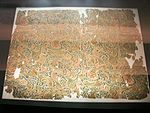

Wild silk
Wild silks have been known and used in many countries from early times, although the scale of production is far smaller than that from cultivated silkworms.-Background:...
s, produced by caterpillar
Caterpillar
Caterpillars are the larval form of members of the order Lepidoptera . They are mostly herbivorous in food habit, although some species are insectivorous. Caterpillars are voracious feeders and many of them are considered to be pests in agriculture...
s other than the mulberry
Mulberry
Morus is a genus of flowering plants in the family Moraceae. The 10–16 species of deciduous trees it contains are commonly known as Mulberries....
silkworm have been known and used in China
China
Chinese civilization may refer to:* China for more general discussion of the country.* Chinese culture* Greater China, the transnational community of ethnic Chinese.* History of China* Sinosphere, the area historically affected by Chinese culture...
, South Asia
South Asia
South Asia, also known as Southern Asia, is the southern region of the Asian continent, which comprises the sub-Himalayan countries and, for some authorities , also includes the adjoining countries to the west and the east...
, and Europe
Europe
Europe is, by convention, one of the world's seven continents. Comprising the westernmost peninsula of Eurasia, Europe is generally 'divided' from Asia to its east by the watershed divides of the Ural and Caucasus Mountains, the Ural River, the Caspian and Black Seas, and the waterways connecting...
since ancient times. However, the scale of production was always far smaller than that of cultivated silks. There are several reasons for this: firstly, they differ from the domesticated varieties in color and texture and are therefore less uniform, secondly, cocoons gathered in the wild have usually had the pupa emerge from them before being discovered so the silk thread that makes up the cocoon has been torn into shorter lengths, and thirdly, many wild cocoons are covered in a mineral layer that stymies attempts to reel from them long strands of silk. Thus previously the only way to obtain silk suitable for spinning into textiles in areas where commercial silks are not cultivated is by tedious and labor intensive carding
Carding
Carding is a mechanical process that breaks up locks and unorganised clumps of fibre and then aligns the individual fibres so that they are more or less parallel with each other. The word is derived from the Latin carduus meaning teasel, as dried vegetable teasels were first used to comb the raw wool...
.
Commercial silks originate from reared silkworm pupae which are killed by dipping them in boiling water before the adult moths emerge or by piercing them with a needle, and have been bred for a white color and no mineral on the surface, factors all contributing to the ability of whole cocoon to be unravelled as one continuous thread. This permits a much stronger cloth to be woven from the silk.
Wild silks also tend to be more difficult to dye than silk from the cultivated silkworm. A technique known as demineralizing allows the mineral layer around the cocoon to be removed, leaving only variability in color as a barrier from creating a commercial silk industry based on wild silks in parts of the world where wild silkmoths thrive, such as Africa and South America.
China
Silk fabric was first developed in ancient ChinaChina
Chinese civilization may refer to:* China for more general discussion of the country.* Chinese culture* Greater China, the transnational community of ethnic Chinese.* History of China* Sinosphere, the area historically affected by Chinese culture...
, with some of the earliest examples found as early as 3500 BC. Legend gives credit for developing silk to a Chinese empress, Leizu
Leizu
Leizu was a legendary Chinese empress and wife of the Yellow Emperor. According to tradition, she discovered silk and invented the silk loom in the 27th century BC.Leizu discovered silkworms while having a midday tea, and a cocoon fell in her tea....
(Hsi-Ling-Shih, Lei-Tzu). Silks were originally reserved for the Kings of China for their own use and gifts to others, but spread gradually through Chinese culture and trade both geographically and socially, and then to many regions of Asia
Asia
Asia is the world's largest and most populous continent, located primarily in the eastern and northern hemispheres. It covers 8.7% of the Earth's total surface area and with approximately 3.879 billion people, it hosts 60% of the world's current human population...
. Silk rapidly became a popular luxury fabric in the many areas accessible to Chinese merchants because of its texture and luster. Silk was in great demand, and became a staple of pre-industrial
Industrial Revolution
The Industrial Revolution was a period from the 18th to the 19th century where major changes in agriculture, manufacturing, mining, transportation, and technology had a profound effect on the social, economic and cultural conditions of the times...
international trade
Trade
Trade is the transfer of ownership of goods and services from one person or entity to another. Trade is sometimes loosely called commerce or financial transaction or barter. A network that allows trade is called a market. The original form of trade was barter, the direct exchange of goods and...
. In July 2007, archeologists discovered intricately woven and dyed silk textile
Textile
A textile or cloth is a flexible woven material consisting of a network of natural or artificial fibres often referred to as thread or yarn. Yarn is produced by spinning raw fibres of wool, flax, cotton, or other material to produce long strands...
s in a tomb in Jiangxi
Jiangxi
' is a southern province in the People's Republic of China. Spanning from the banks of the Yangtze River in the north into hillier areas in the south, it shares a border with Anhui to the north, Zhejiang to the northeast, Fujian to the east, Guangdong to the south, Hunan to the west, and Hubei to...
province, dated to the Eastern Zhou Dynasty
Zhou Dynasty
The Zhou Dynasty was a Chinese dynasty that followed the Shang Dynasty and preceded the Qin Dynasty. Although the Zhou Dynasty lasted longer than any other dynasty in Chinese history, the actual political and military control of China by the Ji family lasted only until 771 BC, a period known as...
roughly 2,500 years ago. Although historians have suspected a long history of a formative textile industry in ancient China, this find of silk textiles employing "complicated techniques" of weaving and dyeing provides direct and concrete evidence for silks dating before the Mawangdui-discovery and other silks dating to the Han Dynasty
Han Dynasty
The Han Dynasty was the second imperial dynasty of China, preceded by the Qin Dynasty and succeeded by the Three Kingdoms . It was founded by the rebel leader Liu Bang, known posthumously as Emperor Gaozu of Han. It was briefly interrupted by the Xin Dynasty of the former regent Wang Mang...
(202 BC-220 AD).
The first evidence of the silk trade is the finding of silk in the hair of an Egypt
Egypt
Egypt , officially the Arab Republic of Egypt, Arabic: , is a country mainly in North Africa, with the Sinai Peninsula forming a land bridge in Southwest Asia. Egypt is thus a transcontinental country, and a major power in Africa, the Mediterranean Basin, the Middle East and the Muslim world...
ian mummy
Mummy
A mummy is a body, human or animal, whose skin and organs have been preserved by either intentional or incidental exposure to chemicals, extreme coldness , very low humidity, or lack of air when bodies are submerged in bogs, so that the recovered body will not decay further if kept in cool and dry...
of the 21st dynasty, c.1070 BC. Ultimately the silk trade reached as far as the India
India
India , officially the Republic of India , is a country in South Asia. It is the seventh-largest country by geographical area, the second-most populous country with over 1.2 billion people, and the most populous democracy in the world...
n subcontinent, the Middle East
Middle East
The Middle East is a region that encompasses Western Asia and Northern Africa. It is often used as a synonym for Near East, in opposition to Far East...
, Europe
Europe
Europe is, by convention, one of the world's seven continents. Comprising the westernmost peninsula of Eurasia, Europe is generally 'divided' from Asia to its east by the watershed divides of the Ural and Caucasus Mountains, the Ural River, the Caspian and Black Seas, and the waterways connecting...
, and North Africa
North Africa
North Africa or Northern Africa is the northernmost region of the African continent, linked by the Sahara to Sub-Saharan Africa. Geopolitically, the United Nations definition of Northern Africa includes eight countries or territories; Algeria, Egypt, Libya, Morocco, South Sudan, Sudan, Tunisia, and...
. This trade was so extensive that the major set of trade routes between Europe and Asia has become known as the Silk Road
Silk Road
The Silk Road or Silk Route refers to a historical network of interlinking trade routes across the Afro-Eurasian landmass that connected East, South, and Western Asia with the Mediterranean and European world, as well as parts of North and East Africa...
. The highest development was in China.
The Emperors of China strove to keep knowledge of sericulture
Sericulture
Sericulture, or silk farming, is the rearing of silkworms for the production of raw silk.Although there are several commercial species of silkworms, Bombyx mori is the most widely used and intensively studied. According to Confucian texts, the discovery of silk production by B...
secret to maintain the Chinese monopoly
Monopoly
A monopoly exists when a specific person or enterprise is the only supplier of a particular commodity...
. Nonetheless sericulture reached Korea
Korea
Korea ) is an East Asian geographic region that is currently divided into two separate sovereign states — North Korea and South Korea. Located on the Korean Peninsula, Korea is bordered by the People's Republic of China to the northwest, Russia to the northeast, and is separated from Japan to the...
around 200 BC, about the first half of the 1st century AD had reached ancient Khotan
Khotan
Hotan , or Hetian , also spelled Khotan, is the seat of the Hotan Prefecture in Xinjiang, China. It was previously known in Chinese as 于窴/於窴 and to 19th-century European explorers as Ilchi....
, and by AD 140 the practice had been established in India.
In the ancient era, silk from China was the most lucrative and sought-after luxury item traded across the Eurasian continent, and many civilizations, such as the ancient Persians, benefited economically from trade.
Thailand

Fiber
Fiber is a class of materials that are continuous filaments or are in discrete elongated pieces, similar to lengths of thread.They are very important in the biology of both plants and animals, for holding tissues together....
is too thin to use on its own so women combine many threads to produce a thicker, usable fiber. They do this by hand-reeling the threads onto a wooden spindle to produce a uniform strand of raw silk. The process takes around 40 hours to produce a half kilogram of Thai silk.
Many local operations use a reeling machine for this task, but some silk threads are still hand-reeled. The difference is that hand-reeled threads produce three grades of silk: two fine grades that are ideal for lightweight fabrics, and a thick grade for heavier material.
The silk fabric is soaked in extremely cold water and bleached before dyeing to remove the natural yellow coloring of Thai silk yarn. To do this, skeins of silk thread are immersed in large tubs of hydrogen peroxide. Once washed and dried, the silk is woven on a traditional hand operated loom.
India
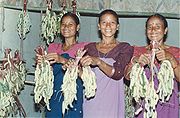
India
India , officially the Republic of India , is a country in South Asia. It is the seventh-largest country by geographical area, the second-most populous country with over 1.2 billion people, and the most populous democracy in the world...
and Resham in Hindi/Urdu, has a long history in India. Recent archaeological discoveries in Harappa
Harappa
Harappa is an archaeological site in Punjab, northeast Pakistan, about west of Sahiwal. The site takes its name from a modern village located near the former course of the Ravi River. The current village of Harappa is from the ancient site. Although modern Harappa has a train station left from...
and Chanhu-daro suggest that sericulture
Sericulture
Sericulture, or silk farming, is the rearing of silkworms for the production of raw silk.Although there are several commercial species of silkworms, Bombyx mori is the most widely used and intensively studied. According to Confucian texts, the discovery of silk production by B...
, employing wild silk
Wild silk
Wild silks have been known and used in many countries from early times, although the scale of production is far smaller than that from cultivated silkworms.-Background:...
threads from native silkworm species, existed in South Asia
South Asia
South Asia, also known as Southern Asia, is the southern region of the Asian continent, which comprises the sub-Himalayan countries and, for some authorities , also includes the adjoining countries to the west and the east...
during the time of the Indus Valley Civilization
Indus Valley Civilization
The Indus Valley Civilization was a Bronze Age civilization that was located in the northwestern region of the Indian subcontinent, consisting of what is now mainly modern-day Pakistan and northwest India...
, roughly contemporaneous with the earliest known silk use in China. According to an article in Nature
Nature (journal)
Nature, first published on 4 November 1869, is ranked the world's most cited interdisciplinary scientific journal by the Science Edition of the 2010 Journal Citation Reports...
by Philip Ball, while there is evidence for silk production in China back to around 2570 BC, newly discovered silk objects from the Indus valley in eastern Pakistan are believed to date from between 2450 BC and 2000 BC, "making them similarly ancient". Shelagh Vainker, a silk expert at the Ashmolean Museum
Ashmolean Museum
The Ashmolean Museum on Beaumont Street, Oxford, England, is the world's first university museum...
in Oxford, sees evidence for silk production in China "significantly earlier" than 2500–2000 BC, however suggests "people of the Indus civilization either harvested silkworm cocoons or traded with people who did, and that they knew a considerable amount about silk." Silk is widely produced today. India is the second largest producer of silk after China. A majority of the silk in India is produced in Karnataka
Karnataka
Karnataka , the land of the Kannadigas, is a state in South West India. It was created on 1 November 1956, with the passing of the States Reorganisation Act and this day is annually celebrated as Karnataka Rajyotsava...
State, particularly in Mysore and the North Bangalore regions of Muddenahalli
Muddenahalli
Muddenahalli is a centrally located town situated 7 km from Chikballapur and 1 km from Kanivenarayanapura in Chikballapur District of Karnataka State...
, Kanivenarayanapura
Kanivenarayanapura
Kanivenarayanapura is a centrally located historical town situated 6 km from Chikballapur, 3 km from Nandi Town and 1 km from Muddenahalli in Chikballapur District of Karnataka State. It is adjacent to the birth place of the renowned Mokshagundam Visvesvarayya, one of India's most...
, and Doddaballapur. India is also the largest consumer of silk in the world. The tradition of wearing silk sarees in marriages by the brides is followed in southern parts of India. Silk is worn by people as a symbol of royalty while attending functions and during festivals. Historically silk was used by the upper classes, while cotton was used by the poorer classes. Today silk is mainly produced in Bhoodhan Pochampally
Bhoodhan Pochampally
Bhoodhan Pochampally is a Mandal in Nalgonda District. Nalgonda District, in turn is a district in Andhra Pradesh in southern India and is popularily known as Silk City of India.-Geography:Bhoodhan Pochampally is located at ,...
(also known as Silk City
Silk City
The term Silk City has been used to refer to multiple major silk-producing centers. These include:*Bhagalpur, Bihar, India Famous of Tussar Silk & Tussar Saree.*Bhoodhan Pochampally, India*Muddenahalli & Doddaballapur, Karnataka, India...
), Kanchipuram
Kanchipuram
Kanchipuram, or Kanchi, is a temple city and a municipality in Kanchipuram district in the Indian state of Tamil Nadu. It is a temple town and the headquarters of Kanchipuram district...
, Dharmavaram, Mysore, etc. in South India and Banaras in the North for manufacturing garments and sarees. "Murshidabad silk", famous from historical times, is mainly produced in Malda and Murshidabad district of West Bengal and woven with hand looms in Birbhum and Murshidabad district. Another place famous for production of silk is Bhagalpur
Bhagalpur
Bhagdattpuram was one of the most influential towns in "Aryavarta" . It is supposed to have been concurrent to Patliputra or Patna. Bhagdattpuram finds its mention in the Vedas and Ramayana as well. It is supposed to be the kingdom of Daanvir Karna, the son of Kunti and the Sun God...
. The silk from Pochampally is particularly well-known for its classic designs and enduring quality. The silk is traditionally hand-woven and hand-dyed and usually also has silver threads woven into the cloth. Most of this silk is used to make sarees. The sarees usually are very expensive and vibrant in color. Garments made from silk form an integral part of Indian weddings and other celebrations. In the northeastern state of Assam
Assam
Assam , also, rarely, Assam Valley and formerly the Assam Province , is a northeastern state of India and is one of the most culturally and geographically distinct regions of the country...
, three different types of silk are produced, collectively called Assam silk
Assam Silk
Assam silk denotes the three major types of indigenous wild silks produced in Assam—golden Muga, white Pat and warm Eri silk. The Assam silk industry, now centered in Sualkuchi, is a labor intensive industry.-Muga silk:...
: Muga, Eri and Pat silk. Muga, the golden silk, and Eri are produced by silkworms that are native only to Assam. The heritage of silk rearing and weaving is very old and continues today especially with the production of Muga and Pat riha and mekhela chador
Mekhela chador
Mekhela chador is the traditional Assamese dress worn by women.There are two main pieces of cloth that are draped around the body.The bottom portion, draped from the waist downwards is called the mekhela...
, the three-piece silk sarees woven with traditional motifs. Mysore Silk Sarees, which are known for their soft texture, last many years if carefully maintained.
Ancient Mediterranean
In the OdysseyOdyssey
The Odyssey is one of two major ancient Greek epic poems attributed to Homer. It is, in part, a sequel to the Iliad, the other work ascribed to Homer. The poem is fundamental to the modern Western canon, and is the second—the Iliad being the first—extant work of Western literature...
, 19.233, when Odysseus, while pretending to be someone else, is questioned by Penelope about her husband's clothing, he says that he wore a shirt "gleaming like the skin of a dried onion" (varies with translations, literal translation here) which could refer to the lustrous quality of silk fabric. The Roman Empire
Roman Empire
The Roman Empire was the post-Republican period of the ancient Roman civilization, characterised by an autocratic form of government and large territorial holdings in Europe and around the Mediterranean....
knew of and traded in silk, and Chinese silk was the most highly priced luxury good imported by them. During the reign of emperor Tiberius
Tiberius
Tiberius , was Roman Emperor from 14 AD to 37 AD. Tiberius was by birth a Claudian, son of Tiberius Claudius Nero and Livia Drusilla. His mother divorced Nero and married Augustus in 39 BC, making him a step-son of Octavian...
, sumptuary laws were passed that forbade men from wearing silk garments, but these proved ineffectual. Despite the popularity of silk, the secret of silk-making only reached Europe around AD 550, via the Byzantine Empire
Byzantine Empire
The Byzantine Empire was the Eastern Roman Empire during the periods of Late Antiquity and the Middle Ages, centred on the capital of Constantinople. Known simply as the Roman Empire or Romania to its inhabitants and neighbours, the Empire was the direct continuation of the Ancient Roman State...
. Legend has it that monks working for the emperor Justinian I
Justinian I
Justinian I ; , ; 483– 13 or 14 November 565), commonly known as Justinian the Great, was Byzantine Emperor from 527 to 565. During his reign, Justinian sought to revive the Empire's greatness and reconquer the lost western half of the classical Roman Empire.One of the most important figures of...
smuggled silkworm eggs to Constantinople
Constantinople
Constantinople was the capital of the Roman, Eastern Roman, Byzantine, Latin, and Ottoman Empires. Throughout most of the Middle Ages, Constantinople was Europe's largest and wealthiest city.-Names:...
in hollow canes from China. All top-quality looms and weavers were located inside the Palace complex in Constantinople and the cloth produced was used in imperial robes or in diplomacy, as gifts to foreign dignitaries. The remainder was sold at very high prices.
Middle East

Necktie
A necktie is a long piece of cloth worn for decorative purposes around the neck or shoulders, resting under the shirt collar and knotted at the throat. Variants include the ascot tie, bow tie, bolo tie, and the clip-on tie. The modern necktie, ascot, and bow tie are descended from the cravat. Neck...
(which are of course very much masculine articles of clothing).
Despite injunctions against silk for men, silk has retained its popularity in the Islamic world because of its permissibility for women. The Muslim Moors
Moors
The description Moors has referred to several historic and modern populations of the Maghreb region who are predominately of Berber and Arab descent. They came to conquer and rule the Iberian Peninsula for nearly 800 years. At that time they were Muslim, although earlier the people had followed...
brought silk with them to Spain during their conquest of the Iberian Peninsula.
Medieval and modern Europe
James IJames I of England
James VI and I was King of Scots as James VI from 24 July 1567 and King of England and Ireland as James I from the union of the English and Scottish crowns on 24 March 1603...
attempted to establish silk production in England, purchasing and planting 100,000 mulberry trees, some on land adjacent to Hampton Court Palace
Hampton Court Palace
Hampton Court Palace is a royal palace in the London Borough of Richmond upon Thames, Greater London; it has not been inhabited by the British royal family since the 18th century. The palace is located south west of Charing Cross and upstream of Central London on the River Thames...
, but they were of a species unsuited to the silk worms, and the attempt failed. in 1732 John Guardivaglio set up a silk throwing enterprise at Logwood mill in Stockport, and in 1744, Burton Mill was erected in Macclesfield
Macclesfield
Macclesfield is a market town within the unitary authority of Cheshire East, the county palatine of Chester, also known as the ceremonial county of Cheshire, England. The population of the Macclesfield urban sub-area at the time of the 2001 census was 50,688...
and in 1753 Old Mill was built in Congleton
Congleton
Congleton is a town and civil parish in the unitary authority of Cheshire East and the ceremonial county of Cheshire, England, on the banks of the River Dane, to the west of the Macclesfield Canal and 21 miles south of Manchester. It has a population of 25,750.-History:The first settlements in...
. These three towns remained the centre of the English silk throwing industry until silk throwing was replaced by silk waste spinning
Silk waste
Silk waste includes all kinds of raw silk which may be unwindable, and therefore unsuited to the throwing process. Before the introduction of machinery applicable to the spinning of silk waste, the refuse from cocoon reeling, and also from silk winding, which is now used in producing spun silk...
. British enterprise also established silk filature in Cyprus
Cyprus
Cyprus , officially the Republic of Cyprus , is a Eurasian island country, member of the European Union, in the Eastern Mediterranean, east of Greece, south of Turkey, west of Syria and north of Egypt. It is the third largest island in the Mediterranean Sea.The earliest known human activity on the...
in 1928. In England in the mid 20th century, raw silk was produced at Lullingstone Castle
Lullingstone Castle
Lullingstone Castle is a historic manor house, set in an estate in the village of Lullingstone and the civil parish of Eynsford in the English county of Kent. It has been inhabited by members of the Hart Dyke family for twenty generations.-History:...
in Kent. Silkworms were raised and reeled under the direction of Zoe Lady Hart Dyke. Production started elsewhere later.
Italy was the most important producer of silk during the Medieval age. One notable center was the italian city-state
City-state
A city-state is an independent or autonomous entity whose territory consists of a city which is not administered as a part of another local government.-Historical city-states:...
of Lucca
Republic of Lucca
The Republic of Lucca was an ancient State of Tuscany which lasted from 1160 to 1805.After the death of Matilda of Tuscany, the city of Lucca began to constitute itself an independent commune, with a charter in 1160. For almost 500 years, Lucca remained an independent republic...
which largely financed itself through silk-production and silk-trading, beginning in the 12th century. Other Italian cities involved in silk production were Genoa
Genoa
Genoa |Ligurian]] Zena ; Latin and, archaically, English Genua) is a city and an important seaport in northern Italy, the capital of the Province of Genoa and of the region of Liguria....
, Venice
Venice
Venice is a city in northern Italy which is renowned for the beauty of its setting, its architecture and its artworks. It is the capital of the Veneto region...
and Florence
Florence
Florence is the capital city of the Italian region of Tuscany and of the province of Florence. It is the most populous city in Tuscany, with approximately 370,000 inhabitants, expanding to over 1.5 million in the metropolitan area....
.
In France, since the 15th century silk production was centered around the city of Lyon
Lyon
Lyon , is a city in east-central France in the Rhône-Alpes region, situated between Paris and Marseille. Lyon is located at from Paris, from Marseille, from Geneva, from Turin, and from Barcelona. The residents of the city are called Lyonnais....
where many mechanic tools for mass production were first introduced in the 17th century.
North America
King James I introduced silk-growing to the American colonies around 1619, ostensibly to discourage tobaccoTobacco
Tobacco is an agricultural product processed from the leaves of plants in the genus Nicotiana. It can be consumed, used as a pesticide and, in the form of nicotine tartrate, used in some medicines...
planting. The Shakers
Shakers
The United Society of Believers in Christ’s Second Appearing, known as the Shakers, is a religious sect originally thought to be a development of the Religious Society of Friends...
in Kentucky adopted the practice as did a cottage industry in New England. In the 19th century a new attempt at a silk industry began with European-born workers in Paterson, New Jersey
Paterson, New Jersey
Paterson is a city serving as the county seat of Passaic County, New Jersey, United States. As of the 2010 United States Census, its population was 146,199, rendering it New Jersey's third largest city and one of the largest cities in the New York City Metropolitan Area, despite a decrease of 3,023...
, and the city became a US silk center, although Japanese imports were still more important.
World War II
World War II
World War II, or the Second World War , was a global conflict lasting from 1939 to 1945, involving most of the world's nations—including all of the great powers—eventually forming two opposing military alliances: the Allies and the Axis...
interrupted the silk trade from Japan
Japan
Japan is an island nation in East Asia. Located in the Pacific Ocean, it lies to the east of the Sea of Japan, China, North Korea, South Korea and Russia, stretching from the Sea of Okhotsk in the north to the East China Sea and Taiwan in the south...
. Silk prices increased dramatically, and US industry began to look for substitutes, which led to the use of synthetic
Synthetic fiber
Synthetic fibers are the result of extensive research by scientists to improve on naturally occurring animal and plant fibers. In general, synthetic fibers are created by forcing, usually through extrusion, fiber forming materials through holes into the air, forming a thread...
s such as nylon
Nylon
Nylon is a generic designation for a family of synthetic polymers known generically as polyamides, first produced on February 28, 1935, by Wallace Carothers at DuPont's research facility at the DuPont Experimental Station...
. Synthetic silks have also been made from lyocell
Lyocell
Lyocell is a regenerated cellulose fiber made from dissolving pulp . It was first manufactured in 1987 by Courtaulds Fibres UK at their pilot plant S25...
, a type of cellulose
Cellulose
Cellulose is an organic compound with the formula , a polysaccharide consisting of a linear chain of several hundred to over ten thousand β linked D-glucose units....
fiber, and are often difficult to distinguish from real silk (see spider silk
Spider silk
Spider silk is a protein fiber spun by spiders. Spiders use their silk to make webs or other structures, which function as nets to catch other animals, or as nests or cocoons for protection for their offspring...
for more on synthetic silks).
Properties
Physical properties
Silk fibers from the Bombyx mori silkworm have a triangularTriangle
A triangle is one of the basic shapes of geometry: a polygon with three corners or vertices and three sides or edges which are line segments. A triangle with vertices A, B, and C is denoted ....
cross section
Cross section (geometry)
In geometry, a cross-section is the intersection of a figure in 2-dimensional space with a line, or of a body in 3-dimensional space with a plane, etc...
with rounded corners, 5-10 μm wide. The fibroin-heavy chain is composed mostly of beta-sheets, due to a 59-mer amino acid repeat sequence with some variations. The flat surfaces of the fibrils reflect light
Light
Light or visible light is electromagnetic radiation that is visible to the human eye, and is responsible for the sense of sight. Visible light has wavelength in a range from about 380 nanometres to about 740 nm, with a frequency range of about 405 THz to 790 THz...
at many angles, giving silk a natural shine. The cross-section from other silkworms can vary in shape and diameter: crescent-like for Anaphe and elongated wedge for tussah. Silkworm fibers are naturally extruded from two silkworm glands as a pair of primary filaments (brin), which are stuck together, with sericin proteins that act like glue
Glue
This is a list of various types of glue. Historically, the term "glue" only referred to protein colloids prepared from animal flesh. The meaning has been extended to refer to any fluid adhesive....
, to form a bave. Bave diameters for tussah silk can reach 65 μm. See cited reference for cross-sectional SEM photographs.
Silk has a smooth, soft texture that is not slippery, unlike many synthetic fiber
Synthetic fiber
Synthetic fibers are the result of extensive research by scientists to improve on naturally occurring animal and plant fibers. In general, synthetic fibers are created by forcing, usually through extrusion, fiber forming materials through holes into the air, forming a thread...
s.
Silk is one of the strongest natural fibers but loses up to 20% of its strength when wet. It has a good moisture regain of 11%. Its elasticity
Elasticity (physics)
In physics, elasticity is the physical property of a material that returns to its original shape after the stress that made it deform or distort is removed. The relative amount of deformation is called the strain....
is moderate to poor: if elongated even a small amount, it remains stretched. It can be weakened if exposed to too much sunlight. It may also be attacked by insects, especially if left dirty.
Silk is a poor conductor of electricity
Electricity
Electricity is a general term encompassing a variety of phenomena resulting from the presence and flow of electric charge. These include many easily recognizable phenomena, such as lightning, static electricity, and the flow of electrical current in an electrical wire...
and thus susceptible to static cling
Static cling
Static cling is the tendency for light objects to stick to other objects owing to static electricity. It is common in clothing, but occurs with other items, such as the tendency of dust to be attracted to, and stick to, plastic items....
.
Unwashed silk chiffon may shrink
Shrinkage (fabric)
Shrinkage is when a fabric becomes smaller than its original size, usually through the process of laundry. Novice users of modern laundry machines sometimes experience accidental shrinkage of garments, especially when applying heat. Others may intentionally try to shrink a garment in their size...
up to 8% due to a relaxation of the fiber macrostructure, so silk should either be washed prior to garment construction, or dry cleaned
Dry cleaning
Dry cleaning is any cleaning process for clothing and textiles using a chemical solvent other than water. The solvent used is typically tetrachloroethylene , abbreviated "perc" in the industry and "dry-cleaning fluid" by the public...
. Dry cleaning
Dry cleaning
Dry cleaning is any cleaning process for clothing and textiles using a chemical solvent other than water. The solvent used is typically tetrachloroethylene , abbreviated "perc" in the industry and "dry-cleaning fluid" by the public...
may still shrink the chiffon up to 4%. Occasionally, this shrinkage can be reversed by a gentle steaming with a press cloth. There is almost no gradual shrinkage nor shrinkage due to molecular-level deformation.
Natural and synthetic silk is known to manifest piezoelectric properties in proteins, probably due to its molecular structure.
Silkworm silk was used as the standard for the denier, a measurement of linear density
Linear density
Linear density, linear mass density or linear mass is a measure of mass per unit of length, and it is a characteristic of strings or other one-dimensional objects. The SI unit of linear density is the kilogram per metre...
in fibers. Silkworm silk therefore has a linear density of approximately 1 den, or 1.1 dtex.
| Comparison of silk fibers | Linear Density(dtex) | Diameter (μm) | Coeff. Variation |
|---|---|---|---|
| Moth Moth A moth is an insect closely related to the butterfly, both being of the order Lepidoptera. Moths form the majority of this order; there are thought to be 150,000 to 250,000 different species of moth , with thousands of species yet to be described... : Bombyx mori Bombyx mori The silkworm is the larva or caterpillar of the domesticated silkmoth, Bombyx mori . It is an economically important insect, being a primary producer of silk... |
1.17 | 12.9 | 24.8% |
| Spider Spider Spiders are air-breathing arthropods that have eight legs, and chelicerae with fangs that inject venom. They are the largest order of arachnids and rank seventh in total species diversity among all other groups of organisms... : Argiope aurentia |
0.14 | 3.57 | 14.8% |
Chemical properties
Silk emitted by the silkworm consists of two main proteins, sericinSericin
Sericin is a type of protein created by Bombyx mori in the production of silk. Silk emitted by the silkworm consists of two main proteins, sericin and fibroin; fibroin being the structural center of the silk, and sericin being the sticky material surrounding it....
and fibroin
Fibroin
Fibroin is a type of protein created by Bombyx mori in the production of silk. Silk emitted by the silkworm consists of two main proteins, sericin and fibroin, fibroin being the structural center of the silk, and sericin being the sticky material surrounding it.The fibroin protein consists of...
, fibroin being the structural center of the silk, and serecin being the sticky material surrounding it. Fibroin is made up of the amino acid
Amino acid
Amino acids are molecules containing an amine group, a carboxylic acid group and a side-chain that varies between different amino acids. The key elements of an amino acid are carbon, hydrogen, oxygen, and nitrogen...
s Gly
Glycine
Glycine is an organic compound with the formula NH2CH2COOH. Having a hydrogen substituent as its 'side chain', glycine is the smallest of the 20 amino acids commonly found in proteins. Its codons are GGU, GGC, GGA, GGG cf. the genetic code.Glycine is a colourless, sweet-tasting crystalline solid...
-Ser
Serine
Serine is an amino acid with the formula HO2CCHCH2OH. It is one of the proteinogenic amino acids. By virtue of the hydroxyl group, serine is classified as a polar amino acid.-Occurrence and biosynthesis:...
-Gly-Ala
Alanine
Alanine is an α-amino acid with the chemical formula CH3CHCOOH. The L-isomer is one of the 20 amino acids encoded by the genetic code. Its codons are GCU, GCC, GCA, and GCG. It is classified as a nonpolar amino acid...
-Gly-Ala and forms beta pleated sheet
Beta sheet
The β sheet is the second form of regular secondary structure in proteins, only somewhat less common than the alpha helix. Beta sheets consist of beta strands connected laterally by at least two or three backbone hydrogen bonds, forming a generally twisted, pleated sheet...
s. Hydrogen bond
Hydrogen bond
A hydrogen bond is the attractive interaction of a hydrogen atom with an electronegative atom, such as nitrogen, oxygen or fluorine, that comes from another molecule or chemical group. The hydrogen must be covalently bonded to another electronegative atom to create the bond...
s form between chains, and side chains form above and below the plane of the hydrogen bond network.
The high proportion (50%) of glycine, which is a small amino acid
Amino acid
Amino acids are molecules containing an amine group, a carboxylic acid group and a side-chain that varies between different amino acids. The key elements of an amino acid are carbon, hydrogen, oxygen, and nitrogen...
, allows tight packing and the fibers are strong and resistant to breaking. The tensile strength is due to the many interseeded hydrogen bonds, and when stretched the force is applied to these numerous bonds and they do not break.
Silk is resistant to most mineral acid
Mineral acid
A mineral acid is an acid derived from one or more inorganic compounds. A mineral acid is not organic and all mineral acids release hydrogen ions when dissolved in water.-Characteristics:...
s, except for sulfuric acid
Sulfuric acid
Sulfuric acid is a strong mineral acid with the molecular formula . Its historical name is oil of vitriol. Pure sulfuric acid is a highly corrosive, colorless, viscous liquid. The salts of sulfuric acid are called sulfates...
, which dissolves it. It is yellowed by perspiration.
Uses

Shirt
A shirt is a cloth garment for the upper body. Originally an undergarment worn exclusively by men, it has become, in American English, a catch-all term for almost any garment other than outerwear such as sweaters, coats, jackets, or undergarments such as bras, vests or base layers...
s, ties
Necktie
A necktie is a long piece of cloth worn for decorative purposes around the neck or shoulders, resting under the shirt collar and knotted at the throat. Variants include the ascot tie, bow tie, bolo tie, and the clip-on tie. The modern necktie, ascot, and bow tie are descended from the cravat. Neck...
, blouse
Blouse
A blouse is a loose-fitting upper garment that was formerly worn by workmen, peasants, artists, women and children. It is typically gathered at the waist so that it hangs loosely over the wearer's body. Today, the word most commonly refers to a woman's shirt but can also refer to a man's shirt if...
s, formal dress
Dress
A dress is a garment consisting of a skirt with an attached bodice or with a matching bodice giving the effect of a one-piece garment.Dress may also refer to:*Clothing in general*Costume, fancy dress...
es, high fashion clothes, lingerie
Lingerie
Lingerie are fashionable and possibly alluring undergarments.Lingerie usually incorporates one or more flexible, stretchy materials like Lycra, nylon , polyester, satin, lace, silk and sheer fabric which are not typically used in more functional, basic cotton undergarments.The term in the French...
, pyjamas, robe
Robe
A robe is a loose-fitting outer garment. A robe is distinguished from a cape or cloak by the fact that it usually has sleeves. The English word robe derives from Middle English robe , borrowed from Old French robe , itself taken from the Frankish word *rouba , and is related to the word rob...
s, dress suits
Formal wear
Formal wear and formal dress are the general terms for clothing suitable for formal social events, such as a wedding, formal garden party or dinner, débutante cotillion, dance, or race...
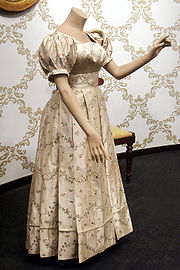
, sun dresses and Eastern folk costumes. Silk's attractive lustre and drape makes it suitable for many furnishing applications. It is used for upholstery
Upholstery
Upholstery is the work of providing furniture, especially seats, with padding, springs, webbing, and fabric or leather covers. The word upholstery comes from the Middle English word upholder, which referred to a tradesman who held up his goods. The term is equally applicable to domestic,...
, wall coverings, window treatments (if blended with another fiber), rug
Carpet
A carpet is a textile floor covering consisting of an upper layer of "pile" attached to a backing. The pile is generally either made from wool or a manmade fibre such as polypropylene,nylon or polyester and usually consists of twisted tufts which are often heat-treated to maintain their...
s, bedding
Bedding
Bedding refers to the materials laid above the mattress of a bed for hygiene, warmth, to protect the mattress, and for decorative effect. Bedding is the removable and washable portion of a human sleeping environment. It is more easily and economically replaced than the bed itself...
and wall hangings. While on the decline now, due to artificial fibers, silk has had many industrial and commercial uses, such as in parachute
Parachute
A parachute is a device used to slow the motion of an object through an atmosphere by creating drag, or in the case of ram-air parachutes, aerodynamic lift. Parachutes are usually made out of light, strong cloth, originally silk, now most commonly nylon...
s, bicycle tire
Tire
A tire or tyre is a ring-shaped covering that fits around a wheel rim to protect it and enable better vehicle performance by providing a flexible cushion that absorbs shock while keeping the wheel in close contact with the ground...
s, comforter filling
Silk comforter
A silk comforter is a bed covering, most often used as a duvet, and also commonly referred to as a silk duvet, silk quilt, or silk blanket. Originally from China, silk comforters are now more common throughout the world. Their increasing popularity stems from a combination of factors, including...
and artillery
Artillery
Originally applied to any group of infantry primarily armed with projectile weapons, artillery has over time become limited in meaning to refer only to those engines of war that operate by projection of munitions far beyond the range of effect of personal weapons...
gunpowder
Gunpowder
Gunpowder, also known since in the late 19th century as black powder, was the first chemical explosive and the only one known until the mid 1800s. It is a mixture of sulfur, charcoal, and potassium nitrate - with the sulfur and charcoal acting as fuels, while the saltpeter works as an oxidizer...
bags.
A special manufacturing process removes the outer irritant sericin
Sericin
Sericin is a type of protein created by Bombyx mori in the production of silk. Silk emitted by the silkworm consists of two main proteins, sericin and fibroin; fibroin being the structural center of the silk, and sericin being the sticky material surrounding it....
coating of the silk, which makes it suitable as non-absorbable surgical sutures. This process has also recently led to the introduction of specialist silk underclothing for children and adults with eczema
Eczema
Eczema is a form of dermatitis, or inflammation of the epidermis . In England, an estimated 5.7 million or about one in every nine people have been diagnosed with the disease by a clinician at some point in their lives.The term eczema is broadly applied to a range of persistent skin conditions...
where it can significantly reduce itch
Itch
Itch is a sensation that causes the desire or reflex to scratch. Itch has resisted many attempts to classify it as any one type of sensory experience. Modern science has shown that itch has many similarities to pain, and while both are unpleasant sensory experiences, their behavioral response...
. New uses and manufacturing techniques have been found for silk for making everything from disposable cups to drug delivery systems and holograms. To produce 1 kg of silk, 104 kg of mulberry leaves must be eaten by 3000 silkworms. It takes about 5000 silkworms to make a pure silk kimono
Kimono
The is a Japanese traditional garment worn by men, women and children. The word "kimono", which literally means a "thing to wear" , has come to denote these full-length robes...
. The construction of silk is called sericulture
Sericulture
Sericulture, or silk farming, is the rearing of silkworms for the production of raw silk.Although there are several commercial species of silkworms, Bombyx mori is the most widely used and intensively studied. According to Confucian texts, the discovery of silk production by B...
. The major silk producers are China
China
Chinese civilization may refer to:* China for more general discussion of the country.* Chinese culture* Greater China, the transnational community of ethnic Chinese.* History of China* Sinosphere, the area historically affected by Chinese culture...
(54%) and India
India
India , officially the Republic of India , is a country in South Asia. It is the seventh-largest country by geographical area, the second-most populous country with over 1.2 billion people, and the most populous democracy in the world...
(14%).
| Top Ten Cocoons (Reelable) Producers — 2005 | ||||
|---|---|---|---|---|
| Country | Production | Footnote | Production | Footnote |
| 978,013 | C | 290,003 | F | |
| 259,679 | C | 77,000 | F | |
| 57,332 | C | 17,000 | F | |
| 37,097 | C | 11,000 | F | |
| 20,235 | C | 6,088 | F | |
| 16,862 | C | 5,000 | F | |
| 10,117 | C | 3,000 | F | |
| 5,059 | C | 1,500 | F | |
| 3,372 | C | 1,000 | F | |
| 2,023 | C | 600 | F | |
| No symbol = official figure, F = FAO estimate, * = Unofficial figure, C = Calculated figure; Production in Int $1000 have been calculated based on 1999-2001 international prices Source: Food And Agricultural Organization of United Nations: Economic And Social Department: The Statistical Division |
||||
Cultivation

Metamorphosis
Metamorphosis is a biological process by which an animal physically develops after birth or hatching, involving a conspicuous and relatively abrupt change in the animal's body structure through cell growth and differentiation...
into moths to breed the next generation of caterpillars. Harvested cocoons are then soaked in boiling water to soften the sericin holding the silk fibers together in a cocoon shape. The fibers are then unwound to produce a continuous thread. Since a single thread is too fine and fragile for commercial use, anywhere from three to ten strands are spun together to form a single thread of silk.
Research
Dr Willy Tan, a Republic PolytechnicRepublic Polytechnic
Republic Polytechnic , commonly abbreviated to RP, is a tertiary institution located in Singapore. It was the first school system in Singapore to use Problem-based learning pedagogy for all its diplomas....
researcher, is "leading a project that coaxes silkworms to spin stronger silk by exposing them to an electric field before they spin." The collaborative work between Republic Polytechnic and National University of Singapore
National University of Singapore
The National University of Singapore is Singapore's oldest university. It is the largest university in the country in terms of student enrollment and curriculum offered....
aims to produce "super" silk which has a number of advantages over carbon/glass fibers and Kevlar
Kevlar
Kevlar is the registered trademark for a para-aramid synthetic fiber, related to other aramids such as Nomex and Technora. Developed at DuPont in 1965, this high strength material was first commercially used in the early 1970s as a replacement for steel in racing tires...
.
Dr Natalia Tansil has led a research program into a "new, more environmentally friendly method allows us to integrate colours into the very fabric of silk and does away with the need for manual dyeing." The study conducted at Singapore's Institute of Materials Research and Engineering (IMRE) involves introducing safe, luminescent dyes into the food of the silkworm in the last four days of its larval stage, which has enabled the researchers to produce brightly coloured silk that isn't nearly as wasteful as conventional dyeing methods.
Animal rights
As the process of harvesting the silk from the cocoon kills the larvae, sericulture has been criticized in the early 21st century by PETAPeta
Peta can refer to:* peta-, an SI prefix denoting a factor of 1015* Peta, Greece, a town in Greece* Peta, the Pāli word for a Preta, or hungry ghost in Buddhism* Peta Wilson, an Australian actress and model* Peta Todd, English glamour model...
.
Mohandas Gandhi was also critical of silk production based on the Ahimsa
Ahimsa
Ahimsa is a term meaning to do no harm . The word is derived from the Sanskrit root hims – to strike; himsa is injury or harm, a-himsa is the opposite of this, i.e. non harming or nonviolence. It is an important tenet of the Indian religions...
philosophy "not to hurt any living thing." This led to Gandhi's promotion of cotton spinning machines, an example of which can be seen at the Gandhi Institute. He also promoted Ahimsa silk, wild silk
Wild silk
Wild silks have been known and used in many countries from early times, although the scale of production is far smaller than that from cultivated silkworms.-Background:...
made from the cocoons of wild and semi-wild silk moths. Ahimsa silk is promoted in parts of Southern India for those who prefer not to wear silk produced by killing silkworms.
See also
- Art silkArt silkArtificial silk or Art silk is a synthetic manufactured fiber which resembles silk but costs less to produce. Frequently, art silk is just a synonym for rayon....
- Byzantine silkByzantine silkByzantine silk is silk woven in the Byzantine Empire from about the 4th century until the Fall of Constantinople in 1453.The Byzantine capital of Constantinople was the first significant silk-weaving center in Europe. Silk was one of the most important commodities in the Byzantine economy, used by...
- History of silkHistory of silkAccording to Chinese tradition, the history of silk begins in the 27th century BCE. Its use was confined to China until the Silk Road opened at some point during the latter half of the first millennium BCE. China maintained its virtual monopoly over silk for another thousand years...
- Mommes, the traditional density unit for silk.
- RayonRayonRayon is a manufactured regenerated cellulose fiber. Because it is produced from naturally occurring polymers, it is neither a truly synthetic fiber nor a natural fiber; it is a semi-synthetic or artificial fiber. Rayon is known by the names viscose rayon and art silk in the textile industry...
- Silk in the Indian subcontinentSilk in the Indian subcontinentSilk in the Indian subcontinent is, as elsewhere, an item of luxury. For more than four thousand years, this cloth has been associated with crowned heads and riches throughout the different ages. As Oscar de la Renta once said "Silk does for the body what diamonds do for the hand".In India, a...
- Silk RoadSilk RoadThe Silk Road or Silk Route refers to a historical network of interlinking trade routes across the Afro-Eurasian landmass that connected East, South, and Western Asia with the Mediterranean and European world, as well as parts of North and East Africa...
- Silk wasteSilk wasteSilk waste includes all kinds of raw silk which may be unwindable, and therefore unsuited to the throwing process. Before the introduction of machinery applicable to the spinning of silk waste, the refuse from cocoon reeling, and also from silk winding, which is now used in producing spun silk...
- Spider silkSpider silkSpider silk is a protein fiber spun by spiders. Spiders use their silk to make webs or other structures, which function as nets to catch other animals, or as nests or cocoons for protection for their offspring...
(with a discussion of synthetic silk) - Tenun Pahang DirajaTenun Pahang DirajaTenun Pahang Diraja is a type of woven silk fabric which is famous and popular in the state of Pahang, Malaysia.-History of Tenun Pahang Diraja:Silk weaving in Pahang originated from the Malay people of Bugis descent...
, famous woven silk fabric of PahangPahangPahang is the third largest state in Malaysia, after Sarawak and Sabah, occupying the huge Pahang River river basin. It is bordered to the north by Kelantan, to the west by Perak, Selangor, Negeri Sembilan, to the south by Johor and to the east by Terengganu and the South China Sea.Its state...
, Malaysia. - Thai silkThai silkThai silk is produced from the cocoons of Thai silkworms. Thai weavers, mainly from the Khorat Plateau in the northeast region of Thailand, raise the caterpillars on a steady diet of mulberry leaves...
External links
- Cocoon Silk: A Natural Architecture
- References to silk by Roman and Byzantine writers
- Sericulture in Asia: Yesterday, today, tomorrow, Asia and Pacific Network ;
- A series of maps depicting the global trade in silk
- History of traditional silk in martial arts uniforms
- Raising silkworms in classrooms for educational purposes (with photos)
- New thread in fabric of insect silks | physorg.com
- Fiorenzo Omenetto: Silk, the ancient material of the future
- Blood on silk