

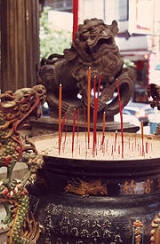
Taoism

Encyclopedia
Taoism refers to a philosophical
or religious
tradition in which the basic concept is to establish harmony with the Tao
(道), which is the mechanism of everything that exists. The word "Tao" (or "Dao", depending on the romanization
scheme) is usually translated as "way", "path" or "principle", although the word literally means "nature" as in the nature of all things as well as the natural world. Taoism had not only a profound influence on the culture of China, but also on neighboring countries. While the philosophical Taoism is not institutionalized, the religious Taoism is institutionalized and present in multiple countries. Taoist philosophy is deeply rooted in contemporary China, and is an unavoidable part of modern Chinese life.
Taoist propriety and ethics emphasize the Three Jewels of the Tao: compassion
, moderation
, and humility
, while Taoist thought generally focuses on nature
, the relationship between humanity and the cosmos ; health
and longevity
; and wu wei
(action through inaction). Harmony with the Universe
, or the source thereof (Tao), is the intended result of many Taoist rules and practices.
Reverence for ancestor spirits and immortals
is common in popular Taoism. Organized Taoism distinguishes its ritual activity from that of the folk religion, which some professional Taoists (Dàoshi) view as debased. Chinese alchemy
(including Neidan
), astrology
, cuisine
, Zen Buddhism
, several Chinese martial arts
, traditional Chinese medicine
, feng shui
, and many styles of qigong
have been intertwined with Taoism throughout history.
of the words "Daoism" and "Taoism". The root Chinese
word "way, path" is romanized tao
in the older Wade–Giles system and dào
in the modern Pinyin
system. In linguistic terminology, English Taoism/Daoism is a calque
formed from the Chinese loanword
tao/dao "way; route; principle" and the native suffix
-ism. The sometimes heated arguments over Taoism vs. Daoism involve sinology
, phoneme
s, loanword
s, and politics – not to mention whether Taoism should be pronounced ˈ or ˈ.
Daoism is consistently pronounced ˈ, but English speakers disagree whether Taoism should be ˈ or ˈ. In theory, both Wade-Giles tao and Pinyin dao are articulated identically, as are Taoism and Daoism. An investment book titled The Tao Jones Averages (a pun on the Dow Jones Indexes
) illustrates this /daʊ/ pronunciation's widespread familiarity. In speech, Tao and Taoism are often pronounced /ˈtaʊ/ and ˈtaʊ.ɪzəm/, reading the Chinese unaspirated lenis ("weak") /t/ as the English voiceless stop consonant
/t/. Lexicography
shows American and British English differences
in pronouncing Taoism. A study of major English dictionaries published in Great Britain and the United States found the most common Taoism glosses were /taʊ.ɪzəm/ in British sources and /daʊ.ɪzəm, taʊ.ɪzəm/ in American ones.
This distinction is complicated by hermeneutic (interpretive) difficulties in the categorization of Taoist schools, sects and movements. Some scholars believe that there is no distinction between Daojia and Daojiao. According to Kirkland, "most scholars who have seriously studied Taoism, both in Asia and the West, have finally abandoned the simplistic dichotomy of Tao-chia and Tao-chiao, 'philosophical Taoism' and 'religious Taoism.'"
Hansen states that the identification of "Taoism" as such first occurred in the early Han Dynasty when dao-jia was identified as a single school. The writings of Laozi
and Zhuangzi
were linked together under this single tradition during the Han Dynasty, but notably not before. It is unlikely that Zhuangzi was familiar with the text of the Daodejing. Additionally, Graham states that Zhuangzi would not have identified himself as a Taoist, a classification that did not arise until well after his death.
Taoism does not fall strictly under an umbrella or a definition of an organized religion like the Abrahamic traditions, nor can it purely be studied as the originator or a variant of Chinese folk religion
, as much of the traditional religion is outside of the tenets and core teachings of Taoism. Robinet asserts that Taoism is better understood as a way of life than as a religion, and that its adherents do not approach or view Taoism the way non-Taoist historians have done. Henri Maspero
noted that many scholarly works frame Taoism as a school of thought focused on the quest for immortality
.
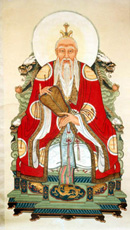
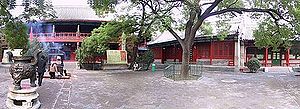 Some forms of Taoism may be traced to prehistoric folk religions in China that later coalesced into a Taoist tradition. Laozi
is traditionally regarded as the founder of Taoism and is closely associated in this context with "original", or "primordial", Taoism. He lived around the 6th century BCE. Laozi received imperial recognition as a divinity in the mid-2nd century BCE. Taoism gained official status in China during the Tang Dynasty, whose emperors claimed Laozi as their relative. Several Song emperors, most notably Huizong
, were active in promoting Taoism, collecting Taoist texts and publishing editions of the Daozang. Aspects of Confucianism, Taoism, and Buddhism were consciously synthesized in the Neo-Confucian school, which eventually became Imperial orthodoxy
for state bureaucratic purposes. The Qing Dynasty, however, much favored Confucian classics over Taoist works. During the 18th century, the imperial library was constituted, but excluded virtually all Taoist books. By the beginning of the 20th century, Taoism had fallen much from favor (for example, only one complete copy of the Daozang
still remained, at the White Cloud Monastery in Beijing). Taoism is one of five religions recognized by the People's Republic of China and regulates its activities through a state bureaucracy (the China Taoist Association).
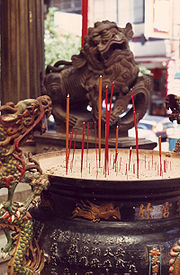 Taoist beliefs include teachings based on revelations from various sources. Therefore, different branches of Taoism often have differing beliefs, especially concerning nature. Nevertheless, there are certain core beliefs that nearly all the sects share. These relate to the symbology of the Tai-Chi, or Yin Yang symbol, and the notion of wu-wei (action through inaction) which seek to counterbalance Yin with Yang at every opportunity. Generally speaking, Taoists believe in embodiment and pragmatism, engaging practice to actualize the natural order within themselves. Also, they believe that life should be peaceful and filled with joy.
, "non-action" (wu wei, or "effortless effort"—see below), emptiness (refinement), detachment
, flexibility, receptiveness, spontaneity, the relativism
of human ways of life, ways of speaking and guiding behavior
.
, as the essential energy of action and existence, is often compared to the universal order of Tao. Tao is compared to what it is not, which according to Keller is similar to the negative theology
of Western scholars. It is often considered to be the source of both existence and non-existence. LaFargue asserts that Tao is rarely an object of worship, being treated more like the Indian concepts of atman
and dharma
.
In ancient Taoist texts, wu wei is associated with water through its yielding nature. Taoist philosophy proposes that the universe works harmoniously according to its own ways. When someone exerts their will against the world, they disrupt that harmony. Taoism does not identify one's will as the root problem. Rather, it asserts that one must place their will in harmony with the natural universe. Thus, a potentially harmful interference is to be avoided, and in this way, goals can be achieved effortlessly.
Pu is usually seen as keeping oneself in the primordial state of tao. It is believed to be the true nature of the mind, unburdened by knowledge or experiences. In the state of pu, there is no right or wrong, beautiful or ugly. There is only pure experience, or awareness
, free from learned labels and definitions. It is this state of being that is the goal of following wu wei.
for the universe
. The body ties directly into the Chinese five elements. The five organs correlate with the five elements, the five directions and the seasons. Akin to the Hermetic
maxim of "as above, so below", Taoism posits that man may gain knowledge of the universe by understanding himself.
In Taoism, even beyond Chinese folk religion, various rituals, exercises, and substances are said to positively affect one's physical and mental health
. They are also intended to align oneself spiritually with cosmic forces, or enable ecstatic spiritual journeys. These concepts seem basic to Taoism in its elite forms. Internal alchemy and various spiritual practices are used by some Taoists to improve health and extend life, theoretically even to the point of physical immortality.
The traditional Chinese religion is polytheistic
. Its many deities are part of a heavenly hierarchy
that mirrors the bureaucracy
of Imperial China. According to their beliefs, Chinese deities may be promoted or demoted for their actions. Some deities are also simply exalted humans, such as Guan Yu
, the god of honor and piety. The particular deities worshipped vary according to geographical regions and historical periods in China, though the general pattern of worship is more constant.
There are disagreements regarding the proper composition of this pantheon. Popular Taoism typically presents the Jade Emperor
as the official head deity
. Intellectual ("elite") Taoists, such as the Celestial Masters sect, usually present Laozi
(Laojun, "Lord Lao") and the Three Pure Ones
at the top of the pantheon of deities.
While a number of immortals or other mysterious figures appear in the Zhuangzi
, and to a lesser extent in the Tao Te Ching
, these have generally not become the objects of worship. Traditional conceptions of Tao are not to be confused with the Western concepts of theism
and monotheism
. Being one with the Tao does not indicate a union with an eternal spirit in the Hindu sense, but rather living in accordance with nature.
is frequently treated as equally dangerous as excessive sexual indulgence. Taoists believe that a man may increase and nourish his own vitality by bringing a woman to orgasm. The female's orgasm activates and strengthens her jing
, which has a nourishing and balancing effect on that of the male. The energy released during either one's orgasm can be harnessed and led up the Governor vessel/channel to nourish the brain, for additional benefit to the longevity of that partner.
The Chinese
government prefers the celibate model of Buddhism
for Taoist clergy. Quanzhen clergy take vows of celibacy, but Zhengyi
clergy are often married, and often reside at home. They are called sanju Taoshi, or "Taoist priests who live at home." Numbering in the tens of thousands, the sanju Taoshi perform rituals for their local communities.
. However, the authorship and precise date that it was written is still the subject of debate. Alan Watts
(1975) held that this view was part of an academic fashion for skepticism about historical spiritual and religious figures, arguing that not enough would be known for years, or possibly ever, to make a firm judgment. The earliest text of the Tao Te Ching that's been excavated (written on bamboo tablets) dates back to the late 4th century BC. It has been used as a ritual text throughout the history of religious Taoism.
Taoist commentators have deeply considered the opening lines of the Tao Te Ching. They are widely discussed in both academic and mainstream literature. A common interpretation is similar to Korzybski's observation that "the map is not the territory". The opening lines, with literal and common translation, are:
Tao literally means "path" or "way" and can figuratively mean "essential nature", "destiny", "principle", or "true path". The philosophical and religious "Tao" is infinite, without limitation. One view states that the paradoxical opening is intended to prepare the reader for teachings about the unteachable Tao. Tao is believed to be transcendent
, indistinct and without form. Hence, it cannot be named or categorized. Even the word "Tao" can be considered a dangerous temptation to make Tao a limiting "name".
The Tao Te Ching is not thematically ordered. However, the main themes of the text are repeatedly expressed using variant formulations, often with only a slight difference. The leading themes revolve around the nature of Tao and how to attain it. Tao is said to be unnameable and accomplishing great things through small means. There is significant debate regarding which English translation of the Tao Te Ching is preferred, and which particular translation methodology is best. Discussions and disputes about various translations of the Tao Te Ching can become acrimonious, involving deeply entrenched views.
Ancient commentaries on the Tao Te Ching are important texts in their own right. The Heshang Gong commentary was most likely written in the 2nd century CE, and as perhaps the oldest commentary, contains the edition of the Tao Te Ching that was transmitted to the present day. Other important commentaries include the Xiang'er
, one of the most important texts from the Way of the Celestial Masters, and Wang Bi's
commentary.
is traditionally attributed to a Taoist sage of the same name, but this has recently been disputed in western academia. Zhuangzi also appears as a character in the book's narrative. The Zhuangzi contains prose, poetry, humour and disputation. The book often is seen as complex and paradoxical as the arguments and subjects of discussion are not those common to classical Western philosophy
, such as the doctrine of Name Rectification (Zhengming) and correctly making "this/not-this" distinctions (shi/fei). Among the cast of characters in the Zhuangzi's stories is Confucius
.
is sometimes referred to as the Taoist canon. It was originally compiled during the Jin
, Tang
, and Song
dynasties. The version surviving today was published during the Ming Dynasty
. The Ming Daozang includes almost 1500 texts. Following the example of the Buddhist Tripiṭaka
, it is divided into three dong . They are arranged from "highest" to "lowest":
Daoshi (Dàoshi) generally do not consult published versions of the Daozang, but individually choose, or inherit, texts included in the Daozang. These texts have been passed down for generations from teacher to student.
The Shangqing school has a tradition of approaching Taoism through scriptural study. It is believed that by reciting certain texts often enough one will be rewarded with immortality.
. Taishang Ganying Pian ("Treatise of the Exalted One on Response and Retribution") discusses sin and ethics, and has become a popular morality tract in the last few centuries. It asserts that those in harmony with Tao will live long and fruitful lives. The wicked, and their descendants, will suffer and have shortened lives. Both the Taiping Jing
("Scripture on Great Peace") and the Baopuzi
("Book of the Master Who Keeps to Simplicity") contain early alchemical formulas that early Taoists believed could lead to immortality.
is estimated to be just under four hundred million. Most Chinese people and many others have been influenced in some way by Taoist tradition. Estimates for the number of Taoists worldwide range from twenty million and possibly to as many as 400 million in China alone.
Recently, there have been some efforts to revive the practice of Taoist religion. In 1956, the Chinese Taoist Association was formed, and received official approval in 1957. It was disbanded during the Cultural Revolution under Mao, but re-established in 1980. The headquarters of the Association are at Baiyun guan, or White Cloud Temple
, of the Longmen branch of Quanzhen.
Geographically, Taoism flourishes best in regions populated by Chinese people: mainland China
, Taiwan
, Malaysia, Singapore
, and various Chinese diaspora communities. Taoist literature and art has influenced the cultures of Korea, Japan
, and Vietnam
. Organized Taoism seems not to have attracted a large non-Chinese following, except in Korea (e.g. see Kouk Sun Do) and Vietnam, until modern times. In Taiwan
7.5 million people (33% of the population) identify themselves as Taoists. In Singapore
, 8.5% of the population identify themselves as Taoist. There are also small numbers of Taoists in the Western world.
 At certain dates, food may be set out as a sacrifice
to the spirits of the deceased and/or the gods, such as during the Qingming Festival
. This may include slaughtered animals, such as pigs and ducks, or fruit. Another form of sacrifice involves the burning of Joss paper
, or Hell Bank Notes
, on the assumption that images thus consumed by the fire will reappear—not as a mere image, but as the actual item—in the spirit world, making them available for revered ancestors and departed loved ones. At other points, a vegan diet or full fast may be observed.
Also on particular holidays, street parades take place. These are lively affairs which invariably involve firecrackers and flower-covered floats broadcasting traditional music. They also variously include lion dance
s and dragon dance
s; human-occupied puppets (often of the "Seventh Lord" and "Eighth Lord"); tongji ( "spirit-medium; shaman") who cut their skin with knives; Bajiajiang, which are Kungfu-practicing honor guards in demonic makeup; and palanquins carrying god-images. The various participants are not considered performers, but rather possessed by the gods and spirits in question.
Fortune-telling
—including astrology
, I Ching
, and other forms of divination
—has long been considered a traditional Taoist pursuit. Mediumship
is also widely encountered in some sects. There is an academic and social distinction between martial forms of mediumship (such as tongji) and the spirit-writing that is typically practiced through planchette writing
.
Many Taoists also participate in the study, analysis and writing of books. Taoists of this type tend to be civil servants, elderly retirees, or in modern times, university faculty. While there is considerable overlap with religious Taoism, there are often important divergences in interpretation. For example, Wang Bi, one of the most influential philosophical commentators on the Laozi (and Yijing), was a Confucian.
A number of martial arts traditions, particularly T'ai Chi Ch'uan, Bagua Zhang, Wing Chun
, Won Yuen Yat Hey Jueng, Bak Mei Pai, Bok Fou Pai, Yaw Gong Moon and Xing Yi Quan
, embody Taoist principles to a greater or lesser extent, and some practitioners consider their art to be a means of practicing Taoism.
") symbol as well as the Ba gua 八卦 ("Eight Trigrams") are associated with Taoist symbolism. While almost all Taoist organizations make use of the yin and yang symbol, one could also call it Confucian, Neo-Confucian or pan-Chinese. The yin and yang make an "S" shape, with yin (Black or Red) on the right. One is likely to see this symbol as decorations on Taoist organization flags and logos, temple floors, or stitched into clerical robes. According to Song Dynasty sources, it originated around the 10th century. Previously, yin and yang were symbolized by a tiger and dragon.
Taoist temples may fly square or triangular flags. They typically feature mystical writing or diagrams and are intended to fulfill various functions including providing guidance for the spirits of the dead, to bring good fortune, increase life span, etc. Other flags and banners may be those of the gods or immortals themselves.
A zigzag with seven stars is sometimes displayed, representing the Big Dipper
(or the Bushel, the Chinese equivalent). In the Shang Dynasty
the Big Dipper was considered a deity, while during the Han Dynasty
, it was considered a qi path of the circumpolar god, Taiyi.
Taoist temples in southern China and Taiwan may often be identified by their roofs, which feature Chinese dragon
s and phoenix
made from multi-colored ceramic tiles. They also stand for the harmony of yin and yang (with the phoenix being yin). A related symbol is the flaming pearl which may be seen on such roofs between two dragons, as well as on the hairpin of a Celestial Master. In general though, Chinese Taoist architecture has no universal features that distinguish it from other structures.
 The terms Tao and De are religious and philosophical terms shared between Taoism and Confucianism. The authorship of the Tao Te Ching
is assigned to Laozi
, who is traditionally held to have been a teacher of Confucius. However, some scholars believe the Tao Te Ching arose as a reaction to Confucianism. Zhuangzi
, reacting to the Confucian-Mohist ethical disputes in his "history of thought", casts Laozi as a prior step to the Mohists by name and the Confucians by implication.
Early Taoist texts reject the basic assumptions of Confucianism which relied on rituals and order, in favour of the examples of "wild" nature and individualism. Historical Taoists challenged conventional morality, while Confucians considered society debased and in need of strong ethical guidance.
The entry of Buddhism
into China was marked by interaction and syncretism
, with Taoism in particular. Originally seen as a kind of "foreign Taoism", Buddhism's scriptures were translated into Chinese using the Taoist vocabulary. Chan Buddhism was particularly modified by Taoism, integrating distrust of scripture, text and even language, as well as the Taoist views of embracing "this life", dedicated practice and the "every-moment". Taoism incorporated Buddhist elements during the Tang period, such as monasteries, vegetarianism, prohibition of alcohol, the doctrine of emptiness, and collecting scripture in tripartite organisation. During the same time, Chan Buddhism grew to become the largest sect in Chinese Buddhism. Christine Mollier concluded that a number of Buddhist sutras
found in medieval East Asia
and Central Asia
adopted many materials from earlier Taoist scriptures.
Ideological and political rivals for centuries, Taoism, Confucianism, and Buddhism deeply influenced one another. They also share some similar values, with all three embracing a humanist
philosophy emphasizing moral behavior and human perfection. In time, most Chinese people identified to some extent with all three traditions simultaneously. This became institutionalised when aspects of the three schools were synthesised in the Neo-Confucian school.
Georg Wilhelm Friedrich Hegel
and Arthur Schopenhauer
both wrote of Taoism.
Mirza Tahir Ahmad
, the fourth Caliph
of the Ahmadiyya Muslim Community
in his book Revelation, Rationality, Knowledge & Truth
sees Taoism in its earliest form as a monotheistic religion divinely revealed to Prophets, the message of which gradually detoriated over many centuries into what is seen today. In terms of this he relates Taoism and other Chinese traditional religions with other traditional Religions such as Judaism, Christianity and Islam.
Popular (non-academic) interpretations of Taoism
Philosophy
Philosophy is the study of general and fundamental problems, such as those connected with existence, knowledge, values, reason, mind, and language. Philosophy is distinguished from other ways of addressing such problems by its critical, generally systematic approach and its reliance on rational...
or religious
Chinese folk religion
Chinese folk religion or Shenism , which is a term of considerable debate, are labels used to describe the collection of ethnic religious traditions which have been a main belief system in China and among Han Chinese ethnic groups for most of the civilization's history until today...
tradition in which the basic concept is to establish harmony with the Tao
Tao
Dao or Tao is a Chinese word meaning 'way', 'path', 'route', or sometimes more loosely, 'doctrine' or 'principle'...
(道), which is the mechanism of everything that exists. The word "Tao" (or "Dao", depending on the romanization
Romanization
In linguistics, romanization or latinization is the representation of a written word or spoken speech with the Roman script, or a system for doing so, where the original word or language uses a different writing system . Methods of romanization include transliteration, for representing written...
scheme) is usually translated as "way", "path" or "principle", although the word literally means "nature" as in the nature of all things as well as the natural world. Taoism had not only a profound influence on the culture of China, but also on neighboring countries. While the philosophical Taoism is not institutionalized, the religious Taoism is institutionalized and present in multiple countries. Taoist philosophy is deeply rooted in contemporary China, and is an unavoidable part of modern Chinese life.
Taoist propriety and ethics emphasize the Three Jewels of the Tao: compassion
Compassion
Compassion is a virtue — one in which the emotional capacities of empathy and sympathy are regarded as a part of love itself, and a cornerstone of greater social interconnection and humanism — foundational to the highest principles in philosophy, society, and personhood.There is an aspect of...
, moderation
Moderation
Moderation is the process of eliminating or lessening extremes. It is used to ensure normality throughout the medium on which it is being conducted...
, and humility
Humility
Humility is the quality of being modest, and respectful. Humility, in various interpretations, is widely seen as a virtue in many religious and philosophical traditions, being connected with notions of transcendent unity with the universe or the divine, and of egolessness.-Term:The term "humility"...
, while Taoist thought generally focuses on nature
Nature
Nature, in the broadest sense, is equivalent to the natural world, physical world, or material world. "Nature" refers to the phenomena of the physical world, and also to life in general...
, the relationship between humanity and the cosmos ; health
Health
Health is the level of functional or metabolic efficiency of a living being. In humans, it is the general condition of a person's mind, body and spirit, usually meaning to be free from illness, injury or pain...
and longevity
Longevity
The word "longevity" is sometimes used as a synonym for "life expectancy" in demography or known as "long life", especially when it concerns someone or something lasting longer than expected ....
; and wu wei
Wu wei
Wu wei is an important concept of Taoism , that involves knowing when to act and when not to act. Another perspective to this is that "Wu Wei" means...
(action through inaction). Harmony with the Universe
Universe
The Universe is commonly defined as the totality of everything that exists, including all matter and energy, the planets, stars, galaxies, and the contents of intergalactic space. Definitions and usage vary and similar terms include the cosmos, the world and nature...
, or the source thereof (Tao), is the intended result of many Taoist rules and practices.
Reverence for ancestor spirits and immortals
Eight Immortals
The Eight Immortals are a group of legendary xian in Chinese mythology. Each Immortal's power can be transferred to a power tool that can give life or destroy evil. Together, these eight tools are called "Covert Eight Immortals" . Most of them are said to have been born in the Tang Dynasty or...
is common in popular Taoism. Organized Taoism distinguishes its ritual activity from that of the folk religion, which some professional Taoists (Dàoshi) view as debased. Chinese alchemy
Chinese alchemy
Chinese alchemy, a part of the larger tradition of Taoism, centers on the tradition of body-spirit cultivation that developed through the Chinese understandings of medicine and the body. These Chinese traditions were developed into a system of energy practices...
(including Neidan
Neidan
Neidan, or internal alchemy, spiritual alchemy is a concept in Taoist Chinese alchemy. It is a series of physical, mental, and spiritual disciplines intended to prolong the life of the body and create an immortal spiritual body that would survive after death.In Neidan the human body becomes a...
), astrology
Chinese astrology
Chinese astrology is based on the traditional astronomy and calendars. The development of Chinese astrology is tied to that of astronomy, which came to flourish during the Han Dynasty ....
, cuisine
Chinese cuisine
Chinese cuisine is any of several styles originating in the regions of China, some of which have become highly popular in other parts of the world – from Asia to the Americas, Australia, Western Europe and Southern Africa...
, Zen Buddhism
Zen
Zen is a school of Mahāyāna Buddhism founded by the Buddhist monk Bodhidharma. The word Zen is from the Japanese pronunciation of the Chinese word Chán , which in turn is derived from the Sanskrit word dhyāna, which can be approximately translated as "meditation" or "meditative state."Zen...
, several Chinese martial arts
Chinese martial arts
Chinese martial arts, also referred to by the Mandarin Chinese term wushu and popularly as kung fu , are a number of fighting styles that have developed over the centuries in China. These fighting styles are often classified according to common traits, identified as "families" , "sects" or...
, traditional Chinese medicine
Traditional Chinese medicine
Traditional Chinese Medicine refers to a broad range of medicine practices sharing common theoretical concepts which have been developed in China and are based on a tradition of more than 2,000 years, including various forms of herbal medicine, acupuncture, massage , exercise , and dietary therapy...
, feng shui
Feng shui
Feng shui ' is a Chinese system of geomancy believed to use the laws of both Heaven and Earth to help one improve life by receiving positive qi. The original designation for the discipline is Kan Yu ....
, and many styles of qigong
Qigong
Qigong or chi kung is a practice of aligning breath, movement, and awareness for exercise, healing, and meditation...
have been intertwined with Taoism throughout history.
Spelling and pronunciation
English-speakers ongoingly debate the preferred romanizationRomanization
In linguistics, romanization or latinization is the representation of a written word or spoken speech with the Roman script, or a system for doing so, where the original word or language uses a different writing system . Methods of romanization include transliteration, for representing written...
of the words "Daoism" and "Taoism". The root Chinese
Chinese language
The Chinese language is a language or language family consisting of varieties which are mutually intelligible to varying degrees. Originally the indigenous languages spoken by the Han Chinese in China, it forms one of the branches of Sino-Tibetan family of languages...
word "way, path" is romanized tao
Tao
Dao or Tao is a Chinese word meaning 'way', 'path', 'route', or sometimes more loosely, 'doctrine' or 'principle'...
in the older Wade–Giles system and dào
Tao
Dao or Tao is a Chinese word meaning 'way', 'path', 'route', or sometimes more loosely, 'doctrine' or 'principle'...
in the modern Pinyin
Pinyin
Pinyin is the official system to transcribe Chinese characters into the Roman alphabet in China, Malaysia, Singapore and Taiwan. It is also often used to teach Mandarin Chinese and spell Chinese names in foreign publications and used as an input method to enter Chinese characters into...
system. In linguistic terminology, English Taoism/Daoism is a calque
Calque
In linguistics, a calque or loan translation is a word or phrase borrowed from another language by literal, word-for-word or root-for-root translation.-Calque:...
formed from the Chinese loanword
Loanword
A loanword is a word borrowed from a donor language and incorporated into a recipient language. By contrast, a calque or loan translation is a related concept where the meaning or idiom is borrowed rather than the lexical item itself. The word loanword is itself a calque of the German Lehnwort,...
tao/dao "way; route; principle" and the native suffix
Suffix
In linguistics, a suffix is an affix which is placed after the stem of a word. Common examples are case endings, which indicate the grammatical case of nouns or adjectives, and verb endings, which form the conjugation of verbs...
-ism. The sometimes heated arguments over Taoism vs. Daoism involve sinology
Sinology
Sinology in general use is the study of China and things related to China, but, especially in the American academic context, refers more strictly to the study of classical language and literature, and the philological approach...
, phoneme
Phoneme
In a language or dialect, a phoneme is the smallest segmental unit of sound employed to form meaningful contrasts between utterances....
s, loanword
Loanword
A loanword is a word borrowed from a donor language and incorporated into a recipient language. By contrast, a calque or loan translation is a related concept where the meaning or idiom is borrowed rather than the lexical item itself. The word loanword is itself a calque of the German Lehnwort,...
s, and politics – not to mention whether Taoism should be pronounced ˈ or ˈ.
Daoism is consistently pronounced ˈ, but English speakers disagree whether Taoism should be ˈ or ˈ. In theory, both Wade-Giles tao and Pinyin dao are articulated identically, as are Taoism and Daoism. An investment book titled The Tao Jones Averages (a pun on the Dow Jones Indexes
Dow Jones Indexes
Dow Jones Indexes was formed in 1997 as an entity within Dow Jones & Co. It is now owned by the CME Group. It serves as the marketing name of CME Group Indexes, LLC. It produces, maintains, licenses and markets indexes as benchmarks and as the basis of investible products such as exchange traded...
) illustrates this /daʊ/ pronunciation's widespread familiarity. In speech, Tao and Taoism are often pronounced /ˈtaʊ/ and ˈtaʊ.ɪzəm/, reading the Chinese unaspirated lenis ("weak") /t/ as the English voiceless stop consonant
Stop consonant
In phonetics, a plosive, also known as an occlusive or an oral stop, is a stop consonant in which the vocal tract is blocked so that all airflow ceases. The occlusion may be done with the tongue , lips , and &...
/t/. Lexicography
Lexicography
Lexicography is divided into two related disciplines:*Practical lexicography is the art or craft of compiling, writing and editing dictionaries....
shows American and British English differences
American and British English differences
This is one of a series of articles about the differences between British English and American English, which, for the purposes of these articles, are defined as follows:...
in pronouncing Taoism. A study of major English dictionaries published in Great Britain and the United States found the most common Taoism glosses were /taʊ.ɪzəm/ in British sources and /daʊ.ɪzəm, taʊ.ɪzəm/ in American ones.
Categorization
There is debate over how, and whether, Taoism should be categorized. Livia Kohn divided it into the following three categories:- Philosophical Taoism (Daojia (PinyinPinyinPinyin is the official system to transcribe Chinese characters into the Roman alphabet in China, Malaysia, Singapore and Taiwan. It is also often used to teach Mandarin Chinese and spell Chinese names in foreign publications and used as an input method to enter Chinese characters into...
: Dàojiā) ) – A philosophical schoolPhilosophyPhilosophy is the study of general and fundamental problems, such as those connected with existence, knowledge, values, reason, mind, and language. Philosophy is distinguished from other ways of addressing such problems by its critical, generally systematic approach and its reliance on rational...
based on the texts Dao De Jing and ZhuangziZhuangziZhuangzi was an influential Chinese philosopher who lived around the 4th century BCE during the Warring States Period, a period corresponding to the philosophical summit of Chinese thought — the Hundred Schools of Thought, and is credited with writing—in part or in whole—a work known by his name,...
; - Religious Taoism (Daojiao (PinyinPinyinPinyin is the official system to transcribe Chinese characters into the Roman alphabet in China, Malaysia, Singapore and Taiwan. It is also often used to teach Mandarin Chinese and spell Chinese names in foreign publications and used as an input method to enter Chinese characters into...
: Dàojiào) ) – A family of organized ChineseReligion in ChinaReligion in China has been characterized by pluralism since the beginning of Chinese history. The Chinese religions are family-oriented and do not demand the exclusive adherence of members. Some scholars doubt the use of the term "religion" in reference to Buddhism and Taoism, and suggest "cultural...
religious movements originating from the Celestial Masters movement during the late Han Dynasty and later including the "Orthodox" (ZhengyiZhengyi DaoZhenyi Dao or the Way of Complete Orthodoxy is a Chinese Daoist movement that emerged during the Tang Dynasty as a transformation of the earlier Tianshi Dao movement...
) and "Complete Reality" (Quanzhen ) sects, which claim lineages going back to Lao Zi or Zhang DaolingZhang DaolingZhang Ling , style name Fuhan , was an Eastern Han Dynasty Taoist hermit who founded the Way of the Celestial Masters sect of Taoism, which is also known as the Way of the Five Pecks of Rice....
in the late Han DynastyHan DynastyThe Han Dynasty was the second imperial dynasty of China, preceded by the Qin Dynasty and succeeded by the Three Kingdoms . It was founded by the rebel leader Liu Bang, known posthumously as Emperor Gaozu of Han. It was briefly interrupted by the Xin Dynasty of the former regent Wang Mang...
; - Folk Taoism – The Chinese folk religionChinese folk religionChinese folk religion or Shenism , which is a term of considerable debate, are labels used to describe the collection of ethnic religious traditions which have been a main belief system in China and among Han Chinese ethnic groups for most of the civilization's history until today...
.
This distinction is complicated by hermeneutic (interpretive) difficulties in the categorization of Taoist schools, sects and movements. Some scholars believe that there is no distinction between Daojia and Daojiao. According to Kirkland, "most scholars who have seriously studied Taoism, both in Asia and the West, have finally abandoned the simplistic dichotomy of Tao-chia and Tao-chiao, 'philosophical Taoism' and 'religious Taoism.'"
Hansen states that the identification of "Taoism" as such first occurred in the early Han Dynasty when dao-jia was identified as a single school. The writings of Laozi
Laozi
Laozi was a mystic philosopher of ancient China, best known as the author of the Tao Te Ching . His association with the Tao Te Ching has led him to be traditionally considered the founder of Taoism...
and Zhuangzi
Zhuangzi
Zhuangzi was an influential Chinese philosopher who lived around the 4th century BCE during the Warring States Period, a period corresponding to the philosophical summit of Chinese thought — the Hundred Schools of Thought, and is credited with writing—in part or in whole—a work known by his name,...
were linked together under this single tradition during the Han Dynasty, but notably not before. It is unlikely that Zhuangzi was familiar with the text of the Daodejing. Additionally, Graham states that Zhuangzi would not have identified himself as a Taoist, a classification that did not arise until well after his death.
Taoism does not fall strictly under an umbrella or a definition of an organized religion like the Abrahamic traditions, nor can it purely be studied as the originator or a variant of Chinese folk religion
Chinese folk religion
Chinese folk religion or Shenism , which is a term of considerable debate, are labels used to describe the collection of ethnic religious traditions which have been a main belief system in China and among Han Chinese ethnic groups for most of the civilization's history until today...
, as much of the traditional religion is outside of the tenets and core teachings of Taoism. Robinet asserts that Taoism is better understood as a way of life than as a religion, and that its adherents do not approach or view Taoism the way non-Taoist historians have done. Henri Maspero
Henri Maspero
Henri Maspero was a French sinologist, today particularly remembered for his pioneering works on Taoism.-Biography:...
noted that many scholarly works frame Taoism as a school of thought focused on the quest for immortality
Immortality
Immortality is the ability to live forever. It is unknown whether human physical immortality is an achievable condition. Biological forms have inherent limitations which may or may not be able to be overcome through medical interventions or engineering...
.
History
Laozi
Laozi was a mystic philosopher of ancient China, best known as the author of the Tao Te Ching . His association with the Tao Te Ching has led him to be traditionally considered the founder of Taoism...
is traditionally regarded as the founder of Taoism and is closely associated in this context with "original", or "primordial", Taoism. He lived around the 6th century BCE. Laozi received imperial recognition as a divinity in the mid-2nd century BCE. Taoism gained official status in China during the Tang Dynasty, whose emperors claimed Laozi as their relative. Several Song emperors, most notably Huizong
Emperor Huizong (Song Dynasty)
Emperor Huizong was the eighth and one of the most famous emperors of the Song Dynasty of China, with a personal life spent amidst luxury, sophistication and art but ending in tragedy....
, were active in promoting Taoism, collecting Taoist texts and publishing editions of the Daozang. Aspects of Confucianism, Taoism, and Buddhism were consciously synthesized in the Neo-Confucian school, which eventually became Imperial orthodoxy
Orthodoxy
The word orthodox, from Greek orthos + doxa , is generally used to mean the adherence to accepted norms, more specifically to creeds, especially in religion...
for state bureaucratic purposes. The Qing Dynasty, however, much favored Confucian classics over Taoist works. During the 18th century, the imperial library was constituted, but excluded virtually all Taoist books. By the beginning of the 20th century, Taoism had fallen much from favor (for example, only one complete copy of the Daozang
Daozang
Daozang , meaning "Treasury of Dao" or "Daoist Canon", consists of around 1400 texts that were collected circa C.E. 400...
still remained, at the White Cloud Monastery in Beijing). Taoism is one of five religions recognized by the People's Republic of China and regulates its activities through a state bureaucracy (the China Taoist Association).
Beliefs
Principles
Taoist theology emphasizes various themes found in the Daodejing and Zhuangzi, such as naturalness, vitality, peacePeace
Peace is a state of harmony characterized by the lack of violent conflict. Commonly understood as the absence of hostility, peace also suggests the existence of healthy or newly healed interpersonal or international relationships, prosperity in matters of social or economic welfare, the...
, "non-action" (wu wei, or "effortless effort"—see below), emptiness (refinement), detachment
Detachment
Detachment, also expressed as non-attachment, is a state in which a person overcomes his or her attachment to desire for things, people or concepts of the world and thus attains a heightened perspective.-Importance of the term:...
, flexibility, receptiveness, spontaneity, the relativism
Relativism
Relativism is the concept that points of view have no absolute truth or validity, having only relative, subjective value according to differences in perception and consideration....
of human ways of life, ways of speaking and guiding behavior
Behavior
Behavior or behaviour refers to the actions and mannerisms made by organisms, systems, or artificial entities in conjunction with its environment, which includes the other systems or organisms around as well as the physical environment...
.
Tao
Tao literally means "way", but can also be interpreted as road, channel, path, doctrine, or line. Wing-tsit Chan stated that Tao meant a system of morality to Confucianists, but that it meant the natural, eternal, spontaneous, indescribable way things began and pursued their course to Taoists. Hansen disagrees that these were separate meanings and attributes. Cane asserts Tao can be roughly stated to be the flow of the universe, or the force behind the natural order, equating it with the influence that keeps the universe balanced and ordered. Martinson says that Tao is associated with nature, due to a belief that nature demonstrates the Tao. The flow of qiQi
In traditional Chinese culture, qì is an active principle forming part of any living thing. Qi is frequently translated as life energy, lifeforce, or energy flow. Qi is the central underlying principle in traditional Chinese medicine and martial arts...
, as the essential energy of action and existence, is often compared to the universal order of Tao. Tao is compared to what it is not, which according to Keller is similar to the negative theology
Negative theology
Apophatic theology —also known as negative theology or via negativa —is a theology that attempts to describe God, the Divine Good, by negation, to speak only in terms of what may not be said about the perfect goodness that is God...
of Western scholars. It is often considered to be the source of both existence and non-existence. LaFargue asserts that Tao is rarely an object of worship, being treated more like the Indian concepts of atman
Atman (Buddhism)
The word Ātman or Atta refers to a self. Occasionally the terms "soul" or "ego" are also used. The words ātman and atta derive from the Indo-European root *ēt-men and are cognate with the Old English æthm and German Atem....
and dharma
Dharma
Dharma means Law or Natural Law and is a concept of central importance in Indian philosophy and religion. In the context of Hinduism, it refers to one's personal obligations, calling and duties, and a Hindu's dharma is affected by the person's age, caste, class, occupation, and gender...
.
De (Te)
Tao is also associated with the complex concept of De "power; virtue; integrity", that is, the active expression of Tao. De is the active living, or cultivation, of that "way". (De is also spelled 'Teh' or 'Te' in some transliteration schemes)Wu wei
Wu wei ( or ) is a central concept in Taoism. The literal meaning of wu wei is "without action". It is often expressed by the paradox wei wu wei, meaning "action without action" or "effortless doing". The practice and efficacy of wu wei are fundamental in Taoist thought, most prominently emphasized in philosophical Taoism. The goal of wu wei is alignment with Tao, revealing the soft and invisible power within all things. It is believed by Taoists that masters of wu wei can observe and follow this invisible potential, the innate in-action of the Way.In ancient Taoist texts, wu wei is associated with water through its yielding nature. Taoist philosophy proposes that the universe works harmoniously according to its own ways. When someone exerts their will against the world, they disrupt that harmony. Taoism does not identify one's will as the root problem. Rather, it asserts that one must place their will in harmony with the natural universe. Thus, a potentially harmful interference is to be avoided, and in this way, goals can be achieved effortlessly.
Pu
Pu is translated "uncarved block", "unhewn log", or "simplicity". It is a metaphor for the state of wu wei and the principle of jian . It represents a passive state of receptiveness. Pu is a symbol for a state of pure potential and perception without prejudice. In this state, Taoists believe everything is seen as it is, without preconceptions or illusion.Pu is usually seen as keeping oneself in the primordial state of tao. It is believed to be the true nature of the mind, unburdened by knowledge or experiences. In the state of pu, there is no right or wrong, beautiful or ugly. There is only pure experience, or awareness
Awareness
Awareness is the state or ability to perceive, to feel, or to be conscious of events, objects or sensory patterns. In this level of consciousness, sense data can be confirmed by an observer without necessarily implying understanding. More broadly, it is the state or quality of being aware of...
, free from learned labels and definitions. It is this state of being that is the goal of following wu wei.
Spirituality
Taoists believe that man is a microcosmMacrocosm and microcosm
Macrocosm and microcosm is an ancient Greek Neo-Platonic schema of seeing the same patterns reproduced in all levels of the cosmos, from the largest scale all the way down to the smallest scale...
for the universe
Universe
The Universe is commonly defined as the totality of everything that exists, including all matter and energy, the planets, stars, galaxies, and the contents of intergalactic space. Definitions and usage vary and similar terms include the cosmos, the world and nature...
. The body ties directly into the Chinese five elements. The five organs correlate with the five elements, the five directions and the seasons. Akin to the Hermetic
Hermeticism
Hermeticism or the Western Hermetic Tradition is a set of philosophical and religious beliefs based primarily upon the pseudepigraphical writings attributed to Hermes Trismegistus...
maxim of "as above, so below", Taoism posits that man may gain knowledge of the universe by understanding himself.
In Taoism, even beyond Chinese folk religion, various rituals, exercises, and substances are said to positively affect one's physical and mental health
Health
Health is the level of functional or metabolic efficiency of a living being. In humans, it is the general condition of a person's mind, body and spirit, usually meaning to be free from illness, injury or pain...
. They are also intended to align oneself spiritually with cosmic forces, or enable ecstatic spiritual journeys. These concepts seem basic to Taoism in its elite forms. Internal alchemy and various spiritual practices are used by some Taoists to improve health and extend life, theoretically even to the point of physical immortality.
Pantheon
The traditional Chinese religion is polytheistic
Polytheism
Polytheism is the belief of multiple deities also usually assembled into a pantheon of gods and goddesses, along with their own mythologies and rituals....
. Its many deities are part of a heavenly hierarchy
Hierarchy
A hierarchy is an arrangement of items in which the items are represented as being "above," "below," or "at the same level as" one another...
that mirrors the bureaucracy
Bureaucracy
A bureaucracy is an organization of non-elected officials of a governmental or organization who implement the rules, laws, and functions of their institution, and are occasionally characterized by officialism and red tape.-Weberian bureaucracy:...
of Imperial China. According to their beliefs, Chinese deities may be promoted or demoted for their actions. Some deities are also simply exalted humans, such as Guan Yu
Guan Yu
Guan Yu was a general serving under the warlord Liu Bei during the late Eastern Han Dynasty of China. He played a significant role in the civil war that led to the collapse of the Han Dynasty and the establishment of the state of Shu Han during the Three Kingdoms period, of which Liu Bei was the...
, the god of honor and piety. The particular deities worshipped vary according to geographical regions and historical periods in China, though the general pattern of worship is more constant.
There are disagreements regarding the proper composition of this pantheon. Popular Taoism typically presents the Jade Emperor
Jade Emperor
The Jade Emperor in Chinese folk culture, is the ruler of Heaven and all realms of existence below including that of Man and Hell, according to a version of Taoist mythology. He is one of the most important gods of the Chinese traditional religion pantheon...
as the official head deity
Deity
A deity is a recognized preternatural or supernatural immortal being, who may be thought of as holy, divine, or sacred, held in high regard, and respected by believers....
. Intellectual ("elite") Taoists, such as the Celestial Masters sect, usually present Laozi
Laozi
Laozi was a mystic philosopher of ancient China, best known as the author of the Tao Te Ching . His association with the Tao Te Ching has led him to be traditionally considered the founder of Taoism...
(Laojun, "Lord Lao") and the Three Pure Ones
Three Pure Ones
The Three Pure Ones also translated as the Three Pure Pellucid Ones, the Three Pristine Ones, the Three Divine Teachers, the Three Clarities, or the Three Purities is the Taoist Trinity, the three highest Gods in the Taoist pantheon. They are regarded as pure manifestation of the Tao and the...
at the top of the pantheon of deities.
While a number of immortals or other mysterious figures appear in the Zhuangzi
Zhuangzi
Zhuangzi was an influential Chinese philosopher who lived around the 4th century BCE during the Warring States Period, a period corresponding to the philosophical summit of Chinese thought — the Hundred Schools of Thought, and is credited with writing—in part or in whole—a work known by his name,...
, and to a lesser extent in the Tao Te Ching
Tao Te Ching
The Tao Te Ching, Dao De Jing, or Daodejing , also simply referred to as the Laozi, whose authorship has been attributed to Laozi, is a Chinese classic text...
, these have generally not become the objects of worship. Traditional conceptions of Tao are not to be confused with the Western concepts of theism
Theism
Theism, in the broadest sense, is the belief that at least one deity exists.In a more specific sense, theism refers to a doctrine concerning the nature of a monotheistic God and God's relationship to the universe....
and monotheism
Monotheism
Monotheism is the belief in the existence of one and only one god. Monotheism is characteristic of the Baha'i Faith, Christianity, Druzism, Hinduism, Islam, Judaism, Samaritanism, Sikhism and Zoroastrianism.While they profess the existence of only one deity, monotheistic religions may still...
. Being one with the Tao does not indicate a union with an eternal spirit in the Hindu sense, but rather living in accordance with nature.
Ethics
The Three Jewels, or Three Treasures, (Chinese: ; pinyin: sānbǎo; Wade-Giles: san-pao) are basic virtues in Taoism. The Three Jewels are compassion, moderation, and humility. They are also translated as kindness, simplicity (or the absence of excess), and modesty. Arthur Waley describes them as "[t]he three rules that formed the practical, political side of the author's teaching". He correlated the Three Treasures with "abstention from aggressive war and capital punishment", "absolute simplicity of living", and "refusal to assert active authority".Sexuality
In the Taoist view of sexuality the body is viewed as a positive asset, and mind and body are not set in contrast or opposition with each other. Sex is treated as a vital component to romantic love; however, Taoism emphasizes the need for self-control and moderation. In Taoism, sex can be encouraged however only where natural (not rough or forced in any way). Complete abstinenceAbstinence
Abstinence is a voluntary restraint from indulging in bodily activities that are widely experienced as giving pleasure. Most frequently, the term refers to sexual abstinence, or abstention from alcohol or food. The practice can arise from religious prohibitions or practical...
is frequently treated as equally dangerous as excessive sexual indulgence. Taoists believe that a man may increase and nourish his own vitality by bringing a woman to orgasm. The female's orgasm activates and strengthens her jing
Jing (TCM)
Jīng is the Chinese word for "essence", specifically kidney essence. Along with qì and shén, it is considered one of the Three Treasures Sanbao 三寶 of Traditional Chinese Medicine or TCM. Jīng is stored in the kidneys and is the most dense physical matter within the body...
, which has a nourishing and balancing effect on that of the male. The energy released during either one's orgasm can be harnessed and led up the Governor vessel/channel to nourish the brain, for additional benefit to the longevity of that partner.
The Chinese
People's Republic of China
China , officially the People's Republic of China , is the most populous country in the world, with over 1.3 billion citizens. Located in East Asia, the country covers approximately 9.6 million square kilometres...
government prefers the celibate model of Buddhism
Buddhism
Buddhism is a religion and philosophy encompassing a variety of traditions, beliefs and practices, largely based on teachings attributed to Siddhartha Gautama, commonly known as the Buddha . The Buddha lived and taught in the northeastern Indian subcontinent some time between the 6th and 4th...
for Taoist clergy. Quanzhen clergy take vows of celibacy, but Zhengyi
Zhengyi Dao
Zhenyi Dao or the Way of Complete Orthodoxy is a Chinese Daoist movement that emerged during the Tang Dynasty as a transformation of the earlier Tianshi Dao movement...
clergy are often married, and often reside at home. They are called sanju Taoshi, or "Taoist priests who live at home." Numbering in the tens of thousands, the sanju Taoshi perform rituals for their local communities.
Tao Te Ching
The Tao Te Ching, or Daodejing, also often called Laozi, is widely regarded to be the most influential Taoist text. The title means "The Classic of the Way and Its Power or Virtue". It is a foundational scripture of central importance in Taoism purportedly written by LaoziLaozi
Laozi was a mystic philosopher of ancient China, best known as the author of the Tao Te Ching . His association with the Tao Te Ching has led him to be traditionally considered the founder of Taoism...
. However, the authorship and precise date that it was written is still the subject of debate. Alan Watts
Alan Watts
Alan Wilson Watts was a British philosopher, writer, and speaker, best known as an interpreter and popularizer of Eastern philosophy for a Western audience. Born in Chislehurst, he moved to the United States in 1938 and began Zen training in New York...
(1975) held that this view was part of an academic fashion for skepticism about historical spiritual and religious figures, arguing that not enough would be known for years, or possibly ever, to make a firm judgment. The earliest text of the Tao Te Ching that's been excavated (written on bamboo tablets) dates back to the late 4th century BC. It has been used as a ritual text throughout the history of religious Taoism.
Taoist commentators have deeply considered the opening lines of the Tao Te Ching. They are widely discussed in both academic and mainstream literature. A common interpretation is similar to Korzybski's observation that "the map is not the territory". The opening lines, with literal and common translation, are:
(Tao (way or path) can be said, not constant/regular/persistent way)
"The Way that can be described is not the true Way."
(names can be named, not usual names)
"The Name that can be named is not the constant Name."
Tao literally means "path" or "way" and can figuratively mean "essential nature", "destiny", "principle", or "true path". The philosophical and religious "Tao" is infinite, without limitation. One view states that the paradoxical opening is intended to prepare the reader for teachings about the unteachable Tao. Tao is believed to be transcendent
Transcendence (religion)
In religion transcendence refers to the aspect of God's nature which is wholly independent of the physical universe. This is contrasted with immanence where God is fully present in the physical world and thus accessible to creatures in various ways...
, indistinct and without form. Hence, it cannot be named or categorized. Even the word "Tao" can be considered a dangerous temptation to make Tao a limiting "name".
The Tao Te Ching is not thematically ordered. However, the main themes of the text are repeatedly expressed using variant formulations, often with only a slight difference. The leading themes revolve around the nature of Tao and how to attain it. Tao is said to be unnameable and accomplishing great things through small means. There is significant debate regarding which English translation of the Tao Te Ching is preferred, and which particular translation methodology is best. Discussions and disputes about various translations of the Tao Te Ching can become acrimonious, involving deeply entrenched views.
Ancient commentaries on the Tao Te Ching are important texts in their own right. The Heshang Gong commentary was most likely written in the 2nd century CE, and as perhaps the oldest commentary, contains the edition of the Tao Te Ching that was transmitted to the present day. Other important commentaries include the Xiang'er
Xiang'er
The Xiang’er is a commentary to the Dao De Jing that is best known for being one of the earliest surviving texts from the Way of the Celestial Master variant of Daoism...
, one of the most important texts from the Way of the Celestial Masters, and Wang Bi's
Wang Bi
Wang Bi , style name Fusi , was a Chinese neotaoist philosopher.-Biography:Wang Bi's most important works are commentaries on Laozi's Dao De Jing and the I Ching. The text of the Dao De Jing that appeared with his commentary was widely considered as the best copy of this work until the discovery of...
commentary.
Zhuangzi
The ZhuangziZhuangzi
Zhuangzi was an influential Chinese philosopher who lived around the 4th century BCE during the Warring States Period, a period corresponding to the philosophical summit of Chinese thought — the Hundred Schools of Thought, and is credited with writing—in part or in whole—a work known by his name,...
is traditionally attributed to a Taoist sage of the same name, but this has recently been disputed in western academia. Zhuangzi also appears as a character in the book's narrative. The Zhuangzi contains prose, poetry, humour and disputation. The book often is seen as complex and paradoxical as the arguments and subjects of discussion are not those common to classical Western philosophy
Western philosophy
Western philosophy is the philosophical thought and work of the Western or Occidental world, as distinct from Eastern or Oriental philosophies and the varieties of indigenous philosophies....
, such as the doctrine of Name Rectification (Zhengming) and correctly making "this/not-this" distinctions (shi/fei). Among the cast of characters in the Zhuangzi's stories is Confucius
Confucius
Confucius , literally "Master Kong", was a Chinese thinker and social philosopher of the Spring and Autumn Period....
.
Daozang
The DaozangDaozang
Daozang , meaning "Treasury of Dao" or "Daoist Canon", consists of around 1400 texts that were collected circa C.E. 400...
is sometimes referred to as the Taoist canon. It was originally compiled during the Jin
Jìn Dynasty (265-420)
The Jìn Dynasty , was a dynasty in Chinese history, lasting between the years 265 and 420 AD. There are two main divisions in the history of the Dynasty, the first being Western Jin and the second Eastern Jin...
, Tang
Tang Dynasty
The Tang Dynasty was an imperial dynasty of China preceded by the Sui Dynasty and followed by the Five Dynasties and Ten Kingdoms Period. It was founded by the Li family, who seized power during the decline and collapse of the Sui Empire...
, and Song
Song Dynasty
The Song Dynasty was a ruling dynasty in China between 960 and 1279; it succeeded the Five Dynasties and Ten Kingdoms Period, and was followed by the Yuan Dynasty. It was the first government in world history to issue banknotes or paper money, and the first Chinese government to establish a...
dynasties. The version surviving today was published during the Ming Dynasty
Ming Dynasty
The Ming Dynasty, also Empire of the Great Ming, was the ruling dynasty of China from 1368 to 1644, following the collapse of the Mongol-led Yuan Dynasty. The Ming, "one of the greatest eras of orderly government and social stability in human history", was the last dynasty in China ruled by ethnic...
. The Ming Daozang includes almost 1500 texts. Following the example of the Buddhist Tripiṭaka
Tripiṭaka
' is a traditional term used by various Buddhist sects to describe their various canons of scriptures. As the name suggests, a traditionally contains three "baskets" of teachings: a , a and an .-The three categories:Tripitaka is the three main categories of texts that make up the...
, it is divided into three dong . They are arranged from "highest" to "lowest":
- The ZhenRealityIn philosophy, reality is the state of things as they actually exist, rather than as they may appear or might be imagined. In a wider definition, reality includes everything that is and has been, whether or not it is observable or comprehensible...
("real" or "truth" ) grotto. Includes the ShangqingShangqing SchoolThe Shangqing School or Supreme Clarity is a Daoist movement that began during the aristocracy of the Western Jin dynasty. Shangqing can be translated as either 'Supreme Clarity' or 'Highest Clarity.' The first leader of the school was Wei Huacun , but Tao Hongjing, who structured the theory and...
texts. - The Xuan ("mystery" ) grotto. Includes the Lingbao scriptures.
- The ShenShen (Chinese religion)Shen is a keyword in Chinese philosophy, Chinese religion, and Traditional Chinese Medicine.-Pronunciation:Shén is the Modern Standard Chinese pronunciation of 神 "spirit; god, deity; spiritual, supernatural; awareness, consciousness etc". Reconstructions of shén in Middle Chinese Shen is a...
("divine" ) grotto. Includes texts predating the Maoshan () revelations.
Daoshi (Dàoshi) generally do not consult published versions of the Daozang, but individually choose, or inherit, texts included in the Daozang. These texts have been passed down for generations from teacher to student.
The Shangqing school has a tradition of approaching Taoism through scriptural study. It is believed that by reciting certain texts often enough one will be rewarded with immortality.
Other texts
While the Tao Te Ching is most famous, there are many other important texts in traditional Taoism including MohismMohism
Mohism or Moism was a Chinese philosophy developed by the followers of Mozi , 470 BC–c.391 BC...
. Taishang Ganying Pian ("Treatise of the Exalted One on Response and Retribution") discusses sin and ethics, and has become a popular morality tract in the last few centuries. It asserts that those in harmony with Tao will live long and fruitful lives. The wicked, and their descendants, will suffer and have shortened lives. Both the Taiping Jing
Taiping Jing
Taiping Jing is the name of several different Daoist texts. At least two works were known by this title:, Pinyin tiān guān lì bāo yuán tàipíng jīng, 12 Chapters, contents unknown, author: Gan Zhongke 甘忠可, Pinyin tàipíng qīng lǐng shū, 170 Chapters, only 57 of which survive via the Daozang,...
("Scripture on Great Peace") and the Baopuzi
Baopuzi
The Baopuzi , written by the Jin Dynasty scholar Ge Hong 葛洪 , is divided into esoteric Neipian 內篇 "Inner Chapters" and exoteric Waipian 外篇 "Outer Chapters". The Daoist Inner Chapters discuss topics such as techniques for xian 仙 "immortality; transcendence", Chinese alchemy, elixirs, and demonology...
("Book of the Master Who Keeps to Simplicity") contain early alchemical formulas that early Taoists believed could lead to immortality.
Adherents
The number of Taoists is difficult to estimate, due to a variety of factors including defining Taoism. The number of people practicing Chinese folk religionChinese folk religion
Chinese folk religion or Shenism , which is a term of considerable debate, are labels used to describe the collection of ethnic religious traditions which have been a main belief system in China and among Han Chinese ethnic groups for most of the civilization's history until today...
is estimated to be just under four hundred million. Most Chinese people and many others have been influenced in some way by Taoist tradition. Estimates for the number of Taoists worldwide range from twenty million and possibly to as many as 400 million in China alone.
Recently, there have been some efforts to revive the practice of Taoist religion. In 1956, the Chinese Taoist Association was formed, and received official approval in 1957. It was disbanded during the Cultural Revolution under Mao, but re-established in 1980. The headquarters of the Association are at Baiyun guan, or White Cloud Temple
White Cloud Temple
The White Cloud Temple or the Monastery of the White Clouds is a Daoist temple located in Beijing, China. It is one of "The Three Great Ancestral Courts" of the Complete Perfection School of Taoism, and is titled "The First Temple under Heaven"....
, of the Longmen branch of Quanzhen.
Geographically, Taoism flourishes best in regions populated by Chinese people: mainland China
Mainland China
Mainland China, the Chinese mainland or simply the mainland, is a geopolitical term that refers to the area under the jurisdiction of the People's Republic of China . According to the Taipei-based Mainland Affairs Council, the term excludes the PRC Special Administrative Regions of Hong Kong and...
, Taiwan
Taiwan
Taiwan , also known, especially in the past, as Formosa , is the largest island of the same-named island group of East Asia in the western Pacific Ocean and located off the southeastern coast of mainland China. The island forms over 99% of the current territory of the Republic of China following...
, Malaysia, Singapore
Singapore
Singapore , officially the Republic of Singapore, is a Southeast Asian city-state off the southern tip of the Malay Peninsula, north of the equator. An island country made up of 63 islands, it is separated from Malaysia by the Straits of Johor to its north and from Indonesia's Riau Islands by the...
, and various Chinese diaspora communities. Taoist literature and art has influenced the cultures of Korea, Japan
Taoism in Japan
Taoism is believed to be the inspiration for spiritual concepts in Japanese culture. Taoism is similar to Shinto in that it also started as an indigenous religion in China, although it is more hermetic than shamanistic...
, and Vietnam
Taoism in Vietnam
Taoism is believed to have been introduced into Vietnam during the Chinese Han Dynasty period . It became one of the main religious faiths of the Vietnamese people. Under Lý Dynasty King Lý Nhân Tông , the examination for the recruitment of officials consisted of essays on the "Three Religions"...
. Organized Taoism seems not to have attracted a large non-Chinese following, except in Korea (e.g. see Kouk Sun Do) and Vietnam, until modern times. In Taiwan
Taiwan
Taiwan , also known, especially in the past, as Formosa , is the largest island of the same-named island group of East Asia in the western Pacific Ocean and located off the southeastern coast of mainland China. The island forms over 99% of the current territory of the Republic of China following...
7.5 million people (33% of the population) identify themselves as Taoists. In Singapore
Singapore
Singapore , officially the Republic of Singapore, is a Southeast Asian city-state off the southern tip of the Malay Peninsula, north of the equator. An island country made up of 63 islands, it is separated from Malaysia by the Straits of Johor to its north and from Indonesia's Riau Islands by the...
, 8.5% of the population identify themselves as Taoist. There are also small numbers of Taoists in the Western world.
Practices
Sacrifice
Sacrifice is the offering of food, objects or the lives of animals or people to God or the gods as an act of propitiation or worship.While sacrifice often implies ritual killing, the term offering can be used for bloodless sacrifices of cereal food or artifacts...
to the spirits of the deceased and/or the gods, such as during the Qingming Festival
Qingming Festival
The Qingming Festival , Pure Brightness Festival or Clear Bright Festival, Ancestors Day or Tomb Sweeping Day is a traditional Chinese festival on the 104th day after the winter solstice , usually occurring around April 5 of the Gregorian calendar...
. This may include slaughtered animals, such as pigs and ducks, or fruit. Another form of sacrifice involves the burning of Joss paper
Joss paper
Joss paper , also known as ghost money, are sheets of paper and/or paper-crafts made into burnt offerings which are common in traditional Chinese religious practices including the veneration of the deceased on holidays and special occasions...
, or Hell Bank Notes
Hell Bank Notes
Hell bank notes are a form of joss paper printed to resemble legal tender bank notes. This faux money has been in use since at least the late 19th century and possibly much earlier. Early 20th century examples took the resemblance of minor commercial currency of the type issued by businesses across...
, on the assumption that images thus consumed by the fire will reappear—not as a mere image, but as the actual item—in the spirit world, making them available for revered ancestors and departed loved ones. At other points, a vegan diet or full fast may be observed.
Also on particular holidays, street parades take place. These are lively affairs which invariably involve firecrackers and flower-covered floats broadcasting traditional music. They also variously include lion dance
Lion dance
Lion dance is a form of traditional dance in Chinese culture, in which performers mimic a lion's movements in a lion costume. The lion dance is often mistakenly referred to as dragon dance. An easy way to tell the difference is that a lion is operated by two people, while a dragon needs many people...
s and dragon dance
Dragon dance
Dragon dance is a form of traditional dance and performance in Chinese culture. Like the lion dance it is most often seen in festive celebrations. Many Chinese people often use the term "Descendants of the Dragon" as a sign of ethnic identity, as part of a trend started in the 1970s. Another...
s; human-occupied puppets (often of the "Seventh Lord" and "Eighth Lord"); tongji ( "spirit-medium; shaman") who cut their skin with knives; Bajiajiang, which are Kungfu-practicing honor guards in demonic makeup; and palanquins carrying god-images. The various participants are not considered performers, but rather possessed by the gods and spirits in question.
Fortune-telling
Fortune-telling
Fortune-telling is the practice of predicting information about a person's life. The scope of fortune-telling is in principle identical with the practice of divination...
—including astrology
Astrology
Astrology consists of a number of belief systems which hold that there is a relationship between astronomical phenomena and events in the human world...
, I Ching
I Ching
The I Ching or "Yì Jīng" , also known as the Classic of Changes, Book of Changes and Zhouyi, is one of the oldest of the Chinese classic texts...
, and other forms of divination
Divination
Divination is the attempt to gain insight into a question or situation by way of an occultic standardized process or ritual...
—has long been considered a traditional Taoist pursuit. Mediumship
Mediumship
Mediumship is described as a form of communication with spirits. It is a practice in religious beliefs such as Spiritualism, Spiritism, Espiritismo, Candomblé, Voodoo and Umbanda.- Concept :...
is also widely encountered in some sects. There is an academic and social distinction between martial forms of mediumship (such as tongji) and the spirit-writing that is typically practiced through planchette writing
Fuji (planchette writing)
Fuji is a method of "planchette writing; spirit writing; automatic writing" using a suspended sieve or tray to guide a stick which writes Chinese characters in sand or incense ashes....
.
Many Taoists also participate in the study, analysis and writing of books. Taoists of this type tend to be civil servants, elderly retirees, or in modern times, university faculty. While there is considerable overlap with religious Taoism, there are often important divergences in interpretation. For example, Wang Bi, one of the most influential philosophical commentators on the Laozi (and Yijing), was a Confucian.
A number of martial arts traditions, particularly T'ai Chi Ch'uan, Bagua Zhang, Wing Chun
Wing Chun
Wing Chun , also romanised as Ving Tsun or Wing Tsun, ; ; is a concept-based Chinese martial art and form of self-defense utilizing both striking and grappling while specializing in close-range combat.The alternative characters 永春 "eternal spring" are also...
, Won Yuen Yat Hey Jueng, Bak Mei Pai, Bok Fou Pai, Yaw Gong Moon and Xing Yi Quan
Xingyiquan
Xingyiquan is one of the major "internal" or Wudang styles of Chinese martial arts. The word translates approximately to "Form/Intention Boxing", or "Shape/Will Boxing", and is characterized by aggressive, seemingly linear movements and explosive power...
, embody Taoist principles to a greater or lesser extent, and some practitioners consider their art to be a means of practicing Taoism.
Taoist symbols and images
The Taijitu ("yin and yangYin and yang
In Asian philosophy, the concept of yin yang , which is often referred to in the West as "yin and yang", is used to describe how polar opposites or seemingly contrary forces are interconnected and interdependent in the natural world, and how they give rise to each other in turn. Opposites thus only...
") symbol as well as the Ba gua 八卦 ("Eight Trigrams") are associated with Taoist symbolism. While almost all Taoist organizations make use of the yin and yang symbol, one could also call it Confucian, Neo-Confucian or pan-Chinese. The yin and yang make an "S" shape, with yin (Black or Red) on the right. One is likely to see this symbol as decorations on Taoist organization flags and logos, temple floors, or stitched into clerical robes. According to Song Dynasty sources, it originated around the 10th century. Previously, yin and yang were symbolized by a tiger and dragon.
Taoist temples may fly square or triangular flags. They typically feature mystical writing or diagrams and are intended to fulfill various functions including providing guidance for the spirits of the dead, to bring good fortune, increase life span, etc. Other flags and banners may be those of the gods or immortals themselves.
A zigzag with seven stars is sometimes displayed, representing the Big Dipper
Big Dipper
The Plough, also known as the Big Dipper or the Saptarishi , is an asterism of seven stars that has been recognized as a distinct grouping in many cultures from time immemorial...
(or the Bushel, the Chinese equivalent). In the Shang Dynasty
Shang Dynasty
The Shang Dynasty or Yin Dynasty was, according to traditional sources, the second Chinese dynasty, after the Xia. They ruled in the northeastern regions of the area known as "China proper" in the Yellow River valley...
the Big Dipper was considered a deity, while during the Han Dynasty
Han Dynasty
The Han Dynasty was the second imperial dynasty of China, preceded by the Qin Dynasty and succeeded by the Three Kingdoms . It was founded by the rebel leader Liu Bang, known posthumously as Emperor Gaozu of Han. It was briefly interrupted by the Xin Dynasty of the former regent Wang Mang...
, it was considered a qi path of the circumpolar god, Taiyi.
Taoist temples in southern China and Taiwan may often be identified by their roofs, which feature Chinese dragon
Chinese dragon
Chinese dragons are legendary creatures in Chinese mythology and folklore, with mythic counterparts among Japanese, Korean, Vietnamese, Bhutanese, Western and Turkic dragons. In Chinese art, dragons are typically portrayed as long, scaled, serpentine creatures with four legs...
s and phoenix
Fenghuang
Fenghuang are mythological birds of East Asia that reign over all other birds. The males are called Feng and the females Huang. In modern times, however, such a distinction of gender is often no longer made and the Feng and Huang are blurred into a single feminine entity so that the bird can be...
made from multi-colored ceramic tiles. They also stand for the harmony of yin and yang (with the phoenix being yin). A related symbol is the flaming pearl which may be seen on such roofs between two dragons, as well as on the hairpin of a Celestial Master. In general though, Chinese Taoist architecture has no universal features that distinguish it from other structures.
Relations with other religions and philosophies
Tao Te Ching
The Tao Te Ching, Dao De Jing, or Daodejing , also simply referred to as the Laozi, whose authorship has been attributed to Laozi, is a Chinese classic text...
is assigned to Laozi
Laozi
Laozi was a mystic philosopher of ancient China, best known as the author of the Tao Te Ching . His association with the Tao Te Ching has led him to be traditionally considered the founder of Taoism...
, who is traditionally held to have been a teacher of Confucius. However, some scholars believe the Tao Te Ching arose as a reaction to Confucianism. Zhuangzi
Zhuangzi
Zhuangzi was an influential Chinese philosopher who lived around the 4th century BCE during the Warring States Period, a period corresponding to the philosophical summit of Chinese thought — the Hundred Schools of Thought, and is credited with writing—in part or in whole—a work known by his name,...
, reacting to the Confucian-Mohist ethical disputes in his "history of thought", casts Laozi as a prior step to the Mohists by name and the Confucians by implication.
Early Taoist texts reject the basic assumptions of Confucianism which relied on rituals and order, in favour of the examples of "wild" nature and individualism. Historical Taoists challenged conventional morality, while Confucians considered society debased and in need of strong ethical guidance.
The entry of Buddhism
Buddhism
Buddhism is a religion and philosophy encompassing a variety of traditions, beliefs and practices, largely based on teachings attributed to Siddhartha Gautama, commonly known as the Buddha . The Buddha lived and taught in the northeastern Indian subcontinent some time between the 6th and 4th...
into China was marked by interaction and syncretism
Syncretism
Syncretism is the combining of different beliefs, often while melding practices of various schools of thought. The term means "combining", but see below for the origin of the word...
, with Taoism in particular. Originally seen as a kind of "foreign Taoism", Buddhism's scriptures were translated into Chinese using the Taoist vocabulary. Chan Buddhism was particularly modified by Taoism, integrating distrust of scripture, text and even language, as well as the Taoist views of embracing "this life", dedicated practice and the "every-moment". Taoism incorporated Buddhist elements during the Tang period, such as monasteries, vegetarianism, prohibition of alcohol, the doctrine of emptiness, and collecting scripture in tripartite organisation. During the same time, Chan Buddhism grew to become the largest sect in Chinese Buddhism. Christine Mollier concluded that a number of Buddhist sutras
Sutra
Sūtra is an aphorism or a collection of such aphorisms in the form of a manual. Literally it means a thread or line that holds things together and is derived from the verbal root siv-, meaning to sew , as does the medical term...
found in medieval East Asia
East Asia
East Asia or Eastern Asia is a subregion of Asia that can be defined in either geographical or cultural terms...
and Central Asia
Central Asia
Central Asia is a core region of the Asian continent from the Caspian Sea in the west, China in the east, Afghanistan in the south, and Russia in the north...
adopted many materials from earlier Taoist scriptures.
Ideological and political rivals for centuries, Taoism, Confucianism, and Buddhism deeply influenced one another. They also share some similar values, with all three embracing a humanist
Humanism
Humanism is an approach in study, philosophy, world view or practice that focuses on human values and concerns. In philosophy and social science, humanism is a perspective which affirms some notion of human nature, and is contrasted with anti-humanism....
philosophy emphasizing moral behavior and human perfection. In time, most Chinese people identified to some extent with all three traditions simultaneously. This became institutionalised when aspects of the three schools were synthesised in the Neo-Confucian school.
Georg Wilhelm Friedrich Hegel
Georg Wilhelm Friedrich Hegel
Georg Wilhelm Friedrich Hegel was a German philosopher, one of the creators of German Idealism. His historicist and idealist account of reality as a whole revolutionized European philosophy and was an important precursor to Continental philosophy and Marxism.Hegel developed a comprehensive...
and Arthur Schopenhauer
Arthur Schopenhauer
Arthur Schopenhauer was a German philosopher known for his pessimism and philosophical clarity. At age 25, he published his doctoral dissertation, On the Fourfold Root of the Principle of Sufficient Reason, which examined the four separate manifestations of reason in the phenomenal...
both wrote of Taoism.
Mirza Tahir Ahmad
Mirza Tahir Ahmad
Mirza Tahir Ahmad was Khalifatul Masih IV, Caliph of the Ahmadiyya Muslim Community and fourth successor to Mirza Ghulam Ahmad...
, the fourth Caliph
Khalifatul Masih
Khalifatul Masih sometimes simply referred to as Khalifah is the elected spiritual leader of the worldwide Ahmadiyya Muslim Community and is the successor of Mirza Ghulam Ahmad of Qadian...
of the Ahmadiyya Muslim Community
Ahmadiyya Muslim Community
The Ahmadiyya Muslim Community is the larger of two communities that arose from the Ahmadiyya movement founded in 1889 in India by Mirza Ghulam Ahmad of Qadian . The original movement split into two factions soon after the death of the founder...
in his book Revelation, Rationality, Knowledge & Truth
Revelation, Rationality, Knowledge & Truth
Revelation, Rationality, Knowledge & Truth is a book written by Mirza Tahir Ahmad, the fourth Caliph of the Ahmadiyya Muslim Community. It was published in 1998, originally written in English, and subsequently translated into the Urdu and Arabic. The book explores religious thought throughout...
sees Taoism in its earliest form as a monotheistic religion divinely revealed to Prophets, the message of which gradually detoriated over many centuries into what is seen today. In terms of this he relates Taoism and other Chinese traditional religions with other traditional Religions such as Judaism, Christianity and Islam.
See also
- BaopuziBaopuziThe Baopuzi , written by the Jin Dynasty scholar Ge Hong 葛洪 , is divided into esoteric Neipian 內篇 "Inner Chapters" and exoteric Waipian 外篇 "Outer Chapters". The Daoist Inner Chapters discuss topics such as techniques for xian 仙 "immortality; transcendence", Chinese alchemy, elixirs, and demonology...
- Daodejing
- Daoyin
- Eastern philosophyEastern philosophyEastern philosophy includes the various philosophies of Asia, including Chinese philosophy, Iranian philosophy, Japanese philosophy, Indian philosophy and Korean philosophy...
- LaoziLaoziLaozi was a mystic philosopher of ancient China, best known as the author of the Tao Te Ching . His association with the Tao Te Ching has led him to be traditionally considered the founder of Taoism...
- Wudang MountainsWudang MountainsThe Wudang Mountains , also known as Wu Tang Shan or simply Wudang, are a small mountain range in the northwestern part of Hubei Province of People's Republic of China, just to the south of the city of Shiyan.-Geography:...
- ZhuangziZhuangziZhuangzi was an influential Chinese philosopher who lived around the 4th century BCE during the Warring States Period, a period corresponding to the philosophical summit of Chinese thought — the Hundred Schools of Thought, and is credited with writing—in part or in whole—a work known by his name,...
Further reading
- Kirkland, Russell. Taoism: The Enduring Tradition. London and New York: Routledge, 2004.
- Klaus, Hilmar. The Tao of Wisdom. Laozi - Daodejing. Chinese-English-German. Aachen: Hochschulverlag 600 p. 2009 ISBN 978-3-8107-0055-1
- Kohn, Livia. The Taoist Experience: An Anthology (Albany: SUNY Press, 1993).
- Komjathy, Louis. Handbooks for Daoist Practice. 10 vols. Hong Kong: Yuen Yuen Institute, 2008.
- Miller, James. Daoism: A Short Introduction (Oxford: Oneworld Publications, 2003). ISBN 1-85168-315-1
- Saso, Michael R. Taoism and the Rite of Cosmic Renewal (2nd ed., Washington State University Press, 1990). ISBN 978-0-87422-054-4
- Sivin, Nathan. Chinese Alchemy: Preliminary Studies (Cambridge: Harvard University Press, 1968)
- Sommer, Deborah. Chinese Religion: An Anthology of Sources (Oxford University Press, 1995) ISBN 0-19-508895-6
- Welch, H. and Seidel, A., Facets of Taoism (Yale University Press, 1979)
- Daoism entry from the Center for Daoist Studies
- Short History of Daoism from Daoist Studies website
- Wikipedia of Daoism
Popular (non-academic) interpretations of Taoism
- Dyer, WayneWayne DyerWayne Walter Dyer is an American self-help advocate, author, and lecturer.- Early life :Dyer was born in Detroit, Michigan, to Melvin Lyle and Hazel Irene Dyer and spent much of his adolescence in an orphanage on the east side of Detroit. Dr. Wayne Dyer is a 1958 graduate of Denby High School;...
. Change Your Thoughts, Change Your Life: Living the Wisdom of the Tao (Hay House, 2007). ISBN 978-1-4019-1750-0 - Hoff, BenjaminBenjamin HoffBenjamin Hoff is an author based in the United States. Two of his books on Taoism, The Tao of Pooh and The Te of Piglet, were on best seller lists. Hoff grew up in Sylvan, Oregon, where he acquired a fondness of the natural world that has been highly influential in his writing.Hoff obtained a...
. The Tao of PoohThe Tao of PoohThe Tao of Pooh is a book written by Benjamin Hoff. The book is intended as an introduction to the eastern belief system of Taoism for westerners. It allegorically employs the fictional characters of A. A. Milne's Winnie-the-Pooh stories to explain the basic principles of philosophical Taoism...
(Penguin, 1983). ISBN 978-0-14-006747-7 - Wilde, StuartStuart WildeStuart WildeBackground informationBornSeptember 24, 1946 Farnham, EnglandNationalityBritishOccupationWriter, lecturer, essayist, humorist, scriptwriter, lyricist, music producerWriting period1983–presentSubject...
. Infinite Self: 33 Steps to Reclaiming Your Inner Power (Hay House, 1995). ISBN 978-1-56170-349-4 - Gerstner, Ansgar. The Tao of Business (Earnshaw Books, 2009). ISBN 978-9881815477
- Taoism Virtual Library
- Taoist Texts at the Internet Sacred Text ArchiveInternet Sacred Text ArchiveThe Internet Sacred Text Archive is a website dedicated to the preservation of electronic public domain texts, specifically those with significant cultural value...
- Patheos Library - Taoism
- Taoism Initiation Page
External links
- Early Daoist texts - Chinese Text ProjectChinese Text ProjectThe Chinese Text Project is a digital library project that assembles collections of early Chinese texts. The name of the project in Chinese literally means "The Digitization Project of Chinese Philosophy Books", showing its focus on books related to Chinese philosophy...