All Topics  
Sogdiana


   Email Print
   Bookmark   Link


Sogdiana


Sogdiana

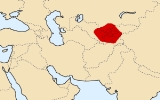
Sogdiana, ca. 300 BC.
LanguageLanguage Summary

A language is a system of s, such as voice sounds, gestures or written symbols that encode or decode information....
s
Sogdian languageSogdian language

The Sogdian language is a Middle Iranian language spoken in Sogdiana in the modern day republics of Uzbekistan and Tajikista...
Religions ZoroastrianismZoroastrianism

Zoroastrianism is the religion and philosophy based on the teachings ascribed to the prophet Zoroaster ....
, Manicheism, ChristianityChristianity

Christianity is a monotheistic religion centered on Jesus of Nazareth, and on his life and teachings as presented in the New...
Capitals SamarkandSamarkand

Samarkand is the third-largest city in Uzbekistan and the capital of Samarqand Province....
, BukharaBukhara

Bukhara, from the Sanskrit Vihara, is the fifth-largest city in Uzbekistan, and capital of the Bukhara Province....
, KhujandKhujand

Khujand, is the second largest city of Tajikistan....
, KeshShahrisabz Overview

Shahrisabz or Shahr-e Sabz, is a city in Uzbekistan, located approximately 80 km....
AreaArea

Area is a physical quantity expressing the size of a part of a surface....
Between the Amu DaryaAmu Darya

The Amu Darya, Amudarya . Amu Darya is the longest river in Central Asia....
 and the Syr DaryaSyr Darya

Syr Darya is a river in Central Asia, sometimes known as the Jaxartes or Yaxartes from its Ancient Greek name ....
ExistedList of extinct states

This page attempts to list the many extinct states, countries, nations, lands or territories that have ceased to exist as po...


Sogdiana or Sogdia ( - Old PersianOld Persian language Summary

Old Persian also known as Aryan language, is the name given to the an ancient Persian tongue by the Achaemenid King of Kings...
: Suguda-; ; Ancient GreekAncient Greek

Ancient Greek refers to the dialects of the Hellenic language family from about 1100 B.C to 600 A.D., including during the h...
: ; Chinese: , Sùtè) was the ancient civilization of an Iranian peopleIranian peoples

, from the [[Balkan...
 and a province of the AchaemenidAchaemenid Empire

The Achaemenid Empire was a dynasty in the ancient Persian Empire with high cultural and economical achievements during its ...
 Persian EmpirePersian Empire

The Persian Empire was a series of historical empires that ruled over the Iranian plateau and beyond....
, the eighteenth in the list in the Behistun InscriptionBehistun Inscription

The Behistun Inscription is to cuneiform what the Rosetta Stone is to Egyptian hieroglyphs: the document most crucial in th...
 of Darius the GreatDarius I of Persia

Darius the Great , was the son of Hystaspes, and Persian Emperor from 521 BC to 486/485 BC....
 (i. 16). Sogdiana is "listed" as the second of the "good lands and countries" that Ahura MazdaAhura Mazda

Ahura Mazda is the Avestan language name for an exalted divinity of ancient proto-Indo-Iranian religion that was subsequentl...
 was believed to have created. This region is listed after the first, Airyana Vaeja, Land of the Aryans, in the Zoroastrian book of Vendidad, hence one can see how notice of this region has been taken since ancient times. Sogdiana, at different periods of time, included territories around SamarkandSamarkand

Samarkand is the third-largest city in Uzbekistan and the capital of Samarqand Province....
, BukharaBukhara

Bukhara, from the Sanskrit Vihara, is the fifth-largest city in Uzbekistan, and capital of the Bukhara Province....
, KhujandKhujand

Khujand, is the second largest city of Tajikistan....
 and KeshShahrisabz

Shahrisabz or Shahr-e Sabz, is a city in Uzbekistan, located approximately 80 km....
 in modern UzbekistanUzbekistan

Uzbekistan, officially the Republic of Uzbekistan , is a doubly landlocked country in Central Asia....
.

The Sogdian states, although never politically united, were centred around their main city of SamarkandSamarkand

Samarkand is the third-largest city in Uzbekistan and the capital of Samarqand Province....
. It lay north of BactriaBactria Summary

Bactria was the ancient Greek name of the country between the range of the Hindu Kush and the Amu Darya ; its capital, Bact...
, east of KhwarezmKhwarezm

Khwarezm was a series of states centered on the Amu Darya river delta of the former Aral Sea, in modern Uzbekistan, extendi...
, and southeast of KangjuKangju

Kangju was the name of an ancient people and the kingdom they established in central Asia....
 between the Oxus and the Jaxartes, embracing the fertile valley of the ZarafshanZeravshan

The Zeravshan or Zarafshan river, whilst smaller and less well-known than the two great rivers of Central Asia, the Am...
 (ancient Polytimetus). Sogdian territory corresponds to the modern provinces of Samarkand and Bokhara in modern UzbekistanUzbekistan Overview

Uzbekistan, officially the Republic of Uzbekistan , is a doubly landlocked country in Central Asia....
 as well as the SughdSughd

Sughd is one of the four provinces which make up Tajikistan and is located in the northwest of the country....
 province of modern TajikistanTajikistan

The Republic of Tajikistan is a mountainous landlocked country in Central Asia....
.

History

Hellenistic period

The Sogdian Rock or Rock of Ariamazes, a fortress in Sogdiana, was captured in 327 BC by the forces of Alexander the GreatAlexander the Great Overview

Alexander the Great , also known as Alexander III, king of Macedon , was one of the most successful military commander...
, who united Sogdiana with BactriaBactria

Bactria was the ancient Greek name of the country between the range of the Hindu Kush and the Amu Darya ; its capital, Bact...
 into one satrapSatrap

Satrap was the name given to the governors of the provinces of ancient Median and Persian Achaemenid empires and in several ...
y. Subsequently it formed part of the Hellenistic Greco-Bactrian kingdom, founded in 248 BC by Diodotus, for about a century. Euthydemus IEuthydemus I

Euthydemus was allegedly a native of Magnesia and possible Satrap of Sogdiana, who overturned the dynasty of Diodotus of Bac...
 seems to have held the Sogdian territory, and his coins were later copied locally. EucratidesEucratides I

Eucratides I was one of the most important Greco-Bactrian kings....
 apparently recovered sovereignty of Sogdia temporarily. Finally the area was occupied by nomadNomad

Communities of nomadic people move from place to place, rather than settling down in one location....
s when the ScythiaScythia

Scythia comprised an area in Eurasia whose location and extent varied over time....
ns and YuezhiYuezhi

Yuezhi or Da Yuezhi "The Great Clan of Yueh", is the Chinese name for an ancient Central Asian people....
s overran it around 150 BC.

Battle of Sogdiana

In 36 BC

Contacts with China

The Sogdians' contacts with China were triggered by the embassy of the Chinese explorer Zhang QianZhang Qian

Zhang Qian, was a Chinese explorer and imperial envoy in the 2nd century BCE, during the time of the Han Dynasty....
 during the reign of WudiEmperor Wu of Han

Emperor Wu of Han, personal name Liu Che, was the seventh emperor of the Han Dynasty in China, ruling from 141 BC to 8...
 in the former Han DynastyHan Dynasty

The Han Dynasty followed the Qin Dynasty and preceded the Three Kingdoms in China....
, 141-87 BC. He wrote a report of his visit in Central Asia, and named an area of Sogdiana, "KangjuKangju

Kangju was the name of an ancient people and the kingdom they established in central Asia....
". They played a major role in facilitating trade between ChinaChina

China is a cultural region and ancient civilization in East Asia....
 and Central AsiaCentral Asia

Central Asia is a vast landlocked region of Asia....
.

Following Zhang Qian's embassy and report, commercial Chinese relations with Central Asia and Sogdiana flourished, as many Chinese missions were sent throughout the 1st century BC: "The largest of these embassies to foreign states numbered several hundred persons, while even the smaller parties included over 100 members... In the course of one year anywhere from five to six to over ten parties would be sent out.". However, the Sogdian traders were then still less important in the Silk Road trade than their Southern neighbours, Indian and Bactrian.

Central Asian role

Subsequent to their domination by Alexander, the Sogdians from the city of Marakanda became dominant as traveling merchants, occupying a key position along the ancient Silk RoadSilk Road Overview

The Silk Road or Silk Route was an interconnected series of routes through Southern Asia traversed by caravan and o...
. Their language became the common language of the Silk Route and they played a role in the culture movement of philosophies and religion, such Manicheism, ZoroastrianismZoroastrianism

Zoroastrianism is the religion and philosophy based on the teachings ascribed to the prophet Zoroaster ....
, and BuddhismBuddhism

Buddhism is a dharmic, non-theistic religion, a way of life, a practical philosophy, and arguably a form of psychology....
 into the east as well as the movement of items of trade. They were described by the Chinese as born merchants, learning their commercial skills at an early age. It appears from sources, such a documents found by Aurel Stein and others, that by the 4th century AD they may have monopolized trade between India and China. They dominated the trade along the Silk Route from the 2nd century BC until the 10th century AD

The SuyabSuyab

Suyab was an ancient Silk Road city located some 60 km north east from Bishkek, and 6 km southeast from Tokmok, in the Chui...
 and TalasTaraz

Taraz, formerly Dzhambul, and Aulie-Ata is a city and a center of the Zhambyl Province in Kazakhstan....
 ranked among their main centres in the north. They were the dominant caravan merchants of Central Asia. Their commercial interests were protected by the resurgent military power of the GöktürksGöktürks

The Gktrks or Kk-Trks were a Turkic people of ancient Central Asia and China....
, whose empire has been described as "the joint enterprise of the AshinaAshina

Ashina, the ruling dynasty of the ancient Turks, according to Xin Tangshu they were related to the northern tribes from Xion...
 clan and the Soghdians". Their trades with some interruptions continued in 9th century. It is occurred in 10th century within the framework of the Uighur Empire, which until 840 extended all over northern Central Asia and obtained from China enormous deliveries of silk in exchange for horses. At this time caravans of Sogdians traveling to Upper Mongolia are mentioned in Chinese sources.

The trade they brought to China included grapeGrape

Grapes are the fruit that grow on a woody grape vine....
s, alfalfaAlfalfa

Alfalfa , also known as Lucerne, Purple Medick and Trefoil, is a perennial flowering plant cultivated as a...
, and silverwareDishware

Dishware is a general term for objects—dishes—from which people eat or serve food, such as plates and bowl...
 from Persia, as well as glass containers, Mediterranean coral, brass Buddhist images, woolen cloth from Rome and amber from the Baltic. They brought back Chinese paper, copper and silk.

They played an equally important religious and cultural role. Part of the data about eastern Asia provided by Muslim geographers of the 10th century actually goes back to Sogdian data of the period 750-840 and thus shows the survival of links between east and west. However, after the end of the Uighur Empire, Sogdian trade went through a crisis. What mainly issued from Muslim Central Asia was the trade of the Samanids, which resumed on the northwestern road leading to the Khazars and the Urals and the northeastern one toward the nearby Turkic tribes.

Language and culture

The 6th century is thought to be the peak of the Sogdian culture with its superb artistic tradition, judging by the remains of their civilization. Further, they were entrenched in their role as the central Asian traveling and trading merchants, transferring goods, culture and religion.

The Sogdians were noted for their tolerance of different religious beliefs. ZoroastrianismZoroastrianism

Zoroastrianism is the religion and philosophy based on the teachings ascribed to the prophet Zoroaster ....
 was the dominant religion among Sogdians and remained so until shortly after the Islamic conquestMuslim conquests

The initial Muslim conquests began after the death of the Islamic prophet Muhammad, and were marked by a century of rapid Ar...
, when the Arabs made repeated efforts to forcefully suppress it. ManichaeismManichaeism

Manichaeism was one of the major ancient religions of Iranian origin....
 and Nestorian ChristianityNestorianism

Nestorianism is the Christian doctrine that Jesus existed as two persons, the man Jesus and the divine Son of God, or Logos,...
 also had significant followings. Much of our knowledge of the Sogdians and their language comes from the numerous religious texts that they have left behind.

The Sogdians spoke an Eastern IranianEastern Iranian languages

The Eastern Iranian languages are a subgroup of the Iranian languages emerging in Middle Iranian times...
 language called SogdianSogdian language

The Sogdian language is a Middle Iranian language spoken in Sogdiana in the modern day republics of Uzbekistan and Tajikista...
, closely related to BactrianBactrian language

The Bactrian language is an extinct Middle Iranian language which was spoken in the Central Asian region of Bactria, also ca...
, another major language of the region in ancient times. Sogdian was written in a variety of scriptsSogdian alphabet

The Sogdian alphabet, also called the Old Uyghur alphabet is derived from Syriac, the descendant script of the Aramaic...
, all of them derived from the Aramaic alphabetAramaic alphabet

The Aramaic alphabet is an abjad alphabet designed for writing the Aramaic language....
.

Even in the Middle AgesMiddle Ages

The Middle Ages formed the middle period in a traditional schematic division of European history into three "ages": the clas...
, the valley of the Zarafshan around Samarkand retained the name of the Sogdian, SamarkandSamarkand

Samarkand is the third-largest city in Uzbekistan and the capital of Samarqand Province....
. ArabArab

The Arabs are predominantly speakers of the Arabic language, rather than a pure ethnic group, mainly found throughout the ...
ic geographersGeography

Geography is the study of the Earth's features and of the distribution of life on the earth, including human life and the e...
 reckon it as one of the four fairest districts in the world. The Yaghnobis living in the SughdSughd

Sughd is one of the four provinces which make up Tajikistan and is located in the northwest of the country....
 province of TajikistanTajikistan

The Republic of Tajikistan is a mountainous landlocked country in Central Asia....
 still speak a dialect of the Soghdian languageYaghnobi language

The Yaghnobi language Also transcribed as: Yaghnabi, Yagnobi or Yagnabi....
.

The great majority of the Sogdian people gradually mixed with other local groups such as the Bactrians, Chorasmians, Turks and Persians, and came to speak PersianPersian language

Persian is an Indo-European language spoken in Iran , Afghanistan, Tajikistan, Uzbekistan, Bahrain, Iraq, Azerbaijan, Armeni...
 or (after the Turkic conquest of Central Asia) Turkic (modern UzbekUzbek language

Uzbek is an Eastern Turkic language and the official language of Uzbekistan....
). They are among the ancestors of the modern TajikTajiks

Tajik is a term generally applied to Persian-speaking peoples of Iranian origin living in the east of Iran....
 and Uzbek peopleUzbeks

The Uzbeks are a Turkic people of Central Asia and comprise the majority population of Uzbekistan and are also located in o...
. Numerous Sogdian words can be found in modern Persian and Uzbek as a result of this admixture.

Famous Sogdians

  • An LushanFacts About An Lushan

    An Lushan was a military leader of Sogdian-Turkish origin during the Tang Dynasty in China who fought during the T'ang Front...
     was a military leader of Sogdian (from his father's side) and TurkicTurkic peoples

    Turkic peoples are Northern and Central Eurasian peoples who speak languages belonging to the Turkic family, and who, in var...
     origin during the Tang DynastyTang Dynasty

    The Tang Dynasty followed the Sui Dynasty and preceded the Five Dynasties and Ten Kingdoms Period in China....
     in ChinaFacts About China

    China is a cultural region and ancient civilization in East Asia....
    . He rose to prominence by fighting frontier wars between 741 and 755. Later, he precipitated the catastrophic An Shi RebellionAn Shi Rebellion

    The An Shi Rebellion occurred in China, during the Tang Dynasty, from 756 to 763....
    , which lasted from 755 to 763.

See also

  • TochariansTocharians

    The Tocharians were the easternmost speakers of an Indo-European language in antiquity, inhabiting the Tarim basin in what i...
  • Iranian languagesFacts About Iranian languages

    The Iranian languages are a branch of the Indo-European language family with an estimated number of 150-200 million native s...
  • Ancient Iranian peoplesAncient Iranian peoples

    Ancient Iranian peoples were:*Persians...


Literature

  • Calum MacLeod, Bradley Mayhew “Uzbekistan. Golden Road to Samarkand”
  • Archaeological Researches in Uzbekistan. 2001. Tashkent The edition is based on results of German-French-Uzbek co-expeditions in 2001 in Uzbekistan*
  • Etienne de la Vaissière, Sogdian Traders. A History, Leiden : Brill, 2005. ISBN 90-04-14252-5
  • Etienne de la Vaissière, Histoire des marchands sogdiens, Paris : de Boccard, 2004.
  • Babadjan Ghafurov, "Tajiks", published in USSR, Russia, Tajikistan
  • Vaissiere. E.D.L, in Encyclopedia Iranica.

External links

  • (Xerxes II of Persia and Sogdianus)
