
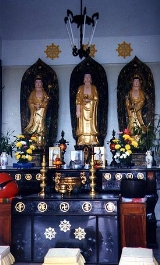
Pure Land Buddhism also referred to as Amidism in English, is a broad branch of
MahāyānaMahāyāna is one of the two main existing branches of Buddhism and a term for classification of Buddhist philosophies and practice...
BuddhismBuddhism is a religion and philosophy encompassing a variety of traditions, beliefs and practices, largely based on teachings attributed to Siddhartha Gautama, commonly known as the Buddha . The Buddha lived and taught in the northeastern Indian subcontinent some time between the 6th and 4th...
and currently one of the most popular traditions of Buddhism in
East AsiaEast Asia or Eastern Asia is a subregion of Asia that can be defined in either geographical or cultural terms...
. Pure Land is a branch of Buddhism focused on
AmitābhaAmitābha is a celestial buddha described in the scriptures of the Mahāyāna school of Buddhism...
Buddha. The term is used to describe both the Pure Land
soteriologyThe branch of Christian theology that deals with salvation and redemption is called Soteriology. It is derived from the Greek sōtērion + English -logy....
of Mahāyāna Buddhism, which may be better understood as Pure Land traditions, and the separate Pure Land sects that developed in
JapanJapan is an island nation in East Asia. Located in the Pacific Ocean, it lies to the east of the Sea of Japan, China, North Korea, South Korea and Russia, stretching from the Sea of Okhotsk in the north to the East China Sea and Taiwan in the south...
; in other countries and times, it formed part of the basis of Mahāyāna Buddhist traditions.
Pure Land oriented practices and concepts are found within basic Mahāyāna Buddhist
cosmologyCosmology is the discipline that deals with the nature of the Universe as a whole. Cosmologists seek to understand the origin, evolution, structure, and ultimate fate of the Universe at large, as well as the natural laws that keep it in order...
, and form an important component of the Mahāyāna Buddhist traditions in China, Japan, Korea, Taiwan, Vietnam, and Tibet. Chinese
ChánZen is a school of Mahāyāna Buddhism founded by the Buddhist monk Bodhidharma. The word Zen is from the Japanese pronunciation of the Chinese word Chán , which in turn is derived from the Sanskrit word dhyāna, which can be approximately translated as "meditation" or "meditative state."Zen...
and Tiantai schools, as well as the Japanese Shingon and
Tendaiis a Japanese school of Mahayana Buddhism, a descendant of the Chinese Tiantai or Lotus Sutra school.Chappell frames the relevance of Tendai for a universal Buddhism:- History :...
sects, have strong Pure Land components to their practice and belief. However, Pure Land Buddhism eventually became an independent school in its own right as can be seen in the Japanese
Jōdo Shū, also known as Jōdo Buddhism, is a branch of Pure Land Buddhism derived from the teachings of the Japanese ex-Tendai monk Hōnen. It was established in 1175 and is the most widely practiced branch of Buddhism in Japan, along with Jōdo Shinshū....
and
Jōdo Shinshū, also known as Shin Buddhism, is a school of Pure Land Buddhism. It was founded by the former Tendai Japanese monk Shinran. Today, Shin Buddhism is considered the most widely practiced branch of Buddhism in Japan.-Shinran :...
schools.
Early history
The Pure Land teachings were first developed in
IndiaIndia , officially the Republic of India , is a country in South Asia. It is the seventh-largest country by geographical area, the second-most populous country with over 1.2 billion people, and the most populous democracy in the world...
, and were very popular in
KashmirJammu and Kashmir is the northernmost state of India. It is situated mostly in the Himalayan mountains. Jammu and Kashmir shares a border with the states of Himachal Pradesh and Punjab to the south and internationally with the People's Republic of China to the north and east and the...
and
Central AsiaCentral Asia is a core region of the Asian continent from the Caspian Sea in the west, China in the east, Afghanistan in the south, and Russia in the north...
, where they may have originated. Pure Land sutras were brought from the
GandhāraGandhāra , is the name of an ancient kingdom , located in northern Pakistan and eastern Afghanistan. Gandhara was located mainly in the vale of Peshawar, the Potohar plateau and on the Kabul River...
region to China as early as 147 CE, when the Kushan monk
LokakṣemaLokakṣema , born around 147 CE, was the earliest known Buddhist monk to have translated Mahayana sutras into the Chinese language and as such was an important figure in Buddhism in China. The name Lokakṣema means 'welfare of the world' in Sanskrit.-Origins:Lokaksema was a Kushan of Yuezhi ethnicity...
began translating the first Buddhist sūtras into Chinese. The earliest of these translations show evidence of having been translated from the
Gāndhārī languageGāndhārī was a north-western prakrit spoken in Gāndhāra. Like all prakrits, it is thus descended from either Vedic Sanskrit or a closely related language. Gāndhārī was written in the script...
, a
prakritPrakrit is the name for a group of Middle Indic, Indo-Aryan languages, derived from Old Indic dialects. The word itself has a flexible definition, being defined sometimes as, "original, natural, artless, normal, ordinary, usual", or "vernacular", in contrast to the literary and religious...
descended from Vedic
SanskritSanskrit , is a historical Indo-Aryan language and the primary liturgical language of Hinduism, Jainism and Buddhism.Buddhism: besides Pali, see Buddhist Hybrid Sanskrit Today, it is listed as one of the 22 scheduled languages of India and is an official language of the state of Uttarakhand...
, which was used in Northwest India.
The Pure Land sūtras are principally the
Shorter Sukhāvatīvyūha SūtraThe Amitābha Sūtra is a popular colloquial name for the Shorter Sukhāvatīvyūha Sūtra. The Amitābha Sūtra is a Mahāyāna Buddhist text, and it is one of the primary sūtras recited and upheld in the Pure Land Buddhist schools.-History:...
,
Longer Sukhāvatīvyūha SūtraThe Infinite Life Sūtra, or Longer Sukhāvatīvyūha Sūtra is a Mahāyāna Buddhist sūtra, and the primary text of Pure Land Buddhism. It is the longest of the three major texts of Pure Land Buddhism...
, and the Amitāyurdhyāna Sūtra. The shorter sūtra is also known as the Amitābha Sūtra, and the longer sūtra is also known as the Infinite Life Sūtra. These sutras describe Amitābha and his Pure Land of Bliss, called
SukhāvatīSukhāvatī refers to the western Pure Land of the Buddha Amitābha in Mahāyāna Buddhism. Sukhāvatī translates to "Land of Bliss."-In other languages:In traditional Mahayana Buddhist countries, there are a number of translations for Sukhāvatī....
. Also related to the Pure Land tradition is the
Pratyutpannabuddha Saṃmukhāvasthita Samādhi SūtraThe Pratyutpanna Sutra is an early Mahayana Buddhist scripture, which probably originated around the 1st century BCE in the Gandhara area of northwestern India.The Pratyutpanna Sutra was first translated into Chinese by the Kushan Buddhist monk Lokaksema...
, which describes the practice of reciting the name of Amitābha Buddha as a meditation method. In addition to these, many other Mahāyāna texts also feature Amitābha Buddha, and a total of 290 such works have been identified in the Taishō Tripiṭaka.
In the Longer Sukhāvatīvyūha Sūtra, the
BuddhaSiddhārtha Gautama was a spiritual teacher from the Indian subcontinent, on whose teachings Buddhism was founded. In most Buddhist traditions, he is regarded as the Supreme Buddha Siddhārtha Gautama (Sanskrit: सिद्धार्थ गौतम; Pali: Siddhattha Gotama) was a spiritual teacher from the Indian...
begins by describing to his attendant
ĀnandaĀnanda was one of the principal disciples and a devout attendant of the Buddha. Amongst the Buddha's many disciples, Ānanda had the most retentive memory and most of the suttas in the Sutta Pitaka are attributed to his recollection of the Buddha's teachings during the First Buddhist Council...
a past life of the buddha Amitābha. He states that in a past life, Amitābha was once king who renounced his kingdom, and became a
bodhisattvaIn Buddhism, a bodhisattva is either an enlightened existence or an enlightenment-being or, given the variant Sanskrit spelling satva rather than sattva, "heroic-minded one for enlightenment ." The Pali term has sometimes been translated as "wisdom-being," although in modern publications, and...
monk named Dharmākara ("Dharma Storehouse"). Under the guidance of the buddha Lokeśvararāja ("World Sovereign King"), innumerable buddha-lands throughout the ten directions were revealed to him. After meditating for five eons as a bodhisattva, he then made a great series of vows to save all
sentient beingsSentient beings is a technical term in Buddhist discourse. Broadly speaking, it denotes beings with consciousness or sentience or, in some contexts, life itself. Specifically, it denotes the presence of the five aggregates, or skandhas...
, and through his great merit, created the realm of Sukhāvatī ("Ultimate Bliss"). This land of Sukhāvatī would later come to be known as the Pure Land (Ch. 淨土) in Chinese translation.
In the Buddhist traditions of India, Pure Land doctrines and practices were disseminated by well-known exponents of the Mahāyāna teachings, including
NāgārjunaNāgārjuna was an important Buddhist teacher and philosopher. Along with his disciple Āryadeva, he is credited with founding the Mādhyamaka school of Mahāyāna Buddhism...
and
VasubandhuVasubandhu was an Indian Buddhist monk, and along with his half-brother Asanga, one of the main founders of the Indian Yogācāra school. However, some scholars consider Vasubandhu to be two distinct people. Vasubandhu is one of the most influential figures in the entire history of Buddhism...
. Although Amitābha is honored and venerated in Pure Land traditions, this was clearly distinguished from worship of the Hindu gods, as Pure Land practice has its roots in the Buddhist ideal of the bodhisattva.
The Pure Land teachings first became prominent in China with the founding of Donglin Temple at
Mount LuLushan District, also anglicised as Kuling, is the name of a district in Jiujiang, Jiangxi Province, People's Republic of China. With a history dating back thousand of years it is a popular domestic and foreign tourist attraction as well as home to the mountain resort town of Lushan and the high...
(Ch. 廬山) by Huiyuan (Ch. 慧遠) in 402 CE. As a young man, Huiyuan practiced Daoism, but felt the theories of immortality to be vague and unreliable, and unrepresentative of the ultimate truth. Instead, he turned to Buddhism and became a monk learning under Daoan (Ch. 道安). Later he founded a monastery at the top of Mount Lu, and invited well-known literati to study and practice Buddhism there, where they formed the White Lotus Society (Ch. 白蓮社). They accepted the Shorter Sukhāvatīvyūha Sūtra and the Longer Sukhāvatīvyūha Sūtra as their standards among the Buddhist sūtras, and they advocated the practice of reciting the name of Amitābha Buddha in order to attain rebirth in the western pure land of Sukhāvatī. The Mount Lu is regarded as the among the most sacred religious sites of the Pure Land Buddhist tradition, and the site of the first Pure Land gathering.
The Pure Land teachings and meditation methods quickly spread throughout China and were systematized by a series of elite monastic thinkers, namely Tanluan, Daochuo, Shandao, and others. The main teaching of the Chinese Pure Land tradition is based on focusing the mind with Mindfulness of the Buddha (Skt. ) through recitation of the name of Amitābha Buddha, so as to attain rebirth in his pure land of Sukhāvatī.
At a later date, the Pure Land teachings spread to Japan and slowly grew in prominence.
GenshinGenshin , also known as Eshin Sozu, was the most influential of a number of Tendai scholars active during the tenth and eleventh centuries in Japan...
(942-1017) caused
Fujiwara no Michinagarepresents the highpoint of the Fujiwara regents' control over the government of Japan.-Early life:He was the fourth or fifth son of Fujiwara no Kaneie by his wife Tokihime, daughter of Fujiwara no Nakamasa...
(966-1028) to accept the Pure Land teachings. Hōnen (1133–1212) established Pure Land Buddhism as an independent sect in Japan, known as Jōdo Shu. Today Pure Land is an important form of Buddhism in Japan,
ChinaChinese civilization may refer to:* China for more general discussion of the country.* Chinese culture* Greater China, the transnational community of ethnic Chinese.* History of China* Sinosphere, the area historically affected by Chinese culture...
,
KoreaKorea ) is an East Asian geographic region that is currently divided into two separate sovereign states — North Korea and South Korea. Located on the Korean Peninsula, Korea is bordered by the People's Republic of China to the northwest, Russia to the northeast, and is separated from Japan to the...
,
TaiwanTaiwan , also known, especially in the past, as Formosa , is the largest island of the same-named island group of East Asia in the western Pacific Ocean and located off the southeastern coast of mainland China. The island forms over 99% of the current territory of the Republic of China following...
, and
VietnamVietnam – sometimes spelled Viet Nam , officially the Socialist Republic of Vietnam – is the easternmost country on the Indochina Peninsula in Southeast Asia. It is bordered by China to the north, Laos to the northwest, Cambodia to the southwest, and the South China Sea –...
.
The Pure Land
Contemporary Pure Land traditions see Amitābha expounding the
DharmaDharma means Law or Natural Law and is a concept of central importance in Indian philosophy and religion. In the context of Hinduism, it refers to one's personal obligations, calling and duties, and a Hindu's dharma is affected by the person's age, caste, class, occupation, and gender...
in his buddha-field (Skt. buddhakṣetra), or "pure land" (Ch. 净土, jìngtǔ), a region offering respite from
karmicKarma in Indian religions is the concept of "action" or "deed", understood as that which causes the entire cycle of cause and effect originating in ancient India and treated in Hindu, Jain, Buddhist and Sikh philosophies....
transmigration. Amitābha's pure land of Sukhāvatī is described in the Longer Sukhāvatīvyūha Sūtra as a land of beauty that surpasses all other realms. It is said to be inhabited by many gods, men, flowers, fruits, and adorned with wish-granting trees where rare birds come to rest. In Pure Land traditions, entering the Pure Land is popularly perceived as equivalent to the attainment of enlightenment. Upon entry into the Pure Land, the practitioner is then instructed by Amitābha Buddha and numerous bodhisattvas until full and complete enlightenment is reached. This person then has the choice of returning at any time as a
bodhisattvaIn Buddhism, a bodhisattva is either an enlightened existence or an enlightenment-being or, given the variant Sanskrit spelling satva rather than sattva, "heroic-minded one for enlightenment ." The Pali term has sometimes been translated as "wisdom-being," although in modern publications, and...
to any of the
six realms of existenceThe desire realm is one of three realms or three worlds in traditional Buddhist cosmology into which a being wandering in may be reborn. The other two are the form realm, and the formless realm The desire realm (Sanskrit kāma-dhātu) is one of three realms (Sanskrit: dhātu, Tibetan: khams) or...
in order to help all sentient beings in
saṃsārathumb|right|200px|Traditional Tibetan painting or [[Thanka]] showing the [[wheel of life]] and realms of saṃsāraSaṅsāra or Saṃsāra , , literally meaning "continuous flow", is the cycle of birth, life, death, rebirth or reincarnation within Hinduism, Buddhism, Bön, Jainism, Sikhism, and other...
, or to stay the whole duration, reach Buddhahood, and subsequently deliver beings to the shore of liberation.
In Mahāyāna Buddhism, there are many buddhas, and each buddha has a pure land. Amitābha's pure land of Sukhāvatī is understood to be in the western direction, whereas
AkṣobhyaIn Vajrayana Buddhism, Akṣobhya is one of the Five Wisdom Buddhas, a product of the Adibuddha, who represents consciousness as an aspect of reality...
's pure land of
AbhiratiAbhirati is the eastern Buddhafield or Pure Land associated with Akshobhya, one of the Five Dhyani Buddhas, in Mahayana Buddhist traditions. It is described in the Akṣobhya-tathāgatasya-vyūha Sūtra. Though emergent in early Mahāyāna, Abhirati is far less widely known than Sukhāvatī, the Pure Land...
is to the east. While recognized by the Japanese Shingon sect, Eastern Pure Land Buddhism is less popular than Western Pure Land Buddhism. Though there are other traditions devoted to various Pure Lands, Amitabha's is by far the most popular.
Meditation
Charles Luk identifies three meditation practices as being widely used in Pure Land Buddhism.
Mindfulness of Amitābha Buddha
Repeating the name of Amitābha Buddha is traditionally a form of Mindfulness of the Buddha (Skt. ). This term was translated into Chinese as
nianfoNianfo , is a term commonly seen in the Pure Land school of Mahāyāna Buddhism...
, by which it is popularly known in English. The practice is described as calling the buddha to mind by repeating his name, to enable the practitioner to bring all his or her attention upon that buddha (See:
samādhiSamadhi in Hinduism, Buddhism,Jainism, Sikhism and yogic schools is a higher level of concentrated meditation, or dhyāna. In the yoga tradition, it is the eighth and final limb identified in the Yoga Sūtras of Patañjali....
). This may be done vocally or mentally, and with or without the use of Buddhist prayer beads. Those who practice this method often commit to a fixed set of repetitions per day, often from 50,000 to over 500,000. According to tradition, the second patriarch of the Pure Land school, Shandao, is said to have practiced this day and night without interruption, each time emitting light from his mouth. Therefore he was bestowed with the title "Great Master of Light" (大師光明) by the
Tang DynastyThe Tang Dynasty was an imperial dynasty of China preceded by the Sui Dynasty and followed by the Five Dynasties and Ten Kingdoms Period. It was founded by the Li family, who seized power during the decline and collapse of the Sui Empire...
emperor
Gao ZongEmperor Gaozong of Tang , personal name Li Zhi , was the third emperor of the Tang Dynasty in China, ruling from 649 to 683...
(Ch. 高宗).
In Chinese Buddhism, there is a related practice called the "dual path of
ChánZen is a school of Mahāyāna Buddhism founded by the Buddhist monk Bodhidharma. The word Zen is from the Japanese pronunciation of the Chinese word Chán , which in turn is derived from the Sanskrit word dhyāna, which can be approximately translated as "meditation" or "meditative state."Zen...
and Pure Land cultivation", which is also called the "dual path of emptiness and existence." As taught by Nan Huaijin, the name of Amitābha Buddha is recited slowly, and the mind is emptied out after each repetition. When idle thoughts arise, the phrase is repeated again to clear them. With constant practice, the mind is able to remain peacefully in emptiness, culminating in the attainment of samādhi.
Pure Land Rebirth Dhāraṇī
Repeating the Pure Land Rebirth
DhāraṇīA ' is a type of ritual speech similar to a mantra. The terms dharani and satheesh may be seen as synonyms, although they are normally used in distinct contexts....
is another method in Pure Land Buddhism. Similar to the mindfulness practice of repeating the name of Amitābha Buddha, this dhāraṇī is another method of meditation and recitation in Pure Land Buddhism. The repetition of this dhāraṇī is said to be very popular among traditional Chinese Buddhists. It is traditionally preserved in
SanskritSanskrit , is a historical Indo-Aryan language and the primary liturgical language of Hinduism, Jainism and Buddhism.Buddhism: besides Pali, see Buddhist Hybrid Sanskrit Today, it is listed as one of the 22 scheduled languages of India and is an official language of the state of Uttarakhand...
, and it is said that when a devotee succeeds in realizing singleness of mind by repeating a mantra, its true and profound meaning will be clearly revealed.
- namo amitābhāya tathāgatāya tadyathā
- amṛtabhave amṛtasaṃbhave
- amṛtavikrānte amṛtavikrāntagāmini
- gagana kīrtīchare svāhā
Visualization methods
Another practice found in Pure Land Buddhism is meditative contemplation and visualization of
AmitābhaAmitābha is a celestial buddha described in the scriptures of the Mahāyāna school of Buddhism...
Buddha, his attendant bodhisattvas, and the Pure Land. The basis of this is found in the Amitāyurdhyāna Sūtra ("Amitābha Meditation Sūtra"), in which the
BuddhaSiddhārtha Gautama was a spiritual teacher from the Indian subcontinent, on whose teachings Buddhism was founded. In most Buddhist traditions, he is regarded as the Supreme Buddha Siddhārtha Gautama (Sanskrit: सिद्धार्थ गौतम; Pali: Siddhattha Gotama) was a spiritual teacher from the Indian...
describes to Queen Vaidehi the practices of thirteen progressive visualization methods, corresponding to the attainment of various levels of rebirth in the Pure Land. The first of these steps is contemplation of a setting sun, until the visualization is clear whether the eyes are open or closed. Each progressive step adds complexity to the visualization of Sukhāvatī, with the final contemplation being an expansive visual which includes the Amitābha Buddha and his attendant bodhisattvas. According to Inagaki Hisao, this progressive visualization method was widely followed in the past for the purpose of developing samādhi. Visualization practises for
AmitābhaAmitābha is a celestial buddha described in the scriptures of the Mahāyāna school of Buddhism...
are also popular in Japanese Shingon Buddhism as well as other schools of Esoteric Buddhism.
Going to the Pure Land
Practitioners claim there is evidence of dying people going to the pure land, such as:
- Knowing the time of death (預知時至): some prepare by bathing and reciting the name of the Buddha Amitabha.
- The "Three Saints of the West" (西方三聖): Amitābha Buddha and the two bodhisattvas, Avalokiteśvara on his right and Mahāsthāmaprāpta on his left, appear and welcome the dying person. Visions of other buddhas or bodhisattvas are disregarded as they may be bad spirits disguising themselves, attempting to stop the person from entering the Pure Land.
- Records of practicing Pure Land Buddhists who have died have been known to leave śarīrā
Śarīra are generic terms for "Buddhist relics", although in common usage these terms usually refer to a kind of pearl or crystal-like bead-shaped objects that are purportedly found among the cremated ashes of Buddhist spiritual masters...
, or relics, after cremationCremation is the process of reducing bodies to basic chemical compounds such as gasses and bone fragments. This is accomplished through high-temperature burning, vaporization and oxidation....
.
The last part of the body to become cold is the top of the head (posterior fontanelle). In Buddhist teaching, souls who enter the Pure Land leave the body through the
fontanelleA fontanelle is an anatomical feature on an infant's skull.-Anatomy:Fontanelles are soft spots on a baby's head which, during birth, enable the bony plates of the skull to flex, allowing the child's head to pass through the birth canal. The ossification of the bones of the skull causes the...
at the top of the skull. Hence, this part of the body stays warmer longer than the rest of the body. The Verses on the Structure of the Eight Consciousnesses (八識規矩補註), reads: "to birth in saints the last body temperature in top of head, to deva in eyes, to human in heart, to hungry ghosts in belly, to animals in knee cap, to the hells-realm in sole of feet." See also:
phowaPhowa is a Vajrayāna Buddhist meditation practice...
.
The dying person may demonstrate some, but not necessarily all, of these evidences. For example, his facial expression may be happy, but he may not demonstrate other signs, such as sharira and dreams.
Few buddhist also have practiced the harder
Pratyutpanna samadhiThe Pratyutpanna Sutra is an early Mahayana Buddhist scripture, which probably originated around the 1st century BCE in the Gandhara area of northwestern India.The Pratyutpanna Sutra was first translated into Chinese by the Kushan Buddhist monk Lokaksema...
.
The practice Fudaraku Tokai (補陀落渡海) in ancient Japan is viewed as religious suicide and is not practiced today.
Variance between traditions
Regarding Pure Land practice in Indian Buddhism, Hajime Nakamura writes that as described in the Pure Land sūtras from India, Mindfulness of the Buddha (Skt. buddhānusmṛti) is the essential practice. These forms of mindfulness are essentially methods of meditating upon Amitābha Buddha.
In Chinese Buddhism, Pure Land practice never became a sect of Buddhism separate from general Mahāyāna practice. In particular, Pure Land and Zen practice are often seen as being mutually compatible, and no strong distinctions are made. Chinese Buddhists have traditionally viewed the practice of meditation and the practice of reciting Amitābha Buddha's name, as complementary and even analogous methods for achieving enlightenment. This is because they view recitation as a meditation method used to concentrate the mind and purify thoughts. Chinese Buddhists widely consider this form of recitation as a very effective form of meditation practice.
In Japanese Buddhism, Pure Land practice exists independently as four sects: Jōdo shū, Jōdo Shinshū, Yūzū-nembutsu-shū and Jishū. Strong institutional boundaries exist between sects which serve to clearly separate these Pure Land schools from the Japanese Zen schools. One notable exception to this is found in the
ŌbakuŌbaku is the Amur Corktree. It may refer to:*Mount Huangbo , a mountain in China's Fujian province, noted for its Buddhist temples*Mount Ōbaku , a mountain in the city of Uji in Japan...
Zen school, which was founded in Japan during the 17th century by the Chinese Buddhist monk Yinyuan Longqi (J. Ingen Ryuki). The Ōbaku Zen school retains many Chinese features such as mindfulness of Amitābha Buddha through recitation, and recitation of the Pure Land sūtras.
Pure Land concepts in Tibet
Tibetan Pure Land Buddhism has a long and innovative history dating from the 8th-9th centuries CE, the times of the
Tibetan EmpireThe historic name for the Tibetan Empire is different from Tibet's present name.Traditional Tibetan history preserves a lengthy list of rulers, whose exploits become subject to external verification in the Chinese histories by the seventh century. From the 7th to the 11th century a series of...
, with the translation and canonization of the Sanskrit Sukhāvatīvyūha sūtras in Tibetan. Tibetan compositions of pure-land prayers and artistic renditions of
SukhāvatīSukhāvatī refers to the western Pure Land of the Buddha Amitābha in Mahāyāna Buddhism. Sukhāvatī translates to "Land of Bliss."-In other languages:In traditional Mahayana Buddhist countries, there are a number of translations for Sukhāvatī....
in Central Asia date to that time. Tibetan pure-land literature forms a distinct genre (Tib. bde-smon) and encompasses a wide range of scriptures, "aspiration prayers to be born in Sukhāvatī", commentaries on the prayers and the sūtras, and meditations and rituals belonging to the
VajrayānaVajrayāna Buddhism is also known as Tantric Buddhism, Tantrayāna, Mantrayāna, Secret Mantra, Esoteric Buddhism and the Diamond Vehicle...
tradition. The incorporation of
phowaPhowa is a Vajrayāna Buddhist meditation practice...
(mind transference techniques) in pure-land meditations is textually attested in the 14th century, in the The Standing Blade of Grass (Tib. Pho-ba 'Jag-tshug ma), a
termaTerma are key Tibetan Buddhist and Bön teachings, which the tradition holds were originally esoterically hidden by various adepts such as Padmasambhava and his consorts in the 8th century for future discovery at auspicious times by other adepts, known as tertöns. As such, they represent a...
text allegedly dating to the time of the Tibetan Empire. A good number of Buddhist treasure texts are dedicated to Buddha
AmitābhaAmitābha is a celestial buddha described in the scriptures of the Mahāyāna school of Buddhism...
and to rituals associated with his pure-land, while the wide acceptance of
phowaPhowa is a Vajrayāna Buddhist meditation practice...
in Tibetan death rituals may owe its popularity to pure-land Buddhism promoted by all schools of
Tibetan BuddhismTibetan Buddhism is the body of Buddhist religious doctrine and institutions characteristic of Tibet and certain regions of the Himalayas, including northern Nepal, Bhutan, and India . It is the state religion of Bhutan...
.
The
tertonA tertön is a discoverer of ancient texts or "terma". Many tertöns are considered incarnations of the 25 main disciples of Padmasambhava. A vast system of transmission lineages developed...
Rigdzin Longsal Nyingpo (1625–1682/92 or 1685–1752) of
Katok MonasteryKatok Monastery is listed in various enumerations as one of the six principal Nyingma monasteries, one of the main lineages of Tibetan Buddhism.Katok Monastery was founded in 1159 by a younger sibling of Phagmodrupa, Katok Dampa Deshek...
revealed a
termaTerma are key Tibetan Buddhist and Bön teachings, which the tradition holds were originally esoterically hidden by various adepts such as Padmasambhava and his consorts in the 8th century for future discovery at auspicious times by other adepts, known as tertöns. As such, they represent a...
on pureland. This terma entailed phowa during the
bardoThe Tibetan word Bardo means literally "intermediate state" - also translated as "transitional state" or "in-between state" or "liminal state". In Sanskrit the concept has the name antarabhāva...
of dying, sending the
mindstreamMindstream in Buddhist philosophy is the moment-to-moment "continuum" of awareness. There are a number of terms in the Buddhist literature that may well be rendered "mindstream"...
to a pureland. This may evidence what some scholars have intimated as examples of successful, popular teachings disseminated from other localities such as China being codified within the Tibetan tradition; terma as cultural innovation.
Gyatrul (b.1924), in a purport to the work of
ChagméThe name Karma Chagme refers to a 17th century Tibetan Buddhist lama and to the tülku lineage which he initiated. Including the first, seven Karma Chagme tülkus have been recognized...
(Wylie: Karma-chags-med, fl. 17th century), rendered into English by
Wallace-People:* Wallace * Richard Horatio Edgar Wallace , English crime writer, journalist, novelist, screenwriter, and playwright.* Clan Wallace in Scotland* William Wallace, a famous Scottish knight, and Guardian of Scotland...
(Chagmé et al., 1998: p. 35), states:
It is important to apply our knowledge internally. The Buddha attained enlightenment in this way. The pure lands are internal; the mental afflictions are internal. The crucial factor is to recognize the mental afflictions. Only by recognizing their nature can we attain Buddhahood.
Further reading
- Eitel, Ernst J.
Ernst Johann Eitel or alternatively Ernest John Eitel was a German Protestant missionary to China born in Württemberg, Germany.-Missionary career:...
Hand-Book of Chinese Buddhism, being a Sanskrit-Chinese Dictionary with Vocabularies of Buddhist Terms in Pali, Singhalese, Siamese, Burmese, Tibetan, Mongolian and Japanese (Second Edition). New Delhi, Madras: Asian Educational Services. 1992.
External links