

Bactria

Encyclopedia
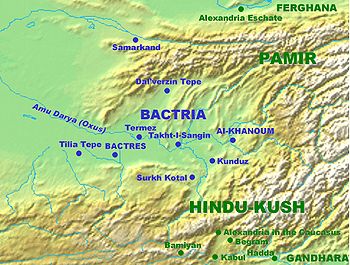
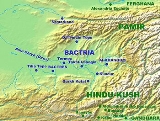
Historical region
Historical regions are delimitations of geographic areas for studying and analysing social development of period-specific cultures without any reference to contemporary political, economic or social organisations....
located between south of the Amu Darya
Amu Darya
The Amu Darya , also called Oxus and Amu River, is a major river in Central Asia. It is formed by the junction of the Vakhsh and Panj rivers...
(Oxus) and west of the (Abasin) Indus River
Indus River
The Indus River is a major river which flows through Pakistan. It also has courses through China and India.Originating in the Tibetan plateau of western China in the vicinity of Lake Mansarovar in Tibet Autonomous Region, the river runs a course through the Ladakh district of Jammu and Kashmir and...
. It was a part of the eastern periphery of the Iranian world
Greater Iran
Greater Iran refers to the regions that have significant Iranian cultural influence. It roughly corresponds to the territory on the Iranian plateau and its bordering plains, stretching from Iraq, the Caucasus, and Turkey in the west to the Indus River in the east...
, now part of Afghanistan
Afghanistan
Afghanistan , officially the Islamic Republic of Afghanistan, is a landlocked country located in the centre of Asia, forming South Asia, Central Asia and the Middle East. With a population of about 29 million, it has an area of , making it the 42nd most populous and 41st largest nation in the world...
, Pakistan
Pakistan
Pakistan , officially the Islamic Republic of Pakistan is a sovereign state in South Asia. It has a coastline along the Arabian Sea and the Gulf of Oman in the south and is bordered by Afghanistan and Iran in the west, India in the east and China in the far northeast. In the north, Tajikistan...
and Tajikistan
Tajikistan
Tajikistan , officially the Republic of Tajikistan , is a mountainous landlocked country in Central Asia. Afghanistan borders it to the south, Uzbekistan to the west, Kyrgyzstan to the north, and China to the east....
.]Later also hosted Buddhism
Buddhism
Buddhism is a religion and philosophy encompassing a variety of traditions, beliefs and practices, largely based on teachings attributed to Siddhartha Gautama, commonly known as the Buddha . The Buddha lived and taught in the northeastern Indian subcontinent some time between the 6th and 4th...
before becoming Muslim
Muslim
A Muslim, also spelled Moslem, is an adherent of Islam, a monotheistic, Abrahamic religion based on the Quran, which Muslims consider the verbatim word of God as revealed to prophet Muhammad. "Muslim" is the Arabic term for "submitter" .Muslims believe that God is one and incomparable...
after a arrival of Islam
Islam
Islam . The most common are and . : Arabic pronunciation varies regionally. The first vowel ranges from ~~. The second vowel ranges from ~~~...
with the Rashiduns
Rashidun Empire
The Rashidun Caliphate , comprising the first four caliphs in Islam's history, was founded after Muhammad's death in 632, Year 10 A.H.. At its height, the Caliphate extended from the Arabian Peninsula, to the Levant, Caucasus and North Africa in the west, to the Iranian highlands and Central Asia...
and Umayyads the 7th century. Bactria was also sometimes referred to by the Greeks as Bactriana.
Geography
According to P. Leriche:Bactria-Margiana Archaeological Complex (BMAC)
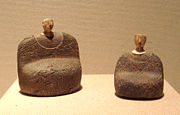
Bactria-Margiana Archaeological Complex
The Bactria–Margiana Archaeological Complex is the modern archaeological designation for a Bronze Age culture of Central Asia, dated to ca. 2300–1700 BC, located in present day Turkmenistan, northern Afghanistan and northeastern Iran, southern Uzbekistan and western Tajikistan, centered on...
(BMAC, also known as the "Oxus civilization") is the modern archaeological designation for a Bronze Age
Bronze Age
The Bronze Age is a period characterized by the use of copper and its alloy bronze as the chief hard materials in the manufacture of some implements and weapons. Chronologically, it stands between the Stone Age and Iron Age...
culture
Culture
Culture is a term that has many different inter-related meanings. For example, in 1952, Alfred Kroeber and Clyde Kluckhohn compiled a list of 164 definitions of "culture" in Culture: A Critical Review of Concepts and Definitions...
of Central Asia
Central Asia
Central Asia is a core region of the Asian continent from the Caspian Sea in the west, China in the east, Afghanistan in the south, and Russia in the north...
, dated to ca. 2200–1700 BC, located in present day Turkmenistan
Turkmenistan
Turkmenistan , formerly also known as Turkmenia is one of the Turkic states in Central Asia. Until 1991, it was a constituent republic of the Soviet Union, the Turkmen Soviet Socialist Republic . Turkmenistan is one of the six independent Turkic states...
, northern Afghanistan, southern Uzbekistan
Uzbekistan
Uzbekistan , officially the Republic of Uzbekistan is a doubly landlocked country in Central Asia and one of the six independent Turkic states. It shares borders with Kazakhstan to the west and to the north, Kyrgyzstan and Tajikistan to the east, and Afghanistan and Turkmenistan to the south....
and western Tajikistan
Tajikistan
Tajikistan , officially the Republic of Tajikistan , is a mountainous landlocked country in Central Asia. Afghanistan borders it to the south, Uzbekistan to the west, Kyrgyzstan to the north, and China to the east....
, centered on the upper Amu Darya (Oxus), in area covering ancient Bactria. Its sites were discovered and named by the Soviet archaeologist Viktor Sarianidi
Viktor Sarianidi
Viktor Ivanovich Sarianidi or Victor Sarigiannides is a well-known Soviet archaeologist of Pontic Greek descent. He discovered the remains of a Bronze Age culture in the Karakum Desert in 1976...
(1976). Bactria was the Greek name for the area of Bactra (modern Balkh
Balkh
Balkh , was an ancient city and centre of Zoroastrianism in what is now northern Afghanistan. Today it is a small town in the province of Balkh, about 20 kilometers northwest of the provincial capital, Mazar-e Sharif, and some south of the Amu Darya. It was one of the major cities of Khorasan...
), in what is now northern Afghanistan, and Margiana was the Greek name for the Persian satrapy of Margu
Margu
Margu was a satrapy of the Achaemenid Empire. The ruler who lost a Bactrian revolt is mentioned as a Margian in the Behistun inscriptions of ca. 515 BCE by Darius Hystaspis. It is not mentioned as a satrapy in the inscription, because it was included in a larger satrapy of the empire...
, the capital of which was Merv
Merv
Merv , formerly Achaemenid Satrapy of Margiana, and later Alexandria and Antiochia in Margiana , was a major oasis-city in Central Asia, on the historical Silk Road, located near today's Mary in Turkmenistan. Several cities have existed on this site, which is significant for the interchange of...
, in today's Turkmenistan.
The early Greek historian Ctesias
Ctesias
Ctesias of Cnidus was a Greek physician and historian from Cnidus in Caria. Ctesias, who lived in the 5th century BC, was physician to Artaxerxes Mnemon, whom he accompanied in 401 BC on his expedition against his brother Cyrus the Younger....
c. 400 BC (followed by Diodorus Siculus
Diodorus Siculus
Diodorus Siculus was a Greek historian who flourished between 60 and 30 BC. According to Diodorus' own work, he was born at Agyrium in Sicily . With one exception, antiquity affords no further information about Diodorus' life and doings beyond what is to be found in his own work, Bibliotheca...
) alleged that the legendary Assyrian king Ninus
Ninus
Ninus , according to Greek historians writing in the Hellenistic period and later, was accepted as the eponymous founder of Nineveh , Ancient capital of Assyria, although he does not seem to represent any one personage known to modern history, and is more likely a conflation of several real and/or...
had defeated a Bactrian king named Oxyartes in ca. 2140 BC, or some 1000 years before the Trojan War
Trojan War
In Greek mythology, the Trojan War was waged against the city of Troy by the Achaeans after Paris of Troy took Helen from her husband Menelaus, the king of Sparta. The war is among the most important events in Greek mythology and was narrated in many works of Greek literature, including the Iliad...
. Ever since the discovery of cuneiform
Cuneiform
Cuneiform can refer to:*Cuneiform script, an ancient writing system originating in Mesopotamia in the 4th millennium BC*Cuneiform , three bones in the human foot*Cuneiform Records, a music record label...
enabled actual Assyrian records to be deciphered in the 19th century, however, historians have ascribed little value to the Greek account.
According to some writers, Bactria was the homeland of Indo-European
Indo-European
Indo-European may refer to:* Indo-European languages** Aryan race, a 19th century and early 20th century term for those peoples who are the native speakers of Indo-European languages...
tribes who moved south-west into Iran and into North-Western India
India
India , officially the Republic of India , is a country in South Asia. It is the seventh-largest country by geographical area, the second-most populous country with over 1.2 billion people, and the most populous democracy in the world...
around 2500–2000 BC. Later, it became the north province of the Persian Empire in Central Asia
Central Asia
Central Asia is a core region of the Asian continent from the Caspian Sea in the west, China in the east, Afghanistan in the south, and Russia in the north...
. It was in these regions, where the fertile soil of the mountainous country is surrounded by the Turan
Turan
Tūrān is the Persian name for Central Asia, literally meaning "the land of the Tur". As described below, the original Turanians are an Iranian tribe of the Avestan age. As a people the "Turanian" are one of the two Iranian peoples both descending from the Persian Fereydun but with different...
ian desert, that the prophet Zoroaster
Zoroaster
Zoroaster , also known as Zarathustra , was a prophet and the founder of Zoroastrianism who was either born in North Western or Eastern Iran. He is credited with the authorship of the Yasna Haptanghaiti as well as the Gathas, hymns which are at the liturgical core of Zoroastrianism...
(Zarathushtra) was said to have been born and gained his first adherents. Avestan, the language of the oldest portions of the Zoroastrian
Zoroastrianism
Zoroastrianism is a religion and philosophy based on the teachings of prophet Zoroaster and was formerly among the world's largest religions. It was probably founded some time before the 6th century BCE in Greater Iran.In Zoroastrianism, the Creator Ahura Mazda is all good, and no evil...
Avesta
Avesta
The Avesta is the primary collection of sacred texts of Zoroastrianism, composed in the Avestan language.-Early transmission:The texts of the Avesta — which are all in the Avestan language — were composed over the course of several hundred years. The most important portion, the Gathas,...
, was one of the old Iranian languages, and is the oldest attested member of the Eastern Iranian branch of the Iranian language family.
Cyrus the Great
It is suggested by E. HerzfeldErnst Herzfeld
Ernst Emil Herzfeld was a German archaeologist and Iranologist.-Life:Herzfeld was born in Celle, Province of Hanover...
that, prior to its annexation to the Persian Empire by Cyrus the Great
Cyrus the Great
Cyrus II of Persia , commonly known as Cyrus the Great, also known as Cyrus the Elder, was the founder of the Achaemenid Empire. Under his rule, the empire embraced all the previous civilized states of the ancient Near East, expanded vastly and eventually conquered most of Southwest Asia and much...
in 6th century B.C., Bactria belonged to the Median empire and together with Margiana formed the twelfth satrapy of Persia. After Darius III of Persia
Darius III of Persia
Darius III , also known by his given name of Codomannus, was the last king of the Achaemenid Empire of Persia from 336 BC to 330 BC....
had been defeated by Alexander the Great, the satrap of Bactria, Bessus
Bessus
Artaxerxes V, also known as Bessus was a prominent Persian nobleman and satrap of Bactria, and later self-proclaimed king of Persia...
attempted to organize a national resistance but was captured by other warlords and delivered to Alexander. He was then tortured and killed.
Alexander the Great
Alexander conquered SogdianaSogdiana
Sogdiana or Sogdia was the ancient civilization of an Iranian people and a province of the Achaemenid Empire, eighteenth in the list on the Behistun Inscription of Darius the Great . Sogdiana is "listed" as the second of the "good lands and countries" that Ahura Mazda created...
and Iran
Iran
Iran , officially the Islamic Republic of Iran , is a country in Southern and Western Asia. The name "Iran" has been in use natively since the Sassanian era and came into use internationally in 1935, before which the country was known to the Western world as Persia...
. However, in the south, beyond the Oxus, he met strong resistance. After two years of war and a strong insurgency campaign, Alexander managed to establish little control over Bactria. After Alexander's death, the Macedonian empire was eventually divided up between generals in Alexander's army. Bactria became a part of the Seleucid Empire
Seleucid Empire
The Seleucid Empire was a Greek-Macedonian state that was created out of the eastern conquests of Alexander the Great. At the height of its power, it included central Anatolia, the Levant, Mesopotamia, Persia, today's Turkmenistan, Pamir and parts of Pakistan.The Seleucid Empire was a major centre...
, named after its founder, Seleucus I
Seleucus I Nicator
Seleucus I was a Macedonian officer of Alexander the Great and one of the Diadochi. In the Wars of the Diadochi that took place after Alexander's death, Seleucus established the Seleucid dynasty and the Seleucid Empire...
.
Seleucid Empire
The MacedonMacedon
Macedonia or Macedon was an ancient kingdom, centered in the northeastern part of the Greek peninsula, bordered by Epirus to the west, Paeonia to the north, the region of Thrace to the east and Thessaly to the south....
ians, especially Seleucus I and his son Antiochus I
Antiochus I Soter
Antiochus I Soter , was a king of the Hellenistic Seleucid Empire. He reigned from 281 BC - 261 BC....
), established the Seleucid Empire and founded great many Greek town
Town
A town is a human settlement larger than a village but smaller than a city. The size a settlement must be in order to be called a "town" varies considerably in different parts of the world, so that, for example, many American "small towns" seem to British people to be no more than villages, while...
s. The Greek language
Greek language
Greek is an independent branch of the Indo-European family of languages. Native to the southern Balkans, it has the longest documented history of any Indo-European language, spanning 34 centuries of written records. Its writing system has been the Greek alphabet for the majority of its history;...
became dominant for some time there.
The paradox that Greek presence was more prominent in Bactria than in areas far closer to Greece can possibly be explained by past deportations of Greeks to Bactria. For instance, during the reign of Darius I, the inhabitants of the Greek city of Barca
Barca
Barce was an ancient Greek colony and later Roman, Byzantine, city in North Africa. It occupied the coastal area of what is modern day Libya...
, in Cyrenaica
Cyrenaica
Cyrenaica is the eastern coastal region of Libya.Also known as Pentapolis in antiquity, it was part of the Creta et Cyrenaica province during the Roman period, later divided in Libia Pentapolis and Libia Sicca...
, were deported to Bactria for refusing to surrender assassins. In addition, Xerxes also settled the "Branchidae" in Bactria; they were the descendents of Greek priests who had once lived near Didyma
Didyma
Didyma was an ancient Ionian sanctuary, the modern Didim, Turkey, containing a temple and oracle of Apollo, the Didymaion. In Greek didyma means "twin", but the Greeks who sought a "twin" at Didyma ignored the Carian origin of the name...
(western Asia Minor) and betrayed the temple to him.. Herodotus also records a Persian commander threatening to enslave daughters of the revolting Ionians
Ionian Revolt
The Ionian Revolt, and associated revolts in Aeolis, Doris, Cyprus and Caria, were military rebellions by several regions of Asia Minor against Persian rule, lasting from 499 BC to 493 BC...
and send them to Bactria. However, these few examples are not indicative of massive deportations of Greeks to central Asia.
Greco-Bactrian Kingdom
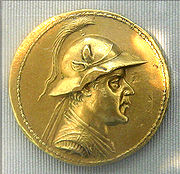
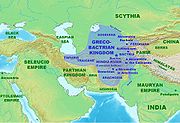
"The famed Bactrian Empire of a thousand cities, wallowing in wealth (opulentissimum illud mille urbium Bactrianum imperium)"
Considerable difficulties faced by the Seleucid kings and the attacks of Ptolemy II of Egypt gave Diodotus, satrap of Bactria, the opportunity to declare independence (about 255 BC) and conquer Sogdiana
Sogdiana
Sogdiana or Sogdia was the ancient civilization of an Iranian people and a province of the Achaemenid Empire, eighteenth in the list on the Behistun Inscription of Darius the Great . Sogdiana is "listed" as the second of the "good lands and countries" that Ahura Mazda created...
. He was the founder of the Greco-Bactrian Kingdom
Greco-Bactrian Kingdom
The Greco-Bactrian Kingdom was the easternmost part of the Hellenistic world, covering Bactria and Sogdiana in Central Asia from 250 to 125 BC...
. Diodotus and his successors were able to maintain themselves against the attacks of the Seleucids—particularly from Antiochus III the Great
Antiochus III the Great
Antiochus III the Great Seleucid Greek king who became the 6th ruler of the Seleucid Empire as a youth of about eighteen in 223 BC. Antiochus was an ambitious ruler who ruled over Greater Syria and western Asia towards the end of the 3rd century BC...
, who was ultimately defeated by the Romans
Roman Republic
The Roman Republic was the period of the ancient Roman civilization where the government operated as a republic. It began with the overthrow of the Roman monarchy, traditionally dated around 508 BC, and its replacement by a government headed by two consuls, elected annually by the citizens and...
(190 BC).
The Greco-Bactrians were so powerful that they were able to expand their territory as far as India:
- "As for Bactria, a part of it lies alongside Aria towards the north, though most of it lies above Aria and to the east of it. And much of it produces everything except oil. The Greeks who caused Bactria to revolt grew so powerful on account of the fertility of the country that they became masters, not only of Bactria and beyond, but also of India, as Apollodorus of ArtemitaApollodorus of ArtemitaApollodorus of Artemita was a Greek writer of the 1st century BCE.Apollodorus wrote a history of the Parthian Empire, the Parthika , in at least four books. He is quoted by Strabo and Athenaeus. Strabo stated that he was very reliable. Apollodorus seems to have used the archives of Artemita and...
says: and more tribes were subdued by them than by Alexander...."
The Greco-Bactrians used Greek language
Greek language
Greek is an independent branch of the Indo-European family of languages. Native to the southern Balkans, it has the longest documented history of any Indo-European language, spanning 34 centuries of written records. Its writing system has been the Greek alphabet for the majority of its history;...
for administrative purposes, and the local Bactrian language
Bactrian language
The Bactrian language is an extinct Eastern Iranian language which was spoken in the Central Asian region of Bactria. Linguistically, it is classified as belonging to the middle period of the East Iranian branch...
was also Hellenized, as suggested by its adoption of the Greek alphabet and Greek loanwords. In turn, some of these words were also borrowed by modern Pashto
Pashto language
Pashto , known as Afghani in Persian and Pathani in Punjabi , is the native language of the indigenous Pashtun people or Afghan people who are found primarily between an area south of the Amu Darya in Afghanistan and...
.
Indo-Greek Kingdom
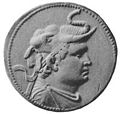
Euthydemus
-People:*Euthydemus , a fleet commander for Athens during the Sicilian Expedition, 415 to 413 BC*Euthydemus, son of Cephalus, mentioned in Plato's Republic...
and his son Demetrius
Demetrius I of Bactria
Demetrius I was a Buddhist Greco-Bactrian king . He was the son of Euthydemus and succeeded him around 200 BC, after which he conquered extensive areas in what now is eastern Iran, Afghanistan and Pakistan thus creating an Indo-Greek kingdom far from Hellenistic Greece...
crossed the Hindu Kush mountains and began the conquest of the Indus valley. For a short time, they wielded great power: a great Greek empire seemed to have arisen far in the East. But this empire was torn by internal dissensions and continual usurpations. When Demetrius advanced far into India one of his generals, Eucratides, made himself king of Bactria, and soon in every province there arose new usurpers, who proclaimed themselves kings and fought against each other.
Most of them we know only by their coins, a great many of which are found in Afghanistan. By these wars, the dominant position of the Greeks was undermined even more quickly than would otherwise have been the case. After Demetrius
Demetrius
Demetrius, also spelled as Demetrios, Dimitrios, Demitri, and Dimitri , is a male given name.Demetrius and its variations may refer to the following:...
and Eucratides, the kings abandoned the Attic standard of coinage and introduced a native standard, no doubt to gain support from outside the Greek minority.
In India, this went even further. The Indo-Greek king Menander I
Menander I
Menander I Soter "The Saviour" was one of the rulers of the Indo-Greek Kingdom from either 165 or 155 BC to 130 BC ....
(known as Milinda in India), recognized as a great conqueror, converted to Buddhism. His successors managed to cling to power until the last known Indo-Greek ruler, a king named Strato II, who ruled in the Punjab region
Punjab region
The Punjab , also spelled Panjab |water]]s"), is a geographical region straddling the border between Pakistan and India which includes Punjab province in Pakistan and the states of the Punjab, Haryana, Himachal Pradesh, Chandigarh and some northern parts of the National Capital Territory of Delhi...
until around 55 BC. Other sources, however, place the end of Strato II's reign as late as 10 AD.
Sakas, Yuezhis and Sassanids
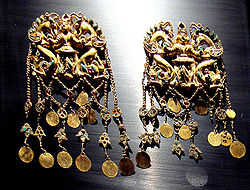
Yuezhi
The Yuezhi, or Rouzhi , also known as the Da Yuezhi or Da Rouzhi , were an ancient Central Asian people....
(who later became known as Kushans), who had conquered Bactria by the time of the visit of the Chinese envoy Zhang Qian
Zhang Qian
Zhang Qian was an imperial envoy to the world outside of China in the 2nd century BCE, during the time of the Han Dynasty...
(circa 127 BC), who had been sent by the Han
Han Dynasty
The Han Dynasty was the second imperial dynasty of China, preceded by the Qin Dynasty and succeeded by the Three Kingdoms . It was founded by the rebel leader Liu Bang, known posthumously as Emperor Gaozu of Han. It was briefly interrupted by the Xin Dynasty of the former regent Wang Mang...
emperor to investigate lands to the west of China.
Kujula Kadphises, the Guishuang xihou (or prince) of the Da Yuezhi, united the region in the early 1st century and laid the foundations for the powerful, but short-lived, Kushan Empire
Kushan Empire
The Kushan Empire originally formed in the early 1st century AD under Kujula Kadphises in the territories of ancient Bactria on either side of the middle course of the Oxus in what is now northern Afghanistan, Pakistan, and southern Tajikistan and Uzbekistan.During the 1st and early 2nd centuries...
(1st to 3rd century AD), which was then overcome by the Sassanians from Persia.
Contacts with China
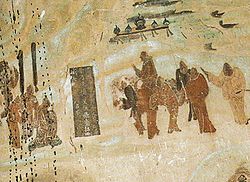
Zhang Qian
Zhang Qian was an imperial envoy to the world outside of China in the 2nd century BCE, during the time of the Han Dynasty...
in 126 BC to designate Bactria.
The reports of Zhang Qian were put in writing in the Shiji ("Records of the Grand Historian") by Sima Qian
Sima Qian
Sima Qian was a Prefect of the Grand Scribes of the Han Dynasty. He is regarded as the father of Chinese historiography for his highly praised work, Records of the Grand Historian , a "Jizhuanti"-style general history of China, covering more than two thousand years from the Yellow Emperor to...
in the 1st century BC. They describe an important urban civilization of about one million people, living in walled cities under small city kings or magistrates. Daxia was an affluent country with rich markets, trading in an incredible variety of objects, coming from as far as Southern China. By the time Zhang Qian visited Daxia, there was no longer a major king, and the Bactrian were suzerains to the nomadic Yuezhi
Yuezhi
The Yuezhi, or Rouzhi , also known as the Da Yuezhi or Da Rouzhi , were an ancient Central Asian people....
, who were settled to the north of their territory beyond the Oxus (Amu Darya). Overall Zhang Qian depicted a rather sophisticated but demoralized people who were afraid of war.
Following these reports, the Chinese emperor Wu Di was informed of the level of sophistication of the urban civilizations of Ferghana, Bactria and Parthia
Parthia
Parthia is a region of north-eastern Iran, best known for having been the political and cultural base of the Arsacid dynasty, rulers of the Parthian Empire....
, and became interested in developing commercial relationship with them:
- "The Son of Heaven on hearing all this reasoned thus: Ferghana (DayuanDayuanThe Dayuan or Ta-Yuan were a people of Ferghana in Central Asia, described in the Chinese historical works of Records of the Grand Historian and the Book of Han. It is mentioned in the accounts of the famous Chinese explorer Zhang Qian in 130 BCE and the numerous embassies that followed him into...
) and the possessions of Bactria (Daxia) and Parthia (Anxi) are large countries, full of rare things, with a population living in fixed abodes and given to occupations somewhat identical with those of the Chinese people, but with weak armies, and placing great value on the rich produce of China" (Hanshu, Former Han History).
These contacts immediately led to the dispatch of multiple embassies from the Chinese, which helped to develop the Silk Road
Silk Road
The Silk Road or Silk Route refers to a historical network of interlinking trade routes across the Afro-Eurasian landmass that connected East, South, and Western Asia with the Mediterranean and European world, as well as parts of North and East Africa...
.
Tokharistan
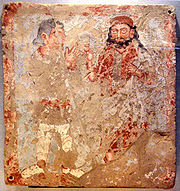
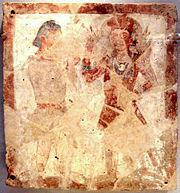
Yuezhi
The Yuezhi, or Rouzhi , also known as the Da Yuezhi or Da Rouzhi , were an ancient Central Asian people....
(described in the West as "Tocharians
Tocharians
The Tocharians were the Tocharian-speaking inhabitants of the Tarim Basin, making them the easternmost speakers of Indo-European languages in antiquity. They were known as, or at least closely related to, the Yuezhi of Chinese sources...
"), the general area of Bactria came to be called Tokharistan. The territory of Tokharistan was identical with Kushan Bactria, including the areas of Surkhandarya, Southern Tajikistan
Tajikistan
Tajikistan , officially the Republic of Tajikistan , is a mountainous landlocked country in Central Asia. Afghanistan borders it to the south, Uzbekistan to the west, Kyrgyzstan to the north, and China to the east....
and Northern Afghanistan.
The first literary mentions of Tokharistan appear at the end of the 4th century in Chinese Buddhist sources (the Vibhasa-sastra). However, the first mention of the Tocharians
Tocharians
The Tocharians were the Tocharian-speaking inhabitants of the Tarim Basin, making them the easternmost speakers of Indo-European languages in antiquity. They were known as, or at least closely related to, the Yuezhi of Chinese sources...
appear much sooner, in the 1st century BC, when Strabo
Strabo
Strabo, also written Strabon was a Greek historian, geographer and philosopher.-Life:Strabo was born to an affluent family from Amaseia in Pontus , a city which he said was situated the approximate equivalent of 75 km from the Black Sea...
mentions that "the Tokharians, together with the Assianis, Passianis and Sakaraulis, took part in the destruction of the Greco-Bactrian kingdom" in the second half of the 2nd century BC. Ptolemy
Ptolemy
Claudius Ptolemy , was a Roman citizen of Egypt who wrote in Greek. He was a mathematician, astronomer, geographer, astrologer, and poet of a single epigram in the Greek Anthology. He lived in Egypt under Roman rule, and is believed to have been born in the town of Ptolemais Hermiou in the...
also mentions a large Tokharian tribe in Bactria, describing the central role of the Tokharians among other tribes in Bactria.
From the 1st century AD to the 3rd century AD, Tokharistan was under the rule of the Kushans. They were followed by Sassanides (Indo-Sassanids). Later, in the 5th century, it was controlled by the Xionites
Xionites
Xionites, Chionites, Chionitae, , Hunni Xionites, Chionites, Chionitae, (Middle Persian: Xiyon, Avestan: Xiiaona, Sogdian:xwn), Hunni Xionites, Chionites, Chionitae, (Middle Persian: Xiyon, Avestan: Xiiaona, Sogdian:xwn), Hunni (Pahlavi:Huna, Yun or Xūn (獯), were a nomadic tribe prominent in...
and the Hephthalite
Hephthalite
The Hephthalites or Hephthalite is a pre-Islamic Greek term for local Abdali Afghans, who's famous ruler was Nazak Abdali . Hephthalites were a Central Asian nomadic confederation of the AD 5th-6th centuries whose precise origins and composition remain obscure...
s. In the 7th century, after a brief rule under the Turkish
Turkic peoples
The Turkic peoples are peoples residing in northern, central and western Asia, southern Siberia and northwestern China and parts of eastern Europe. They speak languages belonging to the Turkic language family. They share, to varying degrees, certain cultural traits and historical backgrounds...
Khagan
Khagan
Khagan or qagan , alternatively spelled kagan, khaghan, qaghan, or chagan, is a title of imperial rank in the Mongolian and Turkic languages equal to the status of emperor and someone who rules a khaganate...
ats, it was conquered by the Arabs and then the Mongols and much later, by the Russians.
Onset of Islam
Advancing further the Arabs faced off with the Turk Shahis ruling in Bactria and defeated them.Descendants of Bactrians
The Bactrians are primarily the ancestors of modern-day TajiksTajiks
Tajik is a general designation for a wide range of Persian-speaking people of Iranic origin, with traditional homelands in present-day Afghanistan, Tajikistan, and Uzbekistan...
, as well as the Pashtuns, as well as Dards
Dard people
The Dards are a group of people defined by linguistic similarities, and not common ethnicity, predominantly found in Eastern Afghanistan, in the Indian State of Jammu and Kashmir and in the Northern Areas and North West Frontier Province of Pakistan...
. Regarding Tajiks, the Encyclopædia Britannica
Encyclopædia Britannica
The Encyclopædia Britannica , published by Encyclopædia Britannica, Inc., is a general knowledge English-language encyclopaedia that is available in print, as a DVD, and on the Internet. It is written and continuously updated by about 100 full-time editors and more than 4,000 expert...
states:
See also
- PashtunsPashtun peoplePashtuns or Pathans , also known as ethnic Afghans , are an Eastern Iranic ethnic group with populations primarily between the Hindu Kush mountains in Afghanistan and the Indus River in Pakistan...
- Dards
- Bactria-Margiana Archaeological ComplexBactria-Margiana Archaeological ComplexThe Bactria–Margiana Archaeological Complex is the modern archaeological designation for a Bronze Age culture of Central Asia, dated to ca. 2300–1700 BC, located in present day Turkmenistan, northern Afghanistan and northeastern Iran, southern Uzbekistan and western Tajikistan, centered on...
- Bactrian GoldBactrian GoldThe Bactrian Treasure is a treasure cache that lay under the "Hill of Gold" in Afghanistan for 2,000 years until Soviet archeologists exposed it shortly before the 1979 invasion...
- Bactrian CamelBactrian camelThe Bactrian camel is a large, even-toed ungulate native to the steppes of central Asia. It is presently restricted in the wild to remote regions of the Gobi and Taklamakan Deserts of Mongolia and Xinjiang. A small number of wild Bactrian camels still roam the Mangystau Province of southwest...
- The BahlikasThe BahlikasThe Bahlikas were the inhabitants of Balikha, mentioned in Atharvaveda, Mahabharata, Ramayana, Puranas, Vartikka of Katyayana, Brhatsamhita, Amarkosha etc. and in the ancient Inscriptions...
- Greater KhorasanGreater KhorasanGreater Khorasan or Ancient Khorasan is a historical region of Greater Iran mentioned in sources from Sassanid and Islamic eras which "frequently" had a denotation wider than current three provinces of Khorasan in Iran...
- Dalverzin TepeDalverzin TepeDalverzin Tepe is an ancient archaeological site located in the northern part of the region of Bactria, southern modern Uzbekistan.It is the location of Hellenistic constructions made during the time of the Greco-Bactrians, perhaps a small fortress. In the first century BC it grew to a substantial...
- BalkhBalkhBalkh , was an ancient city and centre of Zoroastrianism in what is now northern Afghanistan. Today it is a small town in the province of Balkh, about 20 kilometers northwest of the provincial capital, Mazar-e Sharif, and some south of the Amu Darya. It was one of the major cities of Khorasan...
External links
- Bactrian Gold
- Livius.org: Bactria
- Batriane du nord—about the Termez region, an archeological site